|
|

Tip: In the search results, you can click on any word or abbreviation for more information.
|
Source: Cleasby/Vigfusson, page b0037, entry 2 View original page image as: [TIFF] [PNG] [View previous entry] [View next entry] |
[Comment on this entry] [View comments] |
The following entry has been hand-corrected once. |
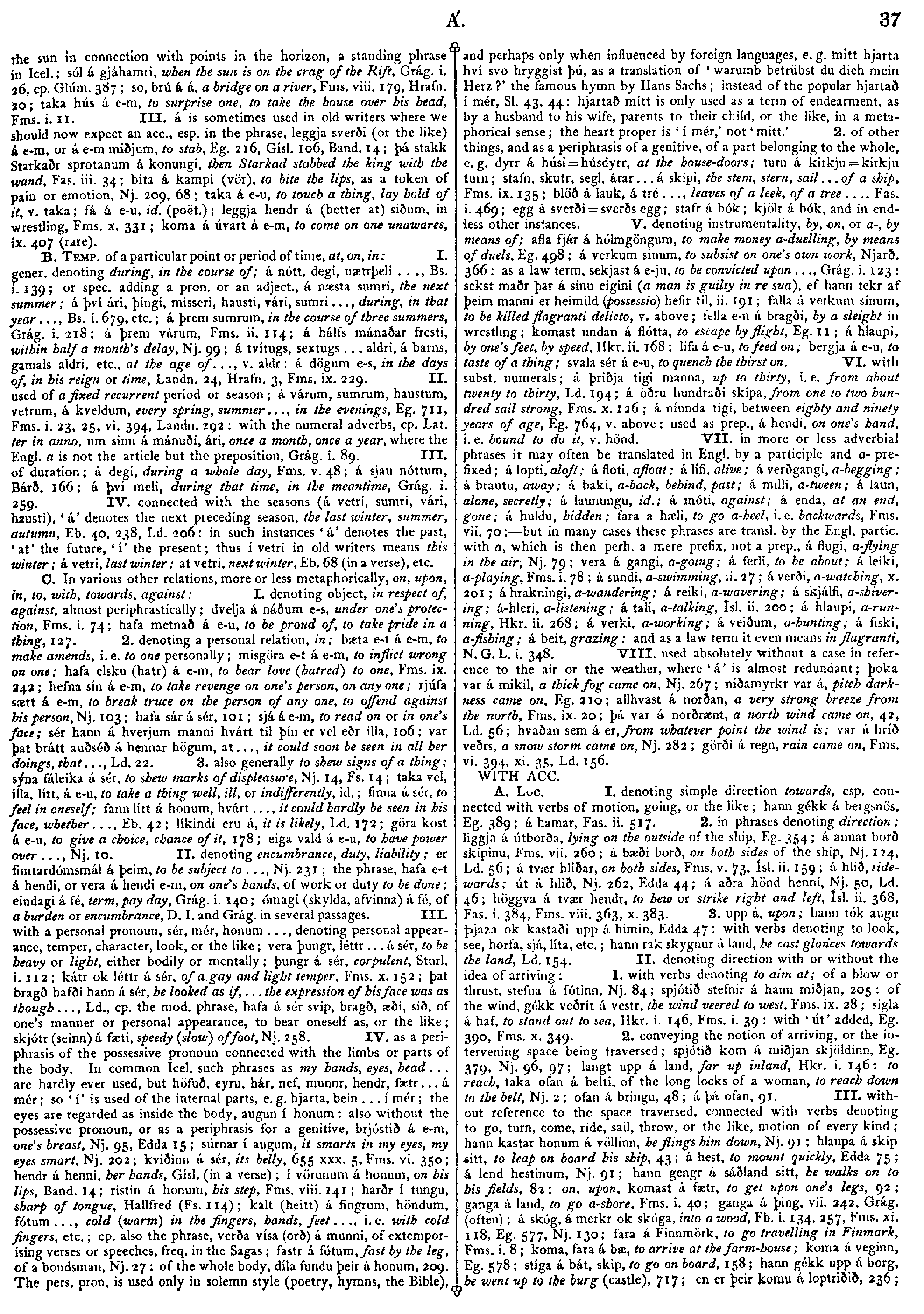
B. TEMP. of a particular point or period of time, at, on, in: I. gener. denoting during, in the course of; á nótt, degi, nætrþeli ..., Bs. i. 139; or spec. adding a pron. or an adject., á næsta sumri, the next summer; á því ári, þingi, misseri, hausti, vári, sumri ..., during, in that year ..., Bs. i. 679, etc.; á þrem sumrum, in the course of three summers, Grág. i. 218; á þrem várum, Fms. ii. 114; á hálfs mánaðar fresti, within half a month's delay, Nj. 99; á tvítugs, sextugs ... aldri, á barns, gamals aldri, etc., at the age of ..., v. aldr: á dögum e-s, in the days of, in his reign or time, Landn. 24, Hrafn. 3, Fms. ix. 229. II. used of a fixed recurrent period or season; á várum, sumrum, haustum, vetrum, á kveldum, every spring, summer ..., in the evenings, Eg. 711, Fms. i. 23, 25, vi. 394, Landn. 292: with the numeral adverbs, cp. Lat. ter in anno, um sinn á mánuði, ári, once a month, once a year, where the Engl. a is not the article but the preposition, Grág. i. 89. III. of duration; á degi, during a whole day, Fms. v. 48; á sjau nóttum, Bárð. 166; á því meli, during that time, in the meantime, Grág. i. 259. IV. connected with the seasons (á vetri, sumri, vári, hausti), 'á' denotes the next preceding season, the last winter, summer, autumn, Eb. 40, 238, Ld. 206: in such instances 'á' denotes the past, 'at' the future, 'í' the present; thus í vetri in old writers means this winter; á vetri, last winter; at vetri, next winter, Eb. 68 (in a verse), etc.
|
Source: Cleasby/Vigfusson, page b0038, entry 2 View original page image as: [TIFF] [PNG] [View previous entry] [View next entry] |
[Comment on this entry] [View comments] |
The following entry has been hand-corrected once. |
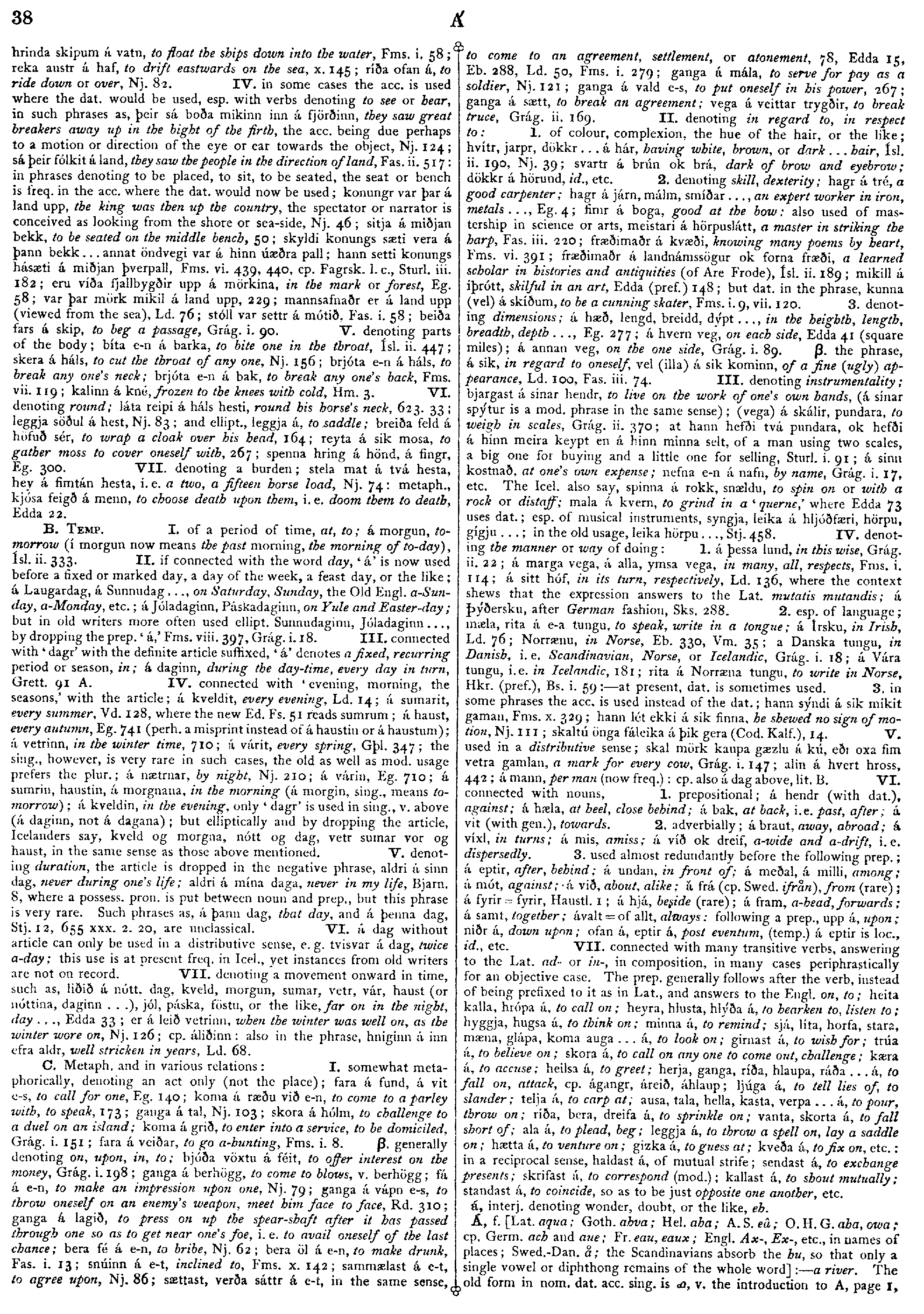
B. TEMP. I. of a period of time, at, to; á morgun, to-morrow (í morgun now means the past morning, the morning of to-day), Ísl. ii. 333. II. if connected with the word day, 'á' is now used before a fixed or marked day, a day of the week, a feast day, or the like; á Laugardag, á Sunnudag ..., on Saturday, Sunday, the Old Engl. a-Sunday, a-Monday, etc.; á Jóladaginn, Páskadaginn, on Yule and Easter-day; but in old writers more often used ellipt. Sunnudaginn, Jóladaginn ..., by dropping the prep. 'á,' Fms. viii. 397, Grág. i. 18. III. connected with 'dagr' with the definite article suffixed, 'á' denotes a fixed, recurring period or season, in; á daginn, during the day-time, every day in turn, Grett. 91 A. IV. connected with 'evening, morning, the seasons,' with the article; á kveldit, every evening, Ld. 14; á sumarit, every summer, Vd. 128, where the new Ed. Fs. 51 reads sumrum; á haust, every autumn, Eg. 741 (perh. a misprint instead of á haustin or á haustum); á vetrinn, in the winter time, 710; á várit, every spring, Gþl. 347; the sing., however, is very rare in such cases, the old as well as mod. usage prefers the plur.; á nætrnar, by night, Nj. 210; á várin, Eg. 710; á sumrin, haustin, á morgnana, in the morning (á morgin, sing., means to-morrow); á kveldin, in the evening, only 'dagr' is used in sing., v. above (á daginn, not á dagana); but elliptically and by dropping the article, Icelanders say, kveld og morgna, nótt og dag, vetr sumar vor og haust, in the same sense as those above mentioned. V. denoting duration, the article is dropped in the negative phrase, aldri á sinn dag, never during one's life; aldri á mína daga, never in my life, Bjarn. 8, where a possess. pron. is put between noun and prep., but this phrase is very rare. Such phrases as, á þann dag, that day, and á þenna dag, Stj. 12, 655 xxx. 2. 20, are unclassical. VI. á dag without article can only be used in a distributive sense, e.g. tvisvar á dag, twice a-day; this use is at present freq. in Icel., yet instances from old writers are not on record. VII. denoting a movement onward in time, such as, liðið á nótt, dag, kveld, morgun, sumar, vetr, vár, haust (or nóttina, daginn ...), jól, páska, föstu, or the like, far on in the night, day ..., Edda 33; er á leið vetrinn, when the winter was well on, as the winter wore on, Nj. 126; cp. áliðinn: also in the phrase, hniginn á inn efra aldr, well stricken in years, Ld. 68.
|
Source: Cleasby/Vigfusson, page b0040, entry 14 View original page image as: [TIFF] [PNG] [View previous entry] [View next entry] |
[Comment on this entry] [View comments] |
The following entry has not been hand-corrected. However, the page is reserved and someone is correcting it. |
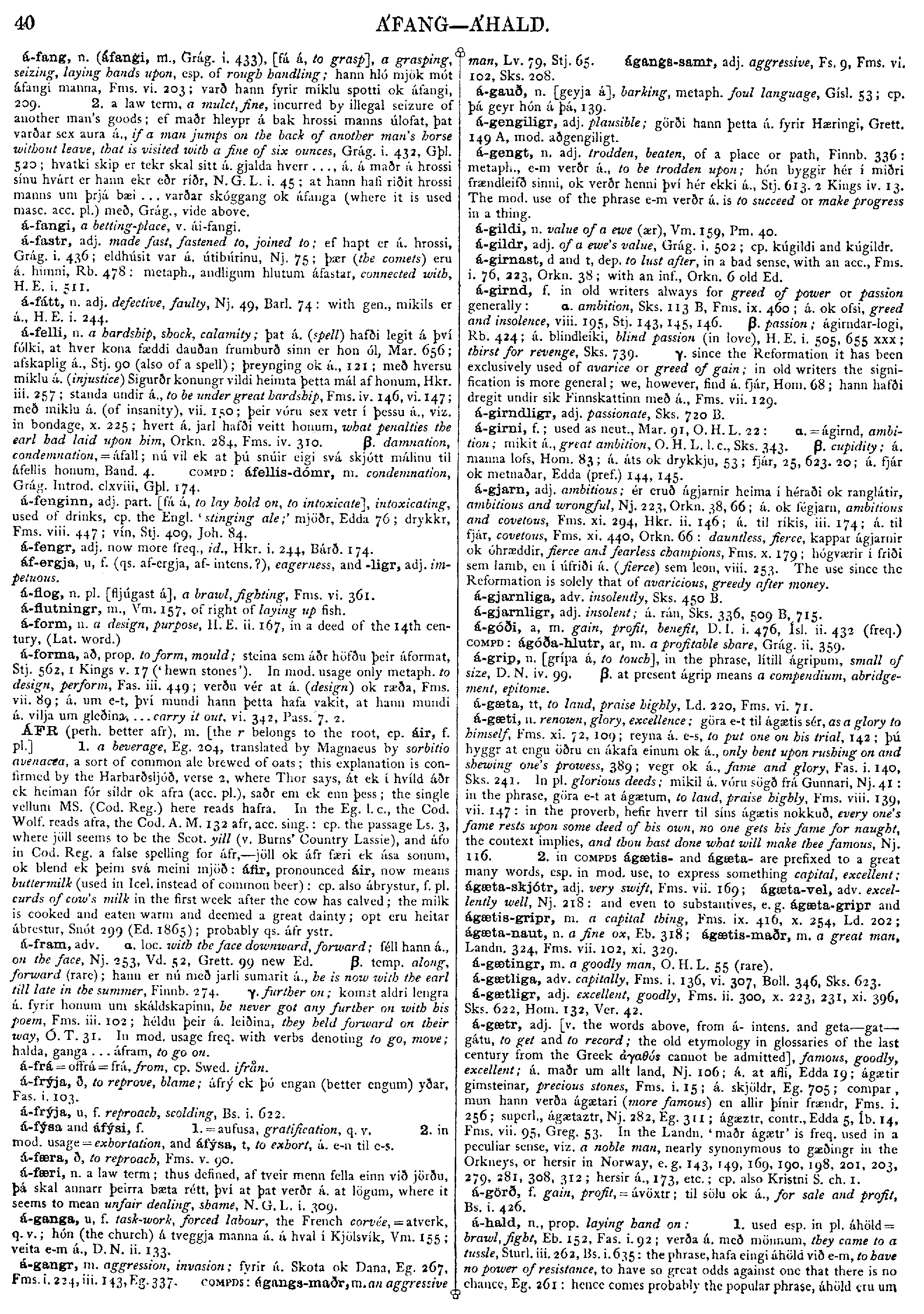
a-fram, adv. a. loc. with the face downward, forward; fell hann a., on the face, Nj. 253, Vd. 52, Grett. 99 new Ed. J3. temp, along, forward (rare); haun er nú með jarli sumarit á., he i s now with the earl till late in the summer, Finnb. 274. y. further on; komst aldri Icngra a. fyrir honum um skáldskapinn, be never got any further on with his poem, Fms. iii. 102; héldu þeir á. leiðina, they held forward on their way, 0. T. 31. In mod. usage freq. with verbs denoting to go, move; hnlda, ganga ... áfram, to go on.
|
Source: Cleasby/Vigfusson, page b0062, entry 1 View original page image as: [TIFF] [PNG] [View previous entry] [View next entry] |
[Comment on this entry] [View comments] |
The following entry has been hand-corrected once. |
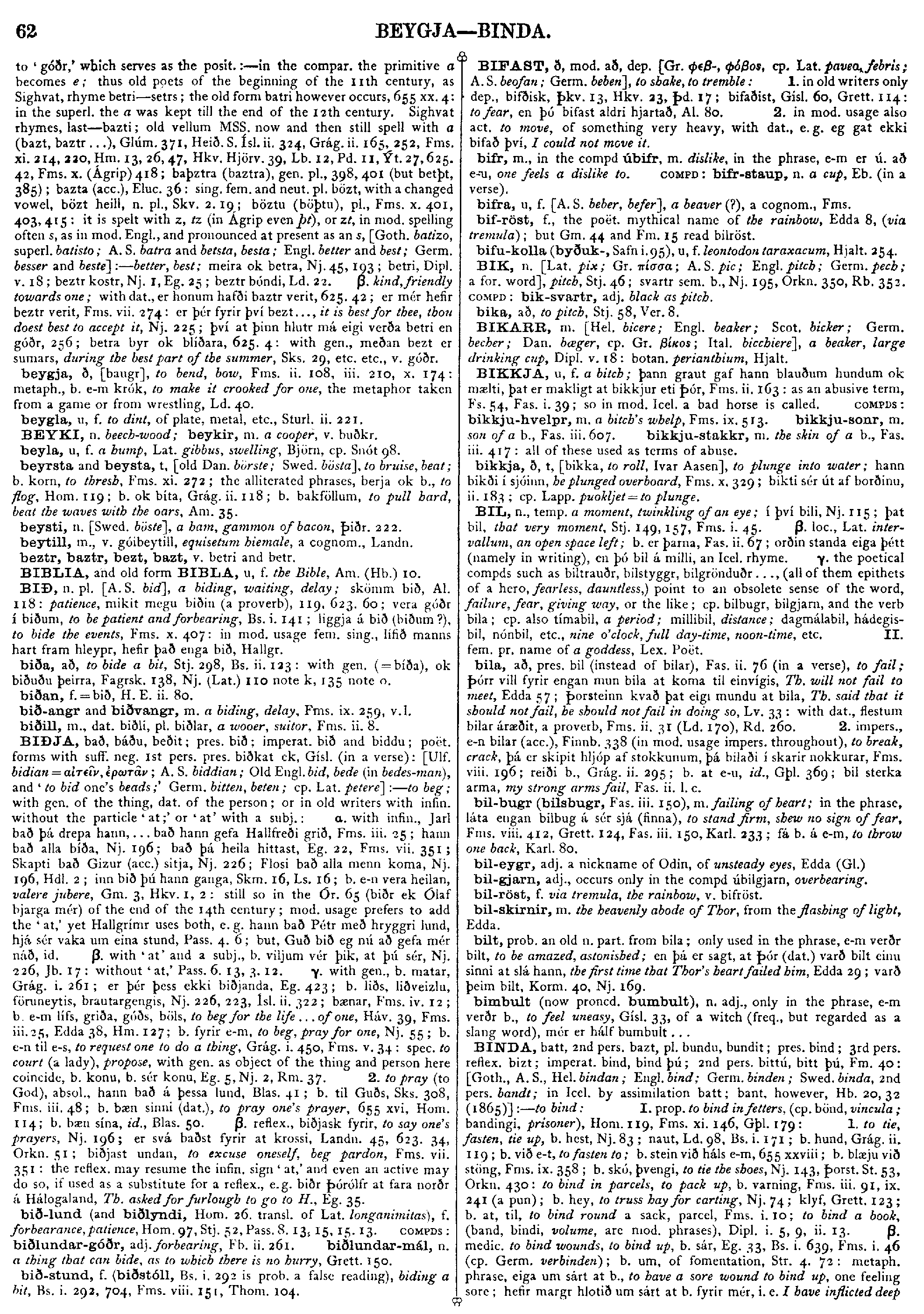
to
'góðr,'
which
serves
as
the
posit.
:--
in
the
compar.
the
primitive
a
becomes
e;
thus
old
poets
of
the
beginning
of
the
11th
century,
as
Sighvat,
rhyme
betri
--
setrs;
the
old
form
batri
however
occurs,
655
xx.
4:
in
the
superl.
the
a
was
kept
till
the
end
of
the
12th
century.
Sighvat
rhymes,
last
--
bazti;
old
vellum
MSS.
now
and
then
still
spell
with
a
(bazt,
baztr
...),
Glúm.
371,
Heið.
S.
Ísl.
ii.
324,
Grág.
ii.
165,
252,
Fms.
xi.
214,
220,
Hm.
13,
26,
47,
Hkv.
Hjörv.
39,
Lb.
12,
Pd.
11,
Ýt.
27,
625.
42,
Fms.
x.
(Ágrip)
418;
baþztra
(baztra),
gen.
pl.,
398,
401
(but
betþt,
385);
bazta
(acc.),
Eluc.
36:
sing.
fem.
and
neut.
pl.
bözt,
with
a
changed
vowel,
bözt
heill,
n.
pl.,
Skv.
2.
19;
böztu
(böþtu),
pl.,
Fms.
x.
401,
403,
415:
it
is
spelt
with
z,
tz
(in
Ágrip
even
þt),
or
zt,
in
mod.
spelling
often
s,
as
in
mod.
Engl.,
and
pronounced
at
present
as
an
s,
[Goth.
batizo,
superl.
batisto;
A.
S.
batra
and
betsta,
besta;
Engl.
better
and
best;
Germ.
besser
and
beste]
:--
better,
best;
meira
ok
betra,
Nj.
45,
193;
betri,
Dipl.
v.
18;
beztr
kostr,
Nj.
1,
Eg.
25;
beztr
bóndi,
Ld.
22.
 .
kind,
friendly
towards
one;
with
dat.,
er
honum
hafði
baztr
verit,
625.
42;
er
mér
hefir
beztr
verit,
Fms.
vii.
274:
er
þér
fyrir
því
bezt
...,
it
is
best
for
thee,
thou
doest
best
to
accept
it,
Nj.
225;
því
at
þinn
hlutr
má
eigi
verða
betri
en
góðr,
256;
betra
byr
ok
blíðara,
625.
4:
with
gen.,
meðan
bezt
er
sumars,
during
the
best
part
of
the
summer,
Sks.
29,
etc.
etc.,
v.
góðr.
.
kind,
friendly
towards
one;
with
dat.,
er
honum
hafði
baztr
verit,
625.
42;
er
mér
hefir
beztr
verit,
Fms.
vii.
274:
er
þér
fyrir
því
bezt
...,
it
is
best
for
thee,
thou
doest
best
to
accept
it,
Nj.
225;
því
at
þinn
hlutr
má
eigi
verða
betri
en
góðr,
256;
betra
byr
ok
blíðara,
625.
4:
with
gen.,
meðan
bezt
er
sumars,
during
the
best
part
of
the
summer,
Sks.
29,
etc.
etc.,
v.
góðr.
|
Source: Cleasby/Vigfusson, page b0070, entry 19 View original page image as: [TIFF] [PNG] [View previous entry] [View next entry] |
[Comment on this entry] [View comments] |
The following entry has been hand-corrected once. |
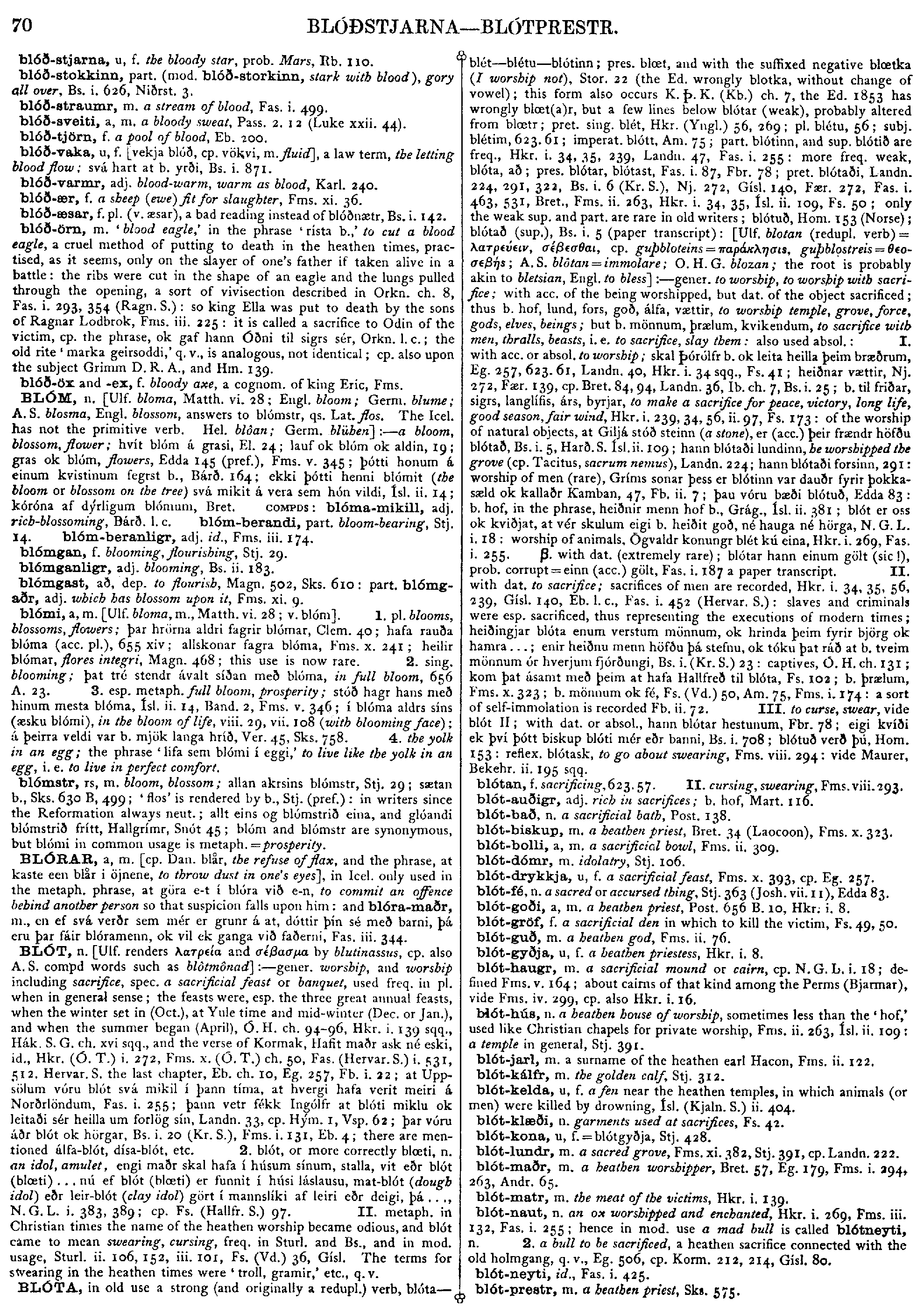
BLÓT, n. [Ulf. renders GREEK and GREEK by blutinassus, cp. also A. S. compd words such as blôtmônad] :-- gener. worship, and worship including sacrifice, spec. a sacrificial feast or banquet, used freq. in pl. when in general sense; the feasts were, esp. the three great annual feasts, when the winter set in (Oct.), at Yule time and mid-winter (Dec. or Jan.), and when the summer began (April), Ó. H. ch. 94-96, Hkr. i. 139 sqq., Hák. S. G. ch. xvi sqq., and the verse of Kormak, Hafit maðr ask né eski, id., Hkr. (Ó. T.) i. 272, Fms. x. (Ó. T.) ch. 50, Fas. (Hervar. S.) i. 531, 512. Hervar. S. the last chapter, Eb. ch. 10, Eg. 257, Fb. i. 22; at Uppsölum vóru blót svá mikil í þann tíma, at hvergi hafa verit meiri á Norðrlöndum, Fas. i. 255; þann vetr fékk Ingólfr at blóti miklu ok leitaði sér heilla um forlög sín, Landn. 33, cp. Hým. 1, Vsp. 62; þar vóru áðr blót ok hörgar, Bs. i. 20 (Kr. S.), Fms. i. 131, Eb. 4; there are mentioned álfa-blót, dísa-blót, etc. 2. blót, or more correctly blœti, n. an idol, amulet, engi maðr skal hafa í húsum sínum, stalla, vit eðr blót (blœti) ... nú ef blot (blœti) er funnit í húsi láslausu, mat-blót (dough idol) eðr leir-blót (clay idol) gört í mannslíki af leiri eðr deigi, þá ..., N. G. L. i. 383, 389; cp. Fs. (Hallfr. S.) 97. II. metaph. in Christian times the name of the heathen worship became odious, and blót came to mean swearing, cursing, freq. in Sturl. and Bs., and in mod. usage, Sturl. ii. 106, 152, iii. 101, Fs. (Vd.) 36, Gísl. The terms for swearing in the heathen times were 'troll, gramir,' etc., q.v.
|
Source: Cleasby/Vigfusson, page b0079, entry 10 View original page image as: [TIFF] [PNG] [View previous entry] [View next entry] |
[Comment on this entry] [View comments] |
The following entry has been hand-corrected once. |
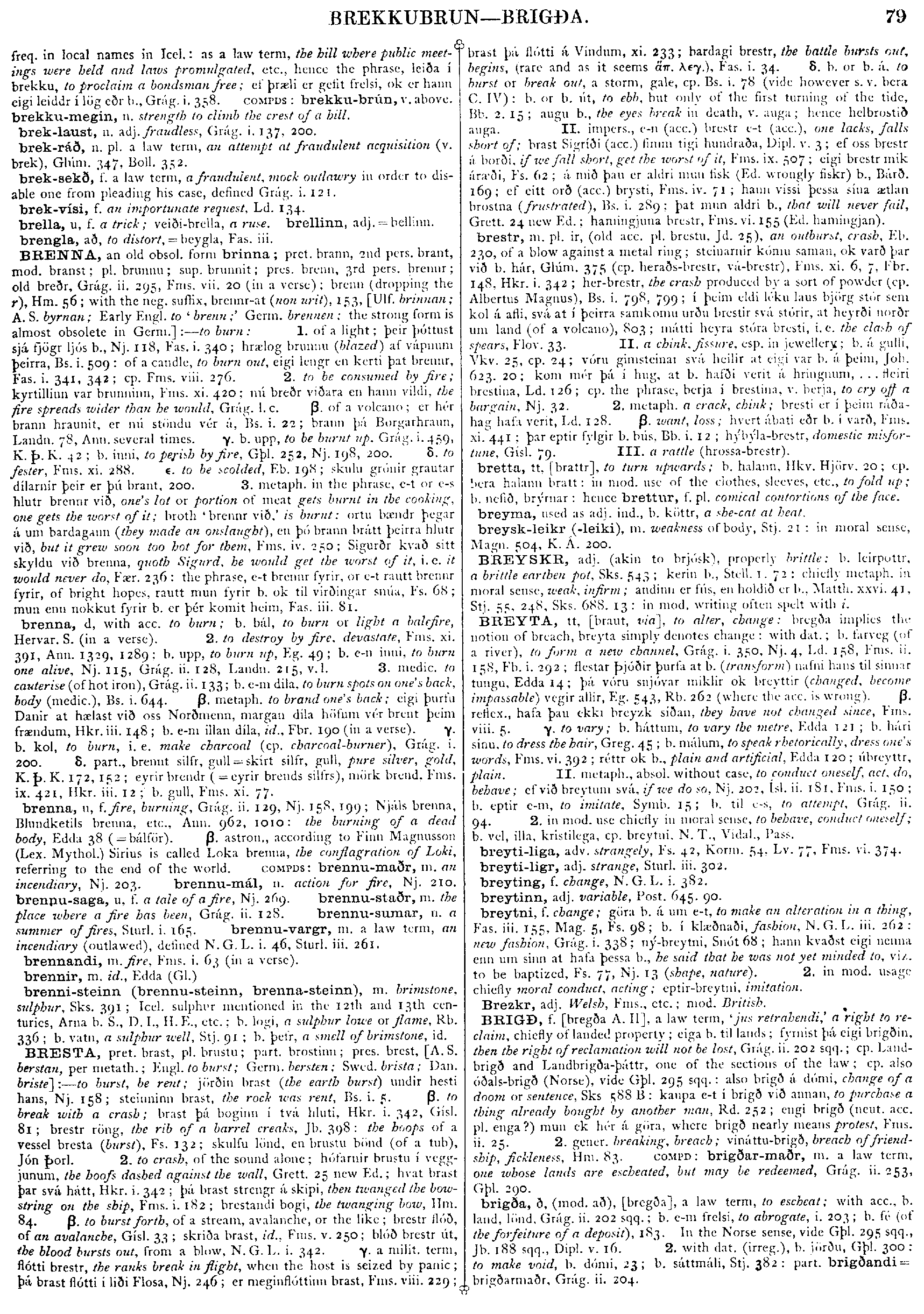
brenna,
u,
f.
fire,
burning,
Grág.
ii.
129,
Nj.
158,
199;
Njáls
brenna,
Blundketils
brenna,
etc.,
Ann.
962,
1010:
the
burning
of
a
dead
body,
Edda
38
(=
bálför).
.
astron.,
according
to
Finn
Magnusson
(Lex.
Mythol.)
Sirius
is
called
Loka
brenna,
the
conflagration
of
Loki,
referring
to
the
end
of
the
world.
COMPDS:
brennu-maðr,
m.
an
incendiary,
Nj.
203.
brennu-mál,
n.
action
for
fire,
Nj.
210.
brennu-saga,
u,
f.
a
tale
of
a
fire,
Nj.
269.
brennu-staðr,
m.
the
place
where
a
fire
has
been,
Grág.
ii.
128.
brennu-sumar,
n.
a
summer
of
fires,
Sturl.
i.
165.
brennu-vargr,
m.
a
law
term,
an
incendiary
(outlawed),
defined
N.
G.
L.
i.
46,
Sturl.
iii.
261.
|
Source: Cleasby/Vigfusson, page b0090, entry 9 View original page image as: [TIFF] [PNG] [View previous entry] [View next entry] |
[Comment on this entry] [View comments] |
The following entry has been hand-corrected once. |
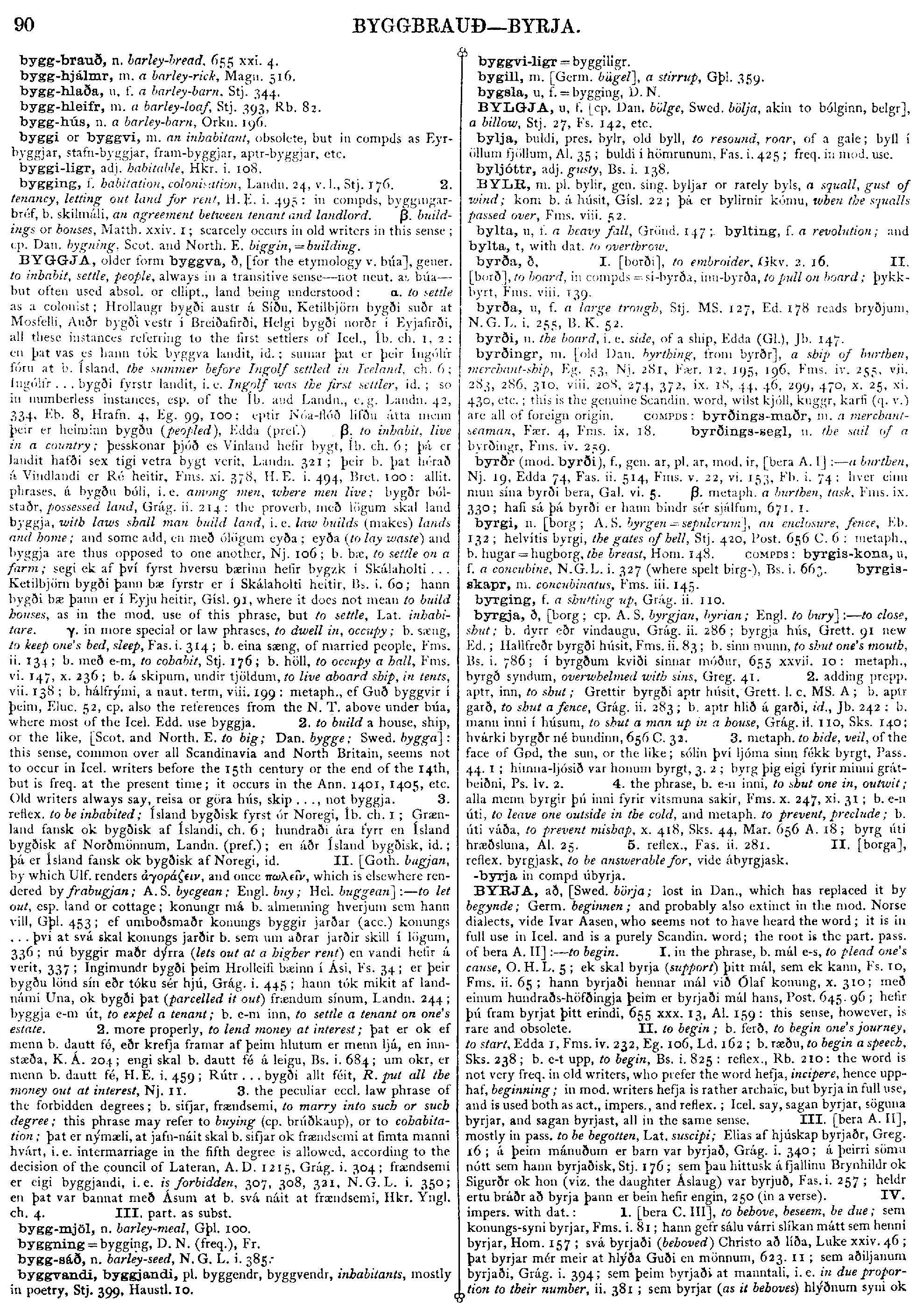
BYGGJA,
older
form
byggva,
ð,
[for
the
etymology
v.
búa],
gener.
to
inhabit,
settle,
people,
always
in
a
transitive
sense--not
neut.
as.
búa--but
often
used
absol.
or
ellipt.,
land
being
understood:
 .
to
settle
as
a
colonist;
Hrollaugr
bygði
austr
á
Síðu,
Ketilbjörn
bygði
suðr
at
Mosfelli,
Auðr
bygði
vestr
í
Breiðafirði,
Helgi
bygði
norðr
í
Eyjafirði,
all
these
instances
referring
to
the
first
settlers
of
Icel.,
Íb.
ch.
1.
2;
en
þat
vas
es
hann
tók
byggva
landit,
id.;
sumar
þat
er
þeir
Ingólfr
fóru
at
b.
Ísland,
the
summer
before
Ingolf
settled
in
Iceland,
ch.
6;
Íngólfr
...
bygði
fyrstr
landit,
i.e.
Ingolf
was
the
first
settler,
id.;
so
in
numberless
instances,
esp.
of
the
Íb.
and
Landn.,
e.g.
Landn.
42,
334,
Eb.
8,
Hrafn.
4,
Eg.
99,
100;
eptir
Nóa-flóð
lifðu
átta
menn
þeir
er
heiminn
bygðu
(peopled),
Edda
(pref.)
.
to
inhabit,
live
in
a
country;
þesskonar
þjóð
es
Vínland
hefir
bygt,
Íb.
ch.
6;
þá
er
landit
hafði
sex
tigi
vetra
bygt
verit,
Landn.
321;
þeir
b.
þat
hérað
á
Vindlandi
er
Ré
heitir,
Fms.
xi.
378,
H.
E.
i.
494,
Bret.
100:
allit.
phrases,
á
bygðu
bóli,
i.e.
among
men,
where
men
live;
bygðr
bólstaðr,
possessed
land,
Grág.
ii.
214:
the
proverb,
með
lögum
skal
land
byggja,
with
laws
shall
man
build
land,
i.e.
law
builds
(makes)
lands
and
home;
and
some
add,
en
með
ólögum
eyða;
eyða
(to
lay
waste)
and
byggja
are
thus
opposed
to
one
another,
Nj.
106;
b.
bæ,
to
settle
on
a
farm;
segi
ek
af
því
fyrst
hversu
bærinn
hefir
bygzk
í
Skálaholti
...
Ketilbjörn
bygði
þann
bæ
fyrstr
er
í
Skálaholti
heitir,
Bs.
i.
60;
hann
bygði
bæ
þann
er
í
Eyju
heitir,
Gísl.
91,
where
it
does
not
mean
to
build
houses,
as
in
the
mod.
use
of
this
phrase,
but
to
settle,
Lat.
inhabitare.
.
to
settle
as
a
colonist;
Hrollaugr
bygði
austr
á
Síðu,
Ketilbjörn
bygði
suðr
at
Mosfelli,
Auðr
bygði
vestr
í
Breiðafirði,
Helgi
bygði
norðr
í
Eyjafirði,
all
these
instances
referring
to
the
first
settlers
of
Icel.,
Íb.
ch.
1.
2;
en
þat
vas
es
hann
tók
byggva
landit,
id.;
sumar
þat
er
þeir
Ingólfr
fóru
at
b.
Ísland,
the
summer
before
Ingolf
settled
in
Iceland,
ch.
6;
Íngólfr
...
bygði
fyrstr
landit,
i.e.
Ingolf
was
the
first
settler,
id.;
so
in
numberless
instances,
esp.
of
the
Íb.
and
Landn.,
e.g.
Landn.
42,
334,
Eb.
8,
Hrafn.
4,
Eg.
99,
100;
eptir
Nóa-flóð
lifðu
átta
menn
þeir
er
heiminn
bygðu
(peopled),
Edda
(pref.)
.
to
inhabit,
live
in
a
country;
þesskonar
þjóð
es
Vínland
hefir
bygt,
Íb.
ch.
6;
þá
er
landit
hafði
sex
tigi
vetra
bygt
verit,
Landn.
321;
þeir
b.
þat
hérað
á
Vindlandi
er
Ré
heitir,
Fms.
xi.
378,
H.
E.
i.
494,
Bret.
100:
allit.
phrases,
á
bygðu
bóli,
i.e.
among
men,
where
men
live;
bygðr
bólstaðr,
possessed
land,
Grág.
ii.
214:
the
proverb,
með
lögum
skal
land
byggja,
with
laws
shall
man
build
land,
i.e.
law
builds
(makes)
lands
and
home;
and
some
add,
en
með
ólögum
eyða;
eyða
(to
lay
waste)
and
byggja
are
thus
opposed
to
one
another,
Nj.
106;
b.
bæ,
to
settle
on
a
farm;
segi
ek
af
því
fyrst
hversu
bærinn
hefir
bygzk
í
Skálaholti
...
Ketilbjörn
bygði
þann
bæ
fyrstr
er
í
Skálaholti
heitir,
Bs.
i.
60;
hann
bygði
bæ
þann
er
í
Eyju
heitir,
Gísl.
91,
where
it
does
not
mean
to
build
houses,
as
in
the
mod.
use
of
this
phrase,
but
to
settle,
Lat.
inhabitare.
 .
in
more
special
or
law
phrases,
to
dwell
in,
occupy;
b.
sæng,
to
keep
one's
bed,
sleep,
Fas.
i.
314;
b.
eina
sæng,
of
married
people,
Fms.
ii.
134;
b.
með
e-m,
to
cohabit,
Stj.
176;
b.
höll,
to
occupy
a
hall,
Fms.
vi.
147,
x.
236;
b.
á
skipum,
undir
tjöldum,
to
live
aboard
ship,
in
tents,
vii.
138;
b.
hálfrými,
a
naut.
term,
viii.
199:
metaph.,
cf
Guð
byggvir
í
þeim,
Eluc.
52,
cp.
also
the
references
from
the
N.
T.
above
under
búa,
where
most
of
the
Icel.
Edd.
use
byggja.
2.
to
build
a
house,
ship,
or
the
like,
[Scot.
and
North.
E.
to
big;
Dan.
bygge;
Swed.
bygga]:
this
sense,
common
over
all
Scandinavia
and
North
Britain,
seems
not
to
occur
in
Icel.
writers
before
the
15th
century
or
the
end
of
the
14th,
but
is
freq.
at
the
present
time;
it
occurs
in
the
Ann.
1401,
1405,
etc.
Old
writers
always
say,
reisa
or
göra
hús,
skip
...,
not
byggja.
3.
reflex.
to
be
inhabited;
Ísland
bygðisk
fyrst
ór
Noregi,
Íb.
ch.
1;
Grænland
fansk
ok
bygðisk
af
Íslandi,
ch.
6;
hundraði
ára
fyrr
en
Ísland
bygðisk
af
Norðmönnum,
Landn.
(pref.);
en
áðr
Ísland
bygðisk,
id.;
þá
er
Ísland
fansk
ok
bygðisk
af
Noregi,
id.
II.
[Goth.
bugjan,
by
which
Ulf.
renders
GREEK,
and
once
GREEK,
which
is
elsewhere
rendered
by
frabugjan;
A.
S.
bycgean;
Engl.
buy;
Hel.
buggean]
:--
to
let
out,
esp.
land
or
cottage;
konungr
má
b.
almenning
hverjum
sem
hann
vill,
Gþl.
453;
ef
umboðsmaðr
konungs
byggir
jarðar
(acc.)
konungs
...
því
at
svá
skal
konungs
jarðir
b.
sem
um
aðrar
jarðir
skill
í
lögum,
336;
nú
byggir
maðr
dýrra
(lets
out
at
a
higher
rent)
en
vandi
hefir
á
verit,
337;
Ingimundr
bygði
þeim
Hrolleifi
bæinn
í
Ási,
Fs.
34;
er
þeir
bygðu
lönd
sín
eðr
tóku
sér
hjú,
Grág.
i.
445;
hann
tók
mikit
af
landnámi
Una,
ok
bygði
þat
(parcelled
it
out)
frændum
sínum,
Landn.
244;
byggja
e-m
út,
to
expel
a
tenant;
b.
e-m
inn,
to
settle
a
tenant
on
one's
estate.
2.
more
properly,
to
lend
money
at
interest;
þat
er
ok
ef
menn
b.
dautt
fé,
eðr
krefja
framar
af
þeim
hlutum
er
menn
ljá,
en
innstæða,
K.
Á.
204;
engi
skal
b.
dautt
fé
á
leigu,
Bs.
i.
684;
um
okr,
er
menn
b.
dautt
fé,
H.
E.
i.
459;
Rútr
...
bygði
allt
féit,
R.
put
all
the
money
out
at
interest,
Nj.
11.
3.
the
peculiar
eccl.
law
phrase
of
the
forbidden
degrees;
b.
sifjar,
frændsemi,
to
marry
into
such
or
such
degree;
this
phrase
may
refer
to
buying
(cp.
brúðkaup),
or
to
cohabitation;
þat
er
nýmæli,
at
jafn-náit
skal
b.
sifjar
ok
frændsemi
at
fimta
manni
hvárt,
i.e.
intermarriage
in
the
fifth
degree
is
allowed,
according
to
the
decision
of
the
council
of
Lateran,
A.D.
1215,
Grág.
i.
304;
frændsemi
er
eigi
byggjandi,
i.e.
is
forbidden,
307,
308,
321,
N.
G.
L.
i.
350;
en
þat
var
bannat
með
Ásum
at
b.
svá
náit
at
frændsemi,
Hkr.
Yngl.
ch.
4.
III.
part.
as
subst.
.
in
more
special
or
law
phrases,
to
dwell
in,
occupy;
b.
sæng,
to
keep
one's
bed,
sleep,
Fas.
i.
314;
b.
eina
sæng,
of
married
people,
Fms.
ii.
134;
b.
með
e-m,
to
cohabit,
Stj.
176;
b.
höll,
to
occupy
a
hall,
Fms.
vi.
147,
x.
236;
b.
á
skipum,
undir
tjöldum,
to
live
aboard
ship,
in
tents,
vii.
138;
b.
hálfrými,
a
naut.
term,
viii.
199:
metaph.,
cf
Guð
byggvir
í
þeim,
Eluc.
52,
cp.
also
the
references
from
the
N.
T.
above
under
búa,
where
most
of
the
Icel.
Edd.
use
byggja.
2.
to
build
a
house,
ship,
or
the
like,
[Scot.
and
North.
E.
to
big;
Dan.
bygge;
Swed.
bygga]:
this
sense,
common
over
all
Scandinavia
and
North
Britain,
seems
not
to
occur
in
Icel.
writers
before
the
15th
century
or
the
end
of
the
14th,
but
is
freq.
at
the
present
time;
it
occurs
in
the
Ann.
1401,
1405,
etc.
Old
writers
always
say,
reisa
or
göra
hús,
skip
...,
not
byggja.
3.
reflex.
to
be
inhabited;
Ísland
bygðisk
fyrst
ór
Noregi,
Íb.
ch.
1;
Grænland
fansk
ok
bygðisk
af
Íslandi,
ch.
6;
hundraði
ára
fyrr
en
Ísland
bygðisk
af
Norðmönnum,
Landn.
(pref.);
en
áðr
Ísland
bygðisk,
id.;
þá
er
Ísland
fansk
ok
bygðisk
af
Noregi,
id.
II.
[Goth.
bugjan,
by
which
Ulf.
renders
GREEK,
and
once
GREEK,
which
is
elsewhere
rendered
by
frabugjan;
A.
S.
bycgean;
Engl.
buy;
Hel.
buggean]
:--
to
let
out,
esp.
land
or
cottage;
konungr
má
b.
almenning
hverjum
sem
hann
vill,
Gþl.
453;
ef
umboðsmaðr
konungs
byggir
jarðar
(acc.)
konungs
...
því
at
svá
skal
konungs
jarðir
b.
sem
um
aðrar
jarðir
skill
í
lögum,
336;
nú
byggir
maðr
dýrra
(lets
out
at
a
higher
rent)
en
vandi
hefir
á
verit,
337;
Ingimundr
bygði
þeim
Hrolleifi
bæinn
í
Ási,
Fs.
34;
er
þeir
bygðu
lönd
sín
eðr
tóku
sér
hjú,
Grág.
i.
445;
hann
tók
mikit
af
landnámi
Una,
ok
bygði
þat
(parcelled
it
out)
frændum
sínum,
Landn.
244;
byggja
e-m
út,
to
expel
a
tenant;
b.
e-m
inn,
to
settle
a
tenant
on
one's
estate.
2.
more
properly,
to
lend
money
at
interest;
þat
er
ok
ef
menn
b.
dautt
fé,
eðr
krefja
framar
af
þeim
hlutum
er
menn
ljá,
en
innstæða,
K.
Á.
204;
engi
skal
b.
dautt
fé
á
leigu,
Bs.
i.
684;
um
okr,
er
menn
b.
dautt
fé,
H.
E.
i.
459;
Rútr
...
bygði
allt
féit,
R.
put
all
the
money
out
at
interest,
Nj.
11.
3.
the
peculiar
eccl.
law
phrase
of
the
forbidden
degrees;
b.
sifjar,
frændsemi,
to
marry
into
such
or
such
degree;
this
phrase
may
refer
to
buying
(cp.
brúðkaup),
or
to
cohabitation;
þat
er
nýmæli,
at
jafn-náit
skal
b.
sifjar
ok
frændsemi
at
fimta
manni
hvárt,
i.e.
intermarriage
in
the
fifth
degree
is
allowed,
according
to
the
decision
of
the
council
of
Lateran,
A.D.
1215,
Grág.
i.
304;
frændsemi
er
eigi
byggjandi,
i.e.
is
forbidden,
307,
308,
321,
N.
G.
L.
i.
350;
en
þat
var
bannat
með
Ásum
at
b.
svá
náit
at
frændsemi,
Hkr.
Yngl.
ch.
4.
III.
part.
as
subst.
|
Source: Cleasby/Vigfusson, page b0093, entry 30 View original page image as: [TIFF] [PNG] [View previous entry] [View next entry] |
[Comment on this entry] [View comments] |
The following entry has been hand-corrected once. |
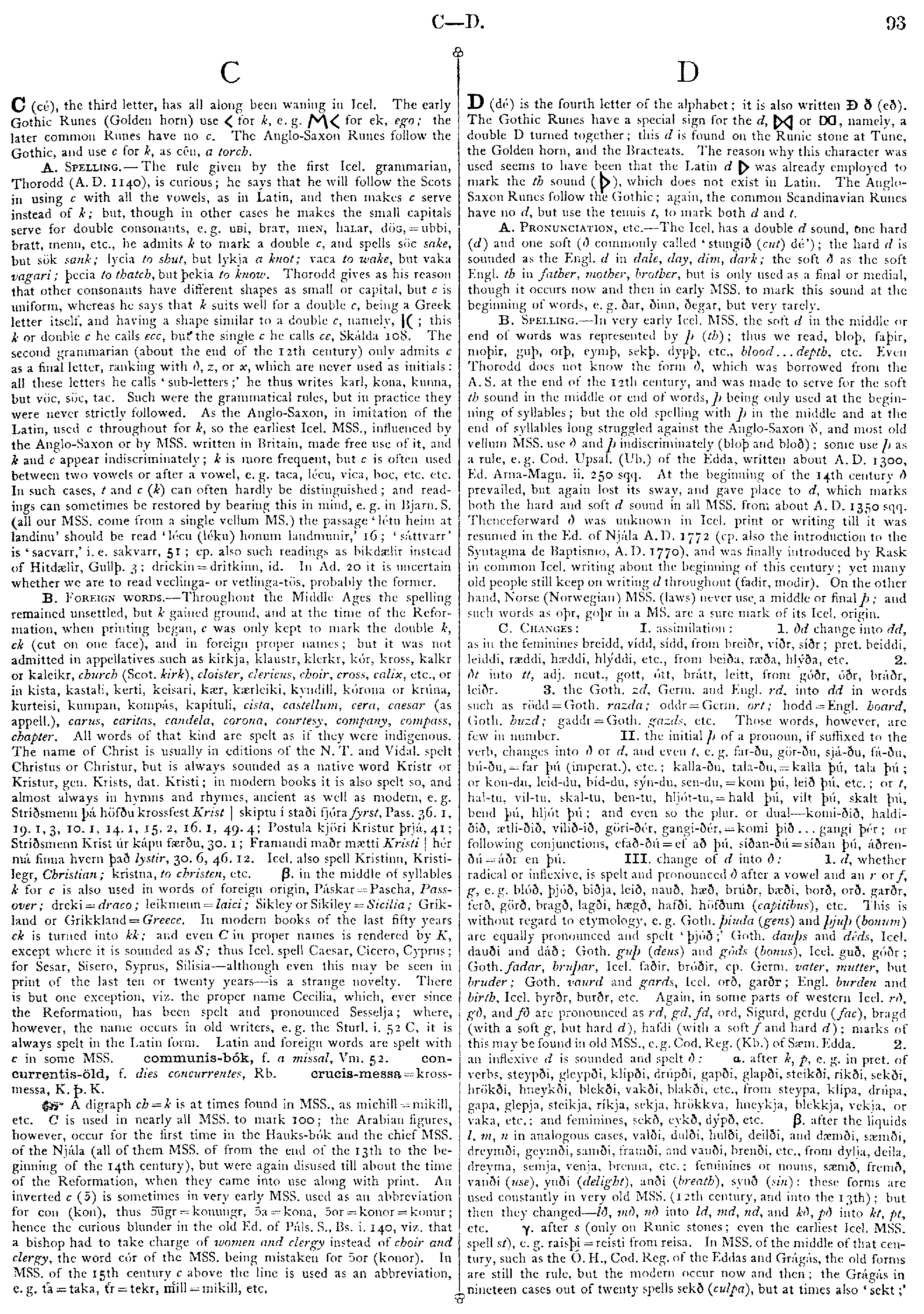
DAGR,
m.,
irreg.
dat.
degi,
pl.
dagar:
[the
kindred
word
dœgr
with
a
vowel
change
from
ó
(dóg)
indicates
a
lost
root
verb
analogous
to
ala,
ól,
cp.
dalr
and
dælir;
this
word
is
common
to
all
Teutonic
dialects;
Goth.
dags;
A.S.
dag;
Engl.
day;
Swed.-Dan.
dag;
Germ,
tag;
the
Lat.
dies
seems
to
be
identical,
although
no
interchange
has
taken
place]
:--
a
day;
in
different
senses:
1.
the
natural
day
:--
sayings
referring
to
the
day,
at
kveldi
skal
dag
leyfa,
at
eventide
shall
the
day
be
praised,
Hm.
80
;
allir
dagar
eiga
kveld
um
síðir;
mörg
eru
dags
augu,
vide
auga;
enginn
dagr
til
enda
tryggr,
no
day
can
be
trusted
till
its
end;
allr
dagr
til
stefnu,
Grág.
i.
395,
443,
is
a
law
phrase,
--
for
summoning
was
lawful
only
if
performed
during
the
day;
this
phrase
is
also
used
metaph.
=
'plenty
of
time'
or
the
like:
popular
phrases
as
to
the
daylight
are
many
--
dagr
rennr,
or
rennr
upp,
and
kemr
upp,
the
day
rises,
Bm.
1;
dagr
í
austri,
day
in
the
east,
where
the
daylight
first
appears;
dagsbrún,
'day's
brow,'
is
the
first
streak
of
daylight,
the
metaphor
taken
from
the
human
face;
lysir
af
degi,
it
brightens
from
the
day,
i.e.
daylight
is
appearing;
dagr
ljómar,
the
day
gleams;
fyrir
dag,
before
day;
móti
degi,
undir
dag,
about
daybreak;
komið
at
degi,
id.,
Fms.
viii.
398;
dagr
á
lopti,
day
in
the
sky;
árla,
snemma
dags,
early
in
the
morning,
Pass.
15.
17;
dagr
um
allt
lopt,
etc.;
albjartr
dagr,
hábjartr
d.,
full
day,
broad
daylight;
hæstr
dagr,
high
day;
önd-verðr
d.,
the
early
day
=
forenoon,
Am.
50;
miðr
dagr,
midday,
Grág.
i.
413,
446,
Sks.
217,
219;
áliðinn
dagr,
late
in
the
day,
Fas.
i.
313;
hallandi
dagr,
declining
day;
at
kveldi
dags,
síð
dags,
late
in
the
day,
Fms.
i.
69.
In
the
evening
the
day
is
said
to
set,
hence
dag-sett,
dag-setr,
and
dagr
setzt;
in
tales,
ghosts
and
spirits
come
out
with
nightfall,
but
dare
not
face
the
day;
singing
merry
songs
after
nightfall
is
not
safe,
það
kallast
ekki
Kristnum
leyft
að
kveða
þegar
dagsett
er,
a
ditty;
Syrpuvers
er
mestr
galdr
er
í
fólginn,
ok
eigi
er
lofat
at
kveða
eptir
dagsetr,
Fas.
iii.
206,
Ísl.
Þjóðs.
ii.
7,
8:
the
daylight
is
symbolical
of
what
is
true
or
clear
as
day,
hence
the
word
dagsanna,
or
satt
sem
dagr,
q.v.
2.
of
different
days;
í
dag,
to-day,
Grág.
i.
16,
18,
Nj.
36,
Ld.
76,
Fms.
vi.
151;
í
gær-dag,
yesterday;
í
fyrra
dag,
the
day
before
yesterday,
Háv.
50;
í
hinni-fyrra
dag,
the
third
day;
annars
dags,
Vígl.
23,
Pass.
50.
I;
hindra
dags,
the
hinder
day,
the
day
after
to-mor-
row,
Hm.
109;
dag
eptir
dag,
day
after
day,
Hkr.
ii.
313;
dag
frá
degi,
from
day
to
day,
Fms.
ii.
230;
hvern
dag
frá
öðrum,
id.,
Fms.
viii.
182;
annan
dag
frá
öðrum.
id.,
Eg.
277;
um
daginn,
during
the
day;
á
dögunum.
the
other
day;
nótt
ok
dag,
night
and
day;
liðlangan
dag,
the
'life-long'
day;
dögunum
optar,
more
times
than
there
are
days,
i.e.
over
and
over
again,
Fms.
x.
433;
á
deyjanda
degi,
on
one's
day
of
death,
Grág.
i.
402.
.
regu-dagr,
a
rainy
day:
sólskins-dagr,
a
sunny
day;
sumar-
dagr,
a
summer
day;
vetrar-dagr,
a
winter
day;
hátíðis-dagr,
a
feast
day;
fegins-dagr,
a
day
of
joy;
dóms-dagr,
the
day
of
doom,
judgment
day,
Gl.
82,
Fms.
viii.
98;
hamingju-dagr,
heilla-dagr,
a
day
of
happiness;
gleði-
dagr,
id.;
brúðkaups-dagr,
bridal-day;
burðar-dagr,
a
birthday.
3.
in
pl.
days
in
the
sense
of
times;
aðrir
dagar,
Fms.
i.
216;
ek
ætlaða
ekki
at
þessir
dagar
mundu
verða,
sem
nú
eru
orðnir,
Nj.
171;
góðir
dagar,
happy
days,
Fms.
xi.
286,
270;
sjá
aldrei
glaðan
dag
(sing.),
never
to
see
glad
days.
.
á
e-s
dögum,
um
e-s
daga
eptir
e-s
daga,
esp.
of
the
lifetime
or
reign
of
kings,
Fms.;
but
in
Icel.
also
used
of
the
lög-
sögumaðr,
Jb.
repeatedly;
vera
á
dögum,
to
be
alive;
eptir
minn
dag,
'after
my
day,'
i.e.
when
I
am
dead.
.
calendar
days,
e.g.
Hvita-
dagar,
the
White
days,
i.e.
Whitsuntide;
Hunda-dagar,
the
Dog
days;
Banda-dagr,
Vincula
Petri;
Höfuð-dagr,
Decap.
Johannis;
Geisla-dagr,
Epiphany;
Imbru-dagar,
Ember
days;
Gang-dagar,
'Ganging
days,'
Ro-
gation
days;
Dýri-dagr,
Corpus
Christi;
etc.
4.
of
the
week-
days;
the
old
names
being
Sunnu-d.
or
Drottins-d.,
Mána-d.,
Týs-d.,
Öðins-d.,
Þórs-d.,
Frjá-d.,
Laugar-d.
or
Þvátt-d.
It
is
hard
to
understand
how
the
Icel.
should
be
the
one
Teut.
people
that
have
disused
the
old
names
of
the
week-days;
but
so
it
was,
vide
Jóns
S.
ch.
24;
fyrir
bauð
hann
at
eigna
daga
vitrum
mönnum
heiðnum,
svá
sem
at
kalla
Týrsdag
|
Source: Cleasby/Vigfusson, page b0099, entry 46 View original page image as: [TIFF] [PNG] [View previous entry] [View next entry] |
[Comment on this entry] [View comments] |
The following entry has not been hand-corrected. However, the page is reserved and someone is correcting it. |
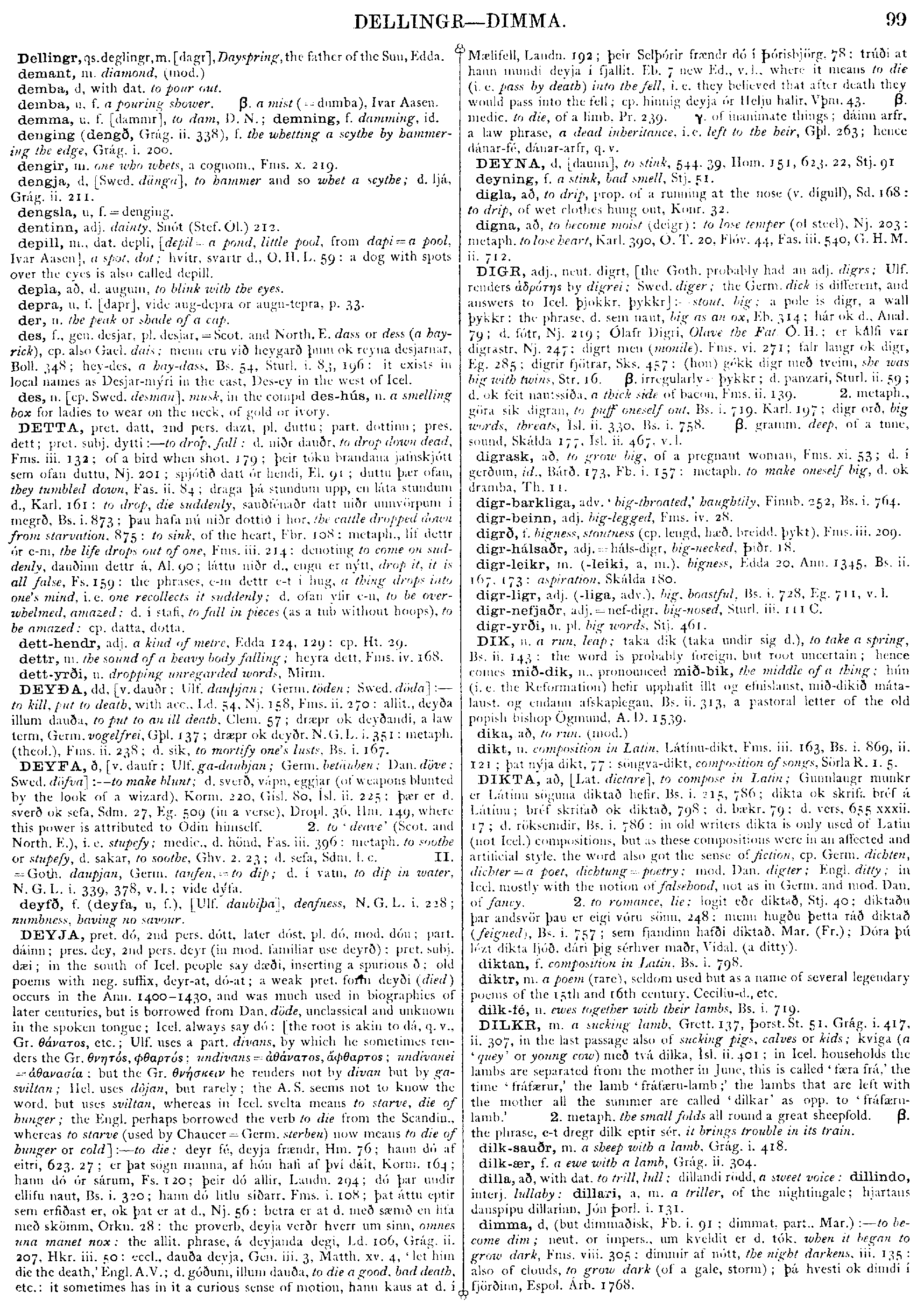
DILKR, in. a sucking lamb, Grett. 137, þorst. St. 51. Grág. 1. 417, ii. 307, in the last passage also of sucking pigs, calves or kid s, - kviga (a ''jney' or young cow) með tvá dilka, Ísl. ii. 401; in Icel. households the lambs are separated from the mother in June, this is called ' færa frá, ' the time ' tráfærur, ' the lamb; fráfærn-lamb;' the lambs that are left with the mother all the summer are called 'dilkar' as opp. to ' fráfæru- larnb. ' 2. metaph. the small folds all round a great sheepfold. p. the phrase, e-t dregr dilk eptir sér. it brings trouble in its train.
|
Source: Cleasby/Vigfusson, page b0108, entry 30 View original page image as: [TIFF] [PNG] [View previous entry] [View next entry] |
[Comment on this entry] [View comments] |
The following entry has not been hand-corrected. However, the page is reserved and someone is correcting it. |
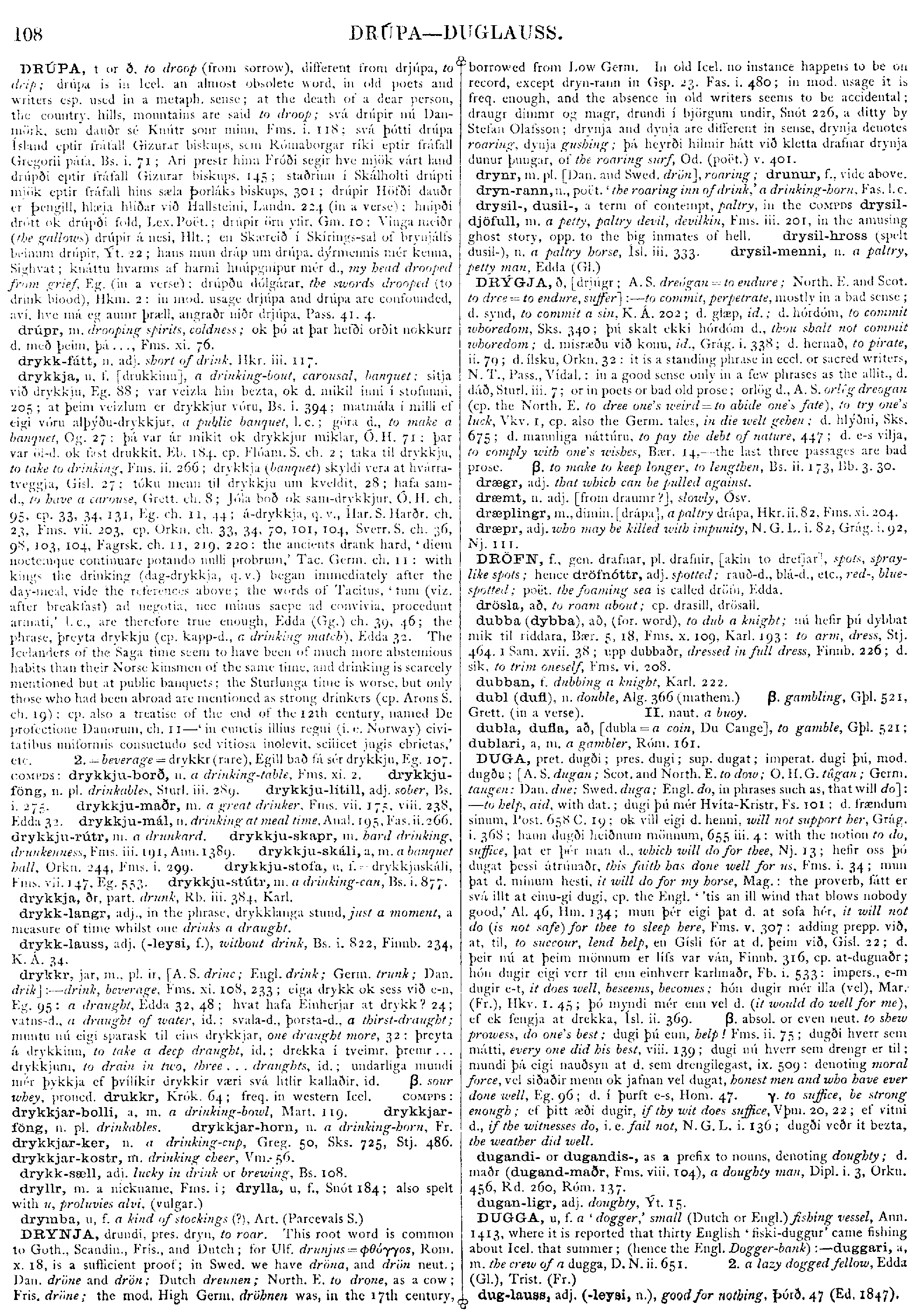
DUGGA, u, f. a ' dogger, ' small (Dutch or Ens.)jîsbing vessel, Ann. 1413, where it is reported that thirty English ' fiski-duggur' came fishing about Icel. that summer; (hence the Engl. Dogger-bank) :-- duggari, a, in. the crew of n dugga, D. N. ii. 651. 2. a lazy dogged fellow, Edda (GL), Trist. (Fr.)
| Result Page: |  |
Previous | 1 2 3 4 5 6 7 8 9 10 11 | Next |  |
Germanic Lexicon Project (main page)
This search system was written by
Sean Crist
Please consider
volunteering
to correct the data in these online dictionaries.
No rights reserved. Feel free to use these data in any way you please.