|
|

|
Source: Cleasby/Vigfusson, page b0137, entry 10 View original page image as: [TIFF] [PNG] [View previous entry] [View next entry] |
[Comment on this entry] [View comments] |
The following entry has been hand-corrected once. |
FALLA, pret. féll, 2nd pers. féllt, mod. féllst, pl. féllu; pres. fell, pl. föllum; part. fallinn; reflex. féllsk, fallisk, etc., with the neg. suffix fellr-at, féll-at, féllsk-at, Am. 6, vide Lex. Poët. [Common to all Teut. languages except Goth. (Ulf. renders GREEK by drjûsan); A. S. feallan; Engl. fall; Germ. fallen; Dan. falde; Swed. falla.]
|
Source: Cleasby/Vigfusson, page b0188, entry 47 View original page image as: [TIFF] [PNG] [View previous entry] [View next entry] |
[Comment on this entry] [View comments] |
The following entry has been hand-corrected once. |
GANGA, pret. gekk or gékk, 2nd pers. gékkt, mod. gékst; pl. gengu, geingu, or géngu, and an old poët. gingu; gengengu in Vsp. 12 is a mere misspelling (vide Sæm. Möb. 258); pres. geng, pl. göngum; pret. subj. gengi (geingi); imperat. gakk and gakktú; with the neg. suffix geng-at, gengr-at, gékk-at, gakk-attu, passim; a middle form göngumk firr, go from me, Gm. 1: a contracted form gá occurs now and then in mod. hymns; it is not vernacular but borrowed from Germ. and Dan.: [cp. Ulf. gaggan; A. S. and Hel. gangan; Scot. and North. E. gang, mod. Engl. go; Dan.-Swed. gange or gå; Germ. gehen; Ivar Aasen ganga: Icel., Scots, and Norsemen have preserved the old ng, which in Germ. and Swed.-Dan. only remains in poetry or in a special sense, e.g. in Germ. compds.]
|
Source: Cleasby/Vigfusson, page b0199, entry 15 View original page image as: [TIFF] [PNG] [View previous entry] [View next entry] |
[Comment on this entry] [View comments] |
The following entry has not been hand-corrected. However, the page is reserved and someone is correcting it. |
-GI (or -ki after i or s), a particle suffixed to nouns and adverbs. A. In a positive sense [Lat. -que] , ever, Lat. -que, -cimqite: 1. with the pronoun hverr (quis) through all cases, answering to the Lat. qnis-quc: out of the Laws we can nearly make a full paradigm :-- noin. hverr-gi or hver-gi, Lat. qids-que, qui-cunque, Grág. Kb. i. 14, 31, 45, 85, 171 (twice), 183, 195, 221, ii. 7, 23, 82, ioi: nom. and acc. neut. hvat-ki (quod-quc). i. 34, 155, 162, 183, 244, ii. 77, 140, 154, Jómsv. 15, Ib. 3; also hvurt- ki, id., Grág. Kb. i. 61 (twice): gen. hvers-kis (cujits-que), 238: dat. hverjun-gi (ctti-que), 31, 156: acc. inasc. hvern-gi (quem-que), 147, 155, 221, 22=;, 245, ii. 47, 66: abl. hve-gi or hvi-gi, however, . 147, 195, ii. 64, ioi, 128, 151, joinsv. 14 :-- plur. acc. neut. hver-gi (quae-que): dual dat. sing, hvarnn-gi megin, on both sides (of a river), Grug. Kb. ii. 93: -- even in historical prose, því at hit næsta surnar gat hvergi ber á íslaiuii, the following:. ummer every nian gathered berries in Iceland (to make some kind ot wine), Bs. 1. 135, (or are we to read hvar-gi, everywhere ?). 2. with adverbs; hvert-ki (quociin-que modo), Grág. ii. 50; nivr-gi. when- ever (ubi-cunyue), i. 191; hvar-gi, wherever, 25, 166, 240, ii. 128, 212. B. In a negative sense, with a few pronouns, adjectives, adverbs, and rarely in old poems with substantives: 1. witli nouns, in the pr. name Lopt-ki, an air. Aey., Ls. 19: with appellatives, þürf-gi, no need, an arr. ey., Hkv. Hjörv. 39; freq. in mann-gi, no man, cp. Lat. nêmo, íb. (which is even used in mod. writers and poets; væt-ki, naught; vettu-gi (dat.) and vettcr-gis (gen.), Vsp.: with adjectives, ein-gi (q. v.), none, a common word; otherwise rare, sjálf-gi, 'self-not, ' i. e. not oneself, Ls. 29, an air. fy.: with a dat. case of langr, þá löngu-gi, then not for a long time, Konr. (MS.): with pronouns, in the dual, hvarr-gi, neither, Lat. neuter, Grág. Kb. i. 46, ii. 93, 151; gen. hvárs-kis (netitrius), freq.; dat. hvarun- gi (jieulri), i. 215; hvarum-gi, ii. 63: neut. hvaru-gi, 216; hitt-ki, ne illud quidem. Urn. 21, 23; þat-ki, Hbl. 6; þat-ki at ek fá (not even that I get) mala minu falslausan, Mork. 83. 2. with adverbs, only in poetry or laws or very old prose; sva-gi. not so, Grág. Kb. ii. 99, Mork. 83; þá-gi, then not; þey-gi, though not, qs. þó-gi; æva-gi, never: again, hver-gi (q. v.), nowhere; ei-gi (q. v.), not; aldri-gi (q. v.), never; hvar-ki (q. v.), neither, are common words in prose and in speech. The negative -gi can never be suffixed to verbs (vide '-at, ' p. 2); therefore býð-gi, non jubeo (in Islands-vaka 61, a poem of the last century. Fél. i. 236), is a spurious imitation of the old idiom; neither can -at be put to nouns; ráð-at hann kuiini, Jónas 105, ought therefore to be ráð hann kunni-t, issue be knew not. C. In an indefinite sense; in a few instances -gi seems to be used almost like Latin quidem with a preceding negative: eigi miklo-gi miuiia, ne multo quidem minus, Ileiðar. S., Ísl. ii. 360; eigi storu-gi meiri, ne multo quidem majora, 386; engi miklo-gi görr... . nemo multo quidem plus ..., Grág. i. 209; cp. also the adverbs iillun-gis or oldun-gis, quite, altogether (allr, -gi); einun-gis, only, solely (einn, -gi). both formed from dat. sing.: the obsolete vil-gi (qs. vel-gi) is ambiguous, being used both in a nt-g. sense -- -not well, and posit. =-well, bene quidem, cp. Bs. i. 393, note; Hrn. 66, malun-gi, is doubtful; -- prob. þyrftig-at múlun-gi mat should be read, -at being taken not as a prep, but as a negative verbal suffix, and -gi as a positive suffix; Icel. now say, hann á ekki málungi matar, he does not know where to look for his next meal. igsf The negative -gi is peculiar to Scandin., and no traces of it are found in any Saxon nor German idioms; whereas, as a positive suffix, it is common to all Teutonic tongues, and remains in the Engl. many and any; ' many' being qs. man-y -- man-ever, ' homo-cunque, ' Goth, tnanags, and 'any' qs. ane-y = every-one; so also is the cf;' in Icel. margr and hvárigr, which are remnants -- the former of the positive, the latter of the negative -gi.
|
Source: Cleasby/Vigfusson, page b0210, entry 27 View original page image as: [TIFF] [PNG] [View previous entry] [View next entry] |
[Comment on this entry] [View comments] |
The following entry has been hand-corrected once. |
GRAFA, pret. gróf; pres. gref; part. grafinn, with neg. suffix gróf-at, Fas. i. 436 (in a verse) : [Ulf. graban = GREEK ; A.S. grafan; North.E. to grave; Germ. graben; Swed. grafva; Dan. grave] :-- to dig; grafa engi sitt, to drain one's field, Grág. ii. 181; jörðin var grafin í hám fjallatindum, Edda 144; en er vatnit gróf tvá vega þá féllu bakkarnir, Ó.H. 18; grafa til vatns, id.; grafa út ósinn, Bs. i. 331; þá er þeir höfðu út grafit fitna (dug through it), Ó.H. 18; g. gröf, to dig a grave, 623. 28, Eg. 300; grafa niðr, to dig down, Grág. ii. 351; hann (the horse) var svá kyrr, sem hann væri grafinn niðr, as if he had been rooted in the ground, Hrafn. 7; g. torf, to dig peat, Njarð. 370, Rm. 12; g. upp, to dig up; þeir grófu upp líkamina, Nj. 86; g. upp bein, K.Þ.K. 40, N.G.L. i. 44; grafa alone, Fms. iv. 110 : reflex, to bury (hide) oneself, hanu grófsk í brúkit, he hid himself in the seaweed, Njarð. 380; var grafinn lykill (the key was hid) í dyra-gætti, Störnu-Odd. 20. 2. to earth, bury (Old Engl. en-grave); vóru þá allir ríkis-menn í hauga lagðir en öll alþýða grafin í jörð, Ó.H. (pref.); var hann grafinn (buried) hjá leiði Kols biskups, Bs. i. 64, passim; grafa lík, g. niðr, etc., Bjarn. 19, Eb. 338, K.Þ.K. passim. 3. to carve, engrave; grafa innsigli, Mar., Sturl. ii. 222; krismu-ker grafit með tönn, Vm. 117; g. fílsbein í eik, Edda 151 (pref.); Margret gróf ok tönn til ágæta-vel, Bs. i. 143; grafa, steinsetja ok amalera, Fms. xi. 427. II metaph. to enquire, dive deep into, Hom. 84 : to unearth, find out the sense, kveða má svá, at vísan sé fegri þá grafin er, Grett. 94 A; nú festir maðr sér konu, ok grefsk upp skylda með þeim, and relationship is found out afterwards, N.G.L. i. 350; þá grófsk Þórir eptir (Th. enquired) en Úlfr segir at lyktum, Gullþ. 5; gróf hann vandlega eptir (he made a close enquiry) þess manns atferð, Fms. viii. 15; gróf hann svá undir þeim (he sounded them so), at hann varð margra hluta víss, 16; hann gróf at vandlega, ok bað hana segja sér, Dropl. 4; g. um e-t, id., Hom. 43; en grafa eigi um þat er vér megum eigi skilja, Greg. 75 : g. upp, to unearth, make out; gátu menn þá upp grafit, at..., Grett. 162; grafask upp, to come to the light, Orkn. (in a verse). III. medic. to suppurate; impers., lærit (acc.) tók at grafa bæði uppi ok niðri, ... var lærit allt grafit upp at smá-þörmum, Grett. 153, 154.
|
Source: Cleasby/Vigfusson, page b0228, entry 3 View original page image as: [TIFF] [PNG] [View previous entry] [View next entry] |
[Comment on this entry] [View comments] |
The following entry has been hand-corrected once. |
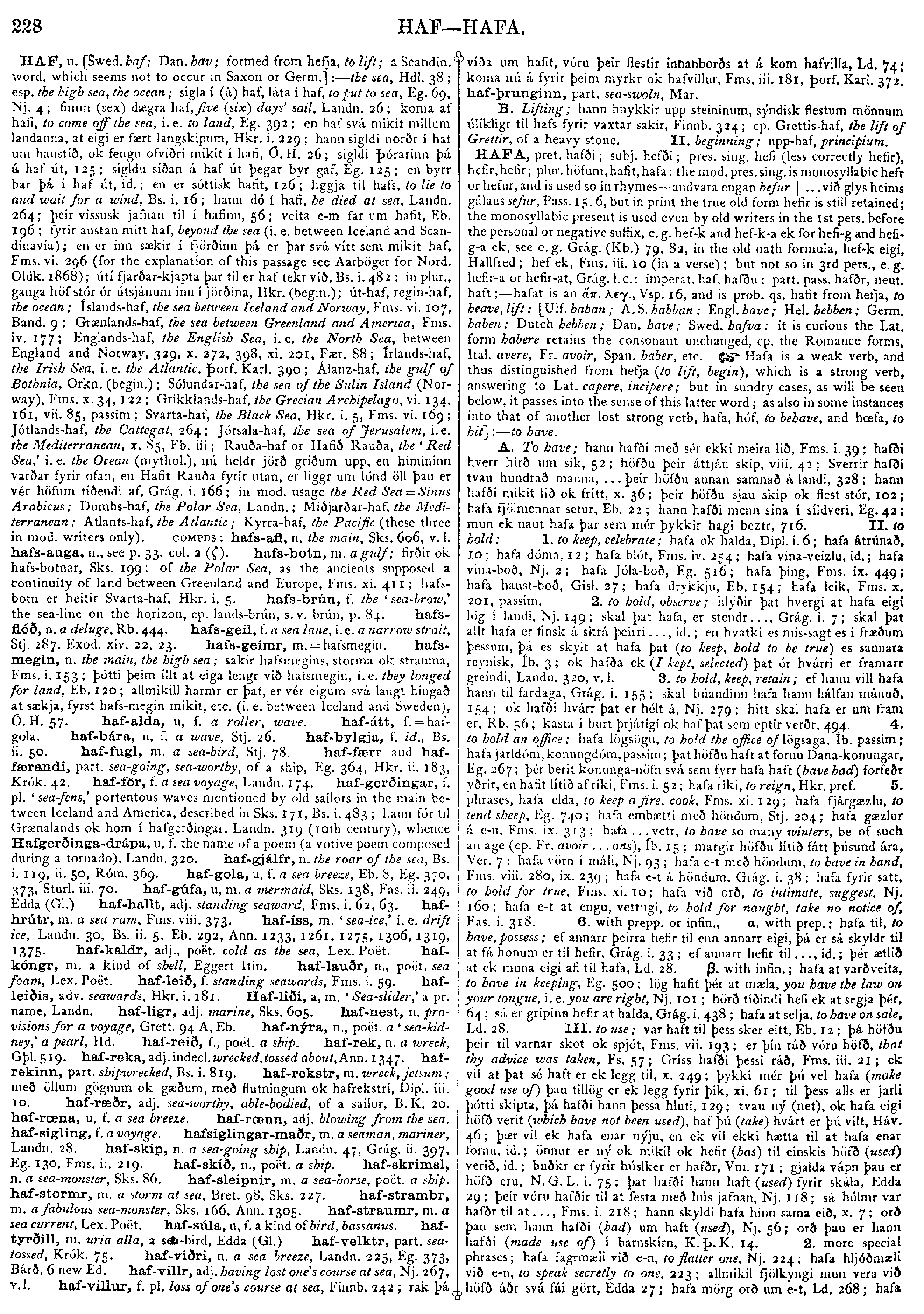
HAFA, pret. hafði; subj. hefði; pres. sing, hefi (less correctly hefir), hefir, hefir; plur. höfum, hafit, hafa: the mod. pres. sing, is monosyllabic hefr or hefur, and is used so in rhymes -- andvara engan hefur | ... við glys heims gálaus sefur, Pass. 15. 6, but in print the true old form hefir is still retained; the monosyllabic present is used even by old writers in the 1st pers. before the personal or negative suffix, e.g. hef-k and hef-k-a ek for hefi-g and hefig-a ek, see e.g. Grág. (Kb.) 79, 82, in the old oath formula, hef-k eigi, Hallfred; hef ek, Fms. iii. 10 (in a verse); but not so in 3rd pers., e.g. hefir-a or hefir-at, Grág. l.c.: imperat. haf, hafðu: part. pass. hafðr, neut. haft; -- hafat is an GREEK, Vsp. 16, and is prob. qs. hafit from hefja, to heave, lift: [Ulf. haban; A. S. habban; Engl. have; Hel. hebben; Germ. haben; Dutch hebben; Dan. have, Swed. hafva: it is curious the Lat. form habere retains the consonant unchanged, cp. the Romance forms, Ital. avere, Fr. avoir, Span. haber, etc. UNCERTAIN Hafa is a weak verb, and thus distinguished from hefja (to lift, begin), which is a strong verb, answering to Lat. capere, incipere; but in sundry cases, as will be seen below, it passes into the sense of this latter word; as also in some instances into that of another lost strong verb, hafa, hóf, to behave, and hœfa, to hit] :-- to have.
|
Source: Cleasby/Vigfusson, page b0263, entry 2 View original page image as: [TIFF] [PNG] [View previous entry] [View next entry] |
[Comment on this entry] [View comments] |
The following entry has been hand-corrected once. |
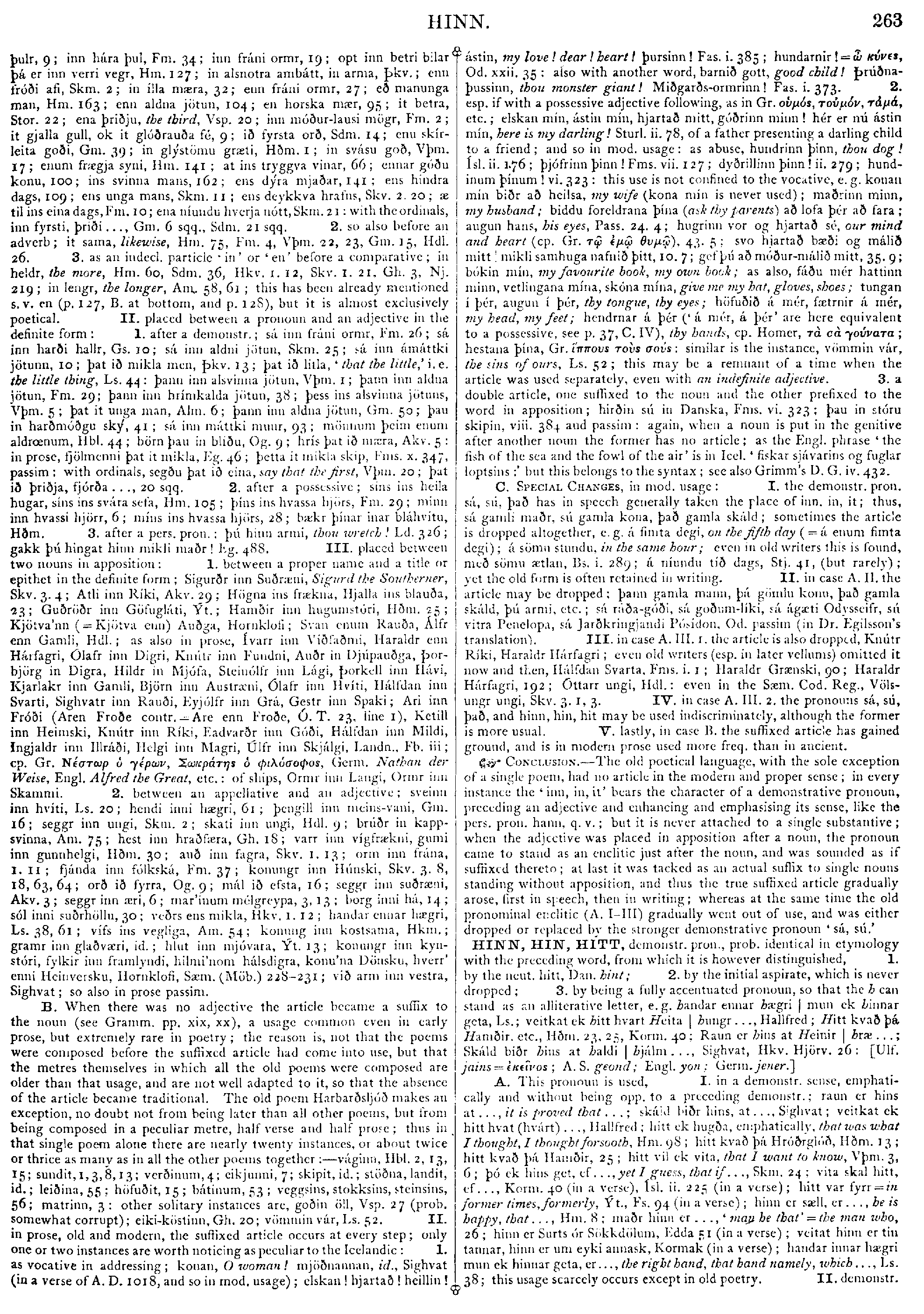
B. When there was no adjective the article became a suffix to the noun (see Gramm. pp. xix, xx), a usage common even in early prose, but extremely rare in poetry; the reason is, not that the poems were composed before the suffixed article had come into use, but that the metres themselves in which all the old poems were composed are older than that usage, and are not well adapted to it, so that the absence of the article became traditional. The old poem Harbarðsljóð makes an exception, no doubt not from being later than all other poems, but from being composed in a peculiar metre, half verse and half prose; thus in that single poem alone there are nearly twenty instances, or about twice or thrice as many as in all the other poems together :-- váginn, Hbl. 2, 13, 15; sundit, 1, 3, 8, 13; verðinum, 4; eikjunni, 7; skipit, id.; stöðna, landit, id.; leiðina, 55; höfuðit, 15; bátinum, 53; veggsins, stokksins, steinsins, 56; matrinn, 3: other solitary instances are, goðin öll, Vsp. 27 (prob. somewhat corrupt); eiki-köstinn, Gh. 20; vömmin vár, Ls. 52. II. in prose, old and modern, the suffixed article occurs at every step; only one or two instances are worth noticing as peculiar to the Icelandic: 1. as vocative in addressing; konan, O woman! mjöðnannan, id., Sighvat (in a verse of A.D. 1018, and so in mod. usage); elskan! hjartað! heillin! ástin, my love! dear! heart! þursinn! Fas. i. 385; hundarnir! = GREEK, Od. xxii. 35: also with another word, barnið gott, good child! Þrúðnaþussinn, thou monster giant! Miðgarðs-ormrinn! Fas. i. 373. 2. esp. if with a possessive adjective following, as in Gr. GREEK, etc.; elskan mín, ástin mín, hjartað mitt, góðrinn minn! hér er nú ástin mín, here is my darling! Sturl. ii. 78, of a father presenting a darling child to a friend; and so in mod. usage: as abuse, hundrinn þinn, thou dog! Ísl. ii. 176; þjófrinn þinn! Fms. vii. 127; dyðrillinn þinn! ii. 279; hundinum þínum! vi. 323: this use is not confined to the vocative, e.g. konan mín biðr að heilsa, my wife (kona mín is never used); maðrinn minn, my husband; biddu foreldrana þína (ask thy parents) að lofa þér að fara; augun hans, his eyes, Pass. 24. 4; hugrinn vor og hjartað sé, our mind and heart (cp. Gr. GREEK), 43. 5; svo hjartað bæði og málið mitt | mikli samhuga nafnið þitt, 10. 7; gef þú að móður-málið mitt, 35. 9; bókin mín, my favourite book, my own book; as also, fáðu mér hattinn minn, vetlingana mína, skóna mína, give me my hat, gloves, shoes; tungan í þér, augun í þér, thy tongue, thy eyes; höfuðið á mér, fætrnir á mér, my head, my feet; hendrnar á þér ('á mér, á þér' are here equivalent to a possessive, see p. 37, C. IV), thy hands, cp. Homer, GREEK; hestana þína, Gr. GREEK: similar is the instance, vömmin vár, the sins of ours, Ls. 52; this may be a remnant of a time when the article was used separately, even with an indefinite adjective. 3. a double article, one suffixed to the noun and the other prefixed to the word in apposition; hirðin sú in Danska, Fms. vi. 323; þau in stóru skipin, viii. 384 and passim: again, when a noun is put in the genitive after another noun the former has no article; as the Engl. phrase 'the fish of the sea and the fowl of the air' is in Icel. 'fiskar sjávarins og fuglar loptsins:' but this belongs to the syntax; see also Grimm's D. G. iv. 432.
|
Source: Cleasby/Vigfusson, page b0263, entry 4 View original page image as: [TIFF] [PNG] [View previous entry] [View next entry] |
[Comment on this entry] [View comments] |
The following entry has been hand-corrected once. |
UNCERTAIN CONCLUSION. -- The old poetical language, with the sole exception of a single poem, had no article in the modern and proper sense; in every instance the 'inn, in, it' bears the character of a demonstrative pronoun, preceding an adjective and enhancing and emphasising its sense, like the pers. pron. hann, q.v.; but it is never attached to a single substantive; when the adjective was placed in apposition after a noun, the pronoun came to stand as an enclitic just after the noun, and was sounded as if suffixed thereto; at last it was tacked as an actual suffix to single nouns standing without apposition, and thus the true suffixed article gradually arose, first in speech, then in writing; whereas at the same time the old pronominal enclitic (A. I-III) gradually went out of use, and was either dropped or replaced by the stronger demonstrative pronoun 'sá, sú.'
|
Source: Cleasby/Vigfusson, page b0351, entry 19 View original page image as: [TIFF] [PNG] [View previous entry] [View next entry] |
[Comment on this entry] [View comments] |
The following entry has been hand-corrected once. |
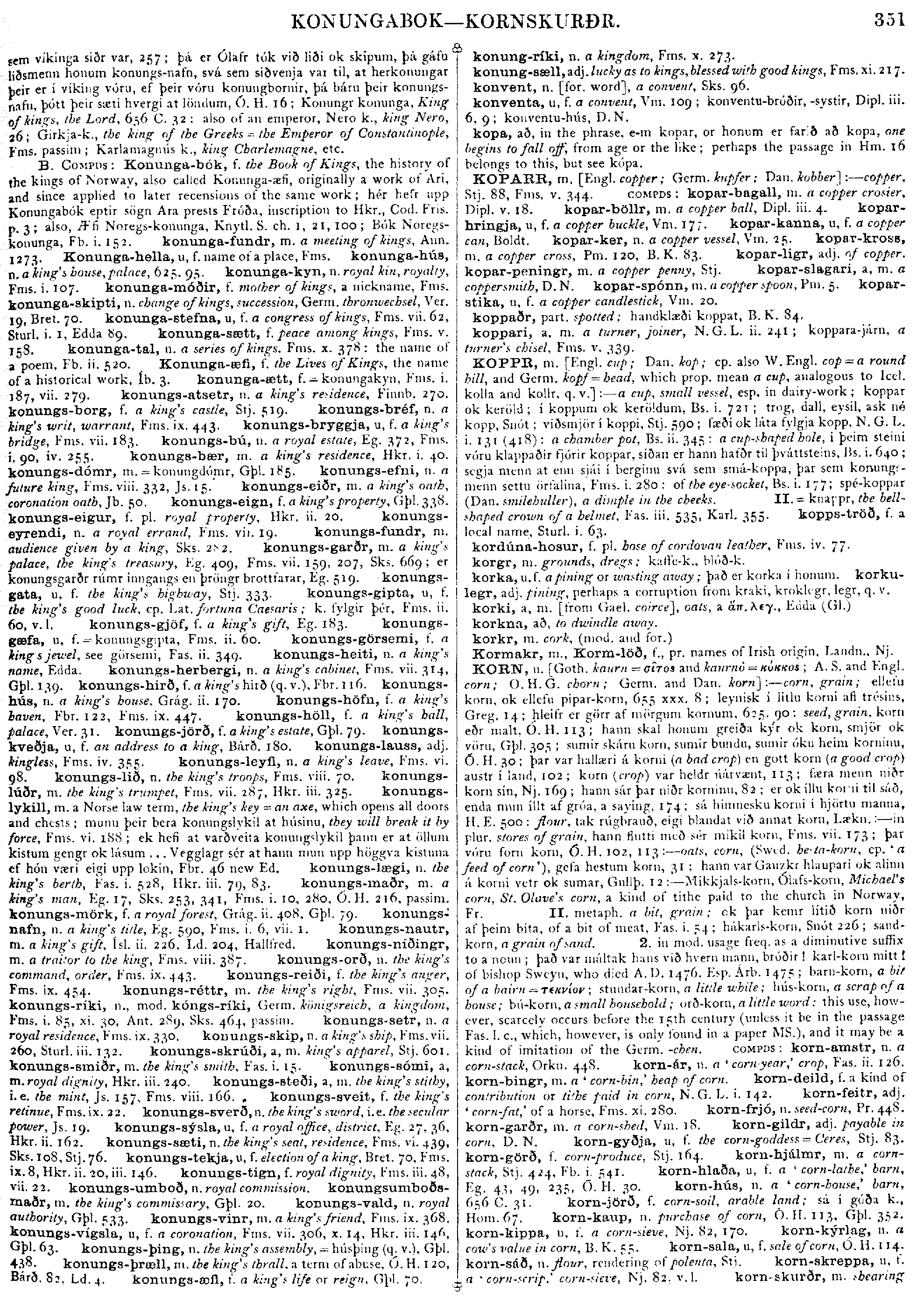
KORN, n. [Goth. kaurn = GREEK and kaurnô = GREEK; A. S. and Engl. corn; O. H. G. chorn; Germ. and Dan. korn] :-- corn, grain; ellefu korn, ok ellefu pipar-korn, 655 xxx. 8; leynisk í litlu korni afl trésins, Greg. 14; hleifr er görr af mörgum kornum, 625. 90: seed, grain, korn eðr malt, Ó. H. 113; hann skal honum greiða kýr ok korn, smjör ok vöru, Gþl. 305; sumir skáru korn, sumir bundu, sumir óku heim korninu, Ó. H. 30; þar var hallæri á korni (a bad crop) en gott korn (a good crop) austr í land, 102; korn (crop) var heldr úárvænt, 113; færa menn niðr korn sín, Nj. 169; hann sár þar niðr korninu, 82; er ok íllu komi til sáð, enda mun íllt af gróa, a saying, 174; sá himnesku korni í hjörtu manna, H. E. 500: flour, tak rúgbrauð, eigi blandat við annat korn, Lækn. :-- in plur. stores of grain, hann flutti með sér mikil korn, Fms. vii. 173; þar vóru forn korn, Ó. H. 102, 113 :-- oats, corn, (Swed. hesta-korn, cp. 'a feed of corn'), gefa hestum korn, 31; hann var Gauzkr hlaupari ok alinn á korni vetr ok sumar, Gullþ. 12 :-- Mikkjals-korn, Ólafs-korn, Michael's corn, St. Olave's corn, a kind of tithe paid to the church in Norway, Fr. II. metaph. a bit, grain; ok þar kemr lítið korn niðr af þeim bita, of a bit of meat, Fas. i. 54; hákarls-korn, Snót 226; sand-korn, a grain of sand. 2. in mod. usage freq. as a diminutive suffix to a noun; það var máltak hans við hvern mann, bróðir! karl-korn mitt! of bishop Sweyn, who died A. D. 1476. Esp. Árb. 1475; barn-korn, a bit of a bairn = GREEK; stundar-korn, a little while; hús-korn, a scrap of a house; bú-korn, a small household; orð-korn, a little word: this use, however, scarcely occurs before the 15th century (unless it be in the passage Fas. l.c., which, however, is only found in a paper MS.), and it may be a kind of imitation of the Germ. -chen. COMPDS: korn-amstr, n. a corn-stack, Orkn. 448. korn-ár, n. a 'corn-year,' crop, Fas. ii. 126. korn-bingr, m. a 'corn-bin,' heap of corn. korn-deild, f. a kind of contribution or tithe paid in corn, N. G. L. i. 142. korn-feitr, adj. 'corn-fat,' of a horse, Fms. xi. 280. korn-frjó, n. seed-corn, Pr. 448. korn-garðr, m. a corn-shed, Vm. 18. korn-gildr, adj. payable in corn, D. N. korn-gyðja, u, f. the corn-goddess = Ceres, Stj. 83. korn-görð, f. corn-produce, Stj. 164. korn-hjálmr, m. a corn-stack, Stj. 424, Fb. i. 541. korn-hlaða, u, f. a 'corn-lathe,' barn, Eg. 43, 49, 235, Ó. H. 30. korn-hús, n. a 'corn-house,' barn, 656 C. 31. korn-jörð, f. corn-soil, arable land; sá í góða k., Hom. 67. korn-kaup, n. purchase of corn, Ó. H. 113, Gþl. 352. korn-kippa, u, f. a corn-sieve, Nj. 82, 170. korn-kýrlag, n. a cow's value in corn, B. K. 55. korn-sala, u, f. sale of corn, Ó. H. 114. korn-sáð, n. flour, rendering of polenta, Stj. korn-skreppa, u, f. a 'corn-scrip,' corn-sieve, Nj. 82. v.l. korn-skurðr, m. shearing
|
Source: Cleasby/Vigfusson, page b0378, entry 10 View original page image as: [TIFF] [PNG] [View previous entry] [View next entry] |
[Comment on this entry] [View comments] |
The following entry has not been hand-corrected. However, the page is reserved and someone is correcting it. |
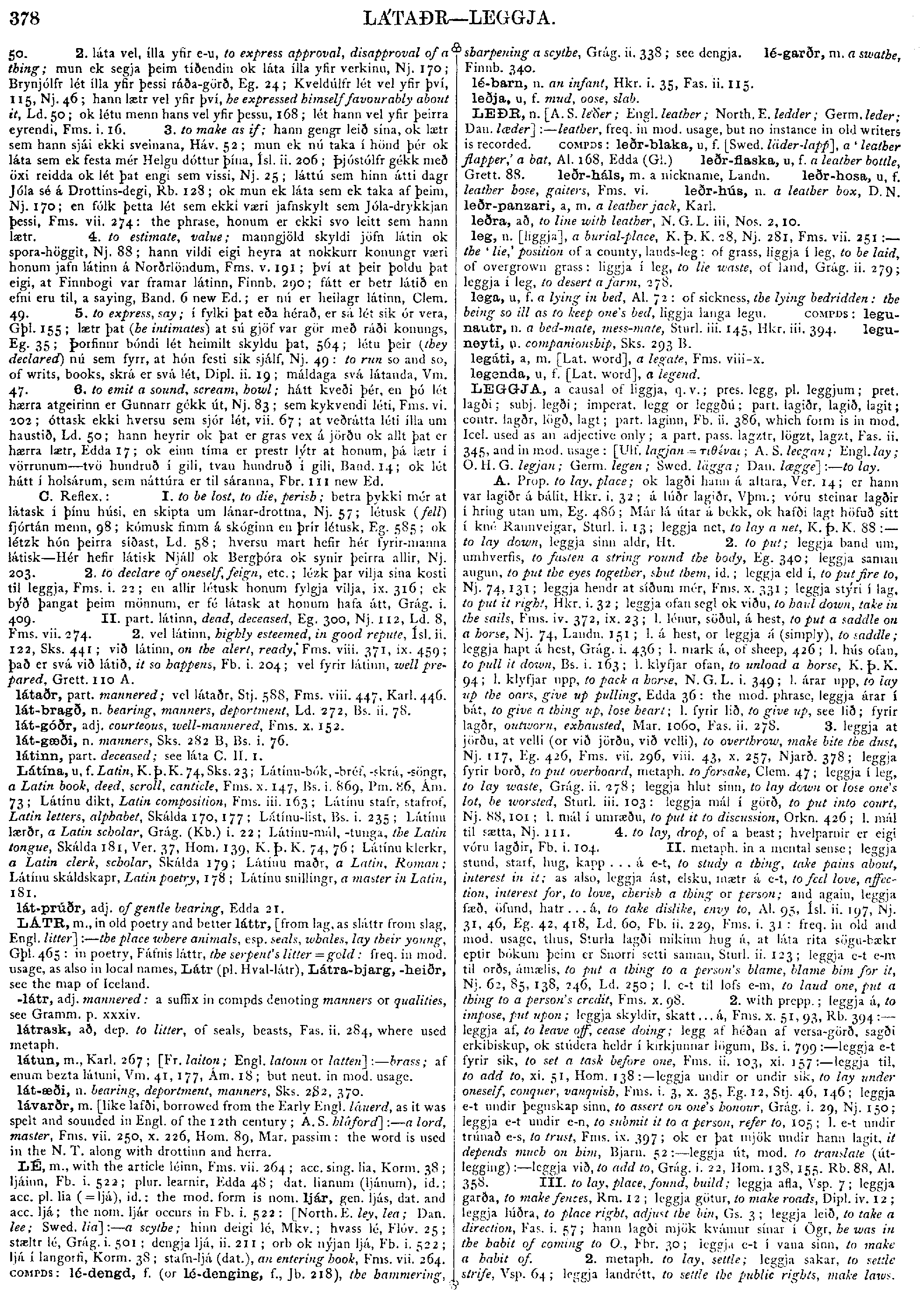
-látr, adj. mannered: a suffix in compds denoting manners or qualifies, see Gramm. p. xxxiv.
|
Source: Cleasby/Vigfusson, page b0412, entry 23 View original page image as: [TIFF] [PNG] [View previous entry] [View next entry] |
[Comment on this entry] [View comments] |
The following entry has been hand-corrected once. |
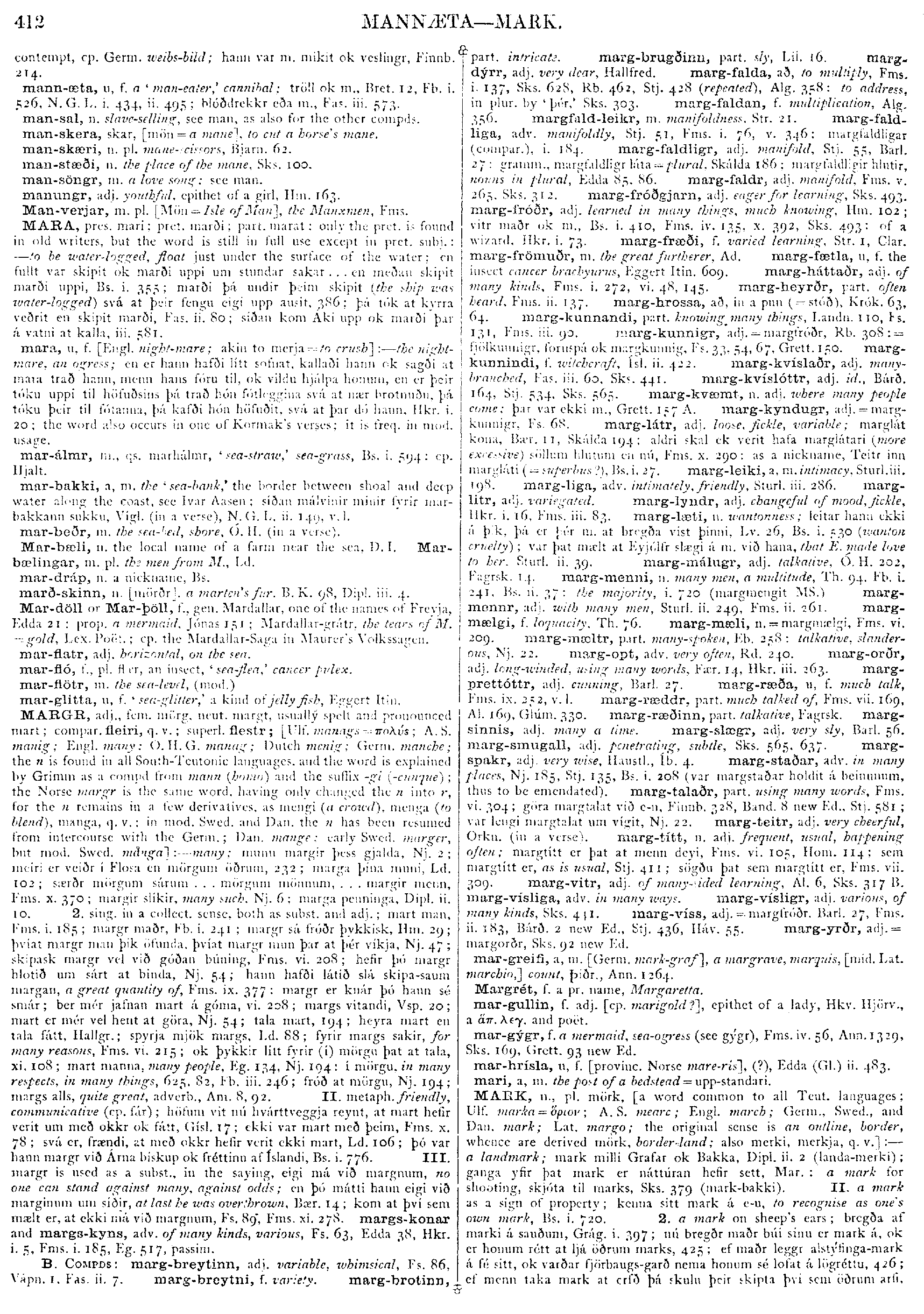
MARGR, adj., fem. mörg. neut. margt, usually spelt and pronounced mart; compar. fleiri, q.v.; superl. flestr; [Ulf. manags = GREEK; A.S. manig; Engl. many: O.H.G. manag; Dutch mennig; Germ. manche; the n is found in all South-Teutonic languages, and the word is explained by Grimm as a compd from mann (homo) and the suffix -gi (-cunque); the Norse margr is the same word, having only changed the n into r, for the n remains in a few derivatives, as mengi (a crowd), menga (to blend), manga, q.v.: in mod. Swed. and Dan. the n has been resumed from intercourse with the Germ.; Dan. mange; early Swed. marger, but mod. Swed. mânga] :-- -many; munu margir þess gjalda, Nj. 2; meiri er veiðr í Flosa en mörgum öðrum, 232; marga þína muni, Ld. 102; særðr mörgum sárum ... mörgum mönnum, ... margir menn, Fms. x. 370; margir slíkir, many such. Nj. 6; marga penninga, Dipl. ii. 10. 2. sing. in a collect. sense, both as subst. and adj.; mart man, Fms. i. 185; margr maðr, Fb. i. 241; margr sá fróðr þvkkisk, Hm. 29; þviat margr man þik öfunda, þvíat margr mun þar at þér víkja, Nj. 47; skipask margr vel við góðan búning, Fms. vi. 208; hefir þó margr hlotið um sárt at binda, Nj. 54; hann hafði látið slá skipa-saum margan, a great quantity of, Fms. ix. 377: margr er knár þó hann sé smár; ber mér jafnan mart á góma, vi. 208; margs vitandi, Vsp. 20; mart er mér vel hent at göra, Nj. 54; tala mart, 194; heyra mart en tala fátt, Hallgr.; spyrja mjök margs, Ld. 88; fyrir margs sakir, for many reasons, Fms. vi. 215; ok þykkir lítt fyrir (í) mörgu þat at tala, xi. 108; mart manna, many people, Eg. 134, Nj. 194: í mörgu, in many respects, in many things, 625. 82, Fb. iii. 246; fróð at mörgu, Nj. 194; margs alls, quite great, adverb., Am. 8, 92. II. metaph. friendly, communicative (cp. fár); höfum vit nú hvarttveggja reynt, at mart hefir verit um með okkr ok fátt, Gísl. 17; ekki var mart með þeim, Fms. x. 78; svá er, frændi, at með okkr hefir verit ekki mart, Ld. 106; þó var hann margr við Árna biskup ok fréttinn af Íslandi, Bs. i. 776. III. margr is used as a subst., in the saying, eigi má við margnum, no one can stand against many, against odds; en þó mátti hann eigi við marginum um síðir, at last he was overthrown, Bær. 14; kom at því sem mælt er, at ekki má við margnum, Fs. 89, Fms. xi. 278. margs-konar and margs-kyns, adv. of many kinds, various, Fs. 63, Edda 38, Hkr. i. 5, Fms. i. 185, Eg. 517, passim. B. COMPDS: marg-breytinn, adj. variable, whimsical, Fs. 86, Vápn. 1. Fas. ii. 7. marg-breytni, f. variety, marg-brotinn, part. intricate. marg-brugðinn, part. sly, Lil. 16. marg-dýrr, adj. very dear, Hallfred. marg-falda, að, to multiply, Fms. i. 137, Sks. 628, Rb. 462, Stj. 428 (repeated), Alg. 358: to address, in plur. by 'þér,' Sks. 303. marg-faldan, f. multiplication, Alg. 356. margfald-leikr, m. manifoldness. Str. 21. marg-faldliga, adv. manifoldly, Stj. 51, Fms. i. 76, v. 346: margfaldligar (compar.), i. 184. marg-faldligr, adj. manifold, Stj. 55, Barl. 27: gramm., margfaldligr láta = plural, Skálda 186; margfaldligar hlutir, nouns in plural, Edda 85. 86. marg-faldr; adj. manifold, Fms. v. 265. Sks. 312. marg-fróðgjarn, adj. eager for learning, Sks. 493. marg-fróðr, adj. learned in many things, much knowing, Hm. 102; vitr maðr ok m., Bs. i. 410, Fms. iv. 135, x. 392, Sks. 493: of a wizard, Hkr. i. 73. marg-fræði, f. varied learning, Str. 1, Clar. marg-frömuðr, m. the great furtherer. Ad. marg-fætla, u, f. the insect cancer brachyurus, Eggert Itin. 609. marg-háttaðr, adj. of many kinds, Fms. i. 272, vi. 48. 145. marg-heyrðr, part. often heard. Fms. ii. 137. marg-hrossa, að, in a pun (= stóð), Krók. 63, 64. marg-kunnandi, part. knowing many things, Landn. 110, Fs. 131, Fms. iii. 90. marg-kunnigr, adj. = margfróðr, Rb. 308: = fjölkunnigr, foruspá ok margkunnig, Fs. 33. 54, 67, Grett. 150. marg-kunnindi, f. witchcraft, Ísl. ii. 422. marg-kvíslaðr, adj. many-branched, Fas. iii. 60, Sks. 441. marg-kvíslóttr, adj. id., Bárð. 164, Stj. 534, Sks. 565. marg-kvæmt, n. adj. where many people come; þar var ekki m., Grett. 157 A. marg-kyndugr, adj. = margkunnigr, Fs. 68. marg-látr, adj. loose, fickle, variable; marglát kona, Bær. 11, Skálda 194; aldri skal ek verit hafa marglátari (more excessive) söllum hlutum en nú, Fms. x. 290: as a nickname, Teitr inn margláti (= superbus?), Bs. i. 27. marg-leiki, a. m. intimacy, Sturl. iii. 198. marg-liga, adv. intimately, friendly, Sturl. iii. 286. marg-litr, adj. variegated. marg-lyndr, adj. changeful of mood, fickle, Hkr. i. 16, Fms. iii. 83. marg-læti, n. wantonness; leitar hann ekki á þik, þá er þér m. at bregða vist þinni, Lv. 26, Bs. i. 530 (wanton cruelty); var þat mælt at Eyjólfr slægi á m. við hana, that E. made love to her. Sturl. ii. 39. marg-málugr, adj. talkative, Ó.H. 202, Fagrsk. 14. marg-menni, n. many men, a multitude, Th. 94, Fb. i. 241, Bs. ii. 37: the majority, i. 720 (margmengit MS.) marg-mennr, adj. with many men, Sturl. ii. 249, Fms. ii. 261. marg-mælgi, f. loquacity. Th. 76. marg-mæli, n. = margmælgi, Fms. vi. 209. marg-mæltr, part. many-spoken, Eb. 258: talkative, slanderous, Nj. 22. marg-opt, adv. very often, Rd. 240. marg-orðr, adj. long-winded, using many words. Fær. 14, Hkr. iii. 263. marg-prettóttr, adj. cunning, Barl. 27. marg-ræða, u, f.; much talk, Fms. ix. 252, v.l. marg-ræddr, part. much talked of, Fms. vii. 169, Al. 169, Glúm. 330. marg-ræðinn, part. talkative, Fagrsk. marg-sinnis, adj. many a time. marg-slægr, adj. very sly, Barl. 56. marg-smugall, adj. penetrating, subtle, Sks. 565. 637. marg-spakr, adj. very wise, Haustl., Íb. 4. marg-staðar, adv. in many places, Nj. 185, Stj. 135, Bs. i. 208 (var margstaðar holdit á beinunum, thus to be emendated). marg-talaðr, part. using many words, Fms. vi. 304; göra margtalat við e-n, Finnb. 328, Band. 8 new Ed., Stj. 581; var lengi margtalat um vígit, Nj. 22. marg-teitr, adj. very cheerful, Orkn. (in a verse). marg-títt, n. adj. frequent, usual, happening often; margtítt er þat at menn deyi, Fms. vi. 105, Hom. 114: sem margtítt er, as is usual, Stj. 411; sögðu þat sem margtítt er, Fms. vii. 309. marg-vitr, adj. of many-sided learning, Al. 6, Sks. 317 B. marg-vísliga, adv. in many ways. marg-vísligr, adj. various, of many kinds, Sks. 411. marg-víss, adj. = margfróðr. Barl. 27, Fms. ii. 183, Bárð. 2 new Ed., Stj. 436, Háv. 55. marg-yrðr, adj. = margorðr, Sks. 92 new Ed.
| Result Page: |  |
Previous | 1 2 3 4 5 6 7 8 9 10 | Next |  |
Germanic Lexicon Project (main page)
This search system was written by
Sean Crist
Please consider
volunteering
to correct the data in these online dictionaries.
No rights reserved. Feel free to use these data in any way you please.