|
|

Search for style again, using less strict matching (53 results)
|
Source: Bosworth/Toller, page b0134, entry 38 View original page image as: [TIFF] [PNG] [View previous entry] [View next entry] |
[Comment on this entry] [View comments (1)] |
The following entry has been hand-corrected once. |
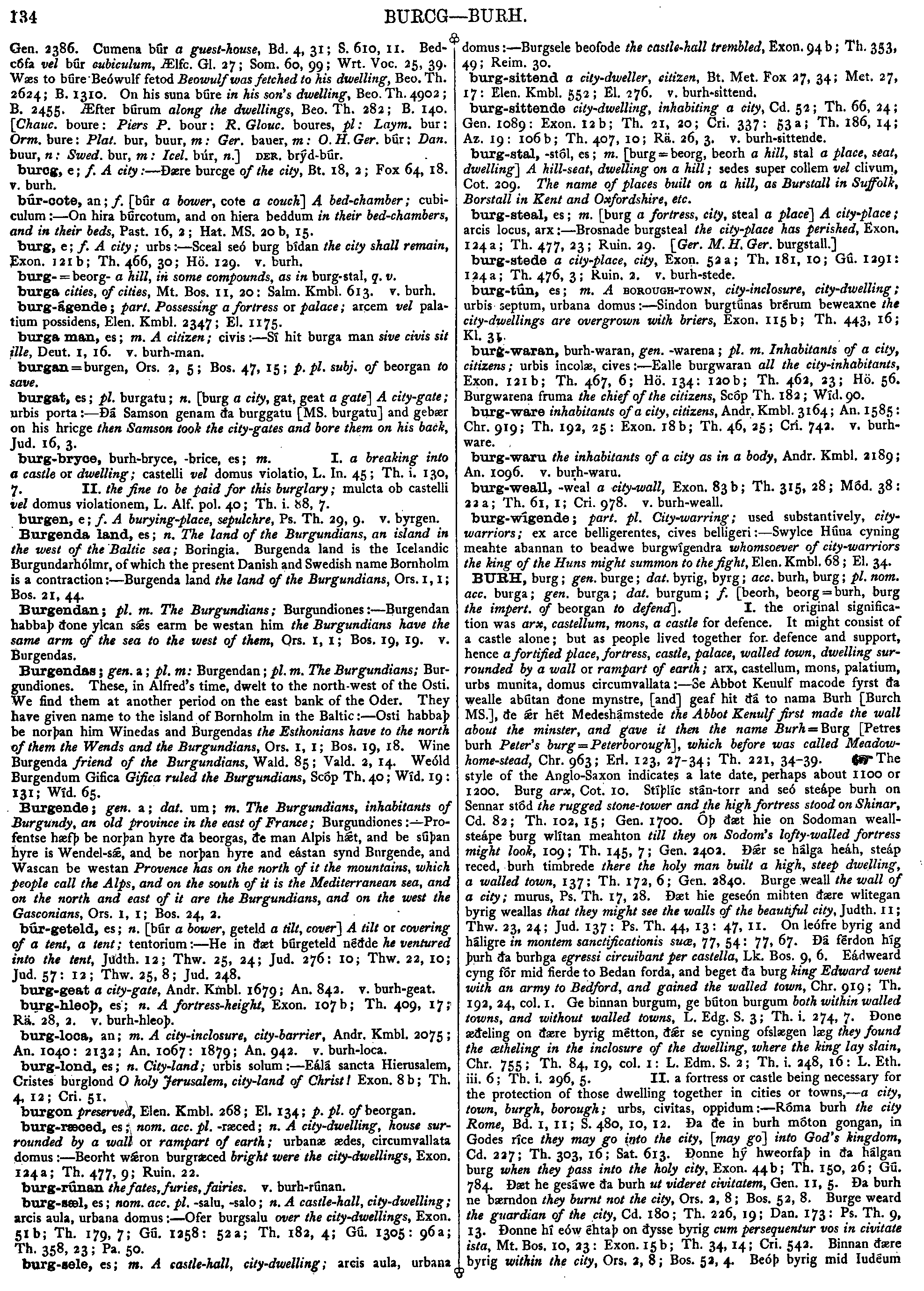
BURH,
burg;
gen.
burge;
dat.
byrig,
byrg;
acc.
burh,
burg;
pl.
nom.
acc.
burga;
gen.
burga;
dat.
burgum;
f.
[beorh,
beorg
=
burh,
burg
the
impert.
of
beorgan
to
defend].
I.
the
original
signification
was
arx,
castellum,
mons,
a
castle
for
defence.
It
might
consist
of
a
castle
alone;
but
as
people
lived
together
for
defence
and
support,
hence
a
fortified
place,
fortress,
castle,
palace,
walled
town,
dwelling
surrounded
by
a
wall
or
rampart
of
earth;
arx,
castellum,
mons,
palatium,
urbs
munita,
domus
circumvallata
:--
Se
Abbot
Kenulf
macode
fyrst
ða
wealle
abútan
ðone
mynstre,
[and]
geaf
hit
ðá
to
nama
Burh
[Burch
MS.],
ðe
 r
hét
Medeshámstede
the
Abbot
Kenulf
first
made
the
wall
about
the
minster,
and
gave
it
then
the
name
Burh
=
Burg
[Petres
burh
Peter's
burg
=
Peterborough]
,
which
before
was
called
Meadow-home-stead,
Chr.
963;
Erl.
123,
27-34;
Th.
221,
34-39.
ILLEGIBLE
The
style
of
the
Anglo-Saxon
indicates
a
late
date,
perhaps
about
1100
or
1200.
Burg
arx,
Cot.
10.
Stíþlíc
stán-torr
and
seó
steépe
burh
on
Sennar
stód
the
rugged
stone-tower
and
the
high
fortress
stood
on
Shinar,
Cd.
82;
Th.
102,
15;
Gen.
1700.
Óþ
ðæt
hie
on
Sodoman
weall-steápe
burg
wlitan
meahton
till
they
on
Sodom's
lofty-walled
fortress
might
look,
109;
Th.
145,
7;
Gen.
2402.
Ðr
se
hálga
heáh,
steáp
reced,
burh
timbrede
there
the
holy
man
built
a
high,
steep
dwelling,
a
walled
town,
137;
Th.
172,
6;
Gen.
2840.
Burge
weall
the
wall
of
a
city;
murus,
Ps.
Th.
17,
28.
Ðæt
hie
geseón
mihten
ðære
wlitegan
byrig
weallas
that
they
might
see
the
walls
of
the
beautiful
city,
Judth.
11;
Thw.
23,
24;
Jud.
137:
Ps.
Th.
44,
13:
47,
11.
On
leófre
byrig
and
háligre
in
montem
sanctificationis
suæ,
77,
54:
77,
67.
Ðá
férdon
híg
þurh
ða
burhga
egressi
circuibant
per
castella.
Lk.
Bos.
9,
6.
Eádweard
cyng
fór
mid
fierde
to
Bedan
forda,
and
beget
ða
burg
king
Edward
went
with
an
army
to
Bedford,
and
gained
the
walled
town,
Chr.
919;
Th.
192,
24,
col.
l.
Ge
binnan
burgum,
ge
búton
burgum
both
within
walled
towns,
and
without
walled
towns,
L.
Edg.
S.
3;
Th.
i.
274,
7.
Ðone
æðeling
on
ðære
byrig
métton,
ðér
se
cyning
ofslægen
læg
they
found
the
ætheling
in
the
inclosure
of
the
dwelling,
where
the
king
lay
slain,
Chr.
755;
Th.
84,
19,
col.
1:
L.
Edm.
S.
2;
Th.
i.
248,
16:
L.
Eth.
iii.
6;
Th.
i.
296,
5.
II.
a
fortress
or
castle
being
necessary
for
the
protection
of
those
dwelling
together
in
cities
or
towns,
--
a
city,
town,
burgh,
borough;
urbs,
civitas,
oppidum
:--
Róma
burh
the
city
Rome,
Bd.
1.
11;
S.
480,
10,
12.
Ða
ðe
in
burh
móton
gongan,
in
Godes
ríce
they
may
go
into
the
city,
[may
go]
into
God's
kingdom,
Cd.
227;
Th.
303,
16;
Sae.
613.
Ðonne
hý
hweorfaþ
in
ða
hálgan
burg
when
they
pass
into
the
holy
city,
Exon.
44b;
Th.
150,
26;
Gú.
784.
Ðæt
he
gesáwe
ða
burh
ut
videret
civitatem,
Gen.
ll,
5.
Ða
burh
ne
bærndon
they
burnt
not
the
city,
Ors.
2,
8;
Bos.
52,
8.
Burge
weard
the
guardian
of
the
city,
Cd.
180;
Th.
226,
19;
Dan.
173:
Ps.
Th.
9,
13.
Ðonne
hí
eów
éhtaþ
on
ðysse
byrig
cum
perseguentur
vos
in
civitate
ista,
Mt.
Bos.
10,
23:
Exon.
15b;
Th.
34,
14;
Cri.
542.
Binnan
ðære
byrig
within
the
city,
Ors.
2,
8;
Bos.
52,
4.
Beóþ
byrig
mid
Iudém
r
hét
Medeshámstede
the
Abbot
Kenulf
first
made
the
wall
about
the
minster,
and
gave
it
then
the
name
Burh
=
Burg
[Petres
burh
Peter's
burg
=
Peterborough]
,
which
before
was
called
Meadow-home-stead,
Chr.
963;
Erl.
123,
27-34;
Th.
221,
34-39.
ILLEGIBLE
The
style
of
the
Anglo-Saxon
indicates
a
late
date,
perhaps
about
1100
or
1200.
Burg
arx,
Cot.
10.
Stíþlíc
stán-torr
and
seó
steépe
burh
on
Sennar
stód
the
rugged
stone-tower
and
the
high
fortress
stood
on
Shinar,
Cd.
82;
Th.
102,
15;
Gen.
1700.
Óþ
ðæt
hie
on
Sodoman
weall-steápe
burg
wlitan
meahton
till
they
on
Sodom's
lofty-walled
fortress
might
look,
109;
Th.
145,
7;
Gen.
2402.
Ðr
se
hálga
heáh,
steáp
reced,
burh
timbrede
there
the
holy
man
built
a
high,
steep
dwelling,
a
walled
town,
137;
Th.
172,
6;
Gen.
2840.
Burge
weall
the
wall
of
a
city;
murus,
Ps.
Th.
17,
28.
Ðæt
hie
geseón
mihten
ðære
wlitegan
byrig
weallas
that
they
might
see
the
walls
of
the
beautiful
city,
Judth.
11;
Thw.
23,
24;
Jud.
137:
Ps.
Th.
44,
13:
47,
11.
On
leófre
byrig
and
háligre
in
montem
sanctificationis
suæ,
77,
54:
77,
67.
Ðá
férdon
híg
þurh
ða
burhga
egressi
circuibant
per
castella.
Lk.
Bos.
9,
6.
Eádweard
cyng
fór
mid
fierde
to
Bedan
forda,
and
beget
ða
burg
king
Edward
went
with
an
army
to
Bedford,
and
gained
the
walled
town,
Chr.
919;
Th.
192,
24,
col.
l.
Ge
binnan
burgum,
ge
búton
burgum
both
within
walled
towns,
and
without
walled
towns,
L.
Edg.
S.
3;
Th.
i.
274,
7.
Ðone
æðeling
on
ðære
byrig
métton,
ðér
se
cyning
ofslægen
læg
they
found
the
ætheling
in
the
inclosure
of
the
dwelling,
where
the
king
lay
slain,
Chr.
755;
Th.
84,
19,
col.
1:
L.
Edm.
S.
2;
Th.
i.
248,
16:
L.
Eth.
iii.
6;
Th.
i.
296,
5.
II.
a
fortress
or
castle
being
necessary
for
the
protection
of
those
dwelling
together
in
cities
or
towns,
--
a
city,
town,
burgh,
borough;
urbs,
civitas,
oppidum
:--
Róma
burh
the
city
Rome,
Bd.
1.
11;
S.
480,
10,
12.
Ða
ðe
in
burh
móton
gongan,
in
Godes
ríce
they
may
go
into
the
city,
[may
go]
into
God's
kingdom,
Cd.
227;
Th.
303,
16;
Sae.
613.
Ðonne
hý
hweorfaþ
in
ða
hálgan
burg
when
they
pass
into
the
holy
city,
Exon.
44b;
Th.
150,
26;
Gú.
784.
Ðæt
he
gesáwe
ða
burh
ut
videret
civitatem,
Gen.
ll,
5.
Ða
burh
ne
bærndon
they
burnt
not
the
city,
Ors.
2,
8;
Bos.
52,
8.
Burge
weard
the
guardian
of
the
city,
Cd.
180;
Th.
226,
19;
Dan.
173:
Ps.
Th.
9,
13.
Ðonne
hí
eów
éhtaþ
on
ðysse
byrig
cum
perseguentur
vos
in
civitate
ista,
Mt.
Bos.
10,
23:
Exon.
15b;
Th.
34,
14;
Cri.
542.
Binnan
ðære
byrig
within
the
city,
Ors.
2,
8;
Bos.
52,
4.
Beóþ
byrig
mid
Iudém
|
Source: Bosworth/Toller, page b0193, entry 23 View original page image as: [TIFF] [PNG] [View previous entry] [View next entry] |
[Comment on this entry] [View comments] |
The following entry has been hand-corrected once. |
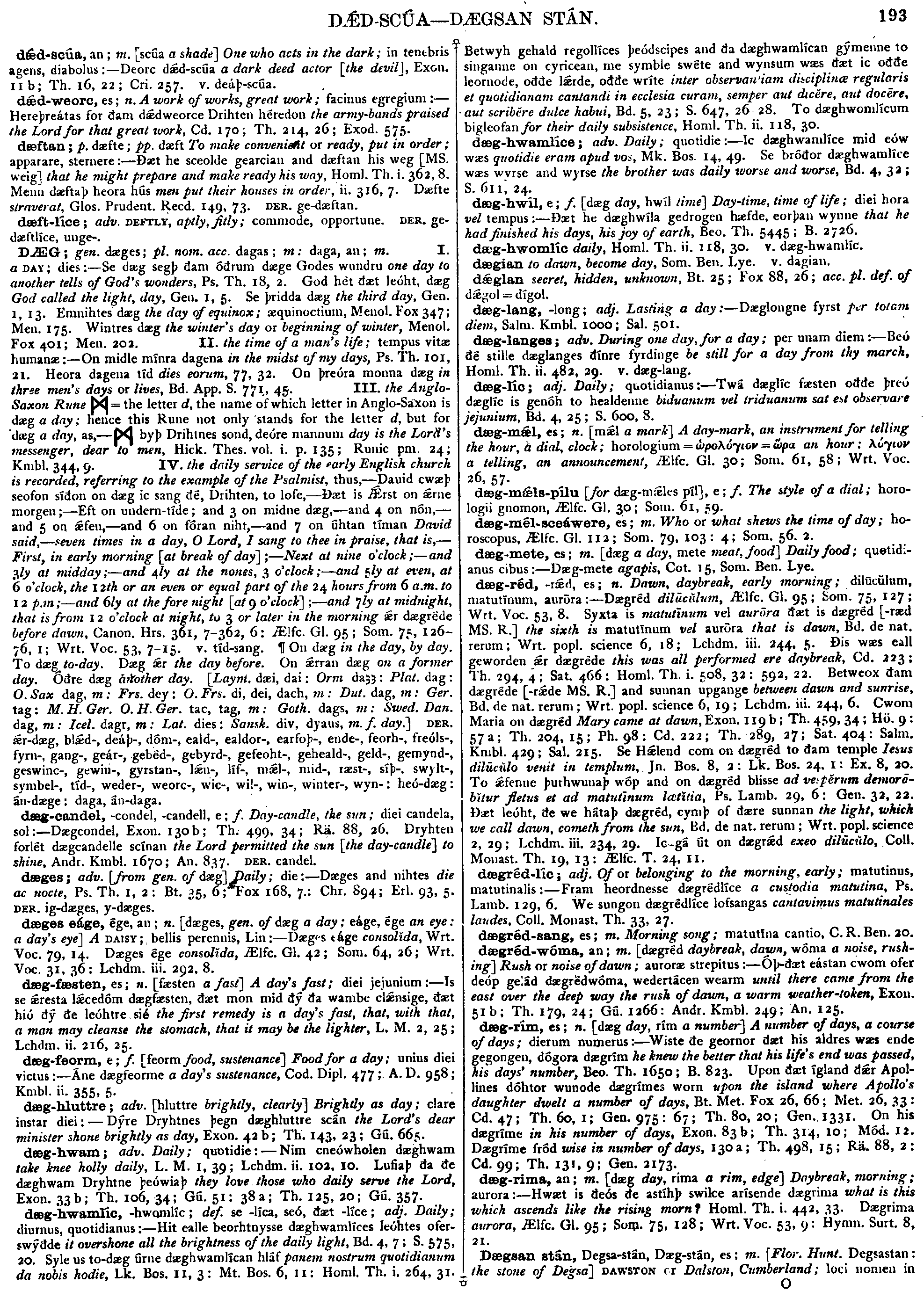
dæg-mls-pílu
[for
dæg-mles
píl],
e;
f.
The
style
of
a
dial;
horologii
gnomon,
Ælfc.
Gl.
30;
Som.
61,
59.
|
Source: Bosworth/Toller, page b0411, entry 3 View original page image as: [TIFF] [PNG] [View previous entry] [View next entry] |
[Comment on this entry] [View comments] |
The following entry has been hand-corrected once. |
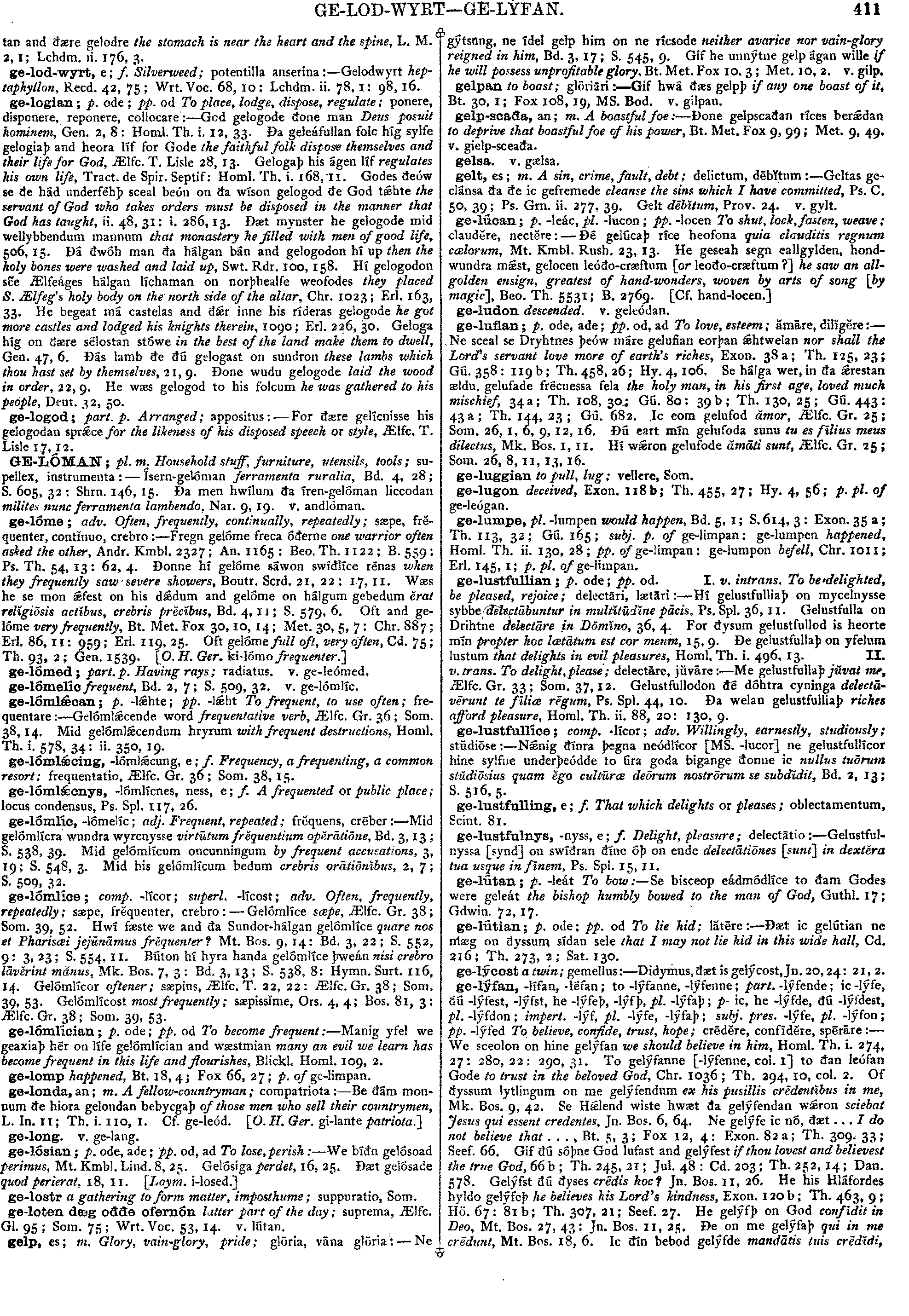
ge-logod;
part.
p.
Arranged;
appositus
:--
For
ðære
gelícnisse
his
gelogodan
sprce
for
the
likeness
of
his
disposed
speech
or
style,
Ælfc.
T.
Lisle
17,
12.
|
Source: Bosworth/Toller, page b0460, entry 2 View original page image as: [TIFF] [PNG] [View previous entry] [View next entry] |
[Comment on this entry] [View comments] |
The following entry has been hand-corrected once. |
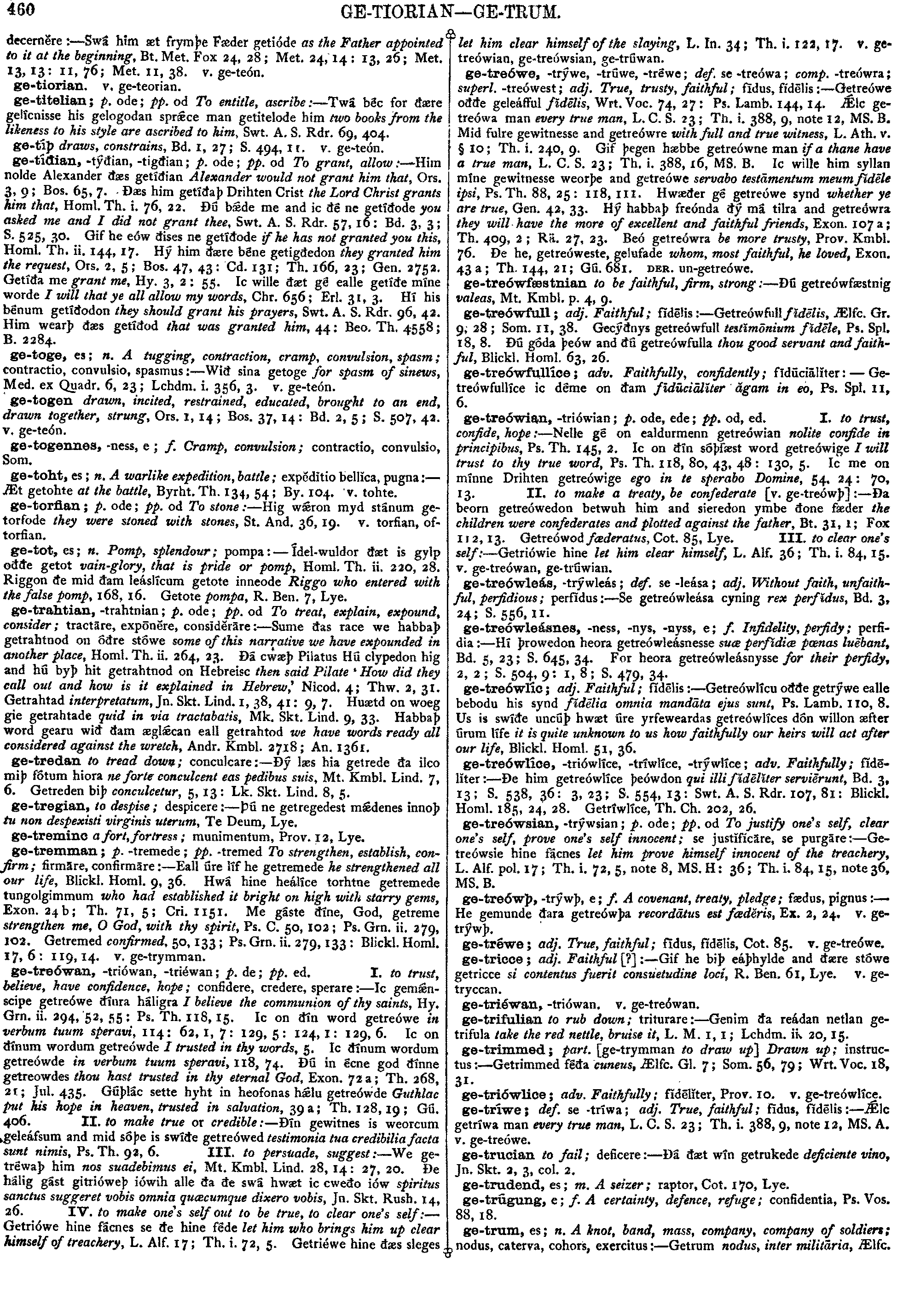
ge-titelian;
p.
ode;
pp.
od
To
entitle,
ascribe
:--
Twá
béc
for
ðære
gelícnisse
his
gelogodan
sprce
man
getitelode
him
two
books
from
the
likeness
to
his
style
are
ascribed
to
him,
Swt.
A.
S.
Rdr.
69,
404.
|
Source: Bosworth/Toller, page b0486, entry 15 View original page image as: [TIFF] [PNG] [View previous entry] [View next entry] |
[Comment on this entry] [View comments] |
The following entry has been hand-corrected once. |
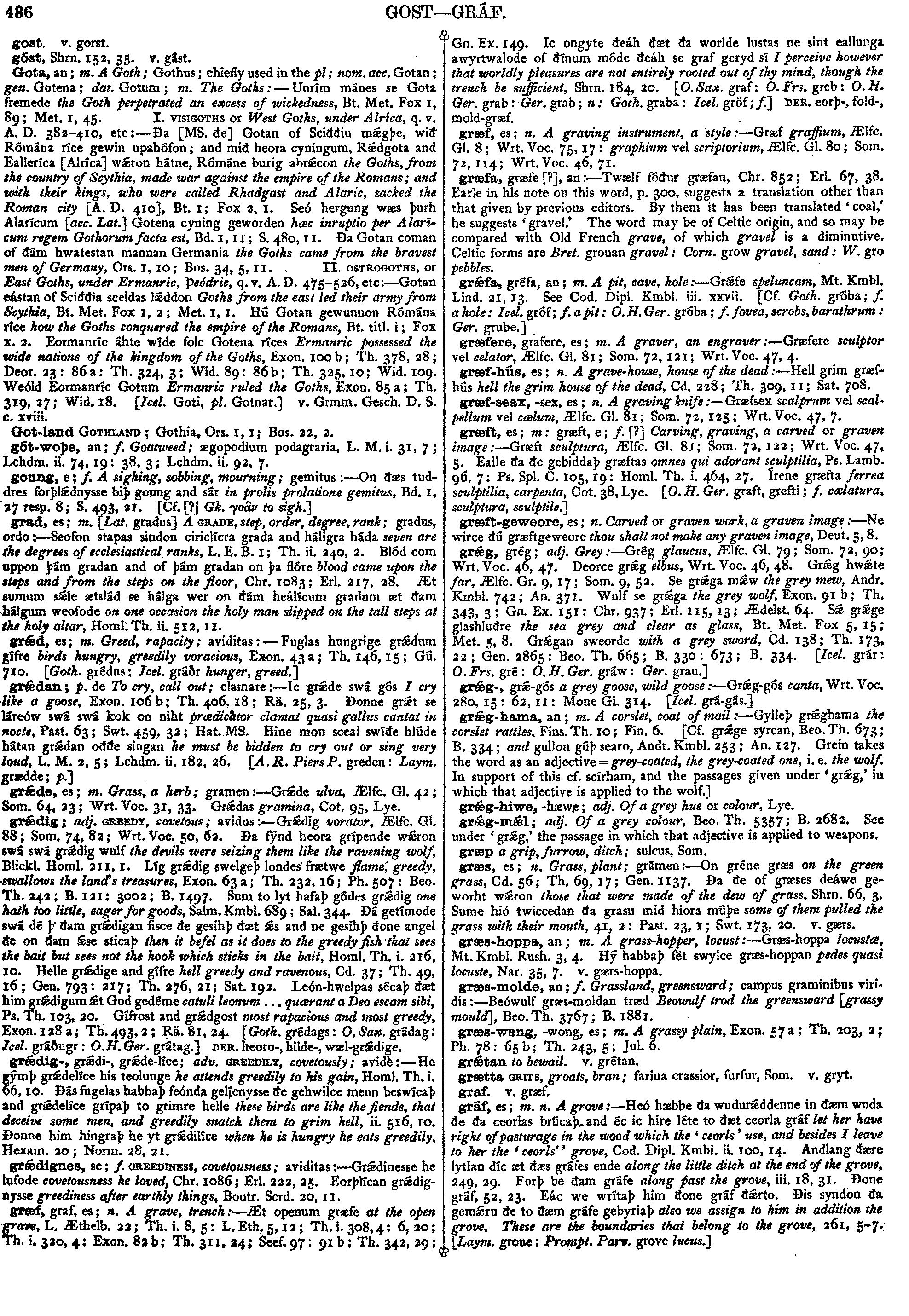
græf, es; n. A graving instrument, a style :-- Græf graffium, Ælfc. Gl. 8; Wrt. Voc. 75, 17: graphium vel scriptorium, Ælfc. Gl. 80; Som. 72, 114; Wrt. Voc. 46, 71.
|
Source: Bosworth/Toller, page b0736, entry 7 View original page image as: [TIFF] [PNG] [View previous entry] [View next entry] |
[Comment on this entry] [View comments] |
The following entry has been hand-corrected once. |
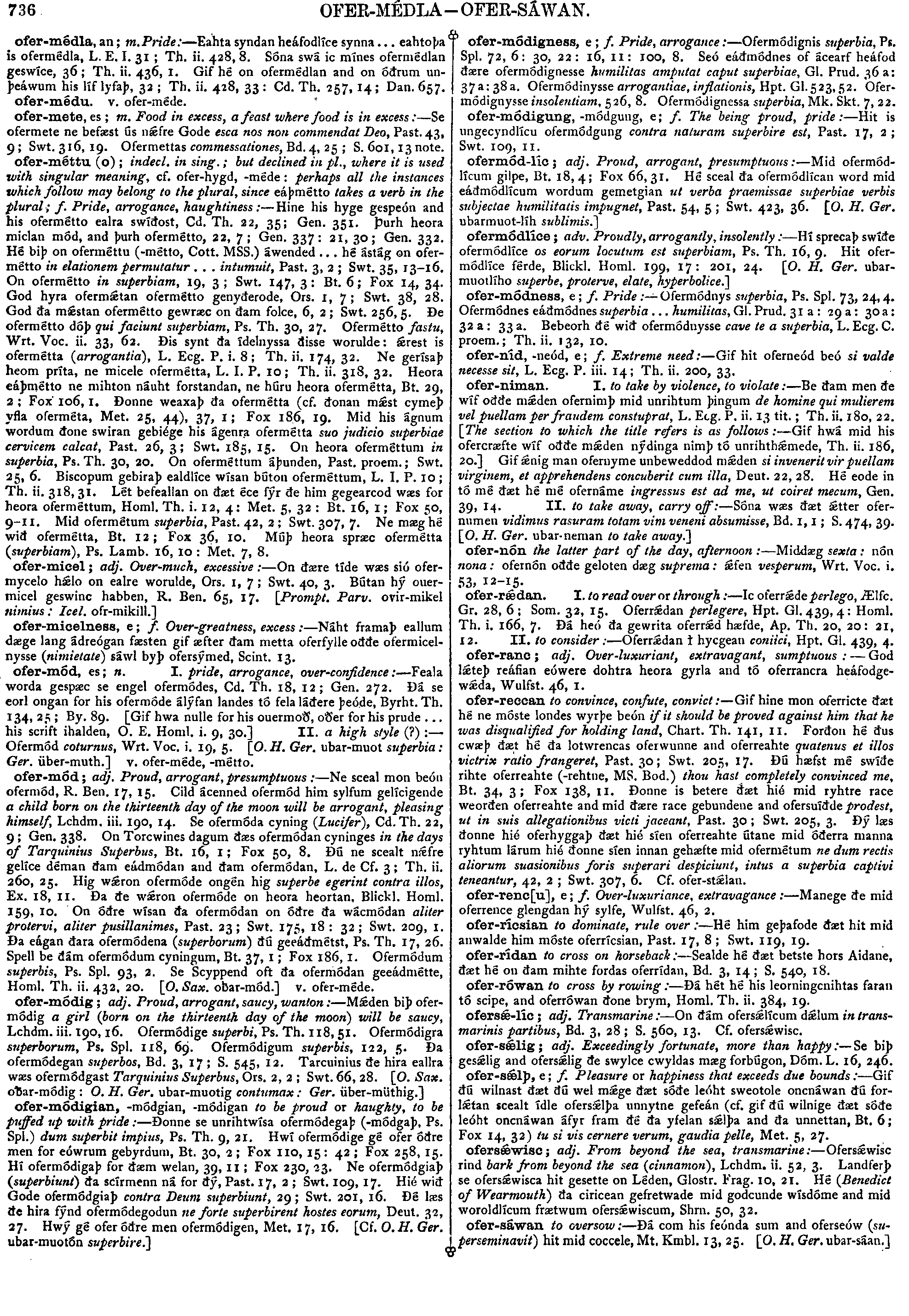
ofer-mód, es; n. I. pride, arrogance, over-confidence: -- Feala worda gespæc se engel ofermódes, Cd. Th. 18, 12; Gen. 272. Ðá se eorl ongan for his ofermóde álýfan landes tó fela láðere þeóde, Byrht. Th. 134,25; By. 89. [Gif hwa nulle for his ouermoð, oðer for his prude . . . his scrift ihalden, O. E. Homl. i. 9, 30.] II. a high style (?) :-- Ofermód coturnus, Wrt. Voc. i. 19, 5. [O. H. Ger. ubar-muot superbia : Ger. über-muth.] v. ofer-méde, -métto.
|
Source: Bosworth/Toller, page b0904, entry 1 View original page image as: [TIFF] [PNG] [View previous entry] [View next entry] |
[Comment on this entry] [View comments] |
The following entry has been hand-corrected once. |
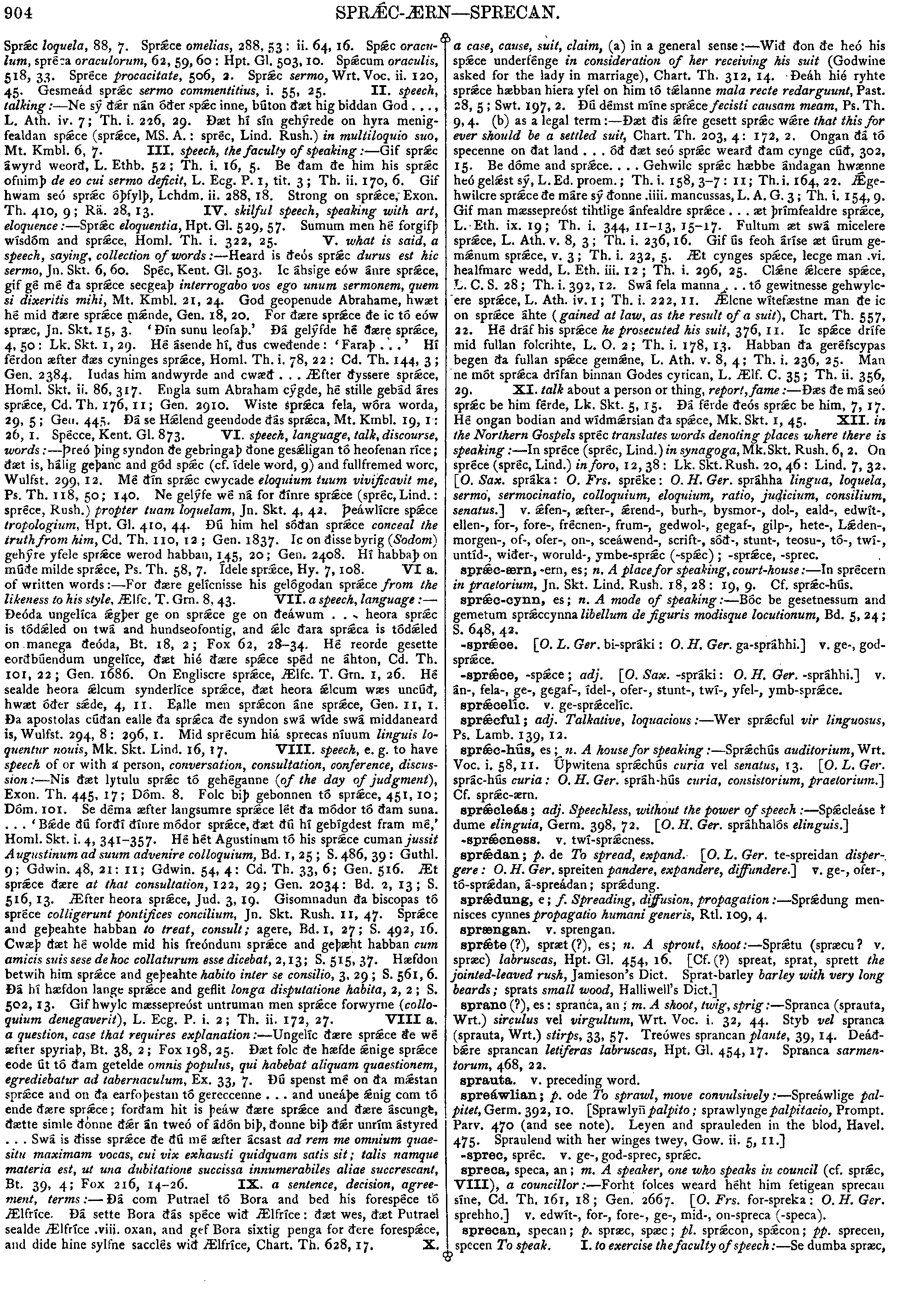
Sprc
loquela,
88,
7.
Sprce
omelias,
288,
53:
ii.
64,
16.
Spc
oraculum,
spréca
oraculorum,
62,
59,
60:
Hpt.
Gl.
503,
10.
Spcum
oraculis,
518,
33.
Spréce
procacitate,
506,
2.
Sprc
sermo,
Wrt.
Voc.
ii.
120,
45.
Gesmeád
sprc
sermo
commentitius,
i.
55,
25.
II.
speech,
talking
:--
Ne
sý
ðr
nán
óðer
spc
inne,
buton
ðæt
hig
biddan
God
...,
L.
Ath.
iv.
7;
Th.
i.
226,
29.
Ðæt
hí
sín
gehýrede
on
hyra
menigfealdan
spce
(sprce,
MS.
A.:
spréc,
Lind.
Rush.)
in
multiloquio
suo,
Mt.
Kmbl.
6,
7.
III.
speech,
the
faculty
of
speaking
:--
Gif
sprc
áwyrd
weorð,
L.
Ethb.
52;
Th.
i.
16,
5.
Be
ðam
ðe
him
his
sprc
ofnimþ
de
eo
cui
sermo
deficit,
L.
Ecg.
P.
1,
tit.
3;
Th.
ii.
170,
6.
Gif
hwam
seó
sprc
óþfylþ,
Lchdm.
ii.
288,
18.
Strong
on
sprce,
Exon.
Th.
410,
9;
Rä.
28,
13.
IV.
skilful
speech,
speaking
with
art,
eloquence
:--
Sprc
eloquentia,
Hpt.
Gl.
529,
57.
Sumum
men
hé
forgifþ
wísdóm
and
sprce,
Homl.
Th.
i.
322,
25.
V.
what
is
said,
a
speech,
saying,
collection
of
words
:--
Heard
is
ðeós
sprc
durus
est
hic
sermo,
Jn.
Skt.
6,
60.
Spéc,
Kent.
Gl.
503.
Ic
áhsige
eów
ánre
sprce,
gif
gé
mé
ða
sprce
secgeaþ
interrogabo
vos
ego
unum
sermonem,
quem
si
dixeritis
mihi,
Mt.
Kmbl.
21,
24.
God
geopenude
Abrahame,
hwæt
hé
mid
ðære
sprce
mnde,
Gen.
18,
20.
For
ðære
sprce
ðe
ic
tó
eów
spræc,
Jn.
Skt.
15,
3.
'Ðín
sunu
leofaþ.'
Ðá
gelýfde
hé
ðære
sprce,
4,
50:
Lk.
Skt.
1,
29.
Hé
ásende
hí,
ðus
cweðende:
'Faraþ
...'
Hí
férdon
æfter
ðæs
cyninges
sprce,
Homl.
Th.
i.
78,
22:
Cd.
Th.
144,
3;
Gen.
2384.
Iudas
him
andwyrde
and
cwæð
...
Æfter
ðyssere
sprce,
Homl.
Skt.
ii.
86,
317.
Engla
sum
Abraham
cýgde,
hé
stille
gebád
áres
sprce,
Cd.
Th.
176,
11;
Gen.
2910.
Wiste
sprca
fela,
wóra
worda,
29,
5;
Gen.
445.
Ðá
se
Hlend
geendode
ðás
sprca,
Mt.
Kmbl.
19,
1;
26,
1.
Spécce,
Kent.
Gl.
873.
VI.
speech,
language,
talk,
discourse,
words
:--
Þreó
þing
syndon
ðe
gebringaþ
ðone
gesligan
tó
heofenan
ríce;
ðæt
is,
hálig
geþanc
and
gód
spc
(cf.
ídele
word,
9)
and
fullfremed
worc,
Wulfst.
299,
12.
Mé
ðin
sprc
cwycade
eloquium
tuum
vivificavit
me,
Ps.
Th.
118,
50;
140.
Ne
gelýfe
wé
ná
for
ðínre
sprce
(spréc,
Lind.:
spréce,
Rush.)
propter
tuam
loquelam,
Jn.
Skt.
4,
42.
Þeáwlícre
spce
tropologium,
Hpt.
Gl.
410,
44.
Ðu
him
hel
sóðan
sprce
conceal
the
truth
from
him,
Cd.
Th.
110,
12;
Gen.
1837.
Ic
on
ðisse
byrig
(Sodom)
gehýre
yfele
sprce
werod
habban,
145,
20;
Gen.
2408.
Hí
habbaþ
on
múðe
milde
sprce,
Ps.
Th.
58,
7.
Ídele
sprce,
Hy.
7,
108.
VI
a.
of
written
words
:--
For
ðære
gelícnisse
his
gelógodan
sprce
from
the
likeness
to
his
style,
Ælfc.
T.
Grn.
8,
43.
VII.
a
speech,
language
:--
Ðeóda
ungelíca
gþer
ge
on
sprce
ge
on
ðeáwum
...
heora
sprc
is
tódled
on
twá
and
hundseofontig,
and
lc
ðara
sprca
is
tódled
on
manega
ðeóda,
Bt.
18,
2;
Fox
62,
28-34.
Hé
reorde
gesette
eorðbúendum
ungelíce,
ðæt
hié
ðære
spce
spéd
ne
áhton,
Cd.
Th.
101,
22;
Gen.
1686.
On
Engliscre
sprce,
Ælfc.
T.
Grn.
1,
26.
Hé
sealde
heora
lcum
synderlíce
sprce,
ðæt
heora
lcum
wæs
uncúð,
hwæt
óðer
sde,
4,
11.
Ealle
men
sprcon
áne
sprce.
Gen.
11,
1.
Ða
apostolas
cúðan
ealle
ða
sprca
ðe
syndon
swá
wíde
swá
middaneard
is,
Wulfst.
294,
8:
296,
1.
Mid
sprécum
hiá
sprecas
níuum
linguis
loquentur
nouis,
Mk.
Skt.
Lind.
16,
17.
VIII.
speech,
e.g.
to
have
speech
of
or
with
a
person,
conversation,
consultation,
conference,
discussion
:--
Nis
ðæt
lytulu
sprc
to
gehéganne
(of
the
day
of
judgment),
Exon.
Th.
445,
17;
Dóm.
8.
Folc
biþ
gebonnen
tó
sprce,
451,
10;
Dóm.
101.
Se
déma
æfter
langsumre
sprce
lét
ða
módor
tó
ðam
suna.
...
'Bde
ðú
forðí
ðínre
módor
sprce,
ðæt
ðú
hí
gebígdest
fram
mé,'
Homl.
Skt.
i.
4,
341-357.
Hé
hét
Agustinum
to
his
sprce
cuman
jussit
Augustinum
ad
suum
advenire
colloquium,
Bd.
1,
25;
S.
486,
39:
Guthl.
9;
Gdwin.
48,
21:
11;
Gdwin.
54,
4:
Cd.
Th.
33,
6;
Gen.
516.
Æt
sprce
ðære
at
that
consultation,
122,
29;
Gen.
2034:
Bd.
2,
13;
S.
516,
13.
Æfter
heora
sprce,
Jud.
3,
19.
Gisomnadun
ða
biscopas
tó
spréce
colligerunt
pontifices
concilium,
Jn.
Skt.
Rush.
11,
47.
Sprce
and
geþeahte
habban
to
treat,
consult;
agere,
Bd.
1,
27;
S.
492,
16.
Cwæþ
ðæt
hé
wolde
mid
his
freóndum
sprce
and
geþæht
habban
cum
amicis
suis
sese
de
hoc
collaturum
esse
dicebat,
2,
13;
S.
515,
37.
Hæfdon
betwih
him
sprce
and
geþeahte
habito
inter
se
consilio,
3,
29;
S.
561,
6.
Ða
hi
hæfdon
lange
sprce
and
geflit
longa
disputatione
habita,
2,
2;
S.
502,
13.
Gif
hwylc
mæssepreóst
untruman
men
sprce
forwyrne
(colloquium
denegaverit),
L.
Ecg.
P.
i.
2;
Th.
ii.
172,
27.
VIII
a.
a
question,
case
that
requires
explanation
:--
Ungelíc
ðære
sprce
ðe
wé
æfter
spyriaþ,
Bt.
38,
2;
Fox
198,
25.
Ðæt
folc
ðe
hæfde
nige
sprce
eode
út
tó
ðam
getelde
omnis
populus,
qui
habebat
aliquam
quaestionem,
egrediebatur
ad
tabernaculum,
Ex.
33,
7.
Ðú
spenst
mé
on
ða
mstan
sprce
and
on
ða
earfoþestan
tó
gereccenne
...
and
uneáþe
nig
com
tó
ende
ðære
sprce;
forðam
hit
is
þeáw
ðære
sprce
and
ðære
áscunge,
ðætte
simle
ðónne
ðr
án
tweó
of
ádón
biþ,
ðonne
biþ
ðr
unrím
ástyred
...
Swá
is
ðisse
sprce
ðe
ðu
mé
æfter
ácsast
ad
rem
me
omnium
quaesitu
maximam
vocas,
cui
vix
exhausti
quidquam
satis
sit;
talis
namque
materia
est,
ut
una
dubitatione
succissa
innumerabiles
aliae
succrescant,
Bt.
39,
4;
Fox
216,
14-26.
IX.
a
sentence,
decision,
agreement,
terms
:--
Ðá
com
Putrael
tó
Bora
and
bed
his
forespéce
tó
Ælfríce.
Ðá
sette
Bora
ðás
spéce
wið
Ælfríce:
ðæt
wes,
ðæt
Putrael
sealde
Ælfríce
.viii.
oxan,
and
gef
Bora
sixtig
penga
for
ðere
forespce,
and
dide
hine
sylfne
sacclés
wið
Ælfríce,
Chart.
Th.
628,
17.
X.
a
case,
cause,
suit,
claim,
(a)
in
a
general
sense
:--
Wið
ðon
ðe
heó
his
spce
underfénge
in
consideration
of
her
receiving
his
suit
(Godwine
asked
for
the
lady
in
marriage),
Chart.
Th.
312,
14.
Ðeáh
hié
ryhte
sprce
hæbban
hiera
yfel
on
him
tó
tlanne
mala
recte
redarguunt,
Past.
28,
5;
Swt.
197,
2.
Ðú
démst
míne
sprce
fecisti
causam
meam,
Ps.
Th.
9,
4.
(b)
as
a
legal
term
:--
Ðæt
ðis
fre
gesett
sprc
wre
that
this
for
ever
should
be
a
settled
suit,
Chart.
Th.
203,
4:
172,
2.
Ongan
ðá
tó
specenne
on
ðat
land
...
óð
ðæt
seó
sprc
wearð
ðam
cynge
cúð,
302,
15.
Be
dóme
and
sprce.
...
Gehwilc
sprc
hæbbe
ándagan
hwænne
heó
gelst
sý,
L.
Ed.
proem.;
Th.
i.
158,
3-7:
11;
Th.
i.
164,
22.
Æ-acute;gehwilcre
sprce
ðe
máre
sý
ðonne
.iiii.
mancussas,
L.
A.
G.
3;
Th.
i.
154,
9.
Gif
man
mæssepreóst
tihtlige
ánfealdre
sprce
...
æt
þrímfealdre
sprce,
L.
Eth.
ix.
19;
Th.
i.
344,
11-13,
15-17.
Fultum
æt
swá
micelere
sprce,
L.
Ath.
v.
8,
3;
Th.
i.
236,
16.
Gif
ús
feoh
áríse
æt
úrum
gemnum
sprce,
v.
3;
Th.
i.
232,
5.
Æt
cynges
spce,
lecge
man
.vi.
healfmarc
wedd,
L.
Eth.
iii.
12;
Th.
i.
296,
25.
Clne
lcere
spce,
L.
C.
S.
28;
Th.
i.
392,
12.
Swá
fela
manna
...
tó
gewitnesse
gehwylcere
sprce,
L.
Ath.
iv.
i;
Th.
i.
222,
11.
Æ-acute;lcne
wítefæstne
man
ðe
ic
on
sprce
áhte
(gained
at
law,
as
the
result
of
a
suit),
Chart.
Th.
557,
22.
Hé
dráf
his
sprce
he
prosecuted
his
suit,
376,
11.
Ic
spce
drífe
mid
fullan
folcrihte,
L.
O.
2;
Th.
i.
178,
13.
Habban
ða
geréfscypas
begen
ða
fullan
spce
gemne,
L.
Ath.
v.
8,
4;
Th.
i.
236,
25.
Man
ne
mót
sprca
drífan
binnan
Godes
cyrican,
L.
Ælf.
C.
35;
Th.
ii.
356,
29.
XI.
talk
about
a
person
or
thing,
report,
fame
:--
Ðæs
ðe
má
seó
sprc
be
him
férde,
Lk.
Skt.
5,
15.
Ðá
férde
ðeós
sprc
be
him,
7,
17.
Hé
ongan
bodian
and
wídmrsian
ða
spce,
Mk.
Skt.
1,
45.
XII.
in
the
Northern
Gospels
spréc
translates
words
denoting
places
where
there
is
speaking
:--
In
spréce
(spréc,
Lind.)
in
synagoga,
Mk.
Skt.
Rush.
6,
2.
On
spréce
(spréc,
Lind.)
in
foro,
12,
38:
Lk.
Skt.
Rush.
20,
46:
Lind.
7,
32.
[O.
Sax.
spráka:
O.
Frs.
spréke:
O.
H.
Ger.
spráhha
lingua,
loquela,
sermo,
sermocinatio,
colloquium,
eloquium,
ratio,
judicium,
consilium,
senatus.]
v.
fen-,
æfter-,
rend-,
burh-,
bysmor-,
dol-,
eald-,
edwít-,
ellen-,
for-,
fore-,
frécnen-,
frum-,
gedwol-,
gegaf-,
gilp-,
hete-,
Lden-,
morgen-,
of-,
ofer-,
on-,
sceáwend-,
scrift-,
sóð,
stunt-,
teosu-,
tó-,
twí-,
untíd-,
wiðer-,
woruld-,
ymbe-sprc
(-spc);
-sprce,
-sprec.
|
Source: Bosworth/Toller, page b0920, entry 3 View original page image as: [TIFF] [PNG] [View previous entry] [View next entry] |
[Comment on this entry] [View comments] |
The following entry has been hand-corrected once. |
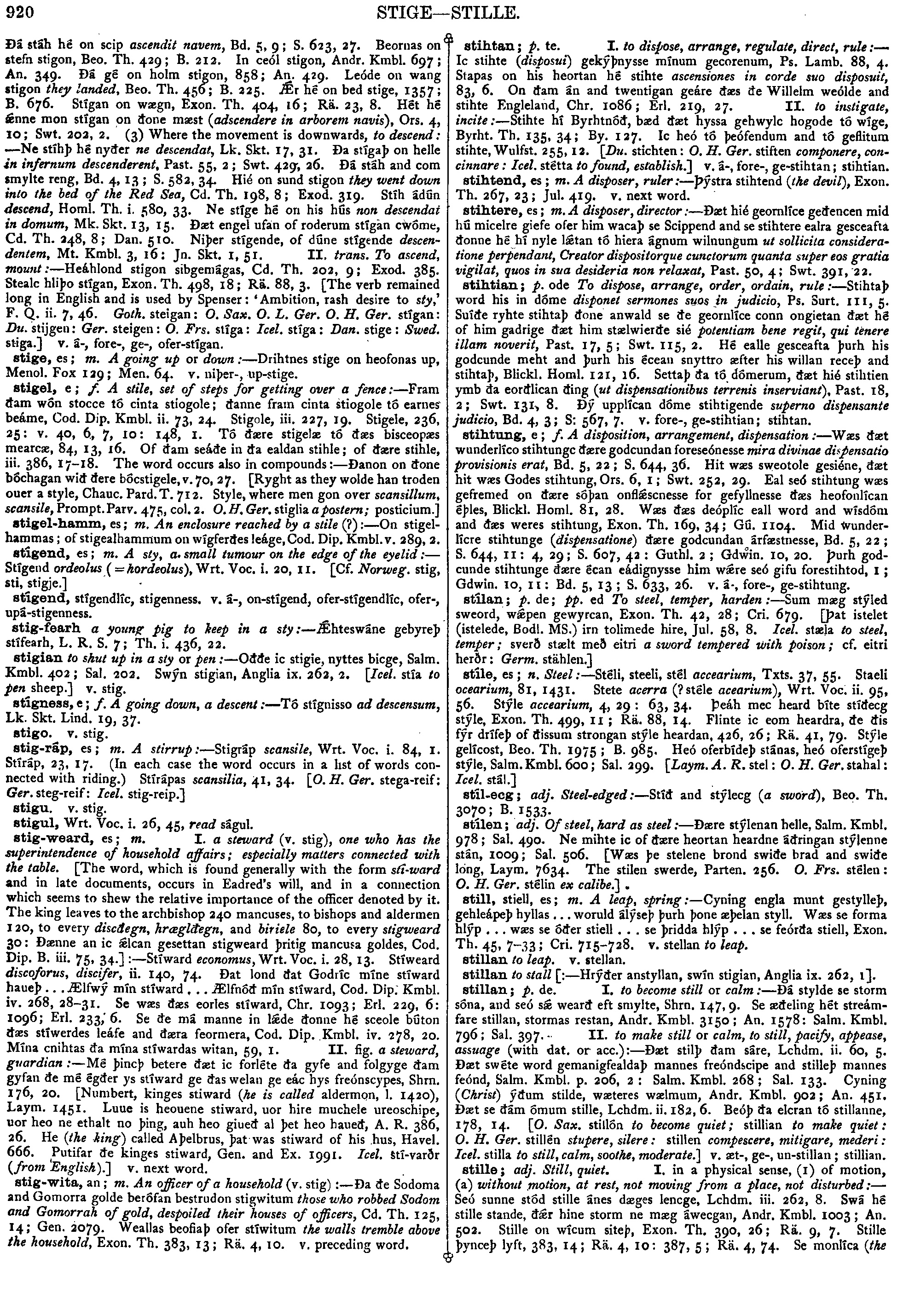
stigel, e ; f. A stile, set of steps for getting over a fence :--Fram ðam wón stocce tó cinta stiogole ; ðanne fram cinta stiogole tó earnes beáme, Cod. Dip. Kmbl. ii. 73, 24. Stigole, iii. 227, 19. Stigele, 236, 25 : v. 40, 6, 7, 10 : 148, 1. Tó ðære stigelæ tó ðæs bisceopæs mearcæ, 84, 13, 16. Of ðam seáðe in ða ealdan stihle ; of ðære stihle, iii. 386, 17-18. The word occurs also in compounds :--Ðanon on ðone bóchagan wið ðere bócstigele, v. 70, 27. [Ryght as they wolde han troden ouer a style, Chauc. Pard. T. 712. Style, where men gon over scansillum, scansile, Prompt. Parv. 475, col. 2. O. H. Ger. stiglia a postern ; posticium.]
|
Source: Bosworth/Toller, page b1084, entry 25 View original page image as: [TIFF] [PNG] [View previous entry] [View next entry] |
[Comment on this entry] [View comments] |
The following entry has been hand-corrected once. |
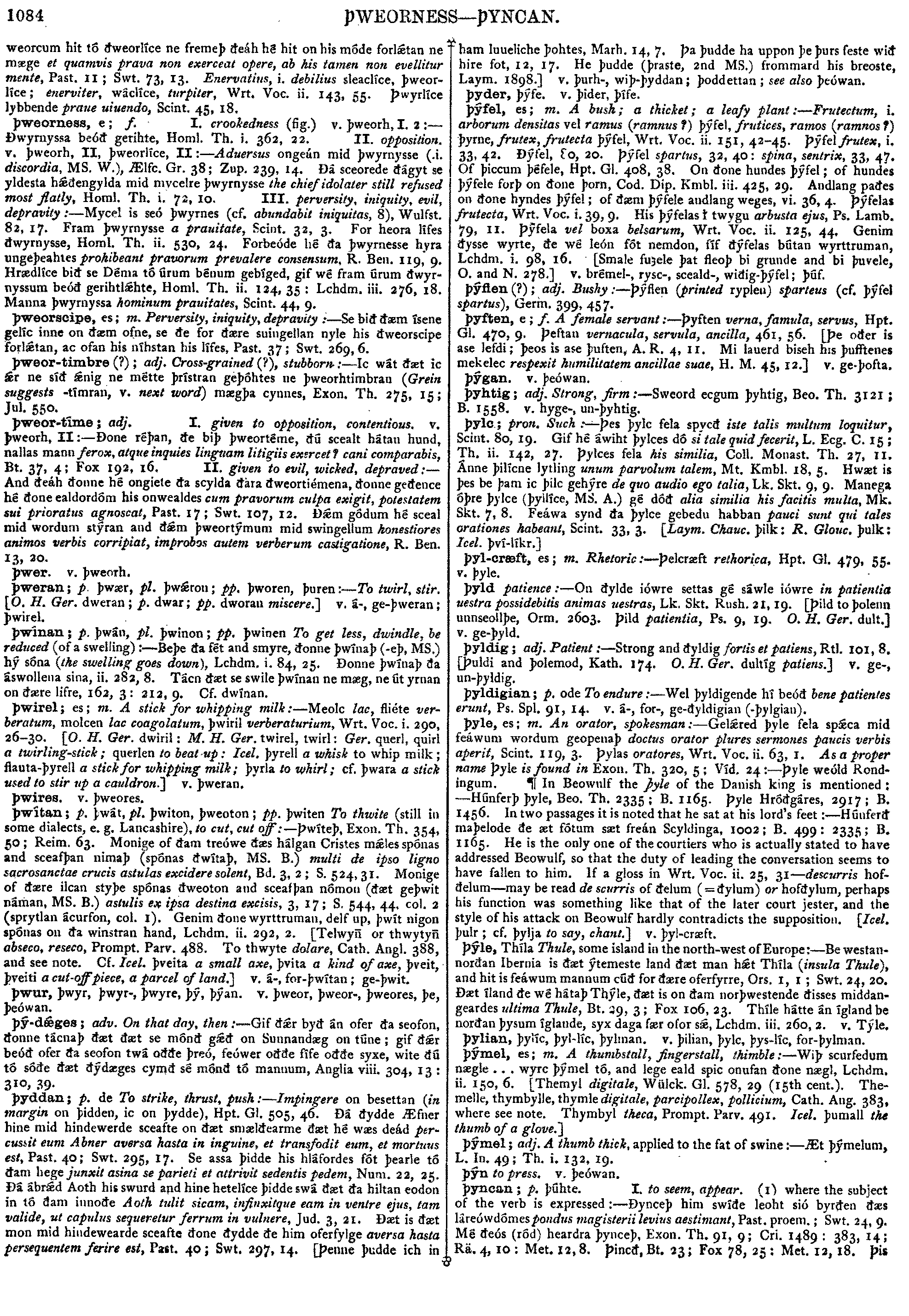
þyle,
es;
m.
An
orator,
spokesman
:--
Gelred
þyle
fela
spca
mid
feáwum
wordum
geopenaþ
doctus
orator
plures
sermones
paucis
verbis
aperit,
Scint.
119,
3.
Þylas
oratores,
Wrt.
Voc.
ii.
63,
1.
As
a
proper
name
Þyle
is
found
in
Exon.
Th.
320,
5;
Víd.
24
:--
Þyle
weóld
Rondingum.

In
Beowulf
the
þyle
of
the
Danish
king
is
mentioned
:--
Húnferþ
þyle,
Beo.
Th.
2335;
B.
1165.
Þyle
Hróðgáres,
2917;
B.
1456.
In
two
passages
it
is
noted
that
he
sat
at
his
lord's
feet
:--
Húnferð
maþelode
ðe
æt
fótum
sæt
freán
Scyldinga,
1002;
B.
499:
2335;
B.
1165.
He
is
the
only
one
of
the
courtiers
who
is
actually
stated
to
have
addressed
Beowulf,
so
that
the
duty
of
leading
the
conversation
seems
to
have
fallen
to
him.
If
a
gloss
in
Wrt.
Voc.
ii.
25,
31-descurris
hofðelum-may
be
read
de
scurris
of
ðelum
(
=
ðylum)
or
hofðylum,
perhaps
his
function
was
something
like
that
of
the
later
court
jester,
and
the
style
of
his
attack
on
Beowulf
hardly
contradicts
the
supposition.
[Icel.
þulr;
cf.
þylja
to
say,
chant.]
v.
þyl-cræft.
|
Source: Bosworth/Toller, page b1265, entry 1 View original page image as: [TIFF] [PNG] [View previous entry] [View next entry] |
[Comment on this entry] [View comments (2)] |
The following entry has been hand-corrected once. |
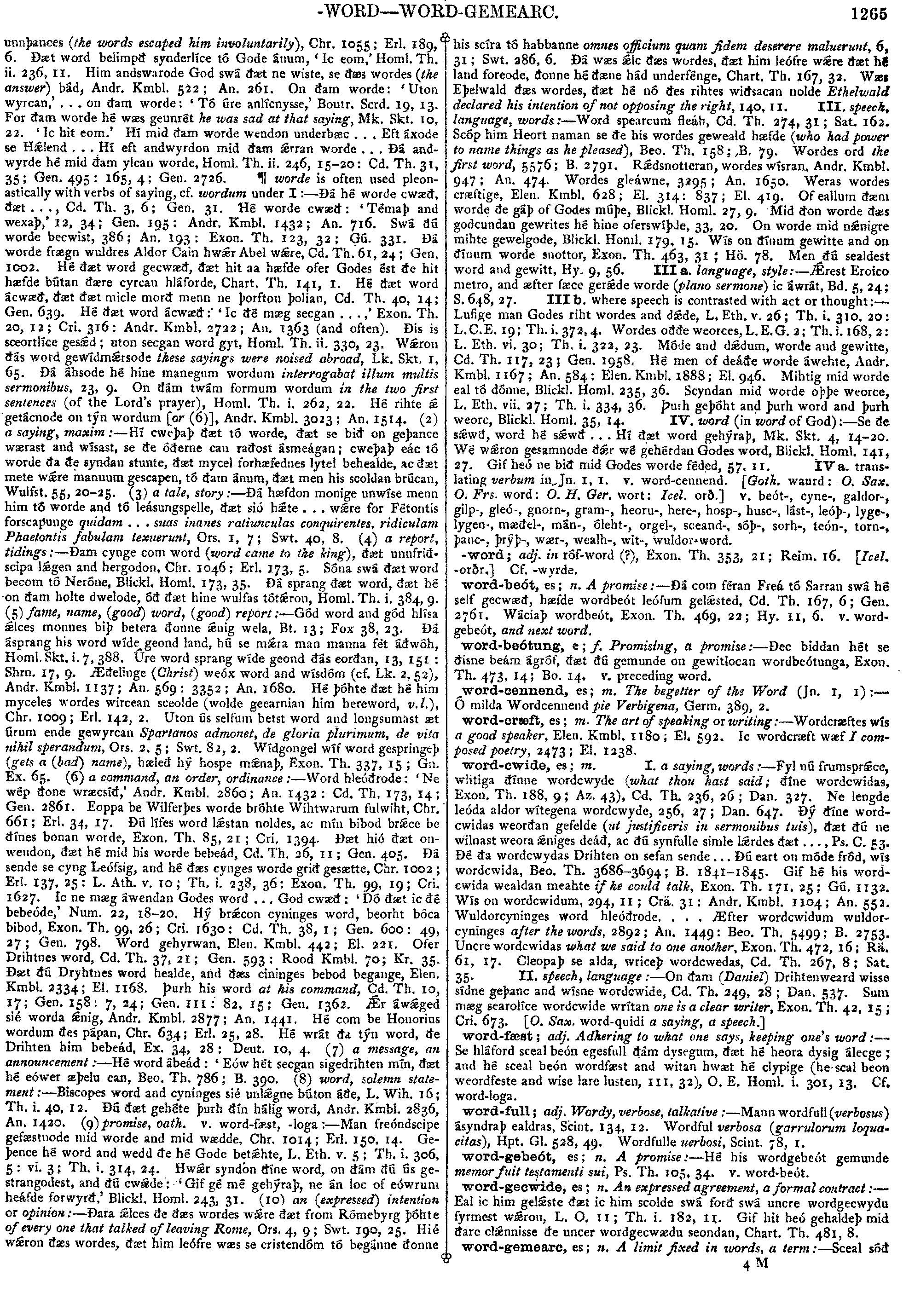
unnþances
(the
words
escaped
him
involuntarily,
Chr.
1055;
Erl.
189,
]
6.
Ðæt
word
belimpð
synderlíce
tó
Gode
ánum,
'
lc
com,'
Homl.
Th.
ii.
236,
II.
Him
andswarode
God
swá
ðæt
ne
wiste,
se
ðæs
wordes
(the
answer)
bád,
Andr.
Kmbl.
522;
An.
261.
On
ðam
worde:
'Uton
wyrcan,
'
.
.
.
on
ðam
worde:
'
Tó
úre
anlícnysse,
'
Boutr.
Scrd.
19,
13.
For
ðam
worde
hé
wæs
geunrét
he
was
sad
at
that
saying,
Mk.
Skt.
10,
22.
'
Ic
hit
eom.
"
Hí
mid
ðam
worde
wendon
underbæc
.
.
.
Eft
áxode
se
Hlend
.
.
.
Hí
eft
andwyrdon
mid
ðam
rran
worde
.
.
.
Ðá
and
wyrde
hé
mid
ðam
ylcan
worde.
Homl.
Th.
ii.
246,
15-20:
Cd.
Th.
31,
35;
Gen.
495:
165,
4;
Gen.
2726.

worde
is
often
used
pleonastically
with
verbs
of
saying,
cf.
wordum
under
I
:--
Ða
hé
worde
cwæð,
ðæt
.
.
.
,
Cd.
Th.
3,
6;
Gen.
31.
Hé
worde
cwæð:
'
Témaþ
and
wexaþ,'12,
34;
Gen.
195:
Andr.
Kmbl.
1432;
An.
716.
Swá
dú
worde
becwist,
386;
An.
193:
Exon.
Th.
123,
32;
Gú.
331.
Ða
worde
frægn
wuldres
Aldor
Cain
hwr
Abel
wre,
Cd.
Th.
61,
24
;
Gen.
1002.
Hé
ðæt
word
gecwæð,
ðæt
hit
aa
hæfde
ofer
Godes
ést
ðe
hit
hæfde
bútan
ðære
cyrcan
hláforde,
Chart.
Th.
141,
I.
Hé
ðæt
word
ácwæð,
ðæt
ðæt
micle
morð
menn
ne
þorfton
þolian,
Cd.
Th.
40,
14;
Gen.
639.
Hé
ðæt
word
ácwæð:'
'
Ic
ðé
mæg
secgan
.
.
.
,
'
Exon.
Th.
20,
12;
Cri.
316:
Andr.
Kmbl.
2722;
An.
1363
(and
often).
Ðis
is
sceortlíce
gesd
;
uton
secgan
word
gyt,
Homl.
Th.
ii.
330,
23.
Wron
ðás
word
gewídmrsode
these
sayings
were
noised
abroad,
Lk.
Skt.
I,
65.
Ðá
áhsode
hé
hine
manegnm
wordum
inlerrogabat
ilium
multis
sermonibus,
23,
9.
On
ðám
twám
formum
wordum
in
the
two
first
sentences
(of
the
Lord's
prayer),
Homl.
Th.
i.
262,
22.
Hé
rihte
getácnode
on
týn
wordum
[or
(6)],
Andr.
Kmbl.
3023
;
An.
1514.
(2)
a
saying,
maxim
:--
Hí
cweþaþ
ðæt
to
worde,
ðæt
se
bið
on
geþance
wærast
and
wísast,
se
ðe
óðerne
can
raðost
ásmeágan;
cweþaþ
eác
tó
worde
ða
ðe
syndan
stunte,
ðæt
mycel
forhæfednes
lytel
behealde,
ac
ðæt
mete
wre
mannum
gescapen,
tó
ðam
ánum,
ðæt
men
his
scoldan
brúcan,
Wulfst.
55,
20
--
25.
(3)
a
tale,
story
:--
Ðá
hæfdon
monige
unwíse
menn
him.
tó
worde
and
tó
leásungspelle,
ðæt
sió
hte
.
.
.
wre
for
Fétontis
forscapunge
quidam
.
.
.
suas
inanes
ratiunculas
conquirentes,
ridiculam
Phaetontis
fabulam
lexuerunt,
Ors.
l,
7;
Swt.
40,
8.
(4)
a
report,
tidings
:--
Ðam
cynge
com
word
(word
came
to
the
king),
ðæt
unnfriðscipa
lgen
and
hergodon.
Chr.
1046;
Erl.
173,
5.
Sóna
swá
ðæt
word
becom
tó
Neróne,
Blickl.
Homl.
173,
35.
Ða
sprang
ðæt
word,
ðæt
hé
on
ðam
holte
dwelode,
óð
ðæt
hine
wulfas
tótron,
Homl.
Th.
i.
384,
9.
(5)
fame,
name,
(good)
word,
(good)
report
:--
Gód
word
and
gód
hlísa
lces
monnes
biþ
betera
ðonne
nig
wela,
Bt.
13;
Fox
38,
23.
Ðá
ásprang
his
word
wíde,
geond
land,
hú
se
mra
man
manna
fét
áðwóh,
Homl.
Skt.
i.
7,
388.
Úre
word
sprang
wíde
geond
ðás
eorðan,
13,
151
:
Shrn.
17,
9.
Æðelinge
(Christ)
weóx
word
and
wísdóm
(cf.
Lk.
2,
52),
Andr.
Kmbl.
1137;
An.
569
:
3352
;
An.
1680.
Hé
þóhte
ðæt
hé
him
myceles
wordes
wircean
sceolde
(wolde
geearnian
him
hereword,
v.
l.),
Chr.
1009
;
Erl.
142,
2.
Uton
ús
selfum
betst
word
and
longsumást
æt
úrum
ende
gewyrcan
Sparlanos
admonet,
de
gloria
plurimum,
de
vita
nihil
sperandum,
Ors.
2,
5
;
Swt.
82,
2.
Wídgongel
wif
word
gespringeþ
(gets
a
(bad)
name),
hæleð
hý
hospe
mnaþ,
Exon.
Th.
337,
15
;
Gn.
Ex.
65.
(6)
a
command,
an
order,
ordinance
:--
Word
hleóðrode:
'Ne
wép
ðone
wræcsíð,
'
Andr.
Kmbl.
2860;
An.
1432
:
Cd.
Th.
173,
14;
Gen.
2861.
Eoppa
be
Wilferþes
worde
bróhte
Wihtwarum
fulwiht,
Chr.
661;
Erl.
34,
17.
Ðú
lífes
word
lstan
noldes,
ac
mín
bibod
brce
be
ðínes
bonan
worde,
Exon.
Th.
85,
21
;
Cri.
1394.
Ðæt
hiá
ðæt
onwendon,
ðæt
hé
mid
his
worde
beheád,
Cd.
Th.
26,
II;
Gen.
405.
Ða
sende
se
cyng
Leófsig,
and
hé
ðæs
cynges
worde
grið
gesætte.
Chr.
1002
;
Erl.
137,
25:
L.
Ath.
v.
10;
Th.
i.
238,
36:
Exon.
Th.
99,
19;
Cri.
1627.
Ic
ne
mæg
áwendan
Godes
word
.
.
.
God
cwæð
:
'
Dó
ðæt
ic
ðé
bebeóde,
'
Num.
22,
18-20.
Hý
brcon
cyninges
word,
beorht
bóca
bibod,
Exon.
Th.
99,
26;
CH.
1630:
Cd.
Th.
38,
l;
Gen.
600:
49,
27;
Gen.
798.
Word
gehyrwan,
Elen.
Kmbl.
442;
El.
221.
Ofer
Drihtnes
word,
Cd.
Th.
37,
21;
Gen.
593:
Rood
Kmbl.
70;
Kr.
35.
Ðæt
ðú
Dryhtnes
word
healde,
and
ðæs
cininges
bebod
begange,
Elen.
Kmbl.
2334;
El.
1168.
Þurh
his
word
at
his
command,
Cd.
Th.
10,
17;
Gen.
158:
7,
24;
Gen.
in
:
82,
15;
Gen.
1362.
Æ-acute;r
áwged
sié
worda
nig,
Andr.
Kmbl.
2877;
An.
1441.
Hé
com
be
Houorius
wordum
ðes
pápan,
Chr.
634;
Erl.
25,
28.
Hé
wrát
ða
týn
word,
ðe
Drihten
him
bebeád,
Ex.
34,
28
:
Deut.
10,
4.
(7)
a
message,
an
announcement
:--
Hé
word
ábeád
:
'Eów
hét
secgan
sigedrihten
mín,
ðæt
hé
eówer
æþelu
can,
Beo.
Th.
786;
B.
390.
(8)
word,
solemn
statement:
--
Biscopes
word
and
cyninges
sié
unlgne
búton
áðe,
L.
Win.
16;
Th.
i.
40,
12.
Ðú
ðæt
gehéte
þurh
ðín
hálig
word,
Andr.
Kmbl.
2836,
An.
1420.
(9)
promise,
oath.
v.
word-fæst,
-loga
:--
Man
freóndscipe
gefæstnode
mid
worde
and
mid
wædde,
Chr.
1014;
Erl.
150,
14.
Geþence
hé
word
and
wedd
ðe
hé
Gode
bethte,
L.
Eth.
v.
5
;
Th.
i.
306,
5
:
vi.
3;
Th.
i.
314,
24.
Hwr
syndbn
díne
word,
on
ðam
ðú
ús
gestrangodest,
and
ðú
cwde:
'
Gif
gé
mé
gehýraþ.
ne
án
loc
of
eówrum
heáfde
forwyrð,
'
Blickl.
Homl.
243,
31.
(10)
an
(expressed)
intention
or
opinion
:--
Ðara
lces
ðe
ðæs
wordes
wre
ðæt
from
Rómebyrg
þóhte
of
every
one
that
talked
of
leaving
Rome,
Ors.
4,
9;
Swt.
190,
25.
Hié
wron
ðæs
wordes,
ðæt
him
leófre
wæs
se
cristendóm
tó
begánne
ðonne
his
scíra
tó
habbanne
omnes
offic'mm
guam
fidem
deserere
maluerunt,
6,
31;
Swt.
286,
6.
Ðá
wæs
lc
ðæs
wordes,
ðæt
him
leófre
wre
ðæt
hé
land
foreode,
ðonne
hé
ðæne
hád
underfénge,
Chart.
Th.
167,
32.
Wæs
Eþelwald
ðæs
wordes,
ðæt
hé
nó
ðes
rihtes
wiðsacan
nolde
Ethelwald
declared
his
intention
of
not
opposing
the
right,
140,
II.
III.
speech,
language,
words
:--
Word
spearcum
fleáh.
Cd.
Th.
274,
31
;
Sat.
162.
Scóp
him
Heort
naman
se
ðe
his
wordes
geweald
hæfde
(who
had
power
to
name
things
as
he
pleased),
Beo.
Th.
158;
,
B.
79.
Wordes
ord
the
first
word,
5576;
B.
2791.
Rdsnotteran,
wordes
wísran.
Andr.
Kmbl.
947
;
An.
474.
Wordes
gleáwne,
3295
;
An.
1650.
Weras
wordes
cræftige,
Elen.
Kmbl.
628;
El.
314:
837
;
El.
419.
Of
eallutn
ðæm
worde
ðe
gáþ
of
Godes
múþe,
Blickl.
Homl.
27,
9.
Mid
ðon
worde
ðæs
godcundan
gewrites
hé
hine
oferswíþde,
33,
20.
On
worde
mid
nnigre
mihte
gewelgode,
Blickl.
Homl.
179,
15.
Wís
on
ðínum
gewitte
and
on
ðínum
worde
snottor,
Exon.
Th.
463,
31
;
Hö.
78.
Men
ðú
sealdest
word
and
gewitt,
Hy.
9,
56.
Ilia,
language,
style
:--
Ærest
Eroico
metro,
and
æfter
fæce
gerde
worde
(piano
sermone]
ic
áwrát,
Bd.
5,
24;
S.
648,
27.
III
b.
where
specen
is
contrasted
with
act
or
thought
:--
Lufige
man
Godes
riht
wordes
and
dde,
L.
Eth.
v.
26;
Th.
i.
310,
20:
L.
C.
E.
19;
Th.
1.
372,
4.
Wordes
oððe
weorces,
L.
E.
G.
2;
Th.
i.
168,
2:
L.
Eth.
vi.
30;
Th.
i.
322,
23.
Móde
and
ddum,
worde
and
gewitte,
Cd.
Th.
117,
23
!
Gen.
1958.
Hé
men
of
deáðe
worde
áwehte,
Andr.
Kmbl.
1167;
An.
584:
Elen.
Kmbl.
1888;
El.
946.
Mihtig
mid
worde
eal
tó
dónne,
Blickl.
Homl.
235,
36.
Scyndan
mid
worde
oþþe
weorce,
L.
Eth.
vii.
27;
Th.
i.
334,
361
þurh
geþóht
and
þurh
word
and
þurh
weorc,
Blickl.
Homl.
35,
14.
IV.
word
(in
word
of
God)
:--
Se
ðe
swð,
word
hé
swð
.
.
.
Hí
ðæt
word
gehýraþ,
Mk.
Skt.
4,
14-20.
Wé
wron
gesamnode
dr
wé
gehérdan
Godes
word,
Blickl.
Homl.
141,
27.
Gif
heó
ne
bið
mid
Godes
worde
féded,
57,
ii.
l
V
a.
translating
verbum
in.
Jn.
I.
I.
v.
word-cennend.
[Goth.
waurd:
O.
Sax.
O.
Frs.
word:
O.
H.
Gen
wort:
Icel.
orð.]
v.
beót-,
cyne-,
galdor-,
gilp-,
gleó-,
gnorn-,
gram-,
heoru-,
here
-,
hosp
-,
husc-,
lást-,
leóþ-,
lyge-,
lygen-,
mæðel-,
mán-,
óleht-,
orgel-,
sceand-,
sóþ-,
sorh-.
teón-,
torn-,
þauc-,
þrýþ-,
wser-,
wealh-,
wit-,
wuldor-word.
| Result Page: | 1 2 3 4 5 | Next |  |
Germanic Lexicon Project (main page)
This search system was written by
Sean Crist
Please consider
volunteering
to correct the data in these online dictionaries.
No rights reserved. Feel free to use these data in any way you please.