|
|

Search for stiga again, using less strict matching (49 results)
|
Source: Torp, page b0492, entry 2 View original page image as: [TIFF] [PNG] [View previous entry] [View next entry] |
[Comment on this entry] [View comments] |
The following entry has been hand-corrected once. |
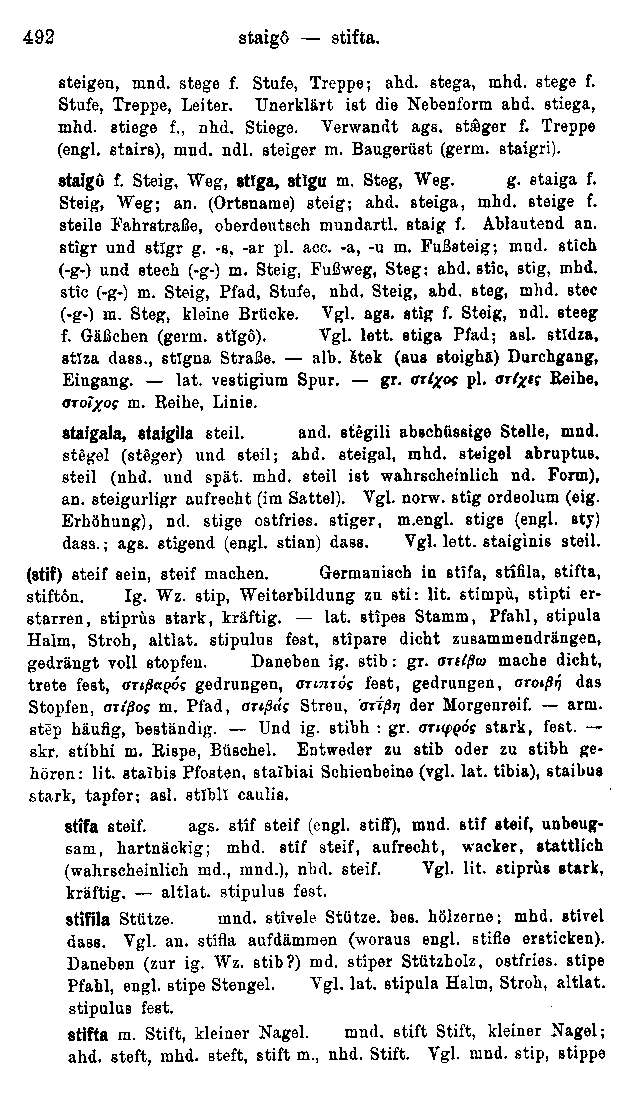
staigô
f.
Steig,
Weg,
st ga,
stgu
m.
Steg,
Weg.
g.
staiga
f.
Steig,
Weg;
an.
(Ortsname)
steig;
ahd.
steiga,
mhd.
steige
f.
steile
Fahrstraße,
oberdeutsch
mundartl.
staig
f.
Ablautend
an.
stîgr
und
st
ga,
stgu
m.
Steg,
Weg.
g.
staiga
f.
Steig,
Weg;
an.
(Ortsname)
steig;
ahd.
steiga,
mhd.
steige
f.
steile
Fahrstraße,
oberdeutsch
mundartl.
staig
f.
Ablautend
an.
stîgr
und
st gr
g.
-s.
-ar
pl.
acc.
-a,
-u
m.
Fußsteig;
mnd.
stîch
(-g-)
und
stech
(-g-)
m.
Steig,
Fußweg,
Steg,
ahd.
stîc,
stîg,
mhd.
stîc
(-g-)
m.
Steig,
Pfad,
Stufe,
nhd.
Steig,
ahd.
steg,
mhd.
stec
(-g-)
m.
Steg,
kleine
Brücke.
Vgl.
ags.
stîg
f.
Steig,
ndl.
steeg
f.
Gäßchen
(germ.
stgô).
Vgl.
lett.
stiga,
Pfad;
asl.
stdza,
stza
dass.,
stgna
Straße.
-
alb.
gr
g.
-s.
-ar
pl.
acc.
-a,
-u
m.
Fußsteig;
mnd.
stîch
(-g-)
und
stech
(-g-)
m.
Steig,
Fußweg,
Steg,
ahd.
stîc,
stîg,
mhd.
stîc
(-g-)
m.
Steig,
Pfad,
Stufe,
nhd.
Steig,
ahd.
steg,
mhd.
stec
(-g-)
m.
Steg,
kleine
Brücke.
Vgl.
ags.
stîg
f.
Steig,
ndl.
steeg
f.
Gäßchen
(germ.
stgô).
Vgl.
lett.
stiga,
Pfad;
asl.
stdza,
stza
dass.,
stgna
Straße.
-
alb.
 tek
(aus
stoigh
tek
(aus
stoigh )
Durchgang,
Eingang.
-
lat.
vestigium
Spur.
-
gr.
[sti'xos]
pl.
[sti'xes]
Reihe,
[stoi=xos]
m.
Reihe,
Linie.
)
Durchgang,
Eingang.
-
lat.
vestigium
Spur.
-
gr.
[sti'xos]
pl.
[sti'xes]
Reihe,
[stoi=xos]
m.
Reihe,
Linie.
[Translate the German words]
|
Source: Bosworth/Toller, page b0920, entry 1 View original page image as: [TIFF] [PNG] [View previous entry] [View next entry] |
[Comment on this entry] [View comments] |
The following entry has been hand-corrected once. |
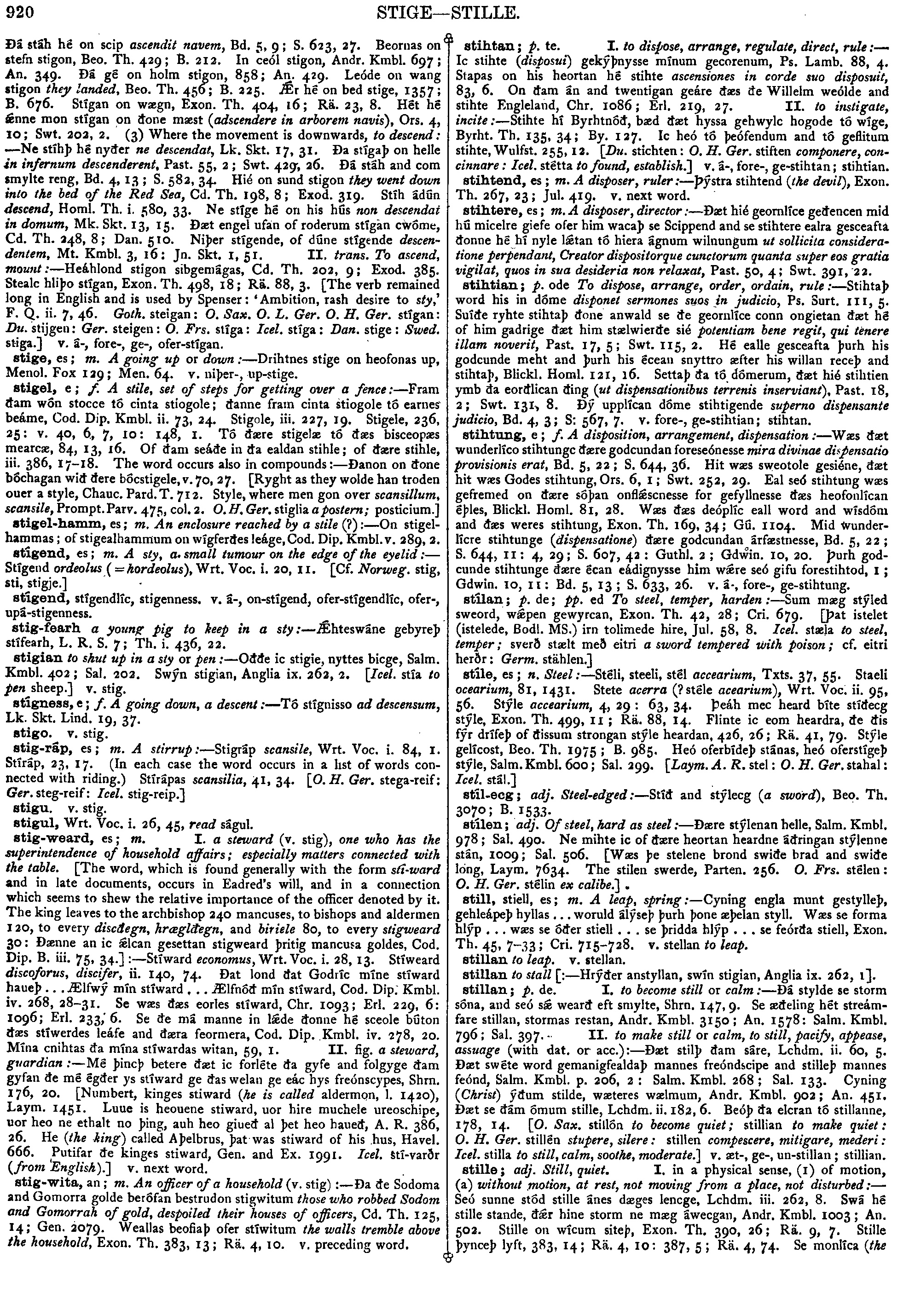
Ðá
stáh
hé
on
scip
ascendit
navem,
Bd.
5,
9
;
S.
623,
27.
Beornas
on
stefn
stigon,
Beo.
Th.
429
;
B.
212,
In
ceól
stigon,
Andr.
Kmbl.
697
;
An.
349.
Ðá
gé
on
holm
stigon,
858
;
An.
429.
Leóde
on
wang
stigon
they
landed,
Beo.
Th.
456
;
B.
225.
Æ-acute;r
hé
on
bed
stige,
1357
;
B.
676.
Stígan
on
wægn,
Exon.
Th.
404,
16
;
Rä.
23,
8.
Hét
hé
 nne
mon
stígan
on
ðone
mæst
(adscendere
in
arborem
navis),
Ors.
4,
10
;
Swt.
202,
2.
(3)
Where
the
movement
is
downwards,
to
descend
:--Ne
stíhþ
hé
nyðer
ne
descendat,
Lk.
Skt.
17,
31.
Ða
stígaþ
on
helle
in
infernunt
descenderent,
Past.
55,
2
;
Swt.
429,
26.
Ðá
stáh
and
com
smylte
reng,
Bd.
4,
13
;
S.
582,
34.
Hié
on
sund
stigon
they
went
down
into
the
bed
of
the
Red
Sea,
Cd.
Th.
198,
8
;
Exod.
319.
Stíh
ádún
descend,
Homl.
Th.
i.
580,
33.
Ne
stíge
hé
on
his
hús
non
descendat
in
domum,
Mk.
Skt.
13,
15.
Ðæt
engel
ufan
of
roderum
stígan
cwóme,
Cd.
Th.
248,
8
;
Dan.
510.
Niþer
stígende,
of
dúne
stígende
descendentem,
Mt.
Kmbl.
3,
16
:
Jn.
Skt.
l,
51.
II.
trans.
To
ascend,
mount
:--Heáhlond
stigon
sibgemágas,
Cd.
Th.
202,
9
;
Exod.
385.
Stealc
hliþo
stígan,
Exon.
Th.
498,
18
;
Rä.
88,
3.
[The
verb
remained
long
in
English
and
is
used
by
Spenser
:
'Ambition,
rash
desire
to
sty,'
F.
Q.
ii.
7,
46.
Goth.
steigan
:
O.
Sax.
O.
L.
Ger.
O.
H.
Ger.
stígan
:
Du.
stijgen
:
Ger.
steigen
:
O.
Frs.
stíga
:
Icel.
stíga
:
Dan.
stige
:
Swed.
stiga.]
v.
á-,
fore-,
ge-,
ofer-stígan.
nne
mon
stígan
on
ðone
mæst
(adscendere
in
arborem
navis),
Ors.
4,
10
;
Swt.
202,
2.
(3)
Where
the
movement
is
downwards,
to
descend
:--Ne
stíhþ
hé
nyðer
ne
descendat,
Lk.
Skt.
17,
31.
Ða
stígaþ
on
helle
in
infernunt
descenderent,
Past.
55,
2
;
Swt.
429,
26.
Ðá
stáh
and
com
smylte
reng,
Bd.
4,
13
;
S.
582,
34.
Hié
on
sund
stigon
they
went
down
into
the
bed
of
the
Red
Sea,
Cd.
Th.
198,
8
;
Exod.
319.
Stíh
ádún
descend,
Homl.
Th.
i.
580,
33.
Ne
stíge
hé
on
his
hús
non
descendat
in
domum,
Mk.
Skt.
13,
15.
Ðæt
engel
ufan
of
roderum
stígan
cwóme,
Cd.
Th.
248,
8
;
Dan.
510.
Niþer
stígende,
of
dúne
stígende
descendentem,
Mt.
Kmbl.
3,
16
:
Jn.
Skt.
l,
51.
II.
trans.
To
ascend,
mount
:--Heáhlond
stigon
sibgemágas,
Cd.
Th.
202,
9
;
Exod.
385.
Stealc
hliþo
stígan,
Exon.
Th.
498,
18
;
Rä.
88,
3.
[The
verb
remained
long
in
English
and
is
used
by
Spenser
:
'Ambition,
rash
desire
to
sty,'
F.
Q.
ii.
7,
46.
Goth.
steigan
:
O.
Sax.
O.
L.
Ger.
O.
H.
Ger.
stígan
:
Du.
stijgen
:
Ger.
steigen
:
O.
Frs.
stíga
:
Icel.
stíga
:
Dan.
stige
:
Swed.
stiga.]
v.
á-,
fore-,
ge-,
ofer-stígan.
|
Source: Bosworth/Toller, page d0277, entry 47 View original page image as: [TIFF] [PNG] [View previous entry] [View next entry] |
[Comment on this entry] [View comments] |
The following entry has been hand-corrected once. |
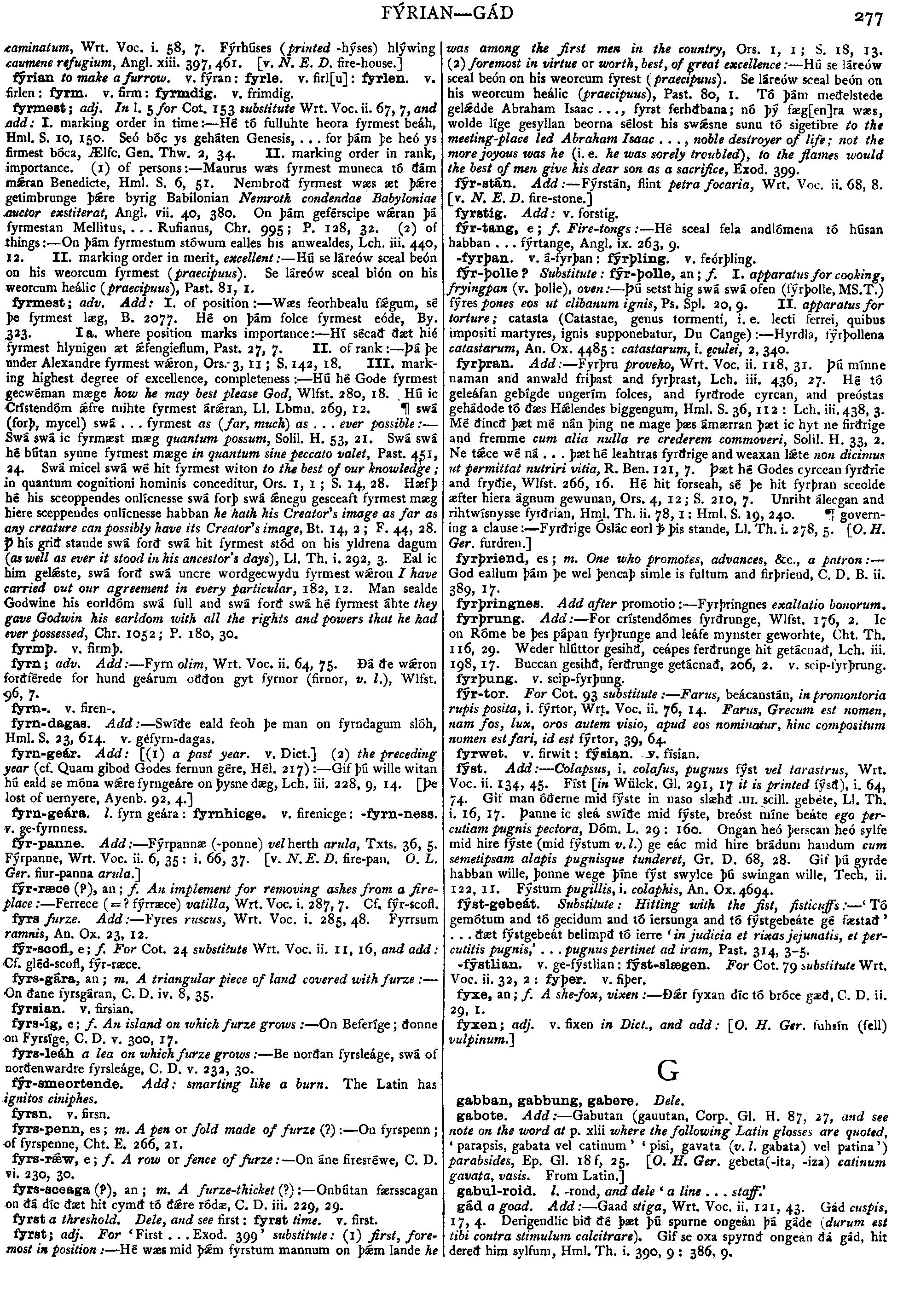
gád a goad. Add:--Gaad stiga, Wrt. Voc. ii. 121, 43. Gád cuspis, 17, 4. Derigendlic bið ðé þæt þú spurne ongeán þá gáde (durum est tibi contra stimulum calcitrare). Gif se oxa spyrnð ongeán ðá gád, hit dereð him sylfum, Hml. Th. i. 390, 9: 386, 9.
|
Source: Bosworth/Toller, page d0712, entry 6 View original page image as: [TIFF] [PNG] [View previous entry] [View next entry] |
[Comment on this entry] [View comments] |
The following entry has been hand-corrected once. |
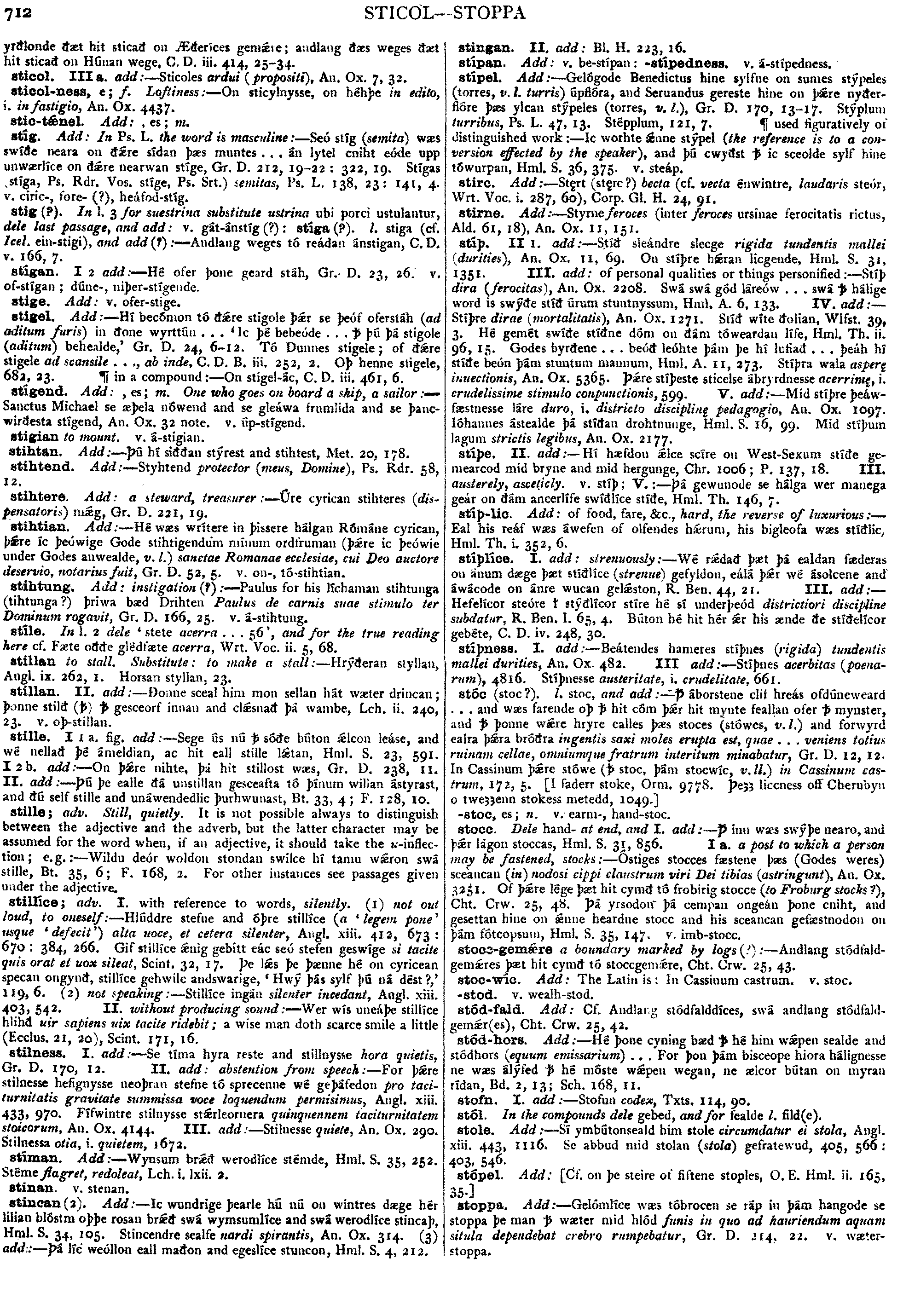
stig(?). In l. 3 for suestrina substitute ustrina ubi porci ustulantur, dele last passage, and add: v. gát-ánstíg(?): stíga(?). l. stiga (cf. Icel. ein-stigi), and add(?) :-- Andlang weges tó reádan ánstigan, C. D. v. 166, 7.
|
Source: Cleasby/Vigfusson, page b0096, entry 3 View original page image as: [TIFF] [PNG] [View previous entry] [View next entry] |
[Comment on this entry] [View comments] |
The following entry has been hand-corrected once. |
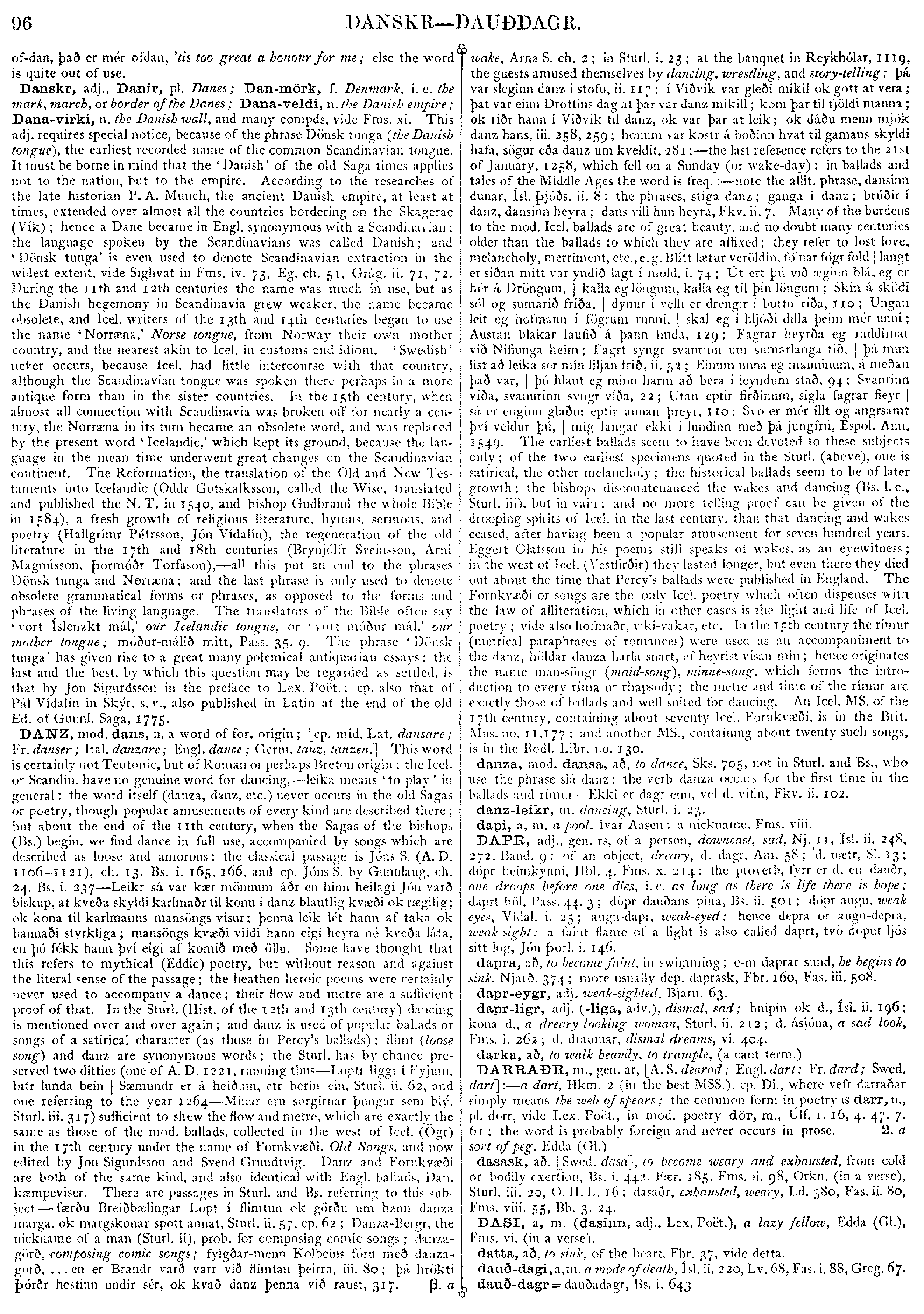
DANZ,
mod.
dans,
n.
a
word
of
for.
origin;
[cp.
mid.
Lat.
dansare;
Fr.
danser;
Ital.
danzare;
Engl.
dance;
Germ.
tanz,
tanzen.]
This
word
is
certainly
not
Teutonic,
but
of
Roman
or
perhaps
Breton
origin:
the
Icel.
or
Scandin.
have
no
genuine
word
for
dancing,
--
leika
means
'to
play'
in
general:
the
word
itself
(danza,
danz,
etc.)
never
occurs
in
the
old
Sagas
or
poetry,
though
popular
amusements
of
every
kind
are
described
there;
but
about
the
end
of
the
11th
century,
when
the
Sagas
of
the
bishops
(Bs.)
begin,
we
find
dance
in
full
use,
accompanied
by
songs
which
are
described
as
loose
and
amorous:
the
classical
passage
is
Jóns
S.
(A.D.
1106-1121),
ch.
13.
Bs.
i.
165,
166,
and
cp.
Júns
S.
by
Gunnlaug,
ch.
24.
Bs.
i.
237
--
Leikr
sá
var
kær
mönnum
áðr
en
hinn
heilagi
Jón
varð
biskup,
at
kveða
skyldi
karlmaðr
til
konu
í
danz
blautlig
kvæði
ok
rægilig;
ok
kona
til
karlmanns
mansöngs
vísur;
þenna
leik
lét
hann
af
taka
ok
bannaði
styrkliga;
mansöngs
kvæði
vildi
hann
eigi
heyra
né
kveða
láta,
en
þó
fékk
hann
því
eigi
af
komið
með
öllu.
Some
have
thought
that
this
refers
to
mythical
(Eddic)
poetry,
but
without
reason
and
against
the
literal
sense
of
the
passage;
the
heathen
heroic
poems
were
certainly
never
used
to
accompany
a
dance;
their
flow
and
metre
are
a
sufficient
proof
of
that.
In
the
Sturl.
(Hist.
of
the
12th
and
13th
century)
dancing
is
mentioned
over
and
over
again;
and
danz
is
used
of
popular
ballads
or
songs
of
a
satirical
character
(as
those
in
Percy's
ballads):
flimt
(loose
song)
and
danz
are
synonymous
words;
the
Sturl.
has
by
chance
preserved
two
ditties
(one
of
A.D.
1221,
running
thus
--
Loptr
liggr
í
Eyjum,
bítr
lunda
bein
|
Sæmundr
er
á
heiðum,
etr
berin
ein.
Stud.
ii.
62,
and
one
referring
to
the
year
1264
--
Mínar
eru
sorgirnar
þungar
sem
blý,
Sturl.
iii.
317)
sufficient
to
shew
the
flow
and
metre,
which
are
exactly
the
same
as
those
of
the
mod.
ballads,
collected
in
the
west
of
Icel.
(Ögr)
in
the
17th
century
under
the
name
of
Fornkvæði,
Old
Songs,
and
now
edited
by
Jon
Sigurdsson
and
Svend
Grundtvig.
Danz
and
Fornkvæði
are
both
of
the
same
kind,
and
also
identical
with
Engl.
ballads,
Dan.
kæmpeviser.
There
are
passages
in
Sturl.
and
B.S.
referring
to
this
subject
--
færðu
Breiðbælingar
Lopt
í
flimtun
ok
görðu
um
hann
danza
marga,
ok
margskonar
spott
annat,
Sturl.
ii.
57,
cp.
62;
Danza-Bergr,
the
nickname
of
a
man
(Stud,
ii),
prob.
for
composing
comic
songs;
danza-
görð,
composing
comic
songs;
fylgðar-menn
Kolbeins
fóru
með
danza-
görð,
...
en
er
Brandr
varð
varr
við
flimtan
þeirra,
iii.
80;
þá
hrökti
Þórðr
hestinn
undir
sér,
ok
kvað
danz
þenna
við
raust,
317.
 .
a
wake,
Arna
S.
ch.
2;
in
Sturl.
i.
23;
at
the
banquet
in
Reykhólar,
1119,
the
guests
amused
themselves
by
dancing,
wrestling,
and
story-telling;
þá
var
sleginn
danz
í
stofu,
ii.
117;
í
Viðvík
var
gleði
mikil
ok
gott
at
vera;
þat
var
einn
Drottins
dag
at
þar
var
danz
mikill;
kom
þar
til
fjöldi
manna;
ok
ríðr
hann
í
Viðvík
til
danz,
ok
var
þar
at
leik;
ok
dáðu
menn
mjök
danz
hans,
iii.
258,
259;
honum
var
kostr
á
boðinn
hvat
til
gamans
skyldi
hafa,
sögur
eða
danz
um
kveldit,
281;
--
the
last
reference
refers
to
the
21st
of
January,
1258,
which
fell
on
a
Sunday
(or
wake-day):
in
ballads
and
tales
of
the
Middle
Ages
the
word
is
freq.
:--
note
the
allit.
phrase,
dansinn
dunar,
Ísl.
Þóðs.
ii.
8:
the
phrases,
stiga
danz;
ganga
í
danz;
brúðir
í
danz,
dansinn
heyra;
dans
vill
hun
heyra,
Fkv.
ii.
7.
Many
of
the
burdens
to
the
mod.
Icel.
ballads
are
of
great
beauty,
and
no
doubt
many
centuries
older
than
the
ballads
to
which
they
are
affixed;
they
refer
to
lost
love,
melancholy,
merriment,
etc.,
e.g.
Blítt
lætur
veröldin,
fölnar
fögr
fold
|
langt
er
síðan
mitt
var
yndið
lagt
í
mold,
i.
74;
Út
ert
þú
við
æginn
blá,
eg
er
hér
á
Dröngum,
|
kalla
eg
löngum,
kalla
eg
til
þin
löngum;
Skín
á
skildi
Sól
og
sumarið
fríða,
|
dynur
í
velli
er
drengir
í
burtu
riða,
110;
Ungan
leit
eg
hofmann
í
fögrum
runni,
|
skal
eg
í
hljóði
dilla
þeim
mér
unm;
Austan
blakar
laufið
á
þann
linda,
129;
Fagrar
heyrða
eg
raddirnar
við
Niflunga
heim;
Fagrt
syngr
svanrinn
um
sumarlanga
tíð,
|
þá
mun
list
að
leika
sér
mín
liljan
fríð,
ii.
52:
Einum
unna
eg
manninum,
á
meðan
það
var,
|
þó
hlaut
eg
minn
harm
að
bera
í
leyndum
stað,
94;
Svanrinn
víða.
svanurinn
syngr
viða,
22;
Utan
eptir
firðinum,
sigla
fagrar
fleyr
|
sá
er
enginn
glaður
eptir
annan
þreyr,
110;
Svo
er
mér
illt
og
angrsamt
því
veldur
þú,
|
mig
langar
ekki
í
lundinn
með
þá
jungfrú,
Espol.
Ann.
1549.
The
earliest
ballads
seem
to
have
been
devoted
to
these
subjects
only;
of
the
two
earliest
specimens
quoted
in
the
Sturl.
(above),
one
is
satirical,
the
other
melancholy;
the
historical
ballads
seem
to
be
of
later
growth:
the
bishops
discountenanced
the
wakes
and
dancing
(Bs.
l.c.,
Sturl.
iii),
but
in
vain:
and
no
more
telling
proof
can
be
given
of
the
drooping
spirits
of
Icel.
in
the
last
century,
than
that
dancing
and
wakes
ceased,
after
having
been
a
popular
amusement
for
seven
hundred
years.
Eggert
Olafsson
in
his
poems
still
speaks
of
wakes,
as
an
eyewitness;
in
the
west
of
Icel.
(Vestfirðir)
they
lasted
longer,
but
even
there
they
died
out
about
the
time
that
Percy's
ballads
were
published
in
England.
The
Fornkvæði
or
songs
are
the
only
Icel.
poetry
which
often
dispenses
with
the
law
of
alliteration,
which
in
other
cases
is
the
light
and
life
of
Icel.
poetry;
vide
also
hofmaðr,
viki-vakar,
etc.
In
the
15th
century
the
rímur
(metrical
paraphrases
of
romances)
were
used
as
an
accompaniment
to
the
danz,
höldar
danza
harla
snart,
ef
heyrist
vísan
mín;
hence
originates
the
name
man-söngr
(maid-song),
minne-sang,
which
forms
the
introduction
to
every
ríma
or
rhapsody;
the
metre
and
time
of
the
rímur
are
exactly
those
of
ballads
and
well
suited
for
dancing.
An
Icel.
MS.
of
the
17th
century,
containing
about
seventy
Icel.
Fornkvæði,
is
in
the
Brit.
Mus.
no.
11,177;
and
another
MS.,
containing
about
twenty
such
songs,
is
in
the
Bodl.
Libr.
no.
130.
.
a
wake,
Arna
S.
ch.
2;
in
Sturl.
i.
23;
at
the
banquet
in
Reykhólar,
1119,
the
guests
amused
themselves
by
dancing,
wrestling,
and
story-telling;
þá
var
sleginn
danz
í
stofu,
ii.
117;
í
Viðvík
var
gleði
mikil
ok
gott
at
vera;
þat
var
einn
Drottins
dag
at
þar
var
danz
mikill;
kom
þar
til
fjöldi
manna;
ok
ríðr
hann
í
Viðvík
til
danz,
ok
var
þar
at
leik;
ok
dáðu
menn
mjök
danz
hans,
iii.
258,
259;
honum
var
kostr
á
boðinn
hvat
til
gamans
skyldi
hafa,
sögur
eða
danz
um
kveldit,
281;
--
the
last
reference
refers
to
the
21st
of
January,
1258,
which
fell
on
a
Sunday
(or
wake-day):
in
ballads
and
tales
of
the
Middle
Ages
the
word
is
freq.
:--
note
the
allit.
phrase,
dansinn
dunar,
Ísl.
Þóðs.
ii.
8:
the
phrases,
stiga
danz;
ganga
í
danz;
brúðir
í
danz,
dansinn
heyra;
dans
vill
hun
heyra,
Fkv.
ii.
7.
Many
of
the
burdens
to
the
mod.
Icel.
ballads
are
of
great
beauty,
and
no
doubt
many
centuries
older
than
the
ballads
to
which
they
are
affixed;
they
refer
to
lost
love,
melancholy,
merriment,
etc.,
e.g.
Blítt
lætur
veröldin,
fölnar
fögr
fold
|
langt
er
síðan
mitt
var
yndið
lagt
í
mold,
i.
74;
Út
ert
þú
við
æginn
blá,
eg
er
hér
á
Dröngum,
|
kalla
eg
löngum,
kalla
eg
til
þin
löngum;
Skín
á
skildi
Sól
og
sumarið
fríða,
|
dynur
í
velli
er
drengir
í
burtu
riða,
110;
Ungan
leit
eg
hofmann
í
fögrum
runni,
|
skal
eg
í
hljóði
dilla
þeim
mér
unm;
Austan
blakar
laufið
á
þann
linda,
129;
Fagrar
heyrða
eg
raddirnar
við
Niflunga
heim;
Fagrt
syngr
svanrinn
um
sumarlanga
tíð,
|
þá
mun
list
að
leika
sér
mín
liljan
fríð,
ii.
52:
Einum
unna
eg
manninum,
á
meðan
það
var,
|
þó
hlaut
eg
minn
harm
að
bera
í
leyndum
stað,
94;
Svanrinn
víða.
svanurinn
syngr
viða,
22;
Utan
eptir
firðinum,
sigla
fagrar
fleyr
|
sá
er
enginn
glaður
eptir
annan
þreyr,
110;
Svo
er
mér
illt
og
angrsamt
því
veldur
þú,
|
mig
langar
ekki
í
lundinn
með
þá
jungfrú,
Espol.
Ann.
1549.
The
earliest
ballads
seem
to
have
been
devoted
to
these
subjects
only;
of
the
two
earliest
specimens
quoted
in
the
Sturl.
(above),
one
is
satirical,
the
other
melancholy;
the
historical
ballads
seem
to
be
of
later
growth:
the
bishops
discountenanced
the
wakes
and
dancing
(Bs.
l.c.,
Sturl.
iii),
but
in
vain:
and
no
more
telling
proof
can
be
given
of
the
drooping
spirits
of
Icel.
in
the
last
century,
than
that
dancing
and
wakes
ceased,
after
having
been
a
popular
amusement
for
seven
hundred
years.
Eggert
Olafsson
in
his
poems
still
speaks
of
wakes,
as
an
eyewitness;
in
the
west
of
Icel.
(Vestfirðir)
they
lasted
longer,
but
even
there
they
died
out
about
the
time
that
Percy's
ballads
were
published
in
England.
The
Fornkvæði
or
songs
are
the
only
Icel.
poetry
which
often
dispenses
with
the
law
of
alliteration,
which
in
other
cases
is
the
light
and
life
of
Icel.
poetry;
vide
also
hofmaðr,
viki-vakar,
etc.
In
the
15th
century
the
rímur
(metrical
paraphrases
of
romances)
were
used
as
an
accompaniment
to
the
danz,
höldar
danza
harla
snart,
ef
heyrist
vísan
mín;
hence
originates
the
name
man-söngr
(maid-song),
minne-sang,
which
forms
the
introduction
to
every
ríma
or
rhapsody;
the
metre
and
time
of
the
rímur
are
exactly
those
of
ballads
and
well
suited
for
dancing.
An
Icel.
MS.
of
the
17th
century,
containing
about
seventy
Icel.
Fornkvæði,
is
in
the
Brit.
Mus.
no.
11,177;
and
another
MS.,
containing
about
twenty
such
songs,
is
in
the
Bodl.
Libr.
no.
130.
|
Source: Cleasby/Vigfusson, page b0243, entry 17 View original page image as: [TIFF] [PNG] [View previous entry] [View next entry] |
[Comment on this entry] [View comments] |
The following entry has been hand-corrected once. |
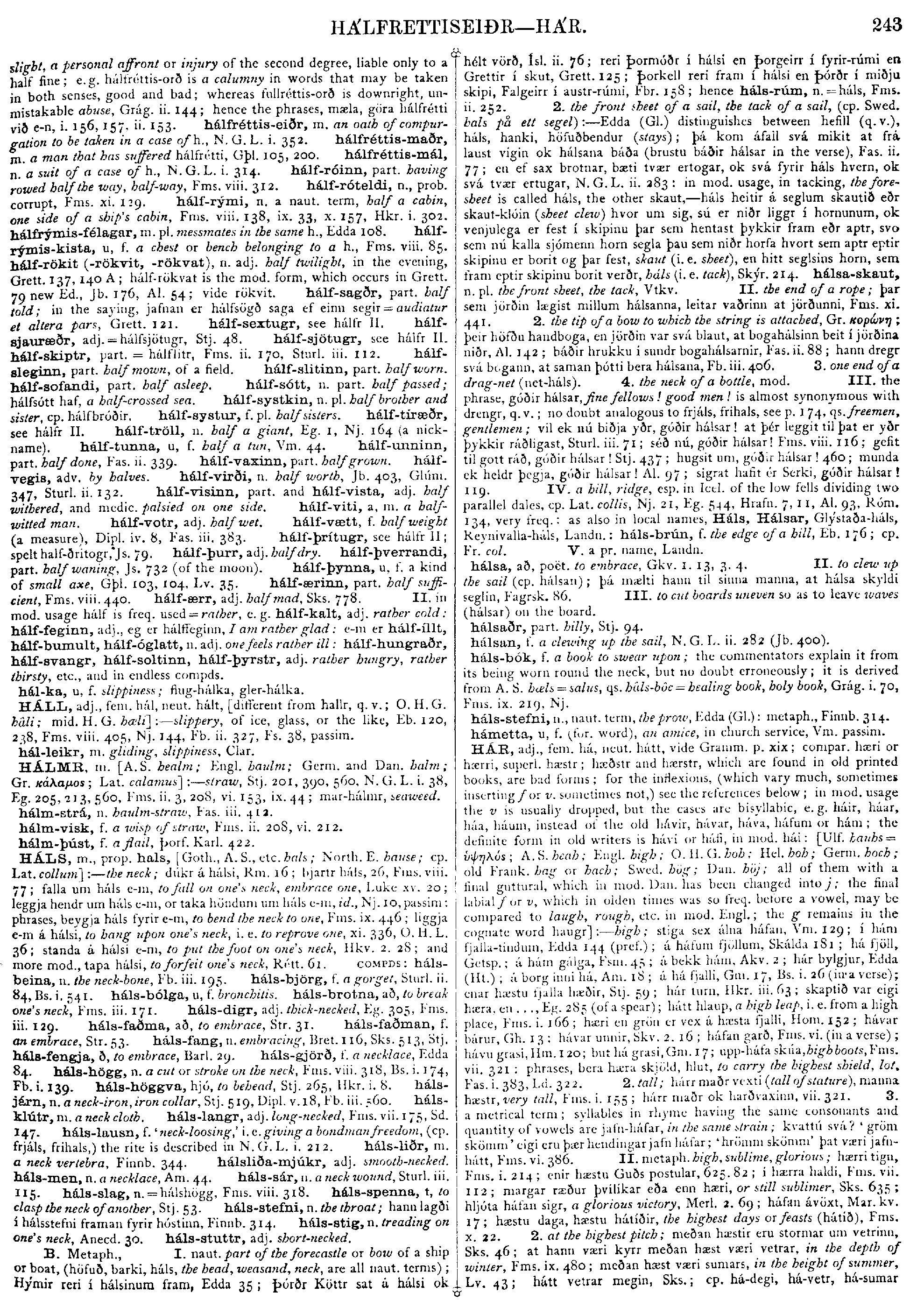
HÁR, adj., fem. há, neut. hátt, vide Gramm. p. xix; compar. hæri or hærri, superl. hæstr; hæðstr and hærstr, which are found in old printed books, are bad forms; for the inflexions, (which vary much, sometimes inserting f or v, sometimes not,) see the references below; in mod. usage the v is usually dropped, but the cases are bisyllabic, e.g. háir, háar, háa, háum, instead of the old hávir, hávar, háva, háfum or hám; the definite form in old writers is hávi or háfi, in mod. hái: [Ulf. hauhs = GREEK; A. S. heah; Engl. high; O. H. G. hoh; Hel. hoh; Germ. hoch; old Frank, hag or hach; Swed. hög; Dan. höj; all of them with a final guttural, which in mod. Dan. has been changed into j; the final labial f or v, which in olden times was so freq. before a vowel, may be compared to laugh, rough, etc. in mod. Engl.; the g remains in the cognate word haugr] :-- high; stiga sex álna háfan, Vm. 129; í hám fjalla-tindum, Edda 144 (pref.); á háfum fjöllum, Skálda 181; há fjöll, Getsp.; á hám gálga, Fsm. 45; á bekk hám, Akv. 2; hár bylgjur, Edda (Ht.); á borg inni há, Am. 18; á há fjalli, Gm. 17, Bs. i. 26 (in a verse); enar hæstu fjalla hæðir, Stj. 59; hár turn, Hkr. iii. 63; skaptið var eigi hæra, en ..., Eg. 285 (of a spear); hátt hlaup, a high leap, i.e. from a high place, Fms. i. 166; hæri en grön er vex á hæsta fjalli, Hom. 152; hávar bárur, Gh. 13: hávar unnir, Skv. 2. 16; háfan garð, Fms. vi. (in a verse); hávu grasi, Hm. 120; but há grasi. Gm. 17; upp-háfa skúa, high boots, Fms. vii. 321: phrases, bera hæra skjöld, hlut, to carry the highest shield, lot, Fas. i. 383, Ld. 322. 2. tall; hárr maðr vexti (tall of stature), manna hæstr, very tall, Fms. i. 155; hárr maðr ok harðvaxinn, vii. 321. 3. a metrical term; syllables in rhyme having the same consonants and quantity of vowels are jafn-háfar, in the same strain; kvattú svá? 'gröm skömm' eigi eru þær hendingar jafn háfar; 'hrömm skömm' þat væri jafnhátt, Fms. vi. 386. II. metaph. high, sublime, glorious; hærri tign, Fms. i. 214; enir hæstu Guðs postular, 625. 82; í hærra haldi, Fms. vii. 112; margar ræður þvílíkar eða enn hæri, or still sublimer, Sks. 635; hljóta háfan sigr, a glorious victory, Merl. 2. 69; háfan ávöxt, Mar. kv. 17; hæstu daga, hæstu hátíðir, the highest days or feasts (hátíð), Fms. x. 22. 2. at the highest pitch; meðan hæstir eru stormar um vetrinn, Sks. 46; at hann væri kyrr meðan hæst væri vetrar, in the depth of winter, Fms. ix. 480; meðan hæst væri sumars, in the height of summer, Lv. 43; hátt vetrar megin, Sks.; cp. há-degi, há-vetr, há-sumar
|
Source: Cleasby/Vigfusson, page b0404, entry 112 View original page image as: [TIFF] [PNG] [View previous entry] [View next entry] |
[Comment on this entry] [View comments] |
The following entry has been hand-corrected once. |
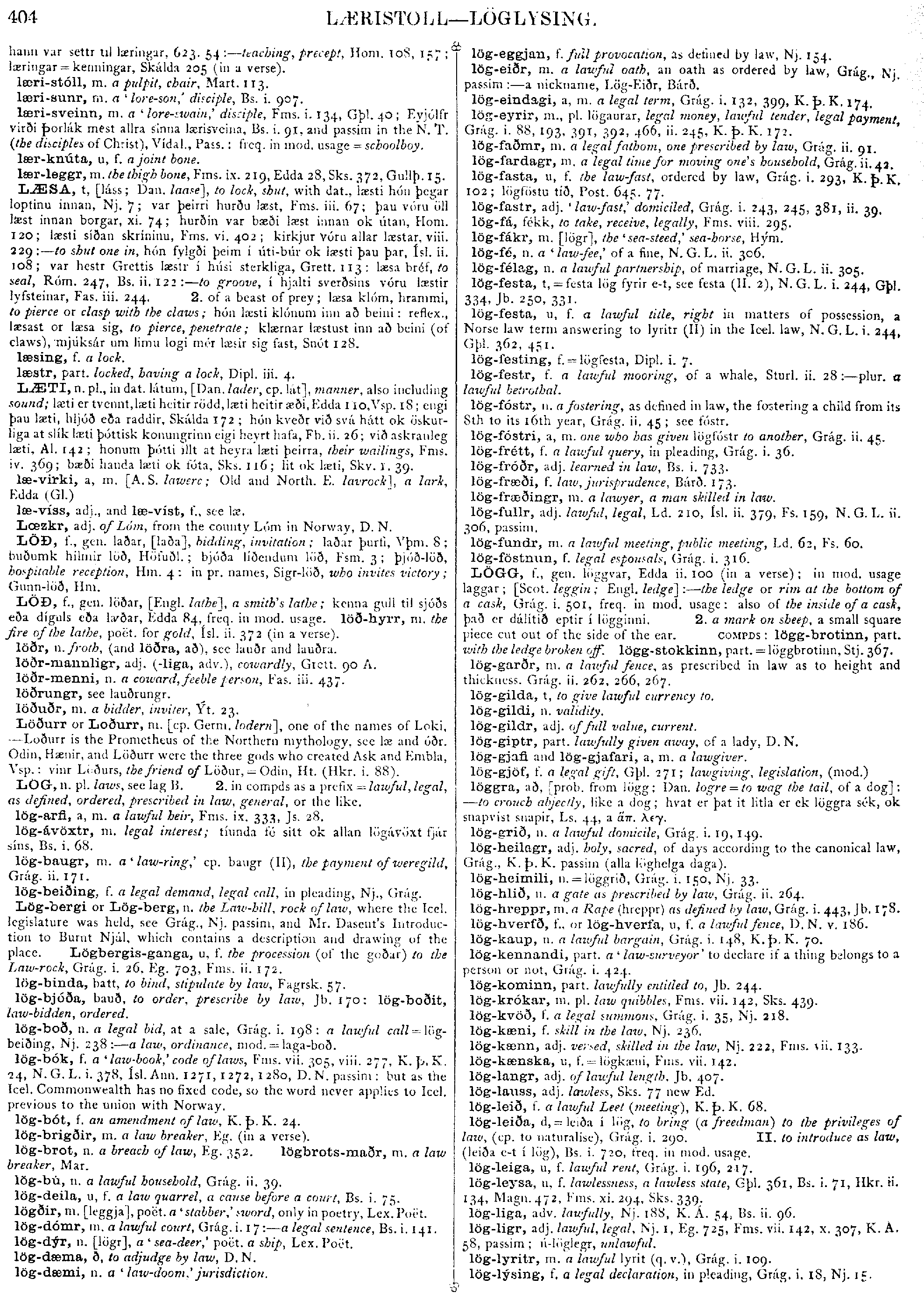
LÖGR, m., gen. lagar; dat. legi. pl. legir, Lil. 31; acc. lögu, Fb. 1. 525 (in a verse); [A. S. lagu; cp. Engl. lake; O. H. G. Iqgu; Lat. locus'] :-- the sea; koma urn log, to come by sea, Vsp. 51: in the allit. phrase, lopt ok log, air and s e a, Sks. 47, Skm. 6; lands eða lagar, o n land or sea; or á landi eða legi, Grág. ii. 171, Al. 107; hvergi kom ek þar lands ne lagar, at... . Bs. i. 721, ii. 5, í 22; lagar hjarta, 'sea-heart, ' poet, for a stone, Ýt.; lagar sîóð, the sea steeds' -- ships, Lex. Poët.; stiga land af le, gi, Hkv. Hjörv. 26. 2. a local name of large lakes, e. g. Logr = the Melar in Sweden, 0. H.; or of a great estuary, við á þá er Tanais heitir ok bann log er þar fellr or, Stj. II. water, any liquid; tak log af grasi, Pr. 471; síðan tók hann sér log nökkurn, kastaði þar í öskunni, ok gorði af graut, Fms. ii. 163; ly'si, hunang ok allskyns lögr annarr, K. Á. 206; í vatni vörmu eða köldu, en öngum legi oðrum eða vokva, H. E. i. 480; af þeim legi er lekit hafði ór hausi, Sdm. 13; verpa lauki í lög, 8; spræna rauðum legi, Ó. H. (in a verse); sár-lögr, benja-lögr = blood; hræ-lögr, hjör-lögr, id., Lex. Poët.: lögr Sonar, Boðnar = the poetical mead, Edda; hver-Higr Óðins, id., Ht. III. the Rune | (A. S. lagu.)
|
Source: Cleasby/Vigfusson, page b0592, entry 19 View original page image as: [TIFF] [PNG] [View previous entry] [View next entry] |
[Comment on this entry] [View comments] |
The following entry has been hand-corrected once. |
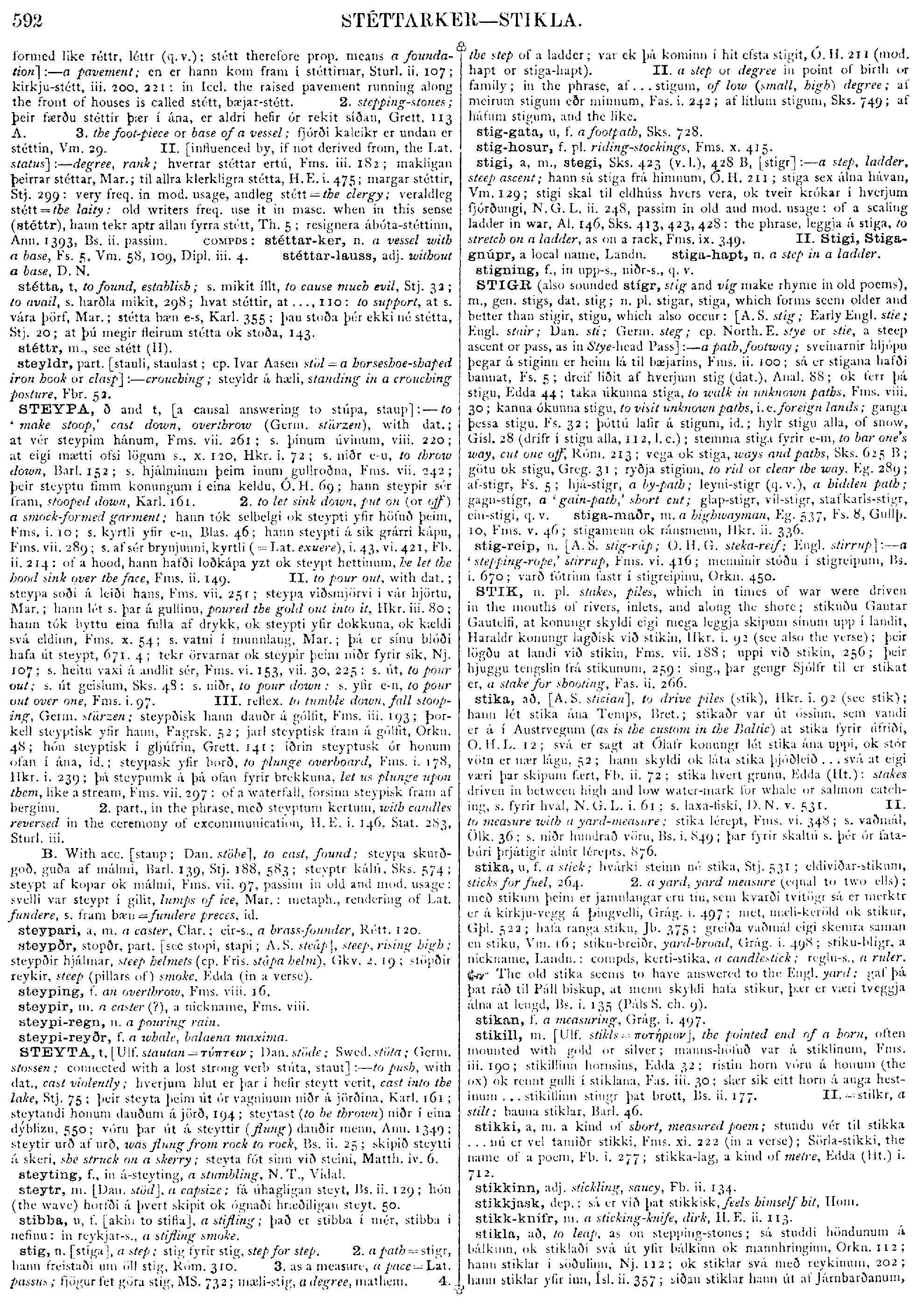
stigi, a, m., stegi, Sks. 423 (v.l.), 428 B, [stigr] :-- a step, ladder, steep ascent; hann sá stiga frá himnum, Ó.H. 211; stiga sex álna hávan, Vm. 129; stigi skal til eldhúss hvers vera, ok tveir krókar í hverjum fjórðungi, N.G.L. ii. 248, passim in old and mod. usage: of a scaling ladder in war, Al. 146, Sks. 413, 423, 428: the phrase, leggja á stiga, to stretch on a ladder, as on a rack, Fms. ix. 349. II. Stigi, Stiga-gnúpr, a local name, Landn. stiga-hapt, n. a step in a ladder.
|
Source: Cleasby/Vigfusson, page b0592, entry 21 View original page image as: [TIFF] [PNG] [View previous entry] [View next entry] |
[Comment on this entry] [View comments] |
The following entry has been hand-corrected once. |
STIGR (also sounded stígr, stíg and víg make rhyme in old poems), m., gen. stigs, dat. stig; n. pl. stigar, stiga, which forms seem older and better than stigir, stigu, which also occur: [A.S. stíg; Early Engl. stie; Engl. stair; Dan. sti; Germ. steg; cp. North. E. stye or stie, a steep ascent or pass, as in stye-head Pass] :-- a path, footway; sveinarnir hljópu þegar á stiginn er heim lá til bæjarins, Fms. ii. 100; sá er stigana hafði bannat, Fs. 5; dreif liðit af hverjum stig (dat.). Anal. 88; ok ferr þá stigu, Edda 44; taka úkunna stiga, to walk in unknown paths, Fms, viii. 30; kanna ókunna stigu, to visit unknown paths, i.e. foreign lands; ganga þessa stigu, Fs. 32; þóttú lafir á stigum, id.; hylr stigu alla, of snow, Gísl. 28 (drífr í stigu alla, 112. l.c.); stemma stiga fyrir e-m, to bar one's way, cut one off, Róm. 213; vega ok stiga, ways and paths, Sks. 625 B; götu ok stigu, Greg. 31; ryðja stiginn, to rid or clear the way, Eg. 289; af-stigr, Fs. 5; hjá-stigr, a by-path; leyni-stigr (q.v.), a hidden path; gagn-stígr, a 'gain-path,' short cut; glap-stigr, vil-stigr, stafkarls-stigr, ein-stigi, q.v. stiga-maðr, m. a highwayman. Eg. 537, Fs. 8, Gullþ. 10, Fms. v. 46; stigamenn ok ránsmenn, Hkr. ii. 336.
|
Source: Cleasby/Vigfusson, page b0594, entry 1 View original page image as: [TIFF] [PNG] [View previous entry] [View next entry] |
[Comment on this entry] [View comments] |
The following entry has been hand-corrected once. |
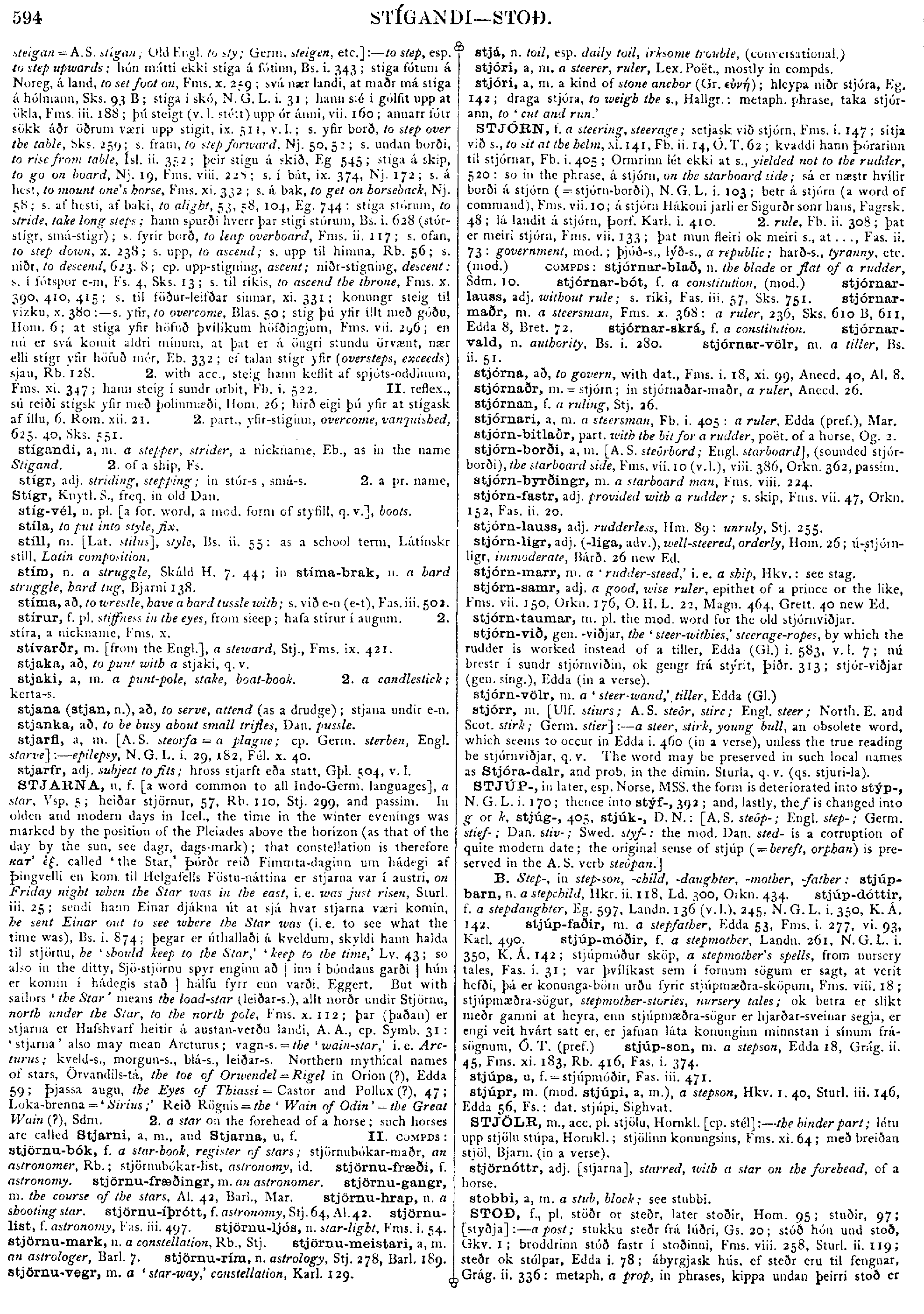
steigan = A.S. stîgan, Old Engl. to sty; Germ. steigen, etc.] :-- to step, esp. to step upwards; hón mátti ekki stíga á fótinn, Bs. i. 343; stíga fótum á Noreg, á land, to set foot on, Fms. x. 259; svá nær landi, at maðr má stíga á hólmann, Sks. 93 B; stíga í skó, N.G.L. i. 31; hann sté í gólfit upp at ökla, Fms. iii. 188; þú steigt (v.l. stétt) upp ór ánni, vii. 160; annarr fótr sökk áðr öðrum væri upp stigit, ix. 511, v.l.; s. yfir borð, to step over the table, Sks. 259; s. fram, to step forward, Nj. 50, 52; s. undan borði, to rise from table, Ísl. ii. 352; þeir stigu á skíð, Eg 545; stiga á skip, to go on board, Nj. 19, Fms. viii. 228; s. í bát, ix. 374, Nj. 172; s. á hest, to mount one's horse, Fms. xi. 332; s. á bak, to get on horseback, Nj. 58; s. af hesti, af baki, to alight, 53, 58, 104, Eg. 744: stíga stórum, to stride, take long steps; hann spurði hverr þar stigi stórum, Bs. i. 628 (stór-stígr, smá-stígr); s. fyrir borð, to leap overboard, Fms. ii. 117; s. ofan, to step down, x. 238; s. upp, to ascend; s. upp til himna, Rb. 56; s. niðr, to descend, 623. 8; cp. upp-stigning, ascent; niðr-stigning, descent: s. í fótspor e-m, Fs. 4, Sks. 13; s. til ríkis, to ascend the throne, Fms. x. 390, 410, 415; s. til föður-leifðar sinnar, xi. 331; konungr steig til vizku, x. 380 :-- s. yfir, to overcome, Blas. 50; stíg þú yfir íllt með góðu, Hom. 6; at stíga yfir höfuð þvílíkum höfðingjum, Fms. vii. 296; en nú er svá komit aldri mínum, at þat er á öngri stundu örvænt, nær elli stígr yfir höfuð mér, Eb. 332; ef talan stígr yfir (oversteps, exceeds) sjau, Rb. 128. 2. with acc., steig hann keflit af spjóts-oddinum, Fms. xi. 347; hann steig í sundr orbit, Fb. i. 522. II. reflex., sú reiði stígsk yfir með þolinmæði, Hom. 26; hirð eigi þú yfir at stígask af íllu, 6. Róm. xii. 21. 2. part., yfir-stiginn, overcome, vanquished, 625. 40, Sks. 551.
Germanic Lexicon Project (main page)
This search system was written by
Sean Crist
Please consider
volunteering
to correct the data in these online dictionaries.
No rights reserved. Feel free to use these data in any way you please.