|
|

|
Source: Bosworth/Toller, page b0915, entry 5 View original page image as: [TIFF] [PNG] [View previous entry] [View next entry] |
[Comment on this entry] [View comments] |
The following entry has been hand-corrected once. |
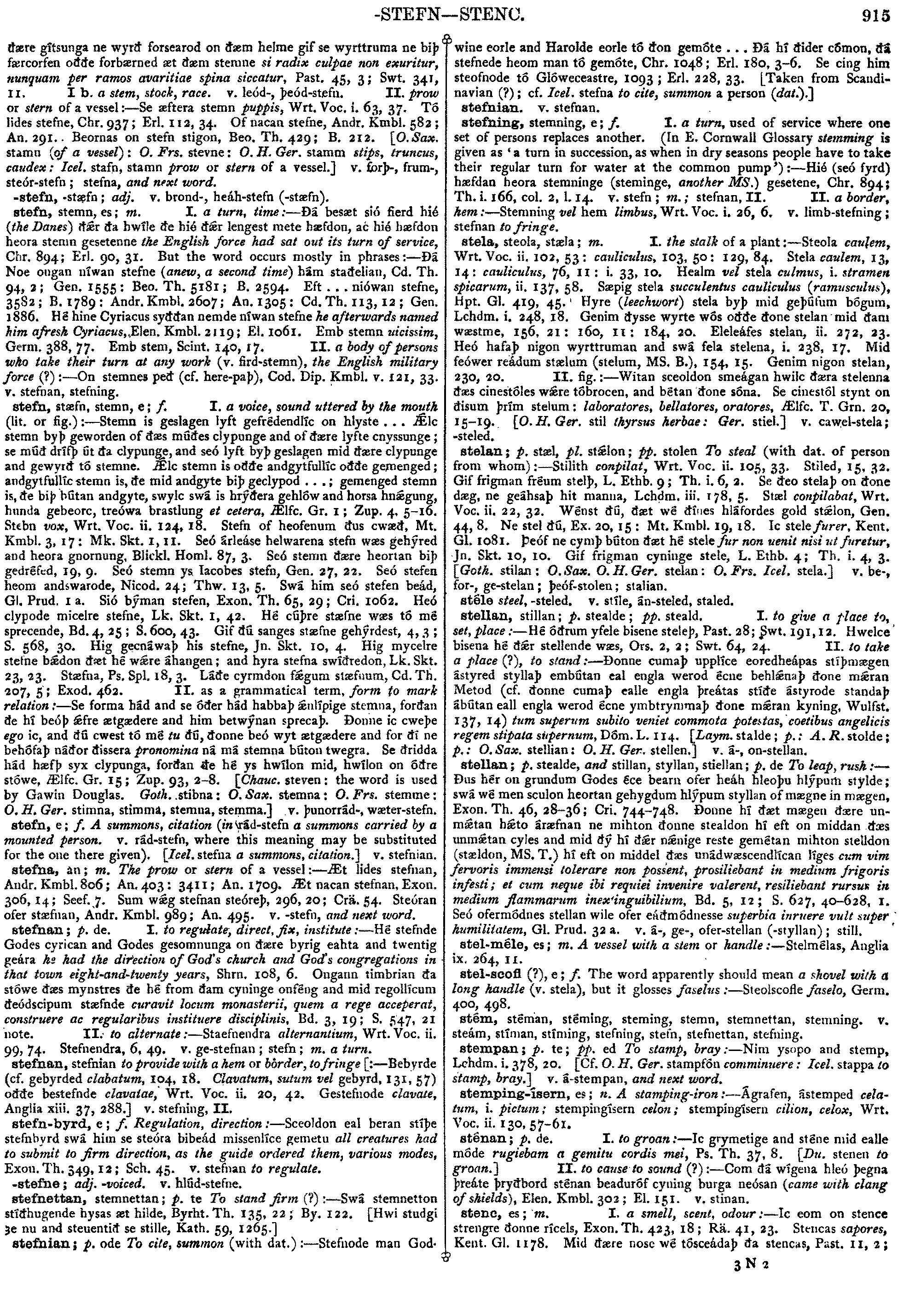
stefna,
an;
m.
The
prow
or
stern
of
a
vessel
:--
Æt
lides
stefnan,
Andr.
Kmbl.
806;
An.
403:
3411;
An.
1709.
Æt
nacan
stefnan,
Exon.
306,
14;
Seef.
7.
Sum
w g
stefnan
steóreþ,
296,
20;
Crä.
54.
Steóran
ofer
stæfnan,
Andr.
Kmbl.
989;
An.
495.
v.
-stefn,
and
next
word.
g
stefnan
steóreþ,
296,
20;
Crä.
54.
Steóran
ofer
stæfnan,
Andr.
Kmbl.
989;
An.
495.
v.
-stefn,
and
next
word.
|
Source: Cleasby/Vigfusson, page b0590, entry 10 View original page image as: [TIFF] [PNG] [View previous entry] [View next entry] |
[Comment on this entry] [View comments] |
The following entry has been hand-corrected once. |
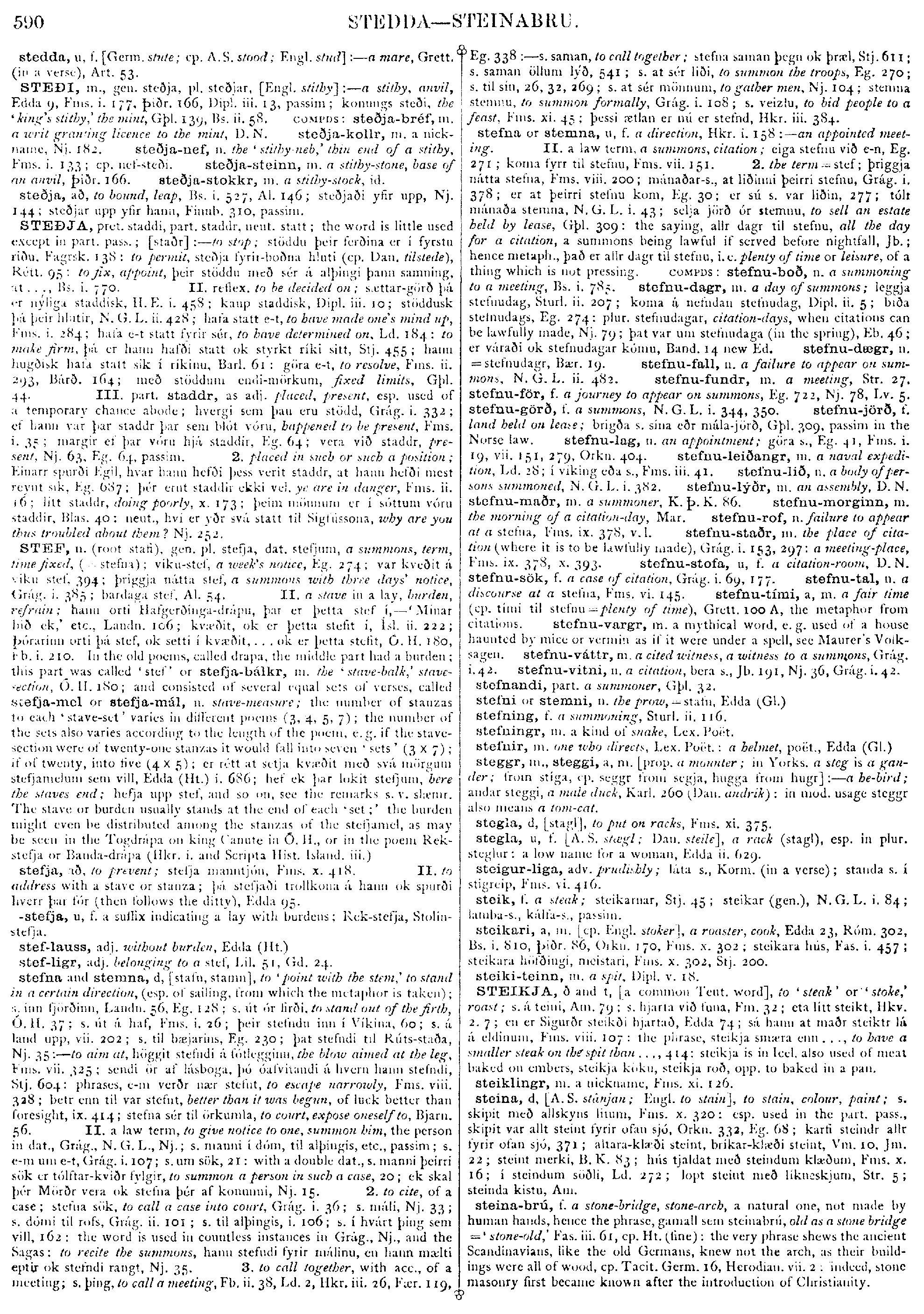
stefna and stemna, d, [stafn, stamn], to 'point with the stem' to stand in a certain direction, (esp. of sailing, from which the metaphor is taken); s. inn fjörðinn, Landn. 56, Eg. 128: s. út ór firði. to stand out of the firth, Ó.H. 37; s. út á haf, Fms. i. 26; þeir stefndu inn í Víkina, 60; s. á land upp, vii. 202; s. til bæjarins, Eg. 230; þat stefndi til Rúts-staða, Nj. 35 :-- to aim at, höggit stefndi á fótlegginn, the blow aimed at the leg, Fms. vii. 325; sendi ör af lásboga, þó óafvitandi á hvern hann stefndi, Stj. 604: phrases, e-m verðr nær stefnt, to escape narrowly, Fms. viii. 328; betr enn til var stefnt, better than it was begun, of luck better than foresight, ix. 414; stefna sér til örkumla, to court, expose oneself to, Bjarn. 56. II. a law term, to give notice to one, summon him, the person in dat., Grág., N.G.L., Nj.; s. manni í dóm, til alþingis, etc., passim; s. e-m um e-t, Grág. i. 107; s. um sök, 21: with a double dat., s. manni þeirri sök er tólftar-kviðr fylgir, to summon a person in such a case, 20; ek skal þér Mörðr vera ok stefna þér af konunni, Nj. 15. 2. to cite, of a case; stefna sök, to call a case into court, Grág. i. 36; s. máli, Nj. 33; s. dómi til rofs, Grág. ii. 101; s. til alþingis, i. 106; s. í hvárt þing sem vill, 162: the word is used in countless instances in Grág., Nj., and the Sagas: to recite the summons, hann stefndi fyrir málinu, en hann mælti eptir ok stefndi rangt, Nj. 35. 3. to call together, with acc., of a meeting; s. þing, to call a meeting, Fb. ii. 38, Ld. 2, Hkr. iii. 26, Fær. 119, Eg. 338 :-- s. saman, to call together; stefna saman þegn ok þræl, Stj. 611; s. saman öllum lýð, 541; s. at sér liði, to summon the troops, Eg. 270; s. til sín, 26, 32, 269; s. at sér mönnum, to gather men, Nj. 104; stemna stemnu, to summon formally, Grág. i. 108; s. veizlu, to bid people to a feast, Fms. xi. 45; þessi ætlan er nú er stefnd, Hkr. iii. 384.
|
Source: Cleasby/Vigfusson, page b0590, entry 11 View original page image as: [TIFF] [PNG] [View previous entry] [View next entry] |
[Comment on this entry] [View comments] |
The following entry has been hand-corrected once. |
stefna or stemna, u, f. a direction, Hkr. i. 158 :-- an appointed meeting. II. a law term, a summons, citation; eiga stefnu við e-n, Eg. 271; koma fyrr til stefnu, Fms. vii. 151. 2. the term = stef; þriggja nátta stefna, Fms. viii. 200; mánaðar-s., at liðinni þeirri stefnu, Grág. i. 378; er at þeirri stefnu kom, Eg. 30; er sú s. var liðin, 277; tólt mánaða stemna, N.G.L. i. 43; selja jörð ór stemnu, to sell an estate held by lease, Gþl. 309: the saying, allr dagr til stefnu, all the day for a citation, a summons being lawful if served before nightfall, Jb.; hence metaph., það er allr dagr til stefnu, i.e. plenty of time or leisure, of a thing which is not pressing. COMPDS: stefnu-boð, n. a summoning to a meeting, Bs. i. 785. stefnu-dagr, m. a day of summons; leggja stefnudag, Sturl. ii. 207; koma í nefndan stefnudag, Dipl. ii. 5; biða stefnudags, Eg. 274: plur. stefnudagar, citation-days, when citations can be lawfully made, Nj. 79; þat var um stefnudaga (in the spring), E.b. 46; er váraði ok stefnudagar kómu, Band. 14 new Ed. stefnu-dægr, n. = stefnudagr, Bær. 19. stefnu-fall, n. a failure to appear on summons, N.G.L. ii. 482. stefnu-fundr, m. a meeting, Str. 27. stefnu-för, f. a journey to appear on summons, Eg. 722, Nj. 78, Lv. 5. stefnu-görð, f. a summons, N.G.L. i. 344, 350. stefnu-jörð, f. land held on lease; brigða s. sína eðr mála-jörð, Gþl. 309, passim in the Norse law. stefnu-lag, n. an appointment; göra s., Eg. 41, Fms. i. 19, vii. 151, 279, Orkn. 404. stefnu-leiðangr, m. a naval expedition, Ld. 28; í viking eða s., Fms. iii. 41. stefnu-lið, n. a body of persons summoned, N.G.L. i. 382. stefnu-lýðr, m. an assembly, D.N. stefnu-maðr, m. a summoner, K.Þ.K. 86. stefnu-morginn, m. the morning of a citation-day, Mar. stefnu-rof, n. failure to appear at a stefna, Fms. ix. 378, v.l. stefnu-staðr, m. the place of citation (where it is to be lawfully made), Grág. i. 153, 297: a meeting-place, Fms. ix. 378, x. 393. stefnu-stofa, u, f. a citation-room, D.N. stefnu-sök, f. a case of citation, Grág. i. 69, 177. stefnu-tal, n. a discourse at a stefna, Fms. vi. 145. stefnu-tími, a, m. a fair time(cp. tími til stefnu = plenty of time), Grett. 100 A, the metaphor from citations. stefnu-vargr, m. a mythical word, e.g. used of a house haunted by mice or vermin as if it were under a spell, see Maurer's Volksagen. stefnu-váttr, m. a cited witness, a witness to a summons, Grág. i. 42. stefnu-vitni, n. a citation, bera s., Jb. 191, Nj. 36, Grág. i. 42.
|
Source: Torp, page b0483, entry 4 View original page image as: [TIFF] [PNG] [View previous entry] [View next entry] |
[Comment on this entry] [View comments] |
The following entry has been hand-corrected once. |
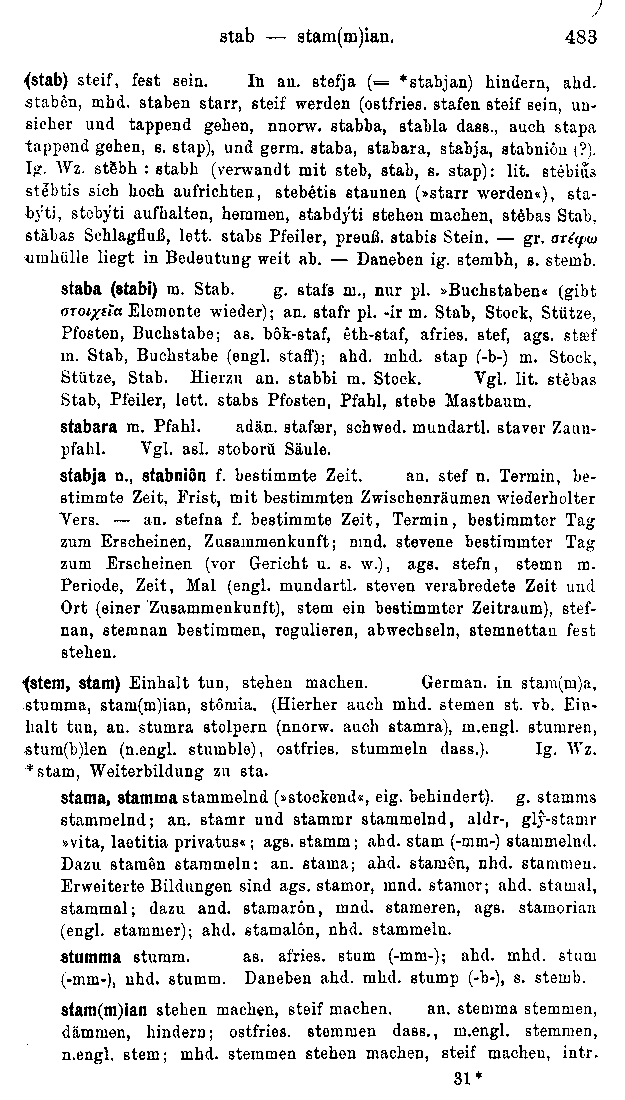
stabja n., stabniôn f. bestimmte Zeit. an. stef n. Termin, bestimmte Zeit, Frist, mit bestimmten Zwischenräumen wiederholter Vers. - an. stefna f. bestimmte Zeit, Termin, bestimmter Tag zum Erscheinen, Zusammenkunft; mnd. stevene bestimmter Tag zum Erscheinen (vor Gericht u. s. w.), ags. stefn, stemn m. Periode, Zeit, Mal (engl. mundartl. steven verabredete Zeit und Ort (einer Zusammenkunft), stem ein bestimmter Zeitraum), stefnan, stemnan bestimmen, regulieren, abwechseln, stemnettan fest stehen.
[Translate the German words]
|
Source: Bosworth/Toller, page b0133, entry 18 View original page image as: [TIFF] [PNG] [View previous entry] [View next entry] |
[Comment on this entry] [View comments] |
The following entry has been hand-corrected once. |
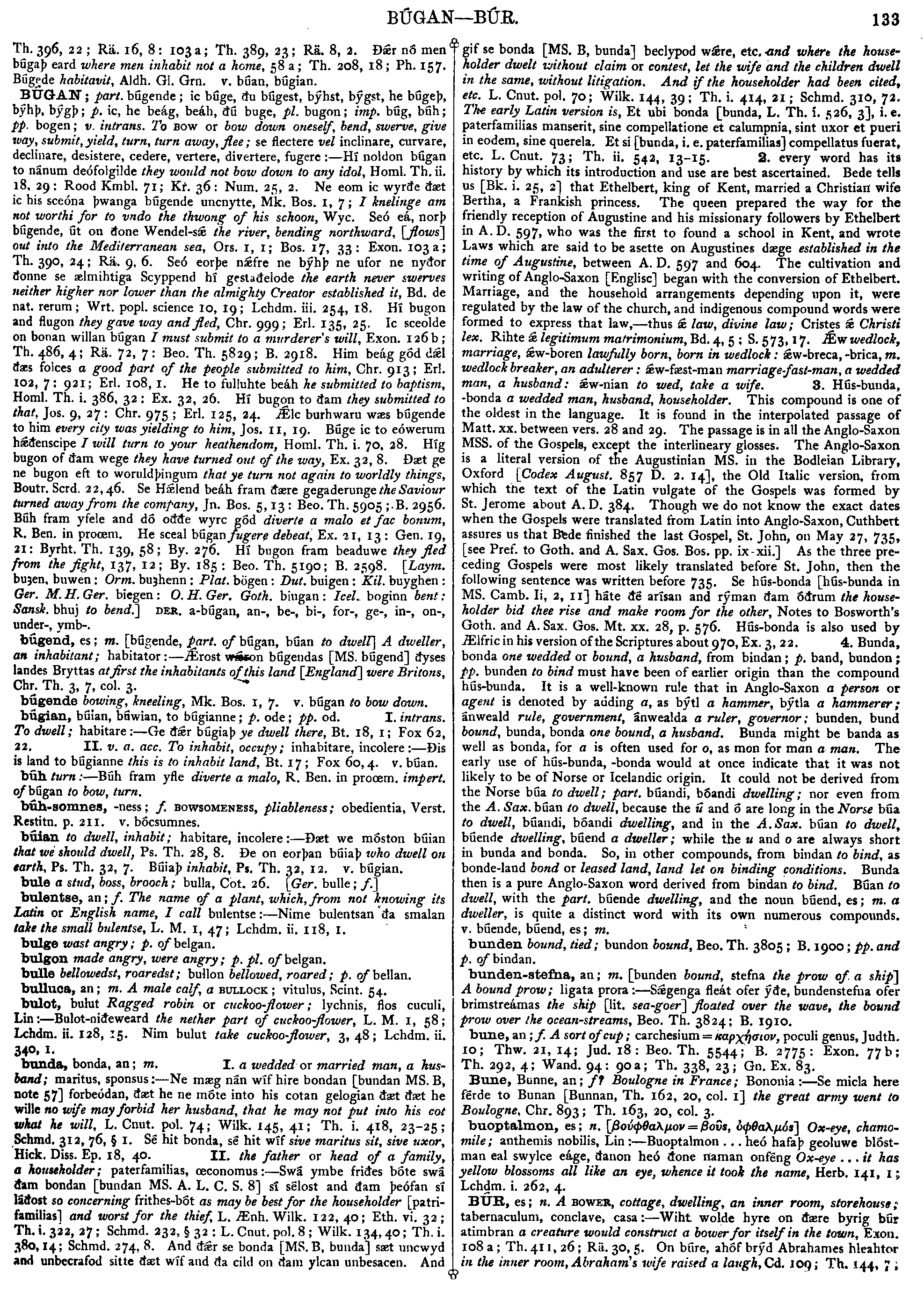
bunden-stefha,
an;
m.
[bunden
bound,
stefna
the
prow
of
a
ship]
A
bound
prow;
ligata
prora:--
Sgenga
fleát
ofer
ýðe,
bundenstefna
ofer
brimstreámas
the
ship
[lit.
sea-goer]
floated
over
the
wave,
the
bound
prow
over
the
ocean-streams.
Beo.
Th.
3824;
B.
1910.
|
Source: Bosworth/Toller, page b0914, entry 23 View original page image as: [TIFF] [PNG] [View previous entry] [View next entry] |
[Comment on this entry] [View comments] |
The following entry has been hand-corrected once. |
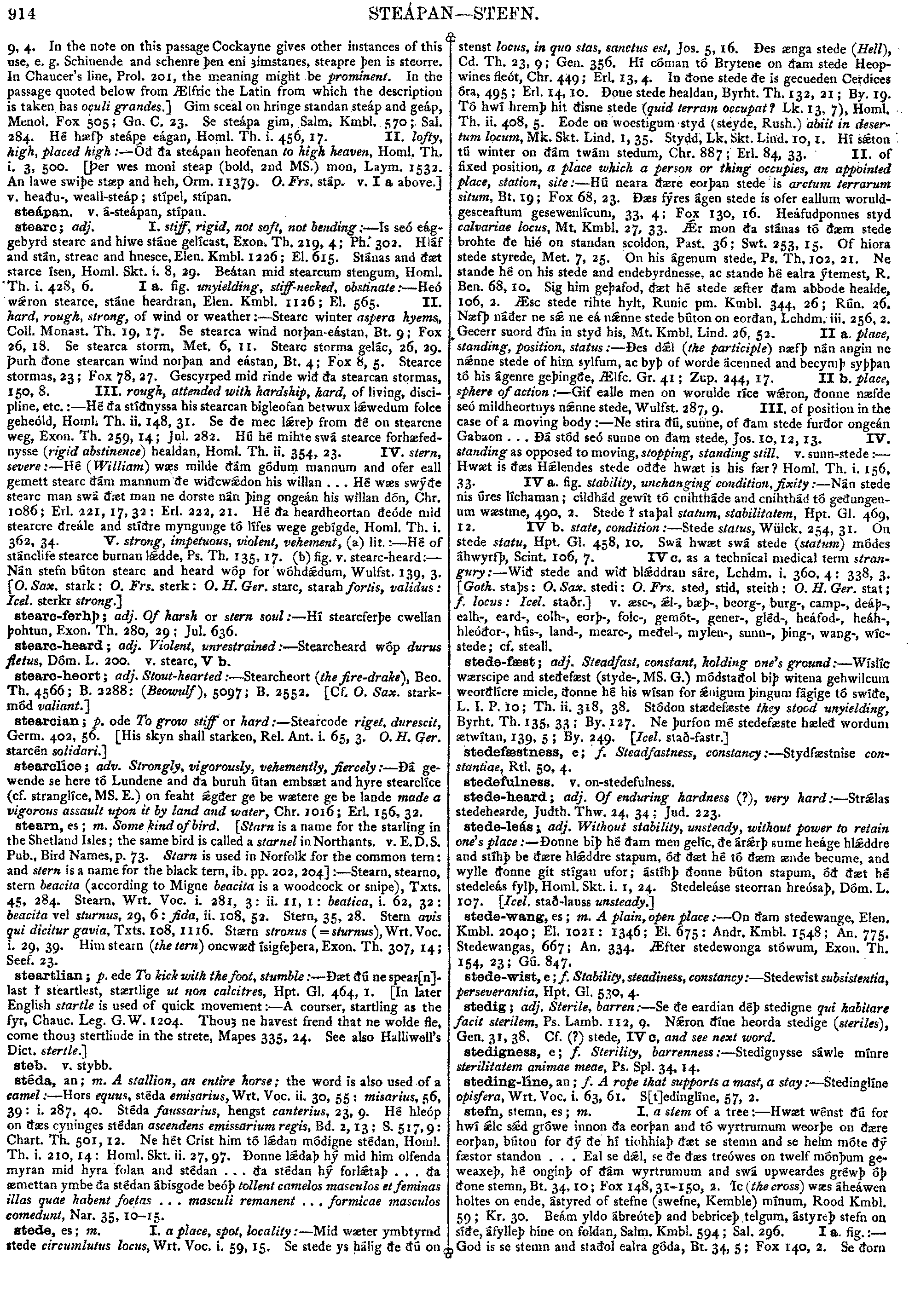
stefn,
stemn,
es;
m.
I.
a
stem
of
a
tree
:--
Hwæt
wénst
ðú
for
hwí
lc
sd
grówe
innon
ða
eorþan
and
tó
wyrtrumum
weorþe
on
ðære
eorþan,
búton
for
ðý
ðe
hí
tiohhiaþ
ðæt
se
stemn
and
se
helm
móte
ðý
fæstor
standon
...
Eal
se
dl,
se
ðe
ðæs
treówes
on
twelf
mónþum
geweaxeþ,
hé
onginþ
of
ðám
wyrtrumum
and
swá
upweardes
gréwþ
óþ
ðone
stemn,
Bt.
34,
10;
Fox
148,
31-150,
2.
Ic
(the
cross)
wæs
áheáwen
holtes
on
ende,
ástyred
of
stefne
(swefne,
Kemble)
mínum,
Rood
Kmbl.
59;
Kr.
30.
Beám
yldo
ábreóteþ
and
bebriceþ
telgum,
ástyreþ
stefn
on
síðe,
áfylleþ
hine
on
foldan,
Salm.
Kmbl.
594;
Sal.
296.
I
a.
fig.
:--
God
is
se
stemn
and
staðol
ealra
góda,
Bt.
34,
5;
Fox
140,
2.
Se
ðorn
ðære
gítsunga
ne
wyrð
forsearod
on
ðæem
helme
gif
se
wyrttruma
ne
biþ
færcorfen
oððe
forbærned
æt
ðæm
stemne
si
radix
culpae
non
exuritur,
nunquam
per
ramos
avaritiae
spina
siccatur,
Past.
45,
3;
Swt.
341,
11.
I
b.
a
stem,
stock,
race.
v.
leód-,
þeód-stefn.
II.
prow
or
stern
of
a
vessel
:--
Se
æftera
stemn
puppis,
Wrt.
Voc,
i.
63,
37.
Tó
lides
stefne,
Chr.
937;
Erl.
112,
34.
Of
nacan
stefne,
Andr.
Kmbl.
582;
An.
291.
Beornas
on
stefn
stigon,
Beo.
Th.
429;
B.
212.
[O.
Sax.
stamn
(of
a
vessel):
O.
Frs.
stevne:
O.
H.
Ger.
stamm
stips,
truncus,
caudex:
Icel.
stafn,
stamn
prow
or
stern
of
a
vessel.]
v.
forþ-,
frum-,
steór-stefn;
stefna,
and
next
word.
|
Source: Bosworth/Toller, page b0915, entry 3 View original page image as: [TIFF] [PNG] [View previous entry] [View next entry] |
[Comment on this entry] [View comments] |
The following entry has been hand-corrected once. |
stefn,
stæfn,
stemn,
e;
f.
I.
a
voice,
sound
uttered
by
the
mouth
(lit.
or
fig.)
:--
Stemn
is
geslagen
lyft
gefrédendlíc
on
hlyste
...
Æ-acute;lc
stemn
byþ
geworden
of
ðæs
múðes
clypunge
and
of
ðære
lyfte
cnyssunge;
se
múð
drífþ
út
ða
clypungee,
and
seó
lyft
byþ
geslagen
mid
ðære
clypunge
and
gewyrð
tó
stemne.
Æ-acute;lc
stemn
is
oððe
andgytfullíc
oððe
gemenged;
andgytfullíc
stemn
is,
ðe
mid
andgyte
biþ
geclypod...;
gemenged
stemn
is,
ðe
biþ
bútan
andgyte,
swylc
swá
is
hrýðera
gehlów
and
horsa
hngung,
hunda
gebeorc,
treówa
brastlung
et
cetera,
Ælfc.
Gr.
1;
Zup.
4,
5-16.
Stebn
vox,
Wrt.
Voc.
ii.
124,
18.
Stefn
of
heofenum
ðus
cwæð,
Mt.
Kmbl.
3,
17:
Mk.
Skt.
1,
11.
Seó
árleáse
helwarena
stefn
wæs
gehýred
and
heora
gnornung,
Blickl.
Homl.
87,
3.
Seó
stemn
ðære
heortan
biþ
gedréfed,
19,
9.
Seó
stemn
ys
Iacobes
stefn,
Gen.
27,
22.
Seó
stefen
heom
andswarode,
Nicod.
24;
Thw.
13,
5.
Swá
him
seó
stefen
beád,
Gl.
Prud.
1
a.
Sió
býman
stefen,
Exon.
Th.
65,
29;
Cri.
1062.
Heó
clypode
micelre
stefne,
Lk.
Skt.
1,
42.
Hé
cúþre
stæfne
wæs
tó
mé
sprecende,
Bd.
4,
25;
S.
600,
43.
Gif
ðú
sanges
stæfne
gehýrdest,
4,
3;
S.
568,
30.
Hig
gecnáwaþ
his
stefne,
Jn.
Skt.
10,
4.
Hig
mycelre
stefne
bdon
ðæt
hé
wre
áhangen;
and
hyra
stefna
swíðredon,
Lk.
Skt.
23,
23.
Stæfna,
Ps.
Spl.
18,
3.
Láðe
cyrmdon
fgum
stæfnum,
Cd.
Th.
207,
5;
Exod.
462.
II.
as
a
grammatical
term,
form
to
mark
relation
:--
Se
forma
hád
and
se
óðer
hád
habbaþ
nlípige
stemna,
forðan
ðe
hí
beóþ
fre
ætgædere
and
him
betwýnan
sprecaþ.
Ðonne
ic
cweþe
ego
ic,
and
ðú
cwest
tó
mé
tu
ðú,
ðonne
beó
wyt
ætgædere
and
for
ðí
ne
behófaþ
náðor
ðissera
pronomina
ná
má
stemna
búton
twegra.
Se
ðridda
hád
hæfþ
syx
clypunga,
forðan
ðe
hé
ys
hwílon
mid,
hwílon
on
óðre
stówe,
Ælfc.
Gr.
15;
Zup.
93,
2-8.
[Chauc.
steven:
the
word
is
used
by
Gawin
Douglas.
Goth.
stibna:
O.
Sax.
stemna:
O.
Frs.
stemme:
O.
H.
Ger.
stimna,
stimma,
stemna,
stemma.]
v.
þunorrád-,
wæter-stefn.
|
Source: Bosworth/Toller, page b0915, entry 4 View original page image as: [TIFF] [PNG] [View previous entry] [View next entry] |
[Comment on this entry] [View comments] |
The following entry has been hand-corrected once. |
stefn, e; f. A summons, citation (in rád-stefn a summons carried by a mounted person. v. rád-stefn, where this meaning may be substituted for the one there given). [Icel. stefna a summons, citation.] v. stefnian.
|
Source: Bosworth/Toller, page b0915, entry 11 View original page image as: [TIFF] [PNG] [View previous entry] [View next entry] |
[Comment on this entry] [View comments] |
The following entry has been hand-corrected once. |
stefnian; p. ode To cite, summon (with dat.) :-- Stefnode man God wine eorle and Harolde eorle tó ðon gemóte ... Ðá hí ðider cómon, ðá stefnede heom man tó gemóte, Chr. 1048; Erl. 180, 3-6. Se cing him steofnode tó Glóweceastre, 1093; Erl. 228, 33. [Taken from Scandinavian(?); cf. Icel. stefna to cite, summon a person (dat.).]
|
Source: Bosworth/Toller, page b0926, entry 1 View original page image as: [TIFF] [PNG] [View previous entry] [View next entry] |
[Comment on this entry] [View comments] |
The following entry has been hand-corrected once. |
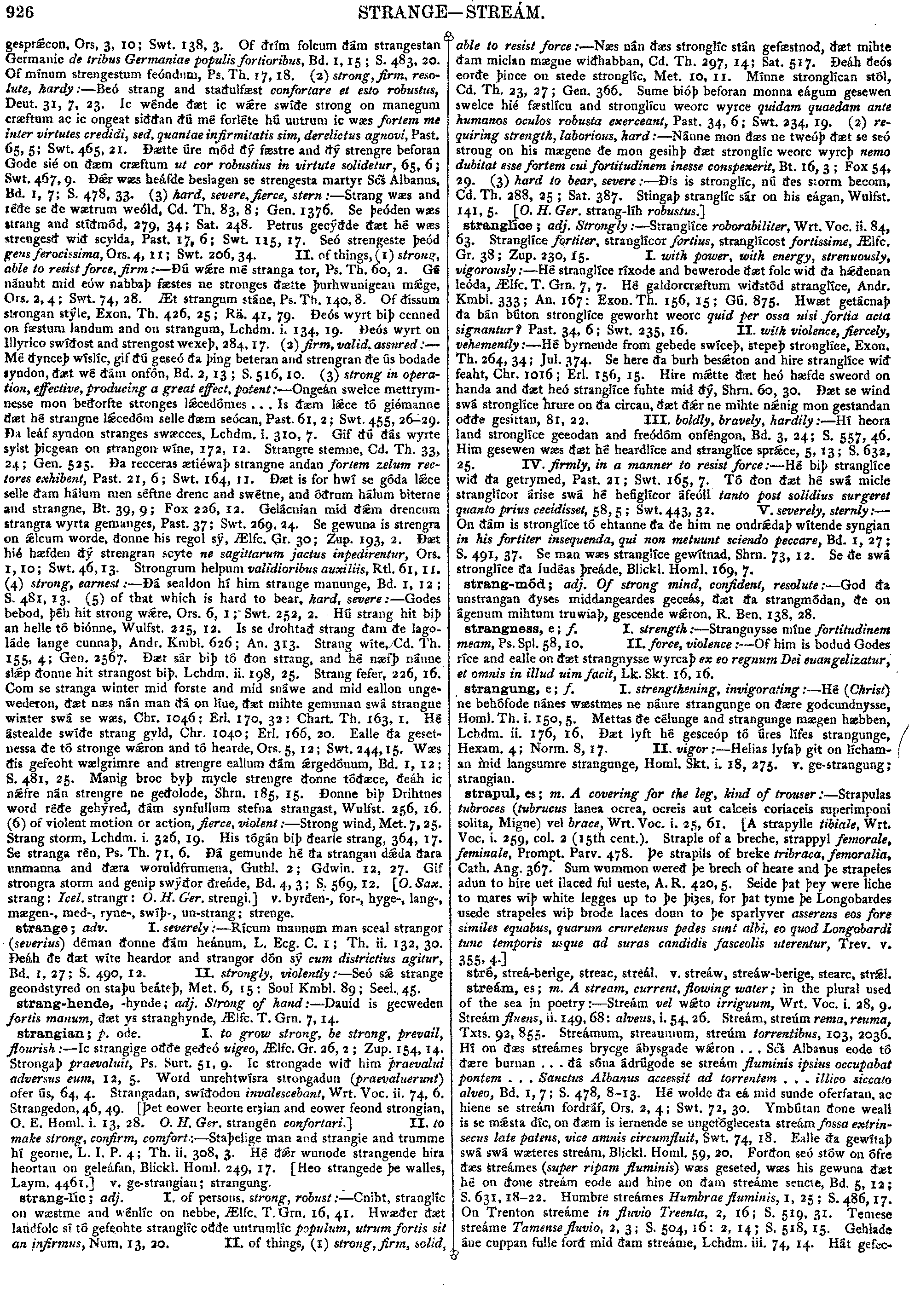
gesprcon,
Ors.
3,
10;
Swt.
138,
3.
Of
ðrím
folcum
ðám
strangestan
Germanie
de
tribus
Germaniae
populisfortioribus,
Bd.
1,
15;
S.
483,
20.
Of
minum
strengestum
feóndum,
Ps.
Th.
17,
18.
(2)
strong,
firm,
resolute,
hardy
:--
Beó
strang
and
staðulfæst
confortare
et
esto
robustus,
Deut.
31,
7,
23.
Ic
wende
ðæt
ic
wre
swíðe
strong
on
manegum
cræftum
ac
ic
ongeat
siððan
ðú
mé
forléte
hú
untrum
ic
wæs
fortem
me
inter
virtutes
credidi,
sed,
quantae
infirmitatis
sim,
derelictus
agnovi,
Past.
65,
5;
Swt.
465,
21.
Ðætte
úre
mód
ðý
fæstre
and
ðý
strengre
beforan
Gode
sié
on
ðæm
cræftum
ut
cor
robustius
in
virtute
solidetur,
65,
6;
Swt.
467,
9.
Ðr
wæs
heáfde
beslagen
se
strengesta
martyr
Scs
UNCERTAIN
Albanus,
Bd.
1,
7;
S.
478,
33.
(3)
hard,
severe,
fierce,
stern
:--
Strang
wæs
and
réðe
se
ðe
wætrum
weóld,
Cd.
Th.
83,
8;
Gen.
1376.
Se
þeóden
wæs
strang
and
stíðmód,
279,
34;
Sat.
248.
Petrus
gecýðde
ðæt
hé
wæs
strengesð
wið
scylda,
Past.
17,
6;
Swt.
115,
17.
Seó
strengeste
þeód
gens
ferocissima,
UNCERTAIN
Ors.
4,
11;
Swt.
206,
34.
II.
of
things,
(1)
strong,
able
to
resist
force,
firm
:--
Ðú
wre
mé
stranga
tor,
Ps.
Th.
60,
2.
Gé
nánuht
mid
eów
nabbaþ
fæstes
ne
stronges
ðætte
þurhwunigean
mge,
Ors.
2,
4;
Swt.
74,
28.
Æt
strangum
stáne,
Ps.
Th.
140,
8.
Of
ðissum
strongan
stýle,
Exon.
Th.
426,
25;
Rä.
41,
79.
Ðeós
wyrt
biþ
cenned
on
fæstum
landum
and
on
strangum,
Lchdm.
i.
134,
19.
Ðeós
wyrt
on
Illyrico
swíðost
and
strengost
wexeþ,
284,
17.
(2)
firm,
valid,
assured
:--
Mé
ðynceþ
wíslíc,
gif
ðú
geseó
ða
þing
beteran
and
strengran
ðe
ús
bodade
syndon,
ðæt
wé
ðám
onfón,
Bd.
2,
13
;
S.
516,
10.
(3)
strong
in
operation,
effective,
producing
a
great
effect,
potent
:--
Ongeán
swelce
mettrymnesse
mon
beðorfte
stronges
lcedómes
.
.
.
Is
ðæm
lce
tó
giémanne
ðæt
hé
strangne
lcedóm
selle
ðæm
seócan,
Past.
61,
2;
Swt.
455,
26-29.
Ða
leáf
syndon
stranges
swæcces,
Lchdm.
i.
310,
7.
Gif
ðú
ðás
wyrte
sylst
þicgean
on
strangon
wine,
172,
12.
Strangre
stemne,
Cd.
Th.
33,
24;
Gen.
525.
Ða
recceras
ætiéwaþ
strangne
andan
fortem
zelum
rectores
exhibent,
Past.
21,
6;
Swt.
164,
11.
Ðæt
is
for
hwí
se
góda
lce
selle
ðam
hálum
men
séftne
drenc
and
swétne,
and
óðrum
hálum
biterne
and
strangne,
Bt.
39,
9;
Fox
226,
12.
Gelácnian
mid
ðæm
drencum
strangra
wyrta
gemanges,
Past.
37;
Swt.
269,
24.
Se
gewuna
is
strengra
on
lcum
worde,
ðonne
his
regol
sý,
Ælfc.
Gr.
30;
Zup.
193,
2.
Ðæt
hié
hæfden
ðý
strengran
scyte
ne
sagittarum
jactus
inpedirentur,
Ors.
1.
10;
Swt.
46,
13.
Strongrum
helpum
validioribus
auxiliis,
Rtl.
61,
11.
(4)
strong,
earnest
:--
Ðá
sealdon
hí
him
strange
manunge,
Bd.
1,
12
;
S.
481,
13.
(5)
of
that
which
is
hard
to
bear,
hard,
severe
:--
Godes
bebod,
þéh
hit
strong
wre,
Ors.
6,
1;
Swt.
252,
2.
Hú
strang
hit
biþ
an
helle
tó
biónne,
Wulfst.
225,
12.
Is
se
drohtað
strang
ðam
ðe
lagoláde
lange
cunnaþ,
Andr.
Kmbl.
626
;
An.
313.
Strang
wite,
Cd.
Th.
155,
4;
Gen.
2567.
Ðæt
sár
biþ
tó
ðon
strang,
and
hé
næfþ
nánne
slp
ðonne
hit
strangest
biþ,
Lchdm.
ii.
198,
25.
Strang
fefer,
226,
16.
Com
se
stranga
winter
mid
forste
and
mid
snáwe
and
mid
eallon
ungewederon,
ðæt
næs
nán
man
ðá
on
líue,
ðæt
mihte
gemunan
swá
strangne
winter
swá
se
wæs,
Chr.
1046;
Erl.
170,
32:
Chart.
Th.
163,
1.
Hé
ástealde
swéðe
strang
gyld.
Chr.
1040;
Erl.
166,
20.
Ealle
ða
gesetnessa
ðe
tó
stronge
wron
and
tó
hearde,
Ors.
5,
12;
Swt.
244,
15.
Wæs
ðis
gefeoht
wælgrimre
and
strengre
eallum
ðám
rgedónum,
Bd.
1,
12,
S.
481,
25.
Manig
broc
byþ
mycle
strengre
ðonne
tóðæce,
ðeáh
ic
nfre
nán
strengre
ne
geðolode,
Shrn.
185,
15.
Ðonne
biþ
Drihtnes
word
réðe
gehýred,
ðám
synfullum
stefna
strangast,
Wulfst.
256,
16.
(6)
of
violent
motion
or
action,
fierce,
violent
:--
Strong
wind,
Met.
7,
25.
Strang
storm,
Lchdm.
i.
326,
19.
His
tógán
biþ
ðearle
strang,
364,
17.
Se
stranga
rén,
Ps.
Th.
71,
6,
Ðá
gemunde
hé
ða
strangan
dda
ðara
unmanna
and
ðæra
woruldfrumena,
Guthl.
2;
Gdwin.
12,
27.
Gif
strongra
storm
and
genip
swýðor
ðreáde,
Bd.
4,
3
;
S.
569,
12.
[O.
Sax.
strang:
Icel.
strangr:
O.
H.
Ger.
strengi.]
v.
byrðen-,
for-,
hyge-,
lang-,
mægen-,
med-,
ryne-,
swíþ-,
un-strang;
strenge.
| Result Page: | 1 2 3 4 5 6 7 | Next |  |
Germanic Lexicon Project (main page)
This search system was written by
Sean Crist
Please consider
volunteering
to correct the data in these online dictionaries.
No rights reserved. Feel free to use these data in any way you please.