|
|

Search for statu again, using less strict matching (12 results)
|
Source: Bosworth/Toller, page b0440, entry 6 View original page image as: [TIFF] [PNG] [View previous entry] [View next entry] |
[Comment on this entry] [View comments] |
The following entry has been hand-corrected once. |
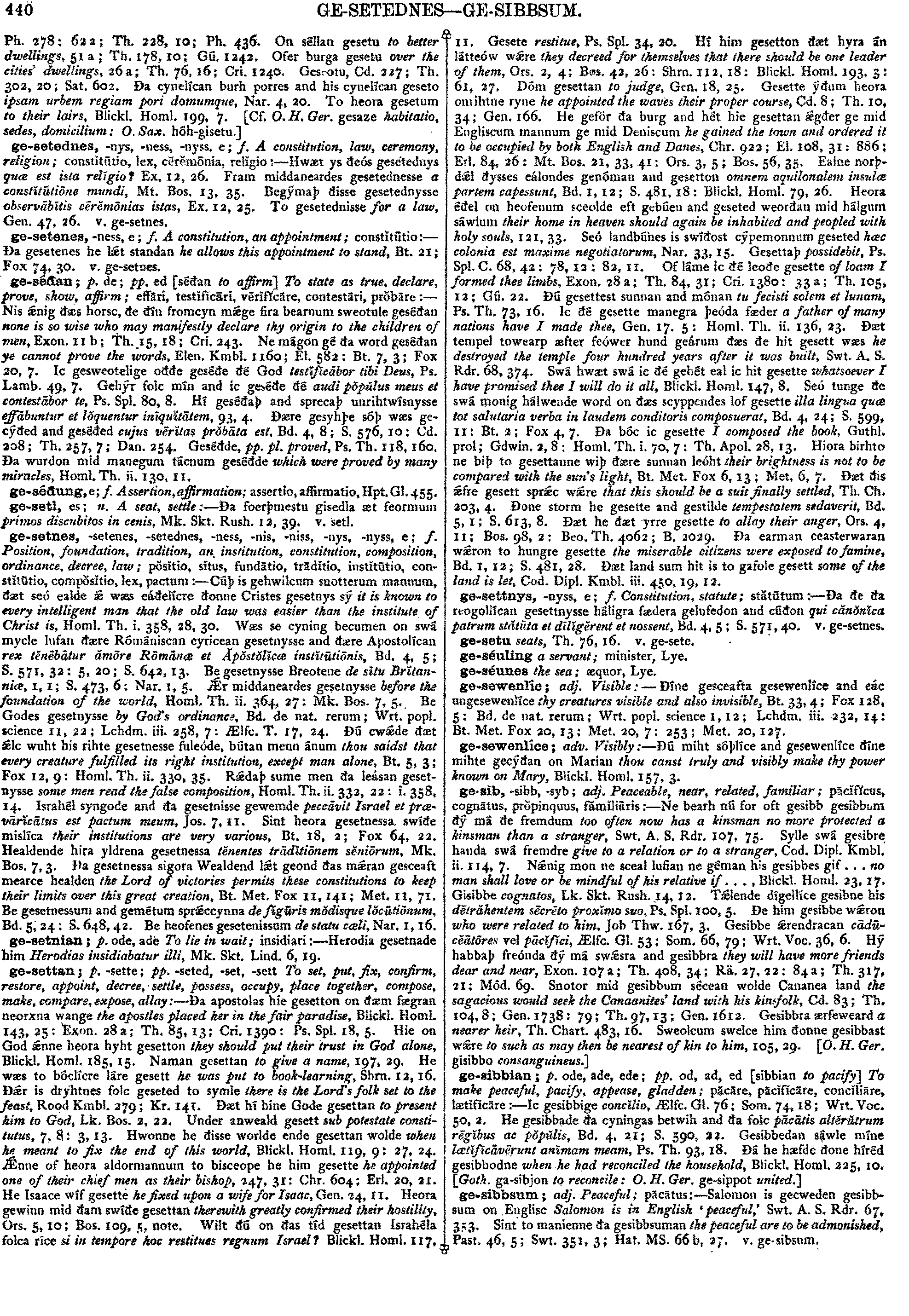
ge-setnes,
-setenes,
-setednes,
-ness,
-nis,
-niss,
-nys,
-nyss,
e;
f.
Position,
foundation,
tradition,
an
institution,
constitution,
composition,
ordinance,
decree,
law;
p s
s tio,
stus,
fund
tio,
stus,
fund tio,
trdtio,
instt
tio,
trdtio,
instt tio,
constttio,
compstio,
lex,
pactum
:--
Cúþ
is
gehwilcum
snotterum
mannum,
ðæt
seó
ealde
tio,
constttio,
compstio,
lex,
pactum
:--
Cúþ
is
gehwilcum
snotterum
mannum,
ðæt
seó
ealde
 wæs
eáðelícre
ðonne
Cristes
gesetnys
sý
it
is
known
to
every
intelligent
man
that
the
old
law
was
easier
than
the
institute
of
Christ
is,
Homl.
Th.
i.
358,
28,
30.
Wæs
se
cyning
becumen
on
swá
mycle
lufan
ðære
Rómániscan
cyricean
gesetnysse
and
ðære
Apostolícan
rex
t
wæs
eáðelícre
ðonne
Cristes
gesetnys
sý
it
is
known
to
every
intelligent
man
that
the
old
law
was
easier
than
the
institute
of
Christ
is,
Homl.
Th.
i.
358,
28,
30.
Wæs
se
cyning
becumen
on
swá
mycle
lufan
ðære
Rómániscan
cyricean
gesetnysse
and
ðære
Apostolícan
rex
t n
n btur
btur
 m
m re
Rmnæ
et
&A-short;pstlcæ
instttinis,
Bd.
4,
5;
S.
571,
32:
5,
20;
S.
642,
13.
Be
gesetnysse
Breotene
de
stu
Brtanniæ,
1,
1;
S.
473,
6:
Nar.
1,
5.
Æ-acute;r
middaneardes
gesetnysse
before
the
foundation
of
the
world,
Homl.
Th.
ii.
364,
27:
Mk.
Bos.
7,
5.
Be
Godes
gesetnysse
by
God's
ordinance,
Bd.
de
nat.
rerum;
Wrt.
popl.
science
11,
22;
Lchdm.
iii.
258,
7:
Ælfc.
T.
17,
24.
Ðú
cwde
ðæt
lc
wuht
his
rihte
gesetnesse
fuleóde,
bútan
menn
ánum
thou
saidst
that
every
creature
fulfilled
its
right
institution,
except
man
alone,
Bt.
5,
3;
Fox
12,
9:
Homl.
Th.
ii.
330,
35.
Rdaþ
sume
men
ða
leásan
gesetnysse
some
men
read
the
false
composition,
Homl.
Th.
ii.
332,
22:
i.
358,
14.
Israhél
syngode
and
ða
gesetnisse
gewemde
peccvit
Israel
et
prævrctus
est
pactum
meum,
Jos.
7,
11.
Sint
heora
gesetnessa
swíðe
mislíca
their
institutions
are
very
various,
Bt.
18,
2;
Fox
64,
22.
Healdende
hira
yldrena
gesetnessa
tnentes
trdtinem
snirum,
Mk.
Bos.
7,
3.
Ða
gesetnessa
sigora
Wealdend
lt
geond
ðas
mran
gesceaft
mearce
healden
the
Lord
of
victories
permits
these
constitutions
to
keep
their
limits
over
this
great
creation,
Bt.
Met.
Fox
11,
141;
Met.
l1,
75.
Be
gesetnessum
and
gemétum
sprccynna
de
fgris
mdisque
lctinum,
Bd.
5,
24:
S.
648,
42.
Be
heofenes
gesetenissum
de
statu
cæli,
Nar.
1,
16.
re
Rmnæ
et
&A-short;pstlcæ
instttinis,
Bd.
4,
5;
S.
571,
32:
5,
20;
S.
642,
13.
Be
gesetnysse
Breotene
de
stu
Brtanniæ,
1,
1;
S.
473,
6:
Nar.
1,
5.
Æ-acute;r
middaneardes
gesetnysse
before
the
foundation
of
the
world,
Homl.
Th.
ii.
364,
27:
Mk.
Bos.
7,
5.
Be
Godes
gesetnysse
by
God's
ordinance,
Bd.
de
nat.
rerum;
Wrt.
popl.
science
11,
22;
Lchdm.
iii.
258,
7:
Ælfc.
T.
17,
24.
Ðú
cwde
ðæt
lc
wuht
his
rihte
gesetnesse
fuleóde,
bútan
menn
ánum
thou
saidst
that
every
creature
fulfilled
its
right
institution,
except
man
alone,
Bt.
5,
3;
Fox
12,
9:
Homl.
Th.
ii.
330,
35.
Rdaþ
sume
men
ða
leásan
gesetnysse
some
men
read
the
false
composition,
Homl.
Th.
ii.
332,
22:
i.
358,
14.
Israhél
syngode
and
ða
gesetnisse
gewemde
peccvit
Israel
et
prævrctus
est
pactum
meum,
Jos.
7,
11.
Sint
heora
gesetnessa
swíðe
mislíca
their
institutions
are
very
various,
Bt.
18,
2;
Fox
64,
22.
Healdende
hira
yldrena
gesetnessa
tnentes
trdtinem
snirum,
Mk.
Bos.
7,
3.
Ða
gesetnessa
sigora
Wealdend
lt
geond
ðas
mran
gesceaft
mearce
healden
the
Lord
of
victories
permits
these
constitutions
to
keep
their
limits
over
this
great
creation,
Bt.
Met.
Fox
11,
141;
Met.
l1,
75.
Be
gesetnessum
and
gemétum
sprccynna
de
fgris
mdisque
lctinum,
Bd.
5,
24:
S.
648,
42.
Be
heofenes
gesetenissum
de
statu
cæli,
Nar.
1,
16.
|
Source: Bosworth/Toller, page b0483, entry 27 View original page image as: [TIFF] [PNG] [View previous entry] [View next entry] |
[Comment on this entry] [View comments] |
The following entry has been hand-corrected once. |
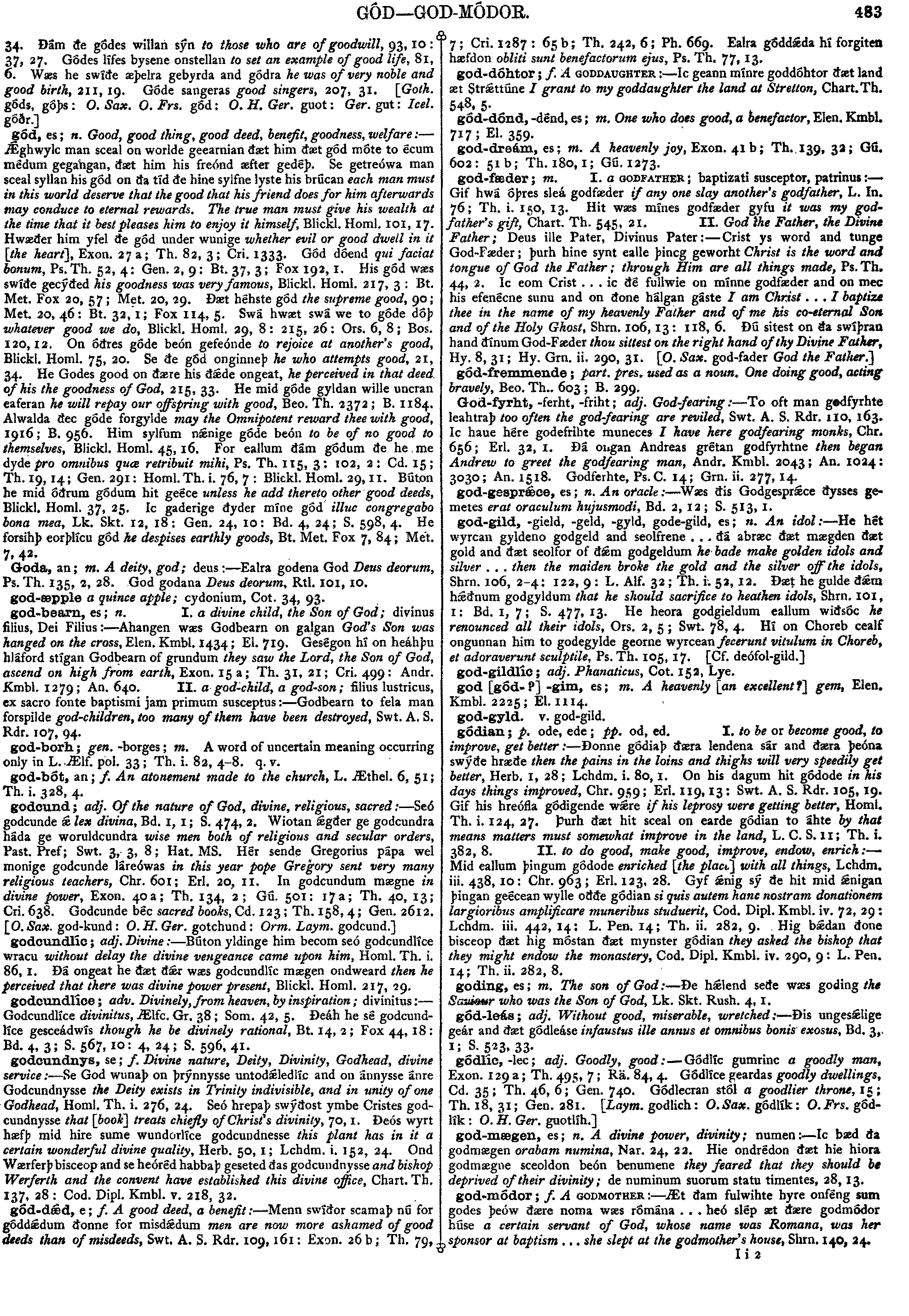
god-mægen, es; n. A divine power, divinity; numen :-- Ic bæd ða godmægen orabam numina, Nar. 24, 22. Hie ondrédon ðæt hie hiora godmægne sceoldon beón benumene they feared that they should be deprived of their divinity; de numinum suorum statu timentes, 28, 13.
|
Source: Bosworth/Toller, page b0574, entry 7 View original page image as: [TIFF] [PNG] [View previous entry] [View next entry] |
[Comment on this entry] [View comments] |
The following entry has been hand-corrected once. |
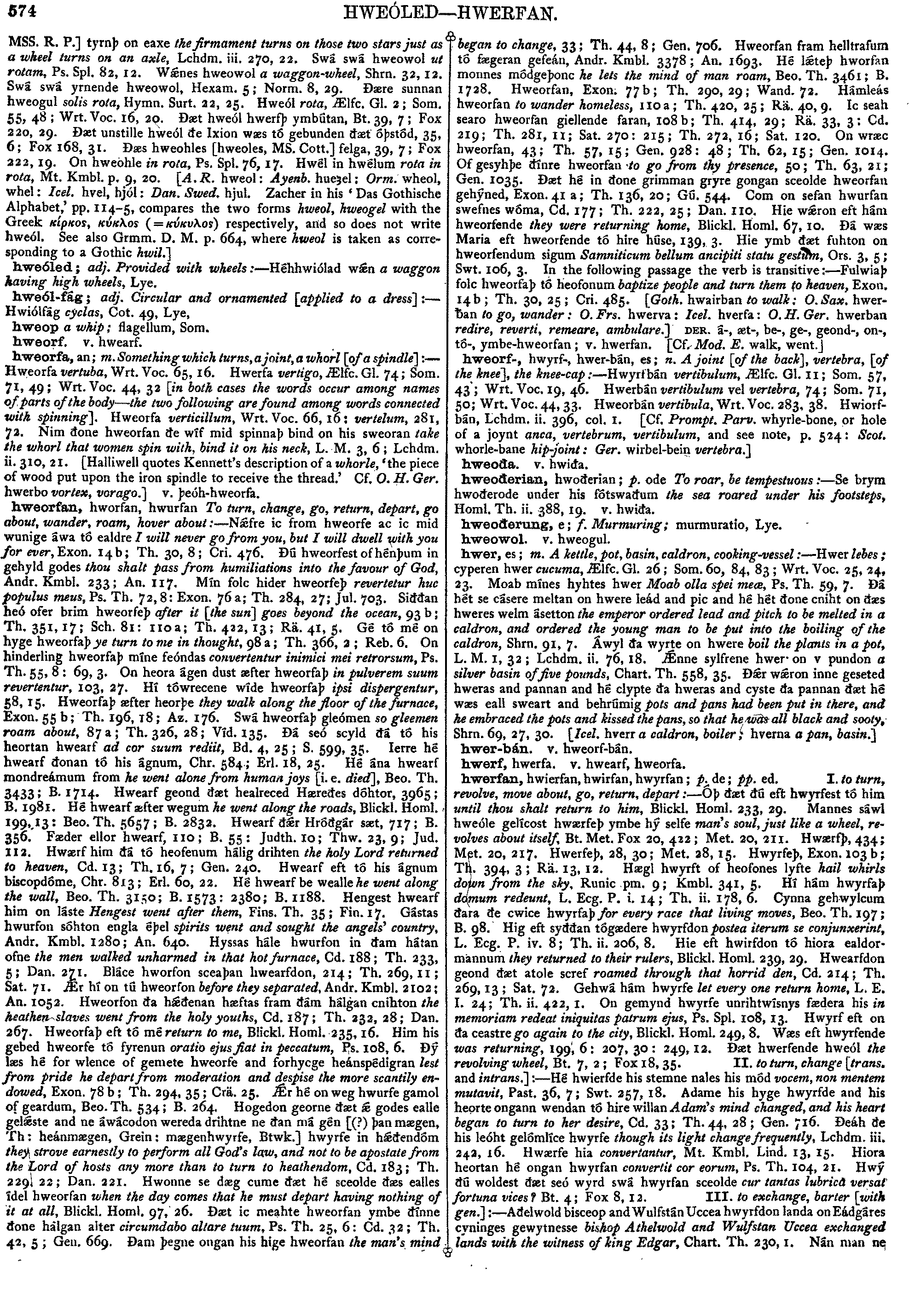
hweorfan,
hworfan,
hwurfan
To
turn,
change,
go,
return,
depart,
go
about,
wander,
roam,
hover
about
:--
Nfre
ic
from
hweorfe
ac
ic
mid
wunige
áwa
tó
ealdre
I
will
never
go
from
you,
but
I
will
dwell
with
you
for
ever,
Exon.
14
b;
Th.
30,
8;
Cri.
476.
Ðú
hweorfest
of
hénþum
in
gehyld
godes
thou
shalt
pass
from
humiliations
into
the
favour
of
God,
Andr.
Kmbl.
233;
An.
117.
Mín
folc
hider
hweorfeþ
revertetur
huc
populus
meus,
Ps.
Th.
72,
8:
Exon.
76
a;
Th.
284,
27;
Jul.
703.
Siððan
heó
ofer
brim
hweorfeþ
after
it
[the
sun]
goes
beyond
the
ocean,
93
b;
Th.
351,
17;
Sch.
81:
110
a;
Th.
422,
13;
Rä.
41,
5.
Gé
tó
mé
on
hyge
hweorfaþ
ye
turn
to
me
in
thought,
98
a;
Th.
366,
2;
Reb.
6.
On
hinderling
hweorfaþ
míne
feóndas
convertentur
inimici
mei
retrorsum,
Ps.
Th.
55,
8:
69,
3.
On
heora
ágen
dust
æfter
hweorfaþ
in
pulverem
suum
revertentur,
103,
27.
Hí
tówrecene
wíde
hweorfaþ
ipsi
dispergentur,
58,
15.
Hweorfaþ
æfter
heorþe
they
walk
along
the
floor
of
the
furnace,
Exon.
55
b;
Th.
196,
18;
Az.
176.
Swá
hweorfaþ
gleómen
so
gleemen
roam
about,
87
a;
Th.
326,
28;
Víd.
135.
Ðá
seó
scyld
ðá
tó
his
heortan
hwearf
ad
cor
suum
rediit,
Bd.
4,
25;
S.
599,
35.
Ierre
hé
hwearf
ðonan
tó
his
ágnum,
Chr.
584;
Erl.
18,
25.
Hé
ána
hwearf
mondreámum
from
he
went
alone
from
human
joys
[i.e.
died],
Beo.
Th.
3433;
B.
1714.
Hwearf
geond
ðæt
healreced
Hæreðes
dóhtor,
3965;
B.
1981.
Hé
hwearf
æfter
wegum
he
went
along
the
roads,
Blickl.
Homl.
199,
13:
Beo.
Th.
5657;
B.
2832.
Hwearf
ðr
Hróðgár
sæt,
717;
B.
356.
Fæder
ellor
hwearf,
110;
B.
55:
Judth.
10;
Thw.
23,
9;
Jud.
112.
Hwærf
him
dá
tó
heofenum
hálig
drihten
the
holy
Lord
returned
to
heaven,
Cd.
13;
Th.
16,
7;
Gen.
240.
Hwearf
eft
tó
his
ágnum
biscopdóme,
Chr.
813;
Erl.
60,
22.
Hé
hwearf
be
wealle
he
went
along
the
wall,
Beo.
Th.
3150;
B.
1573:
2380;
B.
1188.
Hengest
hwearf
him
on
láste
Hengest
went
after
them,
Fins.
Th.
35;
Fin.
17.
Gástas
hwurfon
sóhton
engla
éþel
spirits
went
and
sought
the
angels'
country,
Andr.
Kmbl.
1280;
An.
640.
Hyssas
hále
hwurfon
in
ðam
hátan
ofne
the
men
walked
unharmed
in
that
hot
furnace,
Cd.
188;
Th.
233,
5;
Dan.
271.
Bláce
hworfon
sceaþan
hwearfdon,
214;
Th.
269,
11;
Sat.
71.
Æ-acute;r
hí
on
tú
hweorfon
before
they
separated,
Andr.
Kmbl.
2102;
An.
1052.
Hweorfon
ða
hðenan
hæftas
fram
ðám
hálgan
cnihton
the
heathen
slaves
went
from
the
holy
youths,
Cd.
187;
Th.
232,
28;
Dan.
267.
Hweorfaþ
eft
tó
mé
return
to
me,
Blickl.
Homl.
235,
16.
Him
his
gebed
hweorfe
tó
fyrenun
oratio
ejus
fiat
in
peccatum,
Ps.
108,
6.
Ðý
læs
hé
for
wlence
of
gemete
hweorfe
and
forhycge
heánspédigran
lest
from
pride
he
depart
from
moderation
and
despise
the
more
scantily
endowed,
Exon.
78
b;
Th.
294,
35;
Crä.
25.
Æ-acute;r
hé
on
weg
hwurfe
gamol
of
geardum,
Beo.
Th.
534;
B.
264.
Hogedon
georne
ðæt
godes
ealle
gelste
and
ne
áwácodon
wereda
drihtne
ne
ðan
má
gen
[(?)
þan
mægen,
Th:
heánmægen,
Grem:
mægenhwyrfe,
Btwk.]
hwyrfe
in
hðendóm
they
strove
earnestly
to
perform
all
God's
law,
and
not
to
be
apostate
from
the
Lord
of
hosts
any
more
than
to
turn
to
heathendom,
Cd.
183;
Th.
229,
22;
Dan.
221.
Hwonne
se
dæg
cume
ðæt
hé
sceolde
ðæs
ealles
ídel
hweorfan
when
the
day
comes
that
he
must
depart
having
nothing
of
it
at
all,
Blickl.
Homl.
97,
26.
Ðæt
ic
meahte
hweorfan
ymbe
ðinne
ðone
hálgan
alter
circumdabo
altare
tuum,
Ps.
Th.
25,
6:
Cd.
32;
Th.
42,
5;
Gen.
669.
Ðam
þegne
ongan
his
hige
hweorfan
the
man's
mind
began
to
change,
33;
Th.
44,
8;
Gen.
706.
Hweorfan
fram
helltrafum
tó
fægeran
gefeán,
Andr.
Kmbl.
3378;
An.
1693.
Hé
lteþ
hworfan
monnes
módgeþonc
he
lets
the
mind
of
man
roam,
Beo.
Th.
3461;
B.
1728.
Hweorfan,
Exon.
77
b;
Th.
290,
29;
Wand.
72.
Hámleás
hweorfan
to
wander
homeless,
110
a;
Th.
420,
25;
Rä.
40,
9.
Ic
seah
searo
hweorfan
giellende
faran,
108
b;
Th.
414,
29;
Rä.
33,
3:
Cd.
219;
Th.
281,
11;
Sat.
270:
215;
Th.
272,
16;
Sat.
120.
On
wræc
hweorfan,
43;
Th.
57,
15;
Gen.
928:
48;
Th.
62,
15;
Gen.
1014.
Of
gesyhþe
ðínre
hweorfan
to
go
from
thy
presence,
50;
Th.
63,
21;
Gen.
1035.
Ðæt
hé
in
ðone
grimman
gryre
gongan
sceolde
hweorfan
gehýned.
Exon.
41
a;
Th.
136,
20;
Gú.
544.
Com
on
sefan
hwurfan
swefnes
wóma,
Cd.
177;
Th.
222,
25;
Dan.
110.
Hie
wron
eft
hám
hweorfende
they
were
returning
home,
Blickl.
Homl.
67,
10.
Ðá
wæs
Maria
eft
hweorfende
tó
hire
húse,
139,
3.
Hie
ymb
ðæt
fuhton
on
hweorfendum
sigum
Samniticum
bellum
ancipiti
statu
gestum,
Ors.
3,
5;
Swt.
106,
3.
In
the
following
passage
the
verb
is
transitive
:--
Fulwiaþ
folc
hweorfaþ
tó
heofonum
baptize
people
and
turn
them
to
heaven,
Exon.
14
b;
Th.
30,
25;
Cri.
485.
[Goth.
hwairban
to
walk;
O.
Sax.
hwer an
to
go,
wander:
O.
Frs.
hwerva:
Icel.
hverfa:
O.
H.
Ger.
hwerban
redire,
reverti,
remeare,
ambulare.]
DER.
á-,
æt-,
be-,
ge-,
geond-,
on-,
tó-,
ymbe-hweorfan;
v.
hwerfan.
[Cf.
Mod.
E.
walk,
went.]
an
to
go,
wander:
O.
Frs.
hwerva:
Icel.
hverfa:
O.
H.
Ger.
hwerban
redire,
reverti,
remeare,
ambulare.]
DER.
á-,
æt-,
be-,
ge-,
geond-,
on-,
tó-,
ymbe-hweorfan;
v.
hwerfan.
[Cf.
Mod.
E.
walk,
went.]
|
Source: Bosworth/Toller, page b0913, entry 17 View original page image as: [TIFF] [PNG] [View previous entry] [View next entry] |
[Comment on this entry] [View comments] |
The following entry has been hand-corrected once. |
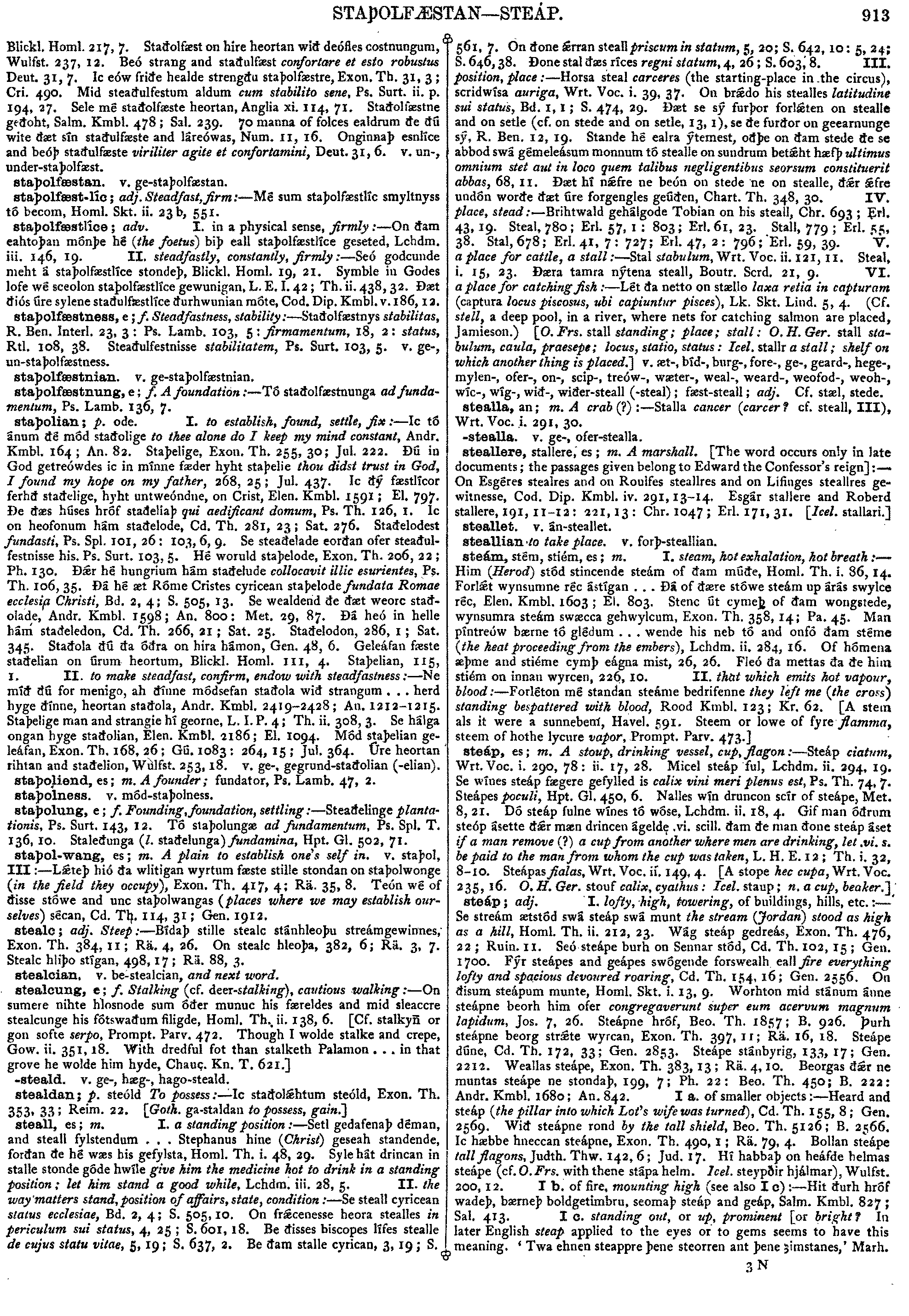
steall,
es;
m.
I.
a
standing
position
:--
Setl
gedafenaþ
déman,
and
steall
fylstendum
...
Stephanus
hine
(Christ)
geseah
standende,
forðan
ðe
hé
wæs
his
gefylsta,
Homl.
Th.
i.
48,
29.
Syle
hát
drincan
in
stalle
stonde
góde
hwíle
give
him
the
medicine
hot
to
drink
in
a
standing
position;
let
him
stand
a
good
while,
Lchdm.
iii.
28,
5.
II.
the
way
matters
stand,
position
of
affairs,
state,
condition
:--
Se
steall
cyricean
status
ecclesiae,
Bd.
2,
4;
S.
505,
10.
On
frcenesse
heora
stealles
in
periculum
sui
status,
4,
25;
S.
601,
18.
Be
ðisses
biscopes
lífes
stealle
de
cujus
statu
vitae,
5,
19;
S.
637,
2.
Be
ðam
stalle
cyrican,
3,
19,
S.
561,
7.
On
ðone
rran
steall
priscum
in
statum,
5,
20;
S.
642,
10:
5,
24;
S.
646,
38.
Ðone
stal
ðæs
ríces
regni
statum,
4,
26;
S.
603,
8.
III.
position,
place
:--
Horsa
steal
carceres
(the
starting-place
in
the
circus),
scridwísa
auriga,
Wrt.
Voc.
i.
39,
37.
On
brdo
his
stealles
latitudine
sui
status,
Bd,
1,
1;
S.
474,
29.
Ðæt
se
sý
furþor
forlten
on
stealle
and
on
setle
(cf.
on
stele
and
on
setle,
13,
1),
se
ðe
furðor
on
geearnunge
sý,
R.
Ben.
12,
19.
Stande
hé
ealra
ýtemest,
oðþe
on
ðam
stede
ðe
se
abbod
swá
gémeleásum
monnum
tó
stealle
on
sundrum
betht
hæfþ
ultimus
omnium
stet
aut
in
loco
quem
talibus
negligentibus
seorsum
constituerit
abbas,
68,
11.
Ðæt
hí
nfre
ne
beón
on
stede
ne
on
stealle,
ðr
fre
undón
worðe
ðæt
úre
forgengles
geúðen,
Chart.
Th.
348,
30.
IV.
place,
stead
:--
Brihtwald
gehálgode
Tobian
on
his
steall,
Chr.
693;
Erl.
43,
19.
Steal.
780;
Erl.
57,
1:
803;
Erl.
61,
23.
Stall,
779;
Erl.
55,
38.
Stal,
678;
Erl.
41,
7:
727;
Erl.
47,
2:
796;
Erl.
59,
39.
V.
a
place
for
cattle,
a
stall
:--
Stal
stabulum,
Wrt.
Voc.
ii.
121,
11.
Steal,
i.
15,
23.
Ðæra
tamra
nýtena
steall,
Boutr.
Scrd.
21,
9.
VI.
a
place
for
catching
fish
:--
Lét
ða
netto
on
stællo
laxa
retia
in
capturam
(captura
locus
piscosus,
ubi
capiuntur
pisces),
Lk.
Skt.
Lind.
5,
4.
(Cf
stell,
a
deep
pool,
in
a
river,
where
nets
for
catching
salmon
are
placed,
Jamieson.)
[O.
Frs.
stall
standing;
place;
stall:
O.
H.
Ger.
stall
stabulum,
caula,
praesepe;
locus,
statio,
status:
Icel.
stallr
a
stall;
shelf
on
which
another
thing
is
placed.]
v.
æt-,
bód-,
burg-,
fore-,
ge-,
geard-,
hege-,
mylen-,
ofer-,
on-,
scip-,
treów-,
wæter-,
weal-,
weard-,
weofod-,
weoh-,
wíc-,
wíg-,
wið-,
wiðer-steall
(-steal);
fæst-steall;
adj.
Cf.
stæl,
stede.
|
Source: Bosworth/Toller, page b0914, entry 12 View original page image as: [TIFF] [PNG] [View previous entry] [View next entry] |
[Comment on this entry] [View comments] |
The following entry has been hand-corrected once. |
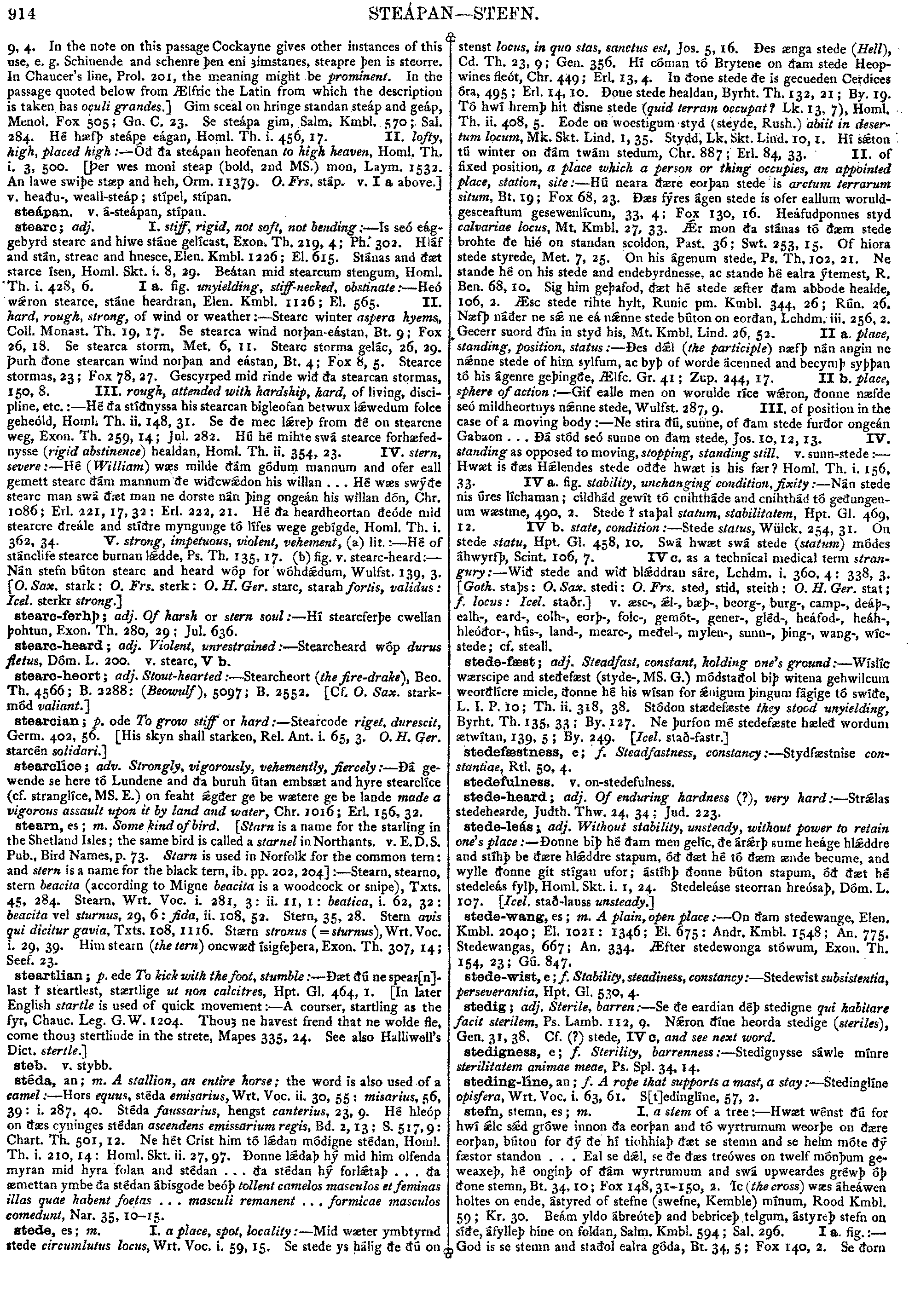
stede,
es;
m.
I.
a
place,
spot,
locality
:--
Mid
wæter
ymbtyrnd
stede
circumlutus
locus,
Wrt.
Voc.
i.
59,
15.
Se
stede
ys
hálig
ðe
ðú
on
stenst
locus,
in
quo
stas,
sanctus
est,
Jos.
5,
16.
Ðes
ænga
stede
(Hell),
Cd.
Th.
23,
9;
Gen.
356.
Hí
cóman
tó
Brytene
on
ðam
stede
Heopwines
fleót,
Chr.
449;
Erl.
13,
4.
In
ðone
stede
ðe
is
gecueden
Cerdices
óra,
495;
Erl.
14,
10.
Ðone
stede
healdan,
Byrht.
Th.
132,
21;
By.
19.
Tó
hwí
hremþ
hit
ðisne
stede
(quid
terram
occupat?
Lk.
13,
7),
Homl.
Th.
ii.
408,
5.
Eode
on
woestigum
styd
(steyde,
Rush.)
abiit
in
desertum
locum,
Mk.
Skt.
Lind.
1,
35.
Stydd,
Lk.
Skt.
Lind.
10,
1.
Hí
ston
tú
winter
on
ðám
twám
stedum,
Chr.
887;
Erl.
84,
33.
II.
of
fixed
position,
a
place
which
a
person
or
thing
occupies,
an
appointed
place,
station,
site
:--
Hú
neara
ðære
eorþan
stede
is
arctum
terrarum
situm,
Bt.
19;
Fox
68,
23.
Ðæs
fýres
ágen
stede
is
ofer
eallum
woruldgesceaftum
gesewenlícum,
33,
4;
Fox
130,
16.
Heáfudponnes
styd
calvariae
locus,
Mt.
Kmbl.
27,
33.
Æ-acute;r
mon
ða
stánas
tó
ðæm
stede
brohte
ðe
hié
on
standan
scoldon,
Past.
36;
Swt.
253,
15.
Of
hiora
stede
styrede,
Met.
7,
25.
On
his
ágenum
stede,
Ps.
Th.
102,
21.
Ne
stande
hé
on
his
stede
and
endebyrdnesse,
ac
stande
hé
ealra
ýtemest,
R.
Ben.
68,
10.
Sig
him
geþafod,
ðæt
hé
stede
æfter
ðam
abbode
healde,
106,
2.
Æsc
stede
rihte
hylt,
Runic
pm.
Kmbl.
344,
26;
Rún.
26.
Næfþ
náðer
ne
s
ne
eá
nnne
stede
búton
on
eorðan,
Lchdm.
iii.
256,
2.
Gecerr
suord
ðín
in
styd
his,
Mt.
Kmbl.
Lind.
26,
52.
II
a.
place,
standing,
position,
status
:--
Ðes
dl
(the
participle)
næfþ
nán
angin
ne
nnne
stede
of
him
sylfum,
ac
byþ
of
worde
ácenned
and
becymþ
syþþan
tó
his
ágenre
geþingðe,
Ælfc.
Gr.
41;
Zup.
244,
17.
II
b.
place,
sphere
of
action
:--
Gif
ealle
men
on
worulde
ríce
wron,
ðonne
næfde
seó
mildheortnys
nnne
stede,
Wulfst.
287,
9.
III.
of
position
in
the
case
of
a
moving
body
:--
Ne
stira
ðú,
sunne,
of
ðam
stede
furðor
ongeán
Gabaon
...
Ðá
stód
seó
sunne
on
ðam
stede,
Jos.
10,
12,
13.
IV.
standing
as
opposed
to
moving,
stopping,
standing
still.
v.
sunn-stede
:--
Hwæt
is
ðæs
Hlendes
stede
oððe
hwæt
is
his
fær?
Homl.
Th.
i.
156,
33.
IV
a.
fig.
stability,
unchanging
condition,
fixity
:--
Nán
stede
nis
úres
líchaman;
cildhád
gewít
tó
cnihtháde
and
cnihthád
tó
geðungenum
wæstme,
490,
2.
Stede
 staþal
statum,
stabilitatem,
Hpt.
Gl.
469,
12.
IV
b.
state,
condition
:--
Stede
status,
Wülck.
254,
31.
On
stede
statu,
Hpt.
Gl.
458,
10.
Swá
hwæt
swá
stede
(statum)
módes
áhwyrfþ,
Scint.
106,
7.
IV
c.
as
a
technical
medical
term
strangury
:--
Wið
stede
and
wið
blddran
sáre,
Lchdm.
i.
360,
4:
338,
3.
[Goth.
staþs:
O.
Sax.
stedi:
O.
Frs.
sted,
stid,
steith:
O.
H.
Ger.
stat;
f.
locus:
Icel.
staðr.]
v.
æsc-,
l-,
bæþ-,
beorg-,
burg-,
camp-,
deáþ-,
ealh-,
eard-,
eolh-,
eorþ-,
folc-,
gemót-,
gener-,
gléd-,
heáfod-,
heáh-,
hleóðor-,
hús-,
land-,
mearc-,
meðel-,
mylen-,
sunn-,
þing-,
wang-,
wíc-stede;
cf,
steall.
staþal
statum,
stabilitatem,
Hpt.
Gl.
469,
12.
IV
b.
state,
condition
:--
Stede
status,
Wülck.
254,
31.
On
stede
statu,
Hpt.
Gl.
458,
10.
Swá
hwæt
swá
stede
(statum)
módes
áhwyrfþ,
Scint.
106,
7.
IV
c.
as
a
technical
medical
term
strangury
:--
Wið
stede
and
wið
blddran
sáre,
Lchdm.
i.
360,
4:
338,
3.
[Goth.
staþs:
O.
Sax.
stedi:
O.
Frs.
sted,
stid,
steith:
O.
H.
Ger.
stat;
f.
locus:
Icel.
staðr.]
v.
æsc-,
l-,
bæþ-,
beorg-,
burg-,
camp-,
deáþ-,
ealh-,
eard-,
eolh-,
eorþ-,
folc-,
gemót-,
gener-,
gléd-,
heáfod-,
heáh-,
hleóðor-,
hús-,
land-,
mearc-,
meðel-,
mylen-,
sunn-,
þing-,
wang-,
wíc-stede;
cf,
steall.
|
Source: Bosworth/Toller, page b1065, entry 9 View original page image as: [TIFF] [PNG] [View previous entry] [View next entry] |
[Comment on this entry] [View comments] |
The following entry has been hand-corrected once. |
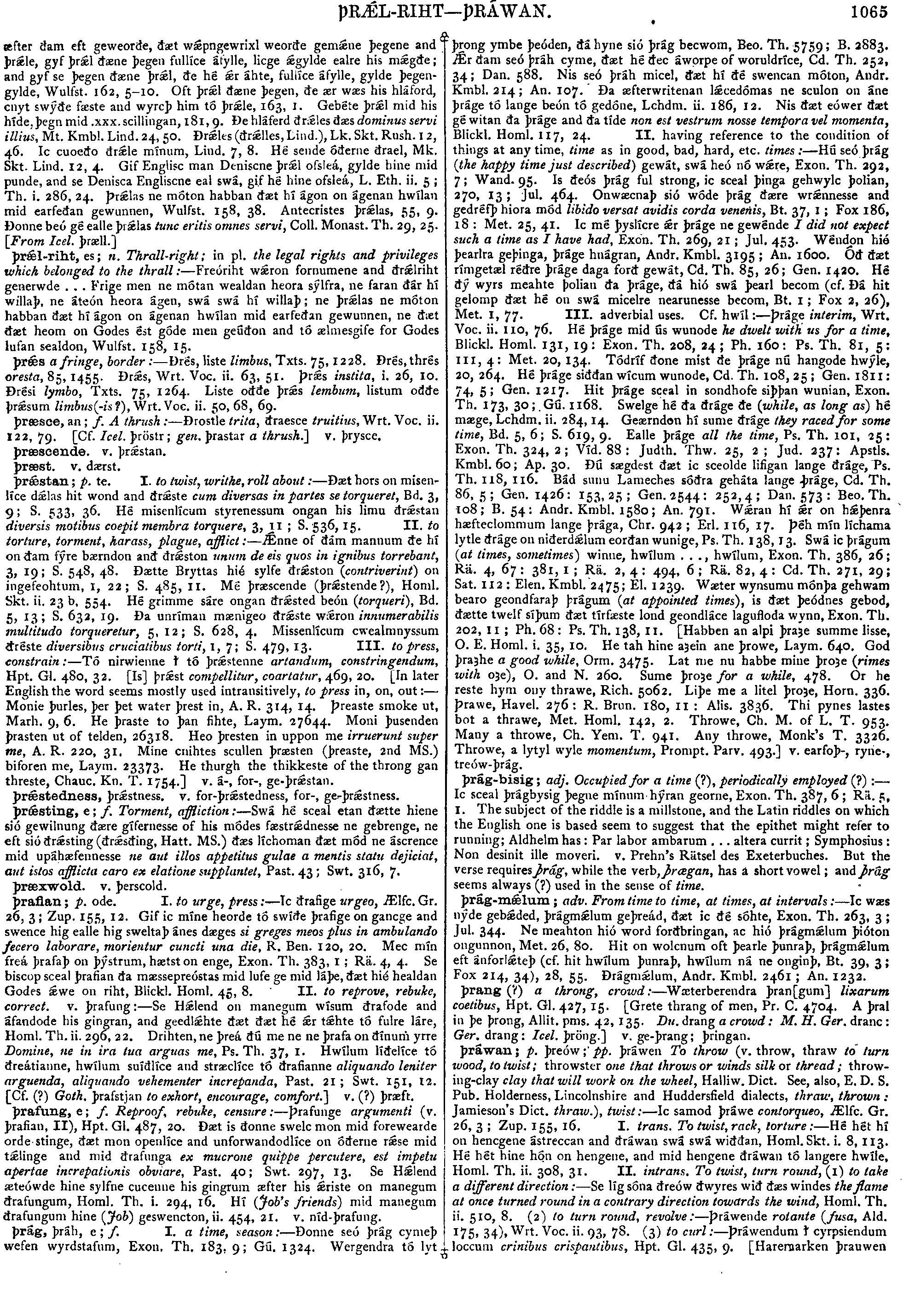
þrsting,
e;
f.
Torment,
affliction
:--
Swá
hé
sceal
etan
ðætte
hiene
sió
gewilnung
ðære
gífernesse
of
his
módes
fæstrdnesse
ne
gebrenge,
ne
eft
sió
ðrsting
(ðrsðing,
Hatt.
MS.)
ðæs
líchoman
ðæt
mód
ne
áscrence
mid
upáhæfennesse
ne
aut
illos
appetitus
gulae
a
mentis
statu
dejiciat,
aut
istos
afflicta
caro
ex
elatione
supplantet,
Past.
43;
Swt.
316,
7.
|
Source: Bosworth/Toller, page b1287, entry 7 View original page image as: [TIFF] [PNG] [View previous entry] [View next entry] |
[Comment on this entry] [View comments] |
The following entry has been hand-corrected once. |
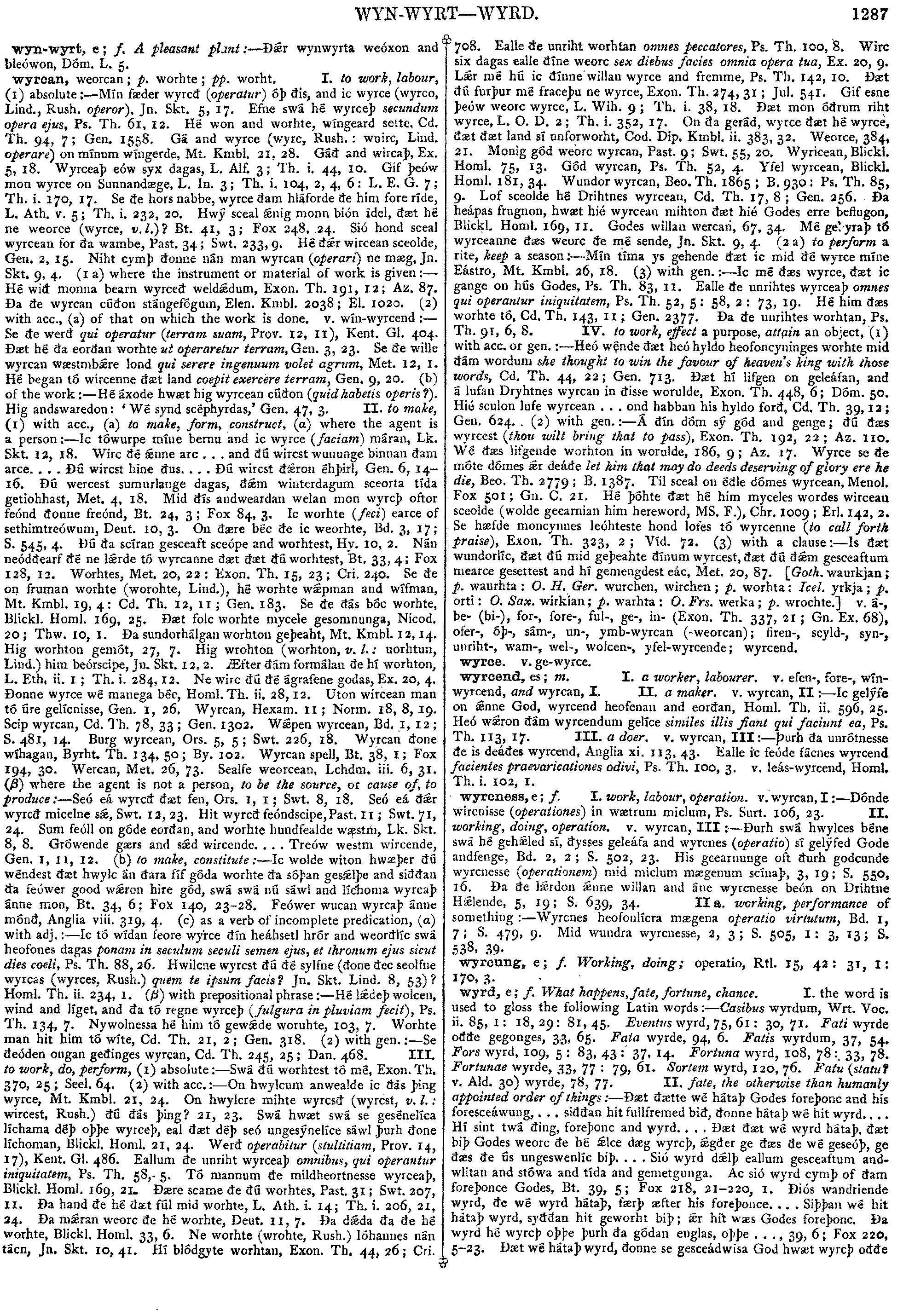
wyrd,
e;
f.
What
happens,
fate,
fortune,
chance.
I.
the
word
is
used
to
gloss
the
following
Latin
words
:--
Casibus
wyrdum,
Wrt.
Voc.
ii.
85,
1
:
18,
29
:
81,
45.
Eventus
wyrd,
75,
61
:
30,
71.
Fati
wyrde
oððe
gegonges,
33,
65.
Fata
wyrde,
94,
6.
Fatis
wyrdum,
37,
54.
Fors
wyrd,
109,
5
:
83,
43:
37,
14.
Fortuna
wyrd,
108,
78
:
33,
78.
Fortunae
wyrde,
33,
77
:
79,
61.
Sortem
wyrd,
120,
76.
Fatu
(statu?
v.
Ald.
30)
wyrde,
78,
77.
II.
fate,
the
otherwise
than
humanly
appointed
order
of
things
:--
Ðæt
ðætte
wé
hátaþ
Godes
foreþonc
and
his
foresceáwung,
.
.
.
siððan
hit
fullfremed
bið,
ðonne
hátaþ
wé
hit
wyrd...
Hí
sint
twá
ðing,
foreþonc
and
wyrd....
Ðæt
ðæt
wé
wyrd
hátaþ,
ðæt
biþ
Godes
weorc
ðe
hé
lce
dæg
wyrcþ,
gðer
ge
ðæs
ðe
wé
geseóþ,
ge
ðæs
ðe
ús
ungeswenlíc
biþ
....
Sió
wyrd
dlþ
eallum
gesceaftum
andwlitan
and
stówa
and
tída
and
gemetgunga.
Ac
sió
wyrd
cymþ
of
ðam
foreþonce
Godes,
Bt.
39,
5;
Fox
218,
21-220,
1.
Ðiós
wandriende
wyrd,
ðe
wé
wyrd
hátaþ,
færþ
æfter
his
foreþonce....
Siþþan
wé
hit
hátaþ
wyrd,
syððan
hit
geworht
biþ;
r
hit
wæs
Godes
foreþonc.
Ða
wyrd
hé
wyrcþ
oþþe
þurh
ða
gódan
englas,
oþþe
.
.
.,
39,
6
;
Fox
220,
5-23.
Ðæt
wé
hátaþ
wyrd,
ðonne
se
gesceádwísa
God
hwæt
wyrcþ
oððe
geþafaþ
ðæs
ðe
wé
ne
wénaþ
fit
illud
fatalis
ordinis
insigne
miraculum,
cum
ab
sciente
geritur,
quod
stupeant
ignorantes,
39,
10;
Fox
226,
24.
Ðé
sceal
on
woruld
bringan
Sarra
sunu,
sóð
forð
gán
wyrd
æfter
ðiosum
wordgemearcum,
Cd.
Th.
142,
1
;
Gen.
2355.
Gð
á
wyrd
swá
hió
sceal,
Beo.
Th.
915;
B.
455.
Ne
wæs
wyrd,
ðæt
hé
má
móste
manna
cynnes
ðicgean,
1473;
B.
734.
Wron
sume
gedwolmen
ðe
cwdon,
ðæt
lc
man
beó
ácenned
be
steorrena
gesetnyssum,
and
þurh
heora
ymbryna
him
wyrd
gelimpe,
Homl.
Th.
i.
110,
8.
Sceal
heó
(Lot's
wife)
wyrde
bídan,
Drihtnes
dómes,
Cd.
Th.
155,
10;
Gen.
2570
:
Exon.
Th.
329,
29;
Vy.
41.
Hí
wyrd
ne
cúþon,
Beo.
Th.
2471
;
B.
1233.
III.
in
a
personal
sense,
one
of
the
Fates
(the
weird
sisters)
:--
Wyrde
Parcae,
Wrt.
Voc.
ii.
116,
9
:
67,
55.
III
a.
as
a
personification,
fate,
fortune
:--
Wyrd
biþ
swíþre,
Meotud
mihtigra,
ðonne
nges
monnes
gehygd,
Exon.
Th.
312,
27;
Seef.
115.
Wyrd
byð
swíþost,
Menol.
Fox
469;
Gn.
C.
5
:
Salm.
Kmbl.
855;
Sal.
427
:
886;
Sal.
442.
Wyrd
bið
ful
árð,
Exon.
Th.
286,
24;
Wand.
5
:
Salm.
Kmbl.
871
;
Sal.
435.
Sume
úþwitan
secgaþ
ðæt
sió
wyrd
wealde
gðer
ge
geslþa
ge
ungeslþa
lces
monnes,
Bt.
39,
8
;
Fox
224,
13.
Weord
(wyrd,
v.
l.),
5,
1
;
Fox
8,
30.
Swá
him
wyrd
ne
gescráf,
Beo.
Th.
5142
;
B.
2574
:
Elen.
Kmbl.
2092;
El.
1047
:
Met.
1,
29.
Behindan
beleác
wyrd
mid
wge,
Cd.
Th.
206,
25;
Exod.
457.
Eorlas
fornóman
wpen
wælgífru,
wyrd
seó
mre,
Exon.
Th.
292,
17
;
Wand.
100:
Beo.
Th.
2415;
B.
1205.
Hié
wyrd
forsweóp,
959;
B.
477
:
5621
;
B.
2814.
Wyrd
ðone
gomelan
grétan
sceolde,
4832;
B.
2420.
Hwý
ðú
fre
woldest
ðæt
seó
wyrd
swá
hwyrfan
sceolde?
Heó
þreáþ
ða
unscildigan,
Bt.
4;
Fox
8,
12
:
Met.
4.
34
:
Andr.
Kmbl.
1226;
An.
613
:
3121
;
An.
1563.
Wyrd
oft
nereþ
unfgne
eorl,
Beó.
Th.
1149;
B.
572
:
Exon.
Th.
165,
18;
Gú.
1030.
Tó
eallum
ðám
geslðum
ðe
seó
wyrd
brengð,
Bt.
16,
3
;
Fox
54,
25
:
14,
1
;
Fox
40,
31.
Ne
wén
ðú
nó
ðæt
ic
tó
ánwillíce
winne
wiþ
ða
wyrd
(fortunam)
...
hit
oft
gebyraþ
ðæt
seó
leáse
wyrd
náuþer
ne
mæg
ðam
men
dón
ne
fultum,
ne
nnne
ðem,
20;
Fox
70,
22.
Wyrde
wiðstondan,
Exón.
Th.
287,
17
;
Wand.
15.
IV.
an
event,
(1)
with
the
special
idea
of
that
which
happens
by
the
determination
of
Providence
or
fate
:--
Ne
wile
Sarran
gelýfan
wordum
mínum;
sceal
seó
wyrd
swá
ðeáh
forð
steallian,
Cd.
Th.
144,
14;
Gen.
2389.
Wyrd
wæs
geworden,
swefen
geséðed,
swá
r
Daniel
cwæð,
257,
5
;
Dan.
653.
God
éce
biþ;
ne
wendaþ
hine
wyrda,
ne
hine
wiht
dreceþ
ádl
ne
yldo,
Exon.
Th.
333,
24;
Gn.
Ex.
9:
Salm.
Kmbl.
666;
Sal.
332.
Wyrda
Waldend,
Cd.
Th.
205,
7;
Exod.
432
:
Andr.
Kmbl.
2113;
An.
1058
:
Elen.
Kmbl.
159
;
El.
80
:
Exon.
Th.
455,
1;
Hy.
4,
43.
Wyrda
gerýnu,
Cd.
Th.
225,
5;
Dan.
149.
Wyrda
geþinga,
250,
14;
Dan.
546.
Wyrda
gesceaft,
224,
6;
Dan.
132.
Onwrigen
is
wyrda
bigang,
Elen.
Kmbl.
2245
;
El.
1124.
Gif
ic
ðé
ðone
[...
age,
the
MS.
is
here
imperfect]
gesecge
ðínes
feores,
ýþelíce
ðú
ða
wyrde
oncyrrest
and
his
hond
beféhst
si
mortis
tue
tibi
insidiatorem
prodidero,
sublato
eo
facile
instantia
fata
mutabis,
mihique
tres
irascentur
sorores,
Clotos,
Lachesis,
Atropos,
Nar.
31,
24.
(2)
in
a
general
sense,
an
event,
occurrence,
circumstance,
incident,
fact
:--
Nnigne
tweógean
ne
þearf,
ðæt
seó
wyrd
on
ðás
ondweardan
tíd
geweorþan
sceal,
ðæt
se
Scyppend
gesittan
wile
on
his
dómsetle,
Blickl.
Howl.
83,
10.
Ðá
gelamp
wundorlíc
wyrd,
ðæt
se
lég
ongan
sleán
ongeán
ðone
wind,
221,
11.
Ðæt
is
mro
wyrd,
Cd.
Th.
84,
18;
Gen.
1399
:
Menol.
Fox
107;
Men.
53.
Egeslíc
wyrd,
Rood
Kmbl.
148;
Kr.
74
:
Exon.
Th.
432,
6
;
Rä.
48,
2.
Seó
wyrd
gewearð
(it
happened)
ðæt
ðæt
wíf
geseah
Ismaél
plegan,
Cd.
Th.
168,
3;
Gen.
2777.
Is
seó
wyrd
mid
eów
open
the
event
is
patent
among
you,
Andr.
Kmbl.
1516;
An.
759
:
Apstls.
Kmbl.
84;
Ap.
42.
Ne
wé
ðære
wyrde
wénan
þurfon
tóweard
in
tíde,
Exon.
Th.
6,
8;
Cri.
81.
Wénan
ðære
wyrde,
ðæt
heó
hire
taman
healde,
Met.
13,
24
:
26,
114
:
Ps.
Th.
119,
5.
Hé
wyrde
bídeþ,
hwonne
God
wille
ðisse
worlde
ende
gewyricean,
Blickl.
Homl.
109,
32.
On
ðæm
dæge
gewíteþ
heofon
and
eorþe....
Swá
eác
for
ðære
ilcan
wyrde
gewíteþ
sunne
and
móna,
91,
22.
Ðá
gesáwon
hié
wundorlíce
wyrd
-
ðone
man
lífgendne,
ðone
ðe
hié
r
deádne
forléton,
217,
36;
Cd.
Th.
61,
112;
Gen.
996
:
245,
30;
Dan.
471.
Hé
ða
wyrd
ne
máð,
fges
forðsíð,
Exon.
Th.
182,
33;
Gú.
1319.
Hé
wyrd
ne
ful
cúþe
freóndrdenne
hú
heó
from
hogde
he
did
not
fully
know
the
circumstance,
how
her
heart
was
turned
from
loving
him,
244,
26;
Jul.
33.
Dígle
wyrd
an
obscure
circumstance,
Elen.
Kmbl.
1077
;
El.
541
:
1163;
El.
583.
Ymb
ða
mran
wyrd,
2126;
El.
1064.
Geopenigean
uncúðe
wyrd,
hwr
hé
ðara
nægla
wénan
þorfte,
2202
;
El.
1102.
Hé
ðé
mæg
onwreón
wyrda
gerýno
he
can
disclose
to
thee
the
secrets
of
events
(can
tell
thee
of
events
which
are
a
secret
to
most
men),
1174;
El.
589
:
1623
;
El.
813.
Hé
ne
leág
fela
wyrda
ne
worda,
Beo.
Th.
6052
;
B.
3030.
V.
what
happens
to
a
person,
fate,
fortune,
lot,
condition
:--
Ic
wille
secgan
ðæt
lc
wyrd
(omnis
fortuna)
bió
gód,
sam
hió
monnum
gód
þince,
sam
hió
him
yfel
þince....
Æ-acute;lc
wyrd,
sam
hió
sié
wynsum,
sam
hió
sié
unwynsum,
for
ðý
cymþ
tó
ðm
gódum
ðæt
hió
...
hine
þreátige
tó
ðon
ðæt
hé
bet
dó,
.
.
.
oððe
him
leánige
ðæt
hé
teala
dyde,
Bt.
40,
1
;
Fox
224,
33-226,
5.
Ða
graman
gydena,
ðe
folcisce
men
hátaþ
Parcas,
ða
hí
secgaþ
ðæt
wealdan
lces
monnes
wyrde,
35,
6
;
Fox
168,
27.
For
hwý
ætwíte
gé
eówerre
wyrde
ðæt
hió
nán
geweald
náh,
39,
1
;
Fox
210,
26.
Him
ne
wæs
nnig
earfoþe
ðæt
líchomlíce
gedál
on
ðære
neówan
wyrde
(in
their
new
condition),
Blickl.
Homl.
135,
31.
Under
wyrd
sub
condicione,
Jn.
Skt.
p.
5,
10.
Ne
meaht
ðú
nó
mid
sóþe
getlan
ðíne
wyrd
and
ðíne
geslþa,
swá
swá
ðú
wénst
quod
tu
falsae
opinionis
supplicium
luis,
id
rebus
jure
imputare
non
possis,
Bt.
10
;
Fox
28,
1.
Wyrd
wánian,
Exon.
Th.
274,
24;
Jul.
538.
Unc
sceal
weorðan
swá
unc
wyrd
geteóð
Metod
manna
gehwæs
to
us
shall
it
befall,
as
the
Lord
of
every
man
decrees
to
us
our
fate,
Beo.
Th.
5046;
B.
2526.
Nýd
bið
wyrda
heardost,
Salm.
Kmbl.
622;
Sal.
310.
Him
mæg
wíssefa
wyrda
gehwylce
gemetigian,
877;
Sal.
438.
Gnornsorga
mst,
wyrda
láðost,
Elen.
Kmbl.
1953;
El.
977
:
Rood
Kmbl.
101
;
Kr.
51.
V
a,
fate,
death.
See
also
III
a
:--
Wille
forgieldan
gsta
Dryhten
willum
æfter
ðære
wyrde,
ðam
ðe
his
synna
nú
sáre
geþenceþ,
Exon.
Th.
450,
3;
Dom.
82.
VI.
chance,
accident
:--
Ðæt
wille
ic
gecýþan,
ðæt
ðu
rícu
of
nánes
monnes
mihtum
swá
gecræftgade
ne
wurdon,
ne
for
nánre
wyrde,
búton
from
Godes
gestihtunge
ut
omnia
haec
profundissimis
Dei
judiciis
disposita,
non
autem
humanis
viribus,
aut
incertis
casibus
accidisse
perdoceam,
Ors.
2,
1
;
Swt.
69,
23.
Sprecan
wiþ
ða
ðe
secgaþ
ðæt
ða
anwaldas
sién
of
wyrda
mægenum
gewordene,
Swt.
62,
10.
[Worþe
hit
wele,
oþer
wo,
as
þe
wyrde
lyke hit
hafe,
Gaw.
2134.
Þe
same
þat
sett
is
be
wirde,
Alex.
(Skt.)
443.
Wyrdis
(wyrde
systres)
Parce,
Cath.
Angl.
420,
and
see
note.
To
dree
his
wyrdes,
Allit.
Pms.
74,
1224.
Heo
biuepeð
hire
wurdes,
H.
M.
33.
24.
Is
þi
werid
(werd,
v.l.)
to
þe
wissid,
Alex.
(Skt.)
689.
Out
of
wo
into
wele
oure
wyrdes
shul
chaunge,
Piers
P.
C.
13,
209.
Þe
sorouful
werdes
of
me
olde
man,
Chauc.
Boet.
4,
10.
O.
Sax.
wurð
fate,
death
:
0.
H.
Ger.
wurt
fatum,
fortuna,
eventus
:
Icel.
urðr
(poet.)
fate;
one
of
the
Norns.
v.
Grmm.
D.
M.
pp.
376
sqq.]
v.
deáþ-,
eft-,
fr-,
for-,
ge-,
tó-,
un-,
wundor-wyrd.
hit
hafe,
Gaw.
2134.
Þe
same
þat
sett
is
be
wirde,
Alex.
(Skt.)
443.
Wyrdis
(wyrde
systres)
Parce,
Cath.
Angl.
420,
and
see
note.
To
dree
his
wyrdes,
Allit.
Pms.
74,
1224.
Heo
biuepeð
hire
wurdes,
H.
M.
33.
24.
Is
þi
werid
(werd,
v.l.)
to
þe
wissid,
Alex.
(Skt.)
689.
Out
of
wo
into
wele
oure
wyrdes
shul
chaunge,
Piers
P.
C.
13,
209.
Þe
sorouful
werdes
of
me
olde
man,
Chauc.
Boet.
4,
10.
O.
Sax.
wurð
fate,
death
:
0.
H.
Ger.
wurt
fatum,
fortuna,
eventus
:
Icel.
urðr
(poet.)
fate;
one
of
the
Norns.
v.
Grmm.
D.
M.
pp.
376
sqq.]
v.
deáþ-,
eft-,
fr-,
for-,
ge-,
tó-,
un-,
wundor-wyrd.
|
Source: Bosworth/Toller, page b1298, entry 17 View original page image as: [TIFF] [PNG] [View previous entry] [View next entry] |
[Comment on this entry] [View comments] |
The following entry has been hand-corrected once. |
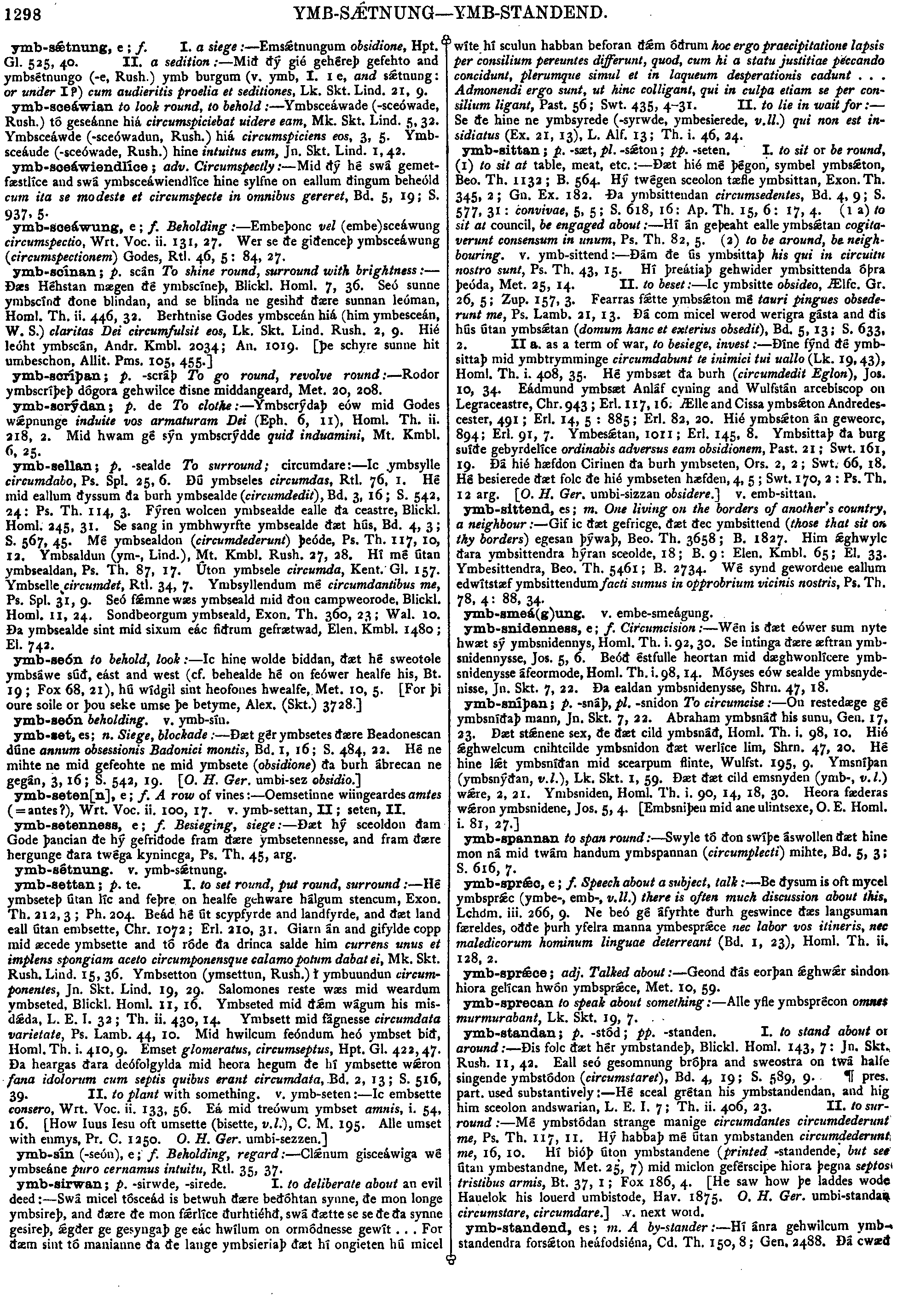
ymb-sirwan;
p.
-sirwde,
-sirede.
I.
to
deliberate
about
an
evil
deed
:--
Swá
micel
tósceád
is
betwuh
ðære
beðóhtan
synne,
ðe
mon
longe
ymbsireþ,
and
ðære
ðe
mon
fæacute;rlíce
ðurhtiéhð,
swá
ðætte
se
se
ðe
ða
synne
gesireþ,
gðer
ge
gesyngaþ
ge
eác
hwílum
on
ormódnesse
gewít.
.
.
For
ðæm
sint
tó
manianne
ða
ðe
lange
ymbsieriaþ
ðæt
hí
ongieten
hú
micel
wíte
hí
sculun
habban
beforan
ðm
óðrum
hoc
ergo
praecipitatione
lapsis
per
consilium
pereuntes
differunt,
quod,
cum
hi
a
statu
justitiae
peccando
UNCERTAIN
concidunt,
plerumque
simul
et
in
laqueum
desperationis
cadunt
.
.
.
Admonendi
ergo
sunt,
ut
hinc
colligant,
qui
in
culpa
etiam
se
per
consilium
ligant,
Past.
56;
Swt.
435,
4-31.
II.
to
lie
in
wait
for
:--
Se
ðe
hine
ne
ymbsyrede
(-syrwde,
ymbesierede,
v.
ll.)
qui
non
est
insidiatus
(Ex.
21,
13),
L.
Alf.
13;
Th.
i.
46,
24.
|
Source: Bosworth/Toller, page d0451, entry 3 View original page image as: [TIFF] [PNG] [View previous entry] [View next entry] |
[Comment on this entry] [View comments] |
The following entry has been hand-corrected once. |
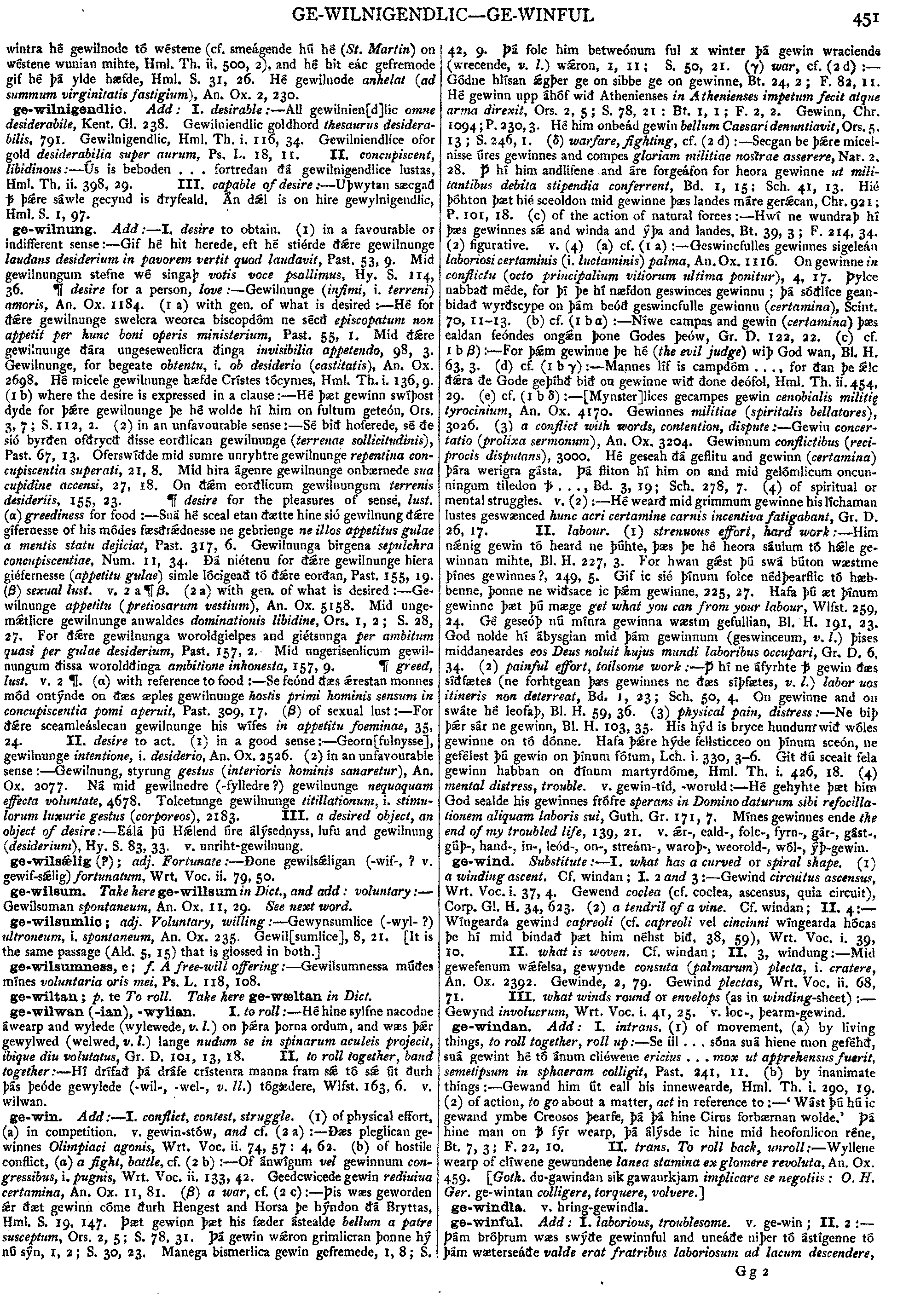
ge-wilnung.
Add:--I.
desire
to
obtain.
(1)
in
a
favourable
or
indifferent
sense:--Gif
hé
hit
herede,
eft
hé
stiérde
ðre
gewilnunge
laudans
desiderium
in
pavorem
vertit
quod
laudavit,
Past.
53,
9.
Mid
gewilnungum
stefne
wé
singaþ
votis
voce
psallimus,
Hy.
S.
114,
36.

desire
for
a
person,
love:--Gewilnunge
(infimi,
i.
terreni)
amoris,
An.
Ox.
1184.
(1
a)
with
gen.
of
what
is
desired:--Hé
for
ðre
gewilnunge
swelcra
weorca
biscopdóm
ne
sécð
episcopatum
non
appetit
per
hunc
boni
operis
ministerium,
Past.
55,
1.
Mid
ðre
gewilnunge
ðára
ungesewenlicra
ðinga
invisibilia
appetendo,
98,
3.
Gewilnunge,
for
begeate
obtentu,
i.
ob
desiderio
(castitatis),
An.
Ox.
2698.
Hé
micele
gewilnunge
hæfde
Crístes
tócymes,
Hml.
Th.
i.
136,
9.
(1
b)
where
the
desire
is
expressed
in
a
clause:--Hé
þæt
gewinn
swíþost
dyde
for
þre
gewilnunge
þe
hé
wolde
hí
him
on
fultum
geteón,
Ors.
3,
7;
S.
112,
2.
(2)
in
an
unfavourable
sense:--Sé
bið
hoferede,
sé
ðe
sió
byrðen
ofðrycð
ðisse
eorðlican
gewilnunge
(terrenae
sollicitudinis),
Past.
67,
13.
Oferswíðde
mid
sumre
unryhtre
gewilnunge
repentina
concupiscentia
superati,
21,
8.
Mid
hira
ágenre
gewilnunge
onbærnede
sua
cupidine
accensi,
27,
18.
On
ðm
eorðlicum
gewilnungum
terrenis
desideriis,
155,
23.

desire
for
the
pleasures
of
sense,
lust.
( )
greediness
for
food:--Suá
hé
sceal
etan
ðætte
hine
sió
gewilnung
ðre
gífernesse
of
his
módes
fæsðrdnesse
ne
gebrienge
ne
illos
appetitus
gulae
a
mentis
statu
dejiciat,
Past.
317,
6.
Gewilnunga
birgena
sepulchra
concupiscentiae,
Num.
11,
34.
Ðá
niétenu
for
ðre
gewilnunge
hiera
giéfernesse
(appetitu
gulae)
simle
lócigeað
tó
ðre
eorðan,
Past.
155,
19.
(
)
greediness
for
food:--Suá
hé
sceal
etan
ðætte
hine
sió
gewilnung
ðre
gífernesse
of
his
módes
fæsðrdnesse
ne
gebrienge
ne
illos
appetitus
gulae
a
mentis
statu
dejiciat,
Past.
317,
6.
Gewilnunga
birgena
sepulchra
concupiscentiae,
Num.
11,
34.
Ðá
niétenu
for
ðre
gewilnunge
hiera
giéfernesse
(appetitu
gulae)
simle
lócigeað
tó
ðre
eorðan,
Past.
155,
19.
( )
sexual
lust.
v.
2
a

.
(2
a)
with
gen.
of
what
is
desired:--Gewilnunge
appetitu
(pretiosarum
vestium),
An.
Ox.
5158.
Mid
ungemtlicre
gewilnunge
anwaldes
dominationis
libidine,
Ors.
1,
2;
S.
28,
27.
For
ðre
gewilnunga
woroldgielpes
and
giétsunga
per
ambitum
quasi
per
gulae
desiderium,
Past.
157,
2.
Mid
ungerisenlicum
gewilnungum
ðissa
woroldðinga
ambitione
inhonesta,
157,
9.

greed,
lust.
v.
2
¶.
()
with
reference
to
food:--Se
feónd
ðæs
restan
monnes
mód
ontýnde
on
ðæs
æples
gewilnunge
hostis
primi
hominis
sensum
in
concupiscentia
pomi
aperuit,
Past.
309,
17.
()
of
sexual
lust:--For
ðre
sceamleáslecan
gewilnunge
his
wífes
in
appetitu
foeminae,
35,
24.
II.
desire
to
act.
(1)
in
a
good
sense:--Georn[fulnysse],
gewilnunge
intentione,
i.
desiderio,
An.
Ox.
2526.
(2)
in
an
unfavourable
sense:--Gewilnung,
styrung
gestus
(interioris
hominis
sanaretur),
An.
Ox.
2077.
Ná
mid
gewilnedre
(-fylledre?)
gewilnunge
nequaquam
effecta
voluntate,
4678.
Tolcetunge
gewilnunge
titillationum,
i.
stimulorum
luxurie
gestus
(corporeos),
2183.
III.
a
desired
object,
an
object
of
desire:--Eálá
þú
Hlend
úre
álýsednyss,
lufu
and
gewilnung
(desiderium),
Hy.
S.
83,
33.
v.
unriht-gewilnung.
)
sexual
lust.
v.
2
a

.
(2
a)
with
gen.
of
what
is
desired:--Gewilnunge
appetitu
(pretiosarum
vestium),
An.
Ox.
5158.
Mid
ungemtlicre
gewilnunge
anwaldes
dominationis
libidine,
Ors.
1,
2;
S.
28,
27.
For
ðre
gewilnunga
woroldgielpes
and
giétsunga
per
ambitum
quasi
per
gulae
desiderium,
Past.
157,
2.
Mid
ungerisenlicum
gewilnungum
ðissa
woroldðinga
ambitione
inhonesta,
157,
9.

greed,
lust.
v.
2
¶.
()
with
reference
to
food:--Se
feónd
ðæs
restan
monnes
mód
ontýnde
on
ðæs
æples
gewilnunge
hostis
primi
hominis
sensum
in
concupiscentia
pomi
aperuit,
Past.
309,
17.
()
of
sexual
lust:--For
ðre
sceamleáslecan
gewilnunge
his
wífes
in
appetitu
foeminae,
35,
24.
II.
desire
to
act.
(1)
in
a
good
sense:--Georn[fulnysse],
gewilnunge
intentione,
i.
desiderio,
An.
Ox.
2526.
(2)
in
an
unfavourable
sense:--Gewilnung,
styrung
gestus
(interioris
hominis
sanaretur),
An.
Ox.
2077.
Ná
mid
gewilnedre
(-fylledre?)
gewilnunge
nequaquam
effecta
voluntate,
4678.
Tolcetunge
gewilnunge
titillationum,
i.
stimulorum
luxurie
gestus
(corporeos),
2183.
III.
a
desired
object,
an
object
of
desire:--Eálá
þú
Hlend
úre
álýsednyss,
lufu
and
gewilnung
(desiderium),
Hy.
S.
83,
33.
v.
unriht-gewilnung.
|
Source: Bosworth/Toller, page d0703, entry 27 View original page image as: [TIFF] [PNG] [View previous entry] [View next entry] |
[Comment on this entry] [View comments] |
The following entry has been hand-corrected once. |
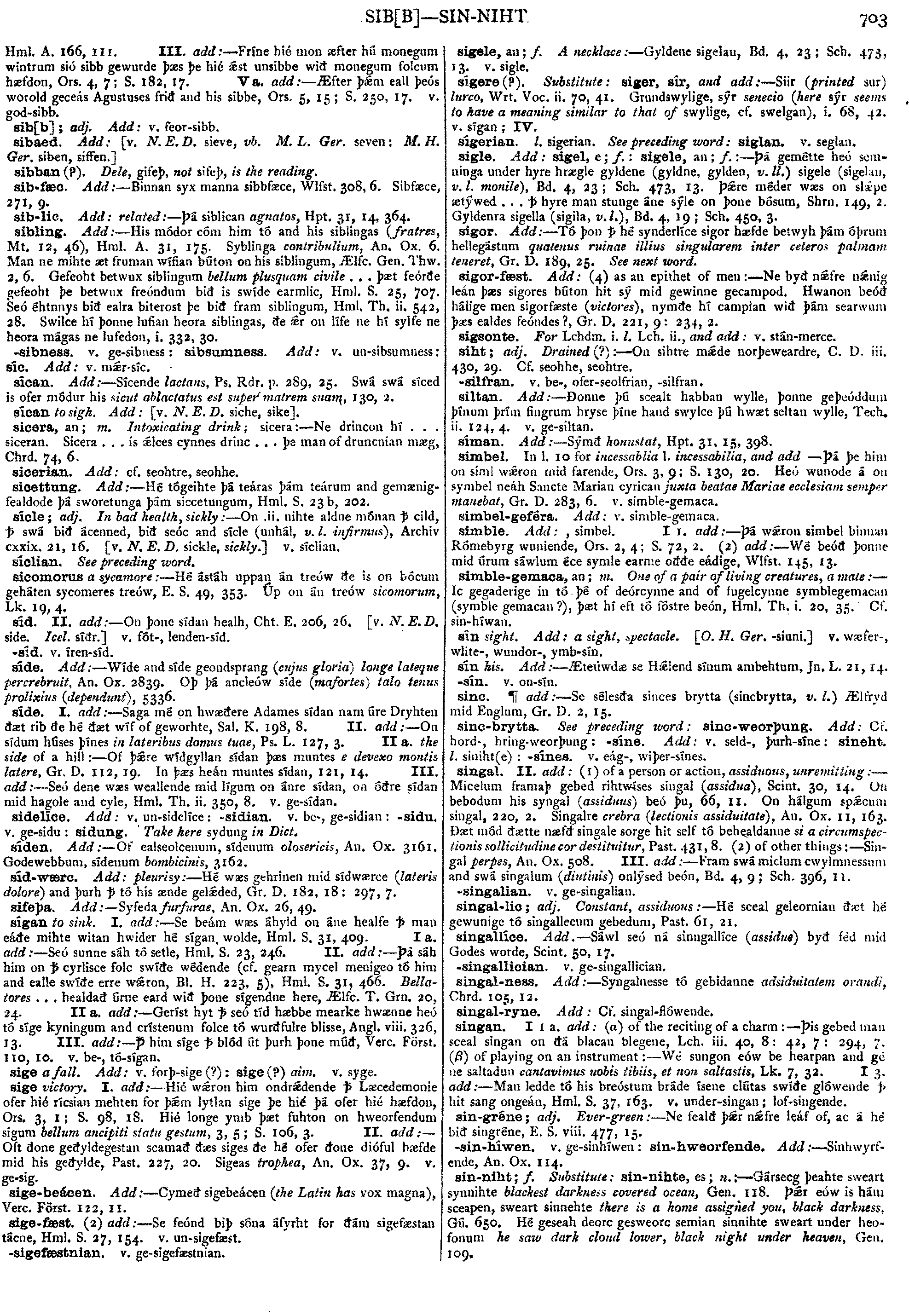
sige
victory.
I.
add
:--
Hié
wron
him
ondrdende
 Læcedemonie
ofer
hié
rícsian
mehten
for
þm
lytlan
sige
þe
hié
þá
ofer
hié
hæfdon,
Ors.
3,
1;
S.
98,
18.
Hié
longe
ymb
þæt
fuhton
on
hweorfendum
sigum
bellum
ancipiti
statu
gestum,
3,
5;
S.
106,
3.
II.
add
:--
Oft
ðone
geðyldegestan
scamað
ðæs
siges
ðe
hé
ofer
ðone
dióful
hæfde
mid
his
geðylde,
Past.
227,
20.
Sigeas
trophea,
An.
Ox.
37,
9.
v.
ge-sig.
Læcedemonie
ofer
hié
rícsian
mehten
for
þm
lytlan
sige
þe
hié
þá
ofer
hié
hæfdon,
Ors.
3,
1;
S.
98,
18.
Hié
longe
ymb
þæt
fuhton
on
hweorfendum
sigum
bellum
ancipiti
statu
gestum,
3,
5;
S.
106,
3.
II.
add
:--
Oft
ðone
geðyldegestan
scamað
ðæs
siges
ðe
hé
ofer
ðone
dióful
hæfde
mid
his
geðylde,
Past.
227,
20.
Sigeas
trophea,
An.
Ox.
37,
9.
v.
ge-sig.
| Result Page: | 1 2 | Next |  |
Germanic Lexicon Project (main page)
This search system was written by
Sean Crist
Please consider
volunteering
to correct the data in these online dictionaries.
No rights reserved. Feel free to use these data in any way you please.