|
|

Search for ss again, using less strict matching (22 results)
|
Source: Cleasby/Vigfusson, page b0401, entry 23 View original page image as: [TIFF] [PNG] [View previous entry] [View next entry] |
[Comment on this entry] [View comments] |
The following entry has not been hand-corrected. However, the page is reserved and someone is correcting it. |
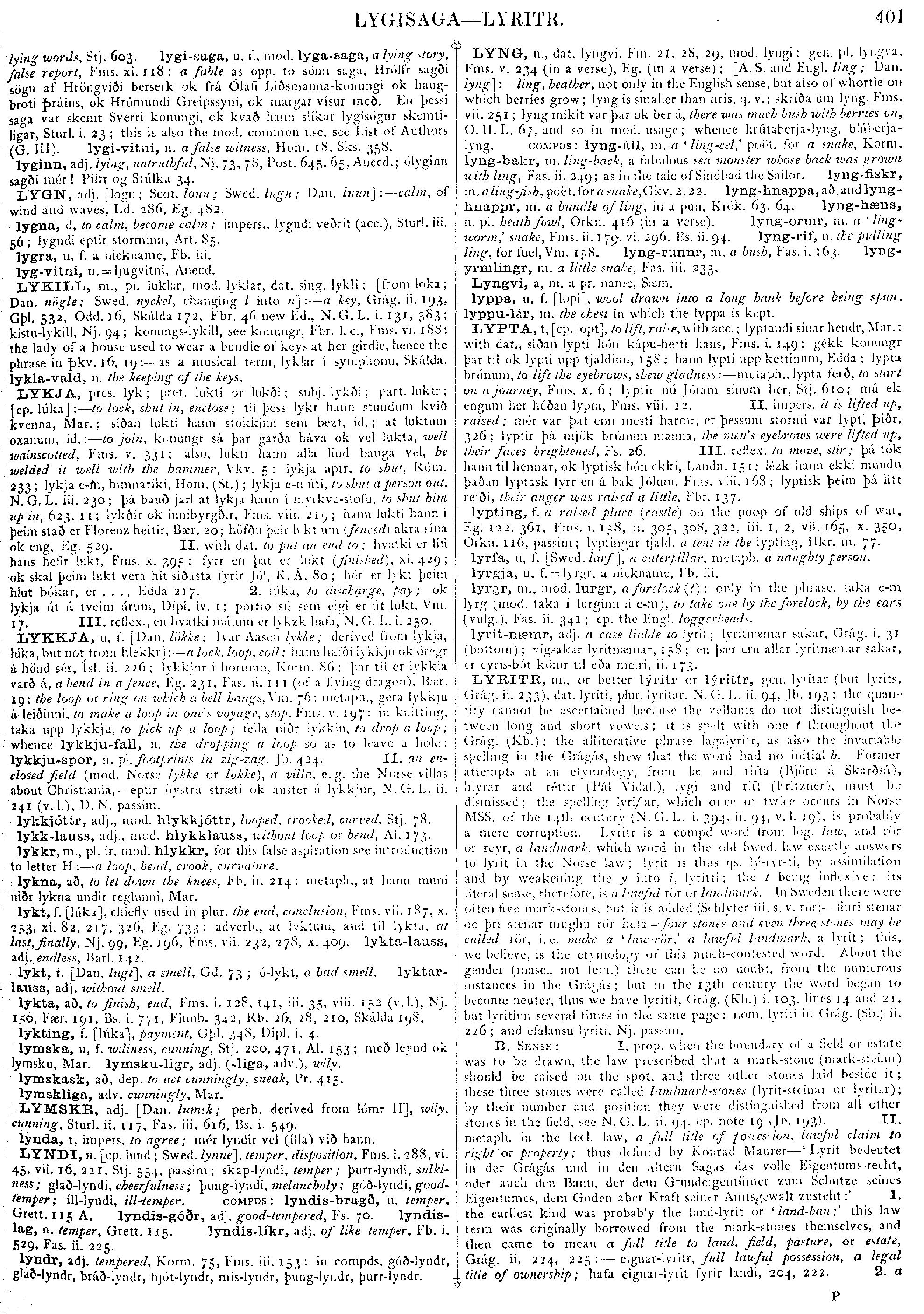
LYNDI, n. [cp. hind; Swed. lynwe], temper, disposition, Fms. i. 288, vi. i 45" vu. TO, 221, Stj. 554, passim; skap-lvndi, temper; þurr-lyndi, su lki- | ne ss; glað-lyndi, cheerfulness; þung-lvndi, melancholy; góð-lyndi, good- | temper; ill-lyndi, ill-temper. COMPDS: lyndis-bragð, n. temper, i Grett. 115 A. lyndis-góðr, adj. good-tempered, Fs. 70. lyndis- j lag, n. temper, Grett. 115. lyndis-likr, adj. of like temper, Fb. i. 529, Fas. ii. 225.
|
Source: Cleasby/Vigfusson, page b0409, entry 12 View original page image as: [TIFF] [PNG] [View previous entry] [View next entry] |
[Comment on this entry] [View comments] |
The following entry has not been hand-corrected. However, the page is reserved and someone is correcting it. |
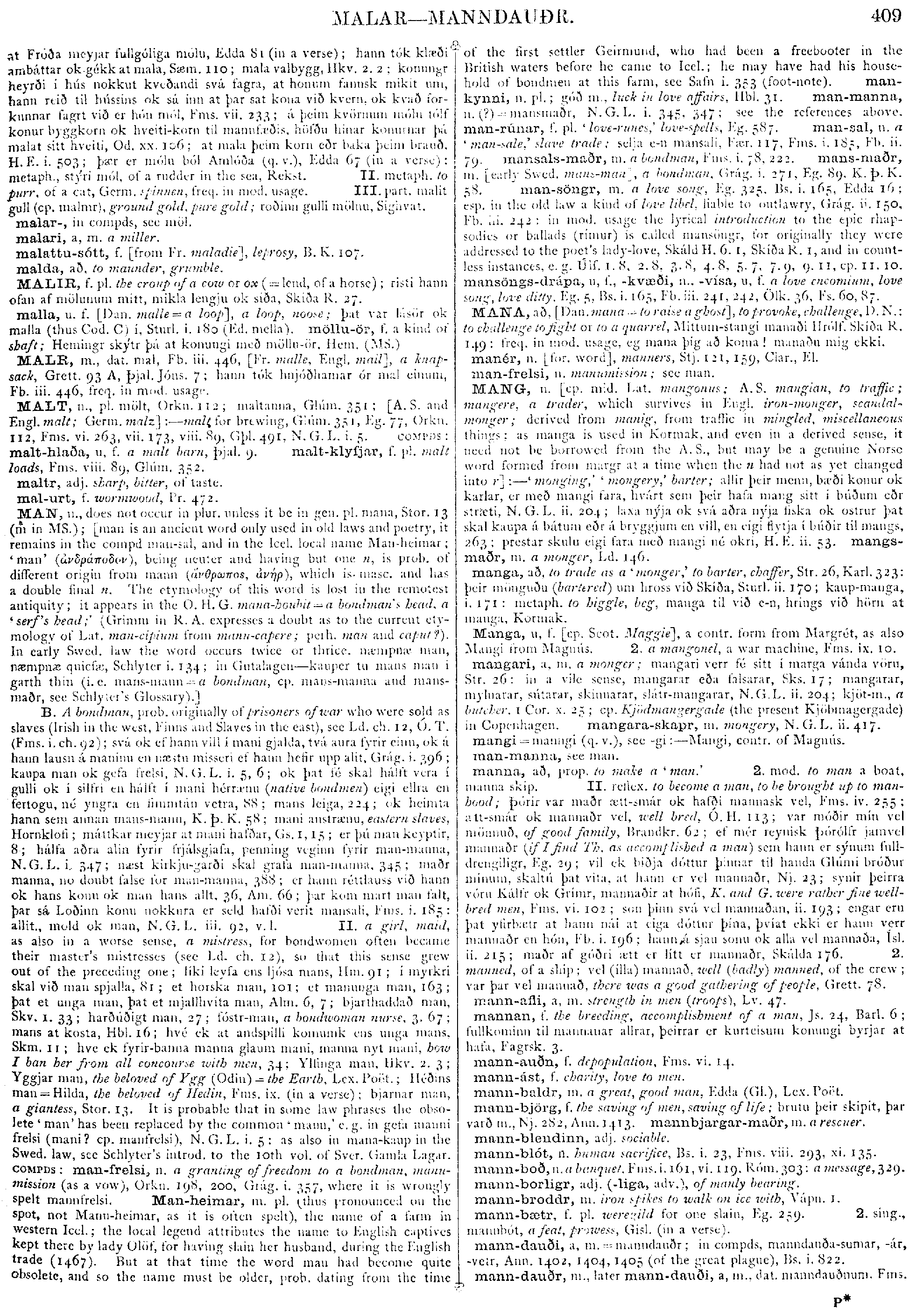
MAN, n., does not occur in piur. unless it be in gen. pl. niana, Stor. 13 (ni in MS.); [man is an ancient word only used in old laws and poetry, it remains in the compd man-sal, and in the Icel. local name Man-heimar; 'man' (åvðpáiroSov'), being neuter and having but one;;, is prob. of different origin from maim (iii'Opcurros, avrjp), which is. masc. and has a double final n. The etymology of this word is lost in the remotest antiquity; it appears in the O. M. G. m a n a -b o ulnt -- -- -a bondman's bead, a 'serf's bead;' (Grimm in R. A. expresses a doubt as to the current ety- mology of Lat. man-cipium from mann-capere; peril, man and capnt"!). In early Swed. law the- word occurs twice or thrice, næmpna' man, naempnæ quicfic, Schlyter i. 134; in Cïutalagen -- kauper tu mans man i garth thin (i. e. mans-mann -- -- a bond/nan, cp. maus-manna and mans- inaðr, see Schly'. er's Glossary).] B. A bondman, prob. originally of prisoners of war who were sold as slaves (Irish in the west, Finns and Slaves in the east), see Ld. ch. 12, O. T. (Fms. i. ch. 92); svá ok ef hann vill i mani gjalda, tva aura fyrir einn, ok a hann lausn á maninu en i;æ. stn misseri ef haun heiir upp alit, Gr;i. g. i. 396; kaupa man ok gefa frelsi, N. G. L. i. 5, 6; ok þat ie skal liáift vera í gulli ok i silfri en hálit i mani herru'nu (n a tive bondmen) eigi cilia en fertogu, ne yngra en iimmtan vetra, SS; mans leiga, 224; ok heiiuta hann sein annan mans-mann, K. þ. K. 58; mani aiistrænu, eastern s lave s, Hornkloii; maukar nicyjar at mani hal'ðar, Gs. 1, 15; er |m man keyptir, 8; hálta aðra alin íyrir trjúlsgiafa, penning veginn fyrir man-manna, N. G. L. i, 347; næst kiikju-garði skal grata man-manna, 345; maðr manna, no doubt false for man-manna, 388; er hann réttlauss við hann ok hans konu ok man hans allt, 36, Am. 66; J-ar koin mart man fait, þar sá Loðinn konu nokkura er seld hafði verit mansali, Fms. i. 185: allit., mold ok man, N. G. L. iii. 92, v. 1. II. a girl, maid, as also in a worse sense, a mistress, for bondwomen often became their master's mistresses (see Ld. ch. 12), so that this sense grew out of the preceding one; liki ley fa ens Ijosa mans, Hm. 91; í myrkri skal við man spjalla, 81; et horska man, 101; et manunga man, 163; bat et unga man, þat et mjallhvita man, Aim. 6, 7; bjarthaddað man, Skv. I. 33; harðúðigt man, 27; tostr-man, a bondwoman mine, 3. 67; mans at kosta, Hbl. 16; live ek at andspilli komumk ens unga mans, Skm. 11; hve ek fyrir-banna manna glaum mani, manna nyt mani, bow I ban her from all concourse with men, 34; Ylfinga man, Hkv. 2. 3; Yggjar man, the beloved of Ygg (Odin) -- the Earth, Lex. l'oi-t.; HOðins man = Hilda, the beloved of lied in, Fms. ix. (in a verse); bjarnar man, a giantess, Stor. 13. It is probable that in some law phrases the obso- lete ' man' has been replaced by the common ' maim, ' e. g. in gefa manni frelsi (mani? cp. manfrelsi), N. G. L. i. 5: as also in mana-kaup in the Swed. law, see Schlyter's introd. to the loth vol. of Sver. (Manila Lag. ir. COMPDS: man-frelsi., n. a granting of freedom to a bondman, manu- mission (as a vow), Orkn. 198, 200, Gr;ig. i. 357, where it is wrongly spelt mannfrelsi. Man-heimar, in. pl. (thus pronounce;! on the spot, not Mann-heimar, as it is often spelt), the name of a farm in western Icel.; the local legend attributes the name to English captives kept there by lady Olo'f, for having slain her husband, during the Fnglish trade (1467). But at that time the word man had become quite obsolete, and so the name must be older, prob. dating from the time of the first settler Geirmund, who had been a freebooter in the British waters before he came to Icel.; he may have had his house- hold of bondmen at this farm, see Safn i. 353 (foot-note). man- kynni, n. pl.; gócî in., luck in love affairs, Hbl. 31. man-manna, n. (?) -- •- mansmaðr, N. G. L. i. 345, 347; see the references above. man-runar, f. pl. 'love-runes, ' love-spells, Eg. 587. man-sal, n. n 'man-sale. ' slave trade; selia e-n mansali, Fær. 117, Fms. i. 185, Fb. ii. 79. mansals-maðr, in. a bondman, Fms. i. 78, 22:. mans-maðr, m. [earh Swed. mam-man'', a bondman, (îrúg. i. 271. Eg. 89, K. p. K. 58. man-scmgr, m. a love song, Fig. 325. Bs. i. 165, Edda 16; esp. in the old law a kind of loi-f libel, liable to outlawry, Grug. ii. 150, Fb. ui. 242: in mod. usage the lyrical introduction to the epic rhap- sodies or ballads (rimur) is called manscingr, tor originally they were addressed to the poet's lady-love, Skald H. 6. i, SkíðaK. i, and in count- less instances, e. g. Ú If. I. H, 2. 8, 3. 8, 4, 8, 5. 7, 7. 9, 9. 11, cp. ii. 10. mansöngs-drápa, u, f., -kvœði, n., -visa, u, f. a love encomium, love song, lore di. 'ty. Eg. 5, Bs. i. 165, Fb. iii. 241, 242, Oik. 36, Fs. 60, 87.
|
Source: Cleasby/Vigfusson, page b0431, entry 8 View original page image as: [TIFF] [PNG] [View previous entry] [View next entry] |
[Comment on this entry] [View comments] |
The following entry has not been hand-corrected. However, the page is reserved and someone is correcting it. |
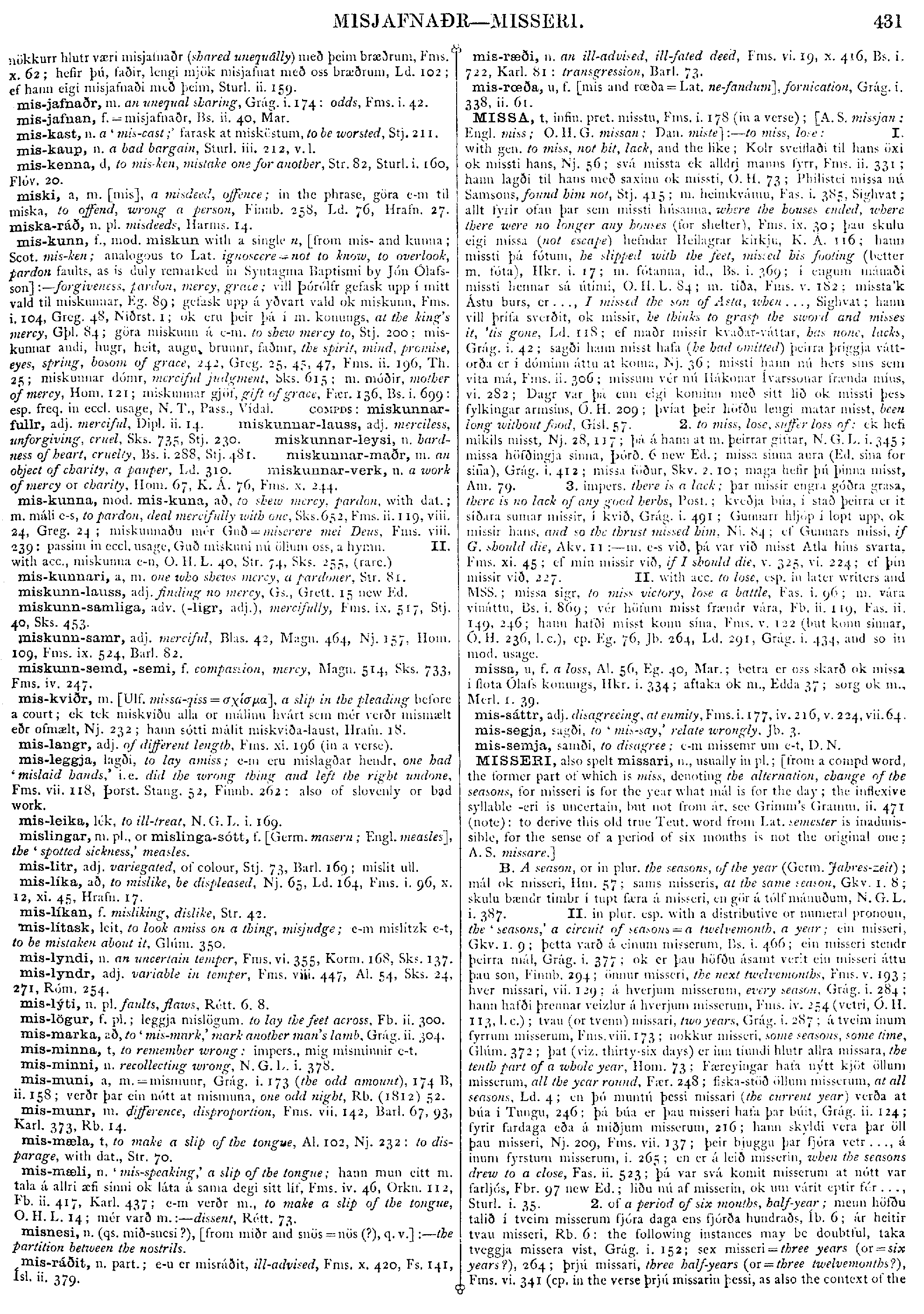
mis-kunn, f., mod. miskun with a single n, [from mis- and kunna; Scot, mis-ken; analogous to Lat. ignoscere -- not to know, to overlook, pardon faults, as is duly renuuked in Syntagma Baptismi by Jim Ólafs- son] :-- forgiveness, pardon, mercy, grace; vill þúrúlfr gc-fask upp í mitt vald til miskunnar, Eg. 89; getask upp á, yðvart vald ok miskunn, Fms. i. 104, Greg. 48, Niðrst. I; ok cru þeir þá í in. konungs, at the king's mercy, Gþl. 84; góra miskunn a e-m. to shew mercy to, Stj. 200; mis- kunnar audi, hugr, licit, augu,, brunnr, faðmr, the spirit, mind, premise, eyes, spring, bosom of grace, 24. 2, Greg. 25, 45, 47, Fms. ii. 196, Th. 2^; miskunnar dornr, merciful judgment, Sks. 615; m. móðir, mother of mercy, Hom. 121; miskunnar gjöf, gift of grace, Fær. 136, Bs. i. 699: esp. freq. in eccl. usage, N. T., Pass., Vidal. COMPDS: miskunnar- fullr, adj. merciful, Dipl. ii. 14. miskunnar-lauss, adj. merciless, unforgiving, cruel, Sks. 735, Stj. 230. miskiinnar-leysi, n. h ar d- ne ss of heart, cruelly, Bs. i. 288, Stj. 481. miskuuiiar-maðr, m. an object of charity, a pauper, Ld. 310. miskxmnar-verk, n. a work of mercy or charity, Hom. 67, K. Á. 76, Fms. x. 244.
|
Source: Cleasby/Vigfusson, page b0431, entry 44 View original page image as: [TIFF] [PNG] [View previous entry] [View next entry] |
[Comment on this entry] [View comments] |
The following entry has not been hand-corrected. However, the page is reserved and someone is correcting it. |
MISSERI, also spelt missari, n., usually in pl.; [from a compd word, the former part of which is miss, denoting the alternation, change of the seasons, for misscri is for the year what ma! is for the day; the infle. xive syllable -eri is uncertain, bait not from;ir, see Grimm's Grannn. ii. 471 (note): to derive this old true Tent, word from Lat. semester is inadmis- sible, for the sense of a period of six months is not the original one: A. S. wj i ss are.] B. A season, or in plur. the seasons, of the year (Germ. Jahres-zeit); mal ok misseri, Hm. 57 ! sains misscris, at the same season, Gkv. 1. 8; skulu bændr timbr í tupt fa-ra á misseri, en giir á tólf nii'inuðum, N. G. L. i. 387. II. in plur. esp. with a distributive or numeral pronoun, the ' seasons, ' a circuit of seasons -- a twelvemonth, a year; tin misseri, Gkv. I. 9; þetta varð a eiinini nusscruin, Bs. i. 4. 66; ein misseri stendr þeirra mal, Grág. i. 377; ok er þau höfðu ásamt verit ein misseri filtu pan son, Finnb. 294; önnur misseri, the next twelvemonths, Fms. v. 193; hver missari, vii. 129: a hverjuin misseruni, every season, Grág. i. 284; hann hafði þrennar vei/. lur á hverjuin misseruni, Fms. iv. 254(vetri, O. H. 113, 1. c.); Ivan (or tvcnn) missari, two years, Grág. i. 287; á tveim inuin fyrrum misseruni, Fms. viii. 173; nokkur misseri, some seasons, some time, (ih'un. 372; þat (viz. thirty-six days) er inn tiuntli hlutr allra missara, the tenth part of a whole year, Hom. 73; Færeyiugar hafa nytt kjöt olluni missennn, all the year round, Fær. 248; fîska-stöð (ilium misseruni, at all seasons, Ld. 4; en þó muntii þessi missari (the current year) verða at búa í Tungu, 246; þ:i búa er þau misseri hafa þar bi'ut, Grág. ii. 124; fyrir fardaga eða á iniðjum misseruni, 216; hann skyldi vera þar oil þau misseri, Nj. 209, Fms. vii. 137; þeir bjuggu þar fjóra vetr ..., á inum fyrstum misseruni, i. 265; en er á leið inisserin, when the seasons drew to a close, Fas. ii. 523; þá var svá koinit misseruni at nótt var farljós, Fbr. 97 new Ed.; liðu mi af misserin, ok um vúrit eptir for ..., Sturl. i. 35. 2. of a period of six months, half-year; menu hüfðu talið í tveim misserum fjóra daga ens fjórða hundraðs, íb. 6; úr heitir tvau misseri, Rb. 6: the following instances may be doubtful, taka tveggja missera vist, Grug. i. 152; sex misseri = three years (or = six years?), 264; þrjú missari, threehalf-years (or -- three twelvemonths?), Fms. vi. 341 (cp. in the verse þrjií missarin bessi, as also the context of the
|
Source: Cleasby/Vigfusson, page b0481, entry 2 View original page image as: [TIFF] [PNG] [View previous entry] [View next entry] |
[Comment on this entry] [View comments] |
The following entry has been hand-corrected once. |
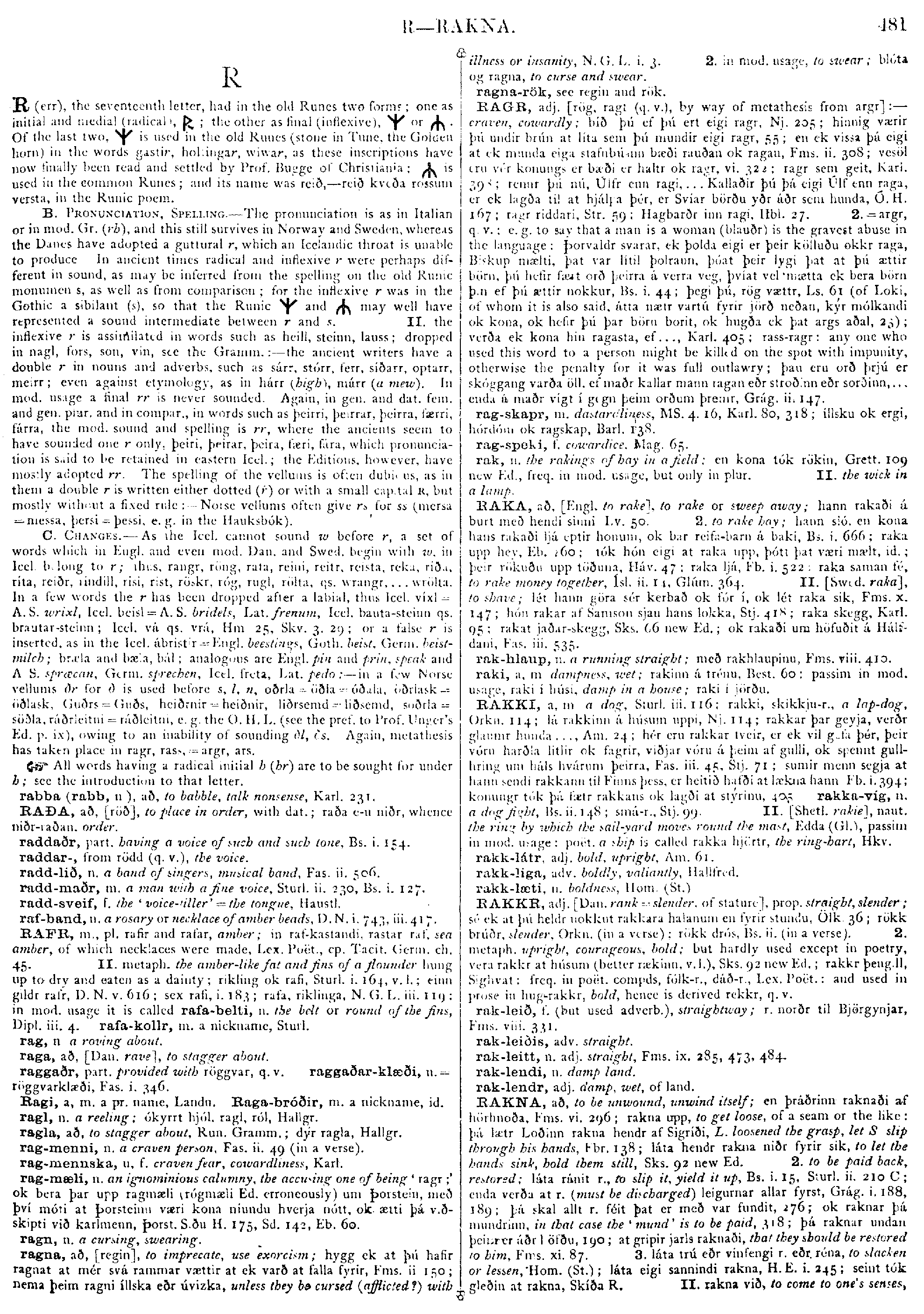
R, (err), the seventeenth letter, had in the old Runes two forms; one as initial and medial (radical), RUNE; the other as final (inflexive), RUNE or RUNE. Of the last two, RUNE is used in the old Runes (stone in Tune, the Golden horn) in the words gastir, hokingar, wiwar, as these inscriptions have now finally been read and settled by Prof. Bugge of Christiana; RUNE is used in the common Runes; and its name was reið, -- reið kveða rossum versta, in the Runic poem. B. PRONUNCIATION, SPELLING. -- The pronunciation is as in Italian or in mod. Gr. (rh), and this still survives in Norway and Sweden, whereas the Danes have adopted a guttural r, which an Icelandic throat is unable to produce In ancient times radical and inflexive r were perhaps different in sound, as may be inferred from the spelling on the old Runic monuments, as well as from comparison; for the inflexive r was in the Gothic a sibilant (s), so that the Runic RUNE and RUNE may well have represented a sound intermediate between r and s. II. the inflexive r is assimilated in words such as heill, steinn, lauss: dropped in nagl, fors, son, vin, see the Gramm. :-- the ancient writers have a double r in nouns and adverbs, such as sárr, stórr, ferr, síðarr, optarr, meirr; even against etymology, as in hárr (high), márr (a mew). In mod. usage a final rr is never sounded. Again, in gen. and dat. fem. and gen. plur. and in compar., in words such as þeirri, þeirrar, þeirra, færri, fárra, the mod. sound and spelling is rr, where the ancients seem to have sounded one r only, þeiri, þeirar, þeira, færi, fára, which pronunciation is said to be retained in eastern Icel.; the Editions, however, have mostly adopted rr. The spelling of the vellums is often dubious, as in them a double r is written either dotted (r) UNCERTAIN or with a small capital R, but mostly without a fixed rule :-- Norse vellums often give rs for ss (mersa = messa, þersi = þessi, e.g. in the Hauksbók). C. CHANGES. -- As the Icel. cannot sound w before r, a set of words which in Engl. and even mod. Dan. and Swed. begin with w, in Icel. belong to r; thus, rangr, röng, rata, reini, reitr, reista, reka, ríða, ríta, reiðr, rindill, risi, rist, röskr, róg, rugl, rölta, qs. wrangr, ... wrölta. In a few words the r has been dropped after a labial, thus Icel. víxl = A.S. wrixl, Icel. beisl = A.S. bridels, Lat. frenum, Icel. bauta-steinn qs. brautar-steinn; Icel. vá qs. vrá, Hm 25, Skv. 3. 29; or a false r is inserted, as in the Icel. ábristir = Engl. beestings, Goth. beist. Germ. beist-milch; bræla and bæla, bál; analogous are Engl. pin and prin, speak and A.S. spræcan, Germ. sprechen, Icel. freta, Lat. pedo :-- in a few Norse vellums ðr for ð is used before s, l, n, oðrla = öðla = óðala, öðrlask = öðlask, Guðrs = Guðs, heiðrnir = heiðnir, liðrsemd = liðsemd, soðrla = söðla, ráðrleitni = ráðleitni, e.g. the O.H.L. (see the pref. to Prof. Unger's Ed. p. ix), owing to an inability of sounding ðl, ðs. Again, metathesis has taken place in ragr, rass, = argr, ars. &FINGER; All words having a radical initial h (hr) are to be sought for under h; see the introduction to that letter.
|
Source: Cleasby/Vigfusson, page b0508, entry 19 View original page image as: [TIFF] [PNG] [View previous entry] [View next entry] |
[Comment on this entry] [View comments] |
The following entry has been hand-corrected once. |
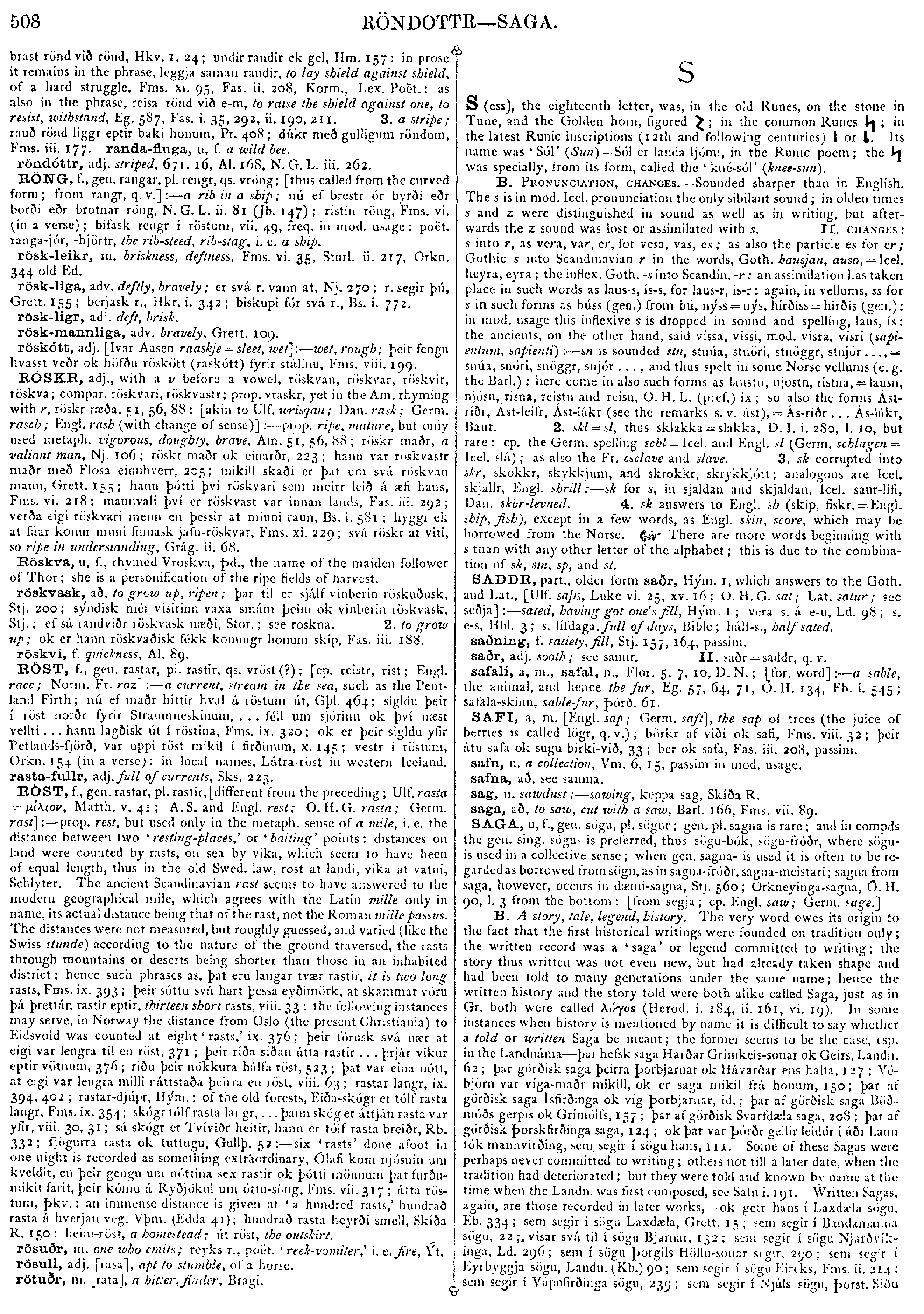
S (ess), the eighteenth letter, was, in the old Runes, on the stone in Tune, and the Golden horn, figured RUNE; in the common Runes RUNE; in the latest Runic inscriptions (12th and following centuries) RUNE or RUNE Its name was 'Sól' (Sun) -- Sól er landa ljómi, in the Runic poem; the RUNE was specially, from its form, called the 'kné-sól' (knee-sun). B. PRONUNCIATION, CHANGES. -- Sounded sharper than in English. The s is in mod. Icel. pronunciation the only sibilant sound; in olden times s and z were distinguished in sound as well as in writing, but afterwards the z sound was lost or assimilated with s. II. CHANGES: s into r, as vera, var, er, for vesa, vas, es; as also the particle es for er; Gothic s into Scandinavian r in the words, Goth. hausjan, auso, = Icel. heyra, eyra; the infiex. Goth. -s into Scandin. -r: an assimilation has taken place in such words as laus-s, ís-s, for laus-r, ís-r: again, in vellums, ss for s in such forms as búss (gen.) from bú, nýss = nýs, hirðiss = hirðis (gen.): in mod. usage this inflexive s is dropped in sound and spelling, laus, ís: the ancients, on the other hand, said víssa, víssi, mod. vísra, vísri (sapientum, sapienti) :-- sn is sounded stn, stnúa, stnöri, stnöggr, stnjór ..., = snúa, snöri, snöggr, snjór ..., and thus spelt in some Norse vellums (e.g. the Barl.): here come in also such forms as laustn, njostn, ristna, = lausn, njósn, risna, reistn and reisn, O.H.L. (pref.) ix; so also the forms Ást-ríðr, Ást-leifr, Ást-lákr (see the remarks s.v. ást), = Ás-ríðr ... Ás-lákr, Baut. 2. skl = sl, thus sklakka = slakka, D.I. i. 280, l. 10, but rare: cp. the Germ. spelling schl = Icel. and Engl. sl (Germ. schlagen = Icel. slá); as also the Fr. esclave and slave. 3. sk corrupted into skr, skokkr, skykkjum, and skrokkr, skrykkjótt; analogous are Icel. skjallr, Engl. shrill :-- sk for s, in sjaldan and skjaldan, Icel. saur-lífi, Dan. skör-levned. 4. sk answers to Engl. sh (skip, fiskr, = Engl.ship, fish), except in a few words, as Engl. skin, score, which may be borrowed from the Norse. (???)UNCERTAIN There are more words beginning with s than with any other letter of the alphabet; this is due to the combination of sk, sm, sp, and st.
|
Source: Cleasby/Vigfusson, page b0555, entry 3 View original page image as: [TIFF] [PNG] [View previous entry] [View next entry] |
[Comment on this entry] [View comments] |
The following entry has not been hand-corrected. However, the page is reserved and someone is correcting it. |
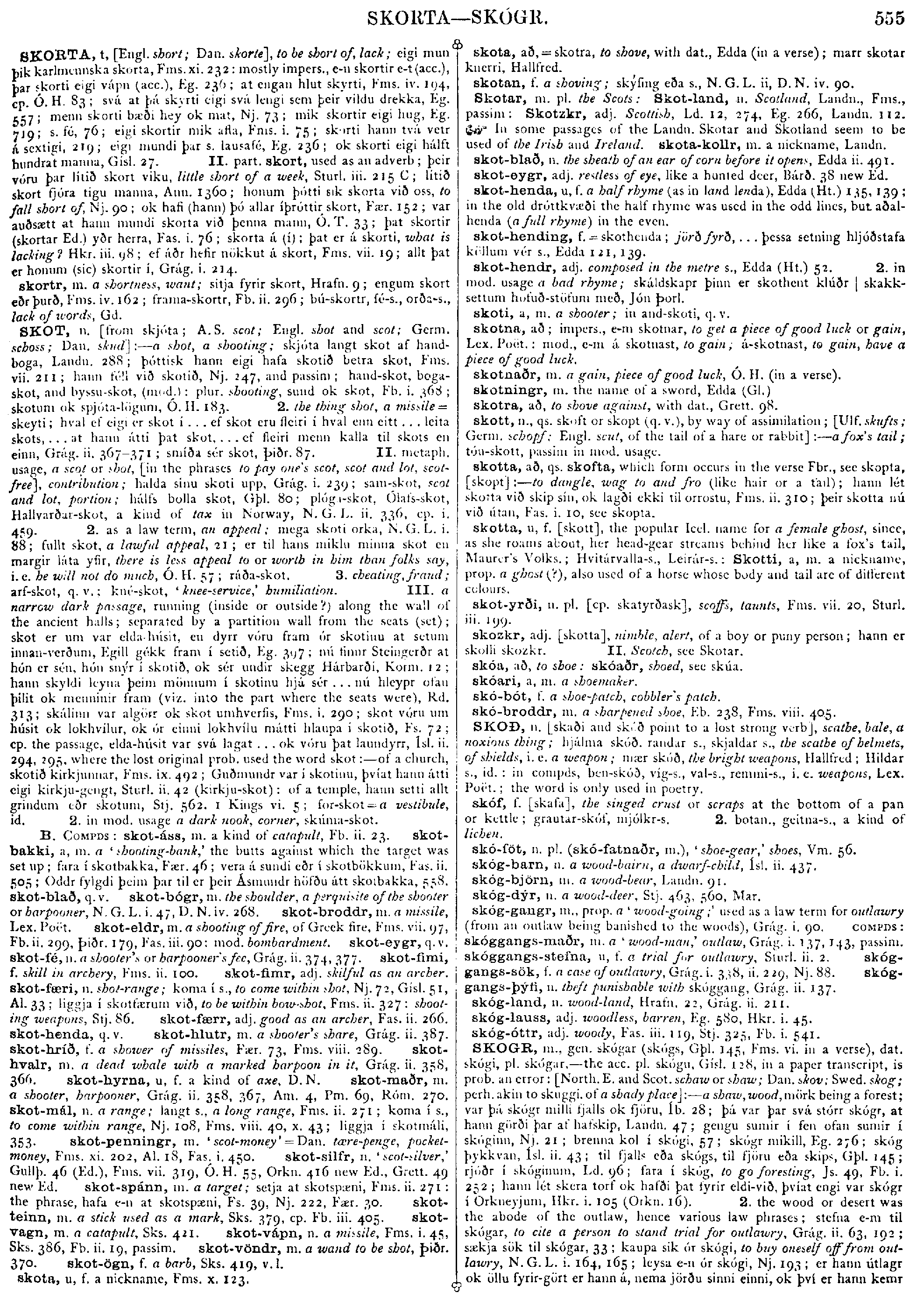
SKOT, n. [from skjóta; A. S. scot; Engl. shot and scot; Germ. scboss; Dan. skiid] :-- a shot, a shooting; skjúta langt skot af hand- boga, Landn. 2SS; þóttiík hann eigi hafa skotið belra skot, Fins, vii. 211; hann tV;!l við skotið, Nj. 247, and passim; hand-skot, boga- skot, and byssu-skot, (mod.): piur. shooting, sund ok skot, Fb. i. 368; skotum ok spjóta-lögum, Ó. II. 183. 2. the thing shot, a missile = skeyti; hval ef eigi IT skot í ... ef skot eru fieiri í hval enn eitt ... Icita skots, ... at hann útti þat skot, ... cf fleiri menu kalla til skots en einn, Gn'ig. ii. 367-371; smíða sér skot, þiðr. 87. II. metaph. usage, a scot or shot, [in the phrases to pay one's scot, scot and lot, scot- free], contribution; halda sinu skoti upp, Grúg. i. 239; sam-skot, scot and lot, portion; hulfs bolla skot, Gþl. 80; plógi-skot, Ölafs-skot, Hallvarðar-skot, a kind of ta* in Norway, N. G. L. ii. 336, cp. i. 459. 2. as a law term, an appeal; mega skoti orka, N. G. L. i. 88; fullt skot, a lawful appeal, i; er til hans miklu niinna skot en margir li'ita yfir, there is less appeal to or worth in him than folks say, i. e. he will not do much, 0. H. 57; ráða-skot. 3. cheating, fraud; arf-skot, q. v.: km'-skot, ' knee-service, ' humiliation. III. a narrow dark passage, running (inside or outside V) along the wall of the ancient halls; separated by a partition wall from the seats (set); skot er urn var elda-hnsit, en dyrr vóru fram or skotinu at setum innan-verðum, Egill gókk fram í setið, Eg. 3^7; mi tinnr Steingerðr at hón er sen, hón snvr í skotið, ok sér nndir skegg Hárbarði, Konn. 12; hann skyldi h-yna þeim mönnum í skotinu hjá súr ... mi hleypr ofan þilit ok menninir fram (vi/. . into the part where the seats were), Rd. 313; skalinn var algutr ok skot umhverfis, Fms. i. 290; skot vi'iru um húsit ok lokhvilur, ok or einni lokhvílu mátti hlaupa í skotið, Fs. 72; cp. the passage, elda-hnsit var svá lagat ... ok vóru þat laundyrr, Ísl. ii. 294, 295, where the lost original prob. used the word skot :-- of a church,: skotið kirkjunnar, Fms. ix. 492; Guðinundr var í skotinu, þviat hann útti • eigi kirkju-gengt, Sturl. ii. 42 (kirkju-skot): of a temple, hann setti allt j grindum tor skotum, Stj. 562. í Kings vi. 5; for-skot = a vestibule, | id. 2. in mod. usage a dark nook, corner, sknina-skot. B. COMPOS: skot-ass, in. a kind of catapult, Fb. ii. 23. skot- bakki, a, m. a ' shooting-hank, ' the butts against which the target was set up; fara í skotbakka, Fær. 46; vera á sundi eðr í skotbokkum, Fas. ii. 505; Ocidr fylgdi þeiin þar til er þeir Ásmundr hó'fðu átt skoibakka, 558. skot-blað, q. v. skot-bógr, in. the shoulder, a perquisite of the shooter orharpooner, N. G. L. i. 47, D. N. iv. 268. skot-broddr, in. a missile, Lex. Poi't. skot-eldr, m. a shooting of fire, of Greek fire, Fms. vii. 97, Fb. ii. 299, þiðr. í 79, Fas. iii. 90: mod. bombardment. skot-eygr, q. v. skot-fe, n. a shooter's or harpooner'sfec, Grág. ii. 374, 377- skot-fimi, f. skill in archery, Fms. ii. loo. skot-flmr, adj. skilful as an archer. Bkot-fœri, n. shot-range; koma í s., to come within shot, Nj. 72, Gísl. 51, Al. 33; liggja í skotfærum við, to be within bow-shot, Fms. ii. 327: shoot- ing weapons, Stj. 86. skot-færr, adj. good as an archer, Fas. ii. 266. skot-henda, q. v. skot-hlutr, m. a shooter's share, Grág. ii. 387. skot-hríð, t'. a shower of missiles, Fær. 73, Fms. viii. 289. skot- hvalr, m. a dead whale with a marked harpoon in it, Grng. ii. 358, 366. skot-liyrna, u, f. a kind of a* e, D. N. skot-maðr, m. a shooter, harpooner, Grug. ii. 358, 367, Am. 4, Pm. 69, Róm. 270. skot-mál, n. a range; langt s., a long range, Fms. ii. 271; koma í s., to come within range, Nj. 108, Fms. viii. 40, x. 43; liggja í skotmúli, 353. skot-penningr, in. ' scot-wow e y' = Dan. tœre-penge, pocket- money, Fms. xi. 202, Al. 18, Fas. 1. 450. skot-silfr, n. 'scot-silver, ' Gullþ. 46 (Ed.), Fms. vii. 319, 0. H. 55, Orkn. 416 new Ed., Grett. 49 new Ed. skot-spánn, m. a target; setja at skotspæni, Fms. ii. 271: the phrase, hafa e-n at skotspaeni, Fs. 39, Nj. 222, Fær. 30. skot- teinn, m. a s tick 7/s ed as a mark, Sks. 379, cp. Fb. iii. 405. skot- vagn, m. a catapult, Sks. 421. skot-vapn, n. a missile, Fms. i. 45, Sks. 386, Fb. ii. 19, passim. skot-vöndr, m. a wand to be shot, þiðr. 37O- skot-ögn, f. a barb, Sks. 419, v. l.
|
Source: Cleasby/Vigfusson, page b0727, entry 45 View original page image as: [TIFF] [PNG] [View previous entry] [View next entry] |
[Comment on this entry] [View comments] |
The following entry has been hand-corrected once. |
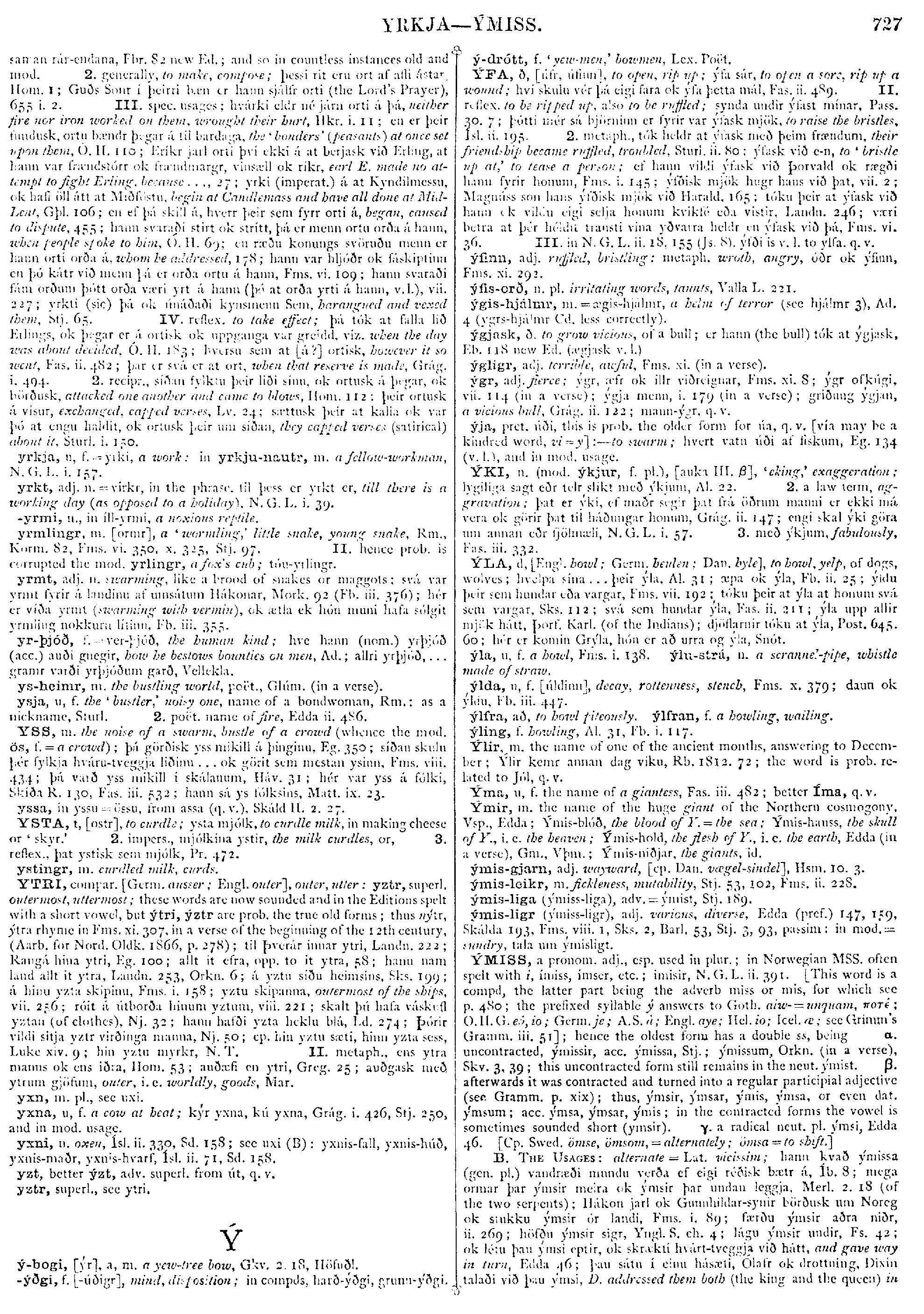
ÝMISS,
a
pronom.
adj.,
esp.
used
in
plur.;
in
Norwegian
MSS.
often
spelt
with
i,
ímiss,
ímser,
etc.;
imisir,
N.G.L.
ii.
391.
[This
word
is
a
compd,
the
latter
part
being
the
adverb
miss
or
mis,
for
which
see
p.
480;
the
prefixed
syllable
ý
answers
to
Goth.
aiw-
=
unquam,
GREEK;
O.H.G.
eo,
io;
Germ.
je;
A.S.
â;
Engl.
aye;
Hel.
io;
Icel.
æ;
see
Grimm's
Gramm.
iii.
51];
hence
the
oldest
form
has
a
double
ss,
being
 .
uncontracted,
ýmissir,
acc.
ýmissa,
Stj.;
ýmissum,
Orkn.
(in
a
verse),
Skv.
3,
39;
this
uncontracted
form
still
remains
in
the
neut.
ýmist.
.
uncontracted,
ýmissir,
acc.
ýmissa,
Stj.;
ýmissum,
Orkn.
(in
a
verse),
Skv.
3,
39;
this
uncontracted
form
still
remains
in
the
neut.
ýmist.
 .
afterwards
it
was
contracted
and
turned
into
a
regular
participial
adjective
(see
Gramm.
p.
xix);
thus,
ýmsir,
ýmsar,
ýmis,
ýmsa,
or
even
dat.
ýmsum;
acc.
ýmsa,
ýmsar,
ýmis;
in
the
contracted
forms
the
vowel
is
sometimes
sounded
short
(ymsir).
.
afterwards
it
was
contracted
and
turned
into
a
regular
participial
adjective
(see
Gramm.
p.
xix);
thus,
ýmsir,
ýmsar,
ýmis,
ýmsa,
or
even
dat.
ýmsum;
acc.
ýmsa,
ýmsar,
ýmis;
in
the
contracted
forms
the
vowel
is
sometimes
sounded
short
(ymsir).
 .
a
radical
neut.
pl.
ýmsi,
Edda
46.
[Cp.
Swed.
ömse,
ömsom,
=
alternately;
ömsa
=
to
shift.]
B.
THE
USAGES:
alternate
=
Lat.
vicissim;
hann
kvað
ýmissa
(gen.
pl.)
vandræði
mundu
verða
ef
eigi
réðisk
bætr
á,
Íb.
8;
mega
ormar
þar
ýmsir
meira
ok
ýmsir
þar
undan
leggja,
Merl.
2.
18
(of
the
two
serpents);
Hákon
jarl
ok
Gunnhildar-synir
börðusk
um
Noreg
ok
stukku
ýmsir
ór
landi,
Fms.
i.
89;
færðu
ýmsir
aðra
niðr,
ii.
269;
höfðu
ýmsir
sigr,
Yngl.
S.
ch.
4;
lágu
ýmsir
undir,
Fs.
42;
ok
létu
þau
ýmsi
eptir,
ok
skrækti
hvárt-tveggja
við
hátt,
and
gave
way
in
turn,
Edda
46;
þau
sátu
í
einu
hásæti,
Ólafr
ok
drottning,
Dixin
talaði
við
þau
ýmsi,
D.
addressed
them
both
(the
king
and
the
queen)
in
.
a
radical
neut.
pl.
ýmsi,
Edda
46.
[Cp.
Swed.
ömse,
ömsom,
=
alternately;
ömsa
=
to
shift.]
B.
THE
USAGES:
alternate
=
Lat.
vicissim;
hann
kvað
ýmissa
(gen.
pl.)
vandræði
mundu
verða
ef
eigi
réðisk
bætr
á,
Íb.
8;
mega
ormar
þar
ýmsir
meira
ok
ýmsir
þar
undan
leggja,
Merl.
2.
18
(of
the
two
serpents);
Hákon
jarl
ok
Gunnhildar-synir
börðusk
um
Noreg
ok
stukku
ýmsir
ór
landi,
Fms.
i.
89;
færðu
ýmsir
aðra
niðr,
ii.
269;
höfðu
ýmsir
sigr,
Yngl.
S.
ch.
4;
lágu
ýmsir
undir,
Fs.
42;
ok
létu
þau
ýmsi
eptir,
ok
skrækti
hvárt-tveggja
við
hátt,
and
gave
way
in
turn,
Edda
46;
þau
sátu
í
einu
hásæti,
Ólafr
ok
drottning,
Dixin
talaði
við
þau
ýmsi,
D.
addressed
them
both
(the
king
and
the
queen)
in
|
Source: Cleasby/Vigfusson, page b0728, entry 18 View original page image as: [TIFF] [PNG] [View previous entry] [View next entry] |
[Comment on this entry] [View comments] |
The following entry has been hand-corrected once. |
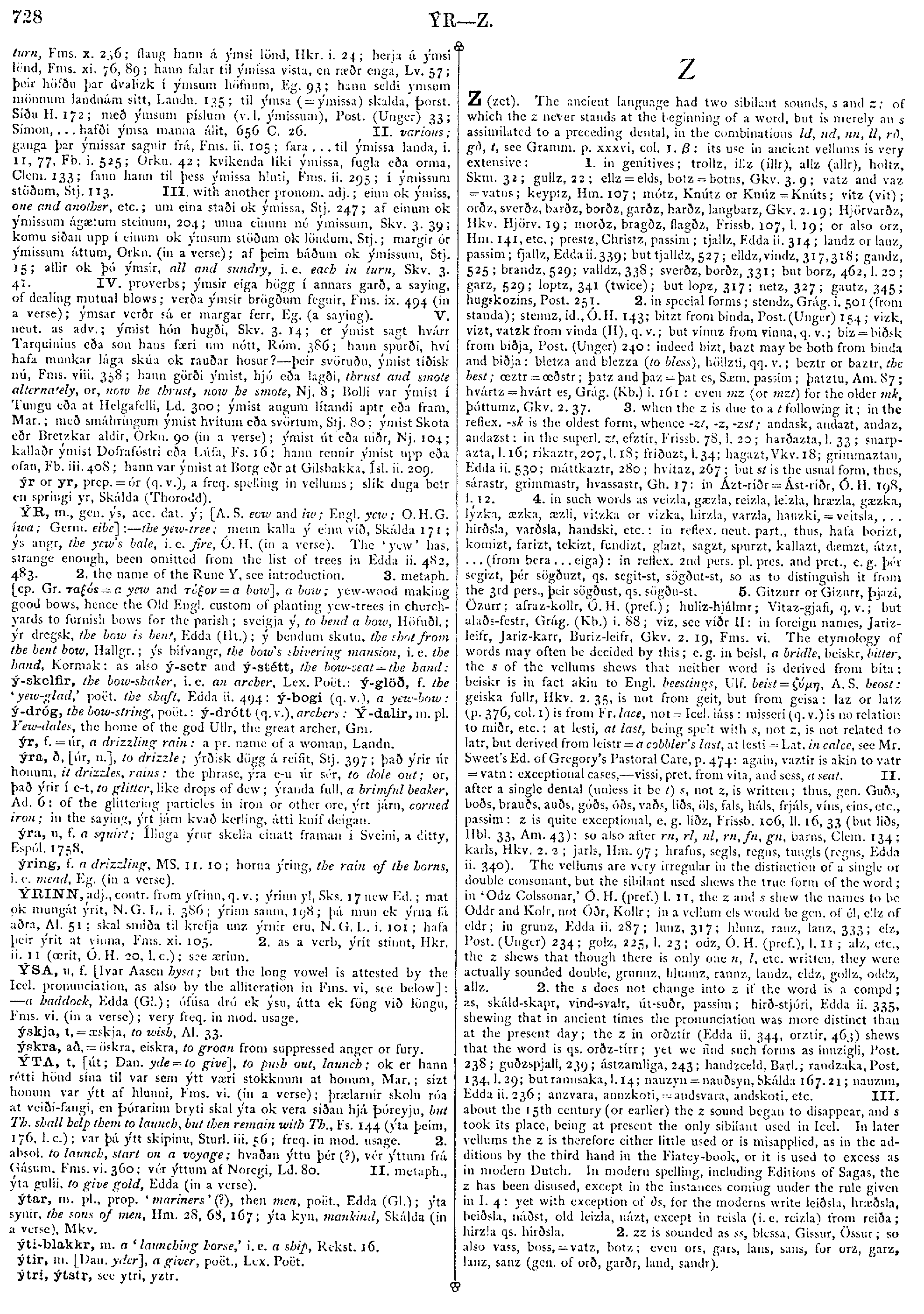
Z
(zet).
The
ancient
language
had
two
sibilant
sounds,
s
and
z;
of
which
the
z
never
stands
at
the
beginning
of
a
word,
but
is
merely
an
s
assimilated
to
a
preceding
dental,
in
the
combinations
ld,
nd,
nn,
ll,
rð,
gð,
see
Gramm.
p.
xxxvi,
col.
I.
:
its
use
in
ancient
vellums
is
very
extensive:
1.
in
genitives;
trollz,
íllz
(íllr),
allz
(allr),
holtz,
Skm.
32;
gullz,
22;
ellz
=
elds,
botz
=
botns,
Gkv.
3.
9;
vatz
and
vaz
=
vatns;
keyptz,
Hm.
107;
mótz,
Knútz
or
Knúz
=
Knúts;
vitz
(vit);
orðz,
sverðz,
barðz,
borðz,
garðz,
harðz,
langbarz,
Gkv.
2.
19;
Hjörvarðz,
Hkv.
Hjörv.
19;
morðz,
bragðz,
flagðz,
Frissb.
107,
l.
19;
or
also
orz,
Hm.
141,
etc.;
prestz,
Christz,
passim;
tjallz,
Edda
ii.
314;
landz
or
lanz,
passim;
fjallz,
Edda
ii-339;
but
tjalldz,
527;
elldz,
vindz,
317,
318;
gandz,
525;
brandz,
529;
valldz,
338;
sverðz,
borðz,
331;
but
borz,
462,
1.
20;
garz,
529;
loptz,
341
(twice);
but
lopz,
317;
netz,
327;
gautz,
345;
hugskozins,
Post.
251.
2.
in
special
forms;
stendz,
Grág.
i.
501
(from
standa);
stennz,
id.,
Ó.
H.
143;
bitzt
from
binda,
Post.
(Unger)
154;
vizk,
vizt,
vatzk
from
vinda
(II),
q.
v.;
but
vinnz
from
vinna,
q.
v.;
biz
=
biðsk
from
biðja,
Post.
(Ungcr)
240:
indeed
bizt,
bazt
may
be
both
from
binda
and
biðja:
bleiza
and
blezza
(to
bless),
höllzti,
qq.
v.;
beztr
or
baztr,
the
best;
œztr
=
œðstr;
þatz
and
þaz
--
þat
es,
Sæm.
passim;
þatztu,
Am.
87;
hvártz
=
hvárt
es,
Grág.
(Kb.)
i.
161:
even
mz
(or
mzt)
for
the
older
mk,
þóttumz,
Gkv.
2.
37.
3.
when
the
z
is
due
to
a
t
following
it;
in
the
reflex,
-sk
is
the
oldest
form,
whence
-z/,
-z,
-zs
t;
andask,
audazt,
andaz,
andazst:
in
the
superl.
zt,
efztir,
Frissb.
78,
1.
20;
harðazta,
l.
33;
snarp-
azta,
l.
16;
ríkaztr,
207,
l.
18;
fríðuzt,
l.
34;
hagazt,
Vkv.
18;
grimmaztan,
Edda
ii.
530;
máttkaztr,
280;
hvitaz,
267;
but
st
is
the
usual
form,
thus,
sárastr,
grimmastr,
hvassastr,
Gh.
17:
in
Ázt-ríðr
=
Ást-ríðr,
Ó.
H.
198,
l.
12.
4.
in
such
words
as
veizla,
gæzla,
reizla,
leizla,
hræzla,
gæzka,
lýzka,
œzka,
æzli,
vitzka
or
vizka,
hirzla,
varzla,
hanzki,
=
veitsla,
...
hirðsla,
varðsla,
handski,
etc.:
in
reflex,
neut.
part.,
thus,
hafa
borizt,
komizt,
farizt,
tekizt,
fundizt,
glazt,
sagzt,
spurzt,
kallazt,
dæmzt,
átzt,
...
(from
bera
...
eiga):
in
reflex.
2nd
pers.
pl.
pres.
and
pret.,
e.
g.
þér
segizt,
þér
sögðuzt,
qs.
segit-st,
sögðut-st,
so
as
to
distinguish
it
from
the
3rd
pers.,
þeir
sögðust,
qs.
sögðu-st.
5.
Gitzurr
or
Gizurr,
þjazi,
Özurr;
afraz-kollr,
Ó.
H.
(pref.);
huliz-hjálmr;
Vitaz-gjafi,
q.
v.;
but
alaðs-festr,
Grág.
(Kb.)
i.
88;
viz,
see
víðr
II:
in
foreign
names,
Jariz-
leifr,
Jariz-karr,
Buriz-leifr,
Gkv.
2.
19,
Fms.
vi.
The
etymology
of
words
may
often
be
decided
by
this;
e.
g.
in
beisl,
a
bridle,
beiskr,
bitter,
the
s
of
the
vellums
shews
that
neither
word
is
derived
from
bíta;
beiskr
is
in
fact
akin
to
Engl.
beestings,
Ulf.
beist
=
GREEK,
A.
S.
beost:
geiska
fullr,
Hkv.
2.
35,
is
not
from
geit,
but
from
geisa:
laz
or
latz
(p.
376,
col.
1)
is
from
Fr.
lace,
not=
Icel.
láss:
misseri
(q.
v.)
is
no
relation
to
miðr,
etc.:
at
lesti,
at
last,
being
spelt
with
s,
not
z,
is
not
related
to
latr,
but
derived
from
leistr
=
a
cobbler's
last,
at
lesti
=
Lat.
in
calce,
see
Mr.
Sweet's
Ed.
of
Gregory's
Pastoral
Care,
p.
474:
again,
vaztir
is
akin
to
vatr
=
vatn:
exceptional
cases,
--
vissi,
pret;
from
vita,
and
sess,
a
seat.
II.
after
a
single
dental
(unless
it
be
t)
s,
not
z,
is
written;
thus,
gen.
Guðs,
boðs,
brauðs,
auðs,
góðs,
óðs,
vaðs,
liðs,
öls,
fals,
háls,
frjáls,
víns,
eins,
etc.,
passim:
z
is
quite
exceptional,
e.
g.
liðz,
Frissb.
106,
ll.
16,
33
(but
liðs,
Hbl.
33,
Am.
43):
so
also
after
rn,
rl,
nl,
rn,
fn,
gn,
barns,
Clem.
134;
karls,
Hkv.
2.2
;
jarls,
Hm.
97;
hrafns,
segls,
regns,
tungls
(regn,
Edda
ii.
340).
The
vellums
are
very
irregular
in
the
distinction
of
a
single
or
double
consonant,
but
the
sibilant
used
shews
the
true
form
of
the
word;
in
'Odz
Colssonar,'
Ö.
H.
(pref.)
l.
II,
the
z
and
s
shew
the
names
to
be
Oddr
and
Kolr,
not
Oðr,
Kollr;
in
a
vellum
els
would
be
gen.
of
él,
e;lz
of
eldr;
in
grunz,
Edda
ii.
287;
lunz,
317;
hlunz,
ranz,
lanz,
333;
elz,
Post,
(Unger)
234;
golz,
225,
l.
23;
odz,
Ó.
H.
(pref.),
l.
II;
alz,
etc.,
the
z
shews
that
though
there
is
only
one
n,
l,
etc.
written,
they
were
actually
sounded
double,
grunnz,
hlunnz,
rannz,
landz,
eldz,
gollz,
oddz,
allz.
2.
the
s
docs
not
change
into
z
if
the
word
is
a
compd;
as,
skáld-skapr,
vind-svalr,
út-suðr,
passim;
hirð-stjóri,
Edda
ii.
335,
shewing
that
in
ancient
times
the
pronunciation
was
more
distinct
than
at
the
present
day;
the
z
in
orðztír
(Edda
ii.
344,
orztír,
463)
shews
that
the
word
is
qs.
orðz-tírr;
yet
we
lind
such
forms
as
innzigli,
Post.
238;
guðzspjall,
239;
ástzamliga,
243;
handzceld,
Barl.;
randzaka.
Post.
134,
l.
29;
but
rannsaka,
l.
14;
nauzyn
=
nauðsyn,
Skálda
167.
21;
nauzun,
Edda
ii.
236;
anzvara,
annzkoti,
=
andsvara,
andskoti,
etc.
III.
about
the
15th
century
(or
earlier)
the
z
sound
began
to
disappear,
and
s
took
its
place,
being
at
present
the
only
sibilant
used
in
Icel.
In
later
vellums
the
z
is
therefore
cither
little
used
or
is
misapplied,
as
in
the
ad-
ditions
by
the
third
hand
in
the
Flatey-book,
or
it
is
used
to
excess
as
in
modern
Dutch.
In
modern
spelling,
including
Editions
of
Sagas,
the
z
has
been
disused,
except
in
the
instances
coming
under
the
rule
given
in
I.
4:
yet
with
exception
of
ðs,
for
the
moderns
write
leiðsla,
hræðsla,
beiðsla,
náðst,
old
leizla,
názt,
except
in
reisla
(i.
e.
reizla)
from
reiða;
hirzla
qs.
hirdsla.
2.
zz
is
sounded
as
ss,
blessa,
Gissur,
Össur;
so
also
vass,
boss,
=
vatz,
botz;
even
ris,
gars,
lans,
sans,
for
orz,
garz,
lanz,
sanz
(gen.
of
orð,
garðr,
land,
sandr).
| Result Page: |  |
Previous | 1 2 |
Germanic Lexicon Project (main page)
This search system was written by
Sean Crist
Please consider
volunteering
to correct the data in these online dictionaries.
No rights reserved. Feel free to use these data in any way you please.