|
|

Tip: In the search results, you can click on any word or abbreviation for more information.
|
Source: Cleasby/Vigfusson, page b0584, entry 28 View original page image as: [TIFF] [PNG] [View previous entry] [View next entry] |
[Comment on this entry] [View comments] |
The following entry has been hand-corrected once. |
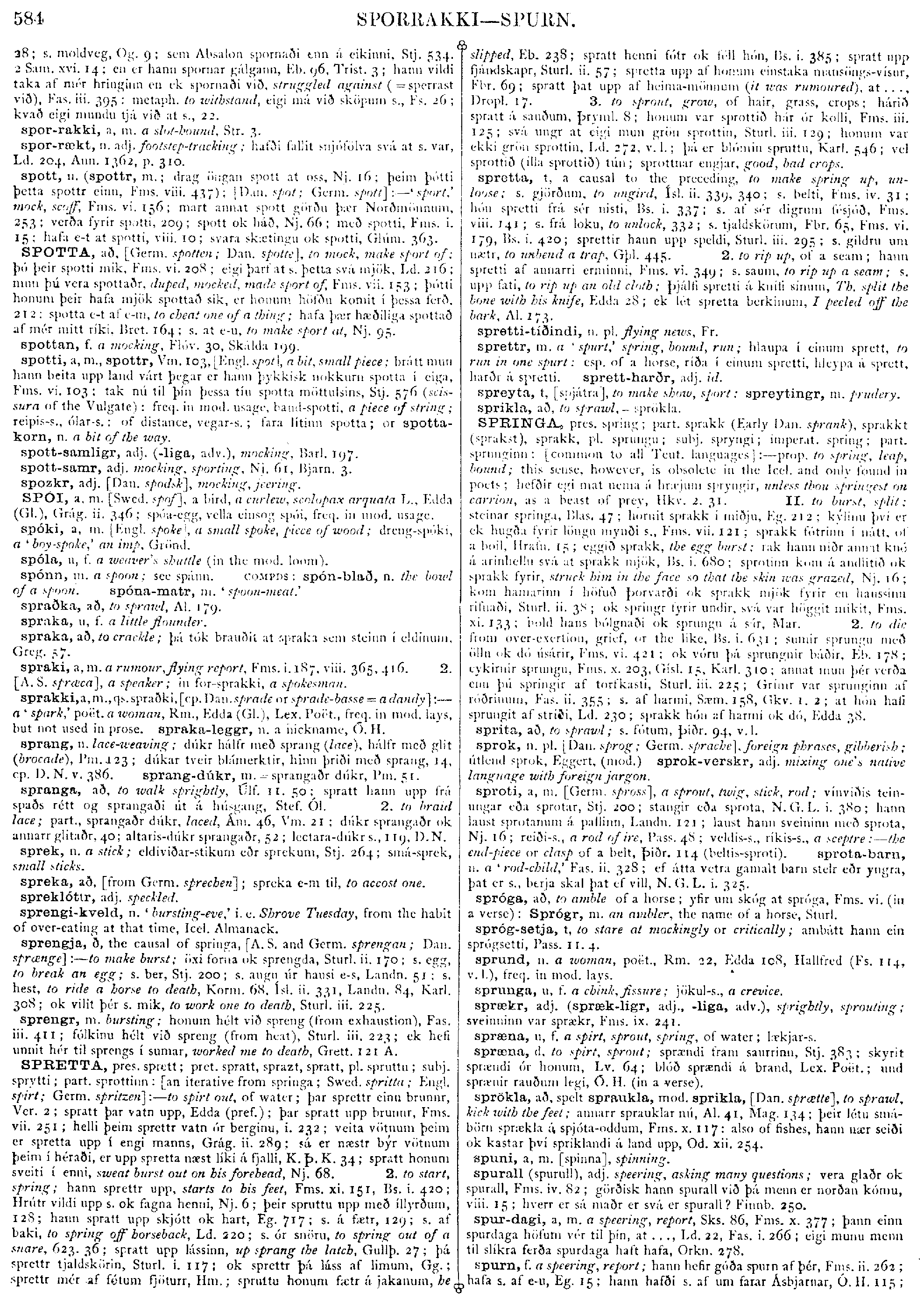
SPRETTA, pres. sprett; pret. spratt, sprazt, spratt, pl. spruttu; subj. sprytti; part. sprottinn: [an iterative from springa; Swed. spritta; Engl. spirt; Germ. spritzen] :-- to spirt out, of water; þar sprettr einn brunnr, Ver. 2; spratt þar vatn upp, Edda (pref.); þar spratt upp brunnr, Fms. vii. 251; helli þeim sprettr vatn ór berginu, i. 232; veita vötnum þeim er spretta upp í engi manns, Grág. ii. 289; sá er næstr býr vötnum þeim í héraði, er upp spretta næst líki á fjalli, K.Þ.K. 34; spratt honum sveiti í enni, sweat burst out on his forehead, Nj. 68. 2. to start, spring; hann sprettr upp, starts to his feet, Fms. xi. 151, Bs. i. 420; Hrútr vildi upp s. ok fagna henni, Nj. 6; þeir spruttu upp með íllyrðum, 128; hann spratt upp skjótt ok hart, Eg. 717; s. á fætr 129; s. af baki, to spring off horseback, Ld. 220; s. ór snöru, to spring out of a snare, 623. 36; spratt upp lássinn, up sprang the latch, Gullþ. 27; þá sprettr tjaldskörin, Sturl. i. 117; ok sprettr þá láss af limum, Gg.; sprettr mér af fótum fjöturr, Hm.; spruttu honum fætr á jakanum, he slipped, Eb. 238; spratt henni fótr ok féll hón, Bs. i. 385; spratt upp fjándskapr, Sturl. ii. 57; spretta upp af honum einstaka mansöngs-vísur, Fbr. 69; spratt þat upp af heima-mönnum (it was rumoured), at ..., Dropl. 17. 3. to sprout, grow, of hair, grass, crops; hárið spratt á sauðum, Þryml. 8; honum var sprottið hár ór kolli, Fms. iii. 125; svá ungr at eigi mun grön sprottin, Sturl. iii. 129; honum var ekki grön sprottin, Ld. 272, v.l.; þá er blómin spruttu, Karl. 546; vel sprottið (illa sprottið) tún; sprottnar engjar, good, bad crops.
|
Source: Cleasby/Vigfusson, page b0584, entry 29 View original page image as: [TIFF] [PNG] [View previous entry] [View next entry] |
[Comment on this entry] [View comments] |
The following entry has been hand-corrected once. |
spretta, t, a causal to the preceding, to make spring up, unloose; s. gjörðum, to ungird, Ísl. ii. 339, 340; s. belti, Fms. iv. 31; hón spretti frá sér nisti, Bs. i. 337; s. af sér digrum fésjóð. Fms. viii. 141; s. frá loku, to unlock, 332; s. tjaldskörum, Fbr. 65, Fms. vi. 179, Bs. i. 420; sprettir hann upp speldi, Sturl. iii. 295; s. gildru um nætr, to unbend a trap, Gþl. 445. 2. to rip up, of a seam; hann spretti af annarri erminni, Fms. vi. 349; s. saum, to rip up a seam; s. upp fati, to rip up an old cloth; Þjálfi spretti á knífi sínum, Th. split the bone with his knife, Edda 28; ek lét spretta berkinum, I peeled off the bark, Al. 173.
|
Source: Torp, page b0516, entry 7 View original page image as: [TIFF] [PNG] [View previous entry] [View next entry] |
[Comment on this entry] [View comments] |
The following entry has been hand-corrected once. |

sprent
sprentan
sprant
spruntum
spruntana
aufspringen.
an.
spretta
spratt
sprattum
sprottinn
auffahren,
ausschlagen
(Baum),
spritzen,
hervorquellen,
aufgehen
(Sonne),
caus.
spretta
(=
germ.
sprantian)
trennen
(Naht),
spritzen
machen,
zerstreuen,
ausbreiten;
mhd.
sprenzen
schw.
vb.
sprengen,
spritzen,
bunt
schmücken,
putzen,
sprenkeln
(st.
vb.
spranz
praet.
(=
an.
spratt)
in
verschiedenen
Farben
glänzen),
intr.
u.
refl.
sich
spreizen,
einherstolzieren,
sprenzel
und
sprenzelære
 daj
daj prdati
springen,
russ.
prjadat
prdati
springen,
russ.
prjadat aufspringen;
lit.
spréndulis
ein
am
Ende
eingespaltener
Stock,
am
damit
Steine
zu
schleudern,
sprénd
aufspringen;
lit.
spréndulis
ein
am
Ende
eingespaltener
Stock,
am
damit
Steine
zu
schleudern,
sprénd iu
spr
iu
spr sti
eine
Spanne
messen
(eig.
»spreizen«).
Ig.
sprend,
Weiterbildung
zu
sper
1.
Daneben
germ.
sprend
in
ags.
sprindel
»tenter-hook«,
sti
eine
Spanne
messen
(eig.
»spreizen«).
Ig.
sprend,
Weiterbildung
zu
sper
1.
Daneben
germ.
sprend
in
ags.
sprindel
»tenter-hook«,
[Translate the German words]
|
Source: Bosworth/Toller, page d0415, entry 9 View original page image as: [TIFF] [PNG] [View previous entry] [View next entry] |
[Comment on this entry] [View comments] |
The following entry has been hand-corrected once. |
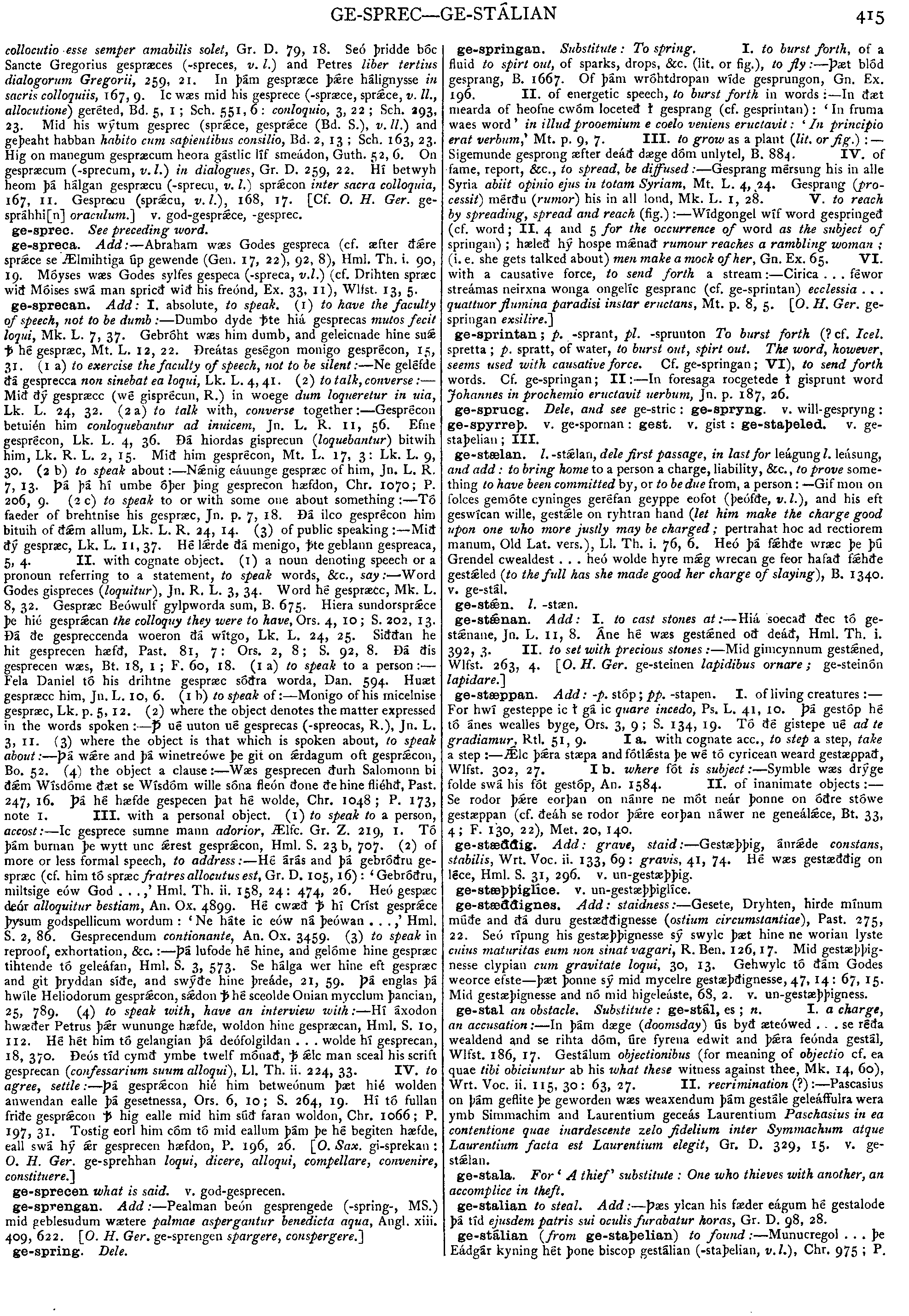
ge-sprintan;
p.
-sprant,
pl.
-sprunton
To
burst
forth
(?
cf.
Icel.
spretta;
p.
spratt,
of
water,
to
burst
out,
spirt
out.
The
word,
however,
seems
used
with
causative
force.
Cf.
ge-springan;
VI),
to
send
forth
words.
Cf.
ge-springan;
II
:--
In
foresaga
rocgetede
 gisprunt
word
Johannes
in
prochemio
eructavit
uerbum,
Jn.
p.
187,
26.
gisprunt
word
Johannes
in
prochemio
eructavit
uerbum,
Jn.
p.
187,
26.
|
Source: Cleasby/Vigfusson, page b0168, entry 51 View original page image as: [TIFF] [PNG] [View previous entry] [View next entry] |
[Comment on this entry] [View comments] |
The following entry has been hand-corrected once. |
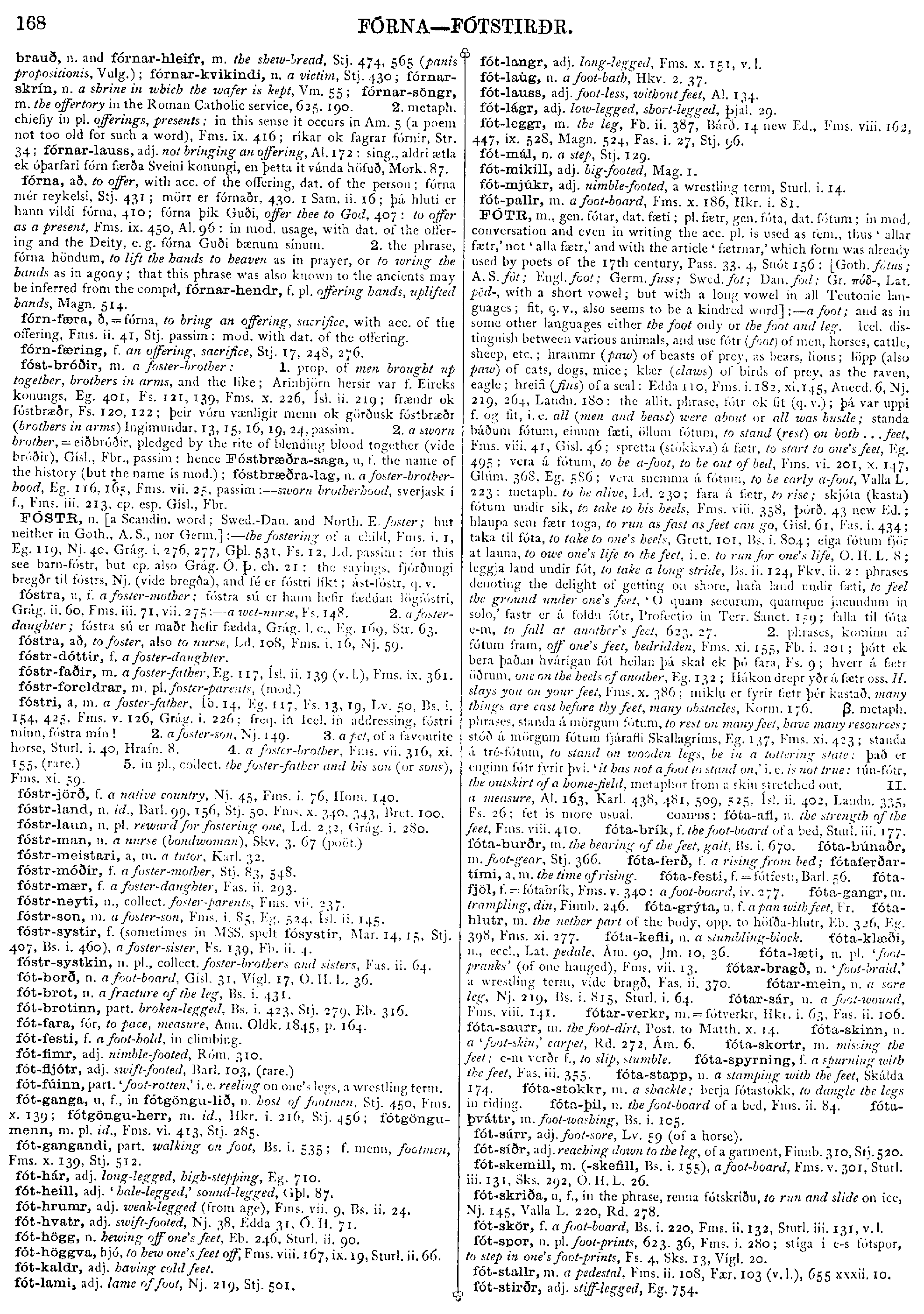
FÓTR,
m.,
gen.
fótar,
dat.
fæti;
pl.
fætr,
gen.
fóta,
dat.
fótum;
in
mod.
conversation
and
even
in
writing
the
acc.
pl.
is
used
as
fem.,
thus
'allar
fætr,'
not
'alla
fætr,'
and
with
the
article
'fætrnar,'
which
form
was
already
used
by
poets
of
the
17th
century,
Pass.
33.
4,
Snót
156:
[Goth.
fôtus;
A.
S.
fôt;
Engl.
foot;
Germ.
fuss;
Swed.
fot;
Dan.
fod;
Gr.
GREEK-,
Lat.
p d-,
with
a
short
vowel;
but
with
a
long
vowel
in
all
Teutonic
languages;
fit,
q.v.,
also
seems
to
be
a
kindred
word]
:--
a
foot;
and
as
in
some
other
languages
either
the
foot
only
or
the
foot
and
leg.
Icel.
distinguish
between
various
animals,
and
use
fótr
(foot)
of
men,
horses,
cattle,
sheep,
etc.;
hrammr
(paw)
of
beasts
of
prey,
as
bears,
lions;
löpp
(also
paw)
of
cats,
dogs,
mice;
klær
(claws)
of
birds
of
prey,
as
the
raven,
eagle;
hreifi
(fins)
of
a
seal:
Edda
110,
Fms.
i.
182,
xi.
145,
Anecd.
6,
Nj.
219,
264,
Landn.
180:
the
allit.
phrase,
fótr
ok
lit
(q.v.);
þá
var
uppi
f.
og
fit,
i.e.
all
(men
and
beast)
were
about
or
all
was
bustle;
standa
báðum
fótum,
einum
fæti,
öllum
fótum,
to
stand
(rest)
on
both
...
feet,
Fms.
viii.
41,
Gísl.
46;
spretta
(stökkva)
á
fætr,
to
start
to
one's
feet,
Eg.
495;
vera
á
fótum,
to
be
a-foot,
to
be
out
of
bed,
Fms.
vi.
201,
x.
147,
Glúm.
368,
Eg.
586;
vera
snemma
á
fótum,
to
be
early
a-foot,
Valla
L.
223:
metaph.
to
be
alive,
Ld.
230;
fara
á
fætr,
to
rise;
skjóta
(kasta)
fótum
undir
sik,
to
take
to
his
heels,
Fms.
viii.
358,
Þórð.
43
new
Ed.;
hlaupa
sem
fætr
toga,
to
run
as
fast
as
feet
can
go,
Gísl.
61.
Fas.
i.
434;
taka
til
fóta,
to
take
to
one's
heels,
Grett.
101,
Bs.
i.
804;
eiga
fótum
fjör
at
launa,
to
owe
one's
life
to
the
feet,
i.e.
to
run
for
one's
life,
O.
H.
L.
8;
leggja
land
undir
fót,
to
take
a
long
stride,
Bs.
ii.
124,
Fkv.
ii.
2:
phrases
denoting
the
delight
of
getting
on
shore,
hafa
land
undir
fæti,
to
feel
the
ground
wider
one's
feet,
'O
quam
securum,
quamque
jucundum
in
solo,'
fastr
er
á
foldu
fótr,
Profectio
in
Terr.
Sanct.
159;
falla
til
fóta
e-m,
to
fall
at
another's
feet,
623.
27.
2.
phrases,
kominn
af
fotum
fram,
off
one's
feet,
bedridden,
Fms.
xi.
155,
Fb.
i.
201;
þótt
ek
bera
þaðan
hvárigan
fót
heilan
þá
skal
ek
þó
fara,
Fs.
9;
hverr
á
fætr
öðrum,
one
on
the
heels
of
another,
Eg.
132;
Hákon
drepr
yðr
á
fætr
oss,
H.
slays
you
on
your
feet,
Fms.
x.
386;
miklu
er
fyrir
fætr
þér
kastað,
many
things
are
cast
before
thy
feet,
many
obstacles,
Korm.
176.
d-,
with
a
short
vowel;
but
with
a
long
vowel
in
all
Teutonic
languages;
fit,
q.v.,
also
seems
to
be
a
kindred
word]
:--
a
foot;
and
as
in
some
other
languages
either
the
foot
only
or
the
foot
and
leg.
Icel.
distinguish
between
various
animals,
and
use
fótr
(foot)
of
men,
horses,
cattle,
sheep,
etc.;
hrammr
(paw)
of
beasts
of
prey,
as
bears,
lions;
löpp
(also
paw)
of
cats,
dogs,
mice;
klær
(claws)
of
birds
of
prey,
as
the
raven,
eagle;
hreifi
(fins)
of
a
seal:
Edda
110,
Fms.
i.
182,
xi.
145,
Anecd.
6,
Nj.
219,
264,
Landn.
180:
the
allit.
phrase,
fótr
ok
lit
(q.v.);
þá
var
uppi
f.
og
fit,
i.e.
all
(men
and
beast)
were
about
or
all
was
bustle;
standa
báðum
fótum,
einum
fæti,
öllum
fótum,
to
stand
(rest)
on
both
...
feet,
Fms.
viii.
41,
Gísl.
46;
spretta
(stökkva)
á
fætr,
to
start
to
one's
feet,
Eg.
495;
vera
á
fótum,
to
be
a-foot,
to
be
out
of
bed,
Fms.
vi.
201,
x.
147,
Glúm.
368,
Eg.
586;
vera
snemma
á
fótum,
to
be
early
a-foot,
Valla
L.
223:
metaph.
to
be
alive,
Ld.
230;
fara
á
fætr,
to
rise;
skjóta
(kasta)
fótum
undir
sik,
to
take
to
his
heels,
Fms.
viii.
358,
Þórð.
43
new
Ed.;
hlaupa
sem
fætr
toga,
to
run
as
fast
as
feet
can
go,
Gísl.
61.
Fas.
i.
434;
taka
til
fóta,
to
take
to
one's
heels,
Grett.
101,
Bs.
i.
804;
eiga
fótum
fjör
at
launa,
to
owe
one's
life
to
the
feet,
i.e.
to
run
for
one's
life,
O.
H.
L.
8;
leggja
land
undir
fót,
to
take
a
long
stride,
Bs.
ii.
124,
Fkv.
ii.
2:
phrases
denoting
the
delight
of
getting
on
shore,
hafa
land
undir
fæti,
to
feel
the
ground
wider
one's
feet,
'O
quam
securum,
quamque
jucundum
in
solo,'
fastr
er
á
foldu
fótr,
Profectio
in
Terr.
Sanct.
159;
falla
til
fóta
e-m,
to
fall
at
another's
feet,
623.
27.
2.
phrases,
kominn
af
fotum
fram,
off
one's
feet,
bedridden,
Fms.
xi.
155,
Fb.
i.
201;
þótt
ek
bera
þaðan
hvárigan
fót
heilan
þá
skal
ek
þó
fara,
Fs.
9;
hverr
á
fætr
öðrum,
one
on
the
heels
of
another,
Eg.
132;
Hákon
drepr
yðr
á
fætr
oss,
H.
slays
you
on
your
feet,
Fms.
x.
386;
miklu
er
fyrir
fætr
þér
kastað,
many
things
are
cast
before
thy
feet,
many
obstacles,
Korm.
176.
 .
metaph.
phrases,
standa
á
mörgum
fótum,
to
rest
on
many
feet,
have
many
resources;
stóð
á
mörgum
fótum
fjárarli
Skallagríms,
Eg.
137,
Fms.
xi.
423;
standa
á
tré-fótum,
to
stand
on
wooden
legs,
be
in
a
tottering
state:
það
er
enginn
fótr
fyrir
því,
'it
has
not
a
foot
to
stand
on,'
i.e.
is
not
true:
tún-fótr,
the
outskirt
of
a
home-field,
metaphor
from
a
skin
stretched
out.
II.
a
measure,
Al.
163,
Karl.
438,
481,
509,
525.
Ísl.
ii.
402,
Landn.
335,
Fs.
26;
fet
is
more
usual.
COMPDS:
fóta-afl,
n.
the
strength
of
the
feet,
Fms.
viii.
410.
fóta-brík,
f.
the
foot-board
of
a
bed,
Sturl.
iii.
177.
fóta-burðr,
m.
the
bearing
of
the
feet,
gait,
Bs.
i.
670.
fóta-búnaðr,
m.
foot-gear,
Stj.
366.
fóta-ferð,
f.
a
rising
from
bed;
fótaferðar-tími,
a,
m.
the
time
of
rising.
fóta-festi,
f.
=
fótfesti,
Barl.
56.
fóta-fjöl,
f.
=
fótabrík,
Fms.
v.
340:
a
foot-board,
iv.
277.
fóta-gangr,
m.
trampling,
din,
Finnb.
246.
fóta-grýta,
u,
f.
a
pan
with
feet,
Fr.
fóta-hlutr,
m.
the
nether
part
of
the
body,
opp.
to
höfða-hlutr,
Eb.
326,
Eg.
398,
Fms.
xi.
277.
fóta-kefli,
n.
a
stumbling-block.
fóta-klæði,
n.,
eccl.,
Lat.
pedale,
Ám.
90,
Jm.
10,
36.
fóta-læti,
n.
pl.
'foot-pranks'
(of
one
hanged),
Fms.
vii.
13.
fótar-bragð,
n.
'foot-braid,'
a
wrestling
term,
vide
bragð.
Fas.
ii.
370.
fótar-mein,
n.
a
sore
leg,
Nj.
219,
Bs.
i.
815,
Sturl.
i.
64.
fótar-sár,
n.
a
foot-wound,
Fms.
viii.
141.
fótar-verkr,
m.
=
fótverkr,
Hkr.
i.
63,
Fas.
ii.
106.
fóta-saurr,
m.
the
foot-dirt,
Post.
to
Matth.
x.
14.
fóta-skinn,
n.
a
'foot-skin,'
carpet,
Rd.
272,
Ám.
6.
fóta-skortr,
m.
missing
the
feet;
e-m
verðr
f.,
to
slip,
stumble.
fóta-spyrning,
f.
a
spurning
with
the
feet,
Fas.
iii.
355.
fóta-stapp,
n.
a
stamping
with
the
feet,
Skálda
174.
fóta-stokkr,
m.
a
shackle;
berja
fótastokk,
to
dangle
the
legs
in
riding.
fóta-þil,
n.
the
foot-board
of
a
bed,
Fms.
ii.
84.
fóta-þváttr,
m.
foot-washing,
Bs.
i.
105.
.
metaph.
phrases,
standa
á
mörgum
fótum,
to
rest
on
many
feet,
have
many
resources;
stóð
á
mörgum
fótum
fjárarli
Skallagríms,
Eg.
137,
Fms.
xi.
423;
standa
á
tré-fótum,
to
stand
on
wooden
legs,
be
in
a
tottering
state:
það
er
enginn
fótr
fyrir
því,
'it
has
not
a
foot
to
stand
on,'
i.e.
is
not
true:
tún-fótr,
the
outskirt
of
a
home-field,
metaphor
from
a
skin
stretched
out.
II.
a
measure,
Al.
163,
Karl.
438,
481,
509,
525.
Ísl.
ii.
402,
Landn.
335,
Fs.
26;
fet
is
more
usual.
COMPDS:
fóta-afl,
n.
the
strength
of
the
feet,
Fms.
viii.
410.
fóta-brík,
f.
the
foot-board
of
a
bed,
Sturl.
iii.
177.
fóta-burðr,
m.
the
bearing
of
the
feet,
gait,
Bs.
i.
670.
fóta-búnaðr,
m.
foot-gear,
Stj.
366.
fóta-ferð,
f.
a
rising
from
bed;
fótaferðar-tími,
a,
m.
the
time
of
rising.
fóta-festi,
f.
=
fótfesti,
Barl.
56.
fóta-fjöl,
f.
=
fótabrík,
Fms.
v.
340:
a
foot-board,
iv.
277.
fóta-gangr,
m.
trampling,
din,
Finnb.
246.
fóta-grýta,
u,
f.
a
pan
with
feet,
Fr.
fóta-hlutr,
m.
the
nether
part
of
the
body,
opp.
to
höfða-hlutr,
Eb.
326,
Eg.
398,
Fms.
xi.
277.
fóta-kefli,
n.
a
stumbling-block.
fóta-klæði,
n.,
eccl.,
Lat.
pedale,
Ám.
90,
Jm.
10,
36.
fóta-læti,
n.
pl.
'foot-pranks'
(of
one
hanged),
Fms.
vii.
13.
fótar-bragð,
n.
'foot-braid,'
a
wrestling
term,
vide
bragð.
Fas.
ii.
370.
fótar-mein,
n.
a
sore
leg,
Nj.
219,
Bs.
i.
815,
Sturl.
i.
64.
fótar-sár,
n.
a
foot-wound,
Fms.
viii.
141.
fótar-verkr,
m.
=
fótverkr,
Hkr.
i.
63,
Fas.
ii.
106.
fóta-saurr,
m.
the
foot-dirt,
Post.
to
Matth.
x.
14.
fóta-skinn,
n.
a
'foot-skin,'
carpet,
Rd.
272,
Ám.
6.
fóta-skortr,
m.
missing
the
feet;
e-m
verðr
f.,
to
slip,
stumble.
fóta-spyrning,
f.
a
spurning
with
the
feet,
Fas.
iii.
355.
fóta-stapp,
n.
a
stamping
with
the
feet,
Skálda
174.
fóta-stokkr,
m.
a
shackle;
berja
fótastokk,
to
dangle
the
legs
in
riding.
fóta-þil,
n.
the
foot-board
of
a
bed,
Fms.
ii.
84.
fóta-þváttr,
m.
foot-washing,
Bs.
i.
105.
|
Source: Cleasby/Vigfusson, page b0173, entry 21 View original page image as: [TIFF] [PNG] [View previous entry] [View next entry] |
[Comment on this entry] [View comments] |
The following entry has been hand-corrected once. |
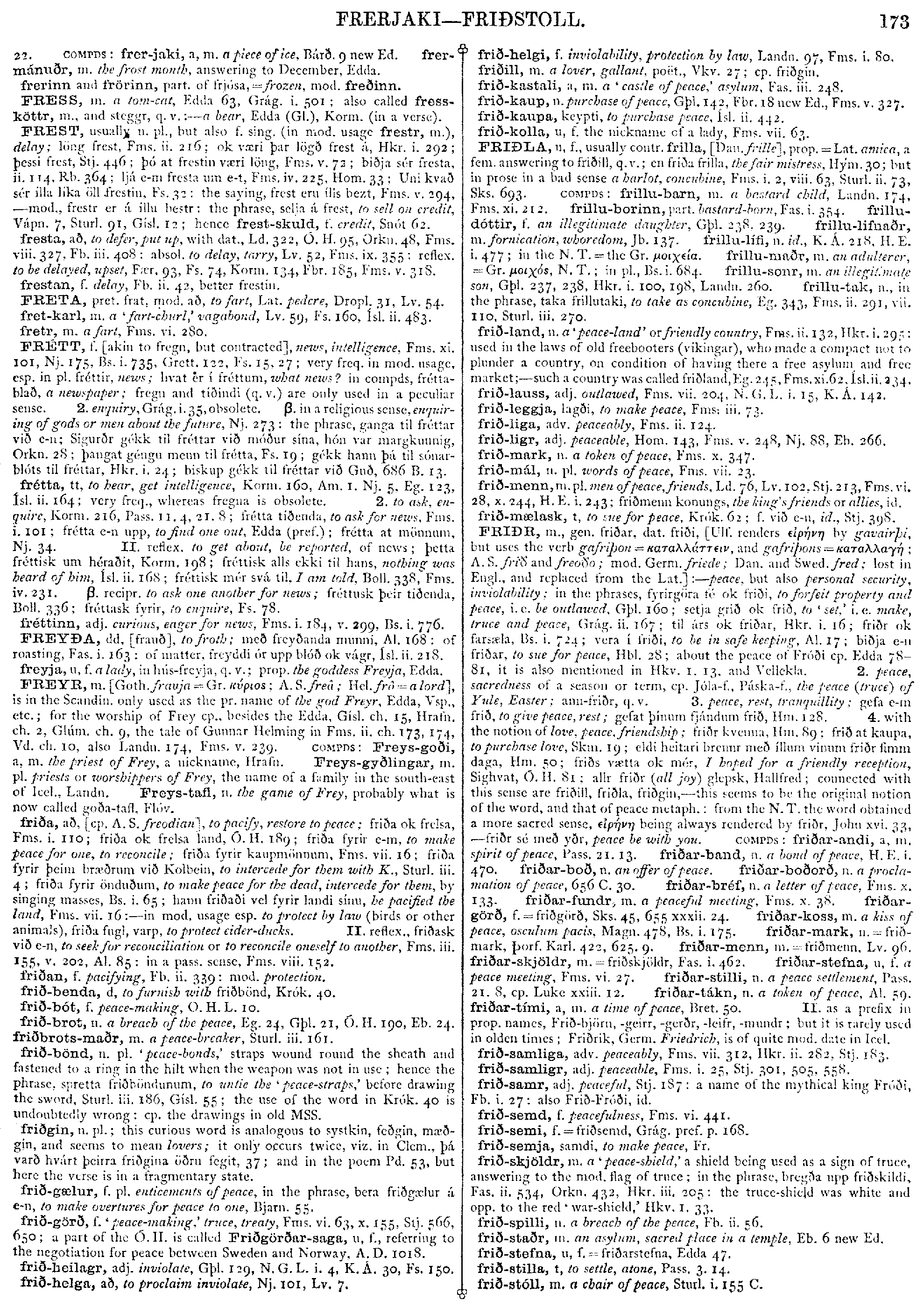
frið-bönd, n. pl. 'peace-bonds,' straps wound round the sheath and fastened to a ring in the hilt when the weapon was not in use; hence the phrase, spretta friðböndunum, to untie the 'peace-straps,' before drawing the sword, Sturl. iii. 186, Gísl. 55; the use of the word in Krók. 40 is undoubtedly wrong: cp. the drawings in old MSS.
|
Source: Cleasby/Vigfusson, page b0260, entry 17 View original page image as: [TIFF] [PNG] [View previous entry] [View next entry] |
[Comment on this entry] [View comments] |
The following entry has been hand-corrected once. |
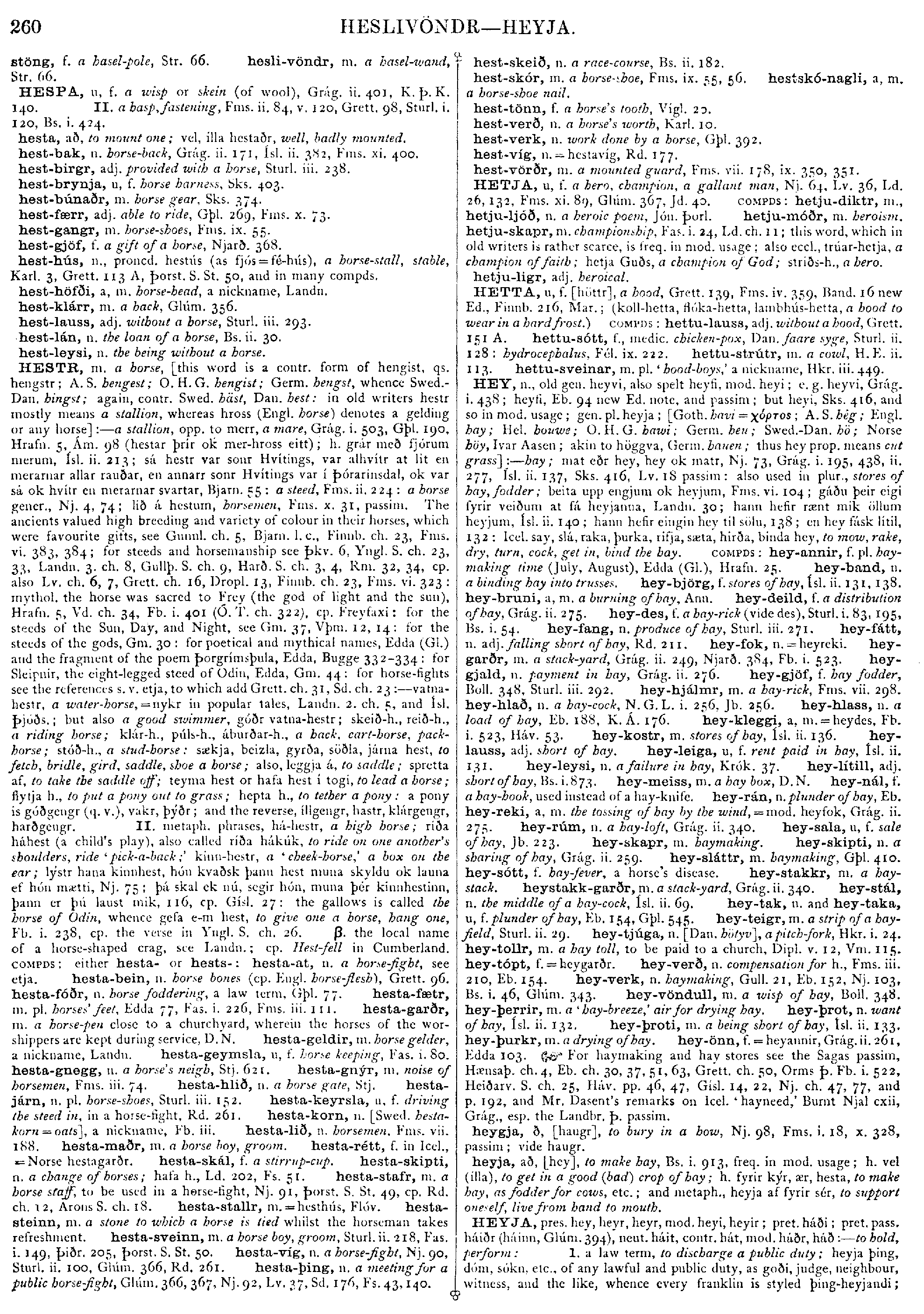
HESTR,
m.
a
horse,
[this
word
is
a
contr.
form
of
hengist,
qs.
hengstr;
A.
S.
hengest;
O.
H.
G.
hengist;
Germ.
hengst,
whence
Swed.-Dan.
hingst;
again,
contr.
Swed.
häst,
Dan.
hest:
in
old
writers
hestr
mostly
means
a
stallion,
whereas
hross
(Engl.
horse)
denotes
a
gelding
or
any
horse]
:--
a
stallion,
opp.
to
merr,
a
mare,
Grág.
i.
503,
Gþl.
190,
Hrafn.
5,
Ám.
98
(hestar
þrír
ok
mer-hross
eitt);
h.
grár
með
fjórum
merum,
Ísl.
ii.
213;
sá
hestr
var
sonr
Hvítings,
var
alhvítr
at
lit
en
merarnar
allar
rauðar,
en
annarr
sonr
Hvítings
var
í
Þórarínsdal,
ok
var
sá
ok
hvítr
en
merarnar
svartar,
Bjarn.
55:
a
steed,
Fms.
ii.
224:
a
horse
gener.,
Nj.
4,
74;
lið
á
hestum,
horsemen,
Fms.
x.
31,
passim.
The
ancients
valued
high
breeding
and
variety
of
colour
in
their
horses,
which
were
favourite
gifts,
see
Gunnl.
ch.
5,
Bjarn.
l.c.,
Finnb.
ch.
23,
Fms.
vi.
383,
384;
for
steeds
and
horsemanship
see
Þkv.
6,
Yngl.
S.
ch.
23,
33,
Landn.
3.
ch.
8,
Gullþ.
S.
ch.
9,
Harð.
S.
ch.
3,
4,
Rm.
32,
34,
cp.
also
Lv.
ch.
6,
7,
Grett.
ch.
16,
Dropl.
13,
Finnb.
ch.
23,
Fms.
vi.
323:
mythol.
the
horse
was
sacred
to
Frey
(the
god
of
light
and
the
sun),
Hrafn.
5,
Vd.
ch.
34,
Fb.
i.
401
(Ó.
T.
ch.
322),
cp.
Freyfaxi:
for
the
steeds
of
the
Sun,
Day,
and
Night,
see
Gm.
37,
Vþm.
12,
14:
for
the
steeds
of
the
gods,
Gm.
30:
for
poetical
and
mythical
names,
Edda
(Gl.)
and
the
fragment
of
the
poem
Þorgrímsþula,
Edda,
Bugge
332-334:
for
Sleipnir,
the
eight-legged
steed
of
Odin,
Edda,
Gm.
44:
for
horse-fights
see
the
references
s.v.
etja,
to
which
add
Grett.
ch.
31,
Sd.
ch.
23
:--
vatna-hestr,
a
water-horse,
=
nykr
in
popular
tales,
Landn.
2.
ch.
5,
and
Ísl.
Þjóðs.;
but
also
a
good
swimmer,
góðr
vatna-hestr;
skeið-h.,
reið-h.,
a
riding
horse;
klár-h.,
púls-h.,
áburðar-h.,
a
hack,
cart-horse,
pack-horse;
stóð-h.,
a
stud-horse:
sækja,
beizla,
gyrða,
söðla,
járna
hest,
to
fetch,
bridle,
gird,
saddle,
shoe
a
horse;
also,
leggja
á,
to
saddle;
spretta
af,
to
take
the
saddle
off;
teyma
hest
or
hafa
hest
í
togi,
to
lead
a
horse;
flytja
h.,
to
put
a
pony
out
to
grass;
hepla
h.,
to
tether
a
pony:
a
pony
is
gúðgengr
(q.v.),
vakr,
þýðr;
and
the
reverse,
íllgengr,
hastr,
klárgengr,
harðgengr.
II.
metaph.
phrases,
há-hestr,
a
high
horse;
ríða
háhest
(a
child's
play),
also
called
ríða
hákúk,
to
ride
on
one
another's
shoulders,
ride
'pick-a-back;'
kinn-hestr,
a
'cheek-horse,'
a
box
on
the
ear;
lýstr
hana
kinnhest,
hón
kvaðsk
þann
hest
muna
skyldu
ok
launa
ef
hón
mætti,
Nj.
75;
þá
skal
ek
nú,
segir
hón,
muna
þér
kinnhestinn,
þann
er
þú
laust
mik,
116,
cp.
Gísl.
27:
the
gallows
is
called
the
horse
of
Odin,
whence
gefa
e-m
hest,
to
give
one
a
horse,
hang
one,
Fb.
i.
238,
cp.
the
verse
in
Yngl.
S.
ch.
26.
.
the
local
name
of
a
horse-shaped
crag,
see
Landn.;
cp.
Hest-fell
in
Cumberland.
COMPDS:
either
hesta-
or
hests-:
hesta-at,
n.
a
horse-fight,
see
etja.
hesta-bein,
n.
horse
bones
(cp.
Engl.
horse-flesh),
Grett.
96.
hesta-fóðr,
n.
horse
foddering,
a
law
term,
Gþl.
77.
hesta-fætr,
m.
pl.
horses'
feet,
Edda
77,
Fas.
i.
226,
Fms.
iii.
111.
hesta-garðr,
m.
a
horse-pen
close
to
a
churchyard,
wherein
the
horses
of
the
worshippers
are
kept
during
service,
D.
N.
hesta-geldir,
m.
horse
gelder,
a
nickname,
Landn.
hesta-geymsla,
u,
f.
horse
keeping,
Fas.
i.
80.
hesta-gnegg,
n.
a
horse's
neigh,
Stj.
621.
hesta-gnýr,
m,
noise
of
horsemen,
Fms.
iii.
74.
hesta-hlið,
n.
a
horse
gate,
Stj.
hesta-járn,
n.
pl.
horse-shoes,
Sturl.
iii.
152.
hesta-keyrsla,
u,
f.
driving
the
steed
in,
in
a
horse-fight,
Rd.
261.
hesta-korn,
n.
[Swed.
hestakorn
=
oats],
a
nickname,
Fb.
iii.
hesta-lið,
n.
horsemen,
Fms.
vii.
188.
hesta-maðr,
m.
a
horse
boy,
groom.
hesta-rétt,
f.
in
Icel.,
=
Norse
hestagarðr.
hesta-skál,
f.
a
stirrup-cup.
hesta-skipti,
n.
a
change
of
horses;
hafa
h.,
Ld.
202,
Fs.
51.
hesta-stafr,
m.
a
horse
staff,
to
be
used
in
a
horse-fight,
Nj.
91,
Þorst.
S.
St.
49,
cp.
Rd.
ch.
12,
Arons
S.
ch.
18.
hesta-stallr,
m.
=
hesthús,
Flóv.
hesta-steinn,
m.
a
stone
to
whicb
a
horse
is
tied
whilst
the
horseman
takes
refreshment.
hesta-sveinn,
m.
a
horse
boy,
groom,
Sturl.
ii.
218,
Fas.
i.
149,
Þiðr.
205,
Þorst.
S.
St.
50.
hesta-víg,
n.
a
horse-fight,
Nj.
90,
Sturl.
ii.
100,
Glúm.
366,
Rd.
261.
hesta-þing,
n.
a
meeting
for
a
public
horse-fight,
Glúm.
366,
367,
Nj.
92,
Lv.
37,
Sd.
176,
Fs.
43,
140.
|
Source: Cleasby/Vigfusson, page b0565, entry 33 View original page image as: [TIFF] [PNG] [View previous entry] [View next entry] |
[Comment on this entry] [View comments] |
The following entry has been hand-corrected once. |
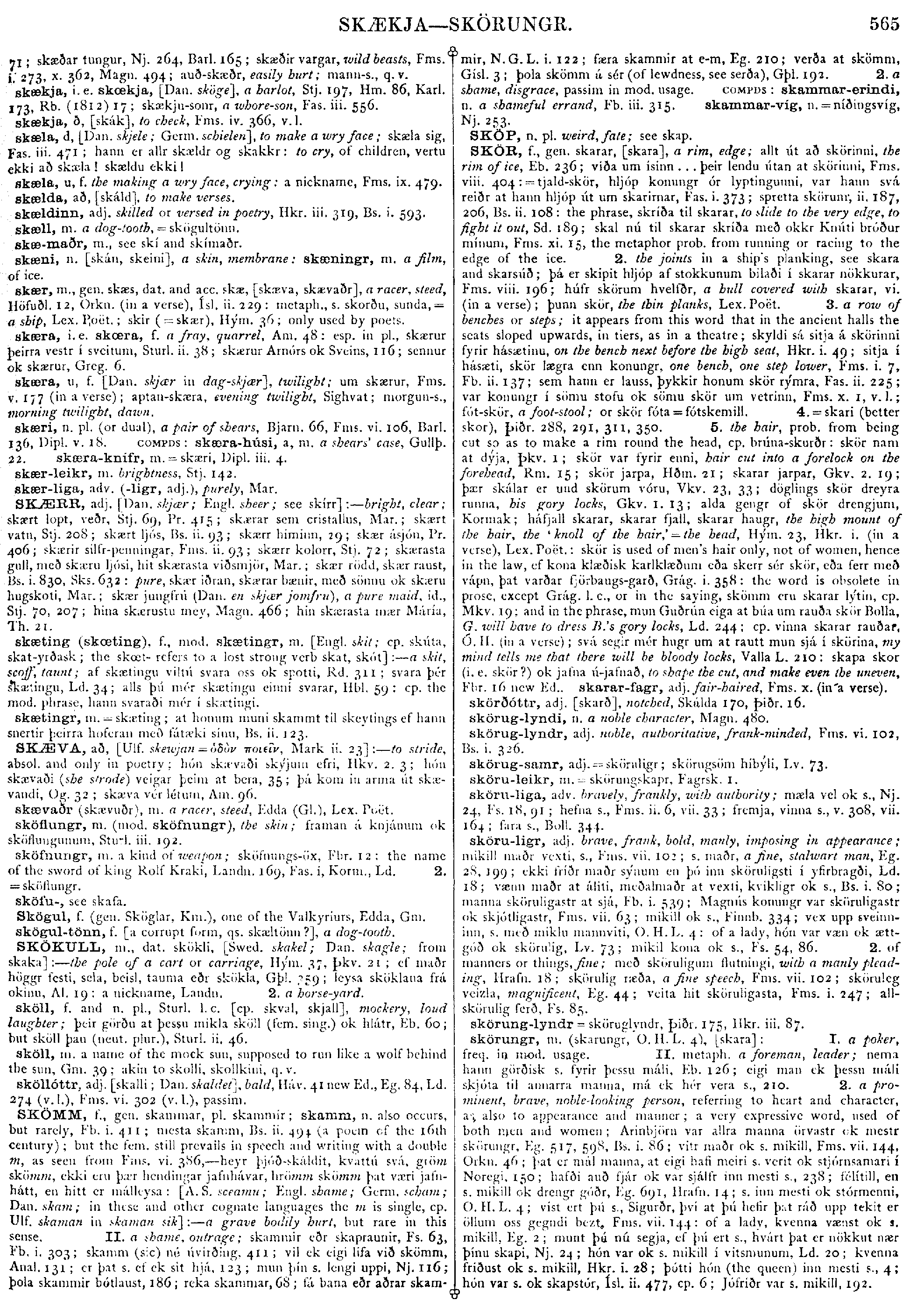
SKÖR, f., gen. skarar, [skara], a rim, edge; allt út að skörinni, the rim of ice, Eb. 236; víða um ísinn ... þeir lendu útan at skörinni, Fms. viii. 404: = tjald-skör, hljóp konungr ór lyptingunni, var hann svá reiðr at hann hljóp út um skarirnar, Fas. i. 373; spretta skörunr, ii. 187, 206, Bs. ii. 108: the phrase, skríða til skarar, to slide to the very edge, to fight it out, Sd. 189; skal nú til skarar skríða með okkr Knúti bróður mínum, Fms. xi. 15, the metaphor prob. from running or racing to the edge of the ice. 2. the joints in a ship's planking, see skara and skarsúð; þá er skipit hljóp af stokkunum bilaði í skarar nökkurar, Fms. viii. 196; húfr skörum hvelfðr, a hull covered with skarar, vi. (in a verse); þunn skör, the thin planks, Lex. Poët. 3. a row of benches or steps; it appears from this word that in the ancient halls the seats sloped upwards, in tiers, as in a theatre; skyldi sá sitja á skörinni fyrir hásætinu, on the bench next before the high seat, Hkr. i. 49; sitja í hásæti, skör lægra enn konungr, one bench, one step lower, Fms. i. 7, Fb. ii. 137; sem hann er lauss, þykkir honum skör rýmra, Fas. ii. 225; var konungr í sömu stofu ok sömu skör um vetrinn, Fms. x. 1, v.l.; fót-skör, a foot-stool; or skör fóta = fótskemill. 4. = skari (better skor), Þiðr. 288, 291, 311, 350. 5. the hair, prob. from being cut so as to make a rim round the head, cp. brúna-skurðr: skör nam at dyja, Þkv. i; skör var fyrir enni, hair cut into a forelock on the forehead, Rm. 15; skör jarpa, Hðm. 21; skarar jarpar, Gkv. 2. 19; þær skálar er und skörum vóru, Vkv. 23, 33; döglings skör dreyra runna, his gory locks, Gkv. 1. 13; alda gengr of skör drengjum, Kormak; háfjall skarar, skarar fjall, skarar haugr, the high mount of the hair, the 'knoll of the hair,' = the head, Hým. 23, Hkr. i. (in a verse), Lex. Poët.: skör is used of men's hair only, not of women, hence in the law, ef kona klæðisk karlklæðum eða skerr sér skör, eða ferr með vápn, þat varðar fjörbaugs-garð, Grág. i. 358: the word is obsolete in prose, except Grág. l.c., or in the saying, skömm eru skarar lýtin, cp. Mkv. 19: and in the phrase, mun Guðrún eiga at búa um rauda skör Bolla, G. will have to dress B.'s gory locks, Ld. 244; cp. vinna skarar rauðar, Ó.H. (in a verse); svá segir mér hugr um at rautt mun sjá í skörina, my mind tells me that there will be bloody locks, Valla L. 210: skapa skor (i.e. skör?) ok jafna ú-jafnað, to shape the cut, and make even the uneven, Fbr. 16 new Ed., skarar-fagr, adj. fair-haired, Fms. x. (in a verse).
|
Source: Cleasby/Vigfusson, page b0583, entry 30 View original page image as: [TIFF] [PNG] [View previous entry] [View next entry] |
[Comment on this entry] [View comments] |
The following entry has been hand-corrected once. |
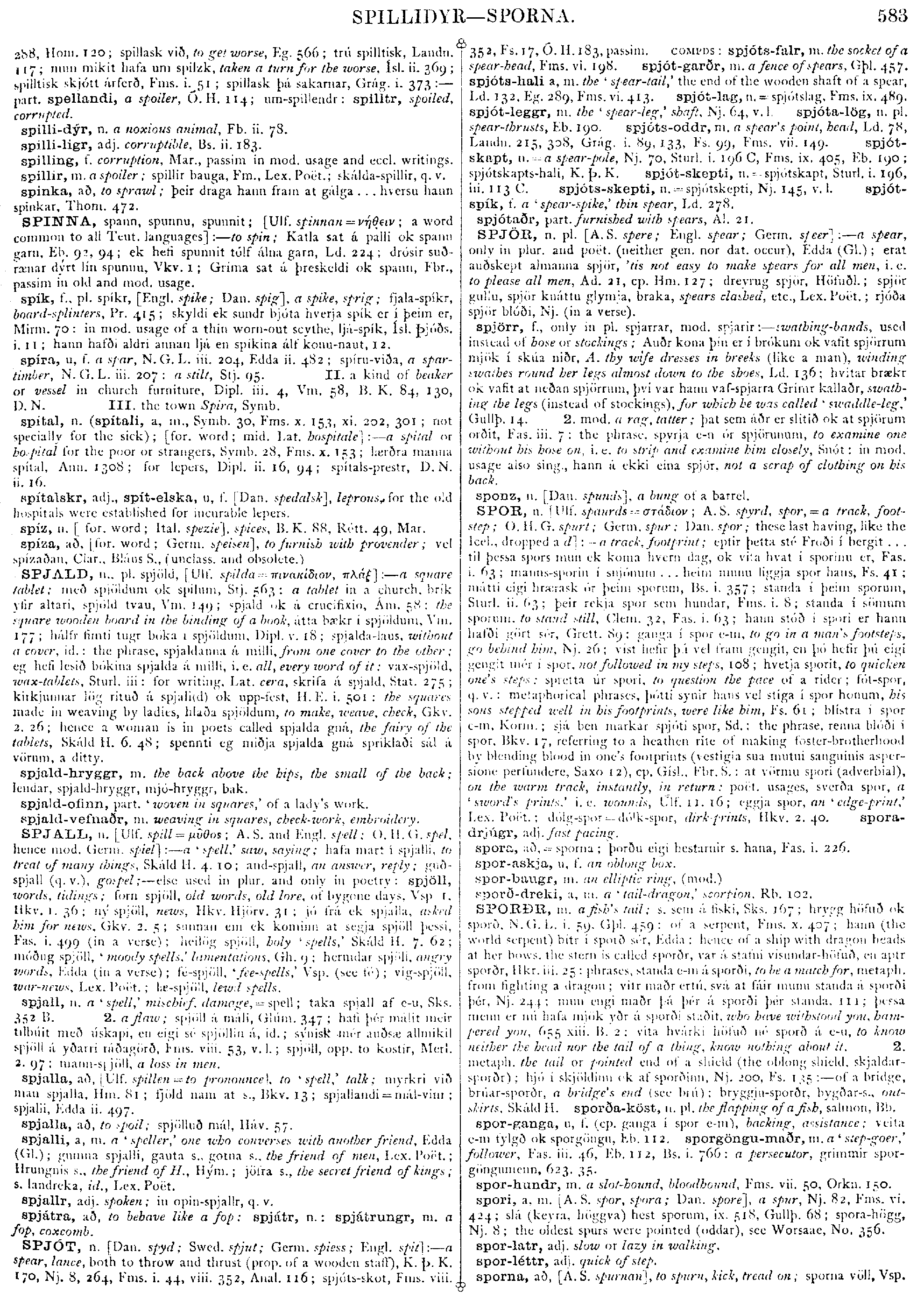
SPOR, n. [Ulf. spaurds = GREEK; A.S. spyrd, spor, = a track, footstep; O.H.G. spurt; Germ. spur; Dan. spor; these last having, like the Icel., dropped a d]:-- a track, footprint; eptir þetta sté Froði í bergit ... til þessa spors mun ek koma hvern dag, ok vita hvat í sporinu er, Fas. i. 63; manns-sporin í snjónum ... heim munu liggja spor hans, Fs. 41; mátti eigi hrærask ór þeim sporum, Bs. i. 357; standa í þeim sporum, Sturl. ii. 63; þeir rekja spor sem hundar, Fms. i. 8; standa í sömum sporum. to stand still, Clem. 32, Fas. i. 63; hann stóð í spori er hann hafði gört sér, Grett. 89: ganga í spor e-m, to go in a man's footsteps, go behind him, Nj. 26 vist hefir þá vel fram gengit, en þó hefir þú eigi gengit mér í spor, not followed in my steps, 108; hvetja sporit, to quicken one's steps: spretta úr spori, to question the pace of a rider; fót-spor, q.v.: metaphorical phrases, þótti synir hans vel stíga í spor honum, his sons stepped well in his footprints, were like him, Fs. 61; blístra í spor e-m, Korm.; sjá ben markar spjóti spor, Sd.: the phrase, renna blóði í spor, Bkv. 17, referring to a heathen rite of making foster-brotherhood by blending blood in one's footprints (vestigia sua mutui sanguinis aspersione perfundere, Saxo 12), cp. Gísl., Fbr. S.: at vörmu spori (adverbial), on the warm track, instantly, in return: poët. usages, sverða spor, a'sword's prints' i.e. wounds., Ulf. 11. 16; eggja spor, an 'edge-print,' Lex. Poët.: dólg-spor = dólk-spor, dirk-prints., Hkv. 2. 40. spora-drjúgr, adj. fast pacing.
|
Source: Cleasby/Vigfusson, page b0655, entry 11 View original page image as: [TIFF] [PNG] [View previous entry] [View next entry] |
[Comment on this entry] [View comments] |
The following entry has been hand-corrected once. |
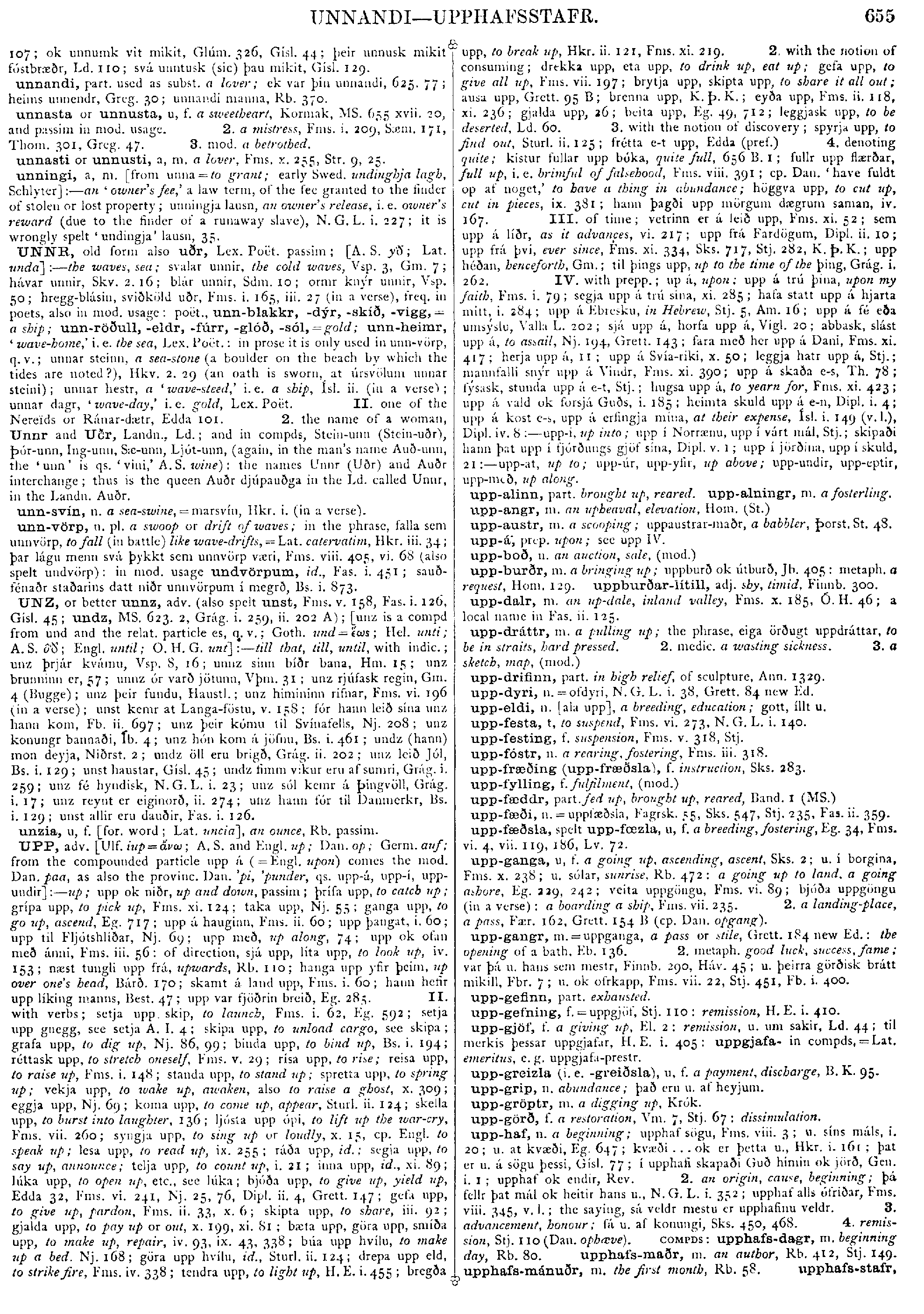
UPP, adv. [Ulf. iup = GREEK; A.S. and Engl. up; Dan. op; Germ. auf; from the compounded particle upp á (= Engl. upon) comes the mod. Dan. paa, as also the provinc. Dan. 'pi, 'punder, qs. upp-á, upp-í, upp-undir] :-- up; upp ok niðr, up and down, passim; þrifa upp, to catch up; gripa upp, to pick up, Fms. xi. 124; taka upp, Nj. 55; ganga upp, to go up, ascend, Eg. 717; upp á hauginn, Fms. ii. 60; upp þangat, i. 60; upp til Fljótshlíðar, Nj. 69; upp með, up along, 74; upp ok ofan með ánni, Fms. iii. 56: of direction, sjá upp, líta upp, to look up, iv. 153; næst tungli upp frá, upwards, Rb. 110; hanga upp yfir þeim, up over one's head, Bárð. 170; skamt á land upp, Fms. i. 60; hann hefir upp líking manns, Best. 47; upp var fjöðrin breið, Eg. 285. II. with verbs; setja upp. skip, to launch, Fms. i. 62, Eg. 592; setja upp gnegg, see setja A.I. 4; skipa upp, to unload cargo, see skipa; grafa upp, to dig up, Nj. 86, 99; binda upp, to bind up, Bs. i. 194; réttask upp, to stretch oneself, Fms. v. 29; rísa upp, to rise; reisa upp, to raise up, Fms. i. 148; standa upp, to stand up; spretta upp, to spring up; vekja upp, to wake up, awaken, also to raise a ghost, x. 309; eggja upp, Nj. 69; koma upp, to come up, appear, Sturl. ii. 124; skella upp, to burst into laughter, 136; ljósta upp ópi, to lift up the war-cry, Fms. vii. 260; syngja upp, to sing up or loudly, x. 15, cp. Engl. to speak up; lesa upp, to read up, ix. 255; ráða upp, id.; segia upp, to say up, announce; telja upp, to count up, i. 21; inna upp, id., xi. 89; lúka upp, to open up, etc., see lúka; bjóða upp, to give up, yield up, Edda 32, Fms. vi. 241, Nj. 25, 76, Dipl. ii. 4, Grett. 147; gefa upp, to give up, pardon, Fms. ii. 33, x. 6; skipta upp, to share, iii. 92; gjalda upp, to pay up or out, x. 199, xi. 81; bæta upp, göra upp, smíða upp, to make up, repair, iv. 93, ix. 43, 338; búa upp hvílu, to make up a bed. Nj. 168; göra upp hvílu, id., Sturl. ii. 124; drepa upp eld, to strike fire, Fms. iv. 338; tendra upp, to light up, H.E. i. 455; bregða upp, to break up, Hkr. ii. 121, Fms. xi. 219. 2. with the notion of consuming; drekka upp, eta upp, to drink up, eat up; gefa upp, to give all up, Fms. vii. 197; brytja upp, skipta upp, to share it all out; ausa upp, Grett. 95 B; brenna upp, K.Þ.K.; eyða upp, Fms. ii. 118, xi. 236; gjalda upp, 26; beita upp, Eg. 49, 712; leggjask upp, to be deserted, Ld. 60. 3. with the notion of discovery; spyrja upp, to find out, Sturl. ii. 125; frétta e-t upp, Fdda (pref.) 4. denoting quite; kistur fullar upp bóka, quite full, 656 B. 1; fullr upp flærðar, full up, i.e. brimful of falsehood, Fms. viii. 391; cp. Dan. 'have fuldt op af noget,' to have a thing in abundance; höggva upp, to cut up, cut in pieces, ix. 381; hann þagði upp mörgum dægrum saman, iv. 167. III. of time; vetrinn er á leið upp, Fms. xi. 52; sem upp á líðr, as it advances, vi. 217; upp frá Fardögum, Dipl. ii. 10; upp frá því, ever since, Fms. xi. 334, Sks. 717, Stj. 282, K.Þ.K.; upp héðan, henceforth, Gm.; til þings upp, up to the time of the þing, Grág. i. 262. IV. with prepp,; up á, upon; upp á trú þína, upon my faith, Fms. i. 79; segja upp á trú sína, xi. 285; hafa statt upp á hjarta mitt, i. 284; upp á Ebresku, in Hebrew, Stj. 5, Am. 16; upp á fé eða umsýslu, Valla L. 202; sjá upp á, horfa upp á, Vígl. 20; abbask, slást upp á, to assail, Nj. 194, Grett. 143; fara með her upp á Dani, Fms. xi. 417; herja upp á, 11; upp á Svía-ríki, x. 50; leggja hatr upp á, Stj.; mannfalli snýr upp á Vindr, Fms. xi. 390; upp á skaða e-s, Th. 78; fýsask, stunda upp á e-t, Stj.; hugsa upp á, to yearn for, Fms. xi. 423; upp á vald ok forsjá Guðs, i. 185; heimta skuld upp á e-n, Dipl. i. 4; upp á kost e-s, upp á erfingja mína, at their expense, Ísl. i. 149 (v.l.), Dipl. iv. 8 :-- upp-í, up into; upp í Norrænu, upp í várt mál, Stj.; skipaði hann þat upp í fjórðungs gjöf síua, Dipl. v. 1; upp í jörðina, upp í skuld, 21 :-- upp-at, up to; upp-úr, upp-yfir, up above; upp-undir, upp-eptir, upp-með, up along.
| Result Page: | 1 2 | Next |  |
Germanic Lexicon Project (main page)
This search system was written by
Sean Crist
Please consider
volunteering
to correct the data in these online dictionaries.
No rights reserved. Feel free to use these data in any way you please.