|
|

Search for spot again, using less strict matching (92 results)
|
Source: Cleasby/Vigfusson, page b0363, entry 18 View original page image as: [TIFF] [PNG] [View previous entry] [View next entry] |
[Comment on this entry] [View comments] |
The following entry has been hand-corrected once. |
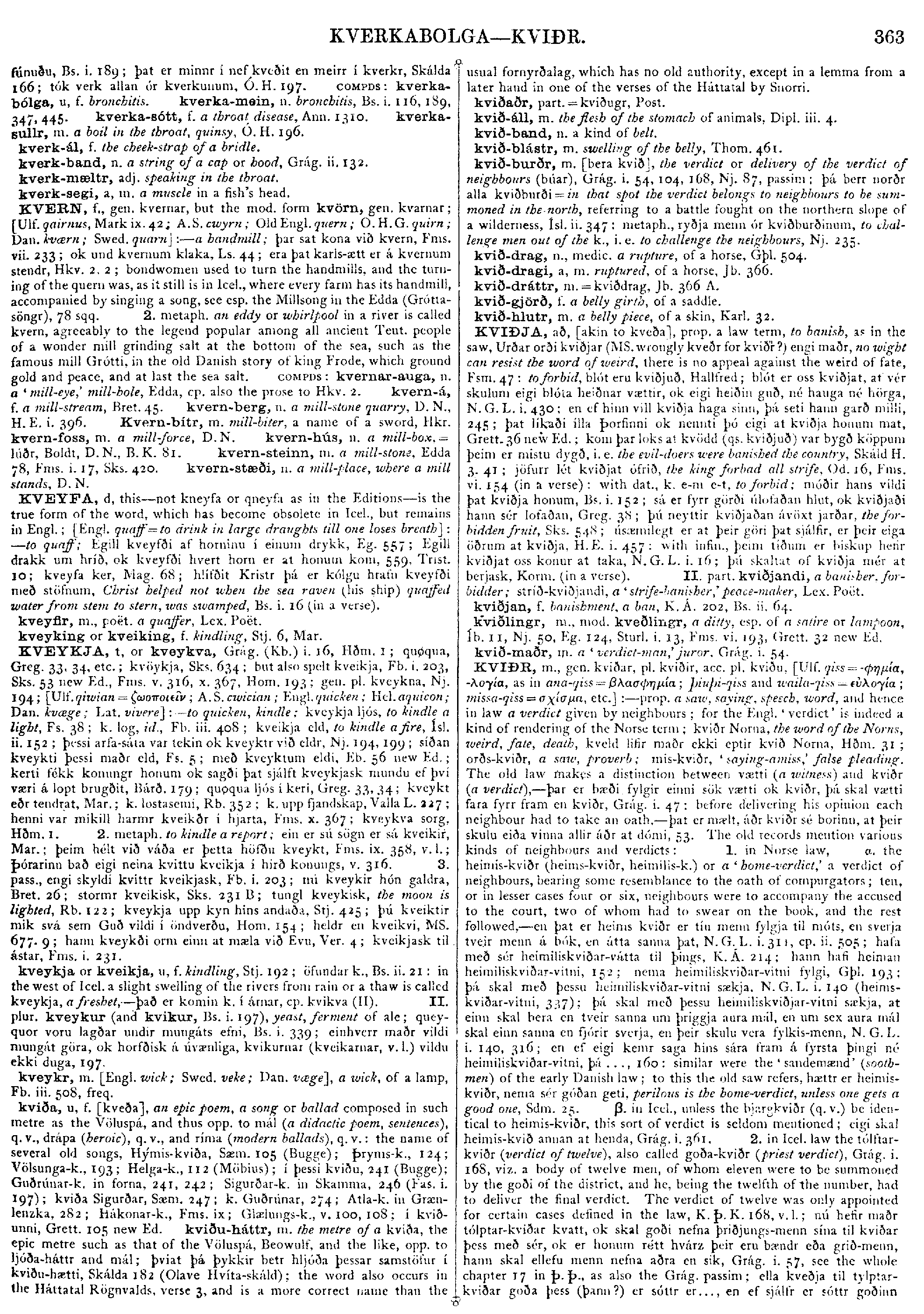
kvið-burðr, m. [bera kviðj, the verdict or delivery of the verdict of neighbours (búar), Grág. i. 54, 104, 168, Nj. 87, passim; þá berr norðr alla kviðburði = in that spot the verdict belongs to neighbours to be summoned in the north, referring to a battle fought on the northern slope of a wilderness, Ísl. ii. 347: metaph., ryðja menn ór kviðburðinum, to challenge men out of the k., i.e. to challenge the neighbours, Nj. 235.
|
Source: Cleasby/Vigfusson, page b0383, entry 11 View original page image as: [TIFF] [PNG] [View previous entry] [View next entry] |
[Comment on this entry] [View comments] |
The following entry has not been hand-corrected. However, the page is reserved and someone is correcting it. |
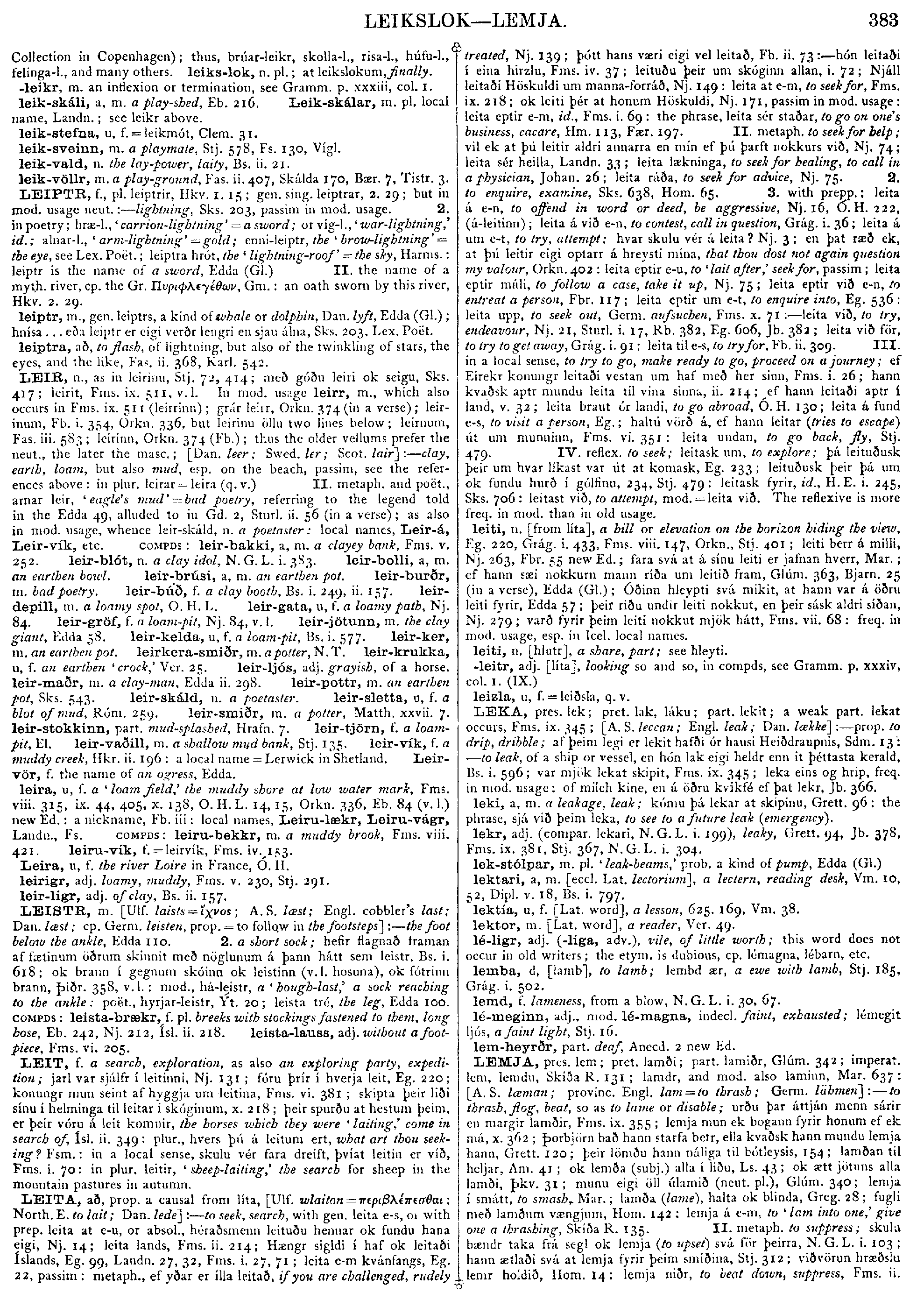
LEIR, n., as in leirinu, Stj. 72, 414; með góðu leiri ok seigu, Sks. 417; Icirit, Fms. ix. 511, v. 1. In mod. usp. ge leirr, m., which also occurs in Fms. ix. 511 (leirrinn); grár leirr, Orkn. 374 (in a verse); leir- inum, Fb. i. 354, Orkn. 336, but leirinu öllu two lines below; Icirnum, Fas. iii. 583; Icirinn, Orkn. 374 (Fb.); thus the older vellums prefer the neut., the later the masc.; [Dan. leer; Swed. ler; Scot, l a ir] :-- clay, earth, loam, but also mud, esp. on the beach, passim, see the refer- ences above: in plur. lcirar = leira (cj. v.) II. metaph. and poet., arnar leir, 'eagle's mud' -- bad poetry, referring to the legend told in the Edda 49, alluded to in Gd. 2, Sturl. ii. 56 (in a verse); as also in mod. usage, whence leir-skáld, n. a poetaster: local names, Leir-a, Leir-vik, etc. COMPOS: leir-bakki, a, m. a clayey bank, Fms. v. 252. leir-blót, n. a c lay idol, N. G. L. i. 383. leir-bolli, a, m. an earthen bowl. leir-brúsi, a, m. an earthen pot. leir-burðr, m. bad poetry. leir-búð, f. a c lay booth, Bs. i. 249, ii. 157. leir- depill, in. a loamy spot, O. H. L. leir-gata, u, f. a loamy path, Nj. 84. leir-gröf, f. a loam-pit, Nj. 84, v. 1. leir-jötunn, m. the c l a y giant, Edda 58. leir-kelda, u, f. a loam-pit, Bs. i. 577. leir-ker, m. a n earthen pot. leirkera-smiðr, m. a palter, N. T. leir-krukka, u, f. an earthen 'crock, ' Ver. 25. leir-ljós, adj. grayish, of a horse. leir-maðr, m. a clay-man, Edda ii. 298. leir-pottr, m. an earthen pot, Sks. 543. leir-skáld, n. a poetaster. leir-sletta, u, f. a blot of mud, Róm. 259. leir-smiðr, m. a potter, Matth. xxvii. 7. leir-stokkiim, part, mud-splashed, Hrafn. 7. leir-tjörn, f. a loam- pit, El. leir-vaðill, m. a shallow mud bank, Stj. 135. leir-vik, f. a muddy creek, Hkr. ii. 196: a local name = Lerwick in Shetland. Leir- vör, f. the name of an ogress, Edda.
|
Source: Cleasby/Vigfusson, page b0396, entry 37 View original page image as: [TIFF] [PNG] [View previous entry] [View next entry] |
[Comment on this entry] [View comments] |
The following entry has been hand-corrected once. |
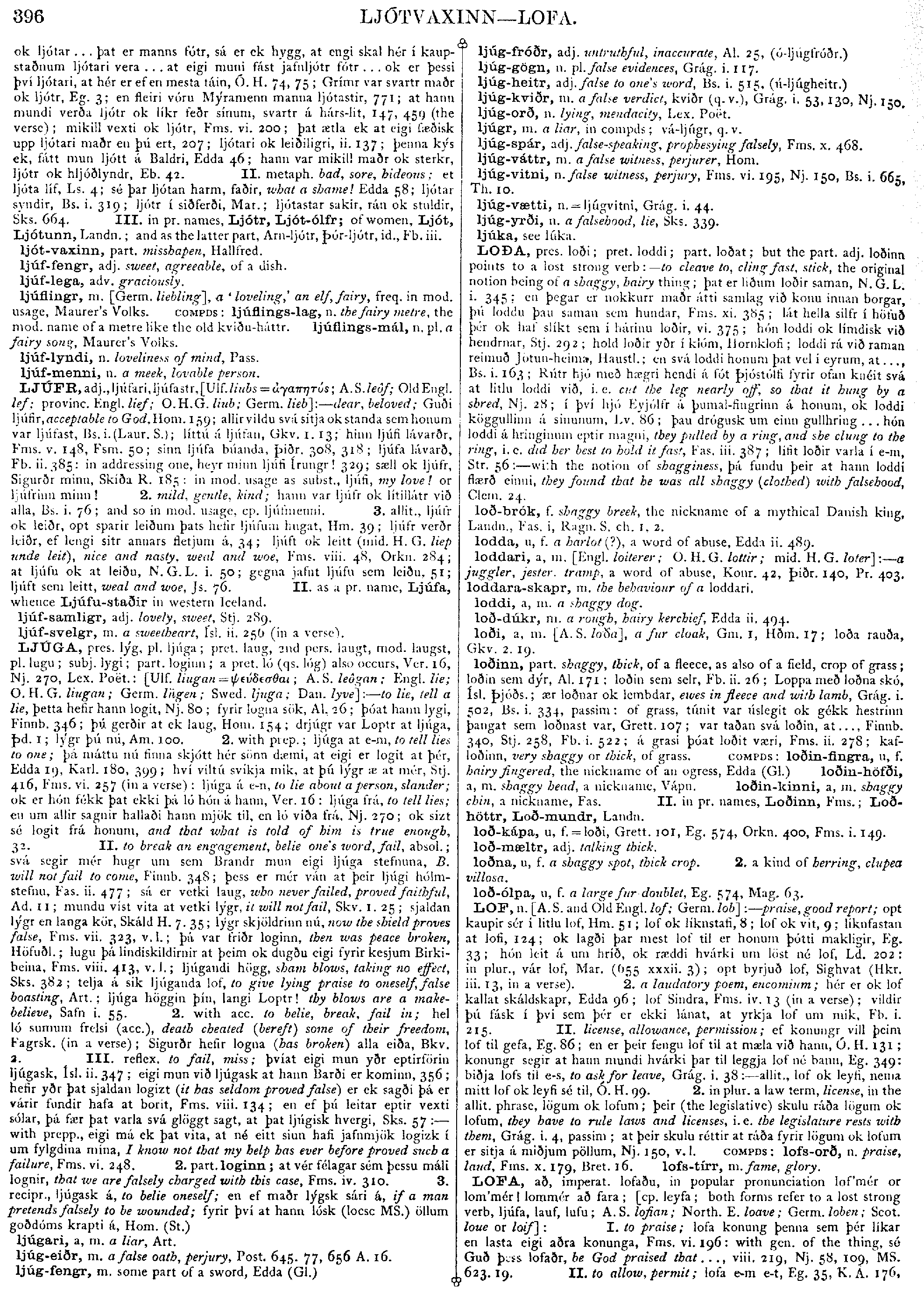
loðna, u, f. a shaggy spot, thick crop. 2. a kind of herring, clupea villosa.
|
Source: Cleasby/Vigfusson, page b0401, entry 34 View original page image as: [TIFF] [PNG] [View previous entry] [View next entry] |
[Comment on this entry] [View comments] |
The following entry has not been hand-corrected. However, the page is reserved and someone is correcting it. |
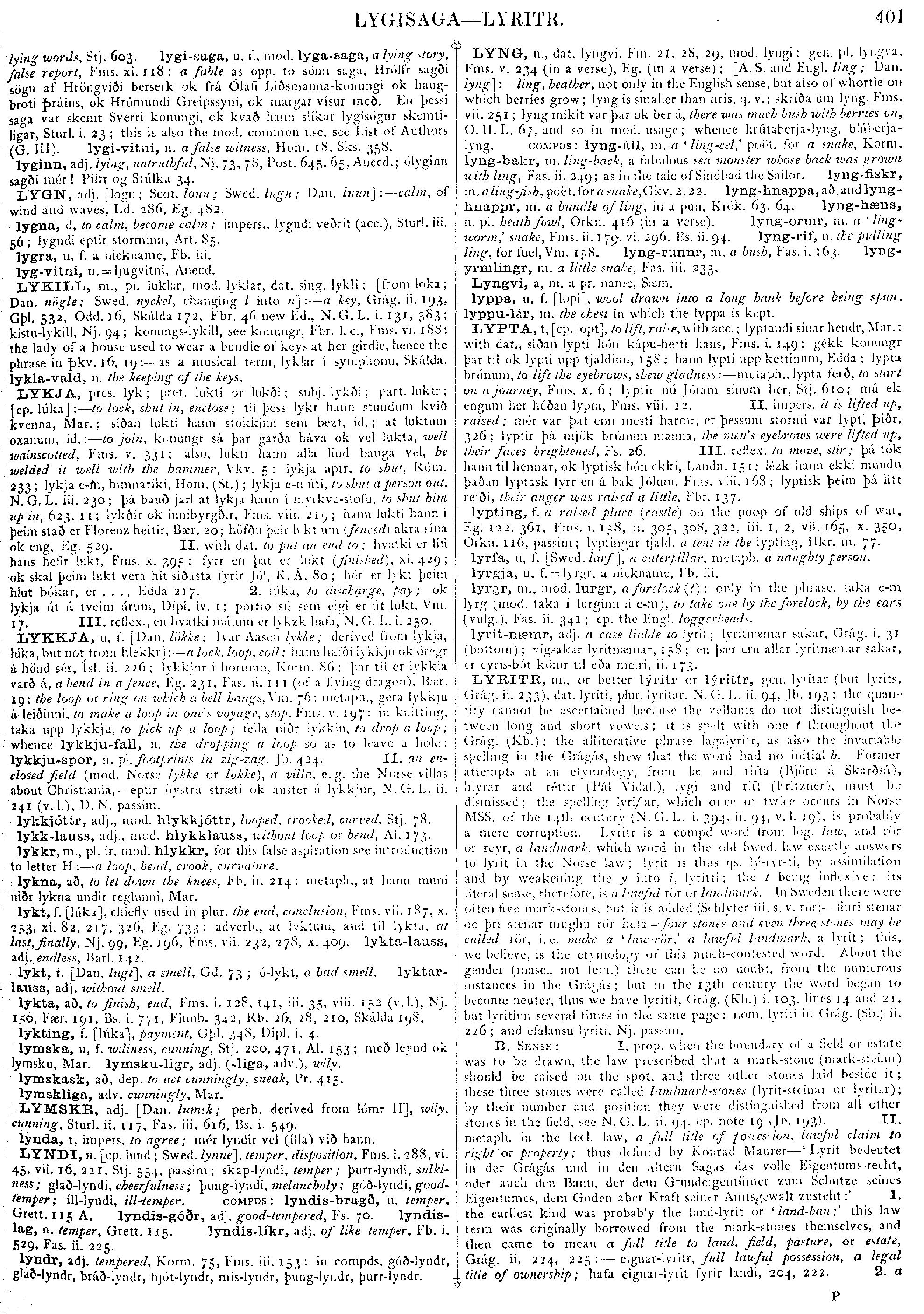
LYRITR, m., or belter lýritr or lýrittr, gen. lyritar (but lyrits, Grág. ii. 233), dat. lyriti, plur. lyritar. N. G. L. ii. 94, Jb. 193; ihc quan- tity cannot be ascertained because the vellums do not distinguish be- tween long and short vowels; it is spelt with one t throughout the Gn'ig. (Kb.); the alliterative phrase lagalyriir, as also the invariable spelling in the Grás/ús, shew that the word had no initial h. Former attempts at an etymology, from he and rifta (Mjiirn ú SkarðsúV, hlyrar and rt'ttir (Pal Vi!al.), lygi and r ti (Frity, ntr must be dismissed; tiie spelling lyri/ar, which once or twice occurs in Norsr MSS. of the 14th cenuiry (N. G. L. i. 394, ii. 94, v. l. 19), i* probably a mere corruption. Lyritr is a compd word from li'ig, law, and r-'ir or reyr, a landmark, which word in the olil Swed. law exactly answi-rs to lyrit in the Norse law; Ivrit is thus qs. lv-rvr-ti, by assimilation and by weakening the y into i, lyritti; the / being intle. xive: its literal sense, therefore, is a lawful ror or landmark. In Swc'ljn there were often five mark-stones, but it is added (Schlvter iii. s. v. riir) -- -tiuri stenar oc þri stenar naighu riir lieta -- four stones and even three stones may be called riir, i. e. make a ' Imi'-riir, ' a lawful landmark, a lyrit; this, we believe, is the etymology of this much-contested word. About the gender (masc., not i'em.) tlure can be no doubt, from the numerous instances in the Grágás; but in the 13th century the word began to become neuter, thus we have lyritit, Grág. (Kb.) i. 103, lines 14 and 21, but lyritinn several times in the same page: nom. lyriti in Gntg. (Sb.) ii. 226; and elalausu lyriti, Nj. passim. B. SKXSK: I. prop, when the boundary o! a field or estate was to be drawn, the law prescribed that a niark-s'. onc (mark-steinn) should be raised on the spot, and three other stones laici beside it; these three stones were called landmark-stones (lyrit-stcinar or lyritar); by their number and position they were distinguished from all other stones in the field, see N. G. L. ii. 94, cp. note 19 ýjb. 193). II. metaph. in the Icel. law, a full tide of ] obsession, lawful claim to right or property; thus defined by Koi. rad Maurer -- 'Lyrit bedeutet in der Grágús und in den iiltern Sagas, das voile Eigeiiturns-recht, oder auch den Bann, der c!ein (jruiKle. gentiimer zum Schutze seines Eigeutumts, clem Cîoden aber Kraft seiiur Amtsgcwalt zusteht:' 1. the earliest kind was probab'y the land-lyrit or 'land-ban;' this law term was originally borrowed from the mark-stones themselves, and then came to mean a /i; ll ti. 'le to land, field, pasture, or estate, Grug. ii. 224, 225 :-- eignar-lyritr, /w ll lawful possession, a legal title of ownership; hafa eignar-lyrit fyrir landi, -204, 222. 2.
|
Source: Cleasby/Vigfusson, page b0409, entry 12 View original page image as: [TIFF] [PNG] [View previous entry] [View next entry] |
[Comment on this entry] [View comments] |
The following entry has not been hand-corrected. However, the page is reserved and someone is correcting it. |
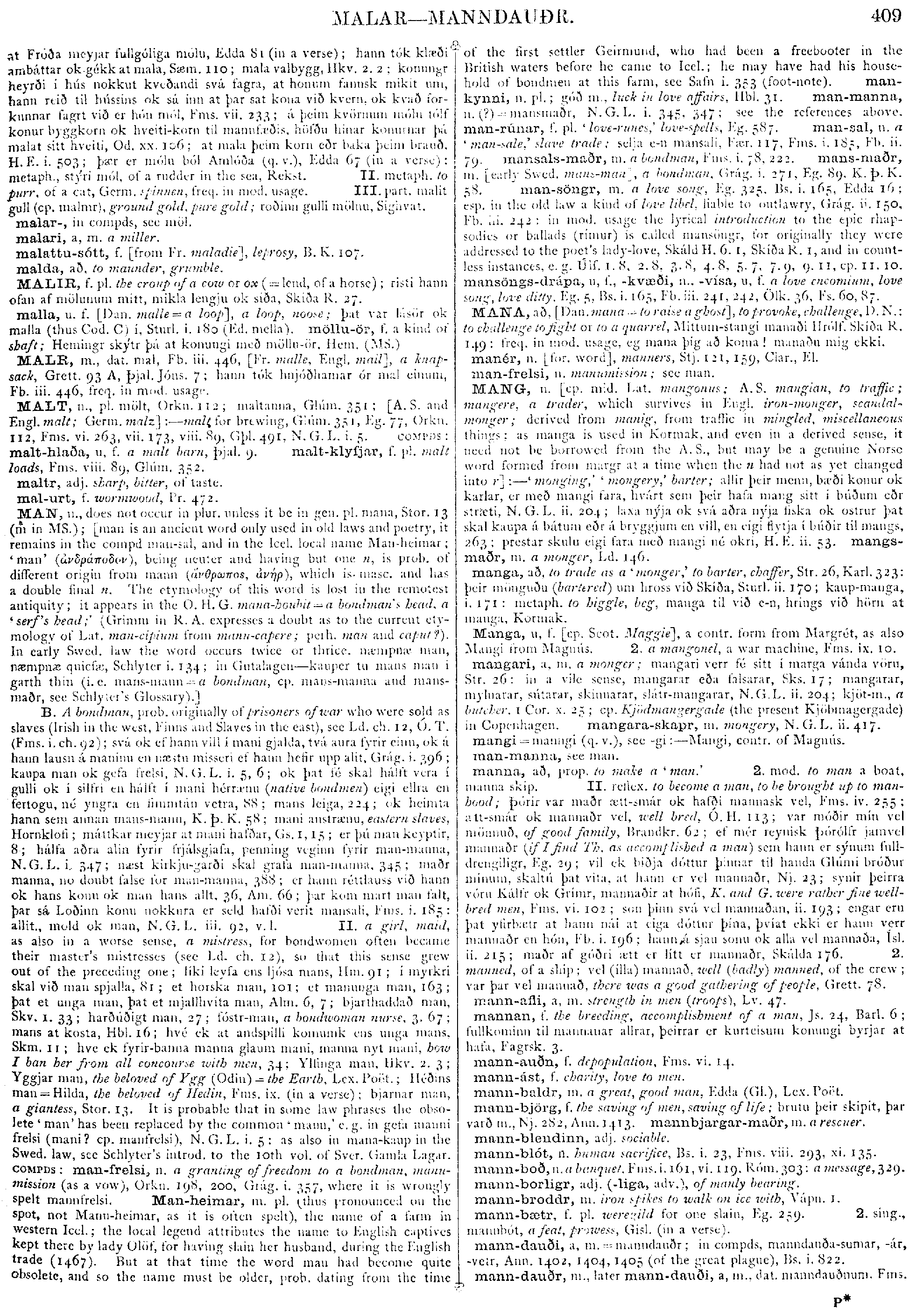
MAN, n., does not occur in piur. unless it be in gen. pl. niana, Stor. 13 (ni in MS.); [man is an ancient word only used in old laws and poetry, it remains in the compd man-sal, and in the Icel. local name Man-heimar; 'man' (åvðpáiroSov'), being neuter and having but one;;, is prob. of different origin from maim (iii'Opcurros, avrjp), which is. masc. and has a double final n. The etymology of this word is lost in the remotest antiquity; it appears in the O. M. G. m a n a -b o ulnt -- -- -a bondman's bead, a 'serf's bead;' (Grimm in R. A. expresses a doubt as to the current ety- mology of Lat. man-cipium from mann-capere; peril, man and capnt"!). In early Swed. law the- word occurs twice or thrice, næmpna' man, naempnæ quicfic, Schlyter i. 134; in Cïutalagen -- kauper tu mans man i garth thin (i. e. mans-mann -- -- a bond/nan, cp. maus-manna and mans- inaðr, see Schly'. er's Glossary).] B. A bondman, prob. originally of prisoners of war who were sold as slaves (Irish in the west, Finns and Slaves in the east), see Ld. ch. 12, O. T. (Fms. i. ch. 92); svá ok ef hann vill i mani gjalda, tva aura fyrir einn, ok a hann lausn á maninu en i;æ. stn misseri ef haun heiir upp alit, Gr;i. g. i. 396; kaupa man ok gefa frelsi, N. G. L. i. 5, 6; ok þat ie skal liáift vera í gulli ok i silfri en hálit i mani herru'nu (n a tive bondmen) eigi cilia en fertogu, ne yngra en iimmtan vetra, SS; mans leiga, 224; ok heiiuta hann sein annan mans-mann, K. þ. K. 58; mani aiistrænu, eastern s lave s, Hornkloii; maukar nicyjar at mani hal'ðar, Gs. 1, 15; er |m man keyptir, 8; hálta aðra alin íyrir trjúlsgiafa, penning veginn fyrir man-manna, N. G. L. i, 347; næst kiikju-garði skal grata man-manna, 345; maðr manna, no doubt false for man-manna, 388; er hann réttlauss við hann ok hans konu ok man hans allt, 36, Am. 66; J-ar koin mart man fait, þar sá Loðinn konu nokkura er seld hafði verit mansali, Fms. i. 185: allit., mold ok man, N. G. L. iii. 92, v. 1. II. a girl, maid, as also in a worse sense, a mistress, for bondwomen often became their master's mistresses (see Ld. ch. 12), so that this sense grew out of the preceding one; liki ley fa ens Ijosa mans, Hm. 91; í myrkri skal við man spjalla, 81; et horska man, 101; et manunga man, 163; bat et unga man, þat et mjallhvita man, Aim. 6, 7; bjarthaddað man, Skv. I. 33; harðúðigt man, 27; tostr-man, a bondwoman mine, 3. 67; mans at kosta, Hbl. 16; live ek at andspilli komumk ens unga mans, Skm. 11; hve ek fyrir-banna manna glaum mani, manna nyt mani, bow I ban her from all concourse with men, 34; Ylfinga man, Hkv. 2. 3; Yggjar man, the beloved of Ygg (Odin) -- the Earth, Lex. l'oi-t.; HOðins man = Hilda, the beloved of lied in, Fms. ix. (in a verse); bjarnar man, a giantess, Stor. 13. It is probable that in some law phrases the obso- lete ' man' has been replaced by the common ' maim, ' e. g. in gefa manni frelsi (mani? cp. manfrelsi), N. G. L. i. 5: as also in mana-kaup in the Swed. law, see Schlyter's introd. to the loth vol. of Sver. (Manila Lag. ir. COMPDS: man-frelsi., n. a granting of freedom to a bondman, manu- mission (as a vow), Orkn. 198, 200, Gr;ig. i. 357, where it is wrongly spelt mannfrelsi. Man-heimar, in. pl. (thus pronounce;! on the spot, not Mann-heimar, as it is often spelt), the name of a farm in western Icel.; the local legend attributes the name to English captives kept there by lady Olo'f, for having slain her husband, during the Fnglish trade (1467). But at that time the word man had become quite obsolete, and so the name must be older, prob. dating from the time of the first settler Geirmund, who had been a freebooter in the British waters before he came to Icel.; he may have had his house- hold of bondmen at this farm, see Safn i. 353 (foot-note). man- kynni, n. pl.; gócî in., luck in love affairs, Hbl. 31. man-manna, n. (?) -- •- mansmaðr, N. G. L. i. 345, 347; see the references above. man-runar, f. pl. 'love-runes, ' love-spells, Eg. 587. man-sal, n. n 'man-sale. ' slave trade; selia e-n mansali, Fær. 117, Fms. i. 185, Fb. ii. 79. mansals-maðr, in. a bondman, Fms. i. 78, 22:. mans-maðr, m. [earh Swed. mam-man'', a bondman, (îrúg. i. 271. Eg. 89, K. p. K. 58. man-scmgr, m. a love song, Fig. 325. Bs. i. 165, Edda 16; esp. in the old law a kind of loi-f libel, liable to outlawry, Grug. ii. 150, Fb. ui. 242: in mod. usage the lyrical introduction to the epic rhap- sodies or ballads (rimur) is called manscingr, tor originally they were addressed to the poet's lady-love, Skald H. 6. i, SkíðaK. i, and in count- less instances, e. g. Ú If. I. H, 2. 8, 3. 8, 4, 8, 5. 7, 7. 9, 9. 11, cp. ii. 10. mansöngs-drápa, u, f., -kvœði, n., -visa, u, f. a love encomium, love song, lore di. 'ty. Eg. 5, Bs. i. 165, Fb. iii. 241, 242, Oik. 36, Fs. 60, 87.
|
Source: Cleasby/Vigfusson, page b0413, entry 20 View original page image as: [TIFF] [PNG] [View previous entry] [View next entry] |
[Comment on this entry] [View comments] |
The following entry has been hand-corrected once. |
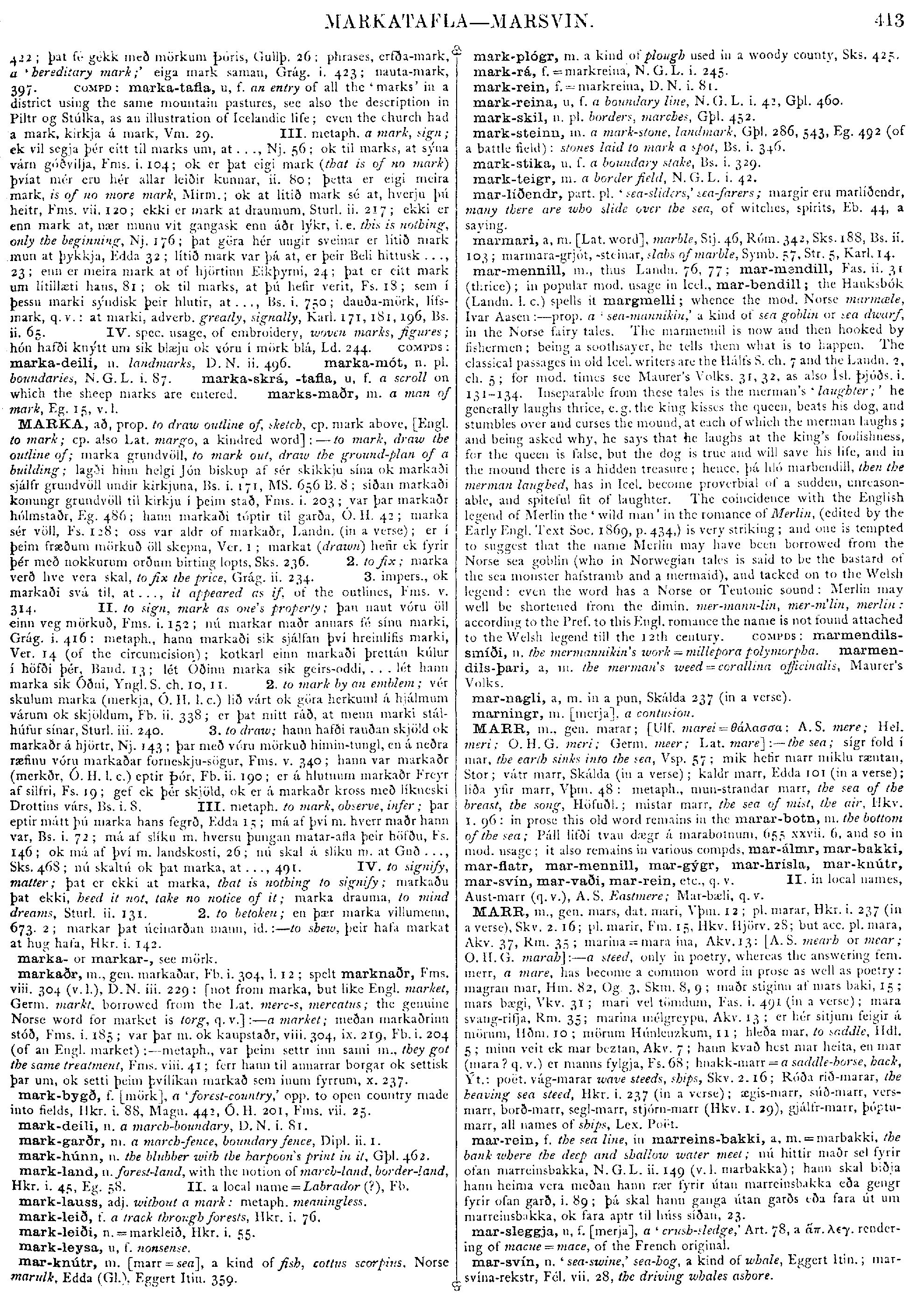
mark-steinn, m. a mark-stone, landmark, Gþl. 286, 543, Eg. 492 (of a battle field): stones laid to mark a spot, Bs. i. 346.
|
Source: Cleasby/Vigfusson, page b0462, entry 10 View original page image as: [TIFF] [PNG] [View previous entry] [View next entry] |
[Comment on this entry] [View comments] |
The following entry has been hand-corrected once. |
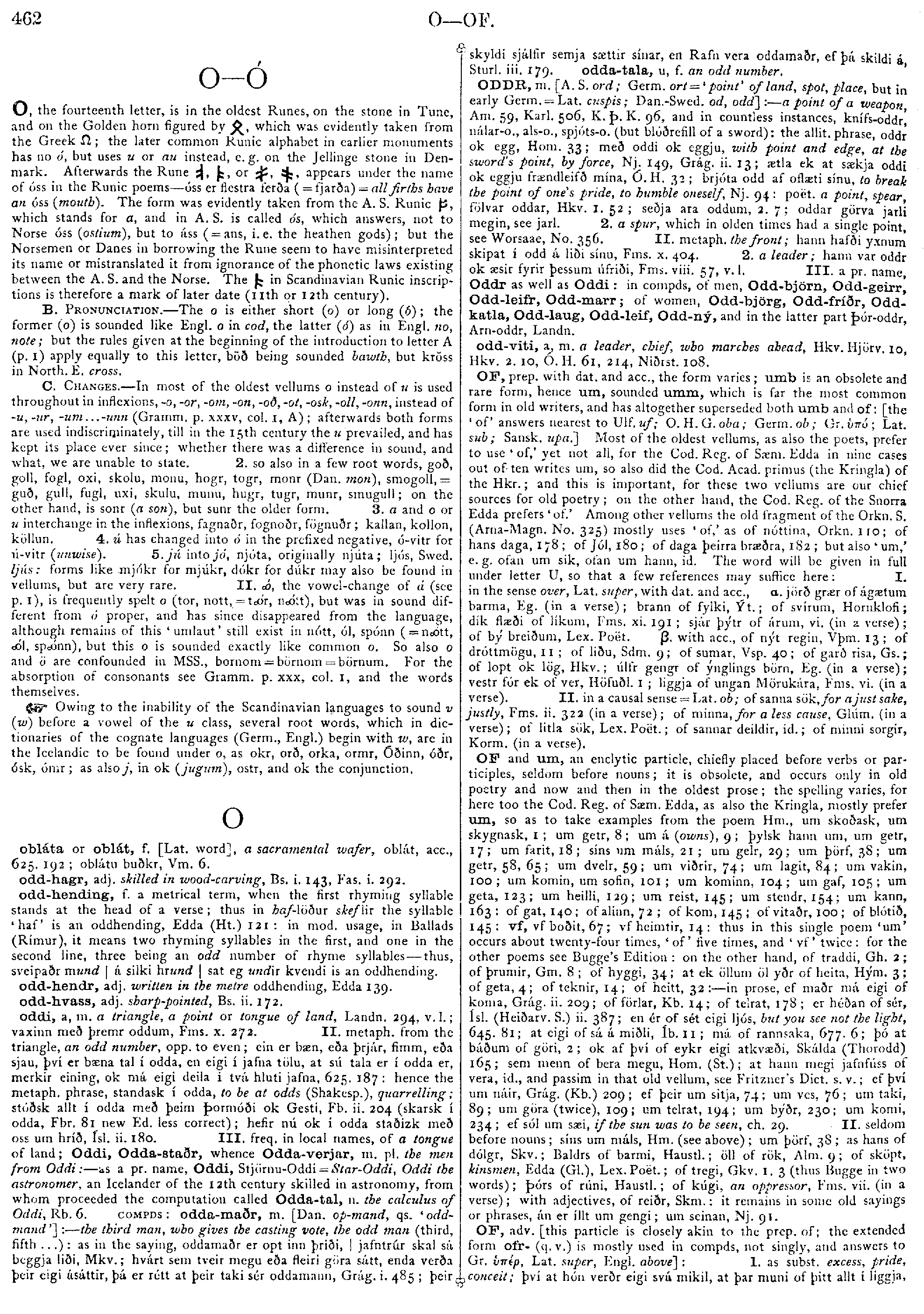
ODDR, m. [A.S. ord; Germ. ort = 'point' of land, spot, place, but in early Germ. = Lat. cuspis; Dan.-Swed. od, odd] :-- a point of a weapon Am. 59, Karl. 506, K.Þ.K. 96, and in countless instances, knífs-oddr, nálar-o., als-o., spjóts-o. (but blóðrefill of a sword): the allit. phrase, oddr ok egg, Hom. 33; með oddi ok eggju, with point and edge, at the sword's point, by force, Nj. 149, Grág. ii. 13; ætla ek at sækja oddi ok eggju frændleifð mína, Ó.H. 32; brjóta odd af oflæti sínu, to break the point of one's pride, to humble oneself, Nj. 94: poët, a point, spear, fölvar oddar, Hkv. 1. 52; seðja ara oddum, 2. 7; oddar görva jarli megin, see jarl. 2. a spur, which in olden times had a single point, see Worsaae, No. 356. II. metaph. the front; hann hafði yxnum skipat í odd á liði sínu, Fms. x. 404. 2. a leader; hann var oddr ok æsir fyrir þessum úfriði, Fms. viii. 57, v.l. III. a pr. name, Oddr as well as Oddi: in compds, of men, Odd-björn, Odd-geirr, Odd-leifr, Odd-marr; of women, Odd-björg, Odd-fríðr, Odd-katla, Odd-laug, Odd-leif, Odd-ný, and in the latter part Þór-oddr, Arn-oddr, Landn.
|
Source: Cleasby/Vigfusson, page b0476, entry 14 View original page image as: [TIFF] [PNG] [View previous entry] [View next entry] |
[Comment on this entry] [View comments] |
The following entry has been hand-corrected once. |
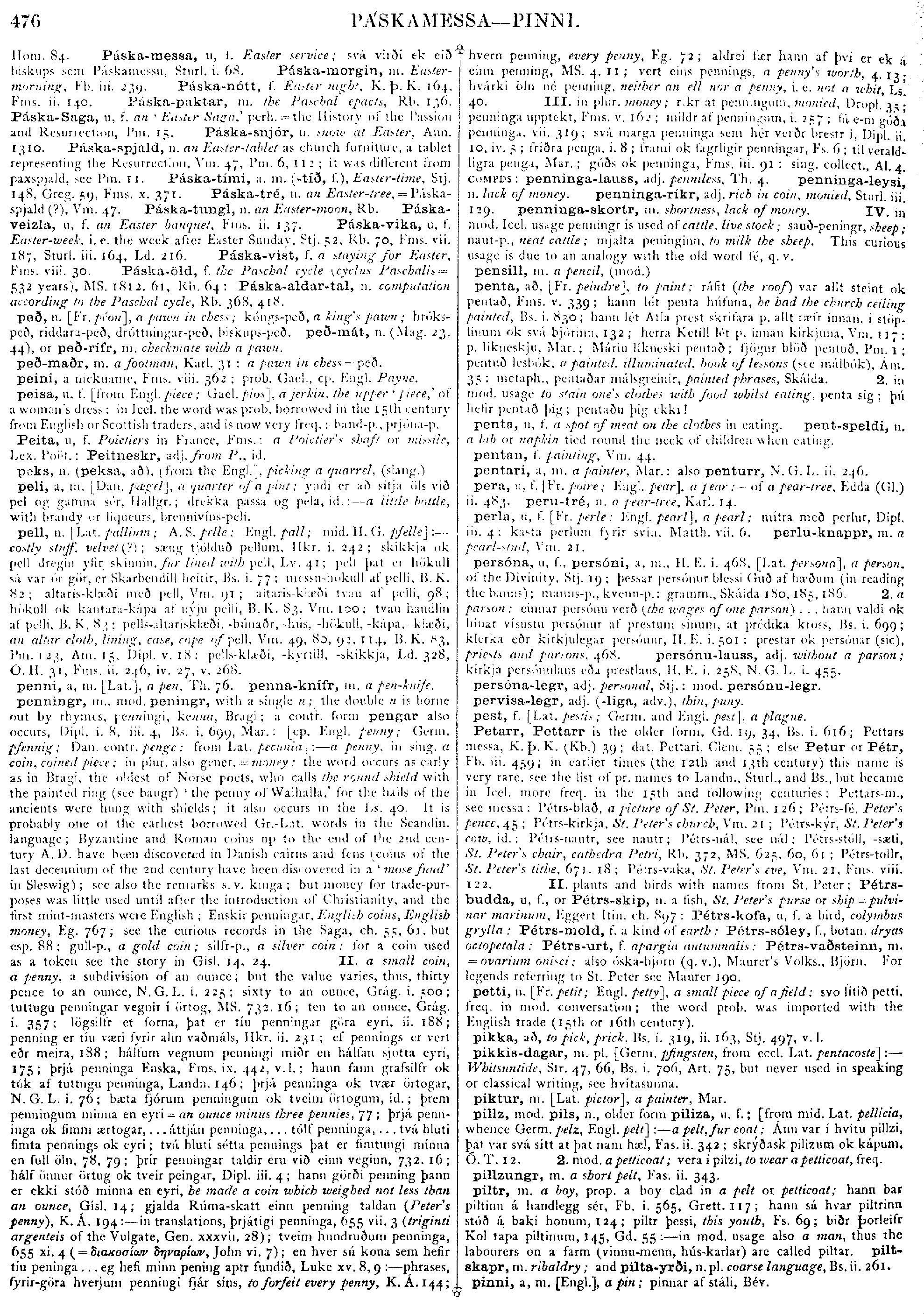
penta, u, f. a spot of meat on the clothes in eating. pent-speldi, n. a bib or napkin tied round the neck of children when eating.
|
Source: Cleasby/Vigfusson, page b0477, entry 51 View original page image as: [TIFF] [PNG] [View previous entry] [View next entry] |
[Comment on this entry] [View comments] |
The following entry has been hand-corrected once. |
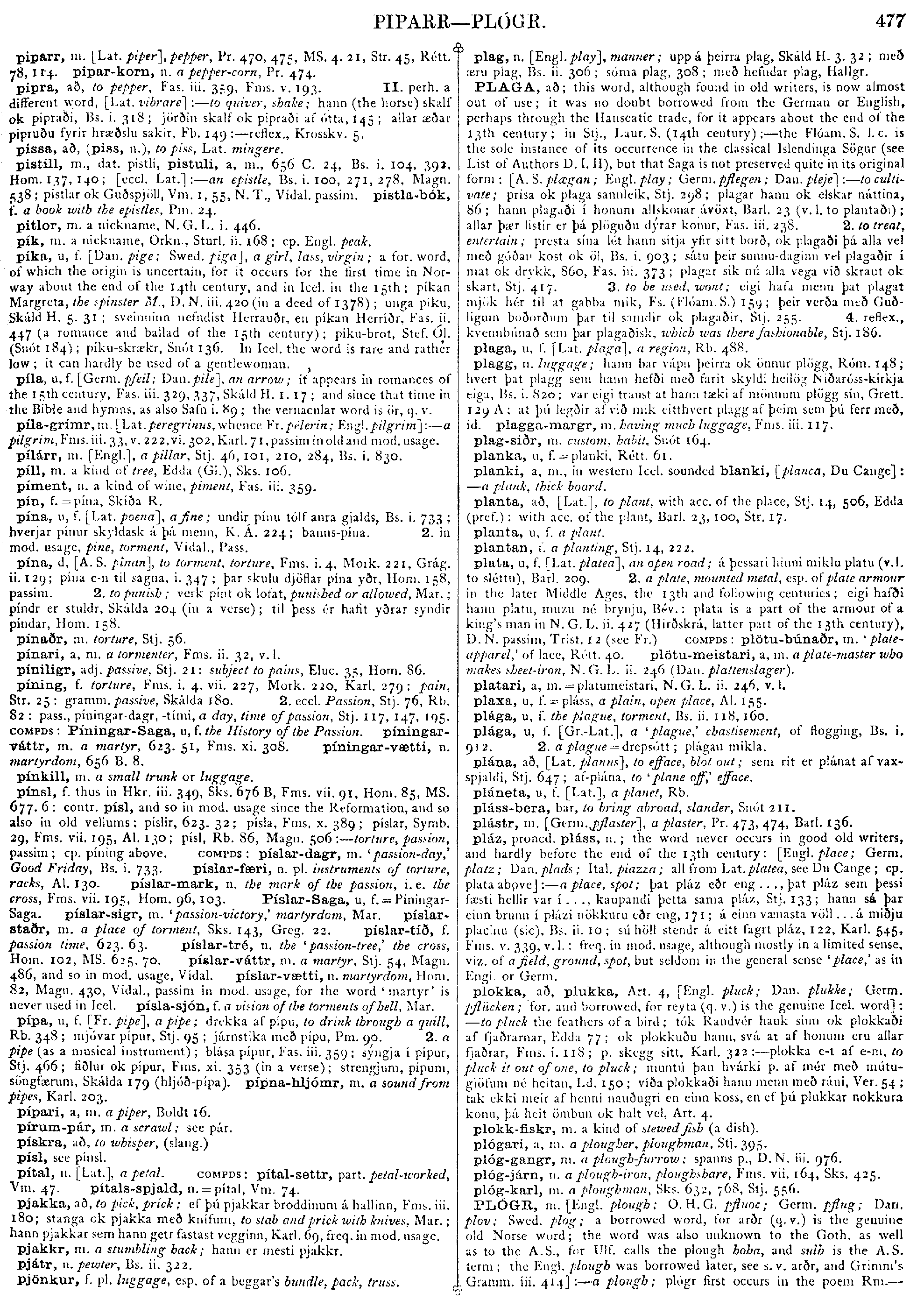
pláz, proncd. pláss, n.; the word never occurs in good old writers, and hardly before the end of the 13th century: [Engl. place; Germ. platz; Dan. plads; Ital. piazza; all from Lat. platea, see Du Cange; cp. plata above] :-- a place, spot; þat pláz eðr eng ..., þat pláz sem þessi fæsti hellir var í ..., kaupandi þetta sama pláz, Stj. 133; hann sá þar einn brunn í plázi nökkuru eðr eng, 171; á einn vænasta völl ... á miðju placinu (sic), Bs. ii. 10; sú höll stendr á eitt fagrt pláz, 122, Karl. 545, Fms. v. 339, v.l.: freq. in mod. usage, although mostly in a limited sense, viz. of a field, ground, spot, but seldom in the general sense 'place,' as in Engl. or Germ.
|
Source: Cleasby/Vigfusson, page b0481, entry 24 View original page image as: [TIFF] [PNG] [View previous entry] [View next entry] |
[Comment on this entry] [View comments] |
The following entry has been hand-corrected once. |
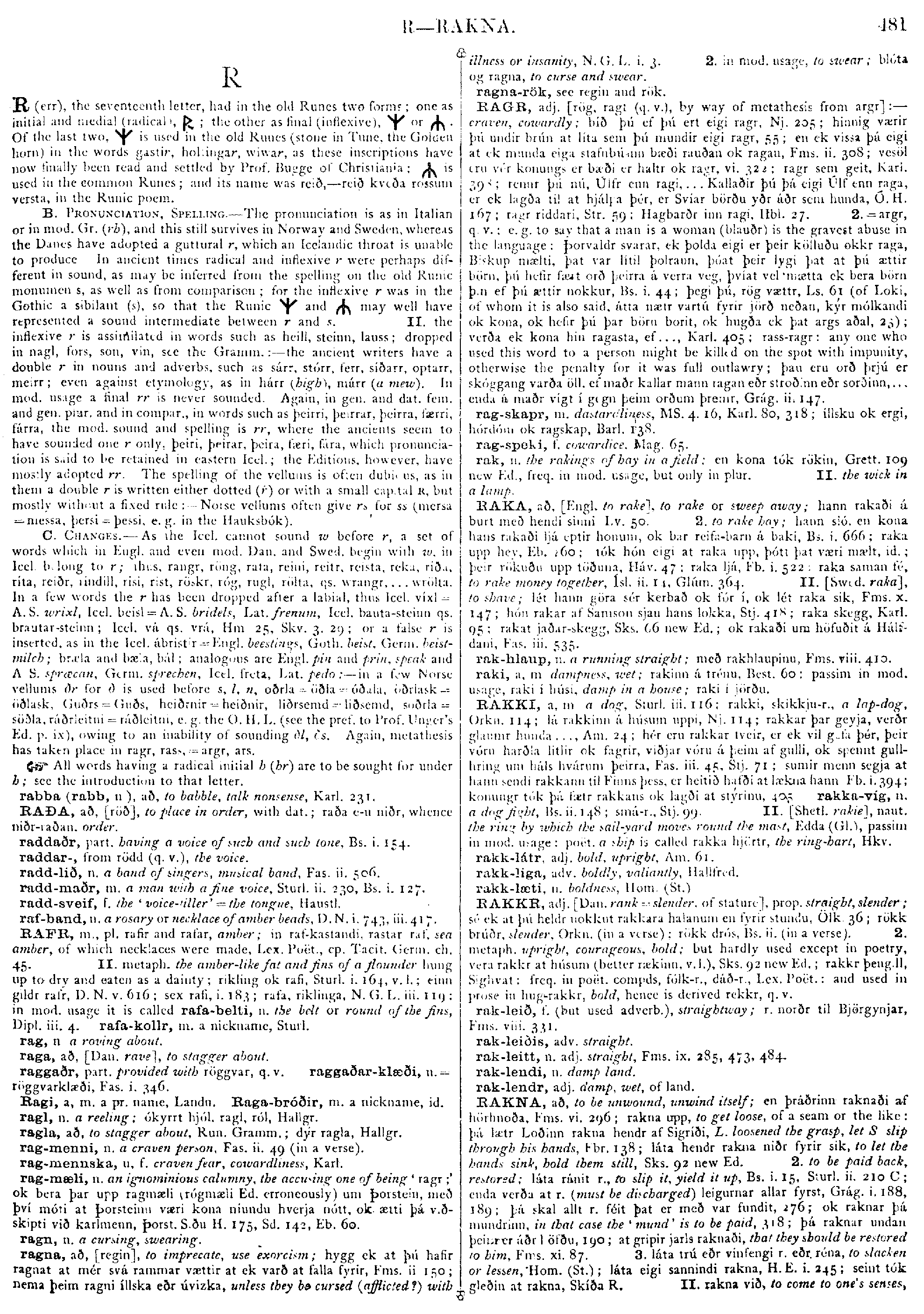
RAGR, adj. [rög, ragt (q.v.), by way of metathesis from argr] :-- craven, cowardly; bíð þú ef þú ert eigi ragr, Nj. 205; hinnig værir þú undir brún at líta sem þú mundir eigi ragr, 55; en ek vissa þá eigi at ek munda eiga stafnbúinn bæði rauðan ok ragan, Fms. ii. 308; vesöl eru vér konungs er bæði er haltr ok ragr, vi. 322; ragr sem geit, Kari. 398; rennr þú nú, Úlfr enn ragi, ... Kallaðir þú þá eigi Úlf enn raga, er ek lagða til at hjálpa þér, er Svíar börðu yðr áðr sem hunda, ÓH. 167; ragr riddari, Str. 59; Hagbarðr inn ragi, Hbl. 27. 2. = argr, q.v.; e.g. to say that a man is a woman (blauðr) is the gravest abuse in the language: Þorvaldr svarar, ek þolda eigi er þeir kölluðu okkr raga, Biskup mælti, þat var lítil þolraun, þóat þeir lygi þat at þú ættir börn, þú hefir fært orð þeirra á verra veg, þvíat vel mætta ek bera börn þin ef þú ættir nokkur, Bs. i. 44; þegi þú, rög vættr, Ls. 61 (of Loki, of whom it is also said, átta nætr vartú fyrir jörð neðan, kýr mólkandi ok kona, ok hefir þú þar börn borit, ok hugða ek þat args aðal, 23); verða ek kona hin ragasta, ef ..., Karl. 405; rass-ragr: any one who used this word to a person might be killed on the spot with impunity, otherwise the penalty for it was full outlawry; þau eru orð þrjú er skóggang varða öll, ef maðr kallar mann ragan eðr stroðinn eðr sorðinn, ... enda á maðr vígt í gegn þeim orðum þremr, Grág. ii. 147.
| Result Page: |  |
Previous | 1 2 3 4 5 6 7 8 9 | Next |  |
Germanic Lexicon Project (main page)
This search system was written by
Sean Crist
Please consider
volunteering
to correct the data in these online dictionaries.
No rights reserved. Feel free to use these data in any way you please.