|
|

Tip: In the search results, you can click on any word or abbreviation for more information.
|
Source: Bosworth/Toller, page b0902, entry 11 View original page image as: [TIFF] [PNG] [View previous entry] [View next entry] |
[Comment on this entry] [View comments] |
The following entry has been hand-corrected once. |
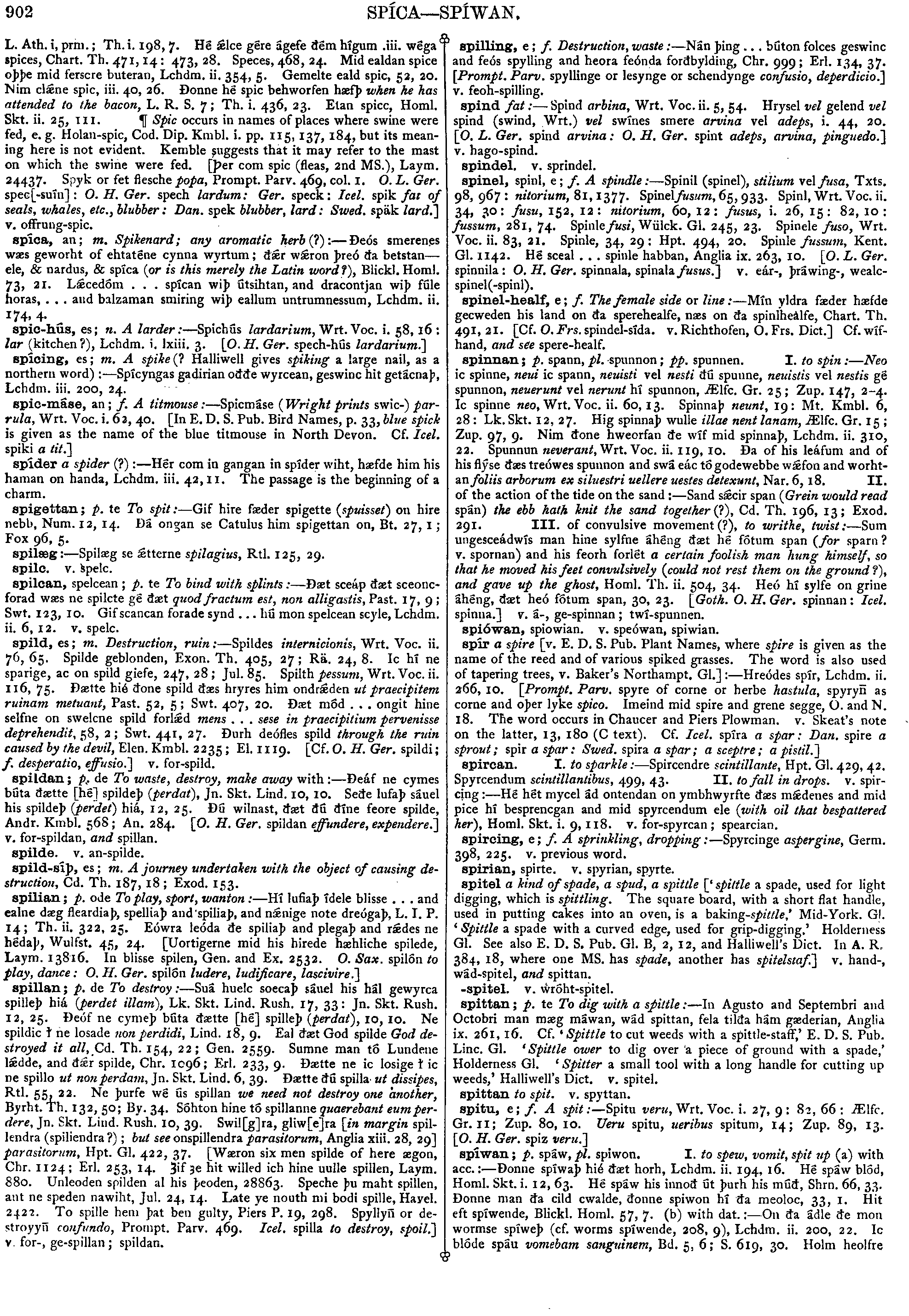
spild,
es;
m.
Destruction,
ruin
:--
Spildes
internicionis,
Wrt.
Voc.
ii.
76,
65.
Spilde
geblonden.
Exon.
Th.
405,
27;
Rä.
24,
8.
Ic
hí
ne
sparige,
ac
on
spild
giefe,
247,
28;
Jul.
85.
Spilth
pessum,
Wrt.
Voc.
ii.
116,
75.
Ðætte
hié
ðone
spild
ðæs
hryres
him
ondr den
ut
praecipitem
ruinam
metuant,
Past.
52,
5
;
Swt.
407,
20.
Ðæt
mód.
.
.
ongit
hine
selfne
on
swelcne
spild
forld
mens
.
.
.
sese
in
praecipitium
pervenisse
deprehendit,
58,
2;
Swt.
441,
27.
Ðurh
deófles
spild
through
the
ruin
caused
by
the
devil,
Elen.
Kmbl.
2235;
El.
1119.
[Cf.
O.
H.
Ger.
spildi;
f.
desperatio,
effusio.]
v.
for-spild.
den
ut
praecipitem
ruinam
metuant,
Past.
52,
5
;
Swt.
407,
20.
Ðæt
mód.
.
.
ongit
hine
selfne
on
swelcne
spild
forld
mens
.
.
.
sese
in
praecipitium
pervenisse
deprehendit,
58,
2;
Swt.
441,
27.
Ðurh
deófles
spild
through
the
ruin
caused
by
the
devil,
Elen.
Kmbl.
2235;
El.
1119.
[Cf.
O.
H.
Ger.
spildi;
f.
desperatio,
effusio.]
v.
for-spild.
|
Source: Torp, page b0511, entry 7 View original page image as: [TIFF] [PNG] [View previous entry] [View next entry] |
[Comment on this entry] [View comments] |
The following entry has been hand-corrected once. |
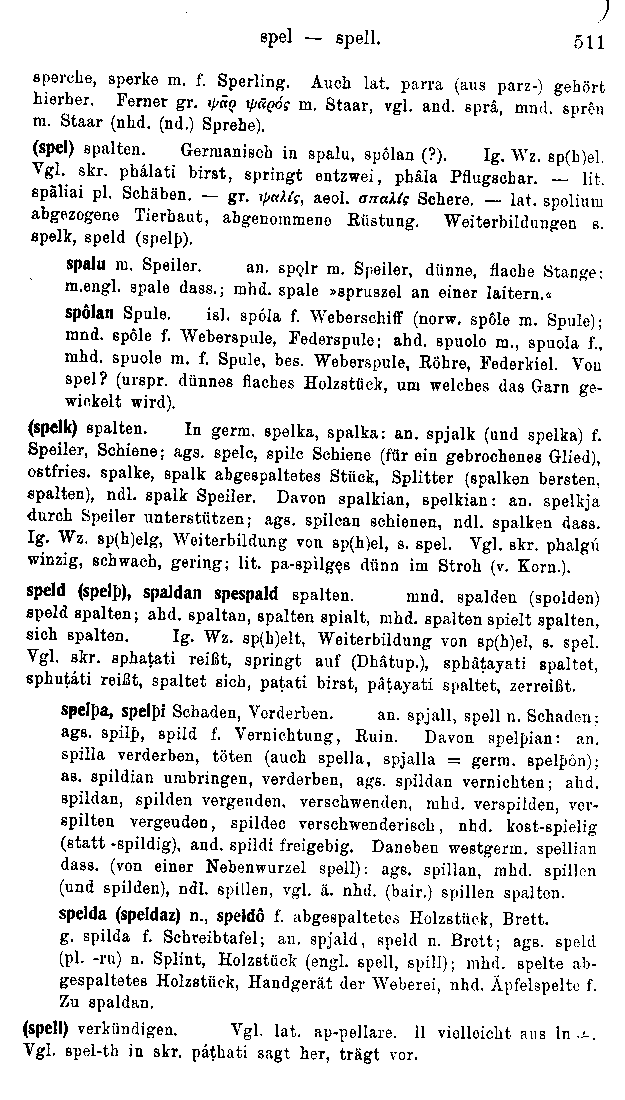
spelþa, spelþi Schaden, Verderben. an. spjall, spell n. Schaden: ags. spilþ, spild f. Vernichtung, Ruin. Davon spelþan: an. spilla verderben, töten (auch spella, spjalla = germ. spelþôn); as. spildian umbringen, verderben, ags. spildan vernichten; ahd. spildan, spilden vergeuden, verschwenden, mhd. verspilden, verspilten vergeuden, spildec verschwenderisch, nhd. kost-spielig (statt -spildig), and. spildi freigebig. Daneben westgerm. spellian dass. (von einer Nebenwurzel spell): ags. spillan, mhd. spillen (und spilden), ndl. spillen, vgl. ä. nhd. (bair.) spillen spalten.
[Translate the German words]
|
Source: Bosworth/Toller, page b0045, entry 33 View original page image as: [TIFF] [PNG] [View previous entry] [View next entry] |
[Comment on this entry] [View comments] |
The following entry has been hand-corrected once. |
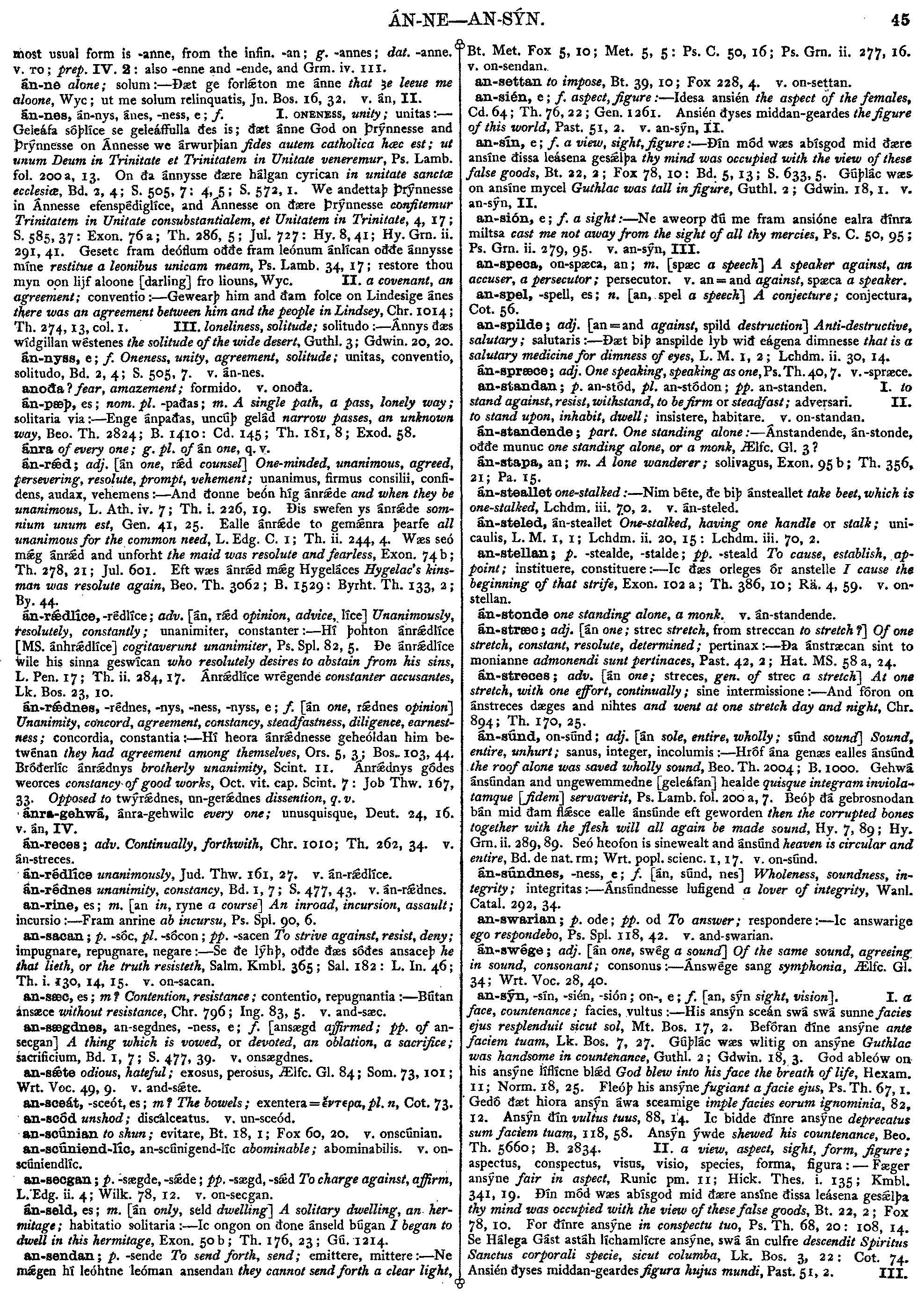
an-spilde; adj. [an = and against, spild destruction] Anti-destructive, salutary; salutaris :-- Ðæt biþ anspilde lyb wið eágena dimnesse that is a salutary medicine for dimness of eyes, L. M. I, 2; Lchdm. ii. 30, 14.
|
Source: Bosworth/Toller, page b0318, entry 27 View original page image as: [TIFF] [PNG] [View previous entry] [View next entry] |
[Comment on this entry] [View comments] |
The following entry has been hand-corrected once. |
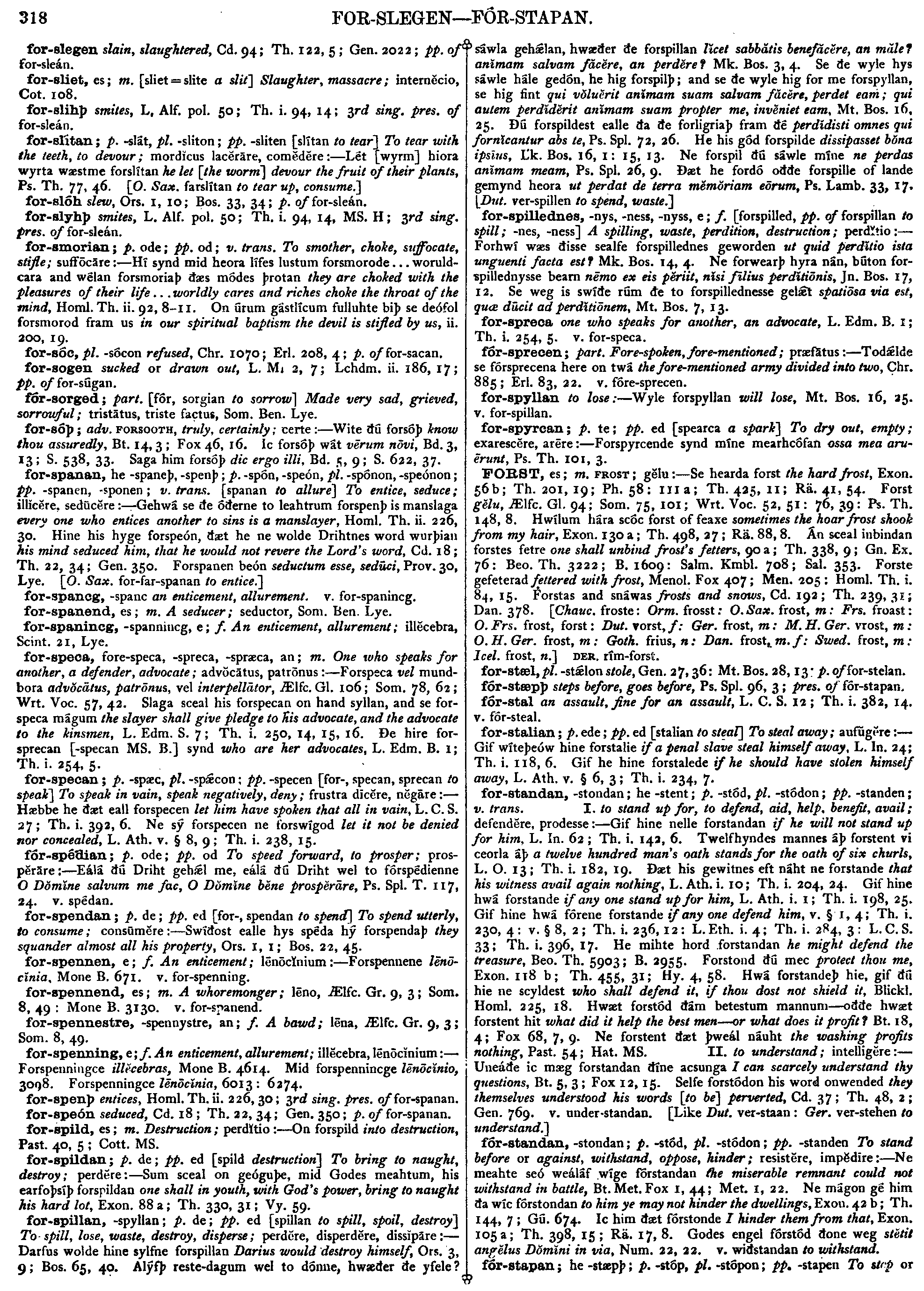
for-spildan;
p.
de;
pp.
ed
[spild
destruction]
To
bring
to
naught,
destroy;
perd re
:--
Sum
sceal
on
geóguþe,
mid
Godes
meahtum,
his
earfoþsíþ
forspildan
one
shall
in
youth,
with
God's
power,
bring
to
naught
his
hard
lot,
Exon.
88
a;
Th.
330,
31;
Vy.
59.
re
:--
Sum
sceal
on
geóguþe,
mid
Godes
meahtum,
his
earfoþsíþ
forspildan
one
shall
in
youth,
with
God's
power,
bring
to
naught
his
hard
lot,
Exon.
88
a;
Th.
330,
31;
Vy.
59.
|
Source: Bosworth/Toller, page b0564, entry 19 View original page image as: [TIFF] [PNG] [View previous entry] [View next entry] |
[Comment on this entry] [View comments] |
The following entry has been hand-corrected once. |
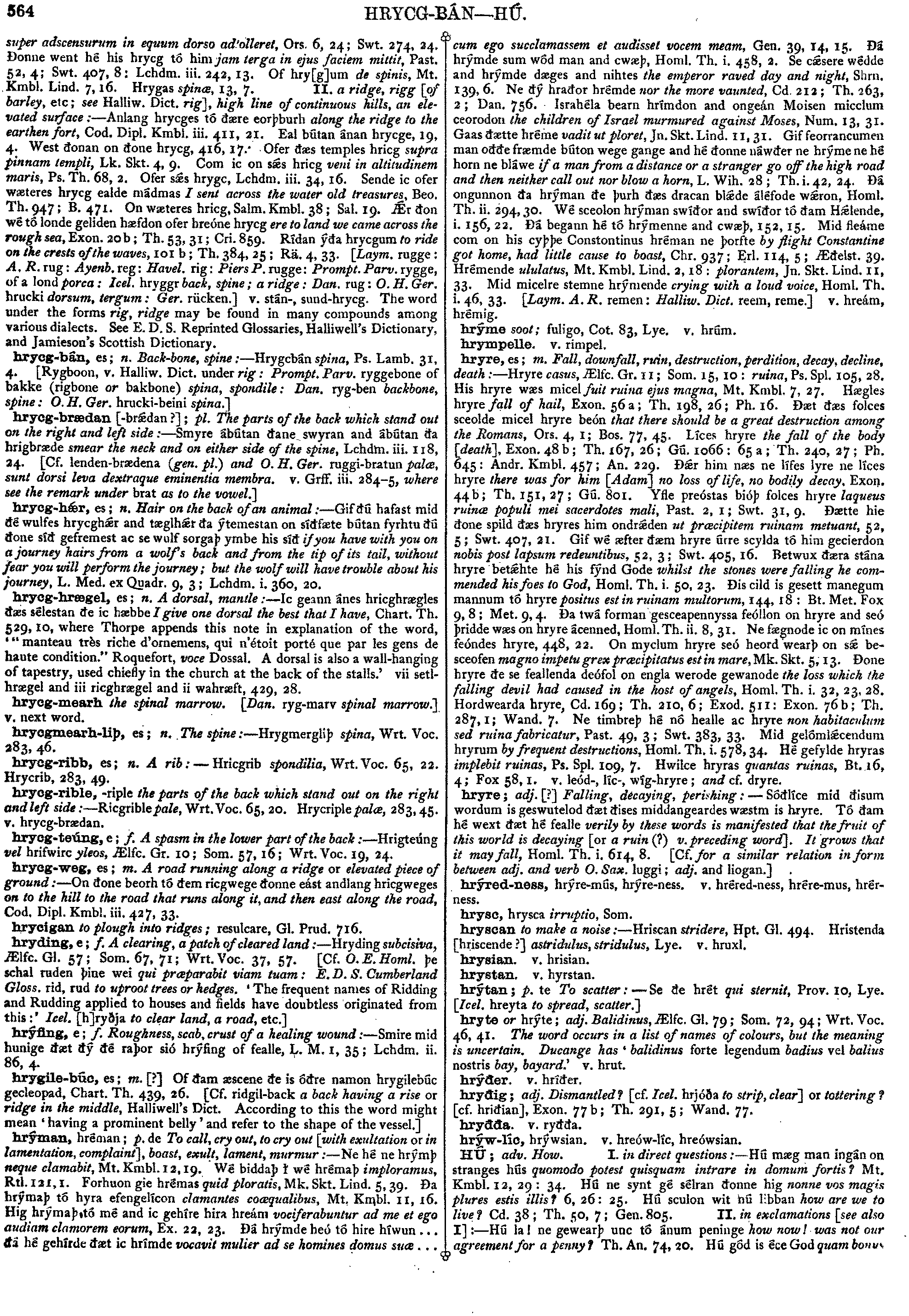
hryre,
es;
m.
Fall,
downfall,
ruin,
destruction,
perdition,
decay,
decline,
death
:--
Hryre
casus,
Ælfc.
Gr.
11;
Som.
15,
10:
ruina,
Ps.
Spl.
105,
28.
His
hryre
wæs
micel
fuit
ruina
ejus
magna,
Mt.
Kmbl.
7,
27.
Hægles
hryre
fall
of
hail,
Exon.
56
a;
Th.
198,
26;
Ph.
16.
Ðæt
ðæs
folces
sceolde
micel
hryre
beón
that
there
should
be
a
great
destruction
among
the
Romans,
Ors.
4,
1;
Bos.
77,
45.
Líces
hryre
the
fall
of
the
body
[death],
Exon.
48
b;
Th.
167,
26;
Gú.
1066:
65
a;
Th.
240,
27;
Ph.
645:
Andr.
Kmbl.
457;
An.
229.
Ðr
him
næs
ne
lífes
lyre
ne
líces
hryre
there
was
for
him
[Adam]
no
loss
of
life,
no
bodily
decay,
Exon.
44
b;
Th.
151,
27;
Gú.
801.
Yfle
preóstas
bióþ
folces
hryre
laqueus
ruinæ
populi
mei
sacerdotes
mali,
Past.
2,
1;
Swt.
31,
9.
Ðætte
hie
ðone
spild
ðæs
hryres
him
ondrden
ut
præcipitem
ruinam
metuant,
52,
5;
Swt.
407,
21.
Gif
wé
æfter
ðæm
hryre
úrre
scylda
tó
him
gecierdon
nobis
post
lapsum
redeuntibus,
52,
3;
Swt.
405,
16,
Betwux
ðæra
stána
hryre
bethte
hé
his
fýnd
Gode
whilst
the
stones
were
falling
he
commended
his
foes
to
God,
Homl.
Th.
i.
50,
23.
Ðis
cild
is
gesett
manegum
mannum
tó
hryre
positus
est
in
ruinam
multorum,
144,
18:
Bt.
Met.
Fox
9,
8;
Met.
9,
4.
Ða
twá
forman
gesceapennyssa
feóllon
on
hryre
and
seó
þridde
wæs
on
hryre
ácenned,
Homl.
Th.
ii.
8,
31.
Ne
fægnode
ic
on
mínes
feóndes
hryre,
448,
22.
On
myclum
hryre
seó
heord
wearþ
on
s
besceofen
magno
impetu
grex
præcipitatus
est
in
mare,
Mk.
Skt.
5,
13.
Ðone
hryre
ðe
se
feallenda
deófol
on
engla
werode
gewanode
the
loss
which
the
falling
devil
had
caused
in
the
host
of
angels,
Homl.
Th.
i.
32,
23,
28.
Hordwearda
hryre,
Cd.
169;
Th.
210,
6;
Exod.
511:
Exon.
76
b;
Th.
287,
1;
Wand.
7.
Ne
timbreþ
hé
nó
healle
ac
hryre
non
habitaculum
sed
ruina
fabricatur,
Past.
49,
3;
Swt.
383,
33.
Mid
gelómlcendum
hryrum
by
frequent
destructions,
Homl.
Th.
i.
578,
34.
Hé
gefylde
hryras
implebit
ruinas,
Ps.
Spl.
109,
7.
Hwilce
hryras
quantas
ruinas,
Bt.
16,
4;
Fox
58,
i.
v.
leód-,
líc-,
wíg-hryre;
and
cf.
dryre.
|
Source: Bosworth/Toller, page b0754, entry 32 View original page image as: [TIFF] [PNG] [View previous entry] [View next entry] |
[Comment on this entry] [View comments] |
The following entry has been hand-corrected once. |
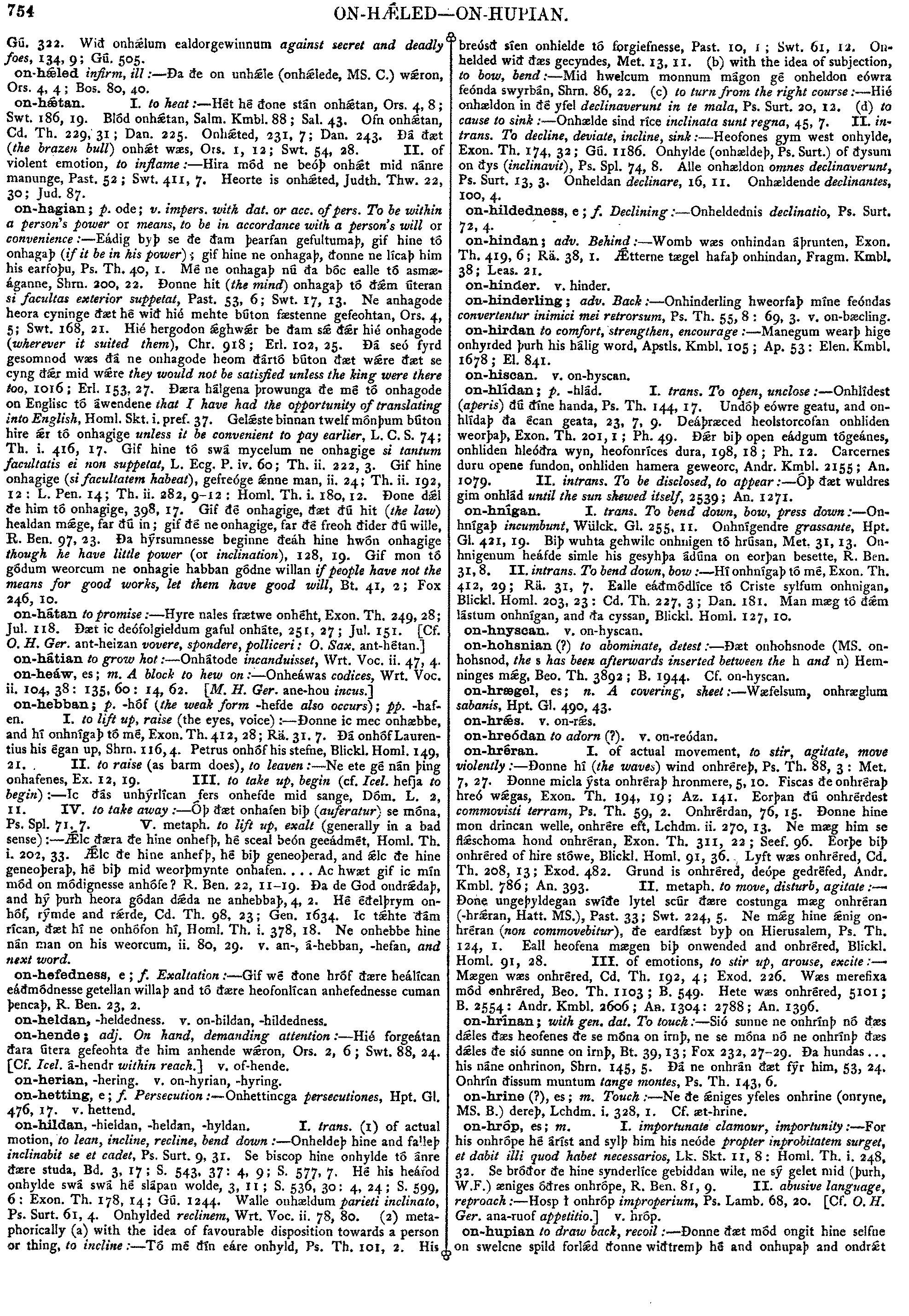
on-hupian
to
draw
back,
recoil:--Ðonne
ðæt
mód
ongit
hine
selfne
on
swelcne
spild
forld
ðonne
wiðtremþ
hé
and
onhupaþ
and
ondrt
|
Source: Bosworth/Toller, page b0899, entry 6 View original page image as: [TIFF] [PNG] [View previous entry] [View next entry] |
[Comment on this entry] [View comments] |
The following entry has been hand-corrected once. |
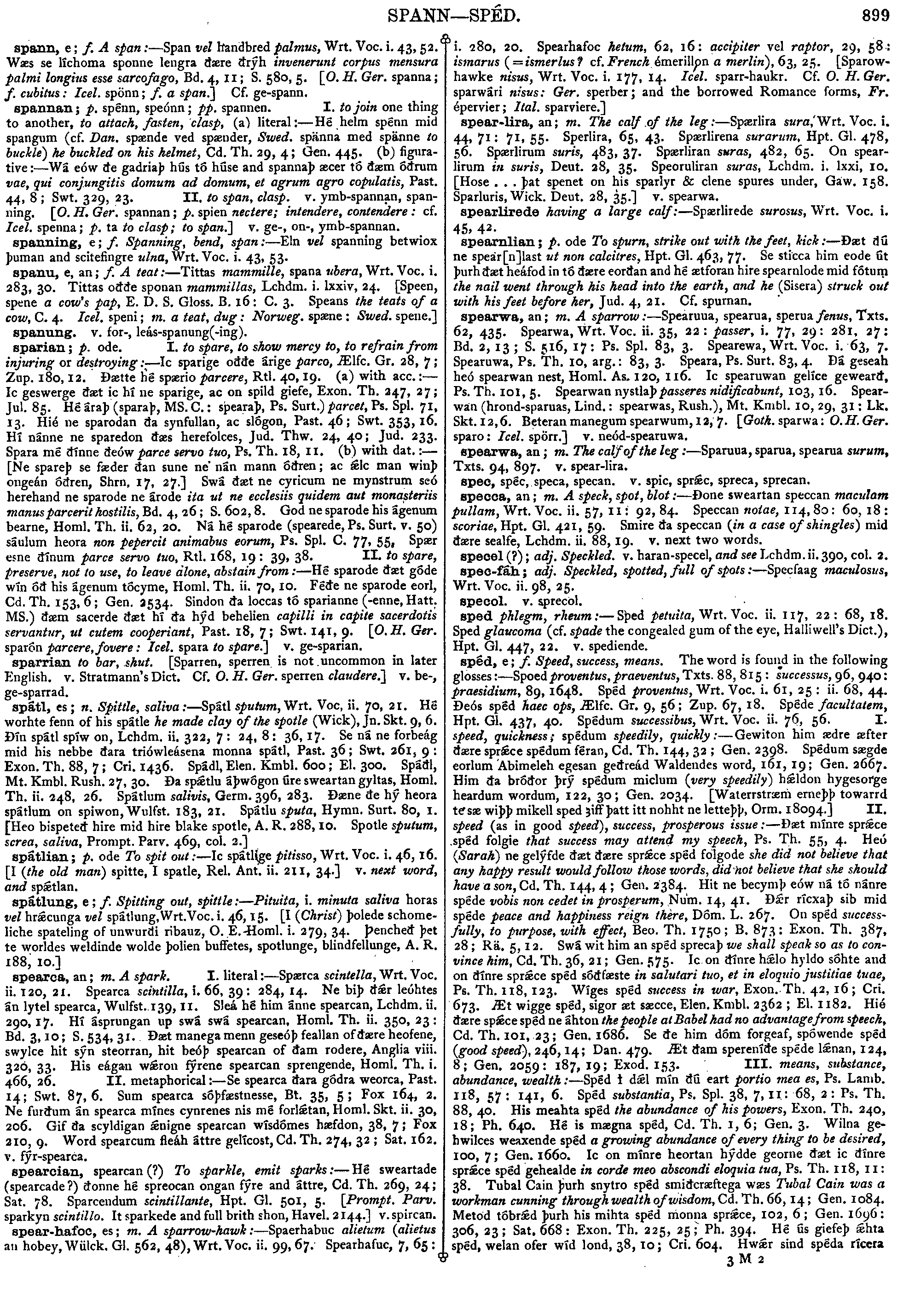
sparian;
p.
ode.
I.
to
spare,
to
show
mercy
to,
to
refrain
from
injuring
or
destroying:--Ic
sparige
oððe
árige
parco,
Ælfc.
Gr.
28,
7;
Zup.
180,
12.
Ðætte
hé
spærio
parcere,
Rtl.
40,
19.
(a)
with
acc.:--Ic
geswerge
ðæt
ic
hí
ne
sparige,
ac
on
spild
giefe,
Exon.
Th.
247,
27;
Jul.
85.
Hé
áraþ
(sparaþ,
MS.
C.:
spearaþ,
Ps.
Surt.)
parcet,
Ps.
Spl.
71,
13.
Hié
ne
sparodan
ða
synfullan,
ac
slógon,
Past.
46;
Swt.
353,
16.
Hí
nánne
ne
sparedon
ðæs
herefolces,
Jud.
Thw.
24,
40;
Jud.
233.
Spara
mé
ðínne
ðeów
parce
servo
tuo,
Ps.
Th.
18,
11.
(b)
with
dat.:--[Ne
spareþ
se
fæder
ðan
sune
ne
nán
mann
óðren;
ac
lc
man
winþ
ongeán
óðren,
Shrn.
17,
27.]
Swá
ðæt
ne
cyricum
ne
mynstrum
seó
herehand
ne
sparode
ne
árode
ita
ut
ne
ecclesiis
quidem
aut
monasteriis
manus
parcerit
hostilis,
Bd.
4,
26;
S.
602,
8.
God
ne
sparode
his
ágenum
bearne,
Homl.
Th.
ii.
62,
20.
Ná
hé
sparode
(spearede,
Ps.
Surt.
v.
50)
sáulum
heora
non
pepercit
animabus
eorum,
Ps.
Spl.
C.
77,
55.
Spær
esne
ðínum
parce
servo
two,
Rtl.
168,
19:
39,
38.
II.
to
spare,
preserve,
not
to
use,
to
leave
alone,
abstain
from:--Hé
sparode
ðæt
góde
wín
óð
his
ágenum
tócyme,
Homl.
Th.
ii.
70,
10.
Féðe
ne
sparode
eorl,
Cd.
Th.
153,
6;
Gen.
2534.
Sindon
ða
loccas
tó
sparianne
(-enne,
Hatt.
MS.)
ðæm
sacerde
ðæt
hí
ða
hýd
behelien
capilli
in
capite
sacerdotis
servantur,
ut
cutem
cooperiant,
Past.
18,
7;
Swt.
141,
9.
[O.
H.
Ger.
sparón
parcere,
fovere:
Icel.
spara
to
spare.]
v.
ge-sparian.
|
Source: Bosworth/Toller, page d0247, entry 1 View original page image as: [TIFF] [PNG] [View previous entry] [View next entry] |
[Comment on this entry] [View comments] |
The following entry has been hand-corrected once. |
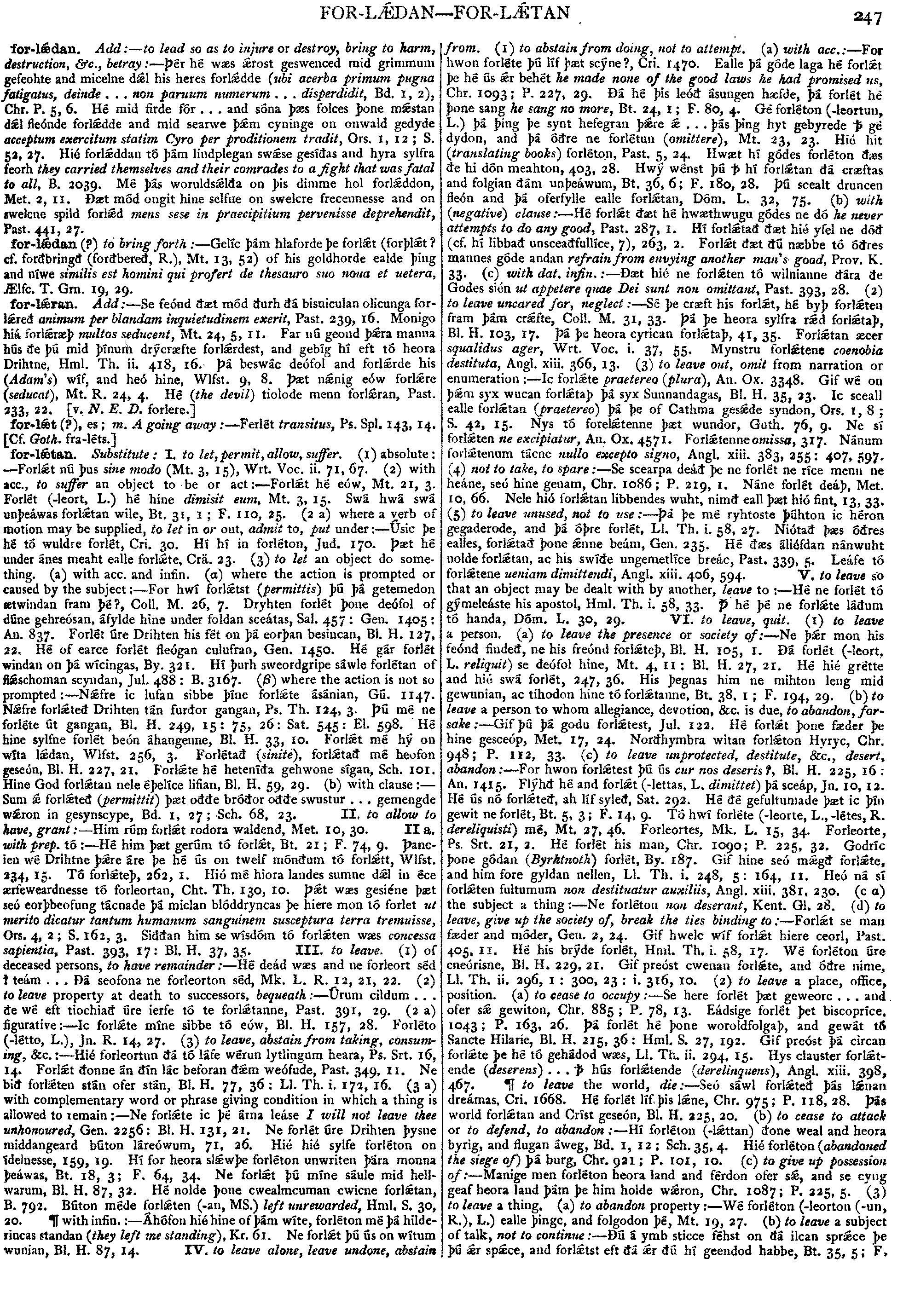
for-ldan.
Add:--to
lead
so
as
to
injure
or
destroy,
bring
to
harm,
destruction,
&c.,
betray:--Þér
hé
wæs
rost
geswenced
mid
grimmum
gefeohte
and
micelne
dl
his
heres
forldde
(ubi
acerba
primum
pugna
fatigatus,
deinde
.
.
.
non
paruum
numerum
.
.
.
disperdidit,
Bd.
1,
2),
Chr.
P.
5,
6.
Hé
mid
firde
fór
.
.
.
and
sóna
þæs
folces
þone
mstan
dl
fleónde
forldde
and
mid
searwe
þm
cyninge
on
onwald
gedyde
acceptum
exercitum
statim
Cyro
per
proditionem
tradit,
Ors.
1,
12;
S.
52,
27.
Hié
forlddan
tó
þám
lindplegan
swse
gesíðas
and
hyra
sylfra
feorh
they
carried
themselves
and
their
comrades
to
a
fight
that
was
fatal
to
all,
B.
2039.
Mé
þás
woruldslða
on
þis
dimme
hol
forlddon,
Met.
2,
11.
Ðæt
mód
ongit
hine
selfne
on
swelcre
frecennesse
and
on
swelcne
spild
forld
mens
sese
in
praecipitium
pervenisse
deprehendit,
Past.
441,
27.
|
Source: Bosworth/Toller, page d0463, entry 3 View original page image as: [TIFF] [PNG] [View previous entry] [View next entry] |
[Comment on this entry] [View comments (1)] |
The following entry has been hand-corrected once. |
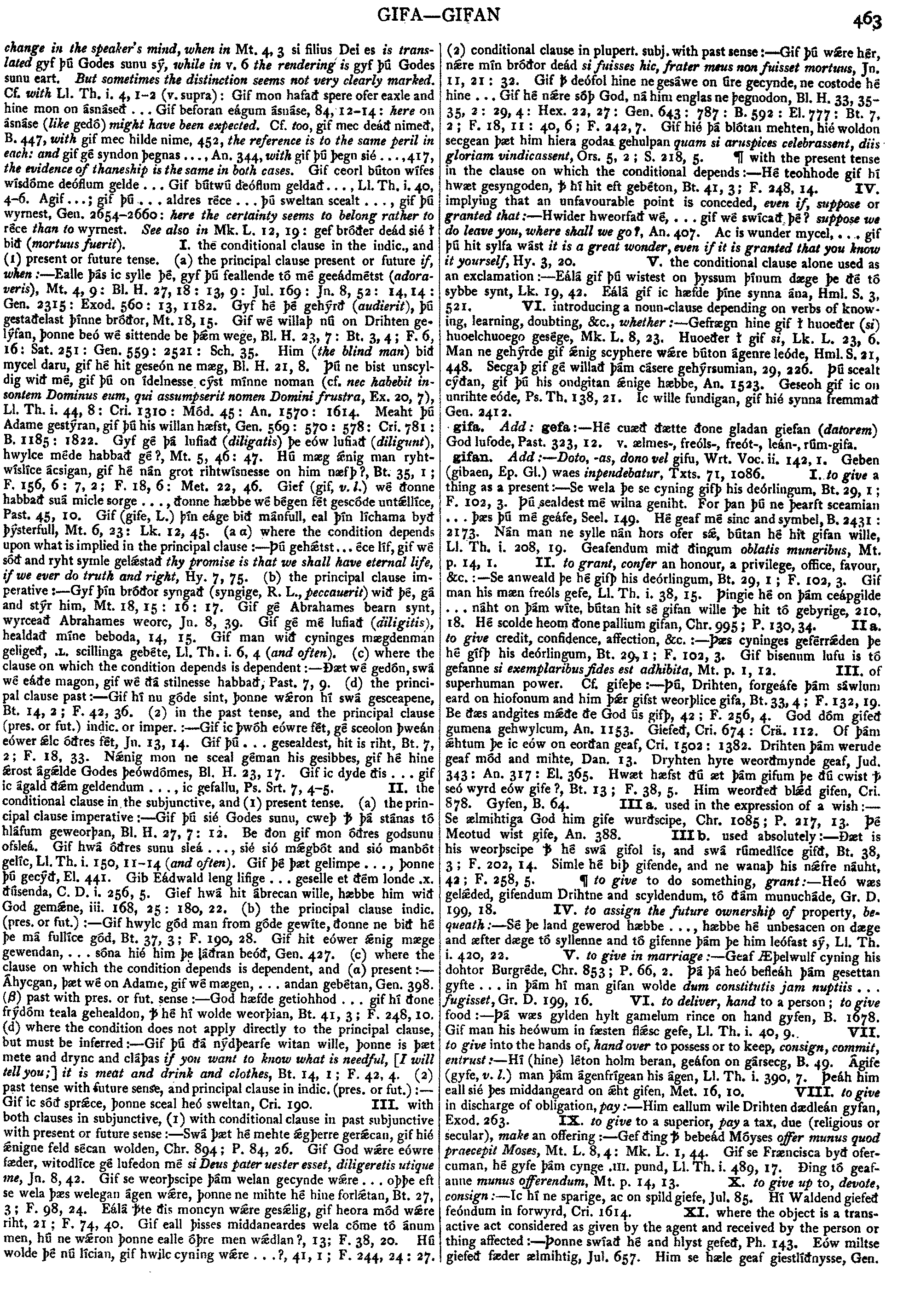
gifan.
Add
:--
Doto,
-as,
dono
vel
gifu,
Wrt.
Voc.
ii.
142,
l.
Geben
(gibaen,
Ep.
Gl.)
wæs
inpendebatur,
Txts.
71,
1086.
I.
to
give
a
thing
as
a
present
:--
Se
wela
þe
se
cyning
gifþ
his
deórlingum.
Bt.
29,
1
;
F.
102,
3.
Þ .
sealdest
m
.
sealdest
m wilna
geniht.
For
þan
þ
ne
þearft
sceamiaii
.
.
.
þæs
þ
m
geáfe,
Seel.
149.
H
geaf
m
sinc
and
symbel,
B.
2431
:
2173.
N
wilna
geniht.
For
þan
þ
ne
þearft
sceamiaii
.
.
.
þæs
þ
m
geáfe,
Seel.
149.
H
geaf
m
sinc
and
symbel,
B.
2431
:
2173.
N n
man
ne
sylle
nn
hors
ofer
s
n
man
ne
sylle
nn
hors
ofer
s ,
btan
h
hit
gifan
wille,
Ll.
Th.
i.
208,
19.
Geafendum
mi
,
btan
h
hit
gifan
wille,
Ll.
Th.
i.
208,
19.
Geafendum
mi ingum
oblatis
muneribus,
Mt.
p.
14,
II.
to
grant,
confer
an
honour,
a
privilege,
office,
favour,
&c.
:--
Se
anweald
þe
h
gifþ
his
deórlingum,
Bt.
29,
I
;
F.
102,
3.
Gif
man
his
mæn
freóls
gefe,
Ll.
Th.
i.
38,
15.
Þpingie
h
on
þm
ceápgilde
.
.
.
nht
on
þm
w
ingum
oblatis
muneribus,
Mt.
p.
14,
II.
to
grant,
confer
an
honour,
a
privilege,
office,
favour,
&c.
:--
Se
anweald
þe
h
gifþ
his
deórlingum,
Bt.
29,
I
;
F.
102,
3.
Gif
man
his
mæn
freóls
gefe,
Ll.
Th.
i.
38,
15.
Þpingie
h
on
þm
ceápgilde
.
.
.
nht
on
þm
w te,
btan
hit
s
gifan
wille
te,
btan
hit
s
gifan
wille
 e
hit
t
e
hit
t gebyrige,
210,
18.
H
scolde
heom
one
pallium
gifan,
Chr.
995
;
P.
130,
34.
II
a.
to
give
credit,
confidence,
affection,
&c.
:--
Þæs
cyninges
gefrrden
þe
h
gfþ
his
deórlingum,
Bt.
29,
1
;
F.
102,
3.
Gif
bisenum
lufu
is
t
gefanne
si
exemplar
ibus
fides
est
adhibita.
Mt.
p.
I.
12.
III.
of
superhuman
power.
Cf.
gifeþe
:--
Þ,
Drihten,
forgeáfe
þm
swlum
eard
on
hiofonum
and
him
þr
UNCERTAIN
gifst
weorþlice
gifa,
Bt.
33,
4
;
F.
132,
19.
Be
æs
andgites
me
e
God
s
gifþ,
42
;
F.
256,
4.
God
dm
gife
gumena
gehwylcum,
An.
1153.
Giefe,
Cri.
674
:
Crä.
112.
Of
þm
htum
þe
ic
eów
on
eoran
geaf,
Cri.
1502
:
1382.
Drihten
þm
werude
geaf
md
and
mihte,
Dan.
13.
Dryhten
hyre
weormynde
geaf,
Jud.
343
:
An.
317
:
El.
365.
Hwæt
hæfst
æt
þm
gifum
þe
cwist
seó
wyrd
eów
gife?,
Bt.
13
;
F.
38,
5.
Him
weore
bld
gifen,
Cri.
878.
Gyfen,
B.
64.
III
a.
used
in
the
expression
of
a
wish
:--
Se
ælmihtiga
God
him
gife
wurscipe,
Chr.
1085;
P.
217,
13.]
Þ
Meotud
wist
gife,
An.
388.
III
b.
used
absolutely:--
Ðæt
is
his
weorþscipe
h
sw
gifol
is,
and
sw
rmedlce
gif,
Bt.
38,
3;
F.
202,
14.
Simle
h
biþ
gifende,
and
ne
wanaþ
his
nfre
nuht,
42;
F.
258,
5.

to
give
to
do
something,
grant
:--
Heó
wæs
gelded,
gifendum
Drihtne
and
scyldendum,
t
m
munuchde,
Gr.
D.
199,
18.
IV.
to
assign
the
future
ownership
of
property,
be-queath
:--
S
þe
land
gewerod
hæbbe
.
.
.
,
hæbbe
h
unbesacen
on
dæge
and
æfter
dæge
t
syllenne
and
t
gifenne
þm
þe
him
leófast
s
gebyrige,
210,
18.
H
scolde
heom
one
pallium
gifan,
Chr.
995
;
P.
130,
34.
II
a.
to
give
credit,
confidence,
affection,
&c.
:--
Þæs
cyninges
gefrrden
þe
h
gfþ
his
deórlingum,
Bt.
29,
1
;
F.
102,
3.
Gif
bisenum
lufu
is
t
gefanne
si
exemplar
ibus
fides
est
adhibita.
Mt.
p.
I.
12.
III.
of
superhuman
power.
Cf.
gifeþe
:--
Þ,
Drihten,
forgeáfe
þm
swlum
eard
on
hiofonum
and
him
þr
UNCERTAIN
gifst
weorþlice
gifa,
Bt.
33,
4
;
F.
132,
19.
Be
æs
andgites
me
e
God
s
gifþ,
42
;
F.
256,
4.
God
dm
gife
gumena
gehwylcum,
An.
1153.
Giefe,
Cri.
674
:
Crä.
112.
Of
þm
htum
þe
ic
eów
on
eoran
geaf,
Cri.
1502
:
1382.
Drihten
þm
werude
geaf
md
and
mihte,
Dan.
13.
Dryhten
hyre
weormynde
geaf,
Jud.
343
:
An.
317
:
El.
365.
Hwæt
hæfst
æt
þm
gifum
þe
cwist
seó
wyrd
eów
gife?,
Bt.
13
;
F.
38,
5.
Him
weore
bld
gifen,
Cri.
878.
Gyfen,
B.
64.
III
a.
used
in
the
expression
of
a
wish
:--
Se
ælmihtiga
God
him
gife
wurscipe,
Chr.
1085;
P.
217,
13.]
Þ
Meotud
wist
gife,
An.
388.
III
b.
used
absolutely:--
Ðæt
is
his
weorþscipe
h
sw
gifol
is,
and
sw
rmedlce
gif,
Bt.
38,
3;
F.
202,
14.
Simle
h
biþ
gifende,
and
ne
wanaþ
his
nfre
nuht,
42;
F.
258,
5.

to
give
to
do
something,
grant
:--
Heó
wæs
gelded,
gifendum
Drihtne
and
scyldendum,
t
m
munuchde,
Gr.
D.
199,
18.
IV.
to
assign
the
future
ownership
of
property,
be-queath
:--
S
þe
land
gewerod
hæbbe
.
.
.
,
hæbbe
h
unbesacen
on
dæge
and
æfter
dæge
t
syllenne
and
t
gifenne
þm
þe
him
leófast
s ,
Ll.
Th.
i.
420,
22.
V.
to
give
in
marriage
:--
Geaf
Æþelwulf
cyning
his
dohtor
Burgrde,
Chr.
853
;
P.
66,
2.
Þ
þ
heó
befleáh
þm
gesettan
gyfte
.
.
.
in
þm
h
man
gifan
wolde
dum
constitutis
jam
nuptiis
.
.
.
fugisset,
Gr.
D.
199,
16.
VI.
to
deliver,
hand
to
a
person;
to
give
food
:--
Þ
wæs
gylden
hylt
gamelum
rince
on
hand
gyfen,
B.
1678.
Gif
man
his
heówum
in
fæsten
flsc
gefe,
Ll.
Th.
i.
40,
9.
.
VII.
to
give
into
the
hands
of,
handover
to
possess
or
to
keep,
consign,
commit,
entrust
:--
H
(hine)
lton
holm
beran,
geáfon
on
grsecg,
B.
49.
&A-long;gife
(gyfe,
v.
l.)
man
þm
genfrgean
his
gen,
Ll.
Th.
i.
390,
7.
Þeáh
him
eall
sié
þes
middangeard
on
ht
gifen,
Met.
16,
10.
VIII.
to
give
in
discharge
of
obligation,
pay
:--
Him
eallum
wile
Drihten
dædleán
gyfan,
Exod.
263.
IX.
to
give
to
a
superior,
pay
a
tax,
due
(religious
or
secular),
make
an
offering
:--
Gef
ing
bebeád
Myses
offer
munus
quod
praecepit
Moses,
Mt.
L.
8,
4:
Mk.
L.
l,
44.
Gif
se
Fræncisca
by
ofer-cuman,
h
gyfe
þm
cynge
.III.
pund,
Ll.
Th.
i.
489,
17.
Ðing
t
geaf-anne
munus
offerendum,
Mt.
p.
14,
13.
X.
to
give
up
to,
devote,
consign
:--
Ic
h
ne
sparige,
ac
on
spild
giefe,
Jul.
85.
H
Waldend
giefe
feóndum
in
forwyrd,
Cri.
1614.
XI.
where
the
object
is
a
trans-active
act
considered
as
given
by
the
agent
and
received
by
the
person
or
thing
affected
:--
Þonne
swa
h
and
hlyst
gefe,
Ph.
143.
Eów
miltse
giefe
fæder
ælmihtig,
Jul.
657.
Him
se
hæle
geaf
giestlnysse,
Gen.
,
Ll.
Th.
i.
420,
22.
V.
to
give
in
marriage
:--
Geaf
Æþelwulf
cyning
his
dohtor
Burgrde,
Chr.
853
;
P.
66,
2.
Þ
þ
heó
befleáh
þm
gesettan
gyfte
.
.
.
in
þm
h
man
gifan
wolde
dum
constitutis
jam
nuptiis
.
.
.
fugisset,
Gr.
D.
199,
16.
VI.
to
deliver,
hand
to
a
person;
to
give
food
:--
Þ
wæs
gylden
hylt
gamelum
rince
on
hand
gyfen,
B.
1678.
Gif
man
his
heówum
in
fæsten
flsc
gefe,
Ll.
Th.
i.
40,
9.
.
VII.
to
give
into
the
hands
of,
handover
to
possess
or
to
keep,
consign,
commit,
entrust
:--
H
(hine)
lton
holm
beran,
geáfon
on
grsecg,
B.
49.
&A-long;gife
(gyfe,
v.
l.)
man
þm
genfrgean
his
gen,
Ll.
Th.
i.
390,
7.
Þeáh
him
eall
sié
þes
middangeard
on
ht
gifen,
Met.
16,
10.
VIII.
to
give
in
discharge
of
obligation,
pay
:--
Him
eallum
wile
Drihten
dædleán
gyfan,
Exod.
263.
IX.
to
give
to
a
superior,
pay
a
tax,
due
(religious
or
secular),
make
an
offering
:--
Gef
ing
bebeád
Myses
offer
munus
quod
praecepit
Moses,
Mt.
L.
8,
4:
Mk.
L.
l,
44.
Gif
se
Fræncisca
by
ofer-cuman,
h
gyfe
þm
cynge
.III.
pund,
Ll.
Th.
i.
489,
17.
Ðing
t
geaf-anne
munus
offerendum,
Mt.
p.
14,
13.
X.
to
give
up
to,
devote,
consign
:--
Ic
h
ne
sparige,
ac
on
spild
giefe,
Jul.
85.
H
Waldend
giefe
feóndum
in
forwyrd,
Cri.
1614.
XI.
where
the
object
is
a
trans-active
act
considered
as
given
by
the
agent
and
received
by
the
person
or
thing
affected
:--
Þonne
swa
h
and
hlyst
gefe,
Ph.
143.
Eów
miltse
giefe
fæder
ælmihtig,
Jul.
657.
Him
se
hæle
geaf
giestlnysse,
Gen.
|
Source: Bosworth/Toller, page d0732, entry 16 View original page image as: [TIFF] [PNG] [View previous entry] [View next entry] |
[Comment on this entry] [View comments] |
The following entry has been hand-corrected once. |
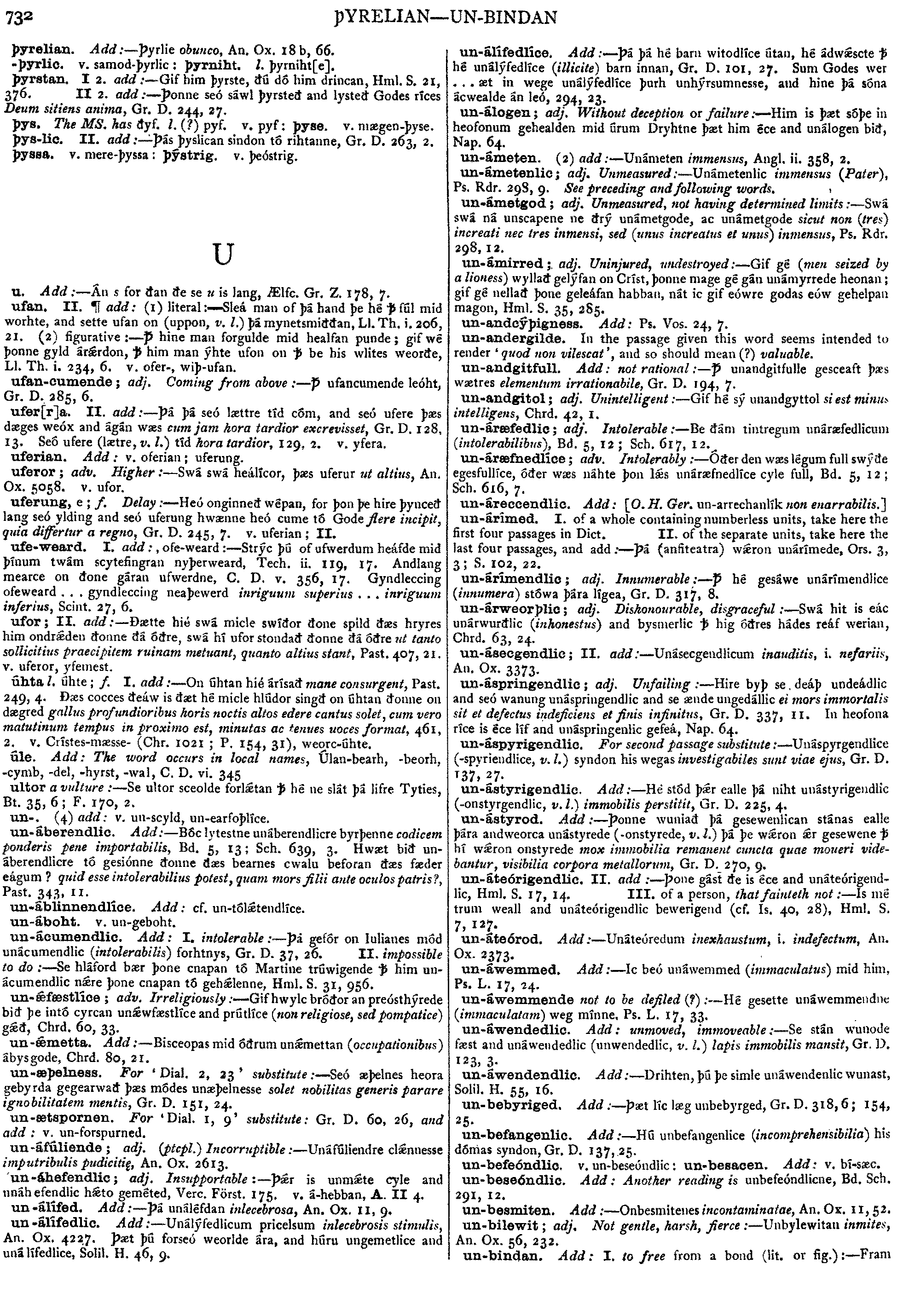
ufor;
II.
add
:--
Ðætte
hié
swá
micle
swíðor
ðone
spild
ðæs
hryres
him
ondrden
ðonne
ða
óðre,
swá
hí
ufor
stondað
ðonne
ðá
óðre
ut
tanto
sollicitius
praecipitem
ruinam
metuant,
quanto
altius
stant,
Past.
407,
21.
v.
uferor,
yfemest.
Germanic Lexicon Project (main page)
This search system was written by
Sean Crist
Please consider
volunteering
to correct the data in these online dictionaries.
No rights reserved. Feel free to use these data in any way you please.