|
|

Tip: In the search results, you can click on any word or abbreviation for more information.
|
Source: Cleasby/Vigfusson, page b0029, entry 1 View original page image as: [TIFF] [PNG] [View previous entry] [View next entry] |
[Comment on this entry] [View comments] |
The following entry has been hand-corrected once. |
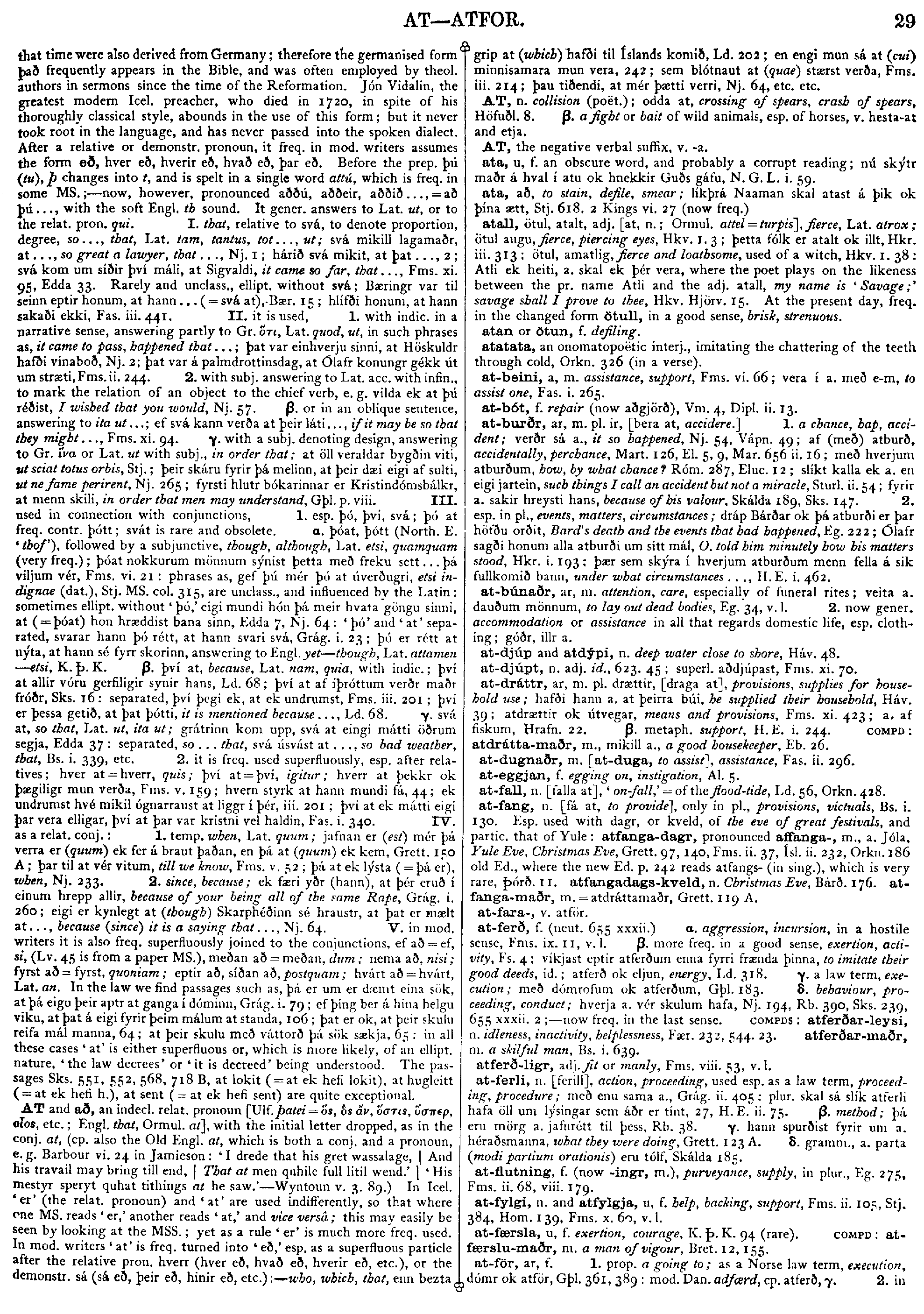
that
time
were
also
derived
from
Germany;
therefore
the
germanised
form
það
frequently
appears
in
the
Bible,
and
was
often
employed
by
theol.
authors
in
sermons
since
the
time
of
the
Reformation.
Jón
Vidalin,
the
greatest
modern
Icel.
preacher,
who
died
in
1720,
in
spite
of
his
thoroughly
classical
style,
abounds
in
the
use
of
this
form;
but
it
never
took
root
in
the
language,
and
has
never
passed
into
the
spoken
dialect.
After
a
relative
or
demonstr.
pronoun,
it
freq.
in
mod.
writers
assumes
the
form
eð,
hver
eð,
hverir
eð,
hvað
eð,
þar
eð.
Before
the
prep,
þú
(t
u),
þ
changes
into
t,
and
is
spelt
in
a
single
word
attú,
which
is
freq.
in
some
MS.;
--
now,
however,
pronounced
aððú,
aððeir,
aððið
...,
=
að
þú...,
with
the
soft
Engl.
th
sound.
It
gener.
answers
to
Lat.
ut,
or
to
the
relat.
pron.
qui.
I.
that,
relative
to
svá,
to
denote
proportion,
degree,
so...,
that,
Lat.
tam,
tantus,
to
t...,
-ut;
svá
mikill
lagamaðr,
at...,
sogr
eat
a
lawyer,
that...,
Nj.
I;
hárið
svá
mikit,
at
þat...,
2;
svá
kom
um
síðir
því
máli,
at
Sigvaldi,
it
came
so
far,
that...,
Fms.
xi.
95,
Edda
33.
Rarely
and
unclass.,
ellipt.
without
svá;
Bæringr
var
til
seinn
eptir
honum,
at
hann
...
(=
svá
at),
-Bær.
15;
hlífði
honum,
at
hann
sakaði
ekki,
Fas.
iii.
441.
II.
it
is
used,
1.
with
indic,
in
a
narrative
sense,
answering
partly
to
Gr.
GREEK
Lat.
quod,
ut,
in
such
phrases
as,
it
came
topass,
happened
that...;
þat
var
einhverju
sinni,
at
Höskuldr
hafði
vinaboð,
Nj.
2;
þat
var
á
palmdrottinsdag,
at
Ólafr
konungr
gékk
út
um
stræti,
Fms.
ii.
244.
2.
with
subj.
answering
to
Lat.
acc.
with
infin.,
to
mark
the
relation
of
an
object
to
the
chief
verb,
e.
g.
vilda
ek
at
þú
réðist,
I
wished
that
yon
-would,
Nj.
57.
 .
or
in
an
oblique
sentence,
answering
to
ita
ut...;.;
ef
svá
kann
verða
at
þeir
láti...,
if
it
may
be
so
that
they
might...,
Fms.
xi.
94.
.
or
in
an
oblique
sentence,
answering
to
ita
ut...;.;
ef
svá
kann
verða
at
þeir
láti...,
if
it
may
be
so
that
they
might...,
Fms.
xi.
94.
 with
a
subj.
denoting
design,
answering
to
GREEK
or
Lat.
ut
with
subj.,
in
order
that;
at
öll
veraldar
bygðin
viti,
ut
sciat
totus
orbis,
Stj.;
þeir
skáru
fyrir
þá
melinn,
at
þeir
dæi
eigi
af
sulti,
ut
ne
fame
perirent,
Nj.
265;
fyrsti
hlutr
bókarinnar
er
Kristindómsbálkr,
at
menn
skili,
in
order
that
men
may
understand,
Gþl.
p.
viii.
III.
used
in
connection
with
conjunctions,
1.
esp.
þó,
því,
svá;
þó
at
freq.
contr.
þótt;
svát
is
rare
and
obsolete.
a.
þóat,
þótt
(North.
E.
'thof'),
followed
by
a
subjunctive,
though,
although,
Lat.
etsi,
quamquam
(very
freq.);
þóat
nokkurum
mönnum
sýnist
þetta
með
freku
sett...
þá
viljum
vér,
Fms.
vi.
21:
phrases
as,
gef
þú
mér
þó
at
úverðugri,
etsi
indignae
(dat.),
Stj.
MS.
col.
315,
are
unclass.,
and
influenced
by
the
Latin:
sometimes
ellipt.
without'
þó,
'
eigi
mundi
hón
þá
meir
hvata
göngu
sinni,
at
(=
þóat)
hon
hraeddist
bana
sinn,
Edda
7,
Nj.
64:
'
þó'
and
'
at'
sepa-
rated,
svarar
hann
þó
rétt,
at
hann
svari
svá,
Grág.
i.
23;
þó
er
rétt
at
nýta,
at
hann
sé
fyrr
skorinn,
answering
to
Engl.
yet
--
though,
Lat.
attamen
--
etsi,
K.
þ.
K.
.
því
at,
because,
Lat.
nam,
quia,
with
indic.;
því
at
allir
vóru
gerfiligir
synir
hans,
Ld.
68;
því
at
af
íþróttum
verðr
maðr
fróðr,
Sks.
16:
separated,
því
þegi
ek,
at
ek
undrumst,
Fms.
iii.
201;
því
er
þessa
getið,
at
þat
þótti,
it
i
s
mentioned
because
...,
Ld.
68.
.
svá
at,
so
that,
Lat.
ut,
ita
ut;
grátrinn
kom
upp,
svá
at
eingi
mátti
öðrum
segja,
Edda
37:
separated,
so
...
that,
svá
úsvúst
at
...,
so
bad
weather,
that,
Bs.
i.
339,
etc.
2.
it
is
freq.
used
superfluously,
esp.
after
rela-
tives;
hver
at
=
hverr,
quis;
því
at
=
því,
igitur;
hverr
at
þekkr
ok
þægiligr
mun
verða,
Fms.
v.
159;
hvern
stvrk
at
hann
mundi
fá,
44;
ek
undrumst
hvé
mikil
ógnarraust
at
liggr
í
þér,
iii.
201;
því
at
ek
mátti
eigi
þar
vera
elligar,
því
at
þar
var
kristni
vel
haldin,
Fas.
i.
340.
IV.
as
a
relat.
conj.:
1.
temp,
when,
Lat.
quum;
jafnan
er
(est)
mér
þá
verra
er
(quum)
ek
fer
á
braut
þaðan,
en
þá
at
(quum)
ek
kem,
Grett.
150
A;
þar
til
at
vér
vitum,
till
we
know,
Fms.
v.
52;
þá
at
ek
lýsta
(=
þá
er),
when,
Nj.
233.
2.
since,
because;
ek
færi
yðr
(hann),
at
þér
eruð
í
einum
hrepp
allir,
because
of
your
being
all
of
the
same
Rape,
Grág.
i.
260;
eigi
er
kynlegt
at
(though)
Skarphéðinn
sé
hraustr,
at
þat
er
mælt
at...,
because
(since)
it
is
a
saying
that...,
Nj.
64.
V.
in
mod.
writers
it
is
also
freq.
superfluously
joined
to
the
conjunctions,
ef
að
=
ef,
si,
(Lv.
45
is
from
a
paper
MS.),
meðan
að
=
meðan,
dum;
nema
að,
nisi;
fyrst
að
=
fyrst,
quoniam;
eptir
að,
síðan
að,
postquam;
hvárt
að
=
hvárt,
Lat.
an.
In
the
law
we
find
passages
such
as,
þá
er
um
er
dæmt
eina
sök,
at
þá
eigu
þeir
aptr
at
ganga
í
dóminn,
Grág.
i.
79;
ef
þing
ber
á
hina
helgu
viku,
at
þat
á
eigi
fyrir
þeim
málum
at
standa,
106;
þat
er
ok,
at
þeir
skulu
reifa
mál
manna,
64;
at
þeir
skulu
með
váttorð
þá
sök
sækja,
65:
in
all
these
cases
'
at'
is
either
superfluous
or,
which
is
more
likely,
of
an
ellipt.
nature,
'the
law
decrees'
or
'it
is
decreed'
being
understood.
The
pas-
sages
Sks.
551,
552,
568,
718
B,
at
lokit
(=
at
ek
hefi
lokit),
at
hugleitt
(=
at
ek
hefi
h.),
at
sent
(=
at
ek
hefi
sent)
are
quite
exceptional
with
a
subj.
denoting
design,
answering
to
GREEK
or
Lat.
ut
with
subj.,
in
order
that;
at
öll
veraldar
bygðin
viti,
ut
sciat
totus
orbis,
Stj.;
þeir
skáru
fyrir
þá
melinn,
at
þeir
dæi
eigi
af
sulti,
ut
ne
fame
perirent,
Nj.
265;
fyrsti
hlutr
bókarinnar
er
Kristindómsbálkr,
at
menn
skili,
in
order
that
men
may
understand,
Gþl.
p.
viii.
III.
used
in
connection
with
conjunctions,
1.
esp.
þó,
því,
svá;
þó
at
freq.
contr.
þótt;
svát
is
rare
and
obsolete.
a.
þóat,
þótt
(North.
E.
'thof'),
followed
by
a
subjunctive,
though,
although,
Lat.
etsi,
quamquam
(very
freq.);
þóat
nokkurum
mönnum
sýnist
þetta
með
freku
sett...
þá
viljum
vér,
Fms.
vi.
21:
phrases
as,
gef
þú
mér
þó
at
úverðugri,
etsi
indignae
(dat.),
Stj.
MS.
col.
315,
are
unclass.,
and
influenced
by
the
Latin:
sometimes
ellipt.
without'
þó,
'
eigi
mundi
hón
þá
meir
hvata
göngu
sinni,
at
(=
þóat)
hon
hraeddist
bana
sinn,
Edda
7,
Nj.
64:
'
þó'
and
'
at'
sepa-
rated,
svarar
hann
þó
rétt,
at
hann
svari
svá,
Grág.
i.
23;
þó
er
rétt
at
nýta,
at
hann
sé
fyrr
skorinn,
answering
to
Engl.
yet
--
though,
Lat.
attamen
--
etsi,
K.
þ.
K.
.
því
at,
because,
Lat.
nam,
quia,
with
indic.;
því
at
allir
vóru
gerfiligir
synir
hans,
Ld.
68;
því
at
af
íþróttum
verðr
maðr
fróðr,
Sks.
16:
separated,
því
þegi
ek,
at
ek
undrumst,
Fms.
iii.
201;
því
er
þessa
getið,
at
þat
þótti,
it
i
s
mentioned
because
...,
Ld.
68.
.
svá
at,
so
that,
Lat.
ut,
ita
ut;
grátrinn
kom
upp,
svá
at
eingi
mátti
öðrum
segja,
Edda
37:
separated,
so
...
that,
svá
úsvúst
at
...,
so
bad
weather,
that,
Bs.
i.
339,
etc.
2.
it
is
freq.
used
superfluously,
esp.
after
rela-
tives;
hver
at
=
hverr,
quis;
því
at
=
því,
igitur;
hverr
at
þekkr
ok
þægiligr
mun
verða,
Fms.
v.
159;
hvern
stvrk
at
hann
mundi
fá,
44;
ek
undrumst
hvé
mikil
ógnarraust
at
liggr
í
þér,
iii.
201;
því
at
ek
mátti
eigi
þar
vera
elligar,
því
at
þar
var
kristni
vel
haldin,
Fas.
i.
340.
IV.
as
a
relat.
conj.:
1.
temp,
when,
Lat.
quum;
jafnan
er
(est)
mér
þá
verra
er
(quum)
ek
fer
á
braut
þaðan,
en
þá
at
(quum)
ek
kem,
Grett.
150
A;
þar
til
at
vér
vitum,
till
we
know,
Fms.
v.
52;
þá
at
ek
lýsta
(=
þá
er),
when,
Nj.
233.
2.
since,
because;
ek
færi
yðr
(hann),
at
þér
eruð
í
einum
hrepp
allir,
because
of
your
being
all
of
the
same
Rape,
Grág.
i.
260;
eigi
er
kynlegt
at
(though)
Skarphéðinn
sé
hraustr,
at
þat
er
mælt
at...,
because
(since)
it
is
a
saying
that...,
Nj.
64.
V.
in
mod.
writers
it
is
also
freq.
superfluously
joined
to
the
conjunctions,
ef
að
=
ef,
si,
(Lv.
45
is
from
a
paper
MS.),
meðan
að
=
meðan,
dum;
nema
að,
nisi;
fyrst
að
=
fyrst,
quoniam;
eptir
að,
síðan
að,
postquam;
hvárt
að
=
hvárt,
Lat.
an.
In
the
law
we
find
passages
such
as,
þá
er
um
er
dæmt
eina
sök,
at
þá
eigu
þeir
aptr
at
ganga
í
dóminn,
Grág.
i.
79;
ef
þing
ber
á
hina
helgu
viku,
at
þat
á
eigi
fyrir
þeim
málum
at
standa,
106;
þat
er
ok,
at
þeir
skulu
reifa
mál
manna,
64;
at
þeir
skulu
með
váttorð
þá
sök
sækja,
65:
in
all
these
cases
'
at'
is
either
superfluous
or,
which
is
more
likely,
of
an
ellipt.
nature,
'the
law
decrees'
or
'it
is
decreed'
being
understood.
The
pas-
sages
Sks.
551,
552,
568,
718
B,
at
lokit
(=
at
ek
hefi
lokit),
at
hugleitt
(=
at
ek
hefi
h.),
at
sent
(=
at
ek
hefi
sent)
are
quite
exceptional
|
Source: Cleasby/Vigfusson, page b0030, entry 29 View original page image as: [TIFF] [PNG] [View previous entry] [View next entry] |
[Comment on this entry] [View comments] |
The following entry has been hand-corrected once. |
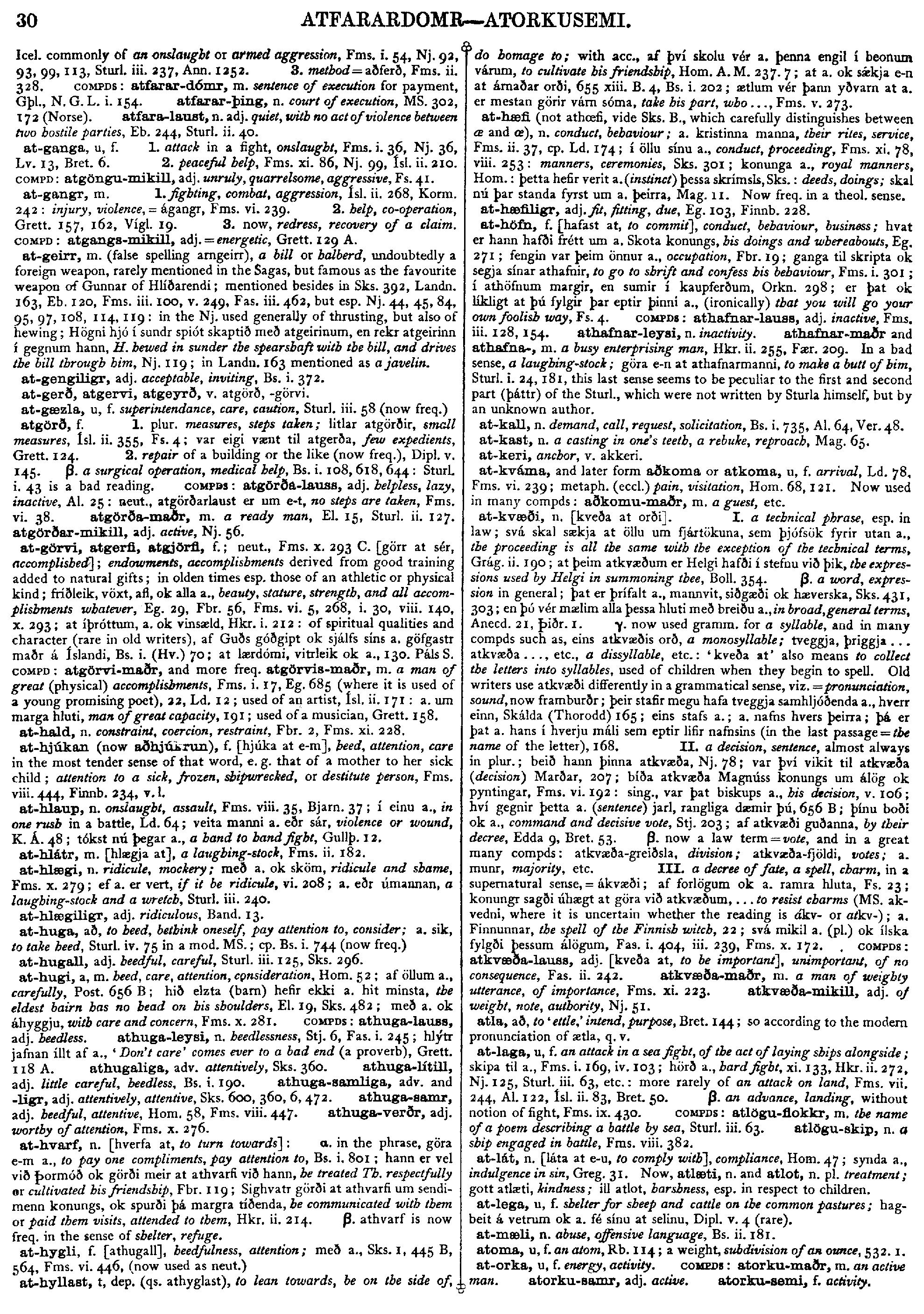
at-kvœði,
n.
[kveða
at
orði].
I.
a
technical
phrase,
esp.
in
law;
svá
skal
sækja
at
öllu
um
fjártökuna,
sem
þjófsök
fyrir
utan
a.,
the
proceeding
is
all
the
same
with
the
exception
of
the
technical
terms,
Grág.
ii.
190;
at
þeim
atkvæðum
er
Helgi
hafði
í
stefnu
við
þik,
the
expres-
sions
used
by
Helgi
in
summoning
thee,
Boll.
354.
.
a
word,
expres-
sion
in
general;
þat
er
þrífalt
a.,
mannvit,
siðgæði
ok
hæverska,
Sks.
431,
303;
en
þó
vér
mælim
alla
þessa
hluti
með
breiðu
a.,
in
broad,
general
terms,
Anecd.
21,
þiðr.
I.
.
now
used
gramm.
for
a
syllable,
and
in
many
compds
such
as,
eins
atkvæðis
orð,
a
monosyllable;
tveggja,
þriggja
...
atkvæða
...,
etc.,
a
dissyllable,
etc.:
'
kveða
at'
also
means
to
collect
the
letters
into
syllables,
used
of
children
when
they
begin
to
spell.
Old
writers
use
atkvæði
differently
in
a
grammatical
sense,
viz.
=
pronunciation,
sound,
now
framburðr;
þeir
stafir
megu
hafa
tveggja
samhljóðenda
a.,
hverr
einn,
Skálda
(Thorodd)
165;
eins
stafs
a.;
a.
nafns
hvers
þeirra;
þá
er
þat
a.
hans
í
hverju
máli
sem
eptir
lifir
nafnsins
(in
the
last
passage
=
the
name
of
the
letter),
168.
II.
a
decision,
sentence,
almost
always
in
plur.;
beið
hann
þinna
atkvæða,
Nj.
78;
var
því
vikit
til
atkvæða
(decision)
Marðar,
207;
bíða
atkvæða
Magnúss
konungs
um
álög
ok
pyntingar,
Fms.
vi.
192:
sing.,
var
þat
biskups
a.,
his
decision,
v.
106;
hvi
gegnir
þetta
a.
(sentence)
jarl,
rangliga
dæmir
þú,
656
B;
þínu
boði
ok
a.,
command
and
decisive
vote,
Stj.
203;
af
atkvæði
guðanna,
by
their
decree,
Edda
9,
Bret.
53.
.
now
a
law
term
=
vote,
and
in
a
great
many
compds:
atkvæða-greiðsla,
division;
atkvzða-fjöldi,
votes;
a.
munr,
majority,
etc.
III.
a
decree
of
fate,
a
spell,
charm,
in
a
supernatural
sense,
=
ákvæði;
af
forlogum
ok
a.
ramra
hluta,
Fs.
23;
konungr
sagði
úhægt
at
göra
við
atkvæðum,
...
to
resist
charms
(MS.
ak-
vedni,
where
it
is
uncertain
whether
the
reading
is
ákv-
or
atkv-);
a.
Finnunnar,
the
spell
of
the
Finnish
witch,
22;
svá
mikil
a.
(pl.)
ok
ilska
fylgði
þessum
álögum,
Fas.
i.
404,
iii.
239,
Fms.
x.
172.,
COMPDS:
atkvæða-lauss,
adj.
[kveða
at,
to
be
important]
,
unimportant,
of
no
consequence,
Fas.
ii.
242.
atkvæða-maðr,
m.
a
man
of
weighty
utterance,
of
importance,
Fms.
xi.
223.
atkvæða-mikill,
adj.
of
weight,
note,
authority,
Nj.
51
|
Source: Cleasby/Vigfusson, page b0048, entry 28 View original page image as: [TIFF] [PNG] [View previous entry] [View next entry] |
[Comment on this entry] [View comments] |
The following entry has been hand-corrected once. |
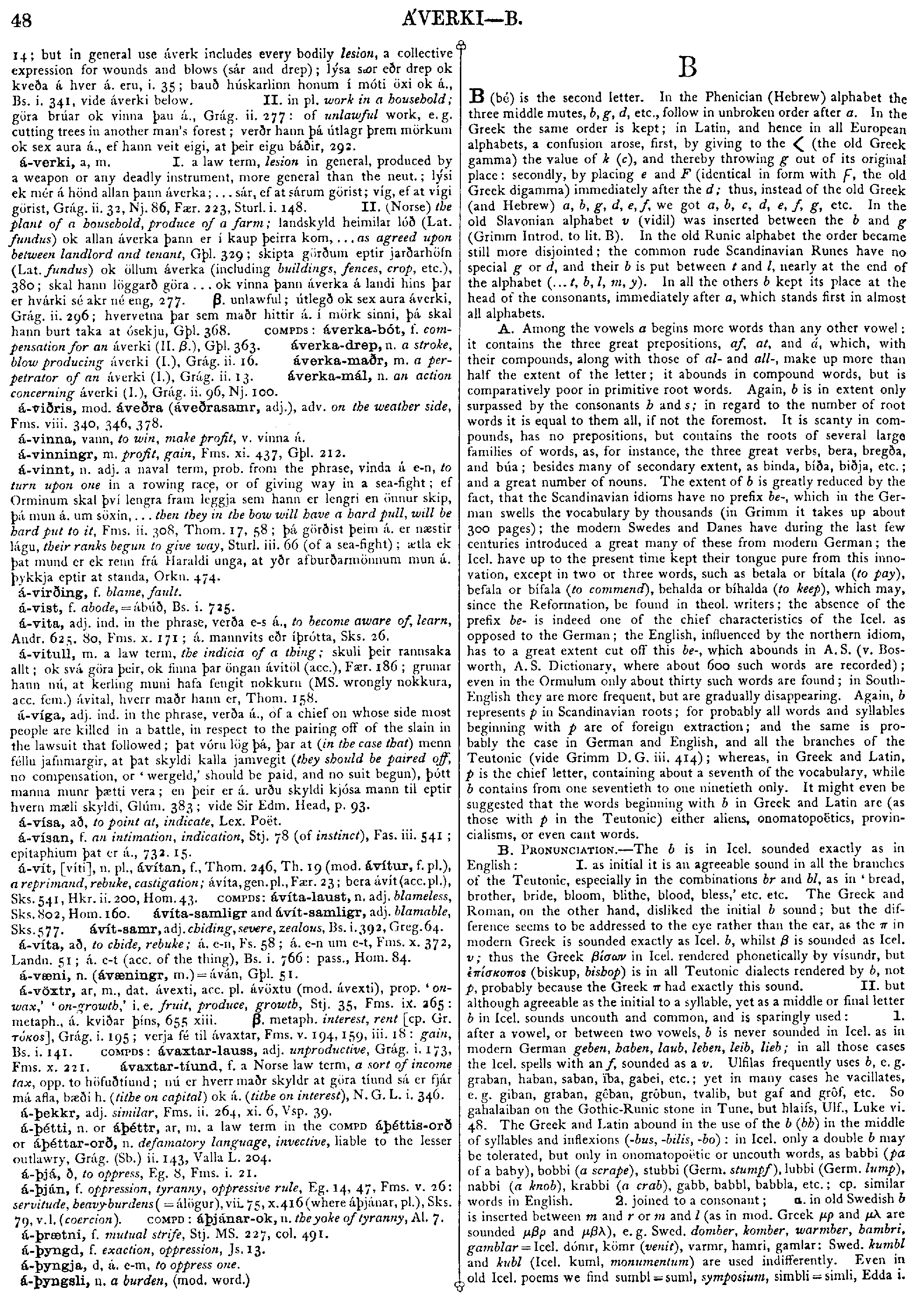
B.
PRONUNCIATION.
--
The
b
is
in
Icel.
sounded
exactly
as
in
English:
I.
as
initial
it
is
an
agreeable
sound
in
all
the
branches
of
the
Teutonic,
especially
in
the
combinations
br
and
bl,
as
in
'bread,
brother,
bride,
bloom,
blithe,
blood,
bless,'
etc.
etc.
The
Greek
and
Roman,
on
the
other
hand,
disliked
the
initial
b
sound;
but
the
difference
seerns
to
be
addressed
to
the
eye
rather
than
the
ear,
as
the
 in
modern
Greek
is
sounded
exactly
as
Icel.
b,
whilst
is
sounded
as
Icel.
v;
thus
the
Greek
GREEK
in
Icel.
rendered
phonetically
by
vísundr,
but
GREEK
(biskup,
bishop)
is
in
all
Teutonic
dialects
rendered
by
b,
not
p,
probably
because
the
Greek
had
exactly
this
sound.
II.
but
although
agreeable
as
the
initial
to
a
syllable,
yet
as
a
middle
or
final
letter
b
in
Icel.
sounds
uncouth
and
common,
and
is
sparingly
used:
1.
after
a
vowel,
or
between
two
vowels,
b
is
never
sounded
in
Icel.
as
in
modern
German
geben,
haben,
laub,
leben,
leib,
lieb;
in
all
those
cases
the
Icel.
spells
with
an
f,
sounded
as
a
v.
Ulfilas
frequently
uses
b,
e.g.
graban,
haban,
saban,
ïba,
gabei,
etc.;
yet
in
many
cases
he
vacillates,
e.g.
giban,
graban,
gêban,
grôbun,
tvalib,
but
gaf
and
grôf,
etc.
So
gahalaiban
on
the
Gothic-Runic
stone
in
Tune,
but
hlaifs,
Ulf.,
Luke
vi.
48.
The
Greek
and
Latin
abound
in
the
use
of
the
b
(bh)
in
the
middle
of
syllables
and
inflexions
(-bus,
-bills,
-bo):
in
Icel.
only
a
double
b
may
be
tolerated,
but
only
in
onomatopoëtic
or
uncouth
words,
as
babbi
(pa
of
a
baby),
bobbi
(a
scrape),
stubbi
(Germ.
stumpf),
lubbi
(Germ.
lump),
nabbi
(a
knob),
krabbi
(a
crab),
gabb,
babbl,
babbla,
etc.;
cp.
similar
words
in
English.
2.
joined
to
a
consonant;
in
modern
Greek
is
sounded
exactly
as
Icel.
b,
whilst
is
sounded
as
Icel.
v;
thus
the
Greek
GREEK
in
Icel.
rendered
phonetically
by
vísundr,
but
GREEK
(biskup,
bishop)
is
in
all
Teutonic
dialects
rendered
by
b,
not
p,
probably
because
the
Greek
had
exactly
this
sound.
II.
but
although
agreeable
as
the
initial
to
a
syllable,
yet
as
a
middle
or
final
letter
b
in
Icel.
sounds
uncouth
and
common,
and
is
sparingly
used:
1.
after
a
vowel,
or
between
two
vowels,
b
is
never
sounded
in
Icel.
as
in
modern
German
geben,
haben,
laub,
leben,
leib,
lieb;
in
all
those
cases
the
Icel.
spells
with
an
f,
sounded
as
a
v.
Ulfilas
frequently
uses
b,
e.g.
graban,
haban,
saban,
ïba,
gabei,
etc.;
yet
in
many
cases
he
vacillates,
e.g.
giban,
graban,
gêban,
grôbun,
tvalib,
but
gaf
and
grôf,
etc.
So
gahalaiban
on
the
Gothic-Runic
stone
in
Tune,
but
hlaifs,
Ulf.,
Luke
vi.
48.
The
Greek
and
Latin
abound
in
the
use
of
the
b
(bh)
in
the
middle
of
syllables
and
inflexions
(-bus,
-bills,
-bo):
in
Icel.
only
a
double
b
may
be
tolerated,
but
only
in
onomatopoëtic
or
uncouth
words,
as
babbi
(pa
of
a
baby),
bobbi
(a
scrape),
stubbi
(Germ.
stumpf),
lubbi
(Germ.
lump),
nabbi
(a
knob),
krabbi
(a
crab),
gabb,
babbl,
babbla,
etc.;
cp.
similar
words
in
English.
2.
joined
to
a
consonant;
 .
in
old
Swedish
b
is
inserted
between
m
and
r
or
m
and
l
(as
in
mod.
Greek
.
in
old
Swedish
b
is
inserted
between
m
and
r
or
m
and
l
(as
in
mod.
Greek

 and
and
 are
sounded
and
,
e.g.
Swed.
domber,
komber,
warmber,
hambri,
gamblar
=
Icel.
dómr,
komr
(venit),
varmr,
hamri,
gamlar:
Swed.
kumbl
and
kubl
(Icel.
kuml,
monumentum)
are
used
indifferently.
Even
in
old
Icel.
poems
we
find
sumbl
=
suml,
symposium,
simbli
=
simli,
Edda
i.
are
sounded
and
,
e.g.
Swed.
domber,
komber,
warmber,
hambri,
gamblar
=
Icel.
dómr,
komr
(venit),
varmr,
hamri,
gamlar:
Swed.
kumbl
and
kubl
(Icel.
kuml,
monumentum)
are
used
indifferently.
Even
in
old
Icel.
poems
we
find
sumbl
=
suml,
symposium,
simbli
=
simli,
Edda
i.
|
Source: Cleasby/Vigfusson, page b0055, entry 6 View original page image as: [TIFF] [PNG] [View previous entry] [View next entry] |
[Comment on this entry] [View comments] |
The following entry has not been hand-corrected. However, the page is reserved and someone is correcting it. |
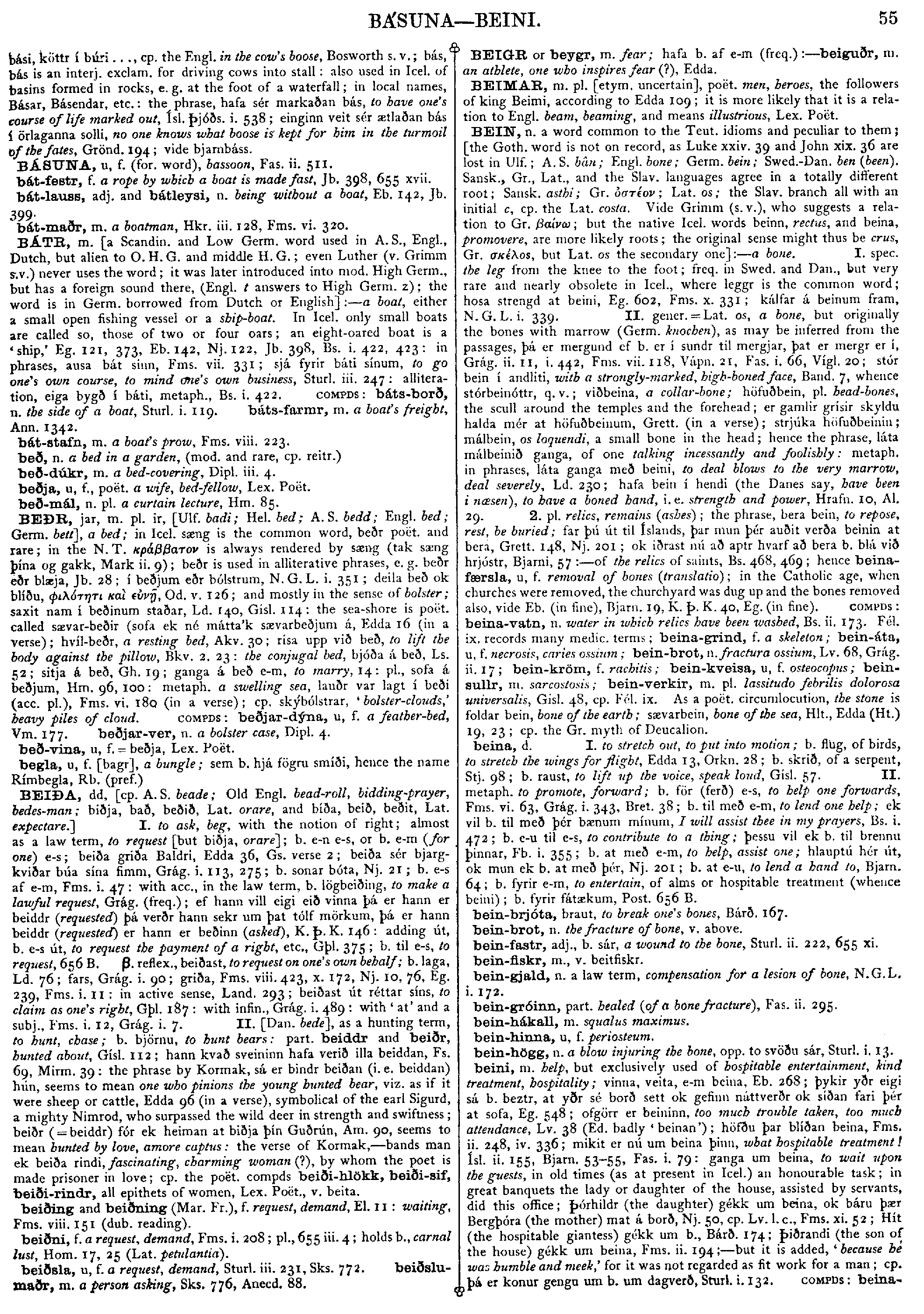
BÁTR,, m. [a Scandin. and Low Germ, word used in A. S., Engl., Dutch, but alien to O. H. G. and middle H. G.; even Luther (v. Grimm y. v.) never uses the word; it was later introduced into mod. High Germ., but has a foreign sound there, (Engl. t answers to High Germ, z); the word is in Germ, borrowed from Dutch or English] :-- a boat, either a small open fishing vessel or a shi p- boat. In Icel. only small boats are called so, those of two or four oars; an eight-oared boat is a 'ship, ' Eg. 121, 373, Eb. 142, Nj. 122, Jb. 398, Bs. 1. 422, 423: in phrases, ausa bat sinn, Fms. vii. 331; sjá fyrir báti sínum, to go one's own course, to mind erne's own business, Sturl. iii. 247: allitera- tion, eiga bygð í báti, metaph., Bs. i. 422. COMPDS: báts-borð, n. the s ide of a boat, Sturl. i. 119. báts-farmr, m. a boat's freight, Ann. 1342.
|
Source: Cleasby/Vigfusson, page b0059, entry 1 View original page image as: [TIFF] [PNG] [View previous entry] [View next entry] |
[Comment on this entry] [View comments] |
The following entry has been hand-corrected once. |
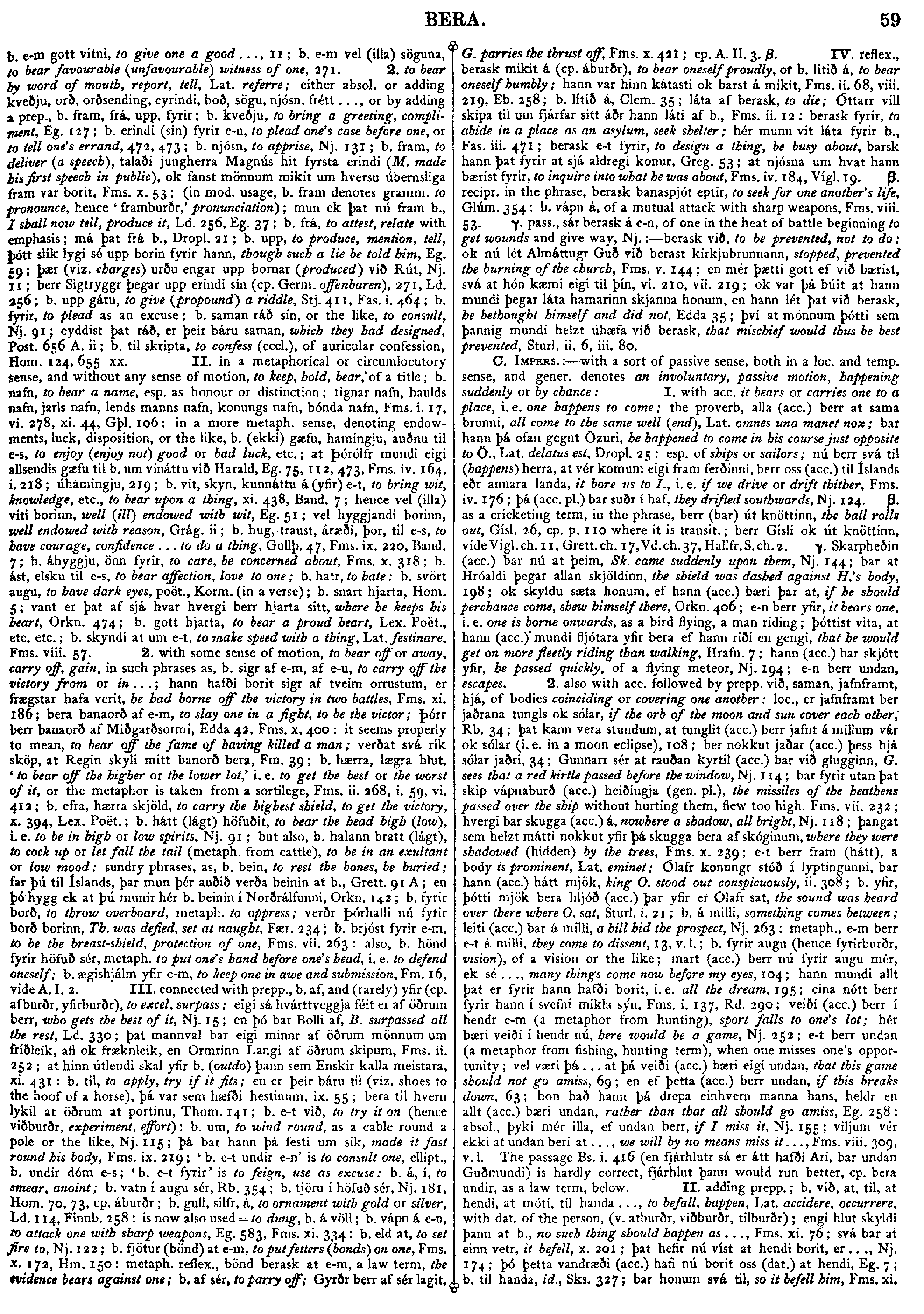
b.
e-m
gott
vitni,
to
give
one
a
good...,
11;
b.
e-m
vel
(illa)
söguna,
to
bear
favourable
(unfavourable)
witness
of
one,
271.
2.
to
bear
by
word
of
mouth,
report,
tell,
Lat.
referre;
either
absol.
or
adding
kveðju,
orð,
orðsending,
eyrindi,
boð,
sögu,
njósn,
frétt...,
or
by
adding
a
prep.,
b.
fram,
frá,
upp,
fyrir;
b.
kveðju,
to
bring
a
greeting,
compliment,
Eg.
127;
b.
erindi
(sín)
fyrir
e-n,
to
plead
one's
case
before
one,
or
to
tell
one's
errand,
472,
473;
b.
njósn,
to
apprise,
Nj.
131;
b.
fram,
to
deliver
(a
speech),
talaði
jungherra
Magnús
hit
fyrsta
erindi
(M.
made
his
first
speech
in
public),
ok
fanst
mönnum
mikit
um
hversu
úbernsliga
fram
var
borit,
Fms.
x.
53;
(in
mod.
usage,
b.
fram
denotes
gramm.
to
pronounce,
hence
'framburðr,'
pronunciation);
mun
ek
þat
nú
fram
b.,
I
shall
now
tell,
produce
it,
Ld.
256,
Eg.
37;
b.
frá,
to
attest,
relate
with
emphasis;
má
þat
frá
b.,
Dropl.
21;
b.
upp,
to
produce,
mention,
tell,
þótt
slík
lygi
sé
upp
borin
fyrir
hann,
though
such
a
lie
be
told
him,
Eg.
59;
þær
(viz.
charges)
urðu
engar
upp
bornar
(produced)
við
Rút,
Nj.
11;
berr
Sigtryggr
þegar
upp
erindi
sín
(cp.
Germ.
ojfenbaren),
271,
Ld.
256;
b.
upp
gátu,
to
give
(propound)
a
riddle,
Stj.
411,
Fas.
i.
464;
b.
fyrir,
to
plead
as
an
excuse;
b.
saman
ráð
sín,
or
the
like,
to
consult,
Nj.
91;
eyddist
þat
ráð,
er
þeir
báru
saman,
which
they
had
designed,
Post.
656
A.
ii;
b.
til
skripta,
to
confess
(eccl.),
of
auricular
confession,
Hom.
124,
655
xx.
II.
in
a
metaphorical
or
circumlocutory
sense,
and
without
any
sense
of
motion,
to
keep,
hold,
bear,
of
a
title;
b.
nafn,
to
bear
a
name,
esp.
as
honour
or
distinction;
tignar
nafn,
haulds
nafn,
jarls
nafn,
lends
manns
nafn,
konungs
nafn,
bónda
nafn,
Fms.
i.
17,
vi.
278,
xi.
44,
Gþl.
106:
in
a
more
metaph.
sense,
denoting
endowments,
luck,
disposition,
or
the
like,
b.
(ekki)
gæfu,
hamingju,
auðnu
til
e-s,
to
enjoy
(enjoy
not)
good
or
bad
luck,
etc.;
at
Þórólfr
mundi
eigi
allsendis
gæfu
til
b.
um
vináttu
við
Harald,
Eg.
75,
112,
473,
Fms.
iv.
164,
i.
218;
úhamingju,
219;
b.
vit,
skyn,
kunnáttu
á
(yfir)
e-t,
to
bring
wit,
knowledge,
etc.,
to
bear
upon
a
thing,
xi.
438,
Band.
7;
hence
vel
(illa)
viti
borinn,
well
(ill)
endowed
with
wit,
Eg.
51;
vel
hyggjandi
borinn,
well
endowed
with
reason,
Grág.
ii;
b.
hug,
traust,
áræði,
þor,
til
e-s,
to
have
courage,
confidence
...
to
do
a
thing,
Gullþ.
47,
Fms.
ix.
220,
Band.
7;
b.
áhyggju,
önn
fyrir,
to
care,
be
concerned
about,
Fms.
x.
318;
b.
ást,
elsku
til
e-s,
to
bear
affection,
love
to
one;
b.
hatr,
to
hate:
b.
svört
augu,
to
have
dark
eyes,
poët.,
Korm.
(in
a
verse);
b.
snart
hjarta,
Hom.
5;
vant
er
þat
af
sjá
hvar
hvergi
berr
hjarta
sitt,
where
he
keeps
his
heart,
Orkn.
474;
b.
gott
hjarta,
to
bear
a
proud
heart,
Lex.
Poët.,
etc.
etc.;
b.
skyndi
at
um
e-t,
to
make
speed
with
a
thing,
Lat.
festinare,
Fms.
viii.
57.
2.
with
some
sense
of
motion,
to
bear
off
or
away,
carry
off,
gain,
in
such
phrases
as,
b.
sigr
af
e-m,
af
e-u,
to
carry
off
the
victory
from
or
in
...;
hann
hafði
borit
sigr
af
tveim
orrustum,
er
frægstar
hafa
verit,
he
had
borne
off
the
victory
in
two
battles,
Fms.
xi.
186;
bera
banaorð
af
e-m,
to
slay
one
in
a
fight,
to
be
the
victor;
Þorr
berr
banaorð
af
Miðgarðsormi,
Edda
42,
Fms.
x.
400:
it
seems
properly
to
mean,
to
bear
off
the
fame
of
having
killed
a
man;
verðat
svá
rík
sköp,
at
Regin
skyli
mitt
banorð
bera,
Fm.
39;
b.
hærra,
lægra
hlut,
'to
bear
off
the
higher
or
the
lower
lot,'
i.
e.
to
get
the
best
or
the
worst
of
it,
or
the
metaphor
is
taken
from
a
sortilege,
Fms.
ii.
268,
i.
59,
vi.
412;
b.
efra,
hærra
skjöld,
to
carry
the
highest
shield,
to
get
the
victory,
x.
394,
Lex.
Poët.;
b.
hátt
(lágt)
höfuðit,
to
bear
the
head
high
(low),
i.
e.
to
be
in
high
or
low
spirits,
Nj.
91;
but
also,
b.
halann
bratt
(lágt),
to
cock
up
or
let
fall
the
tail
(metaph.
from
cattle),
to
be
in
an
exultant
or
low
mood:
sundry
phrases,
as,
b.
bein,
to
rest
the
bones,
be
buried;
far
þú
til
Íslands,
þar
mun
þér
auðið
verða
beinin
at
b.,
Grett.
91
A;
en
þó
hygg
ek
at
þú
munir
hér
b.
beinin
í
Norðrálfunni,
Orkn.
142;
b.
fyrir
borð,
to
throw
overboard,
metaph.
to
oppress;
verðr
Þórhalli
nú
fyrir
borð
borinn,
Th.
was
defied,
set
at
naught,
Fær.
234;
b.
brjóst
fyrir
e-m,
to
be
the
breast-shield,
protection
of
one,
Fms.
vii.
263:
also,
b.
hönd
fyrir
höfuð
sér,
metaph.
to
put
one's
hand
before
one's
head,
i.
e.
to
defend
oneself;
b.
ægishjálm
yfir
e-m,
to
keep
one
in
awe
and
submission,
Fm.
16,
vide
A.
I.
2.
III.
connected
with
prepp.,
b.
af,
and
(rarely)
yfir
(cp.
afburðr,
yfirburðr),
to
excel,
surpass;
eigi
sá
hvárttveggja
féit
er
af
öðrum
berr,
who
gets
the
best
of
it,
Nj.
15;
en
þó
bar
Bolli
af,
B.
surpassed
all
the
rest,
Ld.
330;
þat
mannval
bar
eigi
minnr
af
öðrum
mönnum
um
fríðleik,
afi
ok
fræknleik,
en
Ormrinn
Langi
af
öðrum
skipum,
Fms.
ii.
252;
at
hinn
útlendi
skal
yfir
b.
(outdo)
þann
sem
Enskir
kalla
meistara,
xi.
431:
b.
til,
to
apply,
try
if
it
fits;
en
er
þeir
báru
til
(viz.
shoes
to
the
hoof
of
a
horse),
þá
var
sem
hæfði
hestinum,
ix.
55;
bera
til
hvern
lykil
at
öðrum
at
portinu,
Thom.
141;
b.
e-t
við,
to
try
it
on
(hence
viðburðr,
experiment,
effort):
b.
um,
to
wind
round,
as
a
cable
round
a
pole
or
the
like,
Nj.
115;
þá
bar
hann
þá
festi
um
sik,
made
it
fast
round
his
body,
Fms.
ix.
219;
'b.
e-t
undir
e-n'
is
to
consult
one,
ellipt.,
b.
undir
dóm
e-s;
'b.
e-t
fyrir'
is
to
feign,
use
as
excuse:
b.
á,
í,
to
smear,
anoint;
b.
vatn
í
augu
sér,
Rb.
354;
b.
tjöru
í
höfuð
sér,
Nj.
181,
Hom.
70,
73,
cp.
áburðr;
b.
gull,
silfr,
á,
to
ornament
with
gold
or
silver,
Ld.
114,
Finnb.
258:
is
now
also
used
=
to
dung,
b.
á
völl;
b.
vápn
á
e-n,
to
attack
one
with
sharp
weapons,
Eg.
583,
Fms.
xi.
334:
b.
eld
at,
to
set
fire
to,
Nj.
122;
b.
fjötur
(bönd)
at
e-m,
to
put
fetters
(bonds)
on
one,
Fms.
x.
172,
Hm.
150:
metaph.
reflex.,
bönd
berask
at
e-m,
a
law
term,
the
evidence
bears
against
one;
b.
af
sér,
to
parry
off;
Gyrðr
berr
af
sér
lagit,
G.
parries
the
thrust
off,
Fms.
x.
421;
cp.
A.
II.
3.
.
IV.
reflex.,
berask
mikit
á
(cp.
áburðr),
to
bear
oneself
proudly,
or
b.
lítið
á,
to
bear
oneself
humbly;
hann
var
hinn
kátasti
ok
barst
á
mikit,
Fms.
ii.
68,
viii.
219,
Eb.
258;
b.
lítið
á,
Clem.
35;
láta
af
berask,
to
die;
Óttarr
vill
skipa
til
um
fjárfar
sitt
áðr
hann
láti
af
b.,
Fms.
ii.
12:
berask
fyrir,
to
abide
in
a
place
as
an
asylum,
seek
shelter;
hér
munu
vit
láta
fyrir
b.,
Fas.
iii.
471;
berask
e-t
fyrir,
to
design
a
thing,
be
busy
about,
barsk
hann
þat
fyrir
at
sjá
aldregi
konur,
Greg.
53;
at
njósna
um
hvat
hann
bærist
fyrir,
to
inquire
into
what
he
was
about,
Fms.
iv.
184,
Vígl.
19.
.
recipr.
in
the
phrase,
berask
banaspjót
eptir,
to
seek
for
one
another's
life,
Glúm.
354:
b.
vápn
á,
of
a
mutual
attack
with
sharp
weapons,
Fms.
viii.
53.
.
pass.,
sár
berask
á
e-n,
of
one
in
the
heat
of
battle
beginning
to
get
wounds
and
give
way,
Nj.
:--
berask
við,
to
be
prevented,
not
to
do;
ok
nú
lét
Almáttugr
Guð
við
berast
kirkjubrunnann,
stopped,
prevented
the
burning
of
the
church,
Fms.
v.
144;
en
mér
þætti
gott
ef
við
bærist,
svá
at
hón
kæmi
eigi
til
þín,
vi.
210,
vii.
219;
ok
var
þá
búit
at
hann
mundi
þegar
láta
hamarinn
skjanna
honum,
en
hann
lét
þat
við
berask,
he
bethought
himself
and
did
not,
Edda
35;
því
at
mönnum
þótti
sem
þannig
mundi
helzt
úhæfa
við
berask,
that
mischief
would
thus
be
best
prevented,
Sturl.
ii.
6,
iii.
80.
C.
IMPERS.
:--
with
a
sort
of
passive
sense,
both
in
a
loc.
and
temp.
sense,
and
gener.
denotes
an
involuntary,
passive
motion,
happening
suddenly
or
by
chance:
I.
with
acc.
it
bears
or
carries
one
to
a
place,
i.
e.
one
happens
to
come;
the
proverb,
alla
(acc.)
berr
at
sama
brunni,
all
come
to
the
same
well
(end),
Lat.
omnes
una
manet
nox;
bar
hann
þá
ofan
gegnt
Özuri,
he
happened
to
come
in
his
course
just
opposite
to
Ö.,
Lat.
delatus
est,
Dropl.
25:
esp.
of
ships
or
sailors;
nú
berr
svá
til
(happens)
herra,
at
vér
komum
eigi
fram
ferðinni,
berr
oss
(acc.)
til
Íslands
eðr
annara
landa,
it
bore
us
to
I.,
i.
e.
if
we
drive
or
drift
thither,
Fms.
iv.
176;
þá
(acc.
pl.)
bar
suðr
í
haf,
they
drifted
southwards,
Nj.
124.
.
as
a
cricketing
term,
in
the
phrase,
berr
(bar)
út
knöttinn,
the
ball
rolls
out,
Gísl.
26,
cp.
p.
110
where
it
is
transit.;
berr
Gísli
ok
út
knöttinn,
vide
Vígl.
ch.
11,
Grett.
ch.
17,
Vd.
ch.
37,
Hallfr.
S.
ch.
2.
.
Skarpheðin
(acc.)
bar
nú
at
þeim,
Sk.
came
suddenly
upon
them,
Nj.
144;
bar
at
Hróaldi
þegar
allan
skjöldinn,
the
shield
was
dashed
against
H.'s
body,
198;
ok
skyldu
sæta
honum,
ef
hann
(acc.)
bæri
þar
at,
if
he
should
per
chance
come,
shew
himself
there,
Orkn.
406;
e-n
berr
yfir,
it
bears
one,
i.
e.
one
is
borne
onwards,
as
a
bird
flying,
a
man
riding;
þóttist
vita,
at
hann
(acc.)
mundi
fljótara
yfir
bera
ef
hann
riði
en
gengi,
that
he
would
get
on
more
fleetly
riding
than
walking,
Hrafn.
7;
hann
(acc.)
bar
skjótt
yfir,
he
passed
quickly,
of
a
flying
meteor,
Nj.
194;
e-n
berr
undan,
escapes.
2.
also
with
acc.
followed
by
prepp.
við,
saman,
jafnframt,
hjá,
of
bodies
coinciding
or
covering
one
another:
loc.,
er
jafnframt
ber
jaðrana
tungls
ok
sólar,
if
the
orb
of
the
moon
and
sun
cover
each
other,
Rb.
34;
þat
kann
vera
stundum,
at
tunglit
(acc.)
berr
jafht
á
millum
vár
ok
sólar
(i.
e.
in
a
moon
eclipse),
108;
ber
nokkut
jaðar
(acc.)
þess
hjá
sólar
jaðri,
34;
Gunnarr
sér
at
rauðan
kyrtil
(acc.)
bar
við
glugginn,
G.
sees
that
a
red
kirtle
passed
before
the
window,
Nj.
114;
bar
fyrir
utan
þat
skip
vápnaburð
(acc.)
heiðingja
(gen.
pl.),
the
missiles
of
the
heathens
passed
over
the
ship
without
hurting
them,
flew
too
high,
Fms.
vii.
232;
hvergi
bar
skugga
(acc.)
á,
nowhere
a
shadow,
all
bright,
Nj.
118;
þangat
sem
helzt
mátti
nokkut
yfir
þá
skugga
bera
af
skóginum,
where
they
were
shadowed
(hidden)
by
the
trees,
Fms.
x.
239;
e-t
berr
fram
(hátt),
a
body
is
prominent,
Lat.
eminet;
Ólafr
konungr
stóð
í
lyptingunni,
bar
hann
(acc.)
hátt
mjök,
king
O.
stood
out
conspicuously,
ii.
308;
b.
yfir,
þótti
mjök
bera
hljóð
(acc.)
þar
yfir
er
Ólafr
sat,
the
sound
was
heard
over
there
where
O.
sat,
Sturl.
i.
21;
b.
á
milli,
something
comes
between;
leiti
(acc.)
bar
á
milli,
a
hill
hid
the
prospect,
Nj.
263:
metaph.,
e-m
berr
e-t
á
milli,
they
come
to
dissent,
13,
v.
1.;
b.
fyrir
augu
(hence
fyrirburðr,
vision),
of
a
vision
or
the
like;
mart
(acc.)
berr
nú
fyrir
augu
mér,
ek
sé
...,
many
things
come
now
before
my
eyes,
104;
hann
mundi
allt
þat
er
fyrir
hann
hafði
borit,
i.
e.
all
the
dream,
195;
eina
nótt
berr
fyrir
hann
í
svefni
mikla
sýn,
Fms.
i.
137,
Rd.
290;
veiði
(acc.)
berr
í
hendr
e-m
(a
metaphor
from
hunting),
sport
falls
to
one's
lot;
hér
bæri
veiði
í
hendr
nú,
here
would
be
a
game,
Nj.
252;
e-t
berr
undan
(a
metaphor
from
fishing,
hunting
term),
when
one
misses
one's
opportunity;
vel
væri
þá
...
at
þá
veiði
(acc.)
bæri
eigi
undan,
that
this
game
should
not
go
amiss,
69;
en
ef
þetta
(acc.)
berr
undan,
if
this
breaks
down,
63;
hon
bað
hann
þá
drepa
einhvern
manna
hans,
heldr
en
allt
(acc.)
bæri
undan,
rather
than
that
all
should
go
amiss,
Eg.
258:
absol.,
þyki
mér
illa,
ef
undan
berr,
if
I
miss
it,
Nj.
155;
viljum
vér
ekki
at
undan
beri
at...,
we
will
by
no
means
miss
it...,
Fms.
viii.
309,
v.
1.
The
passage
Bs.
i.
416
(en
fjárhlutr
sá
er
átt
hafði
Ari,
bar
undan
Guðmundi)
is
hardly
correct,
fjárhlut
þann
would
run
better,
cp.
bera
undir,
as
a
law
term,
below.
II.
adding
prepp.;
b.
við,
at,
til,
at
hendi,
at
móti,
til
handa
...,
to
befall,
happen,
Lat.
accidere,
occurrere,
with
dat.
of
the
person,
(v.
atburðr,
viðburðr,
tilburðr);
engi
hlut
skyldi
þann
at
b.,
no
such
thing
should
happen
as...,
Fms.
xi.
76;
svá
bar
at
einn
vetr,
it
befell,
x.
201;
þat
hefir
nú
víst
at
hendi
borit,
er...,
Nj.
174;
þó
þetta
vandræði
(acc.)
hafi
nú
borit
oss
(dat.)
at
hendi,
Eg.
7;
b.
til
handa,
id.,
Sks.
327;
bar
honum
svá
til,
so
it
befell
him,
Fms.
|
Source: Cleasby/Vigfusson, page b0063, entry 1 View original page image as: [TIFF] [PNG] [View previous entry] [View next entry] |
[Comment on this entry] [View comments] |
The following entry has been hand-corrected once. |
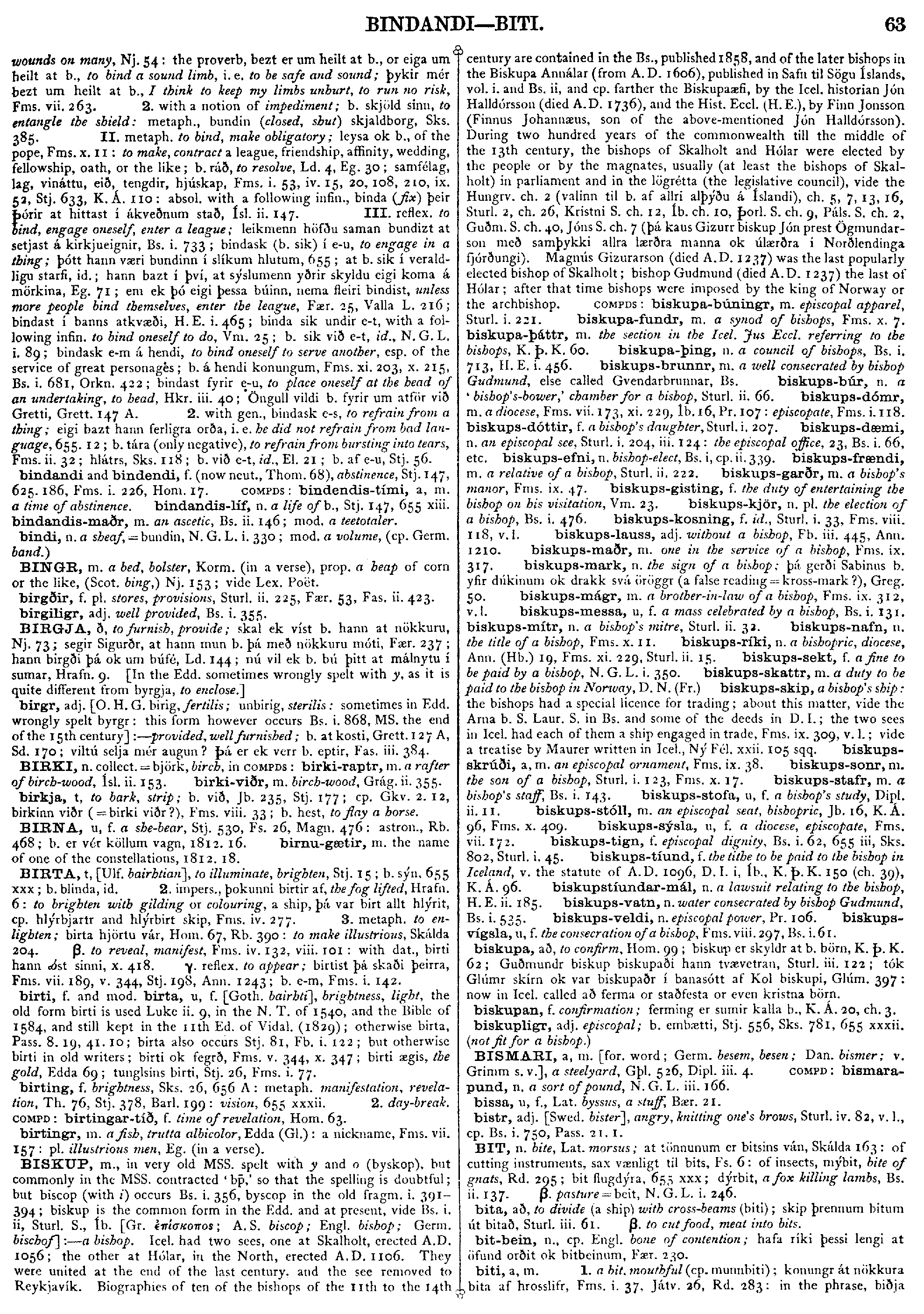
wounds on many, Nj. 54: the proverb, bezt er um heilt at b., or eiga um heilt at b., to bind a sound limb, i.e. to be safe and sound; þykir mér bezt um heilt at b., I think to keep my limbs unhurt, to run no risk, Fms. vii. 263. 2. with a notion of impediment; b. skjöld sinn, to entangle the shield: metaph., bundin (closed, shut) skjaldborg, Sks. 385. II. metaph. to bind, make obligatory; leysa ok b., of the pope, Fms. x. 11: to make, contract a league, friendship, affinity, wedding, fellowship, oath, or the like; b. ráð, to resolve, Ld. 4, Eg. 30; samfélag, lag, vináttu, eið, tengdir, hjúskap, Fms. i. 53, iv. 15, 20, 108, 210, ix. 52, Stj. 633, K. Á. 110: absol. with a following infin., binda (fix) þeir Þórir at hittast í ákveðnum stað, Ísl. ii. 147. III. reflex, to bind, engage oneself, enter a league; leikmenn höfðu saman bundizt at setjast á kirkjueignir, Bs. i. 733; bindask (b. sik) í e-u, to engage in a thing; þótt hann væri bundinn í slíkum hlutum, 655; at b. sik í veraldligu starfi, id.; hann bazt í því, at sýslumenn yðrir skyldu eigi koma á mörkina, Eg. 71; em ek þó eigi þessa búinn, nema fleiri bindist, unless more people bind themselves, enter the league, Fær. 25, Valla L. 216; bindast í banns atkvæði, H. E. i. 465; binda sik undir e-t, with a following infin. to bind oneself to do, Vm. 25; b. sik við e-t, id., N. G. L. i. 89; bindask e-m á hendi, to bind oneself to serve another, esp. of the service of great personages; b. á hendi konungum, Fms. xi. 203, x. 215, Bs. i. 681, Orkn. 422; bindast fyrir e-u, to place oneself at the head of an undertaking, to head, Hkr. iii. 40; Öngull vildi b. fyrir um atför við Gretti, Grett. 147 A. 2. with gen., bindask e-s, to refrain from a thing; eigi bazt harm ferligra orða, i.e. he did not refrain from bad language, 655. 12; b. tára (only negative), to refrain from bursting into tears, Fms. ii. 32; hlátrs, Sks. 118; b. við e-t, id., El. 21; b. af e-u, Stj. 56.
|
Source: Cleasby/Vigfusson, page b0064, entry 25 View original page image as: [TIFF] [PNG] [View previous entry] [View next entry] |
[Comment on this entry] [View comments] |
The following entry has been hand-corrected once. |
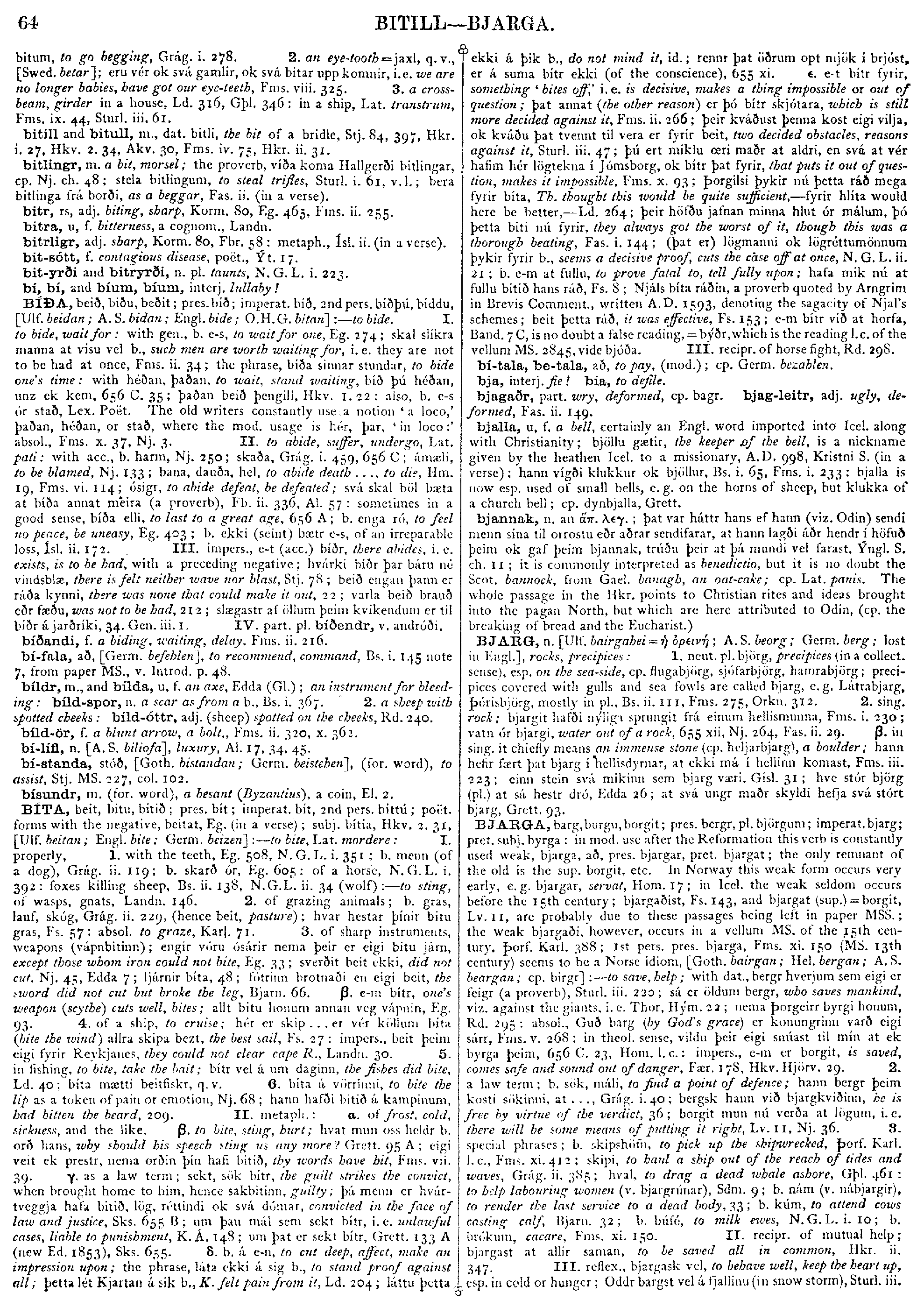
BJARGA, barg, burgu, borgit; pres. bergr, pl. björgum; imperat. bjarg; pret. subj. byrga: in mod. use after the Reformation this verb is constantly used weak, bjarga, að, pres. bjargar, pret. bjargat; the only remnant of the old is the sup. borgit, etc. In Norway this weak form occurs very early, e.g. bjargar, servat, Hom. 17; in Icel. the weak seldom occurs before the 15th century; bjargaðist, Fs. 143, and bjargat (sup.) = borgit, Lv. 11, are probably due to these passages being left in paper MSS.; the weak bjargaði, however, occurs in a vellum MS. of the 15th century, Þorf. Karl. 388; 1st pers. pres. bjarga, Fms. xi. 150 (MS. 13th century) seems to be a Norse idiom, [Goth. bairgan; Hel. bergan; A. S. beargan; cp. birgr] :-- to save, help; with dat., bergr hverjum sem eigi er feigr (a proverb), Sturl. iii. 220; sá er öldum bergr, who saves mankind, viz. against the giants, i.e. Thor, Hým. 22; nema Þorgeirr byrgi honum, Rd. 295: absol., Guð barg (by God's grace) er konungrinn varð eigi sárr, Fms. v. 268: in theol. sense, vildu þeir eigi snúast til mín at ek byrga þeim, 656 C. 23, Hom. l.c.: impers., e-m er borgit, is saved, comes safe and sound out of danger, Fær. 178, Hkv. Hjörv. 29. 2. a law term; b. sök, máli, to find a point of defence; hann bergr þeim kosti sökinni, at ..., Grág. i. 40; bergsk hann við bjargkviðinn, he is free by virtue of the verdict, 36; borgit mun nú verða at lögum, i.e. there will be some means of putting it right, Lv. 11, Nj. 36. 3. special phrases; b. skipshöfn, to pick up the shipwrecked, Þorf. Karl. l.c., Fms. xi. 412; skipi, to haul a ship out of the reach of tides and waves, Grág. ii. 385; hval, to drag a dead whale ashore, Gþl. 461: to help labouring women (v. bjargrúnar), Sdm. 9; b. nám (v. nábjargir), to render the last service to a dead body, 33; b. kúm, to attend cows casting calf, Bjarn. 32; b. búfé, to milk ewes, N. G. L. i. 10; b. brókum, cacare, Fms. xi. 150. II. recipr. of mutual help; bjargast at allir saman, to be saved all in common, Hkr. ii. 347. III. reflex., bjargask vel, to behave well, keep the heart up, esp. in cold or hunger; Oddr bargst vel á fjallinu (in snow storm), Sturl. iii.
|
Source: Cleasby/Vigfusson, page b0068, entry 4 View original page image as: [TIFF] [PNG] [View previous entry] [View next entry] |
[Comment on this entry] [View comments] |
The following entry has not been hand-corrected. However, the page is reserved and someone is correcting it. |
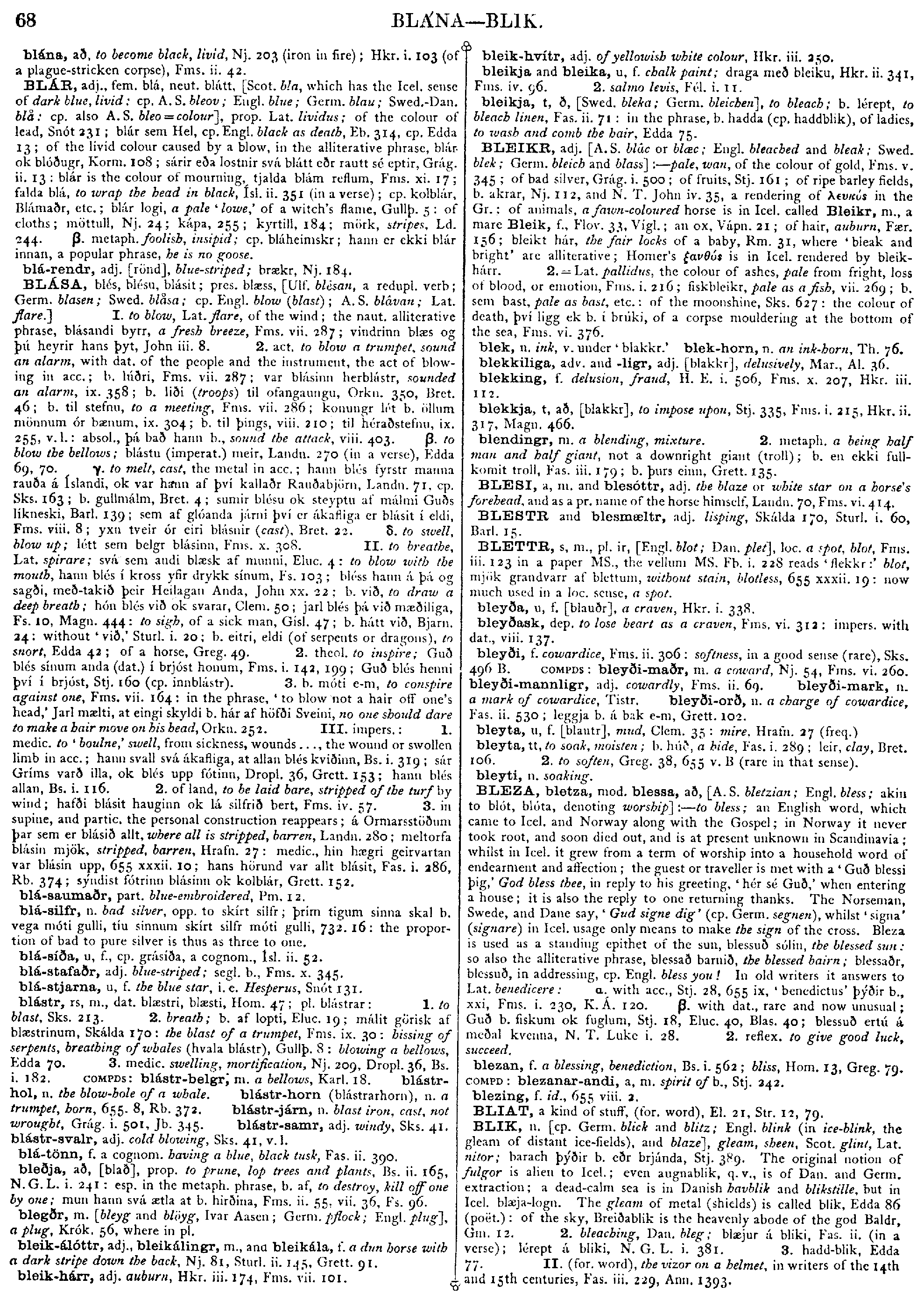
BLÁSA, blós, bk'-su, blásit; pres. blæss, [Ulf. blcsan, a redupl. verb; Germ, blasen; Swed. bla s a; cp. Engl. blow (blast); A. S. blâvan; Lat. flare. ~] I. to blow, Lat. flare, of the wind; the naut. alliterative phrase, blásandi byrr, a fresh breeze, Fms. vii. 287; vindrinn blæs og þú heyrir hans þyt, John iii. 8. 2. act. to blow a trumpet, sound an alarm, with dat. of the people and the instrument, the act of blow- ing in acc.; b. lúðri, Fms. vii. 287; var blásinn herblastr, so unded an alarm, ix. 358; b. liði (troops) til ofanganngu, Orkn. 350, Bret. 46; b. til stefnu, to a meeting, Fms. vii. 286; konungr let b. öllum niünnum ór bænum, ix. 304; b. til þings, viii. 2IO; til heraðstefnu, ix. 255, v. 1.: absol., þá bað hann b., sound the attack, viii. 403. P. t o hl ow the bellows; blásíu (imperat.) meir, Landn. 270 (in a verse), Edda 69, 70. Y- '0 welt, cast, the metal in acc.; hann bli's fyrstr manna rauða á Islandi, ok var hïnn af því kallaðr Rauðabjörii, Landn. 'jï, cp. Sks. 163; b. gullmalm, Bret. 4; sumir blésu ok steyptu af malmi Guos Hkneski, Bad. 139; sem af glóanda járni því er ákarliga er blúsit í eldi, Fms. viii. 8; yxn tveir or eiri blásnir (cast), Bret. 22. S. to swell, blow tip; lótt sem belgr blásinn, Fms. x. 308. II. to breathe, Lat. spirare; svá sem andi blxsk af nmnni, Eluc. 4: to blow with the mouth, hann blés í kross yfir drykk sinum, Fs. 103; bless hann á bá og sagði, með-takið þeir Heilagan Anda, John xx. 22; b. við, to draw a deep breath; hón blés við ok svarar, Clem. 50; jarl blés þá við mæðiliga, Fs. 1O, Magn. 444: to sigh, of a sick man, Gísl. 47; b. halt við, Bjarn. 24: without ' við, ' Sturl. i. 20; b. eitri, eldi (of serpents or dragons), t o snort, Edda 42; of a horse, Greg. 49. 2. theol. to inspire; Guð bids sinum auda (dat.) í brjost honum, Fms. i. 142, 199; Guð blés henni því í brjóst, Stj. 160 (cp. innblástr). 3. b. mod e-m, to conspire against one, Fms. vii. 164: in the phrase, ' to blow not a hair off one's head, ' Jarl mælti, at eingi skyldi b. hár af höfði Sveini, no one should dare to make a hair move on his head, Orkn. 252. III. impers.: 1. medic, t o ' boulne, ' swell, from sickness, wounds ..., the wound or swollen limb in acc.; hann svall svá ákafliga, at allan blés kviðinn, Bs. i. 319; sár Grims varð ilia, ok blés upp fótinn, Dropl. 36, Grett. 153; hann blés allan, Bs. i. ll6. 2. of land, to be laid bare, stripped of the turf by wind; hafði blásit hauginn ok lá silfrið bert, Fms. iv. 57. 3. in supine, and partic. the personal construction reappears; á Ormarsstöðum þar sem er blásið allt, where all is stripped, barren, Landn. 280; meltorfa blásin mjök, stripped, barren, Hrafn. 27: medic., hin hægri geirvartan var blásin upp, 655 xxxii. 10; hans horund var allt blásit, Fas. i. 286, Rb. 374; syndist fótrinn blásinn ok kolblár, Grett.
|
Source: Cleasby/Vigfusson, page b0079, entry 14 View original page image as: [TIFF] [PNG] [View previous entry] [View next entry] |
[Comment on this entry] [View comments] |
The following entry has been hand-corrected once. |
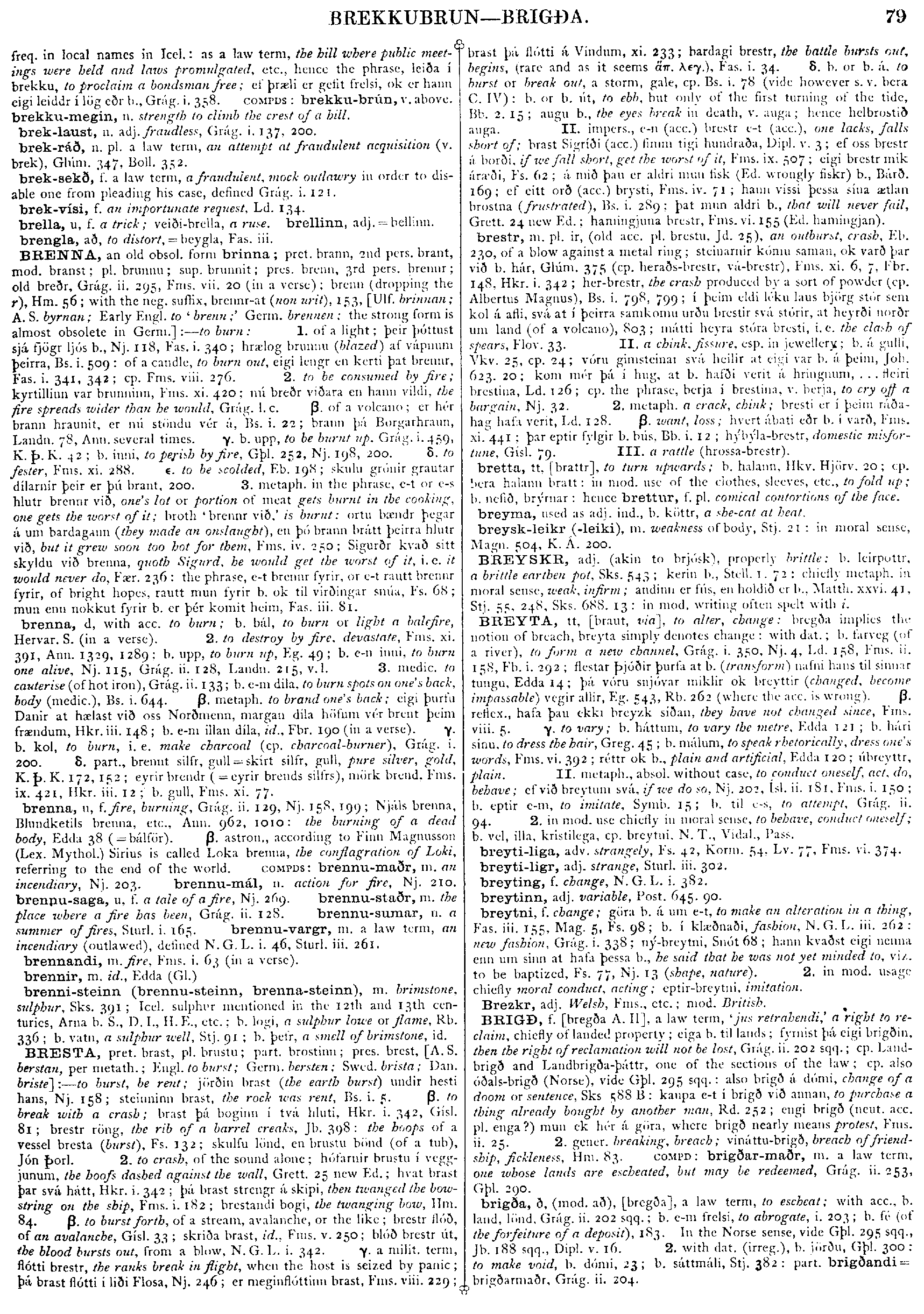
BRESTA,
pret.
brast,
pl.
brustu;
part.
brostinn;
pres.
brest,
[A.
S.
berstan,
per
metath.;
Engl.
to
burst;
Germ.
bersten;
Swed.
brista;
Dan.
briste]
:--
to
burst,
be
rent;
jörðin
brast
(the
earth
burst)
undir
hesti
hans,
Nj.
158;
steinninn
brast,
the
rock
was
rent,
Bs.
i.
5.
.
to
break
with
a
crash;
brast
þú
boginn
í
tvá
hluti,
Hkr.
i.
342,
Gísl.
81;
brestr
röng,
the
rib
of
a
barrel
creaks,
Jb.
398:
the
hoops
of
a
vessel
bresta
(burst),
Fs.
132;
skulfu
lönd,
en
brustu
bönd
(of
a
tub),
Jón
Þorl.
2.
to
crash,
of
the
sound
alone;
hófarnir
brustu
í
veggjunum,
the
hoofs
dashed
against
the
wall,
Grett.
25
new
Ed.;
hvat
brast
þar
svá
hátt,
Hkr.
i.
342;
þá
brast
strengr
á
skipi,
then
twanged
the
bowstring
on
the
ship,
Fms.
i.
182;
brestandi
bogi,
the
twanging
bow,
Hm.
84.
.
to
burst
forth,
of
a
stream,
avalanche,
or
the
like;
brestr
flóð,
of
an
avalanche,
Gísl.
33;
skriða
brast,
id.,
Fms.
v.
250;
blóð
brestr
út,
the
blood
bursts
out,
from
a
blow,
N.
G.
L.
i.
342.
.
a
milit.
term,
flótti
brestr,
the
ranks
break
in
flight,
when
the
host
is
seized
by
panic;
þá
brast
flótti
í
liði
Flosa,
Nj.
246;
er
meginflóttinn
brast,
Fms.
viii.
229;
brast
þá
flótti
á
Vindum,
xi.
233;
bardagi
brestr,
the
battle
bursts
out,
begins,
(rare
and
as
it
seems
GREEK.),
Fas.
i.
34.
 .
b.
or
b.
á,
to
burst
or
break
out,
a
storm,
gale,
cp.
Bs.
i.
78
(vide
however
s.v.
bera
C.
IV):
b.
or
b.
út,
to
ebb,
but
only
of
the
first
turning
of
the
tide,
Bb.
2.
15;
augu
b.,
the
eyes
break
in
death,
v.
auga;
hence
helbrostið
auga.
II.
impers.,
e-n
(acc.)
brestr
e-t
(acc.),
one
lacks,
falls
short
of;
brast
Sigríði
(acc.)
fimm
tigi
hundraða,
Dipl.
v.
3;
ef
oss
brestr
á
borði,
if
we
fall
short,
get
the
worst
of
it,
Fms.
ix.
507;
eigi
brestr
mik
árædi,
Fs.
62;
á
mið
þau
er
aldri
mun
fisk
(Ed.
wrongly
fiskr)
b.,
Bárð.
169;
ef
eitt
orð
(acc.)
brysti,
Fms.
iv.
71;
hann
vissi
þessa
sína
ætlan
brostna
(frustrated),
Bs.
i.
289;
þat
mun
aldri
b.,
that
will
never
fail,
Grett.
24
new
Ed.:
hamingjuna
brestr,
Fms.
vi.
155
(Ed.
hamingjan).
.
b.
or
b.
á,
to
burst
or
break
out,
a
storm,
gale,
cp.
Bs.
i.
78
(vide
however
s.v.
bera
C.
IV):
b.
or
b.
út,
to
ebb,
but
only
of
the
first
turning
of
the
tide,
Bb.
2.
15;
augu
b.,
the
eyes
break
in
death,
v.
auga;
hence
helbrostið
auga.
II.
impers.,
e-n
(acc.)
brestr
e-t
(acc.),
one
lacks,
falls
short
of;
brast
Sigríði
(acc.)
fimm
tigi
hundraða,
Dipl.
v.
3;
ef
oss
brestr
á
borði,
if
we
fall
short,
get
the
worst
of
it,
Fms.
ix.
507;
eigi
brestr
mik
árædi,
Fs.
62;
á
mið
þau
er
aldri
mun
fisk
(Ed.
wrongly
fiskr)
b.,
Bárð.
169;
ef
eitt
orð
(acc.)
brysti,
Fms.
iv.
71;
hann
vissi
þessa
sína
ætlan
brostna
(frustrated),
Bs.
i.
289;
þat
mun
aldri
b.,
that
will
never
fail,
Grett.
24
new
Ed.:
hamingjuna
brestr,
Fms.
vi.
155
(Ed.
hamingjan).
|
Source: Cleasby/Vigfusson, page b0080, entry 48 View original page image as: [TIFF] [PNG] [View previous entry] [View next entry] |
[Comment on this entry] [View comments] |
The following entry has been hand-corrected once. |
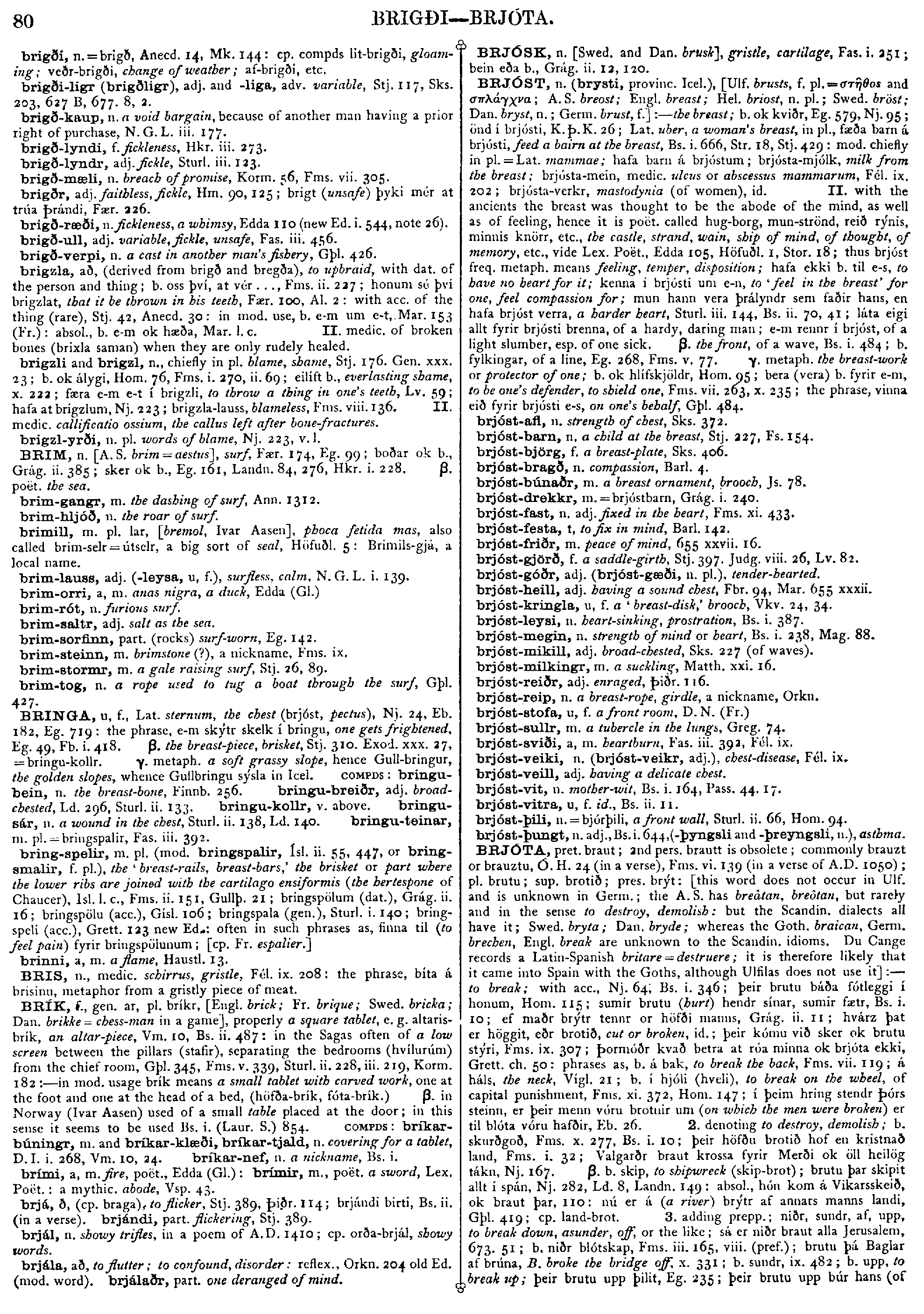
brjóst-heill, adj. having a sound chest, Fbr. 94, Mar. 655 xxxii.
| Result Page: |  |
Previous | 16 17 18 19 20 21 22 23 24 25 26 27 28 29 30 31 32 33 34 | Next |  |
Germanic Lexicon Project (main page)
This search system was written by
Sean Crist
Please consider
volunteering
to correct the data in these online dictionaries.
No rights reserved. Feel free to use these data in any way you please.