|
|

|
Source: Bosworth/Toller, page b0004, entry 31 View original page image as: [TIFF] [PNG] [View previous entry] [View next entry] |
[Comment on this entry] [View comments] |
The following entry has been hand-corrected once. |
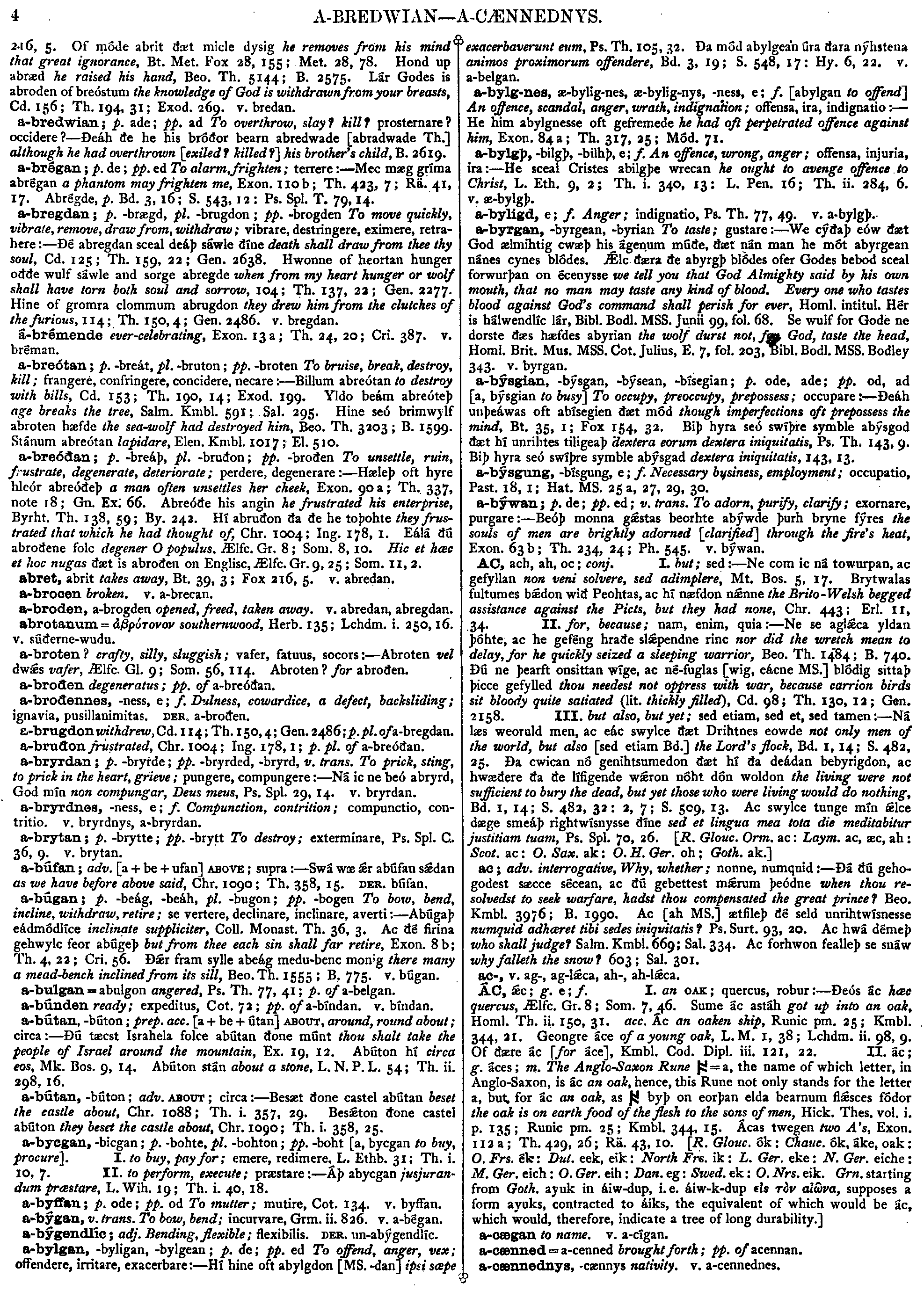
a-bywan;
p.
de;
pp.
ed;
v.
trans.
To
adorn,
purify,
clarify;
exomare,
purgare
:--
Beóþ
monna
g stas
beorhte
abýwde
þurh
bryne
fýres
the
souls
of
men
are
brightly
adorned
[clarified]
through
the
fire's
heat,
Exon.
63
b;
Th.
234,
24;
Ph.
545.
v.
býwan.
stas
beorhte
abýwde
þurh
bryne
fýres
the
souls
of
men
are
brightly
adorned
[clarified]
through
the
fire's
heat,
Exon.
63
b;
Th.
234,
24;
Ph.
545.
v.
býwan.
|
Source: Bosworth/Toller, page b0048, entry 6 View original page image as: [TIFF] [PNG] [View previous entry] [View next entry] |
[Comment on this entry] [View comments] |
The following entry has been hand-corrected once. |
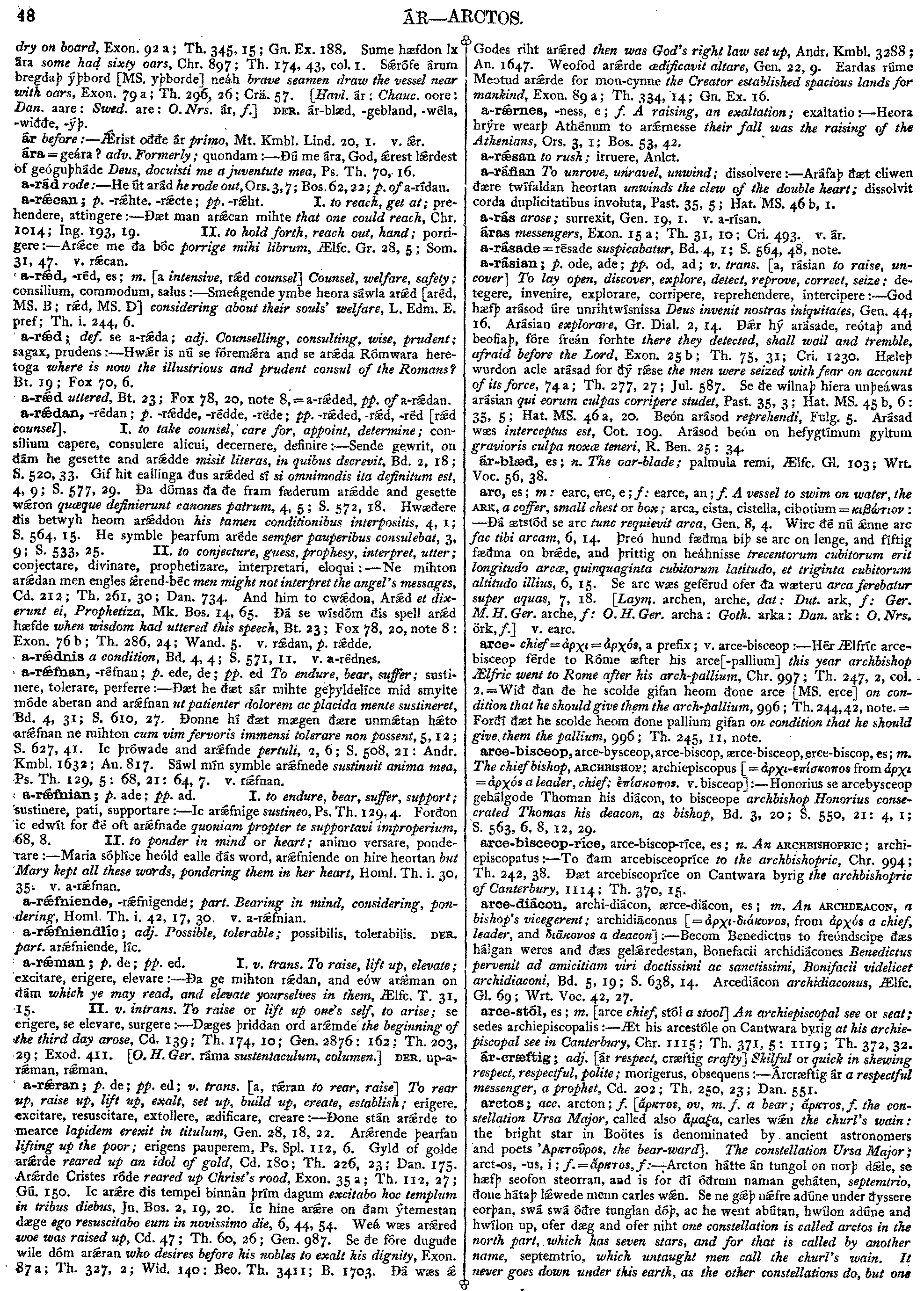
a-rd,
-réd,
es;
m.
[a
intensive,
rd
counsel]
Counsel,
welfare,
safety;
consilium,
commodum,
salus
:--
Smeágende
ymbe
heora
sáwla
ard
[aréd,
MS.
B;
rd,
MS.
D]
considering
about
their
souls'
welfare,
L.
Edm.
E.
pref;
Th.
i.
244,
6.
|
Source: Bosworth/Toller, page b0075, entry 10 View original page image as: [TIFF] [PNG] [View previous entry] [View next entry] |
[Comment on this entry] [View comments] |
The following entry has been hand-corrected once. |
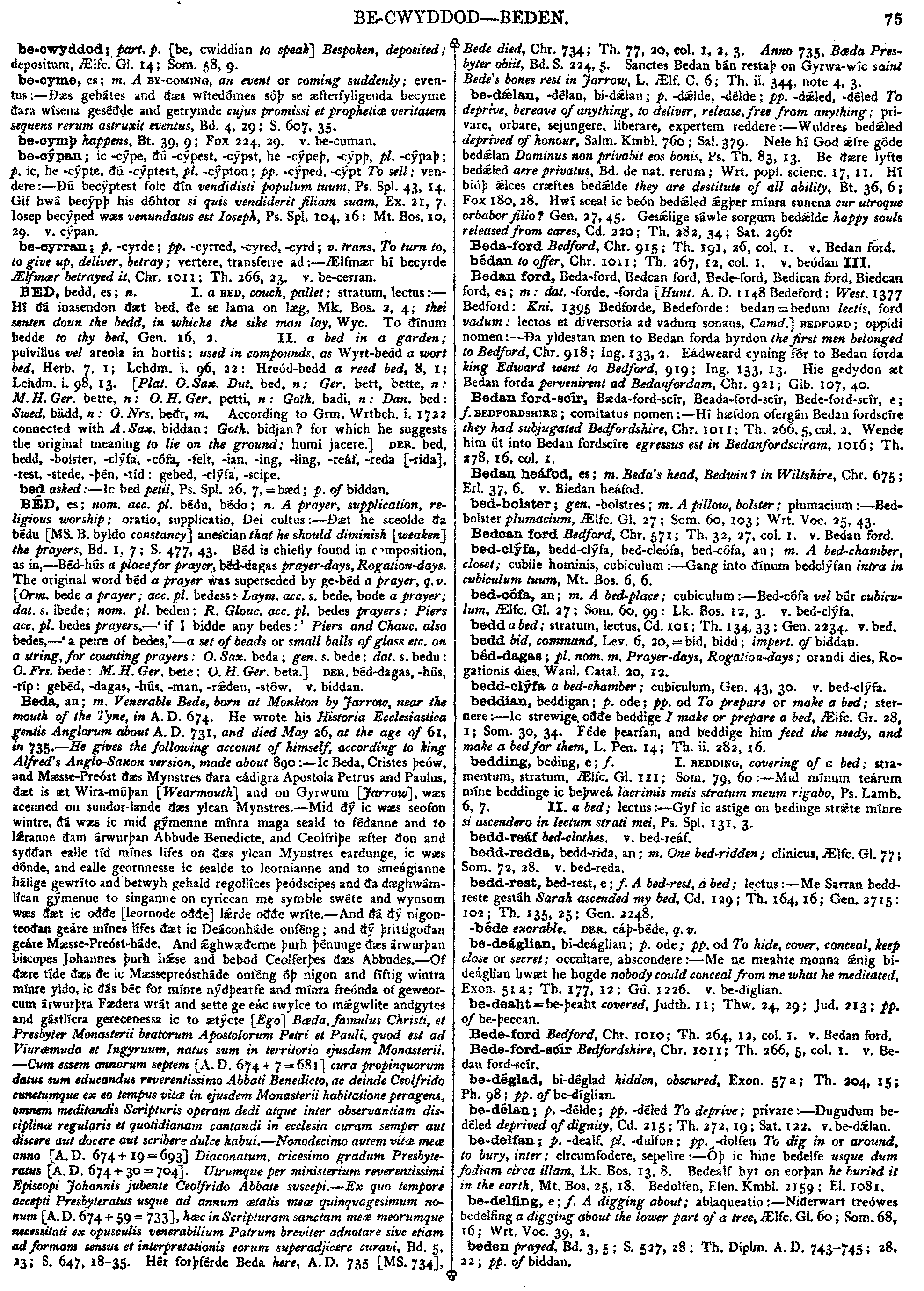
be-dlan,
-délan,
bi-dlan;
p.
-dlde,
-délde;
pp.
-dled,
-déled
To
deprive,
bereave
of
anything,
to
deliver,
release,
free
from
anything;
pri vare,
orbare,
sejungere,
liberare,
expertem
reddere
:--
Wuldres
bedled
deprived
of
honour,
Salm.
Kmbl.
760;
Sal.
379.
Nele
hí
God
fre
góde
bedlan
Dominus
non
privabit
eos
bonis,
Ps.
Th.
83,
13.
Be
ðære
lyfte
bedled
aere
privatus,
Bd.
de
nat.
rerum
;
Wrt.
popl.
scienc.
17,
11.
Hí
bióþ
lces
cræftes
bedlde
they
are
destitute
of
all
ability,
Bt,
36,
6;
Fox
180,
28.
Hwí
sceal
ic
beón
bedled
gþer
mínra
sunena
cur
utroque
orbabor
filio?
Gen.
27,
45.
Geslige
sáwle
sorgum
bedlde
happy
souls
released
from
cares,
Cd.
220;
Th.
282,
34;
Sat.
296.
vare,
orbare,
sejungere,
liberare,
expertem
reddere
:--
Wuldres
bedled
deprived
of
honour,
Salm.
Kmbl.
760;
Sal.
379.
Nele
hí
God
fre
góde
bedlan
Dominus
non
privabit
eos
bonis,
Ps.
Th.
83,
13.
Be
ðære
lyfte
bedled
aere
privatus,
Bd.
de
nat.
rerum
;
Wrt.
popl.
scienc.
17,
11.
Hí
bióþ
lces
cræftes
bedlde
they
are
destitute
of
all
ability,
Bt,
36,
6;
Fox
180,
28.
Hwí
sceal
ic
beón
bedled
gþer
mínra
sunena
cur
utroque
orbabor
filio?
Gen.
27,
45.
Geslige
sáwle
sorgum
bedlde
happy
souls
released
from
cares,
Cd.
220;
Th.
282,
34;
Sat.
296.
|
Source: Bosworth/Toller, page b0093, entry 17 View original page image as: [TIFF] [PNG] [View previous entry] [View next entry] |
[Comment on this entry] [View comments] |
The following entry has been hand-corrected once. |
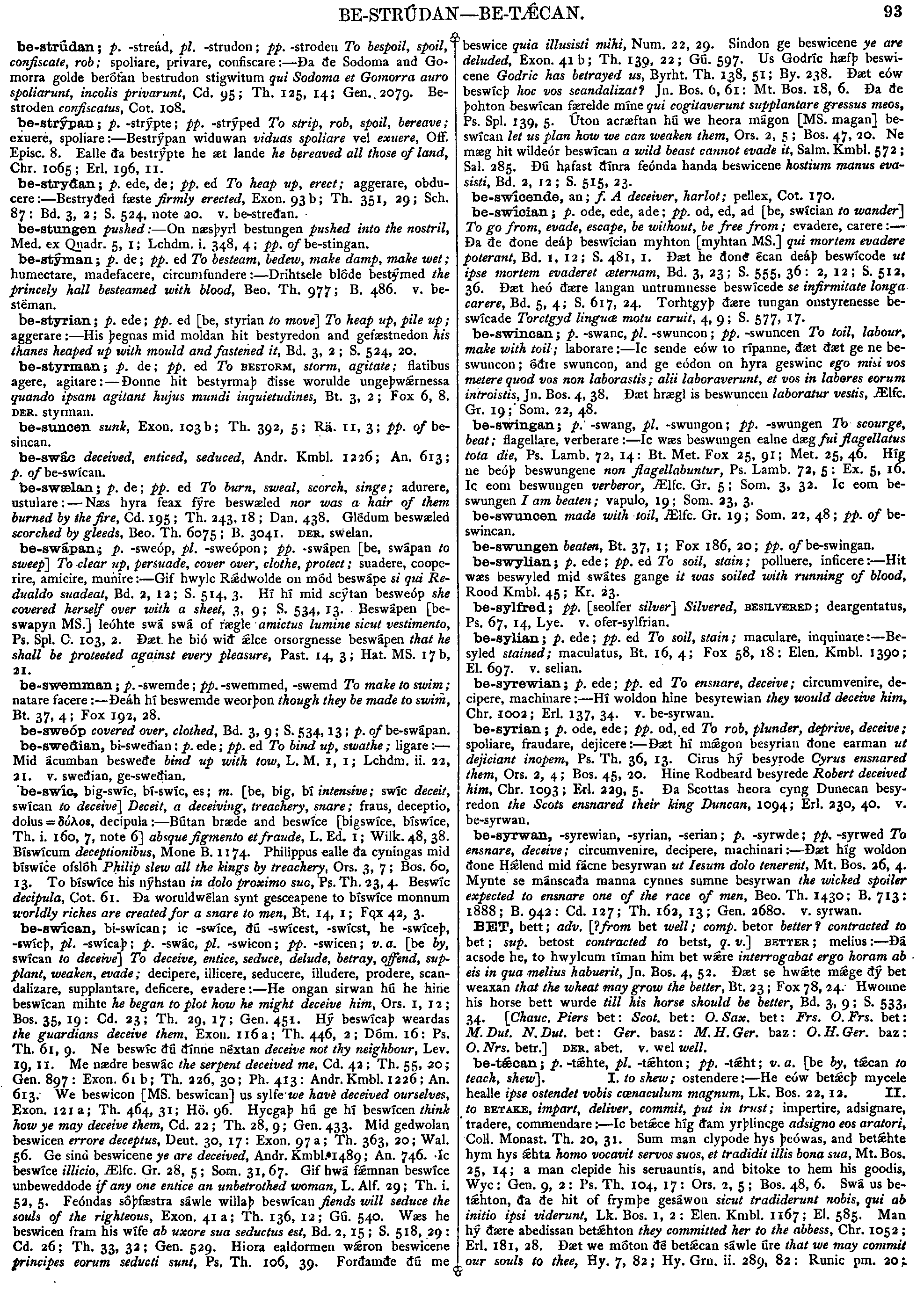
be-swícan,
bi-swícan;
ic
-swíce,
ðú
-swícest,
-swícst,
he
-swíceþ,
-swícþ,
pl.
-swícaþ;
p.
-swác,
pl.
-swicon;
pp.
-swicen;
v.
a.
[be
by,
swícan
to
deceive]
To
deceive,
entice,
seduce,
delude,
betray,
offend,
supplant,
weaken,
evade;
decipere,
illicere,
seducere,
illudere,
prodere,
scandalizare,
supplantare,
deficere,
evadere
:--
He
ongan
sirwan
hú
he
hine
beswícan
mihte
he
began
to
plot
how
he
might
deceive
him,
Ors.
1,
12;
Bos.
35,
19
:
Cd.
23;
Th.
29,
17;
Gen.
451.
Hý
beswícaþ
weardas
the
guardians
deceive
them,
Exon.
116
a;
Th.
446,
2;
Dóm.
16
:
Ps.
Th.
61,
9.
Ne
beswíc
ðú
ðínne
néxtan
deceive
not
thy
neighbour,
Lev.
19,
11.
Me
nædre
beswác
the
serpent
deceived
me,
Cd.
42;
Th.
55,
20;
Gen.
897
:
Exon.
61
b;
Th.
226,
30;
Ph.
413
:
Andr.
Kmbl.
1226;
An.
613.
We
beswicon
[MS.
beswican]
us
sylfe
we
have
deceived
ourselves,
Exon.
121
a;
Th.
464,
31;
Hö.
96.
Hycgaþ
hú
ge
hí
beswícen
think
how
ye
may
deceive
them,
Cd.
22;
Th.
28,
9;
Gen.
433.
Mid
gedwolan
beswicen
errore
deceptus,
Deut.
30,
17
:
Exon.
97
a;
Th.
363,
20;
Wal.
56.
Ge
sind
beswicene
ye
are
deceived,
Andr.
Kmbl.
1489;
An.
746.
Ic
beswíce
illicio,
Ælfc.
Gr.
28,
5;
Som.
31,
67.
Gif
hwá
fmnan
beswíce
unbeweddode
if
any
one
entice
an
unbetrothed
woman,
L.
Alf.
29;
Th.
i.
52,
5.
Feóndas
sóþfæstra
sáwle
willaþ
beswícan
fiends
will
seduce
the
souls
of
the
righteous,
Exon.
41
a;
Th.
136,
12;
Gú.
540.
Wæs
he
beswicen
fram
his
wífe
ab
uxore
sua
seductus
est,
Bd.
2,
15;
S.
518,
29
:
Cd.
26;
Th.
33,
32;
Gen.
529.
Hiora
ealdormen
wron
beswicene
principes
eorum
seducti
sunt,
Ps.
Th.
106,
39.
Forðamðe
ðú
me
beswice
quia
illusisti
mihi,
Num.
22,
29.
Sindon
ge
beswicene
ye
are
deluded,
Exon.
41
b;
Th.
139,
22;
Gú.
597.
Us
Godríc
hæfþ
beswicene
Godric
has
betrayed
us,
Byrht.
Th.
138,
51;
By.
238.
Ðæt
eów
beswícþ
hoc
vos
scandalizat?
Jn.
Bos.
6,
61
:
Mt.
Bos.
18,
6.
Ða
ðe
þohton
beswícan
færelde
míne
qui
cogitaverunt
supplantare
gressus
meos,
Ps.
Spl.
139,
5.
Úton
acræftan
hú
we
heora
mágon
[MS.
magan]
beswícan
let
us
plan
how
we
can
weaken
them,
Ors.
2,
5;
Bos.
47,
20.
Ne
mæg
hit
wildeór
beswícan
a
wild
beast
cannot
evade
it,
Salm.
Kmbl.
572;
Sal.
285.
Ðú
hafast
ðínra
feónda
handa
beswicene
hostium
manus
evasisti,
Bd.
2,
12;
S.
515,
23.
|
Source: Bosworth/Toller, page b0093, entry 31 View original page image as: [TIFF] [PNG] [View previous entry] [View next entry] |
[Comment on this entry] [View comments] |
The following entry has been hand-corrected once. |
be-tcan;
p.
-thte,
pl.
-thton;
pp.
-teht;
v.
a.
[be
by,
tcan
to
teach,
shew].
I.
to
shew;
ostendere
:--
He
eów
betcþ
mycele
healle
ipse
ostendet
vobis
cænaculum
magnum,
Lk.
Bos.
22,
12.
II.
to
BETAKE,
impart,
deliver,
commit,
put
in
trust;
impertire,
adsignare,
tradere,
commendare
:--
Ic
betce
híg
ðam
yrþlincge
adsigno
eos
aratori,
Coll.
Monast.
Th.
20,
31.
Sum
man
clypode
hys
þeówas,
and
bethte
hym
hys
hta
homo
vocavit
servos
suos,
et
tradidit
illis
bona
sua,
Mt.
Bos.
25,
14;
a
man
clepide
his
seruauntis,
and
bitoke
to
hem
his
goodis,
Wyc
:
Gen.
9,
2
:
Ps.
Th.
104,
17
:
Ors.
2,
5;
Bos.
48,
6.
Swá
us
be-thton,
ða
ðe
hit
of
frymþe
gesáwon
sicut
tradiderunt
nobis,
qui
ab
initio
ipsi
viderunt,
Lk.
Bos.
1,
2
:
Elen.
Kmbl.
1167;
El.
585.
Man
hý
ðære
abedissan
bethton
they
committed
her
to
the
abbess,
Chr.
1052;
Ed.
181,
28.
Ðæt
we
móton
ðé
betcan
sáwle
úre
that
we
may
commit
our
souls
to
thee,
Hy.
7,
82;
Hy.
Grn.
ii.
289,
82
:
Runic
pm.
20
:
Kmbl.
343,
18;
Hick.
Thes.
i.
135.
III.
to
send,
follow,
pursue;
mittere,
insequi,
amandare
:--
Betcan
[MS,
betæcen]
cildru
on
scóle
to
send
children
to
school;
mittere
pueros
in
scholam,
Obs.
Lun.
§
4;
Lchdm.
iii.
184,
28.
Mid
swiftum
húndum
ic
betce
wildeór
with
swift
hounds
I
pursue
wild
beasts;
cum
velocibus
canibus
insequor
feras,
Coll.
Monast.
Th.
21,
27.
Ic
betce
fram
me
amando,
Ælfc.
Gr.
47;
Som.
48,
35.
|
Source: Bosworth/Toller, page b0112, entry 37 View original page image as: [TIFF] [PNG] [View previous entry] [View next entry] |
[Comment on this entry] [View comments] |
The following entry has been hand-corrected once. |
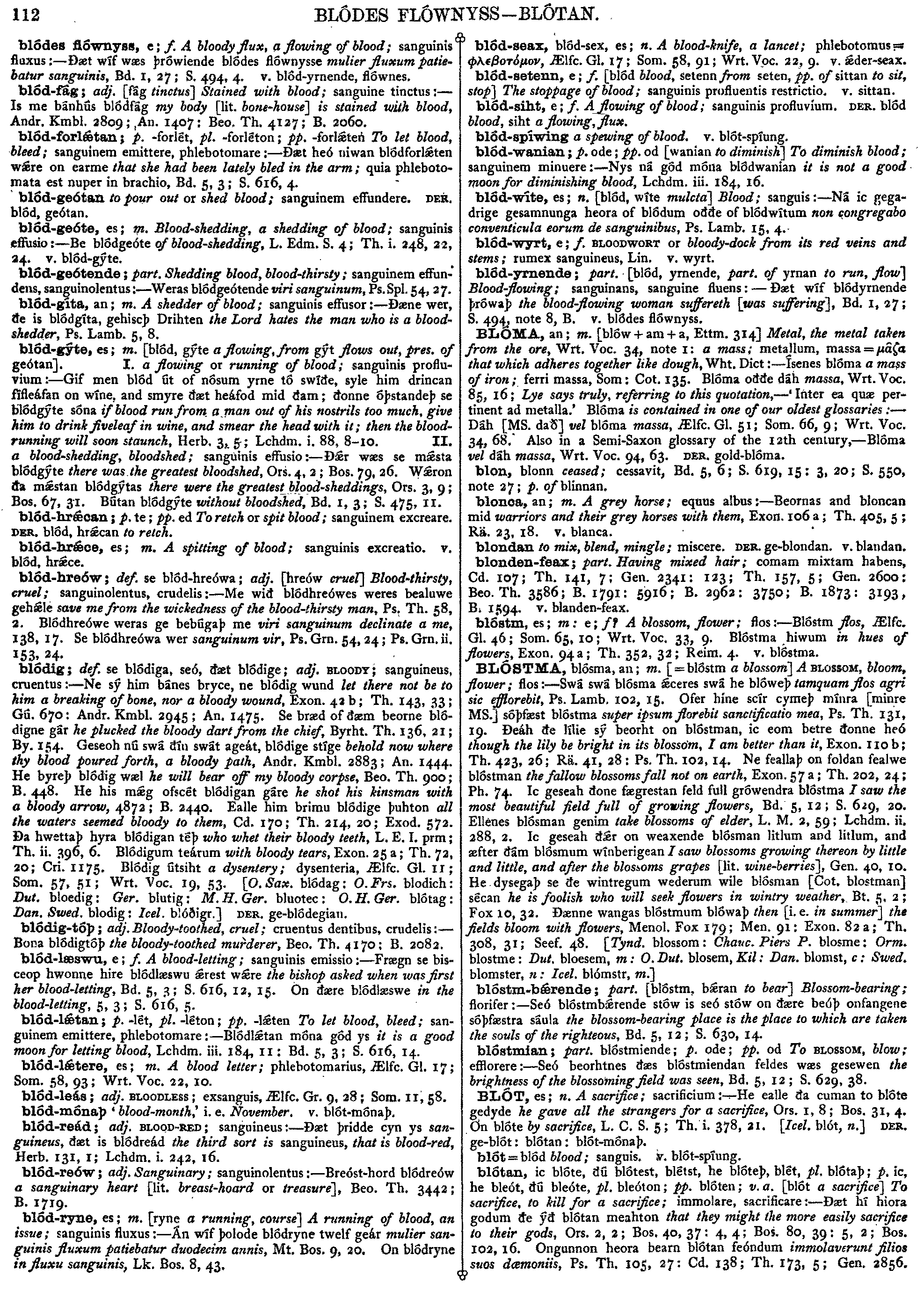
blóstm-brende;
part.
[blóstm,
bran
to
bear]
Blossom-bearing;
florifer
:--
Seó
blóstmbrende
stów
is
seó
stów
on
ðære
beóþ
onfangene
sóþfæstra
sáula
the
blossom-bearing
place
is
the
place
to
which
are
taken
the
souls
of
the
righteous,
Bd.
5,
12;
S.
630,
14.
|
Source: Bosworth/Toller, page b0128, entry 23 View original page image as: [TIFF] [PNG] [View previous entry] [View next entry] |
[Comment on this entry] [View comments] |
The following entry has been hand-corrected once. |
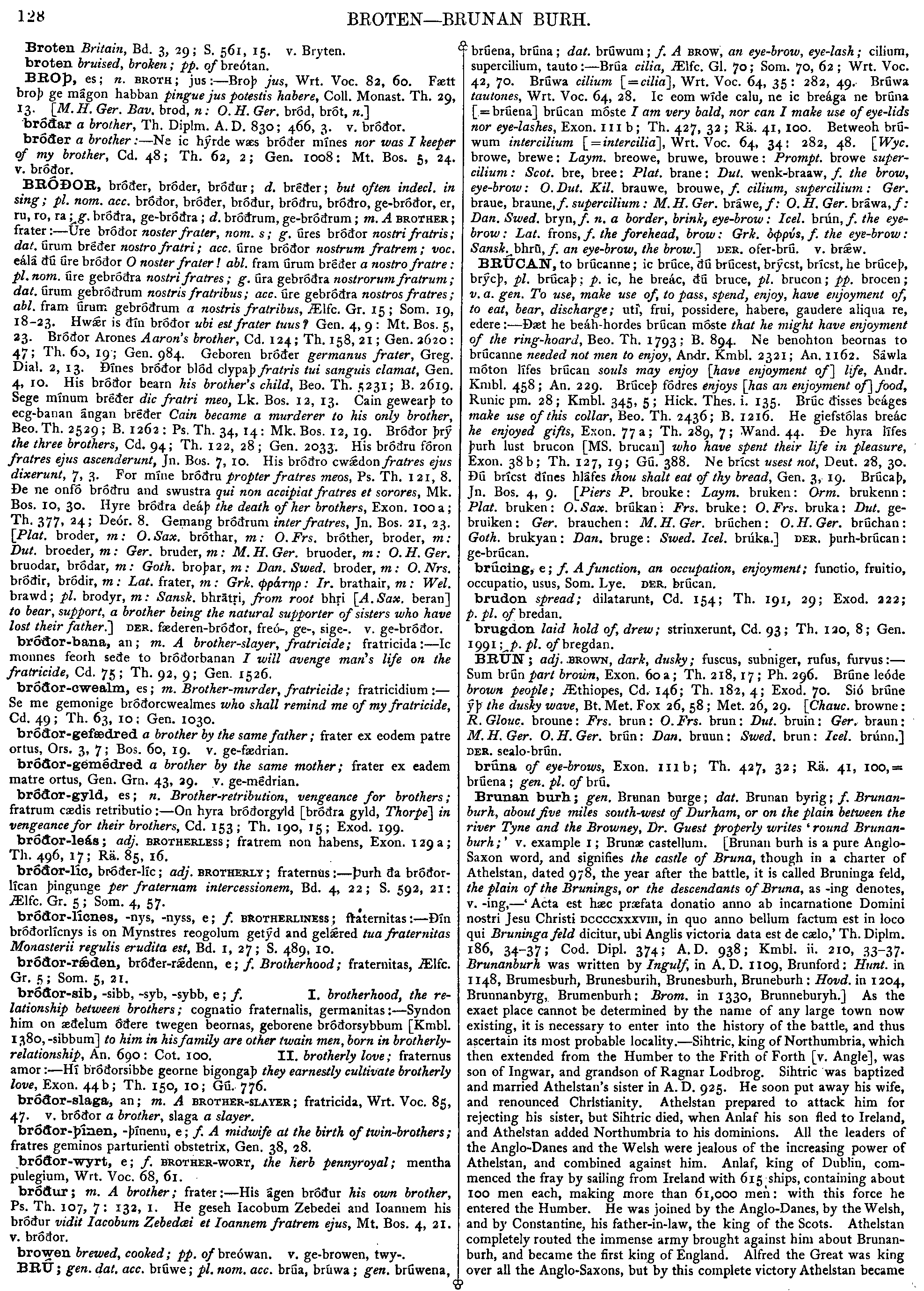
BRÚCAN, to brúcanne; ic brúce, ðú brúcest, brýcst, brícst, he brúceþ, brýcþ, pl. brúcaþ; p. ic, he breác, ðú bruce, pl. brucon; pp. brocen; v. a. gen. To use, make use of, to pass, spend, enjoy, have enjoyment of, to eat, bear, discharge; uti, frui, possidere, habere, gaudere aliqua re, edere :-- Ðæt he beáh-hordes brúcan móste that he might have enjoyment of the ring-hoard, Beo. Th. 1793; B. 894. Ne benohton beornas to brúcanne needed not men to enjoy, Andr. Kmbl. 2321; An. 1162. Sáwla móton lífes brúcan souls may enjoy [have enjoyment of] life, Andr. Kmbl. 458; An. 229. Brúceþ fódres enjoys [has an enjoyment of] food, Runic pm. 28; Kmbl. 345, 5; Hick. Thes. i. 135. Brúc ðisses beáges make use of this collar, Beo. Th. 2436; B. 1216. He giefstólas breác he enjoyed gifts, Exon. 77 a; Th. 289, 7; Wand. 44. Ðe hyra lífes þurh lust brucon [MS. brucan] who have spent their life in pleasure, Exon. 38 b; Th. 127, 19; Gú. 388. Ne brícst usest not, Deut. 28, 30. Ðú brícst ðínes hláfes thou shalt eat of thy bread, Gen. 3, 19. Brúcaþ, Jn. Bos. 4, 9. [Piers P. brouke: Laym. bruken: Orm. brukenn: Plat. bruken: O. Sax. brúkan: Frs. bruke: O. Frs. bruka: Dut. ge-bruiken: Ger. brauchen: M. H. Ger. brúchen: O. H. Ger. brúchan: Goth. brukyan: Dan. bruge: Swed. Icel. brúka.] DER. þurh-brúcan: ge-brúcan.
|
Source: Bosworth/Toller, page b0131, entry 1 View original page image as: [TIFF] [PNG] [View previous entry] [View next entry] |
[Comment on this entry] [View comments (1)] |
The following entry has been hand-corrected once. |
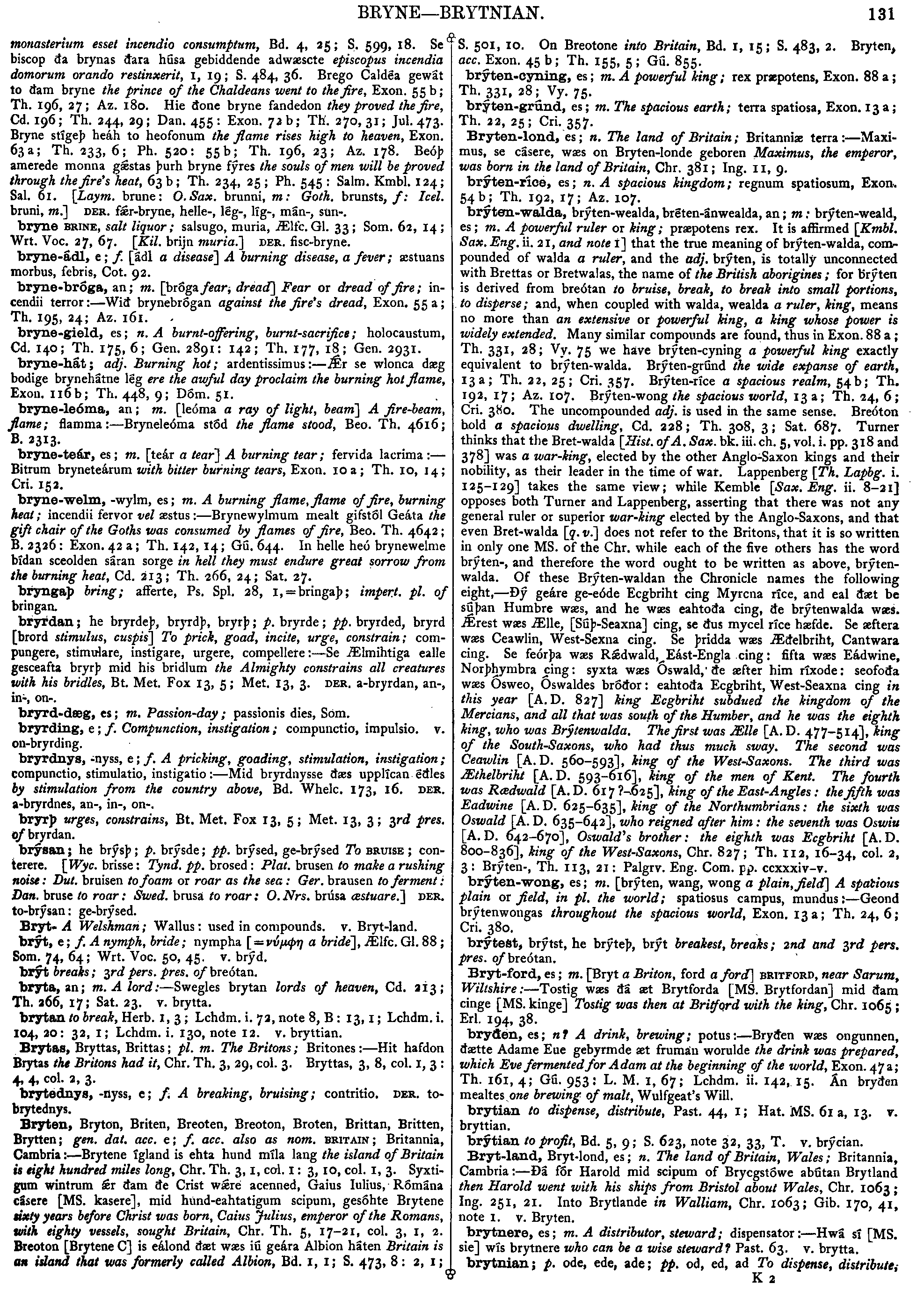
monasterium
esset
incendio
consumptum,
Bd.
4,
25;
S.
599,
18.
Se
biscop
ða
brynas
ðara
húsa
gebiddende
adwæscte
episcopus
incendia
domorum
orando
restinxerit,
l,
19;
S.
484,
36.
Brego
Caldéa
gewát
to
ðarn
bryne
the
prince
of
the
Chaldeans
went
to
the
fire,
Exon.
55b;
Th.
196,
27;
Az.
180.
Hie
ðone
bryne
fandedon
they
proved
the
fire,
Cd.
196;
Th.
244,
29;
Dan.
455:
Exon.
72b;
Th.
270,
31;
Jul.
473.
Bryne
stígeþ
heáh
to
heofonum
the
flame
rises
high
to
heaven,
Exon.
63a;
Th.
233,
6;
Ph.
520:
55b;
Th.
196,
23;
Az.
178.
Beóþ
amerede
monna
gstas
þurh
bryne
fýres
the
souls
of
men
will
be
proved
through
the
fire's
heat,
63b;
Th.
234,
25;
Ph.
545:
Salm.
Kmbl.
124;
Sal.
61.
[Laym,
brune:
O.
Sax.
brunni,
m:
Goth.
brunsts,
f:
Icel.
bruni,
m.]
DER.
fær-bryne,
helle-,
lég-,
líg-,
mán-,
sun-.
|
Source: Bosworth/Toller, page b0167, entry 13 View original page image as: [TIFF] [PNG] [View previous entry] [View next entry] |
[Comment on this entry] [View comments] |
The following entry has been hand-corrected once. |
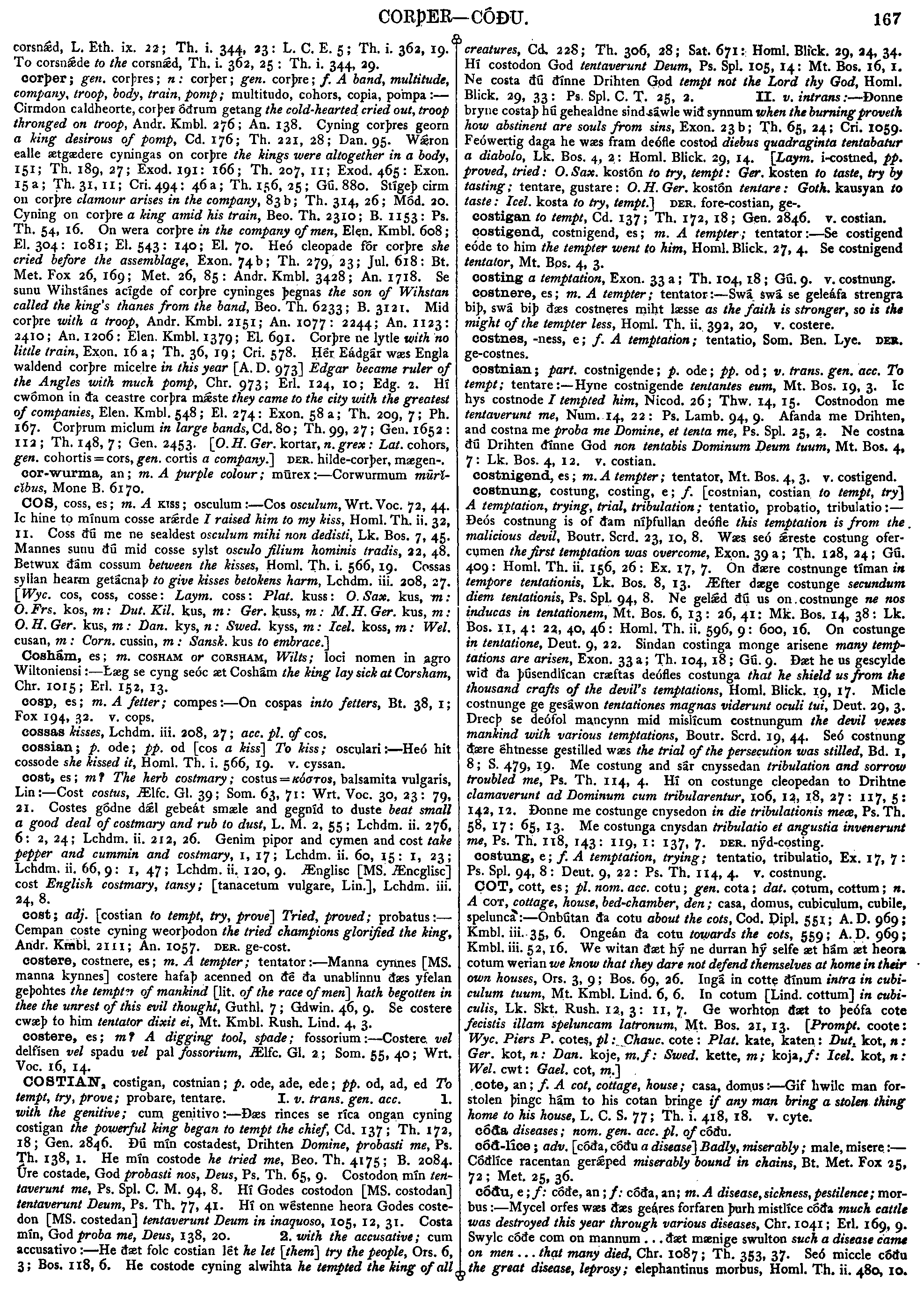
COSTIAN, costigan, costnian; p. ode, ade, ede; pp. od, ad, ed To tempt, try, prove; probare, tentare. I. v. trans. gen. acc. 1. with the genitive; cum genitivo :-- Ðæs rinces se ríca ongan cyning costigan the powerful king began to tempt the chief, Cd. 137; Th. 172 18; Gen. 2846. Ðú mín costadest, Drihten Domine, probasti me, Ps. Th. 138, 1. He mín costode he tried me, Beo. Th. 4175; B. 2084. Úre costade, God probasti nos, Deus, Ps. Th. 65, 9. Costodon mín tentaverunt me, Ps. Spl. C. M. 94, 8. Hí Godes costodon [MS. Costodan] tentaverunt Deum, Ps. Th. 77, 41. Hí on wéstenne heora Godes costedon [MS. costedan] tentaverunt Deum in inaquoso, 105, 12, 31. Costa mín, God proba me, Deus, 138, 20. 2. with the accusative; cum accusativo :-- He ðæt folc costian lét he let [them] try the people, Ors. 6, 3; Bos. 118, 6. He costode cyning alwihta he tempted the king of all creatures, Cd. 228; Th. 306, 28; Sat. 671: Homl. Blíck. 29, 24, 34. Hí costodon God tentaverunt Deum, Ps. Spl. 105, 14: Mt. Bos. 16, 1. Ne costa ðú ðínne Drihten God tempt not the Lord thy God, Homl. Blick. 29, 33: Ps. Spl. C. T. 25, 2. II. v. intrans :-- Ðonne bryne costaþ hú gehealdne sind sáwle wið synnum when the burning proveth how abstinent are souls from sins, Exon. 23b; Th. 65, 24; Cri. 1059. Feówertig daga he wæs fram deófle costod diebus quadraginta tentabatur a diabolo, Lk. Bos. 4, 2: Homl. Blick. 29, 14. [Laym. i-costned, pp. proved, tried: O. Sax. kostón to try, tempt: Ger. kosten to taste, try by tasting; tentare, gustare: O. H. Ger. kostón tentare: Goth. kausyan to taste: Icel. kosta to try, tempt.] DER. fore-costian, ge-.
|
Source: Bosworth/Toller, page b0176, entry 24 View original page image as: [TIFF] [PNG] [View previous entry] [View next entry] |
[Comment on this entry] [View comments (1)] |
The following entry has been hand-corrected once. |
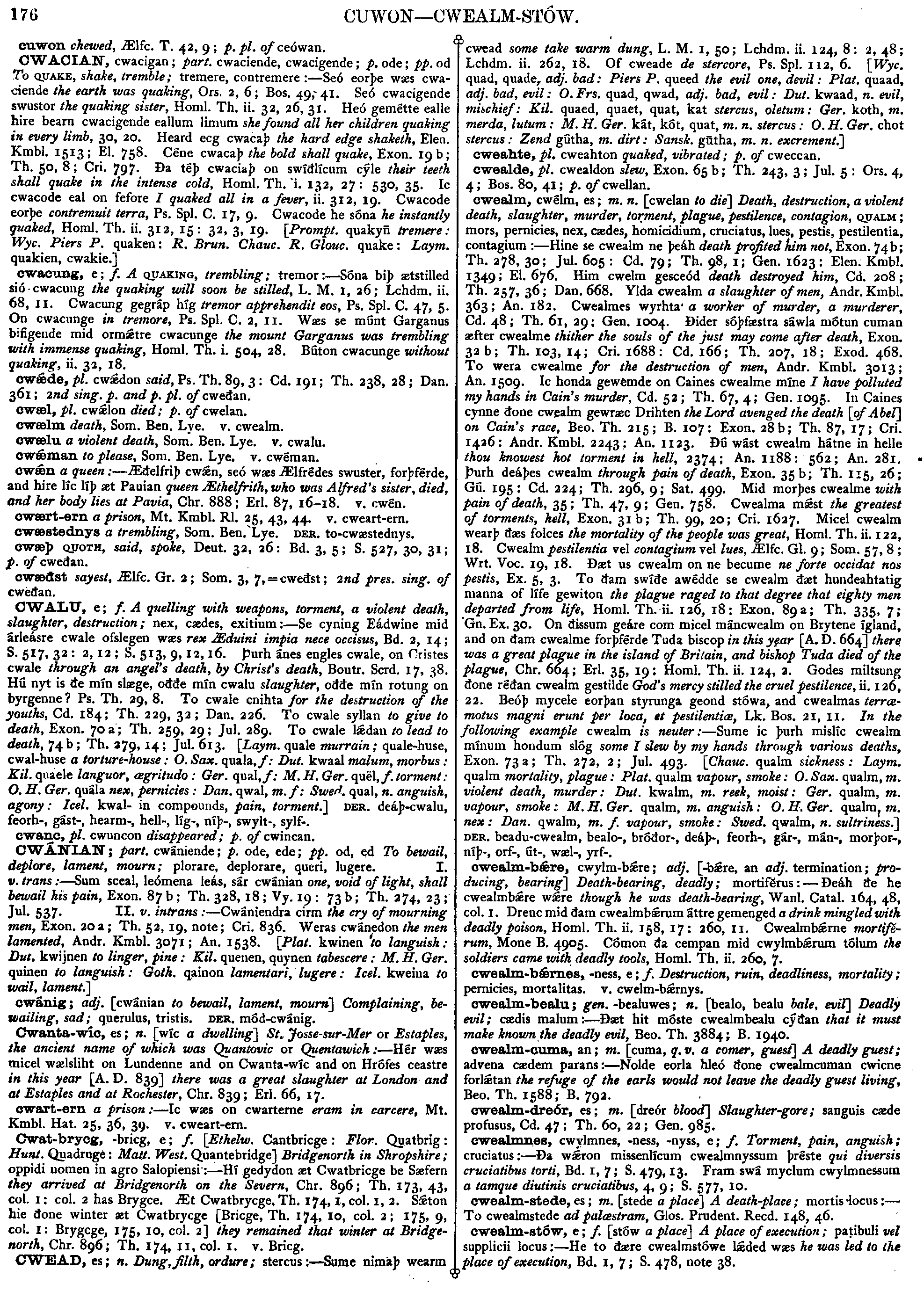
cwealm,
cwélm,
es;
m.
n.
[cwelan
to
die]
Death,
destruction,
a
violent
death,
slaughter,
murder,
torment,
plague,
pestilence,
contagion,
QUALM;
mors,
pernicies,
nex,
cædes,
homicidium,
cruciatus,
lues,
pestis,
pestilentia,
contagium
:--
Hine
se
cwealm
ne
þeáh
death
profited
him
not,
Exon.
74b;
Th.
278,
30;
Jul.
605:
Cd.
79;
Th.
98,
1;
Gen.
1623:
Elen.
Kmbl.
1349;
El.
676.
Him
cwelm
gesceód
death
destroyed
him,
Cd.
208;
Th.
257,
36;
Dan.
668.
Yida
UNCERTAIN
cwealm
a
slaughter
of
men,
Andr.
Kmbl.
363;
An.
182.
Cwealmes
wyrhta
a
worker
of
murder,
a
murderer,
Cd.
48;
Th.
61,
29;
Gen.
1004.
Ðider
sóþfæstra
sáwla
mótun
cuman
æfter
cwealme
thither
the
souls
of
the
just
may
come
after
death,
Exon.
32b;
Th.
103,
14;
Cri.
1688:
Cd.
166;
Th.
207,
18;
Exod.
468.
To
wera
cwealme
for
the
destruction
of
men,
Andr.
Kmbl.
3013;
An.
1509.
Ic
honda
gewemde
on
Caines
cwealme
míne
I
have
polluted
my
hands
in
Cain's
murder,
Cd.
52;
Th.
67,
4;
Gen.
1095.
In
Caines
cynne
ðone
cwealm
gewræc
Drihten
the
Lord
avenged
the
death
[of
Abel]
on
Cain's
race,
Beo.
Th.
215;
B.
107:
Exon.
28b;
Th.
87,
17;
Cri.
1426:
Andr.
Kmbl.
2243:
An.
1123.
Ðú
wást
cwealm
hátne
in
helle
thou
knowest
hot
torment
in
hell,
2374;
An.
1188:
562;
An.
281.
Þurh
deáþes
cwealm
through
pain
of
death,
Exon.
35b;
Th.
115,
26;
Gú.
195:
Cd.
224;
Th.
296,
9;
Sat.
499.
Mid
morþes
cwealme
with
pain
of
death,
35;
Th.
47,
9;
Gen.
758.
Cwealma
mst
the
greatest
of
torments,
hell,
Exon.
31b;
Th.
99,
20;
Cri.
1627.
Micel
cwealm
wearþ
ðæs
folces
the
mortality
of
the
people
was
great,
Homl.
Th.
ii.
122,
18.
Cwealm
pestilentia
vel
contagium
vel
lues,
Ælfc.
Gl.
9;
Som.
57,
8;
Wrt.
Voc.
19,
18.
Ðæt
us
cwealm
on
ne
becume
ne
forte
occidat
nos
pestis,
Ex.
5,
3.
To
ðam
swíðe
awédde
se
cwealm
ðæt
hundeahtatig
manna
of
lífe
gewiton
the
plague
raged
to
that
degree
that
eighty
men
departed
from
life,
Homl.
Th.
ii.
126,
18:
Exon.
89a;
Th.
335,
7;
Gn.
Ex.
30.
On
ðissum
geáre
com
micel
máncwealm
on
Brytene
ígland,
and
on
ðam
cwealme
forþférde
Tuda
biscop
in
this
year
[A.
D.
664]
there
was
a
great
plague
in
the
island
of
Britain,
and
bishop
Tuda
died
of
the
plague,
Chr.
664;
Erl.
35,
19:
Homl.
Th.
ii.
124,
2.
Godes
miltsung
ðone
rédan
cwealm
gestilde
God's
mercy
stilled
the
cruel
pestilence,
ii.
126,
22.
Beóþ
mycele
eorþan
styrunga
geond
stówa,
and
cwealmas
terræmotus
magni
erunt
per
loca,
et
pestilentiæ,
Lk.
Bos.
21,
11.
In
the
following
example
cwealm
is
neuter
:--
Sume
ic
þurh
mislíc
cwealm
mínum
hondum
slóg
some
I
slew
by
my
hands
through
various
deaths,
Exon.
73a;
Th.
272,
2;
Jul.
493.
[Chauc.
qualm
sickness:
Laym.
qualm
mortality,
plague:
Plat.
qualm
vapour,
smoke:
O.
Sax.
qualm,
m.
violent
death,
murder:
Dut.
kwalm,
m.
reek,
moist:
Ger.
qualm,
m.
vapour,
smoke:
M.
H.
Ger.
qualm,
m.
anguish:
O.
H.
Ger.
qualm,
m.
nex:
Dan.
qwalm,
m.
f.
vapour,
smoke:
Swed.
qwalm,
n.
sultriness.]
DER.
beadu-cwealm,
bealo-,
bróðor-,
deáþ-,
feorh-,
gár-,
mán-,
morþor-,
níþ-,
orf-,
út-,
wael-,
yrf-.
| Result Page: | 1 2 3 4 5 6 7 8 | Next |  |
Germanic Lexicon Project (main page)
This search system was written by
Sean Crist
Please consider
volunteering
to correct the data in these online dictionaries.
No rights reserved. Feel free to use these data in any way you please.