|
|

Search for son again, using less strict matching (432 results)
|
Source: Cleasby/Vigfusson, page b0176, entry 28 View original page image as: [TIFF] [PNG] [View previous entry] [View next entry] |
[Comment on this entry] [View comments] |
The following entry has been hand-corrected once. |
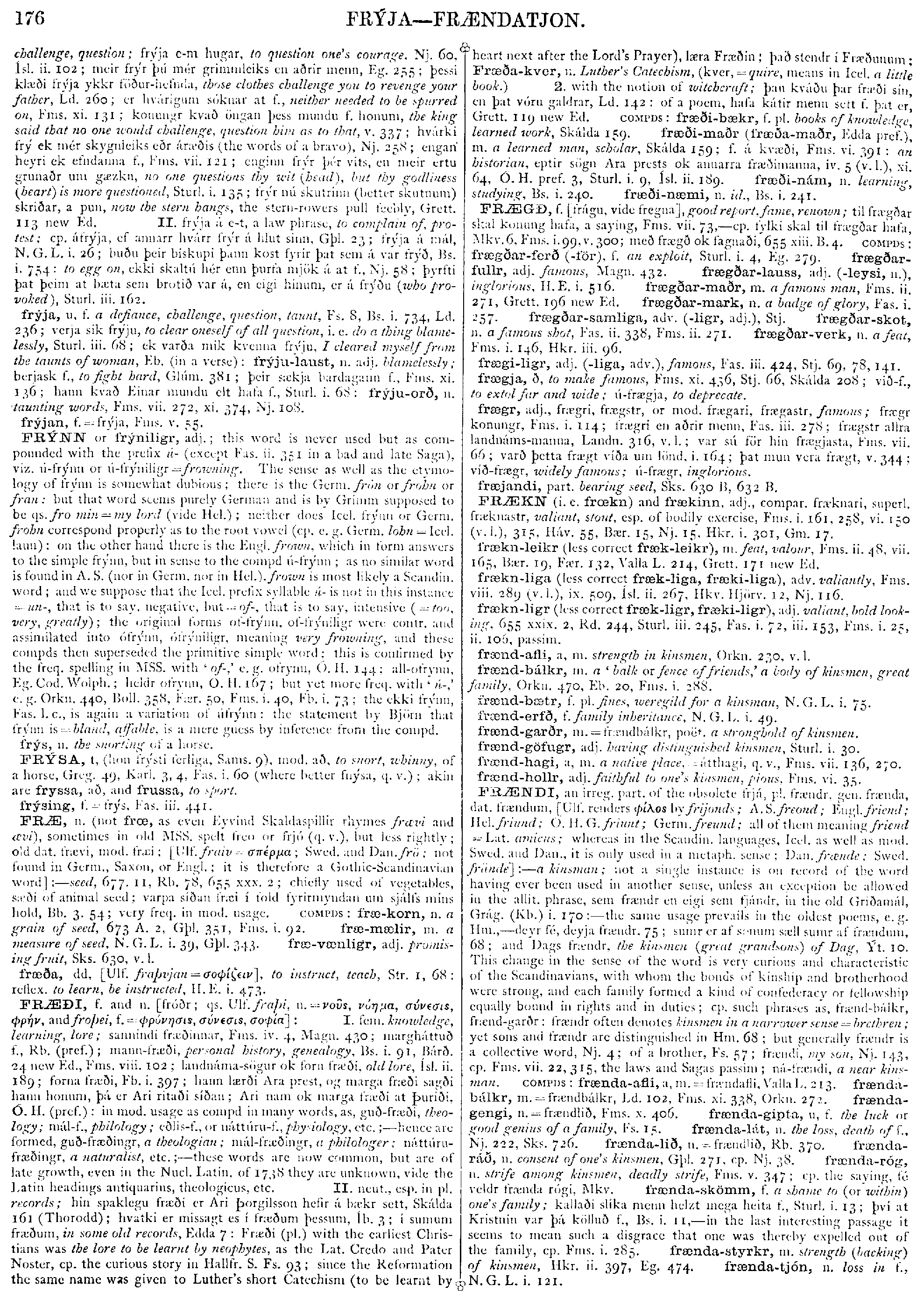
FRÆNDI, an irreg. part. of the obsolete frjá, pl. frændr. gen. frænda, dat. frændum, [Ulf. renders GREEK by frijonds; A. S. freond; Engl. friend; Hel. friund; O. H. G. friunt; Germ. freund; all of them meaning friend = Lat. amicus; whereas in the Scandin. languages, Icel. as well as mod. Swed. and Dan., it is only used in a metaph. sense; Dan. frænde; Swed. frände] :-- a kinsman; not a single instance is on record of the word having ever been used in another sense, unless an exception be allowed in the allit. phrase, sem frændr en eigi sem fjándr, in the old Griðamál, Grág. (Kb.) i. 170 :-- the same usage prevails in the oldest poems, e.g. Hm., -- deyr fé, deyja frændr, 75; sumr er af senum sæll sumr af frændum, 68; and Dags frændr, the kinsmen (great grandsons) of Dag, Ýt. 10. This change in the sense of the word is very curious and characteristic of the Scandinavians, with whom the bonds of kinship and brotherhood were strong, and each family formed a kind of confederacy or fellowship equally bound in rights and in duties; cp. such phrases as, frænd-bálkr, frænd-garðr: frændr often denotes kinsmen in a narrower sense = brethren; yet sons and frændr are distinguished in Hm. 68; but generally frændr is a collective word, Nj. 4; of a brother, Fs. 57; frændi, my son, Nj. 143, cp. Fms. vii. 22, 315, the laws and Sagas passim; ná-frændi, a near kinsman. COMPDS: frænda-afli, a, m. = frændafli, Valla L. 213. frænda-bálkr, m. = frændbálkr, Ld. 102, Fms. xi. 338, Orkn. 272. frænda-gengi, n. = frændlið, Fms. x. 406. frænda-gipta, n, f. the luck or good genius of a family, Fs. 15. frænda-lát, n. the loss, death of f., Nj. 222, Sks. 726. frænda-lið, n. = frændlið, Rb. 370. frænda-ráð, n. consent of one's kinsmen, Gþl. 271, cp. Nj. 38. frænda-róg, n. strife among kinsmen, deadly strife, Fms. v. 347; cp. the saying, fé veldr frænda rógi, Mkv. frænda-skömm, f. a shame to (or within) one's family; kallaði slíka menn helzt mega heita f., Sturl. i. 13; því at Kristnin var þá kölluð f., Bs. i. 11, -- in the last interesting passage it seems to mean such a disgrace that one was thereby expelled out of the family, cp. Fms. i. 285. frænda-styrkr, m. strength (backing) of kinsmen, Hkr. ii. 397, Eg. 474. frænda-tjón, n. loss in f., N. G. L. i. 121.
|
Source: Cleasby/Vigfusson, page b0177, entry 14 View original page image as: [TIFF] [PNG] [View previous entry] [View next entry] |
[Comment on this entry] [View comments] |
The following entry has been hand-corrected once. |
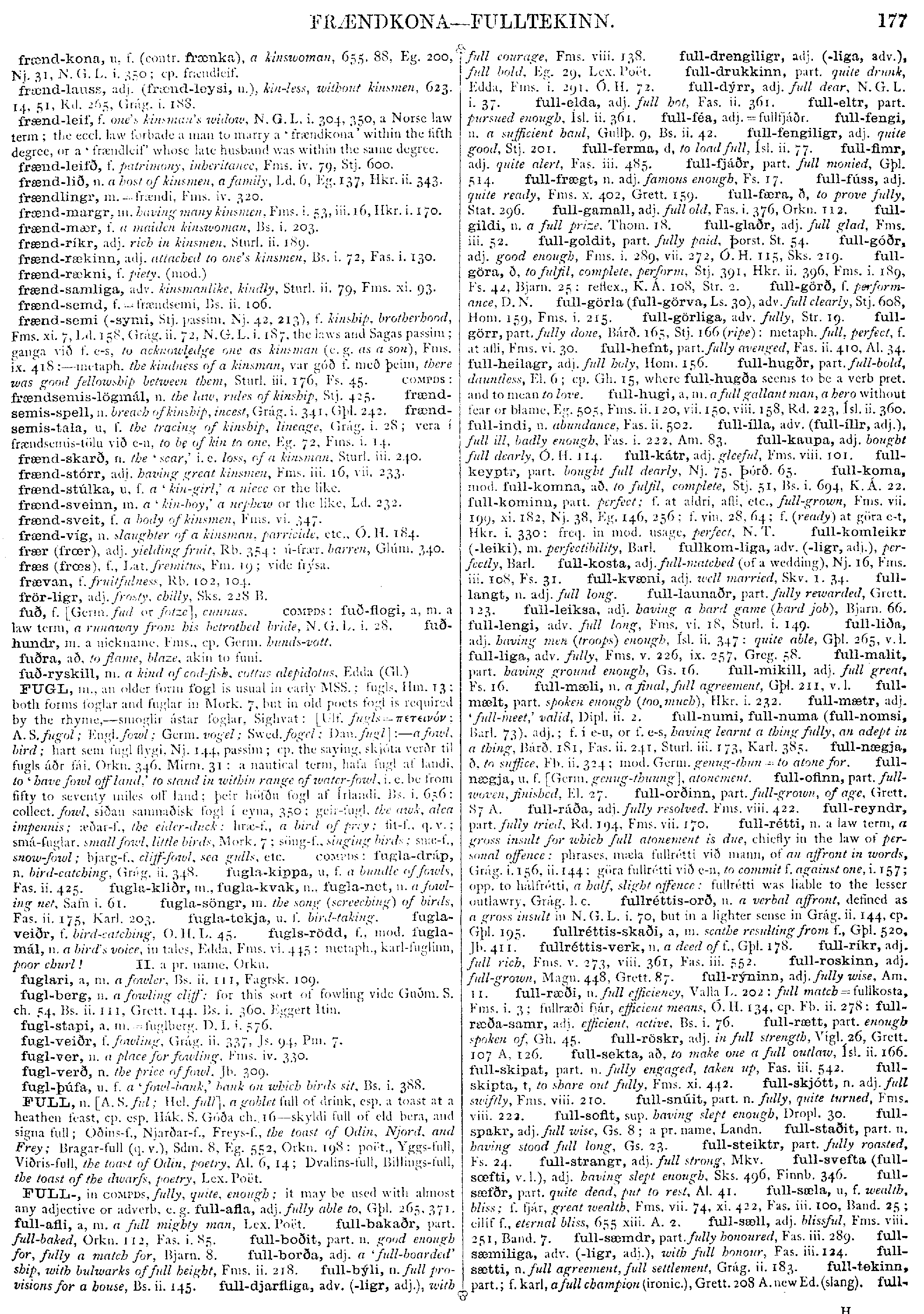
frænd-semi (-symi, Stj. passim, Nj. 42, 213), f. kinship, brotherhood, Fms. xi. 7, Ld. 158, Grág. ii. 72, N. G. L. i. 187, the laws and Sagas passim; ganga við f. e-s, to acknowledge one as kinsman (e.g. as a son), Fms. ix. 418 :-- metaph. the kindness of a kinsman, var góð f. með þeim, there was good fellowship between them, Sturl. iii. 176, Fs. 45. COMPDS: frændsemis-lögmál, n. the law, rules of kinship, Stj. 425. frændsemis-spell, n. breach of kinship, incest, Grág. i. 341, Gþl. 242. frændsemis-tala, u, f. the tracing of kinship, lineage, Grág;, i. 28; vera í frændsemis-tölu við e-n, to be of kin to one, Eg. 72, Fms. i. 14.
|
Source: Cleasby/Vigfusson, page b0191, entry 39 View original page image as: [TIFF] [PNG] [View previous entry] [View next entry] |
[Comment on this entry] [View comments] |
The following entry has been hand-corrected once. |
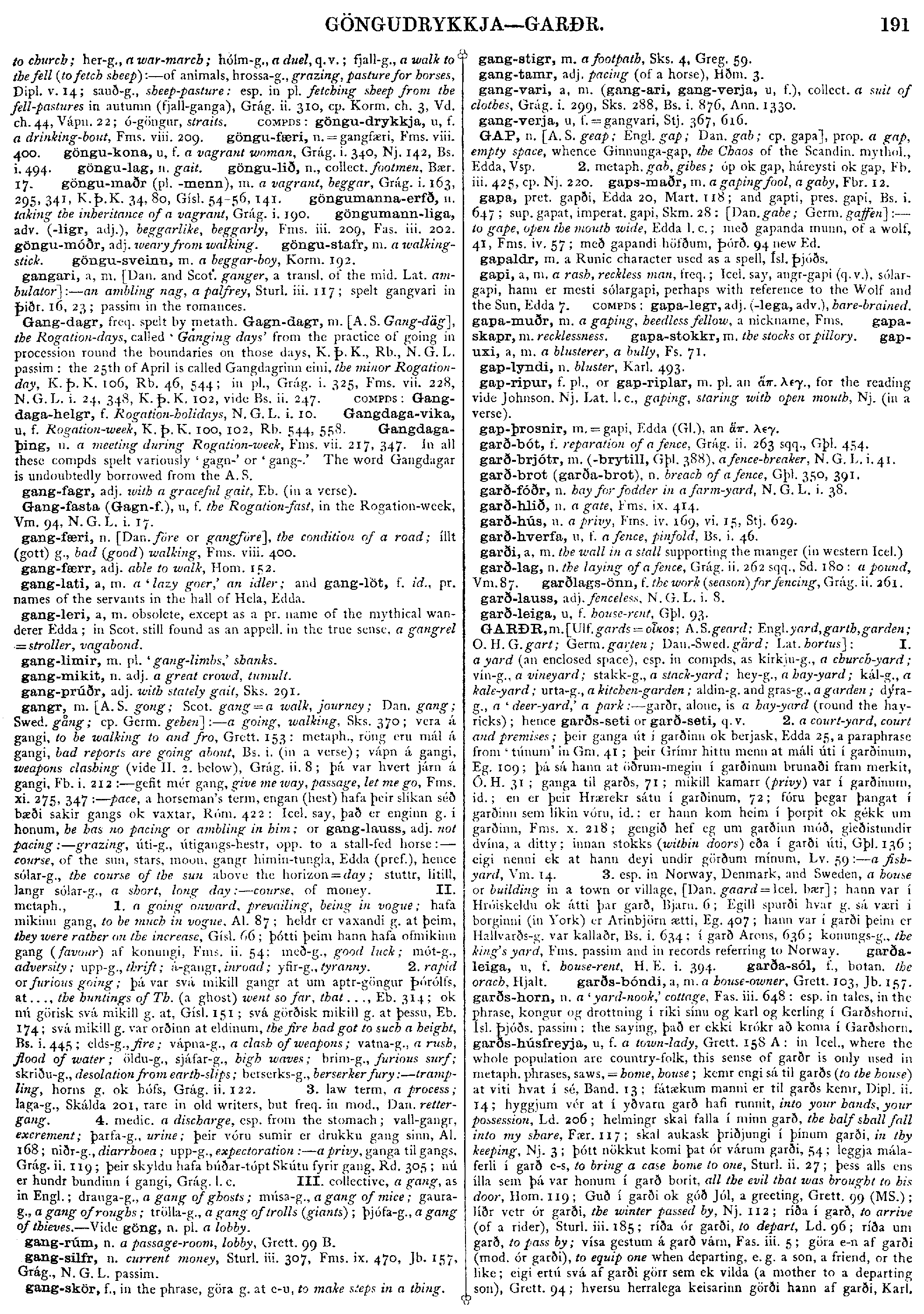
GARÐR, m. [Ulf. gards = GREEK; A. S. geard; Engl. yard, garth, garden; O. H. G. gart; Germ. garten; Dan.-Swed. gård; Lat. hortus]: I. a yard (an enclosed space), esp. in compds, as kirkju-g., a church-yard; vín-g., a vineyard; stakk-g., a stack-yard; hey-g., a hay-yard; kál-g., a kale-yard; urta-g., a kitchen-garden; aldin-g. and gras-g., a garden; dýra-g., a 'deer-yard,' a park :-- garðr, alone, is a hay-yard (round the hay-ricks); hence garðs-seti or garð-seti, q.v. 2. a court-yard, court and premises; þeir ganga út í garðinn ok berjask, Edda 25, a paraphrase from 'túnum' in Gm. 41; þeir Grímr hittu menn at máli úti í garðinum, Eg. 109; þá sá hann at öðrum-megin í garðinum brunaði fram merkit, Ó. H. 31; ganga til garðs, 71; mikill kamarr (privy) var í garðinun, id.; en er þeir Hrærekr sátu í garðinum, 72; fóru þegar þangat í garðinn sem líkin vóru, id.; er hann kom heim í þorpit ok gékk um garðinn, Fms. x. 218; gengið hef eg um garðinn móð, gleðistundir dvína, a ditty; innan stokks (within doors) eða í garði úti, Gþl. 136; eigi nenni ek at hann deyi undir görðum mínum, Lv. 59 :-- a fishyard, Vm. 14. 3. esp. in Norway, Denmark, and Sweden, a house or building in a town or village, [Dan. gaard = Icel. bær]; hann var í Hróiskeldu ok átti þar garð, Bjarn. 6; Egill spurði hvar g. sá væri í borginni (in York) er Arinbjörn setti, Eg. 407; hann var í garði þeim er Hallvarðs-g. var kallaðr, Bs. i. 634; í garð Arons, 636; konungs-g., the king's yard, Fms. passim and in records referring to Norway. garða-leiga, u, f. house-rent, H. E. i. 394. garða-sól, f., botan. the orach, Hjalt. garðs-bóndi, a, m. a house-owner, Grett. 103, Jb. 157. garðs-horn, n. a 'yard-nook,' cottage, Fas. iii. 648: esp. in tales, in the phrase, kongur og drottning í ríki sínu og karl og kerling í Garðshorni, Ísl. Þjóðs. passim: the saying, það er ekki krókr að koma í Garðshorn. garðs-húsfreyja, u, f. a town-lady, Grett. 158 A: in Icel., where the whole population are country-folk, this sense of garðr is only used in metaph. phrases, saws, = home, house; kemr engi sá til garðs (to the house) at viti hvat í sé, Band. 13; fátækum manni er til garðs kemr, Dipl. ii. 14; hyggjum ver at í yðvarn garð hafi runnit, into your hands, your possession, Ld. 206; helmingr skal falla í minn garð, the half shall fall into my share, Fær. 117; skal aukask þriðjungi í þínum garði, in thy keeping, Nj. 3; þótt nökkut komi þat ór várum garði, 54; leggja málaferli í garð e-s, to bring a case home to one, Sturl. ii. 27; þess alls ens ílla sem þá var honum í garð borit, all the evil that was brought to his door, Hom. 119; Guð í garði ok góð Jól, a greeting, Grett. 99 (MS.); líðr vetr ór garði, the winter passed by, Nj. 112; ríða í garð, to arrive (of a rider), Sturl. iii. 185; ríða ór garði, to depart, Ld. 96; ríða um garð, to pass by; vísa gestum á garð várn, Fas. iii. 5; göra e-n af garði (mod. ór garði), to equip one when departing, e.g. a son, a friend, or the like; eigi ertú svá af garði görr sem ek vilda (a mother to a departing son), Grett. 94; hversu herralega keisarinn görði hann af garði, Karl.
|
Source: Cleasby/Vigfusson, page b0194, entry 3 View original page image as: [TIFF] [PNG] [View previous entry] [View next entry] |
[Comment on this entry] [View comments] |
The following entry has been hand-corrected once. |
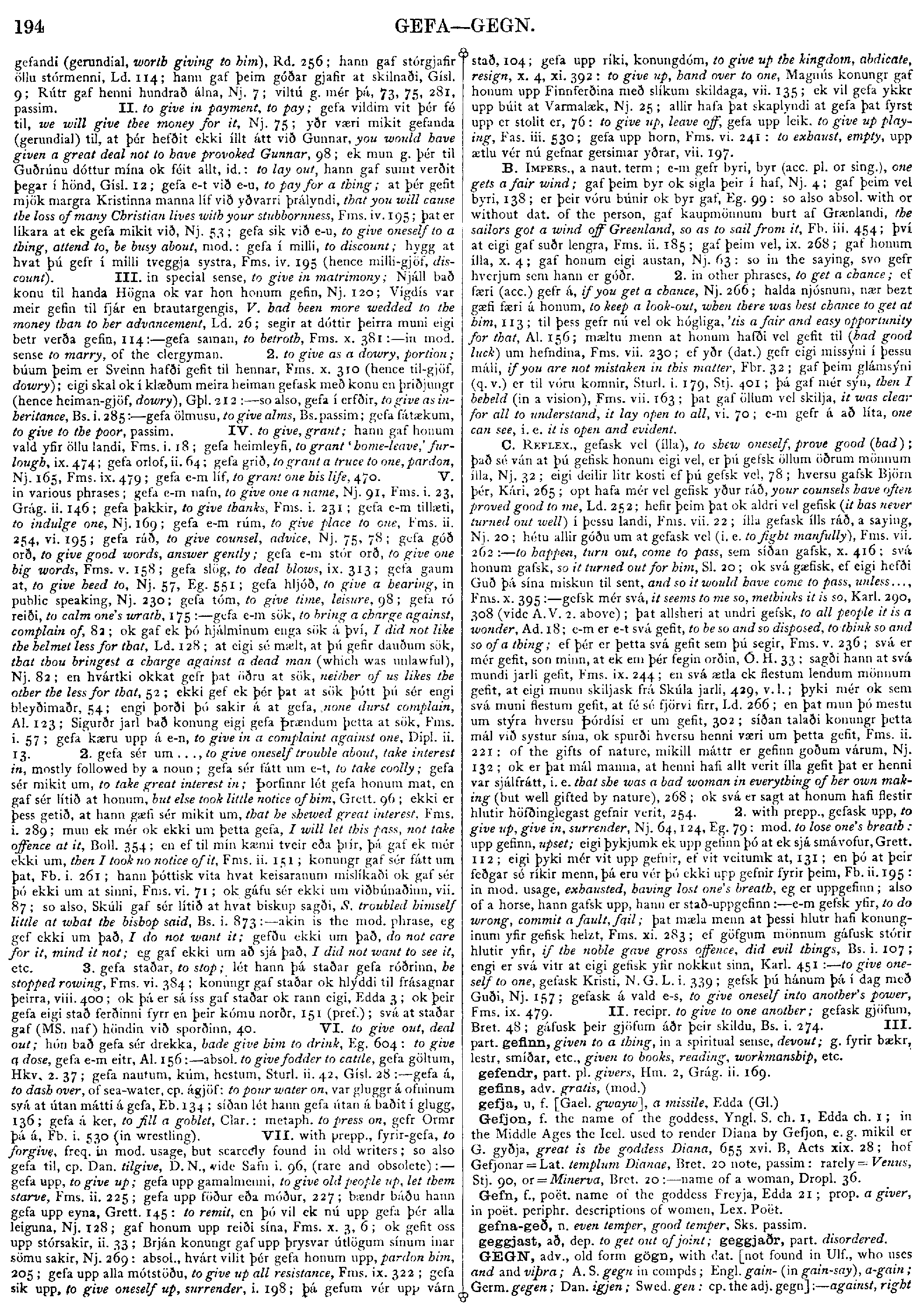
C. REFLEX., gefask vel (ílla), to shew oneself, prove good (bad); það sé ván at þú gefisk honum eigi vel, er þú gefsk öllum öðrum mönnum ílla, Nj. 32; eigi deilir litr kosti ef þú gefsk vel, 78; hversu gafsk Björn þér, Kári, 265; opt hafa mér vel gefisk yður ráð, your counsels have often proved good to me, Ld. 252; hefir þeim þat ok aldri vel gefisk (it has never turned out well) í þessu landi, Fms. vii. 22; ílla gefask ílls ráð, a saying, Nj. 20; hétu allir góðu um at gefask vel (i.e. to fight manfully), Fms. vii. 262 :-- to happen, turn out, come to pass, sem síðan gafsk, x. 416; svá honum gafsk, so it turned out for him, Sl. 20; ok svá gæfisk, ef eigi hefði Guð þá sína miskun til sent, and so it would have come to pass, unless ..., Fms. x. 395 :-- gefsk mér svá, it seems to me so, methinks it is so, Karl. 290, 308 (vide A. V. 2. above); þat allsheri at undri gefsk, to all people it is a wonder, Ad. 18; e-m er e-t svá gefit, to be so and so disposed, to think so and so of a thing; ef þér er þetta svá gefit sem þú segir, Fms. v. 236; svá er mér gefit, son minn, at ek em þér fegin orðin, Ó. H. 33; sagði hann at svá mundi jarli gefit, Fms. ix. 244; en svá ætla ek flestum lendum mönnum gefit, at eigi munu skiljask frá Skúla jarli, 429, v.l.; þyki mér ok sem svá muni flestum gefit, at fé sé fjörvi firr, Ld. 266; en þat mun þó mestu um stýra hversu Þórdísi er um gefit, 302; síðan talaði konungr þetta mál við systur sína, ok spurði hversu henni væri um þetta gefit, Fms. ii. 221: of the gifts of nature, mikill máttr er gefinn goðum várum, Nj. 132; ok er þat mál manna, at henni hafi allt verit ílla gefit þat er henni var sjálfrátt, i.e. that she was a bad woman in everything of her own making (but well gifted by nature), 268; ok svá er sagt at honum hafi flestir hlutir höfðinglegast gefnir verit, 254. 2. with prepp., gefask upp, to give up, give in, surrender, Nj. 64, 124, Eg. 79: mod. to lose one's breath: upp gefinn, upset; eigi þykjumk ek upp gefinn þó at ek sjá smávofur, Grett. 112; eigi þyki mér vit upp gefnir, ef vit veitumk at, 131; en þó at þeir feðgar sé ríkir menn, þá eru vér þó ekki upp gefnir fyrir þeim, Fb. ii. 195: in mod. usage, exhausted, having lost one's breath, eg er uppgefinn; also of a horse, hann gafsk upp, harm er stað-uppgefinn :-- e-m gefsk yfir, to do wrong, commit a fault, fail; þat mæla menn at þessi hlutr hafi konunginum yfir gefisk helzt, Fms. xi. 283; ef göfgum mönnum gáfusk stórir hlutir yfir, if the noble gave gross offence, did evil things, Bs. i. 107; engi er svá vitr at eigi gefisk yfir nokkut sinn, Karl. 451 :-- to give oneself to one, gefask Kristi, N. G. L. i. 339; gefsk þú hánum þá í dag með Guði, Nj. 157; gefask á vald e-s, to give oneself into another's power, Fms. ix. 479. II. recipr. to give to one another; gefask gjöfum, Bret. 48; gáfusk þeir gjöfum áðr þeir skildu, Bs. i. 274. III. part. gefinn, given to a thing, in a spiritual sense, devout; g. fyrir bækr, lestr, smíðar, etc., given to books, reading, workmanship, etc.
|
Source: Cleasby/Vigfusson, page b0198, entry 1 View original page image as: [TIFF] [PNG] [View previous entry] [View next entry] |
[Comment on this entry] [View comments] |
The following entry has been hand-corrected once. |
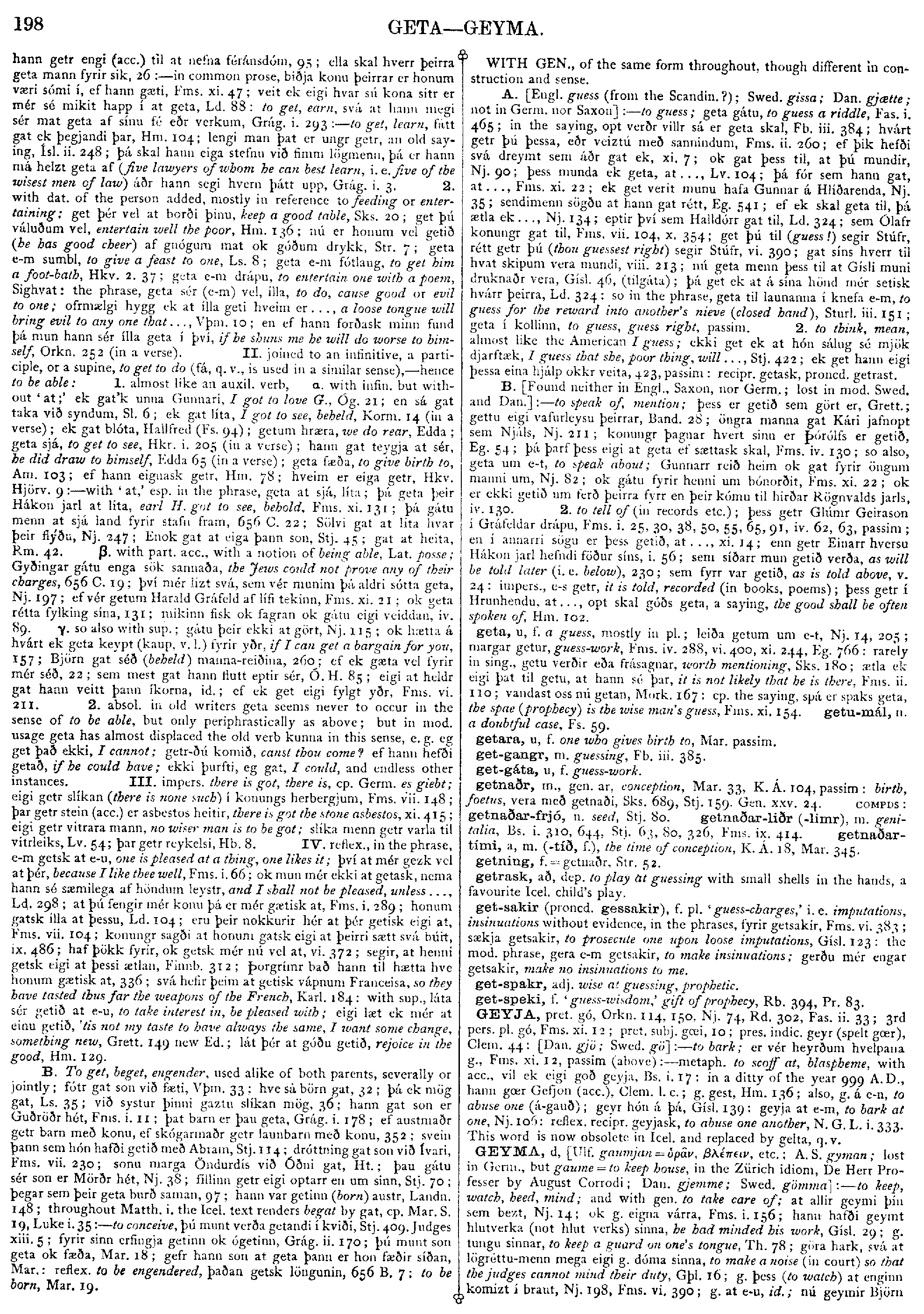
hann
getr
engi
(acc.)
til
at
nefna
féránsdóm,
95;
ella
skal
hverr
þeirra
geta
mann
fyrir
sik,
26
:--
in
common
prose,
biðja
konu
þeirrar
er
honum
væri
sómi
í,
ef
hann
gæti,
Fms.
xi.
47;
veit
ek
eigi
hvar
sú
kona
sitr
er
mér
sé
mikit
happ
í
at
geta,
Ld.
88:
to
get,
earn,
svá
at
hann
megi
sér
mat
geta
af
sínu
fé
eðr
verkum,
Grág.
i.
293
:--
to
get,
learn,
fátt
gat
ek
þegjandi
þar,
Hm.
104;
lengi
man
þat
er
ungr
getr,
an
old
saying,
Ísl.
ii.
248;
þá
skal
hann
eiga
stefnu
við
fimm
lögmenn,
þá
er
hann
má
helzt
geta
af
(five
lawyers
of
whom
he
can
best
learn,
i.e.
five
of
the
wisest
men
of
law)
áðr
hann
segi
hvern
þátt
upp,
Grág.
i.
3.
2.
with
dat.
of
the
person
added,
mostly
in
reference
to
feeding
or
entertaining;
get
þér
vel
at
borði
þínu,
keep
a
good
table,
Sks.
20;
get
þú
váluðum
vel,
entertain
well
the
poor,
Hm.
136;
nú
er
honum
vel
getið
(he
has
good
cheer)
af
gnógum
mat
ok
góðum
drykk,
Str.
7;
geta
e-m
sumbl,
to
give
a
feast
to
one,
Ls.
8;
geta
e-m
fótlaug,
to
get
him
a
foot-bath,
Hkv.
2.
37;
geta
e-m
drápu,
to
entertain
one
with
a
poem,
Sighvat:
the
phrase,
geta
sér
(e-m)
vel,
ílla,
to
do,
cause
good
or
evil
to
one;
ofrmælgi
hygg
ek
at
ílla
geti
hveim
er
...,
a
loose
tongue
will
bring
evil
to
any
one
that
...,
Vþm.
10;
en
ef
hann
forðask
minn
fund
þá
mun
hann
sér
ílla
geta
í
því,
if
he
shuns
me
he
will
do
worse
to
himself,
Orkn.
252
(in
a
verse).
II.
joined
to
an
infinitive,
a
participle,
or
a
supine,
to
get
to
do
(fá,
q.v.,
is
used
in
a
similar
sense),
--
hence
to
be
able:
1.
almost
like
an
auxil.
verb,
 .
with
infin.
but
without
'at;'
ek
gat'k
unna
Gunnari,
I
got
to
love
G.,
Óg.
21;
en
sá
gat
taka
við
syndum,
Sl.
6;
ek
gat
líta,
I
got
to
see,
beheld,
Korm.
14
(in
a
verse);
ek
gat
blóta,
Hallfred
(Fs.
94);
getum
hræra,
we
do
rear,
Edda;
geta
sjá,
to
get
to
see,
Hkr.
i.
205
(in
a
verse);
hann
gat
teygja
at
sér,
he
did
draw
to
himself,
Edda
65
(in
a
verse);
geta
fæða,
to
give
birth
to,
Am.
103;
ef
hann
eignask
getr,
Hm.
78;
hveim
er
eiga
getr,
Hkv.
Hjörv.
9
:--
with
'at,'
esp.
in
the
phrase,
geta
at
sjá,
líta;
þá
geta
þeir
Hákon
jarl
at
líta,
earl
H.
got
to
see,
behold,
Fms.
xi.
131;
þá
gátu
menn
at
sjá
land
fyrir
stafu
fram,
656
C.
22;
Sölvi
gat
at
líta
hvar
þeir
flýðu,
Nj.
247;
Enok
gat
at
eiga
þann
son,
Stj.
45;
gat
at
heita,
Rm.
42.
.
with
infin.
but
without
'at;'
ek
gat'k
unna
Gunnari,
I
got
to
love
G.,
Óg.
21;
en
sá
gat
taka
við
syndum,
Sl.
6;
ek
gat
líta,
I
got
to
see,
beheld,
Korm.
14
(in
a
verse);
ek
gat
blóta,
Hallfred
(Fs.
94);
getum
hræra,
we
do
rear,
Edda;
geta
sjá,
to
get
to
see,
Hkr.
i.
205
(in
a
verse);
hann
gat
teygja
at
sér,
he
did
draw
to
himself,
Edda
65
(in
a
verse);
geta
fæða,
to
give
birth
to,
Am.
103;
ef
hann
eignask
getr,
Hm.
78;
hveim
er
eiga
getr,
Hkv.
Hjörv.
9
:--
with
'at,'
esp.
in
the
phrase,
geta
at
sjá,
líta;
þá
geta
þeir
Hákon
jarl
at
líta,
earl
H.
got
to
see,
behold,
Fms.
xi.
131;
þá
gátu
menn
at
sjá
land
fyrir
stafu
fram,
656
C.
22;
Sölvi
gat
at
líta
hvar
þeir
flýðu,
Nj.
247;
Enok
gat
at
eiga
þann
son,
Stj.
45;
gat
at
heita,
Rm.
42.
 .
with
part.
acc.,
with
a
notion
of
being
able,
Lat.
posse;
Gyðingar
gátu
enga
sök
sannaða,
the
Jews
could
not
prove
any
of
their
charges,
656
C.
19;
því
mér
lízt
svá,
sem
vér
munim
þá
aldri
sótta
geta,
Nj.
197;
ef
vér
getum
Harald
Gráfeld
af
lífi
tekinn,
Fms.
xi.
21;
ok
geta
rétta
fylking
sína,
131;
mikinn
fisk
ok
fagran
ok
gátu
eigi
veiddan,
iv.
89.
.
with
part.
acc.,
with
a
notion
of
being
able,
Lat.
posse;
Gyðingar
gátu
enga
sök
sannaða,
the
Jews
could
not
prove
any
of
their
charges,
656
C.
19;
því
mér
lízt
svá,
sem
vér
munim
þá
aldri
sótta
geta,
Nj.
197;
ef
vér
getum
Harald
Gráfeld
af
lífi
tekinn,
Fms.
xi.
21;
ok
geta
rétta
fylking
sína,
131;
mikinn
fisk
ok
fagran
ok
gátu
eigi
veiddan,
iv.
89.
 .
so
also
with
sup.;
gátu
þeir
ekki
at
gört,
Nj.
115;
ok
hætta
á
hvárt
ek
geta
keypt
(kaup,
v.l.)
fyrir
yðr.
if
I
can
get
a
bargain
for
you,
157;
Björn
gat
séð
(beheld)
manna-reiðina,
260;
ef
ek
gæta
vel
fyrir
mér
séð,
22;
sem
mest
gat
hann
flutt
eptir
sér,
Ó.
H.
85;
eigi
at
heldr
gat
hann
veitt
þann
íkorna,
id.;
ef
ek
get
eigi
fylgt
yðr,
Fms.
vi.
211.
2.
absol.
in
old
writers
geta
seems
never
to
occur
in
the
sense
of
to
be
able,
but
only
periphrastically
as
above;
but
in
mod.
usage
geta
has
almost
displaced
the
old
verb
kunna
in
this
sense,
e.g.
eg
get
það
ekki,
I
cannot;
getr-ðú
komið,
canst
thou
come?
ef
hann
hefði
getað,
if
he
could
have;
ekki
þurfti,
eg
gat,
I
could,
and
endless
other
instances.
III.
impers.
there
is
got,
there
is,
cp.
Germ.
es
giebt;
eigi
getr
slíkan
(there
is
none
such)
í
konungs
herbergjum,
Fms.
vii.
148;
þar
getr
stein
(acc.)
er
asbestos
heitir,
there
is
got
the
stone
asbestos,
xi.
415;
eigi
getr
vitrara
mann,
no
wiser
man
is
to
be
got;
slíka
menn
getr
varla
til
vitrleiks,
Lv.
54;
þar
getr
reykelsi,
Hb,
8.
IV.
reflex.,
in
the
phrase,
e-m
getsk
at
e-u,
one
is
pleased
at
a
thing,
one
likes
it;
því
at
mér
gezk
vel
at
þér,
because
I
like
thee
well,
Fms.
i.
66;
ok
mun
mér
ekki
at
getask,
nema
hann
sé
sæmilega
af
höndum
leystr,
and
I
shall
not
be
pleased,
unless
...,
Ld.
298;
at
þú
fengir
mér
konu
þá
er
mér
gætisk
at,
Fms.
i.
289;
honum
gatsk
ílla
at
þessu,
Ld.
104;
eru
þeir
nokkurir
hér
at
þér
getisk
eigi
at,
Fms.
vii.
104;
konungr
sagði
at
honum
gatsk
eigi
at
þeirri
sætt
svá
búit,
ix.
486;
haf
þökk
fyrir,
ok
getsk
mér
nú
vel
at,
vi.
372;
segir,
at
henni
getsk
eigi
at
þessi
ætlan,
Finnb.
312;
Þorgrímr
bað
hann
til
hætta
hve
honum
gætisk
at,
336;
svá
hefir
þeim
at
getisk
vápnum
Franceisa,
so
they
have
tasted
thus
far
the
weapons
of
the
French,
Karl.
184:
with
sup.,
láta
sér
getið
at
e-u,
to
take
interest
in,
be
pleased
with;
eigi
læt
ek
mér
at
einu
getið,
'tis
not
my
taste
to
have
always
the
same,
I
want
some
change,
something
new,
Grett.
149
new
Ed.;
lát
þér
at
góðu
getið,
rejoice
in
the
good,
Hm.
129.
.
so
also
with
sup.;
gátu
þeir
ekki
at
gört,
Nj.
115;
ok
hætta
á
hvárt
ek
geta
keypt
(kaup,
v.l.)
fyrir
yðr.
if
I
can
get
a
bargain
for
you,
157;
Björn
gat
séð
(beheld)
manna-reiðina,
260;
ef
ek
gæta
vel
fyrir
mér
séð,
22;
sem
mest
gat
hann
flutt
eptir
sér,
Ó.
H.
85;
eigi
at
heldr
gat
hann
veitt
þann
íkorna,
id.;
ef
ek
get
eigi
fylgt
yðr,
Fms.
vi.
211.
2.
absol.
in
old
writers
geta
seems
never
to
occur
in
the
sense
of
to
be
able,
but
only
periphrastically
as
above;
but
in
mod.
usage
geta
has
almost
displaced
the
old
verb
kunna
in
this
sense,
e.g.
eg
get
það
ekki,
I
cannot;
getr-ðú
komið,
canst
thou
come?
ef
hann
hefði
getað,
if
he
could
have;
ekki
þurfti,
eg
gat,
I
could,
and
endless
other
instances.
III.
impers.
there
is
got,
there
is,
cp.
Germ.
es
giebt;
eigi
getr
slíkan
(there
is
none
such)
í
konungs
herbergjum,
Fms.
vii.
148;
þar
getr
stein
(acc.)
er
asbestos
heitir,
there
is
got
the
stone
asbestos,
xi.
415;
eigi
getr
vitrara
mann,
no
wiser
man
is
to
be
got;
slíka
menn
getr
varla
til
vitrleiks,
Lv.
54;
þar
getr
reykelsi,
Hb,
8.
IV.
reflex.,
in
the
phrase,
e-m
getsk
at
e-u,
one
is
pleased
at
a
thing,
one
likes
it;
því
at
mér
gezk
vel
at
þér,
because
I
like
thee
well,
Fms.
i.
66;
ok
mun
mér
ekki
at
getask,
nema
hann
sé
sæmilega
af
höndum
leystr,
and
I
shall
not
be
pleased,
unless
...,
Ld.
298;
at
þú
fengir
mér
konu
þá
er
mér
gætisk
at,
Fms.
i.
289;
honum
gatsk
ílla
at
þessu,
Ld.
104;
eru
þeir
nokkurir
hér
at
þér
getisk
eigi
at,
Fms.
vii.
104;
konungr
sagði
at
honum
gatsk
eigi
at
þeirri
sætt
svá
búit,
ix.
486;
haf
þökk
fyrir,
ok
getsk
mér
nú
vel
at,
vi.
372;
segir,
at
henni
getsk
eigi
at
þessi
ætlan,
Finnb.
312;
Þorgrímr
bað
hann
til
hætta
hve
honum
gætisk
at,
336;
svá
hefir
þeim
at
getisk
vápnum
Franceisa,
so
they
have
tasted
thus
far
the
weapons
of
the
French,
Karl.
184:
with
sup.,
láta
sér
getið
at
e-u,
to
take
interest
in,
be
pleased
with;
eigi
læt
ek
mér
at
einu
getið,
'tis
not
my
taste
to
have
always
the
same,
I
want
some
change,
something
new,
Grett.
149
new
Ed.;
lát
þér
at
góðu
getið,
rejoice
in
the
good,
Hm.
129.
|
Source: Cleasby/Vigfusson, page b0198, entry 2 View original page image as: [TIFF] [PNG] [View previous entry] [View next entry] |
[Comment on this entry] [View comments] |
The following entry has been hand-corrected once. |
B. To get, beget, engender, used alike of both parents, severally or jointly; fótr gat son við fæti, Vþm. 33: hve sá börn gat, 32; þá ek mög gat, Ls. 35; við systur þinni gaztu slíkan mög, 36; hann gat son er Guðröðr hét, Fms. i. 11; þat barn er þau geta, Grág. i. 178; ef austmaðr getr barn með konu, ef skógarmaðr getr launbarn með konu, 352; svein þann sem hón hafði getið með Abram, Stj. 114; dróttning gat son við Ívari, Fms. vii. 230; sonu marga Öndurdís við Óðni gat, Ht.; þau gátu sér son er Mörðr hét, Nj. 38; fíllinn getr eigi optarr en um sinn, Stj. 70; þegar sem þeir geta burð saman, 97; hann var getinn (born) austr, Landn. 148; throughout Matth. i. the Icel. text renders begat by gat, cp. Mar. S. 19, Luke i. 35 :-- to conceive, þú munt verða getandi í kviði, Stj. 409. Judges xiii. 5; fyrir sinn erfingja getinn ok ógetinn, Grág. ii. 170; þú munt son geta ok fæða, Mar. 18; gefr hann son at geta þann er hon fæðir síðan, Mar.: reflex. to be engendered, þaðan getsk löngunin, 656 B. 7: to be born, Mar. 19.
|
Source: Cleasby/Vigfusson, page b0218, entry 46 View original page image as: [TIFF] [PNG] [View previous entry] [View next entry] |
[Comment on this entry] [View comments] |
The following entry has been hand-corrected once. |
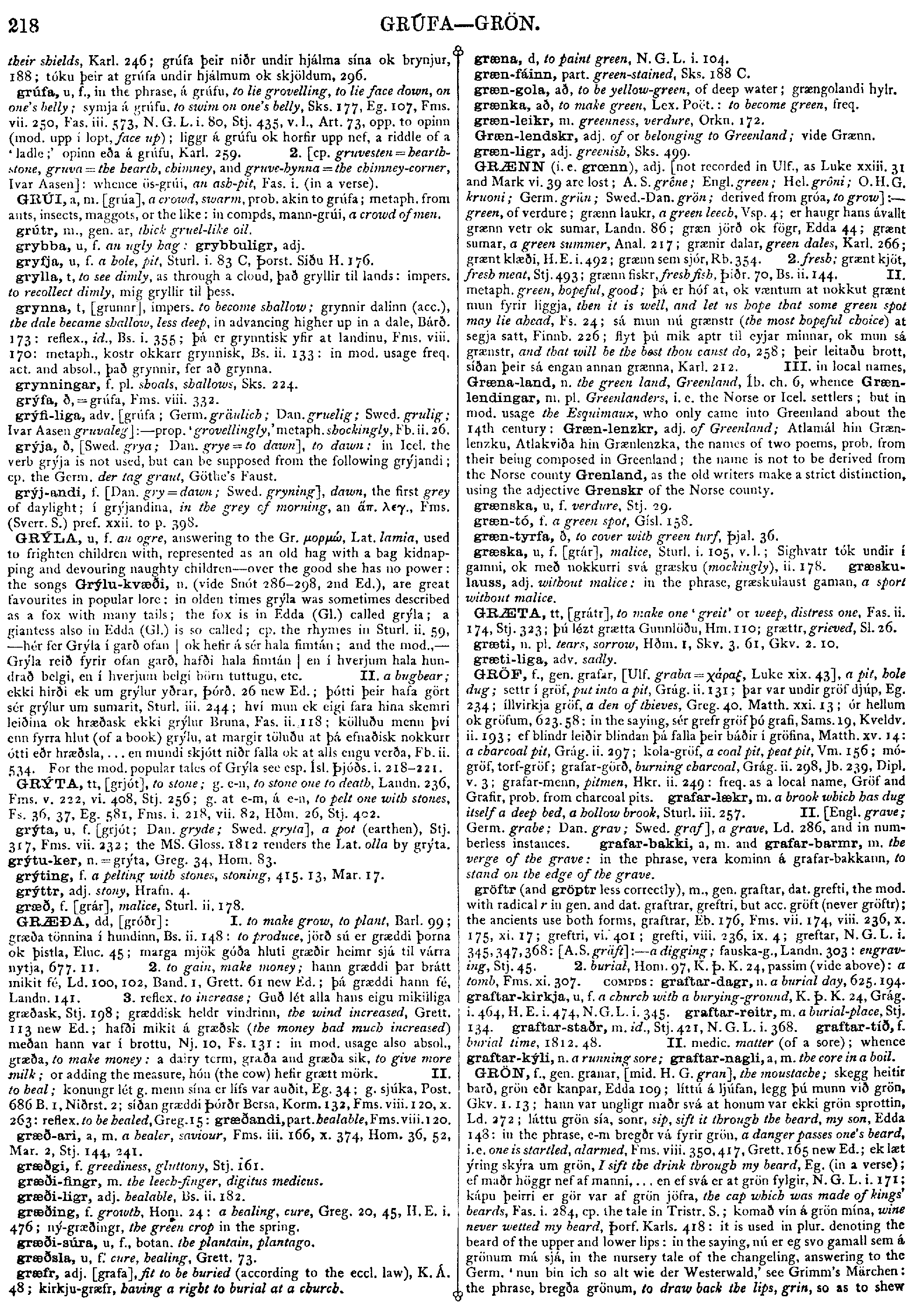
GRÖN, f., gen. granar, [mid. H. G. gran], the moustache; skegg heitir barð, grön eðr kanpar, Edda 109; líttú á ljúfan, legg þú munn við grön, Gkv. 1. 13; hann var ungligr maðr svá at honum var ekki grön sprottin, Ld. 272; láttu grön sía, sonr, sip, sift it through the beard, my son, Edda 148: in the phrase, e-m bregðr vá fyrir grön, a danger passes one's beard, i.e. one is startled, alarmed, Fms. viii. 350, 417, Grett. 165 new Ed.; ek læt ýring skýra um grön, I sift the drink through my beard, Eg. (in a verse); ef maðr höggr nef af manni, ... en ef svá er at grön fylgir, N. G. L. i. 171; kápu þeirri er gör var af grön jöfra, the cap which was made of kings' beards, Fas. i. 284, cp. the tale in Tristr. S.; komað vín á grön mína, wine never wetted my beard, Þorf. Karls. 418: it is used in plur. denoting the beard of the upper and lower lips: in the saying, nú er eg svo gamall sem á grönum má sjá, in the nursery tale of the changeling, answering to the Germ. 'nun bin ich so alt wie der Westerwald,' see Grimm's Märchen: the phrase, bregða grönum, to draw back the lips, grin, so as to shew
|
Source: Cleasby/Vigfusson, page b0219, entry 8 View original page image as: [TIFF] [PNG] [View previous entry] [View next entry] |
[Comment on this entry] [View comments] |
The following entry has been hand-corrected once. |
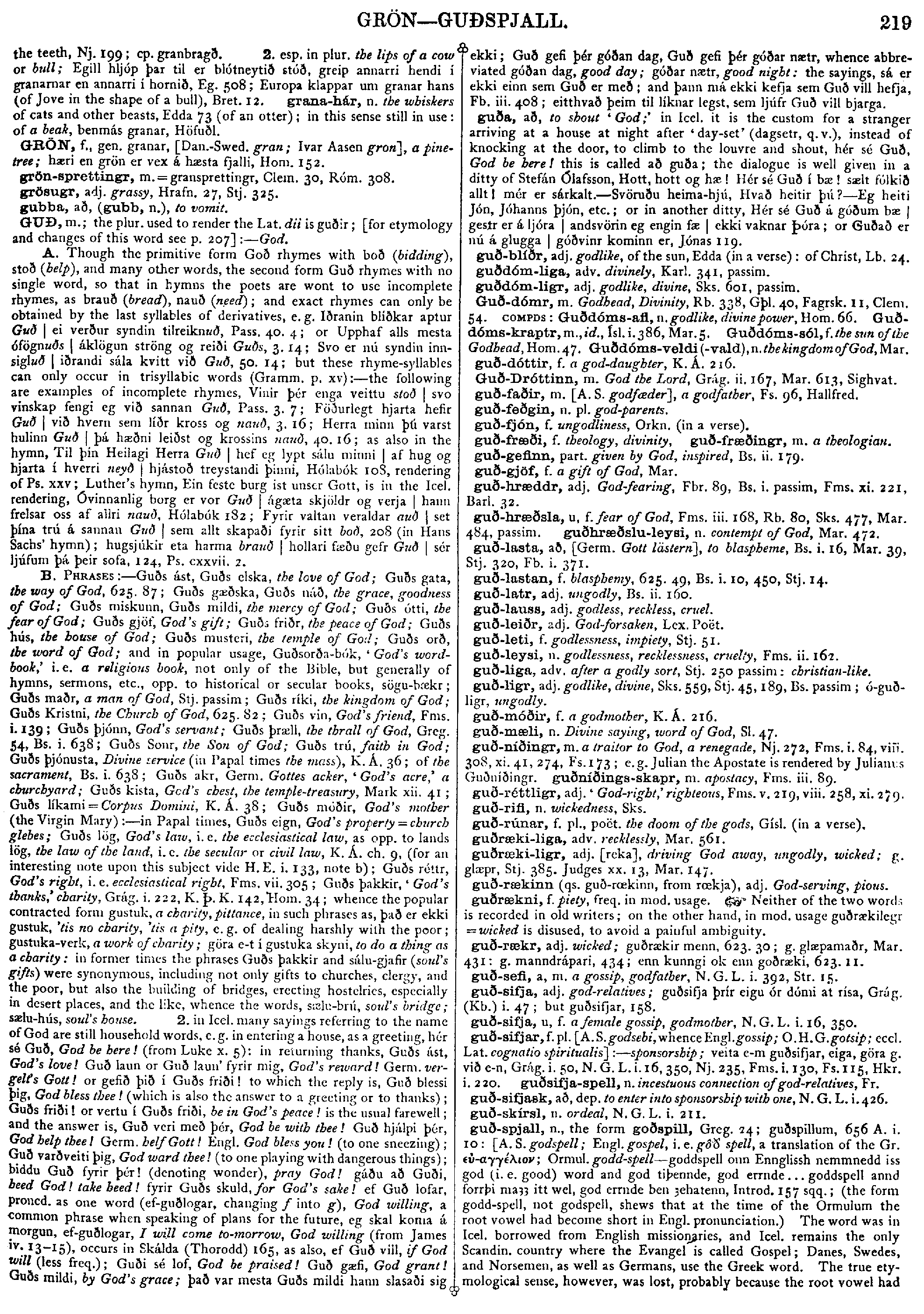
B. PHRASES :-- Guðs ást, Guðs elska, the love of God; Guðs gata, the way of God, 625. 87; Guðs gæðska, Guðs náð, the grace, goodness of God; Guðs miskunn, Guðs mildi, the mercy of God; Guðs ótti, the fear of God; Guðs gjöf, God's gift; Guði friðr, the peace of God; Guðs hús, the house of God; Guðs musteri, the temple of God; Guðs orð, the word of God; and in popular usage, Guðsorða-bók, 'God's word-book,' i.e. a religious book, not only of the Bible, but generally of hymns, sermons, etc., opp. to historical or secular books, sögu-bækr; Guðs maðr, a man of God, Stj. passim; Guðs ríki, the kingdom of God; Guðs Kristni, the Church of God, 625. 82; Guðs vin, God's friend, Fms. i. 139; Guðs þjónn, God's servant; Guðs þræll, the thrall of God, Greg. 54, Bs. i. 638; Guðs Sonr, the Son of God; Guðs trú, faith in God; Guðs þjónusta, Divine service (in Papal times the mass), K. Á. 36; of the sacrament, Bs. i. 638; Guðs akr, Germ. Gottes acker, 'God's acre,' a churchyard; Guðs kista, God's chest, the temple-treasury, Mark xii. 41; Guðs líkami = Corpus Domini, K. Á. 38; Guðs móðir, God's mother (the Virgin Mary) :-- in Papal times, Guðs eign, God's property = church glebes; Guðs lög, God's law, i.e. the ecclesiastical law, as opp. to lands lög, the law of the land, i.e. the secular or civil law, K. Á. ch. 9, (for an interesting note upon this subject vide H. E. i. 133, note b); Guðs réttr, God's right, i.e. ecclesiastical right, Fms. vii. 305; Guðs þakkir, 'God's thanks,' charity, Grág. i. 222, K. Þ. K. 142, Hom. 34; whence the popular contracted form gustuk, a charity, pittance, in such phrases as, það er ekki gustuk, 'tis no charity, 'tis a pity, e.g. of dealing harshly with the poor; gustuka-verk, a work of charity; göra e-t í gustuka skyni, to do a thing as a charity: in former times the phrases Guðs þakkir and sálu-gjafir (soul's gifts) were synonymous, including not only gifts to churches, clergy, and the poor, but also the building of bridges, erecting hostelries, especially in desert places, and the like, whence the words, sælu-brú, soul's bridge; sælu-hús, soul's house. 2. in Icel. many sayings referring to the name of God are still household words, e.g. in entering a house, as a greeting, hér sé Guð, God be here! (from Luke x. 5): in returning thanks, Guðs ást, God's love! Guð laun or Guð laun' fyrir mig, God's reward! Germ. vergelt's Gott! or gefið þið í Guðs friði! to which the reply is, Guð blessi þig, God bless thee ! (which is also the answer to a greeting or to thanks); Guðs friði! or vertu í Guðs friði, be in God's peace! is the usual farewell; and the answer is, Guð veri með þér, God be with thee! Guð hjálpi þér, God help thee! Germ. helf Gott! Engl. God bless you! (to one sneezing); Guð varðveiti þig, God ward thee! (to one playing with dangerous things); biddu Guð fyrir þér! (denoting wonder), pray God! gáðu að Guði, heed God! take heed! fyrir Guðs skuld, for God's sake! ef Guð lofar, proncd. as one word (ef-guðlogar, changing f into g), God willing, a common phrase when speaking of plans for the future, eg skal koma á morgun, ef-guðlogar, I will come to-morrow, God willing (from James iv. 13-15), occurs in Skálda (Thorodd) 165, as also, ef Guð vill, if God will (less freq.); Guði sé lof, God be praised! Guð gæfi, God grant! Guðs mildi, by God's grace; það var mesta Guðs mildi hann slasaði sig ekki; Guð gefi þér góðan dag, Guð gefi þér góðar nætr, whence abbreviated góðan dag, good day; góðar nætr, good night: the sayings, sá er ekki einn sem Guð er með; and þann má ekki kefja sem Guð vill hefja, Fb. iii. 408; eitthvað þeim til líknar legst, sem ljúfr Guð vill bjarga.
|
Source: Cleasby/Vigfusson, page b0230, entry 4 View original page image as: [TIFF] [PNG] [View previous entry] [View next entry] |
[Comment on this entry] [View comments] |
The following entry has been hand-corrected once. |
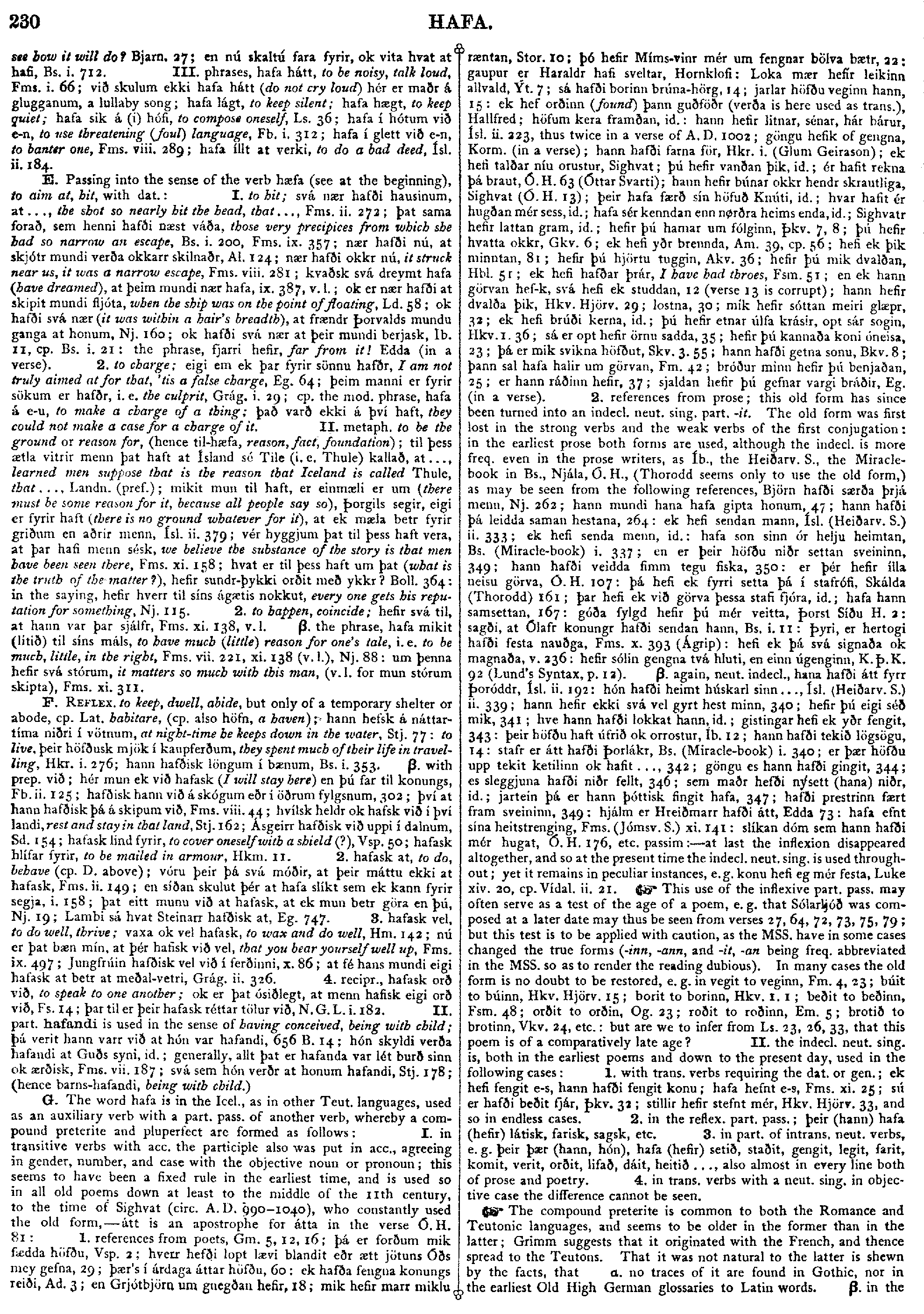
G.
The
word
hafa
is
in
the
Icel.,
as
in
other
Teut.
languages,
used
as
an
auxiliary
verb
with
a
part.
pass.
of
another
verb,
whereby
a
compound
preterite
and
pluperfect
are
formed
as
follows:
I.
in
transitive
verbs
with
acc.
the
participle
also
was
put
in
acc.,
agreeing
in
gender,
number,
and
case
with
the
objective
noun
or
pronoun;
this
seems
to
have
been
a
fixed
rule
in
the
earliest
time,
and
is
used
so
in
all
old
poems
down
at
least
to
the
middle
of
the
11th
century,
to
the
time
of
Sighvat
(circ.
A.D.
990-1040),
who
constantly
used
the
old
form,
--
átt
is
an
apostrophe
for
átta
in
the
verse
Ó.
H.
81:
1.
references
from
poets,
Gm.
5,
12,
16;
þá
er
forðum
mik
fædda
höfðu,
Vsp.
2;
hverr
hefði
lopt
lævi
blandit
eðr
ætt
jötuns
Óðs
mey
gefna,
29;
þær's
í
árdaga
áttar
höfðu,
60:
ek
hafða
fengna
konungs
reiði,
Ad.
3;
en
Grjótbjörn
um
gnegðan
hefir,
18;
mik
hefir
marr
miklu
ræntan,
Stor.
10;
þó
hefir
Míms-vinr
mér
um
fengnar
bölva
bætr,
22:
gaupur
er
Haraldr
hafi
sveltar,
Hornklofi:
Loka
mær
hefir
leikinn
allvald,
Ýt.
7;
sá
hafði
borinn
brúna-hörg,
14;
jarlar
höfðu
veginn
hann,
15:
ek
hef
orðinn
(found)
þann
guðföðr
(verða
is
here
used
as
trans.),
Hallfred;
höfum
kera
framðan,
id.:
hann
hefir
litnar,
sénar,
hár
bárur,
Ísl.
ii.
223,
thus
twice
in
a
verse
of
A.D.
1002;
göngu
hefik
of
gengna,
Korm.
(in
a
verse);
hann
hafði
farna
för,
Hkr.
i.
(Glum
Geirason);
ek
hefi
talðar
níu
orustur,
Sighvat;
þú
hefir
vanðan
þik,
id.;
ér
hafit
rekna
þá
braut,
Ó.
H.
63
(Óttar
Svarti);
hann
hefir
búnar
okkr
hendr
skrautliga,
Sighvat
(Ó.
H.
13);
þeir
hafa
færð
sín
höfuð
Knúti,
id.;
hvar
hafit
ér
hugðan
mér
sess,
id.;
hafa
sér
kenndan
enn
nørðra
heims
enda,
id.;
Sighvatr
hefir
lattan
gram,
id.;
hefir
þú
hamar
um
fólginn,
Þkv.
7,
8;
þú
hefir
hvatta
okkr,
Gkv.
6;
ek
hefi
yðr
brennda,
Am.
39,
cp.
56;
hefi
ek
þik
minntan,
81;
hefir
þú
hjörtu
tuggin,
Akv.
36;
hefir
þú
mik
dvalðan,
Hbl.
51;
ek
hefi
hafðar
þrár,
I
have
had
throes,
Fsm.
51;
en
ek
hann
görvan
hef-k,
svá
hefi
ek
studdan,
12
(verse
13
is
corrupt);
hann
hefir
dvalða
þik,
Hkv.
Hjörv.
29;
lostna,
30;
mik
hefir
sóttan
meiri
glæpr,
32;
ek
hefi
brúði
kerna,
id.;
þú
hefir
etnar
úlfa
krásir,
opt
sár
sogin,
Hkv.
1.
36;
sá
er
opt
hefir
örnu
sadda,
35;
hefir
þú
kannaða
koni
óneisa,
23;
þá
er
mik
svikna
höfðut,
Skv.
3.
55;
hann
hafði
getna
sonu,
Bkv.
8;
þann
sal
hafa
halir
um
görvan,
Fm.
42;
bróður
minn
hefir
þú
benjaðan,
25;
er
hann
ráðinn
hefir,
37;
sjaldan
hefir
þú
gefnar
vargi
bráðir,
Eg.
(in
a
verse).
2.
references
from
prose;
this
old
form
has
since
been
turned
into
an
indecl.
neut.
sing.
part.
-it.
The
old
form
was
first
lost
in
the
strong
verbs
and
the
weak
verbs
of
the
first
conjugation:
in
the
earliest
prose
both
forms
are
used,
although
the
indecl.
is
more
freq.
even
in
the
prose
writers,
as
Íb.,
the
Heiðarv.
S.,
the
Miracle-book
in
Bs.,
Njála,
Ó.
H.,
(Thorodd
seems
only
to
use
the
old
form,)
as
may
be
seen
from
the
following
references,
Björn
hafði
særða
þrjá
menn,
Nj.
262;
hann
mundi
hana
hafa
gipta
honum,
47;
hann
hafði
þá
leidda
saman
hestana,
264:
ek
hefi
sendan
mann,
Ísl.
(Heiðarv.
S.)
ii.
333;
ek
nefi
senda
menn,
id.:
hafa
son
sinn
ór
helju
heimtan,
Bs.
(Miracle-book)
i.
337;
en
er
þeir
höfðu
niðr
settan
sveininn,
349;
hann
hafði
veidda
fimm
tegu
fiska,
350:
er
þér
hefir
ílla
neisu
gorva,
Ó.
H.
107:
þá
hefi
ek
fyrri
setta
þá
í
stafrófi,
Skálda
(Thorodd)
161;
þar
hefi
ek
við
görva
þessa
stafi
fjóra,
id.;
hafa
hann
samsettan,
167:
góða
fylgd
hefir
þú
mér
veitta,
Þorst
Síðu
H.
2:
sagði,
at
Ólafr
konungr
hafði
sendan
hann,
Bs.
i.
11:
Þyri,
er
hertogi
hafði
festa
nauðga,
Fms.
x.
393
(Ágrip):
hefi
ek
þá
svá
signaða
ok
magnaða,
v.
236:
hefir
sólin
gengna
tvá
hluti,
en
einn
úgenginn,
K.
Þ.
K.
92
(Lund's
Syntax,
p.
12).
.
again,
neut.
indecl.,
hana
hafði
átt
fyrr
Þoróddr,
Ísl.
ii.
192:
hón
hafði
heimt
húskarl
sinn
...,
Ísl.
(Heiðarv.
S.)
ii.
339;
hann
hefir
ekki
svá
vel
gyrt
hest
minn,
340;
hefir
þú
eigi
séð
mik,
341;
hve
hann
hafði
lokkat
hann.
id.;
gistingar
hefi
ek
yðr
fengit,
343:
þeir
höfðu
haft
úfrið
ok
orrostur,
Íb.
12;
hann
hafði
tekið
lögsögu,
14:
stafr
er
átt
hafði
Þorlákr,
Bs.
(Miracle-book)
i.
340;
er
þær
höfðu
upp
tekit
ketilinn
ok
hafit
...,
342;
göngu
es
hann
hafði
gingit,
344;
es
sleggjuna
hafði
niðr
fellt,
346;
sem
maðr
hefði
nýsett
(hana)
niðr,
id.;
jartein
þá
er
hann
þóttisk
fingit
hafa,
347;
hafði
prestrinn
fært
fram
sveininn,
349:
hjálm
er
Hreiðmarr
hafði
átt,
Edda
73:
hafa
efnt
sína
heitstrenging,
Fms.
(Jómsv.
S.)
xi.
141:
slíkan
dóm
sem
hann
hafði
mér
hugat,
Ó.
H.
176,
etc.
passim
:--
at
last
the
inflexion
disappeared
altogether,
and
so
at
the
present
time
the
indecl.
neut.
sing,
is
used
throughout;
yet
it
remains
in
peculiar
instances,
e.g.
konu
hefi
eg
mér
festa,
Luke
xiv.
20,
cp.
Vídal.
ii.
21.
UNCERTAIN
This
use
of
the
inflexive
part.
pass.
may
often
serve
as
a
test
of
the
age
of
a
poem,
e.g.
that
Sólarljóð
was
composed
at
a
later
date
may
thus
be
seen
from
verses
27,
64,
72,
73,
75,
79;
but
this
test
is
to
be
applied
with
caution,
as
the
MSS.
have
in
some
cases
changed
the
true
forms
(-inn,
-ann,
and
-it,
-an
being
freq.
abbreviated
in
the
MSS.
so
as
to
render
the
reading
dubious).
In
many
cases
the
old
form
is
no
doubt
to
be
restored,
e.g.
in
vegit
to
veginn,
Fm.
4,
23;
búit
to
búinn,
Hkv.
Hjörv.
15;
borit
to
borinn,
Hkv.
1.
1;
beðit
to
beðinn,
Fsm.
48;
orðit
to
orðin,
Og.
23;
roðit
to
roðinn,
Em.
5;
brotið
to
brotinn,
Vkv.
24,
etc.:
but
are
we
to
infer
from
Ls.
23,
26,
33,
that
this
poem
is
of
a
comparatively
late
age?
II.
the
indecl.
neut.
sing.
is,
both
in
the
earliest
poems
and
down
to
the
present
day,
used
in
the
following
cases:
1.
with
trans.
verbs
requiring
the
dat.
or
gen.;
ek
hefi
fengit
e-s,
hann
hafði
fengit
konu;
hafa
hefnt
e-s,
Fms.
xi.
25;
sú
er
hafði
beðit
fjár,
Þkv.
32;
stillir
hefir
stefnt
mér,
Hkv.
Hjörv.
33,
and
so
in
endless
cases.
2.
in
the
reflex.
part.
pass.;
þeir
(hann)
hafa
(hefir)
látisk,
farisk,
sagsk,
etc.
3.
in
part.
of
intrans.
neut.
verbs,
e.g.
þeir
þær
(hann,
hón),
hafa
(hefir)
setið,
staðit,
gengit,
legit,
farit,
komit,
verit,
orðit,
lifað,
dáit,
heitið
...,
also
almost
in
every
line
both
of
prose
and
poetry.
4.
in
trans.
verbs
with
a
neut.
sing.
in
objective
case
the
difference
cannot
be
seen.
|
Source: Cleasby/Vigfusson, page b0236, entry 7 View original page image as: [TIFF] [PNG] [View previous entry] [View next entry] |
[Comment on this entry] [View comments] |
The following entry has been hand-corrected once. |
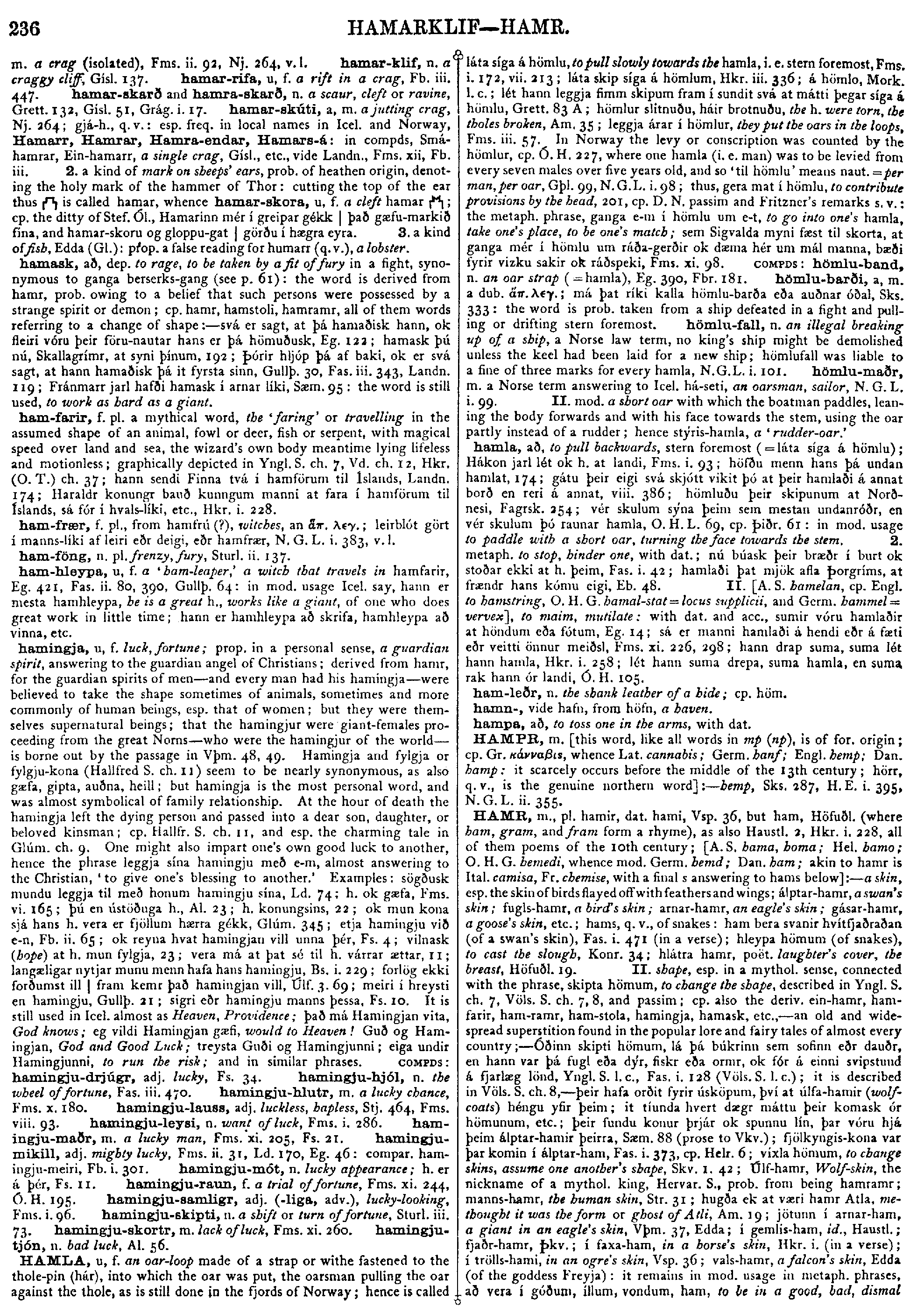
hamingja, u, f. luck, fortune; prop. in a personal sense, a guardian spirit, answering to the guardian angel of Christians; derived from hamr, for the guardian spirits of men -- and every man had his hamingja -- were believed to take the shape sometimes of animals, sometimes and more commonly of human beings, esp. that of women; but they were themselves supernatural beings; that the hamingjur were giant-females proceeding from the great Norns -- who were the hamingjur of the world -- is borne out by the passage in Vþm. 48, 49. Hamingja and fylgja or fylgju-kona (Hallfred S. ch. 11) seem to be nearly synonymous, as also gæfa, gipta, auðna, heill; but hamingja is the most personal word, and was almost symbolical of family relationship. At the hour of death the hamingja left the dying person and passed into a dear son, daughter, or beloved kinsman; cp. Hallfr. S. ch. 11, and esp. the charming tale in Glúm. ch. 9. One might also impart one's own good luck to another, hence the phrase leggja sína hamingju með e-m, almost answering to the Christian, 'to give one's blessing to another.' Examples: sögðusk mundu leggja til með honum hamingju sína, Ld. 74; h. ok gæfa, Fms. vi. 165; þú en ústöðuga h., Al. 23; h. konungsins, 22; ok mun kona sjá hans h. vera er fjöllum hærra gékk, Glúm. 345; etja hamingju við e-n, Fb. ii. 65; ok reyna hvat hamingjan vill unna þér, Fs. 4; vilnask (hope) at h. mun fylgja, 23; vera má at þat sé til h. várrar ættar, 11; langæligar nytjar munu menn hafa hans hamingju, Bs. i. 229; forlög ekki forðumst ill | fram kemr það hamingjan vill, Úlf. 3. 69; meiri í hreysti en hamingju, Gullþ. 21; sigri eðr hamingju manns þessa, Fs. 10. It is still used in Icel. almost as Heaven, Providence; það má Hamingjan vita, God knows; eg vildi Hamingjan gæfi, would to Heaven! Guð og Hamingjan, God and Good Luck; treysta Guði og Hamingjunni; eiga undir Hamingjunni, to run the risk; and in similar phrases. COMPDS: hamingju-drjúgr, adj. lucky, Fs. 34. hamingju-hjól, n. the wheel of fortune, Fas. iii. 470. hamingju-hlutr, m. a lucky chance, Fms. x. 180. hamingju-lauss, adj. luckless, hapless, Stj. 464, Fms. viii. 93. hamingju-leysi, n. want of luck, Fms. i. 286. hamingju-maðr, m. a lucky man, Fms. xi. 205, Fs. 21. hamingju-mikill, adj. mighty lucky, Fms. ii. 31, Ld. 170, Eg. 46: compar. hamingju-meiri, Fb. i. 301. hamingju-mót, n. lucky appearance; h. er á pér, Fs. 11. hamingju-raun, f. a trial of fortune, Fms. xi. 244, Ó. H. 195. hamingju-samligr, adj. (-liga, adv.), lucky-looking, Fms. i. 96. hamingju-skipti, n. a shift or turn of fortune, Sturl. iii. 73. hamingju-skortr, m. lack of luck, Fms. xi. 260. hamingju-tjón, n. bad luck, Al. 56.
| Result Page: |  |
Previous | 19 20 21 22 23 24 25 26 27 28 29 30 31 32 33 34 35 36 37 | Next |  |
Germanic Lexicon Project (main page)
This search system was written by
Sean Crist
Please consider
volunteering
to correct the data in these online dictionaries.
No rights reserved. Feel free to use these data in any way you please.