|
|

|
Source: Cleasby/Vigfusson, page b0176, entry 4 View original page image as: [TIFF] [PNG] [View previous entry] [View next entry] |
[Comment on this entry] [View comments] |
The following entry has been hand-corrected once. |
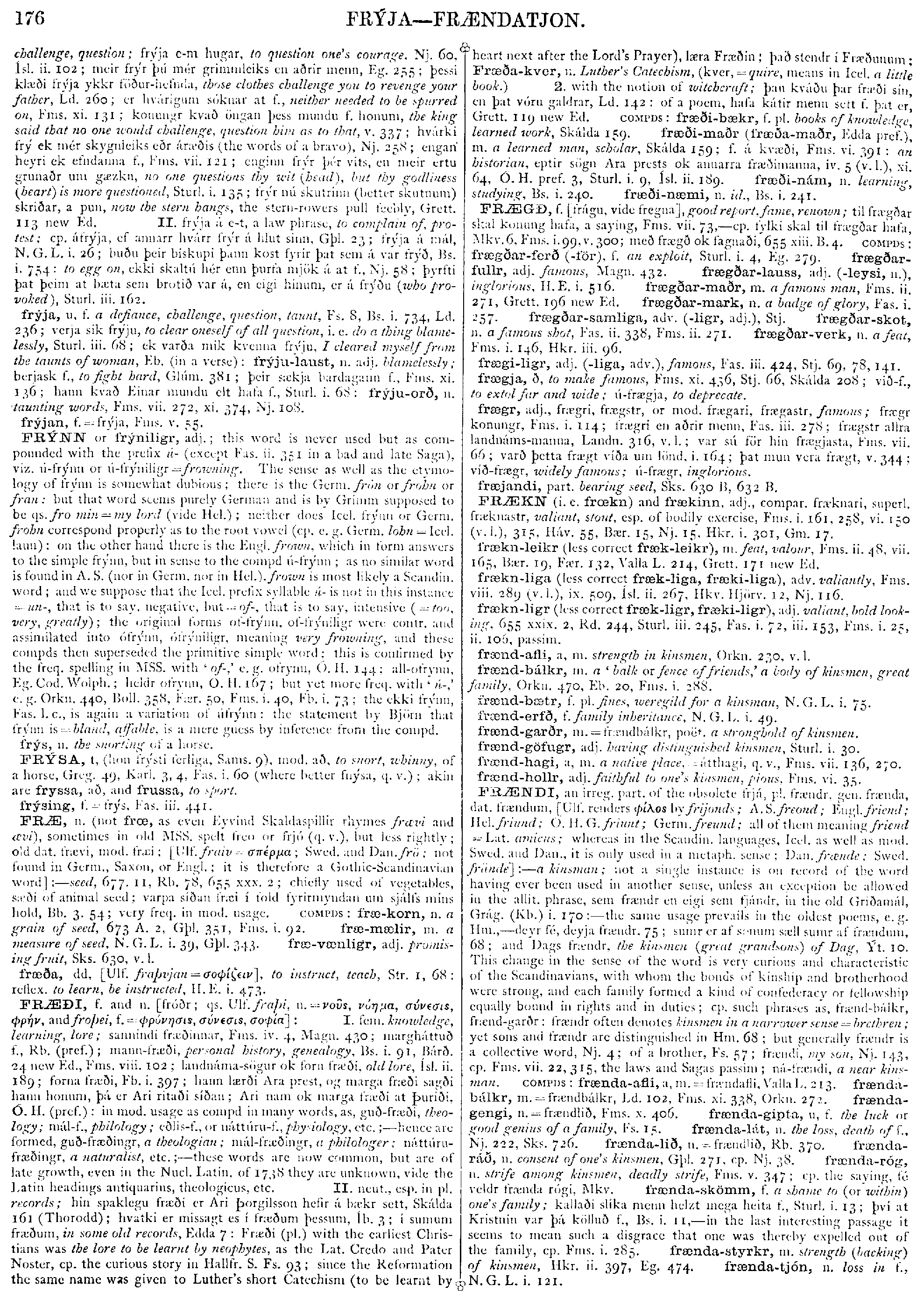
FRÝNN or frýniligr, adj.; this word is never used but as compounded with the prefix ú- (except Fas. ii. 351 in a bad and late Saga), viz. ú-frýnn or ú-frýniligr = frowning. The sense as well as the etymology of frýnn is somewhat dubious; there is the Germ. fron or frohn or fran; but that word seems purely German and is by Grimm supposed to be qs. fro min = my lord (vide Hel.); neither does Icel. frýnn or Germ. frohn correspond properly as to the root vowel (cp. e.g. Germ. lohn = Icel. laun): on the other hand there is the Engl. frown, which in form answers to the simple frýnn, but in sense to the compd ú-frýnn; as no similar word is found in A. S. (nor in Germ. nor in Hel.), frown is most likely a Scandin. word; and we suppose that the Icel. prefix syllable ú- is not in this instance = un-, that is to say, negative, but = of-, that is to say, intensive ( = too, very, greatly); the original forms of-frýnn, of-frýniligr were contr. and assimilated into ófrýnn, ófrýniligr, meaning very frowning, and these compds then superseded the primitive simple word: this is confirmed by the freq. spelling in MSS. with 'of-' e.g. ofrynn, Ó. H. 144; all-ofrynn, Eg. Cod. Wolph.; heldr ofrynn, Ó. H. 167; but yet more freq. with 'ú-' e.g. Orkn. 440, Boll. 358, Fær. 50, Fms. i. 40, Fb. i. 73; the ekki frýnn, Fas. l.c., is again a variation of úfrýnn: the statement by Björn that frýnn is = bland, affable, is a mere guess by inference from the compd.
|
Source: Cleasby/Vigfusson, page b0188, entry 45 View original page image as: [TIFF] [PNG] [View previous entry] [View next entry] |
[Comment on this entry] [View comments] |
The following entry has been hand-corrected once. |
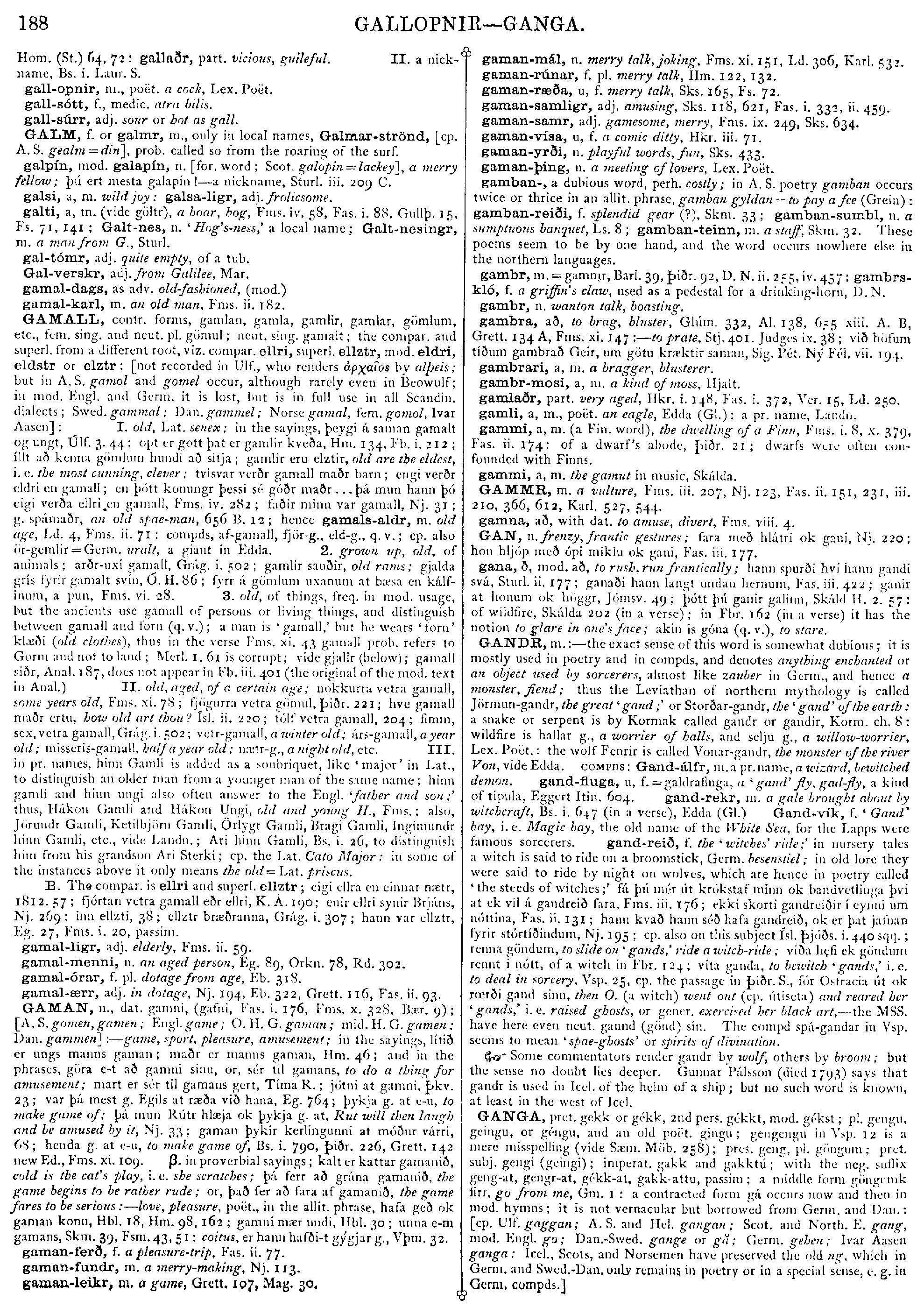
GANDR, m. :-- the exact sense of this word is somewhat dubious; it is mostly used in poetry and in compds, and denotes anything enchanted or an object used by sorcerers, almost like zauber in Germ., and hence a monster, fiend; thus the Leviathan of northern mythology is called Jörmun-gandr, the great 'gand;' or Storðar-gandr, the 'gand' of the earth: a snake or serpent is by Kormak called gandr or gandir, Korm. ch. 8: wildfire is hallar g., a worrier of halls, and selju g., a willow-worrier, Lex. Poët.: the wolf Fenrir is called Vonar-gandr, the monster of the river Von, vide Edda. COMPDS: Gand-álfr, in. a pr. name, a wizard, bewitched demon. gand-fluga, u, f. = galdrafluga, a 'gand' fly, gad-fly, a kind of tipula, Eggert Itin. 604. gand-rekr, m. a gale brought about by witchcraft, Bs. i. 647 (in a verse), Edda (Gl.) Gand-vík, f. 'Gand' bay, i.e. Magic bay, the old name of the White Sea, for the Lapps were famous sorcerers. gand-reið, f. the 'witches' ride;' in nursery tales a witch is said to ride on a broomstick, Germ. besenstiel; in old lore they were said to ride by night on wolves, which are hence in poetry called 'the steeds of witches;' fá þú mér út krókstaf minn ok bandvetlinga því at ek vil á gandreið fara, Fms. iii. 176; ekki skorti gandreiðir í eynni um nóttina, Fas. ii. 131; hann kvað hann séð hafa gandreið, ok er þat jafnan fyrir stórtíðindum, Nj. 195; cp. also on this subject Ísl. Þjóðs. i. 440 sqq.; renna göndum, to slide on 'gands,' ride a witch-ride; víða hefi ek göndum rennt í nótt, of a witch in Fbr. 124; víta ganda, to bewitch 'gands,' i.e. to deal in sorcery, Vsp. 25, cp. the passage in Þiðr. S., fór Ostracia út ok rœrði gand sinn, then O. (a witch) went out (cp. útiseta) and reared her 'gands,' i.e. raised ghosts, or gener. exercised her black art, -- the MSS. have here even neut. gannd (gönd) sín. The compd spá-gandar in Vsp. seems to mean 'spae-ghosts' or spirits of divination.
|
Source: Cleasby/Vigfusson, page b0208, entry 7 View original page image as: [TIFF] [PNG] [View previous entry] [View next entry] |
[Comment on this entry] [View comments] |
The following entry has been hand-corrected once. |
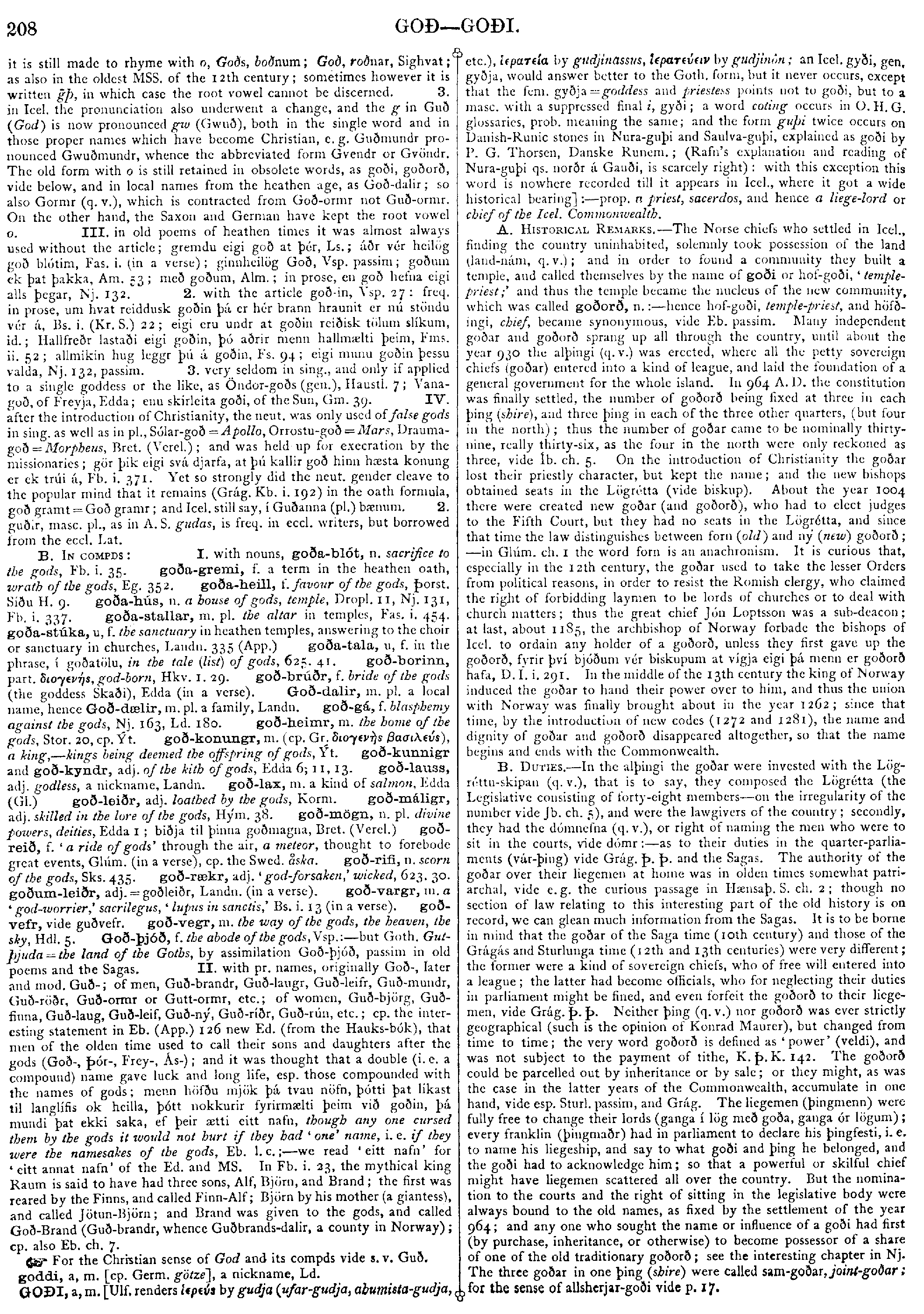
B. DUTIES. -- In the alþingi the goðar were invested with the Lögrettu-skipan (q.v.), that is to say, they composed the Lögrétta (the Legislative consisting of forty-eight members -- on the irregularity of the number vide Jb. ch. 5), and were the lawgivers of the country; secondly, they had the dómnefna (q.v.), or right of naming the men who were to sit in the courts, vide dómr :-- as to their duties in the quarter-parliaments (vár-þing) vide Grág. Þ. Þ. and the Sagas. The authority of the goðar over their liegemen at home was in olden times somewhat patriarchal, vide e.g. the curious passage in Hænsaþ. S. ch. 2; though no section of law relating to this interesting part of the old history is on record, we can glean much information from the Sagas. It is to be borne in mind that the goðar of the Saga time (10th century) and those of the Grágás and Sturlunga time (12th and 13th centuries) were very different; the former were a kind of sovereign chiefs, who of free will entered into a league; the latter had become officials, who for neglecting their duties in parliament might be fined, and even forfeit the goðorð to their liegemen, vide Grág. Þ. Þ. Neither þing (q.v.) nor goðorð was ever strictly geographical (such is the opinion of Konrad Maurer), but changed from time to time; the very word goðorð is defined as 'power' (veldi), and was not subject to the payment of tithe, K. Þ. K. 142. The goðorð could be parcelled out by inheritance or by sale; or they might, as was the case in the latter years of the Commonwealth, accumulate in one hand, vide esp. Sturl. passim, and Grág. The liegemen (þingmenn) were fully free to change their lords (ganga í lög með goða, ganga ór lögum); every franklin (þingmaðr) had in parliament to declare his þingfesti, i.e. to name his liegeship, and say to what goði and þing he belonged, and the goði had to acknowledge him; so that a powerful or skilful chief might have liegemen scattered all over the country. But the nomination to the courts and the right of sitting in the legislative body were always bound to the old names, as fixed by the settlement of the year 964; and any one who sought the name or influence of a goði had first (by purchase, inheritance, or otherwise) to become possessor of a share of one of the old traditionary goðorð; see the interesting chapter in Nj. The three goðar in one þing (shire) were called sam-goða, joint-goðar; for the sense of allsherjar-goði vide p. 17.
|
Source: Cleasby/Vigfusson, page b0224, entry 2 View original page image as: [TIFF] [PNG] [View previous entry] [View next entry] |
[Comment on this entry] [View comments] |
The following entry has been hand-corrected once. |
A.
To
make:
I.
to
build,
work,
make,
etc.;
göra
himin
ok
jörð,
623.
36,
Hom.
100;
göra
hús,
to
build
a
house,
Fms.
xi.
4,
Rb.
384;
göra
kirkju,
Bjarn.
39;
göra
skip,
N.
G.
L.
i.
198;
göra
langskip,
Eg.
44;
göra
stólpa,
Al.
116;
göra
tól
(=
smíða),
Vsp.
7;
göra
(fingr)-gull,
Bs.
i.
877;
göra
haug,
to
build
a
cairn,
Eg.
399;
göra
lokhvílu,
Dropl.
27;
göra
dys,
Ld.
152;
göra
kistu
(coffin),
Eg.
127;
göra
naust,
N.
G.
L.
i.
198;
göra
jarðhús,
Dropl.
34;
göra
veggi,
Eg.
724:
also,
göra
bók,
to
write
a
book,
Íb.
1,
Rb.
384;
göra
kviðling,
to
make
a
song,
Nj.
50;
göra
bréf,
to
draw
up
a
deed
(letter),
Fms.
ix.
22;
göra
nýmæli,
to
frame
a
law,
Íb.
17.
2.
adding
prep.;
göra
upp,
to
repair,
rebuild,
restore,
Fb.
ii.
370;
göra
upp
Jórsala-borg,
Ver.
43;
göra
upp
skála,
Ld.
298;
göra
upp
leiði,
to
build
up
a
grave.
II.
to
make,
prepare,
get
ready;
göra
veizlu,
drykkju,
brúðkaup,
erfi,
and
poët.
öl,
öldr,
to
make
a
feast,
brew
bridal
ale,
Fs.
23,
Fms.
xi.
156,
Dropl.
6,
Am.
86;
göra
seið,
blót,
to
perform
a
sacrifice,
Ld.
152;
göra
bú,
to
set
up
a
house,
Grág.
i.
185,
Ld.
68;
göra
eld,
to
make
a
fire,
Fs.
100,
K.
Þ.
K.
88;
göra
rekkju,
to
make
one's
bed,
Eg.
236;
göra
upp
hvílur,
Sturl.
ii.
124;
göra
graut,
to
make
porridge,
Eg.
196,
N.
G.
L.
i.
349;
göra
drykk,
to
make
a
drink,
Fms.
i.
8;
göra
kol,
or
göra
til
kola,
to
make
charcoal,
Ölk.
35.
III.
in
somewhat
metaph.
phrases;
göra
ferð,
to
make
a
journey,
Fms.
x.
281;
görði
heiman
för
sína,
he
made
a
journey
from
home,
Eg.
23;
göra
sinn
veg,
to
make
one's
way,
travel,
Mar.;
göra
uppreisn,
to
make
an
uprising,
to
rebel,
Rb.
384,
Fms.
ix.
416;
göra
úfrið,
to
make
war,
656
C.
15;
göra
sátt,
göra
frið,
to
make
peace,
Hom.
153,
Bs.
i.
24;
göra
féskipti,
Nj.
118;
göra
tilskipan,
to
make
an
arrangement,
Eg.
67;
göra
ráð
sitt,
to
make
up
one's
mind,
Nj.
267,
Fms.
ix.
21;
göra
hluti,
to
cast
lots,
Fms.
x.
348.
2.
to
make,
give,
pay,
yield;
göra
tíund,
to
pay
tithes,
Hom.
180;
hann
skal
göra
Guði
tíunda
hlut
verðsins,
id.;
göra
ölmusu,
to
give
alms,
64;
göra
ávöxt,
to
yield
fruit,
Greg.
48;
gefa
né
göra
ávöxt,
Stj.
43;
göra
konungi
skatt
eða
skyld,
Fms.
xi.
225.
3.
to
contract;
göra
vináttu,
félagskap,
to
contract
friendship,
Nj.
103,
Eg.
29;
göra
skuld,
to
contract
a
debt,
Grág.
i.
126:
göra
ráð
með
e-m,
to
take
counsel
with,
advise
one,
Eg.
12;
göra
ráð
fyrir,
to
suppose,
Nj.
103,
Fms.
ix.
10;
göra
mun
e-s,
to
make
a
difference,
i.
255,
Eb.
106.
4.
to
make,
make
up,
Lat.
efficere;
sex
tigir
penninga
göra
eyri,
sixty
pence
make
an
ounce,
Grág.
i.
500,
Rb.
458.
5.
to
grant,
render;
göra
kost,
to
make
a
choice,
to
grant,
Nj.
130,
Dropl.
6,
Fms.
xi.
72,
(usually
ellipt.,
kostr
being
understood);
vil
ek
at
þér
gerit
kostinn,
Nj.
3;
ok
megit
þér
fyrir
því
göra
(grant)
honum
kostinn,
49,
51;
göra
e-m
lög,
to
grant
the
law
to
one,
237;
göra
guðsifjar,
to
make
'gossip'
with
one,
to
be
one's
godfather,
Fms.
ii.
130.
6.
special
usages;
göra
spott,
háð,
gabb,
...
at
e-u,
to
make
sport,
gibes,
etc.
at
or
over
a
thing,
Fms.
x.
124;
göra
iðran,
to
do
penance,
Greg.
22;
göra
þakkir,
to
give
thanks,
Hom.
55;
göra
róm
at
máli
e-s,
to
cheer
another's
speech,
shout
hear,
hear!
var
görr
at
máli
hans
mikill
rómr
ok
góðr,
his
speech
was
much
cheered,
Nj.
250,--a
parliamentary
term;
the
Teutons
cheered,
the
Romans
applauded
(with
the
hands),
cp.
Tacit.
Germ.
7.
with
prepp.;
gera
til,
to
make
ready
or
dress
meat;
láta
af
(to
kill)
ok
göra
til
(and
dress),
K.
Þ.
K.
80,
Ísl.
ii.
83,
331,
Fs.
146,
149,
Bjarn.
31,
Finnb.
228;
göra
til
nyt,
to
churn
milk,
K.
Þ.
K.
78;
göra
til
sverð,
to
wash
and
clean
the
sword,
Dropl.
19;
máttu
þeir
eigi
sjá,
hversu
Þorvaldr
var
til
gerr,
how
Th.
got
a
dressing,
Nj.
19.
 .
göra
at
e-u,
to
mend,
make
good,
put
right
(at-görð),
ek
skal
at
því
gera,
Fms.
xi.
153,
Eg.
566,
Nj.
130:
to
heal,
Bárð.
171,
Eg.
579,
Grág.
i.
220;
göra
at
hesti,
K.
Þ.
K.
54,
Nj.
74:
göra
við
e-u,
vide
B.
II.
8.
adding
acc.
of
an
adj.,
part.,
or
the
like;
göra
mun
þat
margan
höfuðlausan,
Nj.
203;
göra
mikit
um
sik,
to
make
a
great
noise,
great
havoc,
Fb.
i.
545,
Grett.
133,
Fms.
x.
329;
göra
e-n
sáttan,
to
reconcile
one,
Grág.
i.
336;
göra
sér
e-n
kæran,
to
make
one
dear
to
oneself,
Hkr.
i.
209;
göra
sik
líkan
e-m,
to
make
oneself
like
to
another,
imitate
one,
Nj.
258;
göra
sik
góðan,
to
make
oneself
good
or
useful,
74,
78;
göra
sik
reiðan,
to
take
offence,
216;
göra
sér
dælt,
to
make
oneself
at
home,
take
liberties,
Ld.
134,
Nj.
216;
göra
langmælt,
to
make
a
long
speech,
Sks.
316;
göra
skjót-kjörit,
to
make
a
quick
choice,
Fms.
ii.
79;
göra
hólpinn,
to
'make
holpen,'
to
help,
x.
314;
göra
lögtekit,
to
make
a
law,
issue
a
law,
xi.
213,
Bs.
i.
37;
hann
gerði
hann
hálshöggvinn,
he
had
him
beheaded,
Fms.
ix.
488,
v.
l.;
ok
görðu
þá
handtekna
alla
at
minsta
kosti,
Sturl.
i.
40;
várir
vöskustu
ok
beztu
menn
era
görfir
handteknir,
41.
.
göra
sér
mikit
um
e-t,
to
make
much
of,
admire,
Eg.
5,
Fms.
x.
254,
364;
göra
e-t
at
ágætum,
to
make
famous,
extol
a
thing,
vii.
147;
göra
at
orðum,
to
notice
as
remarkable,
Fas.
i.
123;
göra
at
álitum,
to
take
into
consideration,
Nj.
3;
göra
sér
úgetið
at
e-u,
to
be
displeased
with,
Ld.
134;
göra
vart
við
sik,
to
make
one's
presence
noticed,
Eg.
79;
göra
sér
mikit,
lítið
fyrir,
to
make
great,
small
efforts,
Finnb.
234;
göra
sér
í
hug,
to
brood
over;
hann
gerði
sér
í
hug
at
drepa
jarl,
Fs.
112;
göra
sér
í
hugar
lund,
to
fancy,
think:
göra
af
sér,
to
exert
oneself,
ef
þú
gerir
eigi
meira
af
þér
um
aðra
leika,
Edda
32;
hvárt
hann
var
með
Eiríki
jarli,
eðr
görði
hann
annat
af
sér,
or
what
else
he
was
making
of
himself,
Fms.
xi.
157.
9.
phrases,
gera
fáleika
á
sik,
to
feign,
make
oneself
look
sad,
Nj.
14;
esp.
adding
upp,
gera
sér
upp
veyki,
to
feign
sickness,
(upp-gerð,
dissimulation);
göra
sér
til,
to
make
a
fuss,
(hence,
til-gerð,
foppishness.)
.
göra
at
e-u,
to
mend,
make
good,
put
right
(at-görð),
ek
skal
at
því
gera,
Fms.
xi.
153,
Eg.
566,
Nj.
130:
to
heal,
Bárð.
171,
Eg.
579,
Grág.
i.
220;
göra
at
hesti,
K.
Þ.
K.
54,
Nj.
74:
göra
við
e-u,
vide
B.
II.
8.
adding
acc.
of
an
adj.,
part.,
or
the
like;
göra
mun
þat
margan
höfuðlausan,
Nj.
203;
göra
mikit
um
sik,
to
make
a
great
noise,
great
havoc,
Fb.
i.
545,
Grett.
133,
Fms.
x.
329;
göra
e-n
sáttan,
to
reconcile
one,
Grág.
i.
336;
göra
sér
e-n
kæran,
to
make
one
dear
to
oneself,
Hkr.
i.
209;
göra
sik
líkan
e-m,
to
make
oneself
like
to
another,
imitate
one,
Nj.
258;
göra
sik
góðan,
to
make
oneself
good
or
useful,
74,
78;
göra
sik
reiðan,
to
take
offence,
216;
göra
sér
dælt,
to
make
oneself
at
home,
take
liberties,
Ld.
134,
Nj.
216;
göra
langmælt,
to
make
a
long
speech,
Sks.
316;
göra
skjót-kjörit,
to
make
a
quick
choice,
Fms.
ii.
79;
göra
hólpinn,
to
'make
holpen,'
to
help,
x.
314;
göra
lögtekit,
to
make
a
law,
issue
a
law,
xi.
213,
Bs.
i.
37;
hann
gerði
hann
hálshöggvinn,
he
had
him
beheaded,
Fms.
ix.
488,
v.
l.;
ok
görðu
þá
handtekna
alla
at
minsta
kosti,
Sturl.
i.
40;
várir
vöskustu
ok
beztu
menn
era
görfir
handteknir,
41.
.
göra
sér
mikit
um
e-t,
to
make
much
of,
admire,
Eg.
5,
Fms.
x.
254,
364;
göra
e-t
at
ágætum,
to
make
famous,
extol
a
thing,
vii.
147;
göra
at
orðum,
to
notice
as
remarkable,
Fas.
i.
123;
göra
at
álitum,
to
take
into
consideration,
Nj.
3;
göra
sér
úgetið
at
e-u,
to
be
displeased
with,
Ld.
134;
göra
vart
við
sik,
to
make
one's
presence
noticed,
Eg.
79;
göra
sér
mikit,
lítið
fyrir,
to
make
great,
small
efforts,
Finnb.
234;
göra
sér
í
hug,
to
brood
over;
hann
gerði
sér
í
hug
at
drepa
jarl,
Fs.
112;
göra
sér
í
hugar
lund,
to
fancy,
think:
göra
af
sér,
to
exert
oneself,
ef
þú
gerir
eigi
meira
af
þér
um
aðra
leika,
Edda
32;
hvárt
hann
var
með
Eiríki
jarli,
eðr
görði
hann
annat
af
sér,
or
what
else
he
was
making
of
himself,
Fms.
xi.
157.
9.
phrases,
gera
fáleika
á
sik,
to
feign,
make
oneself
look
sad,
Nj.
14;
esp.
adding
upp,
gera
sér
upp
veyki,
to
feign
sickness,
(upp-gerð,
dissimulation);
göra
sér
til,
to
make
a
fuss,
(hence,
til-gerð,
foppishness.)
|
Source: Cleasby/Vigfusson, page b0263, entry 2 View original page image as: [TIFF] [PNG] [View previous entry] [View next entry] |
[Comment on this entry] [View comments] |
The following entry has been hand-corrected once. |
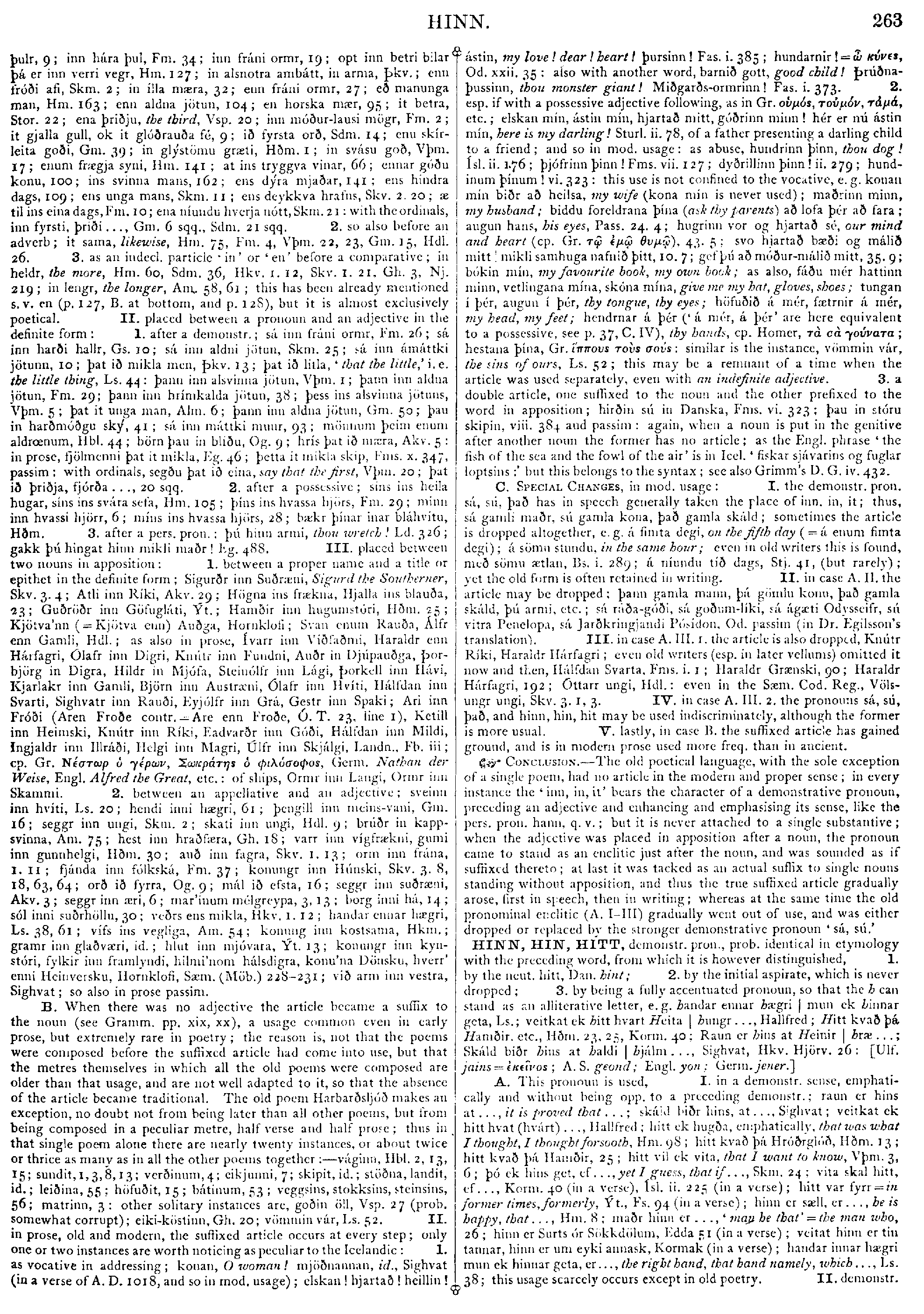
B. When there was no adjective the article became a suffix to the noun (see Gramm. pp. xix, xx), a usage common even in early prose, but extremely rare in poetry; the reason is, not that the poems were composed before the suffixed article had come into use, but that the metres themselves in which all the old poems were composed are older than that usage, and are not well adapted to it, so that the absence of the article became traditional. The old poem Harbarðsljóð makes an exception, no doubt not from being later than all other poems, but from being composed in a peculiar metre, half verse and half prose; thus in that single poem alone there are nearly twenty instances, or about twice or thrice as many as in all the other poems together :-- váginn, Hbl. 2, 13, 15; sundit, 1, 3, 8, 13; verðinum, 4; eikjunni, 7; skipit, id.; stöðna, landit, id.; leiðina, 55; höfuðit, 15; bátinum, 53; veggsins, stokksins, steinsins, 56; matrinn, 3: other solitary instances are, goðin öll, Vsp. 27 (prob. somewhat corrupt); eiki-köstinn, Gh. 20; vömmin vár, Ls. 52. II. in prose, old and modern, the suffixed article occurs at every step; only one or two instances are worth noticing as peculiar to the Icelandic: 1. as vocative in addressing; konan, O woman! mjöðnannan, id., Sighvat (in a verse of A.D. 1018, and so in mod. usage); elskan! hjartað! heillin! ástin, my love! dear! heart! þursinn! Fas. i. 385; hundarnir! = GREEK, Od. xxii. 35: also with another word, barnið gott, good child! Þrúðnaþussinn, thou monster giant! Miðgarðs-ormrinn! Fas. i. 373. 2. esp. if with a possessive adjective following, as in Gr. GREEK, etc.; elskan mín, ástin mín, hjartað mitt, góðrinn minn! hér er nú ástin mín, here is my darling! Sturl. ii. 78, of a father presenting a darling child to a friend; and so in mod. usage: as abuse, hundrinn þinn, thou dog! Ísl. ii. 176; þjófrinn þinn! Fms. vii. 127; dyðrillinn þinn! ii. 279; hundinum þínum! vi. 323: this use is not confined to the vocative, e.g. konan mín biðr að heilsa, my wife (kona mín is never used); maðrinn minn, my husband; biddu foreldrana þína (ask thy parents) að lofa þér að fara; augun hans, his eyes, Pass. 24. 4; hugrinn vor og hjartað sé, our mind and heart (cp. Gr. GREEK), 43. 5; svo hjartað bæði og málið mitt | mikli samhuga nafnið þitt, 10. 7; gef þú að móður-málið mitt, 35. 9; bókin mín, my favourite book, my own book; as also, fáðu mér hattinn minn, vetlingana mína, skóna mína, give me my hat, gloves, shoes; tungan í þér, augun í þér, thy tongue, thy eyes; höfuðið á mér, fætrnir á mér, my head, my feet; hendrnar á þér ('á mér, á þér' are here equivalent to a possessive, see p. 37, C. IV), thy hands, cp. Homer, GREEK; hestana þína, Gr. GREEK: similar is the instance, vömmin vár, the sins of ours, Ls. 52; this may be a remnant of a time when the article was used separately, even with an indefinite adjective. 3. a double article, one suffixed to the noun and the other prefixed to the word in apposition; hirðin sú in Danska, Fms. vi. 323; þau in stóru skipin, viii. 384 and passim: again, when a noun is put in the genitive after another noun the former has no article; as the Engl. phrase 'the fish of the sea and the fowl of the air' is in Icel. 'fiskar sjávarins og fuglar loptsins:' but this belongs to the syntax; see also Grimm's D. G. iv. 432.
|
Source: Cleasby/Vigfusson, page b0270, entry 1 View original page image as: [TIFF] [PNG] [View previous entry] [View next entry] |
[Comment on this entry] [View comments] |
The following entry has been hand-corrected once. |
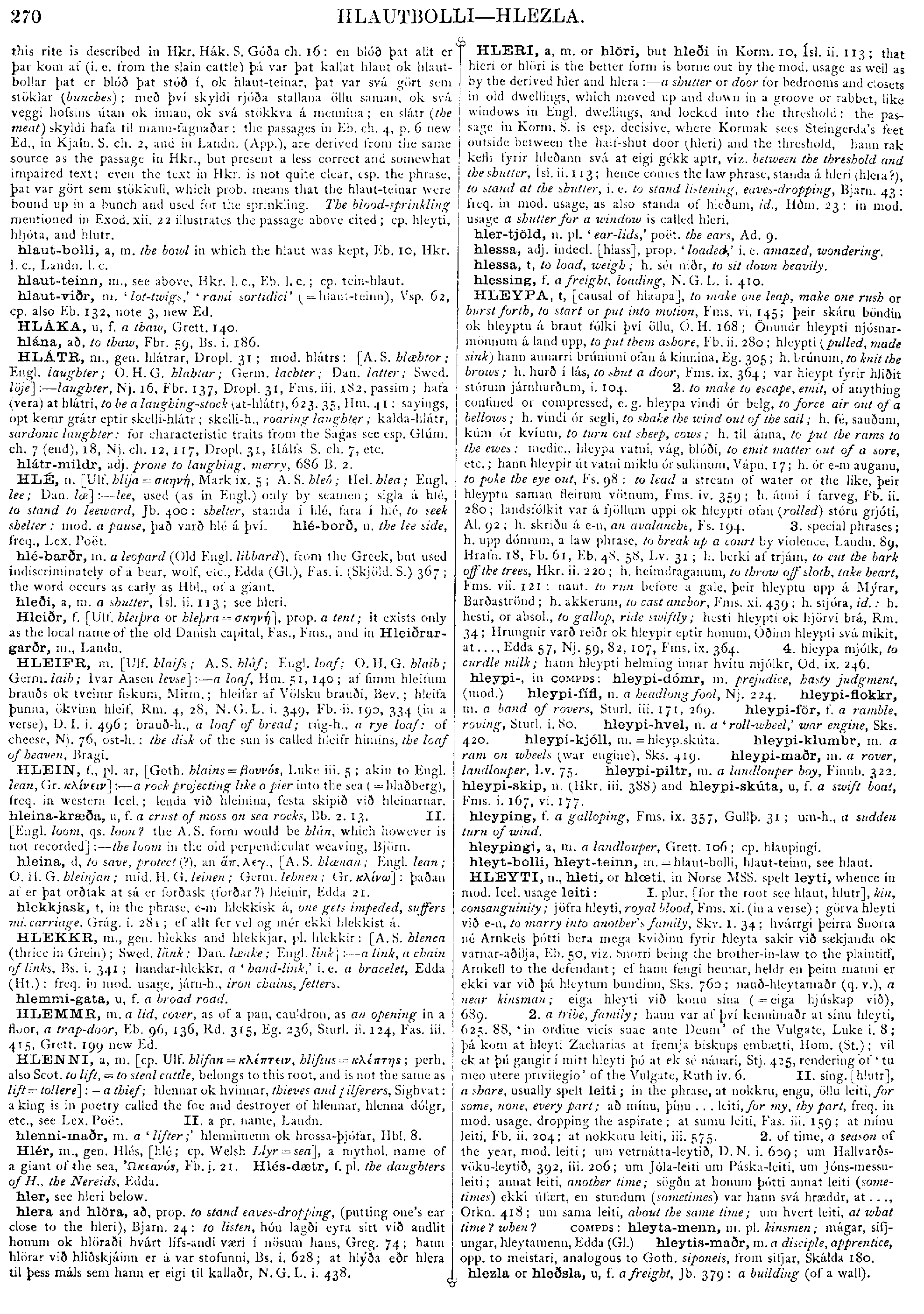
this rite is described in Hkr. Hák. S. Góða ch. 16: en blóð þat allt er þar kom af (i.e. from the slain cattle) þá var þat kallat hlaut ok hlaut-bollar þat er blóð þat stóð í, ok hlaut-teinar, þat var svá gört sem stöklar (bunches); með því skyldi rjóða stallana öllu saman, ok svá veggi hofsins útan ok innan, ok svá stökkva á mennina; en slátr (the meat) skyldi hafa til mann-fagnaðar: the passages in Eb. ch. 4, p. 6 new Ed., in Kjaln. S. ch. 2, and in Landn. (App.), are derived from the same source as the passage in Hkr., but present a less correct and somewhat impaired text; even the text in Hkr. is not quite clear, esp. the phrase, þat var gört sem stökkull, which prob. means that the hlaut-teinar were bound up in a bunch and used for the sprinkling. The blood-sprinkling mentioned in Exod. xii. 22 illustrates the passage above cited; cp. hleyti, hljóta, and hlutr.
|
Source: Cleasby/Vigfusson, page b0276, entry 13 View original page image as: [TIFF] [PNG] [View previous entry] [View next entry] |
[Comment on this entry] [View comments] |
The following entry has been hand-corrected once. |
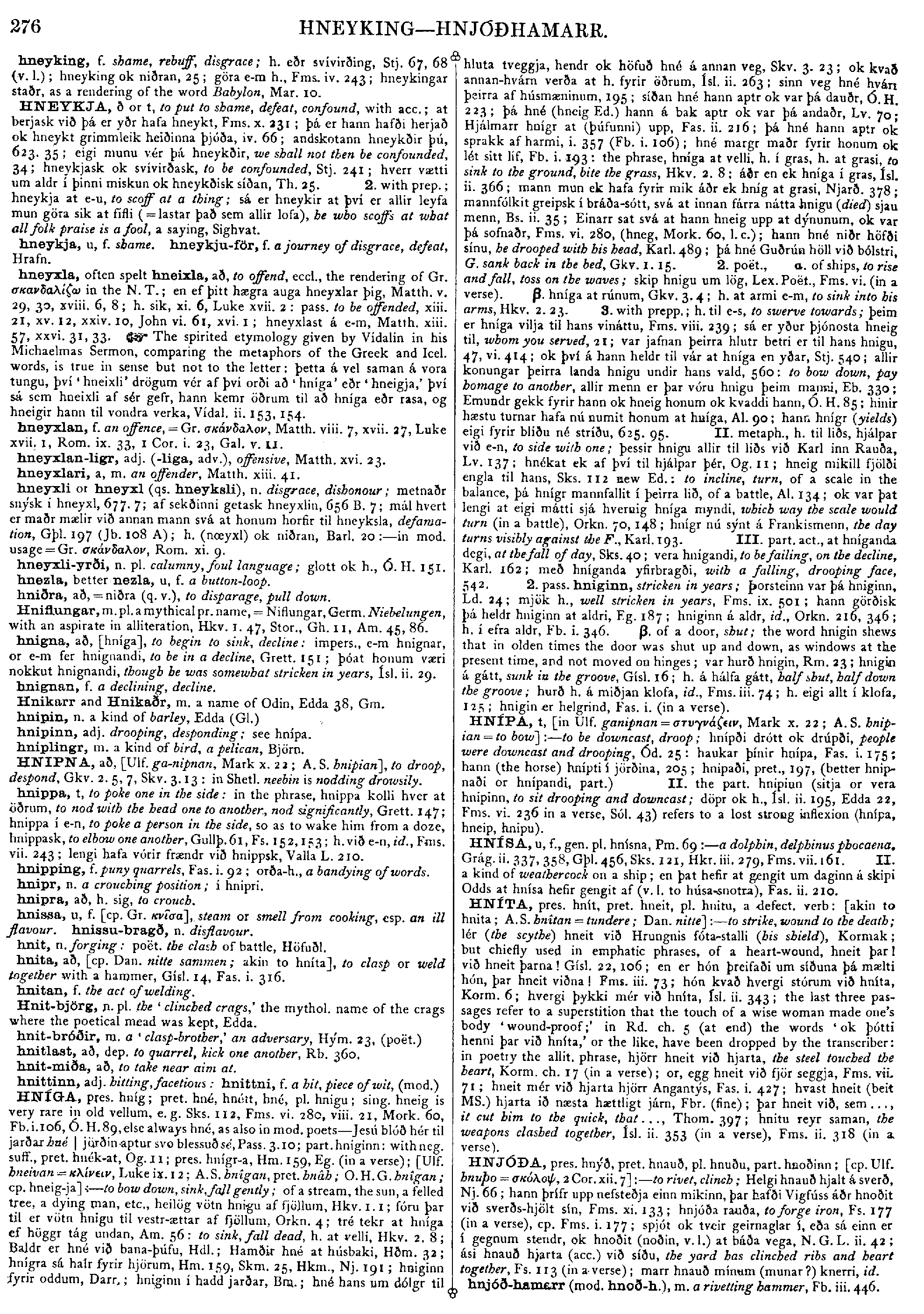
hnigna, að, [hníga], to begin to sink, decline: impers., e-m hnignar, or e-m fer hnignandi, to be in a decline, Grett. 151; þóat honum væri nokkut hnignandi, though he was somewhat stricken in years, Ísl. ii. 29.
|
Source: Cleasby/Vigfusson, page b0293, entry 2 View original page image as: [TIFF] [PNG] [View previous entry] [View next entry] |
[Comment on this entry] [View comments] |
The following entry has been hand-corrected once. |
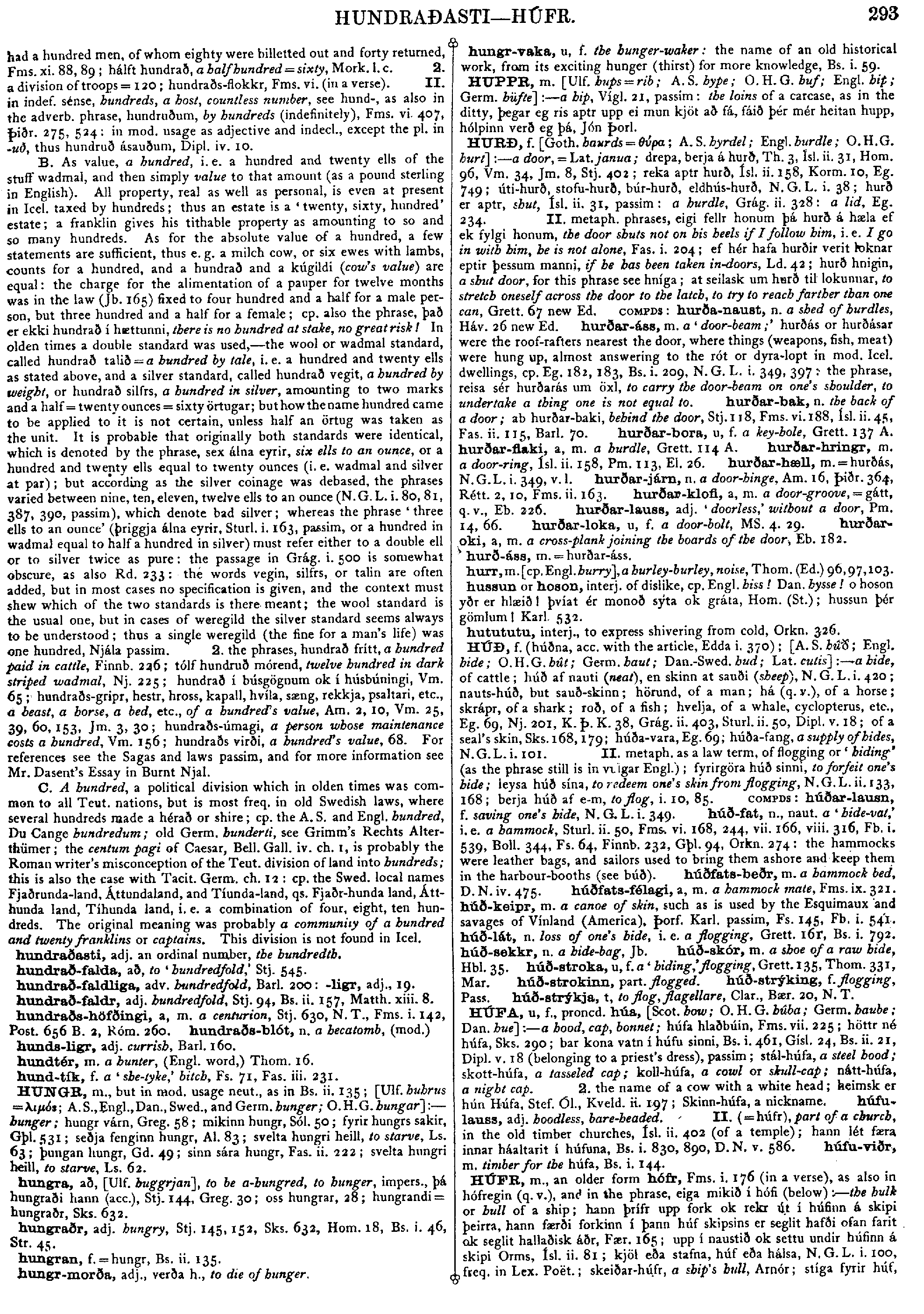
B. As value, a hundred, i.e. a hundred and twenty ells of the stuff wadmal, and then simply value to that amount (as a pound sterling in English). All property, real as well as personal, is even at present in Icel. taxed by hundreds; thus an estate is a 'twenty, sixty, hundred' estate; a franklin gives his tithable property as amounting to so and so many hundreds. As for the absolute value of a hundred, a few statements are sufficient, thus e.g. a milch cow, or six ewes with lambs, counts for a hundred, and a hundrað and a kúgildi (cow's value) are equal: the charge for the alimentation of a pauper for twelve months was in the law (Jb. 165) fixed to four hundred and a half for a male person, but three hundred and a half for a female; cp. also the phrase, það er ekki hundrað í hættunni, there is no hundred at stake, no great risk! In olden times a double standard was used, -- the wool or wadmal standard, called hundrað talið = a hundred by tale, i.e. a hundred and twenty ells as stated above, and a silver standard, called hundrað vegit, a hundred by weight, or hundrað silfrs, a hundred in silver, amounting to two marks and a half = twenty ounces = sixty örtugar; but how the name hundred came to be applied to it is not certain, unless half an örtug was taken as the unit. It is probable that originally both standards were identical, which is denoted by the phrase, sex álna eyrir, six ells to an ounce, or a hundred and twenty ells equal to twenty ounces (i.e. wadmal and silver at par); but according as the silver coinage was debased, the phrases varied between nine, ten, eleven, twelve ells to an ounce (N. G. L. i. 80, 81, 387, 390, passim), which denote bad silver; whereas the phrase 'three ells to an ounce' (þriggja álna eyrir, Sturl. i. 163, passim, or a hundred in wadmal equal to half a hundred in silver) must refer either to a double ell or to silver twice as pure: the passage in Grág. i. 500 is somewhat obscure, as also Rd. 233: the words vegin, silfrs, or talin are often added, but in most cases no specification is given, and the context must shew which of the two standards is there meant; the wool standard is the usual one, but in cases of weregild the silver standard seems always to be understood; thus a single weregild (the fine for a man's life) was one hundred, Njála passim. 2. the phrases, hundrað frítt, a hundred paid in cattle, Finnb. 236; tólf hundruð mórend, twelve hundred in dark striped wadmal, Nj. 225; hundrað í búsgögnum ok í húsbúningi, Vm. 65; hundraðs-gripr, hestr, hross, kapall, hvíla, sæng, rekkja, psaltari, etc., a beast, a horse, a bed, etc., of a hundred's value, Am. 2, 10, Vm. 25, 39, 60, 153, Jm. 3, 30; hundraðs-úmagi, a person whose maintenance costs a hundred, Vm. 156; hundraðs virði, a hundred's value, 68. For references see the Sagas and laws passim, and for more information see Mr. Dasent's Essay in Burnt Njal.
|
Source: Cleasby/Vigfusson, page b0324, entry 16 View original page image as: [TIFF] [PNG] [View previous entry] [View next entry] |
[Comment on this entry] [View comments] |
The following entry has been hand-corrected once. |
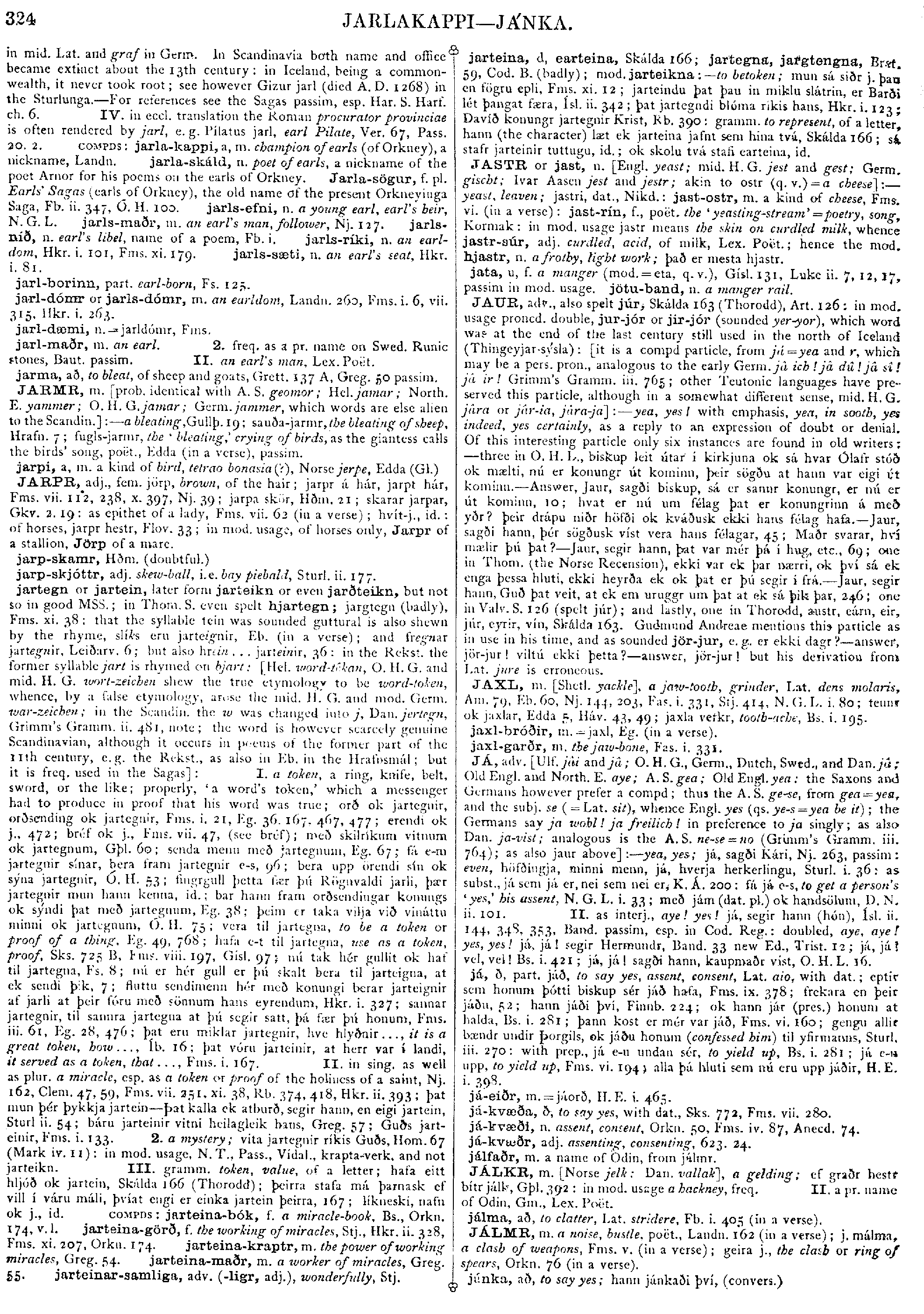
JAUR, adv., also spelt júr, Skálda 163 (Thorodd), Art. 126: in mod. usage proncd. double, jur-jór or jir-jór (sounded yer-yor), which word was at the end of the last century still used in the north of Iceland (Thingeyjar-sýsla): [it is a compd particle, from já = yea and r, which may be a pers. pron., analogous to the early Gmn. jâ ich! jâ dû! jâ sî! jâ ir! Grimm's Gramm. iii. 765; other Teutonic languages have preserved this particle, although in a somewhat different sense, mid. H. G. jâra or jâr-ia, jâra-ja] :-- yea, yes! with emphasis, yea, in sooth, yes indeed, yes certainly, as a reply to an expression of doubt or denial. Of this interesting particle only six instances are found in old writers: -- three in O. H. L., biskup leit útar í kirkjuna ok sá hvar Ólafr stóð ok mælti, nú er konungr út kominn, þeir sögðu at hann var eigi út kominn. -- Answer, Jaur, sagði biskup, sá er sannr konungr, er nú er út kominn, 10; hvat er nú um félag þat er konungrinn á með yðr? þeir drápu niðr höfði ok kváðusk ekki haus félag hafa. -- Jaur, sagði hann, þér sögðusk víst vera hans félagar, 45; Maðr svarar, hvá mælir þú þat ? -- Jaur, segir hann, þat var mér þá í hug, etc., 69; one in Thorn, (the Norse Recension), ekki var ek þar nærri, ok því sá ek enga þessa hluti, ekki heyrða ek ok þat er þú segir í frá. -- Jaur, segir hann, Guð þat veit, at ek em uruggr um þat at ek sá þik þar, 246; one in Valv. S. 126 (spelt júr); and lastly, one in Thorodd, austr, eárn, eir, júr, eyrir, vín, Skálda 163. Gudmund Andreae mentions this particle as in use in his time, and as sounded jör-jur, e.g. er ekki dagr? -- answer, jör-jur! viltú ekki þetta? -- answer, jör-jur! but his derivation from Lat. jure is erroneous.
|
Source: Cleasby/Vigfusson, page b0434, entry 1 View original page image as: [TIFF] [PNG] [View previous entry] [View next entry] |
[Comment on this entry] [View comments] |
The following entry has been hand-corrected once. |
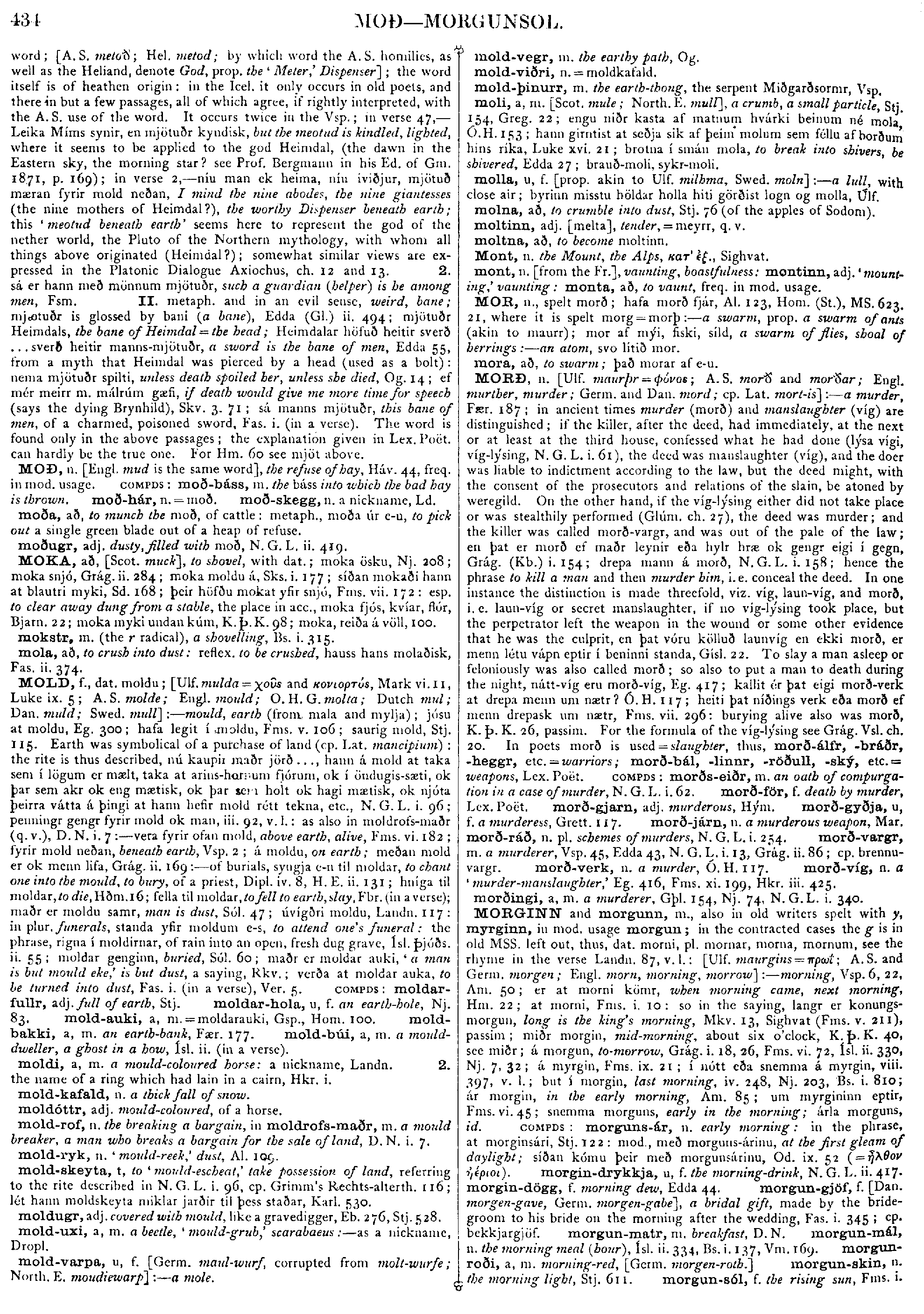
word;
[A.S.
metoð;
Hel.
metod;
by
which
word
the
A.S.
homilies,
as
well
as
the
Heliand,
denote
God,
prop.
the
'Meter,'
Dispenser];
the
word
itself
is
of
heathen
origin:
in
the
Icel.
it
only
occurs
in
old
poets,
and
there
in
but
a
few
passages,
all
of
which
agree,
if
rightly
interpreted,
with
the
A.S.
use
of
the
word.
It
occurs
twice
in
the
Vsp.;
in
verse
47,
--
Leika
Míms
synir,
en
mjötuðr
kyndisk,
but
the
meotud
is
kindled,
lighted,
where
it
seems
to
be
applied
to
the
god
Heimdal,
(the
dawn
in
the
Eastern
sky,
the
morning
star?
see
Prof.
Bergmann
in
his
Ed.
of
Gm.
1871,
p.
169);
in
verse
2,
--
níu
man
ek
heima,
níu
íviðjur,
mjötuð
mæran
fyrir
mold
neðan,
I
mind
the
nine
abodes,
the
nine
giantesses
(the
nine
mothers
of
Heimdal?),
the
worthy
Dispenser
beneath
earth;
this
'meotud
beneath
earth'
seems
here
to
represent
the
god
of
the
nether
world,
the
Pluto
of
the
Northern
mythology,
with
whom
all
things
above
originated
(Heimdal?);
somewhat
similar
views
are
expressed
in
the
Platonic
Dialogue
Axiochus,
ch.
12
and
13.
2.
sá
er
hann
með
mönnum
mjötuðr,
such
a
guardian
(helper)
is
he
among
men,
Fsm.
II.
metaph.
and
in
an
evil
sense,
weird,
bane;
mj tuðr
is
glossed
by
bani
(a
bane),
Edda
(Gl.)
ii.
494;
mjötuðr
Heimdals,
the
bane
of
Heimdal
=
the
head;
Heimdalar
höfuð
heitir
sverð
...
sverð
heitir
manns-mjötuðr,
a
sword
is
the
bane
of
men,
Edda
55,
from
a
myth
that
Heimdal
was
pierced
by
a
head
(used
as
a
bolt):
nema
mjötuðr
spilti,
unless
death
spoiled
her,
unless
she
died,
Og.
14;
ef
mér
meirr
m.
málrúm
gæfi,
if
death
would
give
me
more
time
for
speech
(says
the
dying
Brynhild),
Skv.
3.
71;
sá
manns
mjötuðr,
this
bane
of
men,
of
a
charmed,
poisoned
sword,
Fas.
i.
(in
a
verse).
The
word
is
found
only
in
the
above
passages;
the
explanation
given
in
Lex.
Poët,
can
hardly
be
the
true
one.
For
Hm.
60
see
mjöt
above.
tuðr
is
glossed
by
bani
(a
bane),
Edda
(Gl.)
ii.
494;
mjötuðr
Heimdals,
the
bane
of
Heimdal
=
the
head;
Heimdalar
höfuð
heitir
sverð
...
sverð
heitir
manns-mjötuðr,
a
sword
is
the
bane
of
men,
Edda
55,
from
a
myth
that
Heimdal
was
pierced
by
a
head
(used
as
a
bolt):
nema
mjötuðr
spilti,
unless
death
spoiled
her,
unless
she
died,
Og.
14;
ef
mér
meirr
m.
málrúm
gæfi,
if
death
would
give
me
more
time
for
speech
(says
the
dying
Brynhild),
Skv.
3.
71;
sá
manns
mjötuðr,
this
bane
of
men,
of
a
charmed,
poisoned
sword,
Fas.
i.
(in
a
verse).
The
word
is
found
only
in
the
above
passages;
the
explanation
given
in
Lex.
Poët,
can
hardly
be
the
true
one.
For
Hm.
60
see
mjöt
above.
| Result Page: |  |
Previous | 1 2 3 4 5 6 7 8 | Next |  |
Germanic Lexicon Project (main page)
This search system was written by
Sean Crist
Please consider
volunteering
to correct the data in these online dictionaries.
No rights reserved. Feel free to use these data in any way you please.