|
|

Search for some again, using less strict matching (817 results)
|
Source: Bosworth/Toller, page b0356, entry 16 View original page image as: [TIFF] [PNG] [View previous entry] [View next entry] |
[Comment on this entry] [View comments] |
The following entry has been hand-corrected once. |
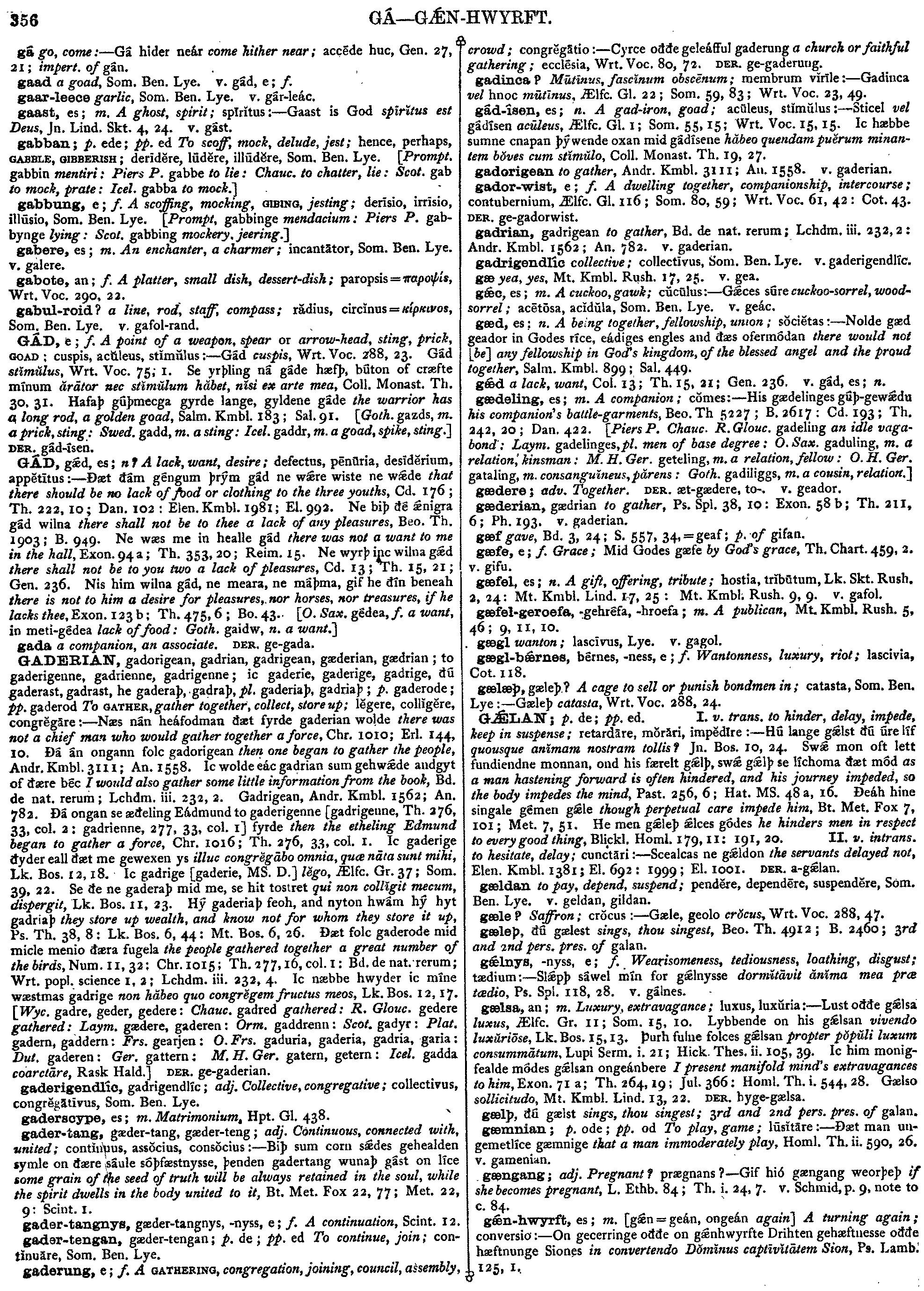
gader-tang,
gæder-tang,
gæder-teng;
adj.
Continuous,
connected
with,
united;
cont nuus,
ass
nuus,
ass cius,
conscius
:--
Biþ
sum
corn
s
cius,
conscius
:--
Biþ
sum
corn
s des
gehealden
symle
on
ðære
sáule
sóþfæstnysse,
þenden
gadertang
wunaþ
gást
on
líce
some
grain
of
the
seed
of
truth
will
be
always
retained
in
the
soul,
while
the
spirit
dwells
in
the
body
united
to
it,
Bt.
Met.
Fox
22,
77;
Met.
22,
9
:
Scint.
1.
des
gehealden
symle
on
ðære
sáule
sóþfæstnysse,
þenden
gadertang
wunaþ
gást
on
líce
some
grain
of
the
seed
of
truth
will
be
always
retained
in
the
soul,
while
the
spirit
dwells
in
the
body
united
to
it,
Bt.
Met.
Fox
22,
77;
Met.
22,
9
:
Scint.
1.
|
Source: Bosworth/Toller, page b0360, entry 1 View original page image as: [TIFF] [PNG] [View previous entry] [View next entry] |
[Comment on this entry] [View comments] |
The following entry has been hand-corrected once. |
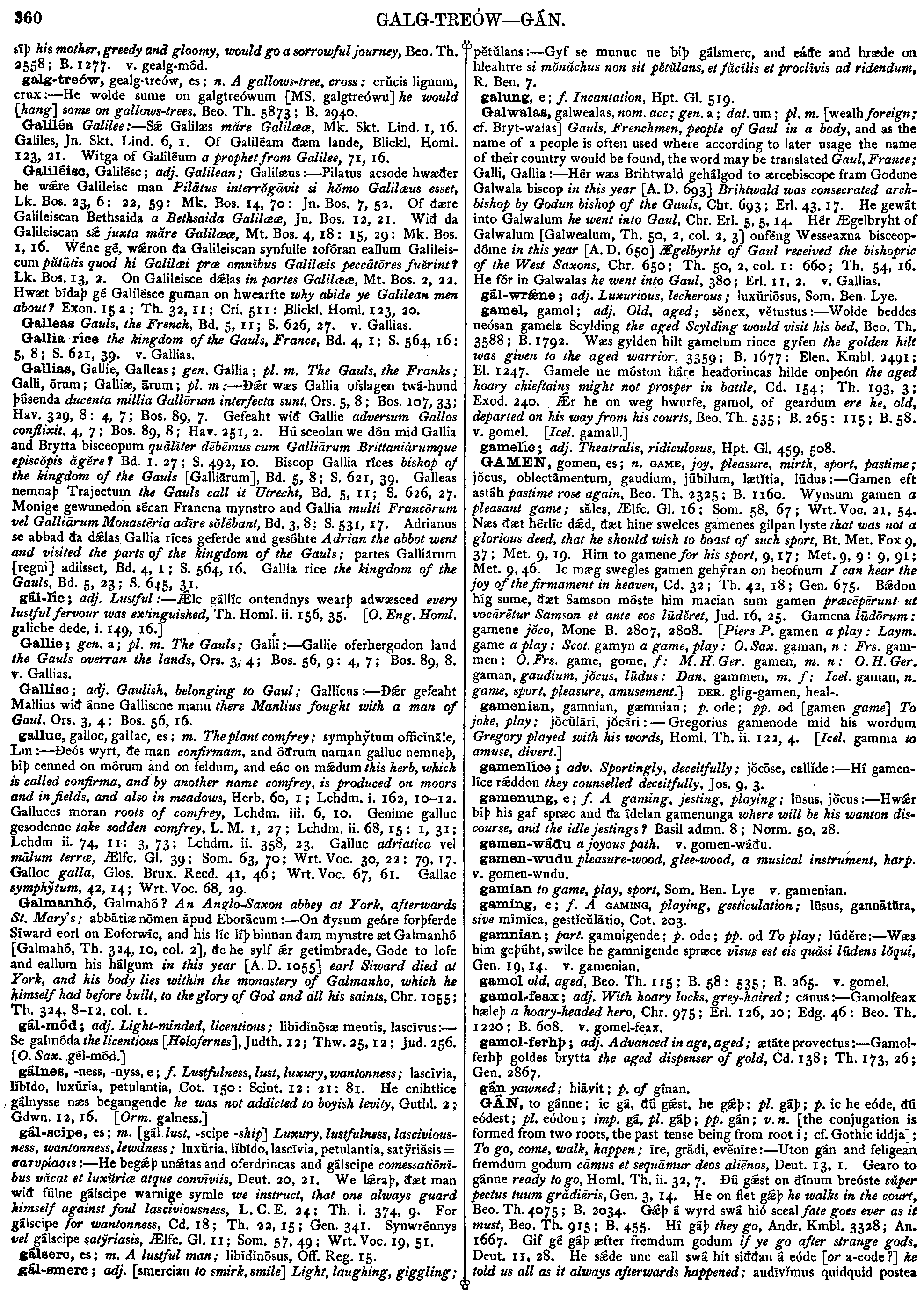
galg-treów,
gealg-treów,
es;
n.
A
gallows-tree,
cross;
cr cis
lignum,
crux
:--
He
wolde
sume
on
galgtreówum
[MS.
galgtreówu]
he
would
[hang]
some
on
gallows-trees,
Beo.
Th.
5873;
B.
2940.
cis
lignum,
crux
:--
He
wolde
sume
on
galgtreówum
[MS.
galgtreówu]
he
would
[hang]
some
on
gallows-trees,
Beo.
Th.
5873;
B.
2940.
|
Source: Bosworth/Toller, page b0360, entry 36 View original page image as: [TIFF] [PNG] [View previous entry] [View next entry] |
[Comment on this entry] [View comments] |
The following entry has been hand-corrected once. |
GÁN,
to
gánne;
ic
gá,
ðú
gst,
he
gþ;
pl.
gáþ;
p.
ic
he
eóde,
ðú
eódest;
pl.
eódon;
imp.
gá,
pl.
gáþ;
pp.
gán;
v.
n.
[the
conjugation
is
formed
from
two
roots,
the
past
tense
being
from
root
i;
cf.
Gothic
iddja];
To
go,
come,
walk,
happen;
 re,
gr
re,
gr di,
ev
di,
ev nre
:--
Uton
gán
and
feligean
fremdum
godum
c
nre
:--
Uton
gán
and
feligean
fremdum
godum
c mus
et
sequmur
deos
ali
mus
et
sequmur
deos
ali nos,
Deut.
13,
1.
Gearo
to
gánne
ready
to
go,
Homl.
Th.
ii.
32,
7.
Ðú
gst
on
ðínum
breóste
sper
pectus
tuum
grdiris,
Gen.
3,
14.
He
on
flet
gþ
he
walks
in
the
court,
Beo.
Th.
4075;
B.
2034.
Gþ
á
wyrd
swá
hió
sceal
fate
goes
ever
as
it
must,
Beo.
Th.
915;
B.
455.
Hí
gáþ
they
go,
Andr.
Kmbl.
3328;
An.
1667.
Gif
gé
gáþ
æfter
fremdum
godum
if
ye
go
after
strange
gods,
Deut.
11,
28.
He
sde
unc
eall
swá
hit
siððan
á
eóde
[or
a-eode?]
he
told
us
all
as
it
always
afterwards
happened;
audvmus
quidquid
postea
rei
prbvit
eventus,
Gen.
41,
13.
Eóde
eall
seó
ceasterwaru
togeánes
ðam
Hlende
t
nos,
Deut.
13,
1.
Gearo
to
gánne
ready
to
go,
Homl.
Th.
ii.
32,
7.
Ðú
gst
on
ðínum
breóste
sper
pectus
tuum
grdiris,
Gen.
3,
14.
He
on
flet
gþ
he
walks
in
the
court,
Beo.
Th.
4075;
B.
2034.
Gþ
á
wyrd
swá
hió
sceal
fate
goes
ever
as
it
must,
Beo.
Th.
915;
B.
455.
Hí
gáþ
they
go,
Andr.
Kmbl.
3328;
An.
1667.
Gif
gé
gáþ
æfter
fremdum
godum
if
ye
go
after
strange
gods,
Deut.
11,
28.
He
sde
unc
eall
swá
hit
siððan
á
eóde
[or
a-eode?]
he
told
us
all
as
it
always
afterwards
happened;
audvmus
quidquid
postea
rei
prbvit
eventus,
Gen.
41,
13.
Eóde
eall
seó
ceasterwaru
togeánes
ðam
Hlende
t ta
cvtas
exiit
obviam
Jesu,
Mt.
Bos.
8,
34
:
Bd.
1,
7;
S.
478,
12.
Sume
for
hungre
heora
feóndum
on
hand
eódon
some
for
hunger
went
into
the
hands
of
their
foes,
1,
15;
S.
484,
5.
Gá
hider
come
hither,
Gen.
27,
21.
Gáþ
eów
into
ðære
cyrcan
unforhtlíce
go
into
the
church
fearlessly,
Homl.
Th.
i.
508,
1.
[Wyc.
gon,
goon,
goo
:
Piers
P.
goon
:
Chauc.
gon,
goon
:
R.
Glouc.
goon
:
Laym.
Orm.
gan
:
Plat.
gan.
gaan;
gaen
:
O.
Sax.
gán
:
Frs.
gean
:
O.
Frs.
gan
:
Dut.
gaan
:
Ger.
gehen,
gehn
:
M.
H.
Ger.
gán,
gén
:
O.
H.
Ger.
gán
:
Dan.
gaae
:
Swed.
gå
:
Zend.
gá,
gé
to
go
:
Sansk.
g
to
go.]
DER.
a-gán,
æfter-,
be-,
bi-,
for-,
fóre-,
forþ-,
ful-,
ge-,
in-,
of-,
ofer-,
óþ-,
þurh-,
to-,
under-,
up-,
upp-,
út-,
wið-,
ymb-.
v.
gangan.
ta
cvtas
exiit
obviam
Jesu,
Mt.
Bos.
8,
34
:
Bd.
1,
7;
S.
478,
12.
Sume
for
hungre
heora
feóndum
on
hand
eódon
some
for
hunger
went
into
the
hands
of
their
foes,
1,
15;
S.
484,
5.
Gá
hider
come
hither,
Gen.
27,
21.
Gáþ
eów
into
ðære
cyrcan
unforhtlíce
go
into
the
church
fearlessly,
Homl.
Th.
i.
508,
1.
[Wyc.
gon,
goon,
goo
:
Piers
P.
goon
:
Chauc.
gon,
goon
:
R.
Glouc.
goon
:
Laym.
Orm.
gan
:
Plat.
gan.
gaan;
gaen
:
O.
Sax.
gán
:
Frs.
gean
:
O.
Frs.
gan
:
Dut.
gaan
:
Ger.
gehen,
gehn
:
M.
H.
Ger.
gán,
gén
:
O.
H.
Ger.
gán
:
Dan.
gaae
:
Swed.
gå
:
Zend.
gá,
gé
to
go
:
Sansk.
g
to
go.]
DER.
a-gán,
æfter-,
be-,
bi-,
for-,
fóre-,
forþ-,
ful-,
ge-,
in-,
of-,
ofer-,
óþ-,
þurh-,
to-,
under-,
up-,
upp-,
út-,
wið-,
ymb-.
v.
gangan.
|
Source: Bosworth/Toller, page b0362, entry 20 View original page image as: [TIFF] [PNG] [View previous entry] [View next entry] |
[Comment on this entry] [View comments (1)] |
The following entry has been hand-corrected once. |
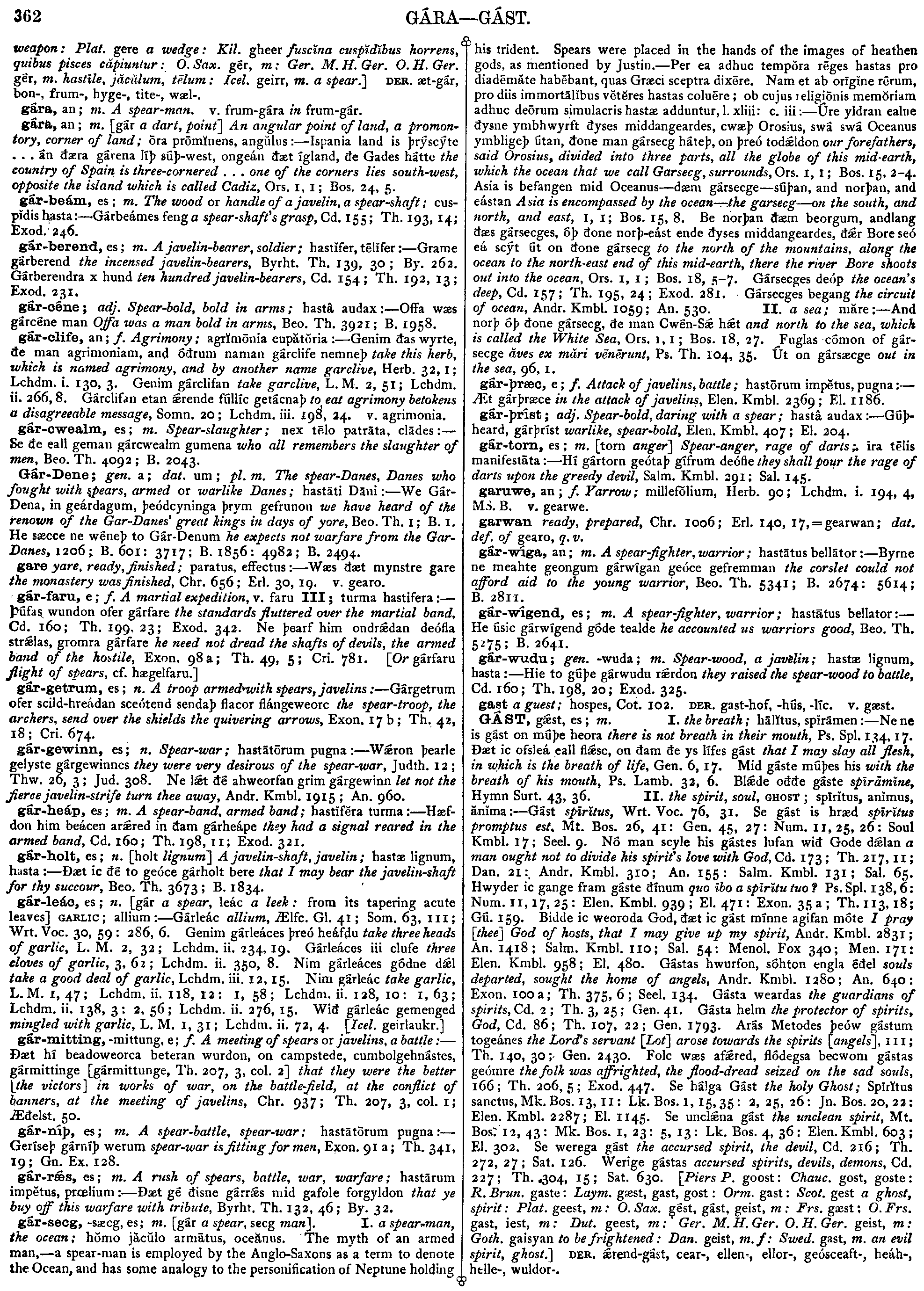
gár-secg,
-sæcg,
es;
m.
[gár
a
spear,
secg
man].
I.
a
spear-man,
the
ocean;
hmo
jclo
armtus,
ocenus.
The
myth
of
an
armed
man,
-
a
spear-man
is
employed
by
the
Anglo-Saxons
as
a
term
to
denote
the
Ocean,
and
has
some
analogy
to
the
personification
of
Neptune
holding
|
Source: Bosworth/Toller, page b0364, entry 25 View original page image as: [TIFF] [PNG] [View previous entry] [View next entry] |
[Comment on this entry] [View comments] |
The following entry has been hand-corrected once. |
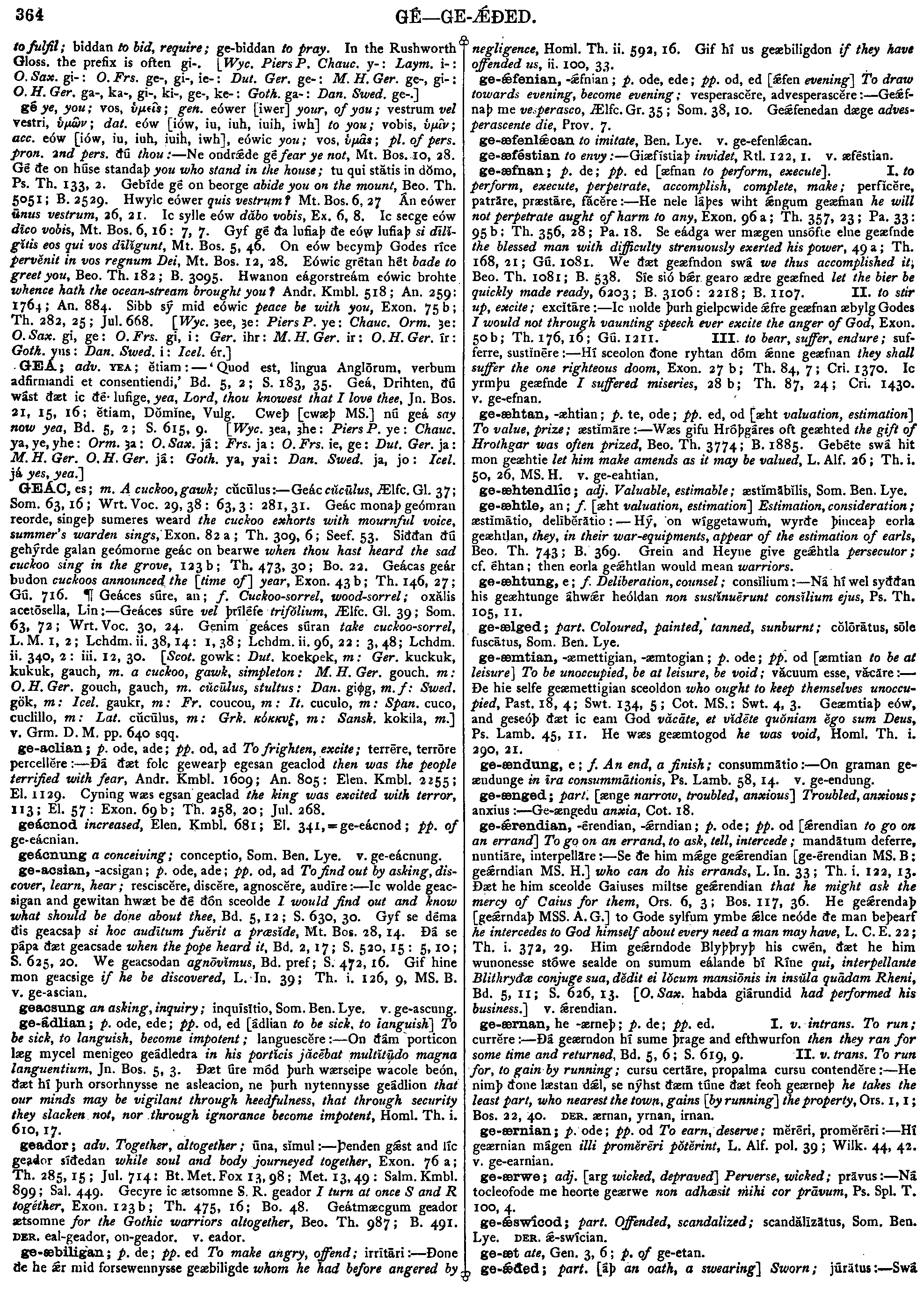
ge-ærnan,
he
-ærneþ;
p.
de;
pp.
ed.
I.
v.
intrans.
To
run;
currre
:--
Ðá
geærndon
hí
sume
þrage
and
efthwurfon
then
they
ran
for
some
time
and
returned,
Bd.
5,
6;
S.
619,
9.
II.
v.
trans.
To
run
for,
to
gain
by
running;
cursu
certre,
propalma
cursu
contendre
:--
He
nimþ
ðone
læstan
dl,
se
nýhst
ðæm
túne
ðæt
feoh
geærneþ
he
takes
the
least
part,
who
nearest
the
town,
gains
[by
running]
the
property,
Ors.
1,
1;
Bos.
22,
40.
DER.
ærnan,
yrnan,
irnan.
|
Source: Bosworth/Toller, page b0365, entry 21 View original page image as: [TIFF] [PNG] [View previous entry] [View next entry] |
[Comment on this entry] [View comments] |
The following entry has been hand-corrected once. |
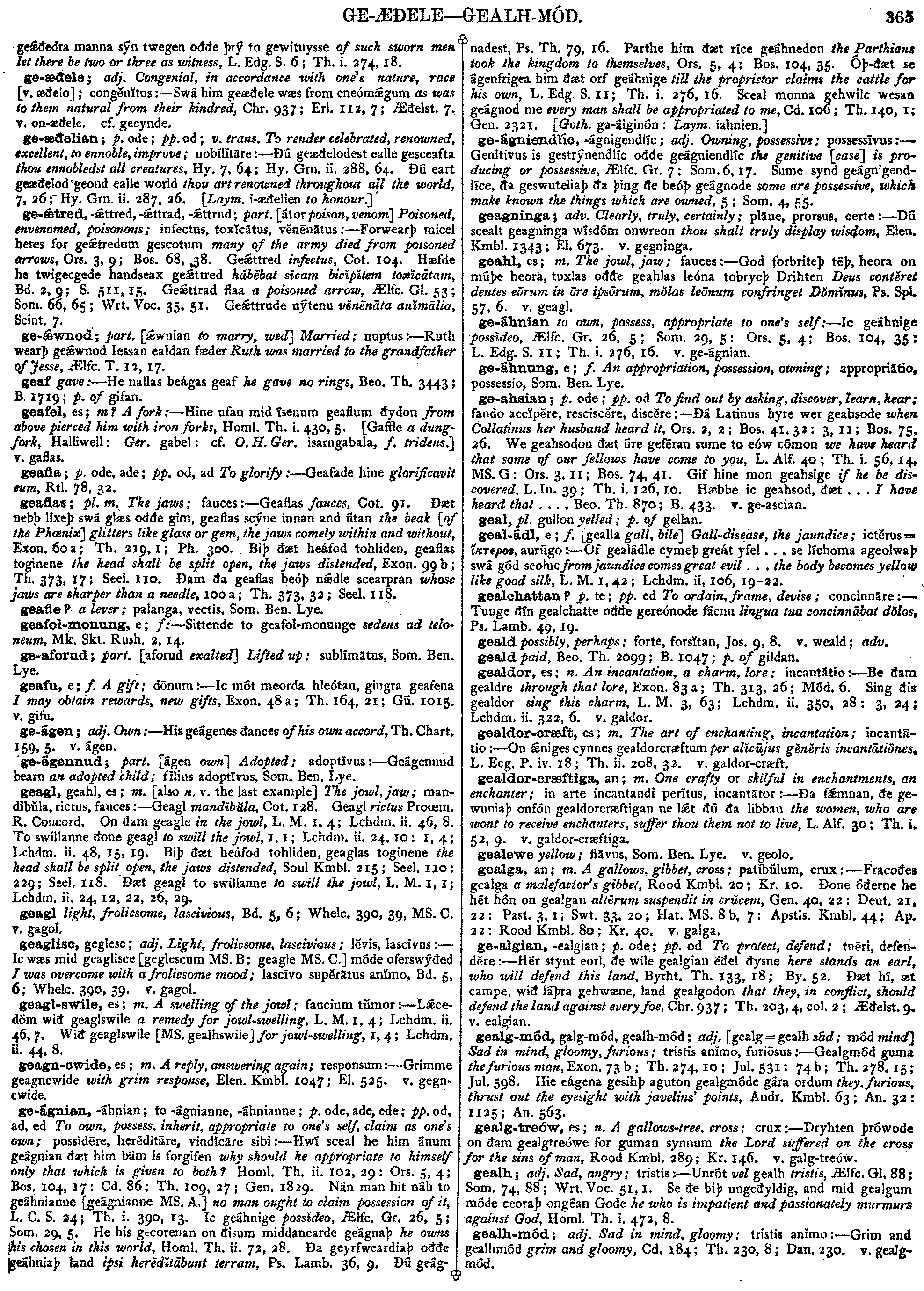
ge-ágniendlíc,
-ágnigendlíc;
adj.
Owning,
possessive;
possessvus
:--
Genitivus
is
gestrýnendlíc
oððe
geágniendlíc
the
genitive
[case]
is
producing
or
possessive,
Ælfc.
Gr.
7;
Som.
6,
17.
Sume
synd
geágnigendlíce,
ða
geswuteliaþ
ða
þing
ðe
beóþ
geágnode
some
are
possessive,
which
make
known
the
things
which
are
owned,
5;
Som.
4,
55.
|
Source: Bosworth/Toller, page b0365, entry 26 View original page image as: [TIFF] [PNG] [View previous entry] [View next entry] |
[Comment on this entry] [View comments (1)] |
The following entry has been hand-corrected once. |
ge-ahsian;
p.
ode;
pp.
od
To
find
out
by
asking,
discover,
learn,
hear;
fando
accpre,
resciscre,
discre
:--
Ðá
Latinus
hyre
wer
geahsode
when
Collatinus
her
husband
heard
it,
Ors.
2,
2;
Bos.
41,
32
:
3,
11;
Bos.
75,
26.
We
geahsodon
ðæt
úre
geféran
sume
to
eów
cómon
we
have
heard
that
some
of
our
fellows
have
come
to
you,
L.
Alf.
40;
Th.
i.
56,
14,
MS.
G
:
Ors.
3,
11;
Bos.
74,
41.
Gif
hine
mon
geahsige
if
he
be
discovered,
L.
In.
39;
Th.
i.
126,
10.
Hæbbe
ic
geahsod,
dæt
.
.
.
I
have
heard
that
.
.
.
,
Beo.
Th.
870;
B.
433.
v.
ge-ascian.
|
Source: Bosworth/Toller, page b0369, entry 6 View original page image as: [TIFF] [PNG] [View previous entry] [View next entry] |
[Comment on this entry] [View comments] |
The following entry has been hand-corrected once. |
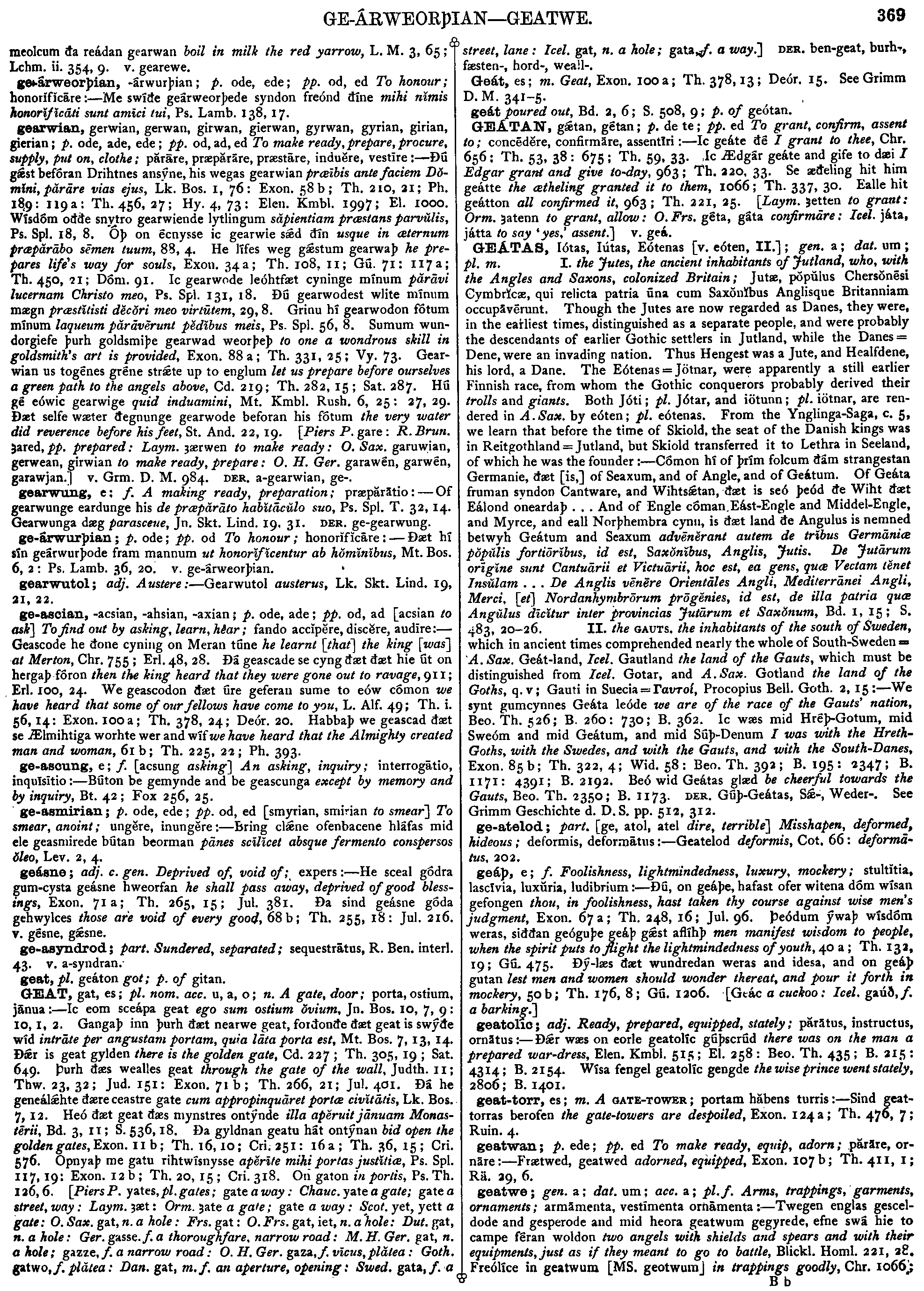
ge-ascian,
-acsian,
-ahsian,
-axian;
p.
ode,
ade;
pp.
od,
ad
[acsian
to
ask]
To
find
out
by
asking,
learn,
hear;
fando
accpre,
discre,
audre
:--
Geascode
he
ðone
cyning
on
Meran
túne
he
learnt
[that]
the
king
[was]
at
Merton,
Chr.
755;
Erl.
48,
28.
Ðá
geascade
se
cyng
ðæt
ðæt
hie
út
on
hergaþ
fóron
then
the
king
heard
that
they
were
gone
out
to
ravage,
911;
Erl.
100,
24.
We
geascodon
ðæt
úre
geferan
sume
to
eów
cómon
we
have
heard
that
some
of
our
fellows
have
come
to
you,
L.
Alf.
49;
Th.
i.
56,
14
:
Exon.
l00
a;
Th.
378,
24;
Deór.
20.
Habbaþ
we
geascad
ðæt
se
Ælmihtiga
worhte
wer
and
wíf
we
have
heard
that
the
Almighty
created
man
and
woman,
61
b;
Th.
225,
22;
Ph.
393.
|
Source: Bosworth/Toller, page b0376, entry 20 View original page image as: [TIFF] [PNG] [View previous entry] [View next entry] |
[Comment on this entry] [View comments] |
The following entry has been hand-corrected once. |
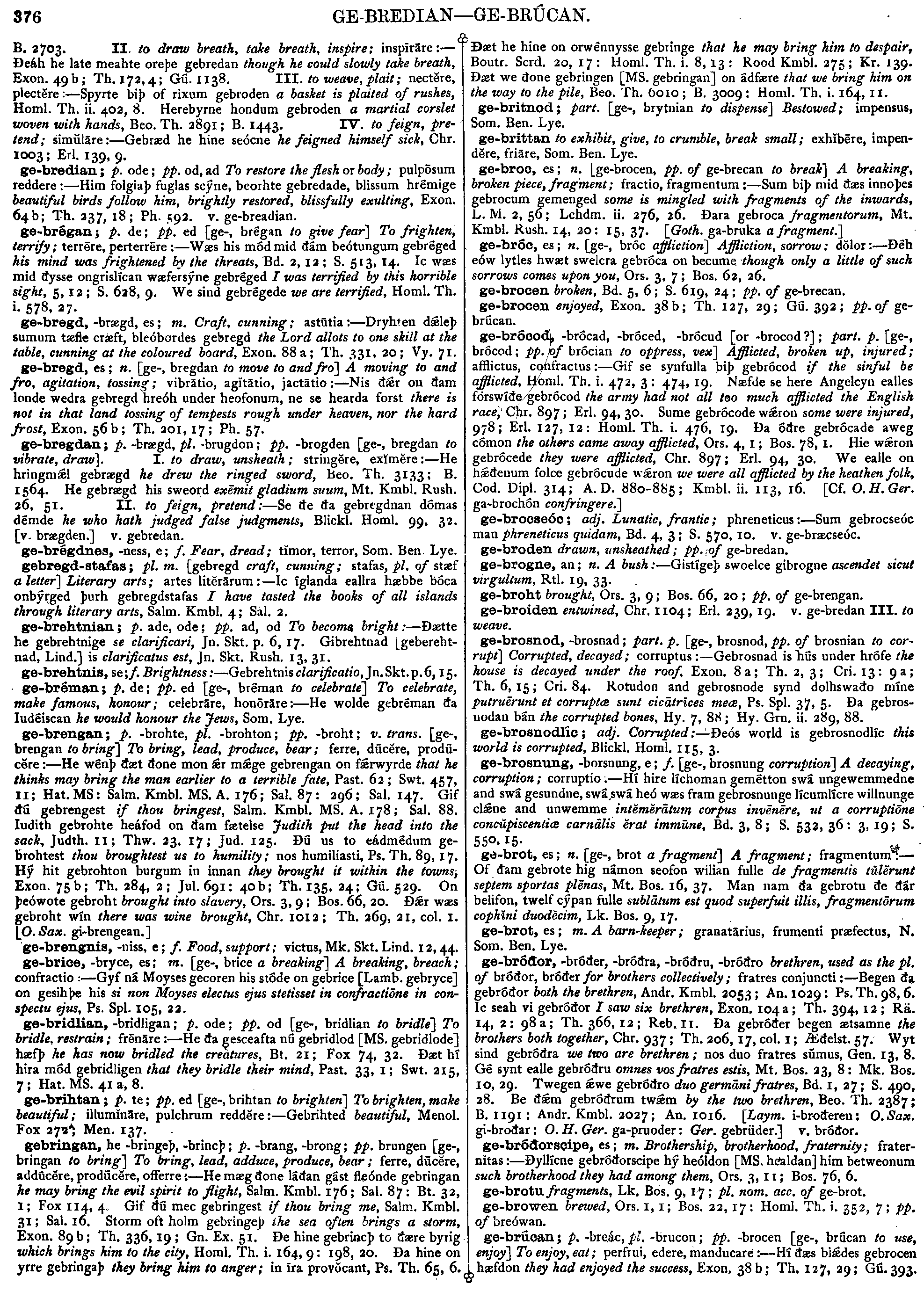
ge-broc, es; n. [ge-brocen, pp. of ge-brecan to break] A breaking, broken piece, fragment; fractio, fragmentum :-- Sum biþ mid ðæs innoþes gebrocum gemenged some is mingled with fragments of the inwards, L. M. 2, 56; Lchdm. ii. 276, 26.Ðara gebroca fragmentorum, Mt. Kmbl. Rush. 14, 20: 15, 37. [Goth. ga-bruka a fragment.]
|
Source: Bosworth/Toller, page b0376, entry 24 View original page image as: [TIFF] [PNG] [View previous entry] [View next entry] |
[Comment on this entry] [View comments] |
The following entry has been hand-corrected once. |
ge-brócod,
-brócad,
-bróced,
-brócud
[or
-brocod
?];
part.
p.
[ge-,
brðcod;
pp.
of
brócian
to
oppress,
vex]
Afflicted,
broken
up,
injured;
afflictus,
confractus
:--
Gif
se
synfulla
biþ
gebrócod
if
the
sinful
be
afflicted,
Homl.
Th.
i.
472,
3:
474,
19.
Næfde
se
here
Angelcyn
ealles
forswíðe
gebrócod
the
army
had
not
all
too
much
afflicted
the
English
race,
Chr.
897;
Erl.
94,
30.
Surne
gebrócode
wron
some
were
injured,
978;
Erl.
127,
12:
Homl.
Th.
i.
476,
19.
Ða
óðre
gebrócade
aweg
cómon
the
others
came
away
afflicted,
Ors.
4,
1;
Bos.
78,
1.
Hie
wron
gebrócede
they
were
afflicted,
Chr.
897;
Erl.
94,
30.
We
ealle
on
hðenum
folce
gebrócude
wron
we
were
all
afflicted
by
the
heathen
folk,
Cod.
Dipl.
314;
A.
D.
880-885;
Kmbl.
ii.
113,
16.
[Cf.
O.
H.
Ger.
ga-brochón
confringere.]
| Result Page: |  |
Previous | 4 5 6 7 8 9 10 11 12 13 14 15 16 17 18 19 20 21 22 | Next |  |
Germanic Lexicon Project (main page)
This search system was written by
Sean Crist
Please consider
volunteering
to correct the data in these online dictionaries.
No rights reserved. Feel free to use these data in any way you please.