|
|

Search for small again, using less strict matching (417 results)
|
Source: Bosworth/Toller, page b0019, entry 35 View original page image as: [TIFF] [PNG] [View previous entry] [View next entry] |
[Comment on this entry] [View comments] |
The following entry has been hand-corrected once. |
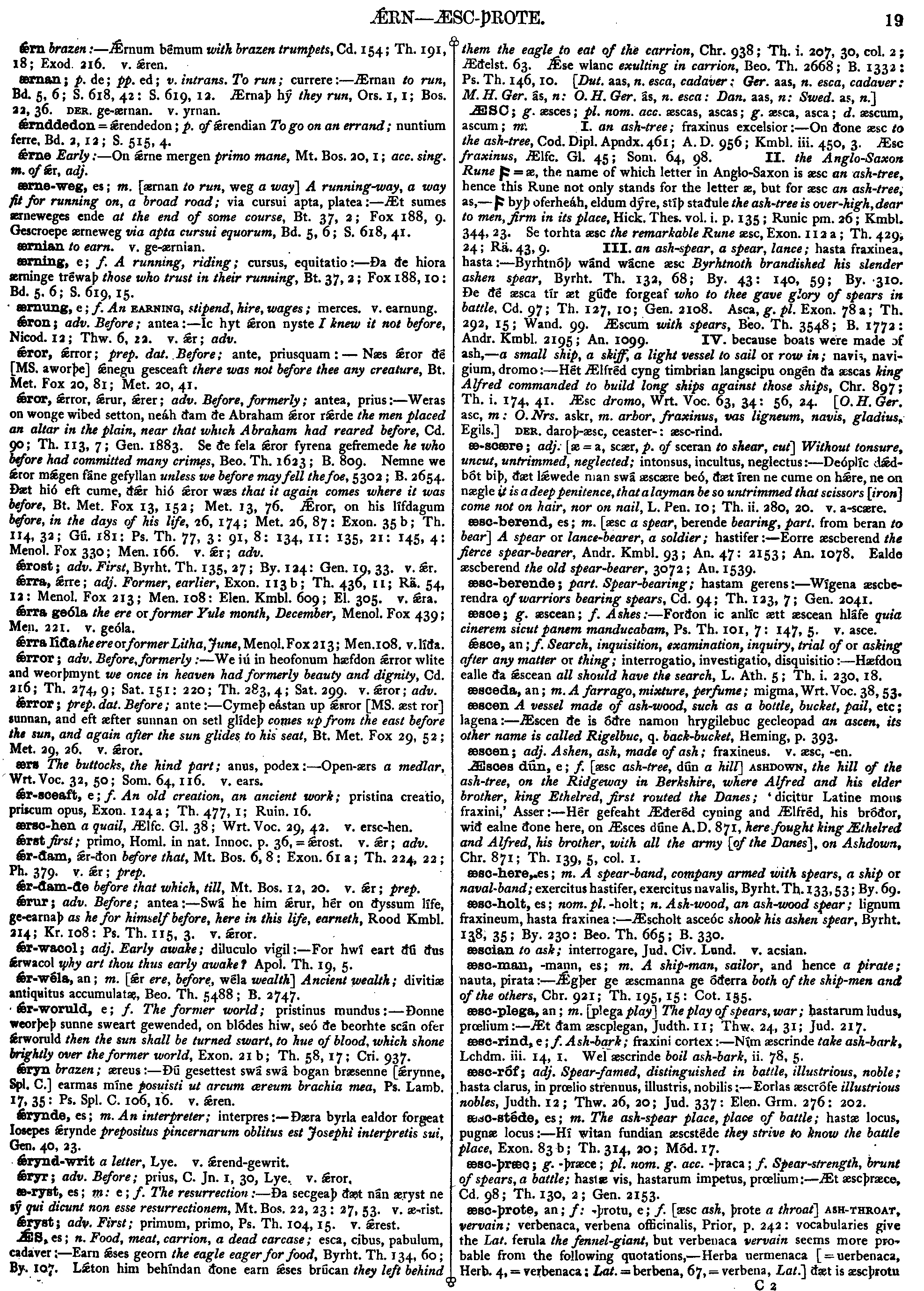
ÆSC; g. æsces; pl. nom. acc. æscas, ascas; g. æsca, asca; d. æscum, ascum; m; I. an ash-tree; fraxinus excelsior :-- On ðone æsc to the ash-tree. Cod. Dipl. Apndx. 461; A. D. 956; Kmbl. iii. 450, 3. Æsc fraxinus, Ælfc. Gl. 45; Som. 64, 98. II. the Anglo-Saxon Rune RUNE = æ, the name of which letter in Anglo-Saxon is æsc an ash-tree, hence this Rune not only stands for the letter æ, but for æsc an ash-tree, as, -- RUNE byþ oferheáh, eldum dýre, stíþ staðule the ash-tree is over-high, dear to men, firm in its place, Hick. Thes. vol. i. p. 135; Runic pm. 26; Kmbl. 344, 23. Se torhta æsc the remarkable Rune æsc, Exon. 112a; Th. 429, 24; Rä. 43, 9. III. an ash-spear, a spear, lance; hasta fraxinea, hasta :-- Byrhtnóþ wánd wácne æsc Byrhtnoth brandished his slender ashen spear, Byrht. Th. 132, 68; By. 43: 140, 59; By. 310. Ðe ðé æsca tír æt gúðe forgeaf who to thee gave glory of spears in battle. Cd. 97; Th. 127, 10; Gen. 2108. Asca, g. pl. Exon. 78a; Th. 292, 15; Wand. 99. Æscum with spears. Beo. Th. 3548; B. 1772: Andr. Kmbl. 2195; An. 1099. IV. because boats were made of ash, -- a small ship, a skiff, a light vessel to sail or row in; navis, navigium, dromo :-- Hét Ælfréd cyng timbrian langscipu ongén ða æscas king Alfred commanded to build long ships against those ships, Chr. 897; Th. i. 174, 41. Æsc dromo, Wrt. Voc. 63, 34: 56, 24. [O. H. Ger. asc, m: O. Nrs. askr, m. arbor, fraxinus, vas ligneum, navis, gladius, Egils.] DER. daroþ-æsc, ceaster-: æsc-rind.
|
Source: Bosworth/Toller, page b0034, entry 38 View original page image as: [TIFF] [PNG] [View previous entry] [View next entry] |
[Comment on this entry] [View comments] |
The following entry has been hand-corrected once. |
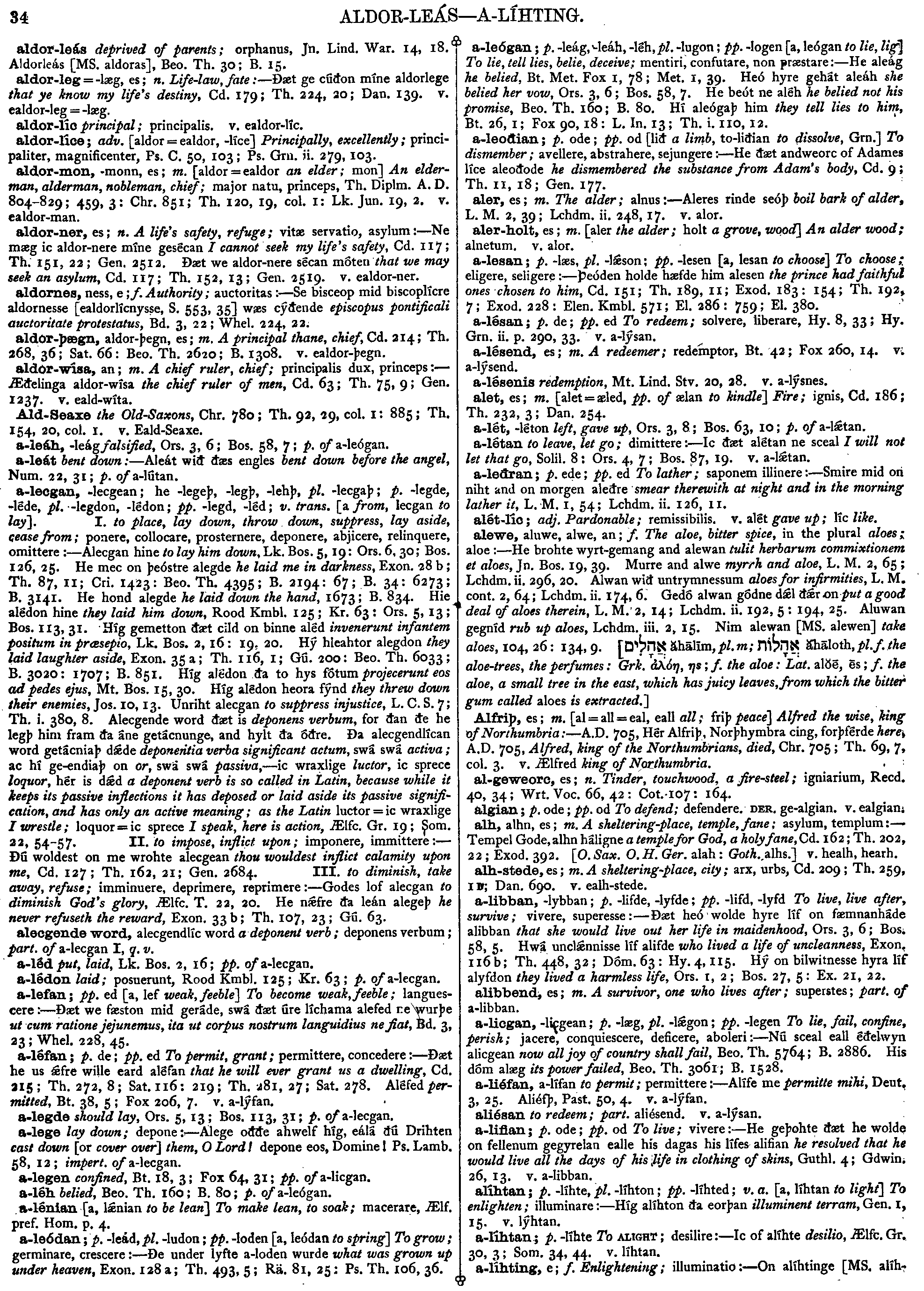
alewe,
aluwe,
alwe,
an;
f.
The
aloe,
bitter
spice,
in
the
plural
aloes;
aloe
:--
He
brohte
wyrt-gemang
and
alewan
tulit
herbarum
commixtionem
et
aloes,
Jn.
Bos.
19,
39.
Murre
and
alwe
myrrh,
and
aloe,
L.
M.
2,
65
;
Lchdm,
ii.
296,
20.
Alwan
wid
untrymnessum
aloes
for
infirmities,
L.
M.
cont.
2,
64;
Lchdm,
ii.
174,
6.
Gedó
alwan
gódne
d l
ðron
put
a
good
deal
of
aloes
therein,
L.
M.
12,
14;
Lchdm,
ii.
192,
5:
194,
25.
Aluwan
gegníd
rub
up
aloes,
Lchdm,
iii.
2,
15.
Nim
alewan
[MS.
alewen]
take
aloes,
104,
26:
134,
9.
[HEBREW
ahalim.
pl.
m;
HEBREW
ahaloth.
pl.
f.
the
aloe-trees,
the
perfumes:
Grk.
GREEK;
f.
the
aloe:
Lat.
aloé,
és;
f.
the
aloe,
a
small
tree
in
the
east,
which
has
juicy
leaves,
from
which
the
bitter
gum
called
aloes
is
extracted]
l
ðron
put
a
good
deal
of
aloes
therein,
L.
M.
12,
14;
Lchdm,
ii.
192,
5:
194,
25.
Aluwan
gegníd
rub
up
aloes,
Lchdm,
iii.
2,
15.
Nim
alewan
[MS.
alewen]
take
aloes,
104,
26:
134,
9.
[HEBREW
ahalim.
pl.
m;
HEBREW
ahaloth.
pl.
f.
the
aloe-trees,
the
perfumes:
Grk.
GREEK;
f.
the
aloe:
Lat.
aloé,
és;
f.
the
aloe,
a
small
tree
in
the
east,
which
has
juicy
leaves,
from
which
the
bitter
gum
called
aloes
is
extracted]
|
Source: Bosworth/Toller, page b0048, entry 25 View original page image as: [TIFF] [PNG] [View previous entry] [View next entry] |
[Comment on this entry] [View comments] |
The following entry has been hand-corrected once. |
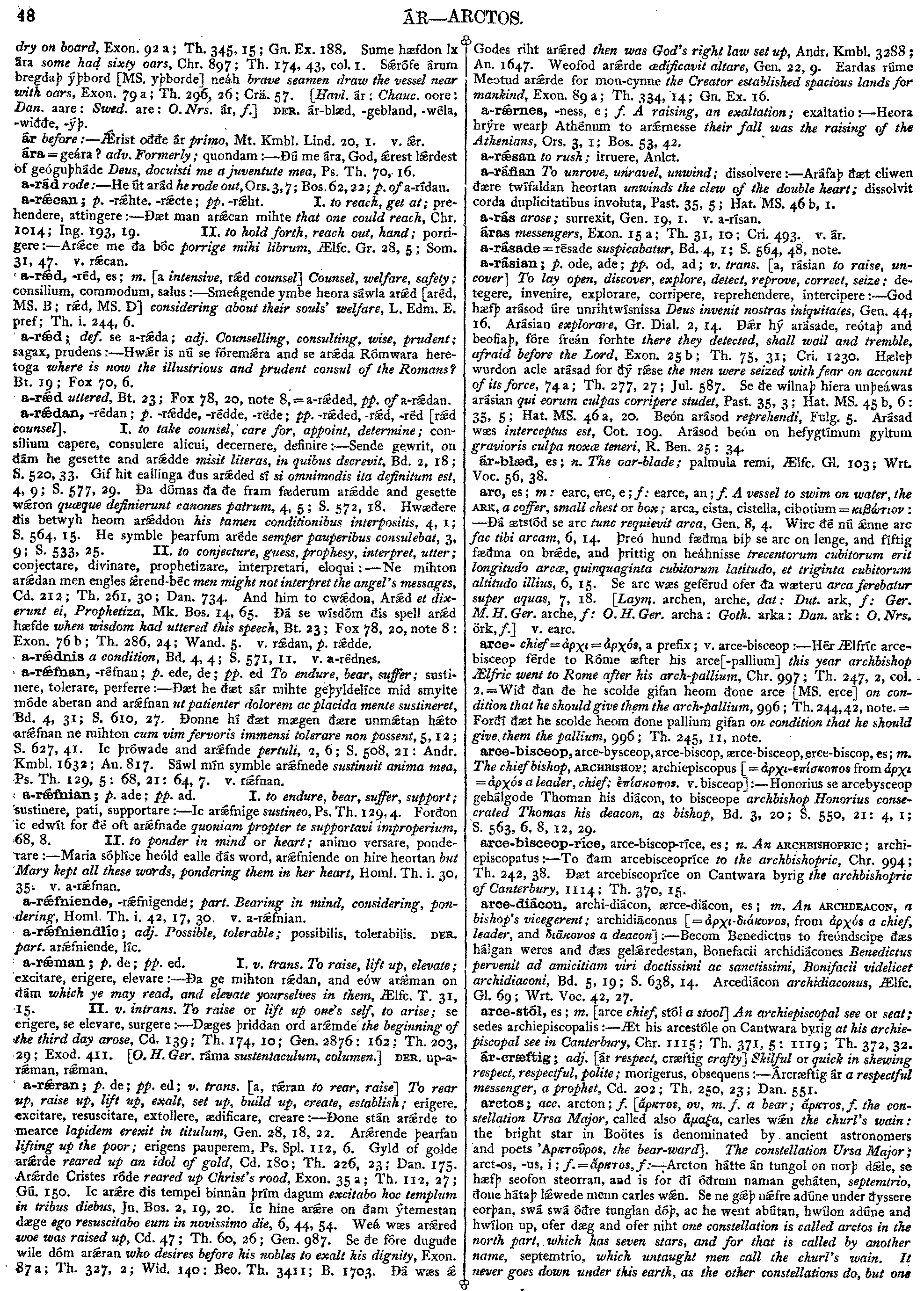
arc,
es;
m:
earc,
erc,
e;
f:
earce,
an;
f.
A
vessel
to
swim
on
water,
the
ARK,
a
coffer,
small
chest
or
box;
arca,
cista,
cistella,
cibotium
=
GREEK
:--
Ðá
ætstód
se
arc
tunc
requievit
arca,
Gen.
8,
4.
Wire
ðé
nú
nne
arc
fac
tibi
arcam,
6,
14.
Þreó
hund
fæðma
bíþ
se
arc
on
lenge,
and
fíftig
fæðma
on
brde,
and
þrittig
on
heáhnisse
trecentorum
cubitorum
erit
longitudo
arcæ,
quinquaginta
cubitorum
latitudo,
et
triginta
cubitorum
altitudo
illius,
6,
15.
Se
arc
wæs
geférud
ofer
ða
wæteru
arca
ferebatur
super
aquas,
7,
18.
[Laym.
archen,
arche,
dat:
Dut.
ark,
f:
Ger.
M.
H.
Ger.
arche,
f:
O.
H.
Ger.
archa:
Goth.
arka:
Dan.
ark:
O.
Nrs.
örk,
f.]
v.
earc.
|
Source: Bosworth/Toller, page b0060, entry 17 View original page image as: [TIFF] [PNG] [View previous entry] [View next entry] |
[Comment on this entry] [View comments] |
The following entry has been hand-corrected once. |
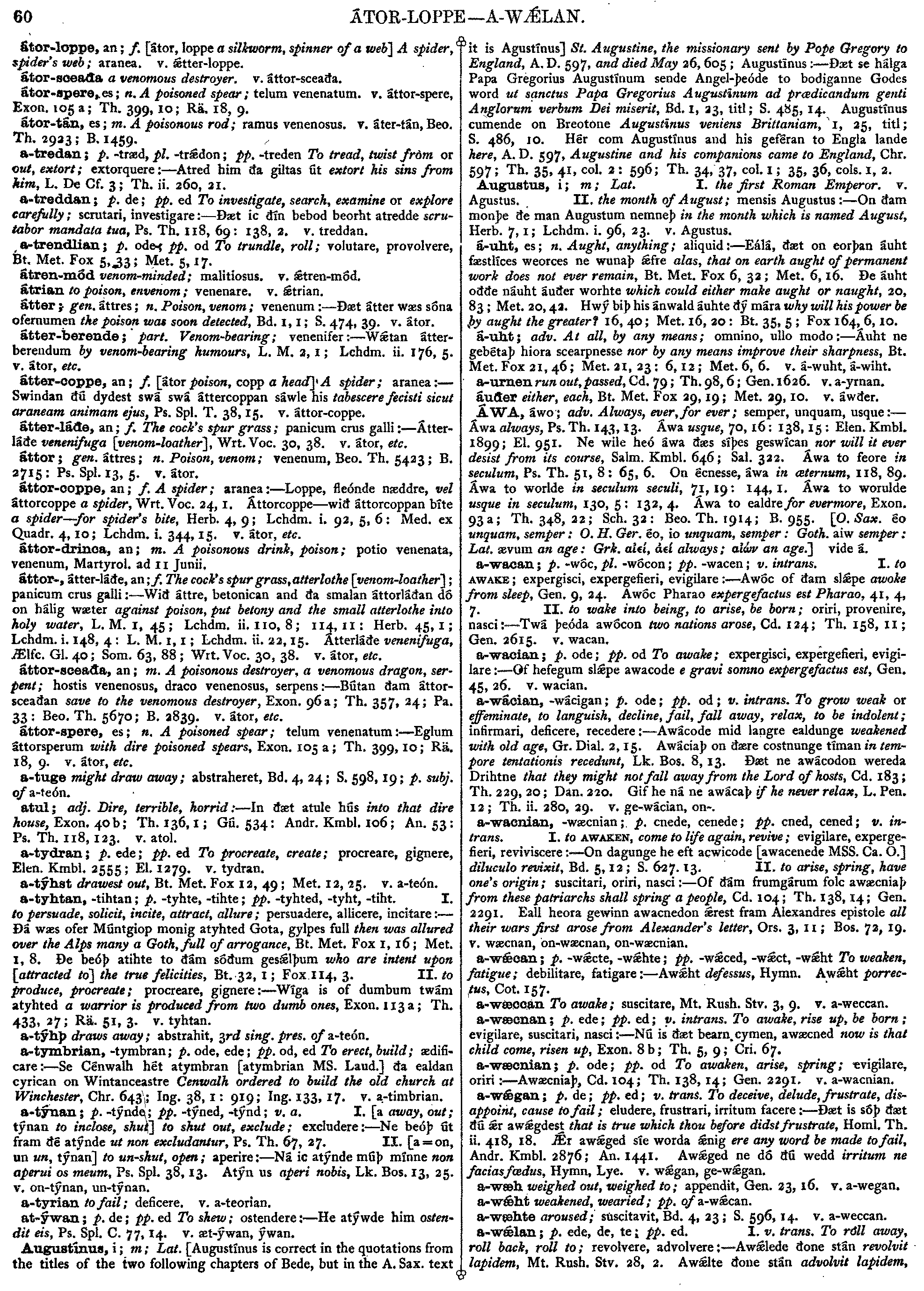
áttor-, átter-láðe, an; f. The cock's spur grass, atterlothe [venom-loather]; panicum crus galli :-- Wið áttre, betonican and ða smalan áttorláðan dó on hálig wæter against poison, put betony and the small atterlothe into holy water, L. M. 1, 45 ; Lchdm. ii. 110, 8 ; 114; 11 : Herb. 45, 1 ; Lchdm. i. 148, 4 : L. M. 1, 1 ; Lchdm. ii. 22, 55. Átterláðe venenifuga, Ælfc. Gl. 40; Som. 63, 88 ; Wrt. Voc. 30, 38. v. átor, etc.
|
Source: Bosworth/Toller, page b0068, entry 23 View original page image as: [TIFF] [PNG] [View previous entry] [View next entry] |
[Comment on this entry] [View comments] |
The following entry has been hand-corrected once. |
bán-wyrt, e; f. Bone-wort, a violet, perhaps the small knapweed; viola, centaurea minor :-- Bánwyrt hæbbe croppan bone-wort hath bunches of flowers, L. M. 2, 51; Lchdm. ii. 266, 5. Bánwyrt centaurea minor, Ælfc. Gl. 44; Som. 64, 85; Wrt. Voc. 32, 21. Sió greáte bánwyrt the great bone-wort, L. M. 3, 8; Lchdm. ii. 312, 19: 1, 1; Lchdm. ii. 22, 15: 1, 25; Lchdm. ii. 66, 17, 20: 1, 31; Lchdm. ii. 74, 24: 1, 36; Lchdm. ii. 86, 21: 1, 59; Lchdm. 130, 11: 1, 63; Lchdm. ii. 138, 15: Herb. 165, 1; Lchdm. i. 294, 7: 152, 1; Lchdm. i. 276, 24: Lchdm. iii. 16, 6.
|
Source: Bosworth/Toller, page b0074, entry 14 View original page image as: [TIFF] [PNG] [View previous entry] [View next entry] |
[Comment on this entry] [View comments] |
The following entry has been hand-corrected once. |
bec, becc, es; m. A brook, BECK or small rapid stream; rivulus :-- Of ðan bece [MS. bæce] from the beck, Kmbl. Cod. Dipl. iii. 121, 16.
|
Source: Bosworth/Toller, page b0075, entry 8 View original page image as: [TIFF] [PNG] [View previous entry] [View next entry] |
[Comment on this entry] [View comments] |
The following entry has been hand-corrected once. |
BÉD,
es;
nom.
acc.
pl.
bédu,
bédo;
n.
A
prayer,
supplication,
re ligious
worship;
oratio,
supplicatio,
Dei
cultus
:--
Ðæt
he
sceolde
ða
bédu
[MS.
B.
byldo
constancy]
anescian
that
he
should
diminish
[weaken]
the
prayers,
Bd.
1,
7;
S.
477,
43.
Béd
is
chiefly
found
in
composition,
as
in,
-
Béd-hús
a
place
for
prayer,
béd-dagas
prayer-days,
Rogation-days.
The
original
word
béd
a
prayer
was
superseded
by
ge-béd
a
prayer,
q.v.
[Orm.
bede
a
prayer;
acc
pl.
bedess
:
Laym.
acc.
s.
bede,
bode
a
prayer;
dat.
s.
ibede
;
nom.
pl.
beden
:
R.
Glouc.
acc.
pl.
bedes
prayers
:
Piers
acc.
pl.
bedes
prayers,
-
'if
I
bidde
any
bedes
:'
Piers
and
Chauc.
also
bedes,
-
'a
peire
of
bedes,'
-
a
set
of
beads
or
small
balls
of
glass
etc.
on
a
string,
for
counting
prayers:
O.
Sax.
beda
;
gen.
s.
bede;
dat.
s.
bedu
:
O.
Frs.
bede
:
M.
H.
Ger.
bete
:
O.
H.
Ger.
beta.]
DER.
béd-dagas,
-hús,
-ríp
:
gebéd,
-dagas,
-hús,
-man,
-rden,
-stów.
v
biddan.
ligious
worship;
oratio,
supplicatio,
Dei
cultus
:--
Ðæt
he
sceolde
ða
bédu
[MS.
B.
byldo
constancy]
anescian
that
he
should
diminish
[weaken]
the
prayers,
Bd.
1,
7;
S.
477,
43.
Béd
is
chiefly
found
in
composition,
as
in,
-
Béd-hús
a
place
for
prayer,
béd-dagas
prayer-days,
Rogation-days.
The
original
word
béd
a
prayer
was
superseded
by
ge-béd
a
prayer,
q.v.
[Orm.
bede
a
prayer;
acc
pl.
bedess
:
Laym.
acc.
s.
bede,
bode
a
prayer;
dat.
s.
ibede
;
nom.
pl.
beden
:
R.
Glouc.
acc.
pl.
bedes
prayers
:
Piers
acc.
pl.
bedes
prayers,
-
'if
I
bidde
any
bedes
:'
Piers
and
Chauc.
also
bedes,
-
'a
peire
of
bedes,'
-
a
set
of
beads
or
small
balls
of
glass
etc.
on
a
string,
for
counting
prayers:
O.
Sax.
beda
;
gen.
s.
bede;
dat.
s.
bedu
:
O.
Frs.
bede
:
M.
H.
Ger.
bete
:
O.
H.
Ger.
beta.]
DER.
béd-dagas,
-hús,
-ríp
:
gebéd,
-dagas,
-hús,
-man,
-rden,
-stów.
v
biddan.
|
Source: Bosworth/Toller, page b0118, entry 18 View original page image as: [TIFF] [PNG] [View previous entry] [View next entry] |
[Comment on this entry] [View comments (1)] |
The following entry has been hand-corrected once. |
BRÁD;
def.
se
bráda,
seó,
ðæt
bráde;
comp.
m.
brádra,
f.
n.
brádre,
brdre;
superl.
brádost;
adj.
BROAD,
open,
large,
spacious,
copious;
latus,
expansus,
amplus,
spatiosus,
copiosus
:--
Ðæt
eálond
on
Wiht
is
twelif
míla
brád
the
isle
of
Wight
is
twelve
miles
broad,
Bd.
1,
3;
S.
475,
19:
Ors.
1,
1;
Bos.
21,
4,
5,
6.
Was
his
ríce
brád
his
kingdom
was
broad,
Exon.
65
b;
Th.
243,
10;
Jul.
8:
Elen.
Kmbl.
1831;
El.
917:
Beo.
Th.
6296;
B.
3158.
Brád
is
bebod
ðín
latum
est
mandatum
tuum,
Ps.
Lamb.
118,
96.
Se
bráda
s
the
broad
sea.
Exon,
24
b;
Th.
70,
28;
Cri.
1145:
Chr.
942;
Erl.
116,
11;
Edm.
5.
Ps.
Th.
79,
10.
Beówulfe
bráde
ríce
on
hand
gehwearf
the
broad
realm
passed
into
the
hand
of
Beowulf,
Beo.
Th.
4421;
B.
2207.
Beorn
monig
seah
on
ðás
beorhtan
burg
brádan
ríces
many
a
chief
looked
on
this
bright
city
of
a
broad
realm,
Exon.
124
b;
Th,
478,
9;
Ruin.
38.
Ofer
Babilóne
brádum
streáme
we
sittaþ
we
sit
over
the
broad
stream
of
Babylon,
Ps.
Th.
136,
1.
On
ðam
brádan
brime
on
the
broad
ocean,
Exon.
55
a;
Th.
194,
20;
Az:
142.
Se
hearda
þegn
lét
brádne
méce
brecan
ofer
bordweal
the
fierce
thane
caused
his
broad
sword
to
break
over
the
shield,
Beo.
Th.
5948;
B.
2978.
Ðú
scealt
ðínum
breóstum
tredan
bráde
eorþan
thou
shalt
tread
the
broad
earth
on
thy
breast,
Cd,
43;
Th.
56,
5;
Gen.
907:
83;
Th.
105,
12;
Gen.
1752:
Ps.
Th.
118,
32:
Exon.
22
b;
Th.
61,
29;
Cri.
992.
He
him
brád
syleþ
lond
he
will
give
him
broad
land,
Exon.
88
a;
Th.
331,
29;
Vy.
75.
On
brád
wæter
on
the
broad
water,
Ps.
Th.
105,
8:
Salm.
Kmbl.
552;
Sal.
275.
Ðá
he
healdan
mihte
brád
swurd
when
he
could
hold
his
broad
sword,
Byrht.
Th.
132,
12;
By.
15:
136,
38;
By.
163:
Beo.
Th,
3096;
B.
1546.
Bráde
synd
on
worulde
gréne
geardas
in
the
world
there
are
broad
green
regions,
Cd.
25;
Th.
32,
29;
Gen.
510.
Of
ðám
brád
blado
sprýtan
ongunnon
thence
broad
leaves
began
to
spring,
48;
Th.
61,
8
;
Gen.
994.
Engle
and
Seaxe
ofer
bráde
brimu
Brytene
sóhton
the
Angles
and
Saxons
sought
Britain
over
the
broad
seas,
Chr.
937;
Erl.
115,
20,
note;
Æðelst.
71:
Exon.
13
a;
Th.
22,
25;
Cri.
357.
Sceolde
he
ða
brádan
lígas
sécan
he
must
seek
the
broad
flames,
Cd.
36;
Th,
47,
20;
Gen.
763.
Hit
mæg
bión
syxtig
míla
brád,
oððe
hwene
brdre;
and
middeweard
þrítig
oððe
brádre
it
may
be
sixty
[of]
miles
broad,
or
a
little
broader;
and
midway
thirty
or
broader,
Ors.
1,
1;
Bos.
21,
1,
2.
Ðeáh
hit
lce
geáre
sý
brádre
and
brádre
though
it
is
broader
and
broader
every
year,
2,
6;
Bos.
50,
22.
Ic
eom
brdre
ðonne
ðes
wong
gréna
I
am
broader
than
this
green
plain,
Exon.
111
a;
Th.
425,
3;
Rä.
41,
50:
111
b;
Th,
426,
32;
Rä.
41,
82.
Ðæt
býne
land
is
easteweard
brádost
the
inhabited
land
is
broadest
eastward,
Ors.
1,
1;
Bos.
20,
45,
Sume
hyne
slógon
on
his
ansýne
mid
hyra
brádum
handum
some
smote
him
on
his
face
with
their
open
hands,
Mt.
Bos.
26,
67.
Brád
amplus,
Ælfc.
Gr.
37;
Som.
39,
35.
Seó
sunne
is
swá
brád
swá
eall
eorþan
ymbhwyrft,
ac
heó
þincþ
[MS.
þingþ]
us
swýðe
unbrád,
forðamðe
heó
is
swíðe
feorr
fram
úrum
gesihþum
the
sun
is
as
large
as
the
whole
compass
of
the
earth,
but
he
[lit.
she]
appears
to
us
very
small
[lit.
un-broad],
because
he
is
very
far
from
our
sight,
Bd.
de
nat.
rerum;
Wrt.
popl,
science
3,
8-11;
Lchdm.
iii.
236,
6-9.
Ða
steorran,
ðe
us
lyttle
þinceaþ
[MS.
þingeaþ],
synd
swýðe
bráde
the
stars,
which
seem
little
to
us,
are
very
large,
3,
16;
Lchdm.
iii.
236,
14.
Se
deófol
brohte
him
bráde
stánas
the
devil
brought
large
stones
to
him,
Cd.
228;
Th.
306,
31;
Sat.
672.
Byþ
se
niwa
móna
brádra
[MS.
braddra]
gesewen
the
new
moon
appears
[lit.
is
seen]
larger,
Bd.
de
nat.
rerum;
Wrt.
popl.
science
14,
14;
Lchdm.
iii.
264,
26.
Ðr
is
bráde
lond
in
heofonríce
there
is
a
spacious
land
in
heaven's
kingdom,
Cd.
218;
Th.
278,
2;
Sat.
215.
Hí
bebúgaþ
brádne
hwyrft
they
shall
inhabit
the
spacious
orb,
190;
Th.
236,
16;
Dan.
322:
Exon.
53
b;
Th.
187,
29;
Az.
38.
Ðú
gearwodest
befóran
me
brádne
beód
thou
preparedst
a
copious
table
before
me,
Ps.
Th.
22,
6.
Ge
onsceáwiaþ
beágas
and
brád
gold
ye
will
behold
bracelets
and
ample
gold,
Beo.
Th.
6201;
B.
3105.
Ic
his
cyan
gedó
brád
and
bresne
I
will
make
his
race
large
and
powerful,
Cd.
134;
Th.
169,
17;
Gen.
2801.
Brád
earmbeáh
a
broad
or
large
arm-bracelet;
dextrocherium,
Ælfc.
Gl.
114;
Som.
80,
30;
Wrt.
Voc.
61,
10.
[Chauc.
Wyc.
brod,
brood:
R.
Glouc.
brod:
Laym.
braed,
brad,
brod:
Orm.
brad:
Scot.
braid,
brade:
Plat.
breed:
O.
Sax.
bréd:
Frs.
bred:
O.
Frs.
bred,
breid:
Dut.
breed:
Ger.
M.
H.
Ger.
breit:
O.
H.
Ger.
breit:
Goth.
braids:
Dan.
Swed.
bred:
Icel.
breiðr:
Lat.
latus
for
platus:
Grk.


 &upsilon-tonos;s:
Lith.
platus:
Zend
frath-anh
breadth:
Sansk.
prithu
broad,
wide;
prith
to
extend.]
DER.
un-brád,
wíd-.
&upsilon-tonos;s:
Lith.
platus:
Zend
frath-anh
breadth:
Sansk.
prithu
broad,
wide;
prith
to
extend.]
DER.
un-brád,
wíd-.
|
Source: Bosworth/Toller, page b0122, entry 7 View original page image as: [TIFF] [PNG] [View previous entry] [View next entry] |
[Comment on this entry] [View comments] |
The following entry has been hand-corrected once. |
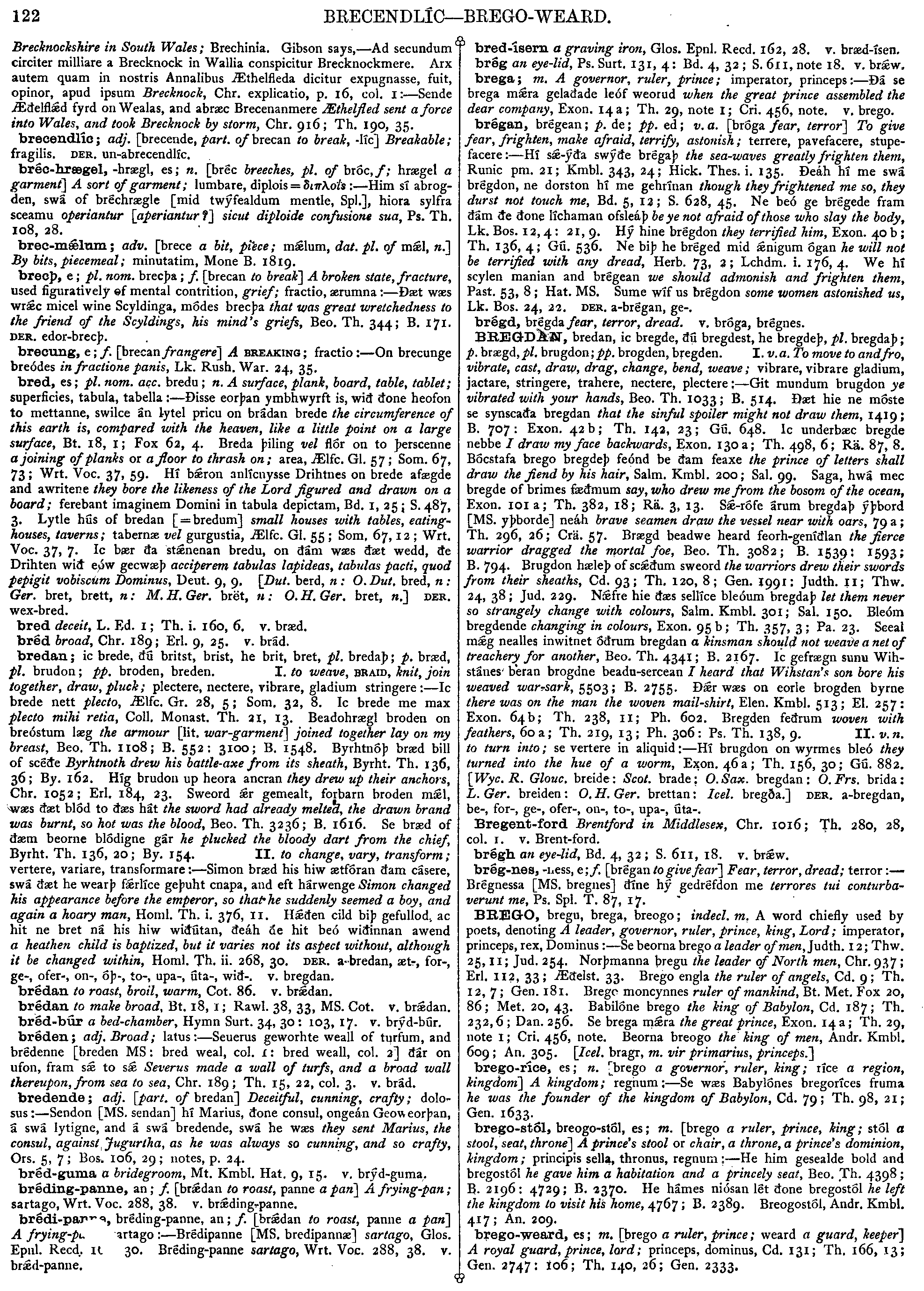
bred,
es;
pl.
nom.
acc.
bredu;
n.
A
surface,
plank,
board,
table,
tablet;
superficies,
tabula,
tabella
:--
Ðisse
eorþan
ymbhwyrft
is,
wið
ðone
heofon
to
mettanne,
swilce
án
lytel
pricu
on
brádan
brede
the
circumference
of
this
earth
is,
compared
with
the
heaven,
like
a
little
point
on
a
large
surface,
Bt.
18,
1;
Fox
62,
4.
Breda
þiling
vel
flor
on
to
þerscenne
a
joining
of
planks
or
a
floor
to
thrash
on;
area,
Ælfc.
Gl.
57;
Som.
67,
73;
Wrt.
Voc.
37,
59.
Hí
bron
anlícnysse
Drihtnes
on
brede
afægde
and
awritene
they
bore
the
likeness
of
the
Lord
figured
and
drawn
on
a
board;
ferebant
imaginem
Domini
in
tabula
depictam,
Bd.
1.
25;
S.
487,
3.
Lytle
hus
of
bredan
[
=
bredum]
small
houses
with
tables,
eating-houses,
taverns;
tabernæ
vel
gurgustia,
Ælfc.
Gl.
55;
Som.
67,
12;
Wrt.
Voc.
37,
7.
Ic
bær
ða
stnenan
bredu,
on
ðám
wæs
ðæt
wedd,
ðe
Drihten
wiþ
eów
gecwæþ
acciperem
tabulas
lapideas,
tabulas
pacti,
quod
pepigit
vobiscum
Dominus,
Deut.
9,
9.
[Dut.
berd,
n:
O.
Dut,
bred,
n:
Ger.
bref,
brett,
n:
M.
H.
Ger.
brët,
n:
O.
H.
Ger.
bret,
n.]
DER.
wex-bred.
|
Source: Bosworth/Toller, page b0131, entry 29 View original page image as: [TIFF] [PNG] [View previous entry] [View next entry] |
[Comment on this entry] [View comments] |
The following entry has been hand-corrected once. |
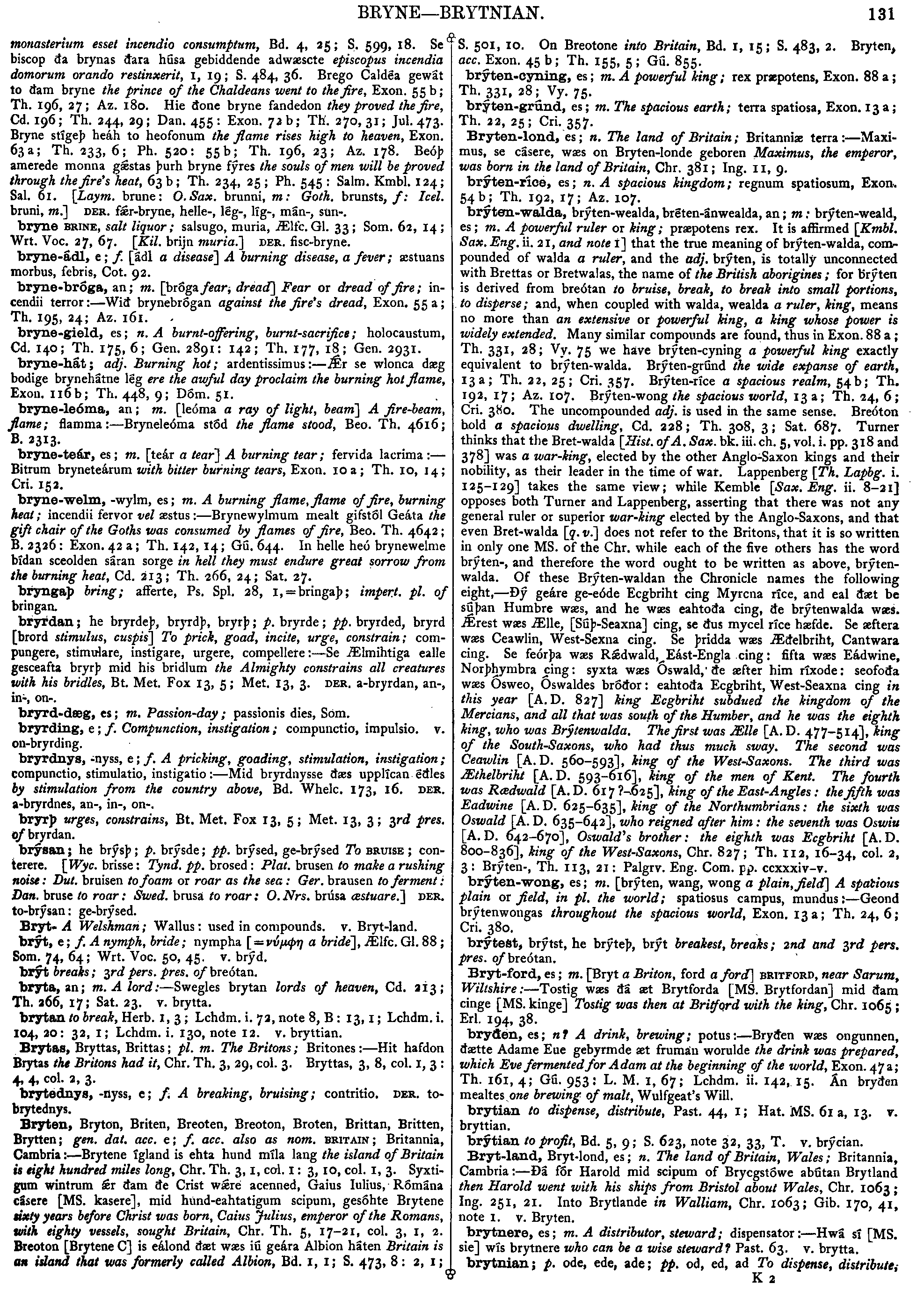
brýten-walda,
brýten-wealda,
bréten-ánwealda,
an;
m:
brýten-weald,
es;
m.
A
powerful
ruler
or
king;
præpotens
rex.
It
is
affirmed
[Kmbl.
Sax.
Eng.
ii.
21,
and
note
i]
that
the
true
meaning
of
brýten-walda,
compounded
of
walda
a
ruler,
and
the
adj.
brýten,
is
totally
unconnected
with
Brettas
or
Bretwalas,
the
name
of
the
British
aborigines;
for
brýten
is
derived
from
breótan
to
bruise,
break,
to
break
into
small
portions,
to
disperse;
and,
when
coupled
with
walda,
wealda
a
ruler,
king,
means
no
more
than
an
extensive
or
powerful
king,
a
king
whose
power
is
widely
extended.
Many
similar
compounds
are
found,
thus
in
Exon.
88
a;
Th.
331,
28;
Vy.
75
we
have
brýten-cyning
a
powerful
king
exactly
equivalent
to
brýten-walda.
Brýten-grúnd
the
wide
expanse
of
earth,
13a;
Th.
22,
25;
Cri.
357.
Brýten-rice
a
spacious
realm,
54
b;
Th.
192,
17;
Az.
107.
Brýten-wong
the
spacious
world,
13
a;
Th.
24,
6;
Cri.
380.
The
uncompounded
adj.
is
used
in
the
same
sense.
Breoton
bold
a
spacious
dwelling,
Cd.
228;
Th.
308,
3;
Sae.
687.
Turner
thinks
that
the
Bret-walda
[Hist,
of
A.
Sax.
bk.
iii.
ch.
5,
vol.
i.
pp.
318
and
378]
was
a
war-king,
elected
by
the
other
Anglo-Saxon
kings
and
their
nobility,
as
their
leader
in
the
time
of
war.
Lappenberg
[Th.
Lapbg.
i.
125-129]
takes
the
same
view;
while
Kemble
[Sax.
Eng.
ii.
8-21]
opposes
both
Turner
and
Lappenberg,
asserting
that
there
was
not
any
general
ruler
or
superior
war-king
elected
by
the
Anglo-Saxons,
and
that
even
Bret-walda
[q.
v.]
does
not
refer
to
the
Britons,
that
it
is
so
written
in
only
one
MS.
of
the
Chr.
while
each
of
the
five
others
has
the
word
brýten-,
and
therefore
the
word
ought
to
be
written
as
above,
brýten-walda.
Of
these
Brýten-waldan
the
Chronicle
names
the
following
eight,
--
Ðý
geáre
ge-eóde
Ecgbriht
cing
Myrcna
ríce,
and
eal
ðæt
be
súþan
Humbre
wæs,
and
he
wæs
eahtoða
cing,
ðe
brýtenwalda
wæs.
Ærest
wæs
Ælle,
[Súþ-Seaxna]
cing,
se
ðus
mycel
ríce
hæfde.
Se
æftera
wæs
Ceawlin,
West-Sexna
cing.
Se
þridda
wæs
Æðelbriht,
Cantwara
cing.
Se
feórþa
wæs
Rdwald.
Eást-Engla
cing:
fifta
wæs
Eádwine,
Norþhymbra
cing:
syxta
wæs
Oswald,
ðe
æfter
him
ríxode:
seofoða
wæs
Ósweo,
Óswaldes
bróðor:
eahtoða
Ecgbriht,
West-Seaxna
cing
in
this
year
[A.
D.
827]
king
Ecgbriht
subdued
the
kingdom
of
the
Mercians,
and
all
that
was
south
of
the
Humber,
and
he
was
the
eighth
king,
who
was
Brýtenwalda.
The
first
was
Ælle
[A.
D.
477-514],
king
of
the
South-Saxons,
who
had
thus
much
sway.
The
second
was
Ceawlin
[A.
D.
560-593],
king
of
the
West-Saxons.
The
third
was
Æthelbriht
[A.
D.
593-616],
king
of
the
men
of
Kent.
The
fourth
was
Rædwald
[A.
D.
617
?-515],
king
of
the
East-Angles:
the
fifth
was
Eadwine
[A.
D.
625-635],
king
of
the
Northumbrians:
the
sixth
was
Oswald
[A.
D.
635-642],
who
reigned
after
him:
the
seventh
was
Oswiu
[A.
D.
642-670],
Oswald's
brother:
the
eighth
was
Ecgbriht
[A.
D.
800-836],
king
of
the
West-Saxons,
Chr.
827;
Th.
112,
16-34,
col.
2,
3
:
Brýten-,
Th.
113,
21:
Palgrv.
Eng.
Com.
pp.
CCXXXIV-V.
| Result Page: |  |
Previous | 1 2 3 4 5 6 7 8 9 10 11 | Next |  |
Germanic Lexicon Project (main page)
This search system was written by
Sean Crist
Please consider
volunteering
to correct the data in these online dictionaries.
No rights reserved. Feel free to use these data in any way you please.