|
|

Search for sint again, using less strict matching (456 results)
|
Source: Bosworth/Toller, page b1254, entry 37 View original page image as: [TIFF] [PNG] [View previous entry] [View next entry] |
[Comment on this entry] [View comments] |
The following entry has been hand-corrected once. |
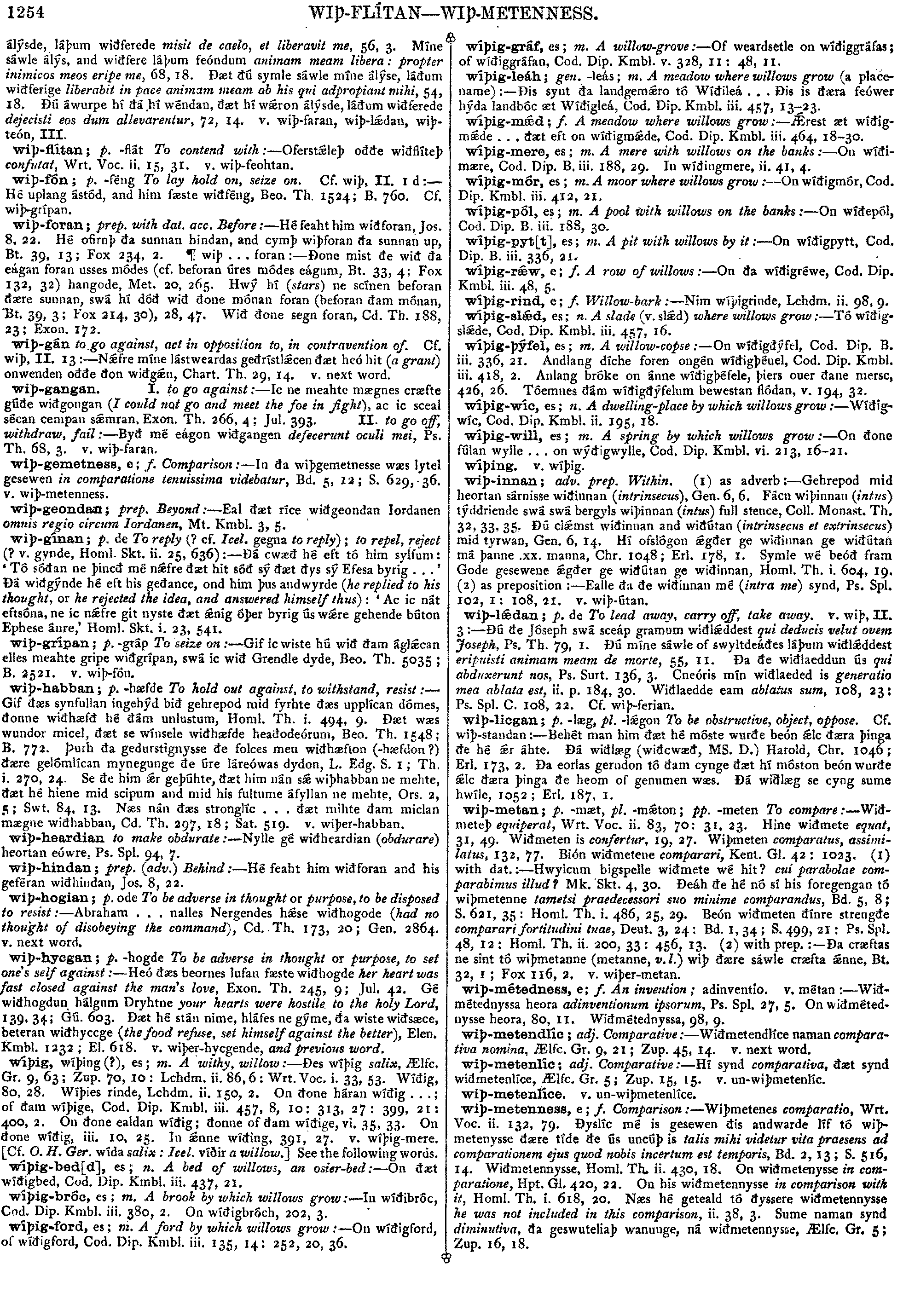
wiþ-metan;
p.
-mæt,
pl.
-m ton;
pp.
-meten
To
compare:--Wið
ton;
pp.
-meten
To
compare:--Wið meteþ
equiperat,
Wrt.
Voc.
ii.
83,
70:
31,
23.
Hine
wiðmete
equat,
31,
49.
Wiðmeten
is
confertur,
19,
27.
Wiþmeten
comparatus,
assimilatus,
132,
77.
Bión
wiðmetene
comparari,
Kent.
Gl.
42:
1023.
(1)
with
dat.:--Hwylcum
bigspelle
wiðmete
wé
hit?
cui
parabolae
comparabimus
illud?
Mk.
Skt.
4,
30.
Ðeáh
ðe
hé
nó
sí
his
foregengan
tó
wiþmetenne
tametsi
praedecessori
suo
minime
comparandus,
Bd.
5,
8;
S.
621,
35:
Homl.
Th.
i.
486,
25,
29.
Beón
wiðmeten
ðínre
strengðe
comparari
fortitudini
tuae,
Deut.
3,
24:
Bd.
1,
34;
S.
499,
21:
Ps.
Spl.
48,
12:
Homl.
Th.
ii.
200,
33:
456,
13.
(2)
with
prep.:--Ða
cræftas
ne
sint
tó
wiþmetanne
(metanne,
v.
l.)
wiþ
ðære
sáwle
cræfta
nne,
Bt.
32,
1;
Fox
116,
2.
v.
wiþer-metan.
meteþ
equiperat,
Wrt.
Voc.
ii.
83,
70:
31,
23.
Hine
wiðmete
equat,
31,
49.
Wiðmeten
is
confertur,
19,
27.
Wiþmeten
comparatus,
assimilatus,
132,
77.
Bión
wiðmetene
comparari,
Kent.
Gl.
42:
1023.
(1)
with
dat.:--Hwylcum
bigspelle
wiðmete
wé
hit?
cui
parabolae
comparabimus
illud?
Mk.
Skt.
4,
30.
Ðeáh
ðe
hé
nó
sí
his
foregengan
tó
wiþmetenne
tametsi
praedecessori
suo
minime
comparandus,
Bd.
5,
8;
S.
621,
35:
Homl.
Th.
i.
486,
25,
29.
Beón
wiðmeten
ðínre
strengðe
comparari
fortitudini
tuae,
Deut.
3,
24:
Bd.
1,
34;
S.
499,
21:
Ps.
Spl.
48,
12:
Homl.
Th.
ii.
200,
33:
456,
13.
(2)
with
prep.:--Ða
cræftas
ne
sint
tó
wiþmetanne
(metanne,
v.
l.)
wiþ
ðære
sáwle
cræfta
nne,
Bt.
32,
1;
Fox
116,
2.
v.
wiþer-metan.
|
Source: Bosworth/Toller, page b1264, entry 24 View original page image as: [TIFF] [PNG] [View previous entry] [View next entry] |
[Comment on this entry] [View comments (1)] |
The following entry has been hand-corrected once. |
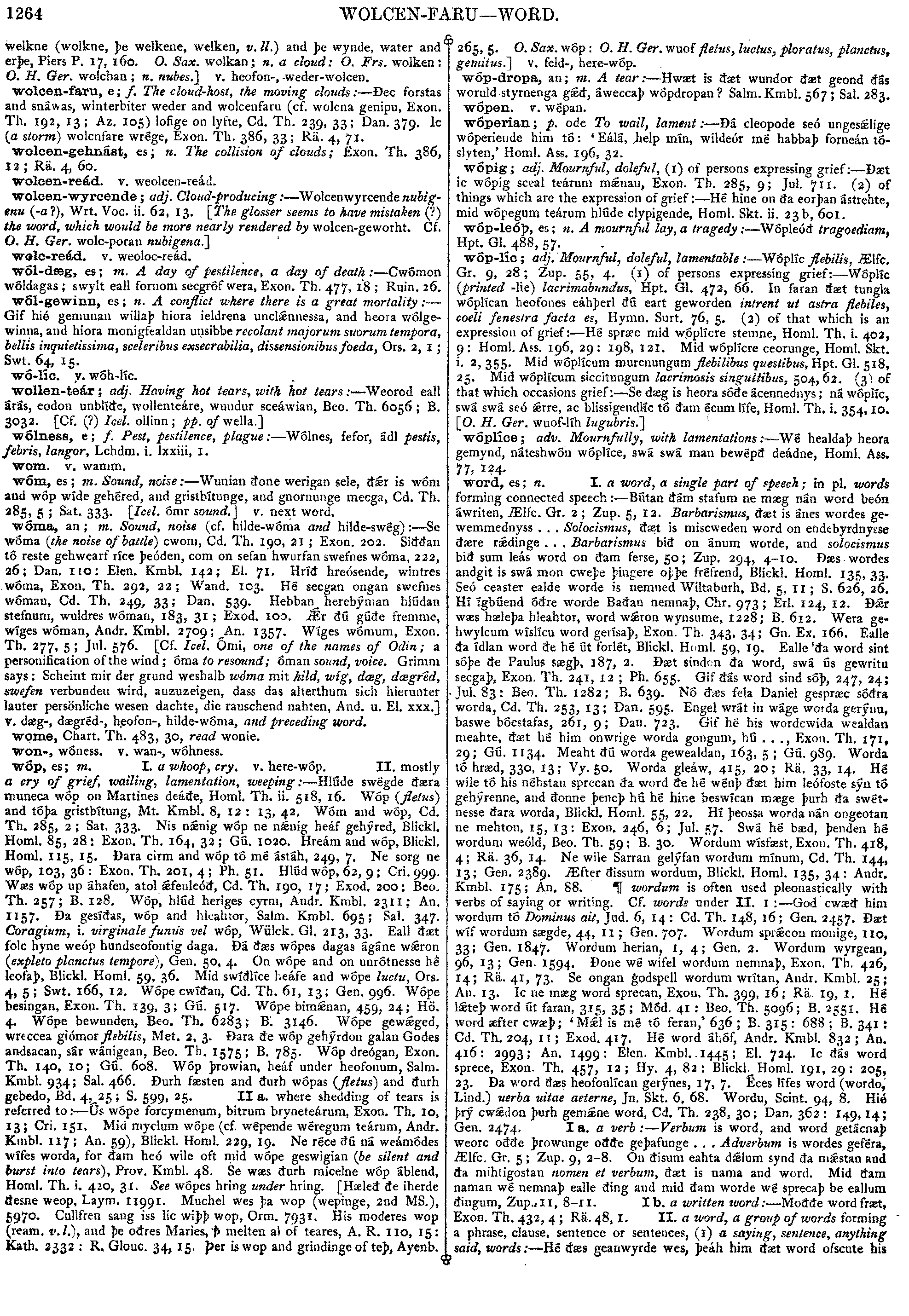
word,
es;
n.
I.
a
word,
a
single
part
of
speech;
in
pl.
words
forming
connected
specen
:--
Bútan
ðám
stafum
ne
mæg
nán
word
beón
áwriten,
Ælfc.
Gr.
2
;
Zup.
5,
12.
Barbarismus,
ðæt
is
ánes
wordes
gewemmednyss
.
.
.
Solocismus,
ðæt
is
miscweden
word
on
endebyrdnysse
ðære
rdinge
.
.
.
Barbarismus
bið
on
ánum
worde,
and
solocismus
bið
sum
leás
word
on
ðam
ferse,
50;
Zup.
294,
4-10.
Ðæs
wordes
andgit
is
swá
mon
cweþe
þingere
oþþe
fréfrend,
Blickl.
Homl.
135,
33.
Seó
ceaster
ealde
worde
is
nemned
Wiltaburh,
Bd.
5,
II
;
S.
626,
26.
Hí
ígbúend
óðre
worde
Baðan
nemnaþ,
Chr.
973;
Erl.
124,
12.
Ðr
wæs
hæleþa
hleahtor,
word
wron
wynsume,
1228;
B.
612.
Wera
gehwylcum
wíslícu
word
gerísaþ,
Exon.
Th.
343,
34;
Gn.
Ex.
166.
Ealle
ða
ídlan
word
ðe
hé
út
forlét.
Blickl.
Homl.
59,
19.
Ealle
'ða
word
sint
sóbe
ðe
Paulus
sægþ,
187,
2.
Ðæt
sindon
ða
word,
swá
ús
gewritu
secgaþ,
Exon.
Th.
241,
12
;
Ph.
655.
Gif
ðás
word
sind
sóþ,
247,
24;
Jul.
83:
Beo.
Th.
1282;
B.
639.
Nó
ðæs
fela
Daniel
gespræc
sóðra
worda,
Cd.
Th.
253,
13;
Dan.
595.
Engel
wrát
in
wáge
werda
gerýnu,
baswe
bócstafas,
261,
9
;
Dan.
723.
Gif
hé
his
wordcwida
wealdan
meahte,
ðæt
hé
him
onwrige
worda
gongum,
hú
.
.
.
,
Exon.
Th.
171,
29;
Gä.
1134.
Meaht
ðú
worda
gewealdan,
163,
5
;
Gä.
989.
Worda
tó
hræd,
330,
13;
Vy.
50.
Worda
gleáw,
415,
20;
Rä.
33,
14.
Hé
wile
tó
his
néhstan
sprecan
ða
word
ðe
hé
wénþ
ðæt
him
leófoste
sýn
tó
gehýrenne,
and
ðonne
þencþ
hú
hé
hine
beswícan
mæge
þurh
ða
swétnesse
ðara
worda,
Blickl.
Homl.
55,
22.
Hí
þeossa
worda
nán
ongeotan
ne
mehton,
15,
13:
Exon.
246,
6;
Jul.
57.
Swá
hé
bæd,
þenden
hé
wordum
weóld,
Beo.
Th.
59
;
B.
30.
Wordum
wisfæst,
Exon.
Th.
418,
4;
Rä.
36,
14.
Ne
wile
Sarran
gelýfan
wordum
mínum,
Cd.
Th.
144,
13;
Gen.
2389.
Æfter
ðissum
wordum,
Blickl.
Homl.
135,
34:
Andr.
Kmbl.
175;
An.
88.

wordum
is
often
used
pleonastically
with
verbs
of
saying
or
writing.
Cf.
worde
under
II.
I
:--
God
cwæð
him
wordum
tó
Dominus
ait,
Jud.
6,
14
:
Cd.
Th.
148,
16;
Gen.
2457.
Ðæt
wíf
wordum
sægde,
44,
II;
Gen.
707.
Wordum
sprcon
monige,
110,
33;
Gen.
1847.
Wordum
herian,
l,
4;
Gen.
2.
Wordum
wyrgean,
96,
13;
Gen.
1594.
Ðone
wé
wifel
wordum
nemnaþ,
Exon.
Th.
426,
14;
Rä.
41,
73.
Se
ongan
godspell
wordum
wrítan,
Andr.
Kmbl.
25;
An.
13.
Ic
ne
mæg
word
sprecan.
Exon.
Th.
399,
16;
Rä.
19,
I.
Hé
lteþ
word
út
faran,
315,
35
;
Mód.
41
:
Beo.
Th.
5096;
B.
2551.
Hé
word
æfter
cwæþ;
'Ml
is
mé
tó
feran,
'
636
;
B.
315
:
688
;
B.
341:
Cd.
Th.
204,
ii;
Exod.
417.
Hé
word
áhóf,
Andr.
Kmbl.
832
;
An.
416:
2993;
An.
1499:
Elen.
Kmbl.
1445;
El.
724.
Ic
ðás
word
sprece.
Exon.
Th.
457,
12;
Hy.
4,
82:
Blickl.
Homl.
191,
29:
205,
23.
Ða
word
ðæs
heofonlícan
gerýnes,
17,
7.
Éces
lifes
word
(wordo,
Lind.
)
uerba
uitae
aeterne,
Jn.
Skt.
6,
68.
Wordu,
Scint.
94,
8.
Hié
þrý
cwdon
þurh
gemne
word,
Cd.
Th.
238,
30;
Dan.
362
:
149,
14;
Gen.
2474.
I
a.
a
verb
:--
Verbum
is
word,
and
word
getácnaþ
weorc
oððe
þrowunge
oððe
geþafunge
.
.
.
Adverbum
is
wordes
geféra,
Ælfc.
Gr.
5
;
Zup.
9,
2-8.
On
ðisum
eahta
dlum
synd
ða
mstan
and
ða
mihtigostan
nomen
et
verbum,
ðæt
is
nama
and
word.
Mid
ðam
naman
wé
nemnaþ
ealle
ðing
and
mid
ðam
worde
wé
sprecaþ
be
eallum
ðingum,
Zup.
II,
8-11.
Ib.
a
written
word
:--
Moððe
word
fræt,
Exon.
Th.
432,
4;
Rä.
48,
1.
II.
a
word,
a
group
of
words
forming
a
phrase,
clause,
sentence
or
sentences,
(l)
a
saying,
sentence,
anything
said,
words:
--
Hé
ðæs
geanwyrde
wes,
þeáh
him
ðæt
word
ofscute
his
|
Source: Bosworth/Toller, page b1276, entry 22 View original page image as: [TIFF] [PNG] [View previous entry] [View next entry] |
[Comment on this entry] [View comments] |
The following entry has been hand-corrected once. |
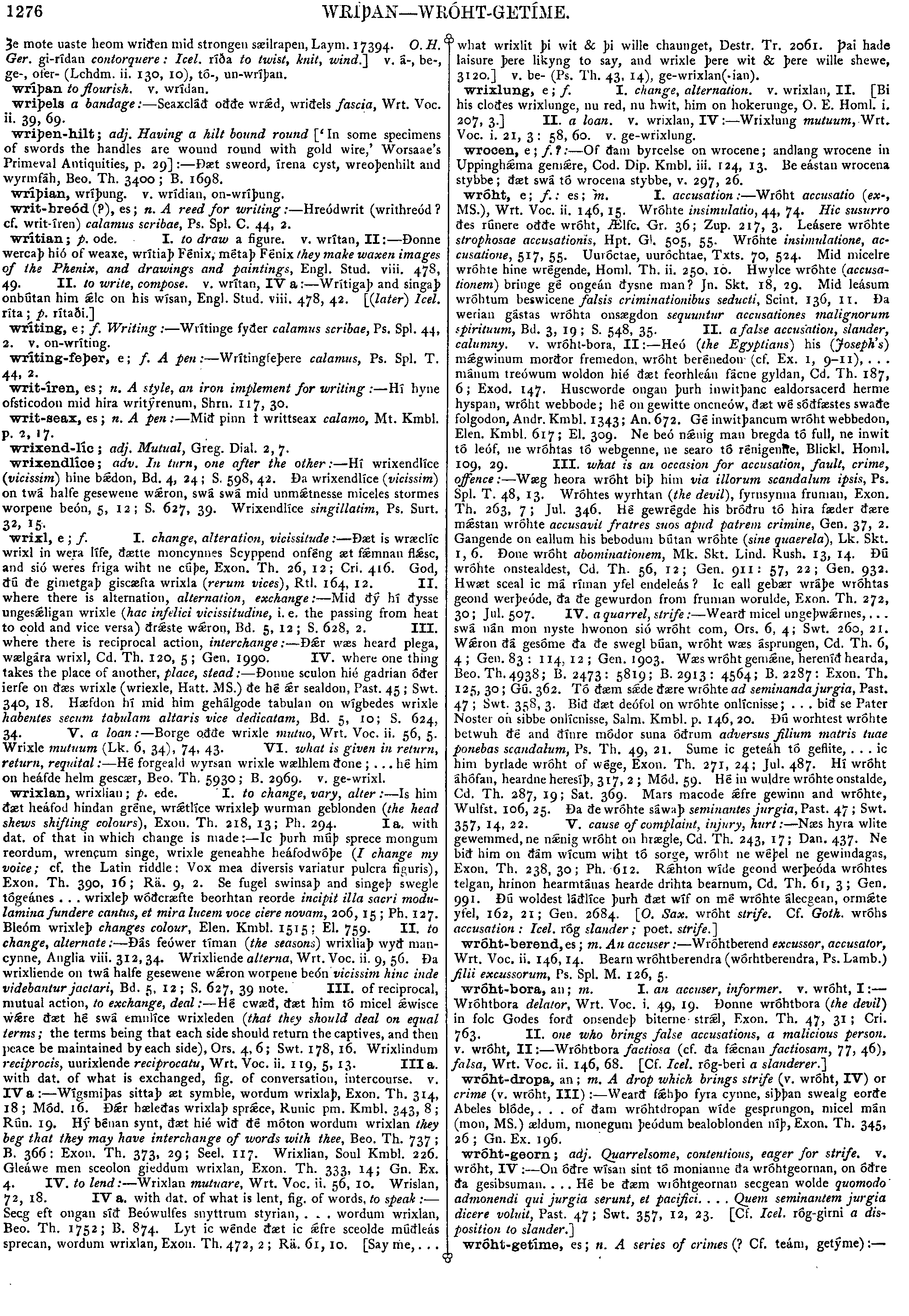
wróht-georn; adj. Quarrelsome, contentious, eager for strife, v. wróht, IV :-- On óðre wísan sint tó monianne ða wróhtgeornan, on óðre ða gesibsuman. . . . Hé be ðæm wróhtgeornan secgean wolde quomodo admonendi qui jurgia serunt, et pacifici. . . . Quem seminantem jurgia dicere voluit, Past. 47; Swt. 357, 12, 23. [Cf. Icel. róg-girni a disposition to slander. ]
|
Source: Bosworth/Toller, page b1283, entry 17 View original page image as: [TIFF] [PNG] [View previous entry] [View next entry] |
[Comment on this entry] [View comments] |
The following entry has been hand-corrected once. |
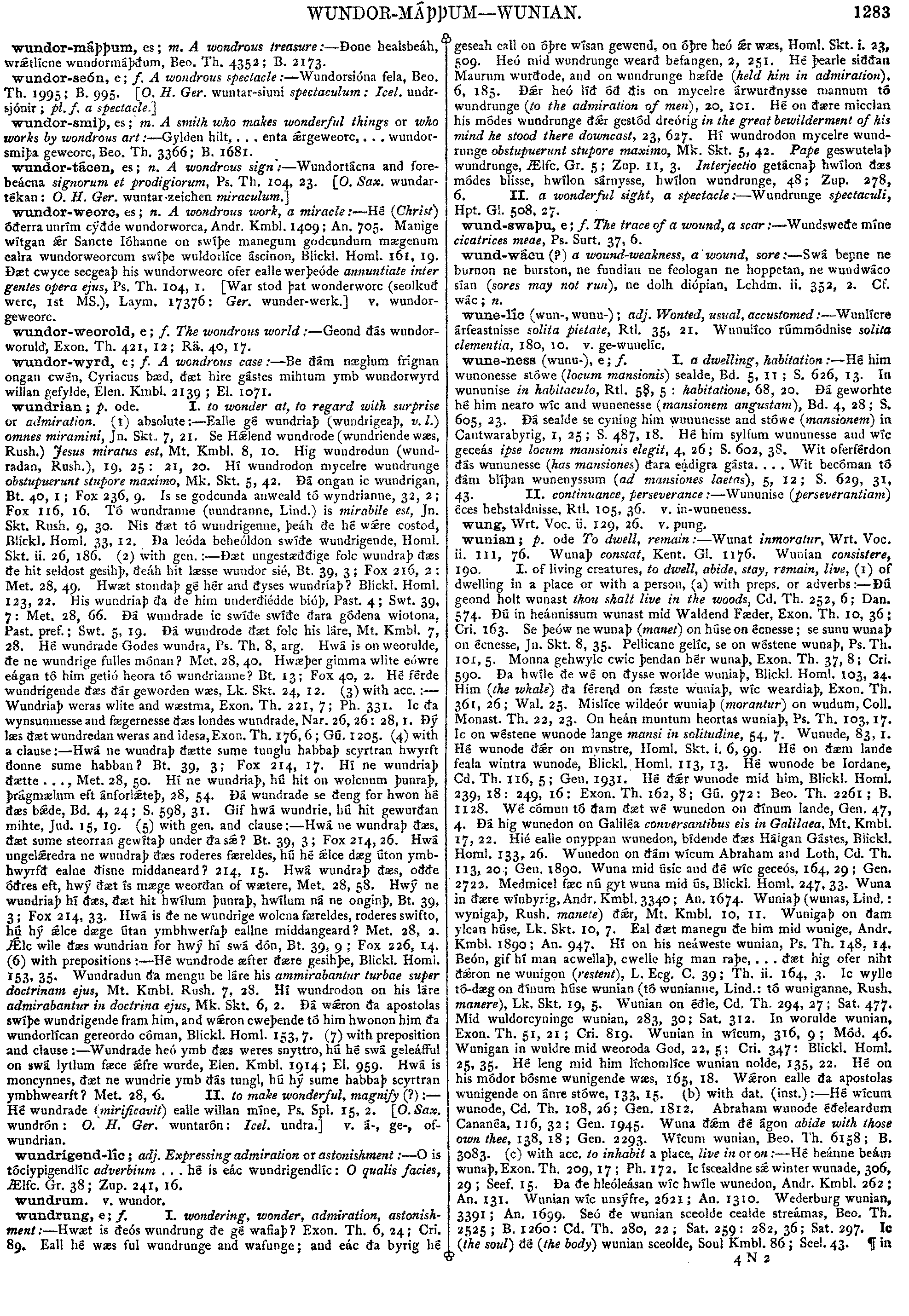
wunian;
p.
ode
To
dwell,
remain
:--
Wunat
inmoratur,
Wrt.
Voc.
ii.
111,
76.
Wunaþ
constat,
Kent.
Gl.
1176.
Wunian
consistere,
190.
I.
of
living
creatures,
to
dwell,
abide,
stay,
remain,
live,
(1)
of
dwelling
in
a
place
or
with
a
person,
(a)
with
preps.
or
adverbs
:--
Ðú
geond
holt
wunast
thou
shalt
live
in
the
woods,
Cd.
Th.
252,
6;
Dan.
574.
Ðú
in
heánnissum
wunast
mid
Waldend
Fæder,
Exon.
Th.
10,
36;
Cri.
163.
Se
þeów
ne
wunaþ
(manet)
on
húse
on
écnesse;
se
sunu
wunaþ
on
écnesse,
Jn.
Skt.
8,
35.
Pellicane
gelíc,
se
on
wéstene
wunaþ,
Ps.
Th.
101,
5.
Monna
gehwylc
cwic
þendan
hér
wunaþ,
Exon.
Th.
37,
8;
Cri.
590.
Ða
hwíle
ðe
wé
on
ðysse
worlde
wuniaþ,
Blickl.
Homl.
103,
24.
Him
(the
whale)
ða
férend
on
fæste
wuniaþ,
wíc
weardiaþ,
Exon.
Th.
361,
26;
Wal.
25.
Mislíce
wildeór
wuniaþ
(morantur)
on
wudum,
Coll.
Monast.
Th.
22,
23.
On
heán
muntum
heortas
wuniaþ,
Ps.
Th.
103,
17.
Ic
on
wéstene
wunode
lange
mansi
in
solitudine,
54,
7.
Wunude,
83,
1.
Hé
wunode
ðr
on
mynstre,
Homl.
Skt.
i.
6,
99.
Hé
on
ðæm
lande
feala
wintra
wunode,
Blickl.
Homl.
113,
13.
Hé
wunode
be
Iordane,
Cd.
Th.
116,
5;
Gen.
1931.
Hé
ðr
wunode
mid
him,
Blickl.
Homl.
239,
18:
249,
16:
Exon.
Th.
162,
8;
Gú.
972:
Beo.
Th.
2261;
B.
1128.
Wé
cómun
tó
ðam
ðæt
wé
wunedon
on
ðínum
lande,
Gen.
47,
4.
Ðá
hig
wunedon
on
Galiléa
conversantibus
eis
in
Galilaea,
Mt.
Kmbl.
17,
22.
Hié
ealle
onyppan
wunedon,
bídende
ðæs
Hálgan
Gástes,
Blickl.
Homl.
133,
26.
Wunedon
on
ðám
wícum
Abraham
and
Loth,
Cd.
Th.
113,
20;
Gen.
1890.
Wuna
mid
úsic
and
ðé
wíc
geceás,
164,
29;
Gen.
2722.
Medmicel
fæc
nú
gyt
wuna
mid
ús,
Blickl.
Homl.
247,
33.
Wuna
in
ðære
wínbyrig,
Andr.
Kmbl.
3340;
An.
1674.
Wuniaþ
(wunas,
Lind.:
wynigaþ,
Rush.
manete)
ðr,
Mt.
Kmbl.
10,
11.
Wunigaþ
on
ðam
ylcan
húse,
Lk.
Skt.
10,
7.
Eal
ðæt
manegu
ðe
him
mid
wunige,
Andr.
Kmbl.
1890;
An.
947.
Hí
on
his
neáweste
wunian,
Ps.
Th.
148,
14.
Beón,
gif
hí
man
acwellaþ,
cwelle
hig
man
raþe,...ðæt
hig
ofer
niht
ðron
ne
wunigon
(restent),
L.
Ecg.
C.
39;
Th.
ii.
164,
3.
Ic
wylle
tó-dæg
on
ðínum
húse
wunian
(tó
wunianne,
Lind.:
tó
wuniganne,
Rush.
manere),
Lk.
Skt.
19,
5.
Wunian
on
éðle,
Cd.
Th.
294,
27;
Sat.
477.
Mid
wuldorcyninge
wunian,
283,
30;
Sat.
312.
In
worulde
wunian,
Exon.
Th.
51,
21;
Cri.
819.
Wunian
in
wícum,
316,
9;
Mód.
46.
Wunigan
in
wuldre
mid
weoroda
God,
22,
5;
Cri.
347:
Blickl.
Homl.
25,
35.
Hé
leng
mid
him
líchomlíce
wunian
nolde,
135,
22.
Hé
on
his
módor
bósme
wunigende
wæs,
165,
18.
Wron
ealle
ða
apostolas
wunigende
on
ánre
stówe,
133,
15.
(b)
with
dat.
(inst.)
:--
Hé
wícum
wunode,
Cd.
Th.
108,
26;
Gen.
1812.
Abraham
wunode
éðeleardum
Cananéa,
116,
32;
Gen.
1945.
Wuna
ðm
ðé
ágon
abide
with
those
own
thee,
138,
18;
Gen.
2293.
Wícum
wunian,
Beo.
Th.
6158;
B.
3083.
(c)
with
acc.
to
inhabit
a
place,
live
in
or
on
:--
Hé
heánne
beám
wunaþ,
Exon.
Th.
209,
17;
Ph.
172.
Ic
íscealdne
s
winter
wunade,
306,
29;
Seef.
15.
Ða
ðe
hleóleásan
wíc
hwíle
wunedon,
Andr.
Kmbl.
262;
An.
131.
Wunian
wíc
unsýfre,
2621;
An.
1310.
Wederburg
wunian,
3391;
An.
1699.
Seó
ðe
wunian
sceolde
cealde
streámas,
Beo.
Th.
2525;
B.
1260:
Cd.
Th.
280,
22;
Sat.
259:
282,
36;
Sat.
297.
Ic
(the
soul)
ðé
(the
body)
wunian
sceolde,
Soul
Kmbl.
86;
Seel.
43.

in
figurative
expressions
:--
Se
fugel
wunaþ
wyllestreámas
(bathes),
Exon.
Th.
204,
29;
Ph.
105.
Wunian
wælreste
to
lie
dead,
184,
10;
Gú.
1342:
Beo.
Th.
5796;
B.
2902:
to
be
buried,
Elen.
Kmbl.
1444;
El.
724.
Reste
wunian
to
sleep,
Cd.
Th.
223,
22;
Dan.
123:
Rood
Kmbl.
6;
Kr.
3.
(2)
to
live,
be
in
certain
conditions
or
circumstances,
(a)
with
prep.
or
adv.
:--
Þenden
ic
wunige
on
worulddreámum
quamdiu
ero,
Ps.
Th.
103,
31.
Seó
sáwel
ðe
wunaþ
on
heofena
ríces
gefeán,
Blickl.
Homl.
57,
31.
Wunaþ
hé
on
wiste,
ne
hine
wiht
dréfeþ,
Beo.
Th.
3474;
B.
1735.
Ða
menigo
ðe
wuniaþ
on
nearonédum,
Andr.
Kmbl.
202;
An.
101.
On
fýrbæðe
ðú
wunodest,
Elen.
Kmbl.
1897;
El.
950.
Hé
in
yrmðum
wunade,
Andr.
Kmbl.
326;
An.
163.
Wé
wunodon
on
wynnum,
Cd.
Th.
279,
12;
Sat.
237.
Hí
wunedon
ætsomne,
Met.
20,
243.
Wunian
on
écean
wuldre,
Blickl.
Homl.
105,
1.
In
wynnum
wunian,
Cd.
Th.
299,
26;
Sat.
556:
Exon.
Th.
140,
2;
Gú.
604.
Wunian
in
wylme,
Salm.
Kmbl.
933;
Sal,
466.
Adam
wæs
wunigende
on
ðisum
lífe
mid
geswince,
Homl.
Th.
i.
20;
6.
(b)
with
dat.
(inst.)
:--
Hé
wunaþ
unlustum,
Salm.
Kmbl.
538;
Sal.
268.
Heó
helltregum
wunodon,
Cd.
Th.
5,
19;
Gn.
74.
Eádig
weorþan,
wunian
wyndagum,
Exon.
Th.
330,
34;
Vy.
61.
(c)
with
noun
or
adj.
:--
Borhhond
[hé]
wunade
fidejussu
exstitit,
Kent.
Gl.
743.
Wunude
extitit
(praestantior),
Hpt.
Gl.
511,
60.
Ðæt
ðú
langlíf
ofer
eorðan
wunie,
Homl.
Th.
ii.
36,
2.
Ána
lifgan,
wineleás
wunian,
Exon.
Th.
344,
15;
Gn.
Ex.
174.
(3)
to
abide,
be
present
with
a
person
to
comfort
or
help
:--
Ic
ðé
mid
wunige,
Andr.
Kmbl.
198;
An.
99:
Exon.
Th.
30,
12;
Cri.
478.
God
wunaþ
on
him
est
in
ipsis
Dominus,
Num.
16,
3.
II.
of
things
abstract
or
concrete,
to
be,
rest,
reside,
remain,
(1)
in
respect
to
locality,
occupy
a
position
:--
Wunaþ
morabitur,
Kent.
Gl.
481:
commorabitur,
540.
(a)
with
prep.
or
adv.
:--
Se
hálga
stenc
wunaþ
geond
wynlond,
Exon.
Th.
203,
10;
Ph.
82.
Ðr
se
wísdóm
wunaþ
on
gemyndum,
Met.
7,
39.
Lyft
on
niiddum
wunaþ,
20,
79.
Mid
ðam
wítegendlícum
gáste
ðe
on
ðé
wunaþ,
Homl.
Skt.
i.
18,
282:
Cd.
Th.
56,
7;
Gen.
908.
Wæter
ðe
wuniaþ
gyt
under
fæstenne
folca
hrófes,
10,
6;
Gen.
152.
Eorðe
and
wæter
wuniaþ
on
fýre,
Met.
20,
148.
Beorh
wunode
on
wonge,
Beo.
Th.
4476;
B.
2242.
Se
monlíca
stille
wunode,
ðr
hié
begeat
wíte,
Cd.
Th.
155,
3;
Gen.
2567.
Egesa
on
hreóstum
wunode,
173,
24;
Gen.
2866.
Treów
on
ðé
wunade,
Exon.
Th.
6,
12;
Cri.
83:
126,
4;
Gú.
366.
Hwæþer
him
yfel
ðe
gód
under
wunige,
82,
4;
Cri.
1333.
Þéh
mín
líchama
on
niðerdlum
eorðan
wunige,
Ps.
Th.
138,
13.
Saga
mé
hwr
seó
ród
wunige,
Elen.
Kmbl.
1244;
El.
624.
Tó
manna
heortan,
r
Drihtnes
weorc
ðr
wunian
móte,
Blickl.
Homl.
19,
8:
111,
5.
Æ-acute;nigne
dl
secgas
geségon
on
sele
wunian,
Beo.
Th.
6248;
B.
3128.
Geweoton
hí
mearcland
tredan,
forlton
moldern
wunigean,
open
eorðscræfu,
Andr.
Kmbl.
1605;
An.
803.
Lazarus,
ðe
Crist
áwehte
ðý
feorþan
dæge
ðæs
ðe
hé
on
byrgenne
wæs
fúl
wunigende,
Blickl.
Homl.
75,
5.
(b)
with
acc.
:--
Ðæt
treów
sceolde
wésten
wunian,
Cd.
Th.
251,
5;
Dan.
559.
Hine
gærsbedd
sceal
wunian,
Ps.
Th.
102,
15.
(2)
of
state
or,
circumstance:Inc
sceal
sealt
wæter
wunian
on
gewealde,
Cd.
Th.
13,
7;
Gen.
199.
Ðá
ðá
ðis
ígland
wæs
wunigende
on
sibbe,
Homl.
Skt.
i.
13,
148,
III.
to
consist
of
or
in,
subsist,
exist.
v.
wunung,
III
:--
On
wordum
Godes
ríce
ne
wunaþ,
ac
on
ánwylnysse
ðæs
hálgan
geleáfan,
Guth.
prol.;
Gdwin.
2,
15.
Ðeós
lyft
ys
án
ðæra
feówer
gesceafta,
ðe
lc
líchamlíc
ðing
on
wunaþ.
Feówer
gesceafta
synd,
ðe
ealle
eorðlíce
líchaman
on
wuniaþ,
Lchdm.
iii.
272,
11-13.
Ða
hálgan
þrynnysse
on
ánre
godcundnysse
fre
wunigende,
Homl.
Skt.
i.
15,
216:
16,
1.
Nis
ná
se
Hálga
Gást
wunigende
on
his
gecynde
swá
swá
hé
gesewen
wæs,
for
ðan
ðe
hé
is
ungesewenlíc,
Homl.
Th.
i.
322,
17.
Him
(man)
is
gemne
mid
stánum
ðæt
hé
beó
wunigende;
him
is
gemne
mid
treówum
ðæt
hé
lybbe,
302,
20.
Hí
nron
fre
wunigende,
ac
God
hí
gesceóp,
276,
15.
God
is
þurh
hine
sylfne
wunigende,
ii.
236,
18.
IV.
where
there
is
permanence,
continuity,
to
remain,
last,
continue,
endure
:--
Ðú
wunast
tu
permanebis,
Ps.
Th.
101,
23.
Ðú
on
écnesse
wunast
tu
in
aeternum
permanes,
101,
10:
92,
3.
Ðr
nóht
elles
ne
wunaþ,
Blickl.
Homl.
101,
5.
Ðínne
naman
ðe
wunaþ
on
ealra
worlda
world,
143,
31:
Ps.
Th.
111,
8.
Seó
ðe
fre
wæs
and
eác
nú
wunaþ,
Homl.
Skt.
i.
15,
217.
Þenden
ðr
wunaþ
húsa
sélest,
Beo.
Th.
574;
B.
284.
Swá
hwylc
swá
on
elne
óþ
his
ende
wunaþ,
se
bid
hál,
Blickl.
Homl.
171,
26:
Homl.
Th.
ii.
502,
21.
Ðære
wylne
sunu
wunaþ
eal
his
líf
on
ðeówte,
i.
110,
29.
Wuniaþ
ða
wácran,
Exon.
Th.
311,
4;
Seef.
87.
Gif
hé
wunode
ofer
middæg
if
he
continued
to
live
past
noon,
Homl.
Skt.
i.
3.
595.
Lucia
on
ðære
ylcan
stówe
wunode
ðe
heó
ofslagen
wæs
Lucia
remained
lying
in
the
same
place
that
she
was
struck
down,
9,
146.
Se
snáw
leng
ne
wunede
ðonne
áne
tíde,
Nar.
23,
21.
Hí
wunedun
(wéren
wungiende
mansissent,
Lind.)
óð
ðysne
dæg,
Mt.
Kmbl.
11,
23.
Ðæt
hió
ne
wunian
on
worldlífe
ita
ut
non
sint,
Ps.
Th.
103,
33.
Herenes
Drihtnes
hér
sceal
wunian
on
worulda
woruld
laudatio
ejus
manet
in
seculum
seculi,
110,
8:
118,
44,
91.
Hæfð
hé
ðæt
gewrixle
geset
ðe
nú
wunian
sceal,
Met.
11,
56.
On
sáre
his
líchoma
sceal
hér
wunian,
Blickl.
Homl.
61,
1:
Exon.
Th.
7,
19;
Cri.
103.
Eallum
rihtgelýfdum
mannum
wunigendum
for
his
noman,
Blickl.
Homl.
171,
14.
IV
a.
with
a
complementary
word
or
phrase
:--
Heó
wæs
fmne
r
hire
beorþre,
and
heó
wunaþ
fmne
æfter
hire
beorþre,
Blickl.
Homl.
155,
33.
Ðú
unstilla
gesceafta
ástyrest
and
ðé
self
wunast
swíðe
stille,
Met.
20,
16.
God
ána
unáwendendlíc
wunaþ,
Bt.
35,
5;
Fox
166,
9.
Gescylded
á
wunaþ
ungewyrded,
þenden
woruld
stondeþ,
Exon.
Th.
210,
5;
Ph.
181.
Hió
dumb
wunaþ,
414,
7;
Rä.
32,
16.
Heó
wæs
mid
twám
werum
and
swá
ðeáh
wunode
mden,
Homl.
Skt.
i.
20,
3.
Se
hearda
hyge
hálig
wunode,
Exon.
Th.
135,
1;
Gu.
517.
Hí
ðágyt
hðene
wunodon,
Homl.
Th.
ii.
502,
23.
Is
sd
of
ðære
tíde
ðe
hí
þanon
gewiton
óþ
tódæge
ðæt
ðæt
land
wéste
wunige
(manere
desertus
perhibetur),
Bd.
1,
15;
S.
483,
27.
Ðis
ungefremed
wunie,
L.
Ath.
i.
proem.;
Th.
i.
198,
13.
Hé
hét
wunian
wyrtruman
eorðan
fæstne,
Cd.
Th.
248,
20;
Dan.
516.
Sceal
lufu
uncer
wrfæst
wunian,
Exon.
Th.
173,
19;
Gú.
1163.
Abrames
wíf
wæs
ðágit
wuniende
bútan
cildum
she
remained
still
childless,
Gen.
16,
1.
V.
to
be
wont
:--
Ic
gewunige
soleo,
wunigende
solens,
Ælfc.
Gr.
41;
Zup.
247,
5.
[O.
E.
Homl.
wunian:
A.
R.
Kath.
wunien:
Laym.
wunien,
wonien:
Orm.
wunenn:
Gen.
and
Ex.
wunen:
Ayenb.
wonie:
Chauc.
Piers
P.
Wick.
wone:
O.
Sax.
wonón,
wunón:
O.
Frs.
wona,
wuna:
O.
H.
Ger.
wonén
habitare,
morari,
conversari,
manere,
solere.]
v.
á-,
ge-,
on-,
þurh-wunian;
án-,
dryht-,
weorold-wuniende.
|
Source: Bosworth/Toller, page b1287, entry 7 View original page image as: [TIFF] [PNG] [View previous entry] [View next entry] |
[Comment on this entry] [View comments] |
The following entry has been hand-corrected once. |
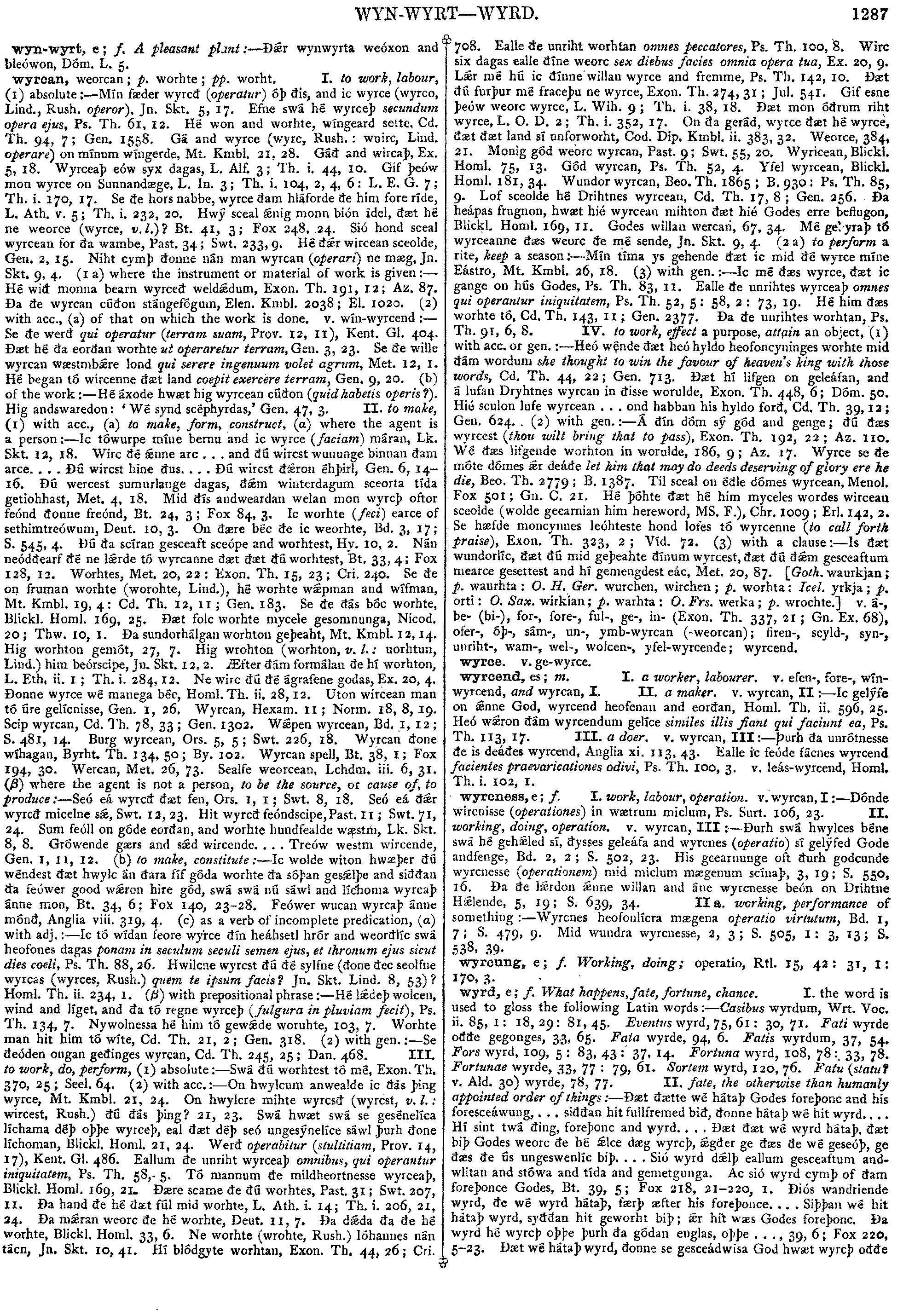
wyrd,
e;
f.
What
happens,
fate,
fortune,
chance.
I.
the
word
is
used
to
gloss
the
following
Latin
words
:--
Casibus
wyrdum,
Wrt.
Voc.
ii.
85,
1
:
18,
29
:
81,
45.
Eventus
wyrd,
75,
61
:
30,
71.
Fati
wyrde
oððe
gegonges,
33,
65.
Fata
wyrde,
94,
6.
Fatis
wyrdum,
37,
54.
Fors
wyrd,
109,
5
:
83,
43:
37,
14.
Fortuna
wyrd,
108,
78
:
33,
78.
Fortunae
wyrde,
33,
77
:
79,
61.
Sortem
wyrd,
120,
76.
Fatu
(statu?
v.
Ald.
30)
wyrde,
78,
77.
II.
fate,
the
otherwise
than
humanly
appointed
order
of
things
:--
Ðæt
ðætte
wé
hátaþ
Godes
foreþonc
and
his
foresceáwung,
.
.
.
siððan
hit
fullfremed
bið,
ðonne
hátaþ
wé
hit
wyrd...
Hí
sint
twá
ðing,
foreþonc
and
wyrd....
Ðæt
ðæt
wé
wyrd
hátaþ,
ðæt
biþ
Godes
weorc
ðe
hé
lce
dæg
wyrcþ,
gðer
ge
ðæs
ðe
wé
geseóþ,
ge
ðæs
ðe
ús
ungeswenlíc
biþ
....
Sió
wyrd
dlþ
eallum
gesceaftum
andwlitan
and
stówa
and
tída
and
gemetgunga.
Ac
sió
wyrd
cymþ
of
ðam
foreþonce
Godes,
Bt.
39,
5;
Fox
218,
21-220,
1.
Ðiós
wandriende
wyrd,
ðe
wé
wyrd
hátaþ,
færþ
æfter
his
foreþonce....
Siþþan
wé
hit
hátaþ
wyrd,
syððan
hit
geworht
biþ;
r
hit
wæs
Godes
foreþonc.
Ða
wyrd
hé
wyrcþ
oþþe
þurh
ða
gódan
englas,
oþþe
.
.
.,
39,
6
;
Fox
220,
5-23.
Ðæt
wé
hátaþ
wyrd,
ðonne
se
gesceádwísa
God
hwæt
wyrcþ
oððe
geþafaþ
ðæs
ðe
wé
ne
wénaþ
fit
illud
fatalis
ordinis
insigne
miraculum,
cum
ab
sciente
geritur,
quod
stupeant
ignorantes,
39,
10;
Fox
226,
24.
Ðé
sceal
on
woruld
bringan
Sarra
sunu,
sóð
forð
gán
wyrd
æfter
ðiosum
wordgemearcum,
Cd.
Th.
142,
1
;
Gen.
2355.
Gð
á
wyrd
swá
hió
sceal,
Beo.
Th.
915;
B.
455.
Ne
wæs
wyrd,
ðæt
hé
má
móste
manna
cynnes
ðicgean,
1473;
B.
734.
Wron
sume
gedwolmen
ðe
cwdon,
ðæt
lc
man
beó
ácenned
be
steorrena
gesetnyssum,
and
þurh
heora
ymbryna
him
wyrd
gelimpe,
Homl.
Th.
i.
110,
8.
Sceal
heó
(Lot's
wife)
wyrde
bídan,
Drihtnes
dómes,
Cd.
Th.
155,
10;
Gen.
2570
:
Exon.
Th.
329,
29;
Vy.
41.
Hí
wyrd
ne
cúþon,
Beo.
Th.
2471
;
B.
1233.
III.
in
a
personal
sense,
one
of
the
Fates
(the
weird
sisters)
:--
Wyrde
Parcae,
Wrt.
Voc.
ii.
116,
9
:
67,
55.
III
a.
as
a
personification,
fate,
fortune
:--
Wyrd
biþ
swíþre,
Meotud
mihtigra,
ðonne
nges
monnes
gehygd,
Exon.
Th.
312,
27;
Seef.
115.
Wyrd
byð
swíþost,
Menol.
Fox
469;
Gn.
C.
5
:
Salm.
Kmbl.
855;
Sal.
427
:
886;
Sal.
442.
Wyrd
bið
ful
árð,
Exon.
Th.
286,
24;
Wand.
5
:
Salm.
Kmbl.
871
;
Sal.
435.
Sume
úþwitan
secgaþ
ðæt
sió
wyrd
wealde
gðer
ge
geslþa
ge
ungeslþa
lces
monnes,
Bt.
39,
8
;
Fox
224,
13.
Weord
(wyrd,
v.
l.),
5,
1
;
Fox
8,
30.
Swá
him
wyrd
ne
gescráf,
Beo.
Th.
5142
;
B.
2574
:
Elen.
Kmbl.
2092;
El.
1047
:
Met.
1,
29.
Behindan
beleác
wyrd
mid
wge,
Cd.
Th.
206,
25;
Exod.
457.
Eorlas
fornóman
wpen
wælgífru,
wyrd
seó
mre,
Exon.
Th.
292,
17
;
Wand.
100:
Beo.
Th.
2415;
B.
1205.
Hié
wyrd
forsweóp,
959;
B.
477
:
5621
;
B.
2814.
Wyrd
ðone
gomelan
grétan
sceolde,
4832;
B.
2420.
Hwý
ðú
fre
woldest
ðæt
seó
wyrd
swá
hwyrfan
sceolde?
Heó
þreáþ
ða
unscildigan,
Bt.
4;
Fox
8,
12
:
Met.
4.
34
:
Andr.
Kmbl.
1226;
An.
613
:
3121
;
An.
1563.
Wyrd
oft
nereþ
unfgne
eorl,
Beó.
Th.
1149;
B.
572
:
Exon.
Th.
165,
18;
Gú.
1030.
Tó
eallum
ðám
geslðum
ðe
seó
wyrd
brengð,
Bt.
16,
3
;
Fox
54,
25
:
14,
1
;
Fox
40,
31.
Ne
wén
ðú
nó
ðæt
ic
tó
ánwillíce
winne
wiþ
ða
wyrd
(fortunam)
...
hit
oft
gebyraþ
ðæt
seó
leáse
wyrd
náuþer
ne
mæg
ðam
men
dón
ne
fultum,
ne
nnne
ðem,
20;
Fox
70,
22.
Wyrde
wiðstondan,
Exón.
Th.
287,
17
;
Wand.
15.
IV.
an
event,
(1)
with
the
special
idea
of
that
which
happens
by
the
determination
of
Providence
or
fate
:--
Ne
wile
Sarran
gelýfan
wordum
mínum;
sceal
seó
wyrd
swá
ðeáh
forð
steallian,
Cd.
Th.
144,
14;
Gen.
2389.
Wyrd
wæs
geworden,
swefen
geséðed,
swá
r
Daniel
cwæð,
257,
5
;
Dan.
653.
God
éce
biþ;
ne
wendaþ
hine
wyrda,
ne
hine
wiht
dreceþ
ádl
ne
yldo,
Exon.
Th.
333,
24;
Gn.
Ex.
9:
Salm.
Kmbl.
666;
Sal.
332.
Wyrda
Waldend,
Cd.
Th.
205,
7;
Exod.
432
:
Andr.
Kmbl.
2113;
An.
1058
:
Elen.
Kmbl.
159
;
El.
80
:
Exon.
Th.
455,
1;
Hy.
4,
43.
Wyrda
gerýnu,
Cd.
Th.
225,
5;
Dan.
149.
Wyrda
geþinga,
250,
14;
Dan.
546.
Wyrda
gesceaft,
224,
6;
Dan.
132.
Onwrigen
is
wyrda
bigang,
Elen.
Kmbl.
2245
;
El.
1124.
Gif
ic
ðé
ðone
[...
age,
the
MS.
is
here
imperfect]
gesecge
ðínes
feores,
ýþelíce
ðú
ða
wyrde
oncyrrest
and
his
hond
beféhst
si
mortis
tue
tibi
insidiatorem
prodidero,
sublato
eo
facile
instantia
fata
mutabis,
mihique
tres
irascentur
sorores,
Clotos,
Lachesis,
Atropos,
Nar.
31,
24.
(2)
in
a
general
sense,
an
event,
occurrence,
circumstance,
incident,
fact
:--
Nnigne
tweógean
ne
þearf,
ðæt
seó
wyrd
on
ðás
ondweardan
tíd
geweorþan
sceal,
ðæt
se
Scyppend
gesittan
wile
on
his
dómsetle,
Blickl.
Howl.
83,
10.
Ðá
gelamp
wundorlíc
wyrd,
ðæt
se
lég
ongan
sleán
ongeán
ðone
wind,
221,
11.
Ðæt
is
mro
wyrd,
Cd.
Th.
84,
18;
Gen.
1399
:
Menol.
Fox
107;
Men.
53.
Egeslíc
wyrd,
Rood
Kmbl.
148;
Kr.
74
:
Exon.
Th.
432,
6
;
Rä.
48,
2.
Seó
wyrd
gewearð
(it
happened)
ðæt
ðæt
wíf
geseah
Ismaél
plegan,
Cd.
Th.
168,
3;
Gen.
2777.
Is
seó
wyrd
mid
eów
open
the
event
is
patent
among
you,
Andr.
Kmbl.
1516;
An.
759
:
Apstls.
Kmbl.
84;
Ap.
42.
Ne
wé
ðære
wyrde
wénan
þurfon
tóweard
in
tíde,
Exon.
Th.
6,
8;
Cri.
81.
Wénan
ðære
wyrde,
ðæt
heó
hire
taman
healde,
Met.
13,
24
:
26,
114
:
Ps.
Th.
119,
5.
Hé
wyrde
bídeþ,
hwonne
God
wille
ðisse
worlde
ende
gewyricean,
Blickl.
Homl.
109,
32.
On
ðæm
dæge
gewíteþ
heofon
and
eorþe....
Swá
eác
for
ðære
ilcan
wyrde
gewíteþ
sunne
and
móna,
91,
22.
Ðá
gesáwon
hié
wundorlíce
wyrd
-
ðone
man
lífgendne,
ðone
ðe
hié
r
deádne
forléton,
217,
36;
Cd.
Th.
61,
112;
Gen.
996
:
245,
30;
Dan.
471.
Hé
ða
wyrd
ne
máð,
fges
forðsíð,
Exon.
Th.
182,
33;
Gú.
1319.
Hé
wyrd
ne
ful
cúþe
freóndrdenne
hú
heó
from
hogde
he
did
not
fully
know
the
circumstance,
how
her
heart
was
turned
from
loving
him,
244,
26;
Jul.
33.
Dígle
wyrd
an
obscure
circumstance,
Elen.
Kmbl.
1077
;
El.
541
:
1163;
El.
583.
Ymb
ða
mran
wyrd,
2126;
El.
1064.
Geopenigean
uncúðe
wyrd,
hwr
hé
ðara
nægla
wénan
þorfte,
2202
;
El.
1102.
Hé
ðé
mæg
onwreón
wyrda
gerýno
he
can
disclose
to
thee
the
secrets
of
events
(can
tell
thee
of
events
which
are
a
secret
to
most
men),
1174;
El.
589
:
1623
;
El.
813.
Hé
ne
leág
fela
wyrda
ne
worda,
Beo.
Th.
6052
;
B.
3030.
V.
what
happens
to
a
person,
fate,
fortune,
lot,
condition
:--
Ic
wille
secgan
ðæt
lc
wyrd
(omnis
fortuna)
bió
gód,
sam
hió
monnum
gód
þince,
sam
hió
him
yfel
þince....
Æ-acute;lc
wyrd,
sam
hió
sié
wynsum,
sam
hió
sié
unwynsum,
for
ðý
cymþ
tó
ðm
gódum
ðæt
hió
...
hine
þreátige
tó
ðon
ðæt
hé
bet
dó,
.
.
.
oððe
him
leánige
ðæt
hé
teala
dyde,
Bt.
40,
1
;
Fox
224,
33-226,
5.
Ða
graman
gydena,
ðe
folcisce
men
hátaþ
Parcas,
ða
hí
secgaþ
ðæt
wealdan
lces
monnes
wyrde,
35,
6
;
Fox
168,
27.
For
hwý
ætwíte
gé
eówerre
wyrde
ðæt
hió
nán
geweald
náh,
39,
1
;
Fox
210,
26.
Him
ne
wæs
nnig
earfoþe
ðæt
líchomlíce
gedál
on
ðære
neówan
wyrde
(in
their
new
condition),
Blickl.
Homl.
135,
31.
Under
wyrd
sub
condicione,
Jn.
Skt.
p.
5,
10.
Ne
meaht
ðú
nó
mid
sóþe
getlan
ðíne
wyrd
and
ðíne
geslþa,
swá
swá
ðú
wénst
quod
tu
falsae
opinionis
supplicium
luis,
id
rebus
jure
imputare
non
possis,
Bt.
10
;
Fox
28,
1.
Wyrd
wánian,
Exon.
Th.
274,
24;
Jul.
538.
Unc
sceal
weorðan
swá
unc
wyrd
geteóð
Metod
manna
gehwæs
to
us
shall
it
befall,
as
the
Lord
of
every
man
decrees
to
us
our
fate,
Beo.
Th.
5046;
B.
2526.
Nýd
bið
wyrda
heardost,
Salm.
Kmbl.
622;
Sal.
310.
Him
mæg
wíssefa
wyrda
gehwylce
gemetigian,
877;
Sal.
438.
Gnornsorga
mst,
wyrda
láðost,
Elen.
Kmbl.
1953;
El.
977
:
Rood
Kmbl.
101
;
Kr.
51.
V
a,
fate,
death.
See
also
III
a
:--
Wille
forgieldan
gsta
Dryhten
willum
æfter
ðære
wyrde,
ðam
ðe
his
synna
nú
sáre
geþenceþ,
Exon.
Th.
450,
3;
Dom.
82.
VI.
chance,
accident
:--
Ðæt
wille
ic
gecýþan,
ðæt
ðu
rícu
of
nánes
monnes
mihtum
swá
gecræftgade
ne
wurdon,
ne
for
nánre
wyrde,
búton
from
Godes
gestihtunge
ut
omnia
haec
profundissimis
Dei
judiciis
disposita,
non
autem
humanis
viribus,
aut
incertis
casibus
accidisse
perdoceam,
Ors.
2,
1
;
Swt.
69,
23.
Sprecan
wiþ
ða
ðe
secgaþ
ðæt
ða
anwaldas
sién
of
wyrda
mægenum
gewordene,
Swt.
62,
10.
[Worþe
hit
wele,
oþer
wo,
as
þe
wyrde
lyke hit
hafe,
Gaw.
2134.
Þe
same
þat
sett
is
be
wirde,
Alex.
(Skt.)
443.
Wyrdis
(wyrde
systres)
Parce,
Cath.
Angl.
420,
and
see
note.
To
dree
his
wyrdes,
Allit.
Pms.
74,
1224.
Heo
biuepeð
hire
wurdes,
H.
M.
33.
24.
Is
þi
werid
(werd,
v.l.)
to
þe
wissid,
Alex.
(Skt.)
689.
Out
of
wo
into
wele
oure
wyrdes
shul
chaunge,
Piers
P.
C.
13,
209.
Þe
sorouful
werdes
of
me
olde
man,
Chauc.
Boet.
4,
10.
O.
Sax.
wurð
fate,
death
:
0.
H.
Ger.
wurt
fatum,
fortuna,
eventus
:
Icel.
urðr
(poet.)
fate;
one
of
the
Norns.
v.
Grmm.
D.
M.
pp.
376
sqq.]
v.
deáþ-,
eft-,
fr-,
for-,
ge-,
tó-,
un-,
wundor-wyrd.
hit
hafe,
Gaw.
2134.
Þe
same
þat
sett
is
be
wirde,
Alex.
(Skt.)
443.
Wyrdis
(wyrde
systres)
Parce,
Cath.
Angl.
420,
and
see
note.
To
dree
his
wyrdes,
Allit.
Pms.
74,
1224.
Heo
biuepeð
hire
wurdes,
H.
M.
33.
24.
Is
þi
werid
(werd,
v.l.)
to
þe
wissid,
Alex.
(Skt.)
689.
Out
of
wo
into
wele
oure
wyrdes
shul
chaunge,
Piers
P.
C.
13,
209.
Þe
sorouful
werdes
of
me
olde
man,
Chauc.
Boet.
4,
10.
O.
Sax.
wurð
fate,
death
:
0.
H.
Ger.
wurt
fatum,
fortuna,
eventus
:
Icel.
urðr
(poet.)
fate;
one
of
the
Norns.
v.
Grmm.
D.
M.
pp.
376
sqq.]
v.
deáþ-,
eft-,
fr-,
for-,
ge-,
tó-,
un-,
wundor-wyrd.
|
Source: Bosworth/Toller, page b1292, entry 15 View original page image as: [TIFF] [PNG] [View previous entry] [View next entry] |
[Comment on this entry] [View comments] |
The following entry has been hand-corrected once. |
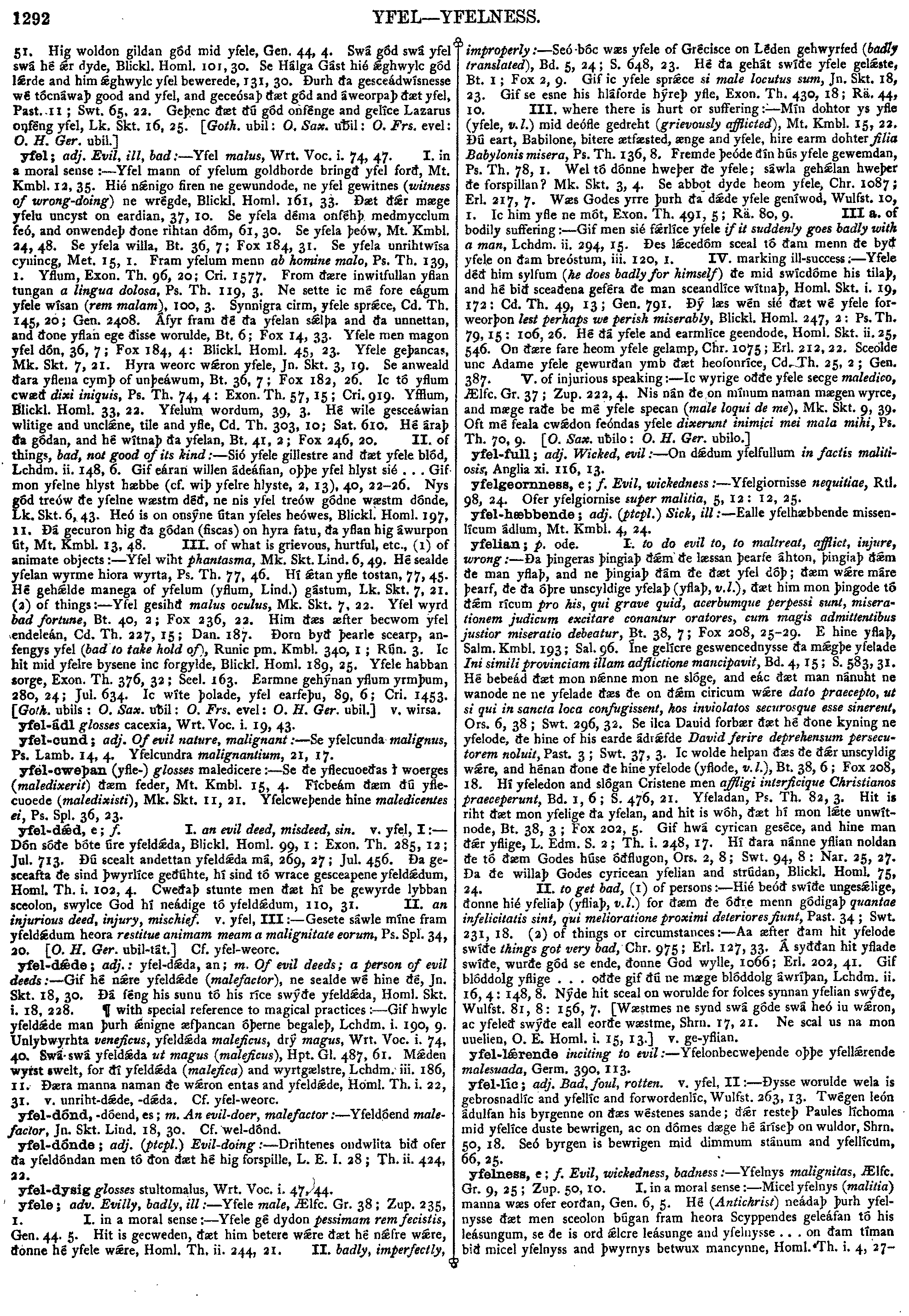
yfelian;
p.
ode.
I.
to
do
evil
to,
to
maltreat,
afflict,
injure,
wrong
:--
Ða
þingeras
þingiaþ
ðm
ðe
læssan
þearfe
áhton,
þingiaþ
ðm
ðe
man
yflaþ,
and
ne
þingiaþ
ðám
ðe
ðæt
yfel
dóþ;
ðæm
wre
máre
þearf,
ðe
ða
óþre
unscyldige
yfelaþ
(yflaþ,
v.
l.),
ðæt
him
mon
þingode
tó
ðm
rícum
pro
his,
qui
grave
quid,
acerbumque
perpessi
sunt,
miserationem
judicum
excitare
conantur
oratores,
cum
magis
admittentibus
justior
miseratio
debeatur,
Bt.
38,
7;
Fox
208,
25-29.
E
hine
yflaþ,
Salm.
Kmbl.
193;
Sal.
96.
Íne
gelícre
geswencednysse
ða
mgþe
yfelade
Ini
simili
provinciam
illam
adflictione
mancipavit,
Bd.
4,
15;
S.
583,
31.
Hé
bebeád
ðæt
mon
nnne
mon
ne
slóge,
and
eác
ðæt
man
nánuht
ne
wanode
ne
ne
yfelade
ðæs
ðe
on
ðm
ciricum
wre
dato
praecepto,
ut
si
qui
in
sancta
loca
confugissent,
hos
inviolatos
securosque
esse
sinerent,
Ors.
6,
38;
Swt.
296,
32.
Se
ilca
Dauid
forbær
ðæt
hé
ðone
kyning
ne
yfelode,
ðe
hine
of
his
earde
ádrfde
David
ferire
deprehensum
persecutorem
noluit,
Past.
3;
Swt.
37,
3.
Ic
wolde
helpan
ðæs
ðe
ðr
unscyldig
wre,
and
hénan
ðone
ðe
hine
yfelode
(yflode,
v.
l.),
Bt.
38,
6;
Fox
208,
18.
Hí
yfeledon
and
slógan
Cristene
men
affligi
interficique
Christianos
praeceperant,
Bd.
1,
6;
S.
476,
21.
Yfeladan,
Ps.
Th.
82,
3.
Hit
is
riht
ðæt
mon
yfelige
ða
yfelan,
and
hit
is
wóh,
ðæt
hí
mon
lte
unwítnode,
Bt.
38,
3;
Fox
202,
5.
Gif
hwá
cyrican
geséce,
and
hine
man
ðr
yflige,
L.
Edm.
S.
2;
Th.
i.
248,
17.
Hí
ðara
nánne
yflian
noldan
ðe
tó
ðæm
Godes
húse
óðflugon,
Ors.
2,
8;
Swt.
94,
8:
Nar.
25,
27.
Ða
ðe
willaþ
Godes
cyricean
yfelian
and
strúdan,
Blickl.
Homl.
75,
24.
II.
to
get
bad,
(1)
of
persons
:--
Hié
beóð
swíðe
ungeslige,
ðonne
hié
yfeliaþ
(yfliaþ,
v.
l.)
for
ðæm
ðe
óðre
menn
gódigaþ
quantae
infelicitatis
sint,
qui
melioratione
proximi
deteriores
fiunt,
Past.
34;
Swt.
231,
18.
(2)
of
things
or
circumstances
:--
Aa
æfter
ðam
hit
yfelode
swíðe
things
got
very
bad,
Chr.
975;
Erl.
127,
33.
Á
syððan
hit
yflade
swíðe,
wurðe
gód
se
ende,
ðonne
God
wylle,
1066;
Erl.
202,
41.
Gif
blóddolg
yflige
.
.
.
oððe
gif
ðú
ne
mæge
blóddolg
áwríþan,
Lchdm.
ii.
16,
4:
148,
8.
Nýde
hit
sceal
on
worulde
for
folces
synnan
yfelian
swýðe,
Wulfst.
81,
8:
156,
7.
[Wæstmes
ne
synd
swá
góde
swá
heó
iu
wron,
ac
yfeleð
swýðe
eall
eorðe
wæstme,
Shrn.
17,
21.
Ne
scal
us
na
mon
uuelien,
O.
E.
Homl.
i.
15,
13.]
v.
ge-yflian.
|
Source: Bosworth/Toller, page b1293, entry 11 View original page image as: [TIFF] [PNG] [View previous entry] [View next entry] |
[Comment on this entry] [View comments] |
The following entry has been hand-corrected once. |
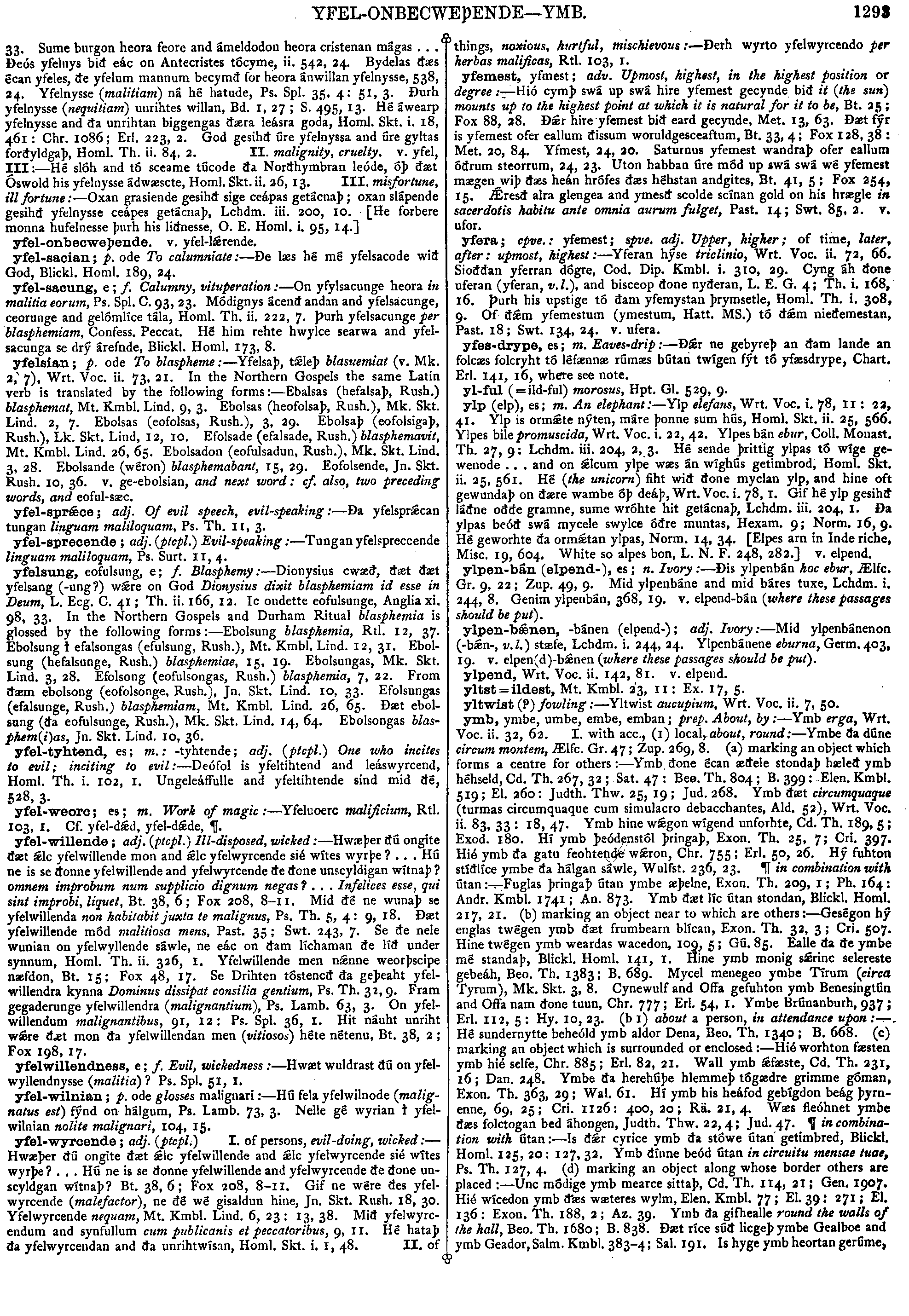
yfel-willende;
adj.
(ptcpl.)
Ill-disposed,
wicked
:--
Hwæþer
ðú
ongite
ðæt
lc
yfelwillende
mon
and
lc
yfelwyrcende
sié
wítes
wyrþe?
.
.
.
Hú
ne
is
se
ðonne
yfelwillende
and
yfelwyrcende
ðe
ðone
unscyldigan
wítnaþ?
omnem
improbum
num
supplicio
dignum
negas?
.
.
.
Infelices
esse,
qui
sint
improbi,
liquet,
Bt.
38,
6;
Fox
208,
8-11.
Mid
ðé
ne
wunaþ
se
yfelwillenda
non
habitabit
juxta
te
malignus,
Ps.
Th.
5,
4:
9,
18.
Ðæt
yfelwillende
mód
malitiosa
mens,
Past.
35;
Swt.
243,
7.
Se
ðe
nele
wunian
on
yfelwyllende
sáwle,
ne
eác
on
ðam
líchaman
ðe
líð
under
synnum,
Homl.
Th.
ii.
326,
1.
Yfelwillende
men
nnne
weorþscipe
næfdon,
Bt.
15;
Fox
48,
17.
Se
Drihten
tóstencð
ða
geþeaht
yfelwillendra
kynna
Dominus
dissipat
consilia
gentium,
Ps.
Th.
32,
9.
Fram
gegaderunge
yfelwillendra
(malignantium),
Ps.
Lamb.
63,
3.
On
yfelwillendum
malignantibus,
91,
12:
Ps.
Spl.
36,
1.
Hit
náuht
unriht
wre
ðæt
mon
ða
yfelwillendan
men
(vitiosos)
héte
nétenu,
Bt.
38,
2;
Fox
198,
17.
|
Source: Bosworth/Toller, page b1296, entry 4 View original page image as: [TIFF] [PNG] [View previous entry] [View next entry] |
[Comment on this entry] [View comments] |
The following entry has been hand-corrected once. |
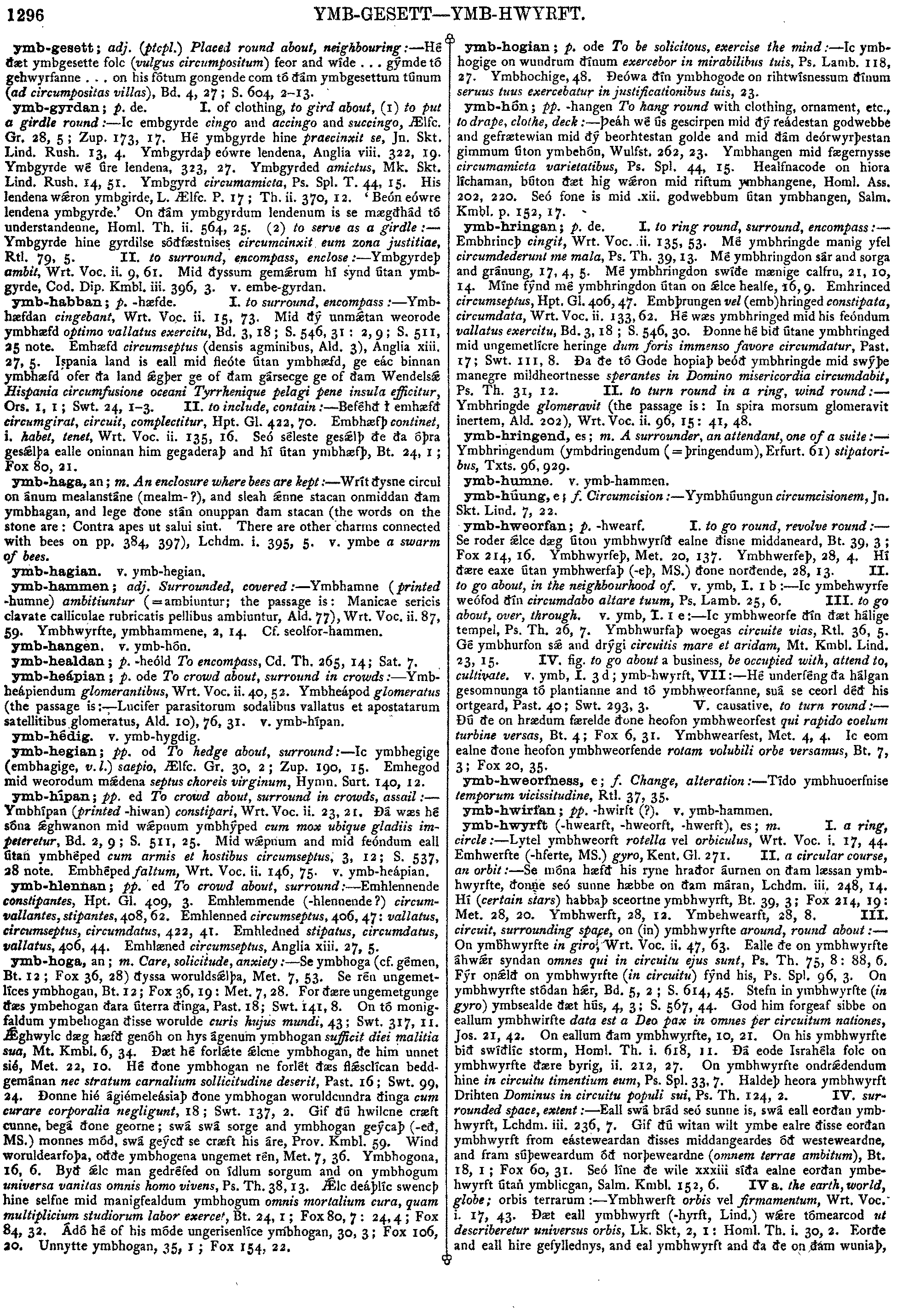
ymb-haga,
an;
m.
An
enclosure
where
bees
are
kept
:--Wrít
ðysne
circul
on
ánum
mealanstáne
(mealm-
?),
and
sleah
nne
stacan
onmiddan
dam
ymbhagan,
and
lege
ðone
stán
onuppan
ðám
stacan
(the
words
on
the
stone
are
:
Contra
apes
ut
salui
sint.
There
are
other
charms
connected
with
bees
on
pp.
384,
397),
Lchdm.
i.
395,
5.
v.
ymbe
a
swarm
of
bees.
|
Source: Bosworth/Toller, page b1298, entry 8 View original page image as: [TIFF] [PNG] [View previous entry] [View next entry] |
[Comment on this entry] [View comments] |
The following entry has been hand-corrected once. |
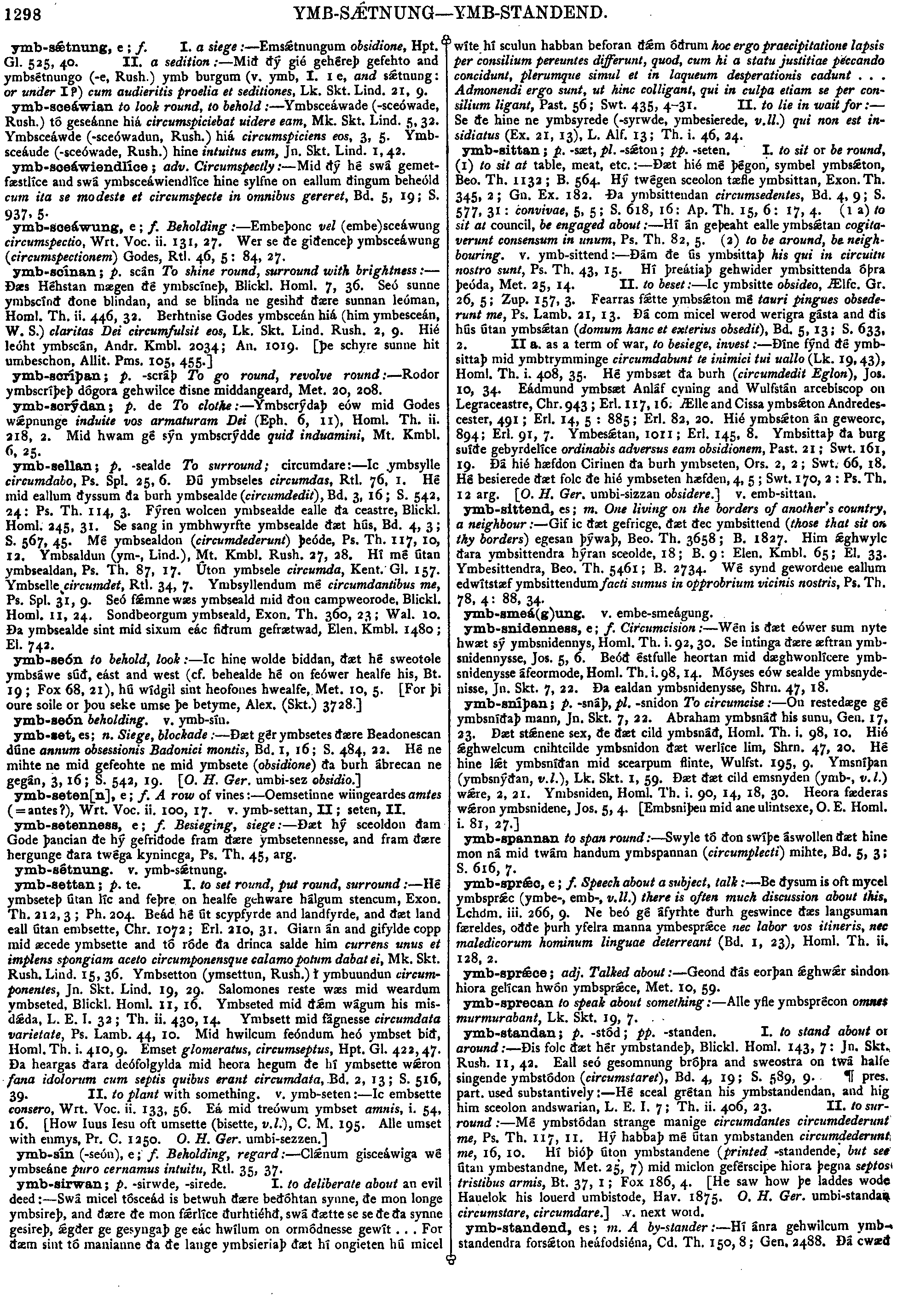
ymb-sellan;
p.
-sealde
To
surround;
circumdare
:--
Ic
ymbsylle
circumdabo,
Ps.
Spl.
25,
6.
Ðú
ymbseles
circumdas,
Rtl.
76,
1.
Hé
mid
eallum
ðyssum
ða
burh
ymbsealde
(circumdedit),
Bd.
3,
16;
S.
542,
24:
Ps.
Th.
114,
3.
Fýren
wolcen
ymbsealde
ealle
ða
ceastre,
Blickl.
Homl.
245,
31.
Se
sang
in
ymbhwyrfte
ymbsealde
ðæt
hús,
Bd.
4,
3;
S.
567,
45.
Mé
ymbsealdon
(circumdederunt)
þeóde,
Ps.
Th.
117,
10,
12.
Ymbsaldun
(ym-,
Lind.),
Mt.
Kmbl.
Rush.
27,
28.
Hí
mé
útan
ymbsealdan,
Ps.
Th.
87,
17.
Úton
ymbsele
circumda,
Kent.
Gl.
157.
Ymbselle
circumdet,
Rtl.
34,
7.
Ymbsyllendum
mé
circumdantibus
me,
Ps.
Spl.
31,
9.
Seó
fmne
wæs
ymbseald
mid
ðon
campweorode,
Blickl.
Homl.
11,
24.
Sondbeorgum
ymbseald,
Exon.
Th.
360,
23;
Wal.
10.
Ða
ymbsealde
sint
mid
sixum
eác
fiðrum
gefrætwad,
Elen.
Kmbl.
1480;
El.
742.
|
Source: Bosworth/Toller, page b1298, entry 9 View original page image as: [TIFF] [PNG] [View previous entry] [View next entry] |
[Comment on this entry] [View comments] |
The following entry has been hand-corrected once. |
ymb-seón to behold, look :-- Ic hine wolde biddan, ðæt hé sweotole ymbsáwe súð, eást and west (cf. behealde hé on feówer healfe his, Bt. 19 ; Fox 68, 21), hú wídgil sint heofones hwealfe, Met. 10, 5. [For þi oure soile or þou seke umse þe betyme, Alex. (Skt.) 3728.]
| Result Page: |  |
Previous | 15 16 17 18 19 20 21 22 23 24 25 26 27 28 29 30 31 32 33 | Next |  |
Germanic Lexicon Project (main page)
This search system was written by
Sean Crist
Please consider
volunteering
to correct the data in these online dictionaries.
No rights reserved. Feel free to use these data in any way you please.