|
|

Tip: In the search results, you can click on any word or abbreviation for more information.
|
Source: Cleasby/Vigfusson, page b0694, entry 11 View original page image as: [TIFF] [PNG] [View previous entry] [View next entry] |
[Comment on this entry] [View comments] |
The following entry has been hand-corrected once. |
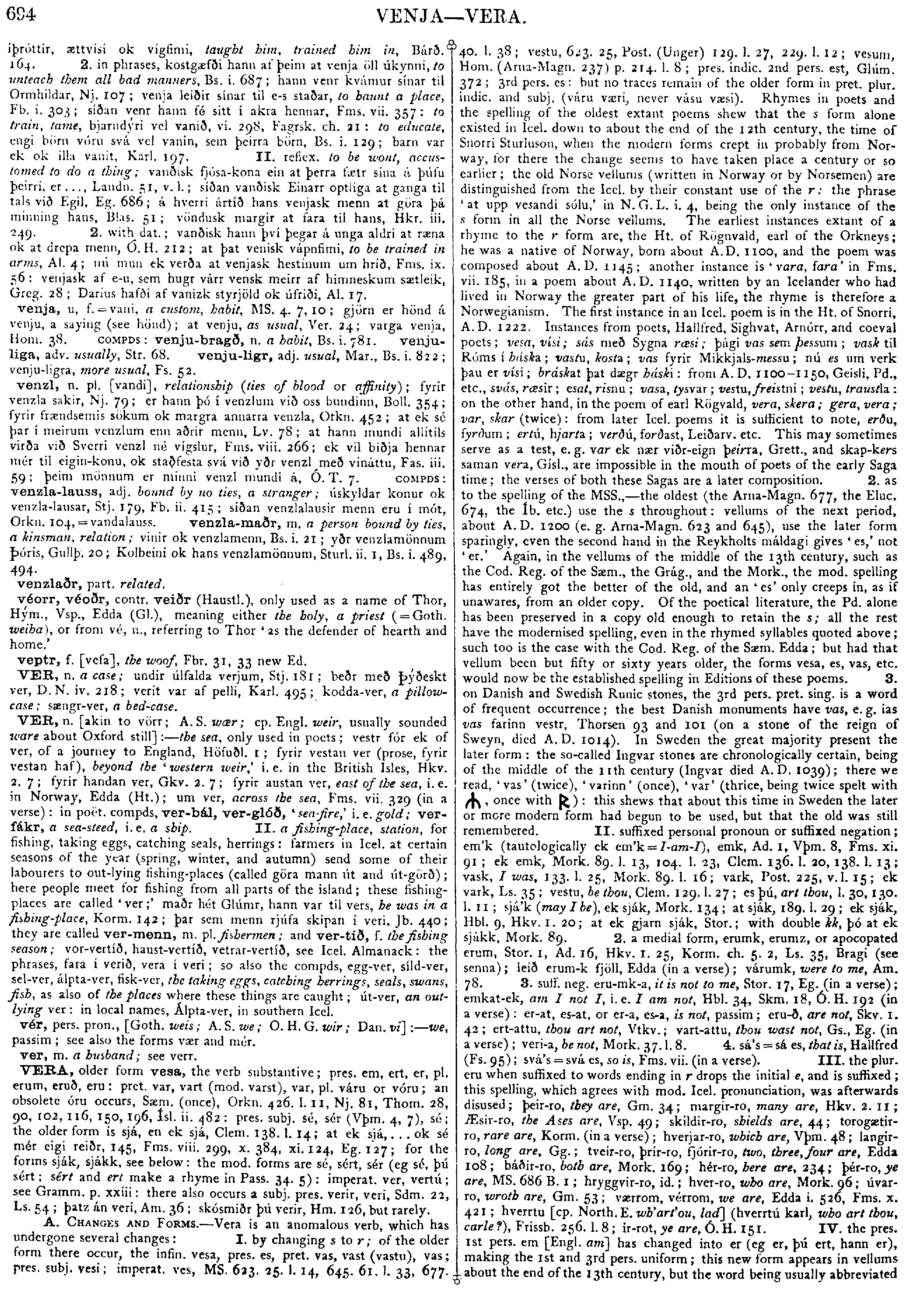
VERA, older form vesa, the verb substantive; pres. em, ert, er, pl. erum, eruð, eru: pret. var, vart (mod. varst), var, pl. váru or vóru; a obsolete óru occurs, Sæm. (once), Orkn. 426. l. 11, Nj. 81, Thom. 28, 90, 102, 116, 150, 196, Ísl. ii. 482: pres. subj. sé, sér (Vþm. 4, 7), sé; the older form is sjá, en ek sjá, Clem. 138. l. 14; at ek sjá, ... ok sé mér eigi reiðr, 145, Fms. viii. 299, x. 384, xi. 124, Eg. 127; for the forms sják, sjákk, see below: the mod. forms are sé, sért, sér (eg sé, þú sért; sert and ert make a rhyme in Pass. 34. 5): imperat. ver, vertú; see Gramm. p. xxiii: there also occurs a subj. pres. verir, veri, Sdm. 22, Ls. 54; þatz án veri, Am. 36; skósmiðr þú verir, Hm. 126, but rarely. A. CHANGES AND FORMS. -- Vera is an anomalous verb, which has undergone several changes: I. by changing s to r; of the older form there occur, the infin. vesa, pres. es, pret. vas, vast (vastu), vas; pres. subj. vesi; imperat. ves, MS. 623. 25. l. 14, 645. 6l. l. 33, 677. 40. l. 38; vestu, 623. 25, Post. (Unger) 129. l. 27, 229. l. 12; vesum, Hom. (Arna-Magn. 237) p. 214. l. 8; pres. indic. 2nd pers. est, Glúm. 372; 3rd pers. es: but no traces remain of the older form in pret. plur. indic. and subj. (váru væri, never vásu væsi). Rhymes in poets and the spelling of the oldest extant poems shew that the s form alone existed in Icel. down to about the end of the 12th century, the time of Snorri Sturluson, when the modern forms crept in probably from Norway, for there the change seems to have taken place a century or so earlier; the old Norse vellums (written in Norway or by Norsemen) are distinguished from the Icel. by their constant use of the r: the phrase 'at upp vesandi sólu', in N.G.L. i. 4, being the only instance of the s form in all the Norse vellums. The earliest instances extant of a rhyme to the r form are, the Ht. of Rögnvald, earl of the Orkneys; he was a native of Norway, born about A.D. 1100, and the poem was composed about A.D. 1145; another instance is 'vara, fara' in Fms. vii. 185, in a poem about A.D. 1140, written by an Icelander who had lived in Norway the greater part of his life, the rhyme is therefore a Norwegianism. The first instance in an Icel. poem is in the Ht. of Snorri, A.D. 1222. Instances from poets, Hallfred, Sighvat, Arnórr, and coeval poets; vesa, vísi; sás með Sygna ræsi; þági vas sem þessum; vask til Róms í háska; vastu, kosta; vas fyrir Mikkjals-messu; nú es um verk þau er vísi; bráskat þat dægr háski: from A.D. 1100-1150, Geisli, Pd., etc., svás, ræsir; esat, risnu; vasa, tysvar; vestu. freistni; vestu, traustla: on the other hand, in the poem of earl Rögvald, vera, skera; gera, vera; var, skar (twice): from later Icel. poems it is sufficient to note, erðu, fyrðum; ertú, hjarta; verðú, forðast, Leiðarv. etc. This may sometimes serve as a test, e.g. var ek nær viðr-eign þeirra, Grett., and skap-kers saman vera, Gísl., are impossible in the mouth of poets of the early Saga time; the verses of both these Sagas are a later composition. 2. as to the spelling of the MSS., -- the oldest (the Arna-Magn. 677, the Eluc. 674, the Íb. etc.) use the s throughout: vellums of the next period, about A.D. 1200 (e.g. Arna-Magn. 623 and 645), use the later form sparingly, even the second hand in the Reykholts máldagi gives 'es,' not 'er.' Again, in the vellums of the middle of the 13th century, such as the Cod. Reg. of the Sæm., the Grág., and the Mork., the mod. spelling has entirely got the better of the old, and an 'es' only creeps in, as if unawares, from an older copy. Of the poetical literature, the Pd. alone has been preserved in a copy old enough to retain the s; all the rest have the modernised spelling, even in the rhymed syllables quoted above; such too is the case with the Cod. Reg. of the Sæm. Edda; but had that vellum been but fifty or sixty years older, the forms vesa, es, vas, etc. would now be the established spelling in Editions of these poems. 3. on Danish and Swedish Runic stones, the 3rd pers. pret. sing. is a word of frequent occurrence; the best Danish monuments have vas, e.g. ias vas farinn vestr, Thorsen 93 and 101 (on a stone of the reign of Sweyn, died A.D. 1014). In Sweden the great majority present the later form: the so-called Ingvar stones are chronologically certain, being of the middle of the 11th century (Ingvar died A.D. 1039); there we read, 'vas' (twice), 'varinn' (once), 'var' (thrice, being twice spelt with RUNE, once with RUNE): this shews that about this time in Sweden the later or more modern form had begun to be used, but that the old was still remembered. II. suffixed personal pronoun or suffixed negation; em'k (tautologically ek em'k = I-am-I), emk, Ad. 1, Vþm. 8, Fms. xi. 91; ek emk, Mork. 89. l. 13, 104. l. 23, Clem. 136. l. 20, 138. l. 13; vask, I was, 133. l. 25, Mork. 89. l. 16; vark, Post. 225, v.l. 15; ek vark, Ls. 35; vestu, be thou, Clem. 129. l. 27; es þú, art thou, l. 30, 130. l. 11; sjá'k (may I be), ek sják, Mork. 134; at sják, 189. l. 29; ek sják, Hbl. 9, Hkv. 1. 20; at ek gjarn sják, Stor.; with double kk, þó at ek sjákk, Mork. 89. 2. a medial form, erumk, erumz, or apocopated erum, Stor. 1, Ad. 16, Hkv. 1. 25, Korm. ch. 5. 2, Ls. 35, Bragi (see senna); leið erum-k fjöll, Edda (in a verse); várumk, were to me, Am. 78. 3. suff. neg. eru-mk-a, it is not to me, Stor. 17, Eg. (in a verse); emkat-ek, am I not I, i.e. I am not, Hbl. 34, Skm. 18, Ó.H. 192 (in a verse): er-at, es-at, or er-a, es-a, is not, passim; eru-ð, are not, Skv. 1. 42; ert-attu, thou art not, Vtkv.; vart-attu, thou wast not, Gs., Eg. (in a verse); veri-a, be not, Mork. 37. l. 8. 4. sá's = sá es, that is, Hallfred (Fs. 95); svá's = svá es, so is, Fms. vii. (in a verse). III. the plur. eru when suffixed to words ending in r drops the initial e, and is suffixed; this spelling, which agrees with mod. Icel. pronunciation, was afterwards disused; þeir-ro, they are, Gm. 34; margir-ro, many are, Hkv. 2. 11; Æsir-ro, the Ases are, Vsp. 49; skildir-ro, shields are, 44; torogætir-ro, rare are, Korm. (in a verse); hverjar-ro, which are, Vþm. 48; langir-ro, long are, Gg.; tveir-ro, þrír-ro, fjórir-ro, two, three, four are, Edda 108; báðir-ro, both are, Mork. 169; hér-ro, here are, 234; þér-ro, ye are, MS. 686 B. 1; hryggvir-ro, id.; hver-ro, who are, Mork. 96; úvar-ro, wroth are, Gm. 53; værrom, vérrom, we are, Edda i. 526, Fms. x. 421; hverrtu [cp. North. E. wh'art'ou, lad] (hverrtú karl, who art thou, carle?), Frissb. 256. l. 8; ir-rot, ye are, Ó.H. 151. IV. the pres. 1st pers. em [Engl. am] has changed into er (eg er, þú ert, hann er), making the 1st and 3rd pers. uniform; this new form appears in vellums about the end of the 13th century, but the word being usually abbreviated
|
Source: Cleasby/Vigfusson, page b0695, entry 1 View original page image as: [TIFF] [PNG] [View previous entry] [View next entry] |
[Comment on this entry] [View comments] |
The following entry has been hand-corrected once. |
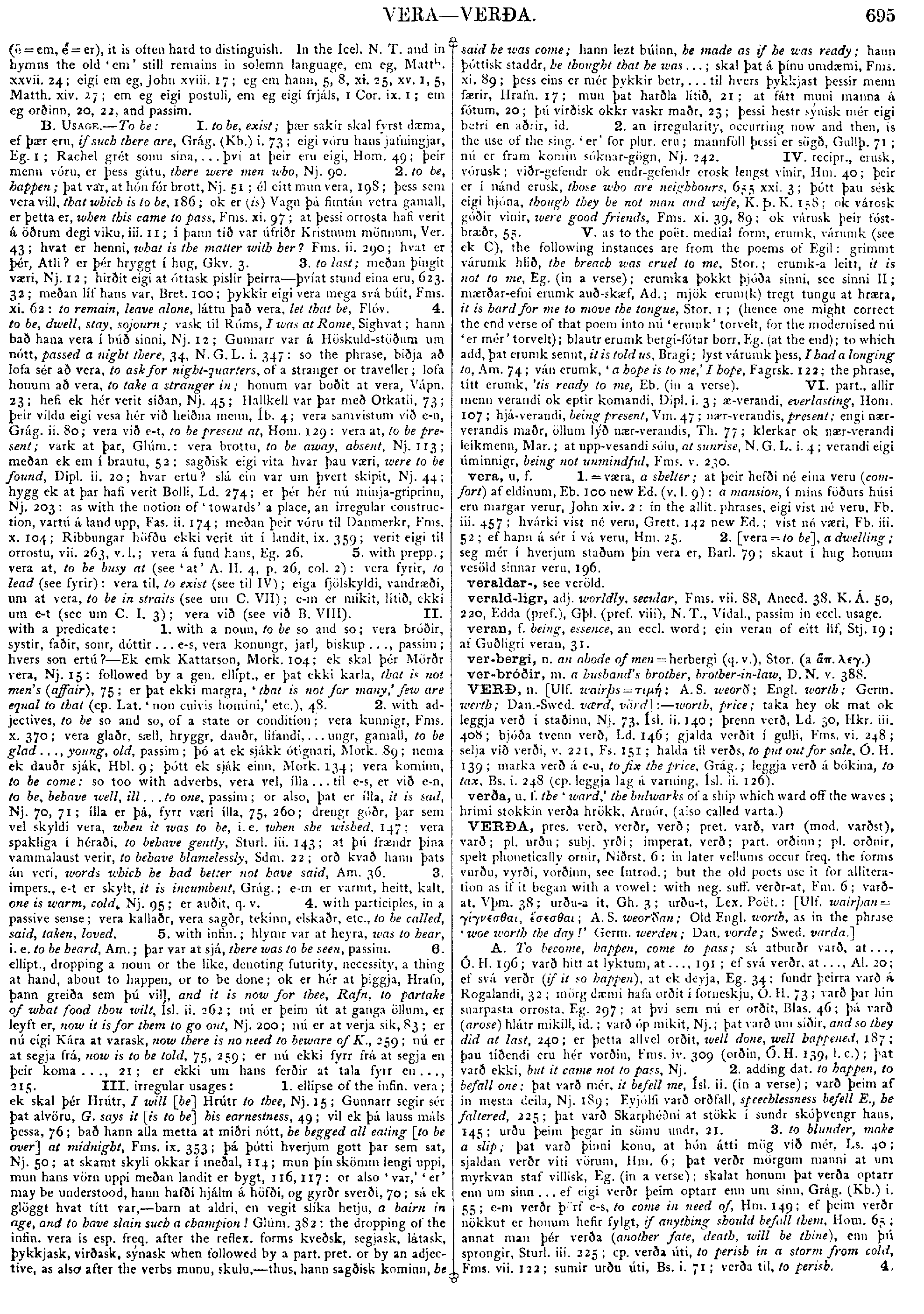
(e UNCERTAIN = em, e UNCERTAIN = er), it is often hard to distinguish. In the Icel. N.T. and in hymns the old 'em' still remains in solemn language, em eg, Matth. xxvii. 24; eigi em eg, John xviii. 17; eg em hann, 5, 8, xi. 25, xv. 1, 5, Matth. xiv. 27; em eg eigi postuli, em eg eigi frjáls, 1 Cor. ix. 1; em eg orðinn, 20, 22, and passim. B. USAGE. -- To be: I. to be, exist; þær sakir skal fyrst dæma, ef þær eru, if such there are, Grág. (Kb.) i. 73; eigi vóru hans jafningjar, Eg. 1; Rachel grét sonu sína, ... þvi at þeir eru eigi, Hom. 49; þeir menn vóru, er þess gátu, there were men who, Nj. 90. 2. to be, happen; þat var, at hón for brott, Nj. 51; él eitt mun vera, 198; þess sem vera vill, that which is to be, 186; ok er (is) Vagn þá fimtán vetra gamall, er þetta er, when this came to pass, Fms. xi. 97; at þessi orrosta hafi verit á öðrum degi viku, iii. 11; í þann tið var úfriðr Kristnum mönnum, Ver. 43; hvat er henni, what is the matter with her? Fms. ii. 290; hvat er þér, Atli? er þér hryggt í hug, Gkv. 3. 3. to last; meðan þingit væri, Nj. 12; hirðit eigi at óttask píslir þeirra -- þvíat stund eina eru, 623. 32; meðan líf hans var, Bret. 100; þykkir eigi vera mega svá búit, Fms. xi. 62: to remain, leave alone, láttu það vera, let that be, Flóv. 4. to be, dwell, stay, sojourn; vask til Róms, I was at Rome, Sighvat; hann bað hana vera í búð sinni, Nj. 12; Gunnarr var á Höskuld-stöðum um nótt, passed a night there, 34, N.G.L. i. 347: so the phrase, biðja að lofa sér að vera, to ask for night-quarters, of a stranger or traveller; lofa honum að vera, to take a stranger in; honum var boðit at vera, Vápn. 23; hefi ek hér verit síðan, Nj. 45; Hallkell var þar með Otkatli, 73; þeir vildu eigi vesa hér við heiðna menn, Íb. 4; vera samvistum við e-n, Grág. ii. 80; vera við e-t, to be present at, Hom. 129: vera at, to be present; vark at þar, Glúm.: vera brottu, to be away, absent, Nj. 113; meðan ek em í brautu, 52: sagðisk eigi vita hvar þau væri, were to be found, Dipl. ii. 20; hvar ertu? slá ein var um þvert skipit, Nj. 44; hygg ek at þar hafi verit Bolli, Ld. 274; er þér hér nú minja-griprinn, Nj. 203: as with the notion of 'towards' a place, an irregular construction, vartú á land upp, Fas. ii. 174; meðan þeir vóru til Danmerkr, Fms. x. 104; Ribbungar höfðu ekki verit út í landit, ix. 359; verit eigi til orrostu, vii. 263, v.l.; vera á fund hans, Eg. 26. 5. with prepp.; vera at, to be busy at (see 'at' A. II, p. 26, col. 2): vera fyrir, to lead (see fyrir): vera til, to exist (see til IV); eiga fjölskyldi, vandræði, um at vera, to be in straits (see um C. VII); e-m er mikit, lítið, ekki um e-t (see um C. I. 3); vera við (see við B. VIII). II. with a predicate: 1. with a noun, to be so and so; vera bróðir, systir, faðir, sonr, dóttir ... e-s, vera konungr, jarl, biskup ..., passim; hvers son ertú? -- Ek emk Kattarson, Mork. 104; ek skal þer Mörðr vera, Nj. 15: followed by a gen. ellípt., er þat ekki karla, that is not men's (affair), 75; er þat ekki margra, 'that is not for many,' few are equal to that (cp. Lat. 'non cuivis homini,' etc.), 48. 2. with adjectives, to be so and so, of a state or condition; vera kunnigr, Fms. x. 370; vera glaðr, sæll, hryggr, dauðr, lifandi, ... ungr, gamall, to be glad ..., young, old, passim; þó at ek sjákk ótignari, Mork. 89; nema ek dauðr sják, Hbl. 9; þótt ek sják einn, Mork. 134; vera kominn, to be come: so too with adverbs, vera vel, ílla ... til e-s, er við e-n, to be, behave well, ill ... to one, passim; or also, þat er ílla, it is sad, Nj. 70, 71; ílla er þá, fyrr væri ílla, 75, 260; drengr góðr, þar sem vel skyldi vera, when it was to be, i.e. when she wished, 147; vera spakliga í heraði, to behave gently, Sturl. iii. 143; at þú frændr þína vammalaust verir, to behave blamelessly, Sdm. 22; orð kvað hann þats án veri, words which he had better not have said, Am. 36. 3. impers., e-t er skylt, it is incumbent, Grág.; e-m er varmt, heitt, kalt, one is warm, cold, Nj. 95; er auðit, q.v. 4. with participles, in a passive sense; vera kallaðr, vera sagðr, tekinn, elskaðr, etc., to be called, said, taken, loved. 5. with infin.; hlymr var at heyra, was to hear, i.e. to be heard, Am.; þar var at sjá, there was to be seen, passim. 6. ellipt., dropping a noun or the like, denoting futurity, necessity, a thing at hand, about to happen, or to be done; ok er hér at þiggja, Hrafn, þann greiða sem þú vill, and it is now for thee, Rafn, to partake of what food thou wilt, Ísl. ii. 262; nú er þeim út at ganga öllum, er leyft er, now it is for them to go out, Nj. 200; nú er at verja sik, 83; er nú eigi Kára at varask, now there is no need to beware of K., 259; nú er at segja frá, now is to be told, 75, 259; er nú ekki fyrr frá at segja en þeir koma ..., 21; er ekki um hans ferðir at tala fyrr en ..., 215. III. irregular usages: 1. ellipse of the infin. vera; ek skal þér Hrútr, I will [be] Hrútr to thee, Nj. 15; Gunnarr segir sér þat alvöru, G. says it [is to be] his earnestness, 49; vil ek þá lauss máls þessa, 76; bað hann alla metta at miðri nótt, he begged all eating [to be over] at midnight, Fms. ix. 353; þá þótti hverjum gott þar sem sat, Nj. 50; at skamt skyli okkar í meðal, 114; mun þín skömm lengi uppi, mun hans vörn uppi meðan landit er bygt, 116, 117: or also 'var,' 'er' may be understood, hann hafði hjálm á höfði, og gyrðr sverði, 70; sá ek glöggt hvat títt var, -- barn at aldri, en vegit slíka hetju, a bairn in age, and to have slain such a champion! Glúm. 382: the dropping of the infin. vera is esp. freq. after the reflex. forms kveðsk, segjask, látask, þykkjask, virðask, sýnask when followed by a part. pret. or by an adjective, as also after the verbs munu, skulu, -- thus, hann sagðisk kominn, he said he was come; hann lezt búinn, he made as if he was ready; hann þóttisk staddr, he thought that he was ...; skal þat á þínu umdæmi, Fms. xi. 89; þess eins er mér þykkir betr, ... til hvers þykkjast þessir menn færir, Hrafn. 17; mun þat harðla lítið, 21; at fátt muni manna á fótum, 20; þú virðisk okkr vaskr maðr, 23; þessi hestr sýnisk mér eigi betri en aðrir, id. 2. an irregularity, occurring now and then, is the use of the sing. 'er' for plur. eru; mannföll þessi er sögð, Gullþ. 71; nú er fram komin sóknar-gögn, Nj. 242. IV. recipr., erusk, vórusk; viðr-gefendr ok endr-gefendr erosk lengst vinir, Hm. 40; þeir er í nánd erusk, those who are neighbours, 655 xxi. 3; þótt þau sésk eigi hjóna, though they be not man and wife, K.Þ.K. 158; ok városk góðir vinir, were good friends, Fms. xi. 39, 89; ok várusk þeir fóstbræðr, 55. V. as to the poët, medial form, erumk, várumk (see ek C), the following instances are from the poems of Egil: grimmt várumk hlið, the breach was cruel to me, Stor.; erumk-a leitt, it is not to me, Eg. (in a verse); erumka þokkt þjóða sinni, see sinni II; mærðar-efni erumk auð-skæf, Ad.; mjök erum(k) tregt tungu at hræra, it is hard for me to move the tongue, Stor. 1; (hence one might correct the end verse of that poem into nú 'erumk' torvelt, for the modernised nú 'er mér' torvelt); blautr erumk bergi-fótar borr, Eg. (at the end); to which add, þat erumk sennt, it is told us, Bragi; lyst várumk þess, I had a longing to, Am. 74; ván erumk, 'a hope is to me,' I hope, Fagrsk. 122; the phrase, títt erumk, 'tis ready to me, Eb. (in a verse). VI. part., allir menn verandi ok eptir komandi, Dipl. i. 3; æ-verandi, everlasting, Hom. 107; hjá-verandi, being present, Vm. 47; nær-verandis, present; engi nær-verandis maðr, öllum lýð nær-verandis, Th. 77; klerkar ok nær-verandi leikmenn, Mar.; at upp-vesandi sólu, at sunrise, N.G.L. i. 4; verandi eigi úminnigr, being not unmindful, Fms. v. 230.
|
Source: Cleasby/Vigfusson, page b0697, entry 24 View original page image as: [TIFF] [PNG] [View previous entry] [View next entry] |
[Comment on this entry] [View comments] |
The following entry has been hand-corrected once. |
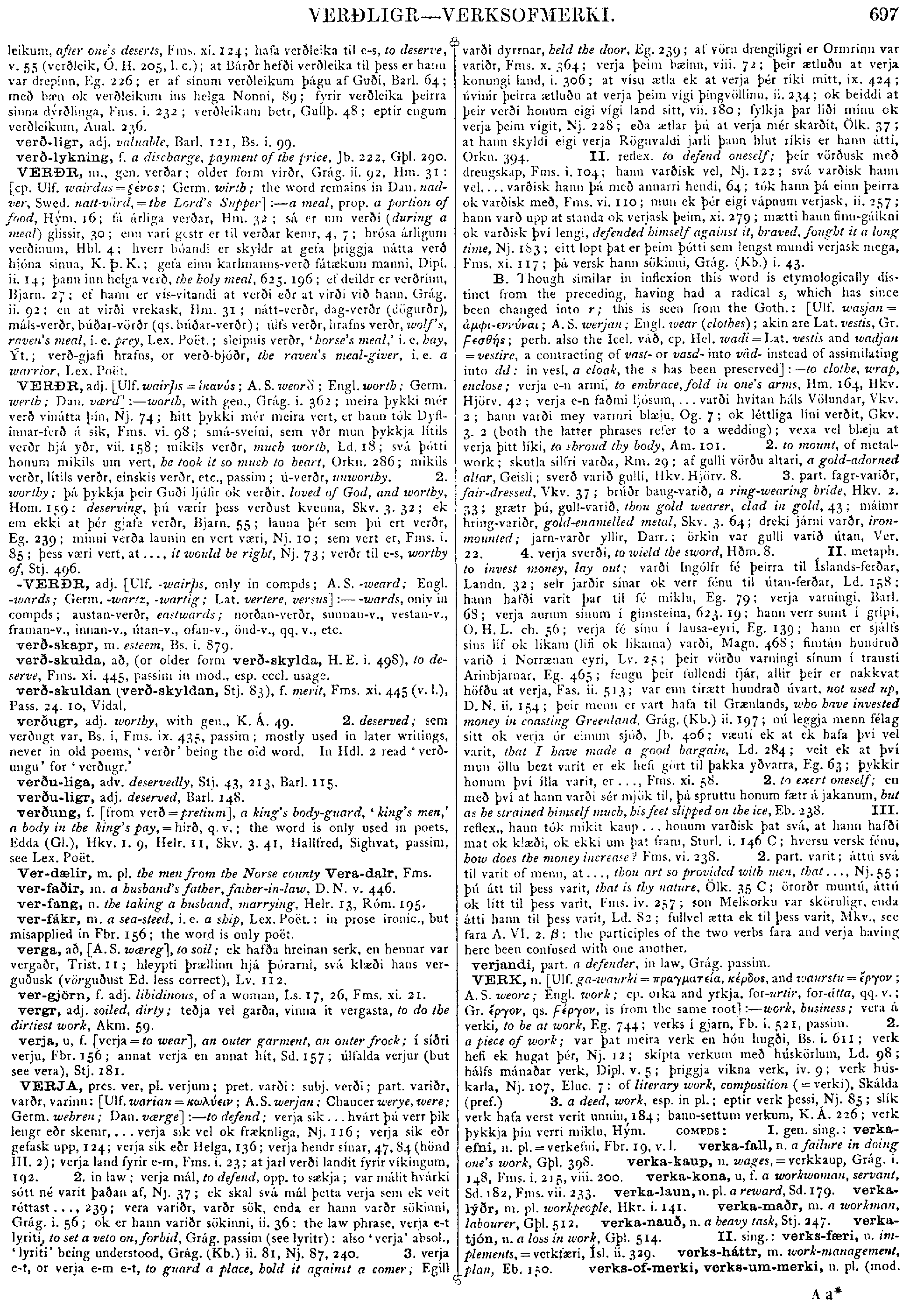
VERK, n. [Ulf. ga-waurki = GREEK, and waurstu = GREEK; A.S. weorc; Engl. work; cp. orka and yrkja, for-urtir, for-átta, qq.v.; Gr. GREEK, qs. GREEK is from the same root] :-- work, business; vera á verki, to be at work, Eg. 744; verks í gjarn, Fb. i. 521, passim. 2. a piece of work; var þat meira verk en hón hugði, Bs. i. 611; verk hefi ek hugat þér, Nj. 12; skipta verkum með húskörlum, Ld. 98; hálfs mánaðar verk, Dipl. v. 5; þriggja vikna verk, iv. 9; verk húskarla, Nj. 107, Eluc. 7: of literary work, composition (= verki), Skálda (pref.) 3. a deed, work, esp. in pl.; eptir verk þessi, Nj. 85; slík verk hafa verst verit unnin, 184; bann-settum verkum, K.Á. 226; verk þykkja þín verri miklu, Hým. COMPDS: I. gen. sing.: verka-efni, n. pl. = verkefni, Fbr. 19, v.l. verka-fall, n. a failure in doing one's work, Gþl. 398. verka-kaup, n. wages, = verkkaup, Grág. i. 148, Fms. i. 215, viii. 200. verka-kona, u, f. a workwoman, servant, Sd. 182, Fms. vii. 233. verka-laun, n. pl. a reward, Sd. 179. verka-lýðr, m. pl. workpeople, Hkr. i. 141. verka-maðr, m. a workman, labourer, Gþl. 512. verka-nauð, n. a heavy task, Stj. 247. verka-tjón, n. a loss in work, Gþl. 514. II. sing.: verks-færi, n. implements, = verkfæri, Ísl. ii. 329. verks-háttr, m. work-management, plan, Eb. 150. verks-of-merki, verks-um-merki, n. pl. (mod.
|
Source: Cleasby/Vigfusson, page b0698, entry 27 View original page image as: [TIFF] [PNG] [View previous entry] [View next entry] |
[Comment on this entry] [View comments] |
The following entry has been hand-corrected once. |
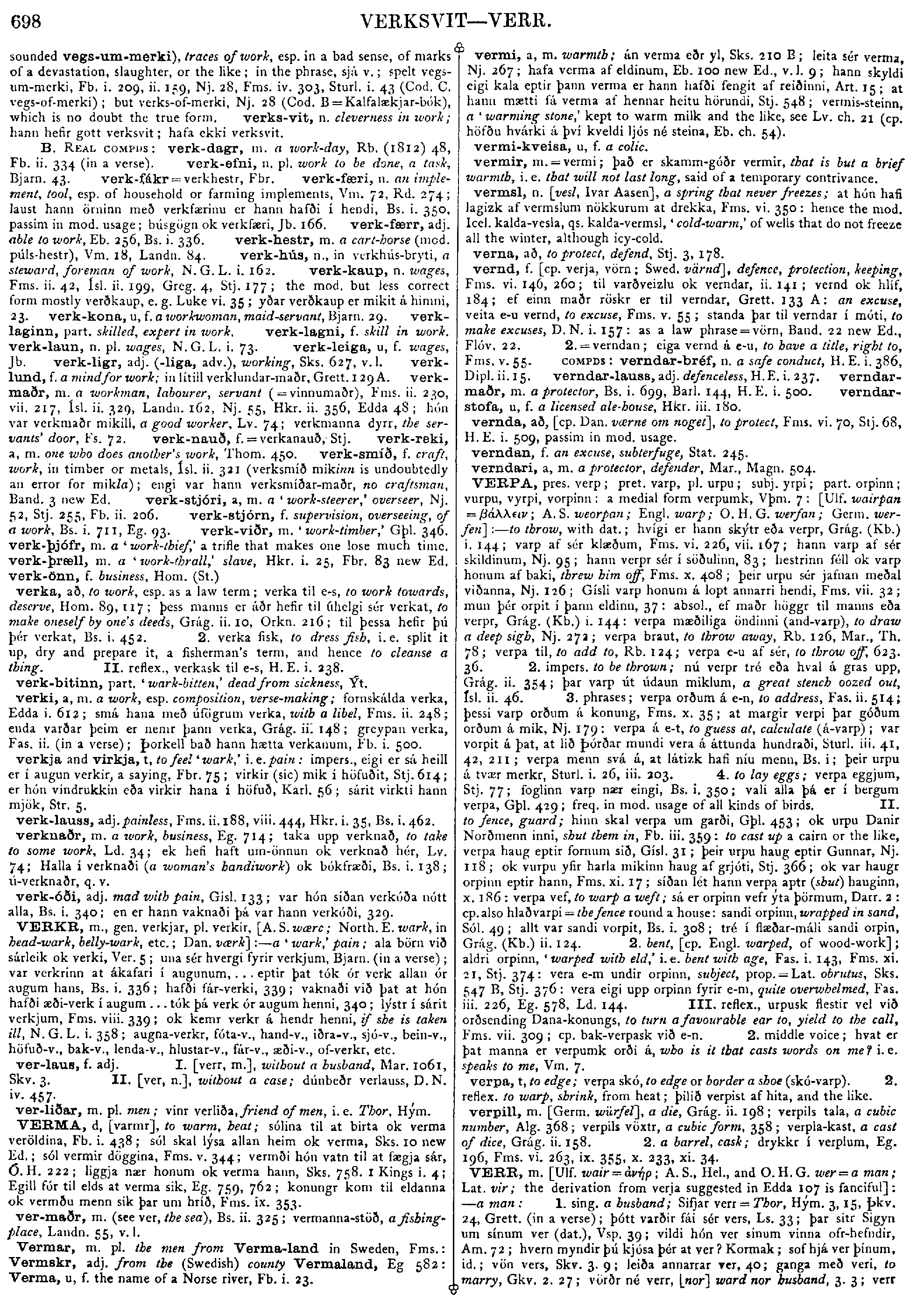
VERR, m. [Ulf. wair = GREEK; A.S., Hel., and O.H.G. wer = a man; Lat. vir; the derivation from verja suggested in Edda 107 is fanciful]:-- a man: 1. sing. a husband; Sifjar verr = Thor, Hým. 3, 15, Þkv. 24, Grett. (in a verse); þótt varðir fái sér vers, Ls. 33; þar sitr Sigyn um sínum ver (dat.), Vsp. 39; vildi hón ver sínum vinna ofr-hefndir, Am. 72; hvern myndir þú kjósa þér at ver? Kormak; sof hjá ver þínum, id.; vön vers, Skv. 3. 9; leiða annarrar ver, 40; ganga með veri, to marry, Gkv. 2. 27; vörðr né verr, [nor] ward nor husband, 3. 3; verr
|
Source: Cleasby/Vigfusson, page b0699, entry 1 View original page image as: [TIFF] [PNG] [View previous entry] [View next entry] |
[Comment on this entry] [View comments] |
The following entry has been hand-corrected once. |
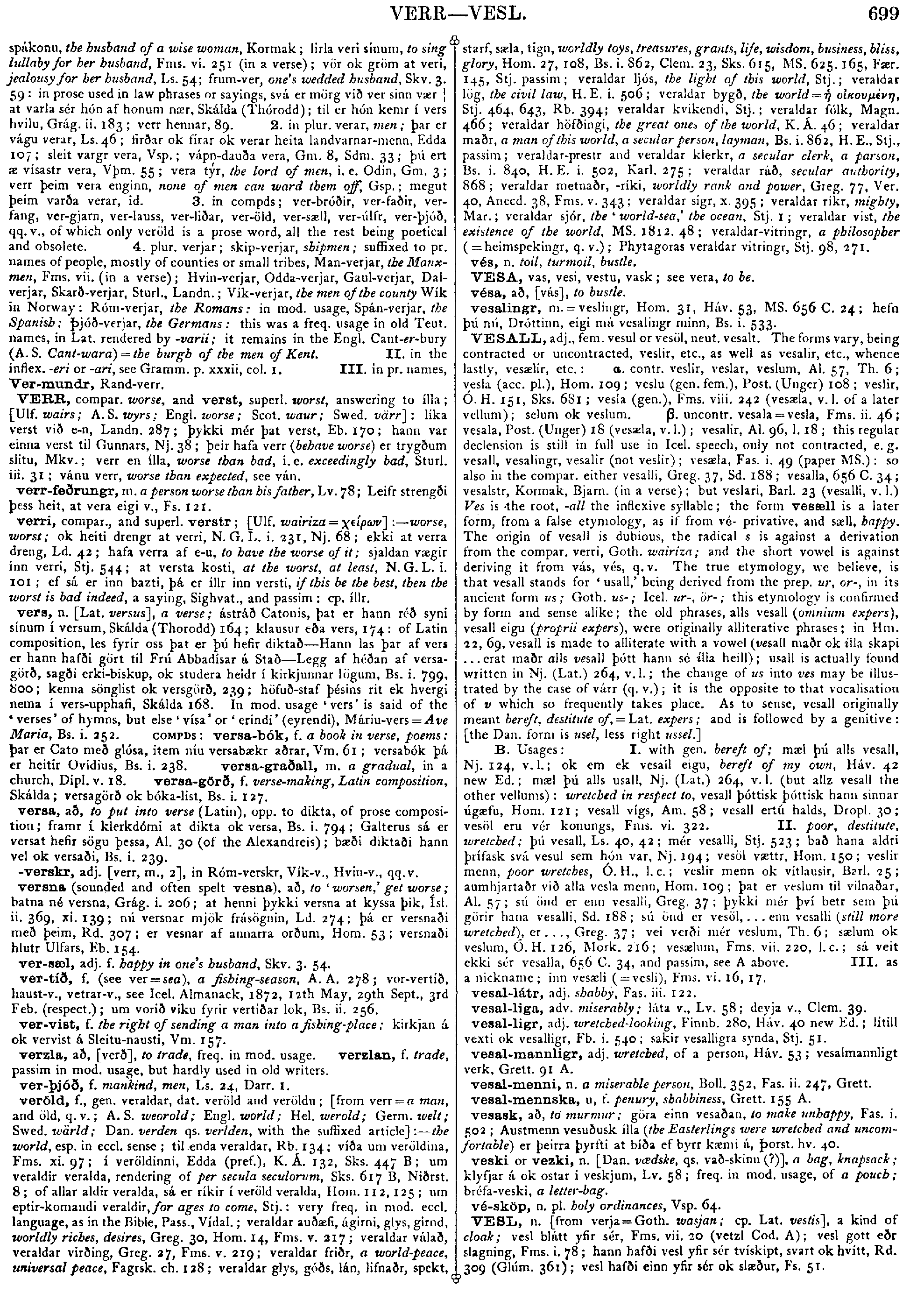
spákonu, the husband of a wise woman, Kormak; lirla veri sínum, to sing lullaby for her husband, Fms. vi. 251 (in a verse); vör ok gröm at veri, jealousy for her husband, Ls. 54; frum-ver, one's wedded husband, Skv. 3. 59: in prose used in law phrases or sayings, svá er mörg við ver sinn vær at varla sér hón af honum nær, Skálda (Thórodd); til er hón kemr í vers hvílu, Grág. ii. 183; verr hennar, 89. 2. in plur. verar, men; þar er vágu verar, Ls. 46; firðar ok fírar ok verar heita landvarnar-menn, Edda 107; sleit vargr vera, Vsp.; vápn-dauða vera, Gm. 8, Sdm. 33; þú ert æ vísastr vera, Vþm. 55; vera týr, the lord of men, i.e. Odin, Gm. 3; verr peim vera enginn, none of men can ward them off, Gsp.; megut þeim varða verar, id. 3. in compds; ver-bróðir, ver-faðir, ver-fang, ver-gjarn, ver-lauss, ver-liðar, ver-öld, ver-sæll, ver-úlfr, ver-þjóð, qq.v., of which only veröld is a prose word, all the rest being poetical and obsolete. 4. plur. verjar; skip-verjar, shipmen; suffixed to pr. names of people, mostly of counties or small tribes, Man-verjar, the Manx-men, Fms. vii. (in a verse); Hvin-verjar, Odda-verjar, Gaul-verjar, Dal-verjar, Skarð-verjar, Sturl., Landn.; Vík-verjar, the men of the county Wík in Norway: Róm-verjar, the Romans: in mod. usage, Spán-verjar, the Spanish; Þjóð-verjar, the Germans: this was a freq. usage in old Teut. names, in Lat. rendered by -varii; it remains in the Engl. Cant-er-bury (A.S. Cant-wara) = the burgh of the men of Kent. II. in the inflex. -eri or -ari, see Gramm. p. xxxii, col. i. III. in pr. names, Ver-mundr, Rand-verr.
|
Source: Cleasby/Vigfusson, page b0700, entry 28 View original page image as: [TIFF] [PNG] [View previous entry] [View next entry] |
[Comment on this entry] [View comments] |
The following entry has been hand-corrected once. |
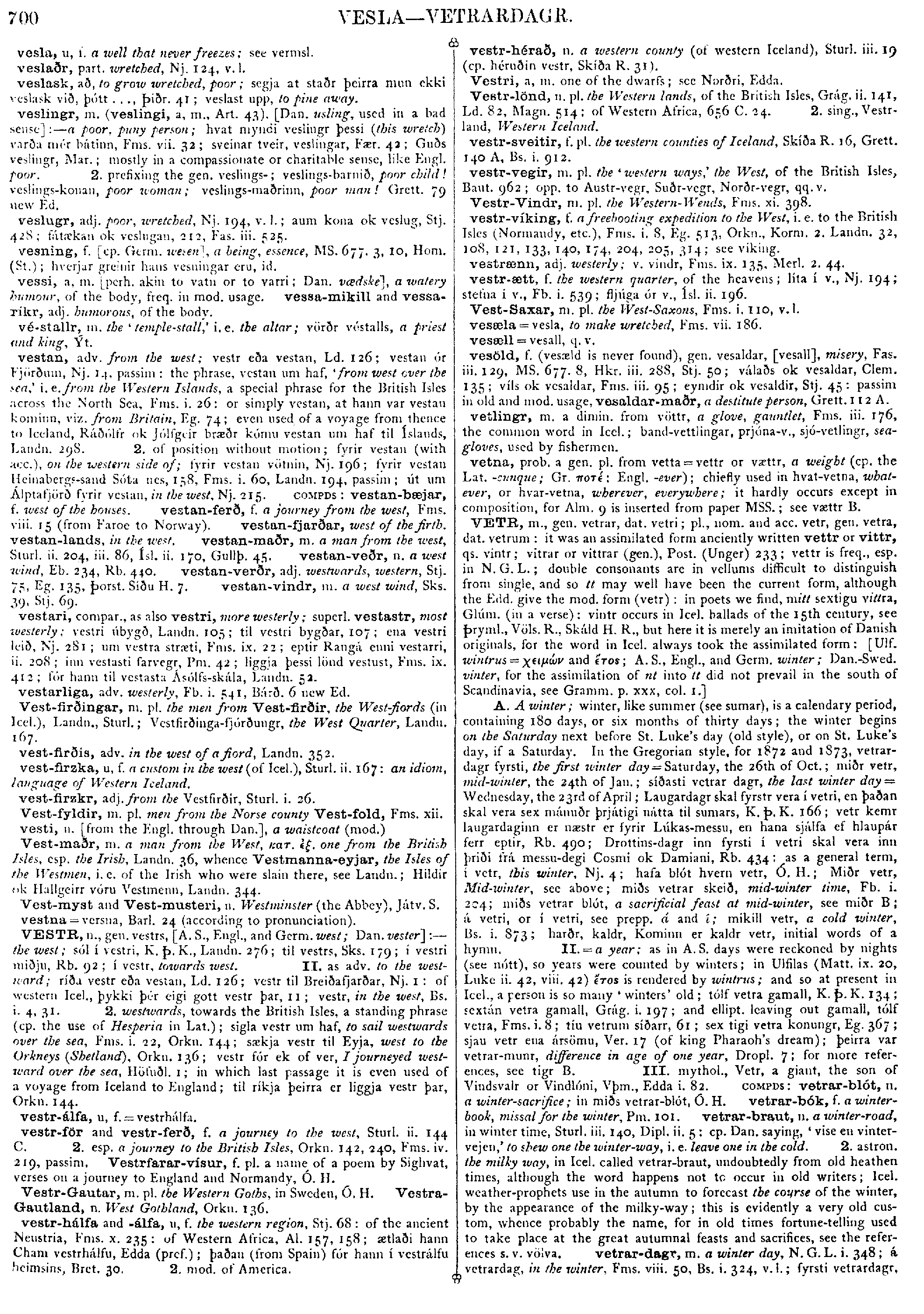
Vestr-lönd, n. pl. the Western lands, of the British Isles, Grág. ii. 141, Ld. 82, Magn. 514: of Western Africa, 656 C. 24. 2. sing., Vestrland, Western Iceland.
|
Source: Cleasby/Vigfusson, page b0701, entry 14 View original page image as: [TIFF] [PNG] [View previous entry] [View next entry] |
[Comment on this entry] [View comments] |
The following entry has been hand-corrected once. |
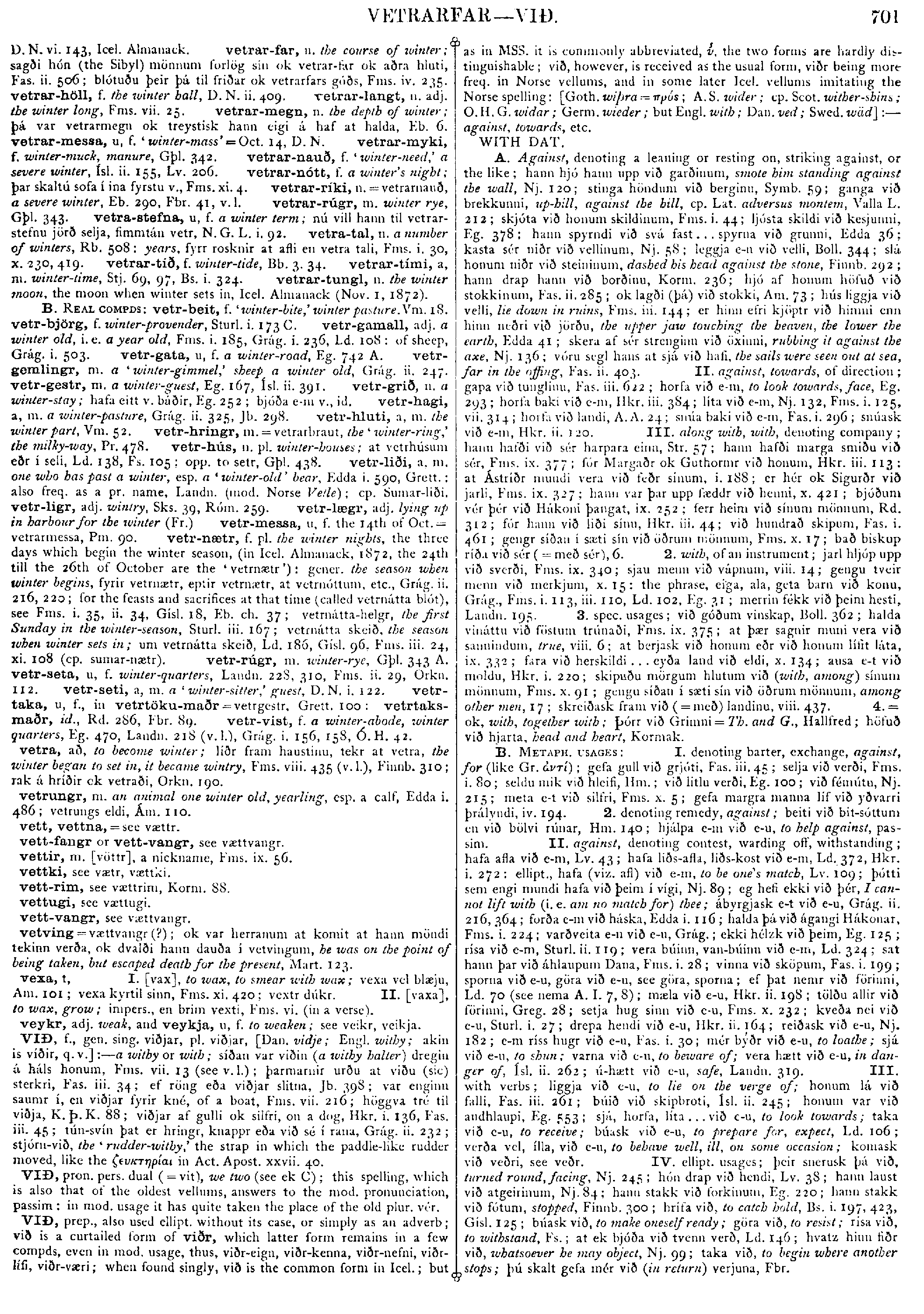
VIÐ, f., gen. sing. viðjar, pl. viðjar, [Dan. vidje; Engl. withy; akin is víðir, q.v.] :-- a withy or with; síðan var viðin (a withy halter) dregin á hals honum, Fms. vii. 13 (see v.l.); þarmarnir urðu at viðu (sic) sterkri, Fas. iii. 34; ef röng eða viðjar slitna, Jb. 398; var enginn saumr í, en viðjar fyrir kné, of a boat, Fms. vii. 216; höggva tré til viðja, K.Þ.K. 88; viðjar af gulli ok silfri, on a dog, Hkr. i. 136, Fas. iii. 45; tún-svín þat er hringr, knappr eða við sé í rana, Grág. ii. 232; stjórn-við, the 'rudder-withy,' the strap in which the paddle-like rudder moved, like the GREEK in Act. Apost. xxvii. 40.
|
Source: Cleasby/Vigfusson, page b0703, entry 61 View original page image as: [TIFF] [PNG] [View previous entry] [View next entry] |
[Comment on this entry] [View comments] |
The following entry has been hand-corrected once. |
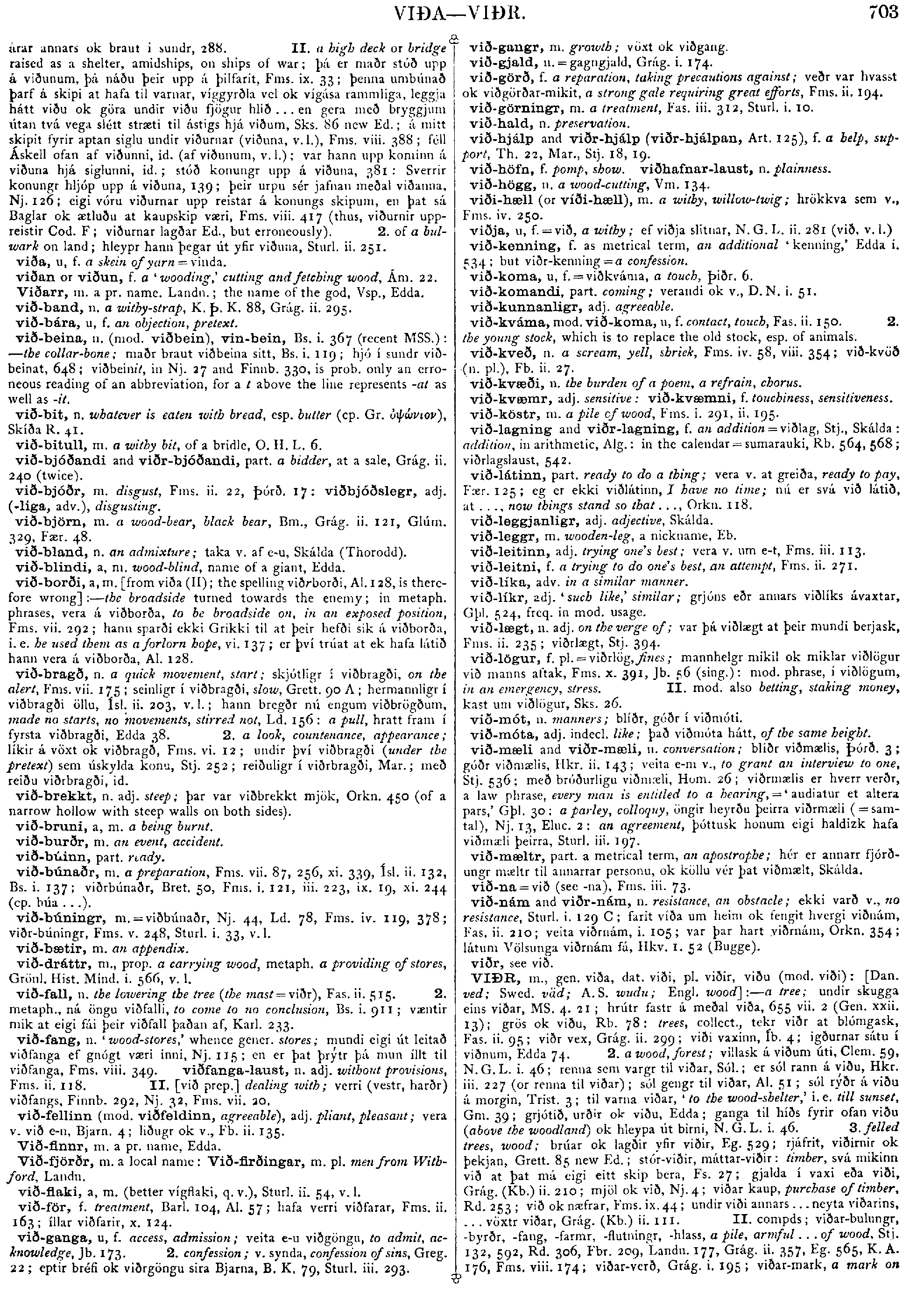
við-lögur, f. pl. = viðrlög, fined; mannhelgr mikil ok miklar viðlögur við manns aftak, Fms. x. 391, Jb. 56 (sing.): mod. phrase, í viðlögum, in an emergency, stress. II. mod. also betting, staking money, kast um viðlögur, Sks. 26.
|
Source: Cleasby/Vigfusson, page b0715, entry 2 View original page image as: [TIFF] [PNG] [View previous entry] [View next entry] |
[Comment on this entry] [View comments] |
The following entry has been hand-corrected once. |
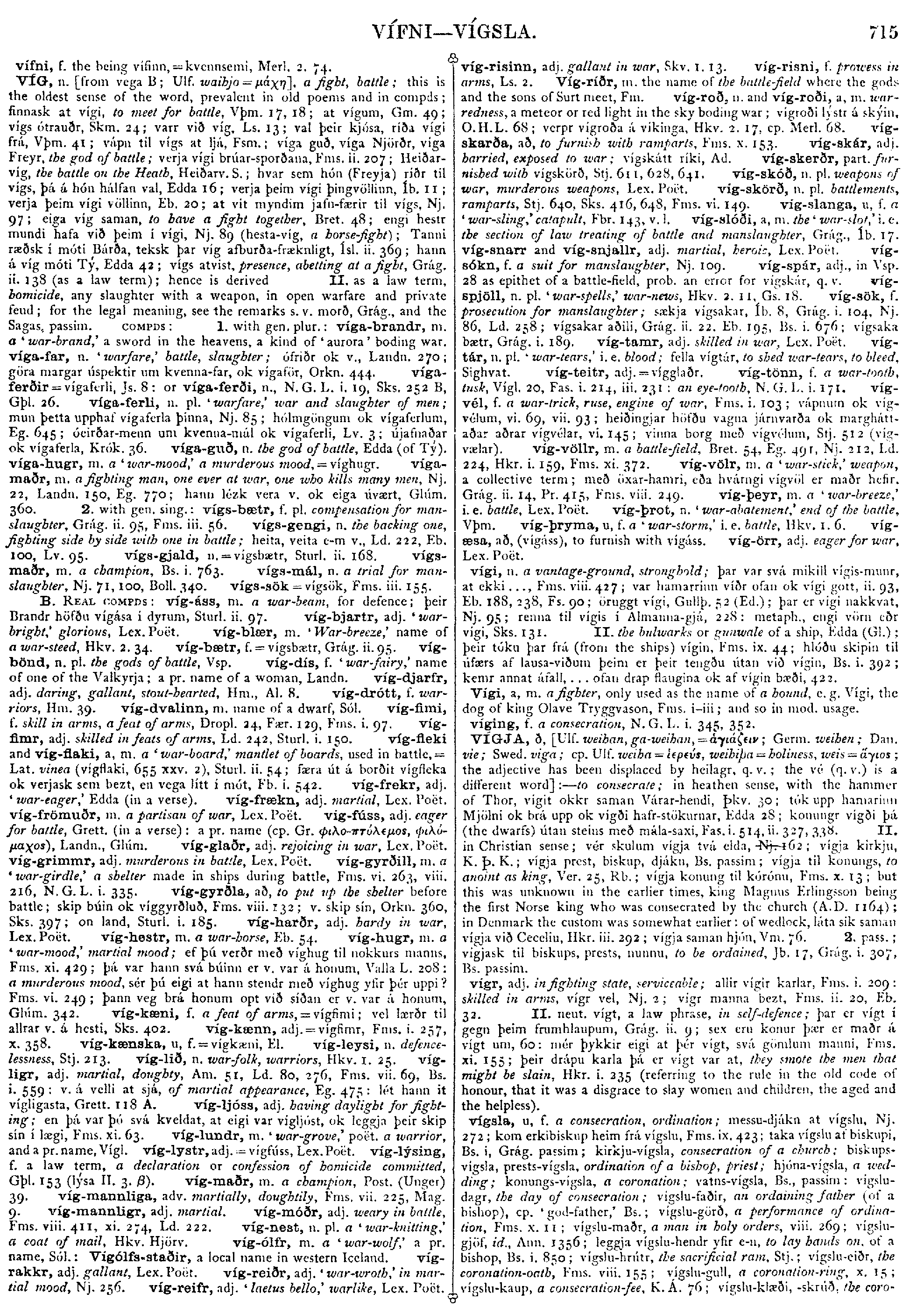
VÍG,
n.
[from
vega
B;
Ulf.
waihjo
=
GREEK],
a
fight,
battle;
this
is
the
oldest
sense
of
the
word,
prevalent
in
old
poems
and
in
compds;
finnask
at
vígi,
to
meet
for
battle,
Vþm.
17,
18;
at
vígum,
Gm.
49;
vígs
ótrauðr,
Skm.
24;
varr
við
víg,
Ls.
13;
val
þeir
kjósa,
ríða
vígi
frá,
Vþm.
41;
vápn
til
vígs
at
ljá,
Fsm.;
víga
guð,
víga
Njörðr,
víga
Freyr,
the
god
of
battle;
verja
vígi
brúar-sporðana,
Fms.
ii.
207;
Heiðar-víg,
the
battle
on
the
Heath,
Heiðarv.
S.;
hvar
sem
hón
(Freyja)
ríðr
til
vígs,
þá
á
hón
hálfan
val,
Edda
16;
verja
þeim
vígi
þingvöllinn,
Íb.
11;
verja
þeim
vígi
völlinn,
Eb.
20;
at
vit
myndim
jafn-færir
til
vígs,
Nj.
97;
eiga
víg
saman,
to
have
a
fight
together,
Bret.
48;
engi
hestr
mundi
hafa
við
þeim
í
vígi,
Nj.
89
(hesta-víg,
a
horse-fight];
Tanni
ræðsk
í
móti
Bárða,
teksk
þar
víg
afburða-fræknligt,
Ísl.
ii.
369;
hann
á
víg
móti
Tý,
Edda
42;
vígs
atvist,
presence,
abetting
at
a
fight,
Grág.
ii.
138
(as
a
law
term);
hence
is
derived
II.
as
a
law
term,
homicide,
any
slaughter
with
a
weapon,
in
open
warfare
and
private
feud;
for
the
legal
meaning,
see
the
remarks
s.v.
morð,
Grág.,
and
the
Sagas,
passim.
COMPDS:
1.
with
gen.
plur.:
víga-brandr,
m.
a
'war-brand,'
a
sword
in
the
heavens,
a
kind
of
'aurora'
boding
war.
víga-far,
n.
'warfare,'
battle,
slaughter;
ófriðr
ok
v.,
Laudn.
270;
göra
margar
úspektir
um
kvenna-far,
ok
vígaför,
Orkn.
444.
víga-ferðir
=
vígaferli,
Js.
8:
or
víga-ferði,
n.,
N.G.L.
i.
19,
Sks.
252
B,
Gþl.
26.
víga-ferli,
n.
pl.
'warfare,'
war
and
slaughter
of
men;
mun
þetta
upphaf
vígaferla
þinna,
Nj.
85;
hólmgöngum
ok
vígaferlum,
Eg.
645;
óeirðar-menn
um
kvenna-mál
ok
vígaferli,
Lv.
3;
újafnaðar
ok
vígaferla,
Krók.
36.
víga-guð,
n.
the
god
of
battle,
Edda
(of
Tý).
víga-hugr,
m.
a
'war-mood,'
a
murderous
mood,
=
víghugr.
víga-maðr,
m.
a
fighting
man,
one
ever
at
war,
one
who
kills
many
men,
Nj.
22,
Landn.
150,
Eg.
770;
hann
lézk
vera
v.
ok
eiga
úvært,
Glúm.
360.
2.
with
gen.
sing.:
vígs-bætr,
f.
pl.
compensation
for
manslaughter,
Grág.
ii.
95,
Fms.
iii.
56.
vígs-gengi,
n.
the
backing
one,
fighting
side
by
side
with
one
in
battle;
heita,
veita
e-m
v.,
Ld.
222,
Eb.
100,
Lv.
95.
víga-gjald,
n.
=
vígsbætr,
Sturl.
ii.
168.
vígs-maðr,
m.
a
champion,
Bs.
i.
763.
vígs-mál,
n.
a
trial
for
manslaughter,
Nj.
71,
100,
Boll.
340.
vígs-sök
=
vígsök,
Fms.
iii.
155.
B.
REAL
COMPDS:
víg-áss,
m.
a
war-beam,
for
defence;
þeir
Brandr
höfðu
vígása
í
dyrum,
Sturl.
ii.
97.
víg-bjartr,
adj.
'war-bright,'
glorious,
Lex.
Poët.
víg-blær,
m.
'War-breeze,'
name
of
a
war-steed,
Hkv.
2.
34.
víg-bætr,
f.
=
vígsbætr,
Grág.
ii.
95.
víg-bönd,
n.
pl.
the
gods
of
battle,
Vsp.
víg-dís,
f.
'war-fairy,'
name
of
one
of
the
Valkyrja;
a
pr.
name
of
a
woman,
Landn.
víg-djarfr,
adj.
daring,
gallant,
stout-hearted,
Hm.,
Al.
8.
víg-drótt,
f.
warriors,
Hm.
39.
víg-dvalinn,
m.
name
of
a
dwarf,
Sól.
víg-fimi,
f.
skill
in
arms,
a
feat
of
arms,
Dropl.
24,
Fær.
129,
Fms.
i.
97.
víg-fimr,
adj.
skilled
in
feats
of
arms,
Ld.
242,
Sturl.
i.
150.
víg-fleki
and
víg-flaki,
a,
m.
a
'war-board,'
mantlet
of
boards,
used
in
battle,
=
Lat.
vinea
(vígflaki,
655
xxv.
2),
Sturl.
ii.
54;
færa
út
á
borðit
vígfleka
ok
verjask
sem
bezt,
en
vega
lítt
í
mót,
Fb.
i.
542.
víg-frekr,
adj.
'war-eager,'
Edda
(in
a
verse).
víg-frækn,
adj.
martial,
Lex.
Poët.
víg-frömuðr,
m.
a
partisan
of
war,
Lex.
Poët.
víg-fúss,
adj.
eager
for
battle,
Grett.
(in
a
verse):
a
pr.
name
(cp.
Gr.
GREEK),
Landn.,
Glúm.
víg-glaðr,
adj.
rejoicing
in
war.
Lex.
Poët.
vig-grimmr,
adj.
murderous
in
battle,
Lex.
Poët.
víg-gyrðill,
m.
a
'war-girdle,'
a
shelter
made
in
ships
during
battle,
Fms.
vi.
263,
viii.
216,
N.G.L.
i.
335.
víg-gyrðla,
að,
to
put
up
the
shelter
before
battle;
skip
búin
ok
víggyrðluð,
Fms.
viii.
132;
v.
skip
sín,
Orkn.
360,
Sks.
397;
on
land,
Sturl.
i.
185.
víg-harðr,
adj.
hardy
in
war,
Lex.
Poët.
víg-hestr,
m,
a
war-horse,
Eb.
54.
víg-hugr,
m.
a
'war-mood,'
martial
mood;
ef
þú
verðr
með
víghug
til
nokkurs
manns,
Fms.
xi.
429;
þá
var
hann
svá
búinn
er
v.
var
á
honum,
Valla
L.
208:
a
murderous
mood,
sér
þú
eigi
at
hann
stendr
með
víghug
yfir
þér
uppi?
Fms.
vi.
249;
þann
veg
brá
honum
opt
við
síðan
er
v.
var
á
honum,
Glúm.
342.
víg-kæni,
f.
a
feat
of
arms,
=
vígfimi;
vel
lærðr
til
allrar
v.
á
hesti,
Sks.
402.
víg-kænn,
adj.
=
vígfimr,
Fms.
i.
257,
x.
358.
víg-kænska,
u,
f.
=
vígkæni,
El.
víg-leysi,
n.
defencelessness
Stj.
213.
víg-lið,
n.
war-folk,
warriors,
Hkv.
1.
25.
víg-ligr,
adj.
martial,
doughty,
Am.
51,
Ld.
80,
276,
Fms.
vii.
69,
Bs.
i.
559:
v.
á
velli
at
sjá,
of
martial
appearance,
Eg.
475:
lét
hann
it
vígligasta,
Grett.
118
A.
víg-ljóss,
adj.
having
daylight
for
fighting;
en
þá
var
þó
svá
kveldat,
at
eigi
var
vígljóst,
ok
leggja
þeir
skip
sín
í
lægi,
Fms.
xi.
63.
víg-lundr,
m.
'war-grove,'
poët,
a
warrior,
and
a
pr.
name,
Vígl.
víg-lystr,
adj.
=
vígfúss,
Lex.
Poët.
víg-lýsing,
f.
a
law
term,
a
declaration
or
confession
of
homicide
committed,
Gþl.
153
(lýsa
II.
3.
 ).
víg-maðr,
m.
a
champion,
Post.
(Unger)
39.
víg-mannliga,
adv.
martially,
doughtily,
Fms.
vii.
225,
Mag.
9.
víg-mannligr,
adj.
martial.
víg-móðr,
adj.
weary
in
battle,
Fms.
viii.
411,
xi.
274,
Ld.
222.
víg-nest,
n.
pl.
a
'war-knitting,'
a
coat
of
mail,
Hkv.
Hjörv.
víg-ólfr,
m.
a
'war-wolf,'
a
pr.
name,
Sól.:
Vígólfs-staðir,
a
local
name
in
western
Iceland.
víg-rakkr,
adj.
gallant,
Lex.
Poët.
víg-reiðr,
adj.
'war-wroth,'
in
martial
mood,
Nj.
256.
víg-reifr,
adj.
'laetus
bello,'
warlike,
Lex.
Poët.,
víg-risinn,
adj.
gallant
in
war,
Skv.
1.
13.
víg-risni,
f.
prowess
in
arms,
Ls.
2.
Víg-ríðr,
m.
the
name
of
the
battle-field
where
the
gods
and
the
sons
of
Surt
meet,
Fm.
víg-roð,
n.
and
víg-roði,
a,
m.
war-redness,
a
meteor
or
red
light
in
the
sky
boding
war;
vígroði
lýstr
á
skýin,
O.H.L.
68;
verpr
vígroða
á
víkinga,
Hkv.
2.
17,
cp.
Merl.
68.
víg-skarða,
að,
to
furnish
with
ramparts,
Fms.
x.
153.
víg-skár,
adj.
harried,
exposed
to
war;
vígskátt
ríki,
Ad.
víg-skerðr,
part.
furnished
with
vígskörð,
Stj.
611
628,
641.
víg-skóð,
n.
pl.
weapons
of
war,
murderous
weapons,
Lex.
Poët.
víg-skörð,
n.
pl.
battlements,
ramparts,
Stj.
640,
Sks.
416,
648,
Fms.
vi.
149.
víg-slanga,
u,
f.
a
'war-sling,'
catapult,
Fbr.
143,
v.l.
víg-slóði,
a,
m.
the
'war-slot,'
i.e.
the
section
of
law
treating
of
battle
and
manslaughter,
Grág.,
Íb.
17.
víg-snarr
and
víg-snjallr,
adj.
martial,
heroic.
Lex.
Poët.
víg-sókn,
f.
a
suit
for
manslaughter,
Nj.
109.
víg-spár,
adj.,
in
Vsp.
28
as
epithet
of
a
battle-field,
prob.
an
error
for
vígskár,
q.v.
víg-spjöll,
n.
pl.
'war-spells,'
war-news,
Hkv.
2.
11,
Gs.
18.
víg-sök,
f.
prosecution
for
manslaughter;
sækja
vígsakar,
Íb.
8,
Grág.
i.
104,
Nj.
86,
Ld.
258;
vígsakar
aðili,
Grág.
ii.
22.
Eb.
195,
Bs.
i.
676;
vígsaka
bætr,
Grág.
i.
189.
víg-tamr,
adj.
skilled
in
war,
Lex.
Poët.
víg-tár,
n.
pl.
'war-tears,'
i.e.
blood;
fella
vígtár,
to
shed
war-tears,
to
bleed,
Sighvat.
víg-teitr,
adj.
=
vígglaðr.
víg-tönn,
f.
a
war-tooth,
tusk,
Vígl.
20,
Fas.
i.
214,
iii.
231:
an
eye-tooth,
N.G.L.
i.
171.
víg-vél,
f.
a
war-trick,
ruse,
engine
of
war,
Fms.
i.
103;
vápnum
ok
vígvélum,
vi.
69,
vii.
93;
heiðingjar
höfðu
vagna
járnvarða
ok
margháttaðar
aðrar
vígvélar,
vi.
145;
vinna
borg
með
vígvélum,
Stj.
512
(vígvælar).
víg-völlr,
m.
a
battle-field,
Bret.
54,
Eg.
491,
Nj.
212,
Ld.
224,
Hkr.
i.
159,
Fms.
xi.
372.
víg-völr,
m.
a
'war-stick,'
weapon,
a
collective
term;
með
öxar-hamri,
eða
hvárngi
vígvöl
er
maðr
hefir,
Grág.
ii.
14,
Pr.
415,
Fms.
viii.
249.
víg-þeyr,
m.
a
'war-breeze,'
i.e.
battle.
Lex.
Poët.
víg-þrot,
n.
'war-abatement'
end
of
the
battle,
Vþm.
víg-þryma,
u,
f.
a
'war-storm,'
i.e.
battle,
Hkv.
1.
6.
víg-æsa,
að,
(vígáss),
to
furnish
with
vígáss.
víg-örr,
adj.
eager
for
war,
Lex.
Poët.
).
víg-maðr,
m.
a
champion,
Post.
(Unger)
39.
víg-mannliga,
adv.
martially,
doughtily,
Fms.
vii.
225,
Mag.
9.
víg-mannligr,
adj.
martial.
víg-móðr,
adj.
weary
in
battle,
Fms.
viii.
411,
xi.
274,
Ld.
222.
víg-nest,
n.
pl.
a
'war-knitting,'
a
coat
of
mail,
Hkv.
Hjörv.
víg-ólfr,
m.
a
'war-wolf,'
a
pr.
name,
Sól.:
Vígólfs-staðir,
a
local
name
in
western
Iceland.
víg-rakkr,
adj.
gallant,
Lex.
Poët.
víg-reiðr,
adj.
'war-wroth,'
in
martial
mood,
Nj.
256.
víg-reifr,
adj.
'laetus
bello,'
warlike,
Lex.
Poët.,
víg-risinn,
adj.
gallant
in
war,
Skv.
1.
13.
víg-risni,
f.
prowess
in
arms,
Ls.
2.
Víg-ríðr,
m.
the
name
of
the
battle-field
where
the
gods
and
the
sons
of
Surt
meet,
Fm.
víg-roð,
n.
and
víg-roði,
a,
m.
war-redness,
a
meteor
or
red
light
in
the
sky
boding
war;
vígroði
lýstr
á
skýin,
O.H.L.
68;
verpr
vígroða
á
víkinga,
Hkv.
2.
17,
cp.
Merl.
68.
víg-skarða,
að,
to
furnish
with
ramparts,
Fms.
x.
153.
víg-skár,
adj.
harried,
exposed
to
war;
vígskátt
ríki,
Ad.
víg-skerðr,
part.
furnished
with
vígskörð,
Stj.
611
628,
641.
víg-skóð,
n.
pl.
weapons
of
war,
murderous
weapons,
Lex.
Poët.
víg-skörð,
n.
pl.
battlements,
ramparts,
Stj.
640,
Sks.
416,
648,
Fms.
vi.
149.
víg-slanga,
u,
f.
a
'war-sling,'
catapult,
Fbr.
143,
v.l.
víg-slóði,
a,
m.
the
'war-slot,'
i.e.
the
section
of
law
treating
of
battle
and
manslaughter,
Grág.,
Íb.
17.
víg-snarr
and
víg-snjallr,
adj.
martial,
heroic.
Lex.
Poët.
víg-sókn,
f.
a
suit
for
manslaughter,
Nj.
109.
víg-spár,
adj.,
in
Vsp.
28
as
epithet
of
a
battle-field,
prob.
an
error
for
vígskár,
q.v.
víg-spjöll,
n.
pl.
'war-spells,'
war-news,
Hkv.
2.
11,
Gs.
18.
víg-sök,
f.
prosecution
for
manslaughter;
sækja
vígsakar,
Íb.
8,
Grág.
i.
104,
Nj.
86,
Ld.
258;
vígsakar
aðili,
Grág.
ii.
22.
Eb.
195,
Bs.
i.
676;
vígsaka
bætr,
Grág.
i.
189.
víg-tamr,
adj.
skilled
in
war,
Lex.
Poët.
víg-tár,
n.
pl.
'war-tears,'
i.e.
blood;
fella
vígtár,
to
shed
war-tears,
to
bleed,
Sighvat.
víg-teitr,
adj.
=
vígglaðr.
víg-tönn,
f.
a
war-tooth,
tusk,
Vígl.
20,
Fas.
i.
214,
iii.
231:
an
eye-tooth,
N.G.L.
i.
171.
víg-vél,
f.
a
war-trick,
ruse,
engine
of
war,
Fms.
i.
103;
vápnum
ok
vígvélum,
vi.
69,
vii.
93;
heiðingjar
höfðu
vagna
járnvarða
ok
margháttaðar
aðrar
vígvélar,
vi.
145;
vinna
borg
með
vígvélum,
Stj.
512
(vígvælar).
víg-völlr,
m.
a
battle-field,
Bret.
54,
Eg.
491,
Nj.
212,
Ld.
224,
Hkr.
i.
159,
Fms.
xi.
372.
víg-völr,
m.
a
'war-stick,'
weapon,
a
collective
term;
með
öxar-hamri,
eða
hvárngi
vígvöl
er
maðr
hefir,
Grág.
ii.
14,
Pr.
415,
Fms.
viii.
249.
víg-þeyr,
m.
a
'war-breeze,'
i.e.
battle.
Lex.
Poët.
víg-þrot,
n.
'war-abatement'
end
of
the
battle,
Vþm.
víg-þryma,
u,
f.
a
'war-storm,'
i.e.
battle,
Hkv.
1.
6.
víg-æsa,
að,
(vígáss),
to
furnish
with
vígáss.
víg-örr,
adj.
eager
for
war,
Lex.
Poët.
|
Source: Cleasby/Vigfusson, page b0718, entry 16 View original page image as: [TIFF] [PNG] [View previous entry] [View next entry] |
[Comment on this entry] [View comments] |
The following entry has been hand-corrected once. |
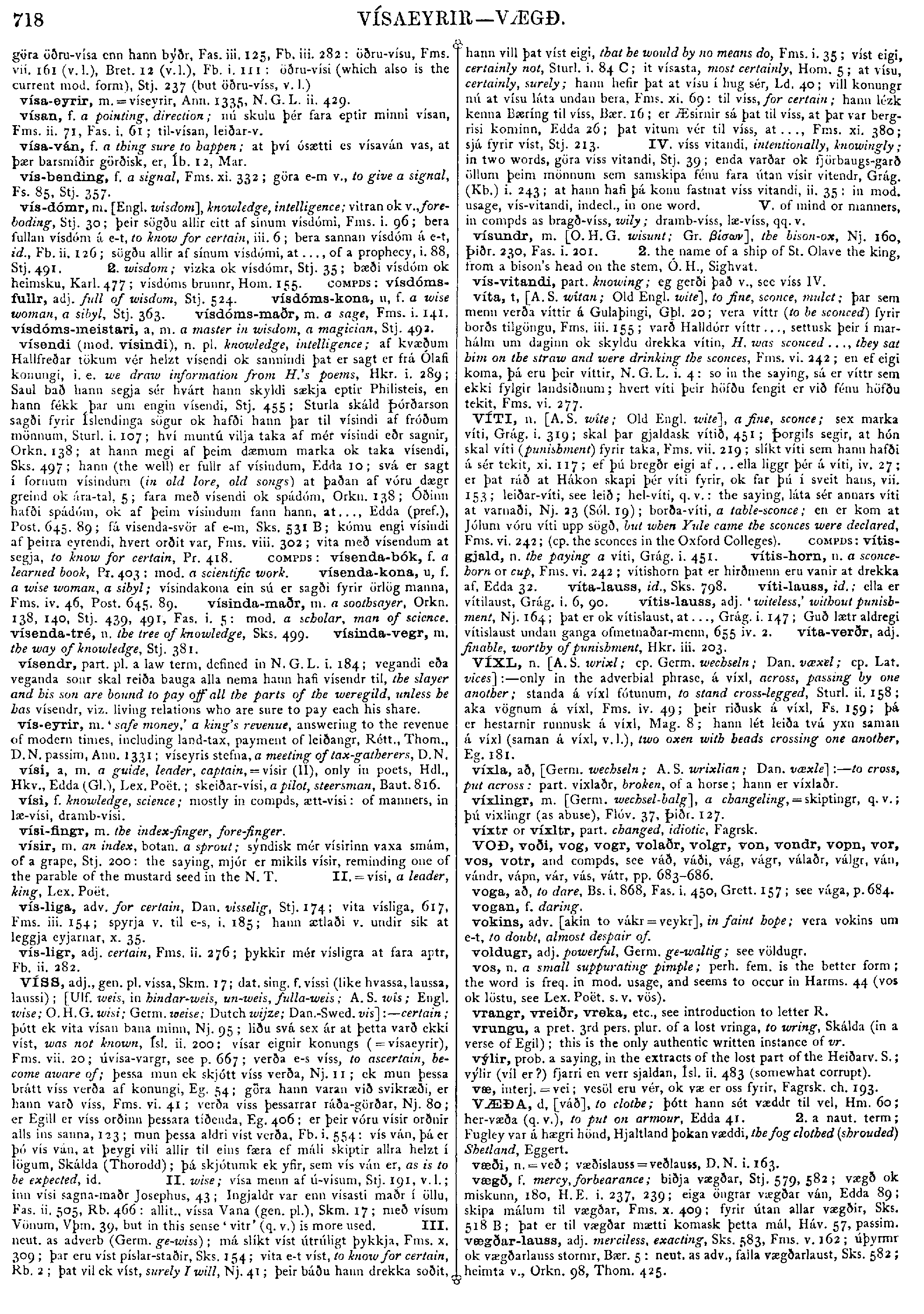
VÍSS, adj., gen. pl. víssa, Skm. 17; dat. sing. f. víssi (like hvassa, laussa, laussi); [Ulf. weis, in hindar-weis, un-weis, fulla-weis; A.S. wîs; Engl. wise; O.H.G. wisi; Germ. weise; Dutch wijze; Dan.-Swed. vis] :-- certain; þótt ek vita vísan bana minn, Nj. 95; liðu svá sex ár at þetta varð ekki víst, was not known, Ísl. ii. 200; vísar eignir konungs (= vísaeyrir), Fms. vii. 20; úvísa-vargr, see p. 667; verða e-s víss, to ascertain, become aware of; þessa mun ek skjótt víss verða, Nj. 11; ek mun þessa brátt víss verða af konungi, Eg. 54; göra hann varan við svikræði, er hann varð víss, Fms. vi. 41; verða víss þessarrar ráða-görðar, Nj. 80; er Egill er víss orðinn þessara tíðenda, Eg. 406; er þeir vóru vísir orðnir alls ins sanna, 123; mun þessa aldri víst verða, Fb. i. 554: vís ván, þá er þó vís ván, at þeygi vili allir til eins færa ef máli skiptir allra helzt í lögum, Skálda (Thorodd); þá skjótumk ek yfir, sem vís ván er, as is to be expected, id. II. wise; vísa menn af ú-vísum, Stj. 191, v.l.; inn vísi sagna-maðr Josephus, 43; Ingjaldr var enn vísasti maðr í öllu, Fas. ii. 505, Rb. 466: allit., víssa Vana (gen. pl.), Skm. 17; með vísum Vönum, Vþm. 39, but in this sense 'vitr' (q.v.) is more used. III. neut. as adverb (Germ. ge-wiss); má slíkt víst útrúligt þykkja, Fms. x. 309; þar eru víst píslar-staðir, Sks. 154; vita e-t víst, to know for certain, Rb. 2; þat vil ek víst, surely I will, Nj. 41; þeir báðu hann drekka soðit, hann vill þat víst eigi, that he would by no means do, Fms. i. 35; víst eigi, certainly not, Sturl. i. 84 C; it vísasta, most certainly, Hom. 5; at vísu, certainly, surely; hann hefir þat at vísu í hug sér, Ld. 40; vill konungr nú at vísu láta undan bera, Fms. xi. 69: til víss, for certain; hann lézk kenna Bæring til víss, Bær. 16; er Æsirnir sá þat til víss, at þar var bergrisi kominn, Edda 26; þat vitum vér til víss, at ..., Fms. xi. 380; sjá fyrir víst, Stj. 213. IV. víss vitandi, intentionally, knowingly; in two words, göra víss vitandi, Stj. 39; enda varðar ok fjörbaugs-garð öllum þeim mönnum sem samskipa fénu fara útan vísir vitendr, Grág. (Kb.) i. 243; at hann hafi þá konu fastnat víss vitandi, ii. 35: in mod. usage, vís-vitandi, indecl., in one word. V. of mind or manners, in compds as bragð-víss, wily; dramb-víss, læ-víss, qq.v.
| Result Page: |  |
Previous | 44 45 46 47 48 49 50 51 52 53 54 55 | Next |  |
Germanic Lexicon Project (main page)
This search system was written by
Sean Crist
Please consider
volunteering
to correct the data in these online dictionaries.
No rights reserved. Feel free to use these data in any way you please.