|
|

|
Source: Bosworth/Toller, page d0415, entry 4 View original page image as: [TIFF] [PNG] [View previous entry] [View next entry] |
[Comment on this entry] [View comments] |
The following entry has been hand-corrected once. |
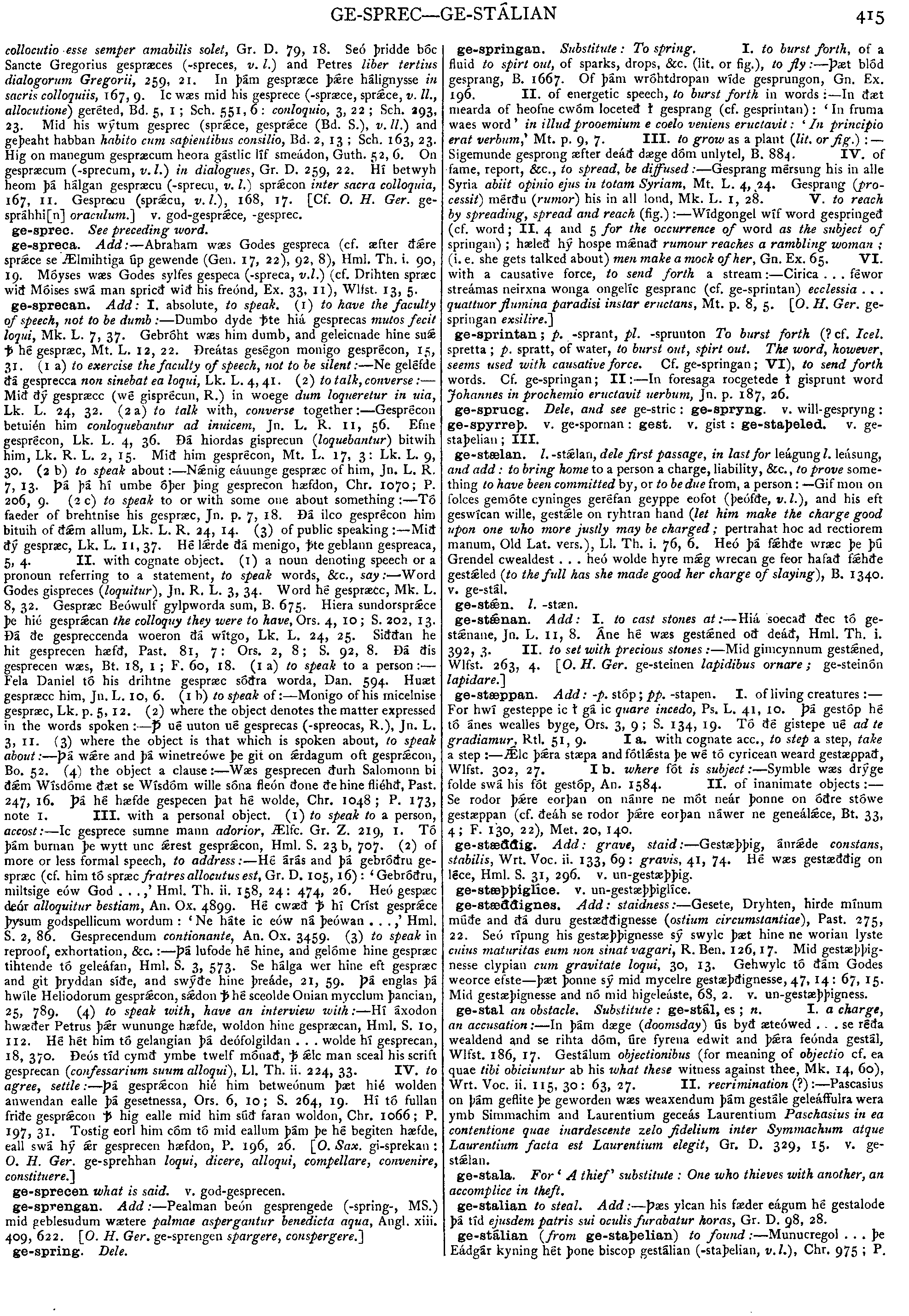
ge-sprecan.
Add:
I.
absolute,
to
speak,
(i)
to
have
the
faculty
of
speech,
not
to
be
dumb
:--
Dumbo
dyde
 te
hiá
gesprecas
mutos
fecit
loqui,
Mk.
L.
7,
37.
Gebróht
wæs
him
dumb,
and
geleicnade
hine
su
te
hiá
gesprecas
mutos
fecit
loqui,
Mk.
L.
7,
37.
Gebróht
wæs
him
dumb,
and
geleicnade
hine
su hé
gespræc,
Mt.
L.
12,
22.
Ðreátas
geségon
monigo
gesprécon,
15,
31.
(l
a)
to
exercise
the
faculty
of
speech,
not
to
be
silent
:--
Ne
geléfde
ðá
gesprecca
non
sinebat
ea
loqui,
Lk.
L.
4,
41.
(2)
to
talk,
converse
:--
Mið
ðý
gespræce
(wé
gisprécun,
R.)
in
woege
dum
loqueretur
in
via,
Lk.
L.
24,
32.
(2
a)
to
talk
with,
converse
together
:--
Gesprécon
betuién
him
conloquebantur
ad
inuicem,
Jn.
L.
R.
II,
56.
Efne
gesprécon,
Lk.
L.
4,
36.
Ðá
hiordas
gisprecun
(loquebantur)
bitwih
him,
Lk.
R.
L.
2,
15.
Mið
him
gesprécon,
Mt.
L.
17,
3:
Lk.
L.
9,
30.
(2
b)
to
speak
about
:--
Nnig
eáuunge
gespræc
of
him,
Jn.
L.
R.
7,
13.
Þá
þá
hí
umbe
óþer
þing
gesprecon
hæfdon,
Chr.
1070;
P.
206,
9.
(2
c)
to
speak
to
or
with
some
one
about
something
:--
Tó
faeder
of
brehtnise
his
gespræc,
Jn.
p.
7,
18.
Ðá
ilco
gesprécon
him
bituih
of
ðm
allum,
Lk.
L.
R.
24,
14.
(3)
of
public
speaking
:--
Mið
ðý
gespræc,
Lk.
L.
11,
37.
Hé
lrde
ðá
menigo,
te
geblann
gespreaca,
5,
4.
II.
with
cognate
object.
(l)
a
noun
denoting
speech
or
a
pronoun
referring
to
a
statement,
to
speak
words,
&c.say
:--
Word
Godes
gispreces
(loquitur],
Jn.
R.
L.
3,
34.
Word
hé
gespræce,
Mk.
L.
8,
32.
Gespræc
Beówulf
gylpworda
sum,
B.
675.
Hiera
sundorsprce
þe
hié
gesprcan
the
colloquy
they
were
to
have,
Ors.
4,
10
;
S.
202,
13.
Ðá
ðe
gespreccenda
woeron
ðá
wítgo,
Lk.
L.
24,
25.
Siððan
he
hit
gesprecen
hæfð,
Past.
81,
7:
Ors.
2,
8;
S.
92,
8.
Ðá
ðis
gesprecen
wæs,
Bt.
18,
I
;
F.
60,
18.
(l
a)
to
speak
to
a
person
:--
Fela
Daniel
tó
his
drihtne
gespræc
sóðra
worda,
Dan.
594.
Huæt
gespræce
him,
Jn.
L.
10,
6.
(l
b)
to
speak
of
:--
Monigo
of
his
micelnise
gespræc,
Lk.
p.
5,
12.
(2)
where
the
object
denotes
the
matter
expressed
in
the
words
spoken
:--
Þ
UNCERTAIN
ué
uuton
ué
gesprecas
(-spreocas,
R.),
Jn.
L.
3,
(3)
where
the
object
is
that
which
is
spoken
about,
to
speak
about
:--
Þá
wre
and
þá
winetreówe
þe
git
on
rdagum
oft
gesprcon,
Bo.
52.
(4)
the
object
a
clause
:--
Wæs
gesprecen
ðurh
Salomonn
bi
ðm
Wísdóme
ðæt
se
Wísdóm
wille
sóna
fleón
ðone
ðe
hine
fliéhð,
Past.
247,
16.
Þá
hé
hæfde
gespecen
þat
hé
wolde,
Chr.
1048;
P.
173,
note
I.
III.
with
a
personal
object.
(l)
to
speak
to
a
person,
accost
:--
Ic
gesprece
sumne
mann
adorior,
Ælfc.
Gr.
Z.
219,
l.
Tó
þám
burnan
þe
wytt
unc
rest
gesprcon,
Hml.
S.
23
b,
707.
(2)
of
more
or
less
formal
speech,
to
address
:--
Hé
árás
and
þá
gebróðru
gespræc
(cf.
him
tó
spræc
fratres
allocutus
est.
Gr.
D.
105,
16)
:
'Gebróðru,
miltsige
eów
God
.
.
.,'
Hml.
Th.
ii.
158,
24:
474,
26.
Heó
gespæc
deór
alloquitur
bestiam,
An.
Ox,
4899.
Hé
cwæð
hí
Críst
gespræce
þysum
godspellicum
wordum:
'Ne
háte
ic
eów
ná
þeówan
.
.
.,'
Hml.
S.
2,
86.
Gesprecendum
contionante,
An.
Ox.
3459.
(3)
to
speak
in
reproof,
exhortation,
&c.
:--
Þá
lufode
hé
hine,
and
gelóme
hine
gespræc
tihtende
tó
geleáfan,
Hml.
S.
3,
573.
Se
hálga
wer
hine
eft
gespræc
and
git
þryddan
síðe,
and
swýðe
hine
þreáde,
21,
59.
Þá
englas
þá
hwíle
Heliodorum
gesprcon,
sdon
hé
sceolde
Onian
mycclum
þancian,
25,
789.
(4)
to
speak
with,
have
an
interview
with
:--
Hí
áxodon
hwæðer
Petrus
þr
wununge
hæfde,
woldon
hine
gespræcan,
Hml.
S.
10,
112.
Hé
hét
him
to
gelangian
þá
deófolgildan
.
.
.
wolde
hí
gesprecan,
18,
370.
Ðeós
tíd
cymð
ymbe
twelf
mónað,
lc
man
sceal
his
scrift
gesprecan
(confessarium
suum
alloqui),
Ll.
Th.
ii.
224,
33.
IV.
to
agree,
settle
:--
Þá
gesprcon
hié
him
betweónum
þæt
hié
wolden
anwendan
ealle
þá
gesetnessa,
Ors.
6,
10
;
S.
264,
19.
Hí
tó
fullan
friðe
gesprcon
hig
ealle
mid
him
súð
faran
woldon,
Chr.
1066;
P.
197,
31.
Tostig
eorl
him
cðm
tó
mid
eallum
þám
þe
hé
begiten
hæfde,
eall
swá
hý
r
gesprecen
hæfdon,
P.
196,
26.
(O.Sax.
gi-sprekan
:
O.H.Ger.
ge-sprehhan
loqui,
dicere,
alloqui,
compellare,
convenire,
constituere.)
hé
gespræc,
Mt.
L.
12,
22.
Ðreátas
geségon
monigo
gesprécon,
15,
31.
(l
a)
to
exercise
the
faculty
of
speech,
not
to
be
silent
:--
Ne
geléfde
ðá
gesprecca
non
sinebat
ea
loqui,
Lk.
L.
4,
41.
(2)
to
talk,
converse
:--
Mið
ðý
gespræce
(wé
gisprécun,
R.)
in
woege
dum
loqueretur
in
via,
Lk.
L.
24,
32.
(2
a)
to
talk
with,
converse
together
:--
Gesprécon
betuién
him
conloquebantur
ad
inuicem,
Jn.
L.
R.
II,
56.
Efne
gesprécon,
Lk.
L.
4,
36.
Ðá
hiordas
gisprecun
(loquebantur)
bitwih
him,
Lk.
R.
L.
2,
15.
Mið
him
gesprécon,
Mt.
L.
17,
3:
Lk.
L.
9,
30.
(2
b)
to
speak
about
:--
Nnig
eáuunge
gespræc
of
him,
Jn.
L.
R.
7,
13.
Þá
þá
hí
umbe
óþer
þing
gesprecon
hæfdon,
Chr.
1070;
P.
206,
9.
(2
c)
to
speak
to
or
with
some
one
about
something
:--
Tó
faeder
of
brehtnise
his
gespræc,
Jn.
p.
7,
18.
Ðá
ilco
gesprécon
him
bituih
of
ðm
allum,
Lk.
L.
R.
24,
14.
(3)
of
public
speaking
:--
Mið
ðý
gespræc,
Lk.
L.
11,
37.
Hé
lrde
ðá
menigo,
te
geblann
gespreaca,
5,
4.
II.
with
cognate
object.
(l)
a
noun
denoting
speech
or
a
pronoun
referring
to
a
statement,
to
speak
words,
&c.say
:--
Word
Godes
gispreces
(loquitur],
Jn.
R.
L.
3,
34.
Word
hé
gespræce,
Mk.
L.
8,
32.
Gespræc
Beówulf
gylpworda
sum,
B.
675.
Hiera
sundorsprce
þe
hié
gesprcan
the
colloquy
they
were
to
have,
Ors.
4,
10
;
S.
202,
13.
Ðá
ðe
gespreccenda
woeron
ðá
wítgo,
Lk.
L.
24,
25.
Siððan
he
hit
gesprecen
hæfð,
Past.
81,
7:
Ors.
2,
8;
S.
92,
8.
Ðá
ðis
gesprecen
wæs,
Bt.
18,
I
;
F.
60,
18.
(l
a)
to
speak
to
a
person
:--
Fela
Daniel
tó
his
drihtne
gespræc
sóðra
worda,
Dan.
594.
Huæt
gespræce
him,
Jn.
L.
10,
6.
(l
b)
to
speak
of
:--
Monigo
of
his
micelnise
gespræc,
Lk.
p.
5,
12.
(2)
where
the
object
denotes
the
matter
expressed
in
the
words
spoken
:--
Þ
UNCERTAIN
ué
uuton
ué
gesprecas
(-spreocas,
R.),
Jn.
L.
3,
(3)
where
the
object
is
that
which
is
spoken
about,
to
speak
about
:--
Þá
wre
and
þá
winetreówe
þe
git
on
rdagum
oft
gesprcon,
Bo.
52.
(4)
the
object
a
clause
:--
Wæs
gesprecen
ðurh
Salomonn
bi
ðm
Wísdóme
ðæt
se
Wísdóm
wille
sóna
fleón
ðone
ðe
hine
fliéhð,
Past.
247,
16.
Þá
hé
hæfde
gespecen
þat
hé
wolde,
Chr.
1048;
P.
173,
note
I.
III.
with
a
personal
object.
(l)
to
speak
to
a
person,
accost
:--
Ic
gesprece
sumne
mann
adorior,
Ælfc.
Gr.
Z.
219,
l.
Tó
þám
burnan
þe
wytt
unc
rest
gesprcon,
Hml.
S.
23
b,
707.
(2)
of
more
or
less
formal
speech,
to
address
:--
Hé
árás
and
þá
gebróðru
gespræc
(cf.
him
tó
spræc
fratres
allocutus
est.
Gr.
D.
105,
16)
:
'Gebróðru,
miltsige
eów
God
.
.
.,'
Hml.
Th.
ii.
158,
24:
474,
26.
Heó
gespæc
deór
alloquitur
bestiam,
An.
Ox,
4899.
Hé
cwæð
hí
Críst
gespræce
þysum
godspellicum
wordum:
'Ne
háte
ic
eów
ná
þeówan
.
.
.,'
Hml.
S.
2,
86.
Gesprecendum
contionante,
An.
Ox.
3459.
(3)
to
speak
in
reproof,
exhortation,
&c.
:--
Þá
lufode
hé
hine,
and
gelóme
hine
gespræc
tihtende
tó
geleáfan,
Hml.
S.
3,
573.
Se
hálga
wer
hine
eft
gespræc
and
git
þryddan
síðe,
and
swýðe
hine
þreáde,
21,
59.
Þá
englas
þá
hwíle
Heliodorum
gesprcon,
sdon
hé
sceolde
Onian
mycclum
þancian,
25,
789.
(4)
to
speak
with,
have
an
interview
with
:--
Hí
áxodon
hwæðer
Petrus
þr
wununge
hæfde,
woldon
hine
gespræcan,
Hml.
S.
10,
112.
Hé
hét
him
to
gelangian
þá
deófolgildan
.
.
.
wolde
hí
gesprecan,
18,
370.
Ðeós
tíd
cymð
ymbe
twelf
mónað,
lc
man
sceal
his
scrift
gesprecan
(confessarium
suum
alloqui),
Ll.
Th.
ii.
224,
33.
IV.
to
agree,
settle
:--
Þá
gesprcon
hié
him
betweónum
þæt
hié
wolden
anwendan
ealle
þá
gesetnessa,
Ors.
6,
10
;
S.
264,
19.
Hí
tó
fullan
friðe
gesprcon
hig
ealle
mid
him
súð
faran
woldon,
Chr.
1066;
P.
197,
31.
Tostig
eorl
him
cðm
tó
mid
eallum
þám
þe
hé
begiten
hæfde,
eall
swá
hý
r
gesprecen
hæfdon,
P.
196,
26.
(O.Sax.
gi-sprekan
:
O.H.Ger.
ge-sprehhan
loqui,
dicere,
alloqui,
compellare,
convenire,
constituere.)
|
Source: Bosworth/Toller, page d0417, entry 21 View original page image as: [TIFF] [PNG] [View previous entry] [View next entry] |
[Comment on this entry] [View comments] |
The following entry has been hand-corrected once. |
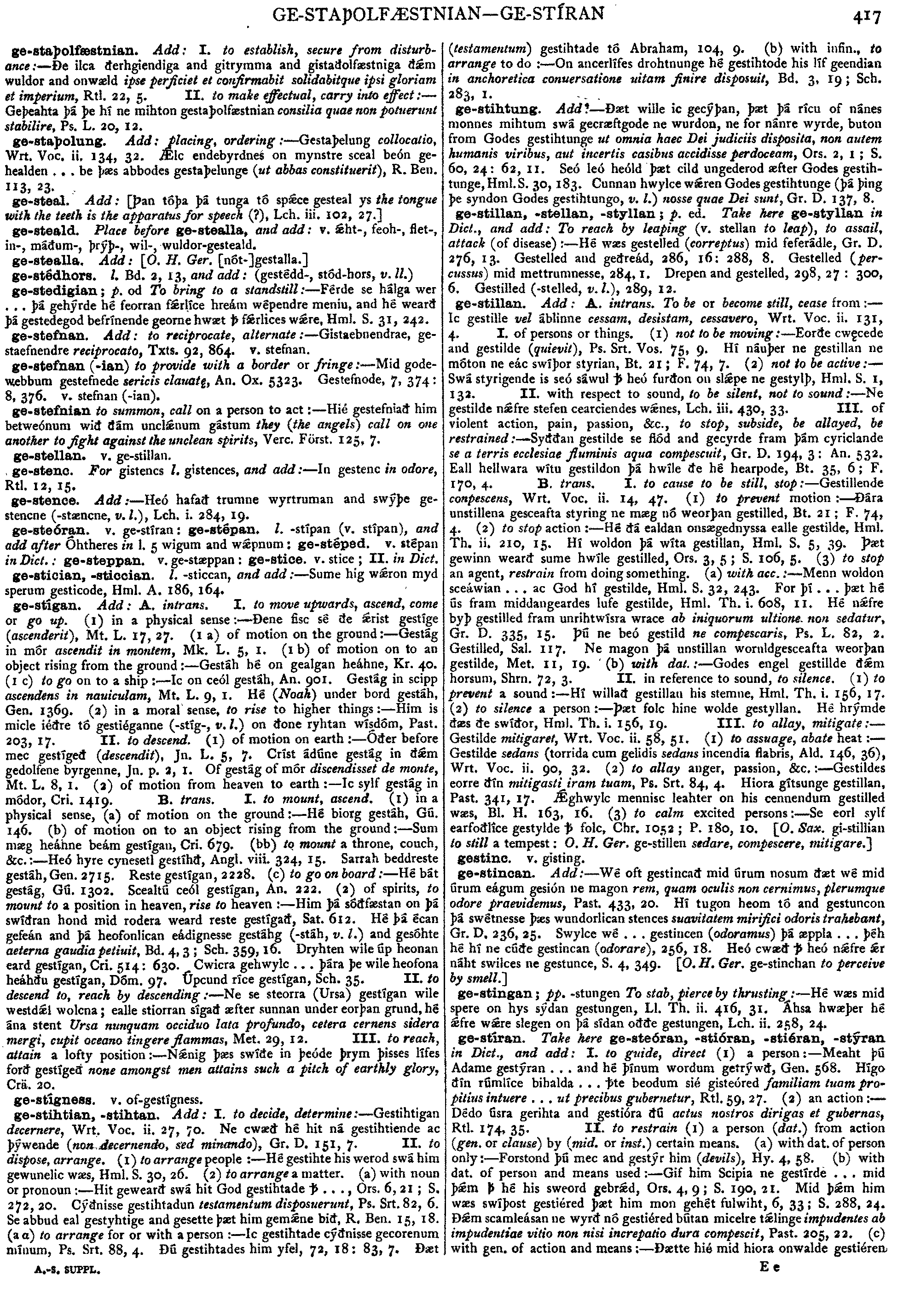
ge-stillan.
Add:
A.
intrans.
To
be
or
become
still,
cease
from
:--
Ic
gestille
itel
áblinne
cessam,
desistam,
cessavero,
Wrt.
Voc.
ii.
131,
4.
I.
of
persons
or
things.
(l)
not
to
be
moving
:--
Eorðe
cwfcede
and
gestilde
(quievii),
Ps.
Srt.
Vos.
75,
9.
Hi
náuþer
ne
gestillan
ne
móton
ne
eác
swíþor
styrian,
Bt.
21;
F.
74,
7.
(2)
not
to
be
active
:--
Swá
styrigende
is
seó
sáwul
j>
heó
furðon
on
slpe
ne
gestylþ,
Hml.
S.
l,
132.
ZI.
with
respect
to
sound,
to
be
silent,
not
to
sound
:--
Ne
gestilde
nfre
stefen
cearciendes
wnes.
Lch.
iii.
430,
33.
III.
of
violent
action,
pain,
passion,
&c.
,
to
stop,
subside,
be
allayed,
be
restrained:
--
Syððan
gestilde
se
flód
and
gecyrde
fram
þám
cyriclande
se
a
terris
ecclesiae
fiuminis
aqua
compescuit,
Gr.
D.
194,
3
:
An.
532.
Eall
hellwara
witu
gestildon
þá
hwíle
ðe
hé
hearpode,
Bt.
35,
6;
F.
170,
4.
B.
trans.
I.
to
cause
to
be
still,
stop
:--
Gestillende
conpescens,
Wrt.
Voc.
ii.
14,
47.
(l)
to
prevent
motion
:--
Ðára
unstillena
gesceafta
styring
ne
mæg
ná
UNCERTAIN
weorþan
gestilled.
Bt.
21;
F.
74,
4.
(2)
to
stop
action
:--
Hé
ðá
ealdan
onsægednyssa
ealle
gestilde,
Hml.
Th.
ii.
210,
15.
Hi
woldon
þá
wíta
gestillan,
Hml.
S.
5,
39.
Þæt
gewinn
wearð
sume
hwíle
gestilled,
Ors.
3,
5
;
S.
106,
5.
(3)
to
stop
an
agent,
restrain
from
doing
something,
(a)
with
acc.
:--
Menn
woldon
sceáwian
.
.
.
ac
God
hi
gestilde,
Hml.
S.
32,
243.
For
þí
.
.
.
þæt
he
us
fram
middangeardes
lufe
gestilde,
Hml.
Th.
i.
608,
ii.
Hé
nfre
byþ
gestilled
fram
unrihtwlsra
wrace
ab
iniquorum
ultione.
non
sedatur,
Gf-
D-
335.
15
PS
ne
beo
gestild
ne
compescaris.
Ps.
L.
82,
2.
Gestilled,
Sal.
117.
Ne
magon
þá
nnstillan
woruldgesceafta
weorþan
gestilde,
Met.
Ii,
19.
'
(b)
with
rfat.
:--
Godes
engel
gestillde
ðm
horsum.
Shrn.
72,
3.
II.
in
reference
to
sound,
to
silence,
(l)
to
prevent
a
sound
:--
Hi
willað
gestillan
his
stemne.
Hml.
Th.
i.
156,
17.
(2)
to
silence
a
person
:--
JJæt
folc
hine
wolde
gestyllan.
Hé
hrymde
ðæs
ðe
swiðor,
Hml.
Th.
i.
156,
19.
III.
to
allay,
mitigate
:--
Gestilde
miligaret,
Wrt.
Voc.
ii.
58,
51.
(l)
to
assuage,
abate
heat
:--
Gestilde
sedans
(torridacum
gelidis
sedans
incendia
flabris,
Aid.
146,
36),
Wrt.
Voc.
ii.
90,
32.
(2)
to
allay
anger,
passion,
&c.
:--
Gestildes
eorre
ðín
mitigasti
iram
tuam,
Ps.
Srt.
84,
4.
Hiora
gitsunge
gestillan,
Past.
341,
17.
Æ-acute;ghwylc
mennisc
leahter
on
his
cennendum
gestilled
wæs,
Bl.
H.
163,
16.
(3)
to
calm
excited
persons
:--
Se
eorl
sylf
earfoðlíce
gestylde
-&
pound;
folc,
Chr.
1052
;
P.
180,
10.
[O.
Sax.
gi-stillian
to
still
a
tempest:
O.H.Ger.
ge-stillen
sedare,
compescere,
mitigare.
|
Source: Bosworth/Toller, page d0422, entry 13 View original page image as: [TIFF] [PNG] [View previous entry] [View next entry] |
[Comment on this entry] [View comments (1)] |
The following entry has been hand-corrected once. |
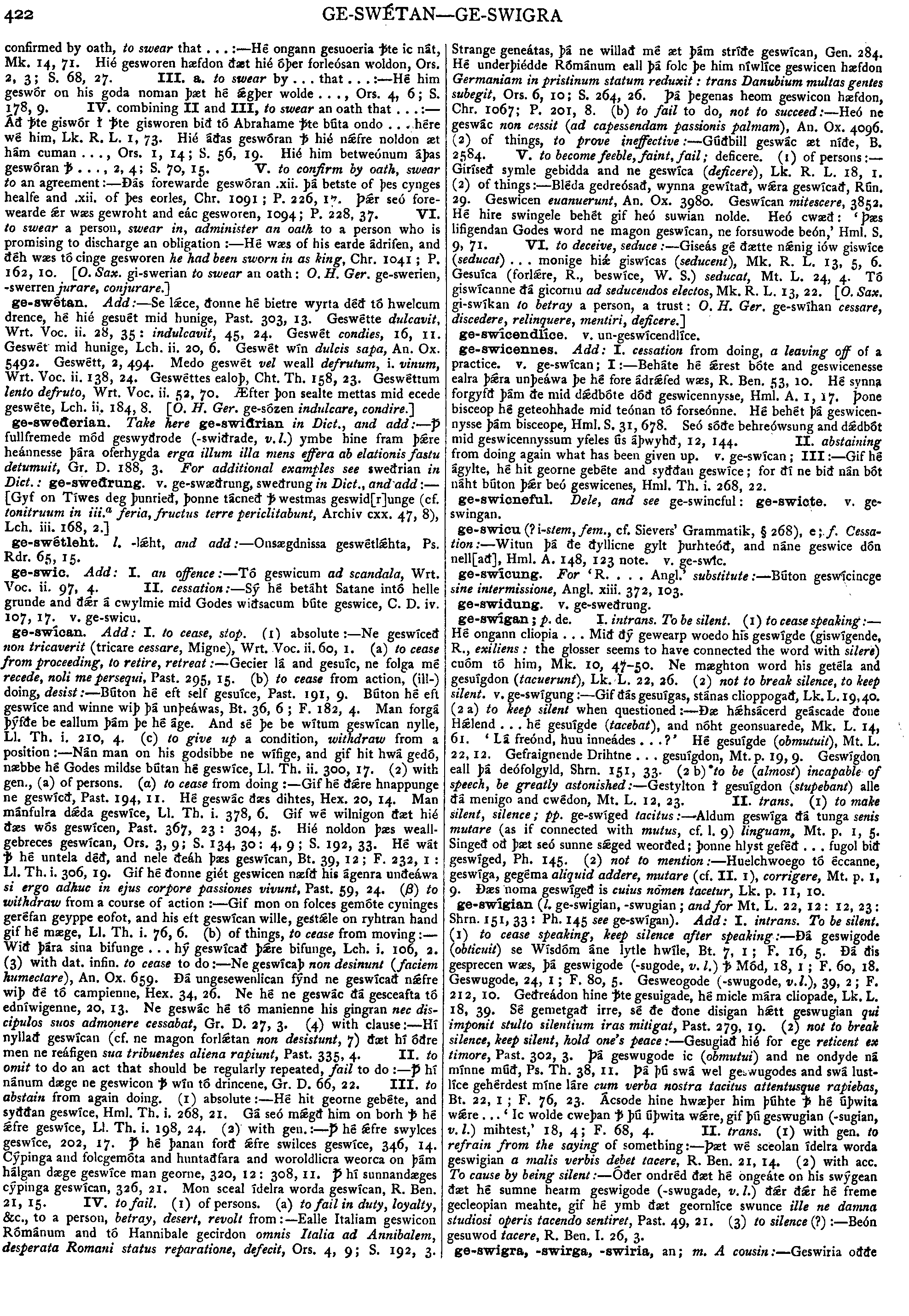
ge-swígan
5
p.
de.
1.
intrans.
To
be
silent.
(I)
to
cease
speaking
:--
Hé
ongann
cliopia
.
.
.
Mið
ðý
gewearp
woedo
his
geswígde
(giswígende,
R.,
exiliens
:
the
glosser
seems
to
have
connected
the
word
with
silere)
cuóm
tó
him,
Mk.
10,
47-50.
Ne
mæghton
word
his
getéla
and
gesuígdon
(tacuerunt),
Lk.
L.
22,
26.
(2)
not:
to
break
silence,
to
keep
silent,
v.
ge-swígung
:--
Gif
ðás
gesuígas,
stánas
clioppogað,
Lk.
L.
19,
40.
(2
a)
to
keep
silent
when
questioned
:--
Ðæ
hhsácerd
geáscade
ðone
Hlend
.
.
.
hé
gesulgde
(tacebat),
and
nóht
geonsuarede,
Mk.
L.
14,
61.
'
Lá
freónd,
huu
inneádes.
.
.
?'
Hé
gesuígde
(obmutait),
Mt.
L.
22,
12.
Gefraignende
Drihtne
.
.
.
gesuígdon,
Mt.
p.
19,
9.
Geswígdon
eall
þá
deófolgyld,
Shrn.
151,
33.
(2b)
to
be
(almost)
incapable
of
speech,
be
greatly
astonished
:--
Gestylton
 gesuígdon
(stupebant)
alle
ðá
menigo
and
cwédon,
Mt.
L.
12,
23.
II.
trans.
(1)
to
make
silent,
silence;
pp.
ge-swíged
tacitus
:--
-Aldum
geswíga
ðá
tunga
senis
mutare
(as
if
connected
with
mutus,
cf.
l.
9)
linguam.
Mt.
p.
1,
5.
Singeð
oð
þæt
seó
sunne
sged
weorðed;
þonne
hlyst
geféð
.
.
.
fugol
bið
geswíged,
Ph.
145.
(2)
not
to
mention
:--
Huelchwoego
tó
éccanne,
geswíga,
gegéma
aliquid
addere,
mutare
(cf.
II.
1),
corrigere,
Mt.
p.
1.
9.
Ðæs
noma
geswígeð
is
cuius
nómen
tacetur,
Lk.
p.
11,
10.
gesuígdon
(stupebant)
alle
ðá
menigo
and
cwédon,
Mt.
L.
12,
23.
II.
trans.
(1)
to
make
silent,
silence;
pp.
ge-swíged
tacitus
:--
-Aldum
geswíga
ðá
tunga
senis
mutare
(as
if
connected
with
mutus,
cf.
l.
9)
linguam.
Mt.
p.
1,
5.
Singeð
oð
þæt
seó
sunne
sged
weorðed;
þonne
hlyst
geféð
.
.
.
fugol
bið
geswíged,
Ph.
145.
(2)
not
to
mention
:--
Huelchwoego
tó
éccanne,
geswíga,
gegéma
aliquid
addere,
mutare
(cf.
II.
1),
corrigere,
Mt.
p.
1.
9.
Ðæs
noma
geswígeð
is
cuius
nómen
tacetur,
Lk.
p.
11,
10.
|
Source: Bosworth/Toller, page d0422, entry 14 View original page image as: [TIFF] [PNG] [View previous entry] [View next entry] |
[Comment on this entry] [View comments] |
The following entry has been hand-corrected once. |
ge-swígian
(l.
ge-swigian,
-swugian;
and
for
Mt.
L.
22,
12:
12,
23:
Shrn.
151,
33:
Ph.
145
see
ge-swígan).
Add:
I.
intrans.
To
be
silent.
(1)
to
cease
speaking,
keep
silence
after
speaking
:--
Dá
geswigode
(o
obticuit)
se
Wísdóm
áne
lytle
hwíle,
Bt.
7,
1
;
F.
16,
5.
Ðá
ðis
gesprecen
wæs,
þá
geswigode
(-sugode,
v.
l.)
Mód.
18,
1
;
F.
60,
18.
Geswugode,
24,
1;
F.
80,
5.
Gesweogode
(-swugode,
v.
l.
),
39,
2
;
F.
212,
10.
Geðreádon
hine
þte
gesuigade,
hé
micle
mára
cliopade,
Lk.
L.
18,
39.
Sé
gemetgað
irre,
sé
ðe
ðone
disigan
htt
geswugian
qui
imponit
slulto
silentium
iras
mitigat,
Past.
279,
19.
(2)
not
to
break
silence,
keep
silent,
hold
one's
peace
:--
Gesugiað
hié
for
ege
reticent
ex
timore,
Past.
302,
3.
þá
geswugode
ic
(obmutui)
and
ne
ondyde
ná
mínne
múð,
Ps.
Th.
38,
11.
þá
þú
swá
wel
ge-wugodes
and
swá
lust láice
gehérdest
míne
láre
cum
verba
nostra
tacitus
attentusque
rapiebas,
Bt.
22,
1
;
F.
76,
23.
Ácsode
hine
hwæþer
him
þ
úhte
hé
úþwita
wre
.
.
.
'
Ic
wolde
cweþan
þú
úþwita
wre,
gif
þú
geswugian
(-sugian,
v.l.)
mihtest,
'
18,
4;
F.
68,
4.
II.
trans.
(1)
with
gen.
to
refrain
from
the
saying
of
something
:--
þæt
wé
sceolan
ídelra
worda
geswigian
a
mails
verbis
debet
tacere,
R.
Ben.
21,
14.
(2)
with
acc.
To
cause
by
being
silent
:--
Óðer
ondréd
ðæt
hé
óngeáte
on
his
swýgean
ðæt
hé
sumne
hearm
geswigode
(-swugade,
v.
l.)
ðr
ðr
hé
freme
gecleopian
meahte,
gif
hé
ymb
ðæt
geornlíce
swunce
ille
ne
damna
studiosi
operis
tacendo
sentiret,
Past.
49,
21.
(3)
to
silence
(?)
:--
Beón
gesuwod
tacere,
R.
Ben.
1.
26,
3.
láice
gehérdest
míne
láre
cum
verba
nostra
tacitus
attentusque
rapiebas,
Bt.
22,
1
;
F.
76,
23.
Ácsode
hine
hwæþer
him
þ
úhte
hé
úþwita
wre
.
.
.
'
Ic
wolde
cweþan
þú
úþwita
wre,
gif
þú
geswugian
(-sugian,
v.l.)
mihtest,
'
18,
4;
F.
68,
4.
II.
trans.
(1)
with
gen.
to
refrain
from
the
saying
of
something
:--
þæt
wé
sceolan
ídelra
worda
geswigian
a
mails
verbis
debet
tacere,
R.
Ben.
21,
14.
(2)
with
acc.
To
cause
by
being
silent
:--
Óðer
ondréd
ðæt
hé
óngeáte
on
his
swýgean
ðæt
hé
sumne
hearm
geswigode
(-swugade,
v.
l.)
ðr
ðr
hé
freme
gecleopian
meahte,
gif
hé
ymb
ðæt
geornlíce
swunce
ille
ne
damna
studiosi
operis
tacendo
sentiret,
Past.
49,
21.
(3)
to
silence
(?)
:--
Beón
gesuwod
tacere,
R.
Ben.
1.
26,
3.
|
Source: Bright's OE Grammar, page b0283, entry 19 View original page image as: [TIFF] [PNG] [View previous entry] [View next entry] |
[Comment on this entry] [View comments] |
The following entry has been hand-corrected once. |
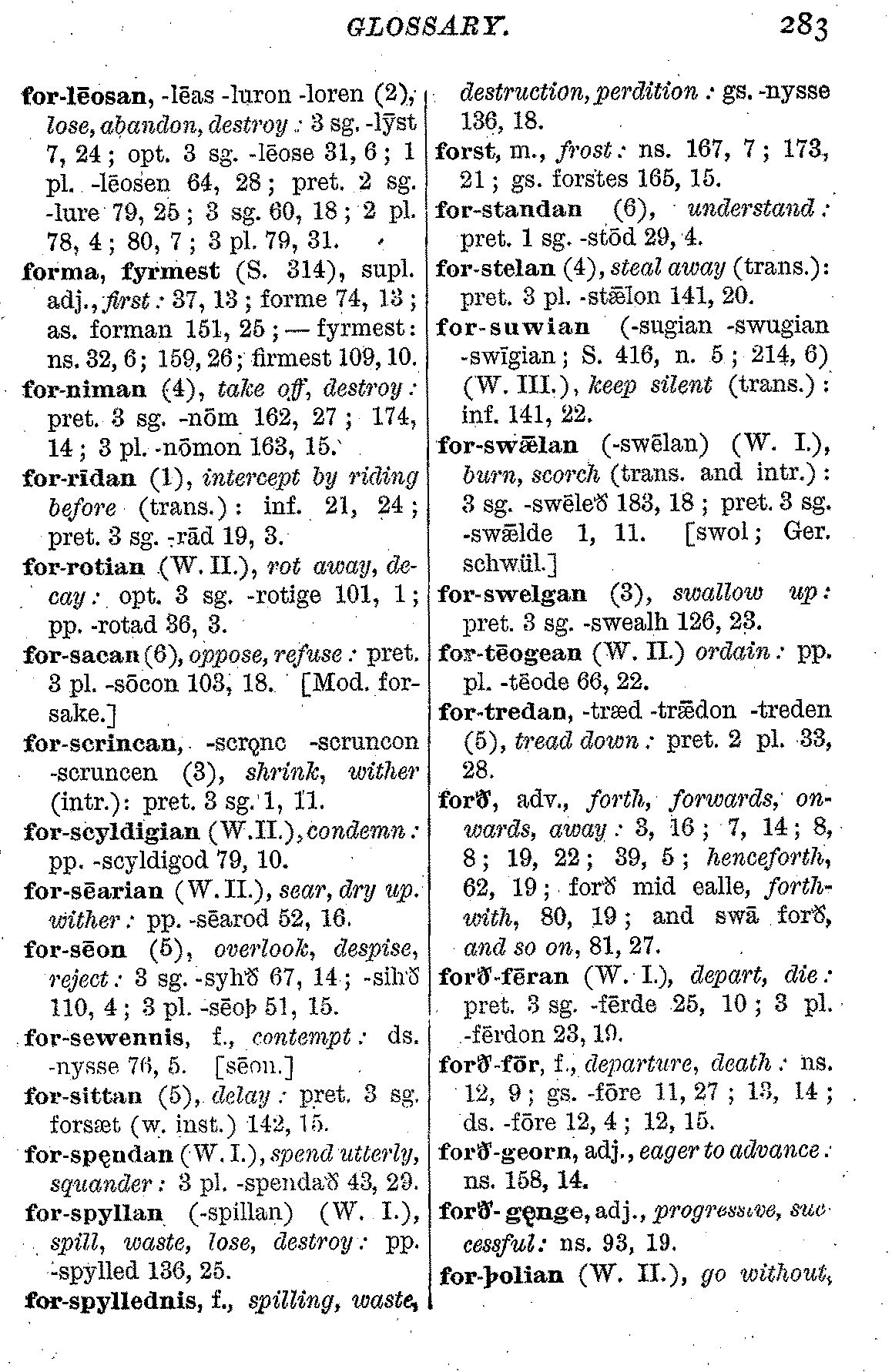
for-suwian
(-sugian
-swugian
-sw gian)
WIII
keep
silent
(trans)
gian)
WIII
keep
silent
(trans)
|
Source: Bright's OE Grammar, page b0358, entry 1 View original page image as: [TIFF] [PNG] [View previous entry] [View next entry] |
[Comment on this entry] [View comments] |
The following entry has been hand-corrected once. |
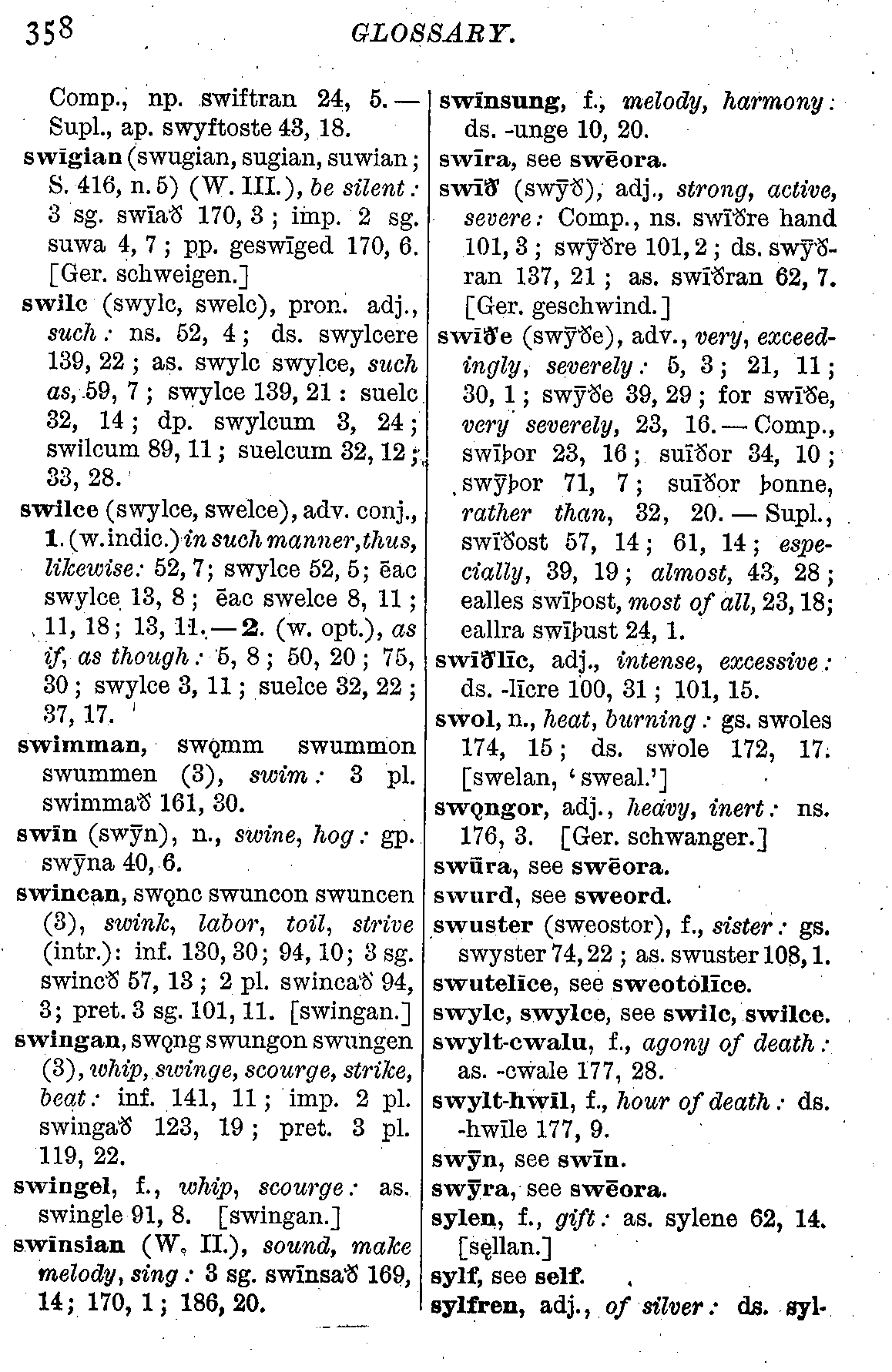
swgian
(swugian,
sugian,
suwian)
WIII
be
silent
|
Source: Cleasby/Vigfusson, page b0041, entry 132 View original page image as: [TIFF] [PNG] [View previous entry] [View next entry] |
[Comment on this entry] [View comments] |
The following entry has been hand-corrected once. |
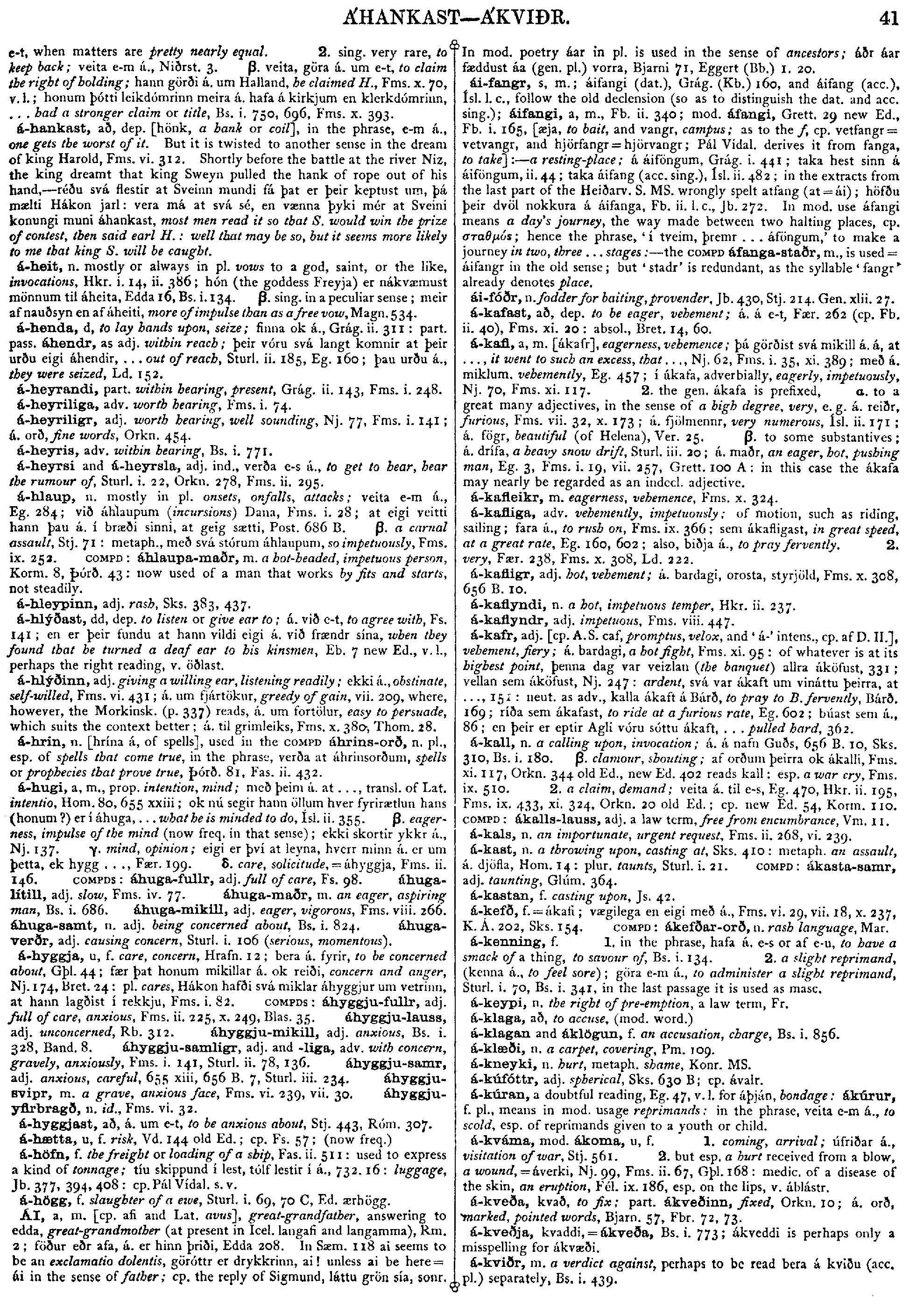
ÁR, adv. I. Lat. olim [Ulf. air = GREEK; Engl. yore], used nearly as a substantive followed by a gen., but only in poetry; in the phrase, ár var alda, in times of yore, in principio, Vsp. 3, Hkv. 2. 1: also, ár var þaz (= þat es), the beginning of some of the mythical and heroical poems, Skv. 3. i, Gkv. 1. 1; cp. árdagar. II. Lat. mane [A. S. ær; O. H. G. êr; cp. Gr. GREEK, Engl. early, Icel. árla], rare, (the prolonged form árla is freq.); it, however, still exists in the Icel. common phrase, með morgunsárinu (spelt and proncd. in a single word), primo diluculo; elsewhere poet, or in laws, ár of morgin, early of a morning, Hðm. verse 1, Grág. ii. 280; rísa ár, to rise early, Hm. 58, 59; ár né um nætr, Hkv. 2. 34, etc.; í ár, adverb. = early, Ísl. ii. (Hænsa Þór. S.) 161; snemma í ár, Ld. 46, MS., where the Ed. um morgininn í ár, Fas. i. 503: it also sometimes means for ever, svá at ár Hýmir ekki mælti, for an age he did not utter a word, remained silent as if stupefied, Hým. 25, Lex. Poët.; ara þúfu á skaltu ár sitja, Skm. 27; cp. the mod. phrase, ár ok síð og allan tíð, early and late and always. In compds = Lat. matutinus.
|
Source: Cleasby/Vigfusson, page b0105, entry 16 View original page image as: [TIFF] [PNG] [View previous entry] [View next entry] |
[Comment on this entry] [View comments] |
The following entry has not been hand-corrected. However, the page is reserved and someone is correcting it. |
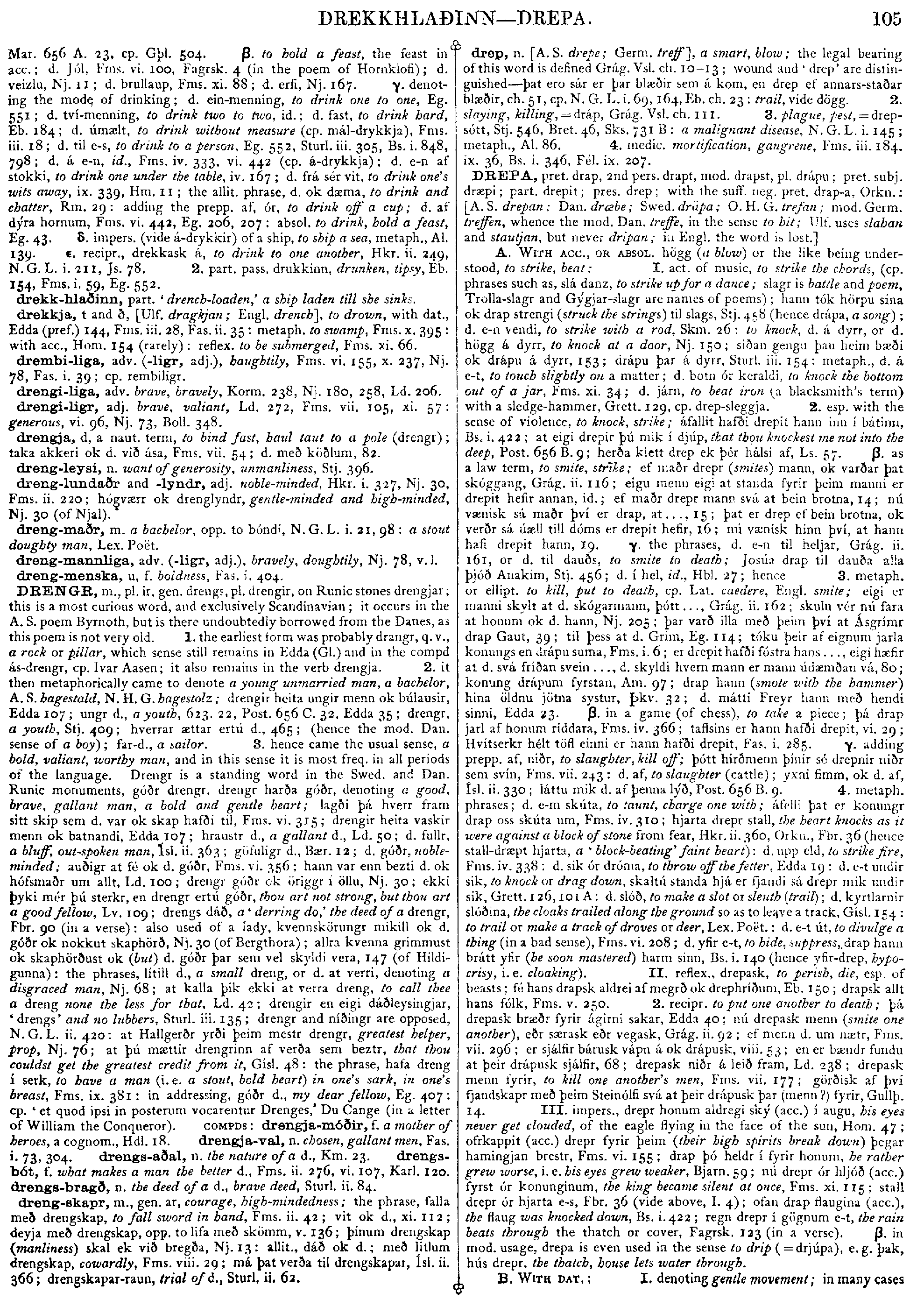
DREPA, pret. drap, 2nd pers. drapt, mod. drapst, pl. drápu; pret. subj. draepi; part, drepit; pres. drep; with the suft". neg. pret. drap-a. Orkn.: [A. S. drepan; Dan. drœbe; Swed. drapa; O. H. G. trefan; mod. Germ. treffen, whence the mod. Dan. treffe, in the sense to hit; Ulf. uses slahan and stautjan, but never dripan; in Engl. the word is lost.] A. WITH ACC., OR ABSOL. högg (a blow) or the like being under- stood, to strike, beat: I. act. of music, to strike the chords, (cp. phrases such as, slá danz, to strike up for a dance; slagr is battle and poem, Trolla-slagr and Gygjar-slagr are names of poems); hann tók hörpu sína ok drap strengi (struck the strings) til slags, Stj. 458 (hence drápa, a so?ig); d. e-n vendi, t o s trike with a rod, Skm. 26: to knock, å. á dyrr, or d. hogg á dyrr, to knock at a door, Nj. 150; síðan gengu þau heim bæði ok drápu á dyrr, 153; cirápu þar á dyrr, Sturl. iii. 154: metaph., d. á e-t, to tou c h slightly on a matter; d. botn or keraldi, to knock the bottom out of a jar, Fms. xi. 34; d. jam, to beat iron (a blacksmith's term) with a sledge-hammer, Grett. 129, cp. drep-sleggja. 2. esp. with the sense of violence, to knock, strike; áfallit hafði drepit hann inn í bátinn, Bs. i. 422; at eigi drepir þú mik í djúp, that thou knockest me not into the deep, Post. 6568. 9; herða klett drep ek þór hálsi af, Ls. 57. p. as a law term, to smite, strike; ef maðr drepr (smites) mann, ok varðar þat skóggang, Grág. ii. 116; eigu menu eigi at standa fyrir þeim inanni er drepit hefir annan, id.; ef maðr drepr mann svá at bein brotna, 14; nú vænisk sá maðr því er drap, at..., 15; þat er drep cf bein brotna, ok verðr sá úæll till dóms er drepit hefir, 16; mi vænisk hinn því, at hann hafi drepit hann, 19. y- tnc phrases, d. e-n til heljar, Grág. ii. 161, or d. til dauðs, to smite todeath; Josua drap til dauða alia þjóð Anakim, Stj. 456; d. í hel, id., Hbl. 27; hence 3. metaph. or ellipt. to kill, pwt todeath, cp. Lat. caedere, Engl. smite; eigi er manni skylt at d. skógarmann, þótt..., Grág. ii. 162; skulu vór mi fara at honum ok d. hann, Nj. 205; þar varð ilia með þeim því at Ásgrímr drap Gaut, 39; til þess at d. Grim, Eg. 114; tóku þeir af eignum jarla konungs en drápu suma, Fms. i. 6; er drepit hafði fóstra hans ..., eigi hæfir at d. svá fríðan svein ..., d. skyldi hvern mann er mann údæmðan vá, 80; konung drápum fyrstan, Am. 97; drap hann (smote with the hammer) hina öldnu jötna systur, ^kv. 32; d. mátti Freyr hann með hendi sinni, Edda 23. p. in a game (of chess), to take a piece; þá drap jarl af honum riddara, Fms. iv. 366; îaflsins er hann hafði drepit, vi. 29; Hvítserkr hélt töfl einni er hann hafði drepit, Fas. i. 285. y. adding prepp. af, niðr, to slaughter, kill off'; þótt hirðmenn þínir so drepnir niðr sem svín, Fms. vii. 243: d. af, to slaughter (cattle); yxni fimm, ok d. af, Ísl. ii. 330; láttu mik d. af þenna lyð, Post. 656 B. 9. 4. metaph. phrases; d. e-m skúta, to taunt, charge one with; áfelli þat er konungr drap oss skvita um, Fms. iv. 310; hjarta drepr stall, the heart knocks as it were against a block of stone from fear, Hkr. ii. 360, Orkn., Fbr. 36 (hence stall-dræpt hjarta, a ' block-beating'faint heart): d. upp eld, to strike fire, Fms. iv. 338: d. sik or droma, to throw off the fetter, Edda 19: d. e-t undir sik, to kn oc k or dra g- down, skahii standa hjá er fjandi sá drepr mik undir sik, Grett. 126, 101 A: d. slóð, to make a slot or sleuth (trail); d. kyrtlarnir slóðina, the cloaks trailed along the ground so as to lea. vea track, Gísl. 154: to trail or w ake a tr ac k of droves or deer, Lex. Poët.: d. e-t út, to divulge a thing (in a bad sense), Fms. vi. 208; d. yfir e-t, to hide, suppress,, dTzp hann brátt yfir (he soo n mastered) harm sinn, Bs. i. 140 (hence yfir-drep, hyp o- c ri s y, i. e. cloaking). II. reflex., drepask, to perish, die, esp. of beasts; fé hans drapsk aldrei af megrð ok drephríðum, Eb. 150; drapsk allt hans folk, Fms. v. 250. 2. recipr. to put one another to death; þá drepask bræðr fyrir ágirni sakar, Edda 40; mi drepask merm (smite one another), eðr særask eðr vegask, Grág. ii. 92; ef menu d. um nætr, Fms. vii. 296; er sjálfir bárusk vápn á ok drápusk, viii. 53; en er bændr fundu at þeir drápusk sjálfir, 68; drepask niðr á ieið fram, Ld. 238; drepask menn fyrir, to killone another's men, Fms. vii. 17?! görðisk af því fjandskapr með þeim Steinólfi svá at þeir drápusk þar (menn ?) fyrir, Gullþ. 14. III. impers., drepr honum aldregi ský (acc.) í augu, hi s eyes never get clouded, of the eagle flying in the face of the sun, Hom. 47; ofrkappit (acc.) drepr fyrir þeim (their high spirits break down) þegar hamingjan brestr, Fms. vi. 155; drap þó heldr í fyrir honum, he rather grew worse, i. e. his eyes . gr ew weaker, Bjarn. 59; nú drcpr ór hljóð (acc.) fyrst or konunginum, the kin g" became silent at once, Fms. xi. 115; stall drepr or hjarta e-s, Fbr. 36 (vide above, I. 4); ofan drap flaugina (acc.), the flaug wa s knocked down, Bs. 1. 422; regn drepr í gögnum e-t, the rain beats through the thatch or cover, Fagrsk. 123 (in a verse). p. in mod. usage, drepa is even used in the sense to drip (= drjupa), e. g. þak, hús drepr, the thatch, house lets water B. WITH DAT,; I. denoting gentle movement; in many cases
|
Source: Cleasby/Vigfusson, page b0109, entry 11 View original page image as: [TIFF] [PNG] [View previous entry] [View next entry] |
[Comment on this entry] [View comments] |
The following entry has not been hand-corrected. However, the page is reserved and someone is correcting it. |
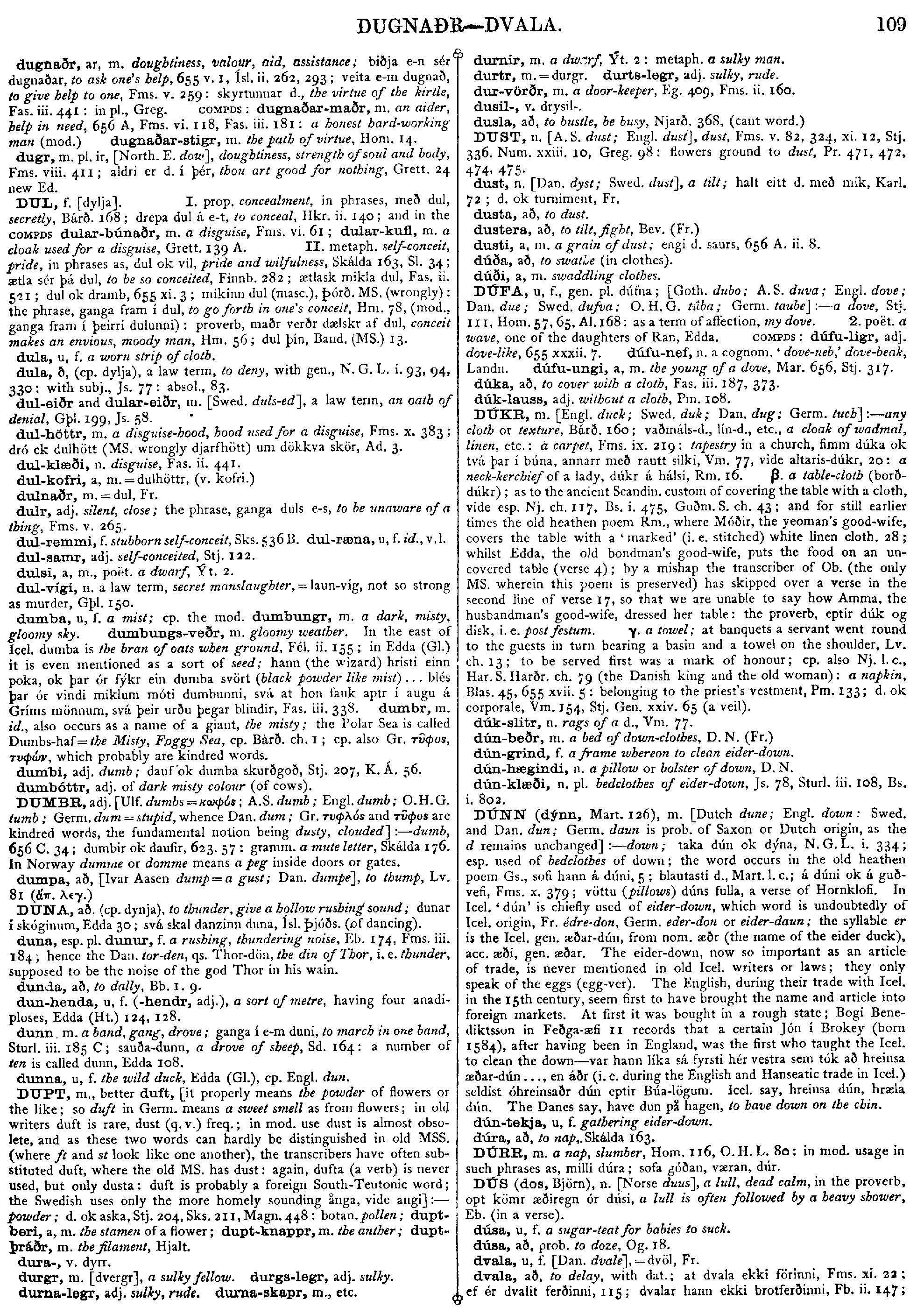
dulr, adj. silent, close; the phrase, ganga duls e-s, to be unaware of a thing, Fms. v. 265.
|
Source: Cleasby/Vigfusson, page b0128, entry 2 View original page image as: [TIFF] [PNG] [View previous entry] [View next entry] |
[Comment on this entry] [View comments] |
The following entry has not been hand-corrected. However, the page is reserved and someone is correcting it. |
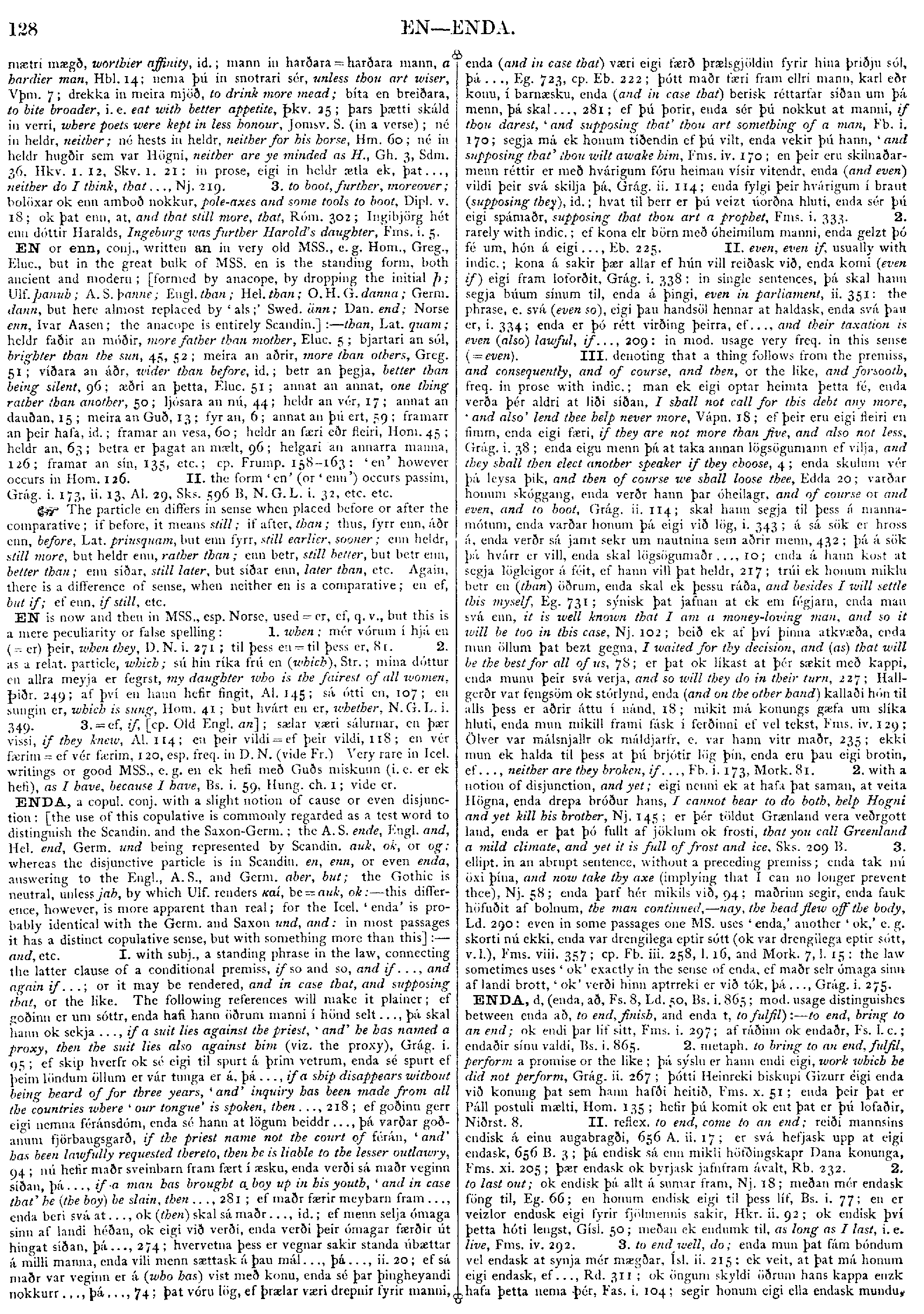
EN or enn, conj., written an in very old MSS., e. g. Hom., Greg., Eluc., but in the great bulk of MSS. en is the standing form, both ancient and modern; [formed by anacope, by dropping the initial þ; Ulf. fjanub; A. S. þanne; Engl. than; Hel. than; O. H. G. danna; Germ. dann, but here almost replaced by ' als;' Swed. unn; Dan. end; Norse enn, Ivar Aasen; the anacope is entirely Scandin.] :-- than, Lat. quam; heldr faðir an móðir, more father than mother, Eluc. 5; bjartari an sol, brighter than the sun, Æí, C2; meira an aðrir, more than others. Grep. o t ' ^i*" *' 7 o 51; viðara an áðr, wider than before, id.; betr an þegja, better than being silent, 96; æðri an þetta, Eluc. 51; annat an annat, one thing rather 'ban another, 50; Ijosara an mi, 44; heldr an vér, 17; annat an dauðan, 15; meira an Guð, 13; fyr an, 6; annat an þú ert, 59; framarr an þeir hafa, id.; framar an vesa, 60; heldr an færi eðr fleiri, Hom. 45; heldr an, 63; betra er þagat an mælt, 96; helgari an annarra manna, 126; framar an sin. 135, etc.; cp. Frump. 158-163: 'en' however occurs in Hom. 126. II. the form ' en' (or ' enn') occurs passim, Grág. i. 173, ii. 13, Al. 29, Sks. 596 B, N. G. L. i. 32, etc. etc. &&* The particle en differs in sense when placed before or after the comparative; if before, it means still; if after, than; thus, fyrr enn, áðr enn, before, Lat. prinsqnam, but enn fyrr, still earlier, sooner; enn heldr, still more, but heldr enn, rather than; enn betr, s till better, but betr enn, better than; enn síðar, s till late r, but síðar enn, later than, etc. Again, there is a difference of sense, when neither en is a comparative; en ef, but if; ef enn, if still, etc.
| Result Page: |  |
Previous | 1 2 3 4 5 6 7 8 | Next |  |
Germanic Lexicon Project (main page)
This search system was written by
Sean Crist
Please consider
volunteering
to correct the data in these online dictionaries.
No rights reserved. Feel free to use these data in any way you please.