|
|

Search for si again, using less strict matching (1304 results)
|
Source: Bosworth/Toller, page b0182, entry 6 View original page image as: [TIFF] [PNG] [View previous entry] [View next entry] |
[Comment on this entry] [View comments] |
The following entry has been hand-corrected once. |
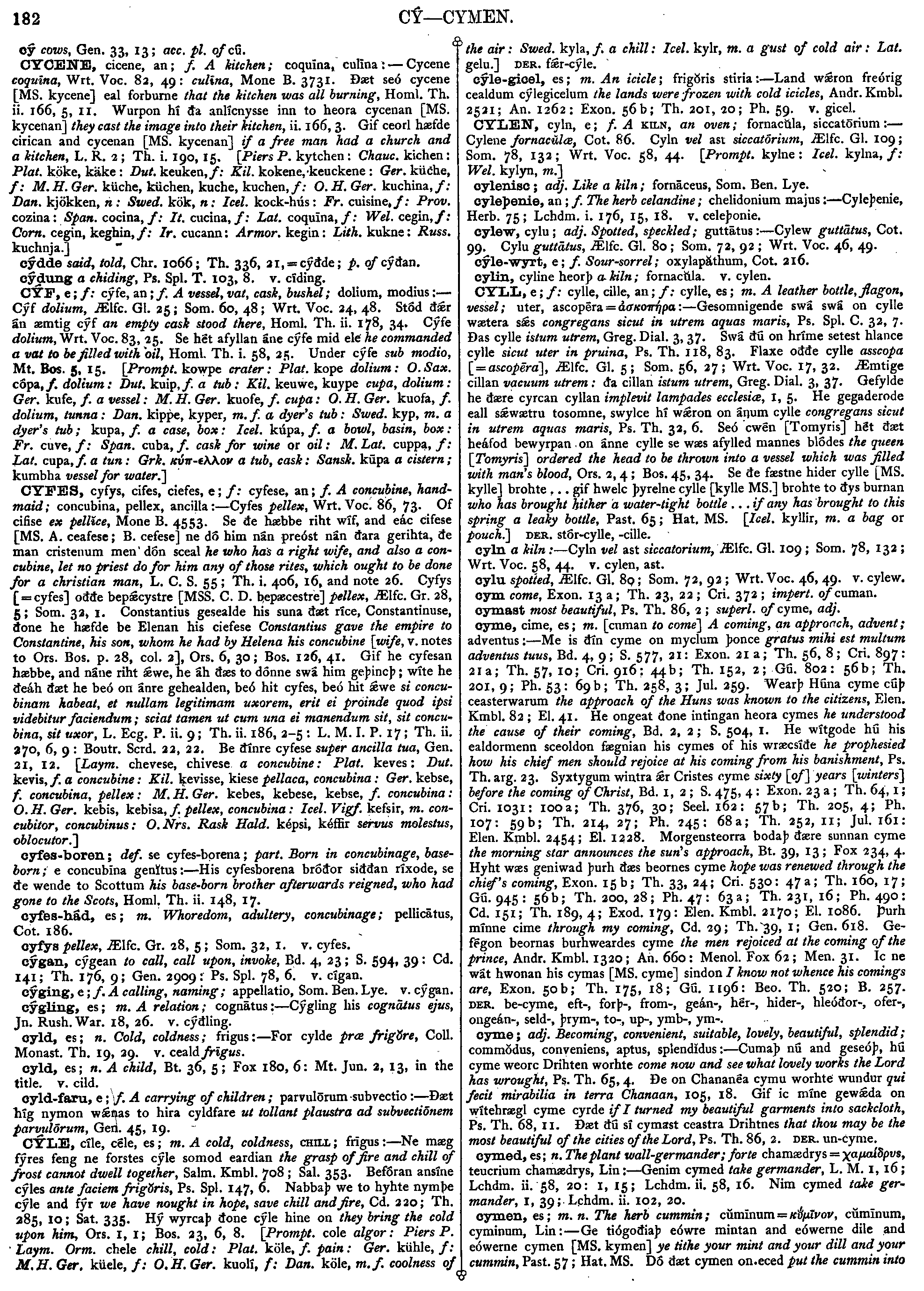
CYFES,
cyfys,
cifes,
ciefes,
e;
f:
cyfese,
an;
f.
A
concubine,
handmaid;
concubina,
pellex,
ancilla
:--
Cyfes
pellex,
Wrt.
Voc.
86,
73.
Of
cifise
ex
pell ce,
Mone
B.
4553.
Se
ðe
hæbbe
riht
wíf,
and
eác
cifese
[MS.
A.
ceafese;
B.
cefese]
ne
dó
him
nán
preóst
nán
ðara
gerihta,
ðe
man
cristenum
men
dón
sceal
he
who
has
a
right
wife,
and
also
a
concubine,
let
no
priest
do
for
him
any
of
those
rites,
which
ought
to
be
done
for
a
christian
man,
L.
C.
S.
55;
Th.
i.
406,
16,
and
note
26.
Cyfys
[
=
cyfes]
oððe
bep
ce,
Mone
B.
4553.
Se
ðe
hæbbe
riht
wíf,
and
eác
cifese
[MS.
A.
ceafese;
B.
cefese]
ne
dó
him
nán
preóst
nán
ðara
gerihta,
ðe
man
cristenum
men
dón
sceal
he
who
has
a
right
wife,
and
also
a
concubine,
let
no
priest
do
for
him
any
of
those
rites,
which
ought
to
be
done
for
a
christian
man,
L.
C.
S.
55;
Th.
i.
406,
16,
and
note
26.
Cyfys
[
=
cyfes]
oððe
bep cystre
[MSS.
C.
D.
bepæcestre]
pellex,
Ælfc.
Gr.
28,
5;
Som.
32,
1.
Constantius
gesealde
his
suna
ðæt
ríce,
Constantinuse,
ðone
he
hæfde
be
Elenan
his
ciefese
Constantius
gave
the
empire
to
Constantine,
his
son,
whom
he
had
by
Helena
his
concubine
[wife,
v.
notes
to
Ors.
Bos.
p.
28,
col.
2],
Ors.
6,
30;
Bos.
126,
41.
Gif
he
cyfesan
hæbbe,
and
náne
riht
we,
he
áh
ðæs
to
dónne
swá
him
geþincþ;
wíte
he
ðeáh
ðæt
he
beó
on
ánre
gehealden,
beó
hit
cyfes,
beó
hit
we
si
concubinam
habeat,
et
nullam
legitimam
uxorem,
erit
ei
proinde
quod
ipsi
videbitur
faciendum;
sciat
tamen
ut
cum
una
ei
manendum
sit,
sit
concubina,
sit
uxor,
L.
Ecg.
P.
ii.
9;
Th.
ii.
186,
2-5:
L.
M.
I.
P.
17;
Th.
ii.
270,
6,
9:
Boutr.
Scrd.
22,
22.
Be
ðínre
cyfese
super
ancilla
tua,
Gen.
21,
12.
[Laym.
chevese,
chivese
a
concubine:
Plat.
keves:
Dut.
kevis,
f.
a
concubine:
Kil.
kevisse,
kiese
pellaca,
concubina:
Ger.
kebse,
f.
concubina,
pellex:
M.
H.
Ger.
kebes,
kebese,
kebse,
f.
concubina:
O.
H.
Ger.
kebis,
kebisa,
f.
pellex,
concubina:
Icel.
Vigf.
kefsir,
m.
concubitor,
concubinus:
O.
Nrs.
Rask
Hald.
képsi,
kéffir
servus
molestus,
oblocutor.]
cystre
[MSS.
C.
D.
bepæcestre]
pellex,
Ælfc.
Gr.
28,
5;
Som.
32,
1.
Constantius
gesealde
his
suna
ðæt
ríce,
Constantinuse,
ðone
he
hæfde
be
Elenan
his
ciefese
Constantius
gave
the
empire
to
Constantine,
his
son,
whom
he
had
by
Helena
his
concubine
[wife,
v.
notes
to
Ors.
Bos.
p.
28,
col.
2],
Ors.
6,
30;
Bos.
126,
41.
Gif
he
cyfesan
hæbbe,
and
náne
riht
we,
he
áh
ðæs
to
dónne
swá
him
geþincþ;
wíte
he
ðeáh
ðæt
he
beó
on
ánre
gehealden,
beó
hit
cyfes,
beó
hit
we
si
concubinam
habeat,
et
nullam
legitimam
uxorem,
erit
ei
proinde
quod
ipsi
videbitur
faciendum;
sciat
tamen
ut
cum
una
ei
manendum
sit,
sit
concubina,
sit
uxor,
L.
Ecg.
P.
ii.
9;
Th.
ii.
186,
2-5:
L.
M.
I.
P.
17;
Th.
ii.
270,
6,
9:
Boutr.
Scrd.
22,
22.
Be
ðínre
cyfese
super
ancilla
tua,
Gen.
21,
12.
[Laym.
chevese,
chivese
a
concubine:
Plat.
keves:
Dut.
kevis,
f.
a
concubine:
Kil.
kevisse,
kiese
pellaca,
concubina:
Ger.
kebse,
f.
concubina,
pellex:
M.
H.
Ger.
kebes,
kebese,
kebse,
f.
concubina:
O.
H.
Ger.
kebis,
kebisa,
f.
pellex,
concubina:
Icel.
Vigf.
kefsir,
m.
concubitor,
concubinus:
O.
Nrs.
Rask
Hald.
képsi,
kéffir
servus
molestus,
oblocutor.]
|
Source: Bosworth/Toller, page b0196, entry 7 View original page image as: [TIFF] [PNG] [View previous entry] [View next entry] |
[Comment on this entry] [View comments (1)] |
The following entry has been hand-corrected once. |
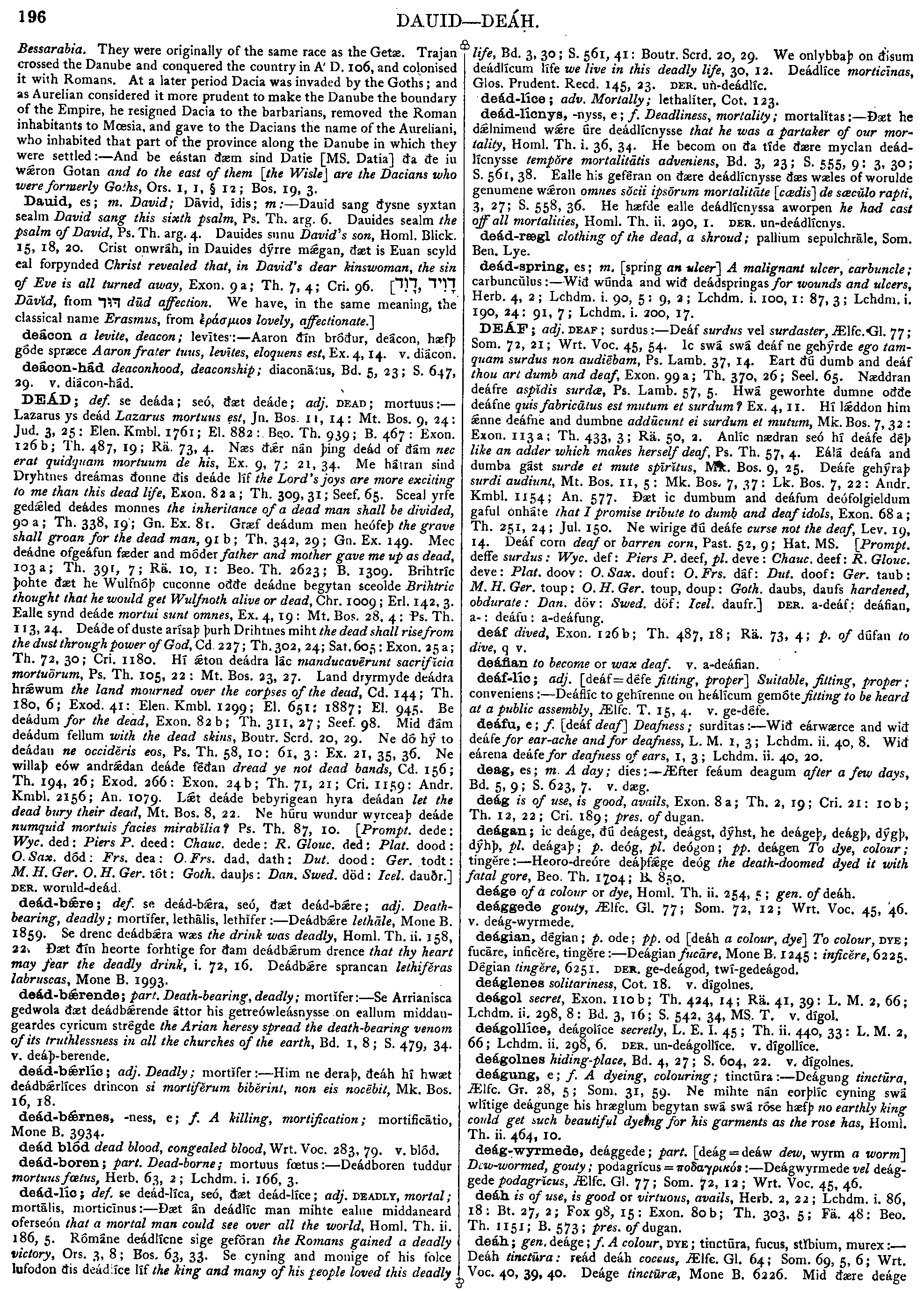
deád-bkrlíc;
adj.
Deadly;
mortfer
:--
Him
ne
deraþ,
ðeáh
hí
hwæt
deádbrlíces
drincon
si
mortif rum
bibrint,
non
eis
noc
rum
bibrint,
non
eis
noc bit,
Mk.
Bos.
16,
18.
bit,
Mk.
Bos.
16,
18.
|
Source: Bosworth/Toller, page b0197, entry 7 View original page image as: [TIFF] [PNG] [View previous entry] [View next entry] |
[Comment on this entry] [View comments] |
The following entry has been hand-corrected once. |
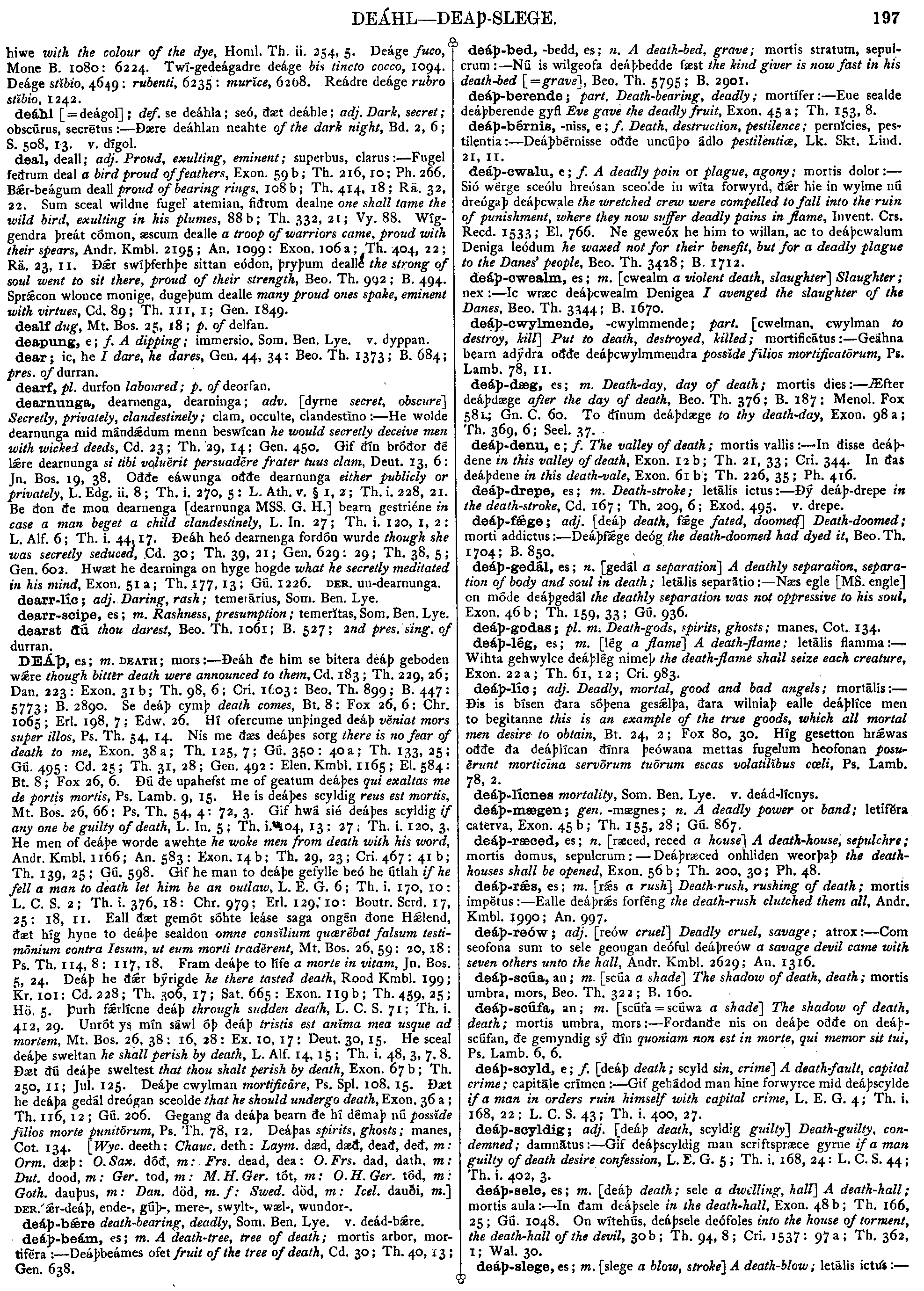
dearnunga,
dearnenga,
dearninga;
adv.
[dyrne
secret,
obscure]
Secretly,
privately,
clandestinely;
clam,
occulte,
clandest no
:--
He
wolde
dearnunga
mid
mánddum
menu
beswícan
he
would
secretly
deceive
men
with
wicked
deeds,
Cd.
23;
Th.
29,
14;
Gen.
450.
Gif
ðín
bróðor
ðé
lre
dearnunga
si
tibi
volurit
persuadre
frater
tuus
clam,
Deut.
13,
6:
Jn.
Bos.
19,
38.
Oððe
eáwunga
oððe
dearnunga
either
publicly
or
privately,
L.
Edg.
ii.
8;
Th.
i.
270,
5:
L.
Ath.
v.
§
1,
2;
Th.
i.
228,
21.
Be
ðon
ðe
mon
dearnenga
[dearnunga
MSS.
G.
H.]
bearn
gestriéne
in
case
a
man
beget
a
child
clandestinely,
L.
In.
27;
Th.
i.
120,
1,
2:
L.
Alf.
6;
Th.
i.
44,
17.
Ðeáh
heó
dearnenga
fordón
wurde
though
she
was
secretly
seduced,
Cd.
30;
Th.
39,
21;
Gen.
629:
29;
Th.
38,
5;
Gen.
602.
Hwæt
he
dearninga
on
hyge
hogde
what
he
secretly
meditated
in
his
mind,
Exon.
51
a;
Th.
177,
13;
Gú.
1226.
DER.
un-dearnunga.
no
:--
He
wolde
dearnunga
mid
mánddum
menu
beswícan
he
would
secretly
deceive
men
with
wicked
deeds,
Cd.
23;
Th.
29,
14;
Gen.
450.
Gif
ðín
bróðor
ðé
lre
dearnunga
si
tibi
volurit
persuadre
frater
tuus
clam,
Deut.
13,
6:
Jn.
Bos.
19,
38.
Oððe
eáwunga
oððe
dearnunga
either
publicly
or
privately,
L.
Edg.
ii.
8;
Th.
i.
270,
5:
L.
Ath.
v.
§
1,
2;
Th.
i.
228,
21.
Be
ðon
ðe
mon
dearnenga
[dearnunga
MSS.
G.
H.]
bearn
gestriéne
in
case
a
man
beget
a
child
clandestinely,
L.
In.
27;
Th.
i.
120,
1,
2:
L.
Alf.
6;
Th.
i.
44,
17.
Ðeáh
heó
dearnenga
fordón
wurde
though
she
was
secretly
seduced,
Cd.
30;
Th.
39,
21;
Gen.
629:
29;
Th.
38,
5;
Gen.
602.
Hwæt
he
dearninga
on
hyge
hogde
what
he
secretly
meditated
in
his
mind,
Exon.
51
a;
Th.
177,
13;
Gú.
1226.
DER.
un-dearnunga.
|
Source: Bosworth/Toller, page b0211, entry 24 View original page image as: [TIFF] [PNG] [View previous entry] [View next entry] |
[Comment on this entry] [View comments] |
The following entry has been hand-corrected once. |
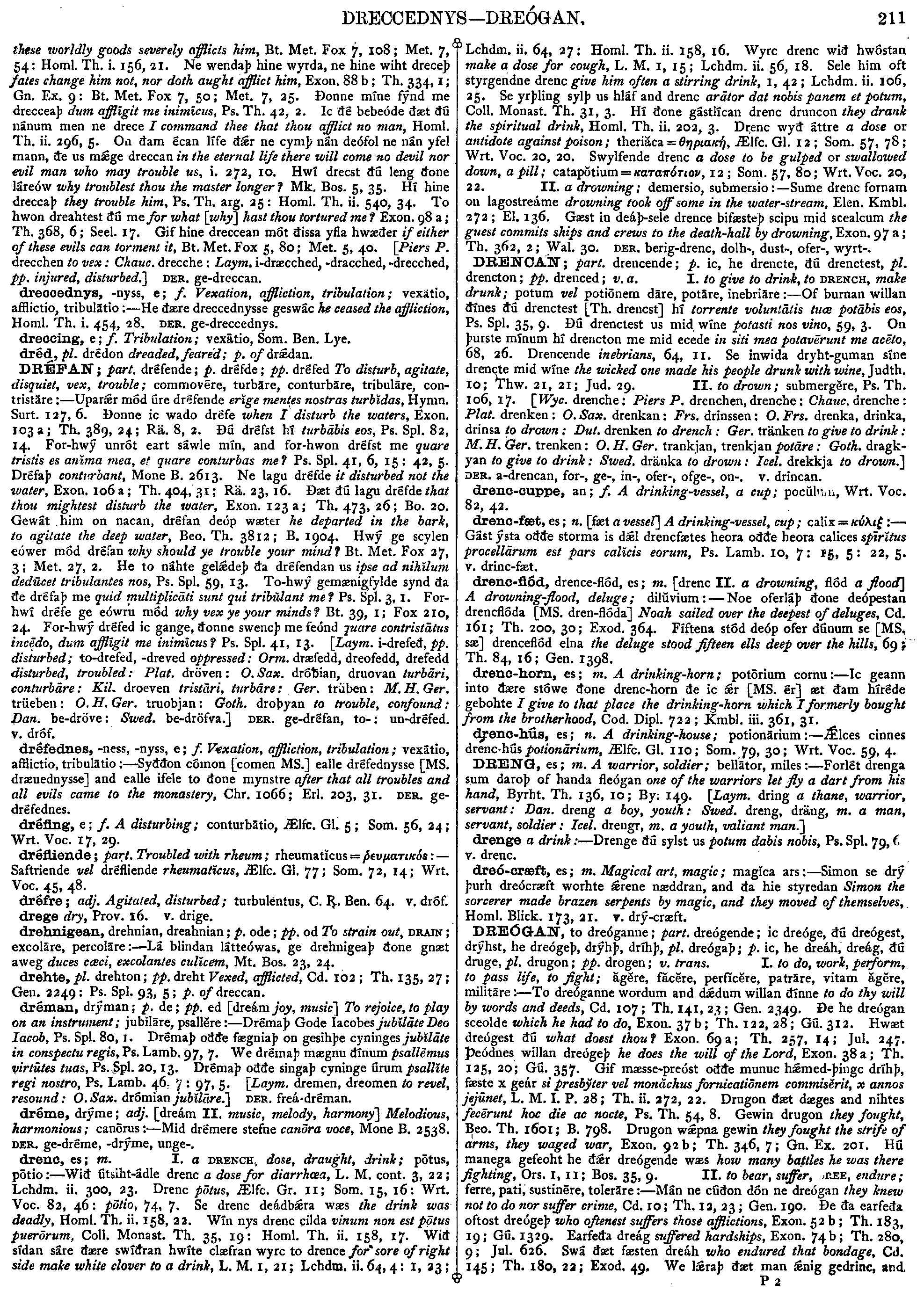
DREÓGAN,
to
dreóganne;
part.
dreógende;
ic
dreóge,
ðú
dreógest,
drýhst,
he
dreógeþ,
drýhþ,
dríhþ,
pl.
dreógaþ;
p.
ic,
he
dreáh,
dreág,
ðú
druge,
pl.
drugon;
pp.
drogen;
v.
trans.
I.
to
do,
work,
perform,
to
pass
life,
to
fight;
 gre,
fcre,
perfcre,
patr
gre,
fcre,
perfcre,
patr re,
vitam
gre,
militre
:--
To
dreóganne
wordum
and
ddum
willan
ðínne
to
do
thy
will
by
words
and
deeds,
Cd.
107;
Th.
141,
23;
Gen.
2349.
Ðe
he
dreógan
sceolde
which
he
had
to
do,
Exon.
37
b;
Th.
122,
28;
Gú.
312.
Hwæt
dreógest
ðú
what
doest
thou?
Exon.
69
a;
Th.
257,
14;
Jul.
247.
Þeódnes
willan
dreógeþ
he
does
the
will
of
the
Lord,
Exon.
38
a;
Th.
125,
20;
Gú.
357.
Gif
mæsse-preóst
oððe
munuc
hmed-þingc
dríhþ,
fæste
x
geár
si
presb
re,
vitam
gre,
militre
:--
To
dreóganne
wordum
and
ddum
willan
ðínne
to
do
thy
will
by
words
and
deeds,
Cd.
107;
Th.
141,
23;
Gen.
2349.
Ðe
he
dreógan
sceolde
which
he
had
to
do,
Exon.
37
b;
Th.
122,
28;
Gú.
312.
Hwæt
dreógest
ðú
what
doest
thou?
Exon.
69
a;
Th.
257,
14;
Jul.
247.
Þeódnes
willan
dreógeþ
he
does
the
will
of
the
Lord,
Exon.
38
a;
Th.
125,
20;
Gú.
357.
Gif
mæsse-preóst
oððe
munuc
hmed-þingc
dríhþ,
fæste
x
geár
si
presb ter
vel
monchus
fornicati
ter
vel
monchus
fornicati nem
commisrit,
x
annos
jej
nem
commisrit,
x
annos
jej net,
L.
M.
I.
P.
28;
Th.
ii.
272,
22.
Drugon
ðæt
dæges
and
nihtes
fecrunt
hoc
die
ac
nocte,
Ps.
Th.
54,
8.
Gewin
drugon
they
fought,
Beo.
Th.
1601;
B.
798.
Drugon
wpna
gewin
they
fought
the
strife
of
arms,
they
waged
war,
Exon.
92
b;
Th.
346,
7;
Gn.
Ex.
201.
Hú
manega
gefeoht
he
ðr
dreógende
wæs
how
many
battles
he
was
there
fighting,
Ors.
1,
11;
Bos.
35,
9.
II.
to
bear,
suffer,
DREE,
endure;
ferre,
pati,
sustinre,
tolerre
:--
Mán
ne
cúðon
dón
ne
dreógan
they
knew
not
to
do
nor
suffer
crime,
Cd.
10;
Th.
12,
23;
Gen.
190.
Ðe
ða
earfeða
oftost
dreógeþ
who
oftenest
suffers
those
afflictions,
Exon.
52
b;
Th.
183,
19;
Gú.
1329.
Earfeða
dreág
suffered
hardships,
Exon.
74
b;
Th.
280,
9;
Jul.
626.
Swá
ðæt
fæsten
dreáh
who
endured
that
bondage,
Cd.
145;
Th.
180,
22;
Exod,
49,
We
lraþ
ðæt
man
nig
gedrinc,
and
nig
unnit
ðár
ne
dreóge
we
teach
that
man
suffer
not
there
any
drinking,
nor
any
vanity,
L.
Edg.
C.
28;
Th.
ii.
250,
14.
III.
to
enjoy;
frui
:--
He
sibbe
dreáh
he
enjoyed
peace,
Cd.
130;
Th.
165,
28;
Gen.
2738.
Symbel-wynne
dreóh
enjoy
the
pleasure
of
the
feast!
Beo.
Th.
3569;
B.
1782.
IV.
v.
intrans.
To
be
employed,
be
busy;
gre,
negtisum
esse
:--
Nnig
manna
wát
hú
mín
hyge
dreógeþ,
býsig
æfter
bócum
no
man
knows
how
my
mind
is
employed,
busy
over
books,
Salm.
Kmbl.
122,
MS.
B;
Sal.
60.
Dreógan,
inf.
Cd.
104;
Th.
137,
31;
Gen.
2282.
Dreág,
p.
Exon.
53
a;
Th.
185,
5;
Az.
3.
[Chauc.
drye
to
suffer,
endure:
Laym.
dri
net,
L.
M.
I.
P.
28;
Th.
ii.
272,
22.
Drugon
ðæt
dæges
and
nihtes
fecrunt
hoc
die
ac
nocte,
Ps.
Th.
54,
8.
Gewin
drugon
they
fought,
Beo.
Th.
1601;
B.
798.
Drugon
wpna
gewin
they
fought
the
strife
of
arms,
they
waged
war,
Exon.
92
b;
Th.
346,
7;
Gn.
Ex.
201.
Hú
manega
gefeoht
he
ðr
dreógende
wæs
how
many
battles
he
was
there
fighting,
Ors.
1,
11;
Bos.
35,
9.
II.
to
bear,
suffer,
DREE,
endure;
ferre,
pati,
sustinre,
tolerre
:--
Mán
ne
cúðon
dón
ne
dreógan
they
knew
not
to
do
nor
suffer
crime,
Cd.
10;
Th.
12,
23;
Gen.
190.
Ðe
ða
earfeða
oftost
dreógeþ
who
oftenest
suffers
those
afflictions,
Exon.
52
b;
Th.
183,
19;
Gú.
1329.
Earfeða
dreág
suffered
hardships,
Exon.
74
b;
Th.
280,
9;
Jul.
626.
Swá
ðæt
fæsten
dreáh
who
endured
that
bondage,
Cd.
145;
Th.
180,
22;
Exod,
49,
We
lraþ
ðæt
man
nig
gedrinc,
and
nig
unnit
ðár
ne
dreóge
we
teach
that
man
suffer
not
there
any
drinking,
nor
any
vanity,
L.
Edg.
C.
28;
Th.
ii.
250,
14.
III.
to
enjoy;
frui
:--
He
sibbe
dreáh
he
enjoyed
peace,
Cd.
130;
Th.
165,
28;
Gen.
2738.
Symbel-wynne
dreóh
enjoy
the
pleasure
of
the
feast!
Beo.
Th.
3569;
B.
1782.
IV.
v.
intrans.
To
be
employed,
be
busy;
gre,
negtisum
esse
:--
Nnig
manna
wát
hú
mín
hyge
dreógeþ,
býsig
æfter
bócum
no
man
knows
how
my
mind
is
employed,
busy
over
books,
Salm.
Kmbl.
122,
MS.
B;
Sal.
60.
Dreógan,
inf.
Cd.
104;
Th.
137,
31;
Gen.
2282.
Dreág,
p.
Exon.
53
a;
Th.
185,
5;
Az.
3.
[Chauc.
drye
to
suffer,
endure:
Laym.
dri en,
drigen,
drien
to
suffer,
do:
Orm.
dreghenn
to
suffer,
endure:
Scot.
dre,
dree,
drey
to
suffer:
Goth.
driugan
to
do
military
service.]
DER.
a-dreógan,
ge-.
en,
drigen,
drien
to
suffer,
do:
Orm.
dreghenn
to
suffer,
endure:
Scot.
dre,
dree,
drey
to
suffer:
Goth.
driugan
to
do
military
service.]
DER.
a-dreógan,
ge-.
|
Source: Bosworth/Toller, page b0213, entry 3 View original page image as: [TIFF] [PNG] [View previous entry] [View next entry] |
[Comment on this entry] [View comments] |
The following entry has been hand-corrected once. |
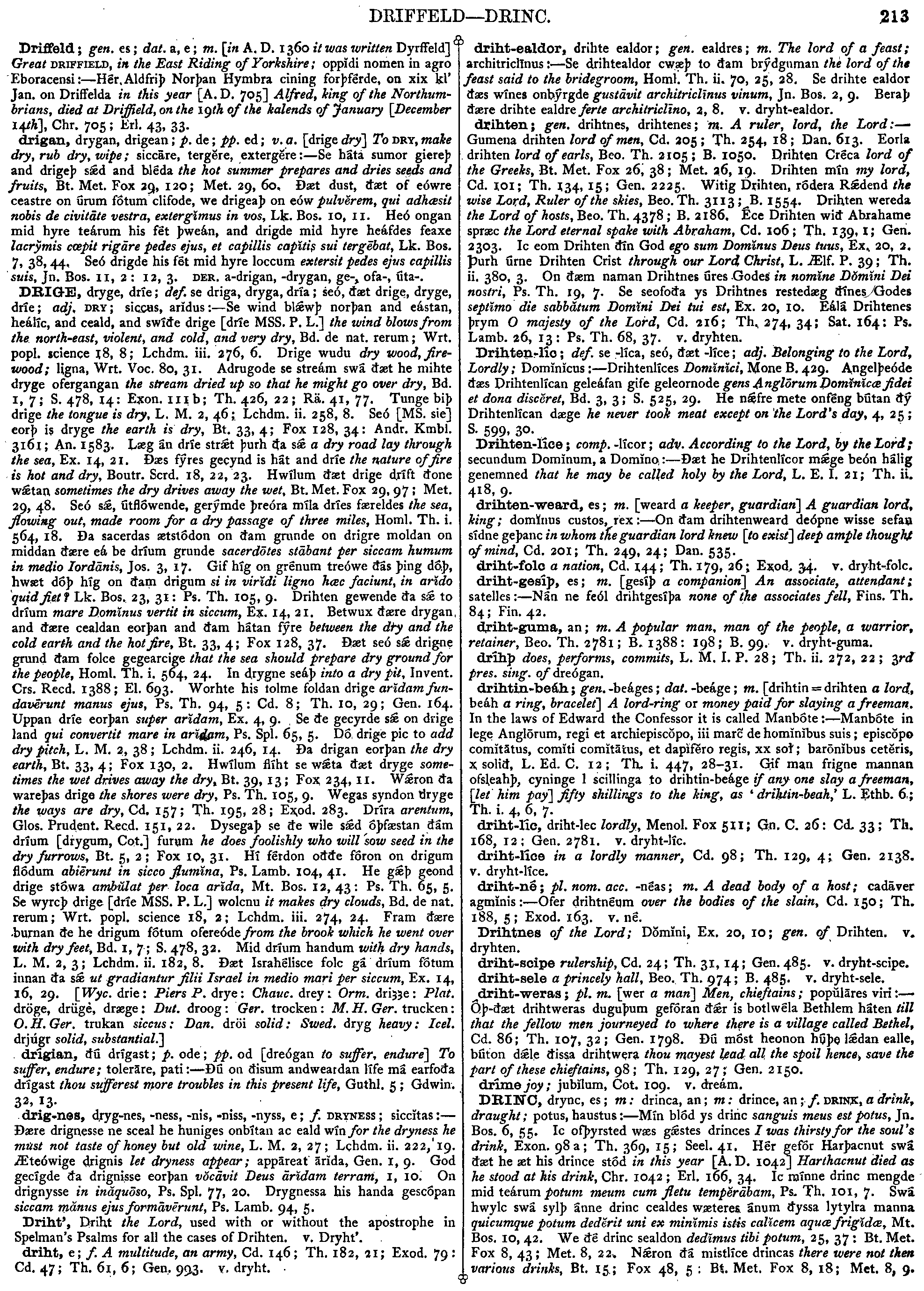
DRIGE,
dryge,
dríe;
def.
se
driga,
dryga,
dría;
seó,
ðæt
drige,
dryge,
dríe;
adj.
DRY;
siccus,
ardus
:--
Se
wind
blwþ
norþan
and
eástan,
heálíc,
and
ceald,
and
swíðe
drige
[dríe
MSS.
P.
L.]
the
wind
blows
from
the
north-east,
violent,
and
cold,
and
very
dry,
Bd.
de
nat.
rerum;
Wrt.
popl.
science
18,
8;
Lchdm.
iii.
276,
6.
Drige
wudu
dry
wood,
fire-wood;
ligna,
Wrt.
Voc.
80,
31.
Adrugode
se
streám
swá
ðæt
he
mihte
dryge
ofergangan
the
stream
dried
up
so
that
he
might
go
over
dry,
Bd.
1,
7;
S.
478,
14:
Exon.
111
b;
Th.
426,
22;
Rä.
41,
77.
Tunge
biþ
drige
the
tongue
is
dry,
L.
M.
2,
46;
Lchdm.
ii.
258,
8.
Seó
[MS.
sie]
eorþ
is
dryge
the
earth
is
dry,
Bt.
33,
4;
Fox
128,
34:
Andr.
Kmbl.
3161;
An.
1583.
Læg
án
dríe
strt
þurh
ða
s
a
dry
road
lay
through
the
sea,
Ex.
14,
21.
Ðæs
fýres
gecynd
is
hát
and
dríe
the
nature
of
fire
is
hot
and
dry,
Boutr.
Scrd.
18,
22,
23.
Hwílum
ðæt
drige
dríft
ðone
wtan
sometimes
the
dry
drives
away
the
wet,
Bt.
Met.
Fox
29,
97;
Met.
29,
48.
Seó
s,
útflówende,
gerýmde
þreóra
míla
dríes
færeldes
the
sea,
flowing
out,
made
room
for
a
dry
passage
of
three
miles,
Homl.
Th.
i.
564,
18.
Ða
sacerdas
ætstódon
on
ðam
grunde
on
drigre
moldan
on
middan
ðære
eá
be
dríum
grunde
sacerdtes
stbant
per
siccam
humum
in
medio
Iordnis,
Jos.
3,
17.
Gif
híg
on
grénum
treówe
ðás
þing
dóþ,
hwæt
dóþ
híg
on
ðam
drigum
si
in
virdi
ligno
hæc
faciunt,
in
ardo
quid
fiet?
Lk.
Bos,.
23,
31:
Ps.
Th.
105,
9.
Drihten
gewende
ða
s
to
dríum
mare
Domnus
vertit
in
siccum,
Ex.
14,
21.
Betwux
ðære
drygan,
and
ðære
cealdan
eorþan
and
ðam
hátan
fýre
between
the
dry
and
the
cold
earth
and
the
hot
fire,
Bt.
33,
4;
Fox
128,
37.
Ðæt
seó
s
drigne
grund
ðam
folce
gegearcige
that
the
sea
should
prepare
dry
ground
for
the
people,
Homl.
Th.
i.
564,
24.
In
drygne
seáþ
into
a
dry
pit,
Invent.
Crs.
Recd.
1388;
El.
693.
Worhte
his
tolme
foldan
drige
ardam
fundavrunt
manus
ejus,
Ps.
Th.
94,
5:
Cd.
8;
Th.
10,
29;
Gen.
164.
Uppan
dríe
eorþan
super
ardam,
Ex.
4,
9.
Se
ðe
gecyrde
s
on
drige
land
qui
convertit
mare
in
ardam,
Ps.
Spl.
65,
5.
Dó
drige
pic
to
add
dry
pitch,
L.
M.
2,
38;
Lchdm.
ii.
246,
14.
Ða
drigan
eorþan
the
dry
earth,
Bt.
33,
4;
Fox
130,
2.
Hwílum
flíht
se
wta
ðæt
dryge
sometimes
the
wet
drives
away
the
dry,
Bt.
39,
13;
Fox.
234,
11.
Wron
ða
wareþas
drige
the
shores
were
dry,
Ps.
Th.
105,
9.
Wegas
syndon
dryge
the
ways
are
dry,
Cd.
157;
Th.
195,
28;
Exod.
283.
Dríra
arentum,
Glos.
Prudent.
Recd.
151,
22.
Dysegaþ
se
ðe
wile
sd
óþfæstan
ðám
dríum
[drygum,
Cot.]
furum
he
does
foolishly
who
will
sow
seed
in
the
dry
furrows,
Bt.
5,
2;
Fox
10,
31.
Hí
férdon
oððe
fóron
on
drigum
flódum
abirunt
in
sicco
flumna,
Ps.
Lamb.
104,
41.
He
gþ
geond
drige
stówa
amb lat
per
loca
arda,
Mt.
Bos.
12,
43:
Ps.
Th.
65,
5.
Se
wyrcþ
drige
[dríe
MSS.
P.
L.]
wolcnu
it
makes
dry
clouds,
Bd.
de
nat.
rerum;
Wrt.
popl.
science
18,
2;
Lchdm.
iii.
274,
24.
Fram
ðære
burnan
ðe
he
drigum
fótum
ofereóde
from
the
brook
which
he
went
over
with
dry
feet,
Bd.
1,
7;
S.
478,
32.
Mid
dríum
handum
with
dry
hands,
L.
M.
2,
3;
Lchdm.
ii.
182,
8.
Ðæt
Israhélisce
folc
gá
dríum
fótum
innan
ða
s
ut
gradiantur
filii
Israel
in
medio
mari
per
siccum,
Ex.
14,
16,
29.
[Wyc.
drie:
Piers
P.
drye:
Chauc.
drey:
Orm.
drie:
Plat.
dröge,
drüge,
dræge:
Dut.
droog:
Ger.
trocken:
M.
H.
Ger.
trucken:
O.
H.
Ger.
trukan
siccus:
Dan.
dröi
solid:
Swed.
dryg
heavy:
Icel.
drjúgr
solid,
substantial.]
lat
per
loca
arda,
Mt.
Bos.
12,
43:
Ps.
Th.
65,
5.
Se
wyrcþ
drige
[dríe
MSS.
P.
L.]
wolcnu
it
makes
dry
clouds,
Bd.
de
nat.
rerum;
Wrt.
popl.
science
18,
2;
Lchdm.
iii.
274,
24.
Fram
ðære
burnan
ðe
he
drigum
fótum
ofereóde
from
the
brook
which
he
went
over
with
dry
feet,
Bd.
1,
7;
S.
478,
32.
Mid
dríum
handum
with
dry
hands,
L.
M.
2,
3;
Lchdm.
ii.
182,
8.
Ðæt
Israhélisce
folc
gá
dríum
fótum
innan
ða
s
ut
gradiantur
filii
Israel
in
medio
mari
per
siccum,
Ex.
14,
16,
29.
[Wyc.
drie:
Piers
P.
drye:
Chauc.
drey:
Orm.
drie:
Plat.
dröge,
drüge,
dræge:
Dut.
droog:
Ger.
trocken:
M.
H.
Ger.
trucken:
O.
H.
Ger.
trukan
siccus:
Dan.
dröi
solid:
Swed.
dryg
heavy:
Icel.
drjúgr
solid,
substantial.]
|
Source: Bosworth/Toller, page b0215, entry 23 View original page image as: [TIFF] [PNG] [View previous entry] [View next entry] |
[Comment on this entry] [View comments] |
The following entry has been hand-corrected once. |
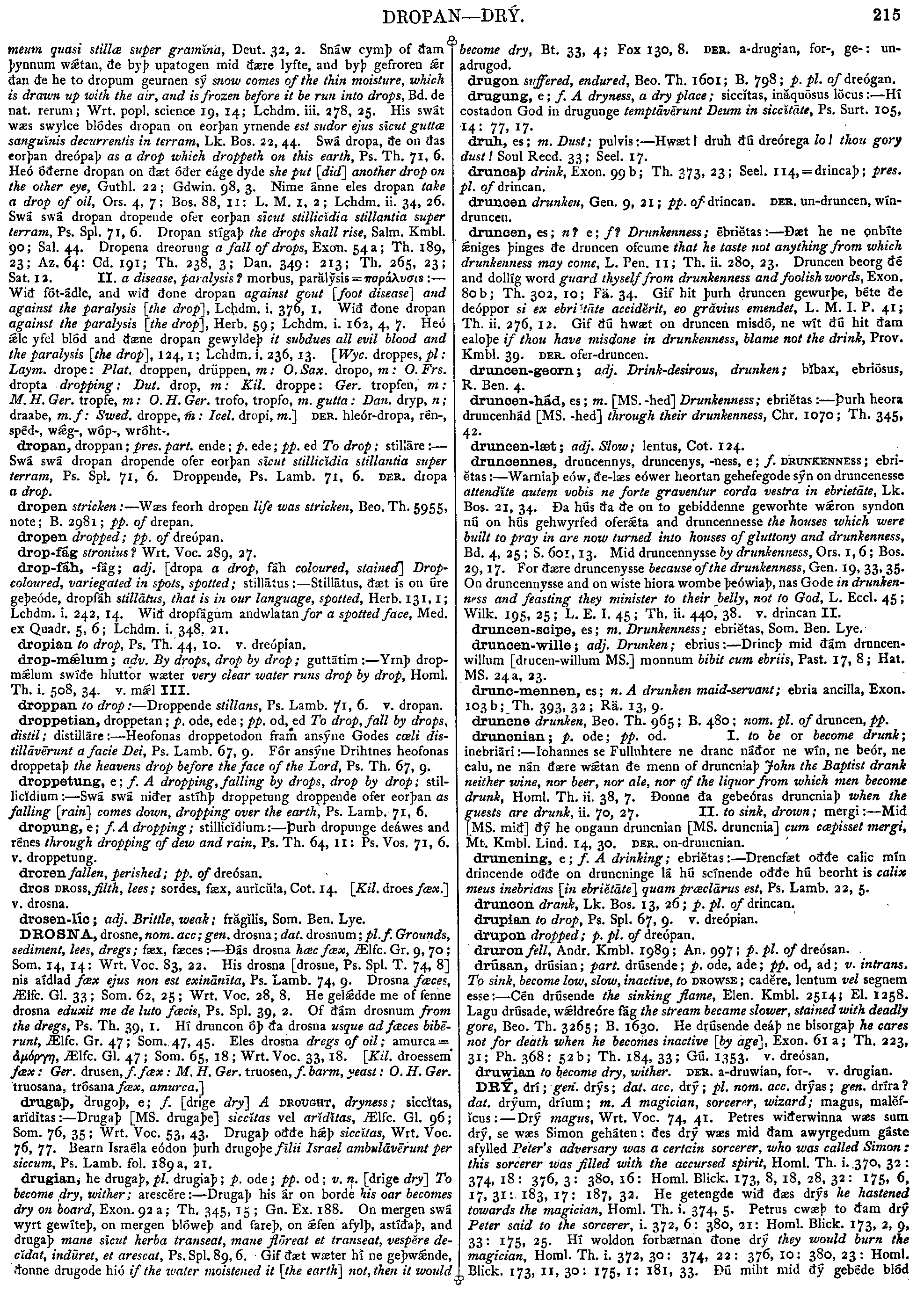
druncen,
es;
n?
e;
f?
Drunkenness;
britas
:--
Ðæt
he
ne
onbíte
niges
þinges
ðe
druncen
ofcume
that
he
taste
not
anything
from
which
drunkenness
may
come,
L.
Pen.
11;
Th.
ii.
280,
23.
Druncen
beorg
ðé
and
dollíg
word
guard
thyself
from
drunkenness
and
foolish
words,
Exon.
80
b;
Th.
302,
l0;
Fä.
34.
Gif
hit
þurh
druncen
gewurþe,
béte
ðe
deóppor
si
ex
ebritte
accidrit,
eo
grvius
emendet,
L.
M.
I.
P.
41;
Th.
ii.
276,
12.
Gif
ðú
hwæt
on
druncen
misdó,
ne
wít
ðú
hit
ðam
ealoþe
if
thou
have
misdone
in
drunkenness,
blame
not
the
drink,
Prov.
Kmbl.
39.
DER.
ofer-druncen.
|
Source: Bosworth/Toller, page b0216, entry 1 View original page image as: [TIFF] [PNG] [View previous entry] [View next entry] |
[Comment on this entry] [View comments] |
The following entry has been hand-corrected once. |
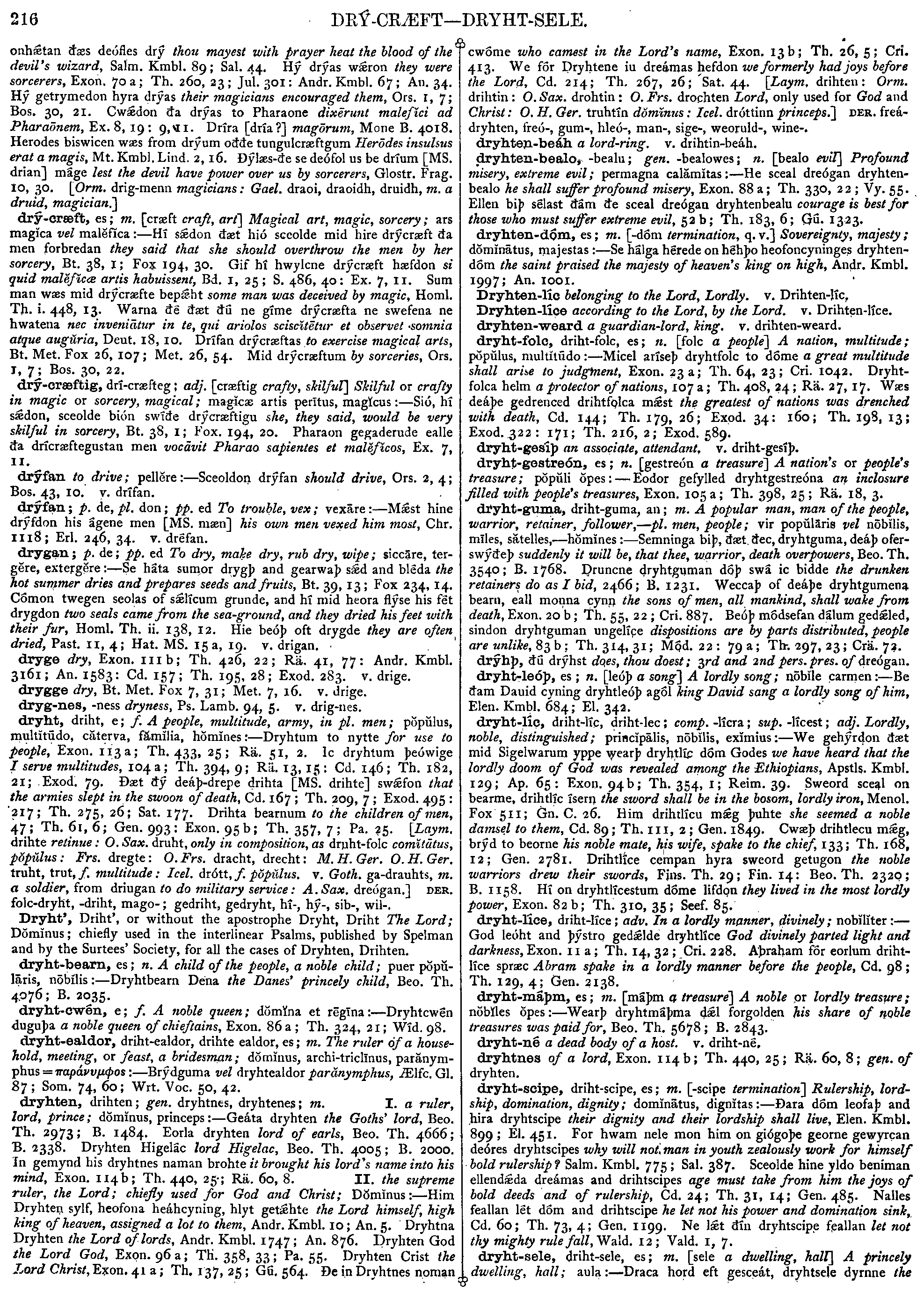
drý-cræft,
es;
m.
[cræft
craft,
art]
Magical
art,
magic,
sorcery;
ars
magca
vel
malfca
:--
Hí
sdon
ðæt
hió
sceolde
mid
hire
drýcræft
ða
men
forbredan
they
said
that
she
should
overthrow
the
men
by
her
sorcery,
Bt.
38,
1;
Fox
194,
30.
Gif
hí
hwylcne
drýcræft
hæfdon
si
quid
malfcæ
artis
habuissent,
Bd.
1,
25;
S.
486,
40
:
Ex.
7,
11.
Sum
man
wæs
mid
drýcræfte
bepht
some
man
was
deceived
by
magic,
Homl.
Th.
i.
448,
13.
Warna
ðé
ðæt
ðú
ne
gíme
drýcræfta
ne
swefena
ne
hwatena
nec
invenitur
in
te,
qui
ariolos
sciscttur
et
observet
somnia
atque
augria,
Deut.
18,
10.
Drífan
drýcræftas
to
exercise
magical
arts,
Bt.
Met.
Fox
26,
107;
Met.
26,
54.
Mid
drýcræftum
by
sorceries,
Ors.
1,
7;
Bos.
30,
22.
|
Source: Bosworth/Toller, page b0226, entry 14 View original page image as: [TIFF] [PNG] [View previous entry] [View next entry] |
[Comment on this entry] [View comments] |
The following entry has been hand-corrected once. |
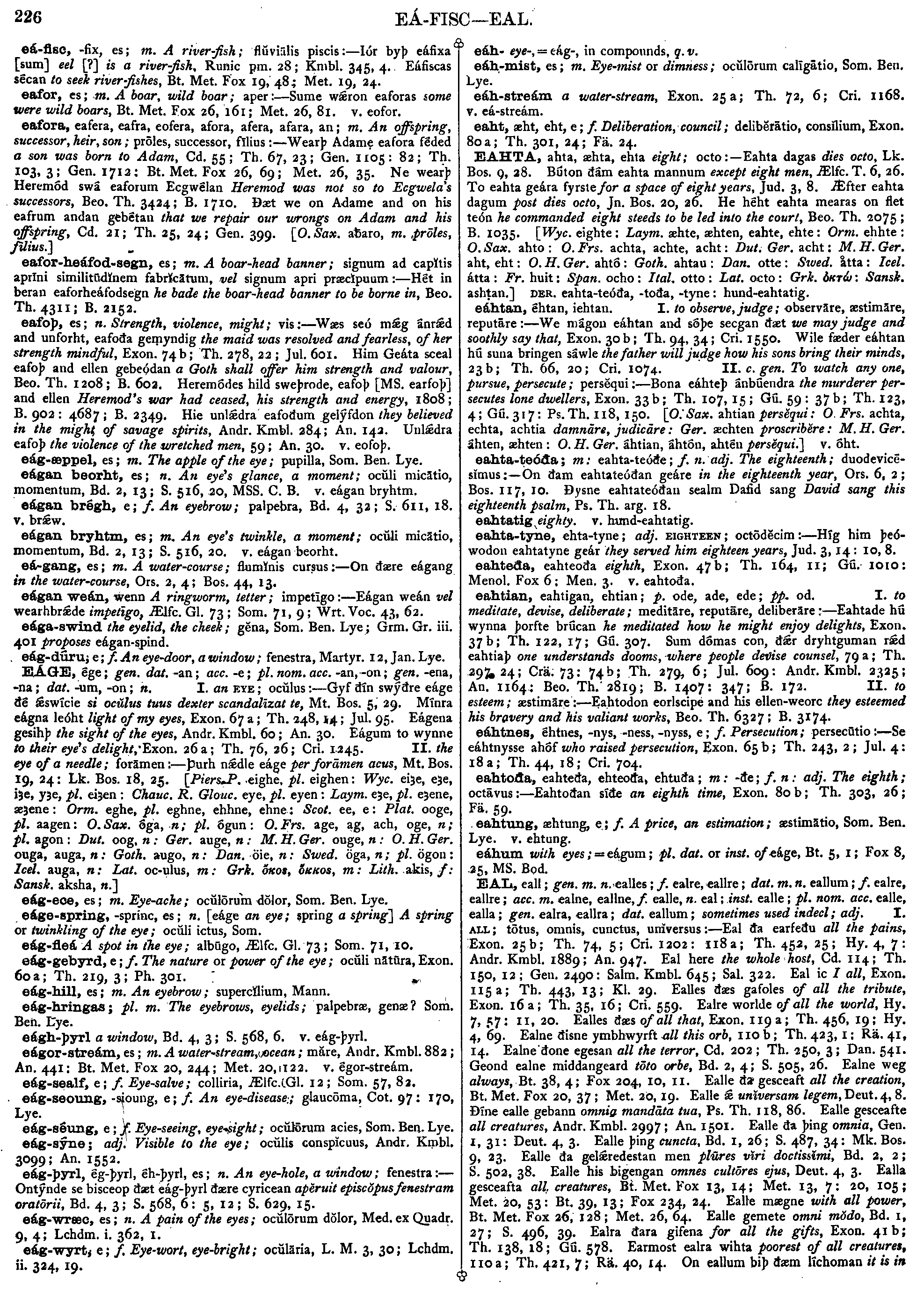
EÁGE,
ége;
gen.
dat.
-an;
acc.
-e;
pl.
nom.
acc.
-an,
-on;
gen.
-ena,
-na;
dat.
-um,
-on;
n.
I.
an
EYE
;
oclus
:--
Gyf
ðín
swýðre
eáge
ðé
swície
si
oclus
tuus
dexter
scandalzat
te,
Mt.
Bos.
5,
29.
Mínra
eégna
leóht
light
of
my
eyes,
Exon.
67
a;
Th.
248,
14;
Jul.
95.
Eágena
gesihþ
the
sight
of
the
eyes.
Andr.
Kmbl.
60;
An.
30.
Eágum
to
wynne
to
their
eye's
delight.Exon.
26
a;
Th.
76,
26;
Cri.
1245.
II.
the
eye
of
a
needle;
formen
:--
þurh
ndle
eáge
per
formen
acus,
Mt.
Bos.
19,
24:
Lk.
Bos.
18,
25.
[Piers
P.
.
eighe,
pl.
eighen:
Wyc.
eie,
ee,
ie,
ye,
pl.
eien:
Chauc.
R.
Glouc.
eye,
pl.
eyen:
Laym.
ee,
pl.
eene,
æene:
Orm.
eghe,
pl.
eghne,
ehhne,
ehne:
Scot.
ee,
e:
Plat,
ooge,
pl.
aagen:
O.
Sax.
óga,
n;
pl.
ógun:
O.
Frs.
age,
ag,
ach,
oge,
n;
pl.
agon
:
Dut.
oog,
n:
Ger.
auge,
n:
M.
H.
Ger.
ouge,
n:
O.
H.
Ger.
ouga,
auga,
n:
Goth.
augo,
n:
Dan.
öie,
n:
Swed,
öga,
n;
pl.
ögon:
Icel.
auga,
a:
Lat.
oc-ulus,
m:
Grk.
GREEK,
m:
Lith.
akis,
f:
Sansk.
aksha,
n.]
|
Source: Bosworth/Toller, page b0231, entry 5 View original page image as: [TIFF] [PNG] [View previous entry] [View next entry] |
[Comment on this entry] [View comments] |
The following entry has been hand-corrected once. |
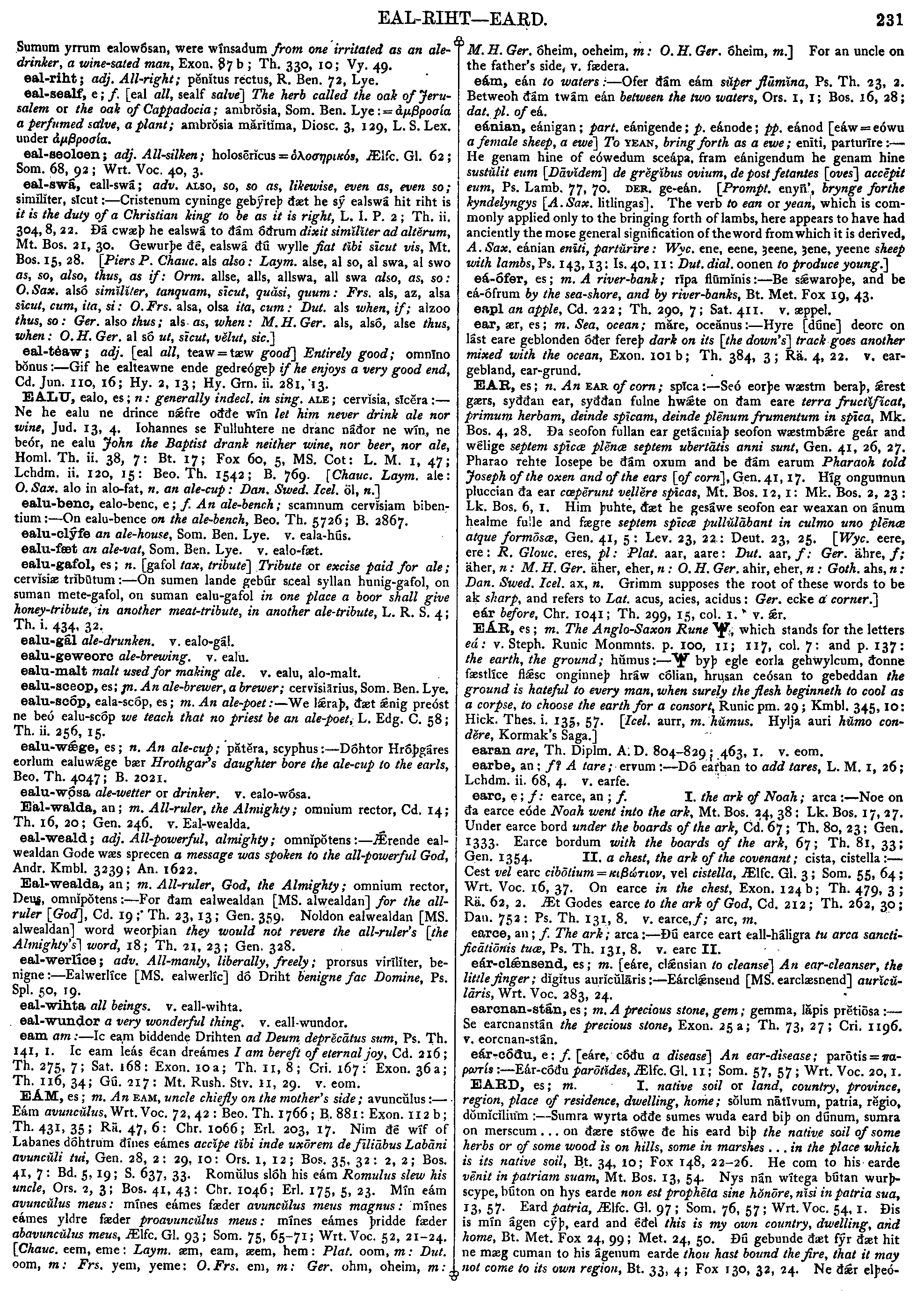
eal-swá,
eall-swá;
adv.
ALSO,
so,
so
as,
likewise,
even
as,
even
so;
simlter,
scut
:--
Cristenum
cyninge
gebýreþ
ðæt
he
sý
ealswá
hit
riht
is
it
is
the
duty
of
a
Christian
king
to
be
as
it
is
right,
L.
I.
P.
2;
Th.
ii.
304,
8,
22.
Ðá
cwæþ
he
ealswá
to
ðám
óðrum
dixit
simlter
ad
altrum,
Mt.
Bos.
21,
30.
Gewurþe
ðé,
ealswá
ðu
wylle
fiat
tbi
scut
vis,
Mt.
Bos.
15,
28.
[Piers
P.
Chauc.
als
also:
Laym.
alse,
al
so,
al
swa,
al
swo
as,
so,
also,
thus,
as
if:
Orm.
allse,
alls,
allswa,
all
swa
also,
as,
so:
O.
Sax.
alsó
simlter,
tanquam,
scut,
qusi,
quum:
Frs.
als,
az,
alsa
scut,
cum,
ita,
si:
O.
Frs.
alsa,
olsa
ita,
cum:
Dut.
als
when,
if;
alzoo
thus,
so:
Ger.
also
thus;
als
as,
when:
M.
H.
Ger.
als,
alsó,
alse
thus,
when:
O.
H.
Ger.
al
só
ut,
scut,
vlut,
sic.]
|
Source: Bosworth/Toller, page b0233, entry 14 View original page image as: [TIFF] [PNG] [View previous entry] [View next entry] |
[Comment on this entry] [View comments] |
The following entry has been hand-corrected once. |
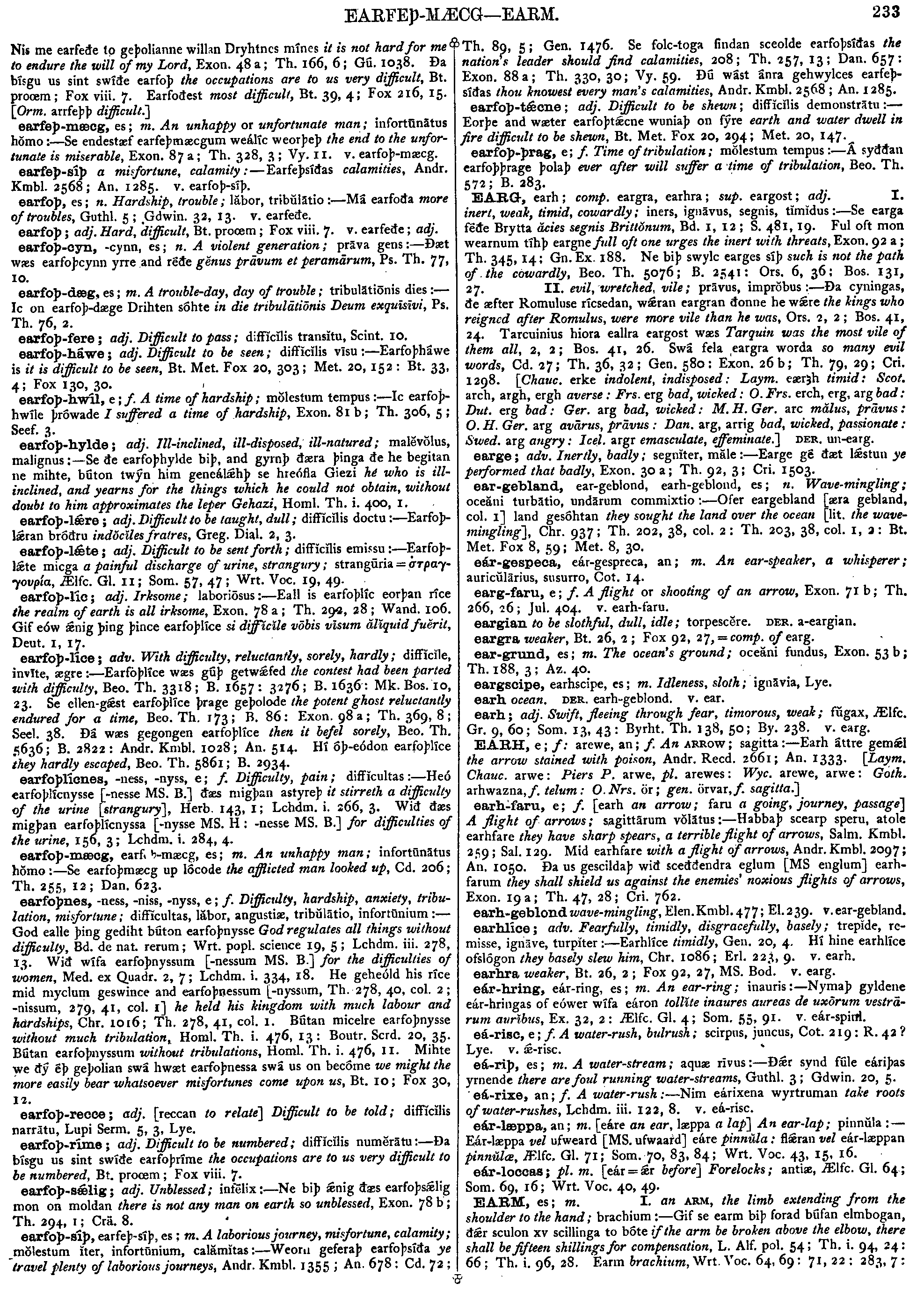
earfoþ-líc;
adj.
Irksome;
laborisus
:--
Eall
is
earfoþlíc
eorþan
ríce
the
realm
of
earth
is
all
irksome,
Exon.
78
a;
Th.
292,
28;
Wand.
106.
Gif
eów
nig
þing
þince
earfoþlíce
si
diffcle
vbis
vsum
lquid
furit,
Deut.
1,
17.
| Result Page: |  |
Previous | 1 2 3 4 5 6 7 8 9 10 11 12 13 14 15 16 | Next |  |
Germanic Lexicon Project (main page)
This search system was written by
Sean Crist
Please consider
volunteering
to correct the data in these online dictionaries.
No rights reserved. Feel free to use these data in any way you please.