|
|

|
Source: Cleasby/Vigfusson, page b0551, entry 15 View original page image as: [TIFF] [PNG] [View previous entry] [View next entry] |
[Comment on this entry] [View comments] |
The following entry has been hand-corrected once. |

SKJALD-, the form taken by skjöldr in COMPDS: skjald-blætr, m. a shield worshipper(?), Yngl. S. (in a verse). skjald-borg, f. a 'shield-burgh,' wall of shields, an old battle array, Ó.H. 206, Nj. 274, Eg. 92, 532, Fms. ii. 319, vi. 416, 418, vii. 262, described in Har. S. Harðr. ch. 117 (Fms. vi 413). skjald-fimr, adj. quick with one's shield, Lex. Poët. skjald-hvalr, m. a kind of whale, from its particoloured skin, Sks. 124. skjald-kona, u, f. = skjaldmær, Lv. 63. skjald-kænn, adj. = skjaldfimr, Lex. Poët. skjald-mær, f. a 'shield-maid,' amazon, Akv. 17, Al. 121, Fas. i. 140, 177, Odd. 22, 26. skjald-rim, f. the 'shield-rim,' i.e. the line of shields along the gunwale of a ship (skip skarat skjöldum), Orkn. 104 (in a verse), Fms, vi. (in a verse), xi. 140 (read. skjaldrimna). skjald-steinn, m. 'the 'shield-stone,' the upper stone of a hand-mill(?), Gísl. (in a verse). skjald-sveinn, m. a 'shield-boy,' shield-bearer, Sks. 705, Korm. 118, Stj. 631.
|
Source: Cleasby/Vigfusson, page b0551, entry 16 View original page image as: [TIFF] [PNG] [View previous entry] [View next entry] |
[Comment on this entry] [View comments] |
The following entry has been hand-corrected once. |
skjalda, að, to enclose in a fence of shields, Fms. x. 78; skip skjaldat með stöfnum, viii. 233; al-skjaldaðr, of a ship, Landn. 156 (see skjöldr): skjaldaðr, shielded, of a person, Fær. 81, Bb. i. 204, Karl. 377.
|
Source: Cleasby/Vigfusson, page b0553, entry 17 View original page image as: [TIFF] [PNG] [View previous entry] [View next entry] |
[Comment on this entry] [View comments] |
The following entry has been hand-corrected once. |
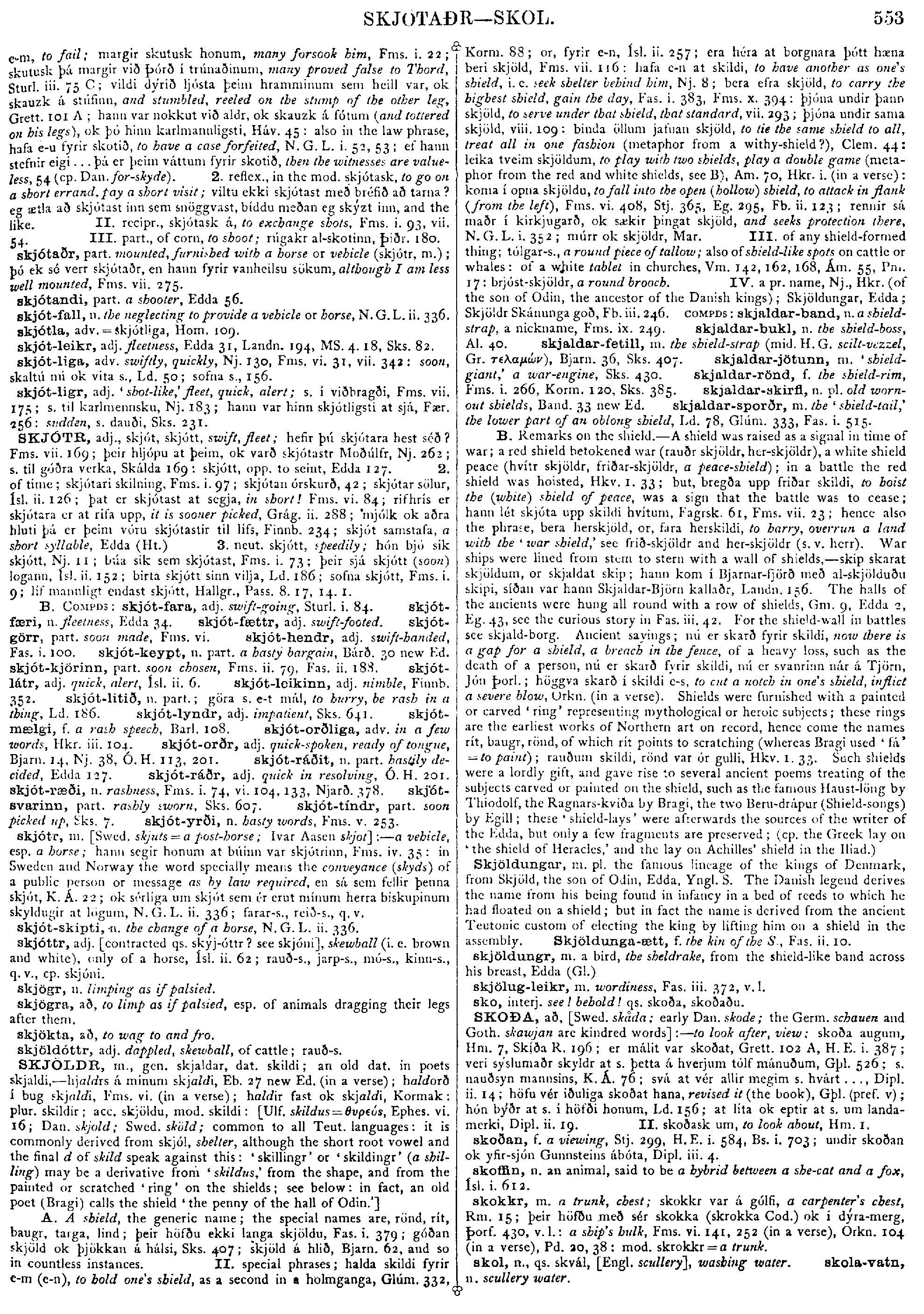
SKJÖLDR, m., gen. skjaldar, dat. skildi; an old dat. in poets skjaldi, -- hjaldrs á mínum skjaldi, Eb. 27 new Ed. (in a verse); haldorð í bug skjaldi, Fms. vi. (in a verse); haldir fast ok skjaldi, Kormak: plur. skildir; acc. skjöldu, mod. skildi: [Ulf. skildus = GREEK, Ephes. vi. 16; Dan. skjold; Swed. sköld; common to all Teut. languages: it is commonly derived from skjól, shelter, although the short root vowel and the final d of skild speak against this: 'skillingr' or 'skildingr' (a shilling) may be a derivative from 'skildus,' from the shape, and from the painted or scratched 'ring' on the shields; see below: in fact, an old poet (Bragi) calls the shield 'the penny of the hall of Odin.'] A. A shield, the generic name; the special names are, rönd, rít, baugr, targa, lind; þeir höfðu ekki langa skjöldu, Fas. i. 379; góðan skjöld ok þjökkan á hálsi, Sks. 407; skjöld á hlið, Bjarn. 62, and so in countless instances. II. special phrases; halda skildi fyrir e-m (e-n), to hold one's shield, as a second in a holmganga, Glúm. 332, Korm. 88; or, fyrir e-n, Ísl. ii. 257; era héra at borgnara þótt hæna beri skjöld, Fms. vii. 116: hafa e-n at skildi, to have another as one's shield, i.e. seek shelter behind him, Nj. 8; bera efra skjöld, to carry the highest shield, gain the day, Fas. i. 383, Fms. x. 394: þjóna undir þann skjöld, to serve under that shield, that standard, vii. 293; þjóna undir sama skjöld, viii. 109: binda öllum jafnan skjöld, to tie the same shield to all, treat all in one fashion (metaphor from a withy-shield?), Clem. 44: leika tveim skjöldum, to play with two shields, play a double game (metaphor from the red and white shields, see B), Am. 70, Hkr. i. (in a verse): koma í opna skjöldu, to fall into the open (hollow) shield, to attack in flank (from the left), Fms. vi. 408, Stj. 365, Eg. 295, Fb. ii. 123; rennir sá maðr í kirkjugarð, ok sækir þingat skjöld, and seeks protection there, N.G.L. i. 352; múrr ok skjöldr, Mar. III. of any shield-formed thing; tólgar-s., a round piece of tallow; also of shield-like spots on cattle or whales: of a white tablet in churches, Vm. 142, 162, 168, Ám. 55, Pm. 17: brjóst-skjöldr, a round brooch. IV. a pr. name, Nj., Hkr. (of the son of Odin, the ancestor of the Danish kings); Skjöldungar, Edda; Skjöldr Skánunga goð, Fb. iii. 246. COMPDS: skjaldar-band, n. a shield-strap, a nickname, Fms. ix. 249. skjaldar-bukl, n. the shield-boss, Al. 40. skjaldar-fetill, m. the shield-strap (mid. H.G. scilt-vezzel, Gr. GREEK), Bjarn. 36, Sks. 407. skjaldar-jötunn, m. 'shield-giant,' a war-engine, Sks. 430. skjaldar-rönd, f. the shield-rim, Fms. i. 266, Korm. 120, Sks. 385. skjaldar-skirfl, n. pl. old worn-out shields, Band. 33 new Ed. skjaldar-sporðr, m. the 'shield-tail,' the lower part of an oblong shield, Ld. 78, Glúm. 333, Fas. i. 515. B. Remarks on the shield. -- A shield was raised as a signal in time of war; a red shield betokened war (rauðr skjöldr, her-skjöldr), a white shield peace (hvítr skjöldr, friðar-skjöldr, a peace-shield); in a battle the red shield was hoisted, Hkv. 1. 33; but, bregða upp friðar skildi, to hoist the (white) shield of peace, was a sign that the battle was to cease; hann lét skjóta upp skildi hvítum, Fagrsk. 6l, Fms. vii. 23; hence also the phrase, bera herskjöld, or, fara herskildi, to harry, overrun a land with the 'war shield,' see frið-skjöldr and her-skjöldr (s.v. herr). War ships were lined from stem to stern with a wall of shields, -- skip skarat skjöldum, or skjaldat skip; hann kom í Bjarnar-fjörð með al-skjölduðu skipi, síðan var hann Skjaldar-Björn kallaðr, Landn. 156. The halls of the ancients were hung all round with a row of shields, Gm. 9, Edda 2, Eg. 43, see the curious story in Fas. iii. 42. For the shield-wall in battles see skjald-borg. Ancient sayings; nú er skarð fyrir skildi, now there is a gap for a shield, a breach in the fence, of a heavy loss, such as the death of a person, nú er skarð fyrir skildi, nú er svanrinn nár á Tjörn, Jón Þorl.; höggva skarð í skildi e-s, to cut a notch in one's shield, inflict a severe blow, Orkn. (in a verse). Shields were furnished with a painted or carved 'ring' representing mythological or heroic subjects; these rings are the earliest works of Northern art on record, hence come the names rít, baugr, rönd, of which rít points to scratching (whereas Bragi used 'fá' = to paint); rauðum skildi, rönd var ór gulli, Hkv. 1. 33. Such shields were a lordly gift, and gave rise to several ancient poems treating of the subjects carved or painted on the shield, such as the famous Haust-löng by Thjodolf, the Ragnars-kviða by Bragi, the two Beru-drápur (Shield-songs) by Egill; these 'shield-lays' were afterwards the sources of the writer of the Edda, but only a few fragments are preserved; (cp. the Greek lay on 'the shield of Heracles,' and the lay on Achilles' shield in the Iliad.)
|
Source: Cleasby/Vigfusson, page b0555, entry 27 View original page image as: [TIFF] [PNG] [View previous entry] [View next entry] |
[Comment on this entry] [View comments] |
The following entry has not been hand-corrected. However, the page is reserved and someone is correcting it. |
SKÓÐ, n. [ skaði and ski'. ð point to a lost strong verb], scathe, bale, a noxious thing; liji'ilma skóð. randar s., skjaldar s., the scathe of helmets, of shields, i. e. a weapon; mær skúð, the bright weapons, Hallfrc-d; Hildar s., id.: in compds, ben-skóð, víg-s., val-s., remini-s., i. e. weapons, Lex. Poi''t.; the word is only used in poetry.
|
Source: Cleasby/Vigfusson, page b0687, entry 9 View original page image as: [TIFF] [PNG] [View previous entry] [View next entry] |
[Comment on this entry] [View comments] |
The following entry has been hand-corrected once. |
vé, n. pl., different from the preceding word; [the Lat. vexillum is a dimin. derivative from root of veho; the root word is vigan = to carry high, Lat. veho] :-- a standard, remains only in poetry; gyld vé, golden standards, Fms. i. 175 (in a verse); veðr-blásin vé, vii. 345 (in a verse); fram óðu vé, vi. 409 (in a verse); þar er vé vaða, Darr. 6; gullsett vé gnæfa, vé geysa, glymja, skjálfa, blása, ríða, all poët, phrases of the standard carried high in battle, see Lex. Poët.; reisa vé, to hoist the vé, Fms. viii. (in a verse); hildar vé, the 'war-standard,' i.e. a shield, Haustl. 1, (for shields were used as such, see remarks s.v. skjöldr.)
|
Source: Cleasby/Vigfusson, page b0694, entry 11 View original page image as: [TIFF] [PNG] [View previous entry] [View next entry] |
[Comment on this entry] [View comments] |
The following entry has been hand-corrected once. |
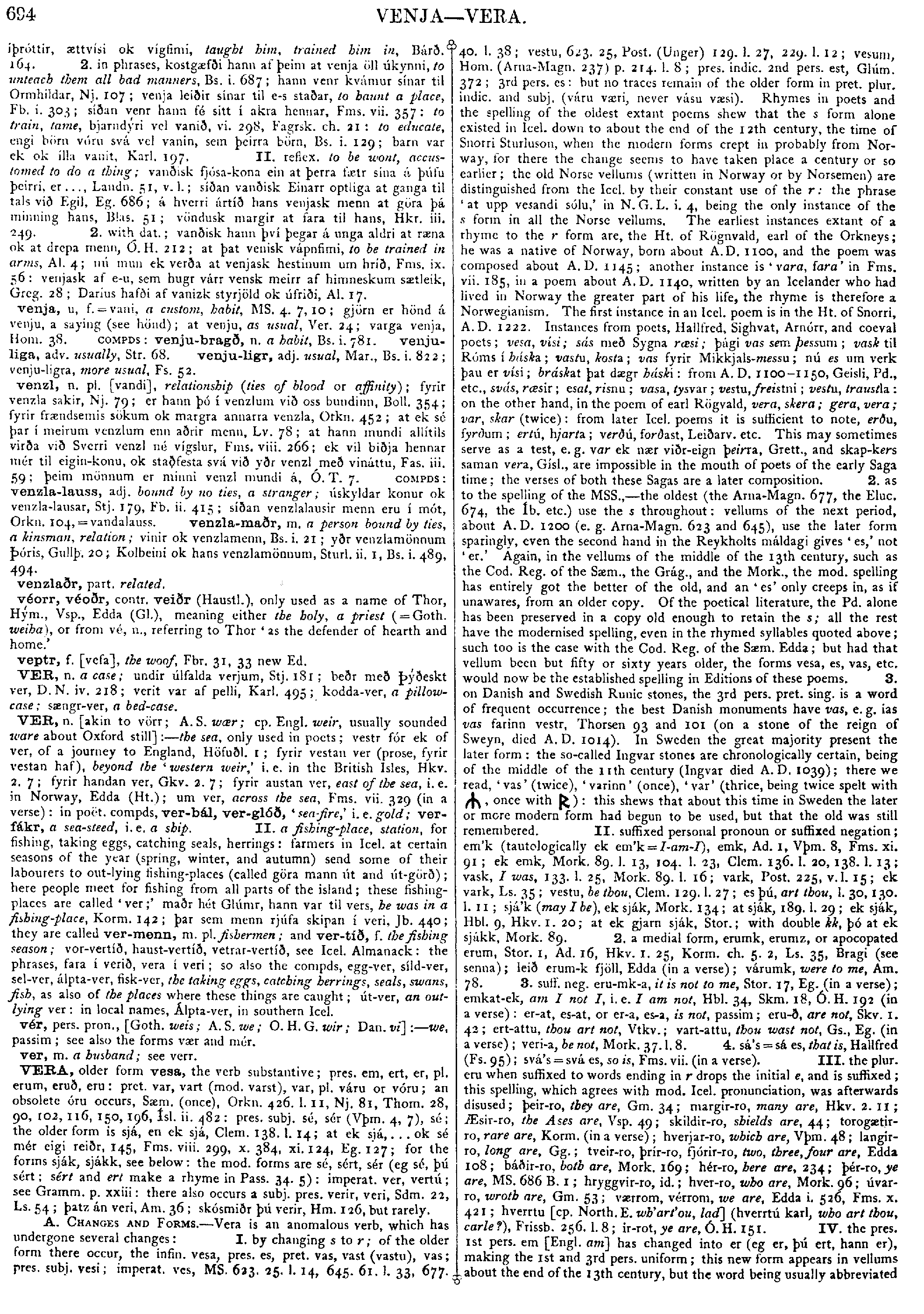
VERA, older form vesa, the verb substantive; pres. em, ert, er, pl. erum, eruð, eru: pret. var, vart (mod. varst), var, pl. váru or vóru; a obsolete óru occurs, Sæm. (once), Orkn. 426. l. 11, Nj. 81, Thom. 28, 90, 102, 116, 150, 196, Ísl. ii. 482: pres. subj. sé, sér (Vþm. 4, 7), sé; the older form is sjá, en ek sjá, Clem. 138. l. 14; at ek sjá, ... ok sé mér eigi reiðr, 145, Fms. viii. 299, x. 384, xi. 124, Eg. 127; for the forms sják, sjákk, see below: the mod. forms are sé, sért, sér (eg sé, þú sért; sert and ert make a rhyme in Pass. 34. 5): imperat. ver, vertú; see Gramm. p. xxiii: there also occurs a subj. pres. verir, veri, Sdm. 22, Ls. 54; þatz án veri, Am. 36; skósmiðr þú verir, Hm. 126, but rarely. A. CHANGES AND FORMS. -- Vera is an anomalous verb, which has undergone several changes: I. by changing s to r; of the older form there occur, the infin. vesa, pres. es, pret. vas, vast (vastu), vas; pres. subj. vesi; imperat. ves, MS. 623. 25. l. 14, 645. 6l. l. 33, 677. 40. l. 38; vestu, 623. 25, Post. (Unger) 129. l. 27, 229. l. 12; vesum, Hom. (Arna-Magn. 237) p. 214. l. 8; pres. indic. 2nd pers. est, Glúm. 372; 3rd pers. es: but no traces remain of the older form in pret. plur. indic. and subj. (váru væri, never vásu væsi). Rhymes in poets and the spelling of the oldest extant poems shew that the s form alone existed in Icel. down to about the end of the 12th century, the time of Snorri Sturluson, when the modern forms crept in probably from Norway, for there the change seems to have taken place a century or so earlier; the old Norse vellums (written in Norway or by Norsemen) are distinguished from the Icel. by their constant use of the r: the phrase 'at upp vesandi sólu', in N.G.L. i. 4, being the only instance of the s form in all the Norse vellums. The earliest instances extant of a rhyme to the r form are, the Ht. of Rögnvald, earl of the Orkneys; he was a native of Norway, born about A.D. 1100, and the poem was composed about A.D. 1145; another instance is 'vara, fara' in Fms. vii. 185, in a poem about A.D. 1140, written by an Icelander who had lived in Norway the greater part of his life, the rhyme is therefore a Norwegianism. The first instance in an Icel. poem is in the Ht. of Snorri, A.D. 1222. Instances from poets, Hallfred, Sighvat, Arnórr, and coeval poets; vesa, vísi; sás með Sygna ræsi; þági vas sem þessum; vask til Róms í háska; vastu, kosta; vas fyrir Mikkjals-messu; nú es um verk þau er vísi; bráskat þat dægr háski: from A.D. 1100-1150, Geisli, Pd., etc., svás, ræsir; esat, risnu; vasa, tysvar; vestu. freistni; vestu, traustla: on the other hand, in the poem of earl Rögvald, vera, skera; gera, vera; var, skar (twice): from later Icel. poems it is sufficient to note, erðu, fyrðum; ertú, hjarta; verðú, forðast, Leiðarv. etc. This may sometimes serve as a test, e.g. var ek nær viðr-eign þeirra, Grett., and skap-kers saman vera, Gísl., are impossible in the mouth of poets of the early Saga time; the verses of both these Sagas are a later composition. 2. as to the spelling of the MSS., -- the oldest (the Arna-Magn. 677, the Eluc. 674, the Íb. etc.) use the s throughout: vellums of the next period, about A.D. 1200 (e.g. Arna-Magn. 623 and 645), use the later form sparingly, even the second hand in the Reykholts máldagi gives 'es,' not 'er.' Again, in the vellums of the middle of the 13th century, such as the Cod. Reg. of the Sæm., the Grág., and the Mork., the mod. spelling has entirely got the better of the old, and an 'es' only creeps in, as if unawares, from an older copy. Of the poetical literature, the Pd. alone has been preserved in a copy old enough to retain the s; all the rest have the modernised spelling, even in the rhymed syllables quoted above; such too is the case with the Cod. Reg. of the Sæm. Edda; but had that vellum been but fifty or sixty years older, the forms vesa, es, vas, etc. would now be the established spelling in Editions of these poems. 3. on Danish and Swedish Runic stones, the 3rd pers. pret. sing. is a word of frequent occurrence; the best Danish monuments have vas, e.g. ias vas farinn vestr, Thorsen 93 and 101 (on a stone of the reign of Sweyn, died A.D. 1014). In Sweden the great majority present the later form: the so-called Ingvar stones are chronologically certain, being of the middle of the 11th century (Ingvar died A.D. 1039); there we read, 'vas' (twice), 'varinn' (once), 'var' (thrice, being twice spelt with RUNE, once with RUNE): this shews that about this time in Sweden the later or more modern form had begun to be used, but that the old was still remembered. II. suffixed personal pronoun or suffixed negation; em'k (tautologically ek em'k = I-am-I), emk, Ad. 1, Vþm. 8, Fms. xi. 91; ek emk, Mork. 89. l. 13, 104. l. 23, Clem. 136. l. 20, 138. l. 13; vask, I was, 133. l. 25, Mork. 89. l. 16; vark, Post. 225, v.l. 15; ek vark, Ls. 35; vestu, be thou, Clem. 129. l. 27; es þú, art thou, l. 30, 130. l. 11; sjá'k (may I be), ek sják, Mork. 134; at sják, 189. l. 29; ek sják, Hbl. 9, Hkv. 1. 20; at ek gjarn sják, Stor.; with double kk, þó at ek sjákk, Mork. 89. 2. a medial form, erumk, erumz, or apocopated erum, Stor. 1, Ad. 16, Hkv. 1. 25, Korm. ch. 5. 2, Ls. 35, Bragi (see senna); leið erum-k fjöll, Edda (in a verse); várumk, were to me, Am. 78. 3. suff. neg. eru-mk-a, it is not to me, Stor. 17, Eg. (in a verse); emkat-ek, am I not I, i.e. I am not, Hbl. 34, Skm. 18, Ó.H. 192 (in a verse): er-at, es-at, or er-a, es-a, is not, passim; eru-ð, are not, Skv. 1. 42; ert-attu, thou art not, Vtkv.; vart-attu, thou wast not, Gs., Eg. (in a verse); veri-a, be not, Mork. 37. l. 8. 4. sá's = sá es, that is, Hallfred (Fs. 95); svá's = svá es, so is, Fms. vii. (in a verse). III. the plur. eru when suffixed to words ending in r drops the initial e, and is suffixed; this spelling, which agrees with mod. Icel. pronunciation, was afterwards disused; þeir-ro, they are, Gm. 34; margir-ro, many are, Hkv. 2. 11; Æsir-ro, the Ases are, Vsp. 49; skildir-ro, shields are, 44; torogætir-ro, rare are, Korm. (in a verse); hverjar-ro, which are, Vþm. 48; langir-ro, long are, Gg.; tveir-ro, þrír-ro, fjórir-ro, two, three, four are, Edda 108; báðir-ro, both are, Mork. 169; hér-ro, here are, 234; þér-ro, ye are, MS. 686 B. 1; hryggvir-ro, id.; hver-ro, who are, Mork. 96; úvar-ro, wroth are, Gm. 53; værrom, vérrom, we are, Edda i. 526, Fms. x. 421; hverrtu [cp. North. E. wh'art'ou, lad] (hverrtú karl, who art thou, carle?), Frissb. 256. l. 8; ir-rot, ye are, Ó.H. 151. IV. the pres. 1st pers. em [Engl. am] has changed into er (eg er, þú ert, hann er), making the 1st and 3rd pers. uniform; this new form appears in vellums about the end of the 13th century, but the word being usually abbreviated
| Result Page: |  |
Previous | 1 2 3 4 5 6 |
Germanic Lexicon Project (main page)
This search system was written by
Sean Crist
Please consider
volunteering
to correct the data in these online dictionaries.
No rights reserved. Feel free to use these data in any way you please.