|
|

Tip: In the search results, you can click on any word or abbreviation for more information.
|
Source: Torp, page b0075, entry 5 View original page image as: [TIFF] [PNG] [View previous entry] [View next entry] |
[Comment on this entry] [View comments] |
The following entry has been hand-corrected once. |
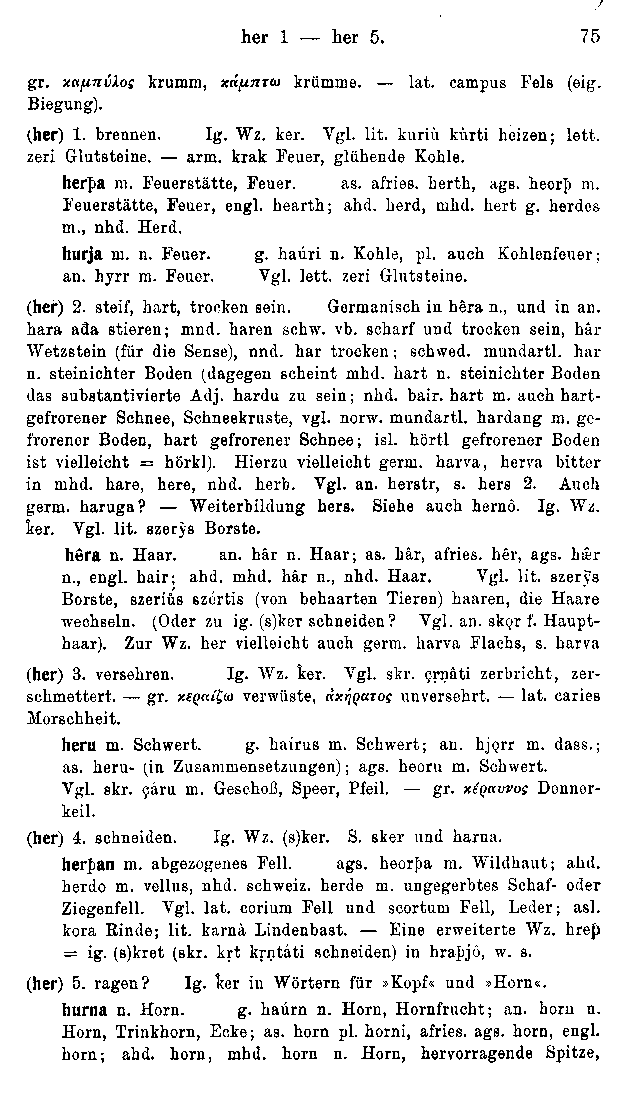
(her)
2.
steif,
hart,
trocken
sein.
Germanisch
in
hêra
n.,
und
in
an.
hara
a a
stieren;
mnd.
haren
schw.
vb.
scharf
und
trocken
sein,
hâr
Wetzstein
(für
die
Sense),
nnd.
har
trocken;
schwed.
mundartl.
har
n.
steinichter
Boden
(dagegen
scheint
mhd.
hart
n.
steinichter
Boden
das
substantivierte
Adj.
hardu
zu
sein;
nhd.
bair.
hart
m.
auch
hartgefrorener
Schnee,
Schneekruste,
vgl.
norw.
mundartl.
hardang
m.
gefrorener
Boden,
hart
gefrorener
Schnee;
isl.
hörtl
gefrorener
Boden
ist
vielleicht
=
hörkl).
Hierzu
vielleicht
germ.
harva,
herva
bitter
in
mhd.
hare,
here,
nhd.
herb.
Vgl.
an.
herstr,
s.
hers
2.
Auch
germ.
haruga?
-
Weiterbildung
hers.
Siehe
auch
hernô.
Ig.
Wz.
a
stieren;
mnd.
haren
schw.
vb.
scharf
und
trocken
sein,
hâr
Wetzstein
(für
die
Sense),
nnd.
har
trocken;
schwed.
mundartl.
har
n.
steinichter
Boden
(dagegen
scheint
mhd.
hart
n.
steinichter
Boden
das
substantivierte
Adj.
hardu
zu
sein;
nhd.
bair.
hart
m.
auch
hartgefrorener
Schnee,
Schneekruste,
vgl.
norw.
mundartl.
hardang
m.
gefrorener
Boden,
hart
gefrorener
Schnee;
isl.
hörtl
gefrorener
Boden
ist
vielleicht
=
hörkl).
Hierzu
vielleicht
germ.
harva,
herva
bitter
in
mhd.
hare,
here,
nhd.
herb.
Vgl.
an.
herstr,
s.
hers
2.
Auch
germ.
haruga?
-
Weiterbildung
hers.
Siehe
auch
hernô.
Ig.
Wz.
 er.
Vgl.
lit.
szer
er.
Vgl.
lit.
szer s
Borste.
s
Borste.
[Translate the German words]
|
Source: Torp, page b0159, entry 8 View original page image as: [TIFF] [PNG] [View previous entry] [View next entry] |
[Comment on this entry] [View comments] |
The following entry has been hand-corrected once. |
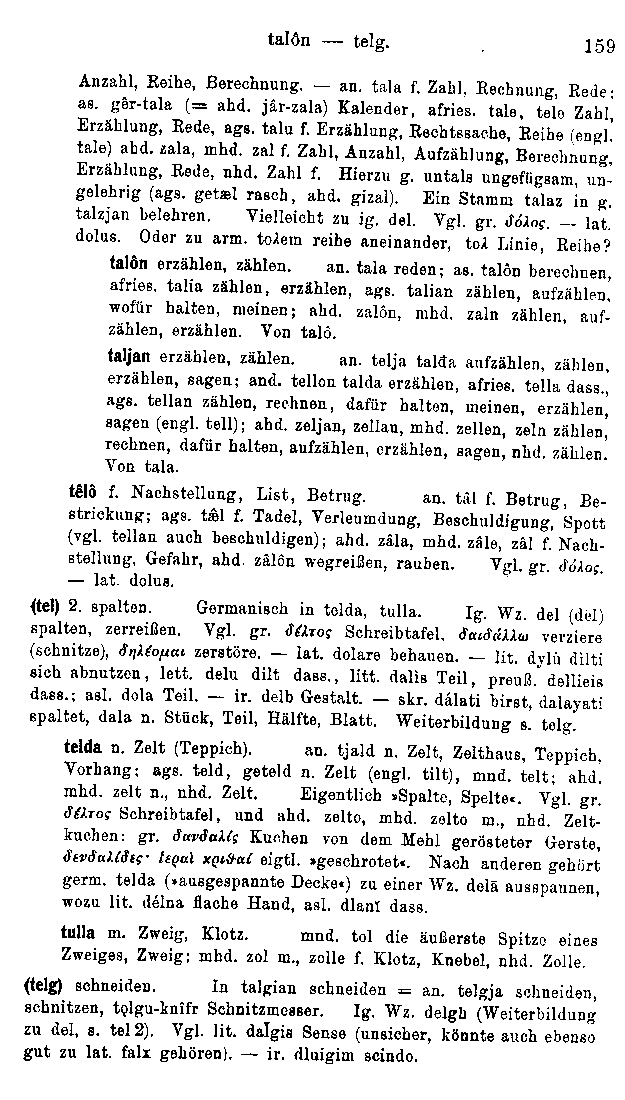
(telg)
schneiden.
In
talgian
schneiden
=
an.
telgja
schneiden,
schnitzen,
t lgu-knîfr
Schnitzmesser.
Ig.
Wz.
delgh
(Weiterbildung
zu
del,
s.
tel
2).
Vgl.
lit.
da
lgu-knîfr
Schnitzmesser.
Ig.
Wz.
delgh
(Weiterbildung
zu
del,
s.
tel
2).
Vgl.
lit.
da gis
Sense
(unsicher,
könnte
auch
ebenso
gut
zu
lat.
falx
gehören).
-
ir.
dluigim
scindo.
gis
Sense
(unsicher,
könnte
auch
ebenso
gut
zu
lat.
falx
gehören).
-
ir.
dluigim
scindo.
[Translate the German words]
|
Source: Torp, page b0210, entry 7 View original page image as: [TIFF] [PNG] [View previous entry] [View next entry] |
[Comment on this entry] [View comments] |
The following entry has been hand-corrected once. |
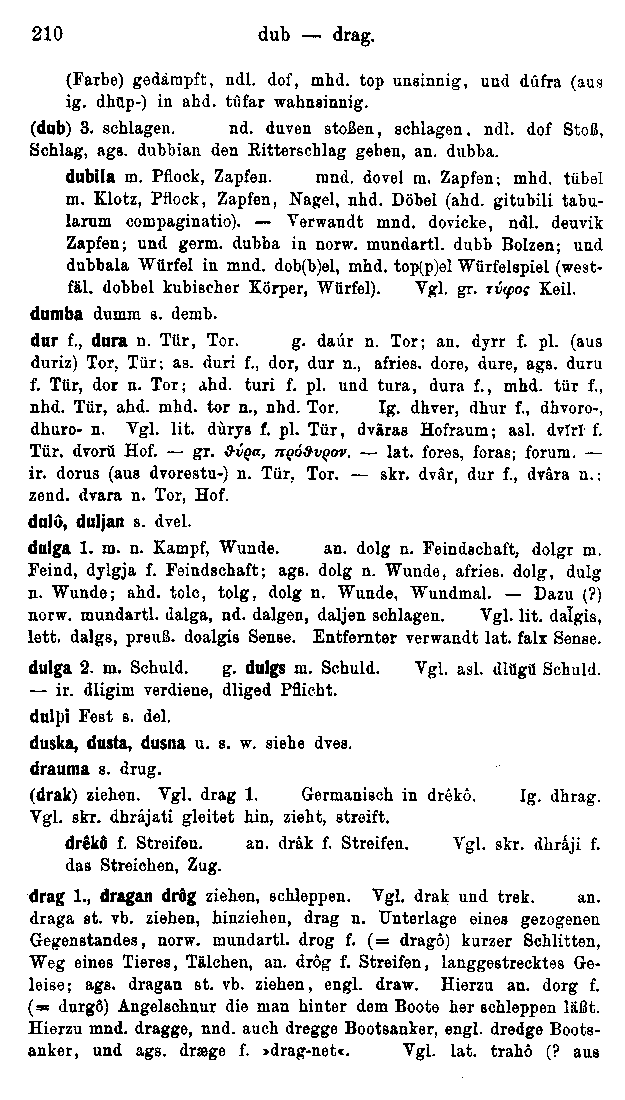
dulga
1.
m.
n.
Kampf,
Wunde.
an.
dolg
n.
Feindschaft,
dolgr
m.
Feind,
dylgja
f.
Feindschaft;
ags.
dolg
n.
Wunde,
afries.
dolg,
dulg
n.
Wunde;
ahd.
tolc,
tolg,
dolg
n.
Wunde,
Wundmal.
-
Dazu
(?)
norw.
mundartl.
dalga,
nd.
dalgen,
daljen
schlagen.
Vgl.
lit.
dagis,
lett.
dalgs,
preuß.
doalgis
Sense.
Entfernter
verwandt
lat.
falx
Sense.
[Translate the German words]
|
Source: Torp, page b0344, entry 4 View original page image as: [TIFF] [PNG] [View previous entry] [View next entry] |
[Comment on this entry] [View comments] |
The following entry has been hand-corrected once. |
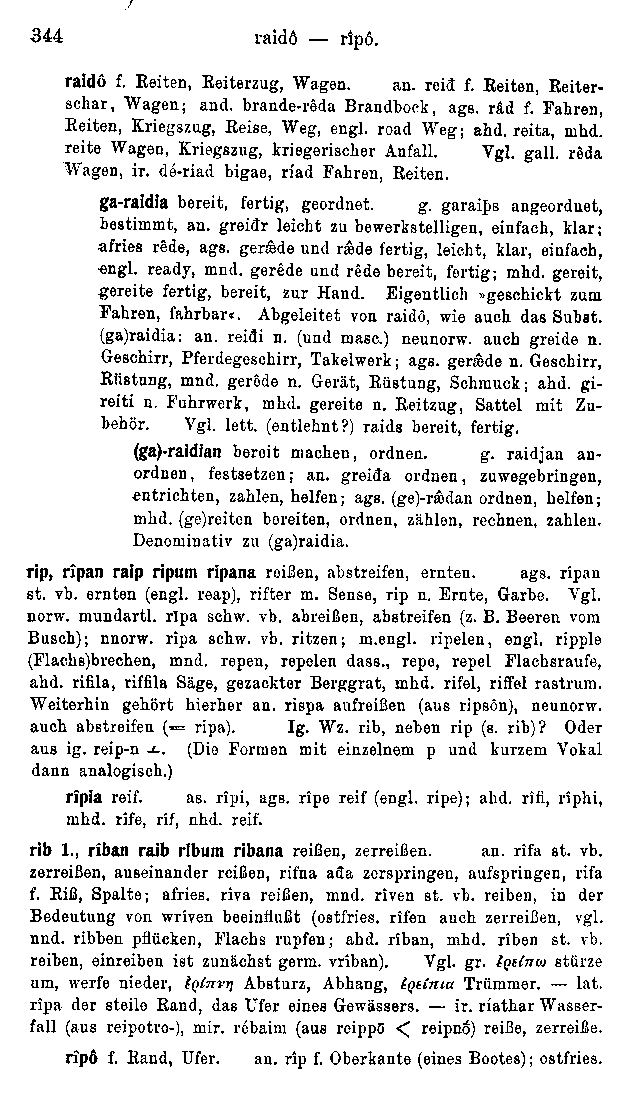
rip,
rîpan
raip
ripum
ripana
reißen,
abstreifen,
ernten.
ags.
rîpan
st.
vb.
ernten
(engl.
reap),
rifter
m.
Sense,
rip
n.
Ernte,
Garbe.
Vgl.
norw.
mundartl.
r pa,
schw.
vb.
abreißen,
abstreifen
(z.
B.
Beeren
vom
Busch);
nnorw.
rîpa
schw.
vb.
ritzen;
m.engl.
ripelen,
engl.
ripple
(Flachs)brechen,
mnd.
repen,
repelen
dass.,
repe,
repel
Flachsraufe,
ahd.
rifila,
riffila
Säge,
gezackter
Berggrat,
mhd.
rifel,
riffel
rastrum.
Weiterhin
gehört
hierher
an.
rispa
aufreißen
(aus
ripsôn),
neunorw.
auch
abstreifen
(=
ripa).
Ig.
Wz.
rib,
neben
rip
(s.
rib)?
Oder
aus
ig.
reip-n
pa,
schw.
vb.
abreißen,
abstreifen
(z.
B.
Beeren
vom
Busch);
nnorw.
rîpa
schw.
vb.
ritzen;
m.engl.
ripelen,
engl.
ripple
(Flachs)brechen,
mnd.
repen,
repelen
dass.,
repe,
repel
Flachsraufe,
ahd.
rifila,
riffila
Säge,
gezackter
Berggrat,
mhd.
rifel,
riffel
rastrum.
Weiterhin
gehört
hierher
an.
rispa
aufreißen
(aus
ripsôn),
neunorw.
auch
abstreifen
(=
ripa).
Ig.
Wz.
rib,
neben
rip
(s.
rib)?
Oder
aus
ig.
reip-n
 .
(Die
Formen
mit
einzelnem
p
und
kurzem
Vokal
dann
analogisch.)
.
(Die
Formen
mit
einzelnem
p
und
kurzem
Vokal
dann
analogisch.)
[Translate the German words]
|
Source: Torp, page b0370, entry 9 View original page image as: [TIFF] [PNG] [View previous entry] [View next entry] |
[Comment on this entry] [View comments] |
The following entry has been hand-corrected once. |
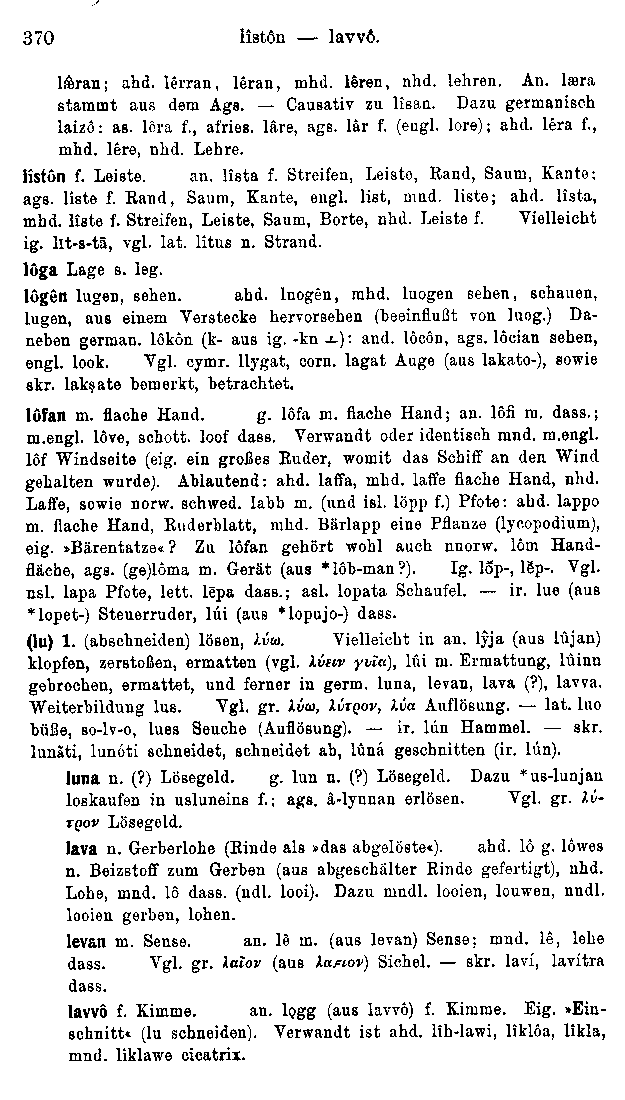
levan m. Sense. an. lê m. (aus levan) Sense; mnd. lê, lehe dass. Vgl. gr. [lai=on] (aus [lavion]) Sichel. - skr. laví, lavítra dass.
[Translate the German words]
|
Source: Torp, page b0424, entry 5 View original page image as: [TIFF] [PNG] [View previous entry] [View next entry] |
[Comment on this entry] [View comments] |
The following entry has been hand-corrected once. |
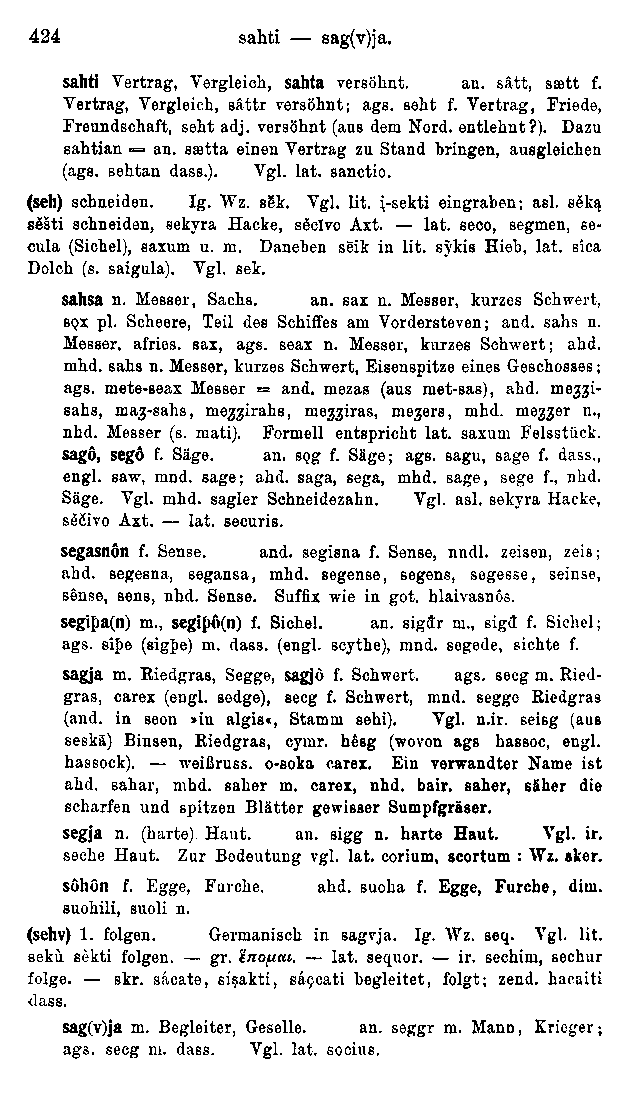
segasnôn f. Sense. and. segisna f. Sense, nndl. zeisen, zeis; ahd. segesna, segansa, mhd. segense, segens, segesse, seinse, sênse, sens, nhd. Sense. Suffix wie in got. hlaivasnôs.
[Translate the German words]
|
Source: Torp, page b0545, entry 2 View original page image as: [TIFF] [PNG] [View previous entry] [View next entry] |
[Comment on this entry] [View comments] |
The following entry has been hand-corrected once. |

svaþa
(das
Schwingen)
Anstreifen,
Gleiten.
an.
sva
n.
das
Gleiten,
glatte
Stelle,
auch
svai
m.
(nnorw.
svade
m.
Schlüpfrigkeit,
die
unter
der
Baumrinde
befindliche
Feuchtigkeit),
svu sâr
Streifwunde,
vb.
svaa
aa
und
sveja
gleiten;
ablautend
svæi
n.
(=
*svêþia)
ein
dem
Winde
ausgesetzter
Ort
(worüber
der
Wind
hinfegt);
ags.
swaþu
f.,
svæþ
n.
Spur,
afries.
swethe
f.
Grenze,
mnd.
swat
(-d-),
swade(n)
n.
Reihe
abgemähten
Grases
oder
Getreides,
swade
f.
Sense;
mhd.
swade
m.
=
mnd.
swat,
nhd.
Schwad,
Schwaden.
Verwandt
scheinen
Worte
mit
der
Bedeutung
»Wickel,
Windel«:
ags.
sweþel
Windel,
besweþian
einwindeln
(engl.
swathe,
swaddle
(ein
Kind)
einwindeln),
ä.
ndl.
swadel
Windel,
ahd.
swedil
m.
Umschlag,
mnd.
mhd.
swede
Pflaster.
Germ.
svaþa
=
ig.
*svato-,
Partizipialbildung
von
svê?
sâr
Streifwunde,
vb.
svaa
aa
und
sveja
gleiten;
ablautend
svæi
n.
(=
*svêþia)
ein
dem
Winde
ausgesetzter
Ort
(worüber
der
Wind
hinfegt);
ags.
swaþu
f.,
svæþ
n.
Spur,
afries.
swethe
f.
Grenze,
mnd.
swat
(-d-),
swade(n)
n.
Reihe
abgemähten
Grases
oder
Getreides,
swade
f.
Sense;
mhd.
swade
m.
=
mnd.
swat,
nhd.
Schwad,
Schwaden.
Verwandt
scheinen
Worte
mit
der
Bedeutung
»Wickel,
Windel«:
ags.
sweþel
Windel,
besweþian
einwindeln
(engl.
swathe,
swaddle
(ein
Kind)
einwindeln),
ä.
ndl.
swadel
Windel,
ahd.
swedil
m.
Umschlag,
mnd.
mhd.
swede
Pflaster.
Germ.
svaþa
=
ig.
*svato-,
Partizipialbildung
von
svê?
[Translate the German words]
|
Source: Wright's Gothic Grammar, page b0327, entry 5 View original page image as: [TIFF] [PNG] [View previous entry] [View next entry] |
[Comment on this entry] [View comments] |
The following entry has been hand-corrected once. |
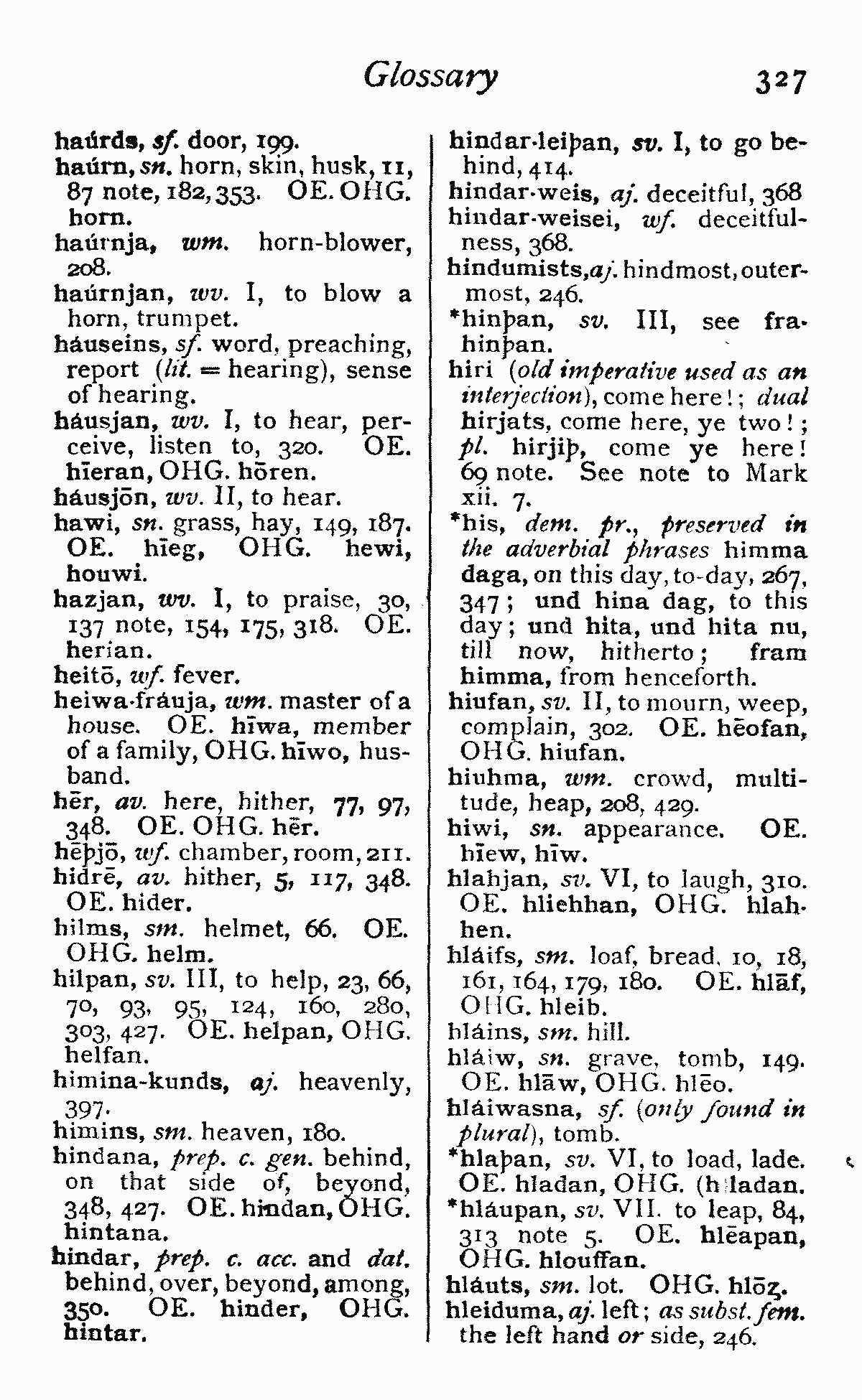
háuseins, sf. word, preaching, report (lit. = hearing), sense of hearing.
|
Source: Bosworth/Toller, page b0008, entry 7 View original page image as: [TIFF] [PNG] [View previous entry] [View next entry] |
[Comment on this entry] [View comments] |
The following entry has been hand-corrected once. |
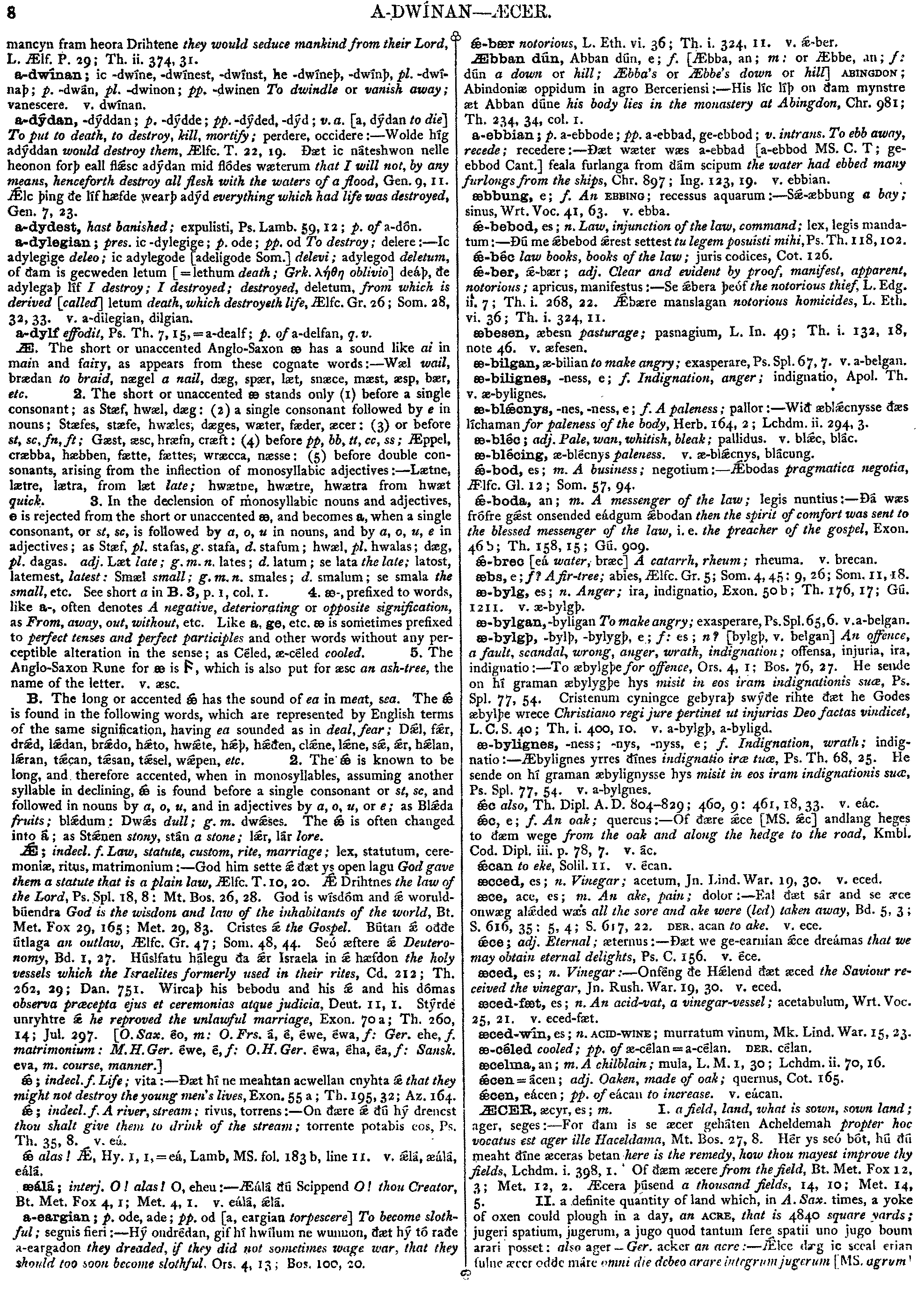
Æ. The short or unaccented Anglo-Saxon æ has a sound like ai in main and fairy, as appears from these cognate words :-- Wæl wail, brædan to braid, nægel a nail, dæg, spær, læt, snæce, mæst, æsp, bær, etc. 2. The short or unaccented æ stands only (1) before a single consonant; as Stæf, hwæl, dæg: (2) a single consonant followed by e in nouns; Stæfes, stæfe, hwæles, dæges, wæter, fæder, æcer: (3) or before st, sc, fn, ft; Gæst, æsc, hræfn, cræft: (4) before pp, bb, tt, cc, ss; Æppel, cræbba, hæbben, fætte, fættes, wræcca, næsse: (5) before double consonants, arising from the inflection of monosyllabic adjectives :-- Lætne, lætre, lætra, from læt late; hwætne, hwætre, hwætra from hwæt quick. 3. In the declension of monosyllabic nouns and adjectives, e is rejected from the short or unaccented æ, and becomes a, when a single consonant, or st, sc, is followed by a, o, u in nouns, and by a, o, u, e in adjectives; as Stæf, pl. stafas, g. stafa, d. stafum; hwæl, pl. hwalas; dæg, pl. dagas. adj. Læt late; g. m. n. lates; d. latum; se lata the late; latost, latemest, latest: Smæl small; g. m. n. smales; d. smalum; se smala the small, etc. See short a in B. 3, p. 1, col. 1. 4. æ-, prefixed to words, like a-, often denotes A negative, deteriorating or opposite signification, as From, away, out, without, etc. Like a, ge, etc. æ is sometimes prefixed to perfect tenses and perfect participles and other words without any perceptible alteration in the sense; as Céled, æ-céled cooled. 5. The Anglo-Saxon Rune for æ is RUNE, which is also put for æsc an ash-tree, the name of the letter. v. æsc.
|
Source: Bosworth/Toller, page b0012, entry 4 View original page image as: [TIFF] [PNG] [View previous entry] [View next entry] |
[Comment on this entry] [View comments] |
The following entry has been hand-corrected once. |
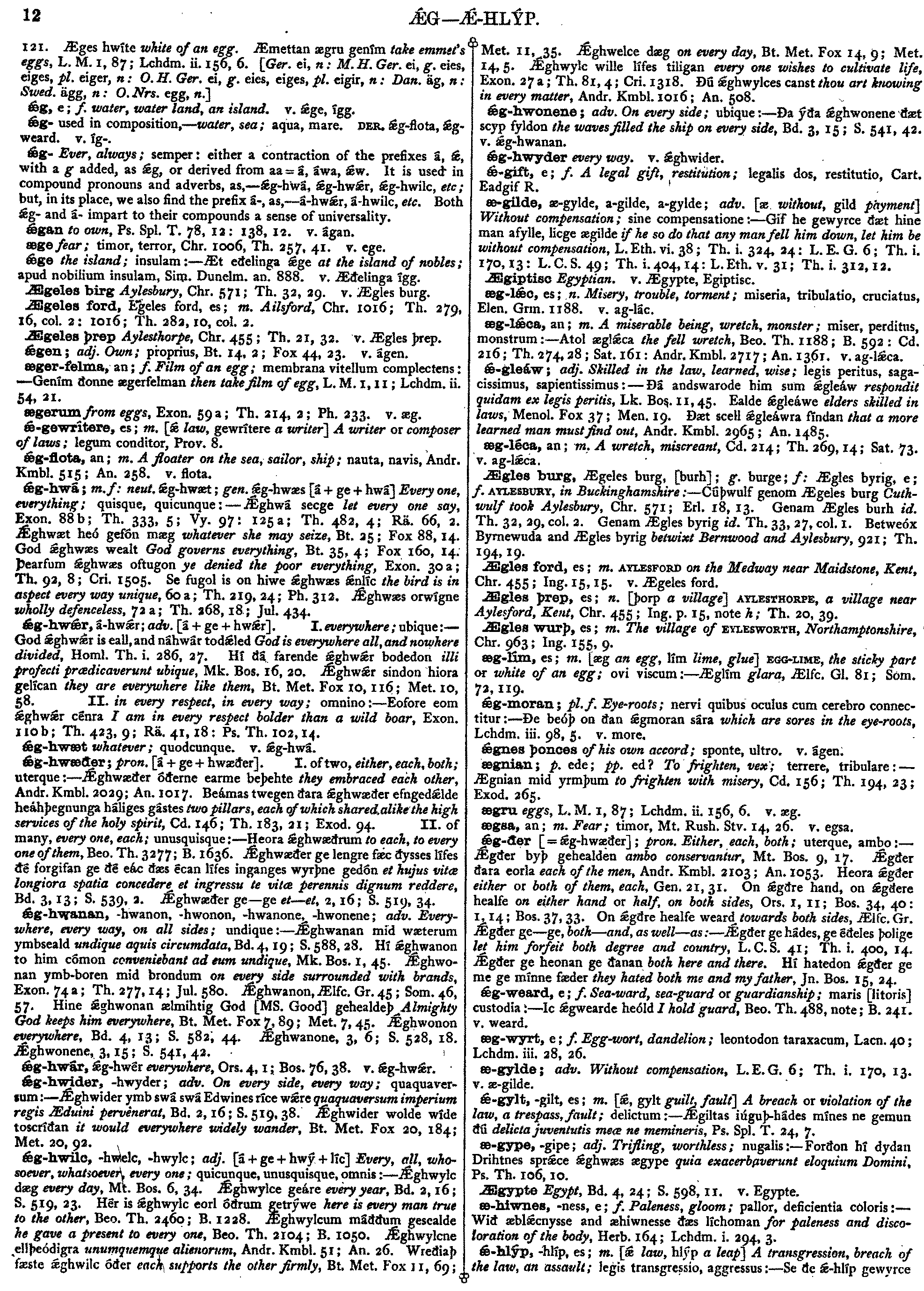
 g-
Ever,
always;
semper:
either
a
contraction
of
the
prefixes
á,
,
with
a
g
added,
as
g,
or
derived
from
aa
=
á,
áwa,
w.
It
is
used
in
compound
pronouns
and
adverbs,
as,
--
g-hwá,
g-hwr,
g-hwilc,
etc;
but,
in
its
place,
we
also
find
the
prefix
á
as,
--
á-hwr,
á-hwilc,
etc.
Both
g-
and
á-
impart
to
their
compounds
a
sense
of
universality.
g-
Ever,
always;
semper:
either
a
contraction
of
the
prefixes
á,
,
with
a
g
added,
as
g,
or
derived
from
aa
=
á,
áwa,
w.
It
is
used
in
compound
pronouns
and
adverbs,
as,
--
g-hwá,
g-hwr,
g-hwilc,
etc;
but,
in
its
place,
we
also
find
the
prefix
á
as,
--
á-hwr,
á-hwilc,
etc.
Both
g-
and
á-
impart
to
their
compounds
a
sense
of
universality.
| Result Page: | 1 2 3 4 5 6 7 8 9 10 | Next |  |
Germanic Lexicon Project (main page)
This search system was written by
Sean Crist
Please consider
volunteering
to correct the data in these online dictionaries.
No rights reserved. Feel free to use these data in any way you please.