|
|

Tip: In the search results, you can click on any word or abbreviation for more information.
|
Source: Torp, page b0428, entry 7 View original page image as: [TIFF] [PNG] [View previous entry] [View next entry] |
[Comment on this entry] [View comments] |
The following entry has been hand-corrected once. |

sen-
alt.
g.
sineigs
alt,
sinista
ältester,
afränk.
Sinigus,
seni scalcus
(lex
Alamann.).
Hierzu
auch
an.
sina
verwelktes
überwintertes
Gras,
und
mhd.
sen-wurz
erigeron,
senecio.
Vgl.
lit.
s
scalcus
(lex
Alamann.).
Hierzu
auch
an.
sina
verwelktes
überwintertes
Gras,
und
mhd.
sen-wurz
erigeron,
senecio.
Vgl.
lit.
s nas
alt,
senia
nas
alt,
senia seit
langer
Zeit.
-
gr.
[e('nh
kai`
ne'a].
-
lat.
senex
senis,
senior,
senêre
alt
sein,
senecio
erigeron.
-
ir.
sen
alt,
comp.
siniu.
-
arm.
hin
alt.
-
skr.
s
seit
langer
Zeit.
-
gr.
[e('nh
kai`
ne'a].
-
lat.
senex
senis,
senior,
senêre
alt
sein,
senecio
erigeron.
-
ir.
sen
alt,
comp.
siniu.
-
arm.
hin
alt.
-
skr.
s na
alt,
sánas,
sánâ
vor
Alters;
zend.
hana
alt.
na
alt,
sánas,
sánâ
vor
Alters;
zend.
hana
alt.
[Translate the German words]
|
Source: Bosworth/Toller, page b0877, entry 5 View original page image as: [TIFF] [PNG] [View previous entry] [View next entry] |
[Comment on this entry] [View comments] |
The following entry has been hand-corrected once. |
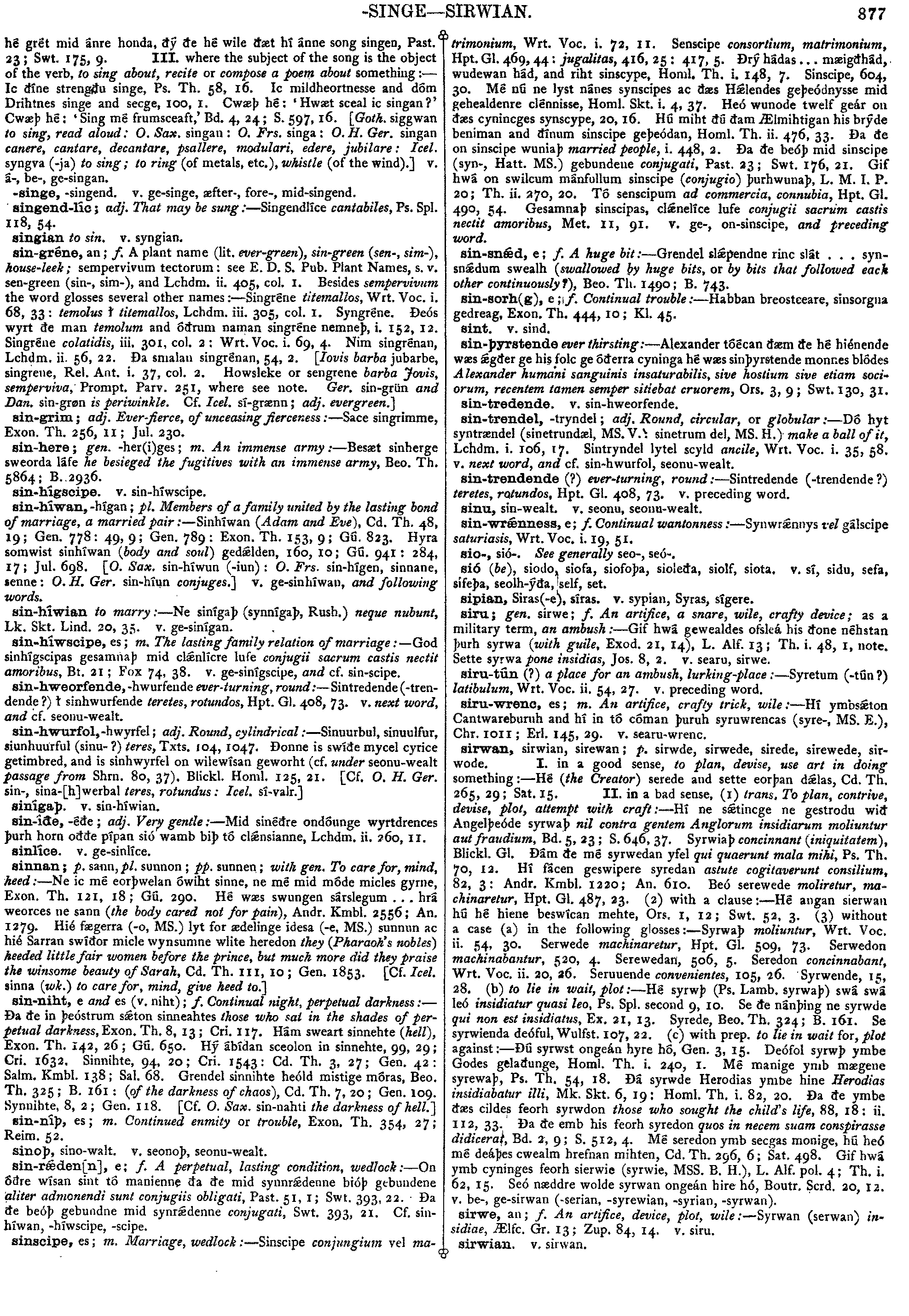
sin-gréne,
an
;
f.
A
plant
name
(lit.
ever-green),
sin-green
(sen-,
sim-),
house-leek
;
sempervivum
tectorum
:
see
E.
D.
S.
Pub.
Plant
Names,
s.
v.
sen-green
(sin-,
sim-),
and
Lchdm.
ii.
405,
col.
1.
Besides
sempervivum
the
word
glosses
several
other
names
:--Singréne
titemallos,
Wrt.
Voc.
i.
68,
33
:
temolus
 titemallos,
Lchdm.
iii.
305,
col.
1.
Syngréne.
Ðeós
wyrt
ðe
man
temolum
and
óðrum
naman
singréne
nemneþ,
i.
152,
12.
Singréne
colatidis,
iii.
301,
col.
2
:
Wrt.
Voc.
i.
69,
4.
Nim
singrénan,
Lchdm.
ii.
56,
22.
Ða
smalan
singrénan,
54,
2.
[Iovis
barba
jubarbe,
singrene.
Rel.
Ant.
i.
37,
col.
2.
Howsleke
or
sengrene
barba
Jovis,
semperviva,
Prompt.
Parv.
251,
where
see
note.
Ger.
sin-grün
and
Dan.
sin-grøn
is
periwinkle.
Cf.
Icel.
sí-grænn
;
adj.
evergreen.]
titemallos,
Lchdm.
iii.
305,
col.
1.
Syngréne.
Ðeós
wyrt
ðe
man
temolum
and
óðrum
naman
singréne
nemneþ,
i.
152,
12.
Singréne
colatidis,
iii.
301,
col.
2
:
Wrt.
Voc.
i.
69,
4.
Nim
singrénan,
Lchdm.
ii.
56,
22.
Ða
smalan
singrénan,
54,
2.
[Iovis
barba
jubarbe,
singrene.
Rel.
Ant.
i.
37,
col.
2.
Howsleke
or
sengrene
barba
Jovis,
semperviva,
Prompt.
Parv.
251,
where
see
note.
Ger.
sin-grün
and
Dan.
sin-grøn
is
periwinkle.
Cf.
Icel.
sí-grænn
;
adj.
evergreen.]
|
Source: Cleasby/Vigfusson, page b0017, entry 1 View original page image as: [TIFF] [PNG] [View previous entry] [View next entry] |
[Comment on this entry] [View comments] |
The following entry has been hand-corrected once. |
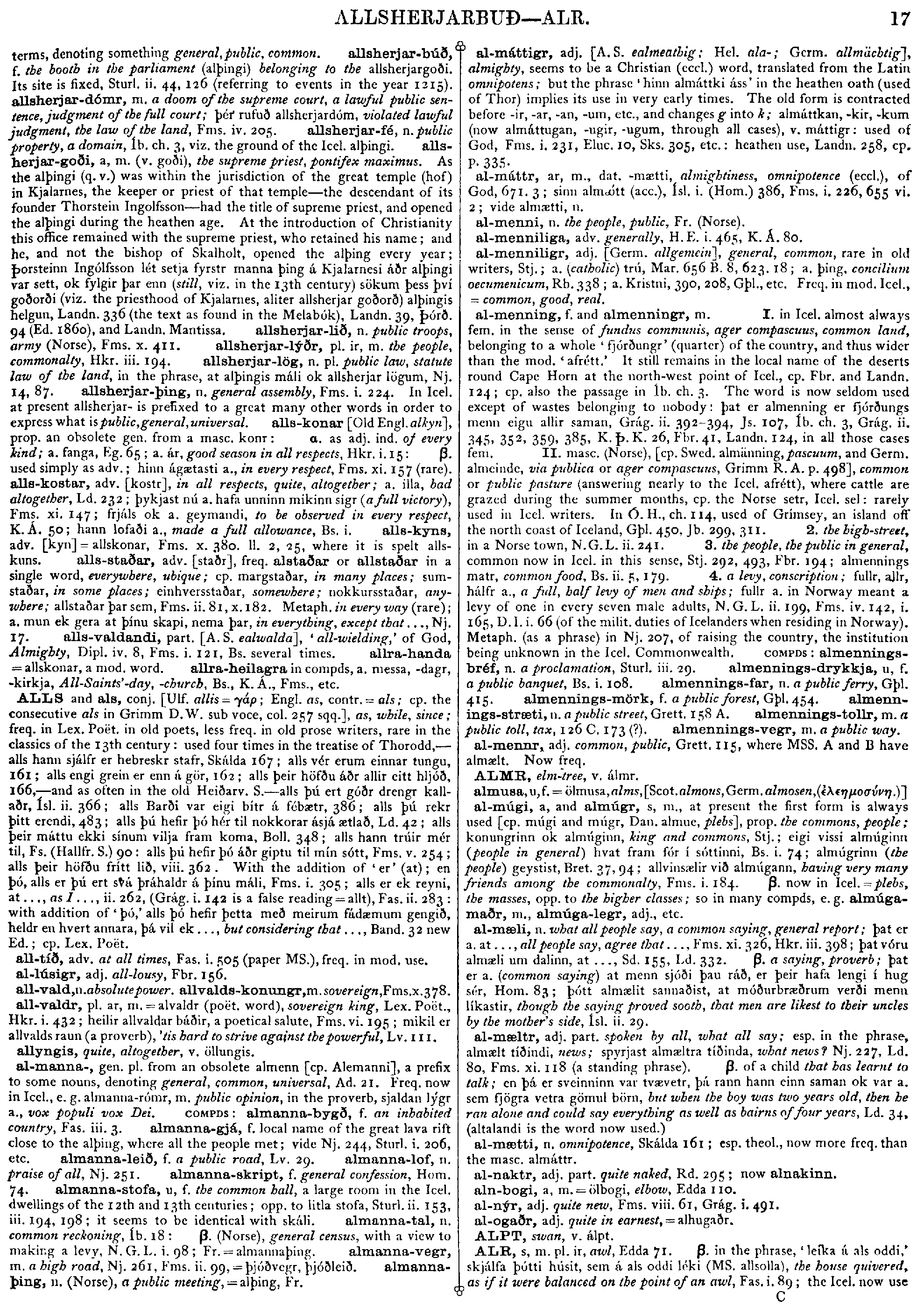
terms,
denoting
something
general,
public,
common.
allsherjar-búð,
f.
the
booth
in
the
parliament
(alþingi)
belonging
to
the
allsherjargoði.
Its
site
is
fixed,
Sturl.
ii.
44,
126
(referring
to
events
in
the
year
1215).
allsherjar-dómr,
m.
a
doom
of
the
supreme
court,
a
lawful
public
sen-
tence,
judgment
of
the
full
court;
þér
rufuð
allsherjardóm,
violated
lawful
judgment,
the
law
of
the
land,
Fms.
iv.
205.
allsherjar-fé,
n.
public
property,
a
domain,
Íb.
ch.
3,
viz.
the
ground
of
the
Icel.
alþingi.
alls-
herjar-goði,
a,
m.
(v.
goði),
the
supreme
priest,
pontifex
maximus.
As
the
alþingi
(q.
v.)
was
within
the
jurisdiction
of
the
great
temple
(hof)
in
Kjalarnes,
the
keeper
or
priest
of
that
temple
--
the
descendant
of
its
founder
Thorstein
Ingolfsson
--
had
the
title
of
supreme
priest,
and
opened
the
alþingi
during
the
heathen
age.
At
the
introduction
of
Christianity
this
office
remained
with
the
supreme
priest,
who
retained
his
name;
and
he,
and
not
the
bishop
of
Skalholt,
opened
the
alþing
every
year;
Þorsteinn
Ingólfsson
lét
setja
fyrstr
manna
þing
á
Kjalarnesi
áðr
alþingi
var
sett,
ok
fylgir
þar
enn
(still,
viz.
in
the
13th
century)
sökum
þess
því
goðorði
(viz.
the
priesthood
of
Kjalarnes,
aliter
allsherjar
goðorð)
alþingis
helgun,
Landn.
336
(the
text
as
found
in
the
Melabók),
Landn.
39,
Þórð.
94
(Ed.
1860),
and
Landn.
Mantissa.
allsherjar-lið,
n.
public
troops,
army
(Norse),
Fms.
x.
411.
allsherjar-lýðr,
pl.
ir,
m.
the
people,
commonalty,
Hkr.
iii.
194.
allsherjar-lög,
n.
pl.
public
law,
statute
law
of
the
land,
in
the
phrase,
at
alþingis
máli
ok
allsherjar
lögum,
Nj.
14,
87.
allsherjar-þing,
n.
general
assembly,
Fms.
i.
224.
In
Icel.
at
present
allsherjar-
is
prefixed
to
a
great
many
other
words
in
order
to
express
what
is
public,
general,
universal.
alls-konar
[Old
Engl.
alkyn],
prop.
an
obsolete
gen.
from
a
masc.
konr:
 .
as
adj.
ind.
of
every
kind;
a.
fanga,
Eg.
65;
a.
ár,
good
season
in
all
respects,
Hkr.
1.
15:
.
as
adj.
ind.
of
every
kind;
a.
fanga,
Eg.
65;
a.
ár,
good
season
in
all
respects,
Hkr.
1.
15:
 .
used
simply
as
adv.;
hinn
ágætasti
a.,
in
every
respect,
Fms.
xi.
157
(rare).
alls-kostar,
adv.
[kostr],
in
all
respects,
quite,
altogether;
a.
illa,
bad
altogether,
Ld.
232;
þykjast
nú
a.
hafa
unninn
mikinn
sigr
(a
full
victory),
Fms.
xi.
147;
frjáls
ok
a.
geymandi,
to
be
observed
in
every
respect,
K.
Á.
50;
hann
lofaði
a.,
made
a
full
allowance,
Bs.
i.
alls-kyns,
adv.
[kyn]
=
allskonar,
Fms.
x.
380.
11.
UNCERTAIN
2,
25,
where
it
is
spelt
alls-
kuns.
alls-staðar,
adv.
[staðr],
freq.
alstaðar
or
allstaðar
in
a
single
word,
everywhere,
ubique;
cp.
margstaðar,
in
many
places;
sum-
staðar,
in
so
me
places;
einhversstaðar,
somewhere;
nokkursstaðar,
any-
where;
allstaðar
þar
sem,
Fms.
ii.
81,
x.
182.
Metaph.
in
every
way
(rare);
a.
mun
ek
gera
at
þínu
skapi,
nema
þar,
in
everything,
except
that...,
Nj.
17.
alls-valdandi,
part.
[A.
S.
ealwalda],
'all-wielding,'
of
God,
Almighty,
Dipl.
iv.
8,
Fms.
i.
121,
Bs.
several
times.
allra-handa
=
allskonar,
a
mod.
word.
allra-heilagra
in
compds,
a.
messa,
-dagr,
-kirkja,
All-Saints'-day,
-church,
Bs.,
K.
Á.,
Fms.,
etc.
.
used
simply
as
adv.;
hinn
ágætasti
a.,
in
every
respect,
Fms.
xi.
157
(rare).
alls-kostar,
adv.
[kostr],
in
all
respects,
quite,
altogether;
a.
illa,
bad
altogether,
Ld.
232;
þykjast
nú
a.
hafa
unninn
mikinn
sigr
(a
full
victory),
Fms.
xi.
147;
frjáls
ok
a.
geymandi,
to
be
observed
in
every
respect,
K.
Á.
50;
hann
lofaði
a.,
made
a
full
allowance,
Bs.
i.
alls-kyns,
adv.
[kyn]
=
allskonar,
Fms.
x.
380.
11.
UNCERTAIN
2,
25,
where
it
is
spelt
alls-
kuns.
alls-staðar,
adv.
[staðr],
freq.
alstaðar
or
allstaðar
in
a
single
word,
everywhere,
ubique;
cp.
margstaðar,
in
many
places;
sum-
staðar,
in
so
me
places;
einhversstaðar,
somewhere;
nokkursstaðar,
any-
where;
allstaðar
þar
sem,
Fms.
ii.
81,
x.
182.
Metaph.
in
every
way
(rare);
a.
mun
ek
gera
at
þínu
skapi,
nema
þar,
in
everything,
except
that...,
Nj.
17.
alls-valdandi,
part.
[A.
S.
ealwalda],
'all-wielding,'
of
God,
Almighty,
Dipl.
iv.
8,
Fms.
i.
121,
Bs.
several
times.
allra-handa
=
allskonar,
a
mod.
word.
allra-heilagra
in
compds,
a.
messa,
-dagr,
-kirkja,
All-Saints'-day,
-church,
Bs.,
K.
Á.,
Fms.,
etc.
|
Source: Cleasby/Vigfusson, page b0091, entry 31 View original page image as: [TIFF] [PNG] [View previous entry] [View next entry] |
[Comment on this entry] [View comments] |
The following entry has been hand-corrected once. |
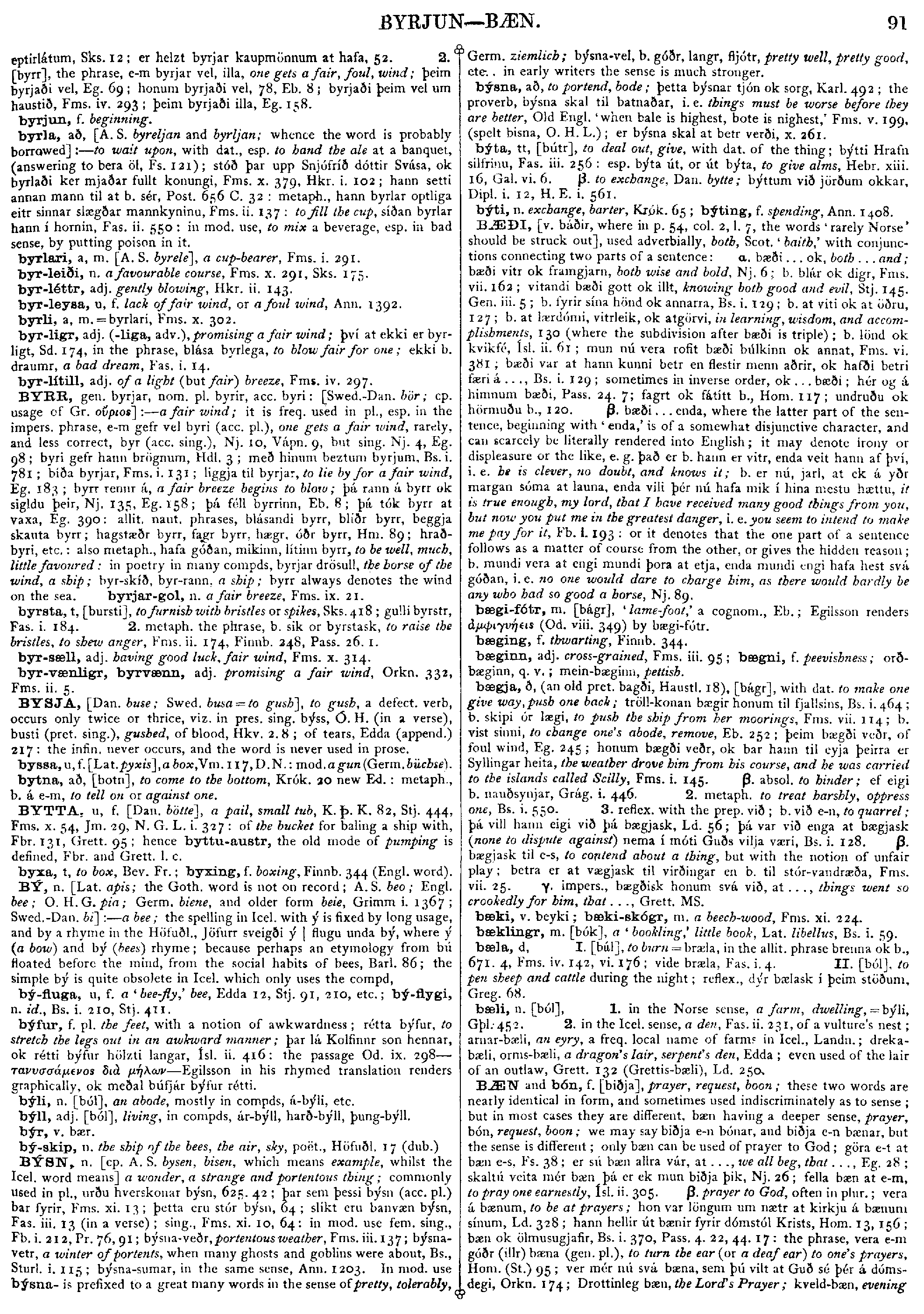
BÆÐI,
[v.
báðir,
where
in
p.
54,
col.
2,
1.
7,
the
words
'rarely
Norse'
should
be
struck
out],
used
adverbially,
both,
Scot.
'
baithh,
'with
conjunctions
connecting
two
parts
of
a
sentence:
a.
bæði,
...
ok,
both
...
and;
bæði
vitr
ok
framgjarn,
both
wise
and
bold,
Nj.
6;
b.
blár
ok
digr,
Fms.
vii.
162;
vitandi
bœði
gott
ok
illt,
knowing
both
good
and
evil,
Stj.
145.
Gen.
iii.
5;
b.
fyrir
sína
hönd
ok
annarra,
Bs.
i.
129;
b.
at
viti
ok
at
öðru,
127;
b.
at
lærdómi,
vitrleik,
ok
atgörvi,
in
learning,
wisdom,
and
accom-
plishments,
130
(where
the
subdivision
after
bæði
is
triple);
b.
lönd
ok
kvikfé,
Ísl.
ii.
61;
mun
nú
vera
rofit
bæði
búlkinn
ok
annat,
Fms.
vi.
381;
bæði
var
at
hann
kunni
betr
en
flestir
menn
aðrir,
ok
hafði
betri
færi
á
...,
Bs.
i.
129;
sometimes
in
inverse
order,
ok
...
bæði;
hér
og
á
himnum
bæði,
Pass.
24.
7;
fagrt
ok
fátítt
b.,
Hom.
117;
undruðu
ok
hörmuðu
b.,
120.
.
bæði...
enda,
where
the
latter
part
of
the
sen-
tence,
beginning
with
'enda,'
is
of
a
somewhat
disjunctive
character,
and
can
scarcely
be
literally
rendered
into
English;
it
may
denote
irony
or
displeasure
or
the
like,
e.
g.
það
er
b.
hann
er
vitr,
enda
veit
hann
af
því,
i.e.
he
is
clever,
no
doubt,
and
knows
it;
b.
er
nú,
jarl,
at
ek
á
yðr
margan
sóma
at
launa,
enda
vili
þér
nú
hafa
mik
í
hina
mestu
hættu,
it
is
true
enough,
my
lord,
that
I
have
received
many
good
things
from
you,
but
now
you
put
me
in
the
greatest
danger,
i.
e.
you
seem
to
intend
to
make
me
pay
for
it,
Fb.
i.
193:
or
it
denotes
that
the
one
part
of
a
sentence
follows
as
a
matter
of
course
from
the
other,
or
gives
the
hidden
reason;
b.
mundi
vera
at
engi
mundi
þora
at
etja,
enda
mundi
engi
hafa
hest
svá
góðan,
i.
e.
no
one
would
dare
to
charge
him,
as
there
would
hardly
be
any
who
had
so
good
a
horse,
Nj.
89.
|
Source: Cleasby/Vigfusson, page b0101, entry 39 View original page image as: [TIFF] [PNG] [View previous entry] [View next entry] |
[Comment on this entry] [View comments] |
The following entry has not been hand-corrected. However, the page is reserved and someone is correcting it. |
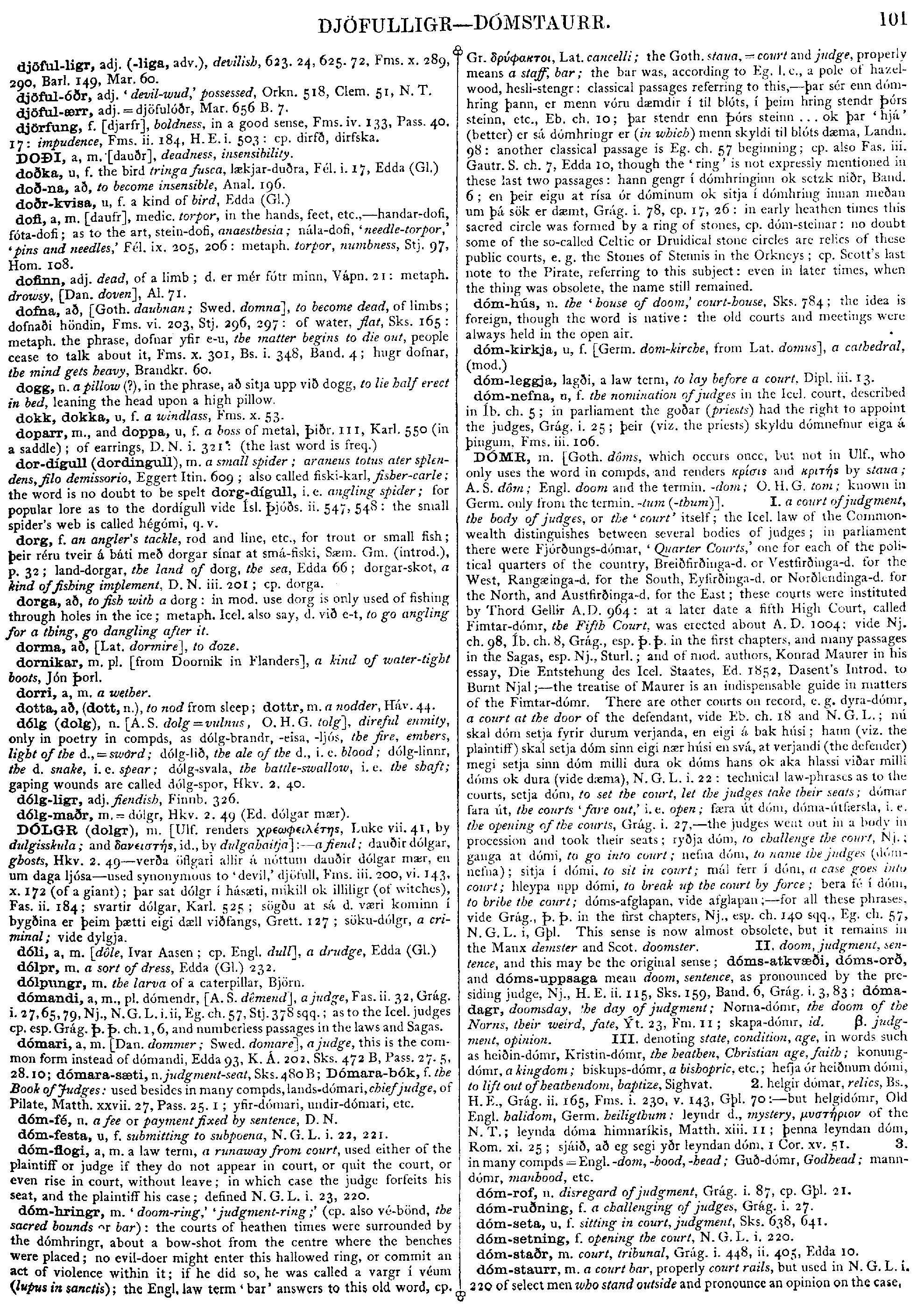
DÓMR, in. [Goth, dams, which occurs once, but not in Ulf., vvho only uses the word in compds, and renders Kpiais and Kptrris by siaua; A. S. dôm; F, ngl. d oow and the termin. -dom; O. H. G. torn; known in Germ, only from the termin. -turn (-thum)'] . I. a court of judgment, the body of judges, or the 'court' itself; the Icel. law of the Common- wealth distinguishes between several bodies of judges; in parliament there were Fjórðungs-dómar, ' Quarter Courts, ' one for each of the poli- tical quarters of the country, Breiðfirðinga-d. or Vesttirðinga-d. for the West, Rangaeinga-d. for the South, Eyiîrðinga-d. or Norðlendinga-d. lor the North, and Austfirðinga-d. for the East; these courts were instituted by Thord Gellir A. D. 964: at a later date a fifth High Court, called Fimtar-domr, the Fifth Court, was erected about A. D. 1004; vide Nj. ch. 98, íb. ch. 8, Grág., esp. f). fx in the first chapters, and many passages in the Sagas, esp. Nj., Sturl.; and of mod. authors, Konrad Maurer in his essay, Die Entstehung des Icel. Staates, Ed. 1852, Dasent's Introd. to Burnt Njal; -- the treatise of Maurer is an indispensable guide in matters of the Fimtar-domr. There are other courts on record, e. g. dyra-dómr, a court at the door of the defendant, vide Eb. ch. 18 and N. G. L.; mi skal dóm setja fyrir durum verjanda, en eigi á. bak hnsi; hann (viz. the plaintiff) skal setja dóm sinn eigi nær húsi en svá, at verjandi (the defender) megi setja sinn dóm milli dura ok dóms hans ok aka hlassi viðar milli dóms ok dura (vide dæma), N. G. L. i. 22: technical law-phrases as to the courts, setja dom, to set the court, let the judges take their seats; durmr fara lit, the courts 'fare out, ' i. e. open; faera lit dom, dúma-iitfærsla, i. e. the opening of the courts, Grug. i. 27, -- the judges went out in a body in procession and took their seats; ryðja dóm, to challenge the court, Nj.; ganga at dúmi, to go info court; nefna dom, to name the judges (iK'. ui- nefna); sitja í dómi, t o s it in court; múl ferr í dom, a case goes into court; hleypa upp dómi, to break up the court by force; bera K i dóm, to bribe the court; dóms-afglapan, vide afglapan; -- for all these phrase?, vide Grág., |x þ. in the first chapters, Nj., esp. ch. 140 sqq., Eg. ch. 57, N. G. L. i, Gþl. This sense is now almost obsolete, but it remains in the Manx demster and Scot, dooinster. II. doom, judgment, sen- tence, and this may be the original sense; dóms-atkvæði, dóms-orð, and dóms-uppsaga mean doom, sentence, as pronounced by the pre- siding judge, Nj., H. E. ii. 115, Sks. 159, Band. 6, Grág. i. 3, 83; dóma- dagr, doomsday, 'he day of judgment; Norna-dómr, the doom of the Norns, their weird, fate, Ýt. 23, Fm. 11; skapa-dómr, id. (3. judg- ment, opinion. III. denoting s t a te, condition, age, in words such as heiðin-dómr, Kristin-dómr, the heathen, Christian age, faith; konung- domr, a kingdom; biskups-dómr, a bishopric, etc.; hefja ór heiðnum dómi, to lift out of heathendom, baptize, Sighvat. 2. helgir dómar, relics, Bs., H. F, ., Grág. ii. 165, Fms. i. 230, v. 143, Gpl. 70 :-- but helgidómr, Old Engl. halidom, Germ, heiligthum: leyndr d., mystery, fjiiaTrjpl. ov of the N. T.; leynda donia hirnnarikis, Matth. xiii. ii; þenna leyndan dom, Rom. xi. 25; sjáið, að eg segi yðr leyndan dom, í Cor. xv. 51. 3. in many compds = Engl. -dom, -hood, -head; Guð-dómr, Godhead; mann- dómr, manhood,
Germanic Lexicon Project (main page)
This search system was written by
Sean Crist
Please consider
volunteering
to correct the data in these online dictionaries.
No rights reserved. Feel free to use these data in any way you please.