|
|

Tip: In the search results, you can click on any word or abbreviation for more information.
|
Source: Bosworth/Toller, page b0169, entry 1 View original page image as: [TIFF] [PNG] [View previous entry] [View next entry] |
[Comment on this entry] [View comments] |
The following entry has been hand-corrected once. |
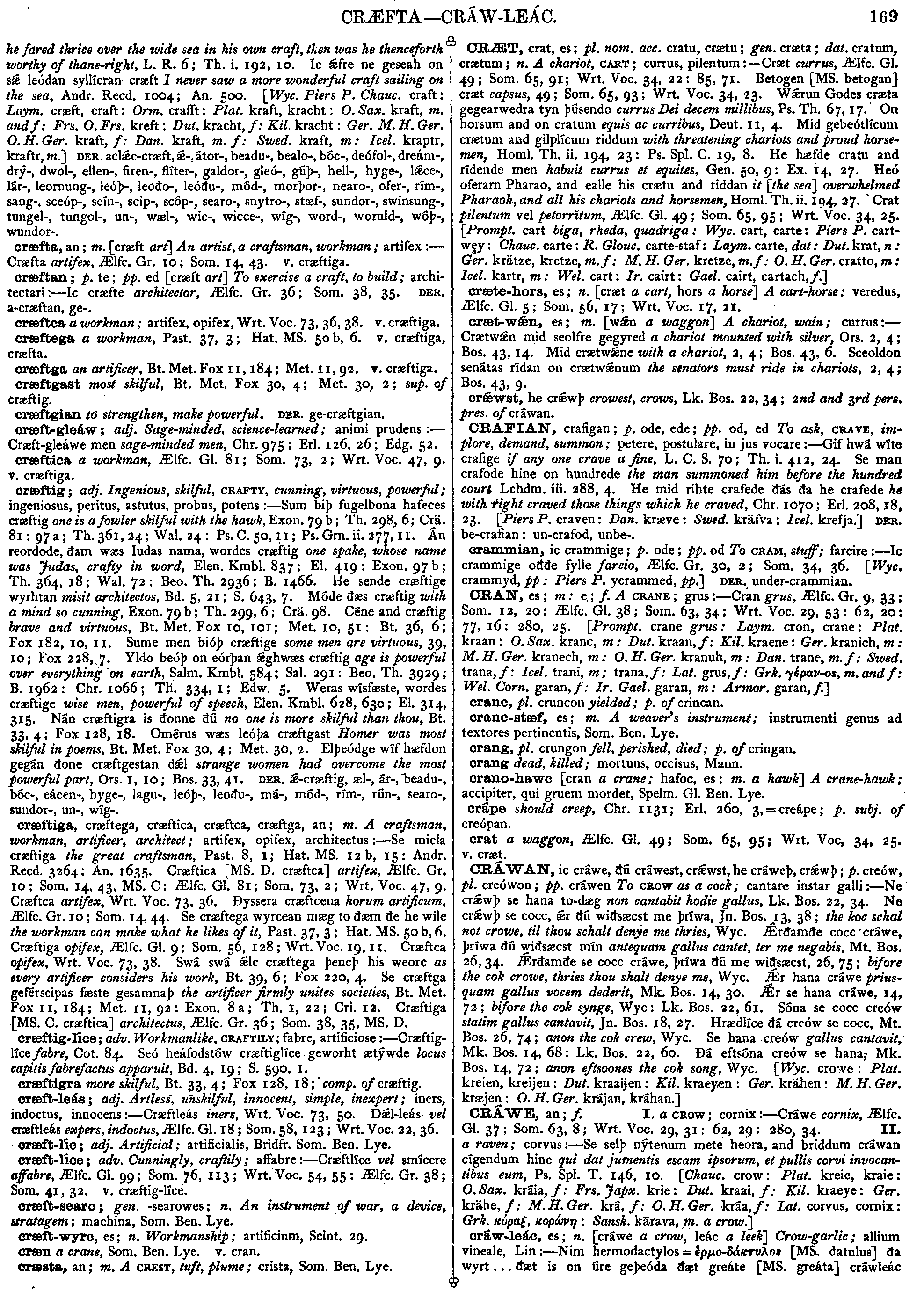
he
fared
thrice
over
the
wide
sea
in
his
own
craft,
then
was
he
thenceforth
worthy
of
thane-right,
L.
R.
6;
Th.
i.
192,
10.
Ic
 fre
ne
geseah
on
s
leódan
syllícran
cræft
I
never
saw
a
more
wonderful
craft
sailing
on
the
sea,
Andr.
Recd.
1004;
An.
500.
[Wyc.
Piers
P.
Chauc.
craft:
Laym.
cræft,
craft:
Orm.
crafft:
Plat,
kraft,
kracht:
O.
Sax.
kraft,
m.
and
f:
Frs.
O.
Frs.
kreft:
Dut.
kracht,
f:
Kil.
kracht:
Ger.
M.
H.
Ger.
O.
H.
Ger.
kraft,
f:
Dan.
kraft,
m.
f:
Swed.
kraft,
m:
Icel.
kraptr,
kraftr,
m.]
DER.
aclc-cræft,
-,
átor-,
beadu-,
bealo-,
bóc-,
deófol-,
dreám-,
drý-,
dwol-,
ellen-,
firen-,
flíter-,
galdor-,
gleó-,
gúþ-,
hell-,
hyge-,
lce-,
lár-,
leornung-,
leóþ-,
leoðo-,
leóðu-,
mód-,
morþor-,
nearo-,
ofer-,
rím-,
sang-,
sceóp-,
scín-,
scip-,
scóp-,
searo-,
snytro-,
stæf-,
sundor-,
swinsung-,
tungel-,
tungol-,
un-,
wæl-,
wic-,
wicce-,
wíg-,
word-,
woruld-,
wóþ-,
wundor-.
fre
ne
geseah
on
s
leódan
syllícran
cræft
I
never
saw
a
more
wonderful
craft
sailing
on
the
sea,
Andr.
Recd.
1004;
An.
500.
[Wyc.
Piers
P.
Chauc.
craft:
Laym.
cræft,
craft:
Orm.
crafft:
Plat,
kraft,
kracht:
O.
Sax.
kraft,
m.
and
f:
Frs.
O.
Frs.
kreft:
Dut.
kracht,
f:
Kil.
kracht:
Ger.
M.
H.
Ger.
O.
H.
Ger.
kraft,
f:
Dan.
kraft,
m.
f:
Swed.
kraft,
m:
Icel.
kraptr,
kraftr,
m.]
DER.
aclc-cræft,
-,
átor-,
beadu-,
bealo-,
bóc-,
deófol-,
dreám-,
drý-,
dwol-,
ellen-,
firen-,
flíter-,
galdor-,
gleó-,
gúþ-,
hell-,
hyge-,
lce-,
lár-,
leornung-,
leóþ-,
leoðo-,
leóðu-,
mód-,
morþor-,
nearo-,
ofer-,
rím-,
sang-,
sceóp-,
scín-,
scip-,
scóp-,
searo-,
snytro-,
stæf-,
sundor-,
swinsung-,
tungel-,
tungol-,
un-,
wæl-,
wic-,
wicce-,
wíg-,
word-,
woruld-,
wóþ-,
wundor-.
|
Source: Bosworth/Toller, page b0295, entry 4 View original page image as: [TIFF] [PNG] [View previous entry] [View next entry] |
[Comment on this entry] [View comments] |
The following entry has been hand-corrected once. |
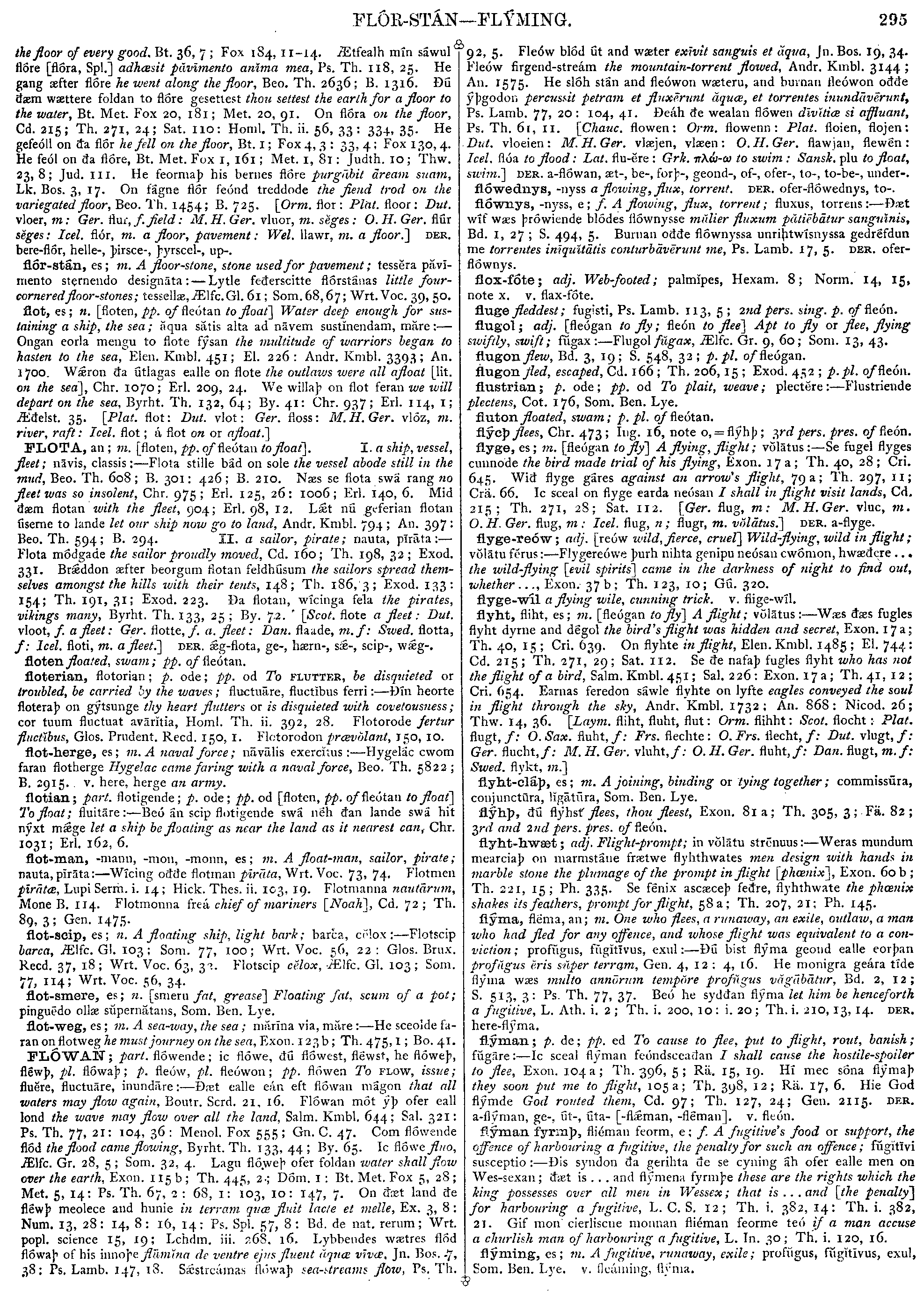
FLOTA,
an;
m.
[floten,
pp.
of
fleótan
to
float].
I.
a
ship,
vessel,
fleet;
n vis,
classis
:--
Flota
stille
bád
on
sole
the
vessel
abode
still
in
the
mud,
Beo.
Th.
608;
B.
301:
426;
B.
210.
Næs
se
fiota
swá
rang
no
fleet
was
so
insolent,
Chr.
975;
Erl.
125,
26:
1006;
Erl.
140,
6.
Mid
ðæm
flotan
with
the
fleet,
904;
Erl.
98,
12.
Lt
nú
geferian
flotan
úserne
to
lande
let
our
ship
now
go
to
land,
Andr.
Kmbl.
794;
An.
397:
Beo.
Th.
594;
B.
294.
II.
a
sailor,
pirate;
nauta,
p
vis,
classis
:--
Flota
stille
bád
on
sole
the
vessel
abode
still
in
the
mud,
Beo.
Th.
608;
B.
301:
426;
B.
210.
Næs
se
fiota
swá
rang
no
fleet
was
so
insolent,
Chr.
975;
Erl.
125,
26:
1006;
Erl.
140,
6.
Mid
ðæm
flotan
with
the
fleet,
904;
Erl.
98,
12.
Lt
nú
geferian
flotan
úserne
to
lande
let
our
ship
now
go
to
land,
Andr.
Kmbl.
794;
An.
397:
Beo.
Th.
594;
B.
294.
II.
a
sailor,
pirate;
nauta,
p rta
:--
Flota
m
rta
:--
Flota
m dgade
the
sailor
proudly
moved,
Cd.
160;
Th.
198,
32;
Exod.
331.
Brddon
æfter
beorgnm
flotan
feldhúsum
the
sailors
spread
themselves
amongst
the
hills
with
their
tents,
148;
Th.
186,
3;
Exod.
133:
154;
Th.
191,
31;
Exod.
223.
Ða
flotan,
wícinga
fela
the
pirates,
vikings
many,
Byrht.
Th.
133,
25;
By.
72.
[Scot.
flote
a
fleet:
Dut.
vloot,
f.
a
fleet:
Ger.
flotte,
f.
a.
fleet:
Dan.
flaade,
m.
f:
Swed.
flotta,
f:
Icel.
floti,
m.
a
fleet.]
EER.
g-flota,
ge-,
hærn-,
s-,
scip-,
wg-.
dgade
the
sailor
proudly
moved,
Cd.
160;
Th.
198,
32;
Exod.
331.
Brddon
æfter
beorgnm
flotan
feldhúsum
the
sailors
spread
themselves
amongst
the
hills
with
their
tents,
148;
Th.
186,
3;
Exod.
133:
154;
Th.
191,
31;
Exod.
223.
Ða
flotan,
wícinga
fela
the
pirates,
vikings
many,
Byrht.
Th.
133,
25;
By.
72.
[Scot.
flote
a
fleet:
Dut.
vloot,
f.
a
fleet:
Ger.
flotte,
f.
a.
fleet:
Dan.
flaade,
m.
f:
Swed.
flotta,
f:
Icel.
floti,
m.
a
fleet.]
EER.
g-flota,
ge-,
hærn-,
s-,
scip-,
wg-.
|
Source: Bosworth/Toller, page b0532, entry 8 View original page image as: [TIFF] [PNG] [View previous entry] [View next entry] |
[Comment on this entry] [View comments] |
The following entry has been hand-corrected once. |
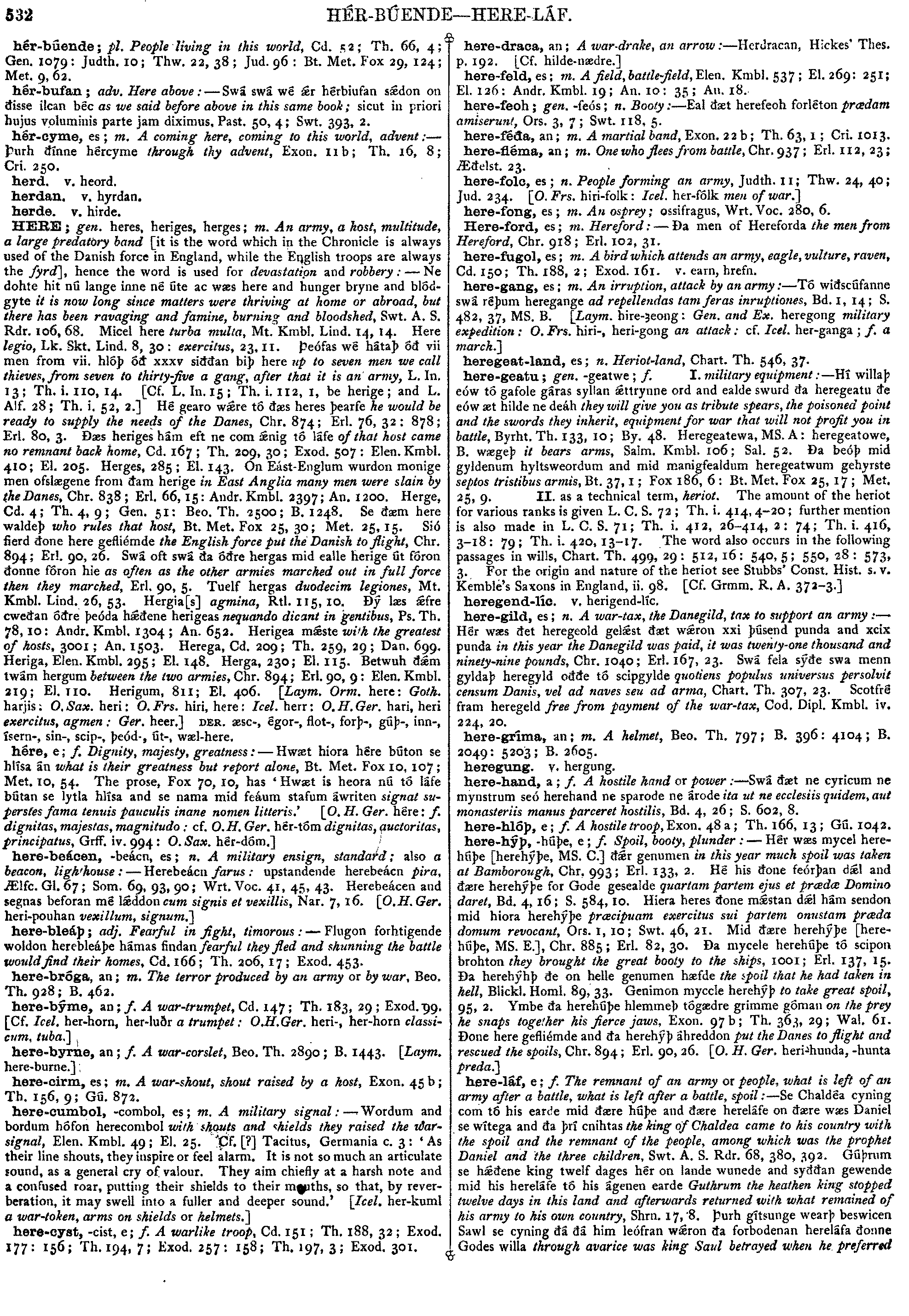
men
from
vii.
hlóþ
óð
xxxv
siððan
biþ
here
up
to
seven
men
we
call
thieves,
from
seven
to
thirty-five
a
gang,
after
that
it
is
an
army,
L.
In.
13;
Th.
i.
110,
14.
[Cf.
L.
In.
15;
Th.
i.
112,
1,
be
herige;
and
L.
Alf.
28;
Th.
i.
52,
2.]
Hé
gearo
wre
tó
ðæs
heres
þearfe
he
would
be
ready
to
supply
the
needs
of
the
Danes,
Chr.
874;
Erl.
76,
32:
878;
Erl.
80,
3.
Ðæs
heriges
hám
eft
ne
com
nig
tó
láfe
of
that
host
came
no
remnant
back
home,
Cd.
167;
Th.
209,
30;
Exod.
507:
Elen.
Kmbl.
410;
El.
205.
Herges,
285;
El.
143.
On
Eást-Englum
wurdon
monige
men
ofslægene
from
ðam
herige
in
East
Anglia
many
men
were
slain
by
the
Danes,
Chr.
838;
Erl.
66,
15:
Andr.
Kmbl.
2397;
An.
1200.
Herge,
Cd.
4;
Th.
4,
9;
Gen.
51:
Beo.
Th.
2500;
B.
1248.
Se
ðæm
here
waldeþ
who
rules
that
host,
Bt.
Met.
Fox
25,
30;
Met.
25,
15.
Sió
fierd
ðone
here
gefliémde
the
English
force
put
the
Danish
to
flight,
Chr.
894;
Erl.
90,
26.
Swá
oft
swá
ða
óðre
hergas
mid
ealle
herige
út
fóron
ðonne
fóron
hie
as
often
as
the
other
armies
marched
out
in
full
force
then
they
marched,
Erl.
90,
5.
Tuelf
hergas
duodecim
legiones,
Mt.
Kmbl.
Lind.
26,
53.
Hergia[s]
agmina,
Rtl.
115,
10.
Ðý
læs
fre
cweðan
óðre
þeóda
hðene
herigeas
nequando
dicant
in
gentibus,
Ps.
Th.
78,
10:
Andr.
Kmbl.
1304;
An.
652.
Herigea
mste
with
the
greatest
of
hosts,
3001;
An.
1503.
Herega,
Cd.
209;
Th.
259,
29;
Dan.
699.
Heriga,
Elen.
Kmbl.
295;
El.
148.
Herga,
230;
El.
115.
Betwuh
ðm
twám
hergum
between
the
two
armies,
Chr.
894;
Erl.
90,
9:
Elen.
Kmbl.
219;
El.
110.
Herigum,
811;
El.
406.
[Laym.
Orm.
here:
Goth.
harjis.
O.
Sax.
heri:
O.
Frs.
hiri,
here:
Icel.
herr:
O.
H.
Ger.
hari,
heri
exercitus,
agmen:
Ger.
heer.]
DER.
æsc-,
égor-,
flot-,
forþ-,
gúþ-,
inn-,
ísern-,
sin-,
scip-,
þeód-,
út-,
wæl-here.
|
Source: Bosworth/Toller, page b0604, entry 13 View original page image as: [TIFF] [PNG] [View previous entry] [View next entry] |
[Comment on this entry] [View comments] |
The following entry has been hand-corrected once. |
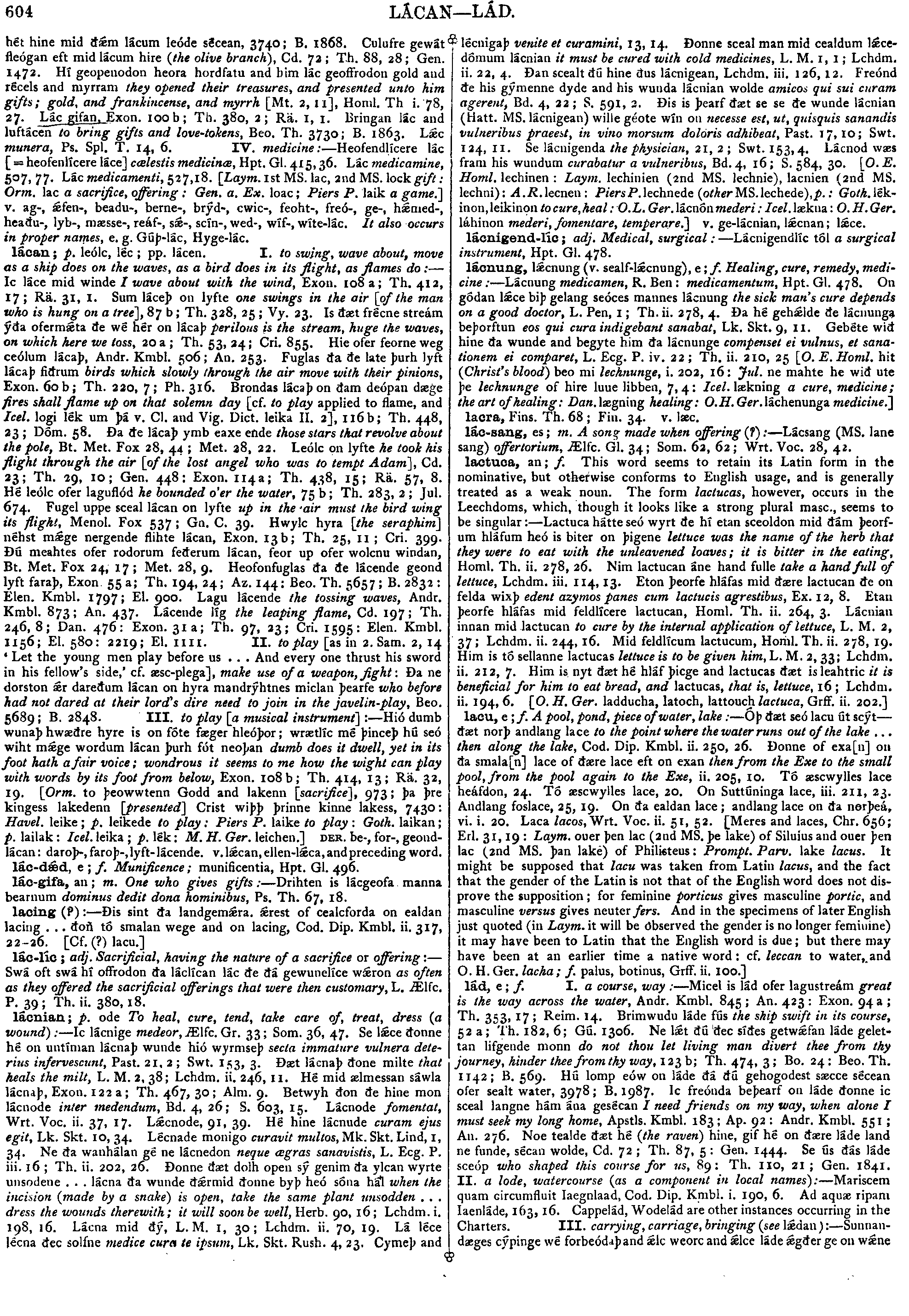
lád,
e;
f.
I.
a
course,
way
:--
Micel
is
lád
ofer
lagustreám
great
is
the
way
across
the
water,
Andr.
Kmbl.
845;
An.
423:
Exon.
94
a;
Th.
353,
17;
Reim.
14.
Brimwudu
láde
fús
the
ship
swift
in
its
course,
52
a;
Th.
182,
6;
Gú.
1306.
Ne
lt
ðú
ðec
síðes
getwfan
láde
gelettan
lifgende
monn
do
not
thou
let
living
man
divert
thee
from
thy
journey,
hinder
thee
from
thy
way,
123
b;
Th.
474,
3;
Bo.
24:
Beo.
Th.
1142
;
B.
569.
Hú
lomp
eów
on
láde
ðá
ðú
gehogodest
sæcce
sécean
ofer
sealt
water,
3978;
B.
1987.
Ic
freónda
beþearf
on
láde
ðonne
ic
sceal
langne
hám
ána
gesécan
I
need
friends
on
my
way,
when
alone
I
must
seek
my
long
home,
Apstls.
Kmbl.
183;
Ap.
92:
Andr.
Kmbl.
551;
An.
276.
Noe
tealde
ðæt
hé
(the
raven)
hine,
gif
hé
on
ðære
láde
land
ne
funde,
sécan
wolde,
Cd.
72;
Th.
87,
5:
Gen.
1444.
Se
ús
ðás
láde
sceóp
who
shaped
this
course
for
us,
89:
Th.
110,
21;
Gen.
1841.
II.
a
lode,
watercourse
(as
a
component
in
local
names)
:--
Mariscem
quam
circumfluit
Iaegnlaad,
Cod.
Dip.
Kmbl.
i.
190,
6.
Ad
aquæ
ripam
Iaenláde,
163,
16.
Cappelád,
Wodelád
are
other
instances
occurring
in
the
Charters.
III.
carrying,
carriage,
bringing
(see
ldan)
:--
Sunnandæges
cýpinge
wé
forbeódaþand
lc
weorc
and
lce
láde
gðer
ge
on
wne
ge
on
horse
ge
on
byrdene
we
forbid
Sunday
traffic
and
all
work
and
all
carrying
(of
goods,
&c.)
both
by
waggon
and
by
horse
and
by
the
man
himself,
L.
N.
P.
L.
55;
Th.
ii.
298,
22.
[The
word
lád
in
this
passage
can
hardly
be
translated
'journeying
;'
for,
in
the
first
place,
such
a
meaning
does
not
well
suit
the
phrase
on
byrdene,
and,
next,
some
journeying
was
allowed.
Thus,
L.
E.
I.
24;
Th.
ii.
420,
21-,
it
is
said
no
secular
work
was
to
be
done
'bútan
hwam
gebyrige
ðæt
hé
nýde
faran
scyle;
ðonne
mót
hé
swá
rídan
swá
rówan
swá
swilce
færelde
faran
swylce
tó
his
wege
gehyrige.'
The
threefold
division
of
the
means
of
carriage
seems
to
be
that
found
in
the
Icelandic
law
where,
dealing
with
the
observance
of
Sunday,
it
is
said
of
the
amount
that
might
be
carried
in
journeying
on
that
day
'er
rétt
at
bera
á
sjálfum
see
(
=
on
byrdene)
eþa
fara
á
skipi
eþa
bera
á
hrossi.']
On
sumon
hé
sceal
láde
ldan
on
some
lands
the
'genéat'
has
to
furnish
means
of
carriage,
L.
R.
S.
2;
Th.
1.
432,
14.
Cf.
436,
5-6
:--
Hé
sceal
beón
gehorsad
ðæt
hé
mge
tó
hláfordes
seáme
ðæt
syllan
oððe
sylf
ldan.
The
word
used
in
both
cases
in
the
Latin
translation
is
summagium,
in
reference
to
which,
and
to
the
English
words
which
it
translates,
may
be
quoted
Thorpe's
explanation
in
his
glossary:
'Lád,
seám,
summagium.
A
service,
which
consisted
in
supplying
the
lord
with
beasts
of
burthen,
or,
as
defined
by
Roquefort
(voce
somey):
"Service
qu'un
vassal
devoit
à
son
seigneur,
et
qui
consistoit
à
faire
faire
quelques
voyages
par
ses
bêtes
de
somme."
See
Spelman
sub
voce,
and
Du
Cange
voce
Sagma.'
The
phrase
láde
ldan
occurs
in
a
similar
passage,
dealing
with
the
duties
of
the
'geneát;
in
Cod.
Dip.
Kmbl.
iii.
450,
31-
:--
Se
geneát
[at
Dyddanham]
sceal
wyrcan
swá
on
lande,
swá
of
lande,
hweðer
swá
man
být
and
rídan,
and
auerian,
and
láde
ldan,
dráfe
drífan,
and
fela
óðra
þinga
dón.
The
later
English
lode
seems
to
keep
this
meaning.
Thus
Prompt.
Parv.
310,
loode
or
caryage
vectura;
lodysmanne
vector,
lator,
vehicularius:
the
verb
lead
is
found
with
the
sense
of
carry,
e.g.
p.
62
cartyn
or
lede
wythe
a
carte;
and
in
the
note,
and
again
in
a
note
on
p.
293,
we
have
the
phrases
'to
lede
dong,'
'to
lede
wheet,'
&c.
See
also
scip-lád.
IV.
Sustenance,
provision,
means
of
subsistence
:--
Ne
sceal
se
dryhtnes
þeów
in
his
módsefan
máre
gelufian
eorþan
htwelan
ðonne
his
ánes
gemet
ðæt
hé
his
líchoman
láde
hæbbe
nor
shall
the
servant
of
the
Lord
love
more
of
earth's
possessions,
than
a
sufficiency
for
himself,
that
he
may
have
sustenance
for
his
body,
Exon.
38
a;
Th.
125,
27;
Gú.
360.
With
this
use
of
lád
may
be
compared
the
later
English
lif-lode
which,
besides
the
meaning
conduct,
has
that
of
sustenance
:--
Heo
tilede
here
lyflode
...
heo
fonden
hem
sustynance
ynow,
R.
Glouc.
41,
22:
Prompt.
Parv.
lyvelode
victus;
lyflode
or
warysone
donativum.
So
O.
H.
Ger.
líb-leita
victus,
annona,
alimonium.
[In
further
illustration
of
lád
the
following
native
and
foreign
words
are
given.
Orm.
Þe
steoressmann
a lokeþþ
till
an
steorrne
þatt
stannt
a
still
...
forr
þatt
he
wile
follhenn
a
þatt
ilike
steorrness
lade
(guidance);
o
lade
on
the
way:
A.
R.
lode
burthen
(v.
III):
Mod.
E.
lode-star:
Icel.
leið.
I.
a
way,
course,
road.
II.
a
levy:
O.
H.
Ger.
leita,
funus,
ducatus;
pl.
exequiæ;
see
also
compounds
of
leiti,
Grff.
ii.
187].
DER.
brim-,
eá-,
ge-,
in-,
lagu-,
líf-,
mere-,
s-,
scip-,
út-,
ýð-lád.
lokeþþ
till
an
steorrne
þatt
stannt
a
still
...
forr
þatt
he
wile
follhenn
a
þatt
ilike
steorrness
lade
(guidance);
o
lade
on
the
way:
A.
R.
lode
burthen
(v.
III):
Mod.
E.
lode-star:
Icel.
leið.
I.
a
way,
course,
road.
II.
a
levy:
O.
H.
Ger.
leita,
funus,
ducatus;
pl.
exequiæ;
see
also
compounds
of
leiti,
Grff.
ii.
187].
DER.
brim-,
eá-,
ge-,
in-,
lagu-,
líf-,
mere-,
s-,
scip-,
út-,
ýð-lád.
|
Source: Bosworth/Toller, page b0643, entry 23 View original page image as: [TIFF] [PNG] [View previous entry] [View next entry] |
[Comment on this entry] [View comments] |
The following entry has been hand-corrected once. |
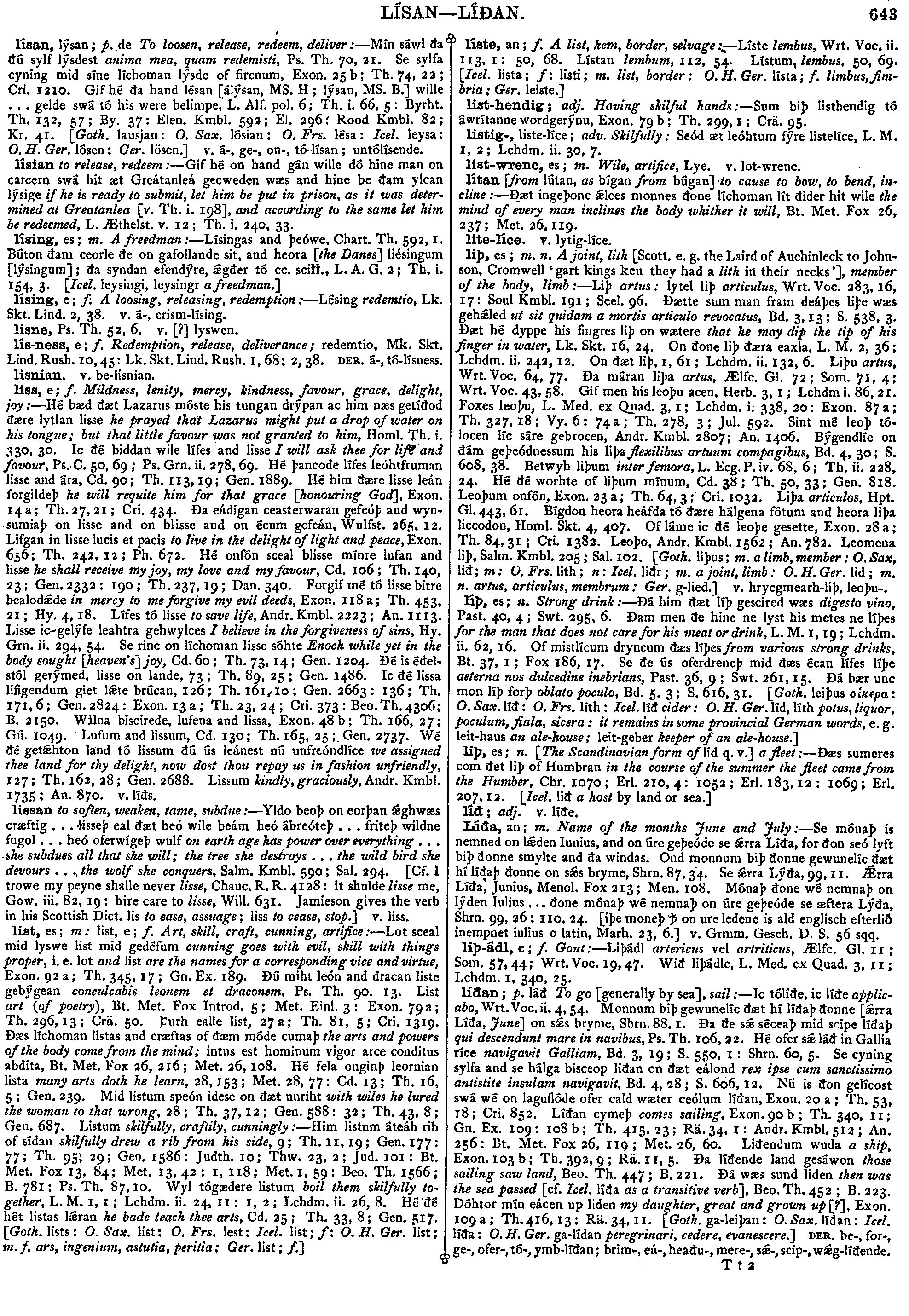
líðan;
p.
láð
To
go
[generally
by
sea],
sail
:--
Ic
tólíðe,
ic
líðe
applicabo,
Wrt.
Voc.
ii.
4,
54.
Monnum
biþ
gewunelíc
ðæt
hí
líðaþ
ðonne
[rra
Líða,
June]
on
ss
bryme,
Shrn.
88.
1.
Ða
ðe
s
séceaþ
mid
scipe
líðaþ
qui
descendunt
mare
in
navibus,
Ps.
Th.
106,
22.
Hé
ofer
s
láð
in
Gallia
ríce
navigavit
Galliam,
Bd.
3,
19;
S.
550,
1:
Shrn.
60,
5.
Se
cyning
sylfa
and
se
hálga
bisceop
líðan
on
ðæt
eálond
rex
ipse
cum
sanctissimo
antistite
insulam
navigavit,
Bd.
4,
28;
S.
606,
12.
Nú
is
ðon
gelícost
swá
wé
on
laguflóde
ofer
cald
wæter
ceólum
líðan,
Exon.
20
a;
Th.
53,
18;
Cri,
852.
Líðan
cymeþ
comes
sailing,
Exon.
90
b;
Th.
340,
11;
Gn.
Ex.
l09:
108
b;
Th.
415,
23;
Rä.
34,
1:
Andr.
Kmbl.
512;
An.
256:
Bt.
Met.
Fox
26,
119;
Met.
26,
60.
Liðendum
wuda
a
ship,
Exon.
103
b;
Th.
392,
9;
Rä.
11,
5.
Ða
líðende
land
gesáwon
those
sailing
saw
land,
Beo.
Th.
447;
B.
221.
Ðá
wæs
sund
liden
then
was
the
sea
passed
[cf.
Icel.
líða
as
a
transitive
verb],
Beo.
Th.
452;
B.
223.
Dóhtor
mín
eácen
up
liden
my
daughter,
great
and
grown
up[?],
Exon.
l09
a;
Th.
416,
13;
Rä.
34,
11.
[Goth.
ga-leiþan:
O.
Sax.
líðan:
Icel.
líða:
O.
H.
Ger.
ga-lídan
peregrinari,
cedere,
evanescere.]
DER.
be-,
for-,
ge-,
ofer-,
tó-,
ymb-líðan;
brim-,
eá-,
heaðu-,
mere-,
s-,
scip-,
wg-líðende.
|
Source: Bosworth/Toller, page b0786, entry 15 View original page image as: [TIFF] [PNG] [View previous entry] [View next entry] |
[Comment on this entry] [View comments] |
The following entry has been hand-corrected once. |
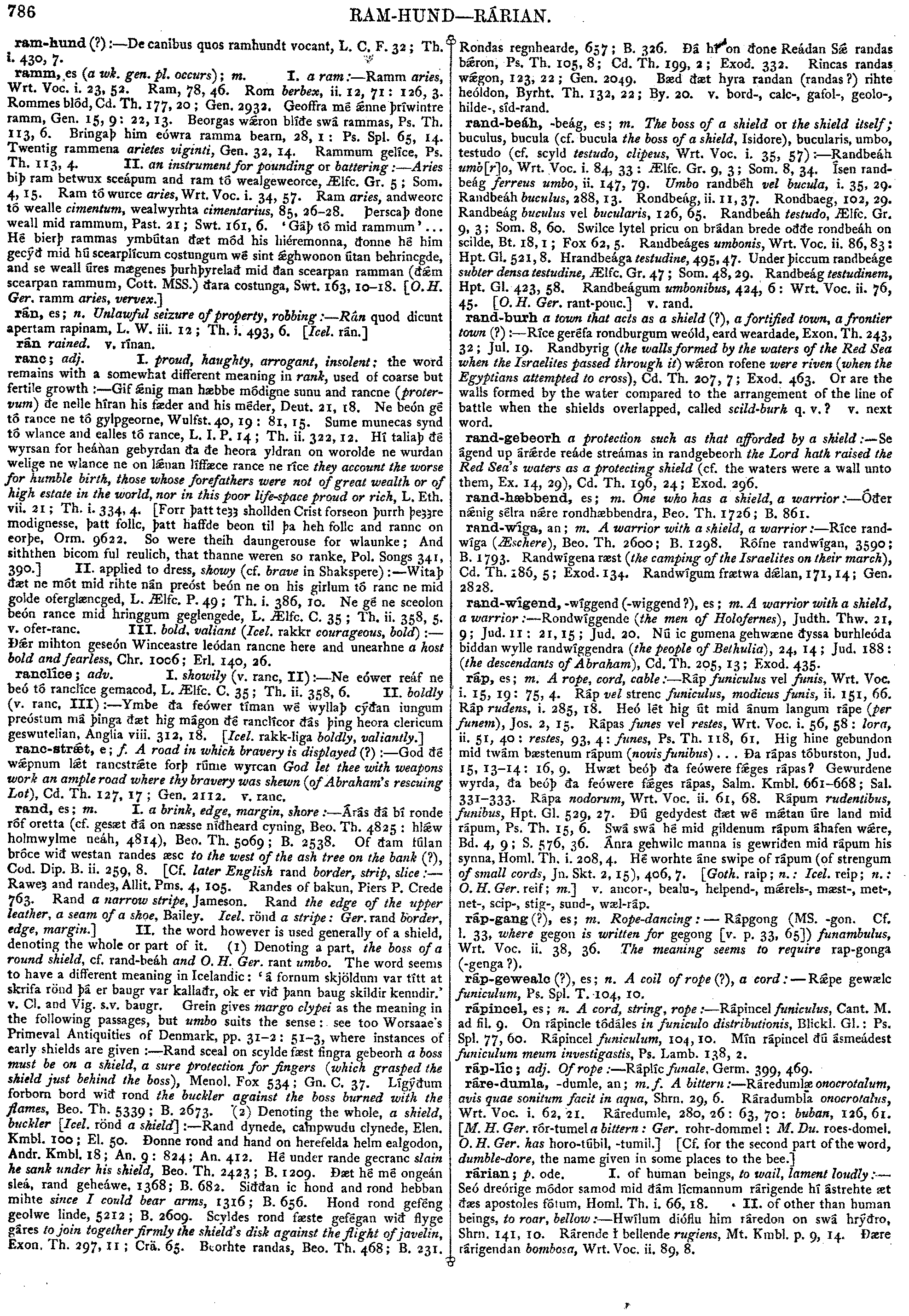
ráp,
es;
m.
A
rope,
cord,
cable
:--
Ráp
funiculus
vel
funis,
Wrt.
Voc.
i.
15,
19
:
75,
4.
Ráp
vel
strenc
funiculus,
modicus
funis,
ii.
151,
66.
Ráp
rudens,
i.
285,
18.
Heó
lét
hig
út
mid
ánum
langum
rápe
(per
funem),
Jos.
2,
15.
Rápas
funes
vel
restes,
Wrt.
Voc.
i.
56,
58
:
lora,
ii.
51,
40
:
restes,
93,
4
:
funes,
Ps.
Th.
118,
61.
Hig
hine
gebundon
mid
twám
bæstenum
rápum
(novis
funibus)
.
.
.
Ða
rápas
tóburston,
Jud.
15,
13-14
:
16,
9.
Hwæt
beóþ
ða
feówere
fges
rápas?
Gewurdene
wyrda,
ða
beóþ
ða
feówere
fges
rápas,
Salm.
Kmbl.
661-668;
Sal.
331-333.
Rápa
nodorum,
Wrt.
Voc.
ii.
61,
68.
Rápum
rudentibus,
funibus,
Hpt.
Gl.
529,
27.
Ðú
gedydest
ðæt
wé
mtan
úre
land
mid
rápum,
Ps.
Th.
15,
6.
Swá
swá
hé
mid
gildenum
rápum
áhafen
wre,
Bd.
4,
9;
S.
576,
36.
Ánra
gehwilc
manna
is
gewriðen
mid
rápum
his
synna,
Homl.
Th.
i.
208,
4.
Hé
worhte
áne
swipe
of
rápum
(of
strengum
of
small
cords,
Jn.
Skt.
2,
15),
406,
7.
[Goth.
raip;
n.
:
Icel.
reip;
n.
:
O.
H.
Ger.
reif;
m.]
v.
ancor-,
bealu-,
helpend-,
mrels-,
mæst-,
met-,
net-,
scip-,
stig-,
sund-,
wæl-ráp.
|
Source: Bosworth/Toller, page b0802, entry 24 View original page image as: [TIFF] [PNG] [View previous entry] [View next entry] |
[Comment on this entry] [View comments] |
The following entry has been hand-corrected once. |
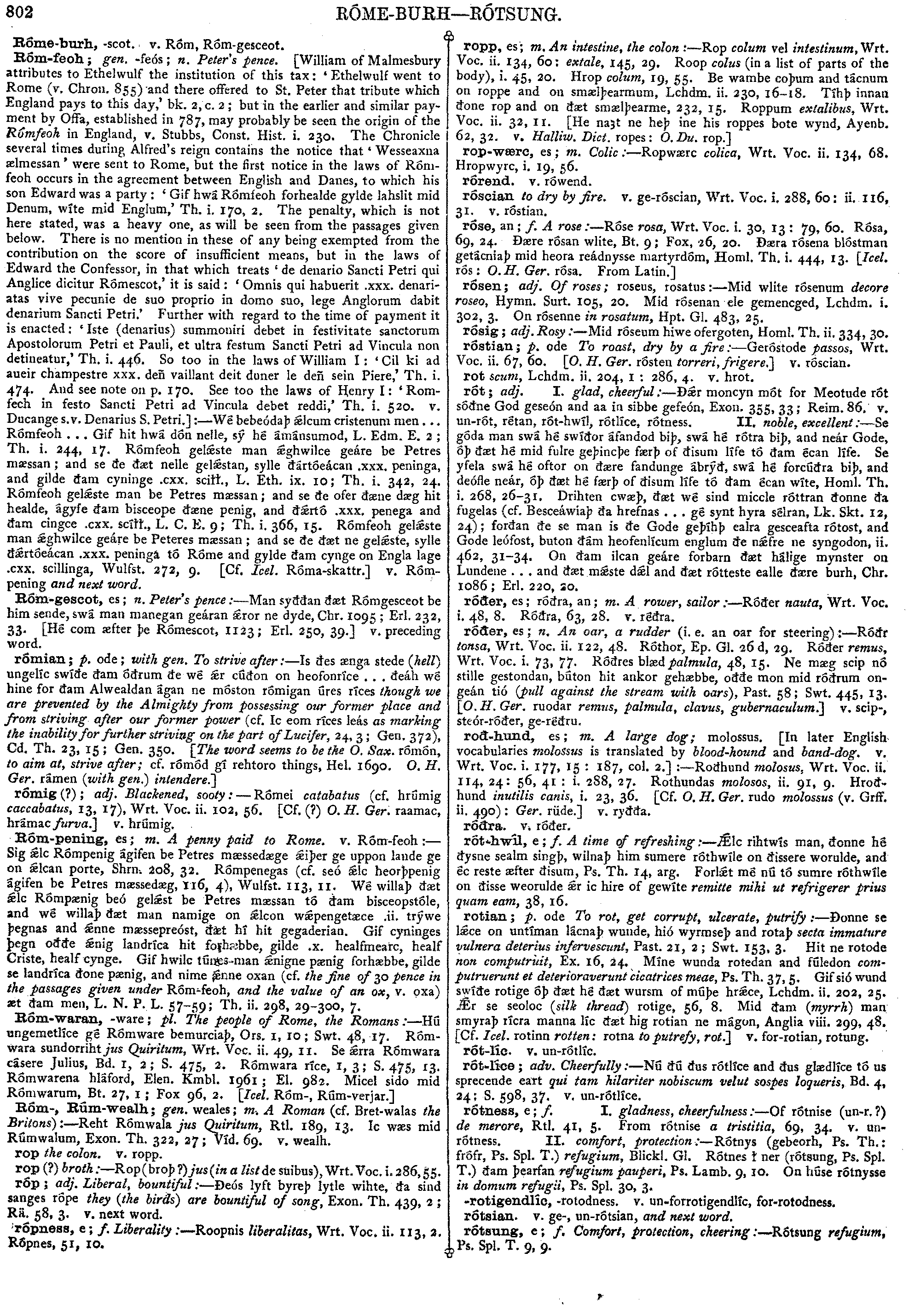
róðer, es; n. An oar, a rudder (i. e. an oar for steering) :-- Róðr tonsa, Wrt. Voc. ii. 122, 48. Róthor, Ep. Gl. 26 d, 29. Róðer remus, Wrt. Voc. i. 73. 77. Róðres blæd palmula, 48, 15. Ne mæg scip nó stille gestondan, búton hit ankor gehæbbe, oððe mon mid róðrum ongeán tió (pull against the stream with oars), Past. 58; Swt, 445. 13. [O. H. Ger. ruodar remus, palmula, clavus, gubernaculum.] v. scip-, steór-róðer, ge-réðru.
|
Source: Bosworth/Toller, page b0835, entry 1 View original page image as: [TIFF] [PNG] [View previous entry] [View next entry] |
[Comment on this entry] [View comments] |
The following entry has been hand-corrected once. |
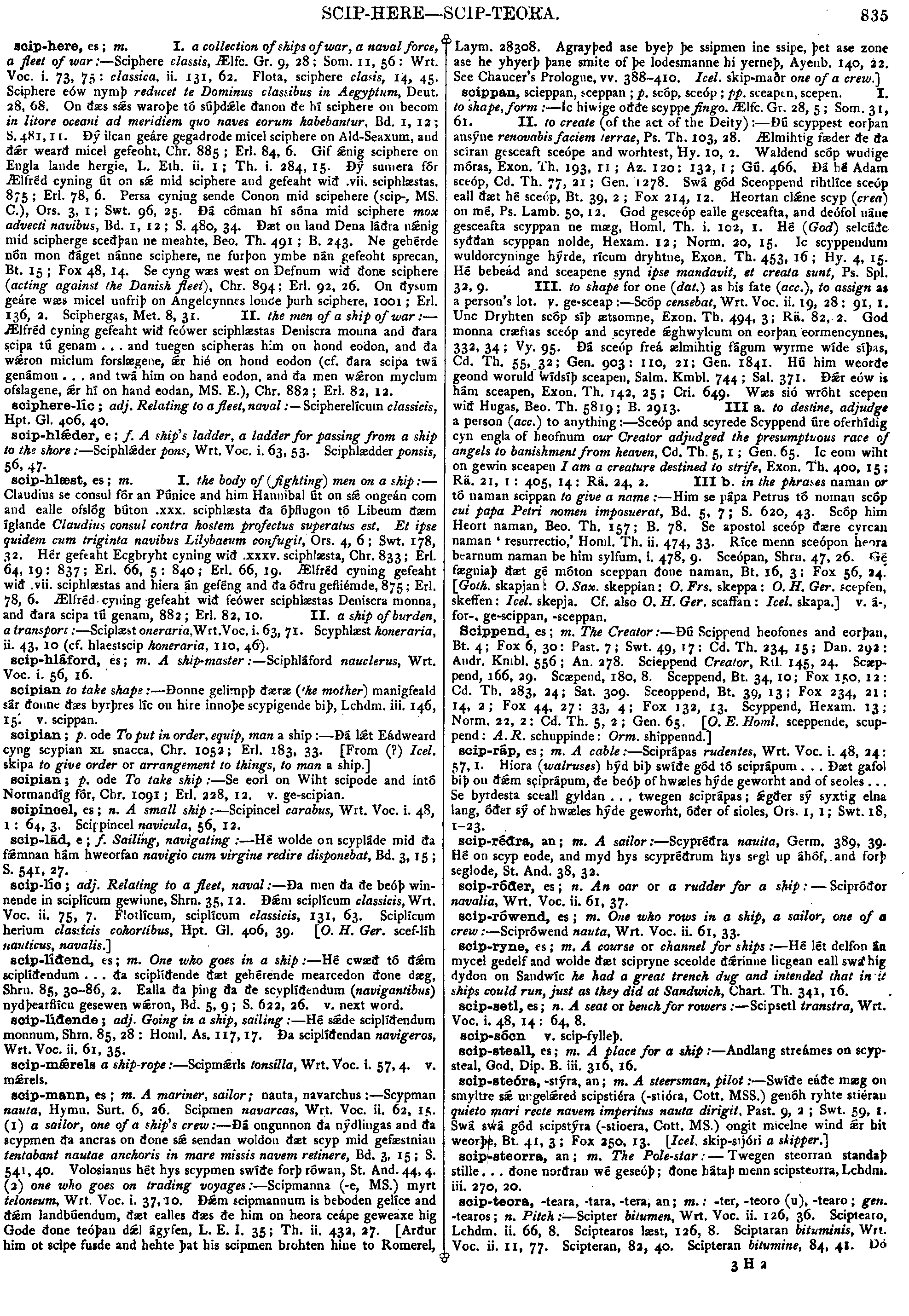
scip-here,
es;
m.
I.
a
collection
of
skips
of
war,
a
naval
force,
a
fleet
of
war:--Sciphere
classis,
Ælfc.
Gr.
9,
28;
Som.
11,
56:
Wrt.
Voc.
i.
73,
75:
classica,
ii.
131,
62.
Flota,
sciphere
clasis,
14,
45.
Sciphere
eów
nymþ
reducet
te
Dominus
classibus
in
Aegyptum,
Deut.
28,
68.
On
ðæs
ss
waroþe
tó
súþdle
ðanon
ðe
hí
sciphere
on
becom
in
litore
oceani
ad
meridiem
quo
naves
eorum
habebantur,
Bd.
1,
12;
S.
481,
11.
Ðý
ilcan
geáre
gegadrode
micel
sciphere
on
Ald-Seaxum,
and
ðr
wearð
micel
gefeoht,
Chr.
885;
Erl.
84,
6.
Gif
nig
sciphere
on
Engla
lande
hergie,
L.
Eth.
ii.
1;
Th.
i.
284,
15.
Ðý
sumera
fór
Ælfréd
cyning
út
on
s
mid
sciphere
and
gefeaht
wið
.vii.
sciphlæstas,
875;
Erl.
78,
6.
Persa
cyning
sende
Conon
mid
scipehere
(scip-,
MS.
C.),
Ors.
3,
1;
Swt.
96,
25.
Ðá
cóman
hí
sóna
mid
sciphere
mox
advecti
navibus,
Bd.
1,
12;
S.
480,
34.
Ðæt
on
land
Dena
láðra
nnig
mid
scipherge
sceðþan
ne
meahte,
Beo.
Th.
491;
B.
243.
Ne
gehérde
nón
mon
ðáget
nánne
sciphere,
ne
furþon
ymbe
nán
gefeoht
sprecan,
Bt.
15;
Fox
48,
14.
Se
cyng
wæs
west
on
Defnum
wið
ðone
sciphere
(acting
against
the
Danish
fleet),
Chr.
894;
Erl.
92,
26.
On
ðysum
geáre
wæs
micel
unfriþ
on
Angelcynnes
londe
þurh
sciphere,
1001;
Erl.
136,
2.
Sciphergas,
Met.
8,
31.
II.
the
men
of
a
ship
of
war:--Ælfréd
cyning
gefeaht
wið
feówer
sciphlæstas
Deniscra
monna
and
ðara
scipa
tú
genam
.
.
.
and
tuegen
scipheras
him
on
hond
eodon,
and
ða
wron
miclum
forslægene,
r
hié
on
hond
eodon
(cf.
ðara
sciþa
twá
genámon
.
.
.
and
twá
him
on
hand
eodon,
and
ða
men
wron
myclum
ofslagene,
r
hí
on
hand
eodan,
MS.
E.),
Chr.
882;
Erl.
82,
12.
|
Source: Bosworth/Toller, page b0867, entry 1 View original page image as: [TIFF] [PNG] [View previous entry] [View next entry] |
[Comment on this entry] [View comments] |
The following entry has been hand-corrected once. |
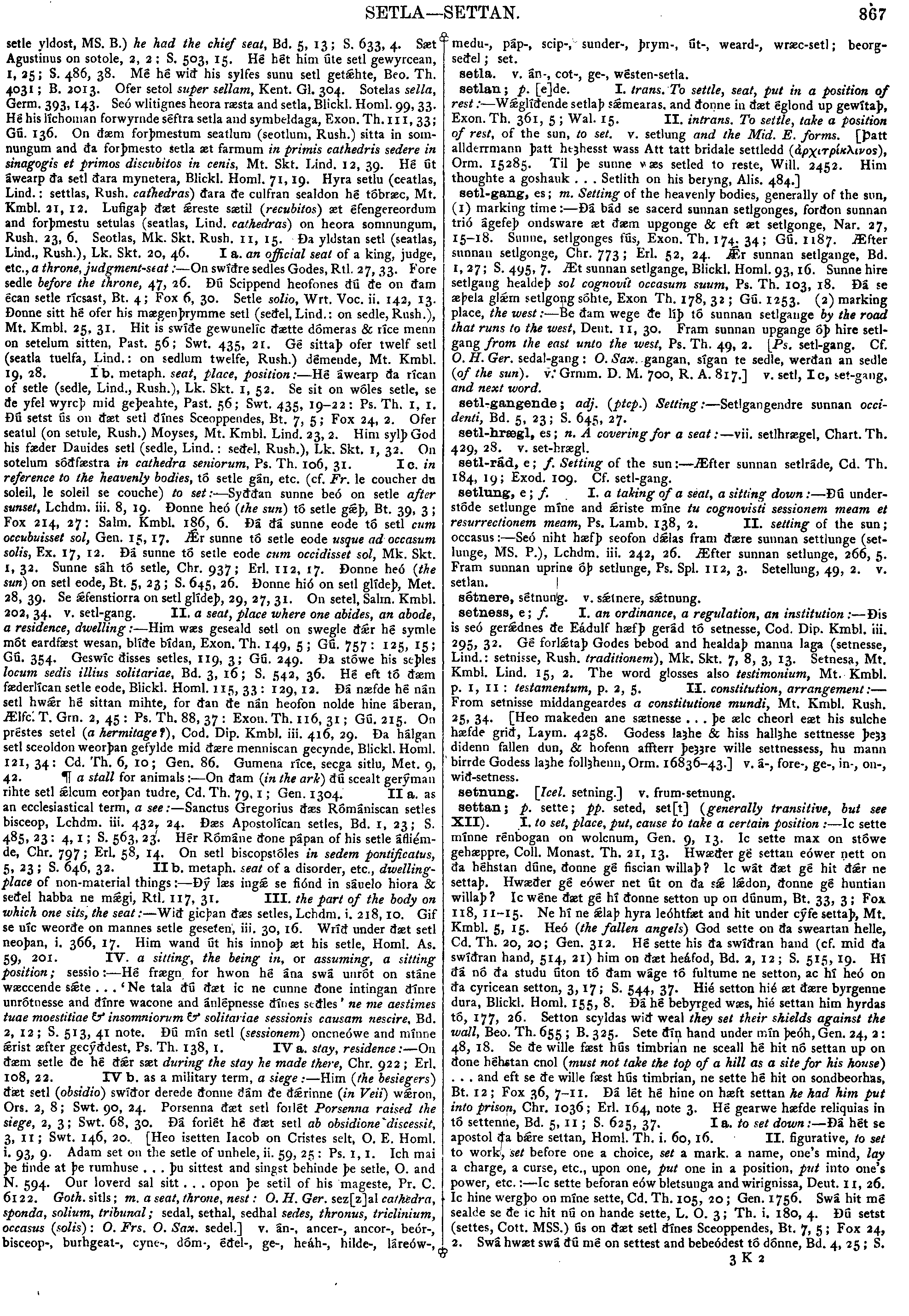
setle
yldost,
MS.
B.)
he
had
the
chief
seat,
Bd.
5,
13;
S.
633,
4.
Sæt
Agustinus
on
sotole,
2,
2
;
S.
503,
15.
Hé
hét
him
úte
setl
gewyrcean,
1,
25;
S.
486,
38.
Mé
hé
wið
his
sylfes
sunu
setl
gethte,
Beo.
Th.
4031;
B.
2013.
Ofer
setol
super
sellam,
Kent.
Gl.
304.
Sotelas
sella,
Germ.
393,
143.
Seó
wlitignes
heora
ræsta
and
setla,
Blickl.
Homl.
99,
33.
Hé
his
líchoman
forwyrnde
séftra
setla
and
symbeldaga,
Exon.
Th.
111,
33;
Gú.
136.
On
ðæm
forþmestum
seatlum
(seotlum.
Rush.)
sitta
in
somnungum
and
ða
forþmesto
setla
æt
farmum
in
primis
cathedris
sedere
in
sinagogis
et
primos
discubitos
in
cenis,
Mt.
Skt.
Lind.
12,
39.
Hé
út
áwearp
ða
setl
ðara
mynetera,
Blickl.
Homl.
71,
19.
Hyra
setlu
(ceatlas,
Lind.:
settlas,
Rush.
cathedras)
ðara
ðe
culfran
sealdon
hé
tóbræc,
Mt.
Kmbl.
31,
12.
Lufigaþ
ðæt
reste
sætil
(recubitos)
æt
éfengereordum
and
forþmestu
setulas
(seatlas,
Lind.
cathedras)
on
heora
somnungum.
Rush.
23,
6.
Seotlas,
Mk.
Skt.
Rush.
11.
15.
Ða
yldstan
setl
(seatlas,
Lind.
,
Rush.),
Lk.
Skt.
20,
46.
I
a.
an
official
seat
of
a
king,
judge,
etc.,
a
throne,
judgment-seat:--
On
swiðre
sedles
Godes,
Rtl.
27,
33.
Fore
sedle
before
the
throne,
47,
26.
Ðú
Scippend
heofones
ðú
ðe
on
ðam
écan
setle
rícsast,
Bt.
4;
Fox
6,
30.
Setle
solio,
Wrt.
Voc.
ii.
142,
13.
Ðonne
sitt
hé
ofer
his
mægen
þrymme
setl
(seðel,
Lind.
:
on
sedle,
Rush.),
Mt.
Kmbl.
25,
31.
Hit
is
swíðe
gewunelíc
ðætte
dómeras
&
ríce
menn
on
setelum
sitten,
Past.
56;
Swt.
435,
21.
Gé
sittaþ
ofer
twelf
setl
(seatla
tuelfa,
Lind.:
on
sedlum
twelfe,
Rush.)
démende,
Mt.
Kmbl.
19,
28.
Ib.
metaph.
seat,
place,
position:--
Hé
áwearp
ða
rícan
of
setle
(sedle,
Lind.,
Rush.),
Lk.
Skt.
1,
52.
Se
sit
on
wóles
setle,
se
ðe
yfel
wyrcþ
mid
geþeahte,
Past.
56;
Swt.
435,
19-22
:
Ps.
Th.
1,
1.
Ðú
setst
ús
on
ðæt
setl
dínes
Sceoppendes,
Bt.
7,
5;
Fox
24,
2.
Ofer
seatul
(on
setule,
Rush.)
Moyses,
Mt.
Kmbl.
Lind.
23,
2.
Him
sylþ
God
his
fæder
Dauides
setl
(sedle,
Lind.:
seðel,
Rush.),
Lk.
Skt.
1.
32.
On
sotelum
sóðfæstra
in
cathedra
seniorum,
Ps.
Th.
106,
31.
I
c.
in
reference
to
the
heavenly
bodies,
tó
setle
gán,
etc.
(cf.
Fr.
le
coucher
do
soleil,
le
soleil
se
couche)
to
set:--
Syððan
sunne
beó
on
setle
after
sunset.
Lchdm.
iii.
8,
19.
Ðonne
heó
(the
sun)
tó
setle
gþ,
Bt.
39,
3
;
Fox
214,
27:
Salm.
Kmbl.
186,
6.
Ðá
ðá
sunne
eode
tó
setl
cum
occubuisset
sol,
Gen.
15,
17.
Æ-acute;r
sunne
tó
setle
eode
usque
ad
occasum
solis,
Ex.
17,
12.
Ðá
sunne
tó
setle
eode
cum
occidisset
sol,
Mk.
Skt.
1,
32.
Sunne
sáh
tó
setle,
Chr.
937;
Erl.
112,
17.
Ðonne
heó
(the
sun)
on
setl
eode,
Bt.
5,
23;
S.
645,
26.
Ðonne
hió
on
setl
glídeþ,
Met.
28,
39.
Se
fenstiorra
on
setl
glídeþ,
29,
27,
31.
On
setel.
Salm.
Kmbl.
202,
34.
v.
setl-gang.
II.
a
seat,
place
where
one
abides,
an
abode,
a
residence,
dwelling:--
Him
wæs
geseald
setl
on
swegle
ðr
hé
symle
mót
eardfæst
wesan,
blíðe
bídan,
Exon.
Th.
149,
5
;
Gú.
757
:
125,
15;
Gú.
354.
Geswíc
ðisses
setles,
119,
3;
Gú.
249.
Ða
stówe
his
seþles
locum
sedis
illius
solitariae.
Bd.
3,
16;
S.
542,
36.
Hé
eft
tó
ðæm
fæderlícan
setle
eode,
Blickl.
Homl.
115,
33
:
129,
12.
Ðá
næfde
hé
nán
setl
hwr
hé
sittan
mihte,
for
ðan
ðe
nán
heofon
nolde
hine
áberan,
Ælfc.
T.
Grn.
2,
45
:
Ps.
Th.
88,
37
:
Exon.
Th.
116,
31;
Gú.
215.
On
préstes
setel
(a
hermitage
?),
Cod.
Dip.
Kmbl.
iii.
416,
29.
Ða
hálgan
setl
sceoldon
weorþan
gefylde
mid
ðære
menniscan
gecynde.
Blickl.
Homl.
121,
34:
Cd.
Th.
6,
10;
Gen.
86.
Gumena
ríce,
secga
sitlu,
Met.
9,
42.

a
stall
for
animals
:--
On
ðam
(in
the
ark)
ðú
scealt
gerýman
rihte
setl
lcum
eorþan
tudre,
Cd.
Th.
79,
1;
Gen.
1304.
II
a.
as
an
ecclesiastical
term,
a
see:--
Sanctus
Gregorius
ðæs
Rómániscan
setles
bisceop,
Lchdm.
iii.
432,
24.
Ðæs
Apostolícan
setles,
Bd.
1,
23;
S.
485,
23:
4,
1;
S.
563,
23.
Hér
Rómáne
ðone
pápan
of
his
setle
áfliémde,
Chr.
797;
Erl.
58,
14,
On
setl
biscopstóles
in
sedem
pontificatus,
5,
23
;
S.
646,
32.
II
b.
metaph.
seat
of
a
disorder,
etc,
,
dwelling-place
of
non-material
things
:--
Ðý
læs
ing
se
fiónd
in
sávelo
hiora
&
seðel
habba
ne
mgi,
Rtl.
117,
31.
III.
the
part
of
the
body
on
which
one
sits,
the
seat:--
Wið
gicþan
ðæs
setles,
Lchdm.
i.
218,
10.
Gif
se
uíc
weorðe
on
mannes
setle
geseten,
iii.
30,
16.
Wríð
under
ðæt
setl
neoþan,
i.
366,
17.
Him
wand
út
his
innoþ
æt
his
setle.
Homl.
As.
59,
201.
IV.
a
sitting,
the
being
in,
or
assuming,
a
sitting
position;
sessio
:--
Hé
frægn
for
hwon
hé
ána
swá
unrót
on
stáne
wæccende
ste
.
.
.
'Ne
tala
ðú
ðæt
ic
ne
cunne
ðone
intingan
ðínre
unrótnesse
and
ðínre
wacone
and
ánlépnesse
ðínes
seðles'
ne
me
aestimes
tuae
moestiliae
RUNE
insomniorum
RUNE
solitariae
sessionis
causam
nescire.
Bd.
2,
12
;
S.
513,
41
note.
Ðú
mín
setl
(sessionem)
oncneówe
and
mínne
rist
æfter
gecýðdest,
Ps.
Th.
138,
1.
IV
a.
stay,
residence:--
On
ðæm
setle
ðe
hé
ðr
sæt
during
the
stay
he
made
there,
Chr.
922
;
Erl.
108,
22.
IV
b.
as
a
military
term,
a
siege
:--
Him
(the
besiegers)
ðæt
setl
(obsidio)
swíðor
derede
ðonne
ðám
ðe
ðrinne
(in
Veii)
wron,
Ors.
2,
8;
Swt.
90,
24.
Porsenna
ðæt
setl
foilét
Porsenna
raised
the
siege,
2,
3;
Swt.
68,
30.
Ðá
forlét
hé
ðæt
setl
ab
obsidione
discessit,
3,
11;
Swt.
146,
20.
[Heo
isetten
Iacob
on
Cristes
selt,
O.
E.
Homl.
i.
93,
9.
Adam
set
on
the
setle
of
unhele,
ii.
59,
25
:
Ps.
1.
1.
Ich
mai
þe
finde
at
þe
rumhuse
.
.
.
þu
sittest
and
singst
behinde
þe
setle,
O.
and
N.
594.
Our
loverd
sal
sitt.
.
.
opon
þe
setil
of
his
mageste,
Pr.
C.
6122.
Goth.
sitls;
m.
a
seat,
throne,
nest:
O.
H.
Ger.
sez[z]al
cathedra,
sponda,
solium,
tribunal;
sedal,
sethal,
sedhal
sedes,
thronus,
triclinium,
occasus
(solis)
:
O.
Frs.
O.
Sax.
sedel.]
v.
án-,
ancer-,
ancor-,
beór-,
bisceop-,
burhgeat-,
cyne-,
dóm-,
éðel-,
ge-,
heáh-,
hilde-,
láreów-,
medu-,
páp-,
scip-,
sunder-,
þrym-,
út-,
weard-,
wræc-setl;
beorg-seðel;
set.
|
Source: Bosworth/Toller, page b0913, entry 17 View original page image as: [TIFF] [PNG] [View previous entry] [View next entry] |
[Comment on this entry] [View comments] |
The following entry has been hand-corrected once. |
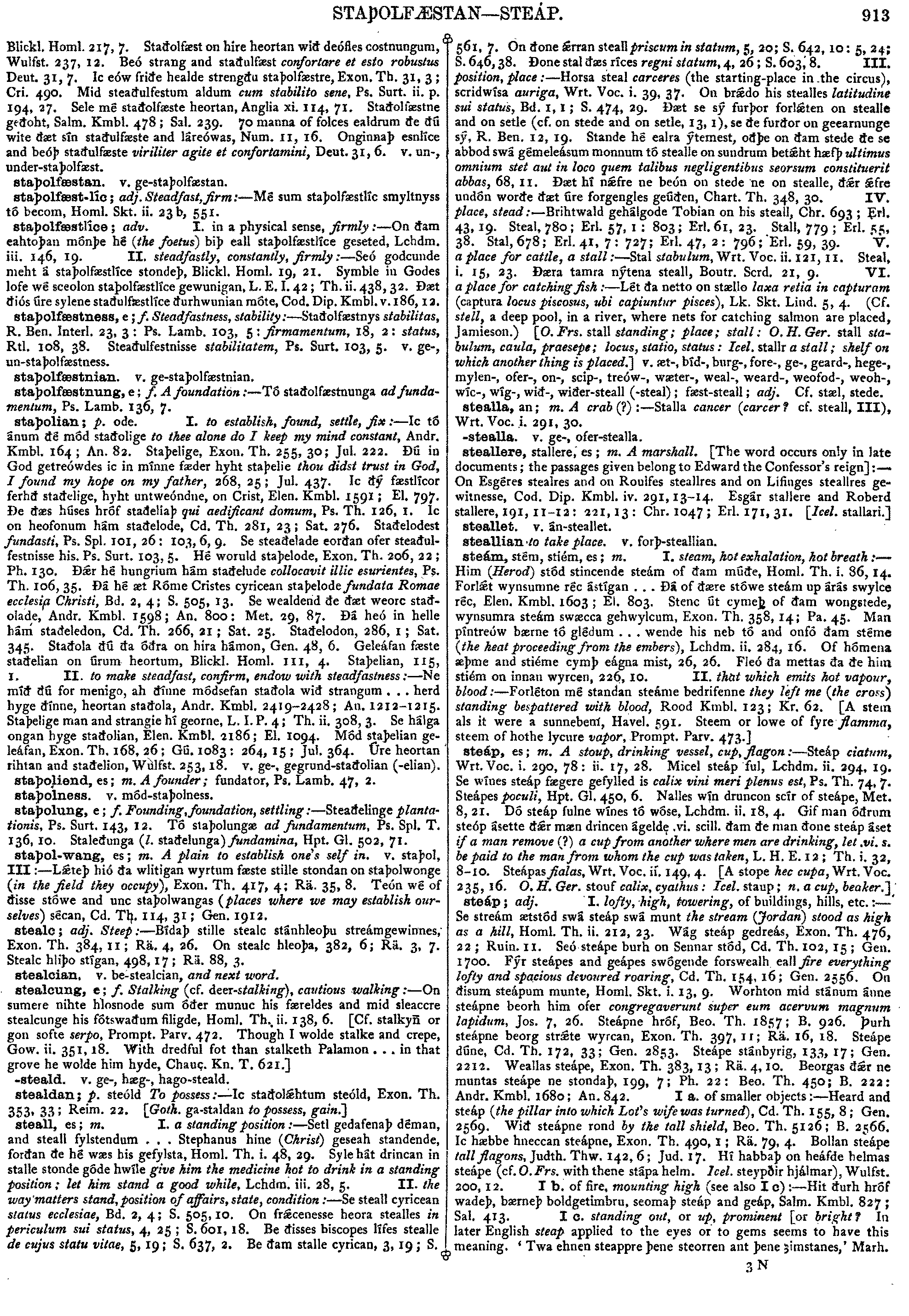
steall,
es;
m.
I.
a
standing
position
:--
Setl
gedafenaþ
déman,
and
steall
fylstendum
...
Stephanus
hine
(Christ)
geseah
standende,
forðan
ðe
hé
wæs
his
gefylsta,
Homl.
Th.
i.
48,
29.
Syle
hát
drincan
in
stalle
stonde
góde
hwíle
give
him
the
medicine
hot
to
drink
in
a
standing
position;
let
him
stand
a
good
while,
Lchdm.
iii.
28,
5.
II.
the
way
matters
stand,
position
of
affairs,
state,
condition
:--
Se
steall
cyricean
status
ecclesiae,
Bd.
2,
4;
S.
505,
10.
On
frcenesse
heora
stealles
in
periculum
sui
status,
4,
25;
S.
601,
18.
Be
ðisses
biscopes
lífes
stealle
de
cujus
statu
vitae,
5,
19;
S.
637,
2.
Be
ðam
stalle
cyrican,
3,
19,
S.
561,
7.
On
ðone
rran
steall
priscum
in
statum,
5,
20;
S.
642,
10:
5,
24;
S.
646,
38.
Ðone
stal
ðæs
ríces
regni
statum,
4,
26;
S.
603,
8.
III.
position,
place
:--
Horsa
steal
carceres
(the
starting-place
in
the
circus),
scridwísa
auriga,
Wrt.
Voc.
i.
39,
37.
On
brdo
his
stealles
latitudine
sui
status,
Bd,
1,
1;
S.
474,
29.
Ðæt
se
sý
furþor
forlten
on
stealle
and
on
setle
(cf.
on
stele
and
on
setle,
13,
1),
se
ðe
furðor
on
geearnunge
sý,
R.
Ben.
12,
19.
Stande
hé
ealra
ýtemest,
oðþe
on
ðam
stede
ðe
se
abbod
swá
gémeleásum
monnum
tó
stealle
on
sundrum
betht
hæfþ
ultimus
omnium
stet
aut
in
loco
quem
talibus
negligentibus
seorsum
constituerit
abbas,
68,
11.
Ðæt
hí
nfre
ne
beón
on
stede
ne
on
stealle,
ðr
fre
undón
worðe
ðæt
úre
forgengles
geúðen,
Chart.
Th.
348,
30.
IV.
place,
stead
:--
Brihtwald
gehálgode
Tobian
on
his
steall,
Chr.
693;
Erl.
43,
19.
Steal.
780;
Erl.
57,
1:
803;
Erl.
61,
23.
Stall,
779;
Erl.
55,
38.
Stal,
678;
Erl.
41,
7:
727;
Erl.
47,
2:
796;
Erl.
59,
39.
V.
a
place
for
cattle,
a
stall
:--
Stal
stabulum,
Wrt.
Voc.
ii.
121,
11.
Steal,
i.
15,
23.
Ðæra
tamra
nýtena
steall,
Boutr.
Scrd.
21,
9.
VI.
a
place
for
catching
fish
:--
Lét
ða
netto
on
stællo
laxa
retia
in
capturam
(captura
locus
piscosus,
ubi
capiuntur
pisces),
Lk.
Skt.
Lind.
5,
4.
(Cf
stell,
a
deep
pool,
in
a
river,
where
nets
for
catching
salmon
are
placed,
Jamieson.)
[O.
Frs.
stall
standing;
place;
stall:
O.
H.
Ger.
stall
stabulum,
caula,
praesepe;
locus,
statio,
status:
Icel.
stallr
a
stall;
shelf
on
which
another
thing
is
placed.]
v.
æt-,
bód-,
burg-,
fore-,
ge-,
geard-,
hege-,
mylen-,
ofer-,
on-,
scip-,
treów-,
wæter-,
weal-,
weard-,
weofod-,
weoh-,
wíc-,
wíg-,
wið-,
wiðer-steall
(-steal);
fæst-steall;
adj.
Cf.
stæl,
stede.
| Result Page: | 1 2 3 | Next |  |
Germanic Lexicon Project (main page)
This search system was written by
Sean Crist
Please consider
volunteering
to correct the data in these online dictionaries.
No rights reserved. Feel free to use these data in any way you please.