|
|

|
Source: Cleasby/Vigfusson, page b0540, entry 43 View original page image as: [TIFF] [PNG] [View previous entry] [View next entry] |
[Comment on this entry] [View comments] |
The following entry has been hand-corrected once. |
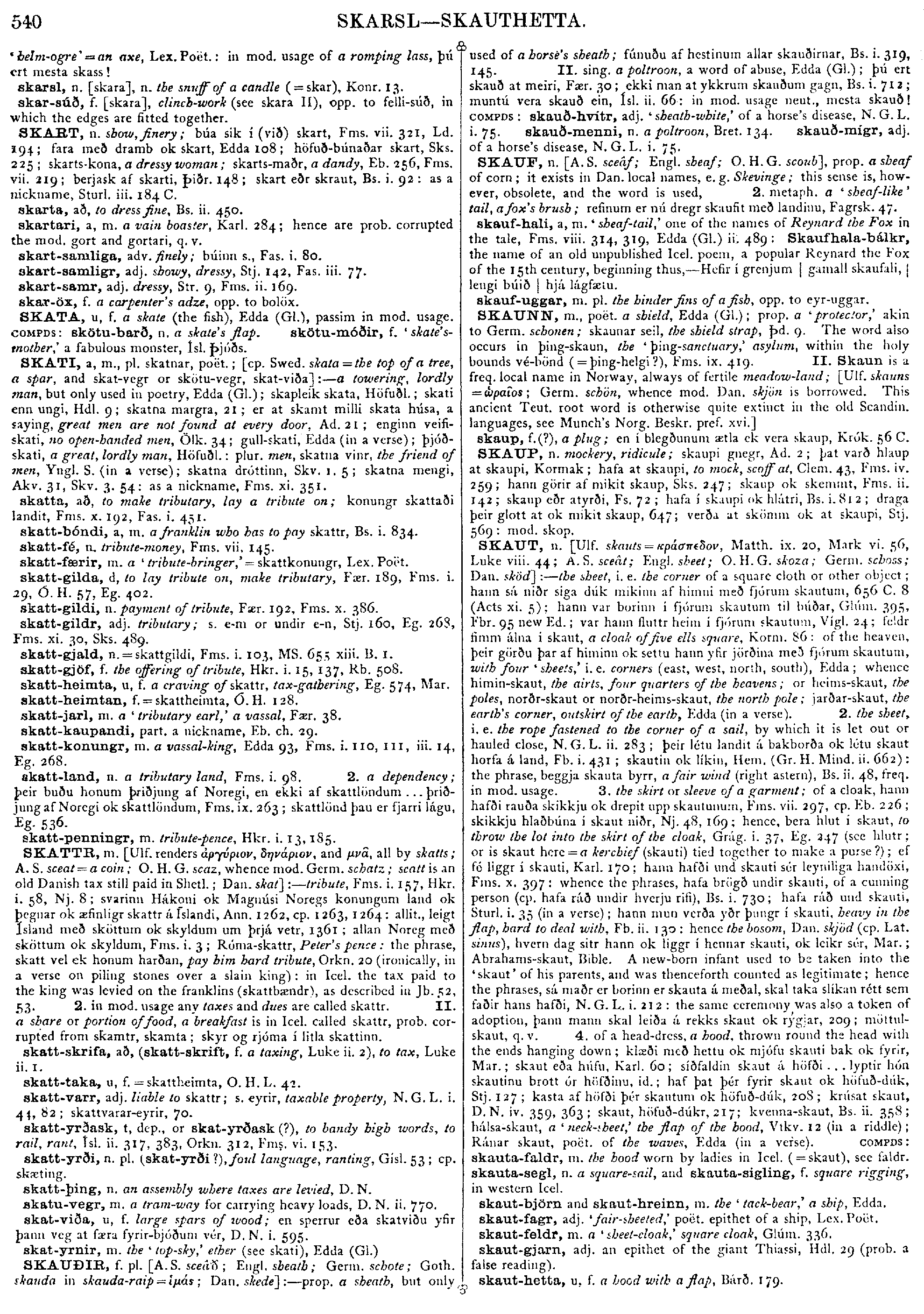
SKAUNN, m., poët, a shield, Edda (Gl.); prop. a 'protector,' akin to Germ. schonen; skaunar seil, the shield strap, Þd. 9. The word also occurs in þing-skaun, the 'þing-sanctuary', asylum, within the holy bounds vé-bönd (= þing-helgi ?), Fms. ix. 419. II. Skaun is a freq. local name in Norway, always of fertile meadow-land; [Ulf. skauns = GREEK; Germ. schön, whence mod. Dan. skjön is borrowed. This ancient Teut. root word is otherwise quite extinct in the old Scandin. languages, see Munch's Norg. Beskr. pref. xvi.]
|
Source: Cleasby/Vigfusson, page b0672, entry 56 View original page image as: [TIFF] [PNG] [View previous entry] [View next entry] |
[Comment on this entry] [View comments] |
The following entry has been hand-corrected once. |
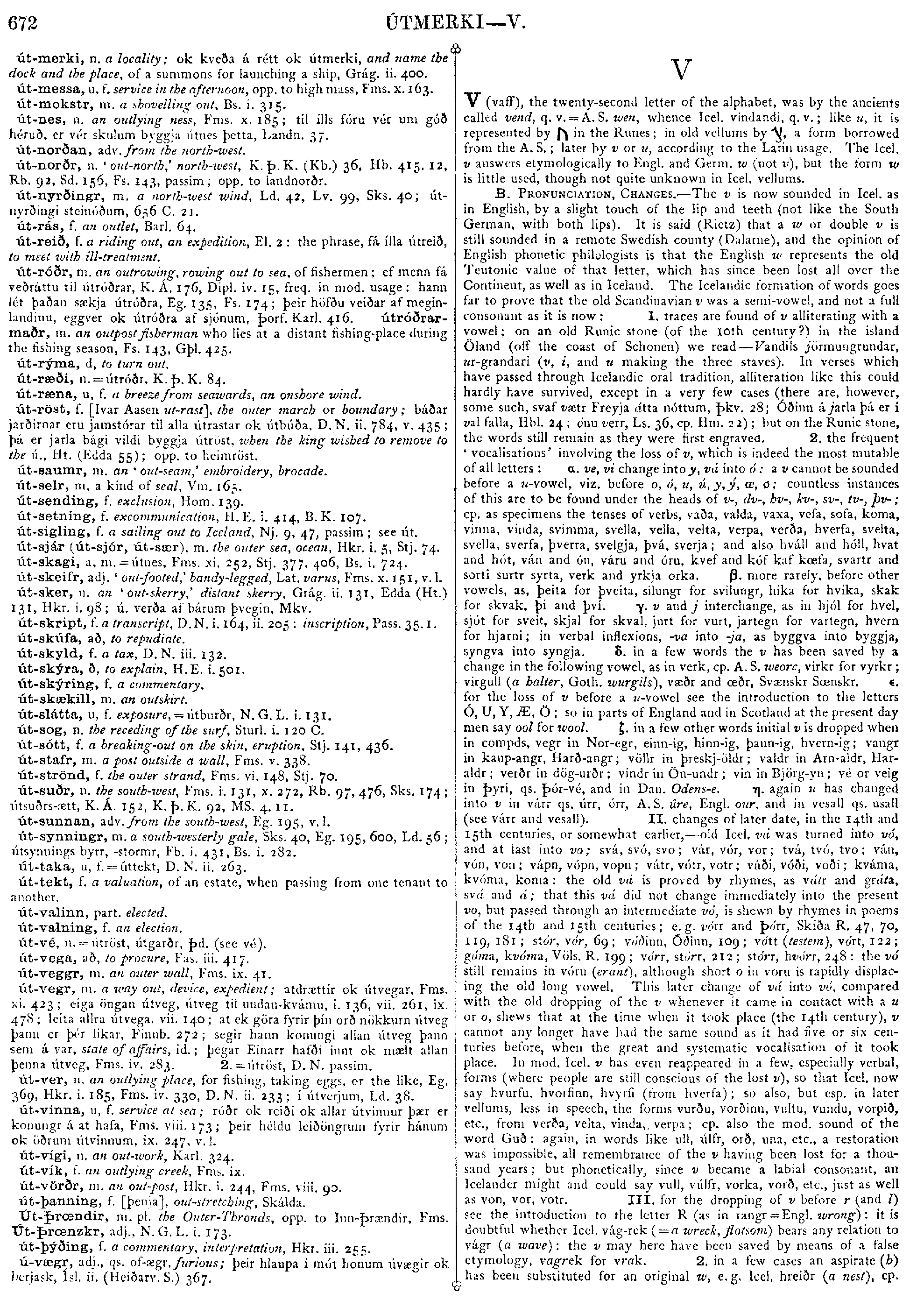
V
(vaff),
the
twenty-second
letter
of
the
alphabet,
was
by
the
ancients
called
vend,
q.v.
=
A.S.
wen,
whence
Icel.
vindandi,
q.v.;
like
u,
it
is
represented
by
RUNE
in
the
Runes;
in
old
vellums
by
RUNE,
a
form
borrowed
from
the
A.S.;
later
by
v
or
u,
according
to
the
Latin
usage.
The
Icel.
v
answers
etymologically
to
Engl.
and
Germ.
w
(not
v),
but
the
form
w
is
little
used,
though
not
quite
unknown
in
Icel.
vellums.
B.
PRONUNCIATION,
CHANGES.
--
The
v
is
now
sounded
in
Icel.
as
in
English,
by
a
slight
touch
of
the
lip
and
teeth
(not
like
the
South
German,
with
both
lips).
It
is
said
(Rietz)
that
a
w
or
double
v
is
still
sounded
in
a
remote
Swedish
county
(Dalarne),
and
the
opinion
of
English
phonetic
philologists
is
that
the
English
w
represents
the
old
Teutonic
value
of
that
letter,
which
has
since
been
lost
all
over
the
Continent,
as
well
as
in
Iceland.
The
Icelandic
formation
of
words
goes
far
to
prove
that
the
old
Scandinavian
v
was
a
semi-vowel,
and
not
a
full
consonant
as
it
is
now:
1.
traces
are
found
of
v
alliterating
with
a
vowel;
on
an
old
Runic
stone
(of
the
10th
century?)
in
the
island
Öland
(off
the
coast
of
Schonen)
we
read
--
Vandils
jörmungrundar,
ur-grandari
(v,
i,
and
u
making
the
three
staves).
In
verses
which
have
passed
through
Icelandic
oral
tradition,
alliteration
like
this
could
hardly
have
survived,
except
in
a
very
few
cases
(there
are,
however,
some
such,
svaf
vætr
Freyja
átta
nóttum,
Þkv.
28;
Óðinn
á
jarla
þá
er
í
val
falla,
Hbl.
24;
ónu
verr,
Ls.
36,
cp.
Hm.
22);
but
on
the
Runic
stone,
the
words
still
remain
as
they
were
first
engraved.
2.
the
frequent
'vocalisations'
involving
the
loss
of
v,
which
is
indeed
the
most
mutable
of
all
letters:
 .
ve,
vi
change
into
y,
vá
into
ó:
a
v
cannot
be
sounded
before
a
u-vowel,
viz.
before
o,
ó,
u,
ú,
y,
ý,
œ,
ø;
countless
instances
of
this
are
to
be
found
under
the
heads
of
v-,
dv-,
hv-,
kv-,
sv-,
tv-,
þv-;
cp.
as
specimens
the
tenses
of
verbs,
vaða,
valda,
vaxa,
vefa,
sofa,
koma,
vinna,
vinda,
svimma,
svella,
vella,
velta,
verpa,
verða,
hverfa,
svelta,
svella,
sverfa,
þverra,
svelgja,
þvá,
sverja;
and
also
hváll
and
hóll,
hvat
and
hót,
ván
and
ón,
váru
and
óru,
kvef
and
kóf
kaf
kœfa,
svartr
and
sorti
surtr
syrta,
verk
and
yrkja
orka.
.
ve,
vi
change
into
y,
vá
into
ó:
a
v
cannot
be
sounded
before
a
u-vowel,
viz.
before
o,
ó,
u,
ú,
y,
ý,
œ,
ø;
countless
instances
of
this
are
to
be
found
under
the
heads
of
v-,
dv-,
hv-,
kv-,
sv-,
tv-,
þv-;
cp.
as
specimens
the
tenses
of
verbs,
vaða,
valda,
vaxa,
vefa,
sofa,
koma,
vinna,
vinda,
svimma,
svella,
vella,
velta,
verpa,
verða,
hverfa,
svelta,
svella,
sverfa,
þverra,
svelgja,
þvá,
sverja;
and
also
hváll
and
hóll,
hvat
and
hót,
ván
and
ón,
váru
and
óru,
kvef
and
kóf
kaf
kœfa,
svartr
and
sorti
surtr
syrta,
verk
and
yrkja
orka.
 .
more
rarely,
before
other
vowels,
as,
þeita
for
þveita,
silungr
for
svilungr,
hika
for
hvika,
skak
for
skvak,
þi
and
því.
.
more
rarely,
before
other
vowels,
as,
þeita
for
þveita,
silungr
for
svilungr,
hika
for
hvika,
skak
for
skvak,
þi
and
því.
 v
and
j
interchange,
as
in
hjól
for
hvel,
sjót
for
sveit,
skjal
for
skval,
jurt
for
vurt,
jartegn
for
vartegn,
hvern
for
hjarni;
in
verbal
inflexions,
-va
into
-ja,
as
byggva
into
byggja,
syngva
into
syngja.
v
and
j
interchange,
as
in
hjól
for
hvel,
sjót
for
sveit,
skjal
for
skval,
jurt
for
vurt,
jartegn
for
vartegn,
hvern
for
hjarni;
in
verbal
inflexions,
-va
into
-ja,
as
byggva
into
byggja,
syngva
into
syngja.
 .
in
a
few
words
the
v
has
been
saved
by
a
change
in
the
following
vowel,
as
in
verk,
cp.
A.S.
weorc,
virkr
for
vyrkr;
virgull
(a
halter,
Goth.
wurgils),
væðr
and
œðr,
Svænskr
Sœnskr.
.
in
a
few
words
the
v
has
been
saved
by
a
change
in
the
following
vowel,
as
in
verk,
cp.
A.S.
weorc,
virkr
for
vyrkr;
virgull
(a
halter,
Goth.
wurgils),
væðr
and
œðr,
Svænskr
Sœnskr.
 .
for
the
loss
of
v
before
a
u-vowel
see
the
introduction
to
the
letters
Ó,
U,
Y,
Æ,
Ö;
so
in
parts
of
England
and
in
Scotland
at
the
present
day
men
say
ool
for
wool.
.
for
the
loss
of
v
before
a
u-vowel
see
the
introduction
to
the
letters
Ó,
U,
Y,
Æ,
Ö;
so
in
parts
of
England
and
in
Scotland
at
the
present
day
men
say
ool
for
wool.
 .
in
a
few
other
words
initial
v
is
dropped
when
in
compds,
vegr
in
Nor-egr,
einn-ig,
hinn-ig,
þann-ig,
hvern-ig;
vangr
in
kaup-angr,
Harð-angr;
völlr
in
þreskj-öldr;
valdr
in
Arn-aldr,
Har-aldr;
verðr
in
dög-urðr;
vindr
in
Ön-undr;
vin
in
Björg-yn;
vé
or
veig
in
Þyri,
qs.
Þór-vé,
and
in
Dan.
Odens-e.
.
in
a
few
other
words
initial
v
is
dropped
when
in
compds,
vegr
in
Nor-egr,
einn-ig,
hinn-ig,
þann-ig,
hvern-ig;
vangr
in
kaup-angr,
Harð-angr;
völlr
in
þreskj-öldr;
valdr
in
Arn-aldr,
Har-aldr;
verðr
in
dög-urðr;
vindr
in
Ön-undr;
vin
in
Björg-yn;
vé
or
veig
in
Þyri,
qs.
Þór-vé,
and
in
Dan.
Odens-e.
 .
again
u
has
changed
into
v
in
várr
qs.
úrr,
órr,
A.S.
ûre,
Engl.
our,
and
in
vesall
qs.
usall
(see
várr
and
vesall).
II.
changes
of
later
date,
in
the
14th
and
15th
centuries,
or
somewhat
earlier,
--
old
Icel.
vá
was
turned
into
vó,
and
at
last
into
vo;
svá,
svó,
svo;
vár,
vór,
vor;
tvá,
tvó,
tvo;
ván,
vón,
von;
vápn,
vópn,
vopn;
vátr,
vótr,
votr;
váði,
vóði,
voði;
kváma,
kvóma,
koma:
the
old
vá
is
proved
by
rhymes,
as
vátr
and
gráta,
svá
and
á;
that
this
vá
did
not
change
immediately
into
the
present
vo,
but
passed
through
an
intermediate
vo,
is
shewn
by
rhymes
in
poems
of
the
14th
and
15th
centuries;
e.g.
vórr
and
Þórr,
Skíða
R.
47,
70,
119,
181;
stór,
vór,
69;
vóðinn,
Óðinn,
109;
vótt
(testem),
vórt,
122;
góma,
kvóma,
Völs.
R.
199;
vórr,
stórr,
212;
stórr,
hvórr,
248:
the
vó
still
remains
in
vóru
(erant),
although
short
o
in
voru
is
rapidly
displacing
the
old
long
vowel.
This
later
change
of
vá
into
vó,
compared
with
the
old
dropping
of
the
v
whenever
it
came
in
contact
with
a
u
or
o,
shews
that
at
the
time
when
it
took
place
(the
14th
century),
v
cannot
any
longer
have
had
the
same
sound
as
it
had
five
or
six
centuries
before,
when
the
great
and
systematic
vocalisation
of
it
took
place.
In
mod.
Icel.
v
has
even
reappeared
in
a
few,
especially
verbal,
forms
(where
people
are
still
conscious
of
the
lost
v),
so
that
Icel.
now
say
hvurfu,
hvorfinn,
hvyrfi
(from
hverfa);
so
also,
but
esp.
in
later
vellums,
less
in
speech,
the
forms
vurðu,
vorðinn,
vultu,
vundu,
vorpið,
etc.,
from
verða,
velta,
vinda,
verpa;
cp.
also
the
mod.
sound
of
the
word
Guð:
again,
in
words
like
ull,
úlfr,
orð,
una,
etc.,
a
restoration
was
impossible,
all
remembrance
of
the
v
having
been
lost
for
a
thousand
years:
but
phonetically,
since
v
became
a
labial
consonant,
an
Icelander
might
and
could
say
vull,
vúlfr,
vorka,
vorð,
etc.,
just
as
well
as
von,
vor,
votr.
III.
for
the
dropping
of
v
before
r
(and
l)
see
the
introduction
to
the
letter
R
(as
in
rangr
=
Engl.
wrong):
it
is
doubtful
whether
Icel.
vág-rek
(=
a
wreck,
flotsom)
bears
any
relation
to
vágr
(a
wave):
the
v
may
here
have
been
saved
by
means
of
a
false
etymology,
vagrek
for
vrak.
2.
in
a
few
cases
an
aspirate
(h)
has
been
substituted
for
an
original
w,
e.g,
Icel.
hreiðr
(a
nest),
cp.
.
again
u
has
changed
into
v
in
várr
qs.
úrr,
órr,
A.S.
ûre,
Engl.
our,
and
in
vesall
qs.
usall
(see
várr
and
vesall).
II.
changes
of
later
date,
in
the
14th
and
15th
centuries,
or
somewhat
earlier,
--
old
Icel.
vá
was
turned
into
vó,
and
at
last
into
vo;
svá,
svó,
svo;
vár,
vór,
vor;
tvá,
tvó,
tvo;
ván,
vón,
von;
vápn,
vópn,
vopn;
vátr,
vótr,
votr;
váði,
vóði,
voði;
kváma,
kvóma,
koma:
the
old
vá
is
proved
by
rhymes,
as
vátr
and
gráta,
svá
and
á;
that
this
vá
did
not
change
immediately
into
the
present
vo,
but
passed
through
an
intermediate
vo,
is
shewn
by
rhymes
in
poems
of
the
14th
and
15th
centuries;
e.g.
vórr
and
Þórr,
Skíða
R.
47,
70,
119,
181;
stór,
vór,
69;
vóðinn,
Óðinn,
109;
vótt
(testem),
vórt,
122;
góma,
kvóma,
Völs.
R.
199;
vórr,
stórr,
212;
stórr,
hvórr,
248:
the
vó
still
remains
in
vóru
(erant),
although
short
o
in
voru
is
rapidly
displacing
the
old
long
vowel.
This
later
change
of
vá
into
vó,
compared
with
the
old
dropping
of
the
v
whenever
it
came
in
contact
with
a
u
or
o,
shews
that
at
the
time
when
it
took
place
(the
14th
century),
v
cannot
any
longer
have
had
the
same
sound
as
it
had
five
or
six
centuries
before,
when
the
great
and
systematic
vocalisation
of
it
took
place.
In
mod.
Icel.
v
has
even
reappeared
in
a
few,
especially
verbal,
forms
(where
people
are
still
conscious
of
the
lost
v),
so
that
Icel.
now
say
hvurfu,
hvorfinn,
hvyrfi
(from
hverfa);
so
also,
but
esp.
in
later
vellums,
less
in
speech,
the
forms
vurðu,
vorðinn,
vultu,
vundu,
vorpið,
etc.,
from
verða,
velta,
vinda,
verpa;
cp.
also
the
mod.
sound
of
the
word
Guð:
again,
in
words
like
ull,
úlfr,
orð,
una,
etc.,
a
restoration
was
impossible,
all
remembrance
of
the
v
having
been
lost
for
a
thousand
years:
but
phonetically,
since
v
became
a
labial
consonant,
an
Icelander
might
and
could
say
vull,
vúlfr,
vorka,
vorð,
etc.,
just
as
well
as
von,
vor,
votr.
III.
for
the
dropping
of
v
before
r
(and
l)
see
the
introduction
to
the
letter
R
(as
in
rangr
=
Engl.
wrong):
it
is
doubtful
whether
Icel.
vág-rek
(=
a
wreck,
flotsom)
bears
any
relation
to
vágr
(a
wave):
the
v
may
here
have
been
saved
by
means
of
a
false
etymology,
vagrek
for
vrak.
2.
in
a
few
cases
an
aspirate
(h)
has
been
substituted
for
an
original
w,
e.g,
Icel.
hreiðr
(a
nest),
cp.
| Result Page: |  |
Previous | 1 2 |
Germanic Lexicon Project (main page)
This search system was written by
Sean Crist
Please consider
volunteering
to correct the data in these online dictionaries.
No rights reserved. Feel free to use these data in any way you please.