|
|

|
Source: Bosworth/Toller, page b0816, entry 13 View original page image as: [TIFF] [PNG] [View previous entry] [View next entry] |
[Comment on this entry] [View comments] |
The following entry has been hand-corrected once. |
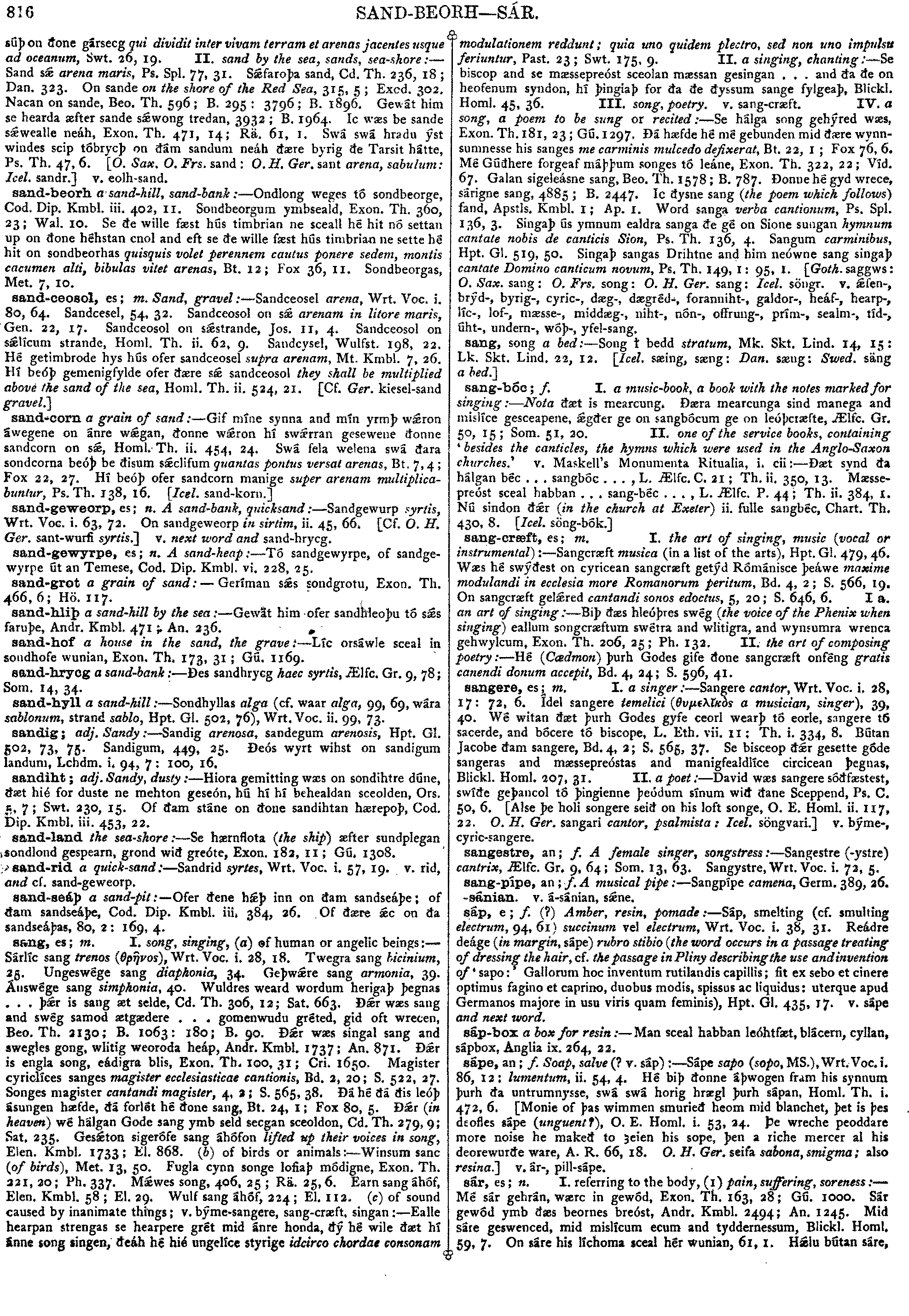
sandiht; adj. Sandy, dusty :-- Hiora gemitting wæs on sondihtre dúne, ðæt hié for duste ne mehton geseón, hú hí hí behealdan sceolden, Ors. 5, 7; Swt. 230, 15. Of ðam stáne on ðone sandihtan hærepoþ, Cod. Dip. Kmbl. iii. 453, 22.
|
Source: Bosworth/Toller, page b0919, entry 3 View original page image as: [TIFF] [PNG] [View previous entry] [View next entry] |
[Comment on this entry] [View comments] |
The following entry has been hand-corrected once. |
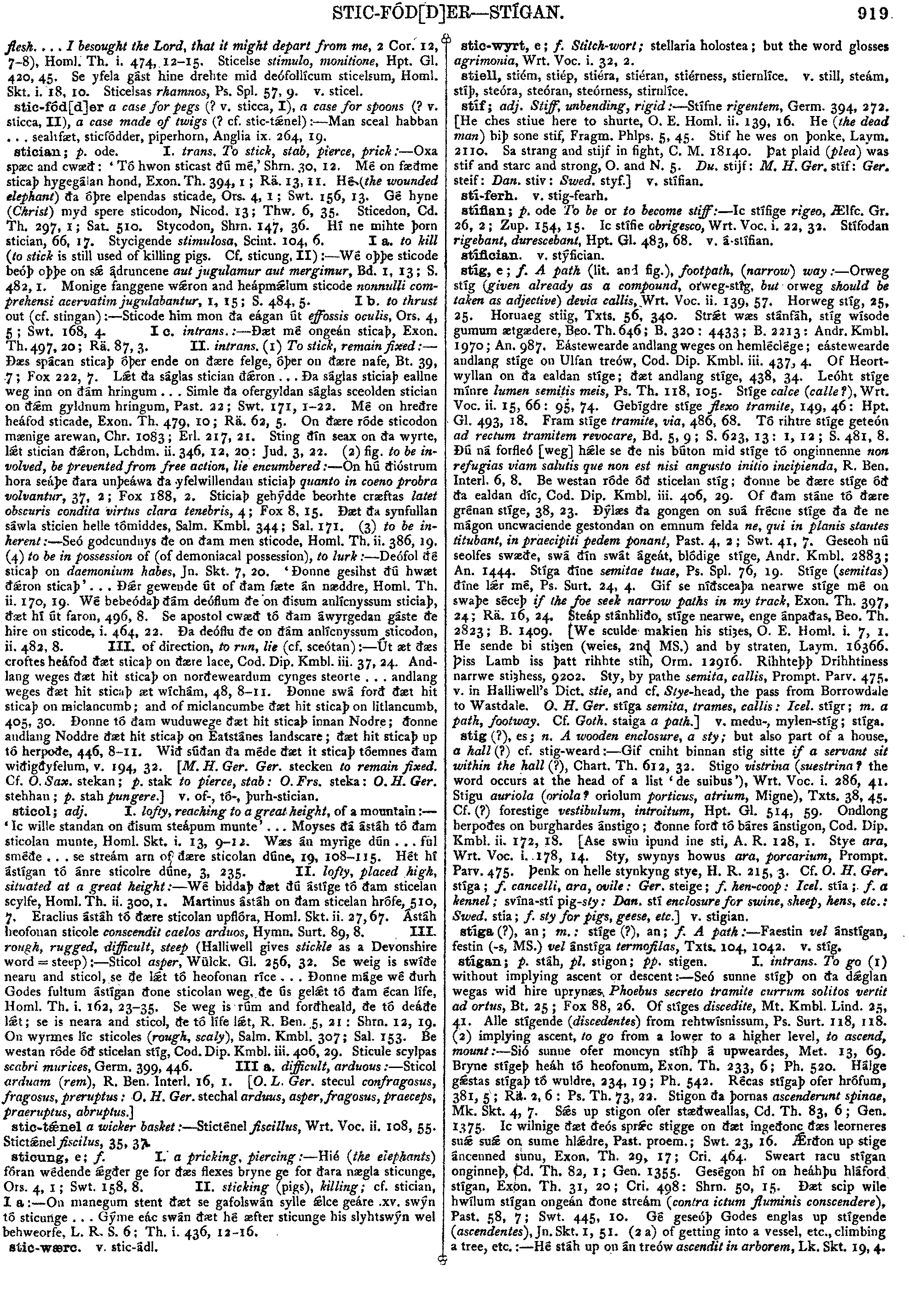
stician;
p.
ode.
I.
trans.
To
stick,
stab,
pierce,
prick:--Oxa
spæc
and
cwæð:
'Tó
hwon
sticast
ðú
mé,'
Shrn.
30,
12.
Mé
on
fæðme
sticaþ
hygegálan
hond,
Exon.
Th.
394,
1;
Rä.
13,
11.
Hé(the
wounded
elephant)
ða
óþre
elpendas
sticade,
Ors.
4,
1;
Swt.
156,
13.
Gé
hyne
(Christ)
myd
spere
sticodon,
Nicod.
13;
Thw.
6,
35.
Sticedon,
Cd.
Th.
297,
1;
Sat.
510.
Stycodon,
Shrn.
147,
36.
Hí
ne
mihte
þorn
stician,
66,
17.
Stycigende
stimulosa,
Scint.
104,
6.
I
a.
to
kill
(to
stick
is
still
used
of
killing
pigs.
Cf.
sticung,
II):--Wé
oþþe
sticode
beóþ
oþþe
on
s ádruncene
aut
jugulamur
aut
mergimur,
Bd.
1,
13;
S.
482,
1.
Monige
fanggene
wron
and
heápmlum
sticode
nonnulli
comprehensi
acervatim
jugulabantur,
1,
15;
S.
484,
5.
I
b.
to
thrust
out
(cf.
stingan):--Sticode
him
mon
ða
eágan
út
efossis
oculis,
Ors.
4,
5;
Swt.
168,
4.
I
c.
intrans.:--Ðæt
mé
ongeán
sticaþ,
Exon.
Th.
497,
20;
Rä.
87,
3.
II.
intrans.
(1)
To
stick,
remain
fixed:--Ðæs
spácan
sticaþ
óþer
ende
on
ðære
felge,
óþer
on
ðære
nafe,
Bt.
39,
7;
Fox
222,
7.
Lt
ða
ságlas
stician
ðron
.
.
.
Ða
ságlas
sticiaþ
eallne
weg
inn
on
ðám
hringum
.
.
.
Simle
ða
ofergyldan
ságlas
sceolden
stician
on
ðm
gyldnum
hringum,
Past.
22;
Swt.
171,
1-22.
Mé
on
hreðre
heáfod
sticade,
Exon.
Th.
479,
10;
Rä.
62,
5.
On
ðære
róde
sticodon
mænige
arewan,
Chr.
1083;
Erl.
217,
21.
Sting
ðín
seax
on
ða
wyrte,
lt
stician
ðron,
Lchdm.
ii.
346,
12,
20:
Jud.
3,
22.
(2)
fig.
to
be
involved,
be
prevented
from
free
action,
lie
encumbered:--On
hú
ðióstrum
hora
seáþe
þara
unþeáwa
ða
yfelwillendan
sticiaþ
quanto
in
coeno
probra
volvantur,
37,
2;
Fox
188,
2.
Sticiaþ
gehýdde
beorhte
cræftas
latet
obscuris
condita
virtus
clara
tenebris,
4;
Fox
8,
15.
Ðæt
ða
synfullan
sáwla
sticien
helle
tómiddes,
Salm.
Kmbl.
344;
Sal.
171.
(3)
to
be
inherent:--Seó
godcundnys
ðe
on
ðam
men
sticode,
Homl.
Th.
ii.
386,
19.
(4)
to
be
in
possession
of
(of
demoniacal
possession),
to
lurk:--Deófol
ðé
sticaþ
on
daemonium
habes,
Jn.
Skt.
7,
20.
'Ðonne
gesihst
ðú
hwæt
ðron
sticaþ'
.
.
.
Ðr
gewende
út
of
ðam
fæte
án
næddre,
Homl.
Th.
ii.
170,
19.
Wé
bebeódaþ
ðám
deóflum
ðe
on
ðisum
anlícnyssum
sticiaþ,
ðæt
hí
út
faron,
496,
8.
Se
apostol
cwæð
tó
ðam
áwyrgedan
gáste
ðe
hire
on
sticode,
i.
464,
22.
Ða
deóflu
ðe
on
ðám
anlícnyssum
sticodon,
ii.
482,
8.
III.
of
direction,
to
run,
lie
(cf.
sceótan):--Út
æt
ðæs
croftes
heáfod
ðæt
sticaþ
on
ðære
lace,
Cod.
Dip.
Kmbl.
iii.
37,
24.
Andlang
weges
ðæt
hit
sticaþ
on
norðeweardum
cynges
steorte.
.
.
andlang
weges
ðæt
hit
sticaþ
æt
wíchám,
48,
8-11.
Ðonne
swá
forð
ðæt
hit
sticaþ
on
miclancumb;
and
of
miclancumbe
ðæt
hit
sticaþ
on
litlancumb,
405,
30.
Ðonne
tó
ðam
wuduwege
ðæt
hit
sticaþ
innan
Nodre;
ðonne
andlang
Noddre
ðæt
hit
sticaþ
on
Eatstánes
landscare;
ðæt
hit
sticaþ
up
tó
herpoðe,
446,
8-11.
Wið
súðan
ða
méde
ðæt
it
sticaþ
tóemnes
ðam
wiðigðyfelum,
v.
194,
32.
[M.
H.
Ger.
Ger.
stecken
to
remain
fixed.
Cf.
O.
Sax.
stekan;
p.
stak
to
pierce,
stab:
O.
Frs.
steka:
O.
H.
Ger.
stehhan;
p.
stah
pungere.]
v.
of-,
tó-,
þurh-stician.
ádruncene
aut
jugulamur
aut
mergimur,
Bd.
1,
13;
S.
482,
1.
Monige
fanggene
wron
and
heápmlum
sticode
nonnulli
comprehensi
acervatim
jugulabantur,
1,
15;
S.
484,
5.
I
b.
to
thrust
out
(cf.
stingan):--Sticode
him
mon
ða
eágan
út
efossis
oculis,
Ors.
4,
5;
Swt.
168,
4.
I
c.
intrans.:--Ðæt
mé
ongeán
sticaþ,
Exon.
Th.
497,
20;
Rä.
87,
3.
II.
intrans.
(1)
To
stick,
remain
fixed:--Ðæs
spácan
sticaþ
óþer
ende
on
ðære
felge,
óþer
on
ðære
nafe,
Bt.
39,
7;
Fox
222,
7.
Lt
ða
ságlas
stician
ðron
.
.
.
Ða
ságlas
sticiaþ
eallne
weg
inn
on
ðám
hringum
.
.
.
Simle
ða
ofergyldan
ságlas
sceolden
stician
on
ðm
gyldnum
hringum,
Past.
22;
Swt.
171,
1-22.
Mé
on
hreðre
heáfod
sticade,
Exon.
Th.
479,
10;
Rä.
62,
5.
On
ðære
róde
sticodon
mænige
arewan,
Chr.
1083;
Erl.
217,
21.
Sting
ðín
seax
on
ða
wyrte,
lt
stician
ðron,
Lchdm.
ii.
346,
12,
20:
Jud.
3,
22.
(2)
fig.
to
be
involved,
be
prevented
from
free
action,
lie
encumbered:--On
hú
ðióstrum
hora
seáþe
þara
unþeáwa
ða
yfelwillendan
sticiaþ
quanto
in
coeno
probra
volvantur,
37,
2;
Fox
188,
2.
Sticiaþ
gehýdde
beorhte
cræftas
latet
obscuris
condita
virtus
clara
tenebris,
4;
Fox
8,
15.
Ðæt
ða
synfullan
sáwla
sticien
helle
tómiddes,
Salm.
Kmbl.
344;
Sal.
171.
(3)
to
be
inherent:--Seó
godcundnys
ðe
on
ðam
men
sticode,
Homl.
Th.
ii.
386,
19.
(4)
to
be
in
possession
of
(of
demoniacal
possession),
to
lurk:--Deófol
ðé
sticaþ
on
daemonium
habes,
Jn.
Skt.
7,
20.
'Ðonne
gesihst
ðú
hwæt
ðron
sticaþ'
.
.
.
Ðr
gewende
út
of
ðam
fæte
án
næddre,
Homl.
Th.
ii.
170,
19.
Wé
bebeódaþ
ðám
deóflum
ðe
on
ðisum
anlícnyssum
sticiaþ,
ðæt
hí
út
faron,
496,
8.
Se
apostol
cwæð
tó
ðam
áwyrgedan
gáste
ðe
hire
on
sticode,
i.
464,
22.
Ða
deóflu
ðe
on
ðám
anlícnyssum
sticodon,
ii.
482,
8.
III.
of
direction,
to
run,
lie
(cf.
sceótan):--Út
æt
ðæs
croftes
heáfod
ðæt
sticaþ
on
ðære
lace,
Cod.
Dip.
Kmbl.
iii.
37,
24.
Andlang
weges
ðæt
hit
sticaþ
on
norðeweardum
cynges
steorte.
.
.
andlang
weges
ðæt
hit
sticaþ
æt
wíchám,
48,
8-11.
Ðonne
swá
forð
ðæt
hit
sticaþ
on
miclancumb;
and
of
miclancumbe
ðæt
hit
sticaþ
on
litlancumb,
405,
30.
Ðonne
tó
ðam
wuduwege
ðæt
hit
sticaþ
innan
Nodre;
ðonne
andlang
Noddre
ðæt
hit
sticaþ
on
Eatstánes
landscare;
ðæt
hit
sticaþ
up
tó
herpoðe,
446,
8-11.
Wið
súðan
ða
méde
ðæt
it
sticaþ
tóemnes
ðam
wiðigðyfelum,
v.
194,
32.
[M.
H.
Ger.
Ger.
stecken
to
remain
fixed.
Cf.
O.
Sax.
stekan;
p.
stak
to
pierce,
stab:
O.
Frs.
steka:
O.
H.
Ger.
stehhan;
p.
stah
pungere.]
v.
of-,
tó-,
þurh-stician.
|
Source: Bosworth/Toller, page b0959, entry 8 View original page image as: [TIFF] [PNG] [View previous entry] [View next entry] |
[Comment on this entry] [View comments] |
The following entry has been hand-corrected once. |
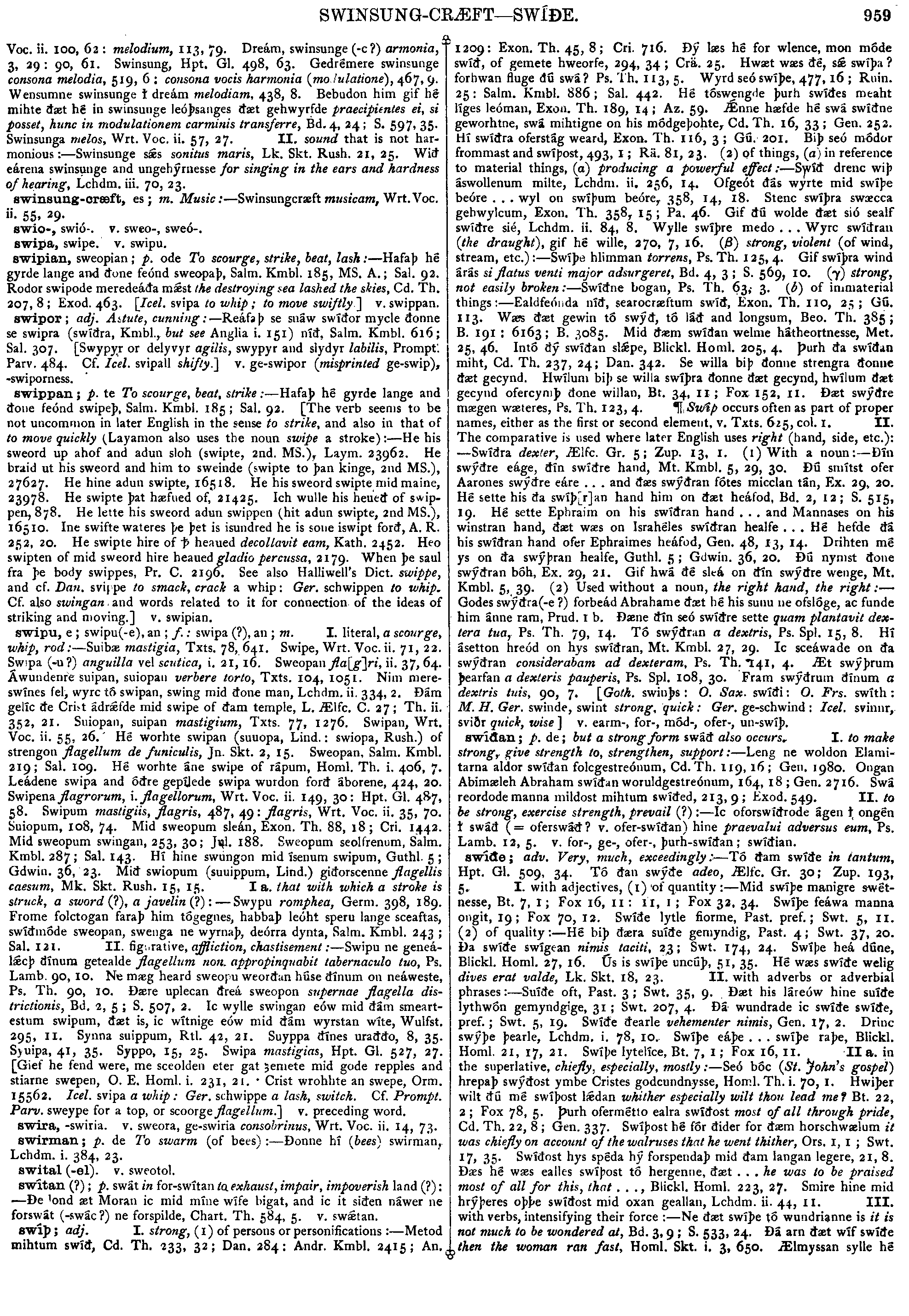
swipu,
e;
swipu(-e),
an;
f.:
swipa
(?),
an;
m.
I.
literal,
a
scourge,
whip,
rod:--Suibæ
mastigia,
Txts.
78,
641.
Swipe,
Wrt.
Voc.
ii.
71,
22.
Swipa
(-n?)
anguilla
vel
scutica,
i.
21,
16.
Sweopan
fla[g]ri,
ii.
37,
64.
Áwundenre
suipan,
suiopan
verbere
torto,
Txts.
104,
1051.
Nim
mere swínes
fel,
wyrc
tó
swipan,
swing
mid
ðone
man,
Lchdm.
ii.
334,
2.
Ðám
gelíc
ðe
Crist
ádrfde
mid
swipe
of
ðam
temple,
L.
Ælfc.
C.
27;
Th.
ii.
352,
21.
Suiopan,
suipan
mastigium,
Txts.
77,
1276.
Swipan,
Wrt.
Voc.
ii.
55.
26.
Hé
worhte
swipan
(suuopa,
Lind.:
swiopa,
Rush.)
of
strengon
flagellum
de
funiculis,
Jn.
Skt.
2,
15.
Sweopan,
Salm.
Kmbl.
219;
Sal.
109.
Hé
worhte
áne
swipe
of
rápum,
Homl.
Th.
i.
406,
7.
Leádene
swipa
and
óðre
gepílede
swipa
wurdon
forð
áborene,
424,
20.
Swipena
flagrorum,
i.
flagellorum,
Wrt.
Voc.
ii.
149,
30:
Hpt.
Gl.
487,
58.
Swipum
mastigiis,
flagris,
487,
49:
flagris,
Wrt.
Voc.
ii.
35,
70.
Suiopum,
108,
74.
Mid
sweopum
sleán,
Exon.
Th.
88,
18;
Cri.
1442.
Mid
sweopum
swingan,
253,
30;
Jul.
188.
Sweopum
seolfrenum,
Salm.
Kmbl.
287;
Sal.
143.
Hí
hine
swungon
mid
ísenum
swipum,
Guthl.
5;
Gdwin.
36,
23.
Mið
swiopum
(suuippum,
Lind.)
giðorscenne
flagellis
caesum,
Mk.
Skt.
Rush.
15,
15.
I
a.
that
with
which
a
stroke
is
struck,
a
sword
(?),
a
javelin
(?):--Swypu
romphea,
Germ.
398,
189.
Frome
folctogan
faraþ
him
tógegnes,
habbaþ
leóht
speru
lange
sceaftas,
swíðmóde
sweopan,
swenga
ne
wyrnaþ,
deórra
dynta,
Salm.
Kmbl.
243;
Sal.
121.
II.
figurative,
affliction,
chastisement:--Swipu
ne
geneálcþ
ðínum
getealde
flagellum
non
appropinquabit
tabernaculo
tuo,
Ps.
Lamb.
90,
10.
Ne
mæg
heard
sweopu
weorðan
húse
ðínum
on
neáweste,
Ps.
Th.
90,
10.
Ðære
uplecan
ðreá
sweopon
supernae
flagella
districtionis,
Bd.
2,
5;
S.
507,
2.
Ic
wylle
swingan
eów
mid
ðám
smeartestum
swipum,
ðæt
is,
ic
wítnige
eów
mid
ðám
wyrstan
wíte,
Wulfst.
295,
11.
Synna
suippum,
Rtl.
42,
21.
Suyppa
ðínes
uraððo,
8,
35.
Syuipa,
41,
35.
Syppo,
15,
25.
Swipa
mastigias,
Hpt.
Gl.
527,
27.
[Gief
he
fend
were,
me
sceolden
eter
gat
swínes
fel,
wyrc
tó
swipan,
swing
mid
ðone
man,
Lchdm.
ii.
334,
2.
Ðám
gelíc
ðe
Crist
ádrfde
mid
swipe
of
ðam
temple,
L.
Ælfc.
C.
27;
Th.
ii.
352,
21.
Suiopan,
suipan
mastigium,
Txts.
77,
1276.
Swipan,
Wrt.
Voc.
ii.
55.
26.
Hé
worhte
swipan
(suuopa,
Lind.:
swiopa,
Rush.)
of
strengon
flagellum
de
funiculis,
Jn.
Skt.
2,
15.
Sweopan,
Salm.
Kmbl.
219;
Sal.
109.
Hé
worhte
áne
swipe
of
rápum,
Homl.
Th.
i.
406,
7.
Leádene
swipa
and
óðre
gepílede
swipa
wurdon
forð
áborene,
424,
20.
Swipena
flagrorum,
i.
flagellorum,
Wrt.
Voc.
ii.
149,
30:
Hpt.
Gl.
487,
58.
Swipum
mastigiis,
flagris,
487,
49:
flagris,
Wrt.
Voc.
ii.
35,
70.
Suiopum,
108,
74.
Mid
sweopum
sleán,
Exon.
Th.
88,
18;
Cri.
1442.
Mid
sweopum
swingan,
253,
30;
Jul.
188.
Sweopum
seolfrenum,
Salm.
Kmbl.
287;
Sal.
143.
Hí
hine
swungon
mid
ísenum
swipum,
Guthl.
5;
Gdwin.
36,
23.
Mið
swiopum
(suuippum,
Lind.)
giðorscenne
flagellis
caesum,
Mk.
Skt.
Rush.
15,
15.
I
a.
that
with
which
a
stroke
is
struck,
a
sword
(?),
a
javelin
(?):--Swypu
romphea,
Germ.
398,
189.
Frome
folctogan
faraþ
him
tógegnes,
habbaþ
leóht
speru
lange
sceaftas,
swíðmóde
sweopan,
swenga
ne
wyrnaþ,
deórra
dynta,
Salm.
Kmbl.
243;
Sal.
121.
II.
figurative,
affliction,
chastisement:--Swipu
ne
geneálcþ
ðínum
getealde
flagellum
non
appropinquabit
tabernaculo
tuo,
Ps.
Lamb.
90,
10.
Ne
mæg
heard
sweopu
weorðan
húse
ðínum
on
neáweste,
Ps.
Th.
90,
10.
Ðære
uplecan
ðreá
sweopon
supernae
flagella
districtionis,
Bd.
2,
5;
S.
507,
2.
Ic
wylle
swingan
eów
mid
ðám
smeartestum
swipum,
ðæt
is,
ic
wítnige
eów
mid
ðám
wyrstan
wíte,
Wulfst.
295,
11.
Synna
suippum,
Rtl.
42,
21.
Suyppa
ðínes
uraððo,
8,
35.
Syuipa,
41,
35.
Syppo,
15,
25.
Swipa
mastigias,
Hpt.
Gl.
527,
27.
[Gief
he
fend
were,
me
sceolden
eter
gat
 emete
mid
gode
repples
and
stiarne
swepen,
O.
E.
Homl.
i.
231,
21.
Crist
wrohhte
an
swepe,
Orm.
15562.
Icel.
svipa
a
whip:
Ger.
schwippe
a
lash,
switch.
Cf.
Prompt.
Parv.
sweype
for
a
top,
or
scoorge
flagellum.]
v.
preceding
word.
emete
mid
gode
repples
and
stiarne
swepen,
O.
E.
Homl.
i.
231,
21.
Crist
wrohhte
an
swepe,
Orm.
15562.
Icel.
svipa
a
whip:
Ger.
schwippe
a
lash,
switch.
Cf.
Prompt.
Parv.
sweype
for
a
top,
or
scoorge
flagellum.]
v.
preceding
word.
|
Source: Bosworth/Toller, page b1134, entry 24 View original page image as: [TIFF] [PNG] [View previous entry] [View next entry] |
[Comment on this entry] [View comments (1)] |
The following entry has been hand-corrected once. |
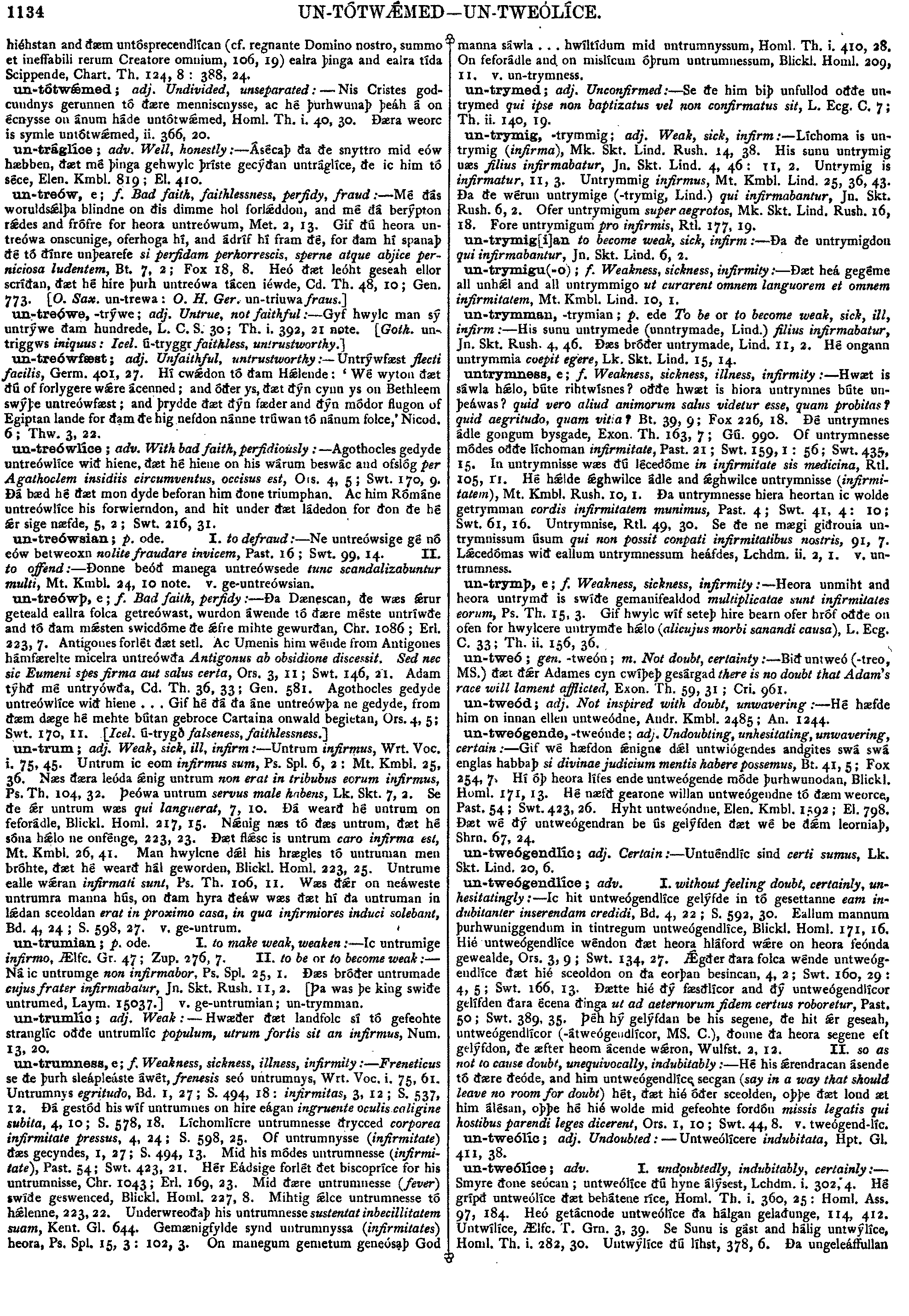
un-tweógendlíce;
adv.
I.
without
feeling
doubt,
certainly,
unhesitatingly
:--
Ic
hit
untweógendlíce
gelýfde
in
tó
gesettanne
eam
indubitanter
inserendam
credidi,
Bd.
4,
22;
S.
592,
30.
Eallum
mannum
þurhwuniggendum
in
tintregum
untweógendlíce,
Blickl.
Homl.
171,
16.
Hié
untweógendlíce
wéndon
ðæt
heora
hláford
wre
on
heora
feónda
gewealde,
Ors.
3,
9;
Swt.
134,
27.
Æ-acute;gðer
ðara
folca
wénde
untweógendlíce
ðæt
hié
sceoldon
on
ða
eorþan
besincan,
4,
2;
Swt.
160,
29;
4,
5;
Swt.
166,
13.
Ðætte
hié
ðý
fæsðlícor
and
ðý
untweógendlícor
gelífden
ðara
écena
ðinga
ut
ad
aeternorum
fidem
certius
roboretur,
Past.
50;
Swt.
389,
35.
Þéh
hý
gelýfdan
be
his
segene,
ðe
hit
r
geseah,
untweógendlícor
(-átweógendlícor,
MS.
C.),
ðonne
ða
heora
segene
eft
gelýfdon,
ðe
æfter
heom
ácende
wron,
Wulfst.
2,
12.
II.
so
as
not
to
cause
doubt,
unequivocally,
indubitably
:--
Hé
his
rendracan
ásende
tó
ðære
ðeóde,
and
him
untweógendlíce
secgan
(say
in
a
way
that
should
leave
no
room
for
doubt)
hét,
ðæt
hié
óðer
sceolden,
oþþe
dæt
lond
æt
him
álésan,
oþþe
hé
hié
wolde
mid
gefeohte
fordón
missis
legatis
qui
hostibus
parendi
leges
dicerent,
Ors.
1,
10;
Swt.
44,
8.
v.
tweógend-líc.
|
Source: Bosworth/Toller, page b1169, entry 3 View original page image as: [TIFF] [PNG] [View previous entry] [View next entry] |
[Comment on this entry] [View comments] |
The following entry has been hand-corrected once. |
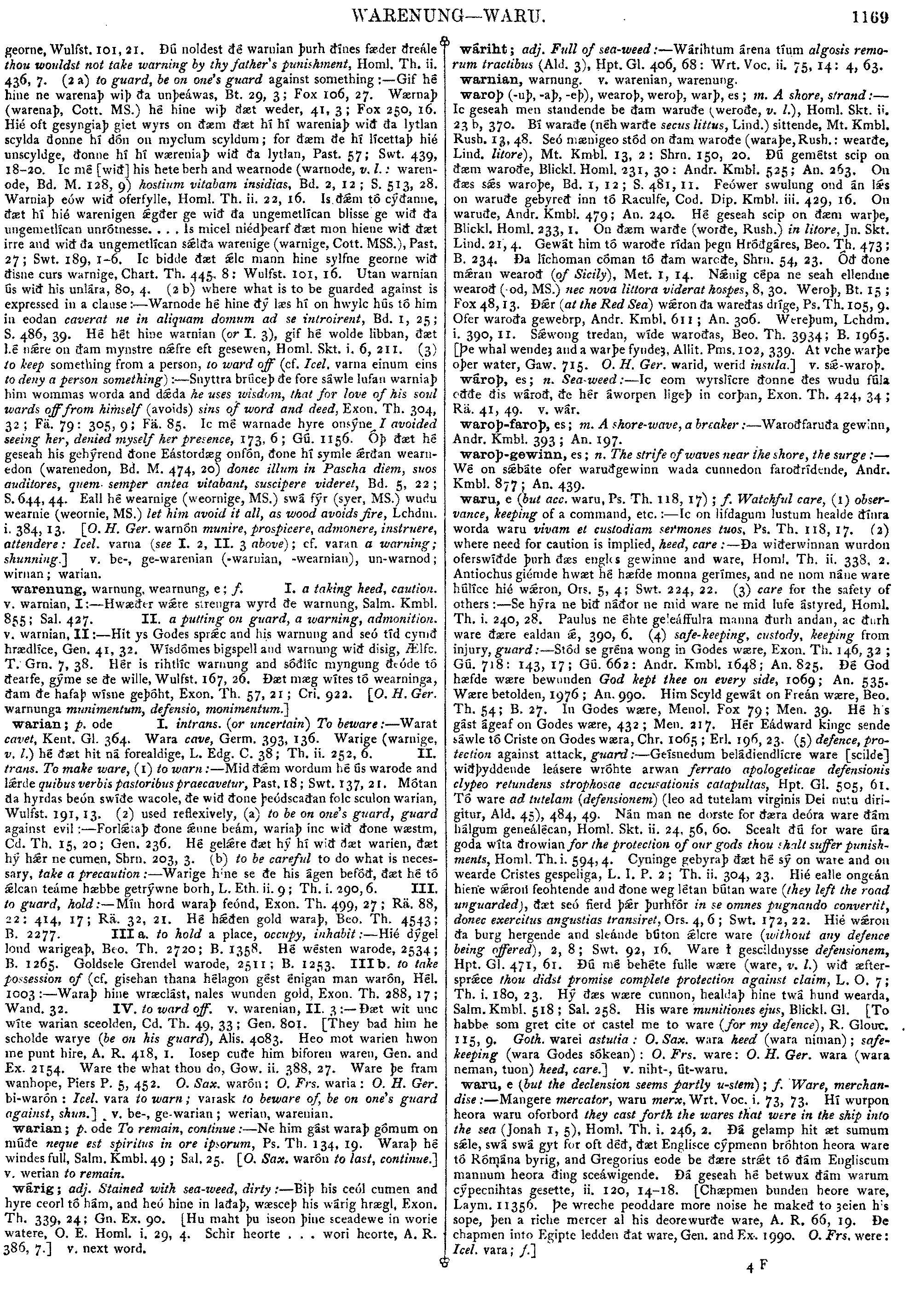
warian;
p.
ode
I.
intrans.
(or
uncertain)
To
beware
:--
Warat
cavet,
Kent.
Gl.
364.
Wara
cave,
Germ.
393,
136.
Warige
(warnige,
v.
l.)
hé
ðæt
hit
ná
forealdige,
L.
Edg.
C.
38;
Th.
ii.
252,
6.
II.
trans.
To
make
ware,
(1)
to
warn
:--
Mid
ðm
wordum
hé
ús
warode
and
lrde
quibus
verbis
pastoribus
praecavetur,
Past.
18;
Swt.
137,
21.
Mótan
ða
hyrdas
beón
swíðe
wacole,
ðe
wið
ðone
þeódscaðan
folc
sculon
warian,
Wulfst.
191,
13.
(2)
used
reflexively,
(a)
to
be
on
one's
guard,
guard
against
evil
:--
Forlaþ
ðone
nne
beám,
wariaþ
inc
wið
ðone
wæstm,
Cd.
Th.
15,
20;
Gen.
236.
Hé
gelre
ðæt
hý
hí
wið
ðæt
warien,
ðæt
hý
hr
ne
cumen,
Sbrn.
203,
3.
(b)
to
be
careful
to
do
what
is
necessary,
take
a
precaution
:--
Warige
hine
se
ðe
his
ágen
befóð,
ðæt
hé
tó
lcan
teáme
hæbbe
getrýwne
borh,
L.
Eth.
ii.
9
;
Th.
i.
290,
6.
III.
to
guard,
hold
:--
Mín
hord
waraþ
feónd,
Exon.
Th.
499,
27
;
Rä.
88,
22:
414,
17;
Rä.
32,
21.
Hé
hðen
gold
waraþ,
Beo.
Th.
4543;
B.
2277.
IIIa.
to
hold
a
place,
occupy,
inhabit
:--
Hié
dýgel
lond
warigeaþ,
Beo.
Th.
2720;
B.
1358.
Hé
wésten
warode,
2534;
B.
1265.
Goldsele
Grendel
warode,
2511;
B.
1253.
IIIb.
to
take
possession
of
(cf.
giseban
thana
hélagon
gést
énigan
man
warón,
Hél.
1003
:--
Waraþ
hine
wræclást,
nales
wunden
gold,
Exon.
Th.
288,
17
;
Wand.
32.
IV.
to
ward
off.
v.
warenian,
II.
3
:--
Ðæt
wit
unc
wíte
warian
sceolden,
Cd.
Th.
49,
33;
Gen.
801.
[They
bad
him
he
scholde
warye
(be
on
his
guard),
Alis.
4083.
Heo
mot
warien
hwon
me
punt
hire,
A.
R.
418,I.
Iosep
cuðe
him
biforen
waren,
Gen.
and
Ex.
2154.
Ware
the
what
thou
do,
Gow.
ii.
388,
27.
Ware
þe
fram
wanhope,
Piers
P.
5,
452.
O.
Sax.
warón:
O.
Frs.
waria
:
O.
H.
Ger.
bi-warón
:
Icel.
vara
to
warn;
varask
to
beware
of,
be
on
one's
guard
against,
shun.]
v.
be-,
ge-warian
;
werian,
warenian.
|
Source: Bosworth/Toller, page d0014, entry 3 View original page image as: [TIFF] [PNG] [View previous entry] [View next entry] |
[Comment on this entry] [View comments] |
The following entry has been hand-corrected once. |
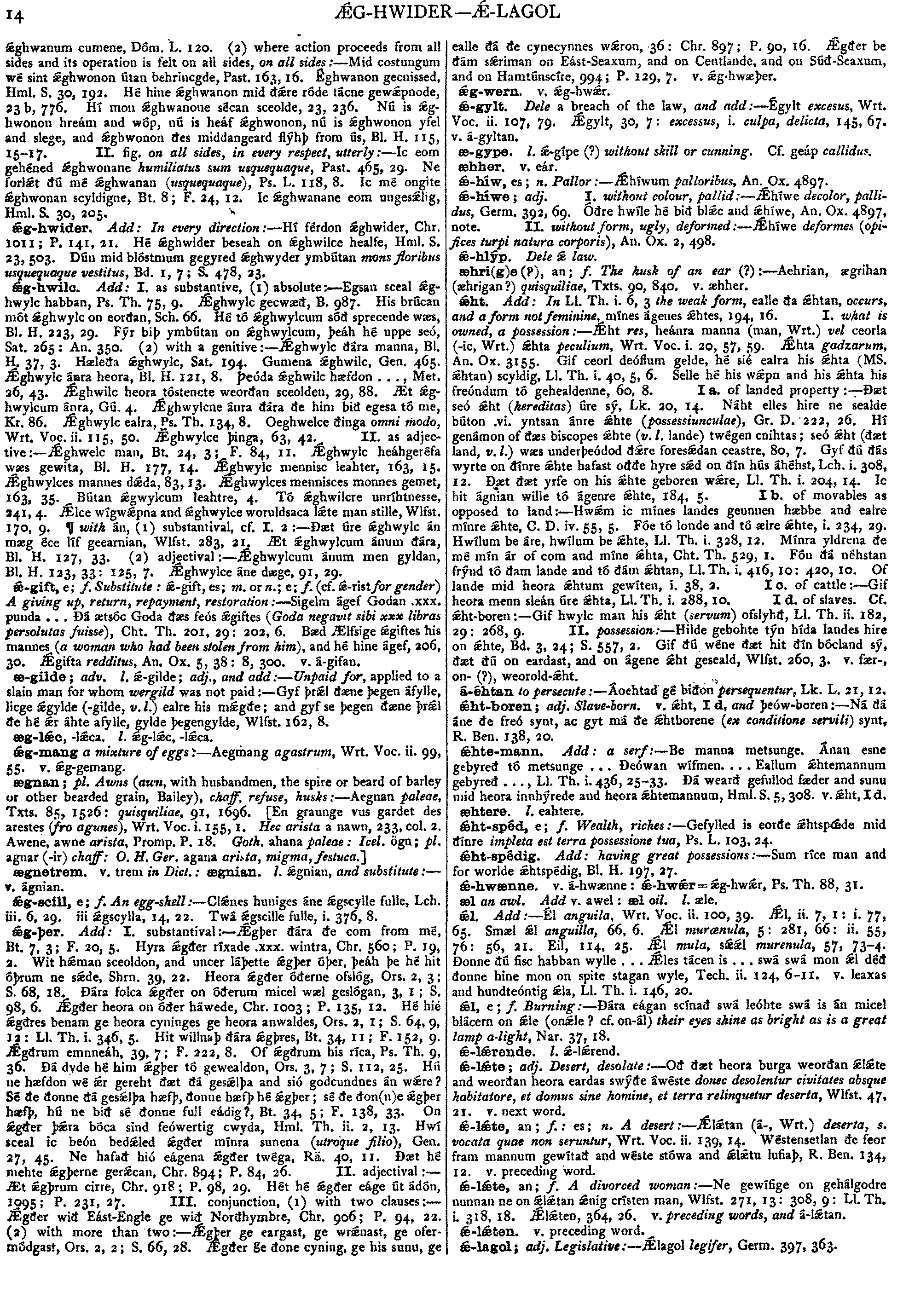
g-hwilc.
Add:
I.
as
substantive,
(1)
absolute:--Egsan
sceal
ghwylc
habban,
Ps.
Th.
75,
9.
Æ-acute;ghwylc
gecwæð,
B.
987.
His
brúcan
mót
ghwylc
on
eorðan,
Sch.
66.
Hé
tó
ghwylcum
sóð
sprecende
wæs,
Bl.
H.
223,
29.
Fýr
biþ
ymbútan
on
ghwylcum,
þeáh
hé
uppe
seó,
Sat.
265:
An.
350.
(2)
with
a
genitive:--Æ-acute;ghwylc
ðára
manna,
Bl.
H.
37,
3.
Hæleða
ghwylc,
Sat.
194.
Gumena
ghwilc,
Gen.
465.
Æ-acute;ghwylc
ánra
heora,
Bl.
H.
121,
8.
Þeóda
ghwilc
hæfdon
.
.
.,
Met.
26,
43.
Æ-acute;ghwilc
heora
tóstencte
weorðan
sceolden,
29,
88.
Æt
ghwylcum
ánra,
Gú.
4.
Æ-acute;ghwylcne
ánra
ðára
ðe
him
bið
egesa
tó
me,
Kr.
86.
Æ-acute;ghwylc
ealra,
Ps.
Th.
134,
8.
Oeghwelce
ðinga
omni
modo,
Wrt.
Voc.
ii.
115,
50.
Æ-acute;ghwylce
þinga,
63,
42.
II.
as
adjective:--Æ-acute;ghwelc
man,
Bt.
24,
3;
F.
84,
11.
Æ-acute;ghwylc
heáhgeréfa
wæs
gewita,
Bl.
H.
177,
14.
Æ-acute;ghwylc
mennisc
leahter,
163,
15.
Æ-acute;ghwylces
mannes
dda,
83,
13.
Æ-acute;ghwylces
mennisces
monnes
gemet,
163,
35.
Bútan
gwylcum
leahtre,
4.
Tó
ghwilcre
unríhtnesse,
241,
4.
Æ-acute;lce
wígwpna
and
ghwylce
woruldsaca
lte
man
stille,
Wlfst.
170,
9.

with
án,
(1)
substantival,
cf.
I.
2:--Ðæt
úre
ghwylc
án
mæg
éce
líf
geearnian,
Wlfst.
283,
21.
Æt
ghwylcum
ánum
ðára,
Bl.
H.
127,
33.
(2)
adjectival:--Æ-acute;ghwylcum
ánum
men
gyldan,
Bl.
H.
123,
33:
125,
7.
Æ-acute;ghwylce
áne
dæge,
91,
29.
|
Source: Bosworth/Toller, page d0037, entry 1 View original page image as: [TIFF] [PNG] [View previous entry] [View next entry] |
[Comment on this entry] [View comments] |
The following entry has been hand-corrected once. |
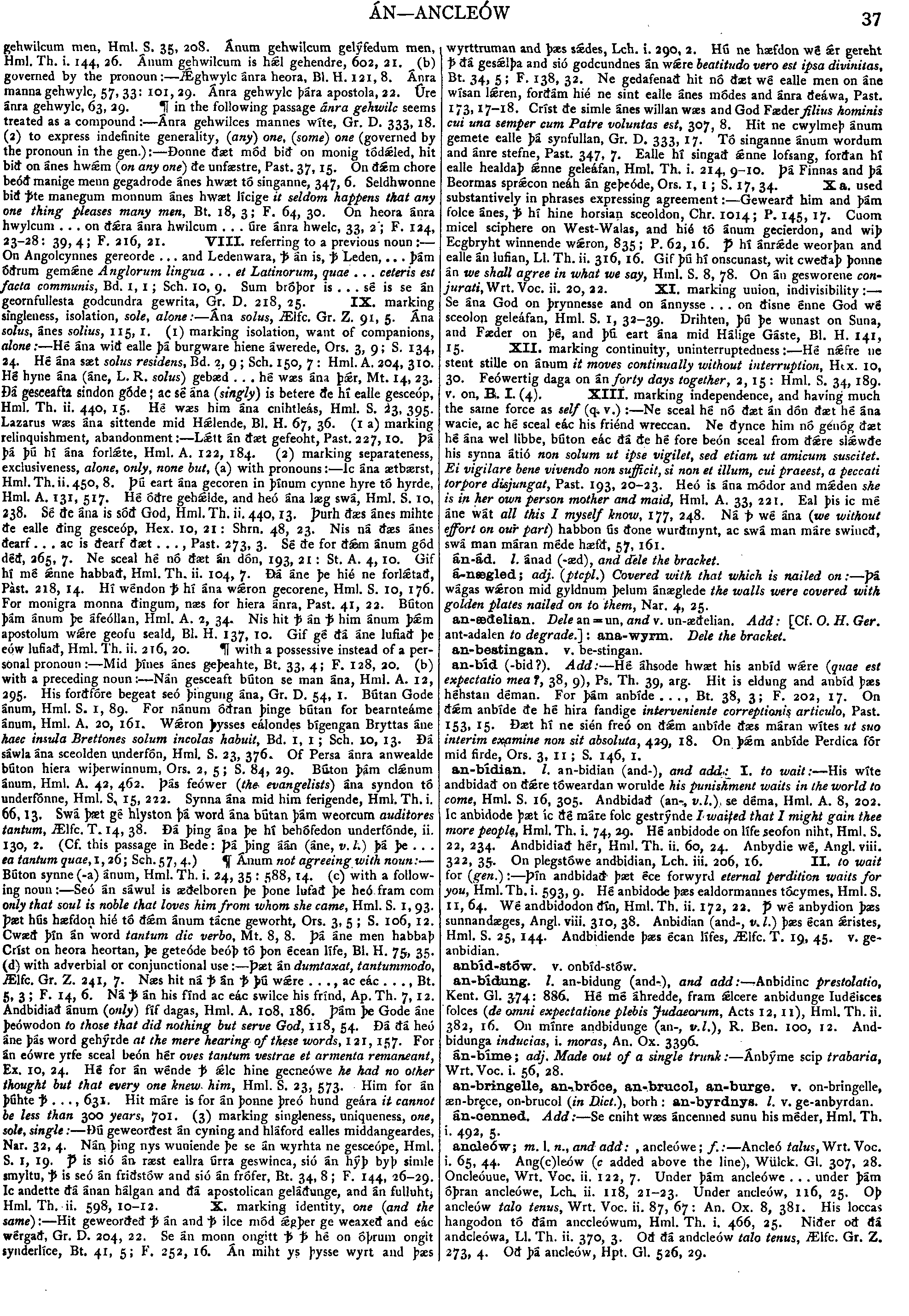
gehwilcum
men,
Hml.
S.
35,
208.
Ánum
gehwilcum
gelýfedum
men,
Hml.
Th.
i.
144,
26.
Ánum
gehwilcum
is
hl
gehendre,
602,
21.
(b)
governed
by
the
pronoun:--Æ-acute;ghwylc
ánra
heora,
Bl.
H.
121,
8.
Ánra
manna
gehwylc,
57,
33:
101,
29.
Ánra
gehwylc
þára
apostola,
22.
Úre
ánra
gehwylc,
63,
29.

in
the
following
passage
ánra
gehwilc
seems
treated
as
a
compound:--Ánra
gehwilces
mannes
wíte,
Gr.
D.
333,
18.
(2)
to
express
indefinite
generality,
(any)
one,
(some)
one
(governed
by
the
pronoun
in
the
gen.):--Ðonne
ðæt
mód
bið
on
monig
tódled,
hit
bið
on
ánes
hwm
(on
any
one)
ðe
unfæstre,
Past.
37,
15.
On
ðm
chore
beóð
manige
menn
gegadrode
ánes
hwæt
tó
singanne,
347,
6.
Seldhwonne
bið
 te
manegum
monnum
ánes
hwæt
lícige
it
seldom
happens
that
any
one
thing
pleases
many
men,
Bt.
18,
3;
F.
64,
30.
On
heora
ánra
hwylcum
.
.
.
on
ðra
ánra
hwilcum
.
.
.
úre
ánra
hwelc,
33,
2;
F.
124,
23-28:
39,
4;
F.
216,
21.
VIII.
referring
to
a
previous
noun:--On
Angolcynnes
gereorde
.
.
.
and
Ledenwara,
án
is,
Leden,
.
.
.
þám
óðrum
gemne
Anglorum
lingua
.
.
.
el
Latinorum,
quae
.
.
.
ceteris
est
facta
communis,
Bd.
1,
1;
Sch.
10,
9.
Sum
bróþor
is
.
.
.
sé
is
se
án
geornfullesta
godcundra
gewrita,
Gr.
D.
218,
25.
IX.
marking
singleness,
isolation,
sole,
alone:--Ána
solus,
Ælfc.
Gr.
Z.
91,
5.
Ána
solus,
ánes
solius,
115,
1.
(1)
marking
isolation,
want
of
companions,
alone:--Hé
ána
wið
ealle
þá
burgware
hiene
áwerede,
Ors.
3,
9;
S.
134,
24.
Hé
ána
sæt
solus
residens,
Bd.
2,
9;
Sch.
150,
7:
Hml.
A.
204,
310.
Hé
hyne
ána
(áne,
L.
R.
solus)
gebæd
.
.
.
hé
wæs
ána
þr,
Mt.
14,
23.
Ðá
gesceafta
sindon
góde;
ac
sé
ána
(singly)
is
betere
ðe
hí
ealle
gesceóp,
Hml.
Th.
ii.
440,
15.
Hé
wæs
him
ána
cnihtleás,
Hml.
S.
23,
395.
Lazarus
wæs
ána
sittende
mid
Hlende,
Bl.
H.
67,
36.
(1
a)
marking
relinquishment,
abandonment:--Ltt
án
ðæt
gefeoht,
Past.
227,
10.
Þá
þá
þú
hí
ána
forlte,
Hml.
A.
122,
184.
(2)
marking
separateness,
exclusiveness,
alone,
only,
none
but,
(a)
with
pronouns:--Ic
ána
ætbærst,
Hml.
Th.
ii.
450,
8.
Þú
eart
ána
gecoren
in
þínum
cynne
hyre
tó
hyrde,
Hml.
A.
131,
517.
Hé
óðre
gehlde,
and
heó
ána
læg
swá,
Hml.
S.
10,
238.
Sé
ðe
ána
is
sóð
God,
Hml.
Th.
ii.
440,
13.
Þurh
ðæs
ánes
mihte
ðe
ealle
ðing
gesceóp,
Hex.
10,
21:
Shrn.
48,
23.
Nis
ná
ðæs
ánes
ðearf
.
.
.
ac
is
ðearf
ðæt
.
.
.
,
Past.
273,
3.
Sé
ðe
for
ðm
ánum
gód
déð,
265,
7.
Ne
sceal
hé
nó
ðæt
án
dón,
193,
21:
St.
A.
4,
10.
Gif
hí
mé
nne
habbað,
Hml.
Th.
ii.
104,
7.
Ðá
áne
þe
hié
ne
forltað,
Past.
218,
14.
Hí
wéndon
hí
ána
wron
gecorene,
Hml.
S.
10,
176.
For
monigra
monna
ðingum,
næs
for
hiera
ánra,
Past.
41,
22.
Búton
þám
ánum
þe
áfeóllan,
Hml.
A.
2,
34.
Nis
hit
án
him
ánum
þm
apostolum
wre
geofu
seald,
Bl.
H.
137,
10.
Gif
gé
ðá
áne
lufiað
þe
eów
lufiað,
Hml.
Th.
ii.
216,
20.

with
a
possessive
instead
of
a
personal
pronoun:--Mid
þínes
ánes
geþeahte,
Bt.
33,
4;
F.
128,
20.
(b)
with
a
preceding
noun:--Nán
gesceaft
búton
se
man
ána,
Hml.
A.
12,
295.
His
forðfóre
begeat
seó
þingung
ána,
Gr.
D.
54,
1.
Bútan
Gode
ánum,
Hml.
S.
1,
89.
For
nánum
óðran
þinge
bútan
for
bearnteáme
ánum,
Hml.
A.
20,
161.
Wron
þysses
eálondes
bígengan
Bryttas
áne
haec
insula
Brettones
solum
incolas
habuit,
Bd.
1,
1;
Sch.
10,
13.
Ðá
sáwla
ána
sceolden
underfón,
Hml.
S.
23,
376.
Of
Persa
ánra
anwealde
búton
hiera
wiþerwinnum,
Ors.
2,
5;
S.
84,
29.
Búton
þám
clnum
ánum,
Hml.
A.
42,
462.
Þás
feówer
(the
evangelists)
ána
syndon
tó
underfónne,
Hml.
S.
15,
222.
Synna
ána
mid
him
ferigende,
Hml.
Th.
i.
66,
13,
Swá
þæt
gé
hlyston
þá
word
ána
bútan
þám
weorcum
auditores
tantum,
Ælfc.
T.
14,
38.
Ðá
þing
ána
þe
hí
behófedon
underfónde,
ii.
130,
2.
(Cf.
this
passage
in
Bede:
Þá
þing
áán
(áne,
v.
l.)
þá
þe
.
.
.
ea
tantum
quae,
1,
26;
Sch.
57,
4.)

Ánum
not
agreeing
with
noun:--Búton
synne
(-a)
ánum,
Hml.
Th.
i.
24,
35:
588,
14.
(c)
with
a
following
noun:--Seó
án
sáwul
is
æðelboren
þe
þone
lufað
þe
heó
fram
com
only
that
soul
is
noble
that
loves
him
from
whom
she
came,
Hml.
S.
1,
93.
Þæt
hús
hæfdon
hié
tó
ðm
ánum
tácne
geworht,
Ors.
3,
5;
S.
106,
12.
Cwæð
þín
án
word
tantum
dic
verbo,
Mt.
8,
8.
Þá
áne
men
habbaþ
Críst
on
heora
heortan,
þe
geteóde
beóþ
tó
þon
écean
lífe,
Bl.
H.
75,
35.
(d)
with
adverbial
or
conjunctional
use:--Þæt
án
dumtaxat,
tantummodo,
Ælfc.
Gr.
Z.
241,
7.
Næs
hit
ná
án
þú
wre
.
.
.
,
ac
eác
.
.
.
,
Bt.
5,
3;
F.
14,
6.
Ná
án
his
fínd
ac
eác
swilce
his
frínd,
Ap.
Th.
7,
12.
Andbidiað
ánum
(only)
fíf
dagas,
Hml.
A.
108,
186.
Þám
þe
Gode
áne
þeówodon
to
those
that
did
nothing
but
serve
God,
118,
54.
Ðá
ðá
heó
áne
þás
word
gehýrde
at
the
mere
hearing
of
these
words,
121,
157.
For
án
eówre
yrfe
sceal
beón
hér
oves
tantum
vestrae
et
armenta
remaneant,
Ex.
10,
24.
Hé
for
án
wénde
lc
hine
gecneówe
he
had
no
other
thought
but
that
every
one
knew
him,
Hml.
S.
23,
573.
Him
for
án
þúhte
.
.
.
,
631.
Hit
máre
is
for
án
þonne
þreó
hund
geára
it
cannot
be
less
than
300
years,
701.
(3)
marking
singleness,
uniqueness,
one,
sole,
single:--Ðú
geweorðest
án
cyning
and
hláford
ealles
middangeardes,
Nar.
32,
4.
Nán
þing
nys
wuniende
þe
se
án
wyrhta
ne
gesceópe,
Hml.
S.
1,
19.
Þ-bar;
is
sió
án
ræst
eallra
úrra
geswinca,
sió
án
hýþ
byþ
simle
smyltu,
is
seó
án
friðstów
and
sió
án
frófer,
Bt.
34,
8;
F.
144,
26-29.
Ic
andette
ðá
ánan
hálgan
and
ðá
apostolican
geláðunge,
and
án
fulluht,
Hml.
Th.
ii.
598,
10-12.
X.
marking
identity,
one
(and
the
same):--Hit
geweorðeð
án
and
ilce
mód
gþer
ge
weaxeð
and
eác
wérgað,
Gr.
D.
204,
22.
Se
án
monn
ongitt
hé
on
óþrum
ongit
synderlíce,
Bt.
41,
5;
F.
252,
16.
Án
miht
ys
þysse
wyrt
and
þæs
wyrttruman
and
þæs
sdes,
Lch.
i.
290,
2.
Hú
ne
hæfdon
wé
r
gereht
ðá
geslþa
and
sió
godcundnes
án
wre
beatitudo
vero
est
ipsa
divinitas,
Bt.
34,
5;
F.
138,
32.
Ne
gedafenað
hit
nó
ðæt
wé
ealle
men
on
áne
wísan
lren,
forðám
hié
ne
sint
ealle
ánes
módes
and
ánra
ðeáwa,
Past.
173,
17-18.
Críst
ðe
simle
ánes
willan
wæs
and
God
Fæder
filius
hominis
cui
una
semper
cum
Patre
voluntas
est,
307,
8.
Hit
ne
cwylmeþ
ánum
gemete
ealle
þá
synfullan,
Gr.
D.
333,
17.
Tó
singanne
ánum
wordum
and
ánre
stefne,
Past.
347,
7.
Ealle
hí
singað
nne
lofsang,
forðan
hí
ealle
healdaþ
nne
geleáfan,
Hml.
Th.
i.
214,
9-10.
Þá
Finnas
and
þá
Beormas
sprcon
neáh
án
geþeóde,
Ors.
1,
1;
S.
17,
34.
X
a.
used
substantively
in
phrases
expressing
agreement:--Gewearð
him
and
þám
folce
ánes,
hí
hine
horsian
sceoldon,
Chr.
1014;
P.
145,
17.
Cuom
micel
sciphere
on
West-Walas,
and
hié
tó
ánum
gecierdon,
and
wiþ
Ecgbryht
winnende
wron,
835;
P.
62,
16.
Þ-bar;
hí
ánrde
weorþan
and
ealle
án
lufian,
Ll.
Th.
ii.
316,
16.
Gif
þú
hí
onscunast,
wit
cweðaþ
þonne
án
we
shall
agree
in
what
we
say,
Hml.
S.
8,
78.
On
án
gesworene
conjurati,
Wrt.
Voc.
ii.
20,
22.
XI.
marking
union,
indivisibility:--Se
ána
God
on
þrynnesse
and
on
ánnysse
.
.
.
on
ðisne
énne
God
wé
sceolon
geleáfan,
Hml.
S.
1,
32-39.
Drihten,
þú
þe
wunast
on
Suna,
and
Fæder
on
þé,
and
þú
eart
ána
mid
Hálige
Gáste,
Bl.
H.
141,
15.
XII.
marking
continuity,
uninterruptedness:--Hé
nfre
ne
stent
stille
on
ánum
it
moves
continually
without
interruption,
Hex.
10,
30.
Feówertig
daga
on
án
forty
days
together,
2,
15:
Hml.
S.
34,
189.
v.
on,
B.
I.
(4).
XIII.
marking
independence,
and
having
much
the
same
force
as
self
(q.
v.):--Ne
sceal
hé
nó
ðæt
án
dón
ðæt
hé
ána
wacie,
ac
hé
sceal
eác
his
friénd
wreccan.
Ne
ðynce
him
nó
genóg
ðæt
hé
ána
wel
libbe,
búton
eác
ðá
ðe
hé
fore
beón
sceal
from
ðre
slwðe
his
synna
átió
non
solum
ut
ipse
vigilet,
sed
etiam
ut
amicum
suscitet.
Ei
vigilare
bene
vivendo
non
sufficit,
si
non
et
illum,
cui
praeest,
a
peccati
torpore
disjungat,
Past.
193,
20-23.
Heó
is
ána
módor
and
mden
she
is
in
her
own
person
mother
and
maid,
Hml.
A.
33,
221.
Eal
þis
ic
mé
áne
wát
all
this
I
myself
know,
177,
248.
Ná
wé
ána
(we
without
effort
on
our
part)
habbon
ús
ðone
wurðmynt,
ac
swá
man
máre
swincð,
swá
man
máran
méde
hæfð,
57,
161.
te
manegum
monnum
ánes
hwæt
lícige
it
seldom
happens
that
any
one
thing
pleases
many
men,
Bt.
18,
3;
F.
64,
30.
On
heora
ánra
hwylcum
.
.
.
on
ðra
ánra
hwilcum
.
.
.
úre
ánra
hwelc,
33,
2;
F.
124,
23-28:
39,
4;
F.
216,
21.
VIII.
referring
to
a
previous
noun:--On
Angolcynnes
gereorde
.
.
.
and
Ledenwara,
án
is,
Leden,
.
.
.
þám
óðrum
gemne
Anglorum
lingua
.
.
.
el
Latinorum,
quae
.
.
.
ceteris
est
facta
communis,
Bd.
1,
1;
Sch.
10,
9.
Sum
bróþor
is
.
.
.
sé
is
se
án
geornfullesta
godcundra
gewrita,
Gr.
D.
218,
25.
IX.
marking
singleness,
isolation,
sole,
alone:--Ána
solus,
Ælfc.
Gr.
Z.
91,
5.
Ána
solus,
ánes
solius,
115,
1.
(1)
marking
isolation,
want
of
companions,
alone:--Hé
ána
wið
ealle
þá
burgware
hiene
áwerede,
Ors.
3,
9;
S.
134,
24.
Hé
ána
sæt
solus
residens,
Bd.
2,
9;
Sch.
150,
7:
Hml.
A.
204,
310.
Hé
hyne
ána
(áne,
L.
R.
solus)
gebæd
.
.
.
hé
wæs
ána
þr,
Mt.
14,
23.
Ðá
gesceafta
sindon
góde;
ac
sé
ána
(singly)
is
betere
ðe
hí
ealle
gesceóp,
Hml.
Th.
ii.
440,
15.
Hé
wæs
him
ána
cnihtleás,
Hml.
S.
23,
395.
Lazarus
wæs
ána
sittende
mid
Hlende,
Bl.
H.
67,
36.
(1
a)
marking
relinquishment,
abandonment:--Ltt
án
ðæt
gefeoht,
Past.
227,
10.
Þá
þá
þú
hí
ána
forlte,
Hml.
A.
122,
184.
(2)
marking
separateness,
exclusiveness,
alone,
only,
none
but,
(a)
with
pronouns:--Ic
ána
ætbærst,
Hml.
Th.
ii.
450,
8.
Þú
eart
ána
gecoren
in
þínum
cynne
hyre
tó
hyrde,
Hml.
A.
131,
517.
Hé
óðre
gehlde,
and
heó
ána
læg
swá,
Hml.
S.
10,
238.
Sé
ðe
ána
is
sóð
God,
Hml.
Th.
ii.
440,
13.
Þurh
ðæs
ánes
mihte
ðe
ealle
ðing
gesceóp,
Hex.
10,
21:
Shrn.
48,
23.
Nis
ná
ðæs
ánes
ðearf
.
.
.
ac
is
ðearf
ðæt
.
.
.
,
Past.
273,
3.
Sé
ðe
for
ðm
ánum
gód
déð,
265,
7.
Ne
sceal
hé
nó
ðæt
án
dón,
193,
21:
St.
A.
4,
10.
Gif
hí
mé
nne
habbað,
Hml.
Th.
ii.
104,
7.
Ðá
áne
þe
hié
ne
forltað,
Past.
218,
14.
Hí
wéndon
hí
ána
wron
gecorene,
Hml.
S.
10,
176.
For
monigra
monna
ðingum,
næs
for
hiera
ánra,
Past.
41,
22.
Búton
þám
ánum
þe
áfeóllan,
Hml.
A.
2,
34.
Nis
hit
án
him
ánum
þm
apostolum
wre
geofu
seald,
Bl.
H.
137,
10.
Gif
gé
ðá
áne
lufiað
þe
eów
lufiað,
Hml.
Th.
ii.
216,
20.

with
a
possessive
instead
of
a
personal
pronoun:--Mid
þínes
ánes
geþeahte,
Bt.
33,
4;
F.
128,
20.
(b)
with
a
preceding
noun:--Nán
gesceaft
búton
se
man
ána,
Hml.
A.
12,
295.
His
forðfóre
begeat
seó
þingung
ána,
Gr.
D.
54,
1.
Bútan
Gode
ánum,
Hml.
S.
1,
89.
For
nánum
óðran
þinge
bútan
for
bearnteáme
ánum,
Hml.
A.
20,
161.
Wron
þysses
eálondes
bígengan
Bryttas
áne
haec
insula
Brettones
solum
incolas
habuit,
Bd.
1,
1;
Sch.
10,
13.
Ðá
sáwla
ána
sceolden
underfón,
Hml.
S.
23,
376.
Of
Persa
ánra
anwealde
búton
hiera
wiþerwinnum,
Ors.
2,
5;
S.
84,
29.
Búton
þám
clnum
ánum,
Hml.
A.
42,
462.
Þás
feówer
(the
evangelists)
ána
syndon
tó
underfónne,
Hml.
S.
15,
222.
Synna
ána
mid
him
ferigende,
Hml.
Th.
i.
66,
13,
Swá
þæt
gé
hlyston
þá
word
ána
bútan
þám
weorcum
auditores
tantum,
Ælfc.
T.
14,
38.
Ðá
þing
ána
þe
hí
behófedon
underfónde,
ii.
130,
2.
(Cf.
this
passage
in
Bede:
Þá
þing
áán
(áne,
v.
l.)
þá
þe
.
.
.
ea
tantum
quae,
1,
26;
Sch.
57,
4.)

Ánum
not
agreeing
with
noun:--Búton
synne
(-a)
ánum,
Hml.
Th.
i.
24,
35:
588,
14.
(c)
with
a
following
noun:--Seó
án
sáwul
is
æðelboren
þe
þone
lufað
þe
heó
fram
com
only
that
soul
is
noble
that
loves
him
from
whom
she
came,
Hml.
S.
1,
93.
Þæt
hús
hæfdon
hié
tó
ðm
ánum
tácne
geworht,
Ors.
3,
5;
S.
106,
12.
Cwæð
þín
án
word
tantum
dic
verbo,
Mt.
8,
8.
Þá
áne
men
habbaþ
Críst
on
heora
heortan,
þe
geteóde
beóþ
tó
þon
écean
lífe,
Bl.
H.
75,
35.
(d)
with
adverbial
or
conjunctional
use:--Þæt
án
dumtaxat,
tantummodo,
Ælfc.
Gr.
Z.
241,
7.
Næs
hit
ná
án
þú
wre
.
.
.
,
ac
eác
.
.
.
,
Bt.
5,
3;
F.
14,
6.
Ná
án
his
fínd
ac
eác
swilce
his
frínd,
Ap.
Th.
7,
12.
Andbidiað
ánum
(only)
fíf
dagas,
Hml.
A.
108,
186.
Þám
þe
Gode
áne
þeówodon
to
those
that
did
nothing
but
serve
God,
118,
54.
Ðá
ðá
heó
áne
þás
word
gehýrde
at
the
mere
hearing
of
these
words,
121,
157.
For
án
eówre
yrfe
sceal
beón
hér
oves
tantum
vestrae
et
armenta
remaneant,
Ex.
10,
24.
Hé
for
án
wénde
lc
hine
gecneówe
he
had
no
other
thought
but
that
every
one
knew
him,
Hml.
S.
23,
573.
Him
for
án
þúhte
.
.
.
,
631.
Hit
máre
is
for
án
þonne
þreó
hund
geára
it
cannot
be
less
than
300
years,
701.
(3)
marking
singleness,
uniqueness,
one,
sole,
single:--Ðú
geweorðest
án
cyning
and
hláford
ealles
middangeardes,
Nar.
32,
4.
Nán
þing
nys
wuniende
þe
se
án
wyrhta
ne
gesceópe,
Hml.
S.
1,
19.
Þ-bar;
is
sió
án
ræst
eallra
úrra
geswinca,
sió
án
hýþ
byþ
simle
smyltu,
is
seó
án
friðstów
and
sió
án
frófer,
Bt.
34,
8;
F.
144,
26-29.
Ic
andette
ðá
ánan
hálgan
and
ðá
apostolican
geláðunge,
and
án
fulluht,
Hml.
Th.
ii.
598,
10-12.
X.
marking
identity,
one
(and
the
same):--Hit
geweorðeð
án
and
ilce
mód
gþer
ge
weaxeð
and
eác
wérgað,
Gr.
D.
204,
22.
Se
án
monn
ongitt
hé
on
óþrum
ongit
synderlíce,
Bt.
41,
5;
F.
252,
16.
Án
miht
ys
þysse
wyrt
and
þæs
wyrttruman
and
þæs
sdes,
Lch.
i.
290,
2.
Hú
ne
hæfdon
wé
r
gereht
ðá
geslþa
and
sió
godcundnes
án
wre
beatitudo
vero
est
ipsa
divinitas,
Bt.
34,
5;
F.
138,
32.
Ne
gedafenað
hit
nó
ðæt
wé
ealle
men
on
áne
wísan
lren,
forðám
hié
ne
sint
ealle
ánes
módes
and
ánra
ðeáwa,
Past.
173,
17-18.
Críst
ðe
simle
ánes
willan
wæs
and
God
Fæder
filius
hominis
cui
una
semper
cum
Patre
voluntas
est,
307,
8.
Hit
ne
cwylmeþ
ánum
gemete
ealle
þá
synfullan,
Gr.
D.
333,
17.
Tó
singanne
ánum
wordum
and
ánre
stefne,
Past.
347,
7.
Ealle
hí
singað
nne
lofsang,
forðan
hí
ealle
healdaþ
nne
geleáfan,
Hml.
Th.
i.
214,
9-10.
Þá
Finnas
and
þá
Beormas
sprcon
neáh
án
geþeóde,
Ors.
1,
1;
S.
17,
34.
X
a.
used
substantively
in
phrases
expressing
agreement:--Gewearð
him
and
þám
folce
ánes,
hí
hine
horsian
sceoldon,
Chr.
1014;
P.
145,
17.
Cuom
micel
sciphere
on
West-Walas,
and
hié
tó
ánum
gecierdon,
and
wiþ
Ecgbryht
winnende
wron,
835;
P.
62,
16.
Þ-bar;
hí
ánrde
weorþan
and
ealle
án
lufian,
Ll.
Th.
ii.
316,
16.
Gif
þú
hí
onscunast,
wit
cweðaþ
þonne
án
we
shall
agree
in
what
we
say,
Hml.
S.
8,
78.
On
án
gesworene
conjurati,
Wrt.
Voc.
ii.
20,
22.
XI.
marking
union,
indivisibility:--Se
ána
God
on
þrynnesse
and
on
ánnysse
.
.
.
on
ðisne
énne
God
wé
sceolon
geleáfan,
Hml.
S.
1,
32-39.
Drihten,
þú
þe
wunast
on
Suna,
and
Fæder
on
þé,
and
þú
eart
ána
mid
Hálige
Gáste,
Bl.
H.
141,
15.
XII.
marking
continuity,
uninterruptedness:--Hé
nfre
ne
stent
stille
on
ánum
it
moves
continually
without
interruption,
Hex.
10,
30.
Feówertig
daga
on
án
forty
days
together,
2,
15:
Hml.
S.
34,
189.
v.
on,
B.
I.
(4).
XIII.
marking
independence,
and
having
much
the
same
force
as
self
(q.
v.):--Ne
sceal
hé
nó
ðæt
án
dón
ðæt
hé
ána
wacie,
ac
hé
sceal
eác
his
friénd
wreccan.
Ne
ðynce
him
nó
genóg
ðæt
hé
ána
wel
libbe,
búton
eác
ðá
ðe
hé
fore
beón
sceal
from
ðre
slwðe
his
synna
átió
non
solum
ut
ipse
vigilet,
sed
etiam
ut
amicum
suscitet.
Ei
vigilare
bene
vivendo
non
sufficit,
si
non
et
illum,
cui
praeest,
a
peccati
torpore
disjungat,
Past.
193,
20-23.
Heó
is
ána
módor
and
mden
she
is
in
her
own
person
mother
and
maid,
Hml.
A.
33,
221.
Eal
þis
ic
mé
áne
wát
all
this
I
myself
know,
177,
248.
Ná
wé
ána
(we
without
effort
on
our
part)
habbon
ús
ðone
wurðmynt,
ac
swá
man
máre
swincð,
swá
man
máran
méde
hæfð,
57,
161.
|
Source: Bosworth/Toller, page d0074, entry 5 View original page image as: [TIFF] [PNG] [View previous entry] [View next entry] |
[Comment on this entry] [View comments] |
The following entry has been hand-corrected once. |
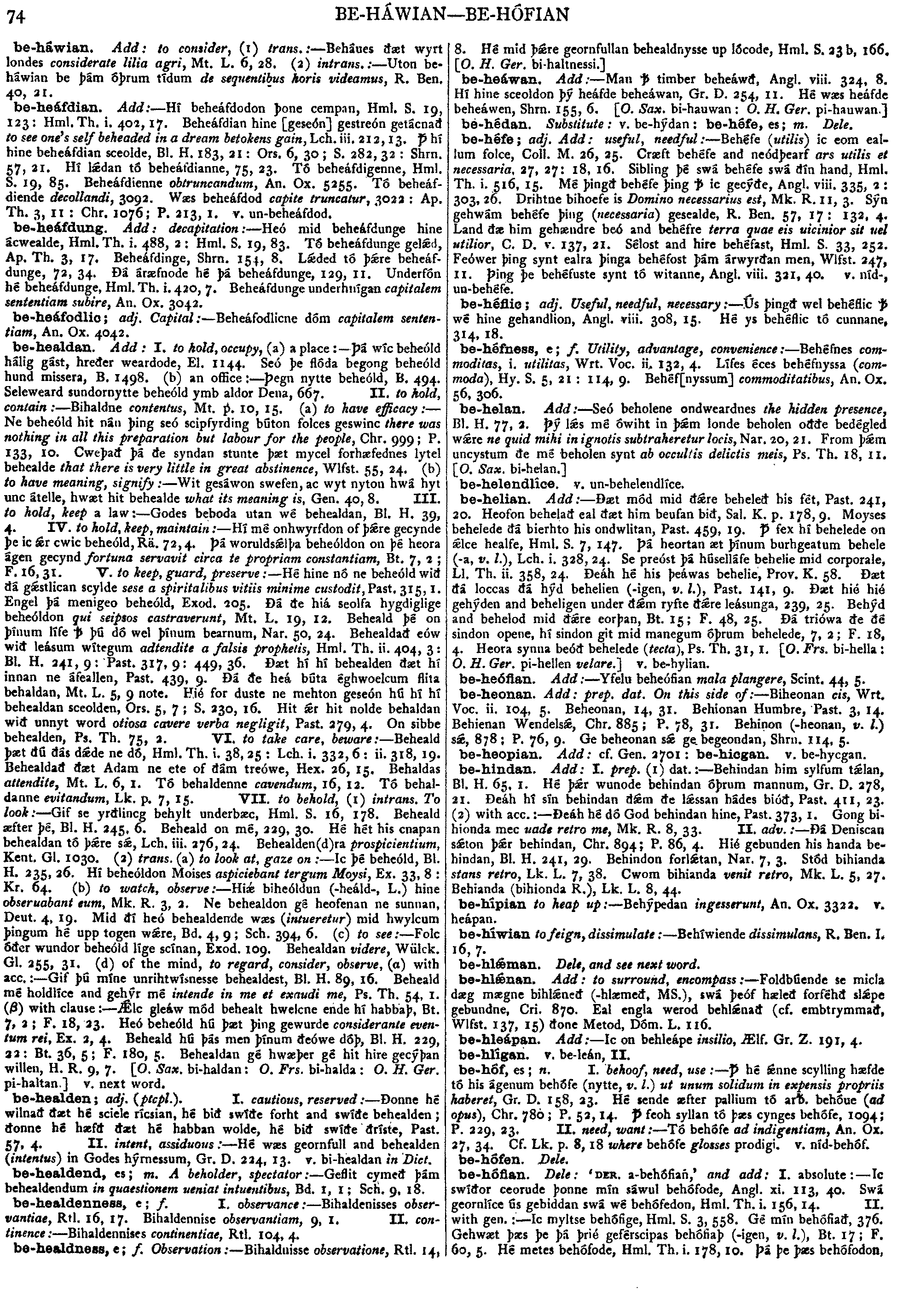
be-healdan.
Add:
I.
to
hold,
occupy,
(a)
a
place:--Þá
wíc
beheóld
hálig
gást,
hreðer
weardode,
El.
1144.
Seó
þe
flóda
begong
beheóld
hund
missera,
B.
1498.
(b)
an
office:--Þegn
nytte
beheóld,
B.
494.
Seleweard
sundornytte
beheóld
ymb
aldor
Dena,
667.
II.
to
hold,
contain:--Bihaldne
contentus,
Mt.
P.
10,
15.
(a)
to
have
efficacy:--Ne
beheóld
hit
nán
þing
seó
scipfyrding
búton
folces
geswinc
there
was
nothing
in
all
this
preparation
but
labour
for
the
people,
Chr.
999;
P.
133,
10.
Cweþað
þá
ðe
syndan
stunte
þæt
mycel
forhæfednes
lytel
behealde
that
there
is
very
little
in
great
abstinence,
Wlfst.
55,
24.
(b)
to
have
meaning,
signify:--Wit
gesáwon
swefen,
ac
wyt
nyton
hwá
hyt
unc
átelle,
hwæt
hit
behealde
what
its
meaning
is.
Gen.
40,
8.
III.
to
hold,
keep
a
law:--Godes
beboda
utan
wé
behealdan,
Bl.
H.
39,
4.
IV.
to
hold,
keep,
maintain:--Hí
mé
onhwyrfdon
of
þre
gecynde
þe
ic
r
cwic
beheóld,
Rä.
72,
4.
Þá
woruldslþa
beheóldon
on
þé
heora
ágen
gecynd
fortuna
servavit
circa
te
propriam
constantiam,
Bt.
7,
2;
F.
16,
31.
V.
to
keep,
guard,
preserve:--Hé
hine
nó
ne
beheóld
wið
ðá
gstlican
scylde
sese
a
spiritalibus
vitiis
minime
custodit,
Past.
315,
1.
Engel
þá
menigeo
beheóld,
Exod.
205.
Ðá
ðe
hiá
seolfa
hygdiglige
beheóldon
qui
seipsos
castraverunt,
Mt.
L.
19,
12.
Beheald
þé
on
þínum
lífe
þú
dó
wel
þínum
bearnum,
Nar.
50,
24.
Behealdað
eów
wið
leásum
wítegum
adtendite
a
falsis
prophetis,
Hml.
Th.
ii.
404,
3:
Bl.
H.
241,
9:
Past.
317,
9:
449,
36.
Ðæt
hí
hí
behealden
ðæt
hí
innan
ne
áfeallen,
Past.
439,
9.
Ðá
ðe
heá
búta
éghwoelcum
flita
behaldan,
Mt.
L.
5,
9
note.
Hié
for
duste
ne
mehton
geseón
hú
hí
hí
behealdan
sceolden,
Ors.
5,
7;
S.
230,
16.
Hit
r
hit
nolde
behaldan
wið
unnyt
word
otiosa
covere
verba
negligit,
Past.
279,
4.
On
sibbe
behealden,
Ps.
Th.
75,
2.
VI.
to
take
care,
beware:--Beheald
þæt
ðú
ðás
dde
ne
dó,
Hml.
Th.
i.
38,
25:
Lch.
i.
332,
6:
ii.
318,
19.
Behealdað
ðæt
Adam
ne
ete
of
ðám
treówe,
Hex.
26,
15.
Behaldas
attendite,
Mt.
L.
6,
I.
Tó
behaldenne
cavendum,
16,
12.
Tó
behal-danne
evitandum,
Lk.
p.
7,
15.
VII.
to
behold,
(I)
intrans.
To
look:--Gif
se
yrðlincg
behylt
underbæc,
Hml.
S.
16,
178.
Beheald
æfter
þé,
Bl.
H.
245,
6.
Beheald
on
mé,
229,
30.
Hé
hét
his
cnapan
behealdan
tó
þre
s,
Lch.
iii.
.
276,
24.
Behealden(d)ra
prospicientium,
Kent.
Gl.
1030.
(2)
trans,
(a)
to
look
at,
gaze
on:--Ic
þé
beheóld,
Bl.
H.
235,
26.
Hí
beheóldon
Moises
aspiciebant
tergum
Moysi,
Ex.
33,
8:
Kr.
64.
(b)
to
watch,
observe:--Hi
biheóldun
(-heáld-.
L.)
hine
obseruabant
eum.
Mk.
R.
3,
2.
Ne
behealdon
gé
heofenan
ne
sunnan,
Deut.
4,
19.
Mid
ðí
heó
behealdende
wæs
(intueretur)
mid
hwylcum
þingum
hé
upp
togen
wre,
Bd.
4,
9;
Sch.
394,
6.
(c)
to
see:--Folc
óðer
wundor
beheóld
líge
scínan,
Exod.
109.
Behealdan
videre,
Wülck.
Gl.
255,
31.
(d)
of
the
mind,
to
regard,
consider,
observe,
(a)
with
acc.:--
Gif
þú
míne
unrihtwísnesse
behealdest,
Bl.
H.
89,
16.
Beheald
mé
holdlíce
and
gehýr
mé
intende
in
me
et
exaudi
me,
Ps.
Th.
54,
l.
( )
with
clause:--Æ-acute;lc
gleáw
mód
behealt
hwelcne
ende
hí
habbaþ,
Bt.
7,
2;
F.
18,
23.
Heó
beheóld
hú
þæt
þing
gewurde
considerante
even-tum
rei,
Ex.
2,
4.
Beheald
hú
þás
men
þínum
ðeówe
dóþ,
Bl.
H.
229,
22:
Bt.
36,
5;
F.
180,
5.
Behealdan
gé
hwæþer
gé
hit
hire
gecýþan
willen,
H.
R.
9,
7.
[O.
Sax,
bi-haldan:
O.
Frs.
bi-halda:
O.
H.
Ger.
pi-haltan.]
v.
next
word.
)
with
clause:--Æ-acute;lc
gleáw
mód
behealt
hwelcne
ende
hí
habbaþ,
Bt.
7,
2;
F.
18,
23.
Heó
beheóld
hú
þæt
þing
gewurde
considerante
even-tum
rei,
Ex.
2,
4.
Beheald
hú
þás
men
þínum
ðeówe
dóþ,
Bl.
H.
229,
22:
Bt.
36,
5;
F.
180,
5.
Behealdan
gé
hwæþer
gé
hit
hire
gecýþan
willen,
H.
R.
9,
7.
[O.
Sax,
bi-haldan:
O.
Frs.
bi-halda:
O.
H.
Ger.
pi-haltan.]
v.
next
word.
|
Source: Bosworth/Toller, page d0170, entry 19 View original page image as: [TIFF] [PNG] [View previous entry] [View next entry] |
[Comment on this entry] [View comments] |
The following entry has been hand-corrected once. |
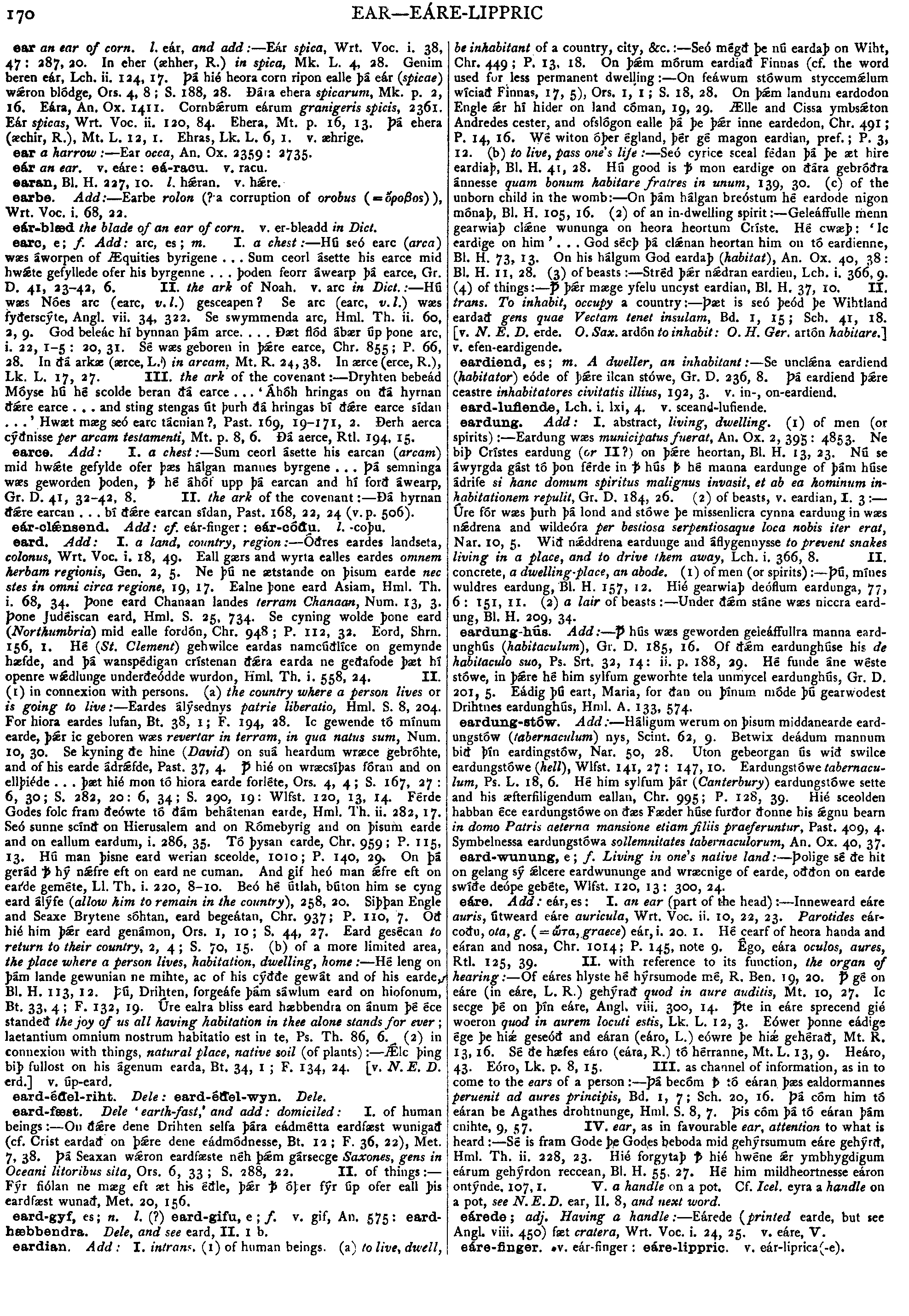
eardung-stów.
Add:--Háligum
werum
on
þisum
middanearde
eardungstów
(tabernaculum)
nys,
Scint.
62,
9.
Betwix
deádum
mannum
bið
þín
eardingstów,
Nar.
50,
28.
Uton
gebeorgan
ús
wið
swilce
eardungstówe
(hell),
Wlfst.
141,
27:
147,
10.
Eardungstówe
tabernaculum,
Ps.
L.
18,
6.
Hé
him
sylfum
þár
(Canterbury)
eardungstówe
sette
and
his
æfterfiligendum
eallan,
Chr.
995;
P.
128,
39.
Hié
sceolden
habban
éce
eardungstówe
on
ðæs
Fæder
húse
furðor
ðonne
his
gnu
bearn
in
domo
Patris
aeterna
mansione
etiam
filiis
praeferuntur,
Past.
409,
4.
Symbelnessa
eardungstówa
sollemnitates
tabernaculorum,
An.
Ox.
40,
37.
|
Source: Bosworth/Toller, page d0189, entry 1 View original page image as: [TIFF] [PNG] [View previous entry] [View next entry] |
[Comment on this entry] [View comments] |
The following entry has been hand-corrected once. |
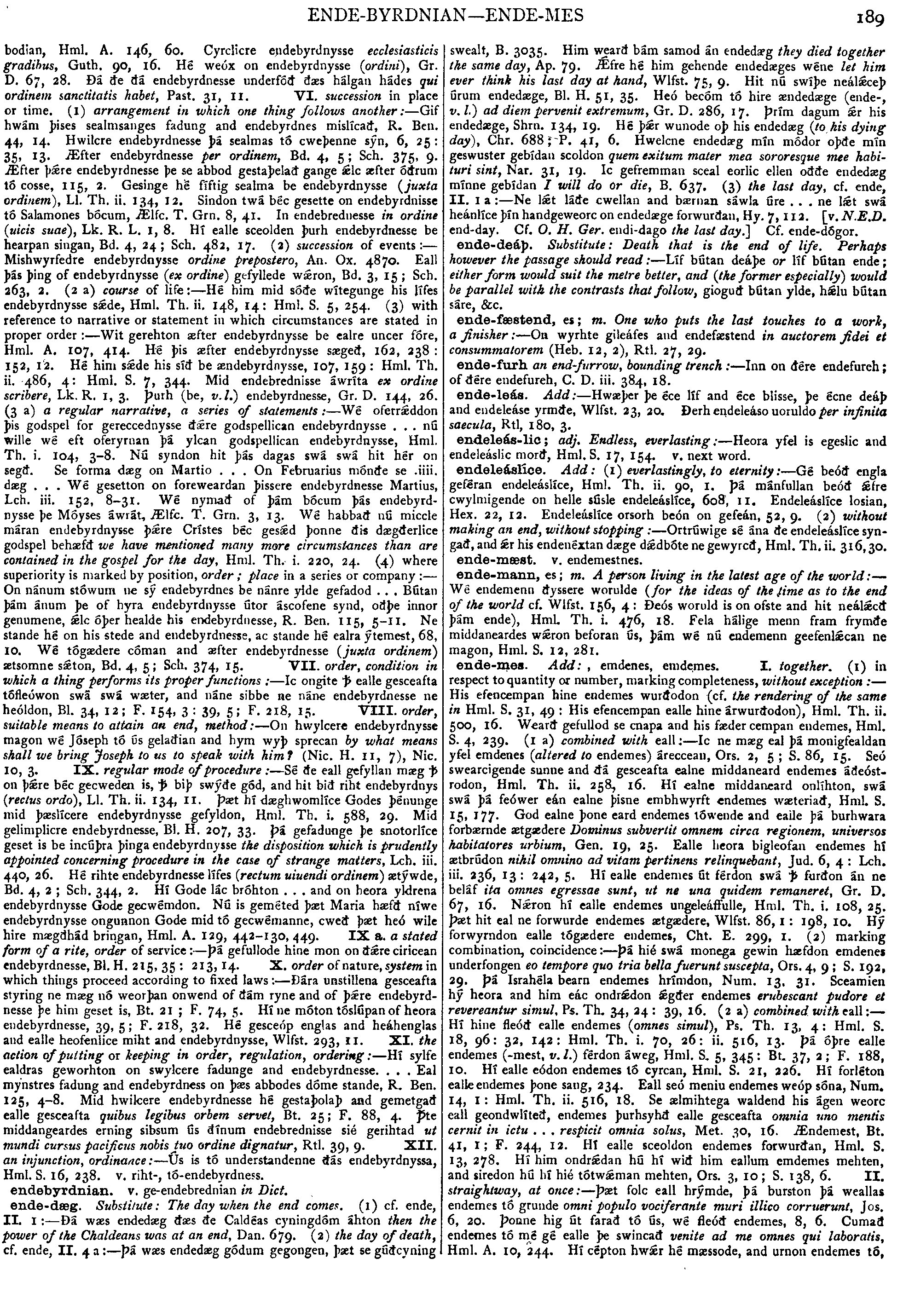
bodian,
Hml.
A.
146,
60.
Cyrclicre
endebyrdnysse
ecclesiasticis
gradibus,
Guth.
90,
16.
Hé
weóx
on
endebyrdnysse
(ordini),
Gr.
D.
67,
28.
Ðá
ðe
ðá
endebyrdnesse
underfóð
ðæs
hálgan
hádes
qui
ordinem
sanctitatis
habet,
Past.
31,
11.
VI.
succession
in
place
or
time.
(1)
arrangement
in
which
one
thing
follows
another
:--
Gif
hwám
þises
sealmsanges
fadung
and
endebyrdnes
mislícað,
R.
Ben.
44,
14.
Hwilcre
endebyrdnesse
þá
sealmas
tó
cweþenne
sýn,
6,
25
:
35,
13.
Æfter
endebyrdnesse
per
ordinem,
Bd.
4,
5;
Sch.
375,
9.
Æfter
þre
endebyrdnesse
þe
se
abbod
gestaþelað
gange
sélc
æfter
óðrum
tó
cosse,
115,
2.
Gesinge
hé
fiftig
sealma
be
endebyrdnysse
(juxta
ordinem),
Ll.
Th.
ii.
134,
12.
Sindon
twá
béc
gesette
on
endebyrdnisse
tó
Salamones
bócum,
Ælfc.
T.
Grn.
8,
41.
In
endebrednesse
in
ordine
(uicis
suae),
Lk.
R.
L.
1,
8.
Hí
ealle
sceolden
þurh
endebyrdnesse
be
hearpan
singan,
Bd.
4,
24
;
Sch.
482,
17.
(2)
succession
of
events
:--
Mishwyrfedre
endebyrdnysse
ordine
prepostero,
An.
Ox.
4870.
Eall
þás
þing
of
endebyrdnysse
(ex
ordine)
gefyllede
wron,
Bd.
3,
15
;
Sch.
263,
2.
(2
a)
course
of
life
:--
Hé
him
mid
sóðe
wítegunge
his
lífes
endebyrdnysse
sde,
Hml.
Th.
ii.
148,
14:
Hml.
S.
5,
254.
(3)
with
reference
to
narrative
or
statement
in
which
circumstances
are
stated
in
proper
order
:--
Wit
gerehton
æfter
endebyrdnysse
be
ealre
uncer
fóre,
Hml.
A.
107,
414.
Hé
þis
æfter
endebyrdnysse
sægeð,
162,
238
:
152,
12.
Hé
him
sde
his
síð
be
ændebyrdnysse,
107,
159:
Hml.
Th.
ii.
486,
4:
Hml.
S.
7,
344.
Mid
endebrednisse
áwríta
ex
ordine
scribere,
Lk.
R.
1,
3.
Þurh
(be,
v.
l.)
endebyrdnesse,
Gr.
D.
144,
26.
(3
a)
a
regular
narrative,
a
series
of
statements
:--
Wé
oferrddon
þis
godspel
for
gereccednysse
ðre
godspellican
endebyrdnysse
.
.
.
nú
wille
wé
eft
oferyrnan
þá
ylcan
godspellican
endebyrdnysse,
Hml.
Th.
i.
104,
3-8.
Nú
syndon
hit
þás
dagas
swá
swá
hit
hér
on
segð.
Se
forma
dæg
on
Martio
.
.
.
On
Februaruis
mónðe
se
.iiii.
dæg
.
.
.
Wé
gesetton
on
foreweardan
þissere
endebyrdnesse
Martius,
Lch.
iii.
152,
8-31.
Wé
nymað
of
þám
bócum
þás
endebyrdnysse
þe
Móyses
áwrát,
Ælfc.
T.
Grn.
3,
13.
Wé
habbað
nú
miccle
máran
endebyrdnysse
þre
Crístes
béc
gesd
þonne
ðis
dægðerlice
godspel
behæfð
we
have
mentioned
many
more
circumstances
than
are
contained
in
the
gospel
for
the
day,
Hml.
Th.
i.
220,
24.
(4)
where
superiority
is
marked
by
position,
order;
place
in
a
series
or
company
:--
On
nánum
stówum
ne
sý
endebyrdnes
be
nánre
ylde
gefadod
.
.
.
Bútan
þám
ánum
þe
of
hyra
endebyrdnysse
útor
áscofene
synd,
oðþe
innor
genumene,
lc
óþer
healde
his
endebyrdnesse,
R.
Ben.
115,
5-11.
Ne
stande
hé
on
his
stede
and
endebyrdnesse,
ac
stande
hé
ealra
ýtemest,
68,
10.
Wé
tógædere
cóman
and
æfter
endebyrdnesse
(juxta
ordinem)
ætsomne
ston,
Bd.
4,
5;
Sch.
374,
15.
VII.
order,
condition
in
which
a
thing
performs
its
proper
functions
:--
Ic
ongite
ealle
gesceafta
tófleówon
swá
swá
wæter,
and
náne
sibbe
ne
náne
endebyrdnesse
ne
heóldon,
Bl.
34,
12;
F.
154,
3
:
39,
5;
F.
218,
15.
VIII.
order,
suitable
means
to
attain
an
end,
method
:--
On
hwylcere
endebyrdnysse
magon
wé
Jóseph
tó
ús
gelaðian
and
hym
wyþ
sprecan
by
what
means
shall
we
bring
Joseph
to
us
to
speak
with
him?
(Nic.
H.
11,
7),
Nic.
10,
3.
IX.
regular
mode
of
procedure
:--
Sé
ðe
eall
gefyllan
mæg
on
þre
béc
gecweden
is,
biþ
swýðe
gód,
and
hit
bið
riht
endebyrdnys
(rectus
ordo),
Ll.
Th.
ii.
134,
11.
Þæt
hí
dæghwomlíce
Godes
þénunge
mid
þæslícere
endebyrdnysse
gefyldon,
Hml.
Th.
i.
588,
29.
Mid
gelimplicre
endebyrdnesse,
Bl.
H.
207,
33.
Þá
gefadunge
þe
snotorlíce
geset
is
be
incúþra
þinga
endebyrdnysse
the
disposition
which
is
prudently
appointed
concerning
procedure
in
the
case
of
strange
matters,
Lch.
iii.
440,
26.
Hé
rihte
endebyrdnesse
lífes
(rectum
uiuendi
ordinem)
ætýwde,
Bd.
4,
2
;
Sch.
344,
2.
Hí
Gode
lác
bróhton
.
.
.
and
on
heora
yldrena
endebyrdnysse
Gode
gecwémdon.
Nú
is
geméted
þæt
Maria
hæfð
níwe
endebyrdnysse
ongunnon
Gode
mid
tó
gecwémanne,
cweð
þæt
heó
wile
hire
mægðhád
bringan,
Hml.
A.
129,
442-130,
449.
IX
a.
a
stated
form
of
a
rite,
order
of
service
:--
Þá
gefullode
hine
mon
on
ðre
ciricean
endebyrdnesse,
Bl.
H.
215,
35
:
213,
14.
X.
order
of
nature,
system
in
which
things
proceed
according
to
fixed
laws
:--
Ðára
unstillena
gesceafta
styring
ne
mæg
nó
weorþan
onwend
of
ðám
ryne
and
of
þre
endebyrdnesse
þe
him
geset
is,
Bt.
21
;
F.
74,
5.
Hí
ne
móton
tóslúpan
of
heora
endebyrdnesse,
39,
5;
F.
218,
32.
Hé
gesceóp
englas
and
heáhenglas
and
ealle
heofenlice
miht
and
endebyrdnysse,
Wlfst.
293,
11.
XI.
the
action
of
putting
or
keeping
in
order,
regulation,
ordering
:--
Hí
sylfe
ealdras
geworhton
on
swylcere
fadunge
and
endebyrdnesse.
.
.
.
Eal
mynstres
fadung
and
endebyrdness
on
þæs
abbodes
dóme
stande,
R.
Ben.
125,
4-8.
Mid
hwilcere
endebyrdnesse
hé
gestaþolaþ
and
gemetgað
ealle
gesceafta
quibus
legibus
orbem
servet,
Bt.
25;
F.
88,
4.
Þ-bar;te
middangeardes
erning
sibsum
ús
ðínum
endebrednisse
sié
gerihtad
ut
mundi
cursus
pacificus
nobis
tuo
ordine
dignatur,
Rtl.
39,
9.
XII.
an
injunction,
ordinance
:--
Ús
is
tó
understandenne
ðás
endebyrdnyssa,
Hml.
S.
16,
238.
v.
riht-,
tó-endebyrdness.
| Result Page: |  |
Previous | 1 2 3 4 | Next |  |
Germanic Lexicon Project (main page)
This search system was written by
Sean Crist
Please consider
volunteering
to correct the data in these online dictionaries.
No rights reserved. Feel free to use these data in any way you please.