|
|

|
Source: Cleasby/Vigfusson, page b0514, entry 35 View original page image as: [TIFF] [PNG] [View previous entry] [View next entry] |
[Comment on this entry] [View comments] |
The following entry has been hand-corrected once. |
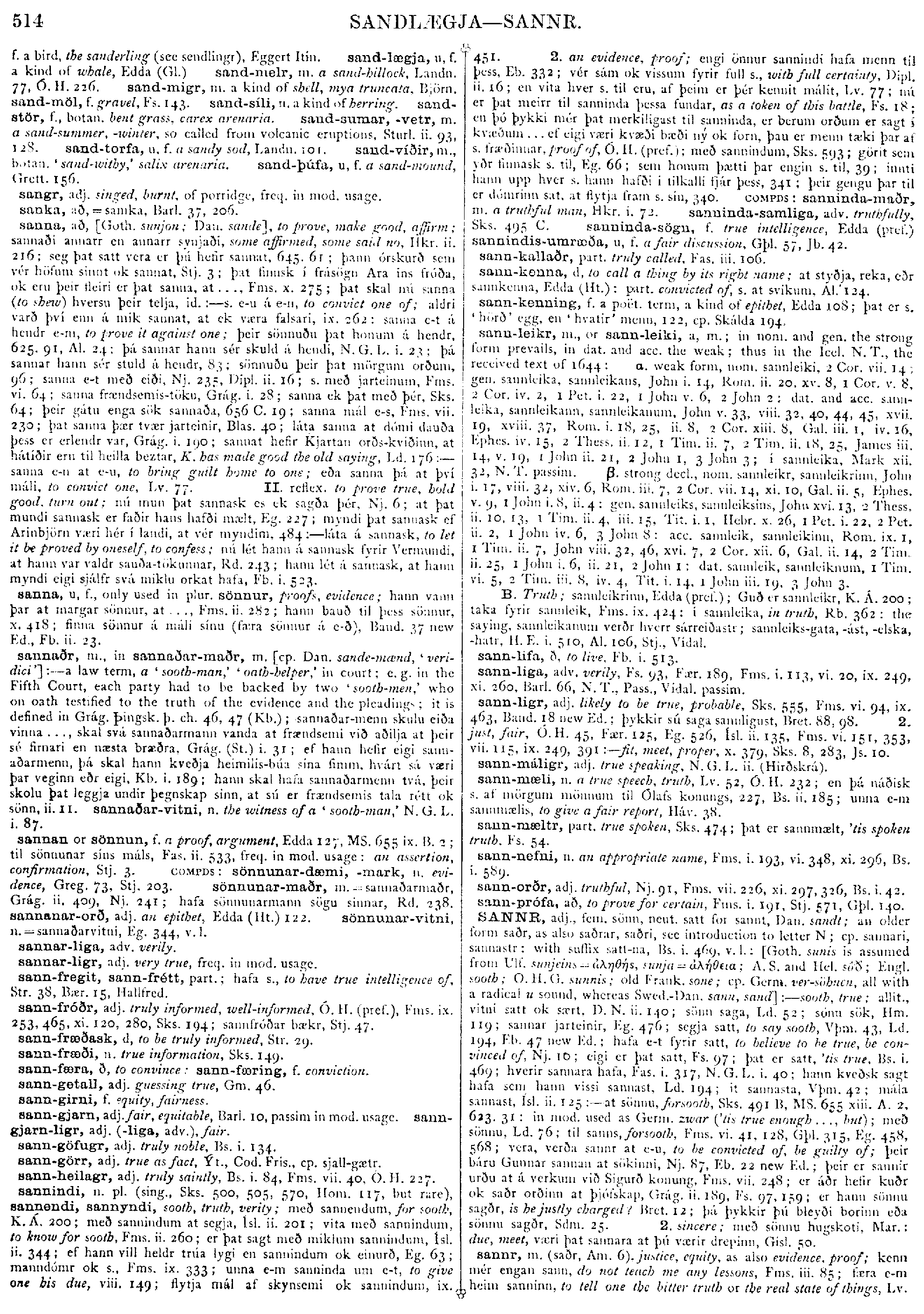
SANNR, adj., fem. sönn, neut. satt for sannt, Dan. sandt; an older form saðr, as also saðrar, saðri, see introduction to letter N; cp. sannari, sannastr: with suffix satt-na, Bs. i. 469, v.l.: [Goth, sunis is assumed from Ulf. sunjeins = GREEK, sunja = GREEK; A.S. and Hel. sôð; Engl.sooth; O.H.G. sunnis; old Frank, sone; cp. Germ. ver-söhnen, all with a radical u sound, whereas Swed. -Dan. sann, sand] :-- sooth, true; allit., vitni salt ok sært, D.N. ii. 140; sönn saga, Ld. 52; sönn sök, Hm. 119; sannar jarteinir, Eg. 476; segja satt, to say sooth, Vþm. 43, Ld. 194, Eb. 47 new Ed.; hafa e-t fyrir satt, to believe to be true, be convinced of, Nj. 10; eigi er þat satt, Fs. 97; þat er satt, 'tis true, Bs. i. 469; hverir sannara hafa, Fas. i. 317, N.G.L. i. 40; hann kveðsk sagt hafa sem hann vissi sannast, Ld. 194; it sannasta, Vþm. 42; mála sannast, Ísl. ii. 125 :-- at sönnu. forsooth, Sks. 491 B, MS. 655 xiii. A. 2, 633. 31: in mod. used as Germ. zwar ('tis true enough ..., but); með sönnu, Ld. 76; til sanns. forsooth, Fms. vi. 41, 128, Gþl. 315, Eg. 458, 568; vera, verða sannr at e-n, to be convicted of, be guilty of; þeir báru Gunnar sannan at sökinni, Nj. 87, Eb. 22 new Ed.; þeir er sannir urðu at á verkum við Sigurð konung, Fms. vii. 248; er áðr hefir kuðr ok saðr orðinn at þjófskap, Grág. ii. 189, Fs. 97, 159; er hann sönnu sagðr, is he justly charged? Bret. 12; þá þykkir þú bleyði borinn eða sönnu sagðr, Sdm. 25. 2. sincere; með sönnu hugskoti, Mar.: due, meet, væri þat sannara at þú værir drepinn, Gísl. 50.
|
Source: Cleasby/Vigfusson, page b0514, entry 36 View original page image as: [TIFF] [PNG] [View previous entry] [View next entry] |
[Comment on this entry] [View comments] |
The following entry has been hand-corrected once. |
sannr, m. (saðr, Am. 6). justice, equity, as also evidence, proof; kenn mér engan sann, do not teach me any lessons, Fms. iii. 85; færa e-m heim sanninn, to tell one the bitter truth or the real state of things, Lv.
|
Source: Cleasby/Vigfusson, page b0778, entry 22 View original page image as: [TIFF] [PNG] [View previous entry] [View next entry] |
[Comment on this entry] [View comments] |
The following entry has been hand-corrected once. |
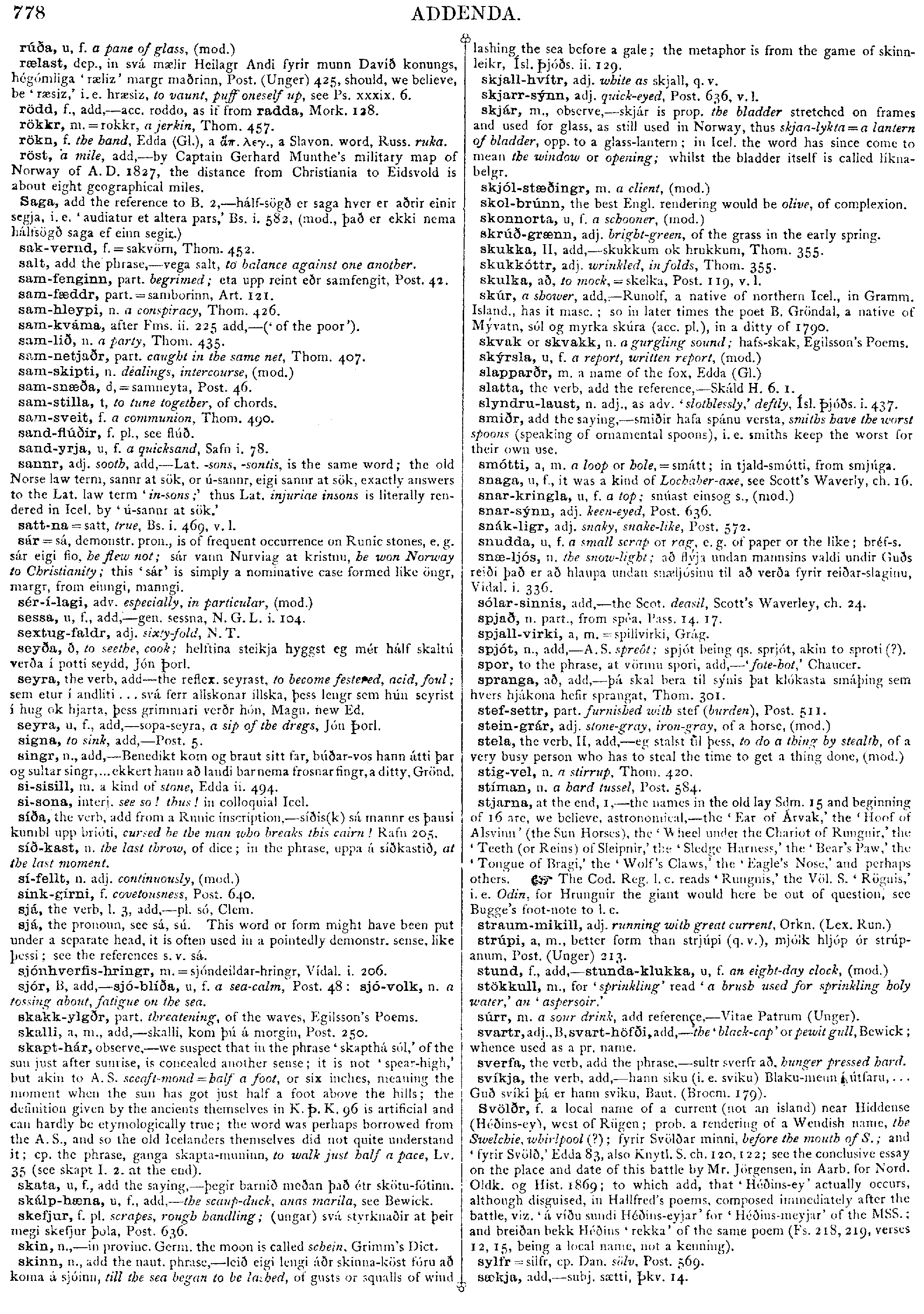
sannr, adj. sooth, add, -- Lat. -sons, -sontis, is the same word; the old Norse law term, sannr at sök, or ú-sannr, eigi sannr at sök, exactly answers to the Lat. law term 'in-sons'; thus Lat. injuriae insons is literally rendered in Icel. by 'ú-sannr at sök.'
|
Source: Torp, page b0430, entry 1 View original page image as: [TIFF] [PNG] [View previous entry] [View next entry] |
[Comment on this entry] [View comments] |
The following entry has been hand-corrected once. |

sanþa
wahr,
schuldig,
subst.
des
Wahre,
Rechte.
an.
sannr,
sa r
wahr,
recht,
billig,
sannr
(at
s
r
wahr,
recht,
billig,
sannr
(at
s k)
schuldig,
sannr
m.
das
Wahre,
Rechte,
das
gute
Recht;
as.
sôth
wahr,
n.
Wahrheit,
te
sôe,
te
sôon
in
Wahrheit,
ags.
sôþ
wahr,
subst.
n.
das
Wahre,
Wahrheit,
Recht,
Gerechtigkeit
(engl.
for
sooth).
Devon
germ.
sanþôn
:
an.
sanna
aa
versichern,
bestätigen;
ags.
sôþian
beweisen;
und
germ.
senþian
(sendian)
:
an.
senna
aussprechen,
disputieren,
subst.
senna
Aussage,
Wortstreit,
afries.
san
Wortstreit,
sannia
streiten.
Hiermit
zu
vergleichen
lat.
sons
(vgl.
an.
sannr
at
sk
schuldig)
sontica
causa,
triftiger
Entschuldigungsgrund.
k)
schuldig,
sannr
m.
das
Wahre,
Rechte,
das
gute
Recht;
as.
sôth
wahr,
n.
Wahrheit,
te
sôe,
te
sôon
in
Wahrheit,
ags.
sôþ
wahr,
subst.
n.
das
Wahre,
Wahrheit,
Recht,
Gerechtigkeit
(engl.
for
sooth).
Devon
germ.
sanþôn
:
an.
sanna
aa
versichern,
bestätigen;
ags.
sôþian
beweisen;
und
germ.
senþian
(sendian)
:
an.
senna
aussprechen,
disputieren,
subst.
senna
Aussage,
Wortstreit,
afries.
san
Wortstreit,
sannia
streiten.
Hiermit
zu
vergleichen
lat.
sons
(vgl.
an.
sannr
at
sk
schuldig)
sontica
causa,
triftiger
Entschuldigungsgrund.
[Translate the German words]
|
Source: Torp, page b0444, entry 1 View original page image as: [TIFF] [PNG] [View previous entry] [View next entry] |
[Comment on this entry] [View comments] |
The following entry has been hand-corrected once. |

sundiô
f.
Sünde.
as.
sundea
f.
Übeltat,
Sünde,
afries.
sinne
Verbrechen,
sonde,
sende
Sünde,
ags.
synn
f.
Verbrechen,
Unrecht,
Feindlichkeit
(engl.
sin);
ahd.
suntea,
sunta,
sundea,
sunda,
mhd.
sünde,
md.
sunde
f.,
nhd.
Sünde,
mhd.
sünde
adj.
sündlich.
Grundform
nom.
sundî
gen.
sun(d)jôz.
An.
syn
f.
Sünde
entweder
aus
*sunidi
oder
*sunjiþô
(?).
Entweder
zu
sanþa
zu
stellen
(vgl.
an.
sannr
schuldig),
lat.
sons,
oder
zu
einer
Wz.
sen
vollenden,
vollbringen,
wozu
gr.
[au)qe'nths]
Gewalthaber,
Mörder,
mit
eigener
Hand
vollbringend.
[Translate the German words]
|
Source: Bosworth/Toller, page b0897, entry 1 View original page image as: [TIFF] [PNG] [View previous entry] [View next entry] |
[Comment on this entry] [View comments] |
The following entry has been hand-corrected once. |
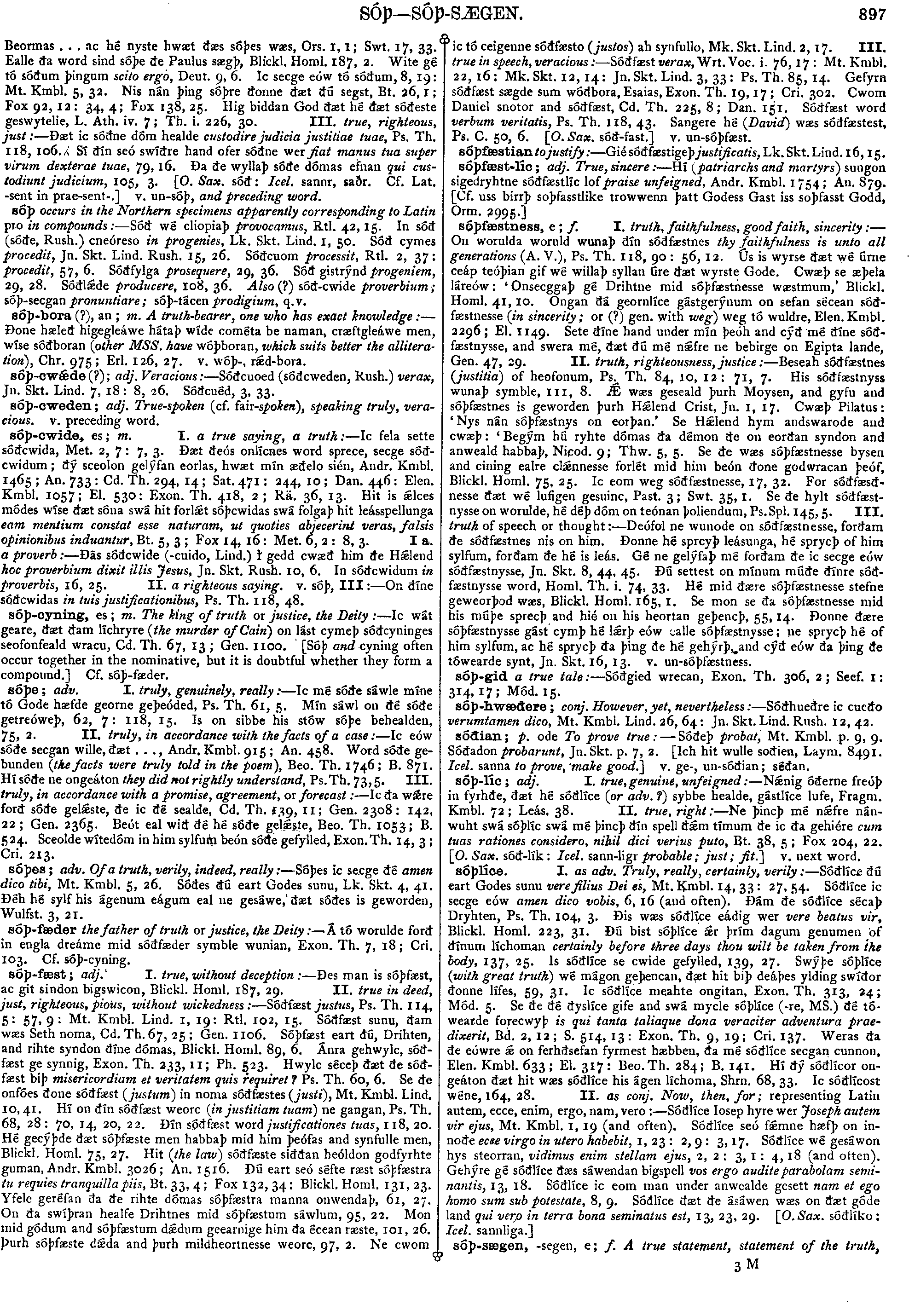
Beormas . . . ac hé nyste hwæt ðæs sóþes wæs, Ors. 1, 1; Swt. 17, 33. Ealle ða word sind sóþe ðe Paulus sægþ, Blickl. Homl. 187, 2. Wite gé tó sóðum þingum scito ergo, Deut. 9, 6. Ic secge eów tó sóðum, 8, 19: Mt. Kmbl. 5, 32. Nis nán þing sóþre ðonne ðæt ðú segst, Bt. 26, 1; Fox 92, 12: 34, 4; Fox 138, 25. Hig biddan God ðæt hé ðæt sóðeste geswytelie, L. Ath. iv. 7; Th. i. 226, 30. III. true, righteous, just:--Ðæt ic sóðne dóm healde custodire judicia justitiae tuae, Ps. Th. 118, 106. Sí ðín seó swíðre hand ofer sóðne wer fiat manus tua super virum dexterae tuae, 79, 16. Ða ðe wyllaþ sóðe dómas efnan qui custodiunt judicium, 105, 3. [O. Sax. sóð: Icel. sannr, saðr. Cf. Lat. -sent in prae-sent.] v. un-sóþ, and preceding word.
|
Source: Cleasby/Vigfusson, page b0041, entry 115 View original page image as: [TIFF] [PNG] [View previous entry] [View next entry] |
[Comment on this entry] [View comments] |
The following entry has been hand-corrected once. |
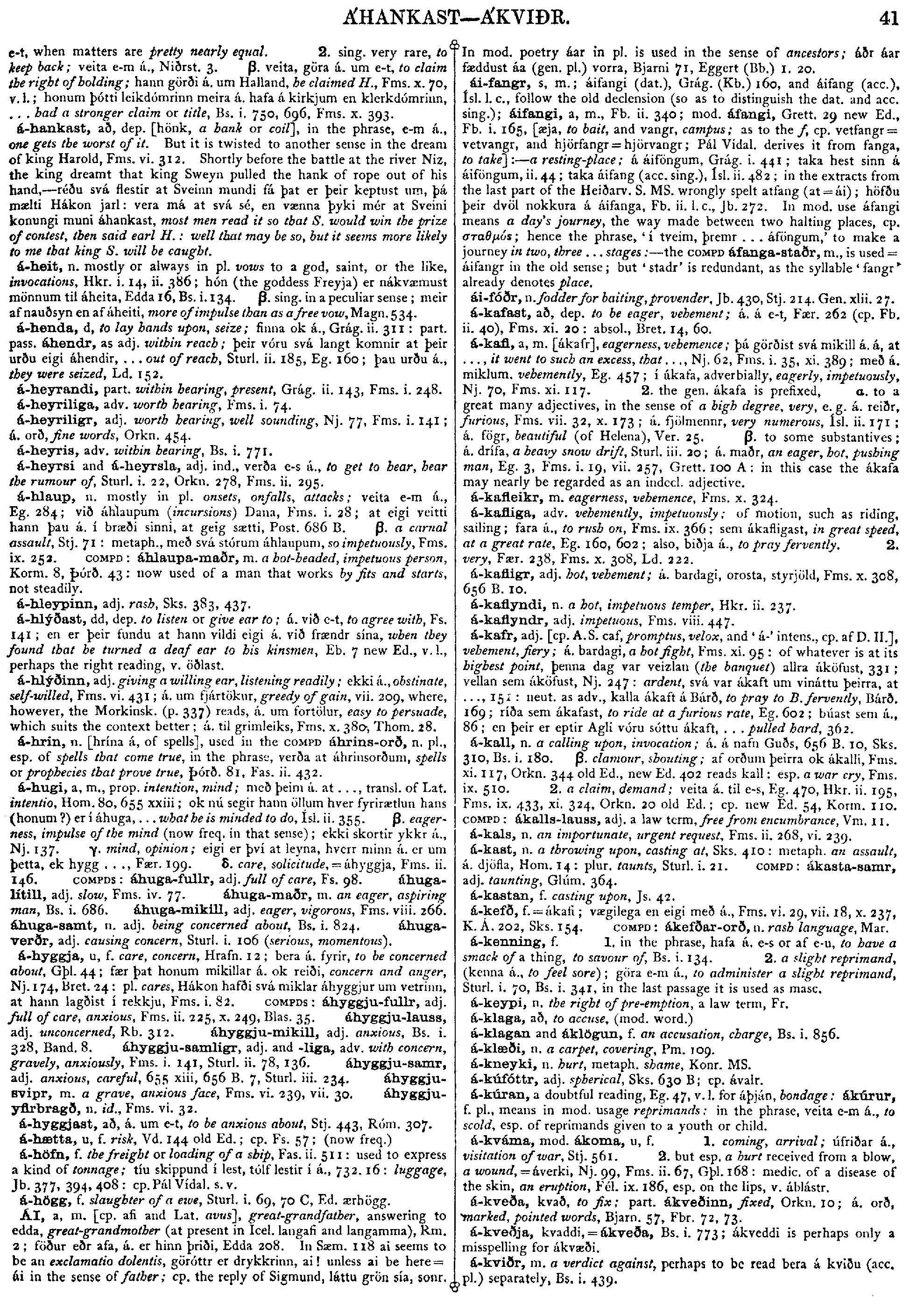
ÁN, prep. [Goth, inuh; Hel. and O. H. G. ano; Germ, ohne; Gr. GREEK] , without: the oldest form in MSS. is ón, Eluc. 25, Greg. Dial, (freq.), 655 xxvii. 2, Fms. xi. in, 153; aon, Hom. 19 sqq.; the common form is án; with gen. dat. and acc.; at present only with gen. I. with gen., þess máttu Gautar ilia án vera, Hkr. ii. 70. Ó. H. 49 has 'þat;' án manna valda, Fms. iii. 98; á. allra afarkosta, x. 7; mættim vér vel þess án vera, Ísl. ii. 339; in the proverb, án er ills gengis nema heiman hafi, Gísl. 63, but án er illt gengi (acc.), 149, Nj. 27, Ísl. ii. 142, l. c..; án allra klæða, Al. 171; án allrar vægðar, Sks. 229; ón lasta synda, Eluc. 25. II. with dat., esp. in translations or eccles. Writings, perh. in imitation of the Lat., and now quite out of use; esp. In the phrase, án e-s ráði, without (against) one's will, Nj. 38, Bjarn. 71, Korm. 142, Fms. xi. 153, 111; ón góðum verkum, Greg. 13; án úfláti, incessantly, Bs. i. 97; ón dómi, Eluc. 39; sannr ok on gildingi, 655 xxvii. 2. III. with acc., esp. freq. in the Grág., án er illt gengi, v. above; þá skal hann án vera liðit, Grág. i. 276; án ráð lögráðanda, 334; hann mun þik ekki þykjast mega án vera, Fms. vii. 26; án allan verma, Sks. 210; án alla flærð, 522 B; ón líkamligan breyskleik, ok on dóm, Eluc. 38; án leyfi, without leave, Fms. vii. 141. IV. ellipt. without case, or adverbially, hvatki es betra es at hafa en ón at vera (to be without), 677. 8; þau er mönnum þykir betr at hafa en án at vera, Gþl. 379; eiga vilja heldr en ón vera þat hit mjallhvíta man, Alvm. 7 : acc. with inf., án við löst at lifa, sine culpâ vivere, Hm. 68; used substantively, in the proverb, alls áni (omnium expers) verðr sá er einskis biðr, Sl. 38: Egilsson also, on Hdl. 23, suggests a form án, n.; but the passage (the poem is only left in the Fb.) is no doubt a corrupt one. Probably 'ani ómi' is a corruption from Arngrími (arngmi, the lower part of the g being blotted out: Arngrími | óru bornir | (öflgir ?) synir | ok Eyfuru, or the like).
|
Source: Cleasby/Vigfusson, page b0217, entry 26 View original page image as: [TIFF] [PNG] [View previous entry] [View next entry] |
[Comment on this entry] [View comments] |
The following entry has been hand-corrected once. |
grund-völlr, m. [cp. Goth. grunduvaddjus = GREEK; mid. H. G. gruntwal; Dan. grundvold]: 1. prop. ground marked out for a building, marka grundvöll til húss (kirkju), Ld. 298, Fms. i. 203, Korm. 8, Sks. 110, Orkn. 286, Stj. 134. 2. metaph. ground-plan, Mar. 12; setja grundvöll Kristni sinnar, Hom. 147; tólf postular eru grundvöllr undir várri trú, Mar. 12; er lítillæti sannr grundvöllr undir öllum mannkostum, id.; Kristiliga trú vera grundvöll ok upphaf góðra verka, Gþl. viii. (pref.); þann grundvöll, er upphaf er allrar speki, Sks. 4; af þessum grundvöllum timbrask enar mestu höfuð-úgæfur, 26; orð eðr erendi, er tekin eru af mannvits grundvelli, which are founded on good sense, 438; reisa hús af grundvelli, to raise a building from the ground, Fms. vi. 440. grundvallar-maðr, m. a founder, Anecd. 66.
|
Source: Cleasby/Vigfusson, page b0311, entry 12 View original page image as: [TIFF] [PNG] [View previous entry] [View next entry] |
[Comment on this entry] [View comments] |
The following entry has been hand-corrected once. |
HÖRGR, m., never f., for the form hörg (Landn. 111) is merely an error; [A. S. hearg; O. H. G. haruc] :-- a heathen place of worship. Distinction is to be made between hof (temple) and horg; the hof was a house of timber, whereas the horg was an altar of stone (the hátimbraðr in Vþm. is not literal) erected on high places, or a sacrificial cairn (like haugr), built in open air, and without images, for the horg itself was to be stained with the blood of the sacrifice; hence such phrases as, to 'break' the horgs, but 'burn' the temples. The horg worship reminds one of the worship in high places of the Bible. The notion of a 'high place' still remains in the popular Icel. phrase, það eru ekki uppi nema hæstu hörgar, only the highest horgs jut out, when all lies under a deep snow. In provincial Norse a dome-shaped mountain is called horg (Ivar Aasen). The worship on horgs seems to be older than that in temples, but was in after times retained along with temple worship, and then, it seems, specially reserved for the worship of the goddesses or female guardians (dísir), Hervar. S. ch. 1, Hdl. l.c., Edda l.c., cp. also Hörga-brúðr, f. the bride of the horgs, see Hölgi. Many of the old cairns and hows are no doubt horgs or high places of worship of the heathen age. A third way of worshipping is recorded, viz. a portable booth or tabernacle in which the god was carried through the land, mentioned in Tacit. Germ. ch. 40; traces of this ancient worship were still found in Sweden at the close of heathendom, see the interesting tale of Gunnar Helming in Fms. ii. 73-78. II. references; hörg hann mér görði hlaðinn steinum, nú er grjót þat at gleri orðit, etc., Hdl. 10; hofum ok hörgum, Vþm. 38; þeir er hörg ok hof hátimbruðu, Vsp. 7; hof mun ek kjósa, hörga marga, Hkv. Hjörv. 4; hátimbraðr h., Gm. 16; hamra ok hörga, skóga, vötn ok tré, Fms. v. 239; brjóta ok brenna hof ok hörga, Fms. i. 283, ii. 41; Oddr brenndi hof ok hörga braut, Fas. ii. 288 (in a verse); hauga né hörga, en ef maðr verðr at því kunnr eða sannr, at hann hleðr hauga, eðr gerir hús, ok kallar hörg, eða reisir stöng, N. G. L. i. 430, cp. ii. 496; höfðu frændr hennar síðan mikinn átrúnað á hólana, var þar görr UNCERTAIN hörg(r) er blót tóku til, trúðu þeir at þeir dæi í hólana, Landn. 111; þar vóru áðr blót ok hörgar, Kristni S. ch. 11; eitt haust var gört dísablót mikit hjá Álfi konungi, gékk Álfhildr at blótinu, en um nóttina er hón rauð hörginn ..., Fas. (Hervar. S.) i. 413; þat var hörgr er gyðjurnar áttu, Edda 9, a paraphrase of the passage in the Vsp. l.c.; blóthús ok hörga, Rekst. 2. poët., brúna-hörgr, the 'forehead-horg' or peak = the horns of a steer, Ýt.; gunn-hörgr, a 'war-horg' = a helmet (not a shield), Hkr. i. 135 (in a verse); hörga herr, the host of the horgs = the heathen host, Knytl. S. (in a verse). III. in Icel. local names, but not so freq. as Hof; Hörg-á and Hörgár-dalr, in the north; Hörga-eyrr, in the west; Hörgs-dalr and Hörgs-land, in the east; Hörgs-holt and Hörgs-hlíð, in the west, Landn., Kristni S., map of Icel.; Hörgs-hylr, Dipl., Ísl. Hörg-dælir, m. the men from Hörgárdalr, Sturl. In Norway, Hörg-in, Hörga-setr, Munch's Norg. Beskr.
|
Source: Cleasby/Vigfusson, page b0319, entry 4 View original page image as: [TIFF] [PNG] [View previous entry] [View next entry] |
[Comment on this entry] [View comments] |
The following entry has been hand-corrected once. |
ÍM, n. [no doubt akin to eim in eimyrja, Engl. embers], dust, ashes, embers; hann hreinsar þat skjótt af, þóat nokkut ím hafi á oss dregit af samneyti annarlegs siðferðis, Fms. ii. 261; hann brennir af oss synda ím, Greg. 19, 46; nú tók ím af honum, at hann var sannr propheta, Fms. x. 392.
| Result Page: | 1 2 3 | Next |  |
Germanic Lexicon Project (main page)
This search system was written by
Sean Crist
Please consider
volunteering
to correct the data in these online dictionaries.
No rights reserved. Feel free to use these data in any way you please.