|
|

Tip: In the search results, you can click on any word or abbreviation for more information.
|
Source: Bosworth/Toller, page b1022, entry 2 View original page image as: [TIFF] [PNG] [View previous entry] [View next entry] |
[Comment on this entry] [View comments] |
The following entry has been hand-corrected once. |
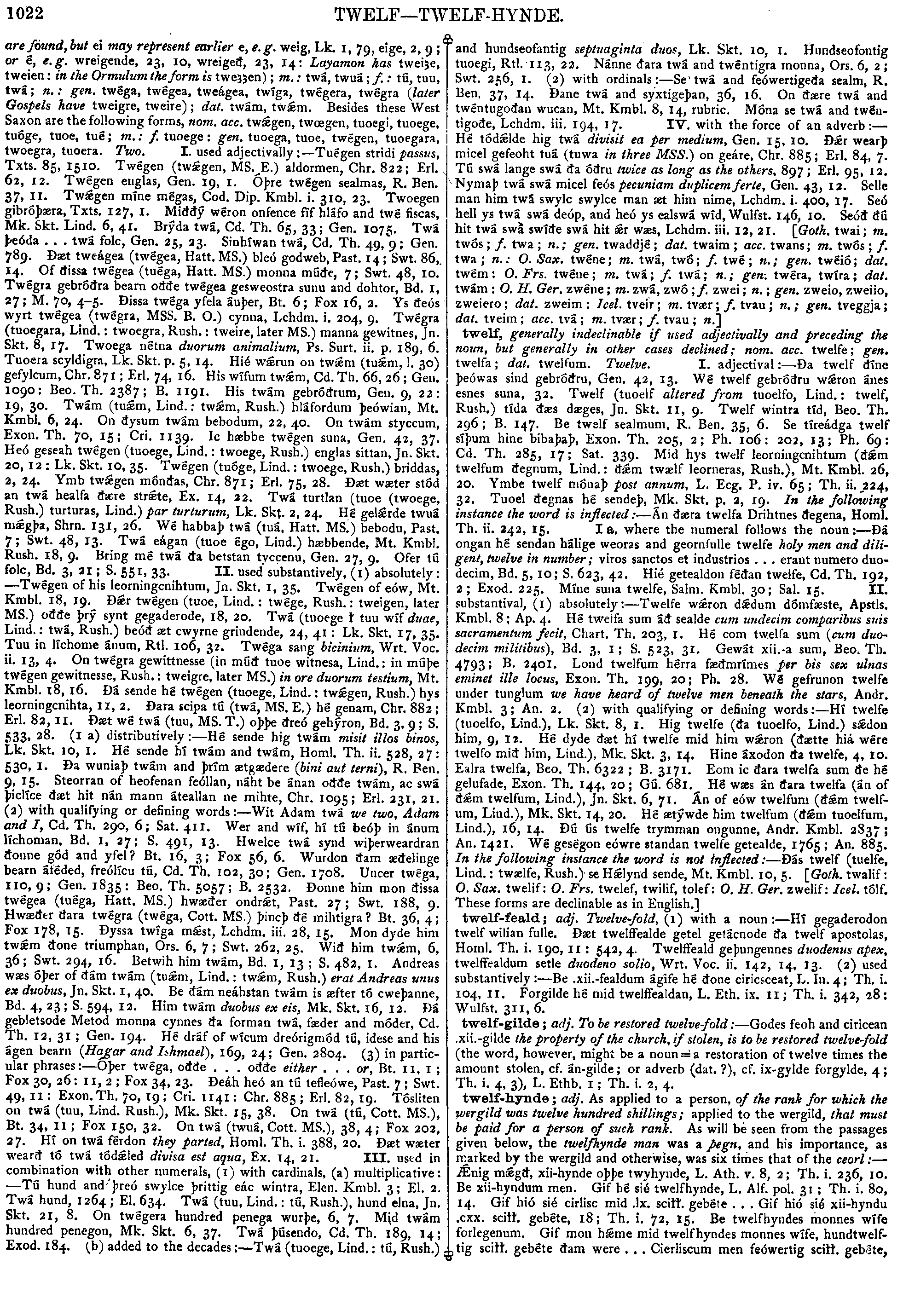
twelf,
generally
indeclinable
if
used
adjectivally
and
preceding
the
noun,
but
generally
in
other
cases
declined;
nom.
acc.
twelfe;
gen.
twelfa;
dat.
twelfum.
Twelve.
I.
adjectival:--Ða
twelf
ðíne
þeówas
sind
gebróðru,
Gen.
42,
13.
Wé
twelf
gebróðru
w ron
ánes
esnes
suna,
32.
Twelf
(tuoelf
altered
from
tuoelfo,
Lind.:
twelf,
Rush.)
tída
ðæs
dæges,
Jn.
Skt.
11,
9.
Twelf
wintra
tíd,
Beo.
Th.
296;
B.
147.
Be
twelf
sealmum,
R.
Ben.
35,
6.
Se
tíreádga
twelf
síþum
hine
bibaþaþ,
Exon.
Th.
205,
2;
Ph.
106:
202,
13;
Ph.
69:
Cd.
Th.
285,
17;
Sat.
339.
Mid
hys
twelf
leorningcnihtum
(ðm
twelfum
ðegnum,
Lind.:
ðm
twælf
leorneras,
Rush.),
Mt.
Kmbl.
26,
20.
Ymbe
twelf
mónaþ
post
annum,
L.
Ecg.
P.
iv.
65;
Th.
ii.
224,
32.
Tuoel
ðegnas
hé
sendeþ,
Mk.
Skt.
p.
2,
19.
In
the
following
instance
the
word
is
inflected:--Án
ðæra
twelfa
Drihtnes
ðegena,
Homl.
Th.
ii.
242,
15.
I
a.
where
the
numeral
follows
the
noun:--Ðá
ongan
hé
sendan
hálige
weoras
and
geornfulle
twelfe
holy
men
and
diligent,
twelve
in
number;
viros
sanctos
et
industrios
.
.
.
erant
numero
duo
ron
ánes
esnes
suna,
32.
Twelf
(tuoelf
altered
from
tuoelfo,
Lind.:
twelf,
Rush.)
tída
ðæs
dæges,
Jn.
Skt.
11,
9.
Twelf
wintra
tíd,
Beo.
Th.
296;
B.
147.
Be
twelf
sealmum,
R.
Ben.
35,
6.
Se
tíreádga
twelf
síþum
hine
bibaþaþ,
Exon.
Th.
205,
2;
Ph.
106:
202,
13;
Ph.
69:
Cd.
Th.
285,
17;
Sat.
339.
Mid
hys
twelf
leorningcnihtum
(ðm
twelfum
ðegnum,
Lind.:
ðm
twælf
leorneras,
Rush.),
Mt.
Kmbl.
26,
20.
Ymbe
twelf
mónaþ
post
annum,
L.
Ecg.
P.
iv.
65;
Th.
ii.
224,
32.
Tuoel
ðegnas
hé
sendeþ,
Mk.
Skt.
p.
2,
19.
In
the
following
instance
the
word
is
inflected:--Án
ðæra
twelfa
Drihtnes
ðegena,
Homl.
Th.
ii.
242,
15.
I
a.
where
the
numeral
follows
the
noun:--Ðá
ongan
hé
sendan
hálige
weoras
and
geornfulle
twelfe
holy
men
and
diligent,
twelve
in
number;
viros
sanctos
et
industrios
.
.
.
erant
numero
duo decim,
Bd.
5,
10;
S.
623,
42.
Hié
getealdon
féðan
twelfe,
Cd.
Th.
192,
2;
Exod.
235.
Míne
suna
twelfe,
Salm.
Kmbl.
30;
Sal.
15.
II.
substantival,
(1)
absolutely:--Twelfe
wron
ddum
dómfæste,
Apstls.
Kmbl.
8;
Ap.
4.
Hé
twelfa
sum
áð
sealde
cum
undecim
comparibus
suis
sacramentum
fecit,
Chart.
Th.
203,
1.
Hé
com
twelfa
sum
(cum
duodecim
militibus),
Bd.
3,
1;
S.
523,
31.
Gewát
xii.-a
sum,
Beo.
Th.
4793;
B.
2401.
Lond
twelfum
hérra
fæðmrímes
per
bis
sex
ulnas
eminet
ille
locus,
Exon.
Th.
199,
20;
Ph.
28.
Wé
gefrunon
twelfe
under
tunglum
we
have
heard
of
twelve
men
beneath
the
stars,
Andr.
Kmbl.
3;
An.
2.
(2)
with
qualifying
or
defining
words:--Hí
twelfe
(tuoelfo,
Lind.),
Lk.
Skt.
8,
1.
Hig
twelfe
(ða
tuoelfo,
Lind.)
sdon
him,
9,
12.
Hé
dyde
ðæt
hí
twelfe
mid
him
wron
(ðætte
hiá
wére
twelfo
mið
him,
Lind.),
Mk.
Skt.
3,
14.
Hine
áxodon
ða
twelfe,
4,
10.
Ealra
twelfa,
Beo.
Th.
6322;
B.
3171.
Eom
ic
ðara
twelfa
sum
ðe
hé
gelufade,
Exon.
Th.
144,
20;
Gú.
681.
Hé
wæs
án
ðara
twelfa
(án
of
ðm
twelfum,
Lind.),
Jn.
Skt.
6,
71.
Án
of
eów
twelfum
(ðm
twelfum,
Lind.),
Mk.
Skt.
14,
20.
Hé
ætýwde
him
twelfum
(ðm
tuoelfum,
Lind.),
16,
14.
Ðú
ús
twelfe
trymman
ongunne,
Andr.
Kmbl.
2837;
An.
1421.
Wé
geségon
eówre
standan
twelfe
getealde,
1765;
An.
885.
In
the
following
instance
the
word
is
not
inflected:--Ðás
twelf
(tuelfe,
Lind.:
twælfe,
Rush.)
se
Hlynd
sende,
Mt.
Kmbl.
10,
5.
[Goth.
twalif:
O.
Sax.
twelif:
O.
Frs.
twelef,
twilif,
tolef:
O.
H.
Ger.
zwelif:
Icel.
tólf.
These
forms
are
declinable
as
in
English.]
decim,
Bd.
5,
10;
S.
623,
42.
Hié
getealdon
féðan
twelfe,
Cd.
Th.
192,
2;
Exod.
235.
Míne
suna
twelfe,
Salm.
Kmbl.
30;
Sal.
15.
II.
substantival,
(1)
absolutely:--Twelfe
wron
ddum
dómfæste,
Apstls.
Kmbl.
8;
Ap.
4.
Hé
twelfa
sum
áð
sealde
cum
undecim
comparibus
suis
sacramentum
fecit,
Chart.
Th.
203,
1.
Hé
com
twelfa
sum
(cum
duodecim
militibus),
Bd.
3,
1;
S.
523,
31.
Gewát
xii.-a
sum,
Beo.
Th.
4793;
B.
2401.
Lond
twelfum
hérra
fæðmrímes
per
bis
sex
ulnas
eminet
ille
locus,
Exon.
Th.
199,
20;
Ph.
28.
Wé
gefrunon
twelfe
under
tunglum
we
have
heard
of
twelve
men
beneath
the
stars,
Andr.
Kmbl.
3;
An.
2.
(2)
with
qualifying
or
defining
words:--Hí
twelfe
(tuoelfo,
Lind.),
Lk.
Skt.
8,
1.
Hig
twelfe
(ða
tuoelfo,
Lind.)
sdon
him,
9,
12.
Hé
dyde
ðæt
hí
twelfe
mid
him
wron
(ðætte
hiá
wére
twelfo
mið
him,
Lind.),
Mk.
Skt.
3,
14.
Hine
áxodon
ða
twelfe,
4,
10.
Ealra
twelfa,
Beo.
Th.
6322;
B.
3171.
Eom
ic
ðara
twelfa
sum
ðe
hé
gelufade,
Exon.
Th.
144,
20;
Gú.
681.
Hé
wæs
án
ðara
twelfa
(án
of
ðm
twelfum,
Lind.),
Jn.
Skt.
6,
71.
Án
of
eów
twelfum
(ðm
twelfum,
Lind.),
Mk.
Skt.
14,
20.
Hé
ætýwde
him
twelfum
(ðm
tuoelfum,
Lind.),
16,
14.
Ðú
ús
twelfe
trymman
ongunne,
Andr.
Kmbl.
2837;
An.
1421.
Wé
geségon
eówre
standan
twelfe
getealde,
1765;
An.
885.
In
the
following
instance
the
word
is
not
inflected:--Ðás
twelf
(tuelfe,
Lind.:
twælfe,
Rush.)
se
Hlynd
sende,
Mt.
Kmbl.
10,
5.
[Goth.
twalif:
O.
Sax.
twelif:
O.
Frs.
twelef,
twilif,
tolef:
O.
H.
Ger.
zwelif:
Icel.
tólf.
These
forms
are
declinable
as
in
English.]
|
Source: Bosworth/Toller, page b1205, entry 4 View original page image as: [TIFF] [PNG] [View previous entry] [View next entry] |
[Comment on this entry] [View comments] |
The following entry has been hand-corrected once. |
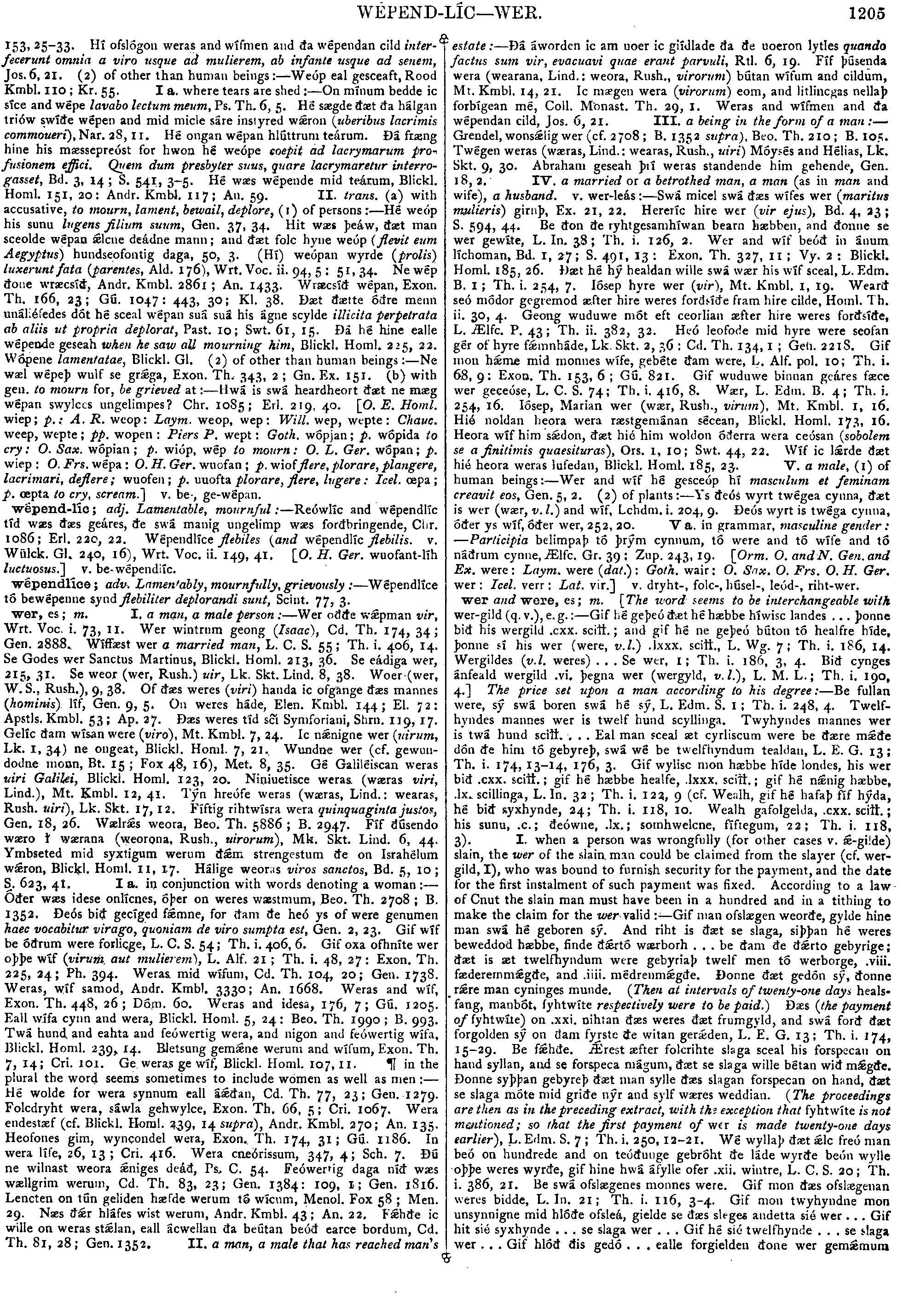
wer,
es;
m.
I.
a
man,
a
male
person:--Wer
oððe
wpman
vir,
Wrt.
Voc.
i.
73,
11.
Wer
wintrum
geong
(Isaac),
Cd.
Th.
174,
34;
Gen.
2888.
Wíffæst
wer
a
married
man,
L.
C.
S.
55;
Th.
i.
406,
14.
Se
Godes
wer
Sanctus
Martinus,
Blickl.
Homl.
213,
36.
Se
eádiga
wer,
215,
31.
Se
weor
(wer,
Rush.)
uir,
Lk.
Skt.
Lind.
8,
38.
Woer
(wer,
W.
S.,
Rush.),
9,
38.
Of
ðæs
weres
(viri)
handa
ic
ofgange
ðæs
mannes
(hominis)
líf,
Gen.
9,
5.
On
weres
háde,
Elen.
Kmbl.
144;
El.
72:
Apstls.
Kmbl.
53;
Ap.
27.
Ðæs
weres
tíd
s i
Symforiani,
Shrn.
119,
17.
Gelíc
ðam
wísan
were
(viro),
Mt.
Kmbl.
7,
24.
Ic
nnigne
wer
(uirum,
Lk.
1,
34)
ne
ongeat,
Blickl.
Homl.
7,
21.
Wundne
wer
(cf.
gewundodne
monn,
Bt.
15;
Fox
48,
16),
Met.
8,
35.
Gé
Galiléiscan
weras
uiri
Galilei,
Blickl.
Homl.
123,
20.
Niniuetisce
weras
(wæras
viri,
Lind.),
Mt.
Kmbl.
12,
41.
Týn
hreófe
weras
(wæras,
Lind.:
wearas,
Rush.
uiri),
Lk.
Skt.
17,
12.
Fíftig
rihtwísra
wera
quinquaginta
justos,
Gen.
18,
26.
Wælrs
weora,
Beo.
Th.
5886;
B.
2947.
Fíf
ðúsendo
wæro
i
Symforiani,
Shrn.
119,
17.
Gelíc
ðam
wísan
were
(viro),
Mt.
Kmbl.
7,
24.
Ic
nnigne
wer
(uirum,
Lk.
1,
34)
ne
ongeat,
Blickl.
Homl.
7,
21.
Wundne
wer
(cf.
gewundodne
monn,
Bt.
15;
Fox
48,
16),
Met.
8,
35.
Gé
Galiléiscan
weras
uiri
Galilei,
Blickl.
Homl.
123,
20.
Niniuetisce
weras
(wæras
viri,
Lind.),
Mt.
Kmbl.
12,
41.
Týn
hreófe
weras
(wæras,
Lind.:
wearas,
Rush.
uiri),
Lk.
Skt.
17,
12.
Fíftig
rihtwísra
wera
quinquaginta
justos,
Gen.
18,
26.
Wælrs
weora,
Beo.
Th.
5886;
B.
2947.
Fíf
ðúsendo
wæro
 wærana
(weorona,
Rush.,
uirorum),
Mk.
Skt.
Lind.
6,
44.
Ymbseted
mid
syxtigum
werum
ðm
strengestum
ðe
on
Israhélum
wron,
Blickl.
Homl.
11,
17.
Hálige
weoras
viros
sanctos,
Bd.
5,
10;
S.
623,
41.
I
a.
in
conjunction
with
words
denoting
a
woman:--Óðer
wæs
idese
onlícines,
óþer
on
weres
wæstmum,
Beo.
Th.
2708;
B.
1352.
Ðeós
bið
gecíged
fmne,
for
ðam
ðe
heó
ys
of
were
genumen
haec
vocabitur
virago,
quoniam
de
viro
sumpta
est,
Gen.
2,
23.
Gif
wíf
be
óðrum
were
forlicge,
L.
C.
S.
54;
Th.
i.
406,
6.
Gif
oxa
ofhníte
wer
oþþe
wíf
(virum
aut
mulierem),
L.
Alf.
21;
Th.
i.
48,
27:
Exon.
Th.
225,
24;
Ph.
394.
Weras
mid
wífum,
Cd.
Th.
104,
20;
Gen.
1738.
Weras,
wíf
samod,
Andr.
Kmbl.
3330;
An.
1668.
Weras
and
wíf,
Exon.
Th.
448,
26;
Dóm.
60.
Weras
and
idesa,
176,
7;
Gú.
1205.
Eall
wífa
cynn
and
wera,
Blickl.
Homl.
5,
24:
Beo.
Th.
1990;
B.
993.
Twá
hund
and
eahta
and
feówertig
wera,
and
nigon
and
feówertig
wífa,
Blickl.
Homl.
239,
14.
Bletsung
gemne
werum
and
wífum,
Exon.
Th.
7,
14;
Cri.
101.
Ge
weras
ge
wíf,
Blickl.
Homl.
107,
11.

in
the
plural
the
word
seems
sometimes
to
include
women
as
well
as
men:--Hé
wolde
for
wera
synnum
eall
áðan,
Cd.
Th.
77,
23;
Gen.
1279.
Folcdryht
wera,
sáwla
gehwylce,
Exon.
Th.
66,
5;
Cri.
1067.
Wera
endestæf
(cf.
Blickl.
Homl.
239,
14
supra),
Andr.
Kmbl.
270;
An.
135.
Heofones
gim,
wyncondel
wera,
Exon.
Th.
174,
31;
Gú.
1186.
In
wera
lífe,
26,
13;
Cri.
416.
Wera
cneórissum,
347,
4;
Sch.
7.
Ðú
ne
wilnast
weora
niges
deáð,
Ps.
C.
54.
Feówertig
daga
níð
wæs
wællgrim
werum,
Cd.
Th.
83,
23;
Gen.
1384:
109,
1;
Gen.
1816.
Lencten
on
tún
geliden
hæfde
werum
tó
wícum,
Menol.
Fox
58;
Men.
29.
Næs
ðr
hláfes
wist
werum,
Andr.
Kmbl.
43;
An.
22.
Fhðe
ic
wille
on
weras
stlan,
eall
ácwellan
ða
beútan
beóð
earce
bordum,
Cd.
Th.
81,
28;
Gen.
1352.
II.
a
man,
a
male
that
has
reached
man's
estate:--Ðá
áworden
ic
am
uoer
ic
giídlade
ða
ðe
uoeron
lytles
quando
factus
sum
vir,
evacuavi
quae
erant
parvuli,
Rtl.
6,
19.
Fíf
þúsenda
wera
(wearana,
Lind.:
weora,
Rush.,
virorum)
bútan
wífum
and
cildum,
Mt.
Kmbl.
14,
21.
Ic
mægen
wera
(virorum)
eom,
and
litlincgas
nellaþ
forbígean
mé,
Coll.
Monast.
Th.
29,
1.
Weras
and
wífmen
and
ða
wépendan
cild,
Jos.
6,
21.
III.
a
being
in
the
form
of
a
man:--Grendel,
wonslig
wer
(cf.
2708;
B.
1352
supra),
Beo.
Th.
210;
B.
105.
Twégen
weras
(wæras,
Lind.:
wearas,
Rush.,
uiri)
Móysés
and
Hélias,
Lk.
Skt.
9,
30.
Abraham
geseah
þrí
weras
standende
him
gehende,
Gen.
18,
2.
IV.
a
married
or
a
betrothed
man,
a
man
(as
in
man
and
wife),
a
husband,
v.
wer-leás:--Swá
micel
swá
ðæs
wífes
wer
(maritus
mulieris)
girnþ,
Ex.
21,
22.
Hereríc
hire
wer
(vir
ejus),
Bd.
4,
23;
S.
594,
44.
Be
ðon
ðe
ryhtgesamhíwan
bearn
hæbben,
and
ðonne
se
wer
gewíte,
L.
In.
38;
Th.
i.
126,
2.
Wer
and
wíf
beóð
in
ánum
líchoman,
Bd.
1,
27;
S.
491,
13:
Exon.
Th.
327,
11;
Vy.
2:
Blickl.
Homl.
185,
26.
Ðæt
hé
hý
healdan
wille
swá
wær
his
wíf
sceal,
L.
Edm.
B.
1;
Th.
i.
254,
7.
Iósep
hyre
wer
(vir),
Mt.
Kmbl.
1,
19.
Wearð
seó
módor
gegremod
æfter
hire
weres
forðsíðe
fram
hire
cilde,
Homl.
Th.
ii.
30,
4.
Geong
wuduwe
mót
eft
ceorlian
æfter
hire
weres
forðsíðe,
L.
Ælfc.
P.
43;
Th.
ii.
382,
32.
Heó
leofode
mid
hyre
were
seofan
gér
of
hyre
fmnháde,
Lk.
Skt.
2,
36:
Cd.
Th.
134,
1;
Gen.
2218.
Gif
mon
hme
mid
monnes
wífe,
gebéte
ðam
were,
L.
Alf.
pol.
10;
Th.
i.
68,
9:
Exon.
Th.
153,
6;
Gú.
821.
Gif
wuduwe
binnan
geáres
fæce
wer
geceóse,
L.
C.
S.
74;
Th.
i.
416,
8.
Wær,
L.
Edm.
B.
4;
Th.
i.
254,
16.
Iósep,
Marian
wer
(wær,
Rush.,
virum),
Mt.
Kmbl.
1,
16.
Hié
noldan
heora
wera
ræstgemánan
sécean,
Blickl.
Homl.
173,
16.
Heora
wíf
him
sdon,
ðæt
hié
him
woldon
óðerra
wera
ceósan
(sobolem
se
a
finitimis
quaesituras),
Ors.
1,
10;
Swt.
44,
22.
Wíf
ic
lrde
ðæt
hié
heora
weras
lufedan,
Blickl.
Homl.
185,
23.
V.
a
male,
(1)
of
human
beings:--Wer
and
wíf
hé
gesceóp
hí
masculum
et
feminam
creavit
eos,
Gen.
5,
2.
(2)
of
plants:--Ys
ðeós
wyrt
twégea
cynna,
ðæt
is
wer
(wær,
v.
l.)
and
wíf,
Lchdm.
i.
204,
9.
Ðeós
wyrt
is
twéga
cynna,
óðer
ys
wíf,
óðer
wer,
252,
20.
V
a.
in
grammar,
masculine
gender:--Participia
belimpaþ
tó
þrým
cynnum,
tó
were
and
tó
wífe
and
tó
náðrum
cynne,
Ælfc.
Gr.
39;
Zup.
243,
19.
[Orm.
O.
and
N.
Gen.
and
Ex.
were:
Laym.
were
(dat.):
Goth.
wair:
O.
Sax.
O.
Frs.
O.
H.
Ger.
wer:
Icel.
verr:
Lat.
vir.]
v.
dryht-,
folc-,
húsel-,
leód-,
riht-wer.
wærana
(weorona,
Rush.,
uirorum),
Mk.
Skt.
Lind.
6,
44.
Ymbseted
mid
syxtigum
werum
ðm
strengestum
ðe
on
Israhélum
wron,
Blickl.
Homl.
11,
17.
Hálige
weoras
viros
sanctos,
Bd.
5,
10;
S.
623,
41.
I
a.
in
conjunction
with
words
denoting
a
woman:--Óðer
wæs
idese
onlícines,
óþer
on
weres
wæstmum,
Beo.
Th.
2708;
B.
1352.
Ðeós
bið
gecíged
fmne,
for
ðam
ðe
heó
ys
of
were
genumen
haec
vocabitur
virago,
quoniam
de
viro
sumpta
est,
Gen.
2,
23.
Gif
wíf
be
óðrum
were
forlicge,
L.
C.
S.
54;
Th.
i.
406,
6.
Gif
oxa
ofhníte
wer
oþþe
wíf
(virum
aut
mulierem),
L.
Alf.
21;
Th.
i.
48,
27:
Exon.
Th.
225,
24;
Ph.
394.
Weras
mid
wífum,
Cd.
Th.
104,
20;
Gen.
1738.
Weras,
wíf
samod,
Andr.
Kmbl.
3330;
An.
1668.
Weras
and
wíf,
Exon.
Th.
448,
26;
Dóm.
60.
Weras
and
idesa,
176,
7;
Gú.
1205.
Eall
wífa
cynn
and
wera,
Blickl.
Homl.
5,
24:
Beo.
Th.
1990;
B.
993.
Twá
hund
and
eahta
and
feówertig
wera,
and
nigon
and
feówertig
wífa,
Blickl.
Homl.
239,
14.
Bletsung
gemne
werum
and
wífum,
Exon.
Th.
7,
14;
Cri.
101.
Ge
weras
ge
wíf,
Blickl.
Homl.
107,
11.

in
the
plural
the
word
seems
sometimes
to
include
women
as
well
as
men:--Hé
wolde
for
wera
synnum
eall
áðan,
Cd.
Th.
77,
23;
Gen.
1279.
Folcdryht
wera,
sáwla
gehwylce,
Exon.
Th.
66,
5;
Cri.
1067.
Wera
endestæf
(cf.
Blickl.
Homl.
239,
14
supra),
Andr.
Kmbl.
270;
An.
135.
Heofones
gim,
wyncondel
wera,
Exon.
Th.
174,
31;
Gú.
1186.
In
wera
lífe,
26,
13;
Cri.
416.
Wera
cneórissum,
347,
4;
Sch.
7.
Ðú
ne
wilnast
weora
niges
deáð,
Ps.
C.
54.
Feówertig
daga
níð
wæs
wællgrim
werum,
Cd.
Th.
83,
23;
Gen.
1384:
109,
1;
Gen.
1816.
Lencten
on
tún
geliden
hæfde
werum
tó
wícum,
Menol.
Fox
58;
Men.
29.
Næs
ðr
hláfes
wist
werum,
Andr.
Kmbl.
43;
An.
22.
Fhðe
ic
wille
on
weras
stlan,
eall
ácwellan
ða
beútan
beóð
earce
bordum,
Cd.
Th.
81,
28;
Gen.
1352.
II.
a
man,
a
male
that
has
reached
man's
estate:--Ðá
áworden
ic
am
uoer
ic
giídlade
ða
ðe
uoeron
lytles
quando
factus
sum
vir,
evacuavi
quae
erant
parvuli,
Rtl.
6,
19.
Fíf
þúsenda
wera
(wearana,
Lind.:
weora,
Rush.,
virorum)
bútan
wífum
and
cildum,
Mt.
Kmbl.
14,
21.
Ic
mægen
wera
(virorum)
eom,
and
litlincgas
nellaþ
forbígean
mé,
Coll.
Monast.
Th.
29,
1.
Weras
and
wífmen
and
ða
wépendan
cild,
Jos.
6,
21.
III.
a
being
in
the
form
of
a
man:--Grendel,
wonslig
wer
(cf.
2708;
B.
1352
supra),
Beo.
Th.
210;
B.
105.
Twégen
weras
(wæras,
Lind.:
wearas,
Rush.,
uiri)
Móysés
and
Hélias,
Lk.
Skt.
9,
30.
Abraham
geseah
þrí
weras
standende
him
gehende,
Gen.
18,
2.
IV.
a
married
or
a
betrothed
man,
a
man
(as
in
man
and
wife),
a
husband,
v.
wer-leás:--Swá
micel
swá
ðæs
wífes
wer
(maritus
mulieris)
girnþ,
Ex.
21,
22.
Hereríc
hire
wer
(vir
ejus),
Bd.
4,
23;
S.
594,
44.
Be
ðon
ðe
ryhtgesamhíwan
bearn
hæbben,
and
ðonne
se
wer
gewíte,
L.
In.
38;
Th.
i.
126,
2.
Wer
and
wíf
beóð
in
ánum
líchoman,
Bd.
1,
27;
S.
491,
13:
Exon.
Th.
327,
11;
Vy.
2:
Blickl.
Homl.
185,
26.
Ðæt
hé
hý
healdan
wille
swá
wær
his
wíf
sceal,
L.
Edm.
B.
1;
Th.
i.
254,
7.
Iósep
hyre
wer
(vir),
Mt.
Kmbl.
1,
19.
Wearð
seó
módor
gegremod
æfter
hire
weres
forðsíðe
fram
hire
cilde,
Homl.
Th.
ii.
30,
4.
Geong
wuduwe
mót
eft
ceorlian
æfter
hire
weres
forðsíðe,
L.
Ælfc.
P.
43;
Th.
ii.
382,
32.
Heó
leofode
mid
hyre
were
seofan
gér
of
hyre
fmnháde,
Lk.
Skt.
2,
36:
Cd.
Th.
134,
1;
Gen.
2218.
Gif
mon
hme
mid
monnes
wífe,
gebéte
ðam
were,
L.
Alf.
pol.
10;
Th.
i.
68,
9:
Exon.
Th.
153,
6;
Gú.
821.
Gif
wuduwe
binnan
geáres
fæce
wer
geceóse,
L.
C.
S.
74;
Th.
i.
416,
8.
Wær,
L.
Edm.
B.
4;
Th.
i.
254,
16.
Iósep,
Marian
wer
(wær,
Rush.,
virum),
Mt.
Kmbl.
1,
16.
Hié
noldan
heora
wera
ræstgemánan
sécean,
Blickl.
Homl.
173,
16.
Heora
wíf
him
sdon,
ðæt
hié
him
woldon
óðerra
wera
ceósan
(sobolem
se
a
finitimis
quaesituras),
Ors.
1,
10;
Swt.
44,
22.
Wíf
ic
lrde
ðæt
hié
heora
weras
lufedan,
Blickl.
Homl.
185,
23.
V.
a
male,
(1)
of
human
beings:--Wer
and
wíf
hé
gesceóp
hí
masculum
et
feminam
creavit
eos,
Gen.
5,
2.
(2)
of
plants:--Ys
ðeós
wyrt
twégea
cynna,
ðæt
is
wer
(wær,
v.
l.)
and
wíf,
Lchdm.
i.
204,
9.
Ðeós
wyrt
is
twéga
cynna,
óðer
ys
wíf,
óðer
wer,
252,
20.
V
a.
in
grammar,
masculine
gender:--Participia
belimpaþ
tó
þrým
cynnum,
tó
were
and
tó
wífe
and
tó
náðrum
cynne,
Ælfc.
Gr.
39;
Zup.
243,
19.
[Orm.
O.
and
N.
Gen.
and
Ex.
were:
Laym.
were
(dat.):
Goth.
wair:
O.
Sax.
O.
Frs.
O.
H.
Ger.
wer:
Icel.
verr:
Lat.
vir.]
v.
dryht-,
folc-,
húsel-,
leód-,
riht-wer.
|
Source: Bosworth/Toller, page b1247, entry 1 View original page image as: [TIFF] [PNG] [View previous entry] [View next entry] |
[Comment on this entry] [View comments] |
The following entry has been hand-corrected once. |
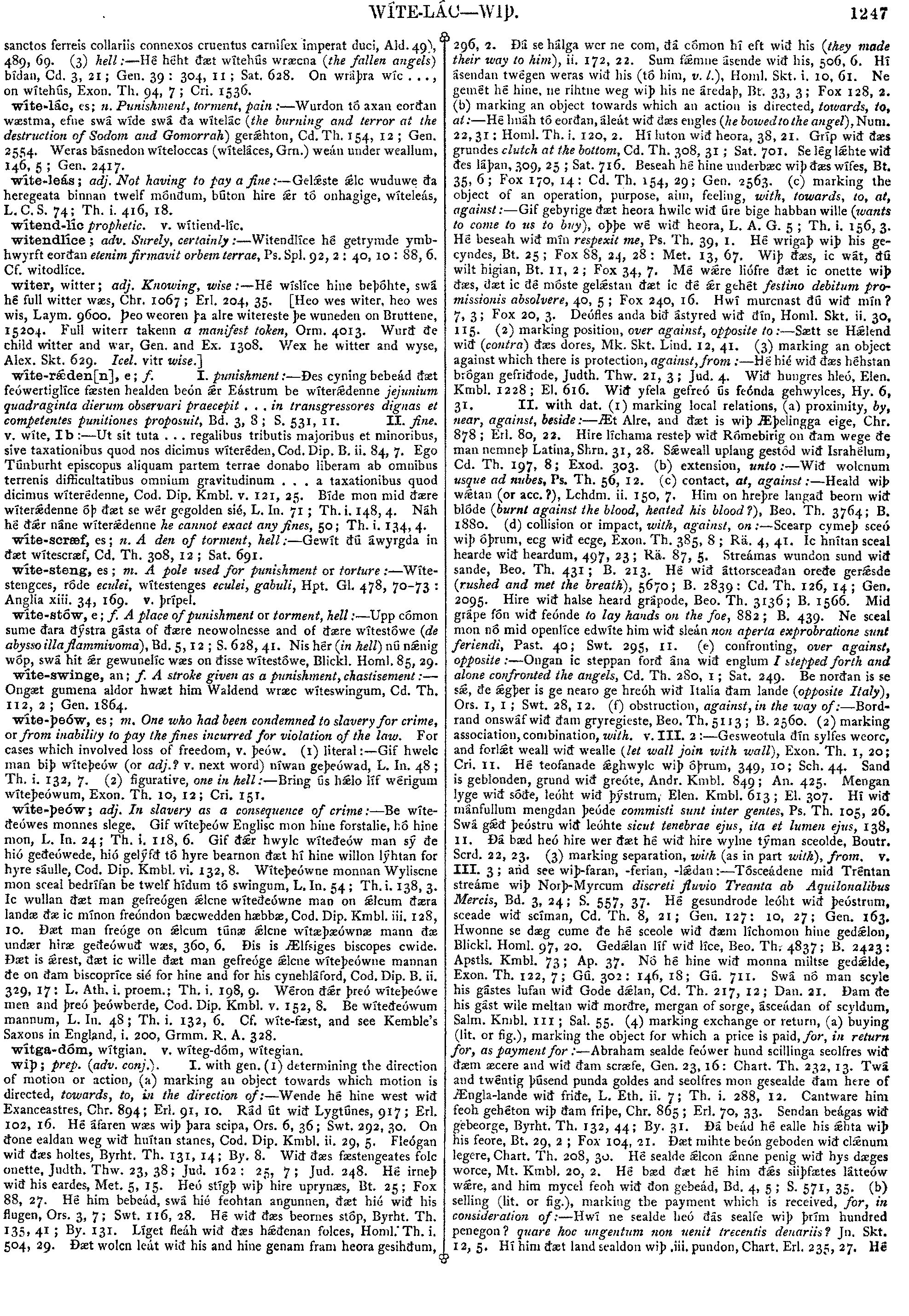
sanctos ferreis collariis connexos cruentus carnifex imperat duci, Ald. 49), 489, 69. (3) hell :-- Hé héht ðæt wítehús wræcna (the fallen angels) bídan, Cd. 3, 21; Gen. 39 : 304, 11 ; Sat. 628. On wráþra wíc . . . , on wítehús, Exon. Th. 94, 7 ; Cri. 1536.
|
Source: Bosworth/Toller, page d0003, entry 3 View original page image as: [TIFF] [PNG] [View previous entry] [View next entry] |
[Comment on this entry] [View comments] |
The following entry has been hand-corrected once. |
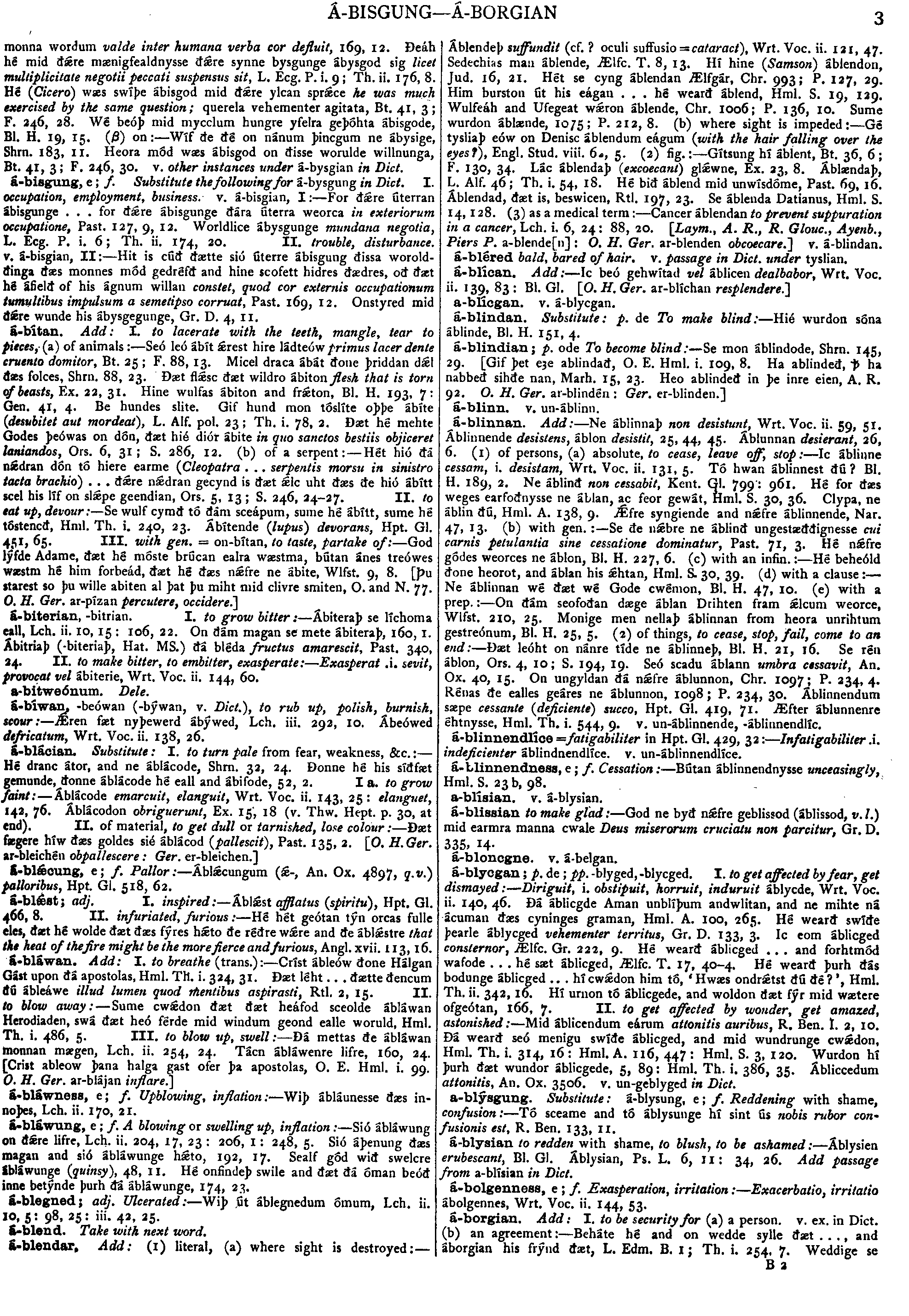
á-bítan.
Add:
I.
to
lacerate
with
the
teeth,
mangle,
tear
to
pieces,
(a)
of
animals
:--
Seó
leó
ábít
rest
hire
ládteów
primus
lacer
dente
cruento
domitor,
Bt.
25
;
F.
88,
13.
Micel
draca
ábát
ðone
þriddan
dl
ðæs
folces,
Shrn.
88,
23.
Ðæt
flsc
ðæt
wildro
ábiton
flesh
that
is
torn
of
beasts,
Ex.
22,
31.
Hine
wulfas
ábiton
and
frton,
Bl.
H.
193,
7;
Gen.
41,
4.
Be
hundes
slite.
Gif
hund
mon
tóslíte
oþþe
ábíte
(desubitet
aut
mordeat),
L.
Alf.
pol.
33;
Th.
i.
78,
2.
Ðæt
he
mehte
Godes
þeówas
on
dón,
ðæt
hié
diór
ábite
in
quo
sanctos
bestiis
objiceret
laniandos,
Ors.
6,
31;
S.
286,
12.
(b)
of
a
serpent
:--
Hét
hió
ðá
ndran
dón
tó
hiere
earme
(Cleopatra
.
.
.
serpentis
morsu
in
sinistro
tacta
brachio)
.
.
.
ðre
ndran
gecynd
is
ðæt
lc
uht
ðæs
ðe
hió
ábítt
scel
his
líf
on
slpe
geendian,
Ors.
5,
13
;
S.
246,
24-27.
II.
to
eat
up,
devour
:--
Se
wulf
cymð
tó
ðám
sceápum,
sume
hé
ábítt,
sume
hé
tóstencð,
Hml.
Th.
i.
240,
23.
Ábítende
(lupus)
devorans,
Hpt.
Gl.
451,
65.
III.
with
gen.
=
on-bítan,
to
taste,
partake
of
:--
God
lýfde
Adame,
ðæt
hé
móste
brúcan
ealra
wæstma,
bútan
ánes
treówes
wæstm
hé
him
forbeád,
ðæt
hé
ðæs
nfre
ne
ábite,
Wlfst.
9,
8.
[Þu
starest
so
þu
wille
abiten
al
þat
þu
miht
mid
clivre
smiten,
O.
and
N.
77.
O.
H.
Ger.
ar-pízan
percutere,
occidere.]
|
Source: Bosworth/Toller, page d0090, entry 8 View original page image as: [TIFF] [PNG] [View previous entry] [View next entry] |
[Comment on this entry] [View comments (1)] |
The following entry has been hand-corrected once. |
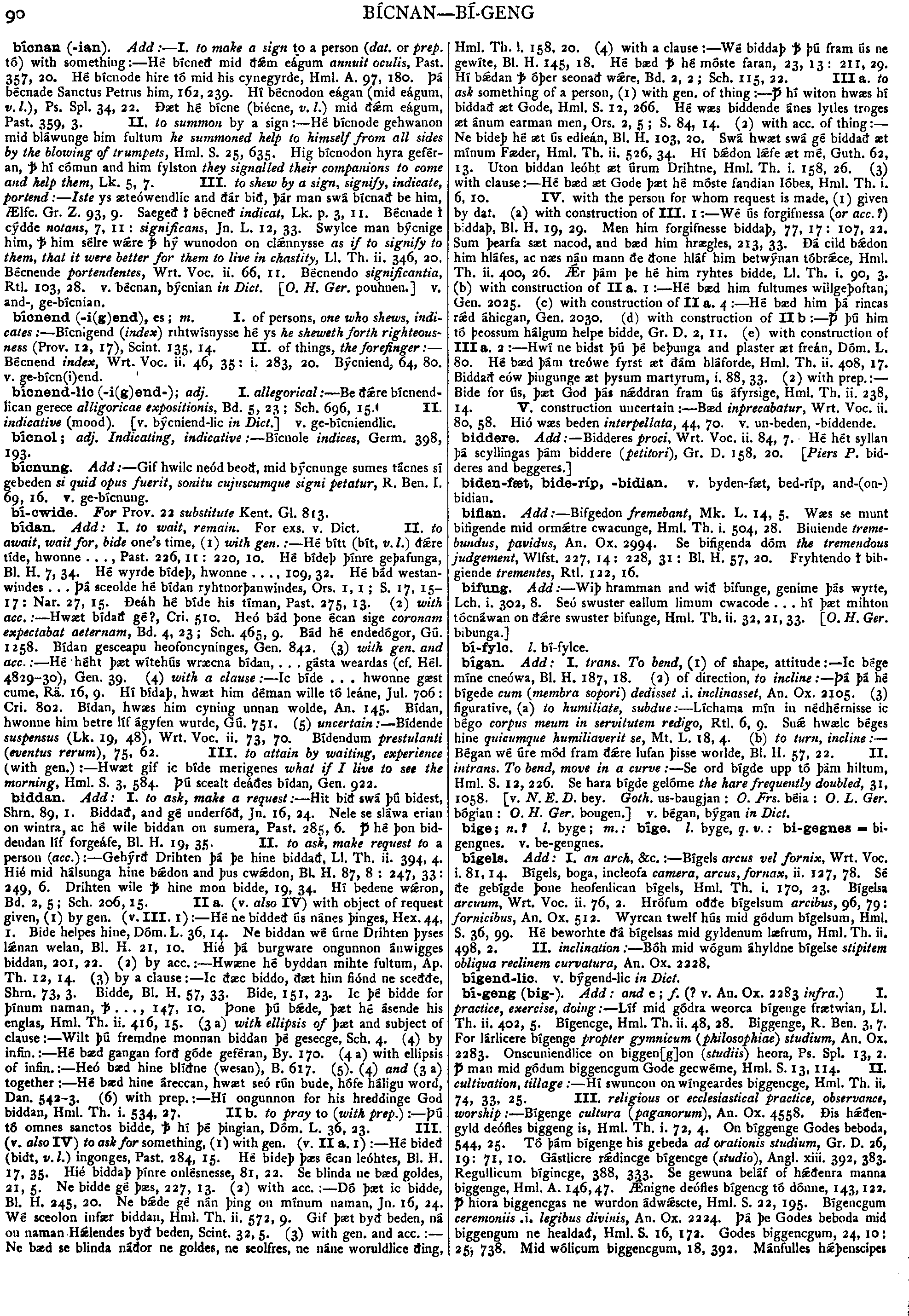
biddan.
Add:
I.
to
ask,
make
a
request
:--
Hit
bið
swá
þú
bidest.
Shrn.
89,
1.
Biddað,
and
gé
underfóð,
Jn.
16,
24.
Nele
se
sláwa
erian
on
wintra,
ac
hé
wile
biddan
on
sumera,
Past.
285,
6.
þ
hé
þon
biddendan
líf
forgeáfe,
Bl.
H.
19,
35.
II.
to
ask,
make
request
to
a
person
(acc.)
:--
Gehýrð
Drihten
þá
þe
hine
biddað.
Ll.
Th.
ii.
394,
4.
Hié
mid
hálsunga
hine
bdon
and
þus
cwdon,
Bl.
H.
87,
8
:
247,
33:
249,
6.
Drihten
wile
 hine
mon
bidde,
19,
34.
Hí
bedene
wron,
Bd.
2,
5;
Sch.
206,
15.
II
a.
(v.
also
IV)
with
object
of
request
given,
(1)
by
gen.
(v.
III.
1)
:--
Hé
ne
biddeð
ús
nánes
þinges.
Hex.
44,
1.
Bide
helpes
hine,
Dóm.
L.
36,
14.
Ne
biddan
wé
úrne
Drihten
þyses
lnan
welan.
Bl.
H.
21,
10.
Hié
þá
burgware
ongunnon
ánwigges
biddan,
201,
22.
(2)
by
acc.
:--
Hwæne
hé
byddan
mihte
fultum,
Ap.
Th.
12,
14.
(3)
by
a
clause
:--
Ic
ðæc
biddo,
ðæt
him
fiónd
ne
sceððe.
Shrn.
73,
3.
Bidde,
Bl.
H.
57,
33.
Bide,
151,
23.
Ic
þé
bidde
for
þínum
naman,
.
.
.147,
10.
þone
þú
bde,
þæt
hé
ásende
his
englas,
Hml.
Th.
ii.
416,
15.
(3
a)
with
ellipsis
of
þæt
and
subject
of
clause
:--
Wilt
þú
fremdne
monnan
biddan
þé
gesecge,
Sch.
4.
(4)
by
infin.
:--
Hé
bæd
gangan
forð
góde
geféran,
By.
170.
(4
a)
with
ellipsis
of
infin.
:--
Heó
bæd
hine
blíðne
(wesan),
B.
617.
(5).
(4)
and
(3
a)
together
:--
Hé
bæd
hine
áreccan,
hwæt
seó
rún
bude,
hófe
háligu
word,
Dan.
542-3.
(6)
with
prep.
:--
Hí
ongunnon
for
his
hreddinge
God
biddan,
Hml.
Th.
i.
534,
27.
II
b.
to
pray
to
(withprep.
)
:--
pú
tó
omnes
sanctos
bidde,
hí
þé
þingian,
Dóm.
L.
36,
23.
III.
(v.
also
IV)
to
ask
for
something,
(1)
with
gen.
(v.
II
a.
I)
:--
Hé
bideð
(bidt,
v.
l.
)
ingonges,
Past.
284,
15.
Hé
bideþ
þæs
écan
leóhtes,
Bl.
H.
17,
35.
Hié
biddaþ
þínre
onlésnesse,
81,
22.
Se
blinda
ne
bæd
goldes,
21,
5.
Ne
bidde
gé
þæs,
227,
13.
(2)
with
acc.
:--
Dó
þæt
ic
bidde,
BI.
H.
245,
20.
Ne
bde
gé
nán
þing
on
mínum
naman,
Jn.
16,
24.
Wé
sceolon
infær
biddan,
Hml.
Th.
ii.
572,
9.
Gif
þæt
byð
beden,
ná
on
naman
Hælendes
byð
beden,
Scint.
32,
5.
(3)
with
gen.
and
acc.
:--
Ne
bæd
se
blinda
náðor
ne
goldes,
ne
seolfres,
ne
náne
woruldlice
ðing,
Hml.
Th.
1.
158,
20.
(4)
with
a
clause
:--
Wé
biddaþ
þú
fram
ús
ne
gewíte,
Bl.
H.
145,
18.
Hé
bæd
hé
móste
faran,
23,
13:
211,
29.
Hí
bdan
óþer
seonað
wre,
Bd.
2,
2
;
Sch.
115,
22.
III
a.
to
ask
something
of
a
person,
(1)
with
gen.
of
thing
:--
hí
witon
hwæs
hí
biddað
æt
Gode,
Hml.
S.
12,
266.
Hé
wæs
biddende
ánes
lytles
troges
æt
ánum
earman
men,
Ors.
2,
5;
S.
84,
14.
(2)
with
acc.
of
thing
:--
Ne
bideþ
hé
æt
ús
edleán,
Bl.
H.
103,
20.
Swá
hwæt
swá
gé
biddað
æt
mínum
Fæder,
Hml.
Th.
ii.
526,
34.
Hí
bdon
lfe
æt
mé,
Guth.
62,
13.
Uton
biddan
leóht
æt
úrum
Drihtne,
Hml.
Th.
i.
158,
26.
(3)
with
clause
:--
Hé
bæd
æt
Gode
þæt
hé
móste
fandian
Ióbes,
Hml.
Th.
i.
6,
10.
IV.
with
the
person
for
whom
request
is
made,
(1)
given
by
dat.
(a)
with
construction
of
III.
I
:--
Wé
ús
forgifnessa
(or
acc.
?)
biddaþ.
Bl.
H.
19,
29.
Men
him
forgifnesse
biddaþ,
77,
17:
107,
22.
Sum
þearfa
sæt
nacod,
and
bæd
him
hrægles,
213,
33.
Ðá
cild
bdon
him
hláfes,
ac
næs
nán
mann
ðe
ðone
hláf
him
betwýnan
tóbrce,
Hml.
Th.
ii.
400,
26.
Æ-acute;r
þ
ám
þe
hé
him
ryhtes
bidde.
Ll.
Th.
i.
90,
3.
(b)
with
construction
of
II
a.
I
:--
Hé
bæd
him
fultumes
willgeþoftan,
Gen.
2025.
(c)
with
construction
of
II
a.
4
:--
Hé
bæd
him
þá
rincas
rd
áhicgan,
Gen.
2030.
(d)
with
construction
of
II
b
:--
þú
him
tó
þeossum
hálgum
helpe
bidde,
Gr.
D.
2,
11.
(e)
with
construction
of
III
a.
2
:--
Hwí
ne
bidst
þú
þé
beþunga
and
plaster
æt
freán,
Dóm.
L.
80.
Hé
bæd
þám
treówe
fyrst
æt
ðám
hláforde,
Hml.
Th.
ii.
408,
17.
Biddað
eów
þingunge
æt
þysum
martyrum,
i.
88,
33.
(2)
with
prep.
:--
Bide
for
ús,
þæt
God
þás
nddran
fram
ús
áfyrsige,
Hml.
Th.
ii.
238,
14.
V.
construction
uncertain
:--
Bæd
inprecabatur,
Wrt.
Voc.
ii.
80,
58.
Hió
wæs
beden
interpellata,
44,
70.
v.
un-beden,
-biddende.
hine
mon
bidde,
19,
34.
Hí
bedene
wron,
Bd.
2,
5;
Sch.
206,
15.
II
a.
(v.
also
IV)
with
object
of
request
given,
(1)
by
gen.
(v.
III.
1)
:--
Hé
ne
biddeð
ús
nánes
þinges.
Hex.
44,
1.
Bide
helpes
hine,
Dóm.
L.
36,
14.
Ne
biddan
wé
úrne
Drihten
þyses
lnan
welan.
Bl.
H.
21,
10.
Hié
þá
burgware
ongunnon
ánwigges
biddan,
201,
22.
(2)
by
acc.
:--
Hwæne
hé
byddan
mihte
fultum,
Ap.
Th.
12,
14.
(3)
by
a
clause
:--
Ic
ðæc
biddo,
ðæt
him
fiónd
ne
sceððe.
Shrn.
73,
3.
Bidde,
Bl.
H.
57,
33.
Bide,
151,
23.
Ic
þé
bidde
for
þínum
naman,
.
.
.147,
10.
þone
þú
bde,
þæt
hé
ásende
his
englas,
Hml.
Th.
ii.
416,
15.
(3
a)
with
ellipsis
of
þæt
and
subject
of
clause
:--
Wilt
þú
fremdne
monnan
biddan
þé
gesecge,
Sch.
4.
(4)
by
infin.
:--
Hé
bæd
gangan
forð
góde
geféran,
By.
170.
(4
a)
with
ellipsis
of
infin.
:--
Heó
bæd
hine
blíðne
(wesan),
B.
617.
(5).
(4)
and
(3
a)
together
:--
Hé
bæd
hine
áreccan,
hwæt
seó
rún
bude,
hófe
háligu
word,
Dan.
542-3.
(6)
with
prep.
:--
Hí
ongunnon
for
his
hreddinge
God
biddan,
Hml.
Th.
i.
534,
27.
II
b.
to
pray
to
(withprep.
)
:--
pú
tó
omnes
sanctos
bidde,
hí
þé
þingian,
Dóm.
L.
36,
23.
III.
(v.
also
IV)
to
ask
for
something,
(1)
with
gen.
(v.
II
a.
I)
:--
Hé
bideð
(bidt,
v.
l.
)
ingonges,
Past.
284,
15.
Hé
bideþ
þæs
écan
leóhtes,
Bl.
H.
17,
35.
Hié
biddaþ
þínre
onlésnesse,
81,
22.
Se
blinda
ne
bæd
goldes,
21,
5.
Ne
bidde
gé
þæs,
227,
13.
(2)
with
acc.
:--
Dó
þæt
ic
bidde,
BI.
H.
245,
20.
Ne
bde
gé
nán
þing
on
mínum
naman,
Jn.
16,
24.
Wé
sceolon
infær
biddan,
Hml.
Th.
ii.
572,
9.
Gif
þæt
byð
beden,
ná
on
naman
Hælendes
byð
beden,
Scint.
32,
5.
(3)
with
gen.
and
acc.
:--
Ne
bæd
se
blinda
náðor
ne
goldes,
ne
seolfres,
ne
náne
woruldlice
ðing,
Hml.
Th.
1.
158,
20.
(4)
with
a
clause
:--
Wé
biddaþ
þú
fram
ús
ne
gewíte,
Bl.
H.
145,
18.
Hé
bæd
hé
móste
faran,
23,
13:
211,
29.
Hí
bdan
óþer
seonað
wre,
Bd.
2,
2
;
Sch.
115,
22.
III
a.
to
ask
something
of
a
person,
(1)
with
gen.
of
thing
:--
hí
witon
hwæs
hí
biddað
æt
Gode,
Hml.
S.
12,
266.
Hé
wæs
biddende
ánes
lytles
troges
æt
ánum
earman
men,
Ors.
2,
5;
S.
84,
14.
(2)
with
acc.
of
thing
:--
Ne
bideþ
hé
æt
ús
edleán,
Bl.
H.
103,
20.
Swá
hwæt
swá
gé
biddað
æt
mínum
Fæder,
Hml.
Th.
ii.
526,
34.
Hí
bdon
lfe
æt
mé,
Guth.
62,
13.
Uton
biddan
leóht
æt
úrum
Drihtne,
Hml.
Th.
i.
158,
26.
(3)
with
clause
:--
Hé
bæd
æt
Gode
þæt
hé
móste
fandian
Ióbes,
Hml.
Th.
i.
6,
10.
IV.
with
the
person
for
whom
request
is
made,
(1)
given
by
dat.
(a)
with
construction
of
III.
I
:--
Wé
ús
forgifnessa
(or
acc.
?)
biddaþ.
Bl.
H.
19,
29.
Men
him
forgifnesse
biddaþ,
77,
17:
107,
22.
Sum
þearfa
sæt
nacod,
and
bæd
him
hrægles,
213,
33.
Ðá
cild
bdon
him
hláfes,
ac
næs
nán
mann
ðe
ðone
hláf
him
betwýnan
tóbrce,
Hml.
Th.
ii.
400,
26.
Æ-acute;r
þ
ám
þe
hé
him
ryhtes
bidde.
Ll.
Th.
i.
90,
3.
(b)
with
construction
of
II
a.
I
:--
Hé
bæd
him
fultumes
willgeþoftan,
Gen.
2025.
(c)
with
construction
of
II
a.
4
:--
Hé
bæd
him
þá
rincas
rd
áhicgan,
Gen.
2030.
(d)
with
construction
of
II
b
:--
þú
him
tó
þeossum
hálgum
helpe
bidde,
Gr.
D.
2,
11.
(e)
with
construction
of
III
a.
2
:--
Hwí
ne
bidst
þú
þé
beþunga
and
plaster
æt
freán,
Dóm.
L.
80.
Hé
bæd
þám
treówe
fyrst
æt
ðám
hláforde,
Hml.
Th.
ii.
408,
17.
Biddað
eów
þingunge
æt
þysum
martyrum,
i.
88,
33.
(2)
with
prep.
:--
Bide
for
ús,
þæt
God
þás
nddran
fram
ús
áfyrsige,
Hml.
Th.
ii.
238,
14.
V.
construction
uncertain
:--
Bæd
inprecabatur,
Wrt.
Voc.
ii.
80,
58.
Hió
wæs
beden
interpellata,
44,
70.
v.
un-beden,
-biddende.
Germanic Lexicon Project (main page)
This search system was written by
Sean Crist
Please consider
volunteering
to correct the data in these online dictionaries.
No rights reserved. Feel free to use these data in any way you please.