|
|

|
Source: Cleasby/Vigfusson, page b0017, entry 63 View original page image as: [TIFF] [PNG] [View previous entry] [View next entry] |
[Comment on this entry] [View comments] |
The following entry has been hand-corrected once. |
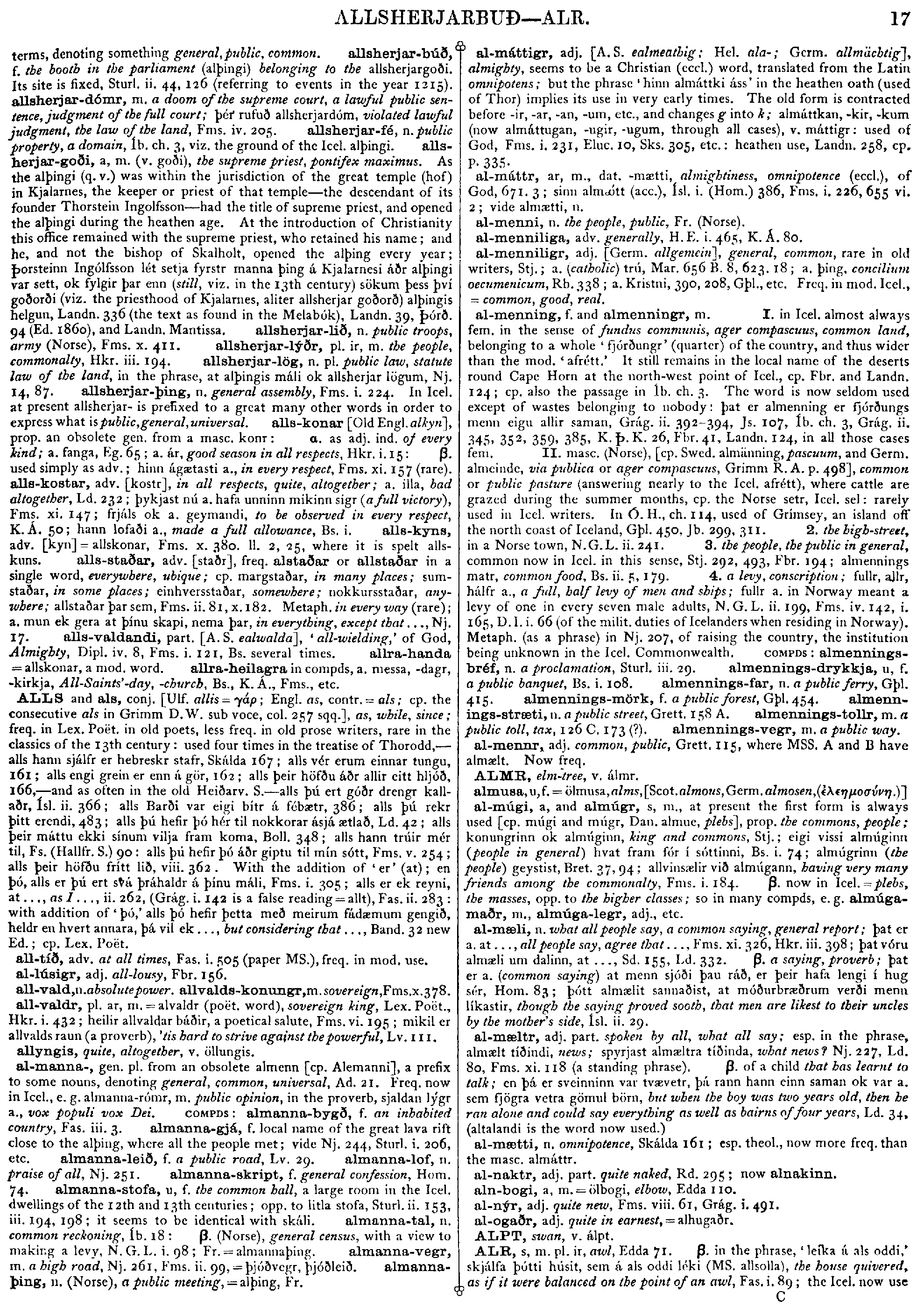
al-tjaldaðr, adj. part, hung with tapestry all round, Fms. xi. 17, Sturl. iii. 193, Háv. 52.
|
Source: Cleasby/Vigfusson, page b0026, entry 4 View original page image as: [TIFF] [PNG] [View previous entry] [View next entry] |
[Comment on this entry] [View comments] |
The following entry has been hand-corrected once. |
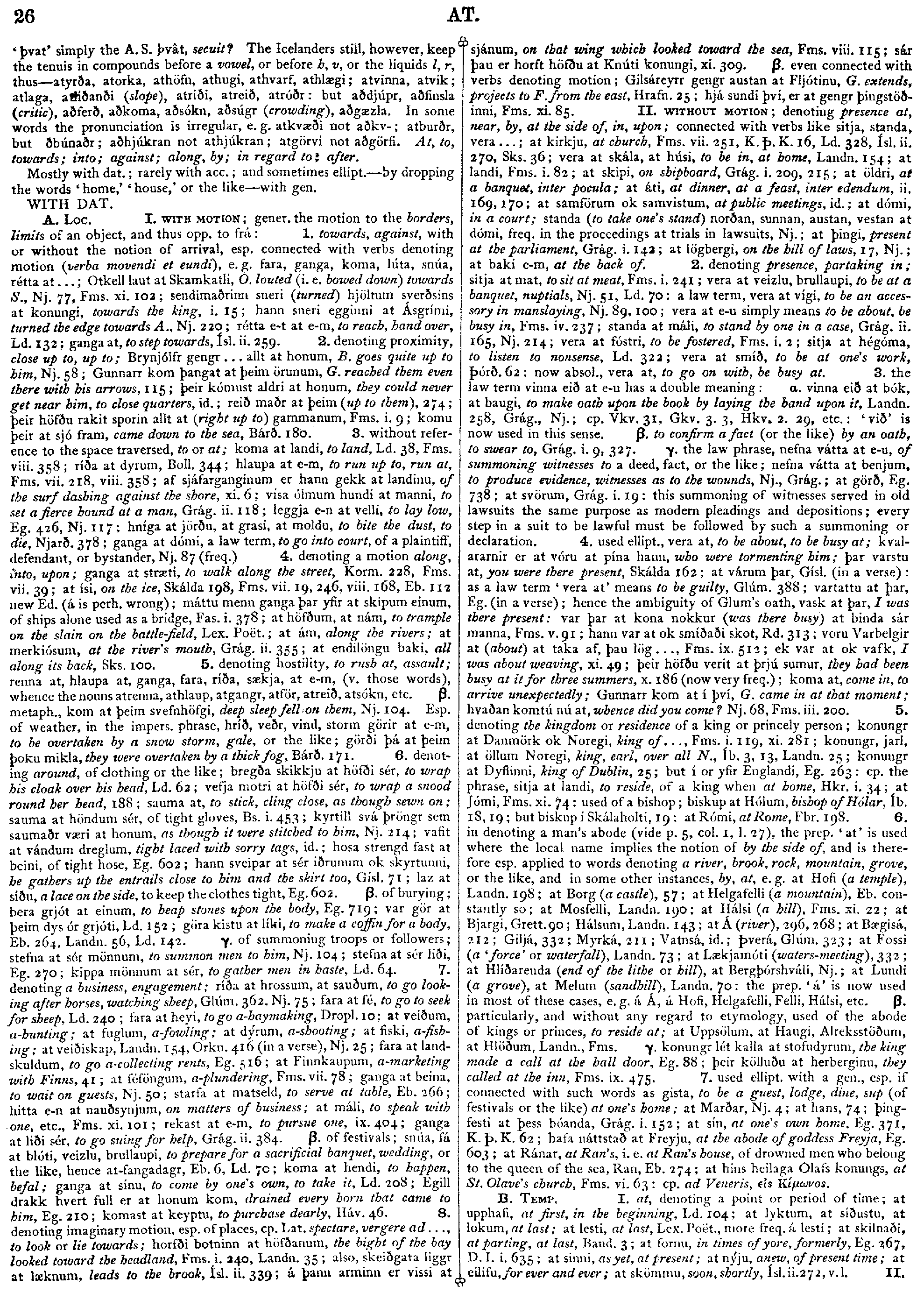
A.
LOG.
I.
WITH
MOTION;
gener.
the
motion
to
the
borders,
limits
of
an
object,
and
thus
opp.
to
frá:
1.
towards,
against,
with
or
without
the
notion
of
arrival,
esp.
connected
with
verbs
denoting
motion
(verba
movendi
et
eundi),
e.
g.
fara,
ganga,
koma,
lúta,
snúa,
rétta
at...;
Otkell
laut
at
Skamkatli,
O.
louted
(i.
e.
bowed
down)
towards
S.,
Nj.
77,
Fms.
xi.
102;
sendimaðrinn
sneri
(turned)
hjöltum
sverðsins
at
konungi,
towards
the
king,
i.
15;
hann
sneri
egginni
at
Ásgrími,
turned
the
edge
towards
A.,
Nj.
220;
rétta
e-t
at
e-m,
to
reach,
hand
over,
Ld.
132;
ganga
at,
to
step
towards,
Ísl.
ii.
259.
2.
denoting
proximity,
close
up
to,
up
to;
Brynjólfr
gengr
...
allt
at
honum,
B.
goes
quite
up
to
him,
Nj.
58;
Gunnarr
kom
þangat
at
þeim
örunum,
G.
reached
them
even
there
with
his
arrows,
115;
þeir
kómust
aldri
at
honum,
they
could
never
get
near
him,
to
close
quarters,
id.;
reið
maðr
at
þeim
(up
to
them),
274;
þeir
höfðu
rakit
sporin
allt
at
(right
up
to)
gammanum,
Fms.
i.
9;
komu
þeir
at
sjó
fram,
came
down
to
the
sea,
Bárð.
180.
3.
without
refer-
ence
to
the
space
traversed,
to
or
at;
koma
at
landi,
to
land,
Ld.
38,
Fms.
viii.
358;
ríða
at
dyrurn,
Boll.
344;
hlaupa
at
e-m,
to
run
up
to,
run
at,
Fms.
vii.
218,
viii.
358;
af
sjáfarganginum
er
hann
gekk
at
landinu,
of
the
surf
dashing
against
the
shore,
xi.
6;
vísa
ólmum
hundi
at
manni,
to
set
a
fierce
hound
at
a
man,
Grág.
ii.
118;
leggja
e-n
at
velli,
to
lay
low,
Eg.
426,
Nj.
117;
hníga
at
jörðu,
at
grasi,
at
moldu,
to
bite
the
dust,
to
die,
Njarð.
378;
ganga
at
dómi,
a
law
term,
to
go
into
court,
of
a
plaintiff,
defendant,
or
bystander,
Nj.
87
(freq.)
4.
denoting
a
motion
along,
into,
upon;
ganga
at
stræti,
to
walk
along
the
street,
Korm.
228,
Fms.
vii.
39;
at
ísi,
on
the
ice,
Skálda
198,
Fms.
vii.
19,
246,
viii.
168,
Eb.
112
new
Ed.
(á
is
perh.
wrong);
máttu
menn
ganga
bar
yfir
at
skipum
einum,
of
ships
alone
used
as
a
bridge,
Fas.
i.
378;
at
höfðum,
at
nám,
to
trample
on
the
slain
on
the
battle-field,
Lex.
Poët.;
at
ám,
along
the
rivers;
at
merkiósum,
at
the
river's
mouth,
Grág.
ii.
355;
at
endilöngu
baki,
all
along
its
back,
Sks.
100.
5.
denoting
hostility,
to
rush
at,
assault;
renna
at,
hlaupa
at,
ganga,
fara,
ríða,
sækja,
at
e-m,
(v.
those
words),
whence
the
nouns
atrenna,
athlaup,
atgangr,
atför,
atreið,
atsókn,
etc.
 .
metaph.,
kom
at
þeim
svefnhöfgi,
deep
sleep
fell
on
them,
Nj.
104.
Esp.
of
weather,
in
the
impers.
phrase,
hríð,
veðr,
vind,
storm
görir
at
e-m,
to
be
overtaken
by
a
snow
storm,
gale,
or
the
like;
görði
þá
at
þeim
þoku
mikla,
they
were
overtaken
by
a
thick
fog,
Bárð.
171.
6.
denot-
ing
around,
of
clothing
or
the
like;
bregða
skikkju
at
höfði
sér,
to
wrap
his
cloak
over
his
head,
Ld.
62;
vefja
motri
at
höfði
sér,
to
wrap
a
snood
round
her
head,
188;
sauma
at,
to
stick,
cling
close,
as
though
sewn
on;
sauma
at
höndum
sér,
of
tight
gloves,
Bs.
i.
453;
kyrtill
svá
þröngr
sem
saumaðr
væri
at
honum,
as
though
it
were
stitched
to
him,
Nj.
214;
vafit
at
vándum
dreglum,
tight
laced
with
sorry
tags,
id.;
hosa
strengd
fast
at
beini,
of
tight
hose,
Eg.
602;
hann
sveipar
at
sér
iðrunum
ok
skyrtunni,
he
gathers
up
the
entrails
close
to
him
and
the
skirt
too,
Gísl.
71;
laz
at
síðu,
a
lace
on
the
side,
to
keep
the
clothes
tight,
Eg.
602.
p.
of
burying;
bera
grjót
at
einum,
to
heap
stones
upon
the
body,
Eg.
719;
var
gör
at
þeim
dys
or
grjóti,
Ld.
152;
gora
kistu
at
líki,
to
make
a
coffin
for
a
body,
Eb.
264,
Landn.
56,
Ld.
142.
.
metaph.,
kom
at
þeim
svefnhöfgi,
deep
sleep
fell
on
them,
Nj.
104.
Esp.
of
weather,
in
the
impers.
phrase,
hríð,
veðr,
vind,
storm
görir
at
e-m,
to
be
overtaken
by
a
snow
storm,
gale,
or
the
like;
görði
þá
at
þeim
þoku
mikla,
they
were
overtaken
by
a
thick
fog,
Bárð.
171.
6.
denot-
ing
around,
of
clothing
or
the
like;
bregða
skikkju
at
höfði
sér,
to
wrap
his
cloak
over
his
head,
Ld.
62;
vefja
motri
at
höfði
sér,
to
wrap
a
snood
round
her
head,
188;
sauma
at,
to
stick,
cling
close,
as
though
sewn
on;
sauma
at
höndum
sér,
of
tight
gloves,
Bs.
i.
453;
kyrtill
svá
þröngr
sem
saumaðr
væri
at
honum,
as
though
it
were
stitched
to
him,
Nj.
214;
vafit
at
vándum
dreglum,
tight
laced
with
sorry
tags,
id.;
hosa
strengd
fast
at
beini,
of
tight
hose,
Eg.
602;
hann
sveipar
at
sér
iðrunum
ok
skyrtunni,
he
gathers
up
the
entrails
close
to
him
and
the
skirt
too,
Gísl.
71;
laz
at
síðu,
a
lace
on
the
side,
to
keep
the
clothes
tight,
Eg.
602.
p.
of
burying;
bera
grjót
at
einum,
to
heap
stones
upon
the
body,
Eg.
719;
var
gör
at
þeim
dys
or
grjóti,
Ld.
152;
gora
kistu
at
líki,
to
make
a
coffin
for
a
body,
Eb.
264,
Landn.
56,
Ld.
142.
 of
summoning
troops
or
followers;
stefna
at
sér
mönnum,
to
summon
men
to
him,
Nj.
104;
stefna
at
sér
liði,
Eg.
270;
kippa
mönnum
at
sér,
to
gather
men
in
haste,
Ld.
64.
7.
denoting
a
business,
engagement;
ríða
at
hrossum,
at
sauðum,
to
go
looking
after
after
horses,
watching
sheep,
Glúm.
362,
Nj.
75;
fara
at
fé,
to
go
to
seek
for
sheep,
Ld.
240;
fara
at
heyi,
to
go
a-haymaking,
Dropl.
10;
at
veiðum,
a-hunting;
at
fuglum,
a-fowling;
at
dýrum,
a-sbooting;
at
fiski,
a-fishing;
at
veiðiskap,
Landn.
154,
Orkn.
416
(in
a
verse),
Nj.
25;
fara
at
landskuldum,
to
go
a-collecling
rents,
Eg.
516;
at
Finnkaupum,
a-marketing
with
Finns,
41;
at
féföngum,
a-plundering,
Fms.
vii.
78;
ganga
at
beina,
to
wait
on
guests,
Nj.
50;
starfa
at
matseld,
to
serve
at
table,
Eb.
266;
hitta
e-n
at
nauðsynjum,
on
matters
of
business;
at
máli,
to
speak
with
one,
etc.,
Fms.
xi.
101;
rekast
at
e-m,
to
pursue
one,
ix.
404;
ganga
at
liði
sér,
to
go
suing
for
help,
Grág.
ii.
384.
p.
of
festivals;
snúa,
fá
at
blóti,
veizlu,
brullaupi,
to
prepare
for
a
sacrificial
banquet,
wedding,
or
the
like,
hence
at-fangadagr,
Eb.
6,
Ld.
70;
koma
at
hendi,
to
happen,
befall;
ganga
at
sínu,
to
come
by
one's
own,
to
take
it,
Ld.
208;
Egill
drakk
hvert
full
er
at
honum
kom,
drained
every
horn
that
came
to
him,
Eg.
210;
komast
at
keyptu,
to
purchase
dearly,
Húv.
46.
8.
denoting
imaginary
motion,
esp.
of
places,
cp.
Lat.
spectare,
vergere
ad...,
to
look
or
lie
towards;
horfði
botninn
at
höfðanum,
the
bight
of
the
bay
looked
toward
the
headland,
Fms.
i.
340,
Landn.
35;
also,
skeiðgata
liggr
at
læknum,
leads
to
the
brook,
Ísl.
ii.
339;
á
þann
arminn
er
vissi
at
sjánum,
on
that
wing
which
looked
toward
the
sea,
Fms.
viii.
115;
sár
þau
er
horft
höfðu
at
Knúti
konungi,
xi.
309.
.
even
connected
with
verbs
denoting
motion;
Gilsáreyrr
gengr
austan
at
Fljótinu,
G.
extends,
projects
to
F.
from
the
east,
Hrafh.
25;
hjá
sundi
því,
er
at
gengr
þingstöðinni,
Fms.
xi.
85.
of
summoning
troops
or
followers;
stefna
at
sér
mönnum,
to
summon
men
to
him,
Nj.
104;
stefna
at
sér
liði,
Eg.
270;
kippa
mönnum
at
sér,
to
gather
men
in
haste,
Ld.
64.
7.
denoting
a
business,
engagement;
ríða
at
hrossum,
at
sauðum,
to
go
looking
after
after
horses,
watching
sheep,
Glúm.
362,
Nj.
75;
fara
at
fé,
to
go
to
seek
for
sheep,
Ld.
240;
fara
at
heyi,
to
go
a-haymaking,
Dropl.
10;
at
veiðum,
a-hunting;
at
fuglum,
a-fowling;
at
dýrum,
a-sbooting;
at
fiski,
a-fishing;
at
veiðiskap,
Landn.
154,
Orkn.
416
(in
a
verse),
Nj.
25;
fara
at
landskuldum,
to
go
a-collecling
rents,
Eg.
516;
at
Finnkaupum,
a-marketing
with
Finns,
41;
at
féföngum,
a-plundering,
Fms.
vii.
78;
ganga
at
beina,
to
wait
on
guests,
Nj.
50;
starfa
at
matseld,
to
serve
at
table,
Eb.
266;
hitta
e-n
at
nauðsynjum,
on
matters
of
business;
at
máli,
to
speak
with
one,
etc.,
Fms.
xi.
101;
rekast
at
e-m,
to
pursue
one,
ix.
404;
ganga
at
liði
sér,
to
go
suing
for
help,
Grág.
ii.
384.
p.
of
festivals;
snúa,
fá
at
blóti,
veizlu,
brullaupi,
to
prepare
for
a
sacrificial
banquet,
wedding,
or
the
like,
hence
at-fangadagr,
Eb.
6,
Ld.
70;
koma
at
hendi,
to
happen,
befall;
ganga
at
sínu,
to
come
by
one's
own,
to
take
it,
Ld.
208;
Egill
drakk
hvert
full
er
at
honum
kom,
drained
every
horn
that
came
to
him,
Eg.
210;
komast
at
keyptu,
to
purchase
dearly,
Húv.
46.
8.
denoting
imaginary
motion,
esp.
of
places,
cp.
Lat.
spectare,
vergere
ad...,
to
look
or
lie
towards;
horfði
botninn
at
höfðanum,
the
bight
of
the
bay
looked
toward
the
headland,
Fms.
i.
340,
Landn.
35;
also,
skeiðgata
liggr
at
læknum,
leads
to
the
brook,
Ísl.
ii.
339;
á
þann
arminn
er
vissi
at
sjánum,
on
that
wing
which
looked
toward
the
sea,
Fms.
viii.
115;
sár
þau
er
horft
höfðu
at
Knúti
konungi,
xi.
309.
.
even
connected
with
verbs
denoting
motion;
Gilsáreyrr
gengr
austan
at
Fljótinu,
G.
extends,
projects
to
F.
from
the
east,
Hrafh.
25;
hjá
sundi
því,
er
at
gengr
þingstöðinni,
Fms.
xi.
85.
|
Source: Cleasby/Vigfusson, page b0028, entry 1 View original page image as: [TIFF] [PNG] [View previous entry] [View next entry] |
[Comment on this entry] [View comments] |
The following entry has been hand-corrected once. |
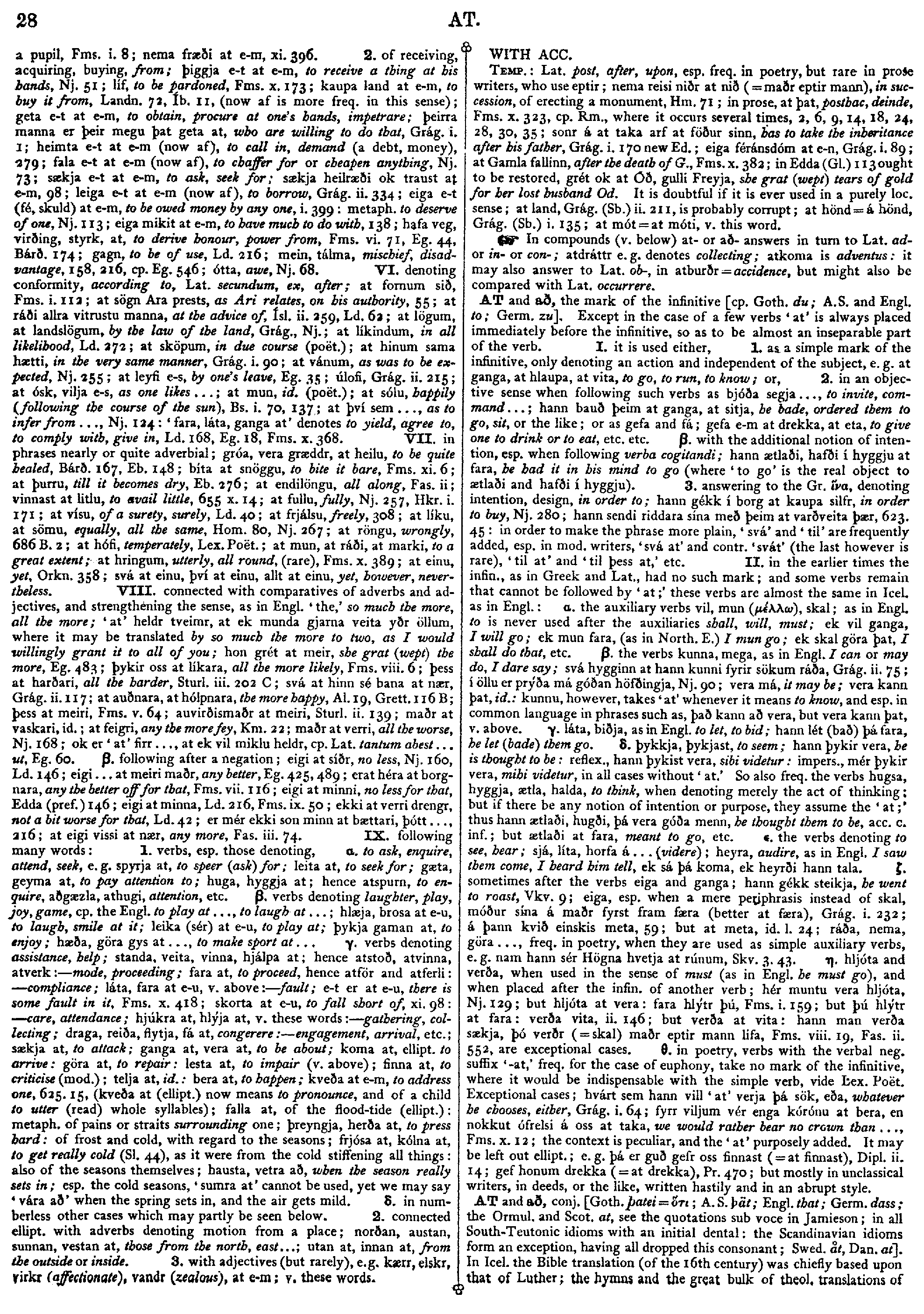
a
pupil,
Fms.
i.
8;
nema
fræði
at
e-m,
xi.
396.
2.
of
receiving,
acquiring,
buying,
from;
þiggja
e-t
at
e-m,
to
receive
a
thing
at
his
hands,
Nj.
51;
líf,
to
be
pardoned,
Fms.
x.
173;
kaupa
land
at
e-m,
to
buy
it
from,
Landn.
72,
Íb.
II,
(now
af
is
more
freq.
in
this
sense);
geta
e-t
at
e-m,
to
obtain,
procure
at
one's
hands,
impetrare;
þeirra
manna
er
þeir
megu
þat
geta
at,
who
are
willing
to
do
that,
Grág.
i.
I;
heimta
e-t
at
e-m
(now
af),
to
call
in,
demand
(a
debt,
money),
279;
fala
e-t
at
e-m
(now
af),
to
chaffer
for
or
cheapen
anything,
Nj.
73;
sækja
e-t
at
e-m,
to
ask,
seek
for;
sækja
heilræði
ok
traust
at
e-m,
98;
leiga
e-t
at
e-m
(now
af),
to
borrow,
Grág.
ii.
334;
eiga
e-t
(fé,
skuld)
at
e-m,
to
be
owed
money
by
any
one,
i.
399:
metaph.
to
deserve
of
one,
Nj.
113;
eiga
mikit
at
e-m,
to
have
much
to
do
with,
138;
hafa
veg,
virðing,
styrk,
at,
to
derive
honour,
power
from,
Fms.
vi.
71,
Eg.
44,
Bárð.
174;
gagn,
to
be
of
use,
Ld.
216;
mein,
tálma,
mischief,
disadvantage,
158,
216,
cp.
Eg.
546;
ótta,
awe,
Nj.
68.
VI.
denoting
conformity,
according
to,
Lat.
secundum,
ex,
after;
at
fornum
sið,
Fms.
i.
112;
at
sögn
Ara
prests,
as
Ari
relates,
on
his
authority,
55;
at
ráði
allra
vitrustu
manna,
at
the
advice
of,
Ísl.
ii.
259,
Ld.
62;
at
lögum,
at
landslögum,
by
the
law
of
the
land,
Grág.,
Nj.;
at
líkindum,
in
all
likelihood,
Ld.
272;
at
sköpum,
in
due
course
(poet.);
at
hinum
sama
hætti,
in
the
very
same
manner,
Grág.
i.
90;
at
vánum,
as
was
to
be
expected,
Nj.
255;
at
leyfi
e-s,
by
one's
leave,
Eg.
35;
úlofi,
Grág.
ii.
215;
at
ósk,
vilja
e-s,
as
one
likes...;
at
mun,
id.
(poet.);
at
sólu,
happily
(following
the
course
of
the
sun),
Bs.
i.
70,
137;
at
því
sem
...,
as
to
infer
from
...,
Nj.
124:'
fara,
láta,
ganga
at'
denotes
to
yield,
agree
to,
to
comply
with,
give
in,
Ld.
168,
Eg.
18,
Fms.
x.
368.
VII.
in
phrases
nearly
or
quite
adverbial;
gróa,
vera
græddr,
at
heilu,
to
be
quite
healed,
Bárð.
167,
Eb.
148;
bíta
at
snöggu,
to
bite
it
bare,
Fms.
xi.
6;
at
þurru,
till
it
becomes
dry,
Eb.
276;
at
endilöngu,
all
along,
Fas.
ii;
vinnast
at
litlu,
to
avail
little,
655
x.
14;
at
fullu,
fully,
Nj.
257,
Hkr.
i.
171;
at
vísu,
of
a
surety,
surely,
Ld.
40;
at
frjálsu,
freely,
308;
at
líku,
at
sömu,
equally,
all
the
same,
Hom.
80,
Nj.
267;
at
röngu,
wrongly,
686
B.
2;
at
hófi,
temperately,
Lex.
Poët.;
at
mun,
at
ráði,
at
marki,
to
a
great
extent;
at
hringum,
utterly,
all
round,
(rare),
Fms.
x.
389;
at
einu,
yet,
Orkn.
358;
svá
at
einu,
því
at
einu,
allt
at
einu,
yet,
however,
nevertheless.
VIII.
connected
with
comparatives
of
adverbs
and
adjectives,
and
strengthening
the
sense,
as
in
Engl.
'
the,
'
so
much
the
more,
all
the
more;
'at'
heldr
tveimr,
at
ek
munda
gjarna
veita
yðr
öllum,
where
it
may
be
translated
by
so
much
the
more
to
two,
as
I
would
willingly
grant
it
to
all
of
you;
hon
grét
at
meir,
she
grat
(wept)
the
more,
Eg.
483;
þykir
oss
at
líkara,
all
the
more
likely,
Fms.
viii.
6;
þess
at
harðari,
all
the
harder,
Sturl.
iii.
202
C;
svá
at
hinn
sé
bana
at
nær,
Grág.
ii.
117;
at
auðnara,
at
hólpnara,
the
more
happy,
Al.
19,
Grett.
116
B;
þess
at
meiri,
Fms.
v.
64;
auvirðismaðr
at
meiri,
Sturl.
ii.
139;
maðr
at
vaskari,
id.;
at
feigri,
any
the
more
fey,
Km.
22;
maðr
at
verri,
all
the
worse,
Nj.
168;
ok
er'
at'
firr...,
at
ek
vil
miklu
heldr,
cp.
Lat.
tantum
abest...
ut,
Eg.
60.
ß.
following
after
a
negation;
eigi
at
síðr,
no
less,
Nj.
160,
Ld.
146;
eigi...
at
meiri
maðr,
any
better,
Eg.
425,
489;
erat
héra
at
borgnara,
any
the
better
off
for
that,
Fms.
vii.
116;
eigi
at
minni,
no
less
for
that,
Edda
(pref.)
146;
eigi
at
minna,
Ld.
216,
Fms.
ix.
50;
ekki
at
verri
drengr,
not
a
bit
worse
for
that,
Ld.
42;
er
mér
ekki
son
minn
at
bættari,
þótt...,
216;
at
eigi
vissi
at
nær,
any
more,
Fas.
iii.
74.
IX.
following
many
words:
1.
verbs,
esp.
those
denoting,
a.
to
ask,
enquire,
attend,
seek,
e.
g.
spyrja
at,
to
speer
(ask)
for;
leita
at,
to
seek
for;
gæta,
geyma
at,
to
pay
attention
to;
huga,
hyggja
at;
hence
atspurn,
to
enquire,
aðgæzla,
athugi,
attention,
etc.
ß.
verbs
denoting
laughter,
play,
joy,
game,
cp.
the
Engl.
to
play
at.
..,
to
laugh
at..
.;
hlæja,
brosa
at
e-u,
to
laugh,
smile
at
it;
leika
(sér)
at
e-u,
to
play
at;
þykja
gaman
at,
to
enjoy;
hæða,
göra
gys
at...,
to
make
sport
at...
.
verbs
denoting
assistance,
help;
standa,
veita,
vinna,
hjálpa
at;
hence
atstoð,
atvinna,
atverk
:—mode,
proceeding;
fara
at,
to
proceed,
hence
atför
and
atferli
:—compliance;
láta,
fara
at
e-u,
v.
above
:—fault;
e-t
er
at
e-u,
there
is
some
fault
in
it,
Fms.
x.
418;
skorta
at
e-u,
to
fall
short
of,
xi.
98:
—care,
attendance;
hjúkra
at,
hlýja
at,
v.
these
words
:—gathering,
collecting;
draga,
reiða,
flytja,
fá
at,
congerere
:—engagement,
arrival,
etc.;
sækja
at,
to
attack;
ganga
at,
vera
at,
to
be
about;
koma
at,
ellipt.
to
arrive:
göra
at,
to
repair:
lesta
at,
to
impair
(v.
above);
finna
at,
to
criticise
(mod.);
telja
at,
id.:
bera
at,
to
happen;
kveða
at
e-m,
to
address
one,
625.
15,
(kveða
at
(ellipt.)
now
means
to
pronounce,
and
of
a
child
to
utter
(read)
whole
syllables);
falla
at,
of
the
flood-tide
(ellipt.):
metaph.
of
pains
or
straits
surrounding
one;
þreyngja,
herða
at,
to
press
hard:
of
frost
and
cold,
with
regard
to
the
seasons;
frjósa
at,
kólna
at,
to
get
really
cold
(SI.
44),
as
it
were
from
the
cold
stiffening
all
things:
also
of
the
seasons
themselves;
hausta,
vetra
að,
when
the
season
really
sets
in;
esp.
the
cold
seasons,
'sumra
at'
cannot
be
used,
yet
we
may
say
'vára
að'
when
the
spring
sets
in,
and
the
air
gets
mild.
 .
in
num-
berless
other
cases
which
may
partly
be
seen
below.
2.
connected
ellipt.
with
adverbs
denoting
motion
from
a
place;
norðan,
austan,
sunnan,
vestan
at,
those
from
the
north,
east...;
utan
at,
innan
at,
from
the
outside
or
inside.
3.
with
adjectives
(but
rarely),
e.
g.
kærr,
elskr,
virkr
(affectionate),
vandr
(zealous),
at
e-m;
v,
these
words.
WITH
ACC.
TEMP.:
Lat.
post,
after,
upon,
esp.
freq.
in
poetry,
but
rare
in
prose
writers,
who
use
eptir;
nema
reisi
niðr
at
nið
(=
maðr
eptir
mann),
in
succession,
of
erecting
a
monument,
Hm.
71;
in
prose,
at
þat.
posthac,
deinde,
Fms.
x.
323,
cp.
Rm.,
where
it
occurs
several
times,
2,
6,
9,
14,
18,
24,
28,
30,
35;
sonr
á
at
taka
arf
at
föður
sinn,
has
to
take
the
inheritance
after
his
father,
Grág.
i.
170
new
Ed.;
eiga
féránsdóm
at
e-n,
Grág.
i.
89;
at
Gamla
fallinn,
after
the
death
of
G.,
Fms.
x.
382;
in
Edda
(Gl.)
113
ought
to
be
restored,
grét
ok
at
Oð,
gulli
Freyja,
she
grat
(wept)
tears
of
gold
for
her
lost
husband
Od.
It
is
doubtful
if
it
is
ever
used
in
a
purely
loc.
sense;
at
land,
Grág.
(Sb.)ii.
211,
is
probably
corrupt;
at
hönd
=
á
hönd,
Grág.
(Sb.)
i.
135;
at
mót
=
at
móti,
v.
this
word.
ILLEGIBLE
In
compounds
(v.
below)
at-
or
að-
answers
in
turn
to
Lat.
ad-
or
in-
or
con-;
atdráttr
e.
g.
denotes
collecting;
atkoma
is
adventus:
it
may
also
answer
to
Lat.
ob-,
in
atburðr
=
accidence,
but
might
also
be
compared
with
Lat.
occurrere.
.
in
num-
berless
other
cases
which
may
partly
be
seen
below.
2.
connected
ellipt.
with
adverbs
denoting
motion
from
a
place;
norðan,
austan,
sunnan,
vestan
at,
those
from
the
north,
east...;
utan
at,
innan
at,
from
the
outside
or
inside.
3.
with
adjectives
(but
rarely),
e.
g.
kærr,
elskr,
virkr
(affectionate),
vandr
(zealous),
at
e-m;
v,
these
words.
WITH
ACC.
TEMP.:
Lat.
post,
after,
upon,
esp.
freq.
in
poetry,
but
rare
in
prose
writers,
who
use
eptir;
nema
reisi
niðr
at
nið
(=
maðr
eptir
mann),
in
succession,
of
erecting
a
monument,
Hm.
71;
in
prose,
at
þat.
posthac,
deinde,
Fms.
x.
323,
cp.
Rm.,
where
it
occurs
several
times,
2,
6,
9,
14,
18,
24,
28,
30,
35;
sonr
á
at
taka
arf
at
föður
sinn,
has
to
take
the
inheritance
after
his
father,
Grág.
i.
170
new
Ed.;
eiga
féránsdóm
at
e-n,
Grág.
i.
89;
at
Gamla
fallinn,
after
the
death
of
G.,
Fms.
x.
382;
in
Edda
(Gl.)
113
ought
to
be
restored,
grét
ok
at
Oð,
gulli
Freyja,
she
grat
(wept)
tears
of
gold
for
her
lost
husband
Od.
It
is
doubtful
if
it
is
ever
used
in
a
purely
loc.
sense;
at
land,
Grág.
(Sb.)ii.
211,
is
probably
corrupt;
at
hönd
=
á
hönd,
Grág.
(Sb.)
i.
135;
at
mót
=
at
móti,
v.
this
word.
ILLEGIBLE
In
compounds
(v.
below)
at-
or
að-
answers
in
turn
to
Lat.
ad-
or
in-
or
con-;
atdráttr
e.
g.
denotes
collecting;
atkoma
is
adventus:
it
may
also
answer
to
Lat.
ob-,
in
atburðr
=
accidence,
but
might
also
be
compared
with
Lat.
occurrere.
|
Source: Cleasby/Vigfusson, page b0034, entry 18 View original page image as: [TIFF] [PNG] [View previous entry] [View next entry] |
[Comment on this entry] [View comments] |
The following entry has been hand-corrected once. |
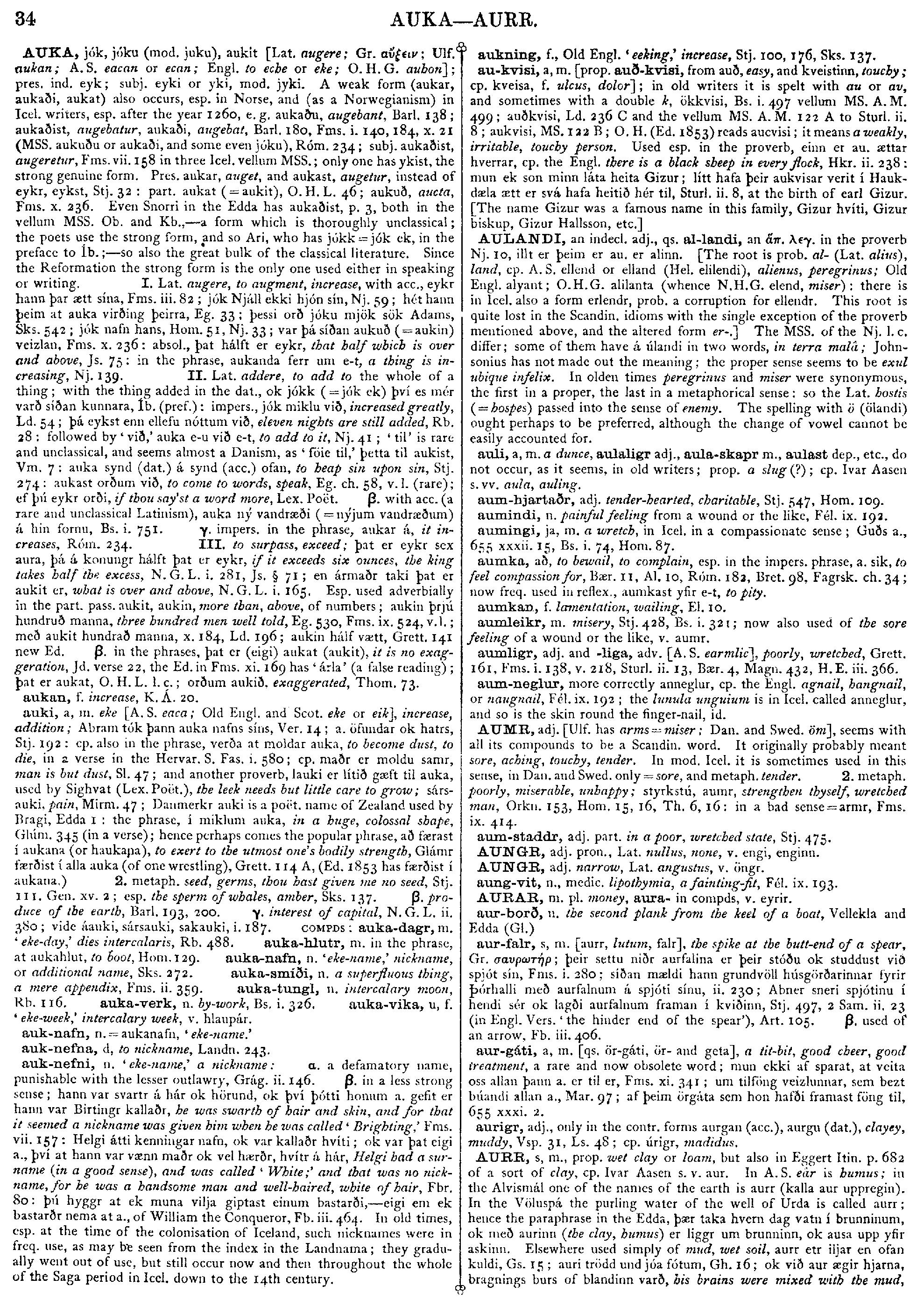
aum-neglurr, more correctly anneglur, cp. the Engl. agnail, hangnail, or naugnail, Fél. ix. 192; the lunula unguium is in Icel. called anneglur, and so is the skin round the finger-nail, id.
|
Source: Cleasby/Vigfusson, page b0038, entry 1 View original page image as: [TIFF] [PNG] [View previous entry] [View next entry] |
[Comment on this entry] [View comments] |
The following entry has been hand-corrected once. |
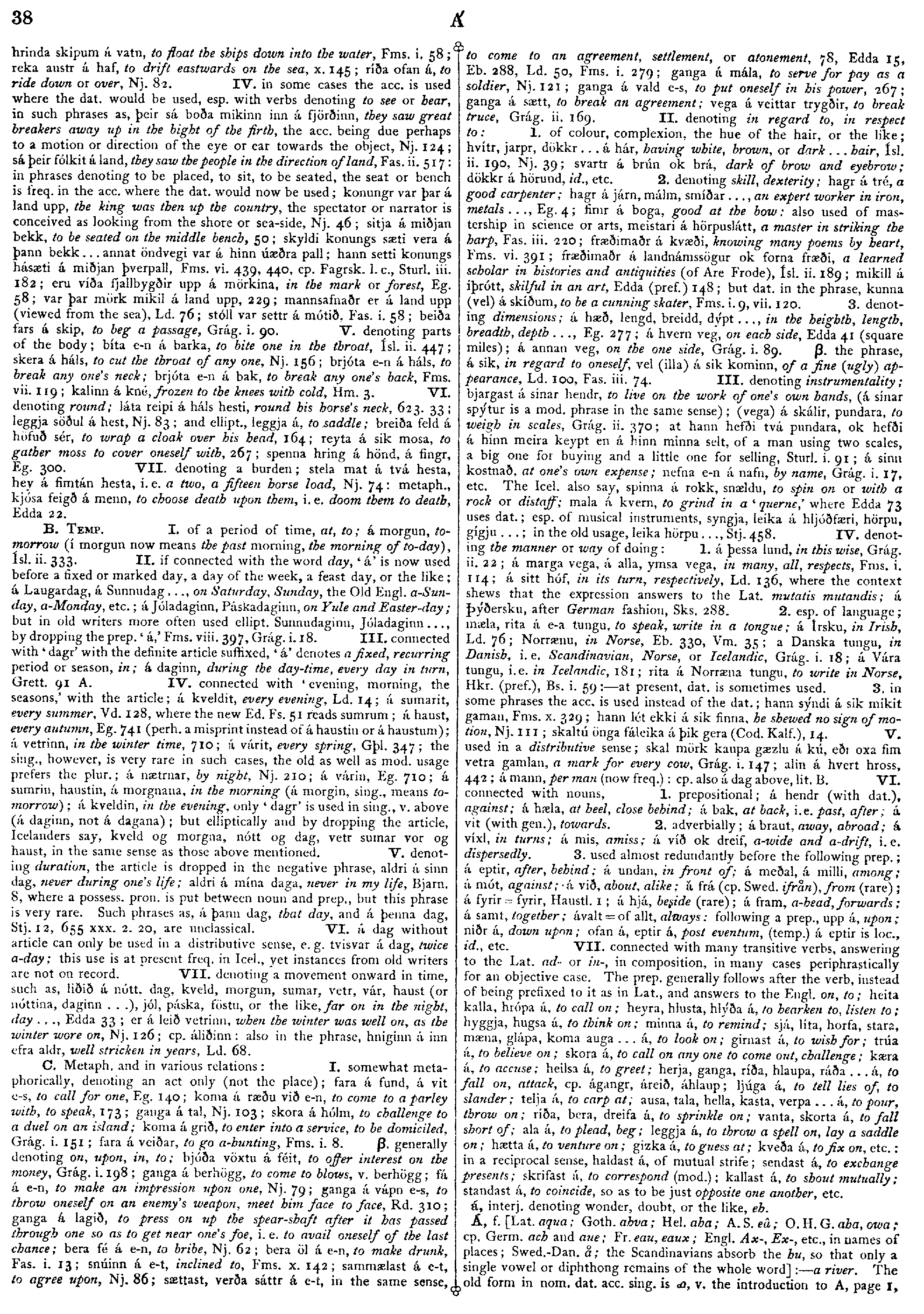
hrinda skipum á vatn, to float the ships down into the water, Fms. i. 58; reka austr á haf, to drift eastwards on the sea, x. 145; ríða ofan á, to ride down or over, Nj. 82. IV. in some cases the acc. is used where the dat. would be used, esp. with verbs denoting to see or hear, in such phrases as, þeir sá boða mikinn inn á fjörðinn, they saw great breakers away up in the bight of the firth, the acc. being due perhaps to a motion or direction of the eye or ear towards the object, Nj. 124; sá þeir fólkit á land, they saw the people in the direction of land, Fas. ii. 517: in phrases denoting to be placed, to sit, to be seated, the seat or bench is freq. in the acc. where the dat. would now be used; konungr var þar á land upp, the king was then up the country, the spectator or narrator is conceived as looking from the shore or sea-side, Nj. 46; sitja á miðjan bekk, to be seated on the middle bench, 50; skyldi konungs sæti vera á þann bekk ... annat öndvegi var á hinn úæðra pall; hann setti konungs hásæti á miðjan þverpall, Fms. vi. 439, 440, cp. Fagrsk. l.c., Sturl. iii. 182; eru víða fjallbygðir upp á mörkina, in the mark or forest, Eg. 58; var þar mörk mikil á land upp, 229; mannsafnaðr er á land upp (viewed from the sea), Ld. 76; stóll var settr á mótið, Fas. i. 58; beiða fars á skip, to beg a passage, Grág. i. 90. V. denoting parts of the body; bíta e-n á barka, to bite one in the throat, Ísl. ii. 447; skera á háls, to cut the throat of any one, Nj. 156; brjóta e-n á háls, to break any one's neck; brjóta e-n á bak, to break any one's back, Fms. vii. 119; kalinn á kné, frozen to the knees with cold, Hm. 3. VI. denoting round; láta reipi á háls hesti, round his horse's neck, 623. 33; leggja söðul á hest, Nj. 83; and ellipt., leggja á, to saddle; breiða feld á hofuð sér, to wrap a cloak over his head, 164; reyta á sik mosa, to gather moss to cover oneself with, 267; spenna hring á hönd, á fingr, Eg. 300. VII. denoting a burden; stela mat á tvá hesta, hey á fimtán hesta, i.e. a two, a fifteen horse load, Nj. 74: metaph., kjósa feigð á menn, to choose death upon them, i.e. doom them to death, Edda 22.
|
Source: Cleasby/Vigfusson, page b0047, entry 45 View original page image as: [TIFF] [PNG] [View previous entry] [View next entry] |
[Comment on this entry] [View comments] |
The following entry has been hand-corrected once. |
á-valr, adj. round, sloping, semi-rotundus; cp. sívalr, rotundus [from völr or from oval (?)]; it seems not to occur in old writers.
|
Source: Cleasby/Vigfusson, page b0047, entry 50 View original page image as: [TIFF] [PNG] [View previous entry] [View next entry] |
[Comment on this entry] [View comments] |
The following entry has been hand-corrected once. |
á-varp, n. (cp. verpa tölu á, to count): 1. a computation, calculation, in round numbers; þat var á. manna, at fyrir Norðnesi mundi eigi færa falla en þrjú hundruð manna, Fms. viii. 143, x. 64, 139; kallaðr ekki vænn maðr at ávarpi flestra manna, in the suggestion, account of most people, Bs. i. 72. 2. in mod. usage, an address, accosting, Lat. allocutio; and ávarpa, að, to address, Lat. alloqui; cp. the old phrase, verpa orði á e-n, alloqui.
|
Source: Cleasby/Vigfusson, page b0053, entry 52 View original page image as: [TIFF] [PNG] [View previous entry] [View next entry] |
[Comment on this entry] [View comments] |
The following entry has not been hand-corrected. However, the page is reserved and someone is correcting it. |
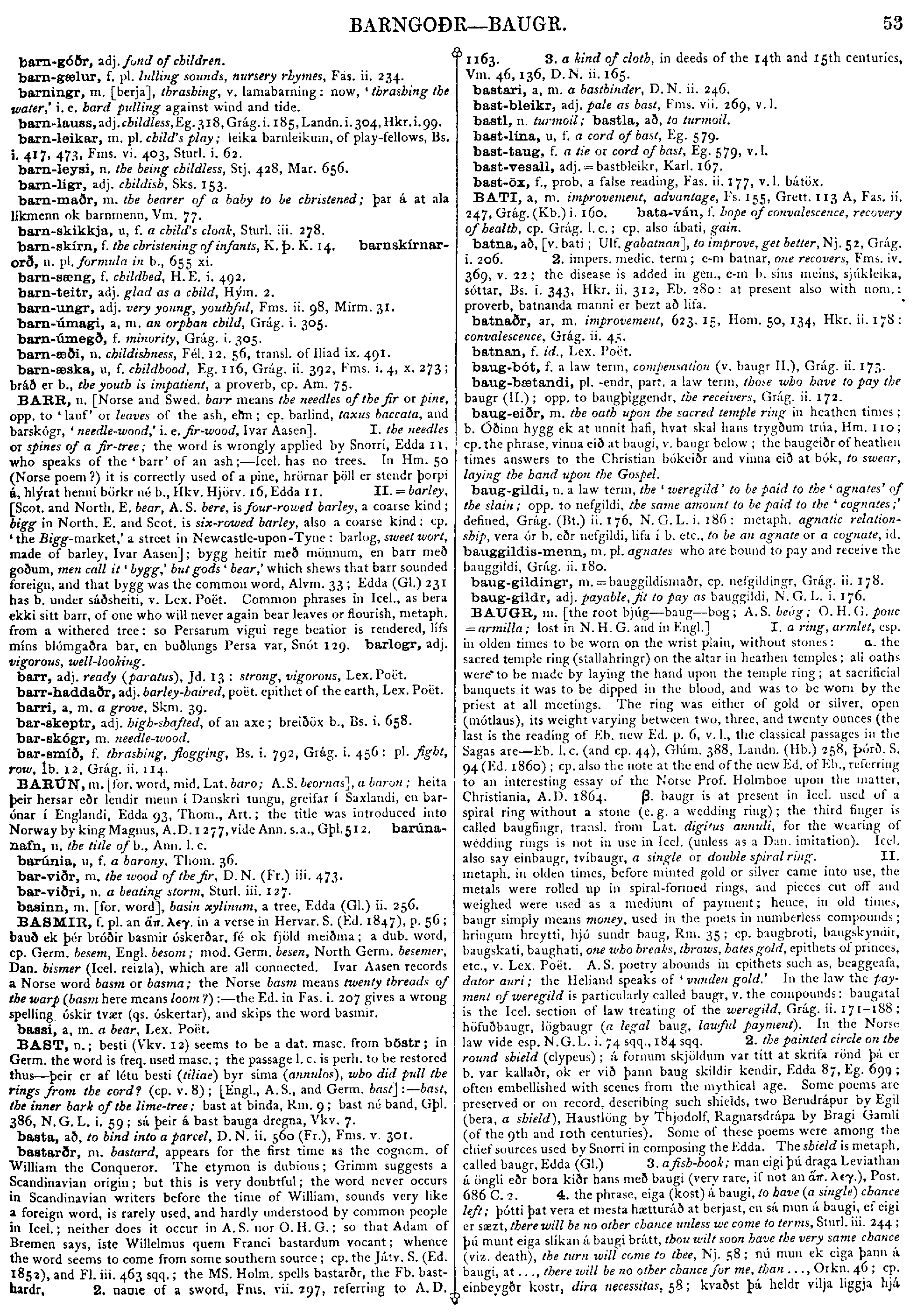
BAUGR, m. [the root bjiig -- bang -- bog; A. S. beág; O. ll. G. pottc = armilla; lost in N. H. G. and in Engl.] I. a ring, armlet, esp. in olden times to be worn on the wrist plain, without stones: o. the sacred temple ring (stallahringr) on the altar in heathen temples; all oaths were' to be made by laying the hand upon the temple ring; at sacrificial banquets it was to be dipped in the blood, and was to be worn by the priest at all meetings. The ring was either of gold or silver, open (mótlaus), its weight varying between two, three, and twenty ounces (the last is the reading of Eb. new Ed. p. 6, v. 1., the classical passages in the Sagas are -- Eb. I. e. (and cp. 44), Glúm. 388, Landn. (Hb.) 258, þórð. S. 94 (Ed. 1860); cp. also the note at the end of the new Ed. of Eb., referring to an interesting essay of the Norse Prof. Holmboe upon the matter, Christiania, A. D. 1864. p. baugr is at present in Icel. used of a spiral ring without a stone (e. g. a wedding ring); the third finger is called baugfingr, transl. from Lat. digitus annuli, for the wearing of wedding rings is not in use in Icel. (unless as a Dan. imitation). Icel. also say einbaugr, tvibaugr, a single or double spiral ring. II. metaph. in olden times, before minted gold or silver came into use, the metals were rolled up in spiral-formed rings, and pieces cut off and weighed were used as a medium of payment; hence, in old times, baugr simply means money, used in the poets in numberless compounds; hringum hreytti, hjó sundr baug, Rm. 35; cp. baugbroti, baugskyndir, baugskati, baughati, one who breaks, throws, hates gold, epithets of princes, etc., v. Lex. Poët. A. S. poetry abounds in epithets such as, beaggeafa, dator awri; the Heliand speaks of ' vunden gold. ' In the law the pay- ment of weregild is particularly called baugr, v. the compounds: baugatal is the Icel. section of law treating of the weregild, Grág. ii. 171-188; höfuôbaugr, lögbaugr (a le^ al bang, lawful payment). In the Norse law vide esp. N. G. L. i. 74 sqq., 184 sqq. 2. the painted circle on the round shield (clypeus); á fornum skjoldum var titt at skrifa rönd þá er b. var kallaðr, ok er við þann baug skildir kendir, Edda 87, Eg. 699; often embellished with scenes from the mythical age. Some poems arc preserved or on record, describing such shields, two Berudrapur by Egil (bera, a shield), Haustlong by Thjodolf, R. agnarsdrapa by Bragi Gamli (of the 9th and loth centuries). Some of these poems were among the chief sources used by Snorri in composing the Edda. The shield is metaph. called baugr, Edda (Gl.) 3. afish-hook; man eigi þú draga Leviathan á öngli eðr bora kiðr hans með baugi (very rare, if not an air. Ae-y.), Post. 686 C. ?. 4. the phrase, eiga (kost) a baugi, to have (a single) chance left; þótti þat vera et mesta hætturáð at berjast, en sá mun á baugi, ef eigi er szzt, there will be no other chance unless we come to terms, Sturl. iii. 244; þii munt eiga slíkan á baugi bratt, th o?/ wilt soon have the very same chance (viz. death), the turn will come to thee, Nj. 58; mi mun ek eiga þann á baugi, at..., there will be no other chance for me, than ..., Orkn. 46; cp. einbeygðr kostr, dira necessitas, 58; kvaðst þá lieldr vilja liggja
|
Source: Cleasby/Vigfusson, page b0056, entry 31 View original page image as: [TIFF] [PNG] [View previous entry] [View next entry] |
[Comment on this entry] [View comments] |
The following entry has not been hand-corrected. However, the page is reserved and someone is correcting it. |
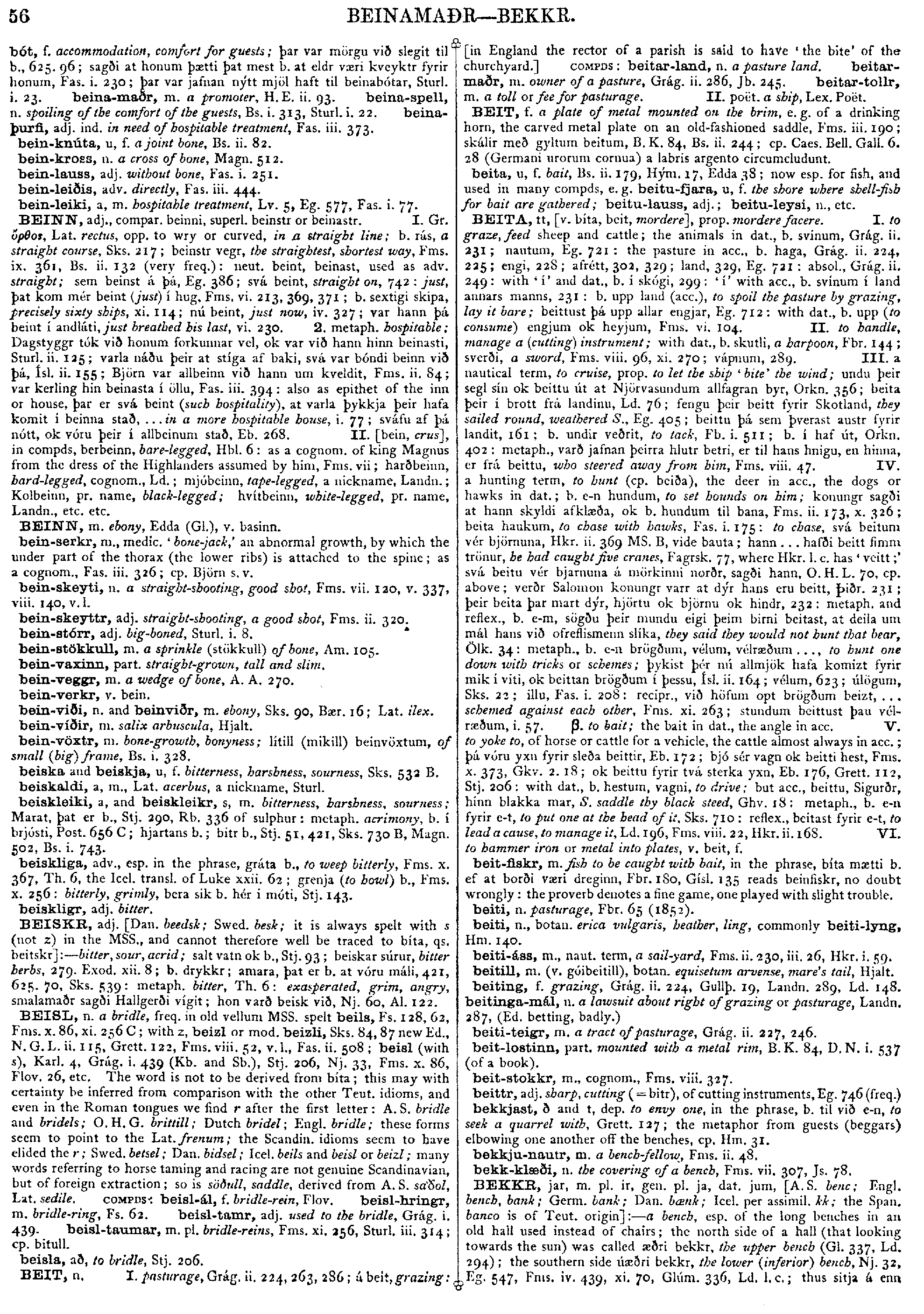
BEITA, tt, [v. bita, beit, mordere], prop, mordere facer e. I. t o graze, feed sheep and cattle; the animals in dat., b. svínum, Grág. ii. 231; nautum, Eg. 721: the pasture in acc., b. haga, Grág. ii. 224, 225; engi, 228; afrétt, 302, 329; land, 329, Eg. 721: absol., Grág. ii. 249: with ' i' and dat., b. í skógi, 299: ' í' with acc., b. svínum í land annars manns, 231: b. upp land (acc.), t o s poil the pasture by grazing, lay it bare; beittust þá upp allar engjar, Eg. 712: with dat., b. upp (t o consume) engjum ok heyjum, Fms. vi. 104. II. to handle, manage a (cutting) instrument; with dat., b. skutli, a harpoon, Fbr. 144; sverði, a sword, Fms. viii. 96, xi. 270; vápnum, 289. III. a nautical term, to cruise, prop, to let the ship 'bite' the wind; undu þeir segl sin ok beittu út at Njcirvasundum allfagran byr, Orkn. 356; beita þeir í brott frá landinu, Ld. 76; fengu þeir beitt fyrir Skotland, the y sailed round, weathered S., Eg. 405; beittu þá sem þverast austr fyrir landit, 161; b. undir veðrit, to tack, Vb. i. 511; b. í haf út, Orkn. 402: metaph., varð jafnan þeirra hlutr betri, er til hans hnigu, en hinna, er frá beittu, who steered away from him, Fms. viii. 47. IV. a hunting term, to bunt (cp. bciða), the deer in acc., the dogs or hawks in dat.; b. e-n hundum, to set hounds on him; konungr sagði at hann skyldi afklæða, ok b. hundum til bana, Fms. ii. 173, x. 326; beita haukum, to chase with hawks, Fas. 1. 175: to chase, svá beitum vér björnuna, Hkr. ii. 369 MS. B, vide bauta; hann ... hafði beitt fimm trönur, be had caught Jîve cranes, Fagrsk. 77, where Hkr. 1. c. has ' veitt;' svá beitu vér bjarnuna á mörkinni norðr, sagði hann, O. H. L. 70, cp. above; verðr Salomon konungr varr at dýr hans eru beitt, biðr. 231; þeir beita bar mart dýr, hjörtu ok bjornu ok hindr, 232: metaph. and reflex., b. e-m, sögðu þeir mundu eigi þeim birni bcitast, at deila um mál hans við ofreflismenn slika, the y sa id the y would not bunt that bear, 01k. 34: metaph., b. e-n brügðum, vélum, vólræðum..., to hunt one down with tricks or schemes; þykist þér nú allmjök hafa komizt fyrir mik í viti, ok beittan brögðum í þessu, Ísl. ii. 164; vélum, 623; lilögum, Sks. 22; illu, Fas. i. 208: recipr., við höfum opt brögðum beizt, ... schemed against each other, Fms. xi. 263; stundum beittust þau vel- ræðum, i. 57. p. to bait; the bait in dat., the angle in acc. V. to yoke to, of horse or cattle for a vehicle, the cattle almost always in acc.; þá vóru yxn fyrir sleða beittir, Eb. 172; bjó sér vagn ok beitti hest, Fms. x. 373, Gkv. 2. 18; ok beittu fyrir tvá sterka yxn, Eb. 176, Grett. 112, Stj. 206: with dat., b. hestum, vagni, to drive; but acc., beittu, Sigurðr, hinn blakka mar, S. saddle thy black steed, Ghv. 18: metaph., b. e-n fyrir e-t, to pwto ne at the head of it, Sks. 710: reflex., beitast fyrir e-t, t o lead a cause, to manage it, Ld. 196, Fms. viii. 22, Hkr. ii. 168. VI. to hammer iron or metal intoplates, v. beit,
|
Source: Cleasby/Vigfusson, page b0059, entry 1 View original page image as: [TIFF] [PNG] [View previous entry] [View next entry] |
[Comment on this entry] [View comments] |
The following entry has been hand-corrected once. |
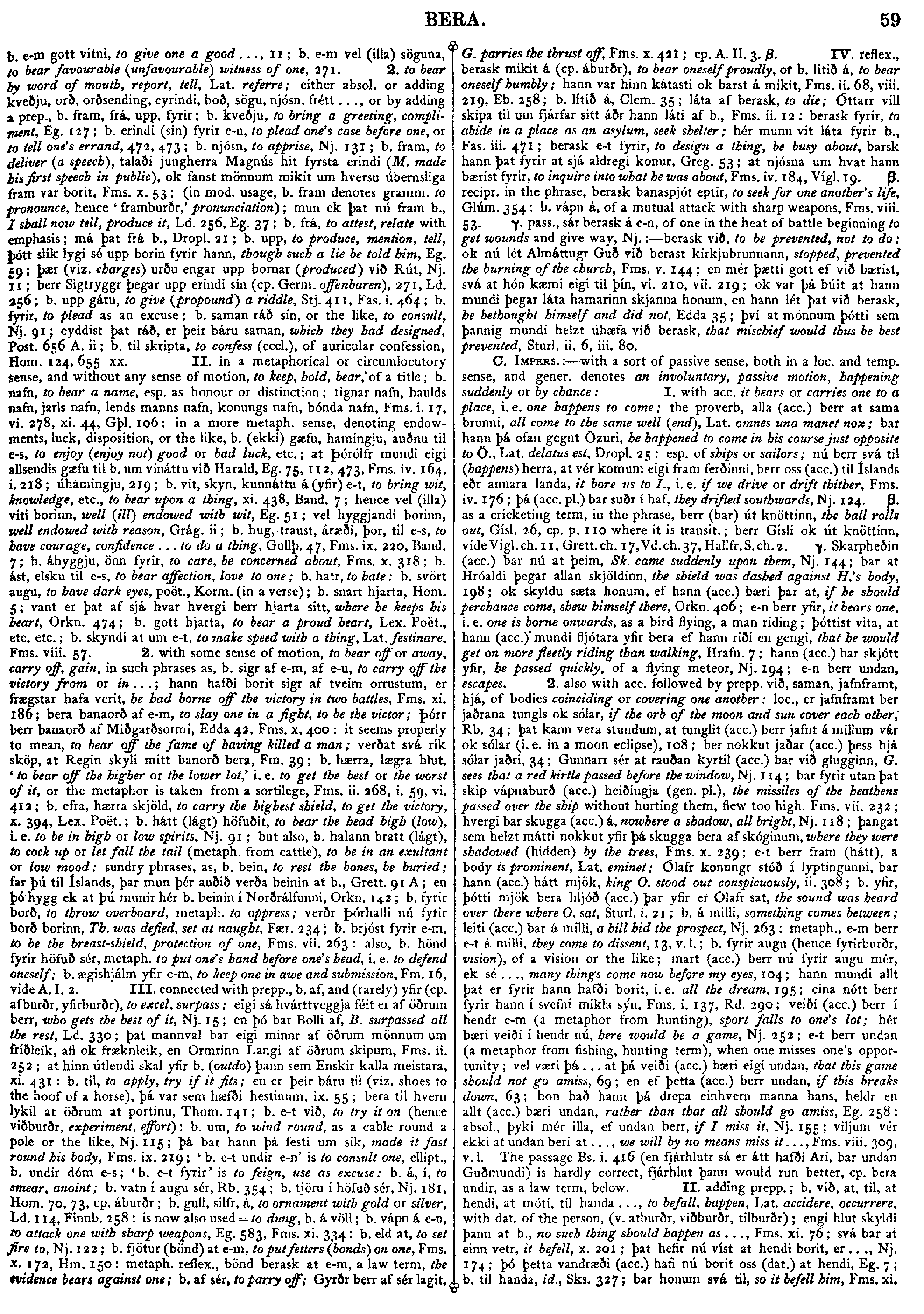
b.
e-m
gott
vitni,
to
give
one
a
good...,
11;
b.
e-m
vel
(illa)
söguna,
to
bear
favourable
(unfavourable)
witness
of
one,
271.
2.
to
bear
by
word
of
mouth,
report,
tell,
Lat.
referre;
either
absol.
or
adding
kveðju,
orð,
orðsending,
eyrindi,
boð,
sögu,
njósn,
frétt...,
or
by
adding
a
prep.,
b.
fram,
frá,
upp,
fyrir;
b.
kveðju,
to
bring
a
greeting,
compliment,
Eg.
127;
b.
erindi
(sín)
fyrir
e-n,
to
plead
one's
case
before
one,
or
to
tell
one's
errand,
472,
473;
b.
njósn,
to
apprise,
Nj.
131;
b.
fram,
to
deliver
(a
speech),
talaði
jungherra
Magnús
hit
fyrsta
erindi
(M.
made
his
first
speech
in
public),
ok
fanst
mönnum
mikit
um
hversu
úbernsliga
fram
var
borit,
Fms.
x.
53;
(in
mod.
usage,
b.
fram
denotes
gramm.
to
pronounce,
hence
'framburðr,'
pronunciation);
mun
ek
þat
nú
fram
b.,
I
shall
now
tell,
produce
it,
Ld.
256,
Eg.
37;
b.
frá,
to
attest,
relate
with
emphasis;
má
þat
frá
b.,
Dropl.
21;
b.
upp,
to
produce,
mention,
tell,
þótt
slík
lygi
sé
upp
borin
fyrir
hann,
though
such
a
lie
be
told
him,
Eg.
59;
þær
(viz.
charges)
urðu
engar
upp
bornar
(produced)
við
Rút,
Nj.
11;
berr
Sigtryggr
þegar
upp
erindi
sín
(cp.
Germ.
ojfenbaren),
271,
Ld.
256;
b.
upp
gátu,
to
give
(propound)
a
riddle,
Stj.
411,
Fas.
i.
464;
b.
fyrir,
to
plead
as
an
excuse;
b.
saman
ráð
sín,
or
the
like,
to
consult,
Nj.
91;
eyddist
þat
ráð,
er
þeir
báru
saman,
which
they
had
designed,
Post.
656
A.
ii;
b.
til
skripta,
to
confess
(eccl.),
of
auricular
confession,
Hom.
124,
655
xx.
II.
in
a
metaphorical
or
circumlocutory
sense,
and
without
any
sense
of
motion,
to
keep,
hold,
bear,
of
a
title;
b.
nafn,
to
bear
a
name,
esp.
as
honour
or
distinction;
tignar
nafn,
haulds
nafn,
jarls
nafn,
lends
manns
nafn,
konungs
nafn,
bónda
nafn,
Fms.
i.
17,
vi.
278,
xi.
44,
Gþl.
106:
in
a
more
metaph.
sense,
denoting
endowments,
luck,
disposition,
or
the
like,
b.
(ekki)
gæfu,
hamingju,
auðnu
til
e-s,
to
enjoy
(enjoy
not)
good
or
bad
luck,
etc.;
at
Þórólfr
mundi
eigi
allsendis
gæfu
til
b.
um
vináttu
við
Harald,
Eg.
75,
112,
473,
Fms.
iv.
164,
i.
218;
úhamingju,
219;
b.
vit,
skyn,
kunnáttu
á
(yfir)
e-t,
to
bring
wit,
knowledge,
etc.,
to
bear
upon
a
thing,
xi.
438,
Band.
7;
hence
vel
(illa)
viti
borinn,
well
(ill)
endowed
with
wit,
Eg.
51;
vel
hyggjandi
borinn,
well
endowed
with
reason,
Grág.
ii;
b.
hug,
traust,
áræði,
þor,
til
e-s,
to
have
courage,
confidence
...
to
do
a
thing,
Gullþ.
47,
Fms.
ix.
220,
Band.
7;
b.
áhyggju,
önn
fyrir,
to
care,
be
concerned
about,
Fms.
x.
318;
b.
ást,
elsku
til
e-s,
to
bear
affection,
love
to
one;
b.
hatr,
to
hate:
b.
svört
augu,
to
have
dark
eyes,
poët.,
Korm.
(in
a
verse);
b.
snart
hjarta,
Hom.
5;
vant
er
þat
af
sjá
hvar
hvergi
berr
hjarta
sitt,
where
he
keeps
his
heart,
Orkn.
474;
b.
gott
hjarta,
to
bear
a
proud
heart,
Lex.
Poët.,
etc.
etc.;
b.
skyndi
at
um
e-t,
to
make
speed
with
a
thing,
Lat.
festinare,
Fms.
viii.
57.
2.
with
some
sense
of
motion,
to
bear
off
or
away,
carry
off,
gain,
in
such
phrases
as,
b.
sigr
af
e-m,
af
e-u,
to
carry
off
the
victory
from
or
in
...;
hann
hafði
borit
sigr
af
tveim
orrustum,
er
frægstar
hafa
verit,
he
had
borne
off
the
victory
in
two
battles,
Fms.
xi.
186;
bera
banaorð
af
e-m,
to
slay
one
in
a
fight,
to
be
the
victor;
Þorr
berr
banaorð
af
Miðgarðsormi,
Edda
42,
Fms.
x.
400:
it
seems
properly
to
mean,
to
bear
off
the
fame
of
having
killed
a
man;
verðat
svá
rík
sköp,
at
Regin
skyli
mitt
banorð
bera,
Fm.
39;
b.
hærra,
lægra
hlut,
'to
bear
off
the
higher
or
the
lower
lot,'
i.
e.
to
get
the
best
or
the
worst
of
it,
or
the
metaphor
is
taken
from
a
sortilege,
Fms.
ii.
268,
i.
59,
vi.
412;
b.
efra,
hærra
skjöld,
to
carry
the
highest
shield,
to
get
the
victory,
x.
394,
Lex.
Poët.;
b.
hátt
(lágt)
höfuðit,
to
bear
the
head
high
(low),
i.
e.
to
be
in
high
or
low
spirits,
Nj.
91;
but
also,
b.
halann
bratt
(lágt),
to
cock
up
or
let
fall
the
tail
(metaph.
from
cattle),
to
be
in
an
exultant
or
low
mood:
sundry
phrases,
as,
b.
bein,
to
rest
the
bones,
be
buried;
far
þú
til
Íslands,
þar
mun
þér
auðið
verða
beinin
at
b.,
Grett.
91
A;
en
þó
hygg
ek
at
þú
munir
hér
b.
beinin
í
Norðrálfunni,
Orkn.
142;
b.
fyrir
borð,
to
throw
overboard,
metaph.
to
oppress;
verðr
Þórhalli
nú
fyrir
borð
borinn,
Th.
was
defied,
set
at
naught,
Fær.
234;
b.
brjóst
fyrir
e-m,
to
be
the
breast-shield,
protection
of
one,
Fms.
vii.
263:
also,
b.
hönd
fyrir
höfuð
sér,
metaph.
to
put
one's
hand
before
one's
head,
i.
e.
to
defend
oneself;
b.
ægishjálm
yfir
e-m,
to
keep
one
in
awe
and
submission,
Fm.
16,
vide
A.
I.
2.
III.
connected
with
prepp.,
b.
af,
and
(rarely)
yfir
(cp.
afburðr,
yfirburðr),
to
excel,
surpass;
eigi
sá
hvárttveggja
féit
er
af
öðrum
berr,
who
gets
the
best
of
it,
Nj.
15;
en
þó
bar
Bolli
af,
B.
surpassed
all
the
rest,
Ld.
330;
þat
mannval
bar
eigi
minnr
af
öðrum
mönnum
um
fríðleik,
afi
ok
fræknleik,
en
Ormrinn
Langi
af
öðrum
skipum,
Fms.
ii.
252;
at
hinn
útlendi
skal
yfir
b.
(outdo)
þann
sem
Enskir
kalla
meistara,
xi.
431:
b.
til,
to
apply,
try
if
it
fits;
en
er
þeir
báru
til
(viz.
shoes
to
the
hoof
of
a
horse),
þá
var
sem
hæfði
hestinum,
ix.
55;
bera
til
hvern
lykil
at
öðrum
at
portinu,
Thom.
141;
b.
e-t
við,
to
try
it
on
(hence
viðburðr,
experiment,
effort):
b.
um,
to
wind
round,
as
a
cable
round
a
pole
or
the
like,
Nj.
115;
þá
bar
hann
þá
festi
um
sik,
made
it
fast
round
his
body,
Fms.
ix.
219;
'b.
e-t
undir
e-n'
is
to
consult
one,
ellipt.,
b.
undir
dóm
e-s;
'b.
e-t
fyrir'
is
to
feign,
use
as
excuse:
b.
á,
í,
to
smear,
anoint;
b.
vatn
í
augu
sér,
Rb.
354;
b.
tjöru
í
höfuð
sér,
Nj.
181,
Hom.
70,
73,
cp.
áburðr;
b.
gull,
silfr,
á,
to
ornament
with
gold
or
silver,
Ld.
114,
Finnb.
258:
is
now
also
used
=
to
dung,
b.
á
völl;
b.
vápn
á
e-n,
to
attack
one
with
sharp
weapons,
Eg.
583,
Fms.
xi.
334:
b.
eld
at,
to
set
fire
to,
Nj.
122;
b.
fjötur
(bönd)
at
e-m,
to
put
fetters
(bonds)
on
one,
Fms.
x.
172,
Hm.
150:
metaph.
reflex.,
bönd
berask
at
e-m,
a
law
term,
the
evidence
bears
against
one;
b.
af
sér,
to
parry
off;
Gyrðr
berr
af
sér
lagit,
G.
parries
the
thrust
off,
Fms.
x.
421;
cp.
A.
II.
3.
.
IV.
reflex.,
berask
mikit
á
(cp.
áburðr),
to
bear
oneself
proudly,
or
b.
lítið
á,
to
bear
oneself
humbly;
hann
var
hinn
kátasti
ok
barst
á
mikit,
Fms.
ii.
68,
viii.
219,
Eb.
258;
b.
lítið
á,
Clem.
35;
láta
af
berask,
to
die;
Óttarr
vill
skipa
til
um
fjárfar
sitt
áðr
hann
láti
af
b.,
Fms.
ii.
12:
berask
fyrir,
to
abide
in
a
place
as
an
asylum,
seek
shelter;
hér
munu
vit
láta
fyrir
b.,
Fas.
iii.
471;
berask
e-t
fyrir,
to
design
a
thing,
be
busy
about,
barsk
hann
þat
fyrir
at
sjá
aldregi
konur,
Greg.
53;
at
njósna
um
hvat
hann
bærist
fyrir,
to
inquire
into
what
he
was
about,
Fms.
iv.
184,
Vígl.
19.
.
recipr.
in
the
phrase,
berask
banaspjót
eptir,
to
seek
for
one
another's
life,
Glúm.
354:
b.
vápn
á,
of
a
mutual
attack
with
sharp
weapons,
Fms.
viii.
53.
.
pass.,
sár
berask
á
e-n,
of
one
in
the
heat
of
battle
beginning
to
get
wounds
and
give
way,
Nj.
:--
berask
við,
to
be
prevented,
not
to
do;
ok
nú
lét
Almáttugr
Guð
við
berast
kirkjubrunnann,
stopped,
prevented
the
burning
of
the
church,
Fms.
v.
144;
en
mér
þætti
gott
ef
við
bærist,
svá
at
hón
kæmi
eigi
til
þín,
vi.
210,
vii.
219;
ok
var
þá
búit
at
hann
mundi
þegar
láta
hamarinn
skjanna
honum,
en
hann
lét
þat
við
berask,
he
bethought
himself
and
did
not,
Edda
35;
því
at
mönnum
þótti
sem
þannig
mundi
helzt
úhæfa
við
berask,
that
mischief
would
thus
be
best
prevented,
Sturl.
ii.
6,
iii.
80.
C.
IMPERS.
:--
with
a
sort
of
passive
sense,
both
in
a
loc.
and
temp.
sense,
and
gener.
denotes
an
involuntary,
passive
motion,
happening
suddenly
or
by
chance:
I.
with
acc.
it
bears
or
carries
one
to
a
place,
i.
e.
one
happens
to
come;
the
proverb,
alla
(acc.)
berr
at
sama
brunni,
all
come
to
the
same
well
(end),
Lat.
omnes
una
manet
nox;
bar
hann
þá
ofan
gegnt
Özuri,
he
happened
to
come
in
his
course
just
opposite
to
Ö.,
Lat.
delatus
est,
Dropl.
25:
esp.
of
ships
or
sailors;
nú
berr
svá
til
(happens)
herra,
at
vér
komum
eigi
fram
ferðinni,
berr
oss
(acc.)
til
Íslands
eðr
annara
landa,
it
bore
us
to
I.,
i.
e.
if
we
drive
or
drift
thither,
Fms.
iv.
176;
þá
(acc.
pl.)
bar
suðr
í
haf,
they
drifted
southwards,
Nj.
124.
.
as
a
cricketing
term,
in
the
phrase,
berr
(bar)
út
knöttinn,
the
ball
rolls
out,
Gísl.
26,
cp.
p.
110
where
it
is
transit.;
berr
Gísli
ok
út
knöttinn,
vide
Vígl.
ch.
11,
Grett.
ch.
17,
Vd.
ch.
37,
Hallfr.
S.
ch.
2.
.
Skarpheðin
(acc.)
bar
nú
at
þeim,
Sk.
came
suddenly
upon
them,
Nj.
144;
bar
at
Hróaldi
þegar
allan
skjöldinn,
the
shield
was
dashed
against
H.'s
body,
198;
ok
skyldu
sæta
honum,
ef
hann
(acc.)
bæri
þar
at,
if
he
should
per
chance
come,
shew
himself
there,
Orkn.
406;
e-n
berr
yfir,
it
bears
one,
i.
e.
one
is
borne
onwards,
as
a
bird
flying,
a
man
riding;
þóttist
vita,
at
hann
(acc.)
mundi
fljótara
yfir
bera
ef
hann
riði
en
gengi,
that
he
would
get
on
more
fleetly
riding
than
walking,
Hrafn.
7;
hann
(acc.)
bar
skjótt
yfir,
he
passed
quickly,
of
a
flying
meteor,
Nj.
194;
e-n
berr
undan,
escapes.
2.
also
with
acc.
followed
by
prepp.
við,
saman,
jafnframt,
hjá,
of
bodies
coinciding
or
covering
one
another:
loc.,
er
jafnframt
ber
jaðrana
tungls
ok
sólar,
if
the
orb
of
the
moon
and
sun
cover
each
other,
Rb.
34;
þat
kann
vera
stundum,
at
tunglit
(acc.)
berr
jafht
á
millum
vár
ok
sólar
(i.
e.
in
a
moon
eclipse),
108;
ber
nokkut
jaðar
(acc.)
þess
hjá
sólar
jaðri,
34;
Gunnarr
sér
at
rauðan
kyrtil
(acc.)
bar
við
glugginn,
G.
sees
that
a
red
kirtle
passed
before
the
window,
Nj.
114;
bar
fyrir
utan
þat
skip
vápnaburð
(acc.)
heiðingja
(gen.
pl.),
the
missiles
of
the
heathens
passed
over
the
ship
without
hurting
them,
flew
too
high,
Fms.
vii.
232;
hvergi
bar
skugga
(acc.)
á,
nowhere
a
shadow,
all
bright,
Nj.
118;
þangat
sem
helzt
mátti
nokkut
yfir
þá
skugga
bera
af
skóginum,
where
they
were
shadowed
(hidden)
by
the
trees,
Fms.
x.
239;
e-t
berr
fram
(hátt),
a
body
is
prominent,
Lat.
eminet;
Ólafr
konungr
stóð
í
lyptingunni,
bar
hann
(acc.)
hátt
mjök,
king
O.
stood
out
conspicuously,
ii.
308;
b.
yfir,
þótti
mjök
bera
hljóð
(acc.)
þar
yfir
er
Ólafr
sat,
the
sound
was
heard
over
there
where
O.
sat,
Sturl.
i.
21;
b.
á
milli,
something
comes
between;
leiti
(acc.)
bar
á
milli,
a
hill
hid
the
prospect,
Nj.
263:
metaph.,
e-m
berr
e-t
á
milli,
they
come
to
dissent,
13,
v.
1.;
b.
fyrir
augu
(hence
fyrirburðr,
vision),
of
a
vision
or
the
like;
mart
(acc.)
berr
nú
fyrir
augu
mér,
ek
sé
...,
many
things
come
now
before
my
eyes,
104;
hann
mundi
allt
þat
er
fyrir
hann
hafði
borit,
i.
e.
all
the
dream,
195;
eina
nótt
berr
fyrir
hann
í
svefni
mikla
sýn,
Fms.
i.
137,
Rd.
290;
veiði
(acc.)
berr
í
hendr
e-m
(a
metaphor
from
hunting),
sport
falls
to
one's
lot;
hér
bæri
veiði
í
hendr
nú,
here
would
be
a
game,
Nj.
252;
e-t
berr
undan
(a
metaphor
from
fishing,
hunting
term),
when
one
misses
one's
opportunity;
vel
væri
þá
...
at
þá
veiði
(acc.)
bæri
eigi
undan,
that
this
game
should
not
go
amiss,
69;
en
ef
þetta
(acc.)
berr
undan,
if
this
breaks
down,
63;
hon
bað
hann
þá
drepa
einhvern
manna
hans,
heldr
en
allt
(acc.)
bæri
undan,
rather
than
that
all
should
go
amiss,
Eg.
258:
absol.,
þyki
mér
illa,
ef
undan
berr,
if
I
miss
it,
Nj.
155;
viljum
vér
ekki
at
undan
beri
at...,
we
will
by
no
means
miss
it...,
Fms.
viii.
309,
v.
1.
The
passage
Bs.
i.
416
(en
fjárhlutr
sá
er
átt
hafði
Ari,
bar
undan
Guðmundi)
is
hardly
correct,
fjárhlut
þann
would
run
better,
cp.
bera
undir,
as
a
law
term,
below.
II.
adding
prepp.;
b.
við,
at,
til,
at
hendi,
at
móti,
til
handa
...,
to
befall,
happen,
Lat.
accidere,
occurrere,
with
dat.
of
the
person,
(v.
atburðr,
viðburðr,
tilburðr);
engi
hlut
skyldi
þann
at
b.,
no
such
thing
should
happen
as...,
Fms.
xi.
76;
svá
bar
at
einn
vetr,
it
befell,
x.
201;
þat
hefir
nú
víst
at
hendi
borit,
er...,
Nj.
174;
þó
þetta
vandræði
(acc.)
hafi
nú
borit
oss
(dat.)
at
hendi,
Eg.
7;
b.
til
handa,
id.,
Sks.
327;
bar
honum
svá
til,
so
it
befell
him,
Fms.
| Result Page: |  |
Previous | 12 13 14 15 16 17 18 19 20 21 22 23 24 25 26 27 28 29 30 | Next |  |
Germanic Lexicon Project (main page)
This search system was written by
Sean Crist
Please consider
volunteering
to correct the data in these online dictionaries.
No rights reserved. Feel free to use these data in any way you please.