|
|

|
Source: Cleasby/Vigfusson, page b0413, entry 25 View original page image as: [TIFF] [PNG] [View previous entry] [View next entry] |
[Comment on this entry] [View comments] |
The following entry has been hand-corrected once. |
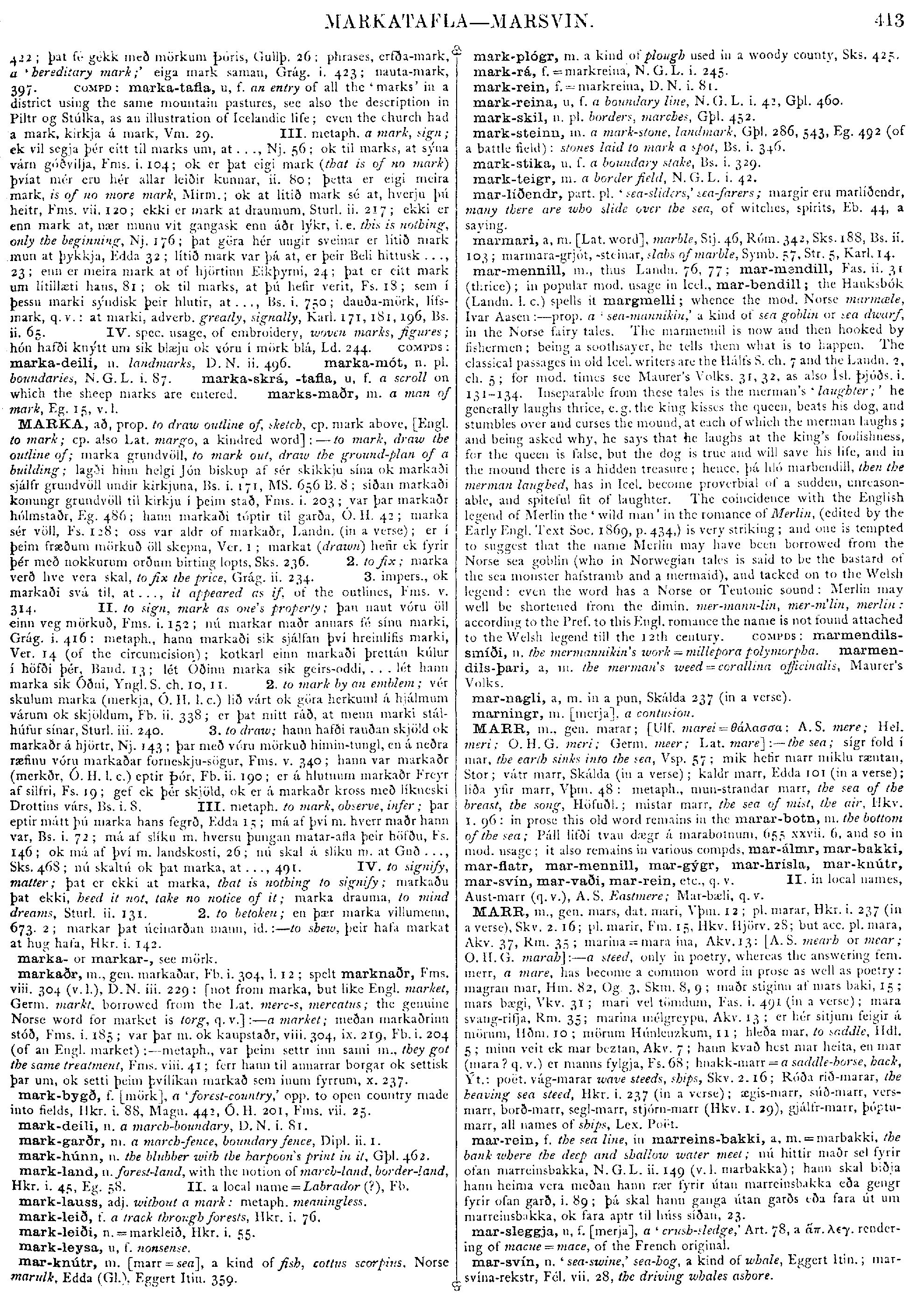
mar-mennill, m., thus Landn. 76, 77; mar-mandill, Fas. ii. 31 (thrice); in popular mod. usage in Icel., mar-bendill; the Hauksbok (Landn. l.c.) spells it margmelli; whence the mod. Norse marmæle, Ivar Aasen :-- prop. a 'sea-mannikin,' a kind ot sea goblin or sea dwarf, in the Norse fairy tales. The marmennil is now and then hooked by fishermen; being a soothsayer, he tells them what is to happen. The classical passages in oid Icel. writers are the Hálf's S. ch. 7 and the Landn. 2, ch. 5; for mod. times see Maurer's Volks. 31, 32, as also Ísl. Þjóðs. i. 131-134. Inseparable from these tales is the merman's 'laughter;' he generally laughs thrice, e.g. the king kisses the queen, beats his dog, and stumbles over and curses the mound, at each of which the merman laughs; and being asked why, he says that he laughs at the king's foolishness, for the queen is false, but the dog is true and will save his life, and in the mound there is a hidden treasure; hence, þá hló marbendill, then the merman laughed, has in Icel. become proverbial of a sudden, unreasonable, and spiteful fit of laughter. The coincidence with the English legend of Merlin the 'wild man' in the romance of Merlin, (edited by the Early Engl. Text Soc. 1869, p. 434,) is very striking; and one is tempted to suggest that the name Merlin may have been borrowed from the Norse sea goblin (who in Norwegian tales is said to be the bastard of the sea monster hafstramb and a mermaid), and tacked on to the Welsh legend: even the word has a Norse or Teutonic sound: Merlin may well be shortened from the dimin. mer-mann-lin, mer-m'lin, merlin: according to the Pref. to this Engl. romance the name is not found attached to the Welsh legend till the 12th century. COMPDS: marmendils-smíði, n. the mermannikins work = millepora polymorpha. marmendils-þari, a, m. the merman's weed = corallina officinalis, Maurer's Volks.
|
Source: Cleasby/Vigfusson, page b0444, entry 24 View original page image as: [TIFF] [PNG] [View previous entry] [View next entry] |
[Comment on this entry] [View comments] |
The following entry has been hand-corrected once. |
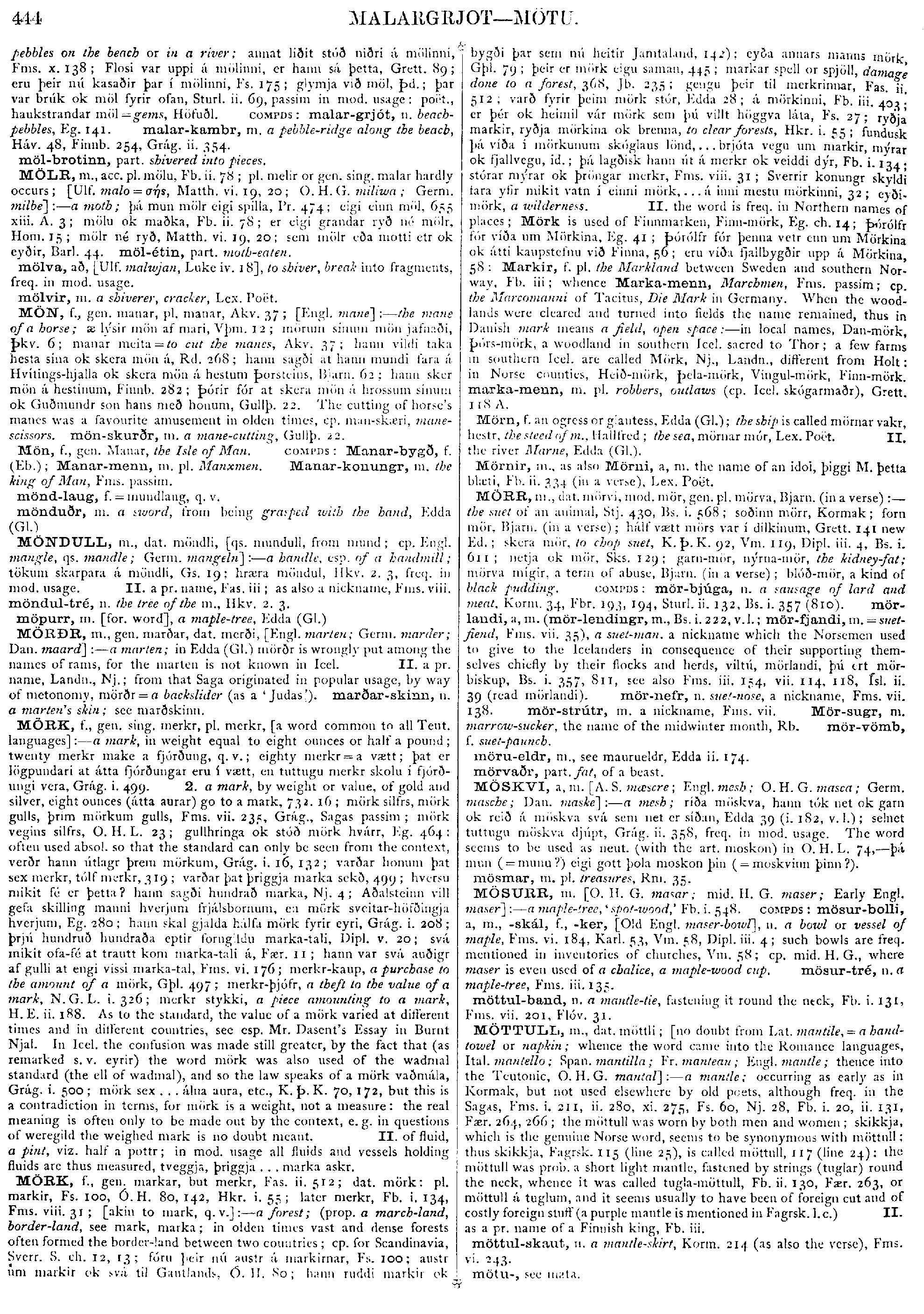
MÖTTULL, m., dat. möttli; [no doubt from Lat. mantile, = a hand-towel or napkin; whence the word came into the Romance languages, Ital. mantello; Span. mantilla; Fr. manteau; Engl. mantle; thence into the Teutonic, O.H.G. mantal] :-- a mantle; occurring as early as in Kormak, but not used elsewhere by old poets, although freq. in the Sagas, Fms. i. 211, ii. 280, xi. 275, Fs. 60, Nj. 28, Fb. i. 20, ii. 131, Fær. 264, 266; the möttull was worn by both men and women; skikkja, which is the genuine Norse word, seems to be synonymous with möttull; thus skikkja, Fagrsk. 115 (line 25), is called möttull, 117 (line 24): the möttull was prob. a short light mantle, fastened by strings (tuglar) round the neck, whence it was called tugla-möttull, Fb. ii. 130, Fær. 263, or möttull á tuglum, and it seems usually to have been of foreign cut and of costly foreign stuff (a purple mantle is mentioned in Fagrsk. l.c.) II. as a pr. name of a Finnish king, Fb. iii.
|
Source: Cleasby/Vigfusson, page b0477, entry 7 View original page image as: [TIFF] [PNG] [View previous entry] [View next entry] |
[Comment on this entry] [View comments] |
The following entry has been hand-corrected once. |
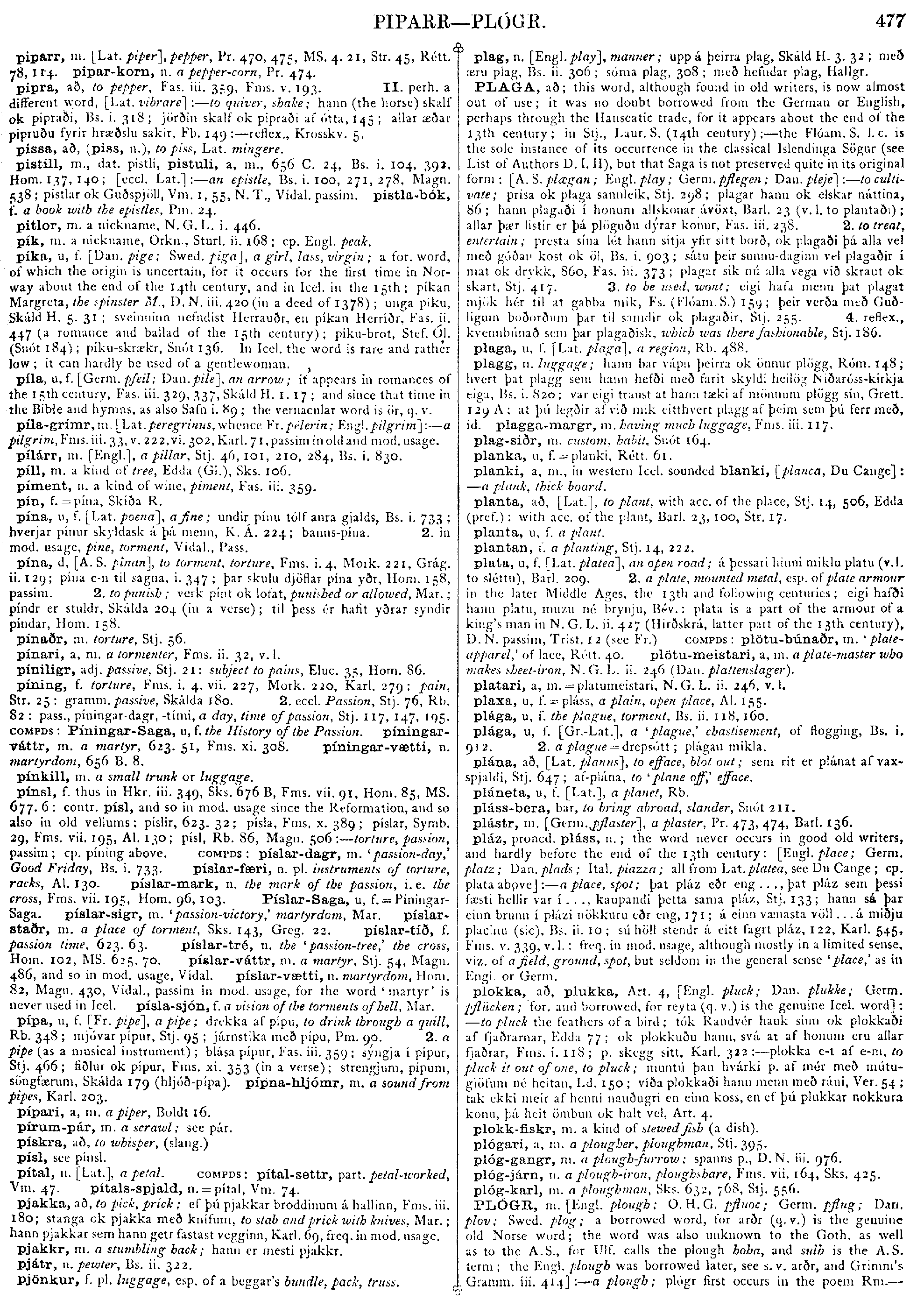
píka, u, f. [Dan. pige; Swed. piga], a girl, lass, virgin; a for. word, of which the origin is uncertain, for it occurs for the first time in Norway about the end of the 14th century, and in Icel. in the 15th; píkan Margreta, the spinster M., D.N. iii. 420 (in a deed of 1378); unga píku, Skáld H. 5. 31; sveinninn nefndist Herrauðr, en píkan Herríðr, Fas. ii. 447 (a romance and ballad of the 15th century); píku-brot, Stef. Ól. (Snót 184); píku-skrækr, Snót 136. In Icel. the word is rare and rather low; it can hardly be used of a gentlewoman.
|
Source: Cleasby/Vigfusson, page b0497, entry 3 View original page image as: [TIFF] [PNG] [View previous entry] [View next entry] |
[Comment on this entry] [View comments] |
The following entry has been hand-corrected once. |
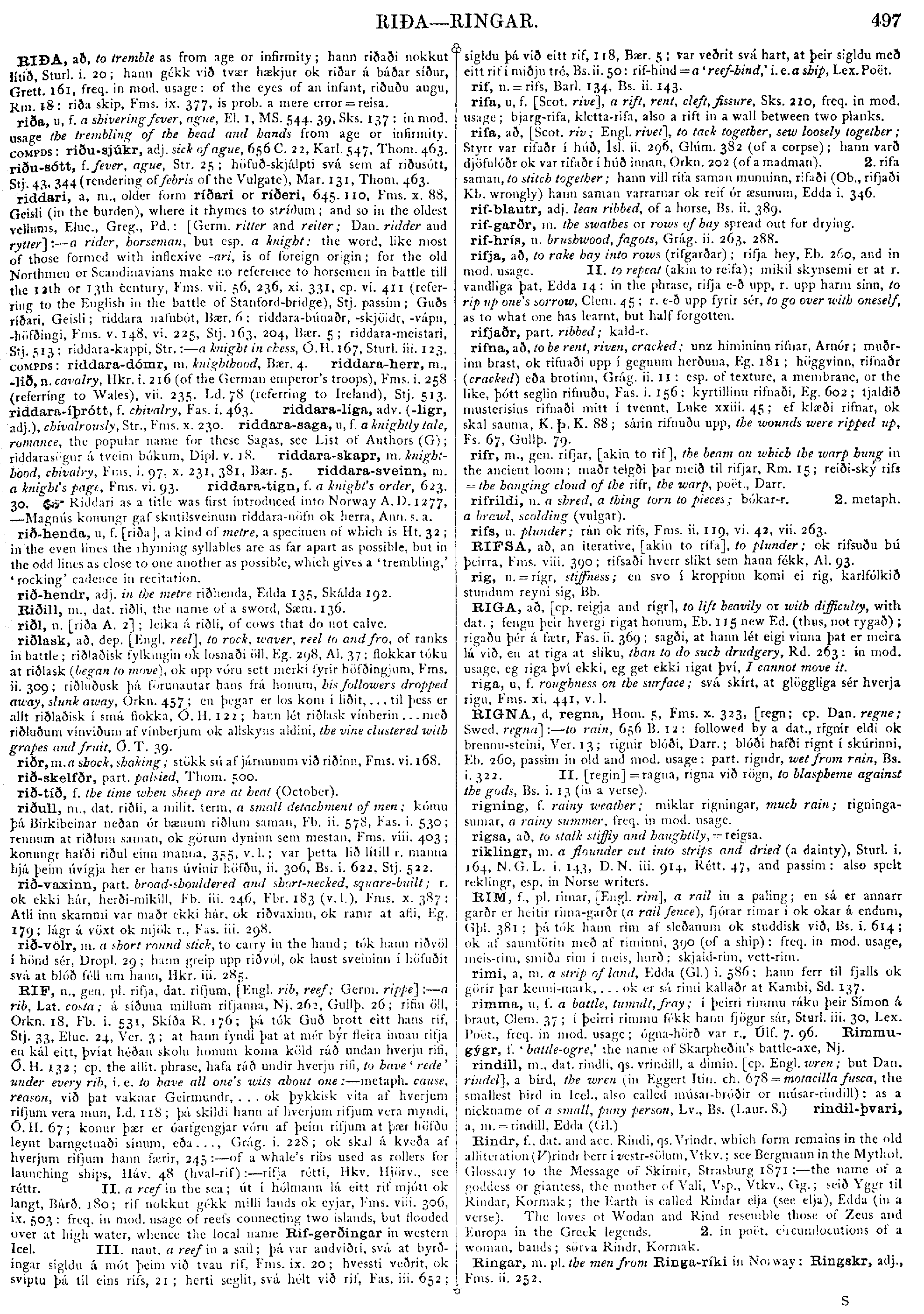
riddari, a, m., older form ríðari or ríðeri, 645. 110, Fms. x. 88, Geisli (in the burden), where it rhymes to striðum; and so in the oldest vellums, Eluc., Greg., Pd.: [Germ. ritter and reiter; Dan. ridder and rytter] :-- a rider, horseman, but esp. a knight: the word, like most of those formed with inflexive -ari, is of foreign origin; for the old Northmen or Scandinavians make no reference to horsemen in battle till the 12th or 13th century, Fms. vii. 56, 236, xi. 331, cp. vi. 411 (referring to the English in the battle of Stanford-bridge), Stj. passim; Guðs riðari, Geisli; riddara nafnbót, Bær. 6; riddara-búnaðr, -skjöldr, -vápn, -höfðingi, Fms. v. 148, vi. 225, Stj. 163, 204, Bær. 5; riddara-meistari, Stj. 513; riddara-kappi, Str. :-- a knight in chess, Ó.H. 167, Sturl. iii. 123. COMPDS: riddara-dómr, m. knighthood, Bær. 4. riddara-herr, m., -lið, n. cavalry, Hkr. i. 216 (of the German emperor's troops), Fms. i. 258 (referring to Wales), vii. 235, Ld. 78 (referring to Ireland), Stj. 513. riddara-íþrótt, f. chivalry. Fas. i. 463. riddara-liga, adv. (-ligr, adj.), chivalrously, Str., Fms. x. 230. riddara-saga, u, f. a knightly tale, romance, the popular name for these Sagas, see List of Authors (G); riddarasögur á tveim bókum, Dipl. v. 18. riddara-skapr, m. knighthood, chivalry, Fms. i. 97, x. 231, 381, Bær. 5. riddara-sveinn, m. a knight's page, Fms. vi. 93. riddara-tign, f. a knight's order, 623. 30. &FINGER; Riddari as a title was first introduced into Norway A.D. 1277, - Magnús konungr gaf skutilsveinum riddara-nöfn ok herra, Ann. s.a.
|
Source: Cleasby/Vigfusson, page b0500, entry 5 View original page image as: [TIFF] [PNG] [View previous entry] [View next entry] |
[Comment on this entry] [View comments] |
The following entry has been hand-corrected once. |
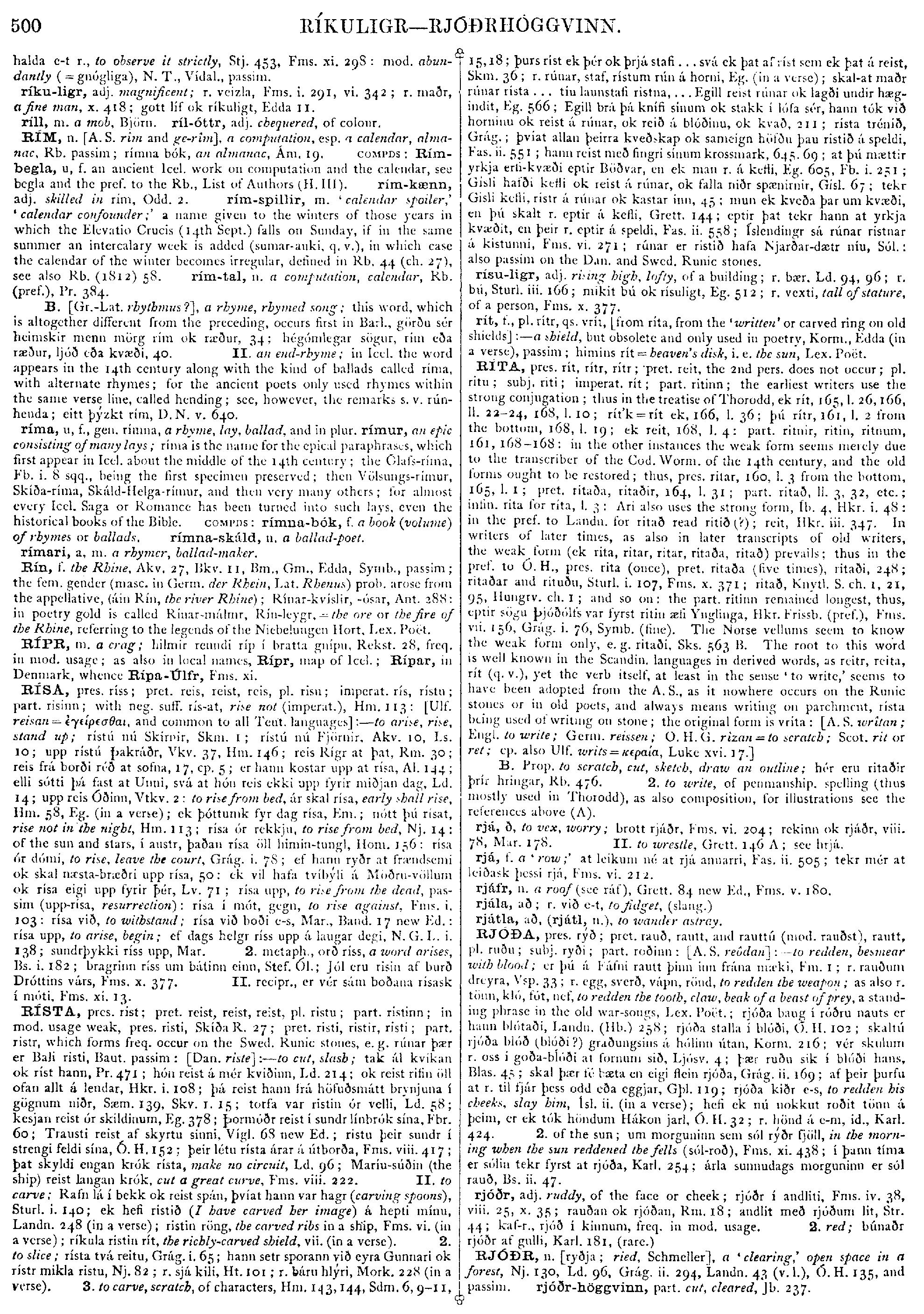
ríma, u, f., gen. rímna, a rhyme, lay, ballad, and in plur. rímur, an epic consisting of many lays; ríma is the name for the epical paraphrases, which first appear in Icel. about the middle of the 14th century; the Olafs-ríma, Fb. i. 8 sqq., being the first specimen preserved; then Völsungs-rímur, Skíða-ríma, Skáld-Helga-rímur, and then very many others; for almost every Icel. Saga or Romance has been turned into such lays, even the historical books of the Bible. COMPDS: rímna-bók, f. a book (volume)of rhymes, or ballads. rímna-skáld, n. a ballad-poet.
|
Source: Cleasby/Vigfusson, page b0532, entry 22 View original page image as: [TIFF] [PNG] [View previous entry] [View next entry] |
[Comment on this entry] [View comments] |
The following entry has been hand-corrected once. |
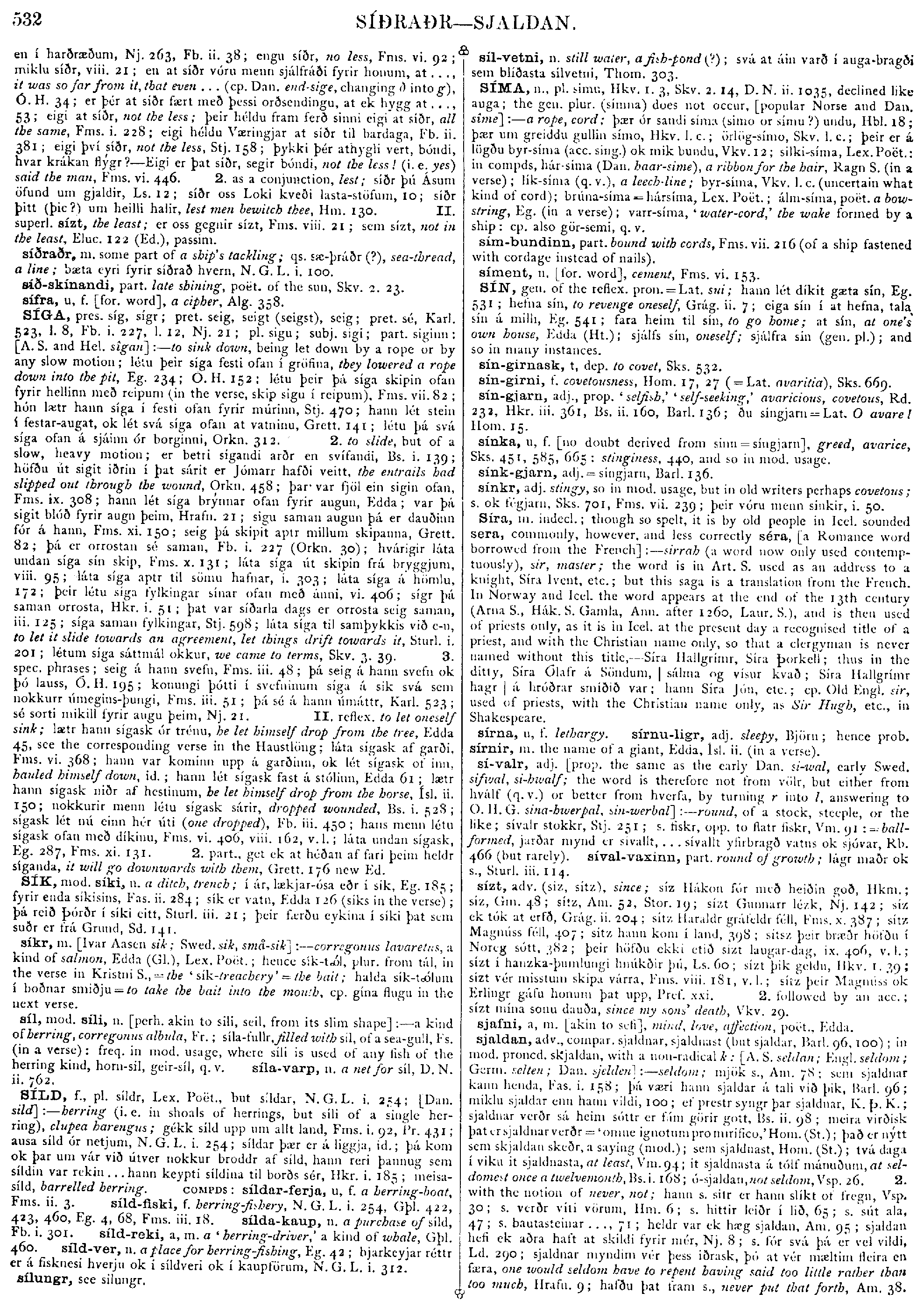
Síra, m. indecl.; though so spelt, it is by old people in Icel. sounded sera, commonly, however, and less correctly séra, [a Romance word borrowed from the French] :-- sirrah (a word now only used contemptuously), sir, master; the word is in Art. S. used as an address to a knight, Síra Ivent, etc.; but this saga is a translation from the French. In Norway and Icel. the word appears at the end of the 13th century (Arna S., Hák. S. Gamla, Ann. after 1260, Laur. S.), and is then used of priests only, as it is in Icel. at the present day a recognised title of a priest, and with the Christian name only, so that a clergyman is never named without this title, -- Síra Hallgrímr, Síra Þorkell; thus in the ditty, Síra Ólafr á Söndum, | sálina og vísur kvað; Síra Hallgrímr hagr | á hróðrar smíðið var; hann Síra Joacute;n, etc.; cp. Old Engl. sir, used of priests, with the Christian name only, as Sir Hugh, etc., in Shakespeare.
|
Source: Cleasby/Vigfusson, page b0556, entry 22 View original page image as: [TIFF] [PNG] [View previous entry] [View next entry] |
[Comment on this entry] [View comments] |
The following entry has been hand-corrected once. |
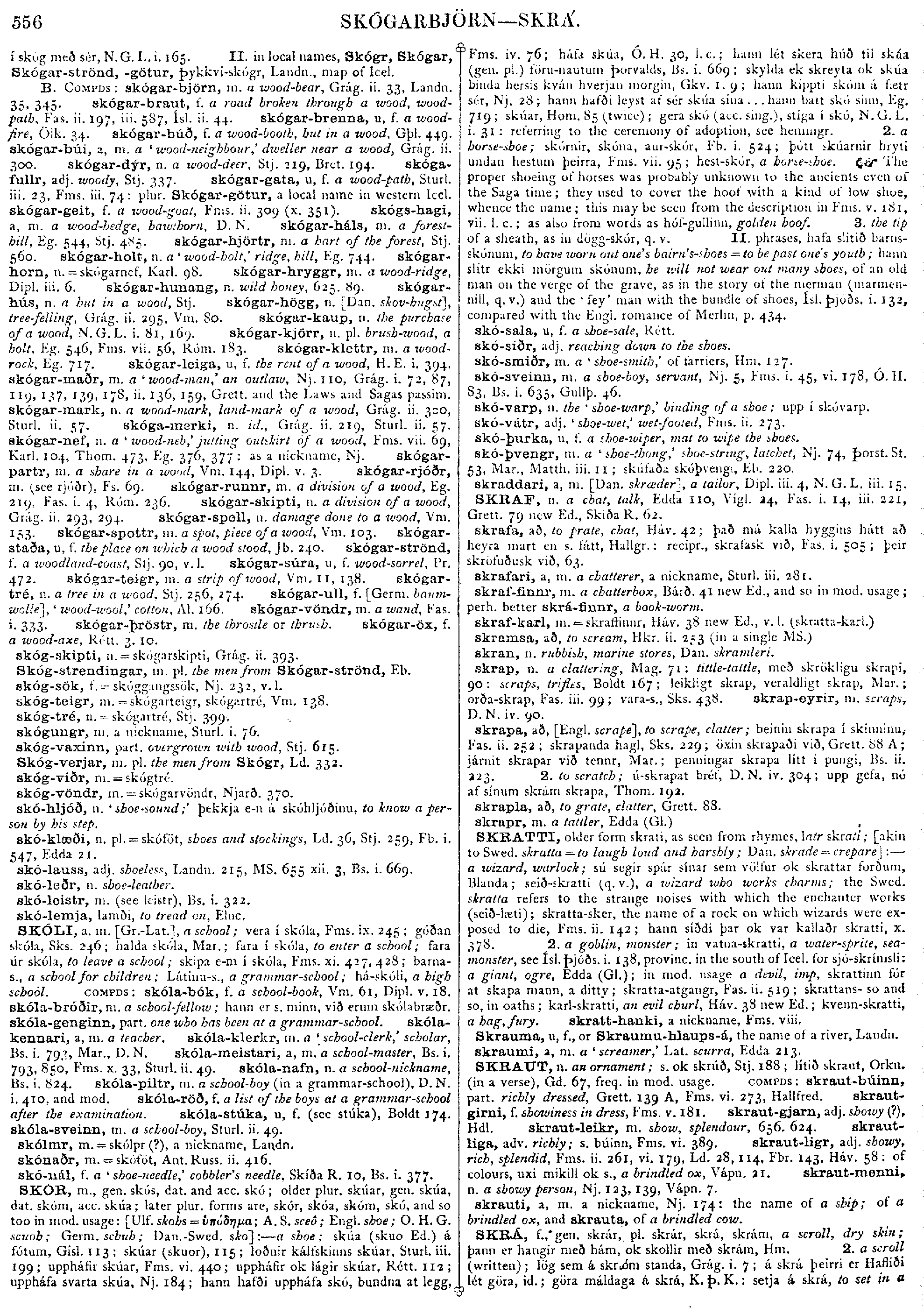
SKÓR, m., gen. skós, dat. and acc. skó; older plur. skúar, gen. skúa, dat. skóm, acc. skúa; later plur. forms are, skór, skóa, skóm, skó, and so too in mod. usage: [Ulf. skohs = GREEK; A.S. sceô; Engl. shoe; O.H.G. scuob; Germ' schuh; Dan. -Swed. sko] :-- a shoe; skúa (skuo Ed.) á fótum, Gísl. 113; skúar (skuor), 115; loðnir kálfskinns skúar, Sturl. iii. 199; uppháfir skúar, Fms. vi. 440; uppháfir ok lágir skúar, Rétt. 112; nppháfa svarta skúa, Nj. 184; hann hafði uppháfa skó, bundna at legg, Fms. iv. 76; háfa skúa, Ó.H. 30, l.c.; hann lét skera húð til skóa (gen. pl.) föru-nautum Þorvalds, Bs. i. 669; skylda ek skreyta ok skúa binda hersis kván hverjan morgin, Gkv. 1. 9; hann kippti skóm á fætr sér, Nj. 28; hann hafði leyst af sér skúa sína ... hann batt skó sinn, Eg. 719; skúar, Hom. 85 (twice); gera skó (acc. sing.), stíga í skó, N.G.L. i. 31: referring to the ceremony of adoption, see hemingr. 2. a horse-shoe; skórnir, skóna, aur-skór, Fb. i. 524; þótt skúarnir hryti undan hestum þeirra, Fms. vii. 95; hest-skór, a horse-shoe. &FINGER; The proper shoeing of horses was probably unknown to the ancients even of the Saga time; they used to cover the hoof with a kind of low shoe, whence the name; this may be seen from the description in Fms. v. 181, vii. l.c.; as also from words as hóf-gullinn, golden hoof. 3. the tip of a sheath, as in dögg-skór, q.v. II. phrases, hafa slitið barns-skónum, to have worn out one's bairn's-shoes = to be past one's youth; hann slítr ekki mörgum skónum, he will not wear out many shoes, of an old man on the verge of the grave, as in the story of the merman (marmennill, q.v.) and the 'fey' man with the bundle of shoes, Ísl. Þjóðs. i. 132, compared with the Engl. romance of Merlin, p. 434.
|
Source: Cleasby/Vigfusson, page b0621, entry 16 View original page image as: [TIFF] [PNG] [View previous entry] [View next entry] |
[Comment on this entry] [View comments] |
The following entry has been hand-corrected once. |
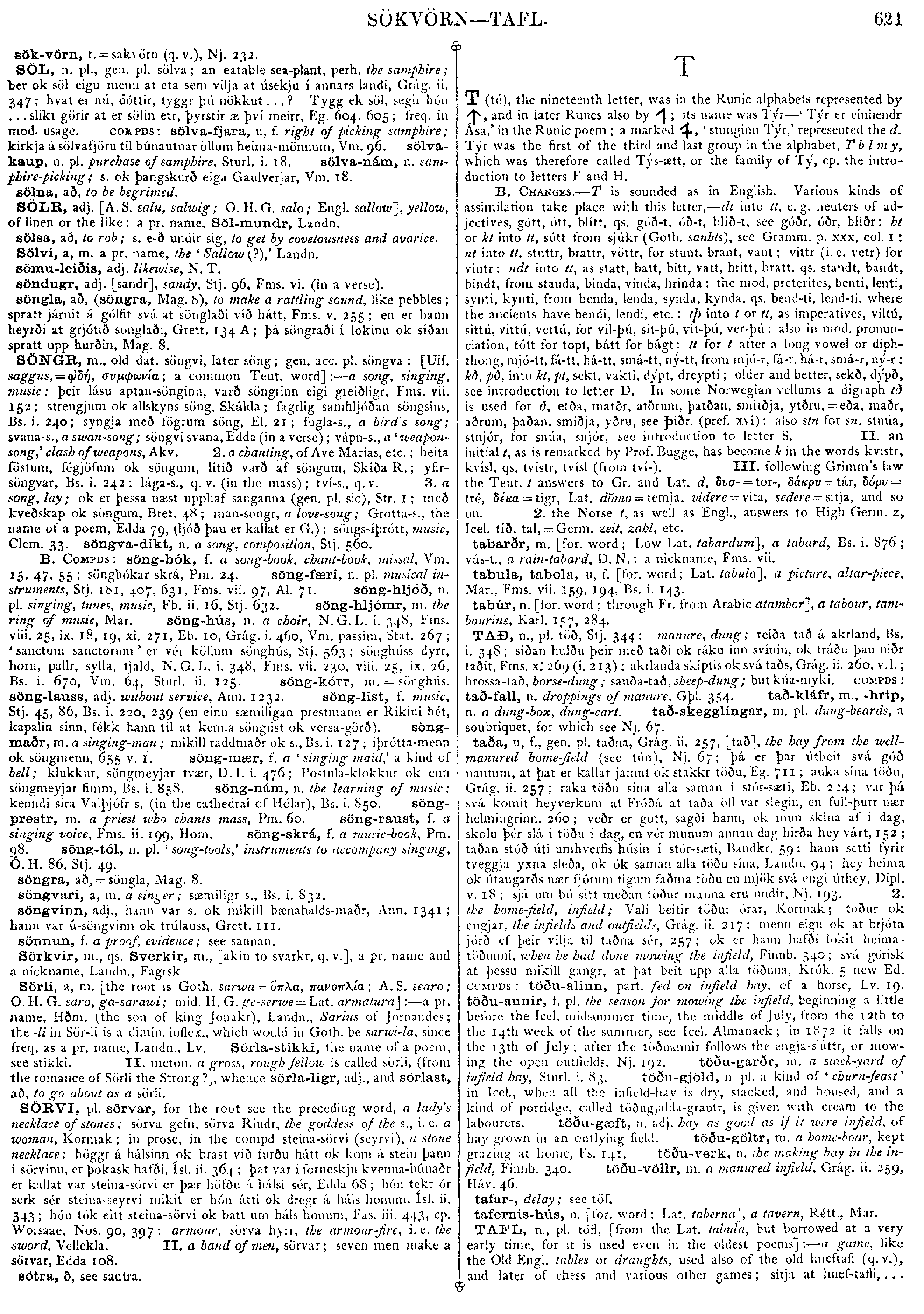
Sörli, a, m. [the root is Goth. sarwa = GREEK; A.S. searo; O.H.G. saro, ga-sarawi; mid.H.G. ge-serwe = Lat. armatura] :-- a pr. name, Hðm. (the son of king Jonakr), Landn., Sarius of Jornandes; the -li in Sör-li is a dimin. inflex., which would in Goth. be sarwi-la, since freq. as a pr. name, Landn., Lv. Sörla-stikki, the name of a poem, see stikki. II. meton, a gross, rough fellow is called sörli, (from the romance of Sörli the Strong?), whence sörla-ligr, adj., and sörlast, að, to go about as a sörli.
|
Source: Cleasby/Vigfusson, page b0732, entry 27 View original page image as: [TIFF] [PNG] [View previous entry] [View next entry] |
[Comment on this entry] [View comments] |
The following entry has been hand-corrected once. |
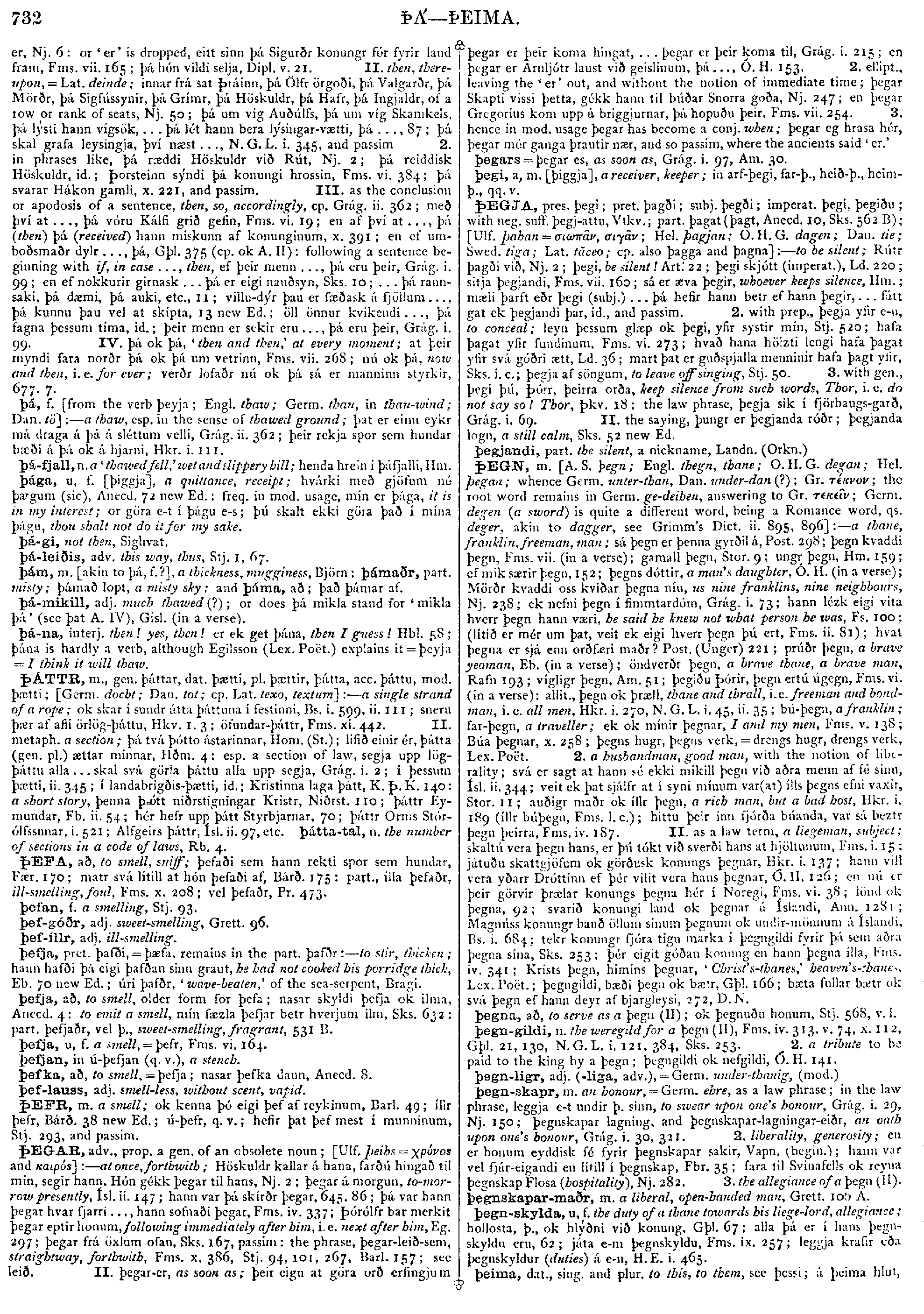
ÞEGN, m. [A.S. þegn; Engl. thegn, thane; O.H.G. degan; Hel. þegan; whence Germ. unter-than, Dan. under-dan(?); Gr. GREEK; the root word remains in Germ. ge-deiben, answering to Gr. GREEK; Germ. degen (a sword) is quite a different word, being a Romance word, qs. deger, akin to dagger, see Grimm's Dict. ii. 895, 896] :-- a thane, franklin, freeman, man; sá þegn er þenna gyrðil á, Post. 298; þegn kvaddi þegn, Fms. vii. (in a verse); gamall þegn, Stor. 9; ungr þegn, Hm. 159; ef mik særir þegn, 152; þegns dóttir, a man's daughter, Ó.H. (in a verse); Mörðr kvaddi oss kviðar þegna níu, us nine franklins, nine neighbours, Nj. 238; ek nefni þegn í fimmtardóm, Grág. i. 73; hann lézk eigi vita hverr þegn hann væri, he said he knew not what person he was, Fs. 100: (lítið er mér um þat, veit ek eigi hverr þegn þú ert, Fms. ii. 81); hvat þegna er sjá enn orðfæri maðr? Post. (Unger) 221; prúðr þegn, a brave yeoman, Eb. (in a verse); öndverðr þegn, a brave thane, a brave man, Rafn 193; vígligr þegn, Am. 51; þegiðu Þórir, þegn ertú úgegn, Fms. vi. (in a verse): allit., þegn ok þræll, thane and thrall, i.e. freeman and bondman, i.e. all men, Hkr. i. 270, N.G.L. i. 45, ii. 35; bú-þegn, a franklin; far-þegn, a traveller; ek ok mínir þegnar, I and my men, Fms. v. 138; Búa þegnar, x. 258; þegns hugr, þegns verk, = drengs hugr, drengs verk, Lex. Poët. 2. a husbandman, good man, with the notion of liberality; svá er sagt at hann sé ekki mikill þegu við adra menn af fé sínu, Ísl. ii. 344; veit ek þat sjálfr at í syni mínum var(at) ílls þegns efni vaxit, Stor. 11; auðigr maðr ok íllr þegn, a rich man, but a bad host, Hkr. i. 189 (íllr búþegu, Fms. l.c.); hittu þeir inn fjórða búanda, var sá beztr þegn þeirra, Fms. iv. 187. II. as a law term, a liegeman, subject; skaltú vera þegn hans, er þú tókt við sverði hans at hjöltunum, Fms. i. 15; játuðu skattgjöfum ok görðusk konungs þegnar, Hkr. i. 137; hann vill vera yðarr Dróttinn ef þér vilit vera hans þegnar, Ó.H. 126; en nú er þeir görvir þrælar konungs þegna hér í Noregi, Fms. vi. 38; lönd ok þegna, 92; svarið konungi land ok þegnar á Íslandi, Ann. 1281; Magnúss konungr bauð öllum sínum þegnum ok undir-mönnum á Íslandi, Bs. i. 684: tekr konungr fjóra tigu marka í þegngildi fyrir þá sem aðra þegna sína, Sks. 253; þér eigit góðan konung en hann þegna ílla, Fms. iv. 341; Krists þegn, himins þegnar, 'Christ's-thanes,' heaven's-thanes, Lex. Poët.; þegngildi, bæði þegn ok bætr, Gþl. 166; bæta fullar bætr ok svá þegn ef hann deyr af bjargleysi, 272, D.N.
| Result Page: |  |
Previous | 1 2 3 |
Germanic Lexicon Project (main page)
This search system was written by
Sean Crist
Please consider
volunteering
to correct the data in these online dictionaries.
No rights reserved. Feel free to use these data in any way you please.