|
|

|
Source: Bosworth/Toller, page b0905, entry 17 View original page image as: [TIFF] [PNG] [View previous entry] [View next entry] |
[Comment on this entry] [View comments (1)] |
The following entry has been hand-corrected once. |
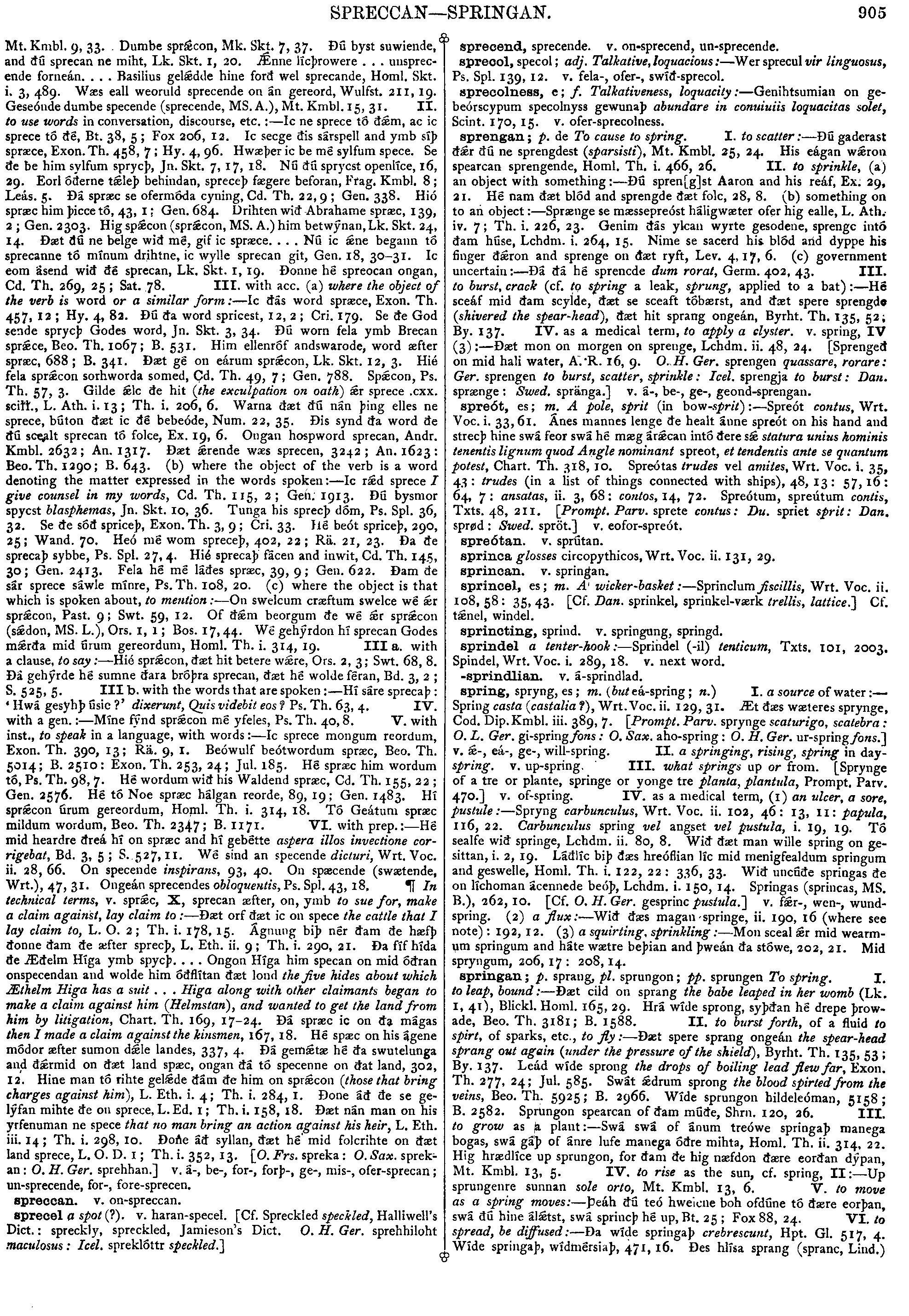
springan;
p.
sprang,
pl.
sprungon;
pp.
sprungen
To
spring.
I.
to
leap,
bound:--Ðæt
cild
on
sprang
the
babe
leaped
in
her
womb
(Lk.
1,
41),
Blickl.
Homl.
165,
29.
Hrá
wíde
sprong,
syþðan
hé
drepe
þrowade,
Beo.
Th.
3181;
B.
1588.
II.
to
burst
forth,
of
a
fluid
to
spirt,
of
sparks,
etc.,
to
fly:--Ðæt
spere
sprang
ongeán
the
spear-head
sprang
out
again
(under
the
pressure
of
the
shield),
Byrht.
Th.
135,
53;
By.
137.
Leád
wíde
sprong
the
drops
of
boiling
lead
flew
far,
Exon.
Th.
277,
24;
Jul.
585.
Swát
 drum
sprong
the
blood
spirted
from
the
veins,
Beo.
Th.
5925;
B.
2966.
Wíde
sprungon
hildeleóman,
5158;
B.
2582.
Sprungon
spearcan
of
ðam
múðe,
Shrn.
120,
26.
III.
to
grow
as
a
plant:--Swá
swá
of
ánum
treówe
springaþ
manega
bogas,
swá
gáþ
of
ánre
lufe
manega
óðre
mihta,
Homl.
Th.
ii.
314,
22.
Hig
hrædlíce
up
sprungon,
for
ðam
ðe
hig
næfdon
ðære
eorðan
dýpan,
Mt.
Kmbl.
13,
5.
IV.
to
rise
as
the
sun,
cf.
spring,
II:--Up
sprungenre
sunnan
sole
orto,
Mt.
Kmbl.
13,
6.
V.
to
move
as
a
spring
moves:--Þeáh
ðú
teó
hweicne
boh
ofdúne
tó
ðære
eorþan,
swá
ðú
hine
áltst,
swá
sprincþ
hé
up.
Bt.
25;
Fox
88,
24.
VI.
to
spread,
be
diffused:--Ða
wíde
springaþ
crebrescunt,
Hpt.
Gl.
517,
4.
Wíde
springaþ,
wídmérsiaþ,
471,
16.
Ðes
hlísa
sprang
(spranc,
Lind.)
drum
sprong
the
blood
spirted
from
the
veins,
Beo.
Th.
5925;
B.
2966.
Wíde
sprungon
hildeleóman,
5158;
B.
2582.
Sprungon
spearcan
of
ðam
múðe,
Shrn.
120,
26.
III.
to
grow
as
a
plant:--Swá
swá
of
ánum
treówe
springaþ
manega
bogas,
swá
gáþ
of
ánre
lufe
manega
óðre
mihta,
Homl.
Th.
ii.
314,
22.
Hig
hrædlíce
up
sprungon,
for
ðam
ðe
hig
næfdon
ðære
eorðan
dýpan,
Mt.
Kmbl.
13,
5.
IV.
to
rise
as
the
sun,
cf.
spring,
II:--Up
sprungenre
sunnan
sole
orto,
Mt.
Kmbl.
13,
6.
V.
to
move
as
a
spring
moves:--Þeáh
ðú
teó
hweicne
boh
ofdúne
tó
ðære
eorþan,
swá
ðú
hine
áltst,
swá
sprincþ
hé
up.
Bt.
25;
Fox
88,
24.
VI.
to
spread,
be
diffused:--Ða
wíde
springaþ
crebrescunt,
Hpt.
Gl.
517,
4.
Wíde
springaþ,
wídmérsiaþ,
471,
16.
Ðes
hlísa
sprang
(spranc,
Lind.)
|
Source: Bosworth/Toller, page b1142, entry 2 View original page image as: [TIFF] [PNG] [View previous entry] [View next entry] |
[Comment on this entry] [View comments] |
The following entry has been hand-corrected once. |
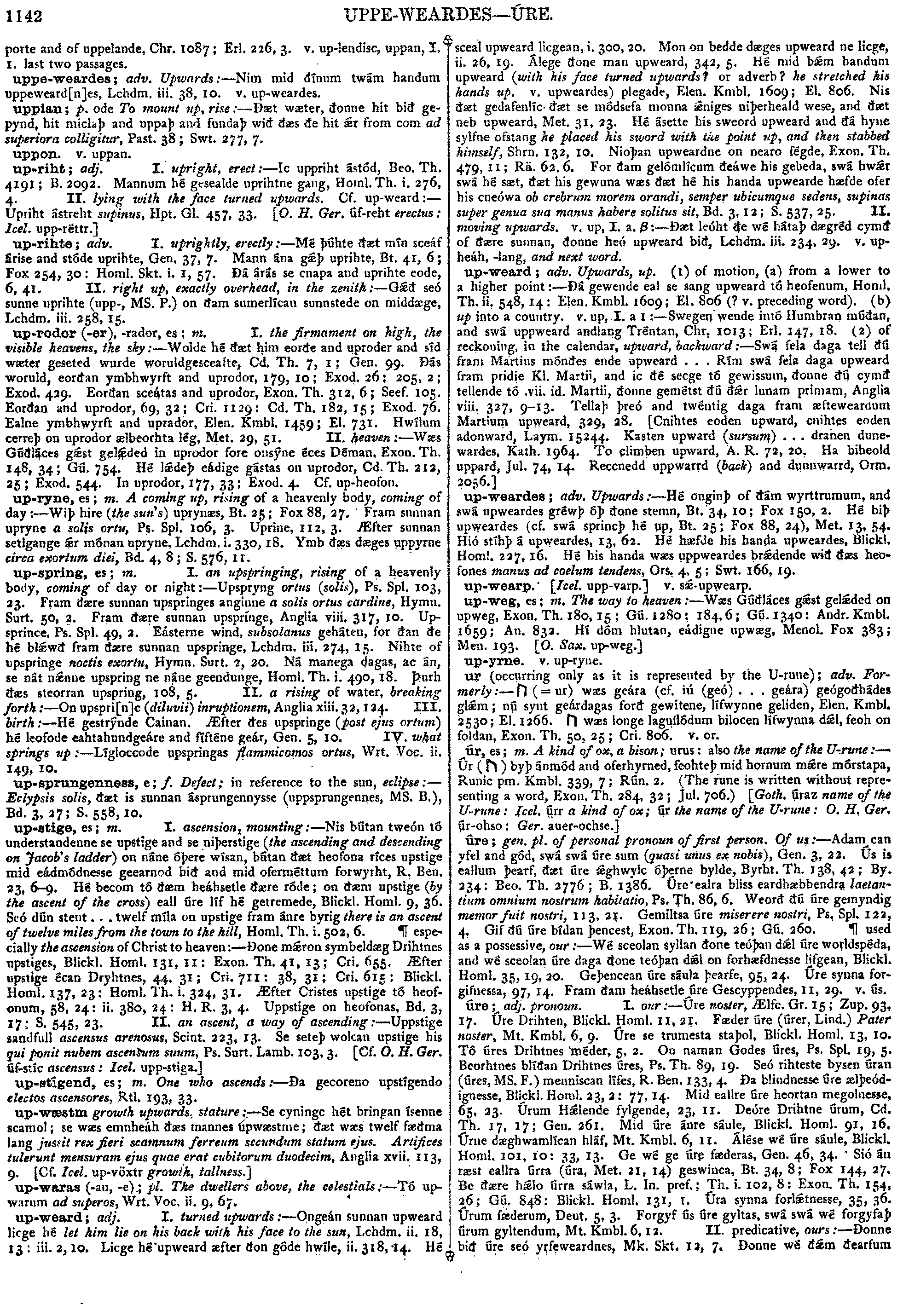
uppian;
p.
ode
To
mount
up,
rise
:--
Ðæt
wæter,
ðonne
hit
bið
gepynd,
hit
miclaþ
and
uppaþ
and
fundaþ
wið
ðæs
ðe
hit
r
from
com
ad
superiora
colligitur,
Past.
38
;
Swt.
277.
7.
|
Source: Bosworth/Toller, page b1180, entry 20 View original page image as: [TIFF] [PNG] [View previous entry] [View next entry] |
[Comment on this entry] [View comments] |
The following entry has been hand-corrected once. |
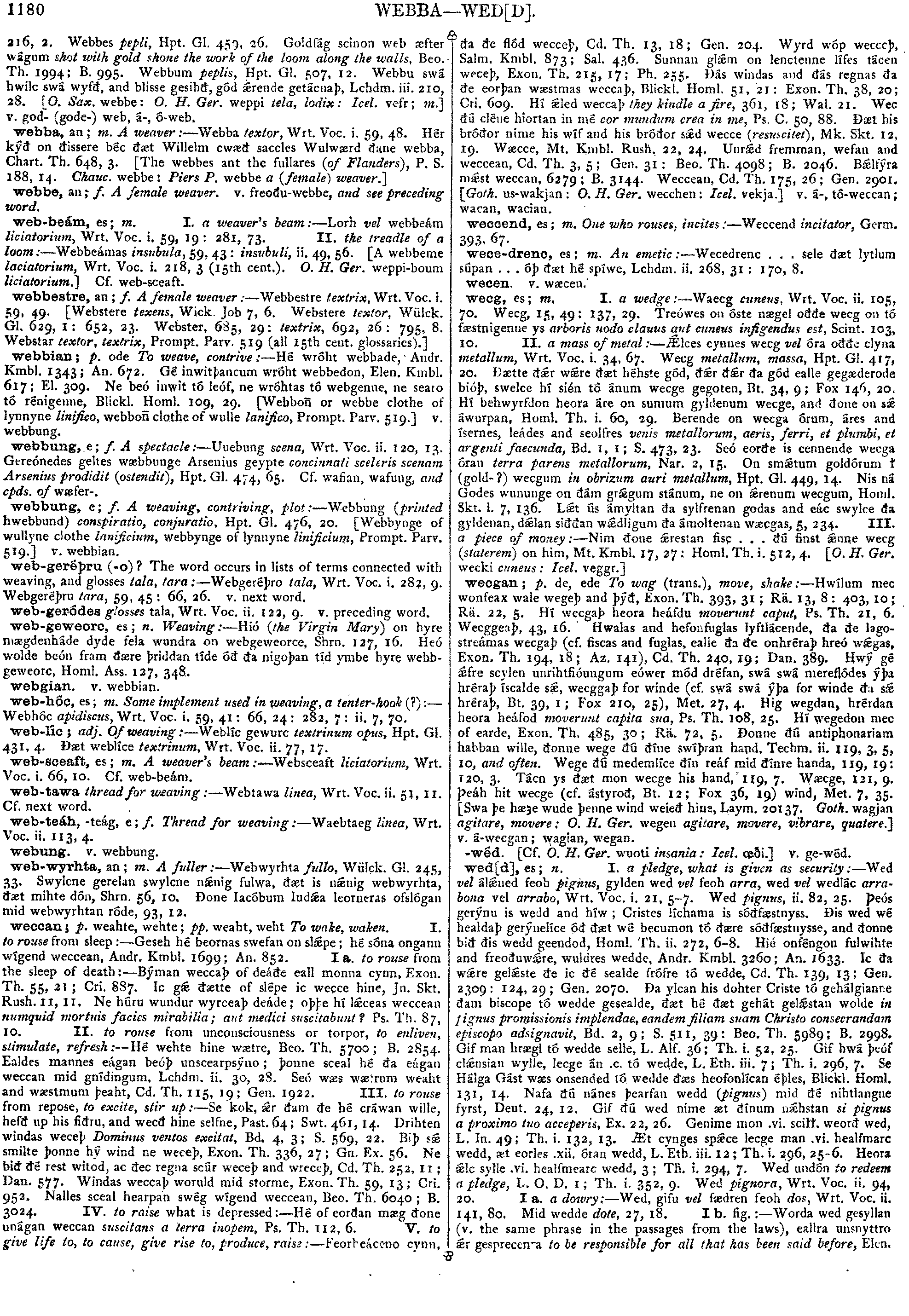
weccan;
p.
weahte,
wehte;
pp.
weaht,
weht
To
wake,
waken.
I.
to
rouse
from
sleep:--Geseh
hé
beornas
swefan
on
slpe;
hé
sóna
ongann
wígend
weccean,
Andr.
Kmbl.
1699;
An.
852.
I
a.
to
rouse
from
the
sleep
of
death:--Býman
weccaþ
of
deáðe
eall
monna
cynn,
Exon.
Th.
55,
21;
Cri.
887.
Ic
g
ðætte
of
slépe
ic
wecce
hine,
Jn.
Skt.
Rush.
11,
11.
Ne
húru
wundur
wyrceaþ
deáde;
oþþe
hí
lceas
weccean
numquid
mortuis
facies
mirabilia;
aut
medici
suscitabunt?
Ps.
Th.
87,
10.
II.
to
rouse
from
unconsciousness
or
torpor,
to
enliven,
stimulate,
refresh:--Hé
wehte
hine
wætre,
Beo.
Th.
5700;
B.
2854.
Ealdes
mannes
eágan
beóþ
unscearpsýno;
þonne
sceal
hé
ða
eágan
wecean
mid
gnídingum,
Lchdm.
ii.
30,
28.
Seó
wæs
wætrum
weaht
and
wæstmum
þeaht,
Cd.
Th.
115,
19;
Gen.
1922.
III.
to
rouse
from
repose,
to
excite,
stir
up:--Se
kok,
r
ðam
ðe
hé
cráwan
wille,
hefð
up
his
fiðru,
and
wecð
hine
selfne,
Past.
64;
Swt.
461,
14.
Drihten
windas
weceþ
Dominus
ventos
excitat,
Bd.
4,
3;
S.
569,
22.
Biþ
s
smilte
þonne
hý
wind
ne
weceþ,
Exon.
Th.
336,
27;
Gn.
Ex.
56.
Ne
bið
ðé
rest
witod,
ac
ðec
regna
scúr
weceþ
and
wreceþ,
Cd.
Th.
252,
11;
Dan.
577.
Windas
weccaþ
woruld
mid
storme,
Exon.
Th.
59,
13;
Cri.
952.
Nalles
sceal
hearpan
swég
wígend
weccean,
Beo.
Th.
6040;
B.
3024.
IV.
to
raise
what
is
depressed:--Hé
of
eorðan
mæg
ðone
unágan
weccan
suscitans
a
terra
inopem,
Ps.
Th.
112,
6.
V.
to
give
life
to,
to
cause,
give
rise
to,
produce,
raise:--Feorbeáceno
cynn,
ða
ðe
flód
wecceþ,
Cd.
Th.
13,
18;
Gen.
204.
Wyrd
wóp
wecccþ,
Salm.
Kmbl.
873;
Sal.
436.
Sunnan
glm
on
lenctenne
lífes
tácen
weceþ,
Exon.
Th.
215,
17;
Ph.
255.
Ðás
windas
and
ðás
regnas
ða
ðe
eorþan
wæstmas
weccaþ,
Blickl.
Homl.
51,
21:
Exon.
Th.
38,
20;
Cri.
609.
Hí
led
weccaþ
they
kindle
a
fire,
361,
18;
Wal.
21.
Wec
ðú
cléne
hiortan
in
mé
cor
mundum
crea
in
me,
Ps.
C.
50,
88.
Ðæt
his
bróðor
nime
his
wíf
and
his
bróðor
sd
wecce
(resuscitet),
Mk.
Skt.
12,
19.
Wæcce,
Mt.
Kmbl.
Rush.
22,
24.
Unrd
fremman,
wefan
and
weccean,
Cd.
Th.
3,
5;
Gen.
31:
Beo.
Th.
4098;
B.
2046.
Blfýra
mst
weccan,
6279;
B.
3144.
Weccean,
Cd.
Th.
175,
26;
Gen.
2901.
[Goth.
us-wakjan:
O.
H.
Ger.
wecchen:
Icel.
vekja.]
v.
á-,
tó-weccan;
wacan,
wacian.
|
Source: Bosworth/Toller, page b1278, entry 41 View original page image as: [TIFF] [PNG] [View previous entry] [View next entry] |
[Comment on this entry] [View comments] |
The following entry has been hand-corrected once. |
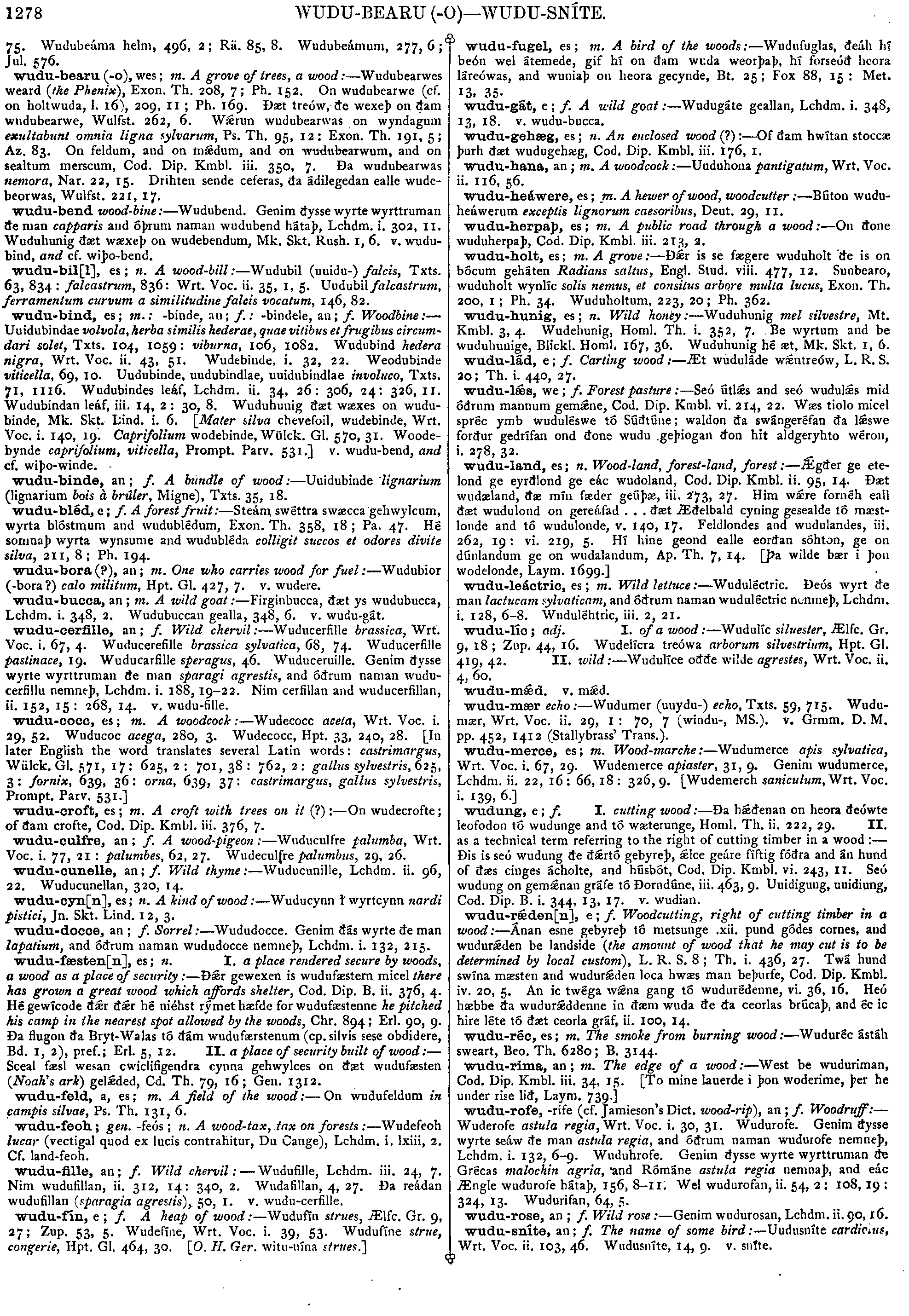
wudu-rima. an ; m. The edge of a wood :-- West be wuduriman, Cod. Dip. Kmbl. in. 34, 15. [To mine lauerde i þon woderime, þer he under rise lið, Laym. 739.]
|
Source: Bosworth/Toller, page d0030, entry 25 View original page image as: [TIFF] [PNG] [View previous entry] [View next entry] |
[Comment on this entry] [View comments] |
The following entry has been hand-corrected once. |
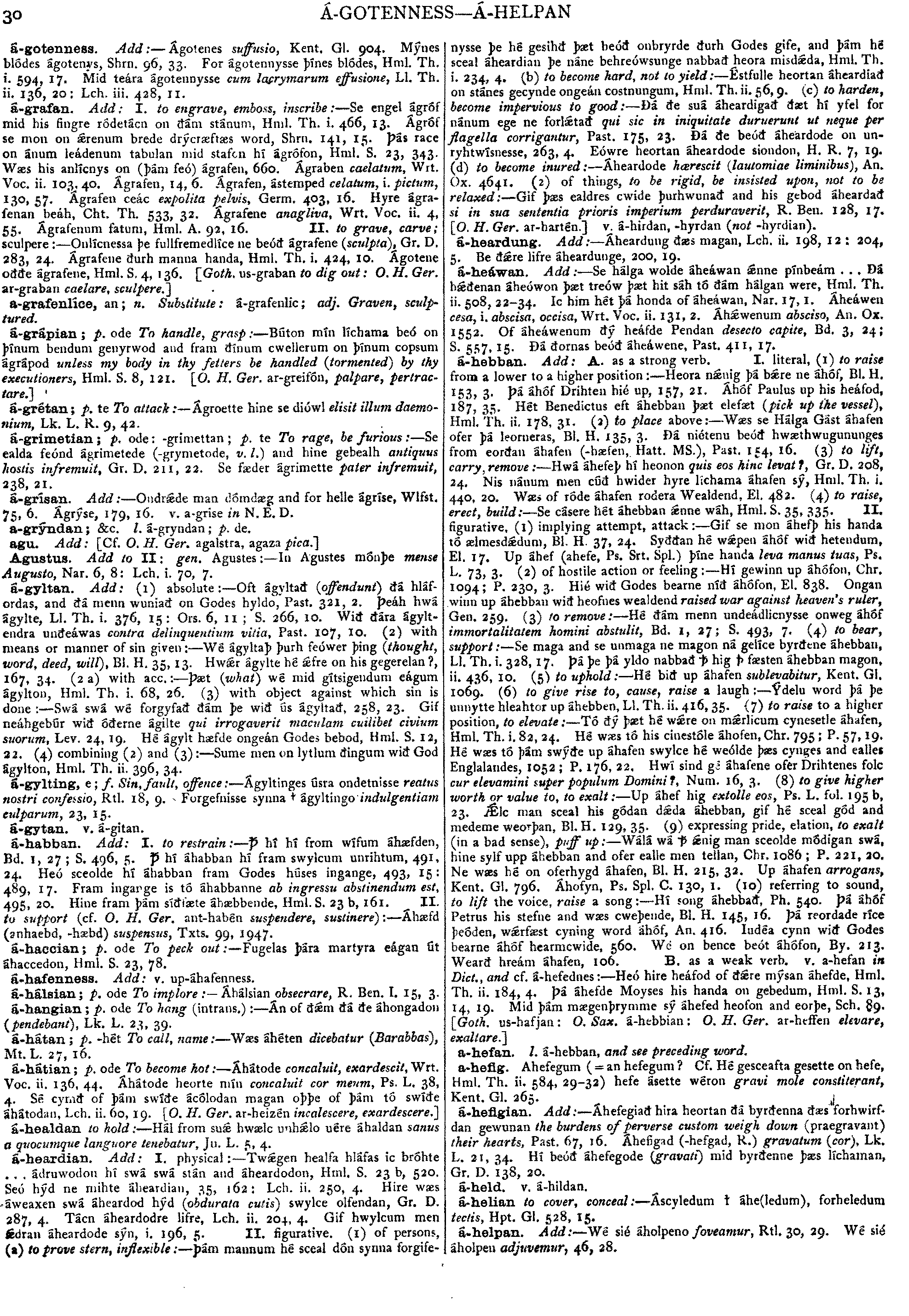
á-hebban.
Add:
A.
as
a
strong
verb.
I.
literal,
(1)
to
raise
from
a
lower
to
a
higher
position:--
Heora
nnig
þá
bre
ne
áhóf.
Bl.
H.
153.
3.
Þá
áhóf
Drihten
hié
up,
157,
21.
Áhóf
Paulus
up
his
heáfod,
187,
35.
Hét
Benedictus
eft
áhebban
þæt
elefæt
(pick
up
the
vessel),
Hml,
Th.
ii.
178,
31.
(2)
to
place
above:--Wæs
se
Hálga
Gást
áhafen
ofer
þá
leorneras.
Bl.
H.
135,
3.
Ðá
niétenu
UNCERTAIN
beóð
hwæthwugununges
from
eorðan
áhafen
(-hæfen,
Hatt.
MS.
),
Past.
154,
16.
(3)
to
lift,
carry.
remove:--Hwá
áhefeþ
hí
heonon
quis
eos
hine
levat?,
Gr.
D.
208,
24.
Nis
nánum
UNCERTAIN
men
cúð
hwider
hyre
líchama
áhafen
sý,
Hml.
Th.
i.
440,
20.
Wæs
of
róde
áhafen
rodera
Wealdend,
El.
482.
(4)
to
raise,
erect,
build:--Se
cásere
hét
áhebban
nne
wáh,
Hml.
S.
35,
335.
II.
figurative,
(1)
implying
attempt,
attack:--Gif
se
mon
áhefþ
his
handa
tó
ælmesddum,
Bl.
H.
37,
24.
Syððan
hé
wpen
áhóf
wið
hetendum,
El.
17.
Up
áhef
(ahefe.
Ps.
Srt.
Spl.)
þíne
handa
leva
manus
tuas,
Ps.
L.
73,
3.
(2)
of
hostile
action
or
feeling:--Hí
gewinn
up
áhófon,
Chr.
1094;
P.
230,
3.
Hié
wið
Godes
bearne
níð
áhófon,
El.
838.
Ongan
winn
up
áhebban
wið
heofnes
wealdend
raised
war
against
heaven's
ruler,
Gen.
259.
(3)
to
remove:--Hé
ðám
menn
undeádlicnysse
onweg
áhóf
immortalitatem
homini
abstulit,
Bd.
1,
27;
S.
493,
7.
(4)
to
bear,
support:--Se
maga
and
se
unmaga
ne
magon
ná
gelíce
byrðene
áhebban,
Ll.
Th.
i.
328,
17.
Þá
þe
þá
yldo
nabbað
 hig
fæsten
áhebban
magon,
ii.
436,
10.
(5)
to
uphold:--Hé
bið
up
áhafen
sublevabitur,
Kent.
Gl.
1069.
(6)
to
give
rise
to,
cause,
raise
a
laugh:--Ýdelu
UNCERTAIN
word
þá
þe
unnytte
hleahtor
up
áhebben,
Ll.
Th.
ii.
416,
35.
(7)
to
raise
to
a
higher
position,
to
elevate:--Tó
ðý
þæt
hé
wre
on
mrlicum
cynesetle
áhafen,
Hml.
Th.
i.
82,
24.
Hé
wæs
tó
his
cinestóle
áhofen,
Chr.
795;
P.
57,
19.
Hé
wæs
tó
þám
swýðe
up
áhafen
swylce
hé
weólde
þæs
cynges
and
ealles
Englalandes,
1052;
P.
176,
22.
Hwí
sind
gé
áhafene
ofer
Drihtenes
folc
cur
elevamini
super
populum
Domini?,
Num.
16,
3.
(8)
to
give
higher
worth
or
value
to,
to
exalt:--Up
áhef
hig
extolle
eos,
Ps.
L.
fol.
195
b,
23.
Æ-acute;lc
man
sceal
his
gódan
dda
áhebban,
gif
hé
sceal
gód
and
medeme
weorþan,
Bl.
H.
129,
35.
(9)
expressing
pride,
elation,
to
exalt
(in
a
bad
sense),
puff
up:--Wálá
wá
nig
man
sceolde
módigan
swá,
hine
sylf
upp
áhebban
and
ofer
ealle
men
tellan,
Chr.
1086;
P.
221,
20.
Ne
wæs
hé
on
oferhygd
áhafen,
Bl.
H.
215,
32.
Up
áhafen
arrogans,
Kent.
Gl.
796.
Áhofyn,
Ps.
Spl.
C.
130,
1.
(10)
referring
to
sound,
to
lift
the
voice,
raise
a
song:--Hí
song
áhebbað,
Ph.
540.
Þá
áhóf
Petrus
his
stefne
and
wæs
cweþende,
Bl.
H.
145,
16.
Þá
reordade
ríce
þeóden,
wrfæst
cyning
word
áhóf,
An.
416.
ludéa
cynn
wið
Godes
bearne
áhóf
hearmcwide,
560.
We
on
bence
beót
áhófon,
By.
213.
Wearð
hreám
áhafen,
106.
B.
as
a
weak
verb.
v.
a-hefan
in
Dict.,
and
cf.
á-hefednes:--Heó
hire
heáfod
of
ðre
mýsan
áhefde,
Hml.
Th.
ii.
184,
4.
Þá
áhefde
Moyses
his
handa
on
gebedum,
Hml.
S.
13,
14,
19.
Mid
þám
mægenþrymme
sý
áhefed
heofon
and
eorþe,
Sch.
89.
[Goth.
us-hafjan:
O.
Sax.
á-hebbian:
O.
H.
Ger.
ar-heffen
elevare,
exaltare.]
hig
fæsten
áhebban
magon,
ii.
436,
10.
(5)
to
uphold:--Hé
bið
up
áhafen
sublevabitur,
Kent.
Gl.
1069.
(6)
to
give
rise
to,
cause,
raise
a
laugh:--Ýdelu
UNCERTAIN
word
þá
þe
unnytte
hleahtor
up
áhebben,
Ll.
Th.
ii.
416,
35.
(7)
to
raise
to
a
higher
position,
to
elevate:--Tó
ðý
þæt
hé
wre
on
mrlicum
cynesetle
áhafen,
Hml.
Th.
i.
82,
24.
Hé
wæs
tó
his
cinestóle
áhofen,
Chr.
795;
P.
57,
19.
Hé
wæs
tó
þám
swýðe
up
áhafen
swylce
hé
weólde
þæs
cynges
and
ealles
Englalandes,
1052;
P.
176,
22.
Hwí
sind
gé
áhafene
ofer
Drihtenes
folc
cur
elevamini
super
populum
Domini?,
Num.
16,
3.
(8)
to
give
higher
worth
or
value
to,
to
exalt:--Up
áhef
hig
extolle
eos,
Ps.
L.
fol.
195
b,
23.
Æ-acute;lc
man
sceal
his
gódan
dda
áhebban,
gif
hé
sceal
gód
and
medeme
weorþan,
Bl.
H.
129,
35.
(9)
expressing
pride,
elation,
to
exalt
(in
a
bad
sense),
puff
up:--Wálá
wá
nig
man
sceolde
módigan
swá,
hine
sylf
upp
áhebban
and
ofer
ealle
men
tellan,
Chr.
1086;
P.
221,
20.
Ne
wæs
hé
on
oferhygd
áhafen,
Bl.
H.
215,
32.
Up
áhafen
arrogans,
Kent.
Gl.
796.
Áhofyn,
Ps.
Spl.
C.
130,
1.
(10)
referring
to
sound,
to
lift
the
voice,
raise
a
song:--Hí
song
áhebbað,
Ph.
540.
Þá
áhóf
Petrus
his
stefne
and
wæs
cweþende,
Bl.
H.
145,
16.
Þá
reordade
ríce
þeóden,
wrfæst
cyning
word
áhóf,
An.
416.
ludéa
cynn
wið
Godes
bearne
áhóf
hearmcwide,
560.
We
on
bence
beót
áhófon,
By.
213.
Wearð
hreám
áhafen,
106.
B.
as
a
weak
verb.
v.
a-hefan
in
Dict.,
and
cf.
á-hefednes:--Heó
hire
heáfod
of
ðre
mýsan
áhefde,
Hml.
Th.
ii.
184,
4.
Þá
áhefde
Moyses
his
handa
on
gebedum,
Hml.
S.
13,
14,
19.
Mid
þám
mægenþrymme
sý
áhefed
heofon
and
eorþe,
Sch.
89.
[Goth.
us-hafjan:
O.
Sax.
á-hebbian:
O.
H.
Ger.
ar-heffen
elevare,
exaltare.]
|
Source: Bosworth/Toller, page d0047, entry 22 View original page image as: [TIFF] [PNG] [View previous entry] [View next entry] |
[Comment on this entry] [View comments] |
The following entry has been hand-corrected once. |
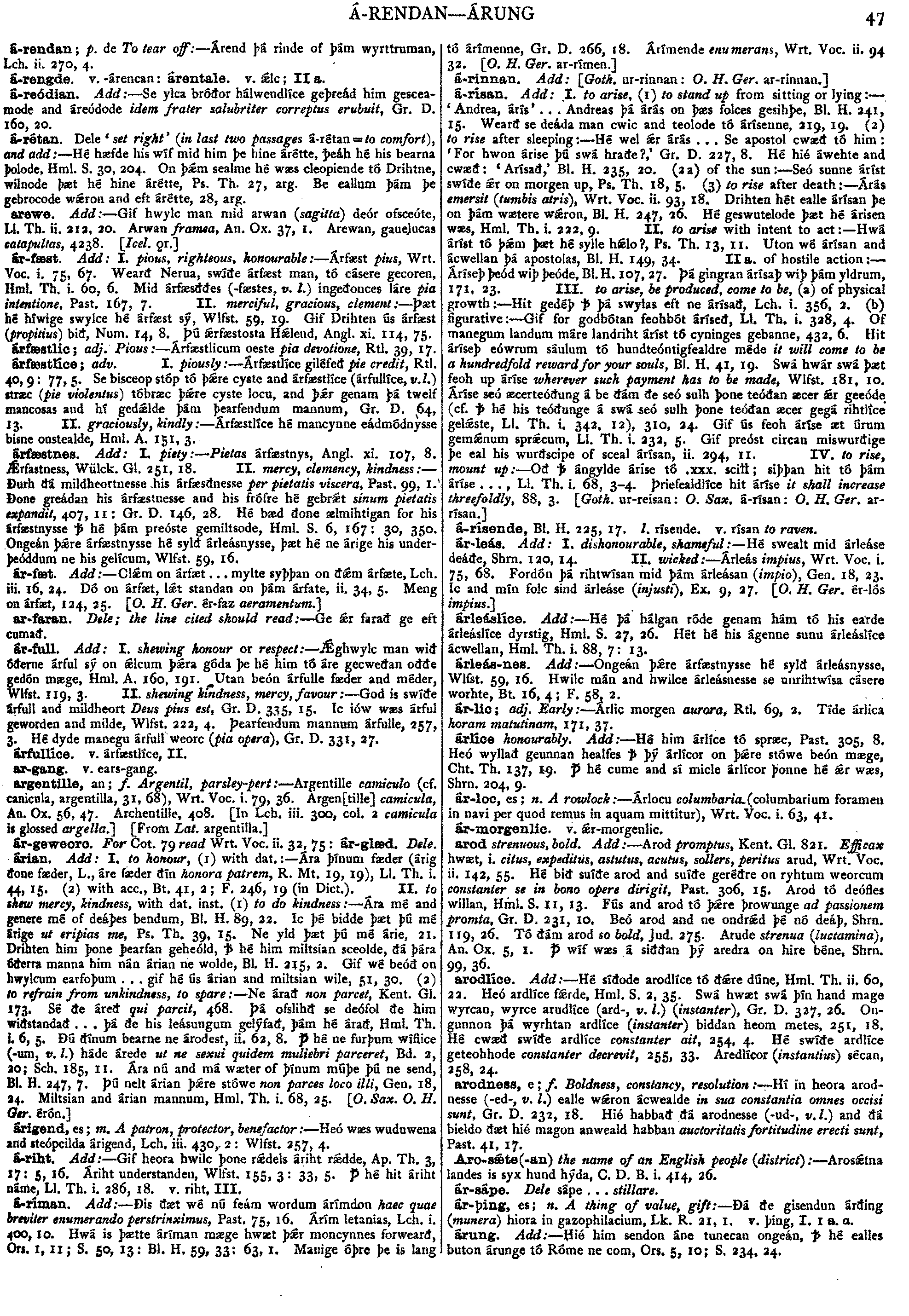
á-rísan.
Add:
I.
to
arise,
(1)
to
stand
up
from
sitting
or
lying:--'Andrea,
árís'
.
.
.
Andreas
þá
árás
on
þæs
folces
gesihþe,
Bl.
H.
241,
15.
Wearð
se
deáda
man
cwic
and
teolode
tó
árísenne,
219,
19.
(2)
to
rise
after
sleeping:--Hé
wel
r
árás
.
.
.
Se
apostol
cwæð
tó
him:
'For
hwon
árise
þú
swá
hraðe?,'
Gr.
D.
227,
8.
Hé
hié
áwehte
and
cwæð:
'Arísað,'
Bl.
H.
235,
20.
(2
a)
of
the
sun:--Seó
sunne
áríst
swíðe
r
on
morgen
up,
Ps.
Th.
18,
5.
(3)
to
rise
after
death:--Árás
emersit
(tumbis
atris),
Wrt.
Voc.
ii.
93,
18.
Drihten
hét
ealle
árísan
þe
on
þám
wætere
wron,
Bl.
H.
247,
26.
Hé
geswutelode
þæt
hé
árisen
wæs,
Hml.
Th.
i.
222,
9.
II.
to
arise
with
intent
to
act:--Hwá
áríst
tó
þm
þæt
hé
sylle
hlo?,
Ps.
Th.
13,
11.
Uton
wé
árísan
and
ácwellan
þá
apostolas,
Bl.
H.
149,
34.
II
a.
of
hostile
action:--Áríseþ
þeód
wiþ
þeóde,
Bl.
H.
107,
27.
Þá
gingran
árísaþ
wiþ
þám
yldrum,
171,
23.
III.
to
arise,
be
produced,
come
to
be,
(a)
of
physical
growth:--Hit
gedéþ
þá
swylas
eft
ne
árísað,
Lch.
i.
356,
2.
(b)
figurative:--Gif
for
godbótan
feohbót
áríseð,
Ll.
Th.
i.
328,
4.
Of
manegum
landum
máre
landriht
áríst
tó
cyninges
gebanne,
432,
6.
Hit
áríseþ
eówrum
sáulum
tó
hundteóntigfealdre
méde
it
will
came
to
be
a
hundredfold
reward
for
your
souls,
Bl.
H.
41,
19.
Swá
hwár
swá
þæt
feoh
up
áríse
wherever
such
payment
has
to
be
made,
Wlfst.
181,
10.
Áríse
seó
æcerteóðung
á
be
ðám
ðe
seó
sulh
þone
teóðan
æcer
r
geeóde
(cf.
hé
his
teóðunge
á
swá
seó
sulh
þone
teóðan
æcer
gegá
rihtlíce
gelste,
Ll.
Th.
i.
342,
12),
310,
24.
Gif
ús
feoh
áríse
æt
úrum
gemnum
sprcum,
Ll.
Th.
i.
232,
5.
Gif
preóst
circan
miswurðige
þe
eal
his
wurðscipe
of
sceal
árísan,
ii.
294,
11.
IV.
to
rise,
mount
up:--Oð
ángylde
áríse
tó
.xxx.
sci ;
siþþan
hit
tó
þám
áríse
.
.
.
,
Ll.
Th.
i.
68,
3-4.
Þriefealdlíce
hit
áríse
it
shall
increase
threefoldly,
88,
3.
[Goth.
ur-reisan:
O.
Sax.
á-rísan:
O.
H.
Ger.
ar-rísan.]
;
siþþan
hit
tó
þám
áríse
.
.
.
,
Ll.
Th.
i.
68,
3-4.
Þriefealdlíce
hit
áríse
it
shall
increase
threefoldly,
88,
3.
[Goth.
ur-reisan:
O.
Sax.
á-rísan:
O.
H.
Ger.
ar-rísan.]
|
Source: Bosworth/Toller, page d0267, entry 18 View original page image as: [TIFF] [PNG] [View previous entry] [View next entry] |
[Comment on this entry] [View comments] |
The following entry has been hand-corrected once. |
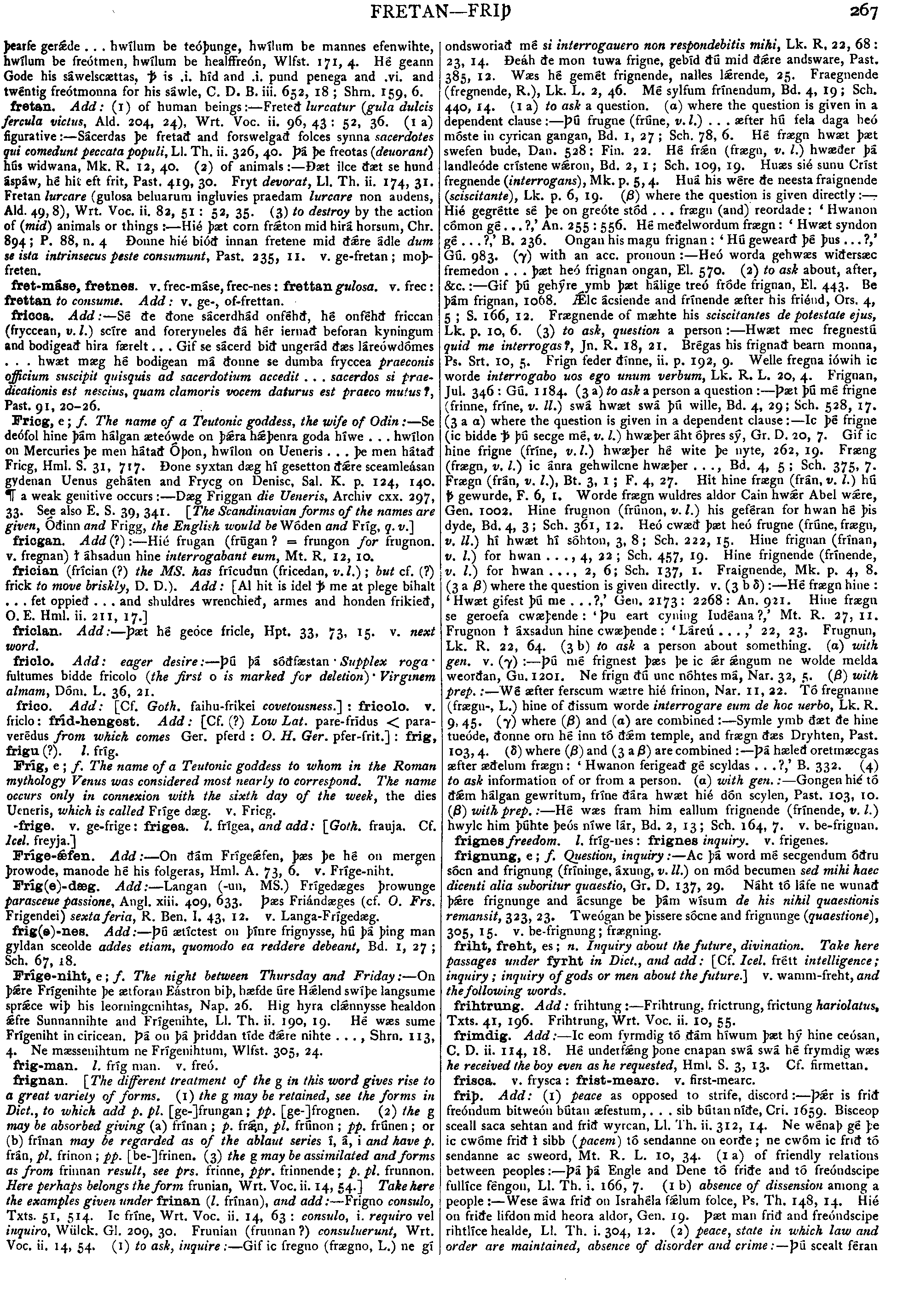
frignan.
[The
different
treatment
of
the
g
in
this
word
gives
rise
to
a
great
variety
of
forms.
(1)
the
g
may
be
retained,
see
the
forms
in
Dict.,
to
which
add
p.pl.
[ge-]frungan;
pp.
[ge-]frognen.
(2)
the
g
may
be
absorbed
giving
(a)
frínan;
p.
frn,
pl.
frúnon
;
pp.
frúnen
;
or
(b)
frínan
may
be
regarded
as
of
the
ablaut
series
í,
á,
i
and
have
p.
frán,
pl.
frinon
;
pp.
[be-]frinen.
(3)
the
g
may
be
assimilated
and
forms
as
from
frinnan
result,
see
prs.
frinne,
ppr.
frinnende;
p.
pl.
frunnon..
Here
perhaps
belongs
the
form
frunian,
Wrt.
Voc.
ii.
14,
54.]
Take
here
the
examples
given
under
frinan
(l.
frínan),
and
add
:--
Frigno
consulo,
Txts.
51,
514.
Ic
fríne.
Wrt.
Voc.
ii.
14,
63
:
consulo,
i.
requiro
vel
inquiro,
Wülck.
Gl.
209,
30.
Frunian
(frunnan
?)
consuluerunt,
Wrt.
Voc.
ii.
14,
54.
(1)
to
ask,
inquire
:--
Gif
ic
fregno
(frægno,
L.
)
ne
gí
ondsworiað
mé
si
inierrogauero
non
respondebitis
mihi,
Lk.
R.
22,
68
:
23,
14.
Ðeáh
ðe
mon
tuwa
frigne,
gebíd
ðú
mid
ðre
andsware,
Past.
385,
12.
Wæs
hé
gemét
frignende,
nalles
lrende,
25.
Fraegnende
(fregnende,
R.),
Lk.
L.
2,
46.
Mé
sylfum
frínendum,
Bd.
4,
19;
Sch.
440,
14.
(la)
to
ask
a
question,
( )
where
the
question
is
given
in
a
dependent
clause
:--
Þú
frugne
(frúne,
v.l.)
.
.
.
æfter
hú
fela
daga
heó
móste
in
cyrican
gangan,
Bd.
l,
27
;
Sch.
78,
6.
Hé
frægn
hwæt
þæt
swefen
bude,
Dan.
528:
Fin.
22.
Hé
frn
(frægn,
v.l.)
hwæðer
þá
landleóde
crístene
wron,
Bd.
2,
l;
Sch.
109,
19.
Huæs
sié
sunu
Críst
fregnende
(interrogans),
Mk.
p.
5,
4.
Huá
his
wére
ðe
neesta
fraignende
(sciscitante),
Lk.
p.
6,
19.
(
)
where
the
question
is
given
in
a
dependent
clause
:--
Þú
frugne
(frúne,
v.l.)
.
.
.
æfter
hú
fela
daga
heó
móste
in
cyrican
gangan,
Bd.
l,
27
;
Sch.
78,
6.
Hé
frægn
hwæt
þæt
swefen
bude,
Dan.
528:
Fin.
22.
Hé
frn
(frægn,
v.l.)
hwæðer
þá
landleóde
crístene
wron,
Bd.
2,
l;
Sch.
109,
19.
Huæs
sié
sunu
Críst
fregnende
(interrogans),
Mk.
p.
5,
4.
Huá
his
wére
ðe
neesta
fraignende
(sciscitante),
Lk.
p.
6,
19.
( )
where
the
question
is
given
directly
:--
Hié
gegrétte
sé
þe
on
greóte
stód
.
.
.
frægn
(and)
reordade:
'Hwanon
cómon
gé
.
.
.
?,'
An.
255
:
556.
Hé
meðelwordum
frægn:
'Hwæt
syndon
gé
.
.
.
?,'
B.
236.
Ongan
his
magu
frignan
:
'Hú
geweard
þé
þus
.
.
.
?,'
Gú.
983.
(
)
where
the
question
is
given
directly
:--
Hié
gegrétte
sé
þe
on
greóte
stód
.
.
.
frægn
(and)
reordade:
'Hwanon
cómon
gé
.
.
.
?,'
An.
255
:
556.
Hé
meðelwordum
frægn:
'Hwæt
syndon
gé
.
.
.
?,'
B.
236.
Ongan
his
magu
frignan
:
'Hú
geweard
þé
þus
.
.
.
?,'
Gú.
983.
( )
with
an
acc.
pronoun
:--
Heó
worda
gehwæs
wiðersæc
fremedon
.
.
.
þæt
heó
frignan
ongan,
El.
570.
(2)
to
ask
about,
after,
&c.:--
Gif
þú
gehýre
ymb
þæt
hálige
treó
fróde
frignan,
El.
443.
Be
þám
frignan,
1068.
Æ-acute;lc
ácsiende
and
frínende
æfter
his
friénd,
Ors.
4,
5
;
S.
166,
12.
Frægnende
of
mæhte
his
sciscitantes
de
potestate
ejus,
Lk.
p.
10,
6.
(3)
to
ask,
question
a
person
:--
Hwæt
mec
fregnestú
quid
me
interrogas
?,
Jn.
R.
18,
21.
Brégas
his
frignað
bearn
monna,
Ps.
Srt.
lo,
5.
Frign
feder
ðínne,
ii.
p.
192,
9.
Welle
fregna
iówih
ic
worde
interrogabo
uos
ego
unum
verbum,
Lk.
R.
L.
20,
4.
Frignan,
Jul.
346
:
Gú.
1184.
(3
a)
to
ask
a
person
a
question
:--
Þæt
þú
mé
frigne
(frinne,
fríne,
v.
ll.)
swá
hwæt
swá
þú
wille,
Bd.
4,
29;
Sch.
528,
17.
(3
a
)
where
the
question
is
given
in
a
dependent
clause
:--
Ic
þé
frigne
(ic
bidde
þú
secge
mé,
v.l.)
hwæþer
áht
óþres
sý,
Gr.
D.
20,
7.
Gif
ic
hine
frigne
(fríne,
v.l.)
hwæþer
hé
wite
þe
nyte,
262,
19.
Fræng
(frægn,
v.l.)
ic
ánra
gehwilcne
hwæþer
.
.
.
,
Bd.
4,
5
;
Sch.
375,
7.
Frægn
(frán,
v.l.),
Bt.
3,
l
;
F.
4,
27.
Hit
hine
frægn
(frán,
v.l.)
hú
gewurde,
F.
6,
I.
Worde
frægn
wuldres
aldor
Cain
hwr
Abel
wre,
Gen.
1002.
Hine
frugnon
(frúnon,
v.l.)
his
geféran
for
hwan
hé
þis
dyde,
Bd.
4,
3;
Sch.
361,
12.
Heó
cwæð
þæt
heó
frugne
(frúne,
frægn,
v.
ll.)
hî
hwæt
hî
sóhton,
3,
8;
Sch.
222,
15.
Hine
frignan
(frínan,
v.l.)
for
hwan
.
.
.
,
4,
22
;
Sch.
457,
19.
Hine
frignende
(frínende,
v.l.)
for
hwan
.
.
.
,
2,
6;
Sch.
137,
l.
Fraignende,
Mk.
p.
4,
8,
(3
a
8)
where
the
question
is
given
directly,
v.
(3
b
)
with
an
acc.
pronoun
:--
Heó
worda
gehwæs
wiðersæc
fremedon
.
.
.
þæt
heó
frignan
ongan,
El.
570.
(2)
to
ask
about,
after,
&c.:--
Gif
þú
gehýre
ymb
þæt
hálige
treó
fróde
frignan,
El.
443.
Be
þám
frignan,
1068.
Æ-acute;lc
ácsiende
and
frínende
æfter
his
friénd,
Ors.
4,
5
;
S.
166,
12.
Frægnende
of
mæhte
his
sciscitantes
de
potestate
ejus,
Lk.
p.
10,
6.
(3)
to
ask,
question
a
person
:--
Hwæt
mec
fregnestú
quid
me
interrogas
?,
Jn.
R.
18,
21.
Brégas
his
frignað
bearn
monna,
Ps.
Srt.
lo,
5.
Frign
feder
ðínne,
ii.
p.
192,
9.
Welle
fregna
iówih
ic
worde
interrogabo
uos
ego
unum
verbum,
Lk.
R.
L.
20,
4.
Frignan,
Jul.
346
:
Gú.
1184.
(3
a)
to
ask
a
person
a
question
:--
Þæt
þú
mé
frigne
(frinne,
fríne,
v.
ll.)
swá
hwæt
swá
þú
wille,
Bd.
4,
29;
Sch.
528,
17.
(3
a
)
where
the
question
is
given
in
a
dependent
clause
:--
Ic
þé
frigne
(ic
bidde
þú
secge
mé,
v.l.)
hwæþer
áht
óþres
sý,
Gr.
D.
20,
7.
Gif
ic
hine
frigne
(fríne,
v.l.)
hwæþer
hé
wite
þe
nyte,
262,
19.
Fræng
(frægn,
v.l.)
ic
ánra
gehwilcne
hwæþer
.
.
.
,
Bd.
4,
5
;
Sch.
375,
7.
Frægn
(frán,
v.l.),
Bt.
3,
l
;
F.
4,
27.
Hit
hine
frægn
(frán,
v.l.)
hú
gewurde,
F.
6,
I.
Worde
frægn
wuldres
aldor
Cain
hwr
Abel
wre,
Gen.
1002.
Hine
frugnon
(frúnon,
v.l.)
his
geféran
for
hwan
hé
þis
dyde,
Bd.
4,
3;
Sch.
361,
12.
Heó
cwæð
þæt
heó
frugne
(frúne,
frægn,
v.
ll.)
hî
hwæt
hî
sóhton,
3,
8;
Sch.
222,
15.
Hine
frignan
(frínan,
v.l.)
for
hwan
.
.
.
,
4,
22
;
Sch.
457,
19.
Hine
frignende
(frínende,
v.l.)
for
hwan
.
.
.
,
2,
6;
Sch.
137,
l.
Fraignende,
Mk.
p.
4,
8,
(3
a
8)
where
the
question
is
given
directly,
v.
(3
b
 )
:--
Hé
frægn
hine
:
'Hwæt
gifest
þú
me
.
.
.
?,'
Gen.
2173:
2268:
An.
921.
Hiue
frægn
se
geroefa
cwæþende
:
'Þu
eart
cyning
Iudeána
?,'
Mt.
R.
27,
II.
Frugnon
áxsadun
hine
cwæþende
:
'Láreú
.
.
.
,'
22,
23.
Frugnun,
Lk.
R.
22,
64.
(3
b)
to
ask
a
person
about
something,
()
with
gen.
v.
()
:--
Þú
mé
frignest
þæs
þe
ic
r
ngum
ne
wolde
melda
weorðan,
Gü.
1201.
Ne
frign
ðú
unc
nóhtes
má,
Nar.
32,
5.
()
with
prep.
:--
Wé
æfter
ferscum
wætre
hié
frinon,
Nar.
II,
22.
Tó
fregnanne
(frægu-.
L.)
hine
of
ðissum
worde
interrogare
eum
de
hoc
uerbo,
Lk.
R.
9a
45.
()
where
()
and
()
are
combined
:--
Symle
ymb
dæt
ðe
hine
tueóde,
ðonne
orn
hé
inn
tó
ðm
temple,
and
frægn
ðæs
Dryhten,
Past.
103,
4.
()
where
()
and
(3
a
)
are
combined
:--
Þá
hæleð
oretmæcgas
æfter
æðelum
frægn:
'Hwanon
ferigeað
gé
scyldas
.
.
.
?,'
B.
332.
(4)
to
ask
information
of
or
from
a
person,
()
with
gen.
:--
Gongen
hié
tó
ðm
hálgan
gewritum,
fríne
ðára
hwæt
hié
dón
scylen,
Past.
103,
10.
()
with
prep.
:--
Hé
wæs
fram
him
eallum
frignende
(frínende,
v.l.)
hwylc
him
þ
úhte
þeós
níwe
lár,
Bd.
2,
13;
Sch.
164,
7.
v.
be-frignan.
)
:--
Hé
frægn
hine
:
'Hwæt
gifest
þú
me
.
.
.
?,'
Gen.
2173:
2268:
An.
921.
Hiue
frægn
se
geroefa
cwæþende
:
'Þu
eart
cyning
Iudeána
?,'
Mt.
R.
27,
II.
Frugnon
áxsadun
hine
cwæþende
:
'Láreú
.
.
.
,'
22,
23.
Frugnun,
Lk.
R.
22,
64.
(3
b)
to
ask
a
person
about
something,
()
with
gen.
v.
()
:--
Þú
mé
frignest
þæs
þe
ic
r
ngum
ne
wolde
melda
weorðan,
Gü.
1201.
Ne
frign
ðú
unc
nóhtes
má,
Nar.
32,
5.
()
with
prep.
:--
Wé
æfter
ferscum
wætre
hié
frinon,
Nar.
II,
22.
Tó
fregnanne
(frægu-.
L.)
hine
of
ðissum
worde
interrogare
eum
de
hoc
uerbo,
Lk.
R.
9a
45.
()
where
()
and
()
are
combined
:--
Symle
ymb
dæt
ðe
hine
tueóde,
ðonne
orn
hé
inn
tó
ðm
temple,
and
frægn
ðæs
Dryhten,
Past.
103,
4.
()
where
()
and
(3
a
)
are
combined
:--
Þá
hæleð
oretmæcgas
æfter
æðelum
frægn:
'Hwanon
ferigeað
gé
scyldas
.
.
.
?,'
B.
332.
(4)
to
ask
information
of
or
from
a
person,
()
with
gen.
:--
Gongen
hié
tó
ðm
hálgan
gewritum,
fríne
ðára
hwæt
hié
dón
scylen,
Past.
103,
10.
()
with
prep.
:--
Hé
wæs
fram
him
eallum
frignende
(frínende,
v.l.)
hwylc
him
þ
úhte
þeós
níwe
lár,
Bd.
2,
13;
Sch.
164,
7.
v.
be-frignan.
|
Source: Bosworth/Toller, page d0381, entry 3 View original page image as: [TIFF] [PNG] [View previous entry] [View next entry] |
[Comment on this entry] [View comments] |
The following entry has been hand-corrected once. |
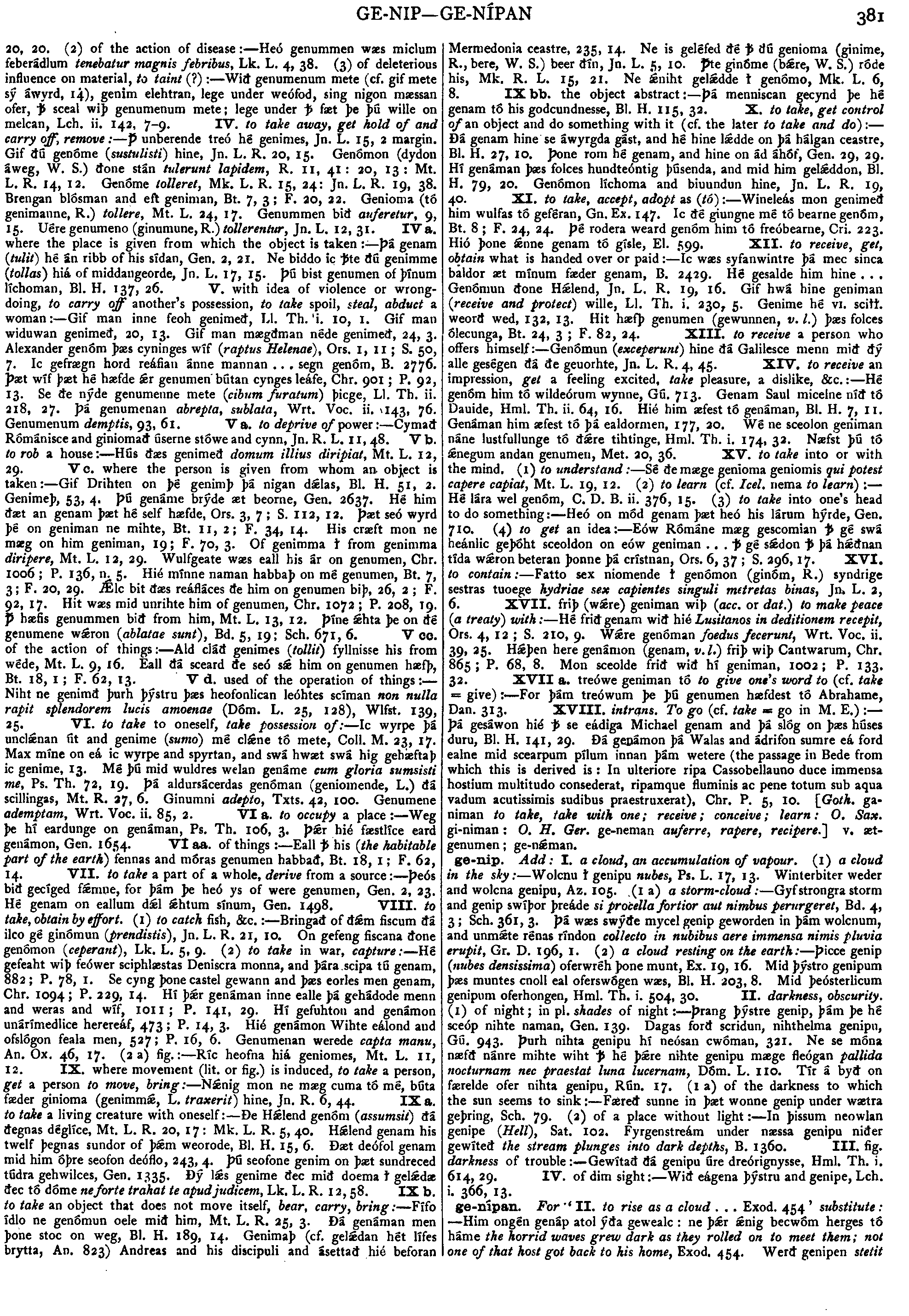
ge-nípan.
For
'II.
to
rise
as
a
cloud
.
.
.
Exod.
454'
substitute:--Him
ongén
genáp
atol
ýða
gewealc:
ne
þr
nig
becwóm
herges
tó
háme
the
horrid
waves
grew
dark
as
they
rolled
on
to
meet
them;
not
one
of
that
host
got
back
to
his
home,
Exod.
454.
Werð
genipen
stetit
|
Source: Bosworth/Toller, page d0397, entry 7 View original page image as: [TIFF] [PNG] [View previous entry] [View next entry] |
[Comment on this entry] [View comments] |
The following entry has been hand-corrected once. |
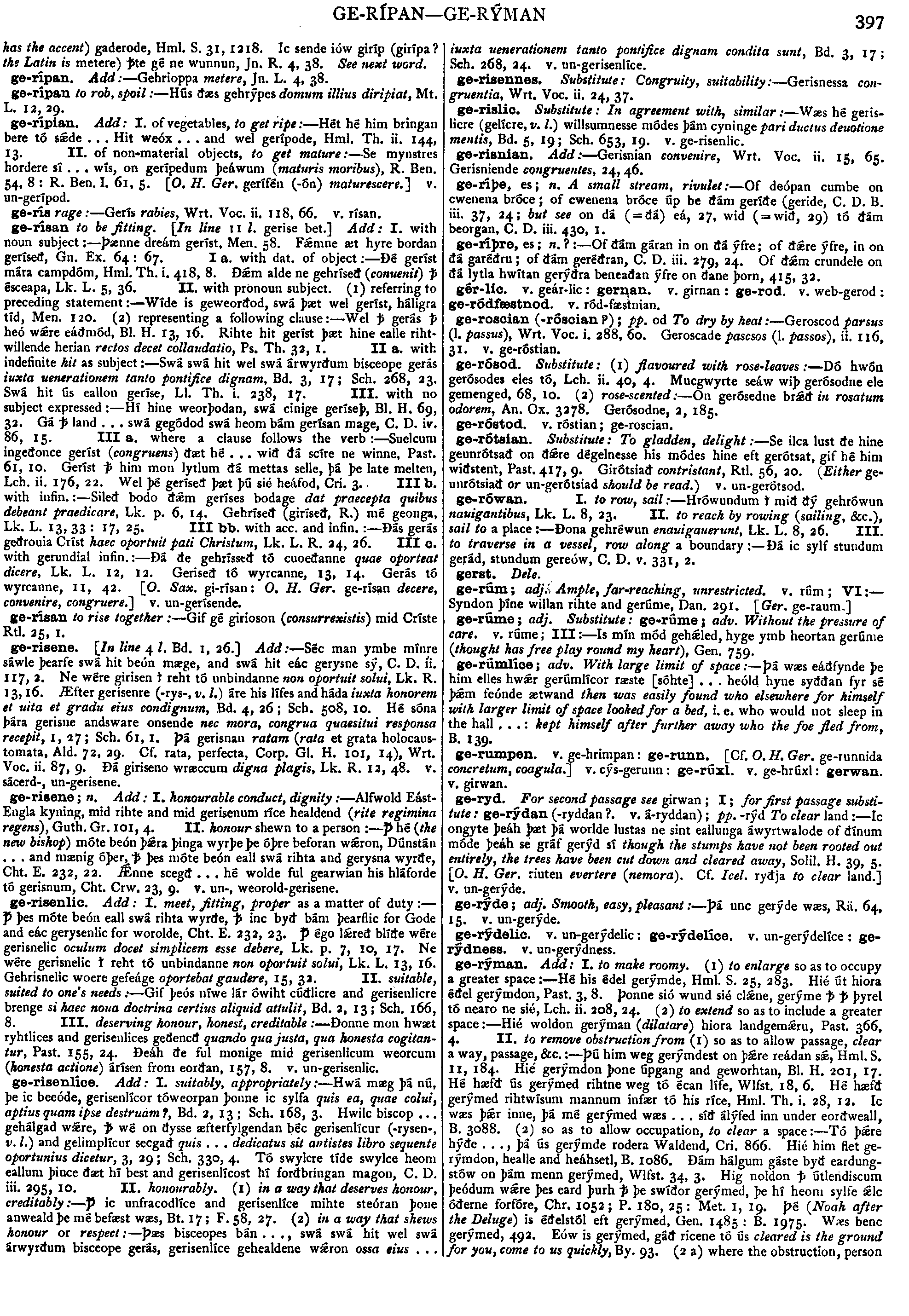
ge-rísan to rise together :-- Gif gé girioson (consurrexistis) mid Críste Rtl. 25, i.
|
Source: Bosworth/Toller, page d0417, entry 16 View original page image as: [TIFF] [PNG] [View previous entry] [View next entry] |
[Comment on this entry] [View comments (1)] |
The following entry has been hand-corrected once. |
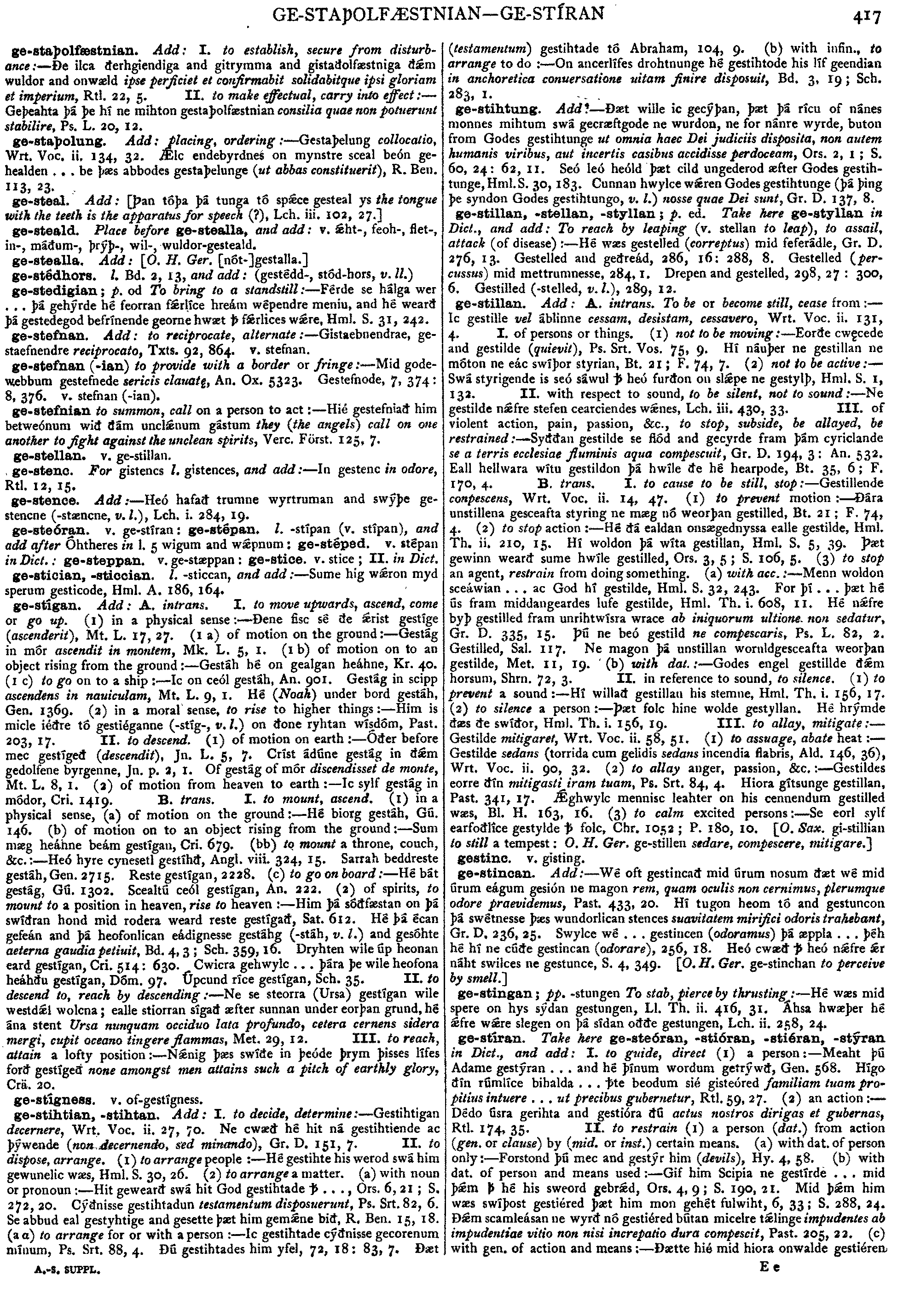
ge-stígan.
Ada":
A.
intrans.
I.
to
move
upwards,
ascend,
come
or
go
up.
(l)
in
a
physical
sense
:--
Dene
fisc
se
ðe
rist
gestíge
(as
cendent),
Mt.
L.
17,
27.
(l
a)
of
motion
on
the
ground
:--
Gestág
in
mór
ascendit
in
montem,
Mk.
L.
5,
l.
(l
b)
of
motion
on
to
an
object
rising
from
the
ground
:--
Gestáh
he
on
gealgan
heáhne,
Kr.
40.
(l
c)
to
go
on
to
a
ship
:--
Ic
on
ceól
gestáh,
An.
901.
Gestág
in
scipp
ascendens
in
nauiculam,
Mt.
L.
9,
l.
He
(Noah)
under
bord
gestáh,
Gen.
1369.
(2)
in
a
moral
sense,
to
rise
to
higher
things
:--
Him
is
micle
iéðre
to
gestiéganne
(-stig-,
v.
/.
)
on
(tone
ryhtan
wisdóm,
Past.
203,
17.
II.
to
descend.
(l)
of
motion
on
earen
:--
Óðer
before
mec
gestigei
(descendit).
Jn.
L.
5,
7-
Críst
ádfine
gestág
in
ðm
gedolfene
byrgenne,
Jn.
p.
2,
Of
gestág
of
mór
discendissei
de
monte,
Mt.
L.
8,
l.
(2)
of
motion
from
heaven
to
earen
:--
Ic
sylf
gestág
in
módor,
Cri.
1419.
B.
trans.
I.
to
mount,
ascend.
(l)
in
a
physical
sense,
(a)
of
motion
on
the
ground
:--
He
biorg
gestáh,
Gú.
146.
(b)
of
motion
on
to
an
object
rising
from
the
ground
:--
Sum
mæg
heáhne
beam
gestígan,
Cri.
679.
(bb)
to
mount
a
throne,
couch,
&c.
:--
Heó
hyre
cynesetl
gestíhð,
Angl.
viii.
324,
15.
Sarran
beddreste
gestáh,
Gen.
2715.
Restegesttgan,
2228.
(c)
to
go
on
board
:--
He
bat
gestág,
Gú.
1302.
Scealtú
ceól
gestígan,
An.
222.
(2)
of
spirits,
to
mount
to
a
position
in
heaven,
rise
to
heaven
:--
Him
þá
sððfæstan
on
þá
swíðran
hond
mid
rodera
weard
reste
gestígað,
Sae.
612.
Hé
bá
écan
gefeán
and
þá
heofonlican
eádignesse
gestáhg
(-stab,
v.l.)
and
gesóhte
aeterna
gaudia
petiuit,
Bd.
4,
3;
Sch.
359,
16.
Dryhten
wile
up
heonan
eard
gestígan,
Cri.
514:
630.
Cwicra
gehwylc
.
.
.
þára
þe
wile
heofona
heáhðu
gestígan,
Dóm.
97.
Úpcund
ríce
gestígan,
Sch.
35.
II.
to
descend
to,
reach
by
descending
:--
Ne
se
steorra
(Ursa)
gestígan
wile
westdl
wolcna;
ealle
stiorran
segað
æfter
sunnan
under
eorþan
grund,
he
ana
stent
Ursa
nunquam
occiduo
lata
profundo,
cetera
cernens
sidera
mergi,
cupit
oceano
tingere
jlammas.
Met.
29,
12.
III.
to
reach,
attain
a
lofty
position
:--
Nsénig
þæs
swíðe
in
þeóde
brym
þisses
Kfes
forð
gestígeit
none
amongst
men
attains
such
a
pitch
of
earthly
glory,
CRä.
| Result Page: |  |
Previous | 1 2 3 4 5 6 7 8 9 | Next |  |
Germanic Lexicon Project (main page)
This search system was written by
Sean Crist
Please consider
volunteering
to correct the data in these online dictionaries.
No rights reserved. Feel free to use these data in any way you please.