|
|

|
Source: Torp, page b0345, entry 7 View original page image as: [TIFF] [PNG] [View previous entry] [View next entry] |
[Comment on this entry] [View comments] |
The following entry has been hand-corrected once. |
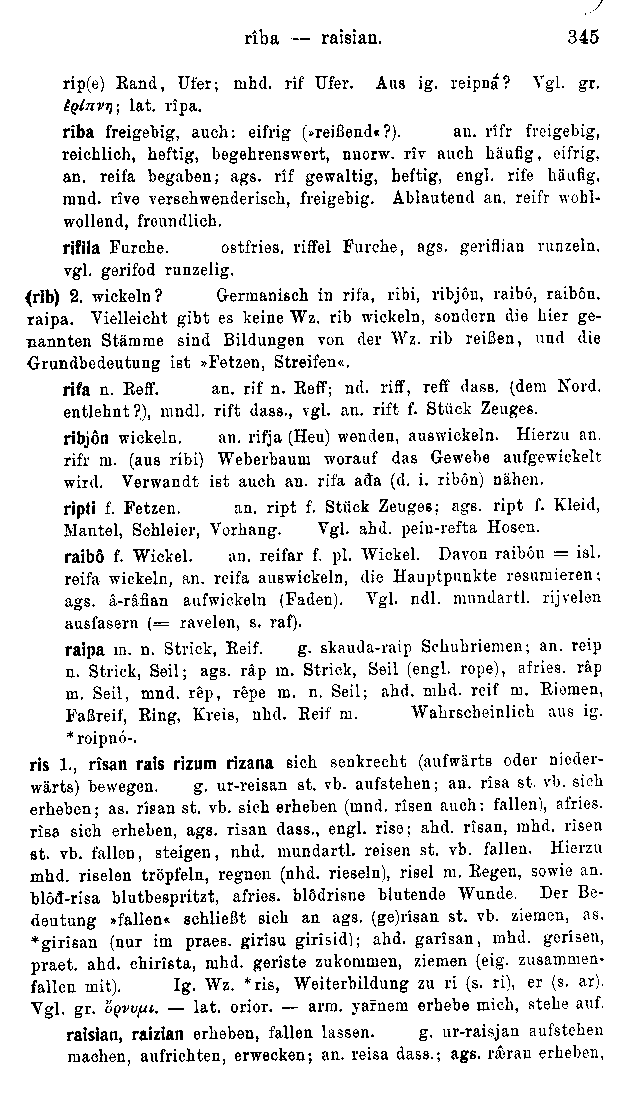
ripti f. Fetzen. an. ript f. Stück Zeuges: ags. ript f. Kleid, Mantel, Schleier, Vorhang. Vgl. ahd. pein-refta Hosen.
[Translate the German words]
|
Source: Bosworth/Toller, page b0795, entry 22 View original page image as: [TIFF] [PNG] [View previous entry] [View next entry] |
[Comment on this entry] [View comments] |
The following entry has been hand-corrected once. |
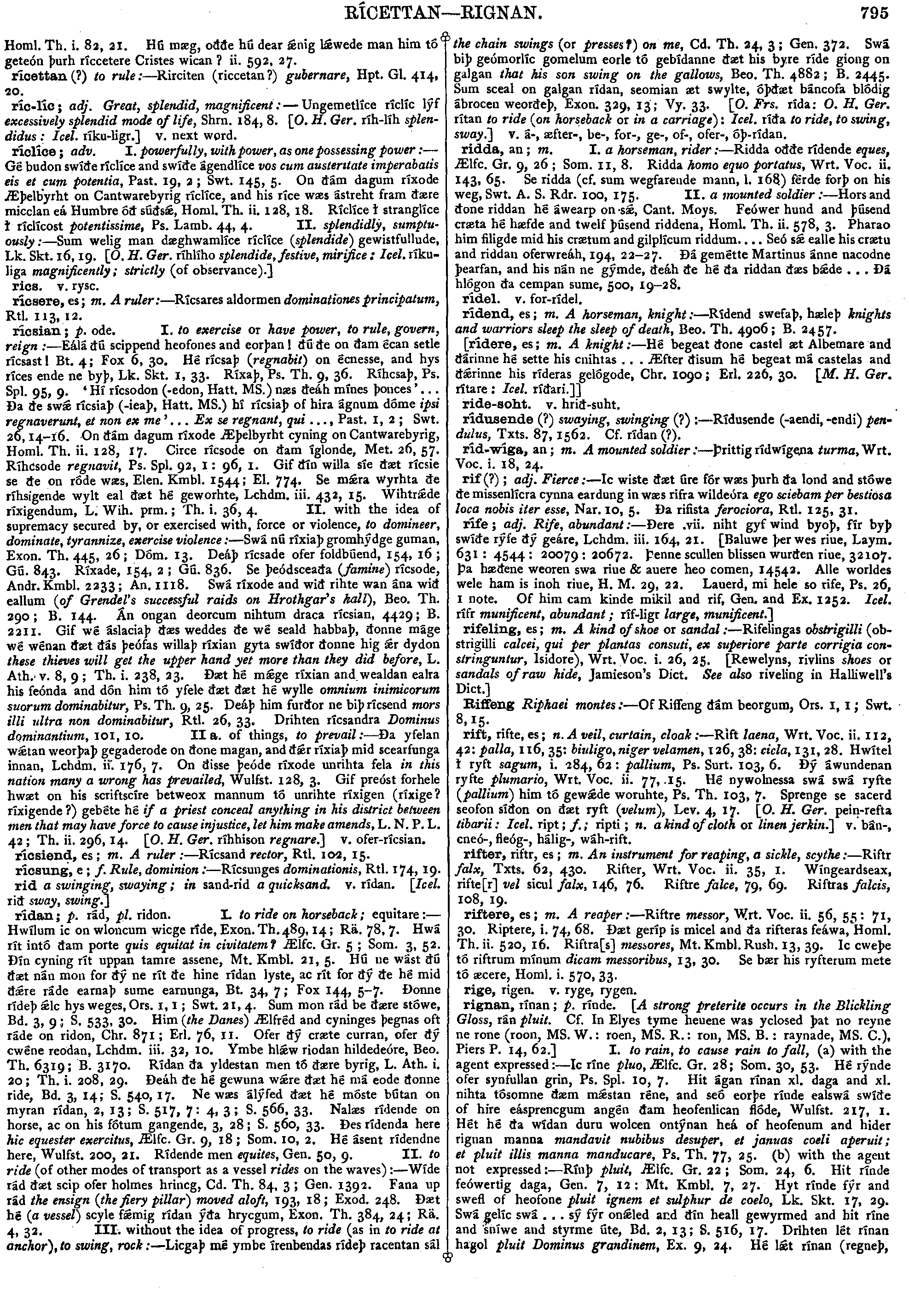
rift,
rifte,
es;
n.
A
veil,
curtain,
cloak
:--
Rift
laena,
Wrt.
Voc.
ii.
112,
42
:
palla,
116,
35
:
biuligo,
niger
velamen,
126,
38
:
cicla,
131,
28.
Hwítel
 ryft
sagum,
i.
284,
62
:
pallium,
Ps.
Surt.
103,
6.
Ðý
áwundenan
ryfte
plumario,
Wrt.
Voc.
ii.
77,
15.
Hé
nywolnessa
swá
swá
ryfte
(pallium)
him
tó
gew
ryft
sagum,
i.
284,
62
:
pallium,
Ps.
Surt.
103,
6.
Ðý
áwundenan
ryfte
plumario,
Wrt.
Voc.
ii.
77,
15.
Hé
nywolnessa
swá
swá
ryfte
(pallium)
him
tó
gew de
woruhte,
Ps.
Th.
103,
7.
Sprenge
se
sacerd
seofon
síðon
on
ðæt
ryft
(velum),
Lev.
4,
17.
[O.
H.
Ger.
pein-refta
tibarii
:
Icel.
ript;
f.;
ripti;
n.
a
kind
of
cloth
or
linen
jerkin.]
v.
bán-,
cneó-,
fleóg-,
hálig-,
wáh-rift.
de
woruhte,
Ps.
Th.
103,
7.
Sprenge
se
sacerd
seofon
síðon
on
ðæt
ryft
(velum),
Lev.
4,
17.
[O.
H.
Ger.
pein-refta
tibarii
:
Icel.
ript;
f.;
ripti;
n.
a
kind
of
cloth
or
linen
jerkin.]
v.
bán-,
cneó-,
fleóg-,
hálig-,
wáh-rift.
|
Source: Cleasby/Vigfusson, page b0084, entry 5 View original page image as: [TIFF] [PNG] [View previous entry] [View next entry] |
[Comment on this entry] [View comments] |
The following entry has been hand-corrected once. |
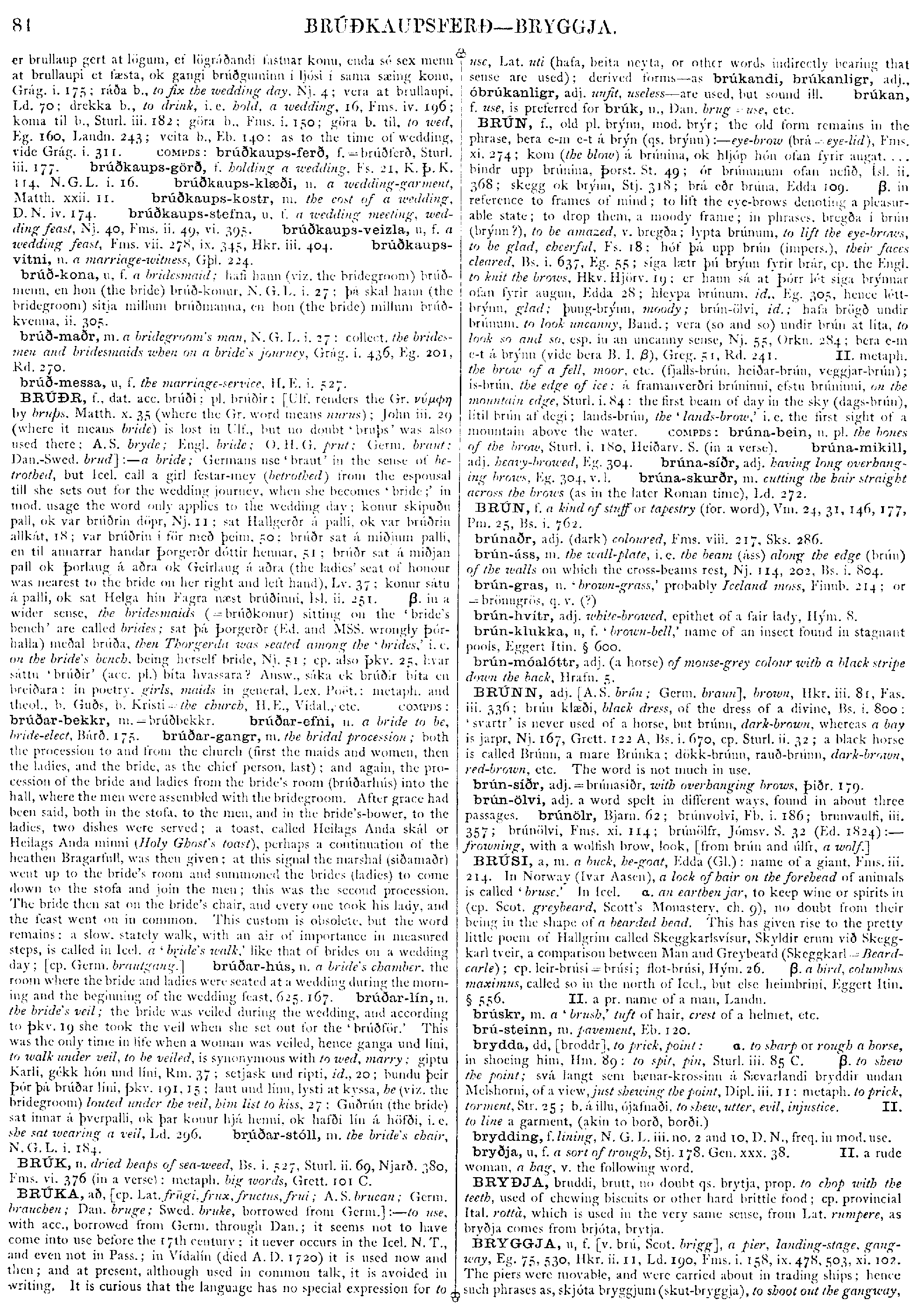
BRÚÐR,
f.,
dat.
acc.
brúði;
pl.
brúðir:
[Ulf.
renders
the
Gr.
GREEK
by
bruþs,
Matth.
x.
35
(where
the
Gr.
word
means
nurus);
John
iii.
29
(where
it
means
bride)
is
lost
in
UIf.,
but
no
doubt
'bruþs'
was
also
used
there:
A.
S.
bryde;
Engl.
bride;
O.
H.
G.
prut;
Germ,
braut;
Dan.-Swed.
Brud]
:--
a
bride;
Germans
use
'braut'
in
the
sense
of
betrothed,
but
Icel.
call
a
girl
festar-mey
(betrothed)
from
the
espousal
till
she
sets
out
for
the
wedding
journey,
when
she
becomes
'bride';
in
mod.
usage
the
word
only
applies
to
the
wedding
day;
konur
skipuðu
pall,
ok
var
brúðrin
döpr,
Nj.
11;
sat
Hallgerðr
á
palli,
ok
var
brúðrin
allkát,
18;
var
brúðrin
í
för
með
þeim,
50;
brúðr
sat
á
miðjum
palli,
en
til
annarrar
handar
Þorgerðr
dóttir
hennar,
51;
brúðr
sat
á
midjan
pall
ok
Þorlaug
á
aðra
ok
Geirlaug
á
aðra
(the
ladies'
seat
of
honour
was
nearest
to
the
bride
on
her
right
and
left
hand),
Lv.
37;
konur
sátu
á
palli,
ok
sat
Helga
hin
Fagra
næst
brúðinni,
Ísl..
ii.
251.
 .
in
a
wider
sense,
the
bridesmaids
(
=
brúðkonur)
sitting
on
the
'bride's
bench'
are
called
brides;
sat
þá
Þorgerðr
(Ed.
and
MSS.
wrongly
Þórhalla)
meðal
brúða,
then
Thorgerda
was
seated
among
the
'brides,'
i.
e.
on
the
bride's
bench,
being
herself
bride,
Ni.
51;
cp.
also
Þkv.
25,
hvar
sattu
'brúðir'
(acc.
pl.)
bíta
hvassara?
Answ.,
sáka
ek
brúðir
bíta
en
breiðara:
in
poetry,
girls,
maids
in
general.
Lex.
Poët.:
metaph.
and
theol.,
b.
Guðs,
b.
Kristi
=
the
church,
H.
E.,
Vidal.,
etc.
COMPDS:
brúðar-bekkr,
m.
=
brúðbekkr.
brúðar-efni,
n.
a
bride
to
be,
bride-elect,
Bárð.
175.
brúðar-gangr,
m.
the
bridal
procession;
both
the
procession
to
and
from
the
church
(first
the
maids
and
women,
then
the
ladies,
and
the
bride,
as
the
chief
person,
last);
and
again,
the
procession
of
the
bride
and
ladies
from
the
bride's
room
(brúðarhús)
into
the
hall,
where
the
men
were
assembled
with
the
bridegroom.
After
grace
had
been
said,
both
in
the
stofa,
to
the
men,
and
in
the
bride's-bower,
to
the
ladies,
two
dishes
were
served;
a
toast,
called
Heilags
Anda
skál
or
Heilags
Anda
minni
(Holy
Ghost's
toast),
perhaps
a
continuation
of
the
heathen
Bragarfull,
was
then
given;
at
this
signal
the
marshal
(siðamaðr)
went
up
to
the
bride's
room
and
summoned
the
brides
(ladies)
to
come
down
to
the
stofa
and
join
the
men;
this
was
the
second
procession.
The
bride
then
sat
on
the
bride's
chair,
and
every
one
took
his
lady,
and
the
feast
went
on
in
common.
This
custom
is
obsolete,
but
the
word
remains:
a
slow,
stately
walk,
with
an
air
of
importance
in
measured
steps,
is
called
in
Icel.
a
'bride's
walk,'
like
that
of
brides
on
a
wedding
day;
[cp.
Germ.
brautgang.]
brúðar-hús,
n.
a
bride's
chamber,
the
room
where
the
bride
and
ladies
were
seated
at
a
wedding
during
the
morning
and
the
beginning
of
the
wedding
feast,
625.
167.
brúðar-lín,
n.
the
bride's
veil;
the
bride
was
veiled
during
the
wedding,
and
according
to
Þkv.
19
she
took
the
veil
when
she
set
out
for
the
'brúðför.'
This
was
the
only
time
in
life
when
a
woman
was
veiled,
hence
ganga
und
líni,
to
walk
under
veil,
to
be
veiled,
is
synonymous
with
to
wed,
marry;
giptu
Karli,
gékk
hón
und
líni,
Rm.
37;
setjask
und
ripti,
id.,
20;
bundu
þeir
Þór
þá
brúðar
líni,
Þkv.
191,
15;
laut
und
línn,
lysti
at
kyssa,
he
(viz.
the
bridegroom)
louted
under
the
veil,
him
list
to
kiss,
27;
Guðrún
(the
bride)
sat
innar
á
þverpalli,
ok
þar
konur
hja
henni,
ok
hafði
lín
á
höfði,
i.
e.
she
sat
wearing
a
veil,
Ld.
296.
brúðar-stóll,
m.
the
bride's
chair,
N.
G.
L.
i.
184.
.
in
a
wider
sense,
the
bridesmaids
(
=
brúðkonur)
sitting
on
the
'bride's
bench'
are
called
brides;
sat
þá
Þorgerðr
(Ed.
and
MSS.
wrongly
Þórhalla)
meðal
brúða,
then
Thorgerda
was
seated
among
the
'brides,'
i.
e.
on
the
bride's
bench,
being
herself
bride,
Ni.
51;
cp.
also
Þkv.
25,
hvar
sattu
'brúðir'
(acc.
pl.)
bíta
hvassara?
Answ.,
sáka
ek
brúðir
bíta
en
breiðara:
in
poetry,
girls,
maids
in
general.
Lex.
Poët.:
metaph.
and
theol.,
b.
Guðs,
b.
Kristi
=
the
church,
H.
E.,
Vidal.,
etc.
COMPDS:
brúðar-bekkr,
m.
=
brúðbekkr.
brúðar-efni,
n.
a
bride
to
be,
bride-elect,
Bárð.
175.
brúðar-gangr,
m.
the
bridal
procession;
both
the
procession
to
and
from
the
church
(first
the
maids
and
women,
then
the
ladies,
and
the
bride,
as
the
chief
person,
last);
and
again,
the
procession
of
the
bride
and
ladies
from
the
bride's
room
(brúðarhús)
into
the
hall,
where
the
men
were
assembled
with
the
bridegroom.
After
grace
had
been
said,
both
in
the
stofa,
to
the
men,
and
in
the
bride's-bower,
to
the
ladies,
two
dishes
were
served;
a
toast,
called
Heilags
Anda
skál
or
Heilags
Anda
minni
(Holy
Ghost's
toast),
perhaps
a
continuation
of
the
heathen
Bragarfull,
was
then
given;
at
this
signal
the
marshal
(siðamaðr)
went
up
to
the
bride's
room
and
summoned
the
brides
(ladies)
to
come
down
to
the
stofa
and
join
the
men;
this
was
the
second
procession.
The
bride
then
sat
on
the
bride's
chair,
and
every
one
took
his
lady,
and
the
feast
went
on
in
common.
This
custom
is
obsolete,
but
the
word
remains:
a
slow,
stately
walk,
with
an
air
of
importance
in
measured
steps,
is
called
in
Icel.
a
'bride's
walk,'
like
that
of
brides
on
a
wedding
day;
[cp.
Germ.
brautgang.]
brúðar-hús,
n.
a
bride's
chamber,
the
room
where
the
bride
and
ladies
were
seated
at
a
wedding
during
the
morning
and
the
beginning
of
the
wedding
feast,
625.
167.
brúðar-lín,
n.
the
bride's
veil;
the
bride
was
veiled
during
the
wedding,
and
according
to
Þkv.
19
she
took
the
veil
when
she
set
out
for
the
'brúðför.'
This
was
the
only
time
in
life
when
a
woman
was
veiled,
hence
ganga
und
líni,
to
walk
under
veil,
to
be
veiled,
is
synonymous
with
to
wed,
marry;
giptu
Karli,
gékk
hón
und
líni,
Rm.
37;
setjask
und
ripti,
id.,
20;
bundu
þeir
Þór
þá
brúðar
líni,
Þkv.
191,
15;
laut
und
línn,
lysti
at
kyssa,
he
(viz.
the
bridegroom)
louted
under
the
veil,
him
list
to
kiss,
27;
Guðrún
(the
bride)
sat
innar
á
þverpalli,
ok
þar
konur
hja
henni,
ok
hafði
lín
á
höfði,
i.
e.
she
sat
wearing
a
veil,
Ld.
296.
brúðar-stóll,
m.
the
bride's
chair,
N.
G.
L.
i.
184.
|
Source: Cleasby/Vigfusson, page b0393, entry 10 View original page image as: [TIFF] [PNG] [View previous entry] [View next entry] |
[Comment on this entry] [View comments] |
The following entry has been hand-corrected once. |
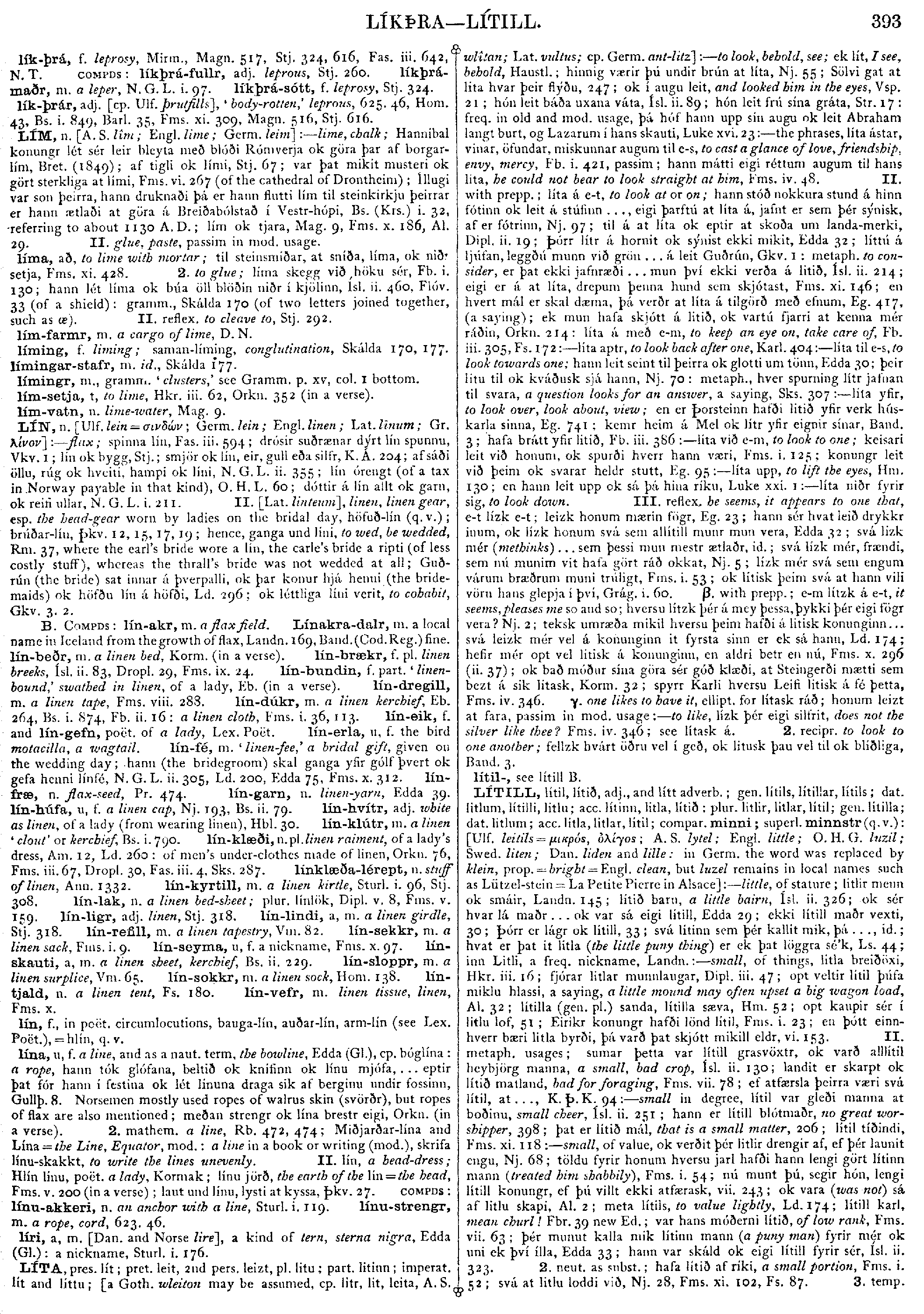
LÍN,
n.
[Ulf.
lein
=
GREEK;
Germ.
lein;
Engl.
linen;
Lat.
l num;
Gr.
GREEK]
:--
flax;
spinna
lín,
Fas.
iii.
594;
drósir
suðrænar
dýrt
lín
spunnu,
Vkv.
1;
lín
ok
bygg,
Stj.;
smjör
ok
lín,
eir,
gull
eða
silfr,
K.Á.
204;
af
sáði
öllu,
rúg
ok
hveiti,
hampi
ok
líni,
N.G.L.
ii.
355;
lín
órengt
(of
a
tax
in
Norway
payable
in
that
kind),
O.H.L.
60;
dóttir
á
lín
allt
ok
garn,
ok
reifi
ullar,
N.G.L.
i.
211.
II.
[Lat.
linteum],
linen,
linen
gear,
esp.
the
head-gear
worn
by
ladies
on
the
bridal
day,
höfuð-lín
(q.v.);
brúðar-lín,
Þkv.
12,
15,
17,
19;
hence,
ganga
und
líni,
to
wed,
be
wedded,
Rm.
37,
where
the
earl's
bride
wore
a
lín,
the
carle's
bride
a
ripti
(of
less
costly
stuff),
whereas
the
thrall's
bride
was
not
wedded
at
all;
Guðrún
(the
bride)
sat
innar
á
þverpalli,
ok
þar
konur
hjá
henni
(the
bride-maids)
ok
höfðu
lín
á
höfði,
Ld.
296;
ok
léttliga
líni
verit,
to
cohabit,
Gkv.
3.
2.
B.
COMPDS:
lín-akr,
m.
a
flax
field.
Línakra-dalr,
m.
a
local
name
in
Iceland
from
the
growth
of
flax,
Landn.
169,
Band.
(Cod.
Reg.)
fine.
lín-beðr,
m.
a
linen
bed,
Korm.
(in
a
verse).
lín-brækr,
f.
pl.
linen
breeks,
Ísl.
ii.
83,
Dropl.
29,
Fms.
ix.
24.
lín-bundin,
f.
part.
'linen-bound,'
swathed
in
linen,
of
a
lady,
Eb.
(in
a
verse).
lín-dregill,
m.
a
linen
tape,
Fms.
viii.
288.
lín-dúkr,
m.
a
linen
kerchief,
Eb.
264,
Bs.
i.
874,
Fb.
ii.
16:
a
linen
cloth,
Fms.
i.
36,
113.
lín-eik,
f.
and
lín-gefn,
poët,
of
a
lady,
Lex.
Poët.
lín-erla,
u,
f.
the
bird
motacilla,
a
wagtail.
lín-fé,
m.
'linen-fee,'
a
bridal
gift,
given
on
the
wedding
day;
hann
(the
bridegroom)
skal
ganga
yfir
gólf
þvert
ok
gefa
henni
línfé,
N.G.L.
ii.
305,
Ld.
200,
Edda
75,
Fms.
x.
312.
lín-fræ,
n.
flax-seed,
Pr.
474.
lín-garn,
n.
linen-yarn,
Edda
39.
lín-húfa,
u,
f.
a
linen
cap,
Nj.
193,
Bs.
ii.
79.
lín-hvítr,
adj.
white
as
linen,
of
a
lady
(from
wearing
linen),
Hbl.
30.
lín-klútr,
m.
a
linen
'clout'
or
kerchief,
Bs.
i.
790.
lín-klæði,
n.
pl.
linen
raiment,
of
a
lady's
dress,
Am.
12,
Ld.
260:
of
men's
under-clothes
made
of
linen,
Orkn.
76,
Fms.
iii.
67,
Dropl.
30,
Fas.
iii.
4,
Sks.
287.
línklæða-lérept,
n.
stuff
of
linen,
Ann.
1332.
lín-kyrtill,
m.
a
linen
kirtle,
Sturl.
i.
96,
Stj.
308.
lín-lak,
n.
a
linen
bed-sheet;
plur.
línlök,
Dipl.
v.
8,
Fms.
v.
159.
lín-ligr,
adj.
linen,
Stj.
318.
lín-lindi,
a,
m.
a
linen
girdle,
Stj.
318.
lín-refill,
m.
a
linen
tapestry,
Vm.
82.
lín-sekkr,
m.
a
linen
sack,
Fms.
i.
9.
lín-seyma,
u,
f.
a
nickname,
Fms.
x.
97.
lín-skauti,
a,
m.
a
linen
sheet,
kerchief,
Bs.
ii.
229.
lín-sloppr,
m.
a
linen
surplice,
Vm.
65.
lín-sokkr,
m.
a
linen
sock,
Hom.
138.
lín-tjald,
n.
a
linen
tent,
Fs.
180.
lín-vefr,
m.
linen
tissue,
linen,
Fms.
x.
num;
Gr.
GREEK]
:--
flax;
spinna
lín,
Fas.
iii.
594;
drósir
suðrænar
dýrt
lín
spunnu,
Vkv.
1;
lín
ok
bygg,
Stj.;
smjör
ok
lín,
eir,
gull
eða
silfr,
K.Á.
204;
af
sáði
öllu,
rúg
ok
hveiti,
hampi
ok
líni,
N.G.L.
ii.
355;
lín
órengt
(of
a
tax
in
Norway
payable
in
that
kind),
O.H.L.
60;
dóttir
á
lín
allt
ok
garn,
ok
reifi
ullar,
N.G.L.
i.
211.
II.
[Lat.
linteum],
linen,
linen
gear,
esp.
the
head-gear
worn
by
ladies
on
the
bridal
day,
höfuð-lín
(q.v.);
brúðar-lín,
Þkv.
12,
15,
17,
19;
hence,
ganga
und
líni,
to
wed,
be
wedded,
Rm.
37,
where
the
earl's
bride
wore
a
lín,
the
carle's
bride
a
ripti
(of
less
costly
stuff),
whereas
the
thrall's
bride
was
not
wedded
at
all;
Guðrún
(the
bride)
sat
innar
á
þverpalli,
ok
þar
konur
hjá
henni
(the
bride-maids)
ok
höfðu
lín
á
höfði,
Ld.
296;
ok
léttliga
líni
verit,
to
cohabit,
Gkv.
3.
2.
B.
COMPDS:
lín-akr,
m.
a
flax
field.
Línakra-dalr,
m.
a
local
name
in
Iceland
from
the
growth
of
flax,
Landn.
169,
Band.
(Cod.
Reg.)
fine.
lín-beðr,
m.
a
linen
bed,
Korm.
(in
a
verse).
lín-brækr,
f.
pl.
linen
breeks,
Ísl.
ii.
83,
Dropl.
29,
Fms.
ix.
24.
lín-bundin,
f.
part.
'linen-bound,'
swathed
in
linen,
of
a
lady,
Eb.
(in
a
verse).
lín-dregill,
m.
a
linen
tape,
Fms.
viii.
288.
lín-dúkr,
m.
a
linen
kerchief,
Eb.
264,
Bs.
i.
874,
Fb.
ii.
16:
a
linen
cloth,
Fms.
i.
36,
113.
lín-eik,
f.
and
lín-gefn,
poët,
of
a
lady,
Lex.
Poët.
lín-erla,
u,
f.
the
bird
motacilla,
a
wagtail.
lín-fé,
m.
'linen-fee,'
a
bridal
gift,
given
on
the
wedding
day;
hann
(the
bridegroom)
skal
ganga
yfir
gólf
þvert
ok
gefa
henni
línfé,
N.G.L.
ii.
305,
Ld.
200,
Edda
75,
Fms.
x.
312.
lín-fræ,
n.
flax-seed,
Pr.
474.
lín-garn,
n.
linen-yarn,
Edda
39.
lín-húfa,
u,
f.
a
linen
cap,
Nj.
193,
Bs.
ii.
79.
lín-hvítr,
adj.
white
as
linen,
of
a
lady
(from
wearing
linen),
Hbl.
30.
lín-klútr,
m.
a
linen
'clout'
or
kerchief,
Bs.
i.
790.
lín-klæði,
n.
pl.
linen
raiment,
of
a
lady's
dress,
Am.
12,
Ld.
260:
of
men's
under-clothes
made
of
linen,
Orkn.
76,
Fms.
iii.
67,
Dropl.
30,
Fas.
iii.
4,
Sks.
287.
línklæða-lérept,
n.
stuff
of
linen,
Ann.
1332.
lín-kyrtill,
m.
a
linen
kirtle,
Sturl.
i.
96,
Stj.
308.
lín-lak,
n.
a
linen
bed-sheet;
plur.
línlök,
Dipl.
v.
8,
Fms.
v.
159.
lín-ligr,
adj.
linen,
Stj.
318.
lín-lindi,
a,
m.
a
linen
girdle,
Stj.
318.
lín-refill,
m.
a
linen
tapestry,
Vm.
82.
lín-sekkr,
m.
a
linen
sack,
Fms.
i.
9.
lín-seyma,
u,
f.
a
nickname,
Fms.
x.
97.
lín-skauti,
a,
m.
a
linen
sheet,
kerchief,
Bs.
ii.
229.
lín-sloppr,
m.
a
linen
surplice,
Vm.
65.
lín-sokkr,
m.
a
linen
sock,
Hom.
138.
lín-tjald,
n.
a
linen
tent,
Fs.
180.
lín-vefr,
m.
linen
tissue,
linen,
Fms.
x.
|
Source: Cleasby/Vigfusson, page b0498, entry 5 View original page image as: [TIFF] [PNG] [View previous entry] [View next entry] |
[Comment on this entry] [View comments] |
The following entry has been hand-corrected once. |
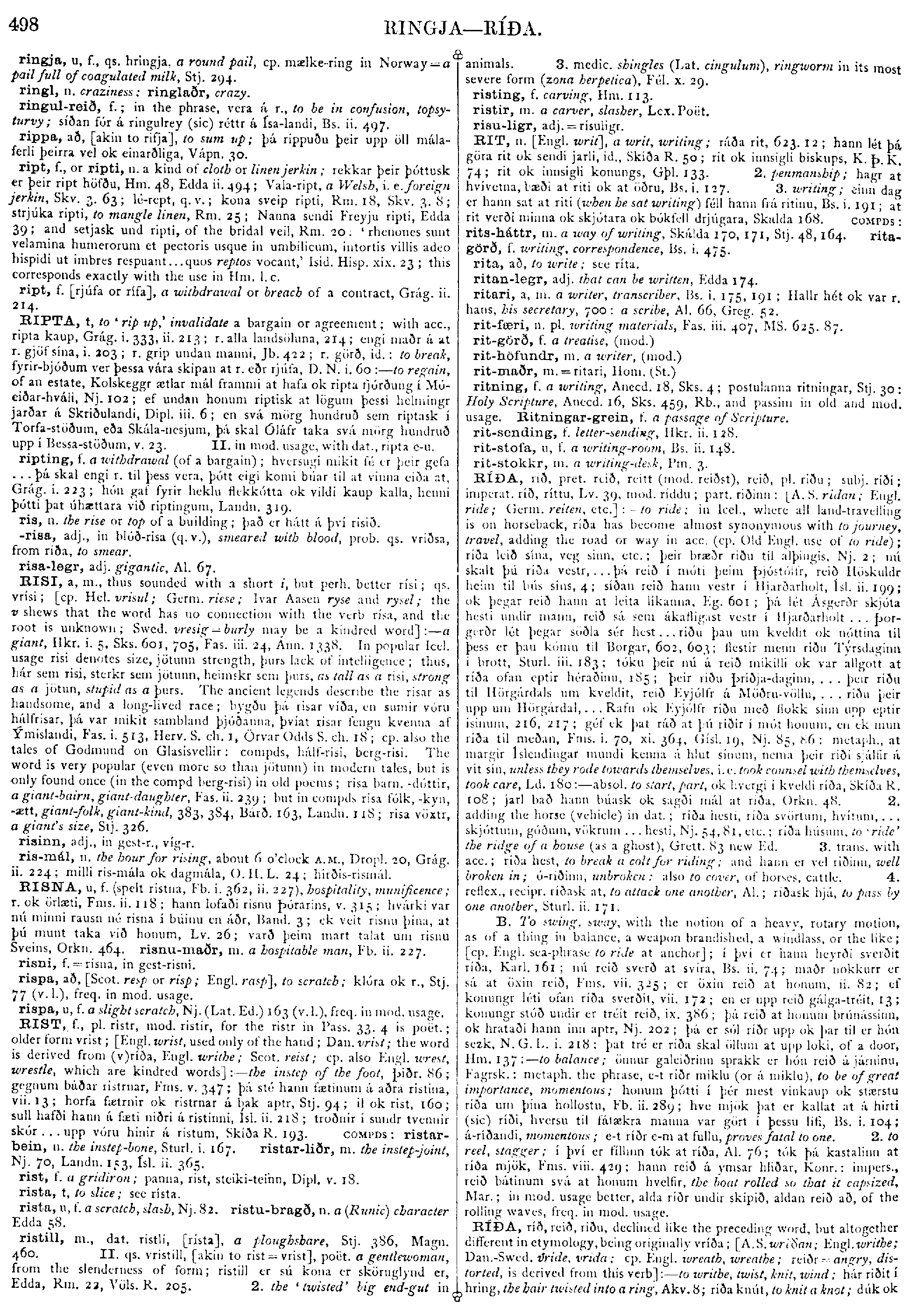
ript, f., or ripti, n. a kind of cloth or linen jerkin; rekkar þeir þóttusk er þeir ript höfðu, Hm. 48, Edda ii. 494; Vala-ript, a Welsh, i.e. foreign jerkin, Skv. 3. 63; lé-rept, q.v.; kona sveip ripti, Rm. 18, Skv. 3. 8; strjúka ripti, to mangle linen, Rm. 25; Nanna sendi Freyju ripti, Edda 39; and setjask und ripti, of the bridal veil, Rm. 20: 'rhenones sunt velamina humerorum et pectoris usque in umbilicum, intortis villis adeo hispidi ut imbres respuant ... quos reptos vocant,' Isid. Hisp. xix. 23; this corresponds exactly with the use in Hm. l.c.
|
Source: Cleasby/Vigfusson, page b0591, entry 41 View original page image as: [TIFF] [PNG] [View previous entry] [View next entry] |
[Comment on this entry] [View comments] |
The following entry has been hand-corrected once. |
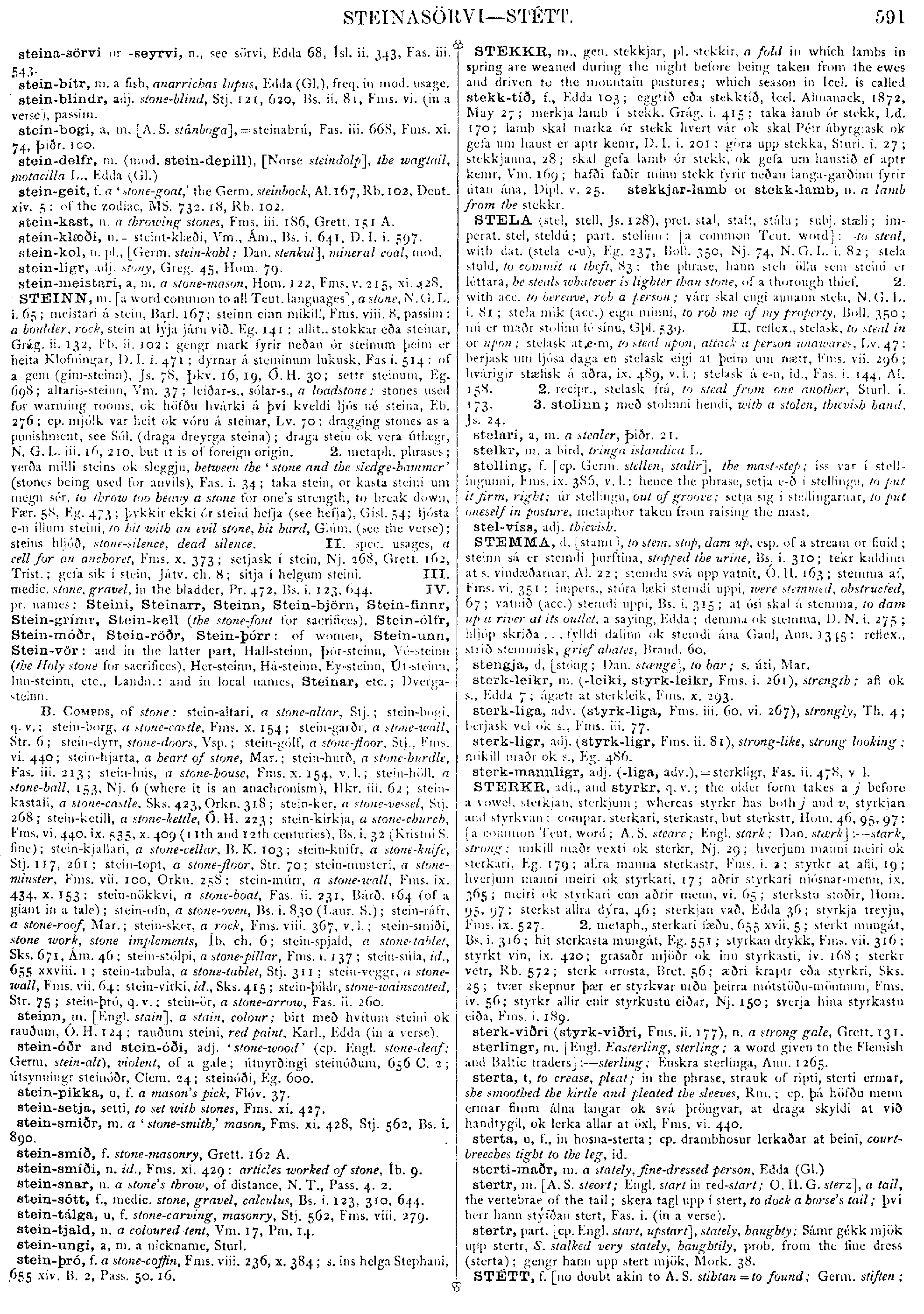
sterta, t, to crease, pleat; in the phrase, strauk of ripti, sterti ermar, she smoothed the kirtle and pleated the sleeves, Rm.; cp. þá höfðu menn ermar fimm álna langar ok svá þröngvar, at draga skyldi at við handtygil, ok lerka allar at öxl, Fms. vi. 440.
|
Source: Cleasby/Vigfusson, page b0599, entry 1 View original page image as: [TIFF] [PNG] [View previous entry] [View next entry] |
[Comment on this entry] [View comments] |
The following entry has been hand-corrected once. |
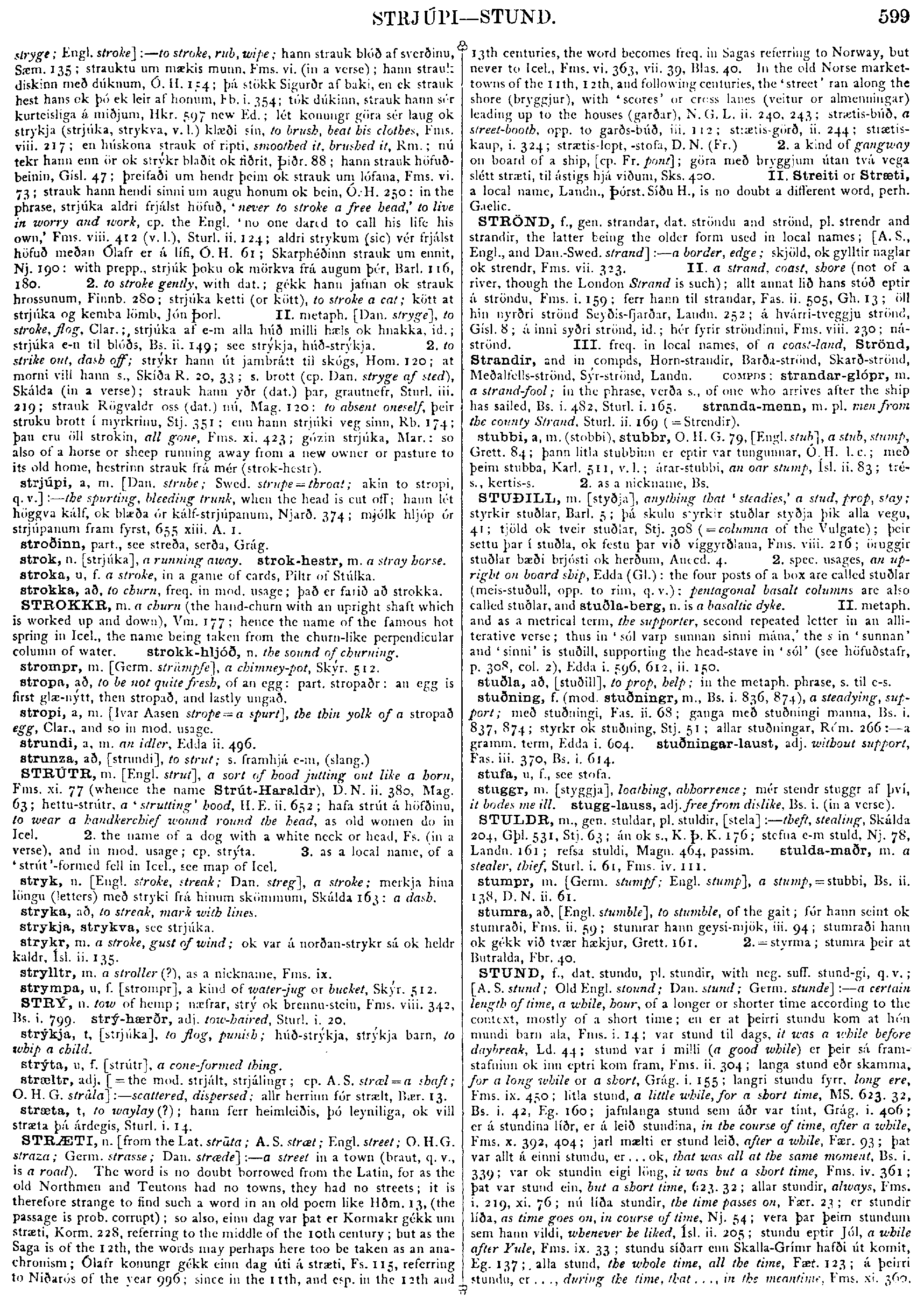
stryge; Engl. stroke] :-- to stroke, rub, wipe; hann strauk blóð af sverðinu, Sæm. 135; strauktu um mækis munn, Fms. vi. (in a verse); hann strauk diskinn með dúknum, Ó.H. 154; þá stökk Sigurðr af baki, en ek strauk hest hans ok þó ek leir af honum, Fb. i. 354; tók dúkinn, strauk hann sér kurteisliga á miðjum, Hkr. 597 new Ed.; lét konungr göra sér laug ok strykja (strjúka, strykva, v.l.) klæði sín, to brush, beat his clothes, Fms. viii. 217; en húskona strauk of ripti, smoothed it, brushed it. Rm.; nú tekr hann enn ör ok strýkr blaðit ok fiðrit, Þiðr. 88; hann strauk höfuð-beinin, Gísl. 47; þreifaði um hendr þeim ok strauk um lófana, Fms. vi. 73; strauk hann hendi sinni um augu honum ok bein, Ó.H. 250: in the phrase, strjúka aldri frjálst höfuð, 'never to stroke a free head,' to live in worry and work, cp. the Engl. 'no one dared to call his life his own,' Fms. viii. 412 (v.l.), Sturl. ii. 124; aldri strykum (sic) vér frjálst höfuð meðan Ólafr er á lífi, Ó.H. 61; Skarphéðinn strauk um ennit, Nj. 190: with prepp., strjúk þoku ok mörkva frá augum þér, Barl. 116, 180. 2. to stroke gently, with dat.; gékk hann jafnan ok strauk hrossunum, Finnb. 280; strjúka ketti (or kött), to stroke a cat; kött at strjúka og kemba lömb, Jón Þorl. II. metaph. [Dan. stryge], to stroke, flog, Clar.;, strjúka af e-m alla húð milli hæls ok hnakka, id.; strjúka e-n til blóðs, Bs. ii. 149; see strýkja, húð-strýkja. 2. to strike out, dash off; strýkr hann út jambrátt til skógs, Hom. 120; at morni vill hann s., Skíða R. 20, 33; s. brott (cp. Dan. stryge af sted), Skálda (in a verse); strauk hann yðr (dat.) þar, grautnefr, Sturl. iii. 219; strauk Rögvaldr oss (dat.) nú, Mag. 120: to absent oneself, þeir struku brott í myrkrinu, Stj. 351; enn hann strjúki veg sinn, Rb. 174; þau eru öll strokin, all gone, Fms. xi. 423; gózin strjúka, Mar.: so also of a horse or sheep running away from a new owner or pasture to its old home, hestrinn strauk frá mér (strok-hestr).
|
Source: Cleasby/Vigfusson, page b0608, entry 30 View original page image as: [TIFF] [PNG] [View previous entry] [View next entry] |
[Comment on this entry] [View comments] |
The following entry has been hand-corrected once. |
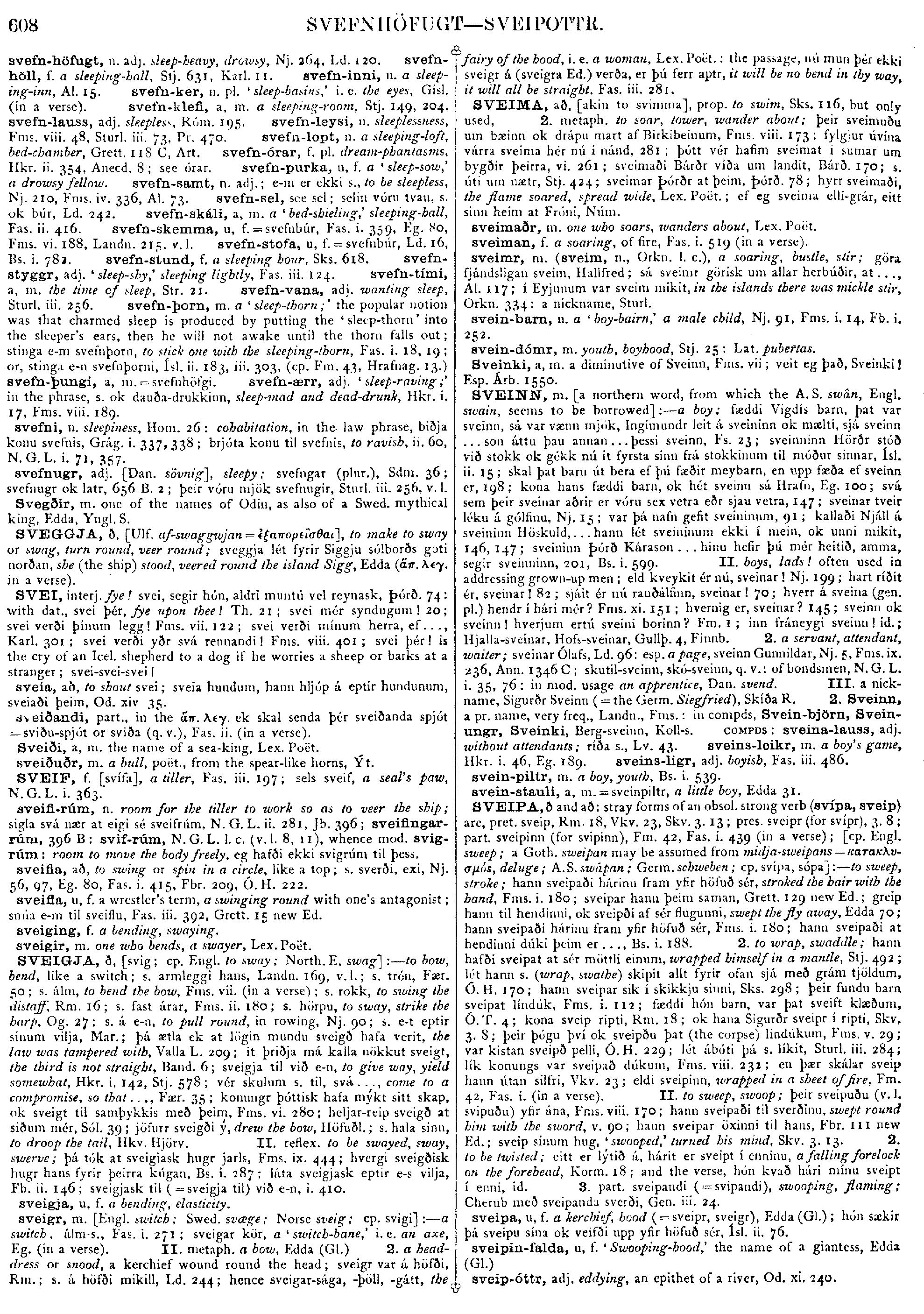
SVEIPA, ð and að: stray forms of an obsol. strong verb (svípa, sveip) are, pret. sveip, Rm. 18, Vkv. 23, Skv. 3. 13; pres. sveipr (for svípr), 3. 8; part. sveipinn (for svipinn), Fm. 42, Fas. i. 439 (in a verse); [cp. Engl. sweep; a Goth. sweipan may be assumed from midja-sweipans = GREEK, deluge; A.S. swâpan; Germ. schweben; cp. svipa, sópa] :-- to sweep, stroke; hann sveipaði hárinu fram yfir höfuð sér, stroked the hair with the hand, Fms. i. 180; sveipar hann þeim saman, Grett. 129 new Ed.; greip hann til hendinni, ok sveipði af sér flugunni, swept the fly away, Edda 70; hann sveipaði hárinu fram yfir höfuð sér, Fms. i. 180; hann sveipaði at hendinni dúki þeim er ..., Bs. i. 188. 2. to wrap, swaddle; hann hafði sveipat at sér möttli einum, wrapped himself in a mantle, Stj. 492; lét hann s. (wrap, swathe) skipit allt fyrir ofan sjá með grám tjöldum, Ó.H. 170; hann sveipar sik í skikkju sinni, Sks. 298; þeir fundu barn sveipat líndúk, Fms. i. 112; fæddi hón barn, var þat sveift klæðum, Ó.T. 4; kona sveip ripti, Rm. 18; ok hana Sigurðr sveipr í ripti, Skv, 3. 8; þeir þógu því ok sveipðu þat (the corpse) líndúkum, Fms. v. 29; var kistan sveipð pelli, Ó.H. 229; lét ábóti þá s. líkit, Sturl. iii. 284; lík konungs var sveipað dúkum, Fms. viii. 232; en þær skálar sveip hann útan silfri, Vkv. 23; eldi sveipinn, wrapped in a sheet of fire, Fm. 42, Fas. i. (in a verse). II. to sweep, swoop; þeir sveipuðu (v.l. svipuðu) yfir ána, Fms. viii. 170; hann sveipaði til sverðinu, swept round him with the sword, v. 90; hann sveipar öxinni til hans, Fbr. 111 new Ed.; sveip sínum hug, 'swooped' turned his mind, Skv. 3. 13. 2. to be twisted; eitt er lýtið á, hárit er sveipt í enninu, a falling forelock on the forehead, Korm. 18; and the verse, hón kvað hári mínu sveipt í enni, id. 3. part. sveipandi (= svipandi), swooping, flaming; Cherub með sveipandu sverði, Gen. iii. 24.
Germanic Lexicon Project (main page)
This search system was written by
Sean Crist
Please consider
volunteering
to correct the data in these online dictionaries.
No rights reserved. Feel free to use these data in any way you please.