|
|

|
Source: Bosworth/Toller, page b0126, entry 17 View original page image as: [TIFF] [PNG] [View previous entry] [View next entry] |
[Comment on this entry] [View comments] |
The following entry has been hand-corrected once. |
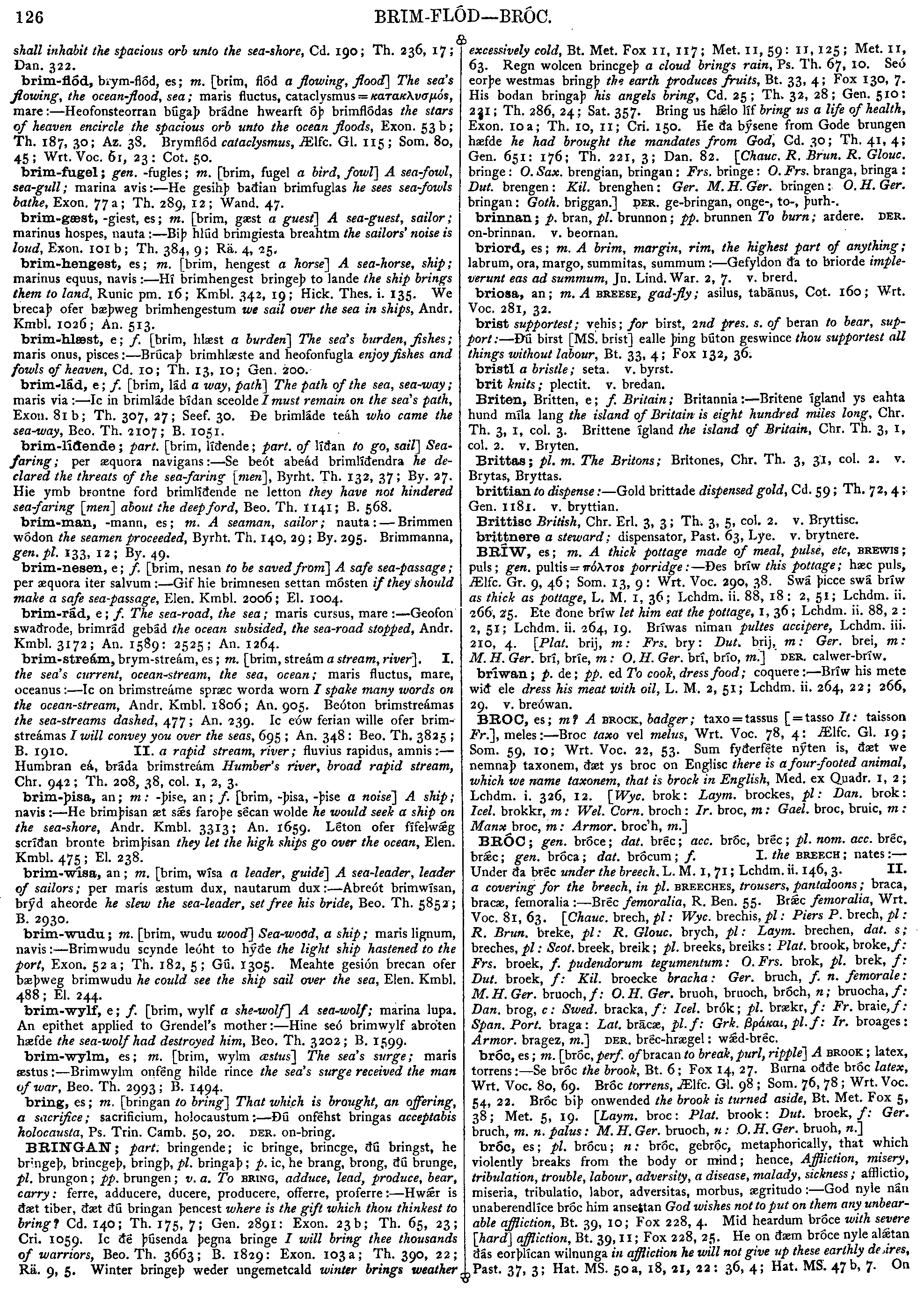
brim-wylm, es; m. [brim, wylm æstus] The sea's surge; maris æstus :-- Brimwylm onféng hilde rince the sea's surge received the man of war, Beo. Th. 2993; B. 1494.
|
Source: Bosworth/Toller, page b0329, entry 12 View original page image as: [TIFF] [PNG] [View previous entry] [View next entry] |
[Comment on this entry] [View comments] |
The following entry has been hand-corrected once. |
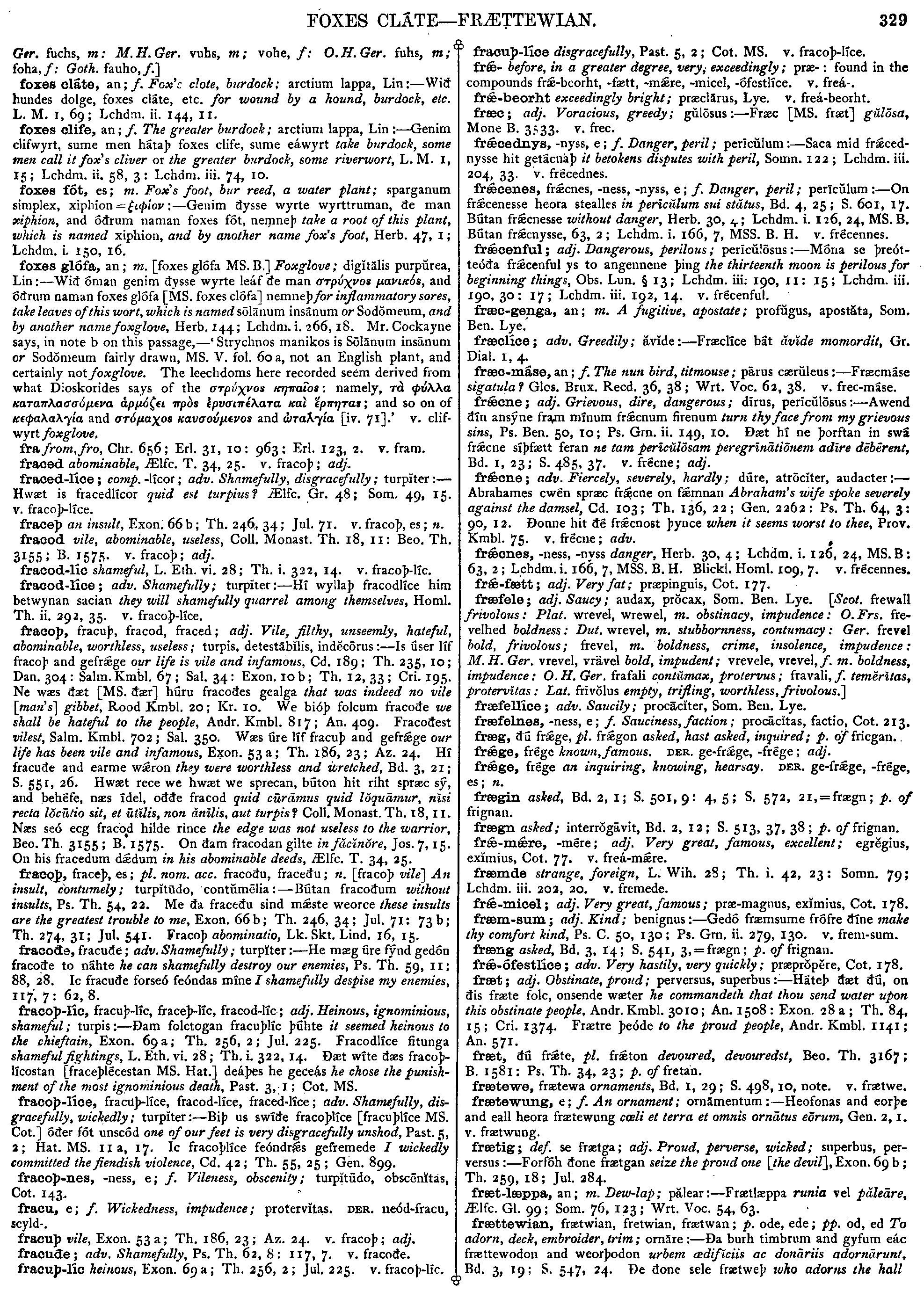
fracoþ,
fracuþ,
fracod,
fraced;
adj.
Vile,
filthy,
unseemly,
hateful,
abominable,
worthless,
useless;
turpis,
detest bilis,
ind
bilis,
ind c
c rus
:--
Is
úser
líf
fracoþ
and
gefr
rus
:--
Is
úser
líf
fracoþ
and
gefr ge
our
life
is
vile
and
infamous,
Cd.
189;
Th.
235,
10;
Dan.
304:
Salm.
Kmbl.
67;
Sal.
34:
Exon.
10
b;
Th.
12,
33;
Cri.
195.
Ne
wæs
ðæt
[MS.
ðær]
húru
fracoðes
gealga
that
was
indeed
no
vile
[man's]
gibbet,
Rood
Kmbl.
20;
Kr.
10.
We
bióþ
folcum
fracoðe
we
shall
be
hateful
to
the
people,
Andr.
Kmbl.
817;
An.
409.
Fracoðest
vilest.
Salm.
Kmbl.
702;
Sal.
350.
Wæs
úre
líf
fracuþ
and
gefrge
our
life
has
been
vile
and
infamous,
Exon.
53
a;
Th.
186,
23;
Az.
24.
Hí
fracuðe
and
earme
wron
they
were
worthless
and
wretched,
Bd.
3,
21;
S.
551,
26.
Hwæt
rece
we
hwæt
we
sprecan,
búton
hit
riht
spræc
sý,
and
behéfe,
næs
idel,
oððe
fracod
quid
c
ge
our
life
is
vile
and
infamous,
Cd.
189;
Th.
235,
10;
Dan.
304:
Salm.
Kmbl.
67;
Sal.
34:
Exon.
10
b;
Th.
12,
33;
Cri.
195.
Ne
wæs
ðæt
[MS.
ðær]
húru
fracoðes
gealga
that
was
indeed
no
vile
[man's]
gibbet,
Rood
Kmbl.
20;
Kr.
10.
We
bióþ
folcum
fracoðe
we
shall
be
hateful
to
the
people,
Andr.
Kmbl.
817;
An.
409.
Fracoðest
vilest.
Salm.
Kmbl.
702;
Sal.
350.
Wæs
úre
líf
fracuþ
and
gefrge
our
life
has
been
vile
and
infamous,
Exon.
53
a;
Th.
186,
23;
Az.
24.
Hí
fracuðe
and
earme
wron
they
were
worthless
and
wretched,
Bd.
3,
21;
S.
551,
26.
Hwæt
rece
we
hwæt
we
sprecan,
búton
hit
riht
spræc
sý,
and
behéfe,
næs
idel,
oððe
fracod
quid
c rmus
quid
l
rmus
quid
l qumur,
n
qumur,
n si
recta
lctio
sit,
et
tlis,
non
si
recta
lctio
sit,
et
tlis,
non
 n
n lis,
aut
turpis?
Coll.
Monast.
Th.
18,
11.
Næs
seó
ecg
fracod
hilde
rince
the
edge
was
not
useless
to
the
warrior,
Beo.
Th.
3155;
B.
1575.
On
ðam
fracodan
gilte
in
fcnre,
Jos.
7,
15.
On
his
fracedum
ddum
in
his
abominable
deeds,
Ælfc.
T.
34,
25.
lis,
aut
turpis?
Coll.
Monast.
Th.
18,
11.
Næs
seó
ecg
fracod
hilde
rince
the
edge
was
not
useless
to
the
warrior,
Beo.
Th.
3155;
B.
1575.
On
ðam
fracodan
gilte
in
fcnre,
Jos.
7,
15.
On
his
fracedum
ddum
in
his
abominable
deeds,
Ælfc.
T.
34,
25.
|
Source: Bosworth/Toller, page b0360, entry 21 View original page image as: [TIFF] [PNG] [View previous entry] [View next entry] |
[Comment on this entry] [View comments] |
The following entry has been hand-corrected once. |
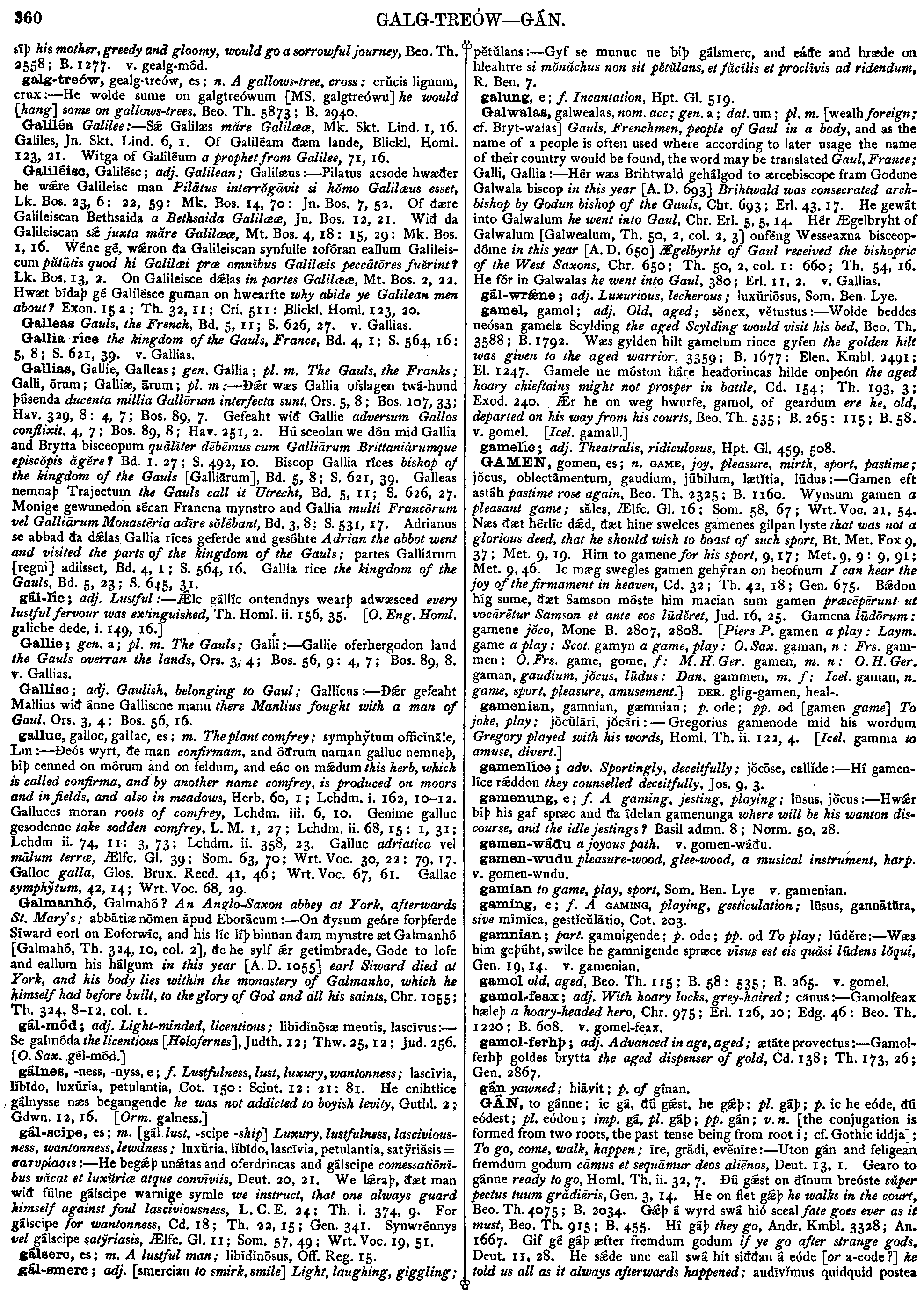
gamel,
gamol;
adj.
Old,
aged;
snex,
vtustus
:--
Wolde
beddes
neósan
gamela
Scylding
the
aged
Scylding
would
visit
his
bed,
Beo.
Th.
3588;
B.
1792.
Wæs
gylden
hilt
gamelum
rince
gyfen
the
golden
hilt
was
given
to
the
aged
warrior,
3359;
B.
1677
:
Elen.
Kmbl.
2491;
El.
1247.
Gamele
ne
móston
háre
heaðorincas
hilde
onþeón
the
aged
hoary
chieftains
might
not
prosper
in
battle,
Cd.
154;
Th.
193,
3;
Exod.
240.
Æ-acute;r
he
on
weg
hwurfe,
gamol,
of
geardum
ere
he,
old,
departed
on
his
way
from
his
courts,
Beo.
Th.
535;
B.
265
:
115;
B.
58.
v.
gomel.
[Icel.
gamall.]
|
Source: Bosworth/Toller, page b0536, entry 55 View original page image as: [TIFF] [PNG] [View previous entry] [View next entry] |
[Comment on this entry] [View comments] |
The following entry has been hand-corrected once. |
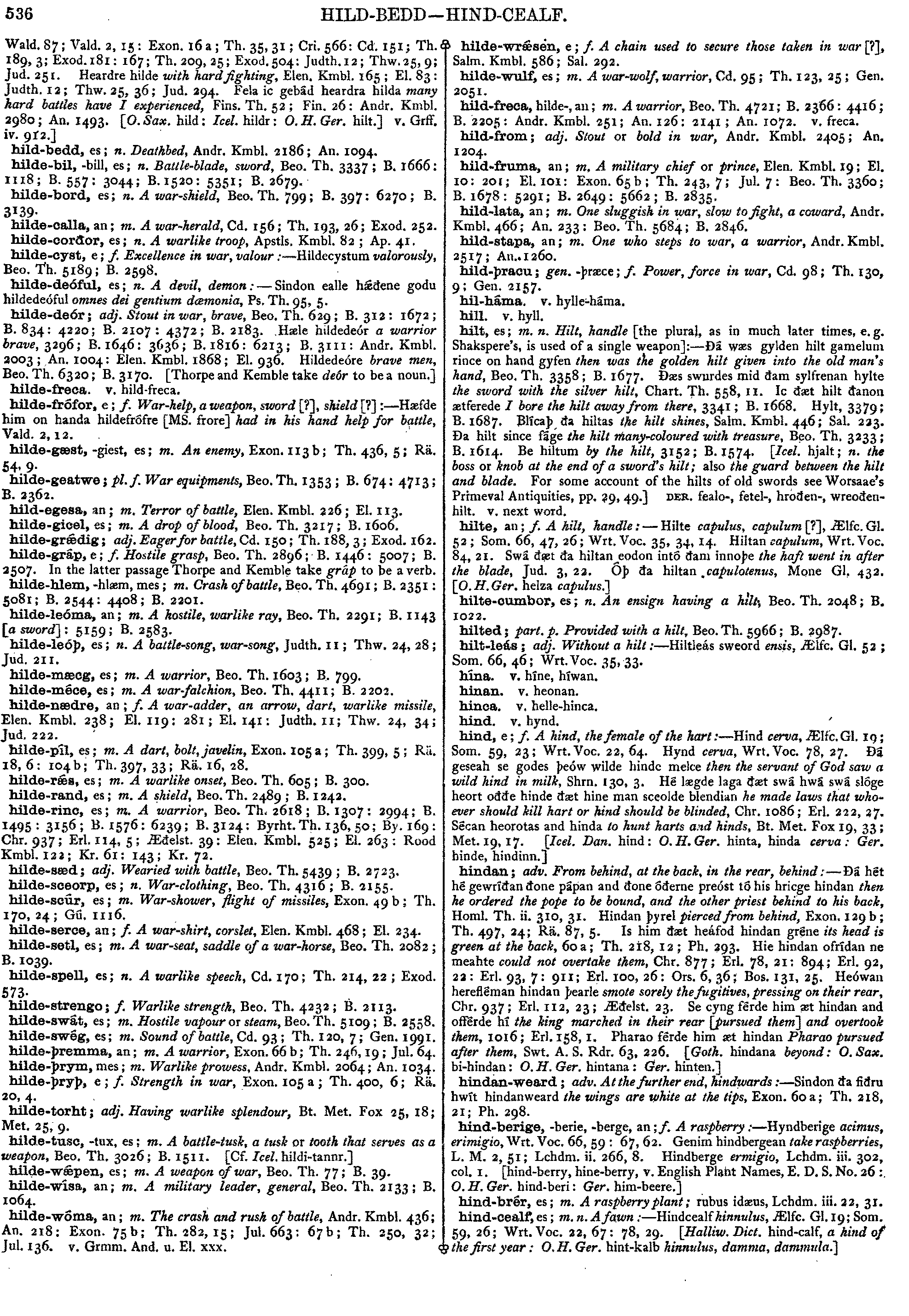
hilt, es; m. n. Hilt, handle [the plural, as in much later times, e. g. Shakspere's, is used of a single weapon]:-- Ðá wæs gylden hilt gamelum rince on hand gyfen then was the golden hilt given into the old man's hand, Beo. Th. 3358; B. 1677. Ðæs swurdes mid ðam sylfrenan hylte the sword with the silver hilt. Chart. Th. 558, 11. Ic ðæt hilt ðanon ætferede I bore the hilt away from there, 3341; B. 1668. Hylt, 3379; B. 1687. Bíþ ða hiltas the hilt shines, Salm. Kmbl. 446; Sal. 223. Ða hilt since fáge the hilt many-coloured with treasure, Beo. Th. 3233; B. 1614. Be hiltum by the hilt, 3152; B. 1574. [Icel. hjalt; n. the boss or knob at the end of a sword's hilt; also the guard between the hilt and blade. For some account of the hilts of old swords see Worsaae's Primeval Antiquities, pp. 39, 49.] DER. fealo-, fetel-, hroðen-, wreoðen-hilt. v. next word.
|
Source: Bosworth/Toller, page b0546, entry 34 View original page image as: [TIFF] [PNG] [View previous entry] [View next entry] |
[Comment on this entry] [View comments] |
The following entry has been hand-corrected once. |
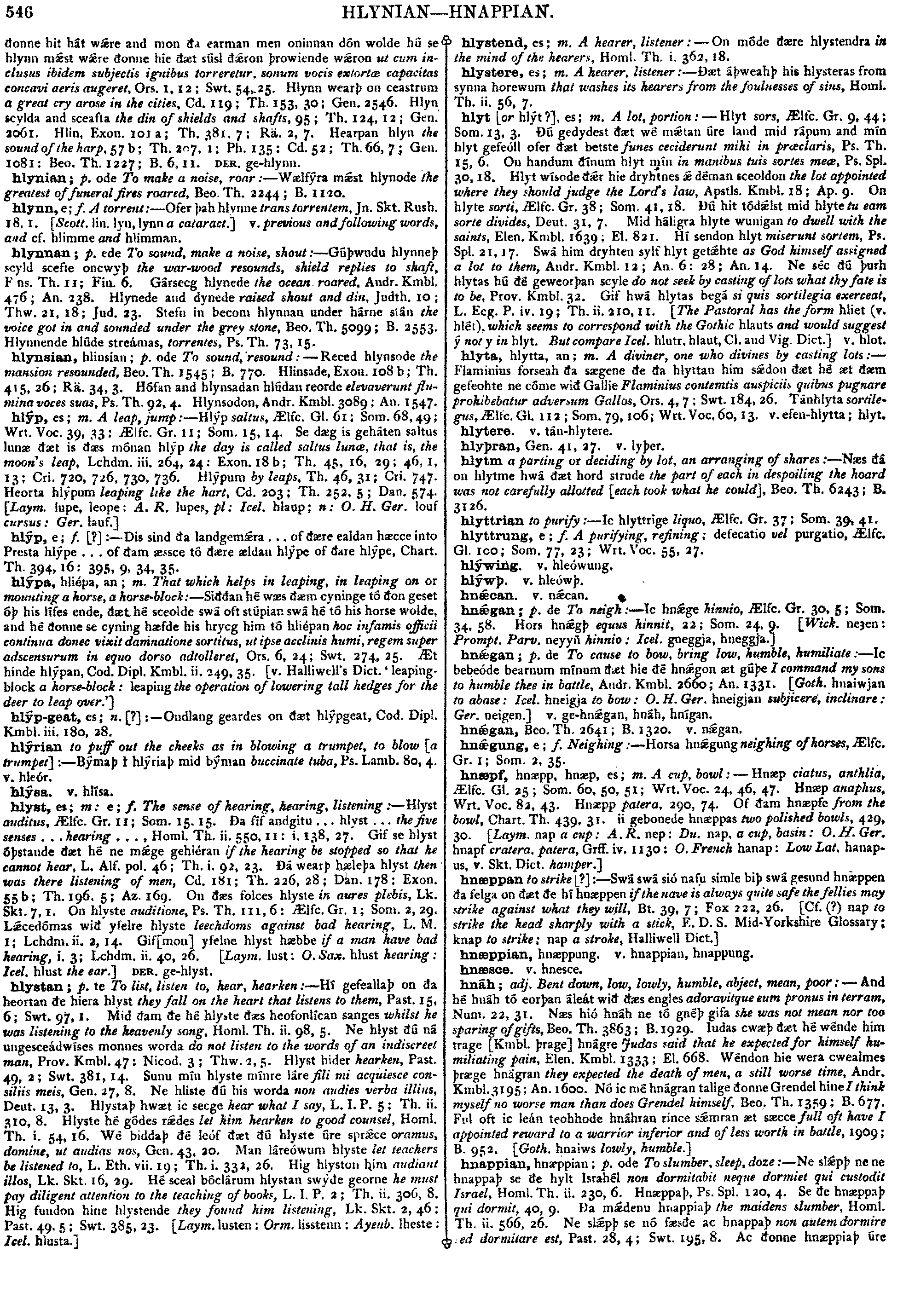
hnáh;
adj.
Bent
down,
low,
lowly,
humble,
abject,
mean,
poor
:--
And
hé
hnáh
tó
eorþan
áleát
wið
ðæs
engles
adoravitque
eum
pronus
in
terram,
Num.
22,
31.
Næs
hió
hnáh
ne
tó
gnéþ
gifa
she
was
not
mean
nor
too
sparing
of
gifts,
Beo.
Th.
3863;
B.
1929.
Iudas
cwæþ
ðæt
hé
wénde
him
trage
[Kmbl.
þrage]
hnágre
Judas
said
that
he
expected
for
himself
humiliating
pain,
Elen.
Kmbl.
1333;
El.
668.
Wéndon
hie
wera
cwealmes
þræge
hnágran
they
expected
the
death
of
men,
a
still
worse
time,
Andr.
Kmbl.
3195;
An.
1600.
Nó
ic
me
hnágran
talige
ðonne
Grendel
hine
I
think
myself
no
worse
man
than
does
Grendel
himself,
Beo.
Th.
1359;
B.
677.
Ful
oft
ic
leán
teohhode
hnáhran
rince
smran
æt
sæcce
full
oft
have
I
appointed
reward
to
a
warrior
inferior
and
of
less
worth
in
battle,
1909;
B.
952.
[Goth.
hnaiws
lowly,
humble.]
|
Source: Bosworth/Toller, page b0799, entry 25 View original page image as: [TIFF] [PNG] [View previous entry] [View next entry] |
[Comment on this entry] [View comments] |
The following entry has been hand-corrected once. |
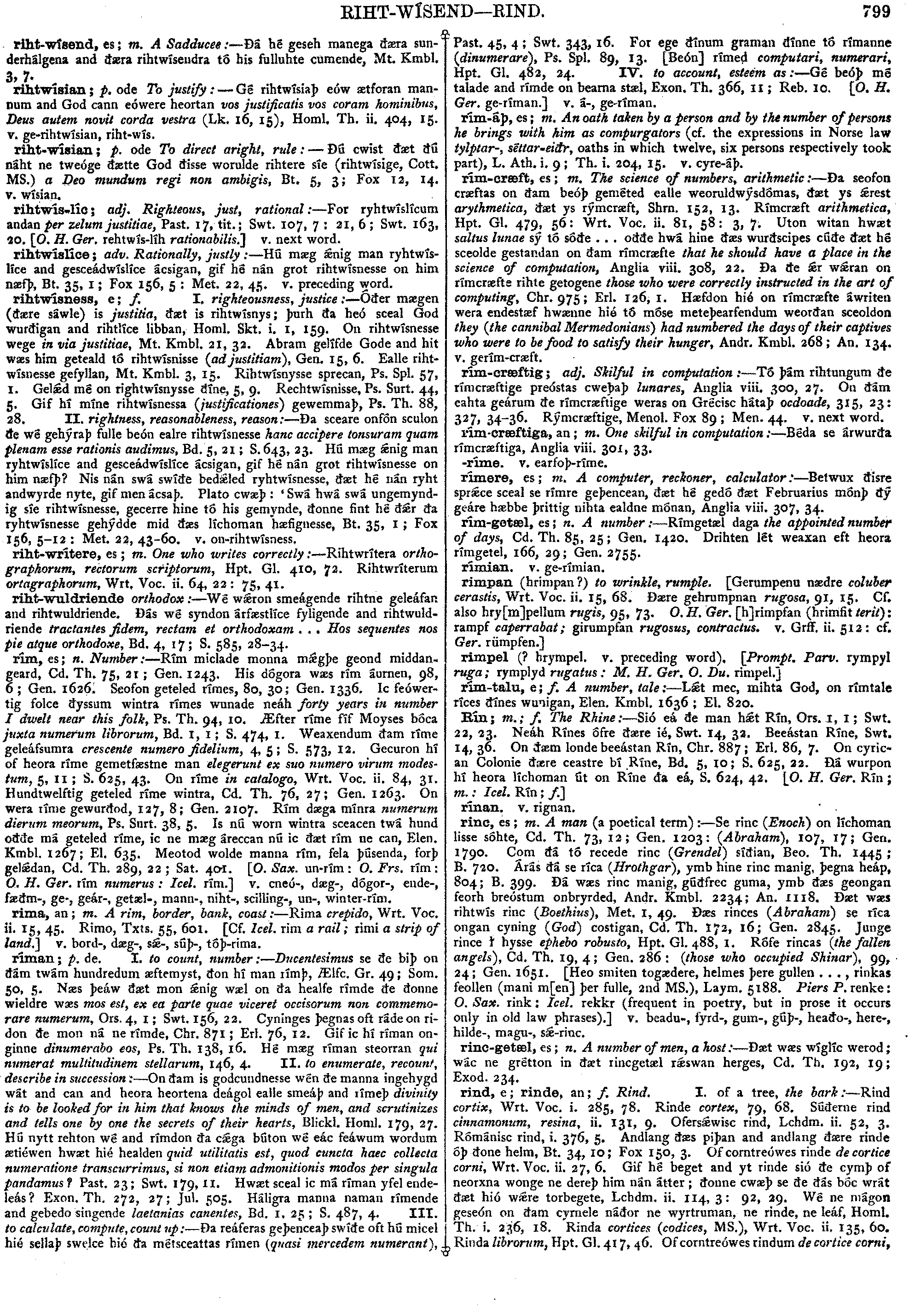
rinc,
es;
m.
A
man
(a
poetical
term)
:--
Se
rinc
(Enoch)
on
líchoman
lisse
sóhte,
Cd.
Th.
73,
12;
Gen.
1203
:
(Abraham),
107,
17;
Ger.
1790.
Com
ðá
tó
recede
rinc
(Grendel)
síðian,
Beo.
Th.
1445;
B.
720.
Árás
ðá
se
ríca
(Hrothgar),
ymb
hine
rinc
manig,
þegna
heáp,
804;
B.
399.
Ðá
wæs
rinc
manig,
gúðfrec
guma,
ymb
ðæs
geongan
feorh
breóstum
onbryrded,
Andr.
Kmbl.
2234;
An.
1118.
Ðæt
wæs
rihtwís
rinc
(Boethius),
Met.
1,
49.
Ðæs
rinces
(Abraham)
se
ríca
ongan
cyning
(God)
costigan,
Cd.
Th.
172,
16;
Gen.
2845.
Junge
rince
 hysse
ephebo
robusto,
Hpt.
Gl.
488,
1.
Rófe
rincas
(the
fallen
angels),
Cd.
Th.
19,
4
;
Gen.
286
:
(those
who
occupied
Shinar),
99,
24;
Gen.
1651.
[Heo
smiten
togædere,
helmes
þere
gullen
...,
rinkas
feollen
(mani
m[en]
þer
fulle,
2nd
MS.),
Laym.
5188.
Piers
P.
renke
:
O.
Sax.
rink
:
Icel.
rekkr
(frequent
in
poetry,
but
in
prose
it
occurs
only
in
old
law
phrases).]
v.
beadu-,
fyrd-,
gum-,
gúþ-,
heaðo-,
here-,
hilde-,
magu-,
s-rinc.
hysse
ephebo
robusto,
Hpt.
Gl.
488,
1.
Rófe
rincas
(the
fallen
angels),
Cd.
Th.
19,
4
;
Gen.
286
:
(those
who
occupied
Shinar),
99,
24;
Gen.
1651.
[Heo
smiten
togædere,
helmes
þere
gullen
...,
rinkas
feollen
(mani
m[en]
þer
fulle,
2nd
MS.),
Laym.
5188.
Piers
P.
renke
:
O.
Sax.
rink
:
Icel.
rekkr
(frequent
in
poetry,
but
in
prose
it
occurs
only
in
old
law
phrases).]
v.
beadu-,
fyrd-,
gum-,
gúþ-,
heaðo-,
here-,
hilde-,
magu-,
s-rinc.
|
Source: Bosworth/Toller, page b0811, entry 19 View original page image as: [TIFF] [PNG] [View previous entry] [View next entry] |
[Comment on this entry] [View comments] |
The following entry has been hand-corrected once. |
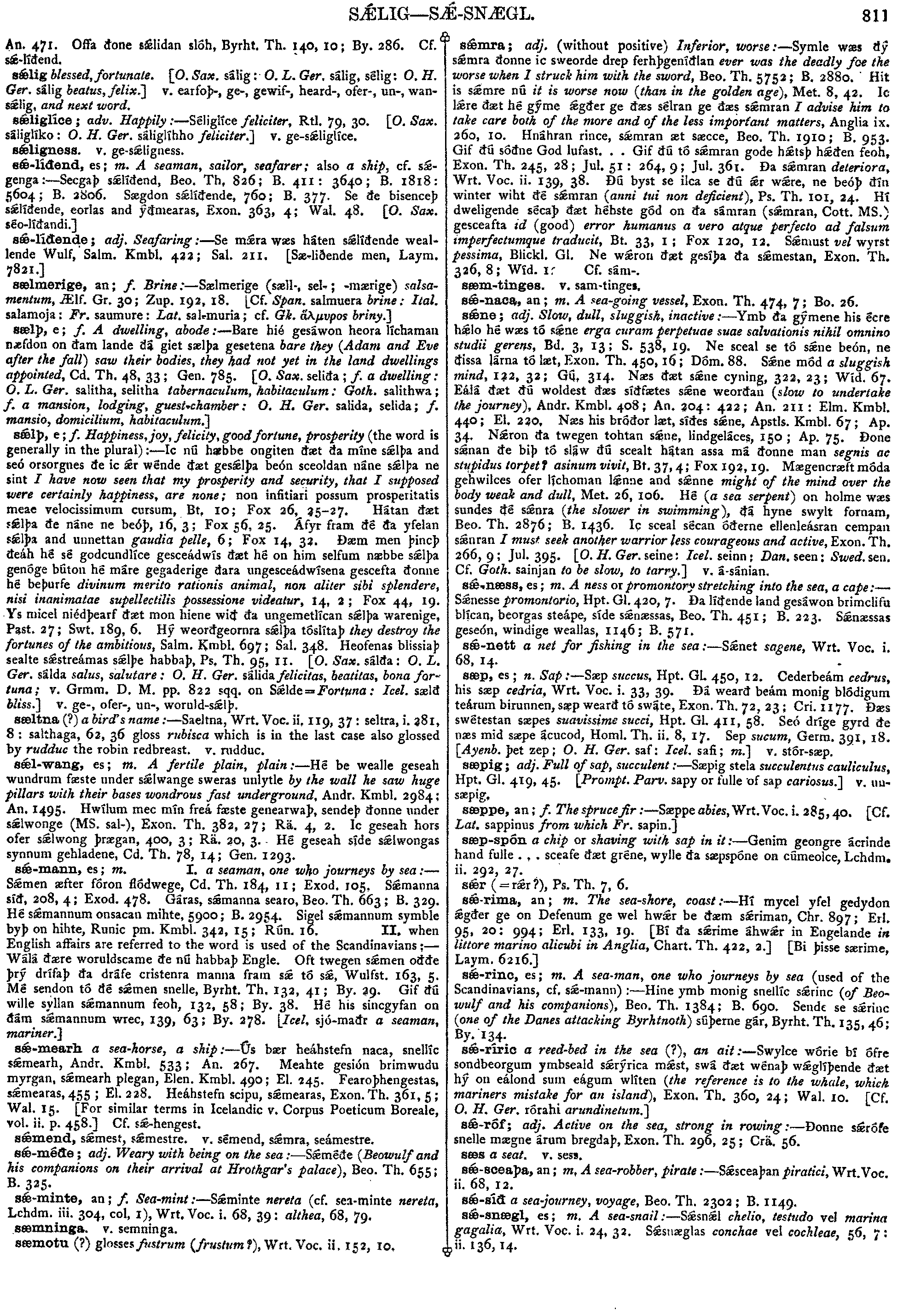
smra;
adj.
(without
positive)
Inferior,
worse
:--
Symle
wæs
ðý
smra
ðonne
ic
sweorde
drep
ferhþgeníðlan
ever
was
the
deadly
foe
the
worse
when
I
struck
him
with
the
sword,
Beo.
Th.
5752;
B.
2880.
Hit
is
smre
nú
it
is
worse
now
(than
in
the
golden
age).
Met.
8,
42.
Ic
lre
ðæt
hé
gýme
ðter
ge
ðæs
sélran
ge
ðæs
smran
I
advise
him
to
take
care
both
of
the
more
and
of
the
less
important
matters,
Anglia
ix.
260,
10.
Hnáhran
rince,
smran
æt
sæcce,
Beo.
Th.
1910;
B.
953.
Gif
ðú
sóðne
God
lufast.
.
.
Gif
ðú
tó
smran
gode
htsþ
hðen
feoh.
Exon.
Th.
245,
28;
Jul.
51
:
264,
9;
Jul.
361.
Ða
smran
deteriora,
Wrt.
Voc.
ii.
139,
38.
Ðú
byst
se
ilca
se
ðú
r
ware,
ne
beóþ
ðín
winter
wiht
ðé
smran
(anni
tui
non
deficient).
Ps.
Th.
101,
24.
Hí
dweligende
sécaþ
ðæt
héhste
gód
on
ða
sámran
(smran,
Cote.
MS.
)
gesceafta
id
(good)
error
humanus
a
vero
atque
perfecto
ad
falsum
imperfectumque
traducit,
Bt.
33,
1;
Fox
120,
12.
Smust
vel
wyrst
pessima,
Blickl.
Gl.
Ne
wron
ðæt
gesíba
ða
smestan,
Exon.
Th.
326,
8;
Wíd.
1
Cf.
sám-.
|
Source: Bosworth/Toller, page b0872, entry 2 View original page image as: [TIFF] [PNG] [View previous entry] [View next entry] |
[Comment on this entry] [View comments] |
The following entry has been hand-corrected once. |
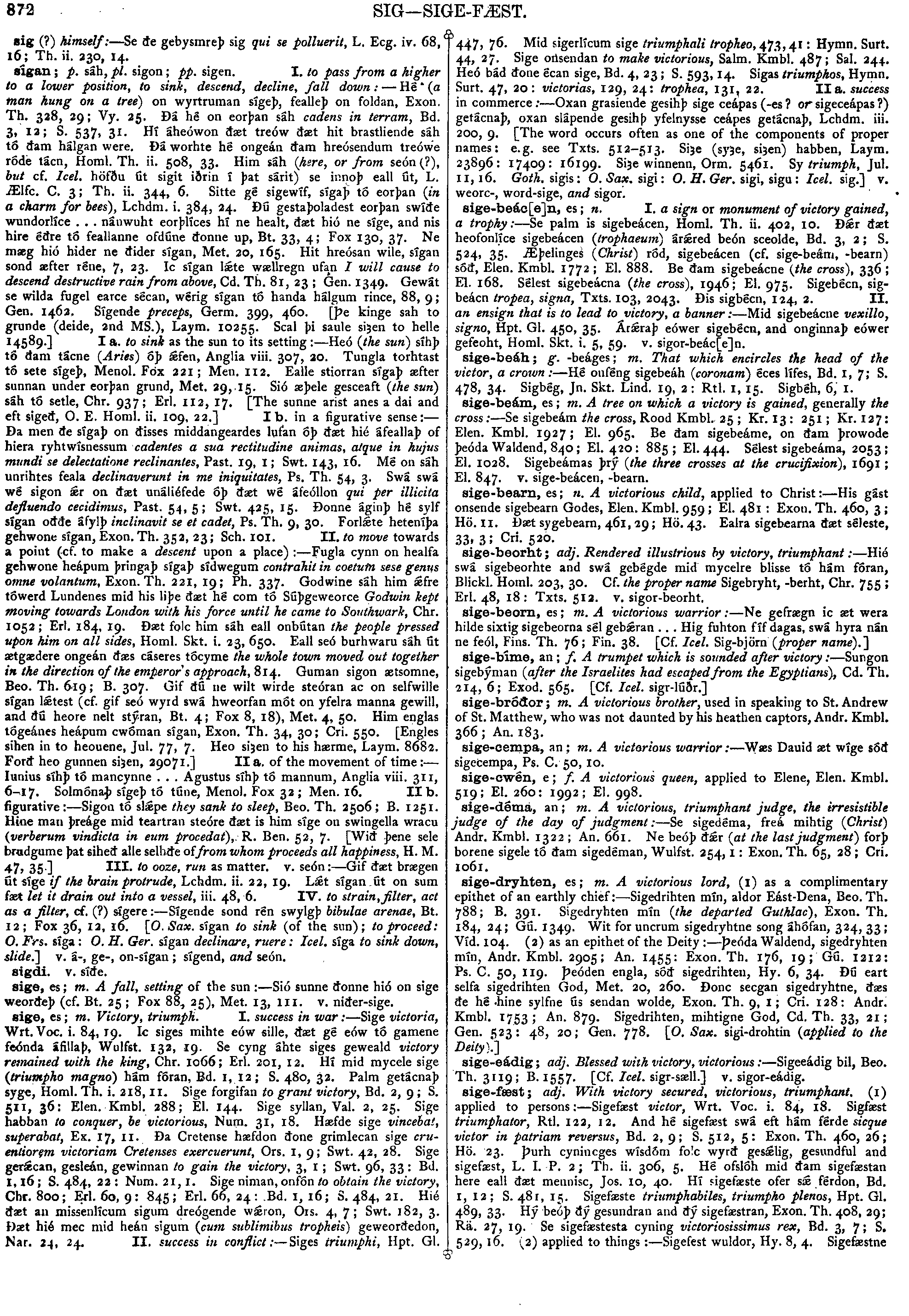
sígan
;
p.
sáh,
pl.
sigon
;
pp.
sigen.
I.
to
pass
from
a
higher
to
a
lower
position,
to
sink,
descend,
decline,
fall
down
:--Hé
(a
man
hung
on
a
tree)
on
wyrtruman
sígeþ,
fealleþ
on
foldan,
Exon.
Th.
328,
29
;
Vy.
25.
Ðá
hé
on
eorþan
sáh
cadens
in
terram,
Bd.
3,
12
;
S.
537,
31.
Hí
áheówon
ðæt
treów
ðæt
hit
brastliende
sáh
tó
ðam
hálgan
were.
Ðá
worhte
hé
ongeán
ðam
hreósendum
treówe
róde
tácn,
Homl.
Th.
ii.
508,
33.
Him
sáh
(here,
or
from
seón
(?),
but
cf.
Icel.
höfðu
út
sigit
iðrin
í
þat
sárit)
se
innoþ
eall
út,
L.
Ælfc.
C.
3
;
Th.
ii.
344,
6.
Sitte
gé
sigewíf,
sígaþ
tó
eorþan
(in
a
charm
for
bees),
Lchdm.
i.
384,
24.
Ðú
gestaþoladest
eorþan
swíðe
wundorlíce
.
.
.
nánwuht
eorþlíces
hí
ne
healt,
ðæt
hió
ne
síge,
and
nis
hire
éðre
tó
feallanne
ofdúne
ðonne
up,
Bt.
33,
4
;
Fox
130,
37.
Ne
mæg
hió
hider
ne
ðider
sígan,
Met.
20,
165.
Hit
hreósan
wile,
sígan
sond
æfter
réne,
7,
23.
Ic
sígan
lte
wællregn
ufan
I
will
cause
to
descend
destructive
rain
from
above,
Cd.
Th.
81,
23
;
Gen.
1349.
Gewát
se
wilda
fugel
earce
sécan,
wérig
sígan
tó
handa
hálgum
rince,
88,
9
;
Gen.
1462.
Sígende
preceps,
Germ.
399,
460.
[Þe
kinge
sah
to
grunde
(deide,
2nd
MS.),
Laym.
10255.
Scal
þi
saule
si en
to
helle
14589.]
Ia.
to
sink
as
the
sun
to
its
setting
:--Heó
(the
sun)
síhþ
tó
ðam
tácne
(Aries)
óþ
fen,
Anglia
viii.
307,
20.
Tungla
torhtast
tó
sete
sígeþ,
Menol.
Fox
221
;
Men.
112.
Ealle
stiorran
sígaþ
æfter
sunnan
under
eorþan
grund,
Met.
29,
15.
Sió
æþele
gesceaft
(the
sun)
sáh
tó
setle,
Chr.
937
;
Erl.
112,
17.
[The
sunne
arist
anes
a
dai
and
eft
sigeð,
O.
E.
Homl.
ii.
109,
22.]
Ib.
in
a
figurative
sense
:--Ða
men
ðe
sígaþ
on
ðisses
middangeardes
lufan
óþ
ðæt
hié
áfeallaþ
of
hiera
ryhtwísnessum
cadentes
a
sua
rectitudine
animas,
atque
in
hujus
mundi
se
delectatione
reclinantes,
Past.
19,
1
;
Swt.
143,
16.
Mé
on
sáh
unrihtes
feala
declinaverunt
in
me
iniquitates,
Ps.
Th.
54,
3.
Swá
swá
wé
sigon
r
on
ðæt
unáliéfede
óþ
ðæt
wé
áfeóllon
qui
per
illicita
defluendo
cecidimus,
Past.
54,
5
;
Swt.
425,
15.
Ðonne
áginþ
hé
sylf
sígan
oððe
áfylþ
inclinavit
se
et
cadet,
Ps.
Th.
9,
30.
Forlte
heteníþa
gehwone
sígan,
Exon.
Th.
352,
23
;
Sch.
101.
II.
to
move
towards
a
point
(cf.
to
make
a
descent
upon
a
place)
:--Fugla
cynn
on
healfa
gehwone
heápum
þringaþ
sígaþ
sídwegum
contrahit
in
coetum
sese
genus
omne
volantum,
Exon.
Th.
221,
19
;
Ph.
337.
Godwine
sáh
him
fre
tówerd
Lundenes
mid
his
liþe
ðæt
hé
com
tó
Súþgeweorce
Godwin
kept
moving
towards
London
with
his
force
until
he
came
to
Southwark,
Chr.
1052
;
Erl.
184,
19.
Ðæt
folc
him
sáh
eall
onbútan
the
people
pressed
upon
him
on
all
sides,
Homl.
Skt.
i.
23,
650.
Eall
seó
burhwaru
sáh
út
ætgædere
ongeán
ðæs
cáseres
tócyme
the
whole
town
moved
out
together
in
the
direction
of
the
emperor's
approach,
814.
Guman
sigon
ætsomne.
Beo.
Th.
619
;
B.
307.
Gif
ðú
ne
wilt
wirde
steóran
ac
on
selfwille
sígan
ltest
(cf.
gif
seó
wyrd
swá
hweorfan
mót
on
yfelra
manna
gewill,
and
ðú
heore
nelt
stýran,
Bt.
4
;
Fox
8,
18),
Met.
4,
50.
Him
englas
tógeánes
heápum
cwóman
sígan,
Exon.
Th.
34,
30
;
Cri.
550.
[Engles
sihen
in
to
heouene,
Jul.
77,
7.
Heo
sien
to
his
hærme,
Laym.
8682.
Forð
heo
gunnen
sien,
29071.]
IIa.
of
the
movement
of
time
:--Iunius
síhþ
tó
mancynne
.
.
.
Agustus
síhþ
tó
mannum,
Anglia
viii.
311,
6-17.
Solmónaþ
sígeþ
tó
túne,
Menol.
Fox
32
;
Men.
16.
IIb.
figurative
:--Sigon
tó
slpe
they
sank
to
sleep,
Beo.
Th.
2506
;
B.
1251.
Hine
man
þreáge
mid
teartran
steóre
ðæt
is
him
síge
on
swingella
wracu
(verberum
vindicta
in
eum
procedat),
R.
Ben.
52,
7.
[Wið
þene
sele
brudgume
þat
siheð
alle
selhðe
of
from
whom
proceeds
all
happiness,
H.
M.
47,
35.]
III.
to
ooze,
run
as
matter,
v.
seón
:--Gif
ðæt
brægen
út
síge
if
the
brain
protrude,
Lchdm.
ii.
22,
19.
Lt
sígan
út
on
sum
fæt
let
it
drain
out
into
a
vessel,
iii.
48,
6.
IV.
to
strain,
filter,
act
as
a
filter,
cf.
(?)
sígere
:--Sígende
sond
rén
swylgþ
bibulae
arenae,
Bt.
12
;
Fox
36,
12,
16.
[O.
Sax.
sígan
to
sink
(of
the.
sun)
;
to
proceed
:
O.
Frs.
síga
:
O.
H.
Ger.
sígan
declinare,
ruere
:
Icel.
síga
to
sink
down,
slide.]
v.
á-,
ge-,
on-sígan
;
sígend,
and
seón.
en
to
helle
14589.]
Ia.
to
sink
as
the
sun
to
its
setting
:--Heó
(the
sun)
síhþ
tó
ðam
tácne
(Aries)
óþ
fen,
Anglia
viii.
307,
20.
Tungla
torhtast
tó
sete
sígeþ,
Menol.
Fox
221
;
Men.
112.
Ealle
stiorran
sígaþ
æfter
sunnan
under
eorþan
grund,
Met.
29,
15.
Sió
æþele
gesceaft
(the
sun)
sáh
tó
setle,
Chr.
937
;
Erl.
112,
17.
[The
sunne
arist
anes
a
dai
and
eft
sigeð,
O.
E.
Homl.
ii.
109,
22.]
Ib.
in
a
figurative
sense
:--Ða
men
ðe
sígaþ
on
ðisses
middangeardes
lufan
óþ
ðæt
hié
áfeallaþ
of
hiera
ryhtwísnessum
cadentes
a
sua
rectitudine
animas,
atque
in
hujus
mundi
se
delectatione
reclinantes,
Past.
19,
1
;
Swt.
143,
16.
Mé
on
sáh
unrihtes
feala
declinaverunt
in
me
iniquitates,
Ps.
Th.
54,
3.
Swá
swá
wé
sigon
r
on
ðæt
unáliéfede
óþ
ðæt
wé
áfeóllon
qui
per
illicita
defluendo
cecidimus,
Past.
54,
5
;
Swt.
425,
15.
Ðonne
áginþ
hé
sylf
sígan
oððe
áfylþ
inclinavit
se
et
cadet,
Ps.
Th.
9,
30.
Forlte
heteníþa
gehwone
sígan,
Exon.
Th.
352,
23
;
Sch.
101.
II.
to
move
towards
a
point
(cf.
to
make
a
descent
upon
a
place)
:--Fugla
cynn
on
healfa
gehwone
heápum
þringaþ
sígaþ
sídwegum
contrahit
in
coetum
sese
genus
omne
volantum,
Exon.
Th.
221,
19
;
Ph.
337.
Godwine
sáh
him
fre
tówerd
Lundenes
mid
his
liþe
ðæt
hé
com
tó
Súþgeweorce
Godwin
kept
moving
towards
London
with
his
force
until
he
came
to
Southwark,
Chr.
1052
;
Erl.
184,
19.
Ðæt
folc
him
sáh
eall
onbútan
the
people
pressed
upon
him
on
all
sides,
Homl.
Skt.
i.
23,
650.
Eall
seó
burhwaru
sáh
út
ætgædere
ongeán
ðæs
cáseres
tócyme
the
whole
town
moved
out
together
in
the
direction
of
the
emperor's
approach,
814.
Guman
sigon
ætsomne.
Beo.
Th.
619
;
B.
307.
Gif
ðú
ne
wilt
wirde
steóran
ac
on
selfwille
sígan
ltest
(cf.
gif
seó
wyrd
swá
hweorfan
mót
on
yfelra
manna
gewill,
and
ðú
heore
nelt
stýran,
Bt.
4
;
Fox
8,
18),
Met.
4,
50.
Him
englas
tógeánes
heápum
cwóman
sígan,
Exon.
Th.
34,
30
;
Cri.
550.
[Engles
sihen
in
to
heouene,
Jul.
77,
7.
Heo
sien
to
his
hærme,
Laym.
8682.
Forð
heo
gunnen
sien,
29071.]
IIa.
of
the
movement
of
time
:--Iunius
síhþ
tó
mancynne
.
.
.
Agustus
síhþ
tó
mannum,
Anglia
viii.
311,
6-17.
Solmónaþ
sígeþ
tó
túne,
Menol.
Fox
32
;
Men.
16.
IIb.
figurative
:--Sigon
tó
slpe
they
sank
to
sleep,
Beo.
Th.
2506
;
B.
1251.
Hine
man
þreáge
mid
teartran
steóre
ðæt
is
him
síge
on
swingella
wracu
(verberum
vindicta
in
eum
procedat),
R.
Ben.
52,
7.
[Wið
þene
sele
brudgume
þat
siheð
alle
selhðe
of
from
whom
proceeds
all
happiness,
H.
M.
47,
35.]
III.
to
ooze,
run
as
matter,
v.
seón
:--Gif
ðæt
brægen
út
síge
if
the
brain
protrude,
Lchdm.
ii.
22,
19.
Lt
sígan
út
on
sum
fæt
let
it
drain
out
into
a
vessel,
iii.
48,
6.
IV.
to
strain,
filter,
act
as
a
filter,
cf.
(?)
sígere
:--Sígende
sond
rén
swylgþ
bibulae
arenae,
Bt.
12
;
Fox
36,
12,
16.
[O.
Sax.
sígan
to
sink
(of
the.
sun)
;
to
proceed
:
O.
Frs.
síga
:
O.
H.
Ger.
sígan
declinare,
ruere
:
Icel.
síga
to
sink
down,
slide.]
v.
á-,
ge-,
on-sígan
;
sígend,
and
seón.
|
Source: Bosworth/Toller, page b0976, entry 25 View original page image as: [TIFF] [PNG] [View previous entry] [View next entry] |
[Comment on this entry] [View comments (1)] |
The following entry has been hand-corrected once. |
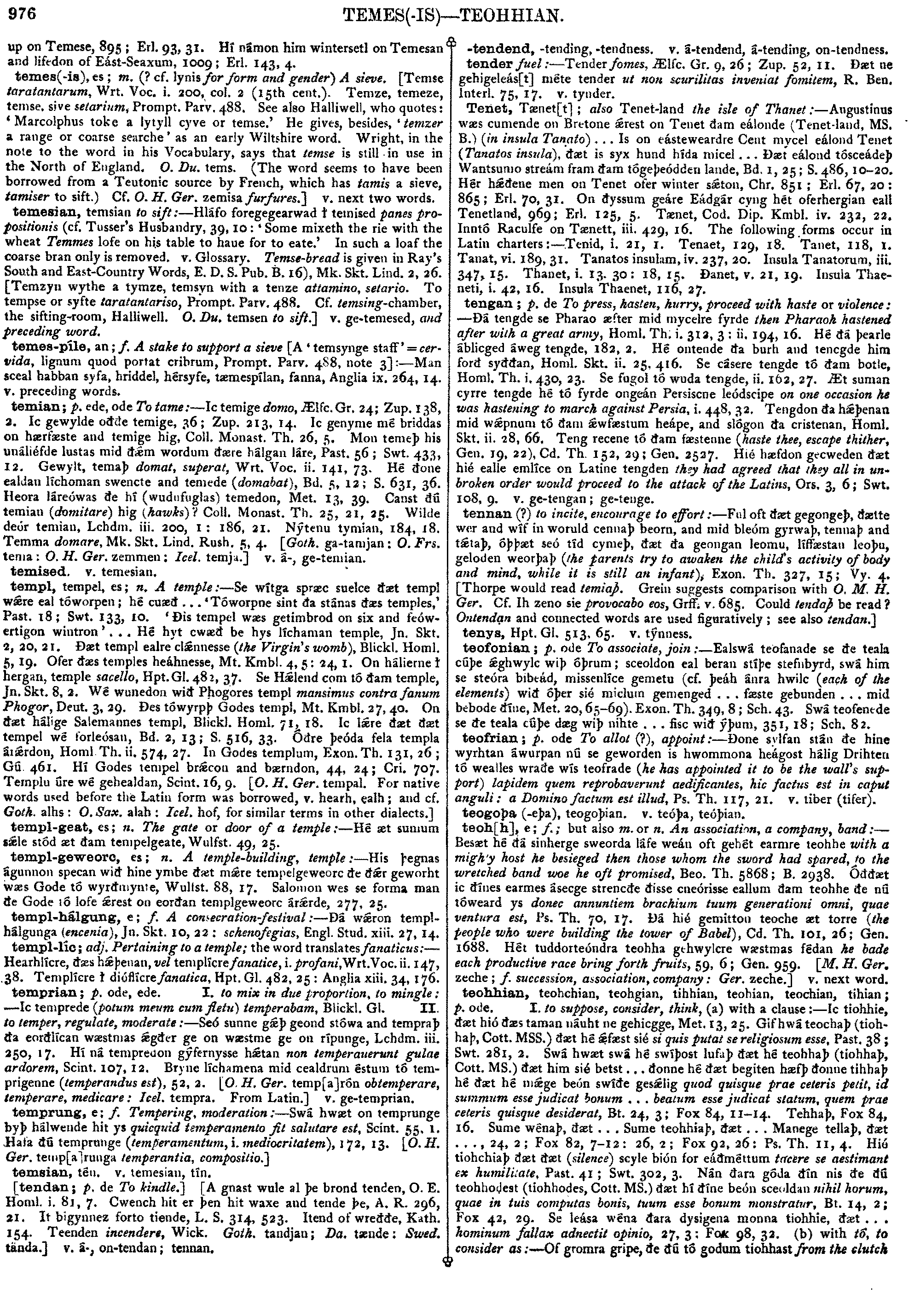
teohhian,
teohchian,
teohgian,
tihhian,
teohian,
teochian,
tihian;
p.
ode.
I.
to
suppose,
consider,
think,
(a)
with
a
clause
:--
Ic
tiohhie,
ðæt
hió
ðæs
taman
náuht
ne
gehicgge,
Met.
13,
25.
Gif
hwá
teochaþ
(tiohhaþ,
Cott.
MSS.)
ðæt
hé
fæst
sié
si
quis
putat
se
religiosum
esse,
Past.
38;
Swt.
281,
2.
Swá
hwæt
swá
hé
swíþost
lufaþ
ðæt
hé
teohhaþ
(tiohhaþ,
Cott.
MS.)
ðæt
him
sié
betst
...
ðonne
hé
ðæt
begiten
hæfþ
ðonne
tihhaþ
hé
ðæt
hé
mge
beón
swíðe
geslig
quod
quisque
prae
ceteris
petit,
id
summum
esse
judicat
bonum
...
beatum
esse
judicat
statum,
quem
prae
ceteris
quisque
desiderat,
Bt.
24,
3;
Fox
84,
11-14.
Tehhaþ,
Fox
84,
16.
Sunte
wénaþ,
ðæt
...
Sume
teohhiaþ,
ðæt
...
Manege
tellaþ,
ðæt...,
24,
2;
Fox
82,
7-12:
26,
2;
Fox
92,
26:
Ps.
Th.
11,
4.
Hié
tiohchiaþ
ðæt
ðæt
(silence)
scyle
bión
for
eáðméttum
tacere
se
aestimant
ex
humilitate,
Past.
41;
Swt.
302,
3.
Nán
ðara
góda
ðín
nis
ðe
ðú
teohhodest
(tiohhodes,
Cott.
MS.)
ðæt
hí
ðíne
beón
sceoldan
nihil
horum,
quae
in
tuis
computas
bonis,
tuum
esse
bonum
monstratur,
Bt.
14,
2;
Fox
42,
29.
Se
leása
wéna
ðara
dysigena
manna
tiohhie,
ðæt
...
hominum
fallax
adnectit
opinio,
27,
3;
Fox.
98,
32.
(b)
with
tó,
to
consider
as
:--
Of
gromra
gripe,
ðe
ðú
tó
godum
tiohhast
from
the
clutch
of
cruel
ones,
whom
thou
countest
as
gods,
Exon.
Th.
255,
17;
Jul.
215.
Æ-acute;lc
mon
tiohhaþ
him
ðæt
tó
sélestum
goode
ðæt
ðæt
hé
swíþost
lufaþ
every
man
considers
that
as
his
best
good,
which
he
most
loves,
Bt.
33,
2;
Fox
122,
23.
Hí
teohhiaþ
út
him
tó
sndincgsceápum
aestimati
sumus
ut
oves
occisionis,
Ps.
Th.
43,
23.
Ðam
wísan
men
com
tó
lofe
and
tó
wyrðscipe
ðæt
se
unrihtwísa
cyning
him
teohhode
tó
wíte
cruciatus,
quos
putabat
tyrannus
materiam
crudelitatis,
vir
sapiens
fecit
esse
virtutis,
Bt.
16,
2;
Fox
52,
27.
Gif
hé
hit
ne
tiohchode
eall
tó
anum
si
utraque
unum
esse
non
decerneret,
Past,
49;
Swt.
385,
34.
(c)
in
other
ways
:--
Teohgaþ
decreverit,
cogitaverit,
Hpt.
Gl.
412,
48.
Ne
biþ
hé
swá
brád
swá
hé
teohhaþ
(tihhaþ,
Cott.
MS.),
Bt.
30,
1;
Fox
108,
12.
II.
to
purpose,
determine,
intend,
appoint,
(a)
with
an
accusative
:--
Man
ús
tyhhaþ
twegen
eardas
two
dwellings
are
intended
for
us,
Hy.
7,
97.
Oft
ic
leán
teohhode
hnáhran
rince,
Beo.
Th.
1907;
B.
951.
(b)
with
an
accusative
and
(implied)
infinitive
:--
Swilce
hé
ná
ða
sprce
ne
mnde
and
tiohhode
hit
þeáh
þiderweardes
(and
yet
he
intended
it
to
go
in
that
direction),
Bt.
39,
5;
Fox
218,
12.
(c)
with
a
clause
:--
Tó
ðm
sóþum
geslþum
ic
tiohhie
(tiohige,
Cott.
MS.)
ðæt
ic
ðé
lde,
Bt.
22,
2;
Fox
78,
7.
Swá
swá
hé
tiohhaþ,
ðæt
hit
sié,
39,
6;
Fox
220,
7.
Nis
nán
gesceaft
ðe
hé
tiohhige
(tiohhie,
Cott.
MS.)
ðæt
hió
scyle
winnan
wiþ
hire
Scippendes
willan
...
Hwæt
wénst
ðú
gif
negu
gesceaft
tiohhode
ðæt
hió
wiþ
his
willan
sceolde
winnan
hwæt
hió
mihte
wiþ
swá
mihtine
swá
wé
hine
gerehtne
habbaþ
nihil
est
quod
Deo
contraire
conetur
...
quid
si
conetur,
sum
tandem
proficiet
quidquam
adversus
eum,
quem
potentissimum
esse
concessimus,
35,
4;
Fox
160,
21-27.
Ðæt
hé
forðý
reáfige
ðý
hé
tiohchie
(teohhige,
Cott.
MSS.)
ðæt
hé
eft
scyle
mid
ðý
reáfláce
ælmessan
gewyrcean
pro
misericordia
facienda
peccare,
Past.
45;
Swt.
341,
22.
(d)
with
tó
:--
Swá
hwæt
swá
ðú
mé
tó
gyfe
tihhie
bring
ðæt
Gode
tó
onsægednysse
whatever
you
may
intend
as
a
gift
to
me,
bring
that
as
a
sacrifice
to
God,
Homl.
Ass.
123,
209.
(e)
with
gerundial
infinitive
:--
Ðr
ðú
ongeáte
hwidre
ic
ðé
teohhie
(tiohige,
Cott.
MS.)
tó
ldenne
si,
quonam
te
ducere
aggredimur,
agnosceres,
Bt.
22,
2;
Fox
78,
1.
Cildum
ðe
wé
tiochiaþ
úrne
eard
tó
te
forltanne,
and
hié
tiochiaþ
ús
tó
ierfeweardum
tó
habbanne,
Past.
50;
Swt.
391,
28.
Hý
teohhiaþ
mé
tó
áfyrranne,
Ps.
Th.
39,
16.
Hé
tiohchode
him
má
tó
fultemanne
...
hé
teohchode
hine
tó
ldanne
on
lífes
weg,
Past.
41;
Swt.
305,
4,
5.
His
(Ulysses')
þegnas
for
hiora
eardes
lufan
tihodon
hine
tó
forltanne,
Bt.
38,
1;
Fox
194,
29.
(f)
undetermined
:--
Teohhaþ
distinat,
i.
disponit,
contendit,
Wrt.
Voc.
ii.
141,
35.
[Cf.
O.
H.
Ger.
gi-zehón
instaurare,
resarcire.]
v.
ge-teohhian;
teón
(wk.).
|
Source: Bosworth/Toller, page b1217, entry 23 View original page image as: [TIFF] [PNG] [View previous entry] [View next entry] |
[Comment on this entry] [View comments] |
The following entry has been hand-corrected once. |
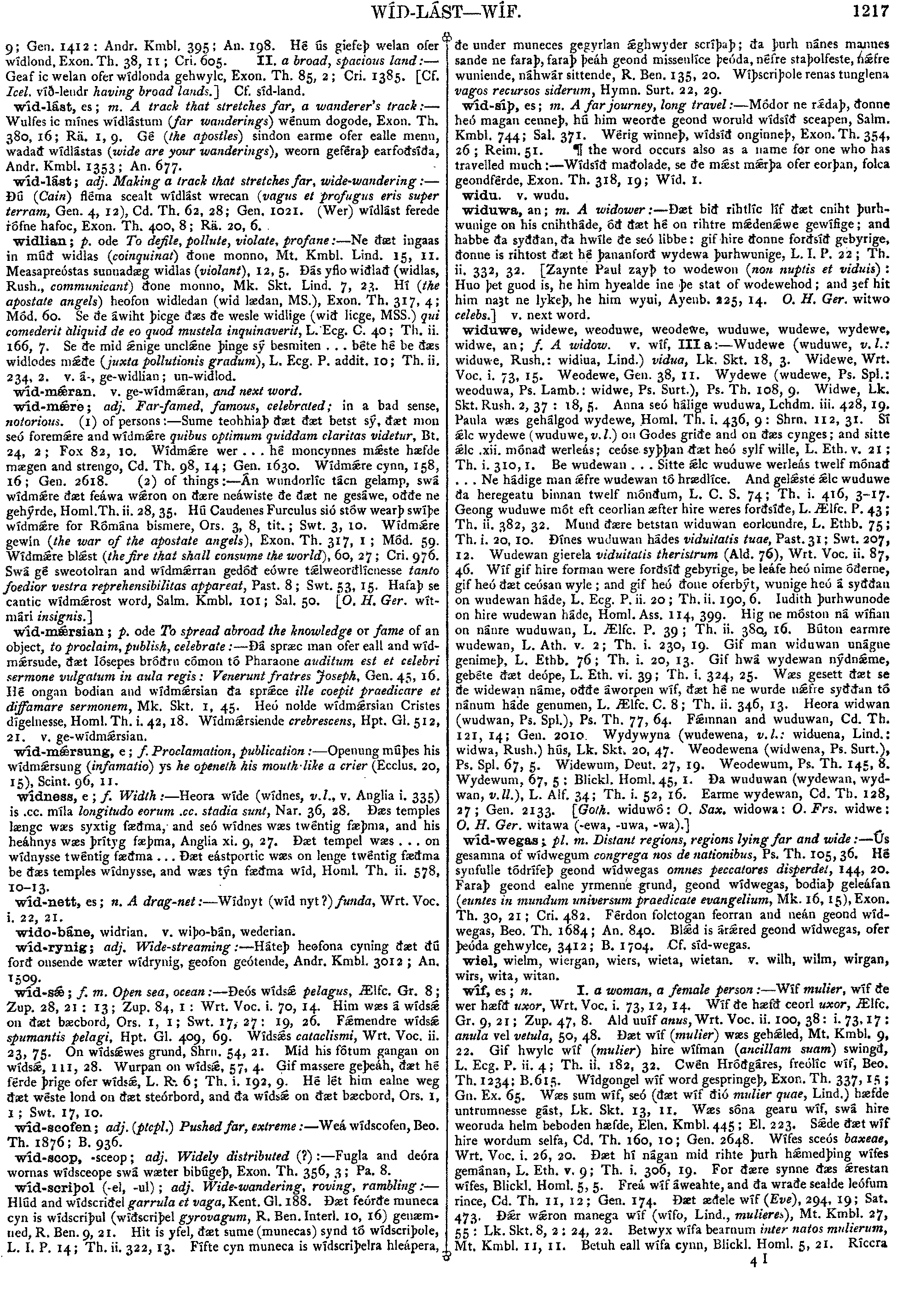
wíf,
es;
n.
I.
a
woman,
a
female
person
:--
Wíf
mulier,
wíf
ðe
wer
hæfð
uxor,
Wrt.
Voc.
i.
73,
12,
14.
Wíf
ðe
hæfð
ceorl
uxor,
Ælfc.
Gr.
9,
21;
Zup.
47,
8.
Ald
uuíf
anus,
Wrt.
Voc.
ii.
100,
38:
i.
73,
17
:
anula
vel
vetula,
50,
48.
Ðæt
wíf
(mulier)
wæs
gehled,
Mt.
Kmbl.
9,
22.
Gif
hwylc
wíf
(mulier)
hire
wífman
(ancillam
suam)
swingð,
L.
Ecg.
P.
ii.
4;
Th.
ii.
182,
32.
Cwén
Hróðgáres,
freólíc
wíf,
Beo.
Th.
1234;
B.
615.
Wídgongel
wíf
word
gespringeþ,
Exon.
Th.
337,
15
;
Gn.
Ex.
65.
Wæs
sum
wíf,
seó
(ðæt
wíf
ðió
mulier
quae,
Lind.)
hæfde
untrumnesse
gást,
Lk.
Skt.
13,
11.
Wæs
sóna
gearu
wíf,
swá
hire
weoruda
helm
beboden
hæfde,
Elen.
Kmbl.
445
;
El.
223.
Sde
ðæt
wíf
hire
wordum
selfa,
Cd.
Th.
160,
10;
Gen.
2648.
Wífes
sceós
baxeae,
Wrt.
Voc.
i.
26,
20.
Ðæt
hi
nágan
mid
rihte
þurh
hmedþing
wífes
gemánan,
L.
Eth.
v.
9;
Th.
i.
306,
19.
For
ðære
synne
ðæs
restan
wífes,
Blickl.
Homl.
5,
5.
Freá
wíf
áweahte,
and
ða
wraðe
scalde
leófum
rince,
Cd.
Th.
11.
12;
Gen.
174.
Ðæt
ædele
wíf
(Eve),
294,
19;
Sat.
473.
Ðr
wron
manega
wíf
(wífo,
Lind.,
mulieres),
Mt.
Kmbl.
27,
55
:
Lk.
Skt.
8,
2
:
24,
22.
Betwyx
wífa
bearnum
inter
natos
mulierum,
Mt.
Kmbl.
11,
11.
Betuh
eall
wífa
cynn,
Blickl.
Homl.
5,
21.
Ríccra
| Result Page: | 1 2 | Next |  |
Germanic Lexicon Project (main page)
This search system was written by
Sean Crist
Please consider
volunteering
to correct the data in these online dictionaries.
No rights reserved. Feel free to use these data in any way you please.