|
|

|
Source: Cleasby/Vigfusson, page b0089, entry 21 View original page image as: [TIFF] [PNG] [View previous entry] [View next entry] |
[Comment on this entry] [View comments] |
The following entry has been hand-corrected once. |
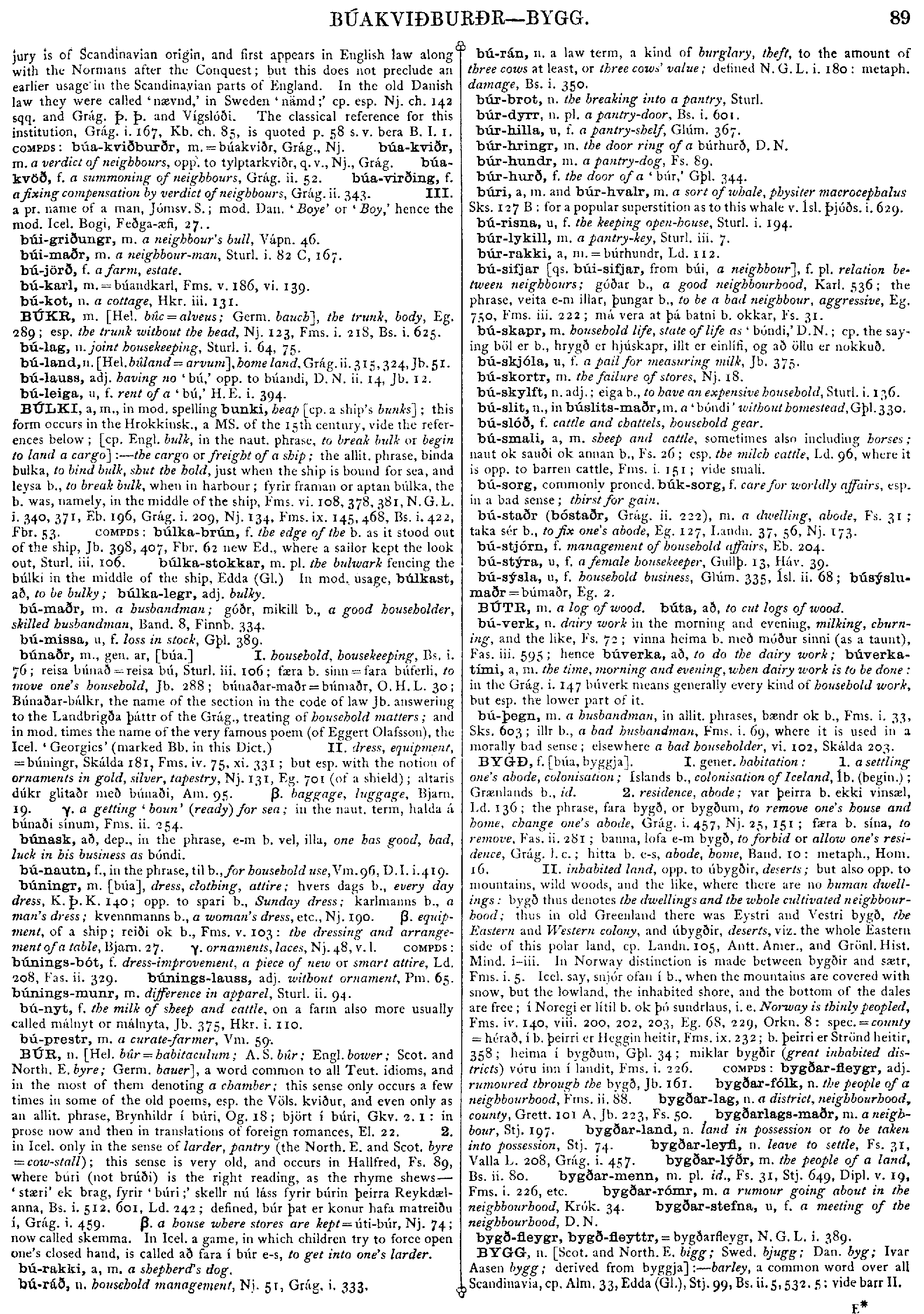
BÚR,
n.
[Hel.
bûr
=
habitaculum;
A.
S.
bûr;
Engl.
bower;
Scot.
and
North.
E.
byre;
Germ.
bauer],
a
word
common
to
all
Teut.
idioms,
and
in
the
most
of
them
denoting
a
chamber;
this
sense
only
occurs
a
few
times
in
some
of
the
old
poems,
esp.
the
Völs.
kviður,
and
even
only
as
an
allit.
phrase,
Brynhildr
í
búri,
Og.
18;
björt
í
búri,
Gkv.
2.
1:
in
prose
now
and
then
in
translations
of
foreign
romances,
El.
22.
2.
in
Icel.
only
in
the
sense
of
larder,
pantry
(the
North.
E.
and
Scot.
byre
=
cow-stall);
this
sense
is
very
old,
and
occurs
in
Hallfred,
Fs.
89,
where
búri
(not
brúði)
is
the
right
reading,
as
the
rhyme
shews--'stæri'
ek
brag,
fyrir
'búri;'
skellr
nú
lass
fyrir
búrin
þeirra
Reykdælanna,
Bs.
i.
512.
601,
Ld.
242;
defined,
búr
þat
er
konur
hafa
matreiðu
í,
Grág.
i.
459.
 .
a
house
where
stores
are
kept
=
úti-búr,
Nj.
74;
now
called
skemma.
In
Icel.
a
game,
in
which
children
try
to
force
open
one's
closed
hand,
is
called
að
fara
í
búr
e-s,
to
get
into
one's
larder.
.
a
house
where
stores
are
kept
=
úti-búr,
Nj.
74;
now
called
skemma.
In
Icel.
a
game,
in
which
children
try
to
force
open
one's
closed
hand,
is
called
að
fara
í
búr
e-s,
to
get
into
one's
larder.
|
Source: Cleasby/Vigfusson, page b0091, entry 49 View original page image as: [TIFF] [PNG] [View previous entry] [View next entry] |
[Comment on this entry] [View comments] |
The following entry has been hand-corrected once. |
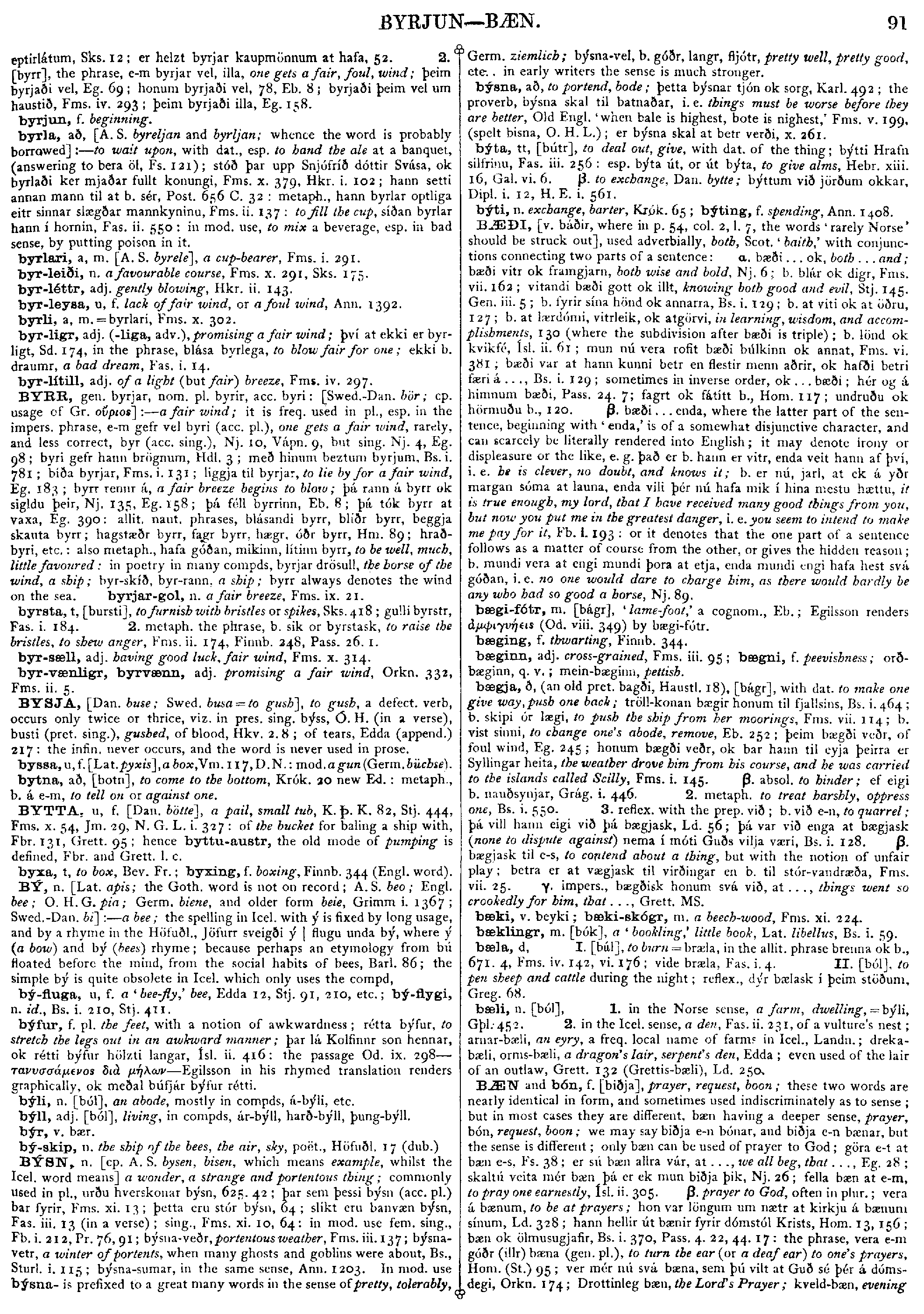
bærr, adj. due, entitled to, cp. Germ, gebührend; the proverb, b. er hverr at ráða sínu, every one has a right to dispose of his own property, Ísl. ii. 145; vera b. at dæma um e-t, to be a fit judge in a matter (a proverb); unbecoming, Yt. 11.
|
Source: Cleasby/Vigfusson, page b0101, entry 38 View original page image as: [TIFF] [PNG] [View previous entry] [View next entry] |
[Comment on this entry] [View comments] |
The following entry has not been hand-corrected. However, the page is reserved and someone is correcting it. |
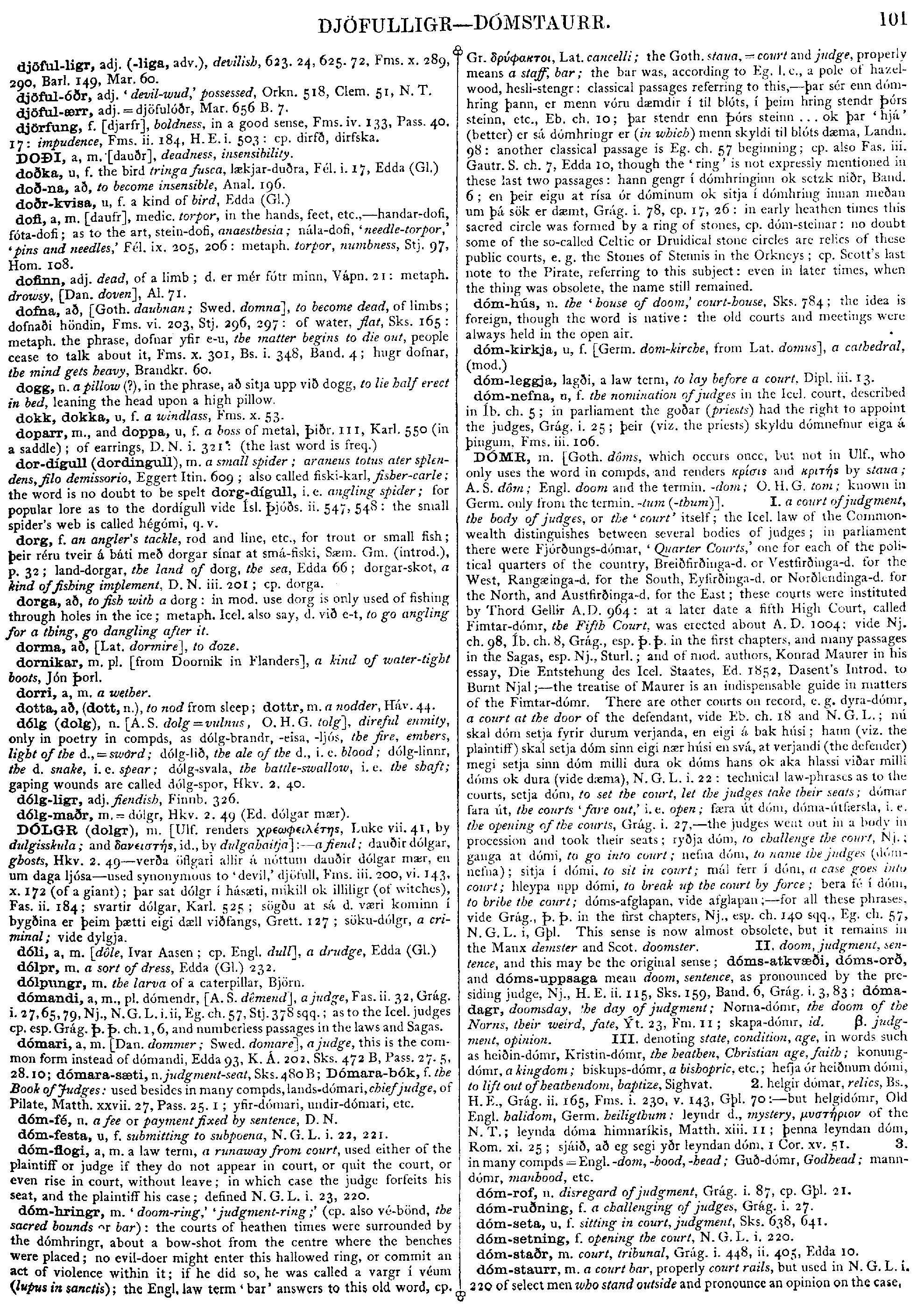
dóm-nefna, u, f. the nomination of judges in the Icel. court, described in ib. ch. 5; in parliament the goðar (priests) had the right to appoint the judges, Grág. i. 25; þeir (viz. the priests) skyldu domnefnur eiga á þingum, Fms. iii. 106.
|
Source: Cleasby/Vigfusson, page b0103, entry 1 View original page image as: [TIFF] [PNG] [View previous entry] [View next entry] |
[Comment on this entry] [View comments] |
The following entry has not been hand-corrected. However, the page is reserved and someone is correcting it. |
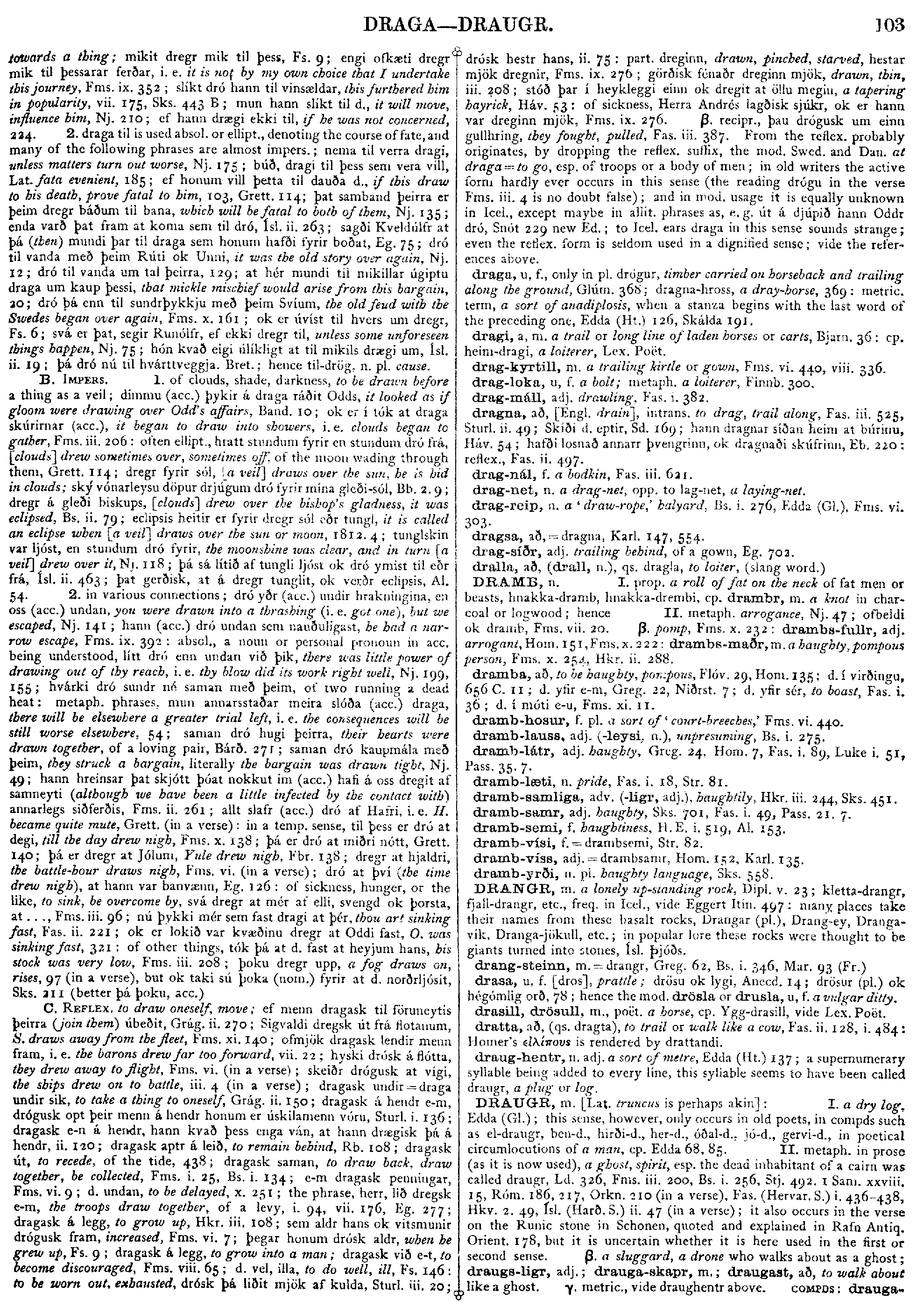
iatvards a thing; mikit dregr mik til þess, Fs. 9; engi ofkæti dregr' mik til þessarar ferðar, i. e. it i s no(by my own choice that í -undertake this journey, Fms. ix. 352; slíkt dró hann til vinsældar, ibis furthered him in popularity, vii. 175, Sks. 443 B; mun hann slikt til d., it will move, influence him, Nj. 210; ef hann drægi ekki til, if he was not concerned, 224. 2. dragatil isusedabsol. or ellipt., denoting the course of fate, and many of the following phrases are almost impers.; nema til verra dragi, unless matters turn out worse, Nj. 175; búð, dragi til þess sem vera vill, Lat. y at a evenient, 185; ef honum vill þetta til dauða d., if ibis draw to his death, prove fatal to him, 103, Grett. 114; þat samband þeirra er þeim dregr báðum til bana, which will be fatal to both of them, Nj. 135; enda varð þat fram at koma sem til dró, Ísl. ii. 263; sagði Kveldúlfr at þá (then) mundi þar ti! draga sem honum hafði fyrir boðat, Eg. 75; dró til vanda með þeim Rúti ok Unni, it was the old story over again, Nj. 12; dró til vanda um tai þeirra, 129; at her mundi til nnkillar ugiptu draga um kaup þessi, that mickle mischief would arise from this bargain, 30; dró þá enn til sundrþykkju með þeim Svíum, the old feud with the Swedes began over again, Fms. x. 161; ok er úvíst til hvers um dregr, Fs. 6; svá er þat, segir Runólfr, ef ekki dregr til, unless some unforeseen things happen, Nj. 75; hón kvað eigi tilikligt at til mikils drsegi um, Ísl. ii. 19; þá dró nú til hvárttveggja. Bret.; hence til-drög. n. pl. cause. B. IMPERS. 1. of clouds, shade, darkness, to be drav-'n before a thing as a veil; dimmu (acc.) þykir á draga ráðit Odds, it looked as if gloom were drawing over Odd's affairs, Band. 10; ok er í lók at draga skurirnar (acc.), it began to draw into showers, i. e. clouds began to gather, Fms. iii. 206: often ellipt., hratt stundum fyrir en stundum dró frá, [clouds] drew sometimes over, sometiin. es off, of the moon wading through them, Grett. 114; dregr fyrir sol, a veil] draws over (be sun, be is bid in clouds; sky vónarleysu döpur drjugum dró iyrir mína gleði-sól, Bb. 2. 9; dregr á gleði biskups, [clouds'] drew over the bishop's gladness, it was eclipsed, Bs. ii. 79; eclipsis heitir er fyrir dregr sól rðr tungl, it is called an eclipse when [a veif] draws over the sun or moon, 1812. 4; tunglskin var Ijost, en stundum dró fyrir, the moonshine was clear, and in turn [a veil] drew over it, Nj. 118; þá sá lítið af tungli Ijóst ok dró ymist til eor frá, Ísl. ii. 463; þat gerðisk, at á dregr tunglit, ok verðr eclipsis, A]. 54. 2. in various connections; dró yðr (acc.) undir hrakningina, en oss (acc.) undan, you were drawn into a thrashing (i. e. got one] , but we escaped, Nj. 141; hann (acc.) dró undan sem r. auðuligast, he bad a nar- row escape, Fms. ix. 392: absol., a noun or personal pronoun in acc. being understood, lítt dró enn undan við þik, there ivas little power of drawing out of thy reach, i. e. thy blow did its work right well. Nj. 199, 155; hvárki dró sundr nó saman með þeim, of two running a dead heat: metaph. phrases, mun annarsstaðar meira slóða (acc.) draga, there will be elsewhere a greater trial left, i. e. the consequences will be still worse elsewhere, 54; saman dró hugi þeirra, their hearts were drawn together, of a loving pair, Bárð. 271; saman dró kaupmála með þeim, they struck a bargain, literally the bargain was drawn tight, Nj. 49; hann hreinsar þat skjótt þóat nokkut im (acc.) hafi á oss dregit af samneyti (although we have been a little infected by the contact witb) annarlegs siðferðis, Fms. ii. 261; allt slafr (acc.) dro af Hafri, i. e. //. became quite mute, Grett. (in a verse): in a temp, sense, til þess er dró at degi, till the day drew nigh, Fms. x. 138; þá er dró at miðri nótt, Grett. 140; þá er dregr at Joluni, Yule drew nigh, Fbr. 138; dregr at hjaldri, the battle-hour draws nigh, Fms. vi. (in a verse); dró at því (the time drew nigh), at hann var banvænn, Eg. 126: of sickness, hunger, or the like, to sink, be overcome by, svá dregr at mér af elli, svengd ok þorsta, at..., Fms. iii. 96; nú þvkki mér sem fast dragi at þér, th ow art sinking fast, Fas. ii. 221; ok er lokið var kvæðinu dregr at Oddi fast, O. was sinking fast, 321: of other things, tók þá at d. fast at heyjum bans, hi s s to ek was very low, Fms. iii. 208; þoku dregr upp, a fog draws on, rises, 97 (in a verse), but ok taki sú poka (nom.) fyrir at d. norðrljósit, Sks. an (better þá þoku, acc.) C. REFLEX, to draw oneself, move; ef menn dragask til föruneytis þeirra (Join them) úbeðit, Grág. ii. 270; Sigvaldi dregsk út frá flotanum, 8. draws away from the fleet, Fms. xi. 140; ofmjök dragask lendir menn fram, i. e. the barons drew far too forward, vii. 22; hyski drósk á flótta, they drew away to flight, Fms. vi. (in a verse); skeiðr drógusk at vigi, the ship s drewon tobattle, iii. 4 (in a verse); dragask undir -- draga undir sik, to take a thing tooneself, Grág. ii. 150; dragask á hendr e-m, drógusk opt þeir menn á hendr honum er uskilamenn voru, Sturl. i. 136; dragask e-n á heridr, hann kvað þess enga van, at hann drægisk þá á hendr, ii. 120; dragask aptr á leið, to remain behind, Rb. 108; dragask út, to recede, of the tide, 438; dragask saman, to draw back, draw together, be collected, Fms. i. 25, Bs. i. 134; e-m dragask peimingar, Fms. vi. 9; d. undan, to be delayed, x. 251; the phrase, herr, lið dregsk e-m, the troops draw together, of a levy, i. 94, vii. 176, Eg. 277; dragask á legg, t o gro w up, Hkr. iii. 108; sem aldr hans ok vitsmunir drógusk fram, increased, Fms. vi. 7; þegar honum drósk aldr, when he grew up, Fs. 9; dragask á legg, to grow into a man; dragask við e-t, t o become discouraged, Fms. via. 65; d. vel, ilia, to do well, ill, Fs. 146: to be worn out, exhausted, drósk þá liðit mjök af kulda, Stud. üi. 20; drósk hestr hans, ii. 75 •' part, dreginn, drawn, pinched, starved, hestar mjök dregnir, Fms. ix. 276; görðisk fénaðr dreginn mjök, drawn, thin, iii. 208; stóð þar í heykleggi einn ok dregit at o!lu megin, a tapering hayrick, Háv. 53: of sickness, Herra Andrés lagðisk sjúkr, ok er hann var dreginn mjök, Fms. ix. 276. /3. recipr., þau drógusk um einn gullhring, they fought, pulled. Fas. iii. 387. From the reflex, probably originates, by dropping the reflex, suffix, the mod. Swed. and Dan. at draga -- to go, esp. of troops or a body of men; in old writers the active form hardly ever occurs in this sense (the reading drogu in the verse Fms. iii. 4 is no doubt false); and in rrod. usage it is equally unknown in Icel., except maybe in allit. phrases as, e. g. út á djúpið hann Oddr dró, Snot 229 new Ed.; to Icel. ears draga in this sense sounds strange; even the rerlex. form is seldom used in a dignified sense; vide the refer- ences above.
|
Source: Cleasby/Vigfusson, page b0114, entry 1 View original page image as: [TIFF] [PNG] [View previous entry] [View next entry] |
[Comment on this entry] [View comments] |
The following entry has not been hand-corrected. However, the page is reserved and someone is correcting it. |
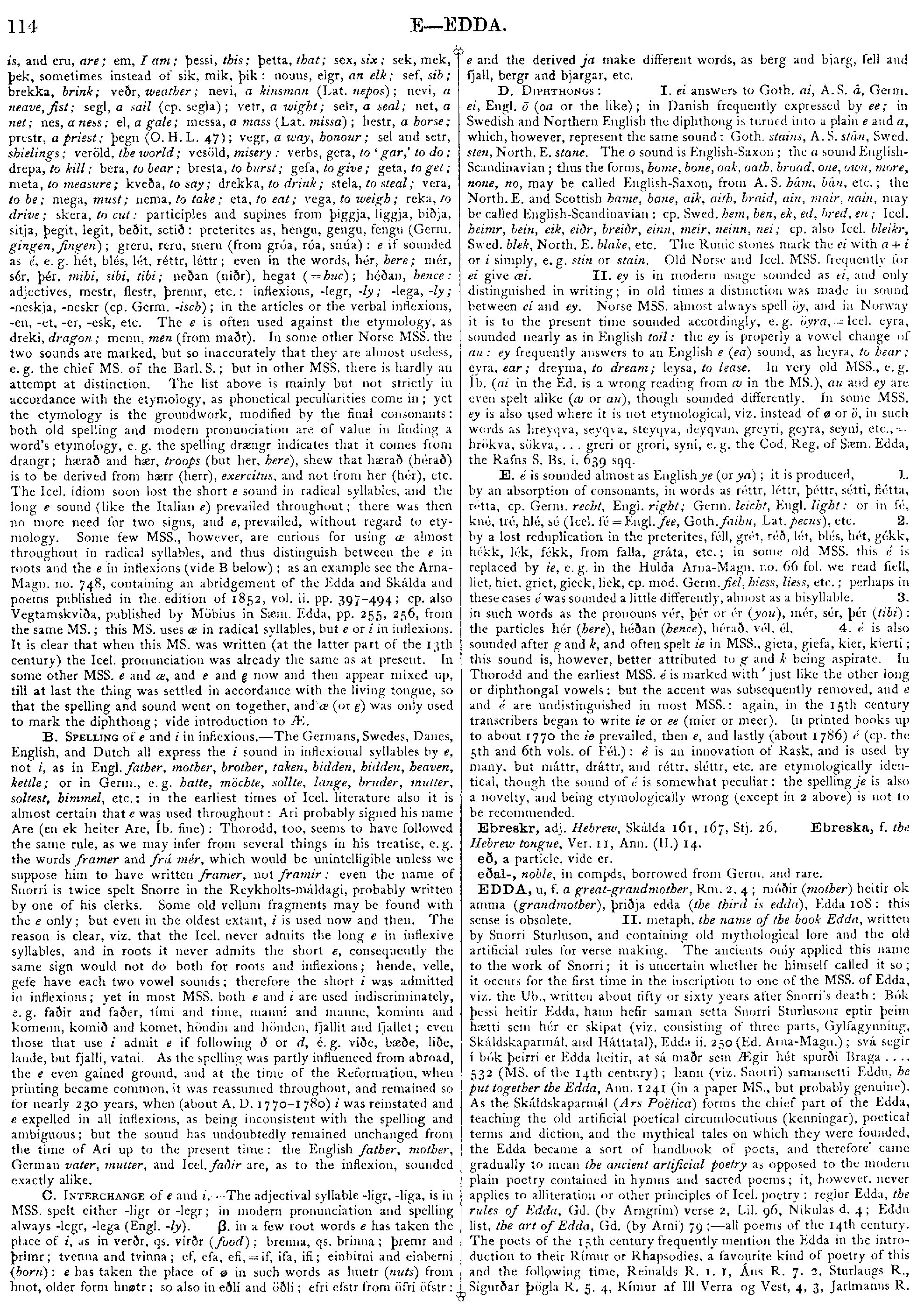
i s, and em, are; em, lam; þessi, thi s; þetta, that; sex, s i x: sek, mek, þek, sometimes instead of sik, mik, þik: nouns, elgr, an elk; sef, s ib; brekka, brink; veðr, weather; nevi, a kinsman (Lat. nepos); nevi, a neave, fist; segl, a sail (cp. segla); vetr, a wight; selr, a se a l; net, a net; nes, a ne ss; el, a gale; messa, a mass (Lat. missa); hestr, a horse; prtstr, a priest; þegn (O. H. L. 47); vegr, a way, honour; sel and setr, shielings; verold, the world; vesold, misery: verbs, gera, to ' gar, ' to do; drepa, to kill; bera, to bear; bresta, to burst; gefa, to give; geta, to get; meta, to measure; kveða, to say; drekka, to drink; stela, to steal; vera, to be; mega, must; nema, to take; eta, to e a t; vega, to weigh; reka, t o drive; skera, to cut: participles and supines from þiggja, liggja, biðja, sitja, þegit, legit, beðit, setið: preterites as, hengu, gengu, fengu (Germ. gingen, fingen); greru, reru, srxeru (from gróa, róa, snúa): e if sounded as é, e. g. hot, blés, let, réttr, léttr; even in the words, her, here; mér, scr, þér, mihi, sibi, tibi; neðan (niðr), hegat ( -- hue); héðan, hence: adjectives, mestr, flestr, þrennr, etc.: inflexions, -legr, - ly; -lega, - ly; -neskja, -neskr (cp. Germ, - i sc h); in the articles or the verbal inflexions, -en, -et, -er, -esk, etc. The e is often used against the etymology, as dreki, dragon; menu, men (from maðr). In some other Norse MSS. the two sounds are marked, but so inaccurately that they are almost useless, e. g. the chief MS. of the Bad. S.; but in other MSS. there is hardly an attempt at distinction. The list above is mainly but not strictly in accordance with the etymology, as phonetical peculiarities come in; yet the etymology is the groundwork, modified by the final consonants: both old spelling and modern pronunciation are of value in finding a word's etymology, e. g. the spelling drsengr indicates that it comes from drangr; hærað and haer, troops (but her, here), shew that hærað (hérað) is to be derived from hærr (herr), exercitus, and not from her (her), etc. The Icel. idiom soon lost the short e sound in radical syllables, and the long e sound (like the Italian e) prevailed throughout; there was then no more need for two signs, and e, prevailed, without regard to ety- mology. Some few MSS., however, are curious for using æ almost throughout in radical syllables, and thus distinguish between the e in roots and the e in inflexions (vide B below); as an example see the Arna- Magn. no. 748, containing an abridgement of the Edda and Skálda and poems published in the edition of 1852, vol. ii. pp. 397-494; cp. also Vegtamskviða, published by Mubius in Sæm. Edda, pp. 255, 256, from the same MS.; this MS. uses æ in radical syllables, but e or i in inflexions. It is clear that when this MS. was written (at the latter part of the i^th century) the Icel. pronunciation was already the same as at present. In some other MSS. e and ce, and e and g now and then appear mixed up, till at last the thing was settled in accordance with the living tongue, so that the spelling and sound went on together, and CE (or g) was only used to mark the diphthong; vide introduction to Æ. B. SPELLING of e and i in inflexions. -- The Germans, Swedes, Danes, English, and Dutch all express the i sound in inflexional syllables by e, not i, as in Engl. y a í her, mother, brother, taken, bidden, hidden, heaven, kettle; or in Germ., e. g. hatte, möchte, sollte, lange, bruder, mutter, soltesf, himmel, etc.: in the earliest times of Icel. literature also it is almost certain that e was used throughout: Ari probably signed his name Are (en ek heitcr Are, tb. fine): Thorodd, too, seems to have followed the same rule, as we may infer from several things in his treatise, e. g. the words framer and frá mér, which would be unintelligible unless we suppose him to have written framer, not framir: even the name of Snorri is twice spelt Snorre in the Reykholts-máldagi, probably written by one of his clerks. Some old vellum fragments may be found with the e only; but even in the oldest extant, i is used now and then. The reason is clear, viz. that the Icel. never admits the long e in inflexive syllables, and in roots it never admits the short e, consequently the same sign would not do both for roots and inflexions; hende, velle, gefe have each two vowel sounds; therefore the short i was admitted in inflexions; yet in most MSS. both e and i are used indiscriminately, a. g. faðir and faðer, tími and time, manni and manne, kominn and komenn, komið and komet, hihidin and hundcn, fjallit and fjallet; even those that use i admit e if following ð or d, é. g. viðe, bæðe, liðe, lande, but fjalli, vatni. As the spelling was partly influenced from abroad, the e even gained ground, and at the time of the Reformation, when printing became common, it was rcassmned throughout, and remained so for nearly 230 years, when (about A. D. 1770-1/80) i was reinstated and e expelled in all inflexions, as being inconsistent with the spelling and ambiguous; but the sound has undoubtedly remained unchanged from the time of Ari up to the present time: the English father, mother, German vater, mutter, and lcd. fadir are, as to the inflexion, sounded exactly alike. C. INTERCHANGE of e and i. -- The adjectival syllable -ligr, -liga, is in MSS. spelt either -ligr or -legr; in modern pronunciation and spelling always -legr, -lega (Engl. -ly). |3. in a few root words e has taken the place of i, as in verðr, qs. virðr (food); brenna, qs. brinna; þremr and þrimr; tvenna and tvinna; ef, efa, efi, = if, ifa, ifi; einbirni and einberni (horn): e has taken the place of a in such words as hnetr (nuts) from hnot, older form hnøtr: so also in eðli and öðli; efri efstr from öfri öfstr: e and the derived ja make different words, as berg and bjarg, fell and fjall, bergr and bjargar, etc. D. DIPHTHONGS: I. ei answers to Goth, ai, A. S. â, Germ. ei, Engl. a (oa or the like); in Danish frequently expressed by ee; in Swedish and Northern English the diphthong is turned into a plain e and a, which, however, represent the same sound: Goth, stains, A. S. stan, Swed. sten, North. E. s to ne. The o sound is English-Saxon; the a sound English- Scandinavian; thus the forms, home, bone, oak, oath, broad, one, own, more, none, no, may be called English-Saxon, from A. S. ham, ban, etc.; the North. E. and Scottish harne, bane, aik, ai/h, braid, ain, mair, /tain, may be called English-Scandinavian: cp. Swed. hem, ben, ek, ed. bred, en; Icel. heimr, bein, eik, eidr, breidr, einn, meir, neinn, nei; cp. also Icel. bleikr, Swed. blek, North. E. blake, etc. The Runic stones mark the ei with a + i or i simply, e. g. sti w or s tain. Old Norse and Icel. MSS. frequently for ei give Æ i. II. ey is in modern usage sounded as ei, and only distinguished in writing; in old times a distinction was made in sound between ei and ey. Norse MSS. almost always spell 'ôy, and in Norway it is to the present time sounded accordingly, e. g. iiyra, -- Icel. eyra, sounded nearly as in English toil: the ey is properly a vowel change of au: ey frequently answers to an English e (ea) sound, as heyra, to hear; eyra, e ar; dreyma, to dream; leysa, to lease. In very old MSS., e. g. Ib. (ai in the Ed. is a wrong reading from aj in the MS.), au and ey are even spelt alike (aj or a;^), though sounded differently. In some MSS. ey is also used where it is not etymological, viz. instead of ø or o, in such words as hreyqva, seyqva, stcyqva, deyqvan, greyri, geyra, seyni, etc., = hrökva, sökva, ... greri or grori, syni, e. g. the Cod. Reg. of S;em. Edda, the Rafns S. Bs. i. 639 E. é is sounded almost as English y e (or y a); it is produced, 1. by an absorption of consonants, in words as réttr, léttr, þéttr, sétti, flétta, n'-tta, cp. Germ, recht, Engl. right; Germ. Icicht, Engl. light: or in fo, kno, tré, hit:, sc (Icel. fe = Engl. / ee, Goth. / aih w, Lat. pe cws), etc. 2. by a lost reduplication in the preterites, fell, grot, réð, h-t, blús, hot, gékk, hékk, Ick, fékk, from falla, grata, etc.; in some old MSS. this é is replaced by ie, e. g. in the Hulda Arna-Magn. no. 66 fol. we read fiell, liet, hiet, griet, gieck, liek, cp. mod. Geim. fíel. hiess, Hess, etc.; perhaps in these cases e was sounded a little differently, almost as a bisyllable. 3. in such words as the pronouns vt'-r, þér or ér (you), niér, sér, þér (tibi): the particles her (here), héðan (hence), hérað, vi'-l, el. 4. t' is also sounded after g and k, and often spelt ie in MSS., gieta, giefa, kier, kierti; this sound is, however, better attributed to g and k being aspirate. In Thorodd and the earliest MSS. é is marked with ' just like the other long or diphthongal vowels; but the accent was subsequently removed, and e and é are undistinguished in most MSS.: again, in the 15th century transcribers began to write ie or ee (mier or meer). In printed books up to about 1770 the ie- prevailed, then e, and lastly (about 1786) (; (cp. the 5th and 6th vols. of Eél.): ë is an innovation of Rask, and is used by many, but máttr, dráttr, and rettr, sléttr, etc. are etymologically iden- tical, though the sound of K is somewhat peculiar: the spelling~/e is also a novelty, and being etymologically wrong (except in 2 above) is not to be recommended.
|
Source: Cleasby/Vigfusson, page b0117, entry 38 View original page image as: [TIFF] [PNG] [View previous entry] [View next entry] |
[Comment on this entry] [View comments] |
The following entry has been hand-corrected once. |
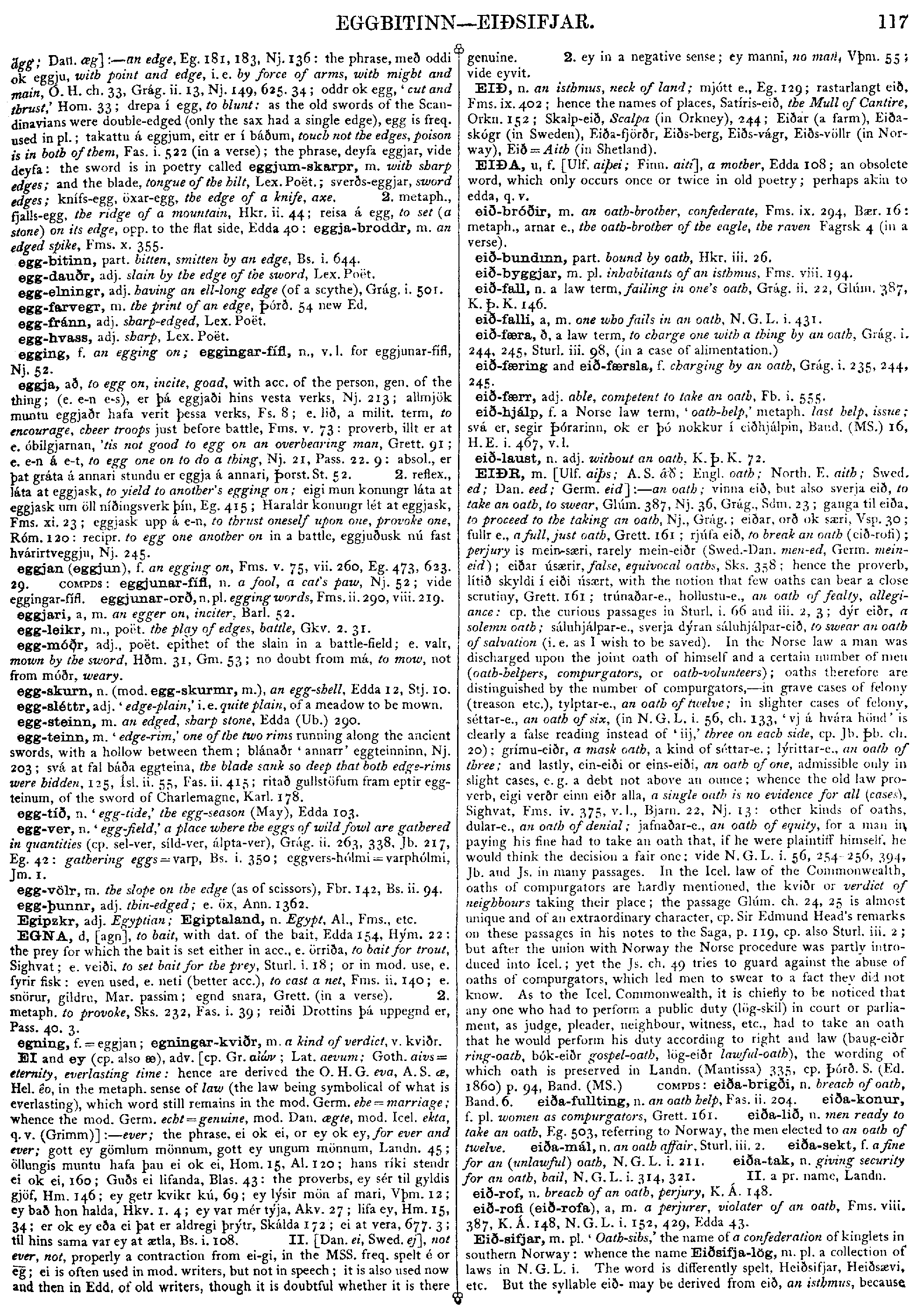
EIÐR, m. [Ulf. aiþs; A. S. að; Engl. oath; North. E. aith; Swed. ed; Dan. eed; Germ. eid] :-- an oath; vinna eið, but also sverja eið, to take an oath, to swear, Glúm. 387, Nj. 36, Grág., Sdm. 23; ganga til eiða, to proceed to the taking an oath, Nj., Grág.; eiðar, orð ok særi, Vsp. 30; fullr e., a full, just oath, Grett. 161; rjúfa eið, to break an oath (eið-rofi); perjury is mein-særi, rarely mein-eiðr (Swed.-Dan. men-ed, Germ. mein-eid); eiðar úsærir, false, equivocal oaths, Sks. 358; hence the proverb, lítið skyldi í eiði úsært, with the notion that few oaths can bear a close scrutiny, Grett. 161; trúnaðar-e., hollustu-e., an oath of fealty, allegiance: cp. the curious passages in Sturl. i. 66 and iii. 2, 3; dýr eiðr, a solemn oath; sáluhjálpar-e., sverja dýran sáluhjálpar-eið, to swear an oath of salvation (i.e. as I wish to be saved). In the Norse law a man was discharged upon the joint oath of himself and a certain number of men (oath-helpers, compurgators, or oath-volunteers); oaths therefore are distinguished by the number of compurgators,--in grave cases of felony (treason etc.), tylptar-e., an oath of twelve; in slighter cases of felony, séttar-e., an oath of six, (in N. G. L. i. 56, ch. 133, 'vj á hvára hönd' is clearly a false reading instead of 'iij,' three on each side, cp. Jb. Þb. ch. 20); grímu-eiðr, a mask oath, a kind of séttar-e.; lýrittar-e., an oath of three; and lastly, ein-eiði or eins-eiði, an oath of one, admissible only in slight cases, e.g. a debt not above an ounce; whence the old law proverb, eigi verðr einn eiðr alla, a single oath is no evidence for all (cases), Sighvat, Fms. iv. 375, v.l., Bjarn. 22, Nj. 13: other kinds of oaths, dular-e., an oath of denial; jafnaðar-e., an oath of equity, for a man in paying his fine had to take an oath that, if he were plaintiff himself, he would think the decision a fair one: vide N. G. L. i. 56, 254-256, 394, Jb. and Js. in many passages. In the Icel. law of the Commonwealth, oaths of compurgators are hardly mentioned, the kviðr or verdict of neighbours taking their place; the passage Glúm. ch. 24, 25 is almost unique and of an extraordinary character, cp. Sir Edmund Head's remarks on these passages in his notes to the Saga, p. 119, cp. also Sturl. iii. 2; but after the union with Norway the Norse procedure was partly introduced into Icel.; yet the Js. ch. 49 tries to guard against the abuse of oaths of compurgators, which led men to swear to a fact they did not know. As to the Icel. Commonwealth, it is chiefly to be noticed that any one who had to perform a public duty (lög-skil) in court or parliament, as judge, pleader, neighbour, witness, etc., had to take an oath that he would perform his duty according to right and law (baug-eiðr ring-oath, bók-eiðr gospel-oath, lög-eiðr lawful-oath), the wording of which oath is preserved in Landn. (Mantissa) 335, cp. Þórð. S. (Ed. 1860) p. 94, Band. (MS.) COMPDS: eiða-brigði, n. breach of oath, Band. 6. eiða-fullting, n. an oath help, Fas. ii. 204. eiða-konur, f. pl. women as compurgators, Grett. 161. eiða-lið, n. men ready to take an oath, Eg. 503, referring to Norway, the men elected to an oath of twelve. eiða-mál, n. an oath affair, Sturl. iii. 2. eiða-sekt, f. a fine for an (unlawful) oath, N. G. L. i. 211. eiða-tak, n. giving security for an oath, bail, N. G. L. i. 314, 321. II. a pr. name, Landn.
|
Source: Cleasby/Vigfusson, page b0118, entry 13 View original page image as: [TIFF] [PNG] [View previous entry] [View next entry] |
[Comment on this entry] [View comments] |
The following entry has been hand-corrected once. |
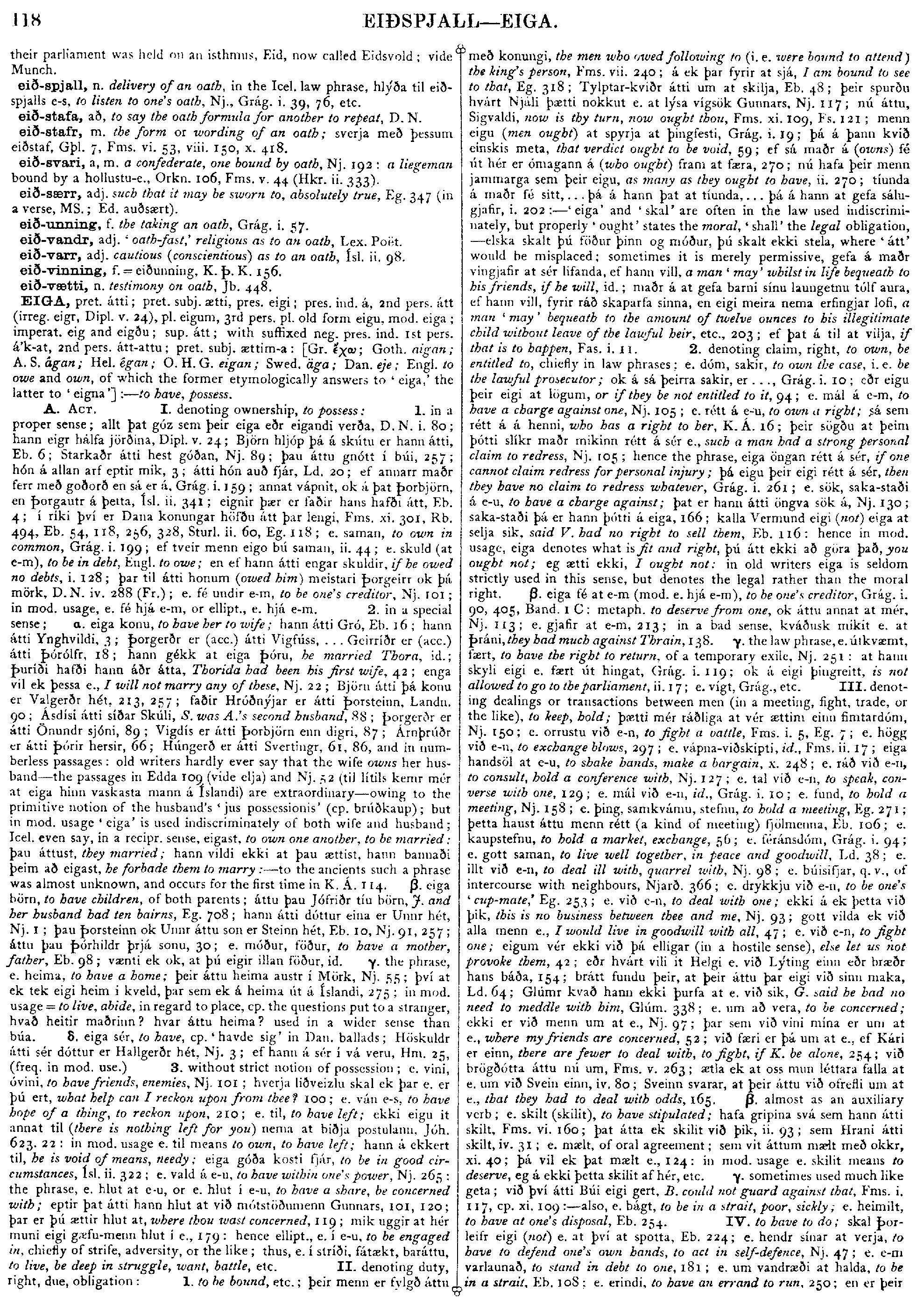
A.
ACT.
I.
denoting
ownership,
to
possess:
1.
in
a
proper
sense;
allt
þat
góz
sem
þeir
eiga
eðr
eigandi
verða,
D.
N.
i.
80;
hann
eigr
hálfa
jörðina,
Dipl.
v.
24;
Björn
hljóp
þá
á
skútu
er
hann
átti,
Eb.
6;
Starkaðr
átti
hest
góðan,
Nj.
89;
þau
áttu
gnótt
í
búi,
257;
hón
á
allan
arf
eptir
mik,
3;
átti
hón
auð
fjár,
Ld.
20;
ef
annarr
maðr
ferr
með
goðorð
en
sá
er
á,
Grág.
i.
159;
annat
vápnit,
ok
á
þat
Þorbjörn,
en
Þorgautr
á
þetta,
Ísl.
ii.
341;
eignir
þær
er
faðir
hans
hafði
átt,
Eb.
4;
í
ríki
því
er
Dana
konungar
höfðu
átt
þar
lengi,
Fms.
xi.
301,
Rb.
494,
Eb.
54,
118,
256,
328,
Sturl.
ii.
60,
Eg.
118;
e.
saman,
to
own
in
common,
Grág.
i.
199;
ef
tveir
menn
eigo
bú
saman,
ii.
44;
e.
skuld
(at
e-m),
to
be
in
debt,
Engl.
to
owe;
en
ef
hann
átti
engar
skuldir,
if
he
owed
no
debts,
i.
128;
þar
til
átti
honum
(owed
him)
meistari
Þorgeirr
ok
þá
mörk,
D.
N.
iv.
288
(Fr.);
e.
fé
undir
e-m,
to
be
one's
creditor,
Nj.
101;
in
mod.
usage,
e.
fé
hjá
e-m,
or
ellipt.,
e.
hjá
e-m.
2.
in
a
special
sense;
 .
eiga
konu,
to
have
her
to
wife;
hann
átti
Gró,
Eb.
16;
hann
átti
Ynghvildi,
3;
Þorgerðr
er
(acc.)
átti
Vigfúss,
...
Geirríðr
er
(acc.)
átti
Þórólfr,
18;
hann
gékk
at
eiga
Þóru,
he
married
Thora,
id.;
Þuríði
hafði
hann
áðr
átta,
Thorida
had
been
his
first
wife,
42;
enga
vil
ek
þessa
e.,
I
will
not
marry
any
of
these,
Nj.
22;
Björn
átti
þá
konu
er
Valgerðr
hét,
213,
257;
faðir
Hróðnýjar
er
átti
Þorsteinn,
Landn.
90;
Ásdísi
átti
síðar
Skúli,
S.
was
A.'s
second
husband,
88;
Þorgerðr
er
átti
Önundr
sjóni,
89;
Vigdís
er
átti
Þorbjörn
enn
digri,
87;
Árnþrúðr
er
átti
Þórir
hersir,
66;
Húngerð
er
átti
Svertingr,
6l,
86,
and
in
numberless
passages:
old
writers
hardly
ever
say
that
the
wife
owns
her
husband--the
passages
in
Edda
109
(vide
elja)
and
Nj.
52
(til
lítils
kemr
mér
at
eiga
hinn
vaskasta
mann
á
Islandi)
are
extraordinary--owing
to
the
primitive
notion
of
the
husband's
'jus
possessionis'
(cp.
brúðkaup);
but
in
mod.
usage
'eiga'
is
used
indiscriminately
of
both
wife
and
husband;
Icel.
even
say,
in
a
recipr.
sense,
eigast,
to
own
one
another,
to
be
married:
þau
áttust,
they
married;
hann
vildi
ekki
at
þau
ættist,
hann
bannaði
þeim
að
eigast,
he
forbade
them
to
marry
:--
to
the
ancients
such
a
phrase
was
almost
unknown,
and
occurs
for
the
first
time
in
K.
Á.
114.
.
eiga
börn,
to
have
children,
of
both
parents;
áttu
þau
Jófriðr
tíu
börn,
J.
and
her
husband
had
ten
bairns,
Eg.
708;
hann
átti
dóttur
eina
er
Unnr
hét,
Nj.
1;
þau
Þorsteinn
ok
Unnr
áttu
son
er
Steinn
hét,
Eb.
10,
Nj.
91,
257;
áttu
þau
Þórhildr
þrjá
sonu,
30;
e.
móður,
föður,
to
have
a
mother,
father,
Eb.
98;
vænti
ek
ok,
at
þú
eigir
illan
föður,
id.
.
eiga
konu,
to
have
her
to
wife;
hann
átti
Gró,
Eb.
16;
hann
átti
Ynghvildi,
3;
Þorgerðr
er
(acc.)
átti
Vigfúss,
...
Geirríðr
er
(acc.)
átti
Þórólfr,
18;
hann
gékk
at
eiga
Þóru,
he
married
Thora,
id.;
Þuríði
hafði
hann
áðr
átta,
Thorida
had
been
his
first
wife,
42;
enga
vil
ek
þessa
e.,
I
will
not
marry
any
of
these,
Nj.
22;
Björn
átti
þá
konu
er
Valgerðr
hét,
213,
257;
faðir
Hróðnýjar
er
átti
Þorsteinn,
Landn.
90;
Ásdísi
átti
síðar
Skúli,
S.
was
A.'s
second
husband,
88;
Þorgerðr
er
átti
Önundr
sjóni,
89;
Vigdís
er
átti
Þorbjörn
enn
digri,
87;
Árnþrúðr
er
átti
Þórir
hersir,
66;
Húngerð
er
átti
Svertingr,
6l,
86,
and
in
numberless
passages:
old
writers
hardly
ever
say
that
the
wife
owns
her
husband--the
passages
in
Edda
109
(vide
elja)
and
Nj.
52
(til
lítils
kemr
mér
at
eiga
hinn
vaskasta
mann
á
Islandi)
are
extraordinary--owing
to
the
primitive
notion
of
the
husband's
'jus
possessionis'
(cp.
brúðkaup);
but
in
mod.
usage
'eiga'
is
used
indiscriminately
of
both
wife
and
husband;
Icel.
even
say,
in
a
recipr.
sense,
eigast,
to
own
one
another,
to
be
married:
þau
áttust,
they
married;
hann
vildi
ekki
at
þau
ættist,
hann
bannaði
þeim
að
eigast,
he
forbade
them
to
marry
:--
to
the
ancients
such
a
phrase
was
almost
unknown,
and
occurs
for
the
first
time
in
K.
Á.
114.
.
eiga
börn,
to
have
children,
of
both
parents;
áttu
þau
Jófriðr
tíu
börn,
J.
and
her
husband
had
ten
bairns,
Eg.
708;
hann
átti
dóttur
eina
er
Unnr
hét,
Nj.
1;
þau
Þorsteinn
ok
Unnr
áttu
son
er
Steinn
hét,
Eb.
10,
Nj.
91,
257;
áttu
þau
Þórhildr
þrjá
sonu,
30;
e.
móður,
föður,
to
have
a
mother,
father,
Eb.
98;
vænti
ek
ok,
at
þú
eigir
illan
föður,
id.
 .
the
phrase,
e.
heima,
to
have
a
home;
þeir
áttu
heima
austr
í
Mörk,
Nj.
55;
því
at
ek
tek
eigi
heim
í
kveld,
þar
sem
ek
á
heima
út
á
Íslandi,
275;
in
mod.
usage
=
to
live,
abide,
in
regard
to
place,
cp.
the
questions
put
to
a
stranger,
hvað
heitir
maðrinn?
hvar
áttu
heima?
used
in
a
wider
sense
than
búa.
.
the
phrase,
e.
heima,
to
have
a
home;
þeir
áttu
heima
austr
í
Mörk,
Nj.
55;
því
at
ek
tek
eigi
heim
í
kveld,
þar
sem
ek
á
heima
út
á
Íslandi,
275;
in
mod.
usage
=
to
live,
abide,
in
regard
to
place,
cp.
the
questions
put
to
a
stranger,
hvað
heitir
maðrinn?
hvar
áttu
heima?
used
in
a
wider
sense
than
búa.
 .
eiga
sér,
to
have,
cp.
'havde
sig'
in
Dan.
ballads;
Höskuldr
átti
sér
dóttur
er
Hallgerðr
hét,
Nj.
3;
ef
hann
á
sér
í
vá
veru,
Hm.
25,
(freq.
in
mod.
use.)
3.
without
strict
notion
of
possession;
e.
vini,
óvini,
to
have
friends,
enemies,
Nj.
101;
hverja
liðveizlu
skal
ek
þar
e.
er
þú
ert,
what
help
can
I
reckon
upon
from
thee?
100;
e.
ván
e-s,
to
have
hope
of
a
thing,
to
reckon
upon,
210;
e.
til,
to
have
left;
ekki
eigu
it
annat
til
(there
is
nothing
left
for
you)
nema
at
biðja
postulann.
Jóh.
623.
22:
in
mod.
usage
e.
til
means
to
own,
to
have
left;
hann
á
ekkert
til,
he
is
void
of
means,
needy;
eiga
góða
kosti
fjár,
to
be
in
good
circumstances,
Ísl.
ii.
322;
e.
vald
á
e-u,
to
have
within
one's
power,
Nj.
265;
the
phrase,
e.
hlut
at
e-u,
or
e.
hlut
í
e-u,
to
have
a
share,
be
concerned
with;
eptir
þat
átti
hann
hlut
at
við
mótstöðumenn
Gunnars,
101,
120;
þar
er
þú
ættir
hlut
at,
where
thou
wast
concerned,
119;
mik
uggir
at
hér
muni
eigi
gæfu-menn
hlut
í
e.,
179:
hence
ellipt.,
e.
í
e-u,
to
be
engaged
in,
chiefly
of
strife,
adversity,
or
the
like;
thus,
e.
í
stríði,
fátaekt,
baráttu,
to
live,
be
deep
in
struggle,
want,
battle,
etc.
II.
denoting
duty,
right,
due,
obligation:
1.
to
be
bound,
etc.;
þeir
menn
er
fylgð
áttu
með
konungi,
the
men
who
owed
following
to
(i.e.
were
bound
to
attend)
the
king's
person,
Fms.
vii.
240;
á
ek
þar
fyrir
at
sjá,
I
am
bound
to
see
to
that,
Eg.
318;
Tylptar-kviðr
átti
um
at
skilja,
Eb.
48;
þeir
spurðu
hvárt
Njáli
þætti
nokkut
e.
at
lýsa
vígsök
Gunnars,
Nj.
117;
nú
áttu,
Sigvaldi,
now
is
thy
turn,
now
ought
thou,
Fms.
xi.
109,
Fs.
121;
menn
eigu
(men
ought)
at
spyrja
at
þingfesti,
Grág.
i.
19;
þá
á
þann
kvið
einskis
meta,
that
verdict
ought
to
be
void,
59;
ef
sá
maðr
á
(owns)
fé
út
hér
er
ómagann
á
(who
ought)
fram
at
færa,
270;
nú
hafa
þeir
menn
jammarga
sem
þeir
eigu,
as
many
as
they
ought
to
have,
ii.
270;
tíunda
á
maðr
fé
sitt,
...
þá
á
hann
þat
at
tíunda,
...
þá
á
hann
at
gefa
sálugjafir,
i.
202
:--
'eiga'
and
'skal'
are
often
in
the
law
used
indiscriminately,
but
properly
'ought'
states
the
moral,
'shall'
the
legal
obligation,--elska
skalt
þú
föður
þinn
og
móður,
þú
skalt
ekki
stela,
where
'átt'
would
be
misplaced;
sometimes
it
is
merely
permissive,
gefa
á
maðr
vingjafir
at
sér
lifanda,
ef
hann
vill,
a
man
'may'
whilst
in
life
bequeath
to
his
friends,
if
he
will,
id.;
maðr
á
at
gefa
barni
sínu
laungetnu
tólf
aura,
ef
hann
vill,
fyrir
ráð
skaparfa
sinna,
en
eigi
meira
nema
erfingjar
lofi,
a
man
'may'
bequeath
to
the
amount
of
twelve
ounces
to
his
illegitimate
child
without
leave
of
the
lawful
heir,
etc.,
203;
ef
þat
á
til
at
vilja,
if
that
is
to
happen,
Fas.
i.
11.
2.
denoting
claim,
right,
to
own,
be
entitled
to,
chiefly
in
law
phrases;
e.
dóm,
sakir,
to
own
the
case,
i.e.
be
the
lawful
prosecutor;
ok
á
sá
þeirra
sakir,
er
...,
Grág.
i.
10;
eðr
eigu
þeir
eigi
at
lögum,
or
if
they
be
not
entitled
to
it,
94;
e.
mál
á
e-m,
to
have
a
charge
against
one,
Nj.
105;
e.
rétt
á
e-u,
to
own
a
right;
sá
sem
rétt
á
á
henni,
who
has
a
right
to
her,
K.
Á.
16;
þeir
sögðu
at
þeim
þótti
slíkr
maðr
mikinn
rétt
á
sér
e.,
such
a
man
had
a
strong
personal
claim
to
redress,
Nj.
105;
hence
the
phrase,
eiga
öngan
rétt
á
sér,
if
one
cannot
claim
redress
for
personal
injury;
þá
eigu
þeir
eigi
rétt
á
sér,
then
they
have
no
claim
to
redress
whatever,
Grág.
i.
261;
e.
sök,
saka-staði
á
e-u,
to
have
a
charge
against;
þat
er
hann
átti
öngva
sök
á,
Nj.
130;
saka-staði
þá
er
hann
þótti
á
eiga,
166;
kalla
Vermund
eigi
(not)
eiga
at
selja
sik,
said
V.
had
no
right
to
sell
them,
Eb.
116:
hence
in
mod.
usage,
eiga
denotes
what
is
fit
and
right,
þú
átt
ekki
að
göra
það,
you
ought
not;
eg
ætti
ekki,
I
ought
not:
in
old
writers
eiga
is
seldom
strictly
used
in
this
sense,
but
denotes
the
legal
rather
than
the
moral
right.
.
eiga
fé
at
e-m
(mod.
e.
hjá
e-m),
to
be
one's
creditor,
Grág.
i.
90,
405,
Band.
1
C:
metaph.
to
deserve
from
one,
ok
áttu
annat
at
mér,
Nj.
113;
e.
gjafir
at
e-m,
213;
in
a
bad
sense,
kváðusk
mikit
e.
at
Þráni,
they
had
much
against
Thrain,
138.
.
the
law
phrase,
e.
útkvæmt,
fært,
to
have
the
right
to
return,
of
a
temporary
exile,
Nj.
251:
at
hann
skyli
eigi
e.
fært
út
hingat,
Grág.
i.
119;
ok
á
eigi
þingreitt,
is
not
allowed
to
go
to
the
parliament,
ii.
17;
e.
vígt,
Grág.,
etc.
III.
denoting
dealings
or
transactions
between
men
(in
a
meeting,
fight,
trade,
or
the
like),
to
keep,
hold;
þætti
mér
ráðliga
at
vér
ættim
einn
fimtardóm,
Nj.
150;
e.
orrustu
við
e-n,
to
fight
a
battle,
Fms.
i.
5,
Eg.
7;
e.
högg
við
e-n,
to
exchange
blows,
297;
e.
vápna-viðskipti,
id.,
Fms.
ii.
17;
eiga
handsöl
at
e-u,
to
shake
hands,
make
a
bargain,
x.
248;
e.
ráð
við
e-n,
to
consult,
hold
a
conference
with,
Nj.
127;
e.
tal
við
e-n,
to
speak,
converse
with
one,
129;
e.
mál
við
e-n,
id.,
Grág.
i.
10;
e.
fund,
to
hold
a
meeting,
Nj.
158;
e.
þing,
samkvámu,
stefnu,
to
hold
a
meeting,
Eg.
271;
þetta
haust
áttu
menn
rétt
(a
kind
of
meeting)
fjölmenna,
Eb.
106;
e.
kaupstefnu,
to
hold
a
market,
exchange,
56;
e.
féránsdóm,
Grág.
i.
94;
e.
gott
saman,
to
live
well
together,
in
peace
and
goodwill,
Ld.
38;
e.
illt
við
e-n,
to
deal
ill
with,
quarrel
with,
Nj.
98;
e.
búisifjar,
q.v.,
of
intercourse
with
neighbours,
Njarð.
366;
e.
drykkju
við
e-n,
to
be
one's
'cup-mate,'
Eg.
253;
e.
við
e-n,
to
deal
with
one;
ekki
á
ek
þetta
við
þik,
this
is
no
business
between
thee
and
me,
Nj.
93;
gott
vilda
ek
við
alla
menn
e.,
I
would
live
in
goodwill
with
all,
47;
e.
við
e-n,
to
fight
one;
eigum
vér
ekki
við
þá
elligar
(in
a
hostile
sense),
else
let
us
not
provoke
them,
42;
eðr
hvárt
vili
it
Helgi
e.
við
Lýting
einn
eðr
bræðr
hans
báða,
154;
brátt
fundu
þeir,
at
þeir
áttu
þar
eigi
við
sinn
maka,
Ld.
64;
Glúmr
kvað
hann
ekki
þurfa
at
e.
við
sik,
G.
said
he
had
no
need
to
meddle
with
him,
Glúm.
338;
e.
um
að
vera,
to
be
concerned;
ekki
er
við
menn
um
at
e.,
Nj.
97;
þar
sem
við
vini
mína
er
um
at
e.,
where
my
friends
are
concerned,
52;
við
færi
er
þá
um
at
e.,
ef
Kári
er
einn,
there
are
fewer
to
deal
with,
to
fight,
if
K.
be
alone,
254;
við
brögðótta
áttu
nú
um,
Fms.
v.
263;
ætla
ek
at
oss
mun
léttara
falla
at
e.
um
við
Svein
einn,
iv.
80;
Sveinn
svarar,
at
þeir
áttu
við
ofrefli
um
at
e.,
that
they
had
to
deal
with
odds,
165.
.
almost
as
an
auxiliary
verb;
e.
skilt
(skilit),
to
have
stipulated;
hafa
gripina
svá
sem
hann
átti
skill,
Fms.
vi.
160;
þat
átta
ek
skilit
við
þik,
ii.
93;
sem
Hrani
átti
skilt,
iv.
31;
e.
mælt,
of
oral
agreement;
sem
vit
áttum
mælt
með
okkr,
xi.
40;
þá
vil
ek
þat
mælt
e.,
124:
in
mod.
usage
e.
skilit
means
to
deserve,
eg
á
ekki
þetta
skilit
af
hér,
etc.
.
sometimes
used
much
like
geta;
við
því
átti
Búi
eigi
gert,
B.
could
not
guard
against
that,
Fms.
i.
117,
cp.
xi.
109
:--
also,
e.
bágt,
to
be
in
a
strait,
poor,
sickly;
e.
heimilt,
to
have
at
one's
disposal,
Eb.
254.
IV.
to
have
to
do;
skal
Þorleifr
eigi
(not)
e.
at
því
at
spotta,
Eb.
224;
e.
hendr
sínar
at
verja,
to
have
to
defend
one's
own
hands,
to
act
in
self-defence,
Nj.
47;
e.
e-m
varlaunað,
to
stand
in
debt
to
one,
181;
e.
um
vandræði
at
halda,
to
be
in
a
strait,
Eb.
108;
e.
erindi,
to
have
an
errand
to
run,
250;
en
er
þeir
.
eiga
sér,
to
have,
cp.
'havde
sig'
in
Dan.
ballads;
Höskuldr
átti
sér
dóttur
er
Hallgerðr
hét,
Nj.
3;
ef
hann
á
sér
í
vá
veru,
Hm.
25,
(freq.
in
mod.
use.)
3.
without
strict
notion
of
possession;
e.
vini,
óvini,
to
have
friends,
enemies,
Nj.
101;
hverja
liðveizlu
skal
ek
þar
e.
er
þú
ert,
what
help
can
I
reckon
upon
from
thee?
100;
e.
ván
e-s,
to
have
hope
of
a
thing,
to
reckon
upon,
210;
e.
til,
to
have
left;
ekki
eigu
it
annat
til
(there
is
nothing
left
for
you)
nema
at
biðja
postulann.
Jóh.
623.
22:
in
mod.
usage
e.
til
means
to
own,
to
have
left;
hann
á
ekkert
til,
he
is
void
of
means,
needy;
eiga
góða
kosti
fjár,
to
be
in
good
circumstances,
Ísl.
ii.
322;
e.
vald
á
e-u,
to
have
within
one's
power,
Nj.
265;
the
phrase,
e.
hlut
at
e-u,
or
e.
hlut
í
e-u,
to
have
a
share,
be
concerned
with;
eptir
þat
átti
hann
hlut
at
við
mótstöðumenn
Gunnars,
101,
120;
þar
er
þú
ættir
hlut
at,
where
thou
wast
concerned,
119;
mik
uggir
at
hér
muni
eigi
gæfu-menn
hlut
í
e.,
179:
hence
ellipt.,
e.
í
e-u,
to
be
engaged
in,
chiefly
of
strife,
adversity,
or
the
like;
thus,
e.
í
stríði,
fátaekt,
baráttu,
to
live,
be
deep
in
struggle,
want,
battle,
etc.
II.
denoting
duty,
right,
due,
obligation:
1.
to
be
bound,
etc.;
þeir
menn
er
fylgð
áttu
með
konungi,
the
men
who
owed
following
to
(i.e.
were
bound
to
attend)
the
king's
person,
Fms.
vii.
240;
á
ek
þar
fyrir
at
sjá,
I
am
bound
to
see
to
that,
Eg.
318;
Tylptar-kviðr
átti
um
at
skilja,
Eb.
48;
þeir
spurðu
hvárt
Njáli
þætti
nokkut
e.
at
lýsa
vígsök
Gunnars,
Nj.
117;
nú
áttu,
Sigvaldi,
now
is
thy
turn,
now
ought
thou,
Fms.
xi.
109,
Fs.
121;
menn
eigu
(men
ought)
at
spyrja
at
þingfesti,
Grág.
i.
19;
þá
á
þann
kvið
einskis
meta,
that
verdict
ought
to
be
void,
59;
ef
sá
maðr
á
(owns)
fé
út
hér
er
ómagann
á
(who
ought)
fram
at
færa,
270;
nú
hafa
þeir
menn
jammarga
sem
þeir
eigu,
as
many
as
they
ought
to
have,
ii.
270;
tíunda
á
maðr
fé
sitt,
...
þá
á
hann
þat
at
tíunda,
...
þá
á
hann
at
gefa
sálugjafir,
i.
202
:--
'eiga'
and
'skal'
are
often
in
the
law
used
indiscriminately,
but
properly
'ought'
states
the
moral,
'shall'
the
legal
obligation,--elska
skalt
þú
föður
þinn
og
móður,
þú
skalt
ekki
stela,
where
'átt'
would
be
misplaced;
sometimes
it
is
merely
permissive,
gefa
á
maðr
vingjafir
at
sér
lifanda,
ef
hann
vill,
a
man
'may'
whilst
in
life
bequeath
to
his
friends,
if
he
will,
id.;
maðr
á
at
gefa
barni
sínu
laungetnu
tólf
aura,
ef
hann
vill,
fyrir
ráð
skaparfa
sinna,
en
eigi
meira
nema
erfingjar
lofi,
a
man
'may'
bequeath
to
the
amount
of
twelve
ounces
to
his
illegitimate
child
without
leave
of
the
lawful
heir,
etc.,
203;
ef
þat
á
til
at
vilja,
if
that
is
to
happen,
Fas.
i.
11.
2.
denoting
claim,
right,
to
own,
be
entitled
to,
chiefly
in
law
phrases;
e.
dóm,
sakir,
to
own
the
case,
i.e.
be
the
lawful
prosecutor;
ok
á
sá
þeirra
sakir,
er
...,
Grág.
i.
10;
eðr
eigu
þeir
eigi
at
lögum,
or
if
they
be
not
entitled
to
it,
94;
e.
mál
á
e-m,
to
have
a
charge
against
one,
Nj.
105;
e.
rétt
á
e-u,
to
own
a
right;
sá
sem
rétt
á
á
henni,
who
has
a
right
to
her,
K.
Á.
16;
þeir
sögðu
at
þeim
þótti
slíkr
maðr
mikinn
rétt
á
sér
e.,
such
a
man
had
a
strong
personal
claim
to
redress,
Nj.
105;
hence
the
phrase,
eiga
öngan
rétt
á
sér,
if
one
cannot
claim
redress
for
personal
injury;
þá
eigu
þeir
eigi
rétt
á
sér,
then
they
have
no
claim
to
redress
whatever,
Grág.
i.
261;
e.
sök,
saka-staði
á
e-u,
to
have
a
charge
against;
þat
er
hann
átti
öngva
sök
á,
Nj.
130;
saka-staði
þá
er
hann
þótti
á
eiga,
166;
kalla
Vermund
eigi
(not)
eiga
at
selja
sik,
said
V.
had
no
right
to
sell
them,
Eb.
116:
hence
in
mod.
usage,
eiga
denotes
what
is
fit
and
right,
þú
átt
ekki
að
göra
það,
you
ought
not;
eg
ætti
ekki,
I
ought
not:
in
old
writers
eiga
is
seldom
strictly
used
in
this
sense,
but
denotes
the
legal
rather
than
the
moral
right.
.
eiga
fé
at
e-m
(mod.
e.
hjá
e-m),
to
be
one's
creditor,
Grág.
i.
90,
405,
Band.
1
C:
metaph.
to
deserve
from
one,
ok
áttu
annat
at
mér,
Nj.
113;
e.
gjafir
at
e-m,
213;
in
a
bad
sense,
kváðusk
mikit
e.
at
Þráni,
they
had
much
against
Thrain,
138.
.
the
law
phrase,
e.
útkvæmt,
fært,
to
have
the
right
to
return,
of
a
temporary
exile,
Nj.
251:
at
hann
skyli
eigi
e.
fært
út
hingat,
Grág.
i.
119;
ok
á
eigi
þingreitt,
is
not
allowed
to
go
to
the
parliament,
ii.
17;
e.
vígt,
Grág.,
etc.
III.
denoting
dealings
or
transactions
between
men
(in
a
meeting,
fight,
trade,
or
the
like),
to
keep,
hold;
þætti
mér
ráðliga
at
vér
ættim
einn
fimtardóm,
Nj.
150;
e.
orrustu
við
e-n,
to
fight
a
battle,
Fms.
i.
5,
Eg.
7;
e.
högg
við
e-n,
to
exchange
blows,
297;
e.
vápna-viðskipti,
id.,
Fms.
ii.
17;
eiga
handsöl
at
e-u,
to
shake
hands,
make
a
bargain,
x.
248;
e.
ráð
við
e-n,
to
consult,
hold
a
conference
with,
Nj.
127;
e.
tal
við
e-n,
to
speak,
converse
with
one,
129;
e.
mál
við
e-n,
id.,
Grág.
i.
10;
e.
fund,
to
hold
a
meeting,
Nj.
158;
e.
þing,
samkvámu,
stefnu,
to
hold
a
meeting,
Eg.
271;
þetta
haust
áttu
menn
rétt
(a
kind
of
meeting)
fjölmenna,
Eb.
106;
e.
kaupstefnu,
to
hold
a
market,
exchange,
56;
e.
féránsdóm,
Grág.
i.
94;
e.
gott
saman,
to
live
well
together,
in
peace
and
goodwill,
Ld.
38;
e.
illt
við
e-n,
to
deal
ill
with,
quarrel
with,
Nj.
98;
e.
búisifjar,
q.v.,
of
intercourse
with
neighbours,
Njarð.
366;
e.
drykkju
við
e-n,
to
be
one's
'cup-mate,'
Eg.
253;
e.
við
e-n,
to
deal
with
one;
ekki
á
ek
þetta
við
þik,
this
is
no
business
between
thee
and
me,
Nj.
93;
gott
vilda
ek
við
alla
menn
e.,
I
would
live
in
goodwill
with
all,
47;
e.
við
e-n,
to
fight
one;
eigum
vér
ekki
við
þá
elligar
(in
a
hostile
sense),
else
let
us
not
provoke
them,
42;
eðr
hvárt
vili
it
Helgi
e.
við
Lýting
einn
eðr
bræðr
hans
báða,
154;
brátt
fundu
þeir,
at
þeir
áttu
þar
eigi
við
sinn
maka,
Ld.
64;
Glúmr
kvað
hann
ekki
þurfa
at
e.
við
sik,
G.
said
he
had
no
need
to
meddle
with
him,
Glúm.
338;
e.
um
að
vera,
to
be
concerned;
ekki
er
við
menn
um
at
e.,
Nj.
97;
þar
sem
við
vini
mína
er
um
at
e.,
where
my
friends
are
concerned,
52;
við
færi
er
þá
um
at
e.,
ef
Kári
er
einn,
there
are
fewer
to
deal
with,
to
fight,
if
K.
be
alone,
254;
við
brögðótta
áttu
nú
um,
Fms.
v.
263;
ætla
ek
at
oss
mun
léttara
falla
at
e.
um
við
Svein
einn,
iv.
80;
Sveinn
svarar,
at
þeir
áttu
við
ofrefli
um
at
e.,
that
they
had
to
deal
with
odds,
165.
.
almost
as
an
auxiliary
verb;
e.
skilt
(skilit),
to
have
stipulated;
hafa
gripina
svá
sem
hann
átti
skill,
Fms.
vi.
160;
þat
átta
ek
skilit
við
þik,
ii.
93;
sem
Hrani
átti
skilt,
iv.
31;
e.
mælt,
of
oral
agreement;
sem
vit
áttum
mælt
með
okkr,
xi.
40;
þá
vil
ek
þat
mælt
e.,
124:
in
mod.
usage
e.
skilit
means
to
deserve,
eg
á
ekki
þetta
skilit
af
hér,
etc.
.
sometimes
used
much
like
geta;
við
því
átti
Búi
eigi
gert,
B.
could
not
guard
against
that,
Fms.
i.
117,
cp.
xi.
109
:--
also,
e.
bágt,
to
be
in
a
strait,
poor,
sickly;
e.
heimilt,
to
have
at
one's
disposal,
Eb.
254.
IV.
to
have
to
do;
skal
Þorleifr
eigi
(not)
e.
at
því
at
spotta,
Eb.
224;
e.
hendr
sínar
at
verja,
to
have
to
defend
one's
own
hands,
to
act
in
self-defence,
Nj.
47;
e.
e-m
varlaunað,
to
stand
in
debt
to
one,
181;
e.
um
vandræði
at
halda,
to
be
in
a
strait,
Eb.
108;
e.
erindi,
to
have
an
errand
to
run,
250;
en
er
þeir
|
Source: Cleasby/Vigfusson, page b0120, entry 36 View original page image as: [TIFF] [PNG] [View previous entry] [View next entry] |
[Comment on this entry] [View comments] |
The following entry has been hand-corrected once. |
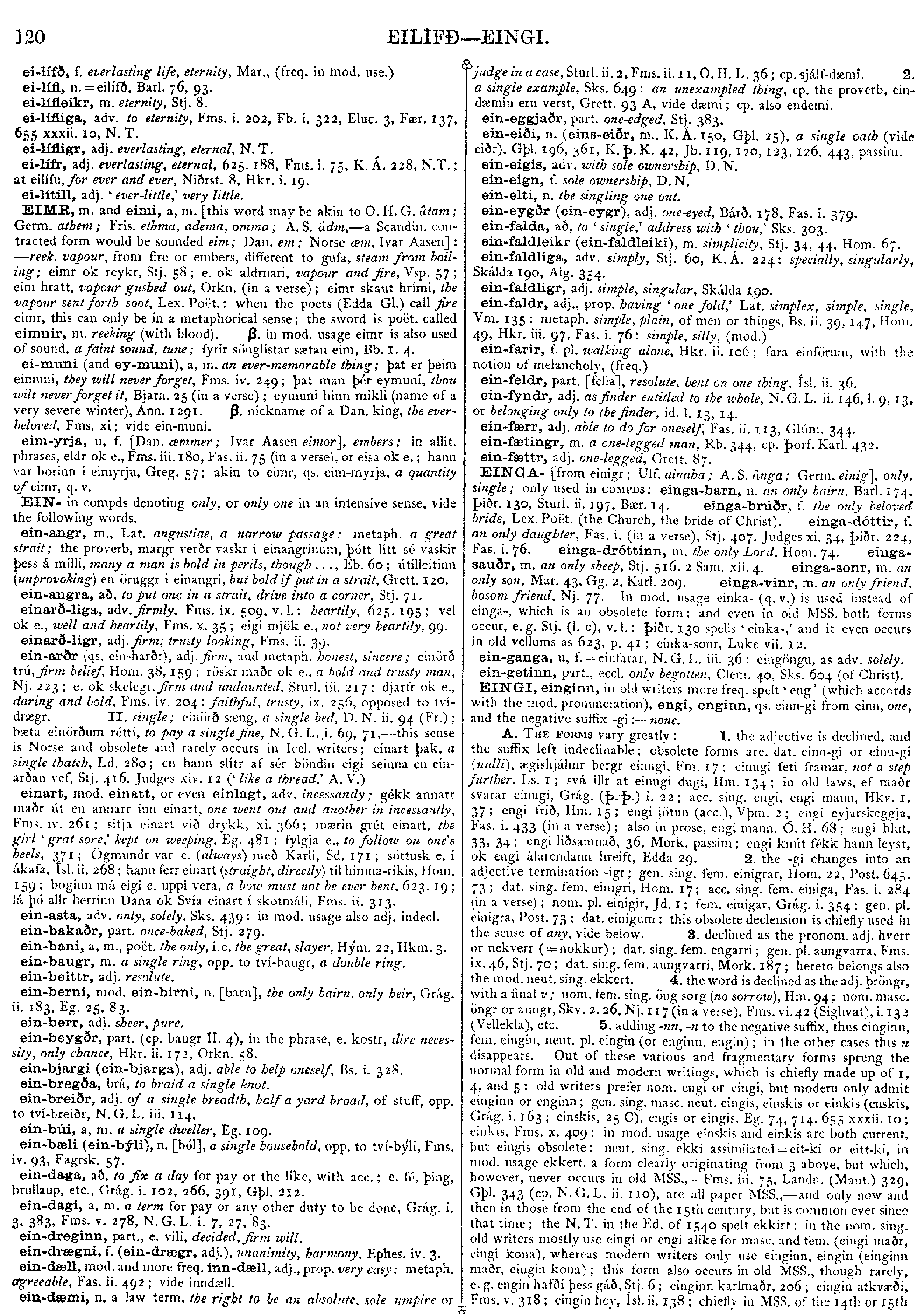
ein-dæmi, n. a law term, the right to be an absolute, sole umpire or judge in a case, Sturl. ii. 2, Fms. ii. 11, O. H. L. 36; cp. sjálf-dæmi. 2. a single example, Sks. 649: an unexampled thing, cp. the proverb, eindæmin eru verst, Grett. 93 A, vide dæmi; cp. also endemi.
|
Source: Cleasby/Vigfusson, page b0123, entry 14 View original page image as: [TIFF] [PNG] [View previous entry] [View next entry] |
[Comment on this entry] [View comments] |
The following entry has been hand-corrected once. |
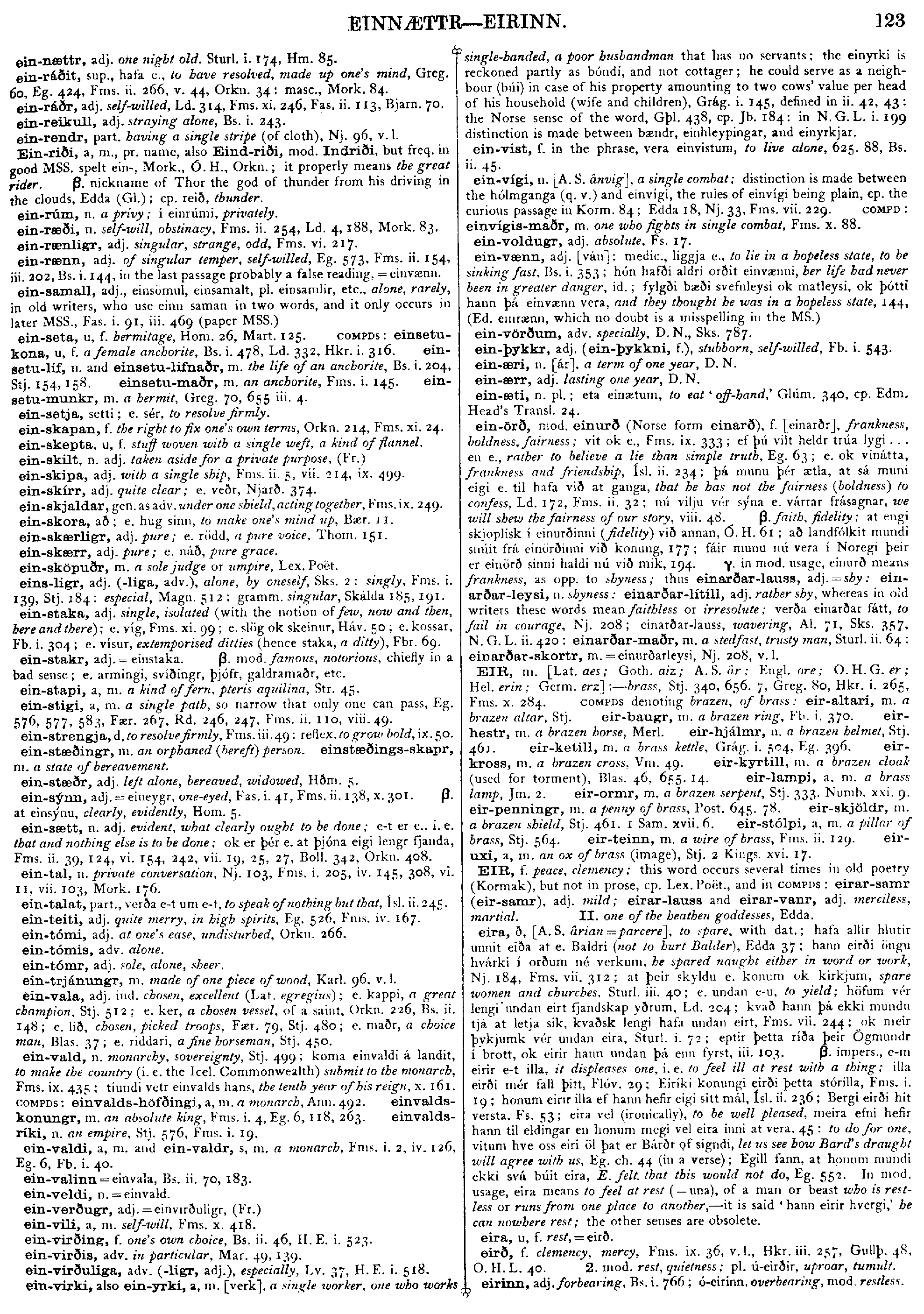
ein-skapan, f. the right to fix one's own terms, Orkn. 214, Fms. xi. 24.
|
Source: Cleasby/Vigfusson, page b0127, entry 9 View original page image as: [TIFF] [PNG] [View previous entry] [View next entry] |
[Comment on this entry] [View comments] |
The following entry has been hand-corrected once. |
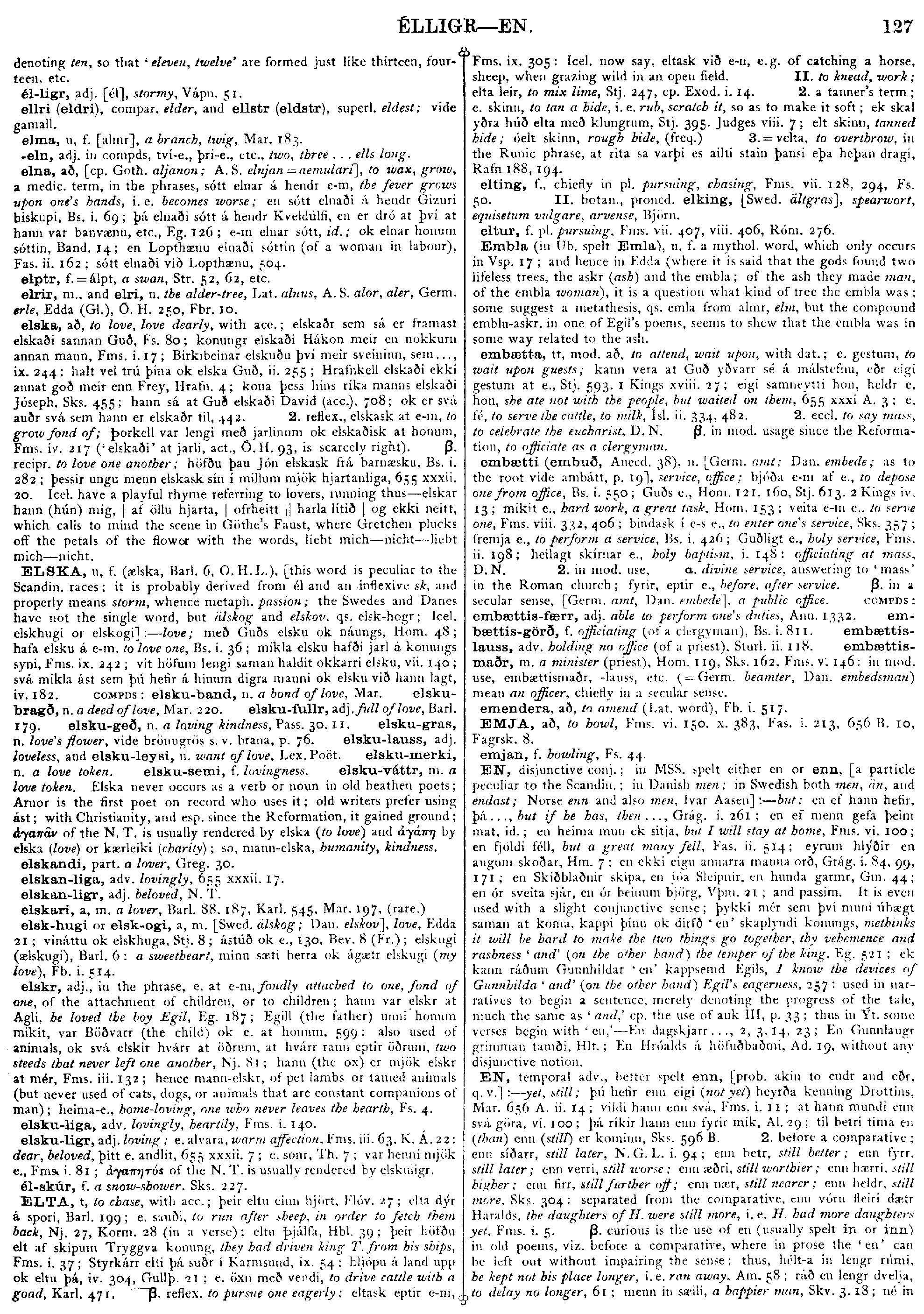
elska,
að,
to
love,
love
dearly,
with
acc.;
elskaðr
sem
sá
er
framast
elskaði
sannan
Guð,
Fs.
80;
konungr
elskaði
Hákon
meir
en
nokkurn
annan
mann,
Fms.
i.
17;
Birkibeinar
elskuðu
því
meir
sveininn,
sem...,
ix.
244;
halt
vel
trú
þína
ok
elska
Gnð,
ii.
255;
Hrafnkell
elskaði
ekki
annat
goð
meir
enn
Frey,
Hrafn.
4;
kona
þess
hins
rika
maims
elskaði
Joseph,
Sks.
455:
hann
sá
at
Guð
elskaði
David
(acc.),
708;
ok
er
sva
auðr
svá
sem
hann
er
elskaðr
til,
442.2.
reflex.,
elskask
at
e-m,
to
grow
fond
of;
þorkell
var
lengi
með
jarlinum
ok
elskaðisk
at
honum,
Fms.
iv.
217
('elskaði'
at
jarli,
act.,
Ó.
H.
93,
is
scarcely
right).
.
recipr.
to
love
one
another;
höfðu
þau
Jón
elskask
frá
barnæsku,
Bs.
i.
282;
þessir
ungu
menu
elskask
sin
í
millum
mjök
hjartanliga,
655
xxxii.
20.
Icel.
have
a
playful
rhyme
referring
to
lovers,
running
thus
--
elskar
hann
(hún)
mig,
|af
öllu
hjarta,|ofrheitt
UNCERTAIN
harla
lítið
|og
ekki
neitt,
which
calls
to
mind
the
scene
in
Göthe's
Faust,
where
Gretchen
plucks
off
the
petals
of
the
flower
with
the
words,
liebt
mich
--
nicht
--
licbt
mich
--
nicht.
| Result Page: |  |
Previous | 25 26 27 28 29 30 31 32 33 34 35 36 37 38 39 40 41 42 43 | Next |  |
Germanic Lexicon Project (main page)
This search system was written by
Sean Crist
Please consider
volunteering
to correct the data in these online dictionaries.
No rights reserved. Feel free to use these data in any way you please.