|
|

Tip: In the search results, you can click on any word or abbreviation for more information.
|
Source: Cleasby/Vigfusson, page b0311, entry 12 View original page image as: [TIFF] [PNG] [View previous entry] [View next entry] |
[Comment on this entry] [View comments] |
The following entry has been hand-corrected once. |
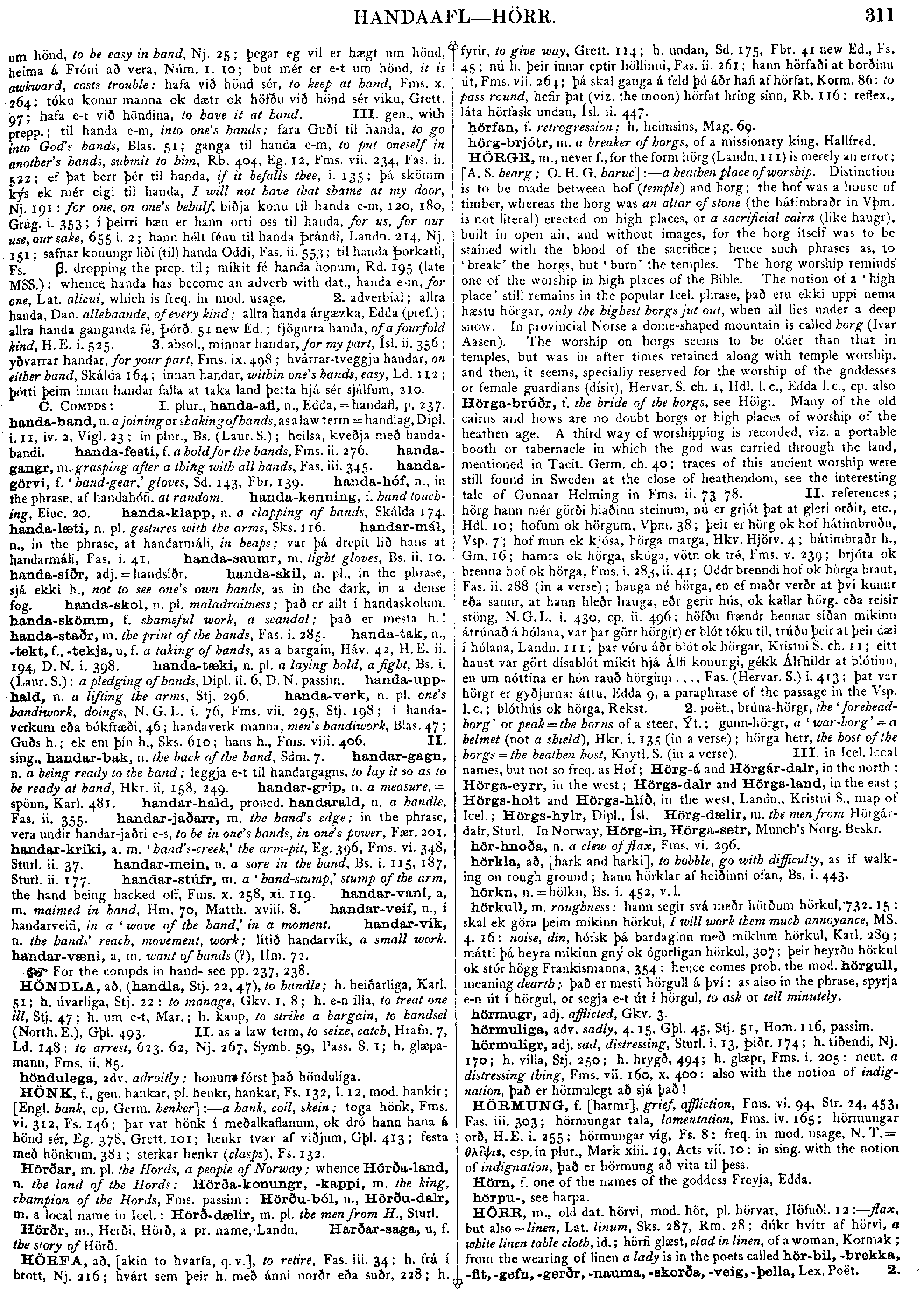
HÖRGR, m., never f., for the form hörg (Landn. 111) is merely an error; [A. S. hearg; O. H. G. haruc] :-- a heathen place of worship. Distinction is to be made between hof (temple) and horg; the hof was a house of timber, whereas the horg was an altar of stone (the hátimbraðr in Vþm. is not literal) erected on high places, or a sacrificial cairn (like haugr), built in open air, and without images, for the horg itself was to be stained with the blood of the sacrifice; hence such phrases as, to 'break' the horgs, but 'burn' the temples. The horg worship reminds one of the worship in high places of the Bible. The notion of a 'high place' still remains in the popular Icel. phrase, það eru ekki uppi nema hæstu hörgar, only the highest horgs jut out, when all lies under a deep snow. In provincial Norse a dome-shaped mountain is called horg (Ivar Aasen). The worship on horgs seems to be older than that in temples, but was in after times retained along with temple worship, and then, it seems, specially reserved for the worship of the goddesses or female guardians (dísir), Hervar. S. ch. 1, Hdl. l.c., Edda l.c., cp. also Hörga-brúðr, f. the bride of the horgs, see Hölgi. Many of the old cairns and hows are no doubt horgs or high places of worship of the heathen age. A third way of worshipping is recorded, viz. a portable booth or tabernacle in which the god was carried through the land, mentioned in Tacit. Germ. ch. 40; traces of this ancient worship were still found in Sweden at the close of heathendom, see the interesting tale of Gunnar Helming in Fms. ii. 73-78. II. references; hörg hann mér görði hlaðinn steinum, nú er grjót þat at gleri orðit, etc., Hdl. 10; hofum ok hörgum, Vþm. 38; þeir er hörg ok hof hátimbruðu, Vsp. 7; hof mun ek kjósa, hörga marga, Hkv. Hjörv. 4; hátimbraðr h., Gm. 16; hamra ok hörga, skóga, vötn ok tré, Fms. v. 239; brjóta ok brenna hof ok hörga, Fms. i. 283, ii. 41; Oddr brenndi hof ok hörga braut, Fas. ii. 288 (in a verse); hauga né hörga, en ef maðr verðr at því kunnr eða sannr, at hann hleðr hauga, eðr gerir hús, ok kallar hörg, eða reisir stöng, N. G. L. i. 430, cp. ii. 496; höfðu frændr hennar síðan mikinn átrúnað á hólana, var þar görr UNCERTAIN hörg(r) er blót tóku til, trúðu þeir at þeir dæi í hólana, Landn. 111; þar vóru áðr blót ok hörgar, Kristni S. ch. 11; eitt haust var gört dísablót mikit hjá Álfi konungi, gékk Álfhildr at blótinu, en um nóttina er hón rauð hörginn ..., Fas. (Hervar. S.) i. 413; þat var hörgr er gyðjurnar áttu, Edda 9, a paraphrase of the passage in the Vsp. l.c.; blóthús ok hörga, Rekst. 2. poët., brúna-hörgr, the 'forehead-horg' or peak = the horns of a steer, Ýt.; gunn-hörgr, a 'war-horg' = a helmet (not a shield), Hkr. i. 135 (in a verse); hörga herr, the host of the horgs = the heathen host, Knytl. S. (in a verse). III. in Icel. local names, but not so freq. as Hof; Hörg-á and Hörgár-dalr, in the north; Hörga-eyrr, in the west; Hörgs-dalr and Hörgs-land, in the east; Hörgs-holt and Hörgs-hlíð, in the west, Landn., Kristni S., map of Icel.; Hörgs-hylr, Dipl., Ísl. Hörg-dælir, m. the men from Hörgárdalr, Sturl. In Norway, Hörg-in, Hörga-setr, Munch's Norg. Beskr.
|
Source: Cleasby/Vigfusson, page b0364, entry 20 View original page image as: [TIFF] [PNG] [View previous entry] [View next entry] |
[Comment on this entry] [View comments] |
The following entry has been hand-corrected once. |
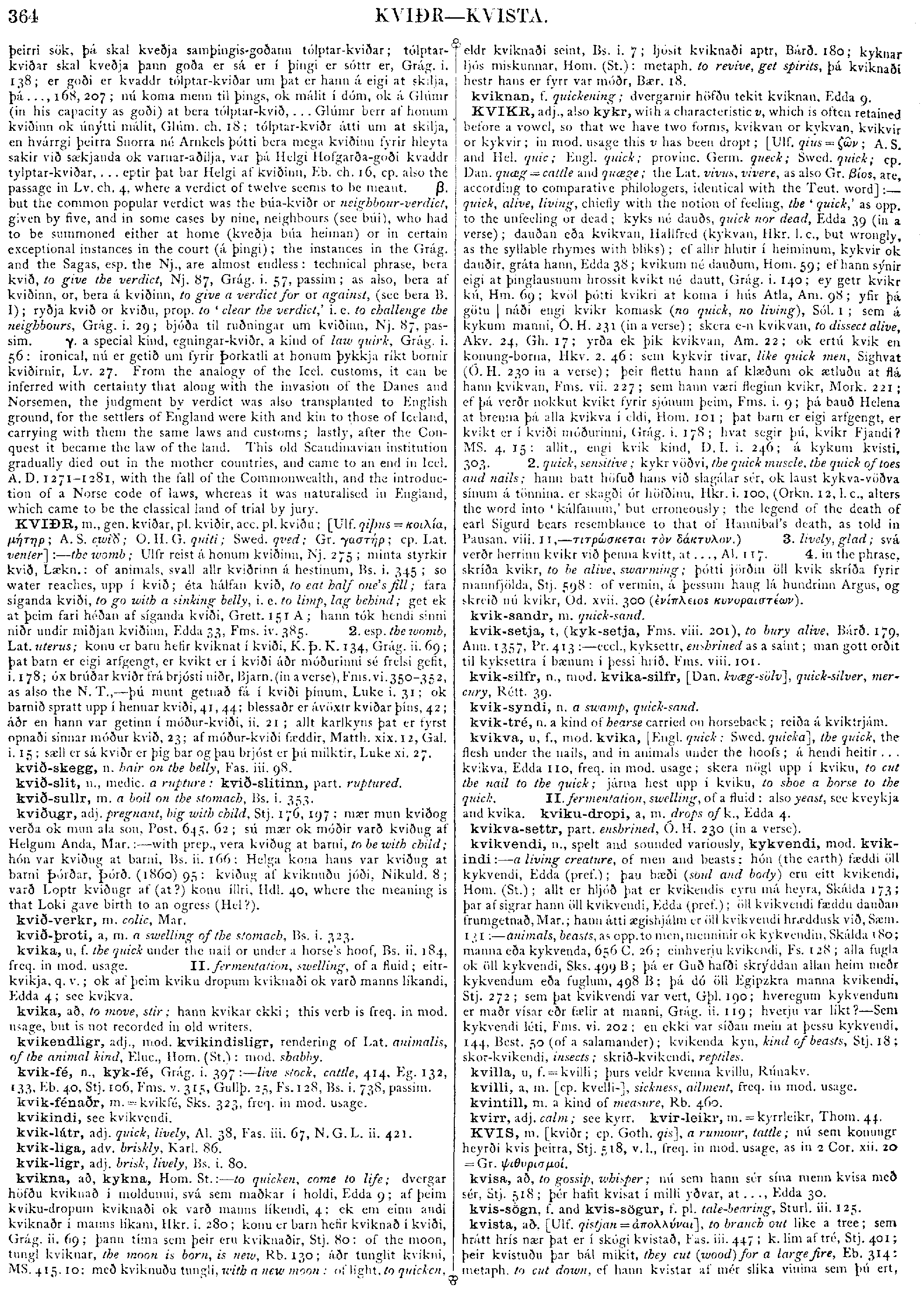
KVIKR, adj., also kykr, with a characteristic v, which is often retained before a vowel, so that we have two forms, kvikvan or kykvan, kvikvir or kykvir; in mod. usage this v has been dropt; [Ulf. qius = GREEK; A. S. and Hel. quic; Engl. quick; provinc. Germ. queck; Swed. quick; cp. Dan. quæg = cattle and quæge; the Lat. virus, vivere, as also Gr. GREEK, are according to comparative philologers, identical with the Teut. word] :-- quick, alive, living, chiefly with the notion of feeling, the 'quick,' as opp. to the unfeeling or dead; kyks né dauðs, quick nor dead, Edda 39 (in a verse); dauðan eða kvikvan, Hallfred (kykvan, Hkr. l.c., but wrongly, as the syllable rhymes with bliks); ef allir hlutir í heiminum, kykvir ok dauðir, gráta hann, Edda 38; kvikum né dauðum, Hom. 59; ef hann sýnir eigi at þinglausnum hrossit kvikt né dautt, Grág. i. 140; ey getr kvikr kú, Hm. 69; kvöl þótti kvikri at koma í hús Atla, Am. 98; yfir þá götu | náði engi kvikr komask (no quick, no living), Sól. 1; sem á kykum manni, Ó. H. 231 (in a verse); skera e-n kvikvan, to dissect alive, Akv. 24, Gh. 17; yrða ek þik kvikvan, Am. 22; ok ertú kvik en konung-borna, Hkv. 2. 46: sem kykvir tívar, like quick men, Sighvat (Ó. H. 230 in a verse); þeir flettu hann af klæðum ok ætluðu at flá hann kvikvan, Fms. vii. 227; sem hann væri fleginn kvikr, Mork. 221; ef þá verðr nokkut kvikt fyrir sjónum þeim, Fms. i. 9; þá bauð Helena at brenna þá alla kvikva í eldi, Hom. 101; þat barn er eigi arfgengt, er kvikt er í kviði móðurinni, Grág. i. 178; hvat segir þú, kvikr Fjandi? MS. 4. 15: allit., engi kvik kind, D. I. i. 246; á kykum kvisti, 303. 2. quick, sensitive; kykr vöðvi, the quick muscle, the quick of toes and nails; hann batt höfuð hans við slagálar sér, ok laust kykva-vöðva sínum á tönnina, er skagði ór höfðinn, Hkr. i. 100, (Orkn. 12, l.c., alters the word into 'kálfanum,' but erroneously; the legend of the death of earl Sigurd bears resemblance to that of Hannibal's death, as told in Pausan. viii. 11, -- GREEK.) 3. lively, glad; svá verðr herrinn kvikr við þenna kvitt, at ..., Al. 117. 4. in the phrase, skríða kvikr, to be alive, swarming; þótti jörðin öll kvik skríða fyrir mannfjölda, Stj. 598: of vermin, á þessum haug lá hundrinn Argus, og skreið nú kvikr, Od. xvii. 300 (GREEK).
|
Source: Cleasby/Vigfusson, page b0439, entry 2 View original page image as: [TIFF] [PNG] [View previous entry] [View next entry] |
[Comment on this entry] [View comments] |
The following entry has been hand-corrected once. |
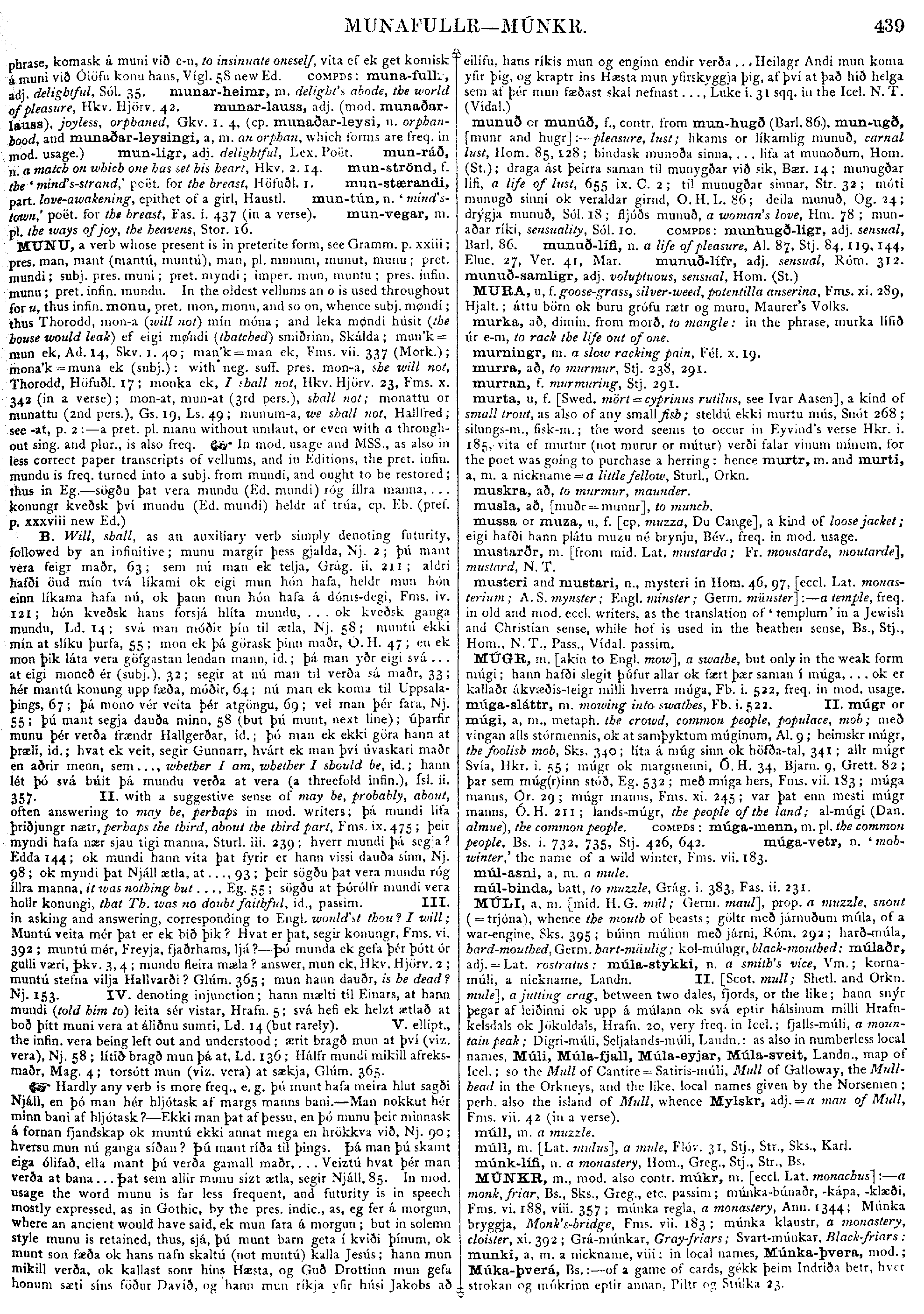
MUNU, a verb whose present is in preterite form, see Gramm. p. xxiii; pres. man, mant (mantú, muntú), man, pl. munum, munut, munu; pret. mundi; subj. pres. muni; pret. myndi; imper. mun, muntu; pres. infin. munu; pret. infin. mundu. In the oldest vellums an o is used throughout for u, thus infin. monu, pret. mon, monu, and so on, whence subj. møndi; thus Thorodd, mon-a (will not) mín móna; and leka møndi húsit (the house would leak) ef eigi møndi (thatched) smiðrinn, Skálda; mun'k = mun ek, Ad. 14, Skv. 1. 40; man'k = man ek, Fms. vii. 337 (Mork.); mona'k = muna ek (subj.): with neg. suff. pres. mon-a, she will not, Thorodd, Höfuðl. 17; monka ek, I shall not, Hkv. Hjörv. 23, Fms. x. 342 (in a verse); mon-at, mun-at (3rd pers.), shall not; monattu or munattu (2nd pers.), Gs. 19, Ls. 49; munum-a, we shall not, Hallfred; see -at, p. 2 :-- a pret. pl. manu without umlaut, or even with a throughout sing. and plur., is also freq. &FINGER; In mod. usage and MSS., as also in less correct paper transcripts of vellums, and in Editions, the pret. infin. mundu is freq. turned into a subj. from mundi, and ought to be restored; thus in Eg. -- sögðu þat vera mundu (Ed. mundi) róg íllra manna, ... konungr kveðsk því mundu (Ed. mundi) heldr af trúa, cp. Eb. (pref. p. xxxviii new Ed.) B. Will, shall, as an auxiliary verb simply denoting futurity, followed by an infinitive; munu margir þess gjalda, Nj. 2; þú mant vera feigr maðr, 63; sem nú man ek telja, Grág. ii. 211; aldri hafði önd mín tvá líkami ok eigi mun hón hafa, heldr mun hón einn líkama hafa nú, ok þann mun hón hafa á dóms-degi, Fms. iv. 121; hón kveðsk hans forsjá hlíta mundu, ... ok kveðsk ganga mundu, Ld. 14; svá man móðir þín til ætla, Nj. 58; muntú ekki mín at slíku þurfa, 55; mon ek þá görask þinn maðr, Ó.H. 47; en ek mon þik láta vera göfgastan lendan mann, id.; þá man yðr eigi svá ... at eigi moneð ér (subj.), 32; segir at nú man til verða sá maðr, 33; hér mantú konung upp fæða, móðir, 64; nú man ek koma til Uppsala-þings, 67; þá mono vér veita þér atgöngu, 69; vel man þér fara, Nj. 55; þú mant segja dauða minn, 58 (but þú munt, next line); úþarfir munu þér verða frændr Hallgerðar, id.; þó man ek ekki göra hann at þræli, id.; hvat ek veit, segir Gunnarr, hvárt ek man því úvaskari maðr en aðrir menn, sem ..., whether I am, whether I should be, id.; hann lét þó svá búit þá mundu verða at vera (a threefold infin.), Ísl. ii. 357. II. with a suggestive sense of may be, probably, about, often answering to may be, perhaps in mod. writers; þá mundi lífa þriðjungr nætr, perhaps the third, about the third part, Fms. ix. 475; þeir myndi hafa nær sjau tigi manna, Sturl. iii. 239; hverr mundi þá segja? Edda 144; ok mundi hann vita þat fyrir er hann vissi dauða sinn, Nj. 98; ok myndi þat Njáll ætla, at ..., 93; þeir sögðu þat vera mundu róg íllra manna, it was nothing but ..., Eg. 55; sögðu at Þórólfr mundi vera hollr konungi, that Th. was no doubt faithful, id., passim. III. in asking and answering, corresponding to Engl. would'st thou? I will; Muntú veita mér þat er ek bið þik? Hvat er þat, segir konungr, Fms. vi. 392; muntú mér, Freyja, fjaðrhams, ljá? -- Þó munda ek gefa þér þótt ór gulli væri, Þkv. 3, 4; mundu fleira mæla? answer, mun ek, Hkv. Hjörv. 2; muntú stefna vilja Hallvarði? Glúm. 365; mun hann dauðr, is he dead? Nj. 135. IV. denoting injunction; hann mælti til Einars, at hann mundi (told him to) leita sér vistar, Hrafn. 5; svá hefi ek helzt ætlað at boð þitt muni vera at áliðnu sumri, Ld. 14 (but rarely). V. ellipt., the infin. vera being left out and understood; ærit bragð mun at því (viz. vera), Nj. 58; lítið bragð mun þá at, Ld. 136; Hálfr mundi mikill afreksmaðr, Mag. 4; torsótt mun (viz. vera) at sækja, Glúm. 365. &FINGER; Hardly any verb is more freq., e.g. þú munt hafa meira hlut sagði Njáll, en þó man hér hljótask af margs manns bani. -- Man nokkut hér minn bani af hljótask? -- Ekki man þat af þessu, en þó munu þeir minnask á fornan fjandskap ok muntú ekki annat mega en hrökkva við, Nj. 90; hversu mun nú ganga síðan? Þú mant ríða til þings. Þá man þú skamt eiga ólifað, ella mant þú verða gamall maðr, ... Veiztú hvat þér man verða at bana ... Þat sem allir munu sízt ætla, segir Njáll, 85. In mod. usage the word munu is far less frequent, and futurity is in speech mostly expressed, as in Gothic, by the pres. indic., as, eg fer á morgun, where an ancient would have said, ek mun fara á morgun; but in solemn style munu is retained, thus, sjá, þú munt barn geta í kviði þínum, ok munt son fæða ok hans nafn skaltú (not muntú) kalla Jesús; hann mun mikill verða, ok kallast sonr hins Hæsta, og Guð Drottinn mun gefa honum sæti síns föður Davíð, og hann mun ríkja yfir húsi Jakobs að eilifu, hans ríkis mun og enginn endir verða ... Heilagr Audi mun koma yfir þig, og kraptr ins Hæsta mun yfirskyggja þig, af því at það hið helga sem af þér mun fæðast skal nefnast ..., Luke i. 31 sqq. in the Icel. N.T. (Vídal.)
|
Source: Cleasby/Vigfusson, page b0446, entry 35 View original page image as: [TIFF] [PNG] [View previous entry] [View next entry] |
[Comment on this entry] [View comments] |
The following entry has been hand-corrected once. |
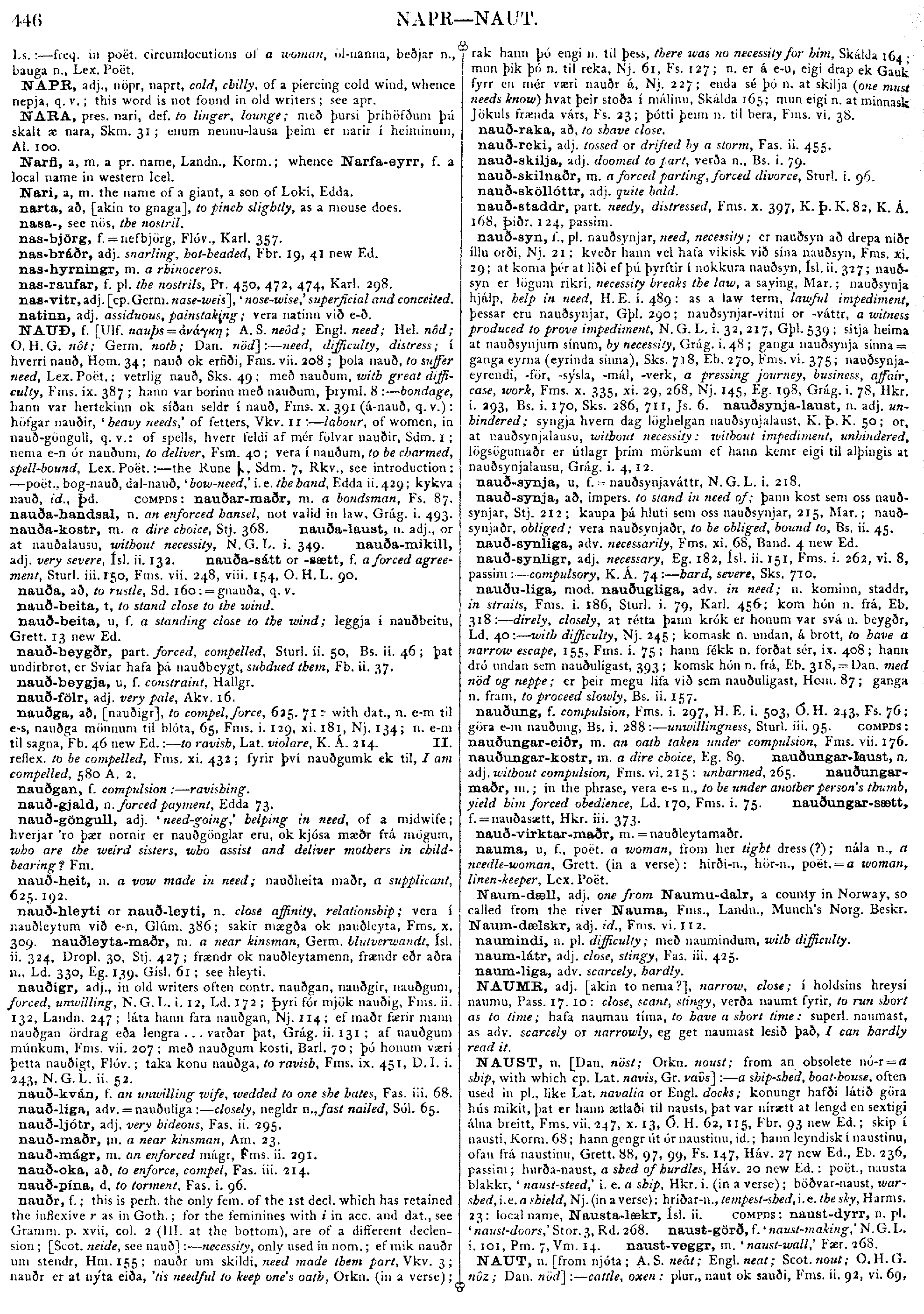
nauðr, f.; this is perh. the only fem. of the 1st decl. which has retained the inflexive r as in Goth.; for the feminines with i in acc. and dat., see Gramm. p. xvii, col. 2 (III. at the bottom), are of a different declension; [Scot. neide, see nauð] :-- necessity, only used in nom.; ef mik nauðr um stendr, Hm. 155; nauðr um skildi, need made them part, Vkv. 3; nauðr er at nýta eiða, 'tis needful to keep one's oath, Orkn. (in a verse); rak hann þó engi n. til þess, there was no necessity for him, Skálda 164; mun þik þó n. til reka, Nj. 61, Fs. 127; n. er á e-u, eigi drap ek Gauk fyrr en mér væri nauðr á, Nj. 227; enda sé þó n. at skilja (one must needs know) hvat þeir stoða í málinu, Skálda 165; mun eigi n. at minnask Jökuls fræada várs, Fs. 23; þótti þeim n. til bera, Fms. vi. 38.
|
Source: Cleasby/Vigfusson, page b0465, entry 50 View original page image as: [TIFF] [PNG] [View previous entry] [View next entry] |
[Comment on this entry] [View comments] |
The following entry has been hand-corrected once. |
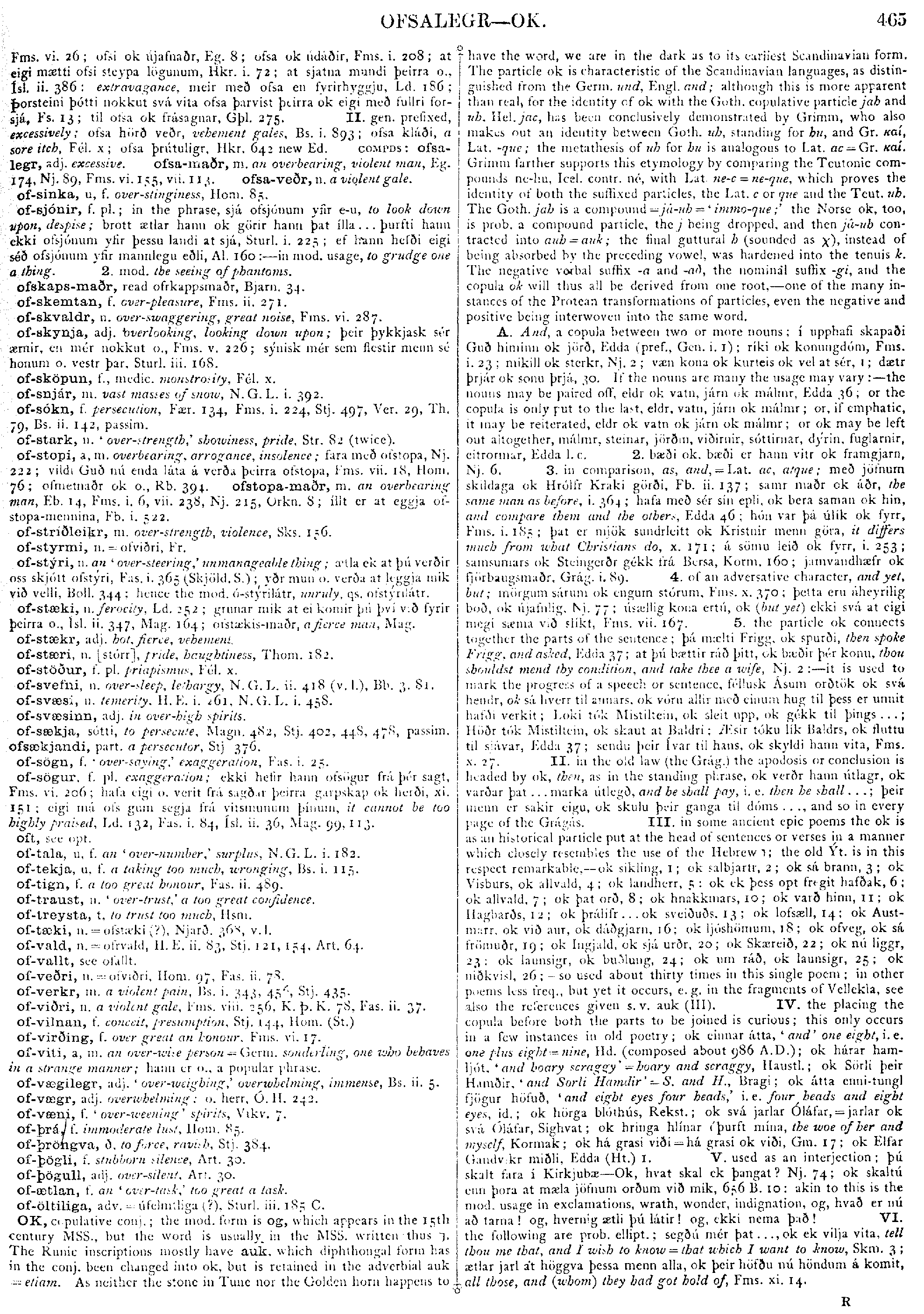
OK, copulative conj.; the mod. form is og, which appears in the 15th century MSS., but the word is usually in the MSS. written thus RUNE. The Runic inscriptions mostly have auk, which diphthongal form has in the conj. been changed into ok, but is retained in the adverbial auk = etiam. As neither the stone in Tune nor the Golden horn happens to have the word, we are in the dark as to its earliest Scandinavian form. The particle ok is characteristic of the Scandinavian languages, as distinguished from the Germ. und, Engl. and; although this is more apparent than real, for the identity of ok with the Goth. copulative particle jah and uh. Hel. jac, has been conclusively demonstrated by Grimm, who also makes out an identity between Goth. uh, standing for hu, and Gr. GREEK, Lat. -que; the metathesis of uh for hu is analogous to Lat. ac = Gr. GREEK. Grimm farther supports this etymology by comparing the Teutonic compounds ne-hu, Icel. contr. né, with Lat. ne-c = ne-que, which proves the identity of both the suffixed particles, the Lat. c or que and the Teut. uh. The Goth. jah is a compound = jâ-uh = 'immo-que;' the Norse ok, too, is prob. a compound particle, the j being dropped, and then jâ-uh contracted into auh = auk; the final guttural h (sounded as RUNE), instead of being absorbed by the preceding vowel, was hardened into the tenuis k. The negative verbal suffix -a and -að, the nominal suffix -gi, and the copula ok will thus all be derived from one root, -- one of the many instances of the Protean transformations of particles, even the negative and positive being interwoven into the same word. A. And, a copula between two or more nouns; í upphafi skapaði Guð himinn ok jörð, Edda (pref., Gen. i. 1); ríki ok konungdóm, Fms. i. 23; mikill ok sterkr, Nj. 2; væn kona ok kurteis ok vel at sér, 1; dætr þrjár ok sonu þrá, 30. If the nouns are many the usage may vary :-- the nouns may be paired off, eldr ok vatn, járn ok málmr, Edda 36; or the copula is only put to the last, eldr, vatn, járn ok málmr; or, if emphatic, it may be reiterated, eldr ok vatn ok járn ok málmr; or ok may be left out altogether, málmr. steinar, jörðin, viðirnir, sóttirnar, dýrin, fuglarnir, eitrormar, Edda l.c. 2. bæði ok, bæði er hann vitr ok framgjarn, Nj. 6. 3. in comparison, as, and, = Lat. ac, atque; með jöfnum skildaga ok Hrólfr Kraki görði, Fb. ii. 137; samr maðr ek áðr, the same man as before, i. 364; hafa með sér sín epli, ok bera saman ok hin, and compare them and the others, Edda 46; hón var þá úlík ok fyrr, Fms. i. 185; þat er mjök sundrleitt ok Kristnir menn göra, it differs much from what Christians do, x. 171; á sömu leið ok fyrr, i. 253; samsumars ok Steingerðr gékk frá Bersa, Korm. 160; jamvandhæfr ok flörbaugsmaðr, Grág. i. 89. 4. of an adversative character, and yet, but; mörgum sárum ok engum stórum, Fms. x. 370; þetta eru áheyrilig boð, ok újafnlig. Nj. 77; úsællig kona ertú, ok (but yet) ekki svá at eigi megi sæma við slíkt, Fms. vii. 167. 5. the particle ok connects together the parts of the sentence; þá mælti Frigg, ok spurði, then spoke Frigg, and asked, Edda 37; at þú bættir ráð þitt, ok bæðir þér konu, thou shouldst mend thy condition, and take thee a wife, Nj. 2 :-- it is used to mark the progress of a speech or sentence, féllusk Ásum orðtök ok svá hendr, ok sá hverr til annars, ok vóru allir með einum hug til þess er unnit hafði verkit; Loki tók. Mistiltein, ok sleit upp, ok gékk til þings ...; Höðr tók Mistiltein, ok skaut at Baldri; Æsir tóku lík Baldrs, ok fluttu til sjávar, Edda 37; sendu þeir Ívar til hans, ok skyldi hann vita, Fms. x. 27. II. in the old law (the Grág.) the apodosis or conclusion is headed by ok, then, as in the standing phrase, ok verðr hann útlagr, ok varðar þat ... marka útlegð, and he shall pay, i.e. then he shall ...; þeir menn er sakir eigu, ok skulu þeir ganga til dóms ..., and so in every page of the Grágás. III. in some ancient epic poems the ok is as an historical particle put at the head of sentences or verses in a manner which closely resembles the use of the Hebrew HEBREW; the old Ýt. is in this respect remarkable, -- ok sikling, I; ok salbjartr, 2; ok sá brann, 3; ok Visburs, ok allvald, 4; ok landherr, 5: ok ek þess opt fregit hafðak, 6; ok allvald, 7; ok þat orð, 8; ok hnakkmars, 10; ok varð hinn, 11; ok Hagbarðs, 12; ok þrálífr ... ok sveiðuðs. 13; ok lofsæll, 14; ok Austmarr, ok við aur, ok dáðgjarn, 16; ok ljóshömum, 18; ok ofveg, ok sá frömuðr, 19; ok Ingjald, ok sjá urðr, 20; ok Skæreið, 22; ok nú liggr, 23: ok launsigr, ok buðlung, 24; ok um ráð, ok launsigr, 25; ok niðkvisl, 26; - so used about thirty times in this single poem; in other poems less freq., but yet it occurs, e.g. in the fragments of Vellekla, see also the references given s.v. auk (III). IV. the placing the copula before both the parts to be joined is curious; this only occurs in a few instances in old poetry; ok einnar átta, 'and' one eight, i.e. one plus eight = nine, Hd. (composed about 986 A.D.); ok hárar hamljót, 'and hoary scraggy' = hoary and scraggy, Haustl.; ok Sörli þeir Hamðir, 'and Sorli Hamdir' = S. and H., Bragi; ok átta enni-tungl fjögur höfuð, 'and eight eyes four heads' i.e. four heads and eight eyes, id.; ok hörga blóthús, Rekst.; ok svá jarlar Óláfar, = jarlar ok svá Óláfar, Sighvat; ok hringa hlínar óþurft mína, the woe of her and myself, Kormak; ok há grasi viði = há grasi ok viði, Gm. 17; ok Elfar Gandvikr miðli, Edda (Ht.) 1. V. used as an interjection; þú skalt fara í Kirkjubæ -- Ok, hvat skal ek þangat? Nj. 74; ok skaltú enn þora at mæla jöfnum orðum við mik, 656 B. 10: akin to this is the mod. usage in exclamations, wrath, wonder, indignation, og, hvað er nú að tarna! og, hvernig ætli þú látir! og, ekki nema það! VI. the following are prob. ellipt.; segðú mér þat ..., ok ek vilja vita, tell thou me that, and I wish to know = that which I want to know, Skm. 3; ætlar jarl at höggva þessa menn alla, ok þeir hofðu nú höndum á komit, all those, and (whom) they had got hold of, Fms. xi. 14.
|
Source: Cleasby/Vigfusson, page b0469, entry 21 View original page image as: [TIFF] [PNG] [View previous entry] [View next entry] |
[Comment on this entry] [View comments] |
The following entry has been hand-corrected once. |
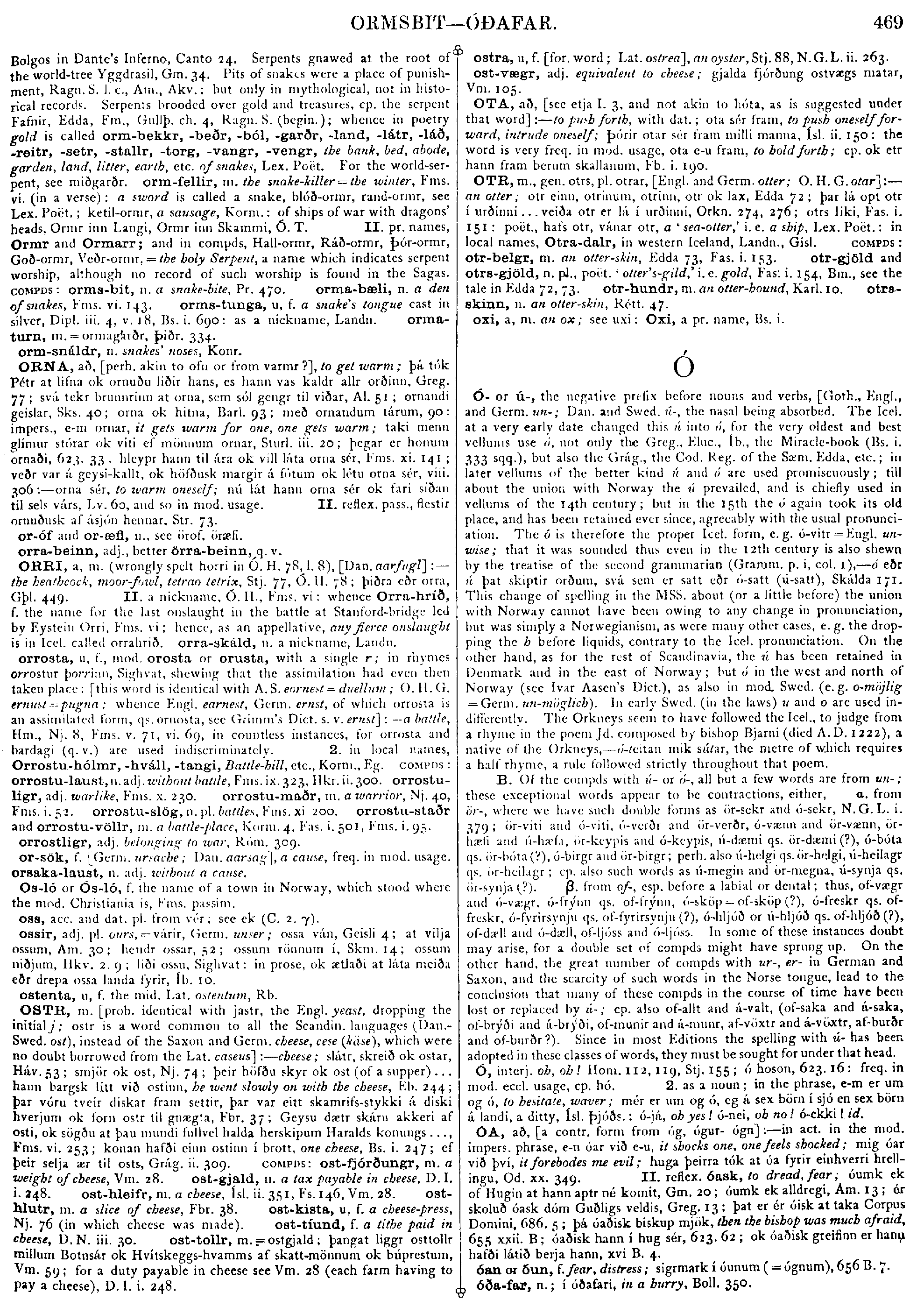
Ó-
or
ú-,
the
negative
prefix
before
nouns
and
verbs,
[Goth.,
Engl.,
and
Germ.
un-;
Dan.
and
Swed.
û-,
the
nasal
being
absorbed.
The
Icel.
at
a
very
early
date
changed
this
ú
into
ó,
for
the
very
oldest
and
best
vellums
use
ó,
not
only
the
Greg.,
Eluc.,
Íb.,
the
Miracle-book
(Bs.
i.
333
sqq.),
but
also
the
Grág.,
the
Cod.
Reg.
of
the
Sæm.
Edda,
etc.;
in
later
vellums
of
the
better
kind
ú
and
ó
are
used
promiscuously;
till
about
the
union
with
Norway
the
ú
prevailed,
and
is
chiefly
used
in
vellums
of
the
14th
century;
but
in
the
15th
the
ó
again
took
its
old
place,
and
has
been
retained
ever
since,
agreeably
with
the
usual
pronunciation.
The
ó
is
therefore
the
proper
Icel.
form,
e.g.
ó-vitr
=
Engl.
un-wise;
that
it
was
sounded
thus
even
in
the
12th
century
is
also
shewn
by
the
treatise
of
the
second
grammarian
(Gramm.
p.
i,
col.
1),
--
ó
eðr
ú
þat
skiptir
orðum,
svá
sem
er
satt
eðr
ó-satt
(ú-satt),
Skálda
171.
This
change
of
spelling
in
the
MSS.
about
(or
a
little
before)
the
union
with
Norway
cannot
have
been
owing
to
any
change
in
pronunciation,
but
was
simply
a
Norwegianism,
as
were
many
other
cases,
e.g.
the
dropping
the
h
before
liquids,
contrary
to
the
Icel.
pronunciation.
On
the
other
hand,
as
for
the
rest
of
Scandinavia,
the
ú
has
been
retained
in
Denmark
and
in
the
east
of
Norway;
but
ó
in
the
west
and
north
of
Norway
(see
Ivar
Aasen's
Dict.),
as
also
in
mod,
Swed.
(e.g.
o-möjlig
=
Germ.
un-möglich).
In
early
Swed.
(in
the
laws)
u
and
o
are
used
indifferently.
The
Orkneys
seem
to
have
followed
the
Icel.,
to
judge
from
a
rhyme
in
the
poem
Jd.
composed
by
bishop
Bjarni
(died
A.D.
1222),
a
native
of
the
Orkneys,
--
ó-teitan
mik
sútar,
the
metre
of
which
requires
a
half
rhyme,
a
rule
followed
strictly
throughout
that
poem.
B.
Of
the
compds
with
ú-
or
ó-,
all
but
a
few
words
are
from
un-;
these
exceptional
words
appear
to
be
contractions,
either,
 .
from
ör-,
where
we
have
such
double
forms
as
ör-sekr
and
ó-sekr,
N.G.L.
i.
379;
ör-viti
and
ó-viti,
ó-verðr
and
ör-verðr,
ó-vænn
and
ör-vænn,
ör-hæfi
and
ú-hæfa,
ör-keypis
and
ó-keypis,
ú-dæmi
qs.
ör-dæmi(?),
ó-bóta
qs.
ör-bóta(?),
ó-birgr
and
ör-birgr;
perh.
also
ú-helgi
qs.
ör-helgi,
ú-heilagr
qs.
ör-heilagr;
cp.
also
such
words
as
ú-megin
and
ör-megna,
ú-synja
qs.
ör-synja(?).
.
from
ör-,
where
we
have
such
double
forms
as
ör-sekr
and
ó-sekr,
N.G.L.
i.
379;
ör-viti
and
ó-viti,
ó-verðr
and
ör-verðr,
ó-vænn
and
ör-vænn,
ör-hæfi
and
ú-hæfa,
ör-keypis
and
ó-keypis,
ú-dæmi
qs.
ör-dæmi(?),
ó-bóta
qs.
ör-bóta(?),
ó-birgr
and
ör-birgr;
perh.
also
ú-helgi
qs.
ör-helgi,
ú-heilagr
qs.
ör-heilagr;
cp.
also
such
words
as
ú-megin
and
ör-megna,
ú-synja
qs.
ör-synja(?).
 .
from
of-,
esp.
before
a
labial
or
dental;
thus,
of-vægr
and
ó-vægr,
ó-frýnn
qs.
of-frýnn,
ó-skö;p
=
of-sköp(?),
ó-freskr
qs.
of-freskr,
ó-fyrirsynju
qs.
of-fyrirsynju(?),
ó-hljóð
or
ú-hljóð
qs.
of-hljóð(?),
of-dæll
and
ó-dæll,
of-ljóss
and
ó-ljóss.
In
some
of
these
instances
doubt
may
arise,
for
a
double
set
of
compds
might
have
sprung
up.
On
the
other
hand,
the
great
number
of
compds
with
ur-,
er-
in
German
and
Saxon,
and
the
scarcity
of
such
words
in
the
Norse
tongue,
lead
to
the
conclusion
that
many
of
these
compds
in
the
course
of
time
have
been
lost
or
replaced
by
ú-;
cp.
also
of-allt
and
á-valt,
(of-saka
and
á-saka,
of-brýði
and
á-brýði,
of-munir
and
á-munr,
af-vöxtr
and
á-vöxtr,
af-burðr
and
of-burðr?).
Since
in
most
Editions
the
spelling
with
ú-
has
been
adopted
in
these
classes
of
words,
they
must
be
sought
for
under
that
head.
.
from
of-,
esp.
before
a
labial
or
dental;
thus,
of-vægr
and
ó-vægr,
ó-frýnn
qs.
of-frýnn,
ó-skö;p
=
of-sköp(?),
ó-freskr
qs.
of-freskr,
ó-fyrirsynju
qs.
of-fyrirsynju(?),
ó-hljóð
or
ú-hljóð
qs.
of-hljóð(?),
of-dæll
and
ó-dæll,
of-ljóss
and
ó-ljóss.
In
some
of
these
instances
doubt
may
arise,
for
a
double
set
of
compds
might
have
sprung
up.
On
the
other
hand,
the
great
number
of
compds
with
ur-,
er-
in
German
and
Saxon,
and
the
scarcity
of
such
words
in
the
Norse
tongue,
lead
to
the
conclusion
that
many
of
these
compds
in
the
course
of
time
have
been
lost
or
replaced
by
ú-;
cp.
also
of-allt
and
á-valt,
(of-saka
and
á-saka,
of-brýði
and
á-brýði,
of-munir
and
á-munr,
af-vöxtr
and
á-vöxtr,
af-burðr
and
of-burðr?).
Since
in
most
Editions
the
spelling
with
ú-
has
been
adopted
in
these
classes
of
words,
they
must
be
sought
for
under
that
head.
|
Source: Cleasby/Vigfusson, page b0470, entry 3 View original page image as: [TIFF] [PNG] [View previous entry] [View next entry] |
[Comment on this entry] [View comments] |
The following entry has been hand-corrected once. |
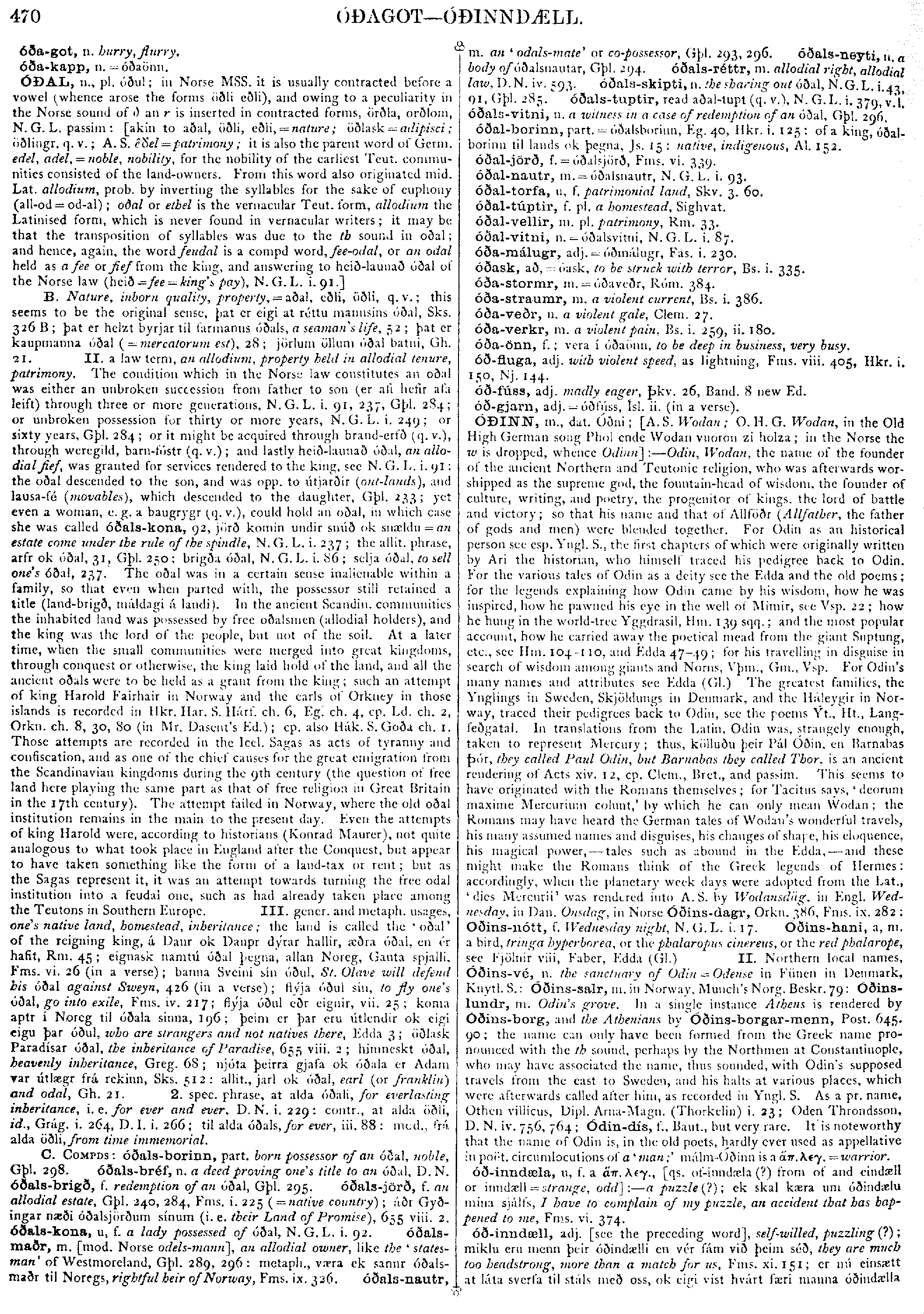
ÓÐAL, n., pl. óðul; in Norse MSS. it is usually contracted before a vowel (whence arose the forms öðli eðli), and owing to a peculiarity in the Norse sound of ð an r is inserted in contracted forms, örðla, orðlom, N.G.L. passim: [akin to aðal, öðli, eðli, = nature; öðlask = adipisci; oðlingr, q.v.; A.S. êðel = patrimony; it is also the parent word of Germ. edel, adel, = noble, nobility, for the nobility of the earliest Teut. communities consisted of the land-owners. From this word also originated mid. Lat. allodium, prob. by inverting the syllables for the sake of euphony (all-od = od-al); oðal or ethel is the vernacular Teut. form, allodium the Latinised form, which is never found in vernacular writers; it may be that the transposition of syllables was due to the th sound in oðal; and hence, again, the word feudal is a compd word, fee-odal, or an odal held as a fee or feif from the king, and answering to heið-launað óðal of the Norse law (heið = fee = king's pay), N.G.L. i. 91.] B. Nature, inborn quality, property, = aðal, eðli, öðli, q.v.; this seems to be the original sense, þat er eigi at réttu mannsins óðal, Sks. 326 B; þat er helzt byrjar til farmanns óðals, a seaman's life, 52; þat er kaupmanna óðal ( = mercatorum est), 28; jörlum öllum óðal batni, Gh. 21. II. a law term, an allodium, property held in allodial tenure, patrimony. The condition which in the Norse law constitutes an oðal was either an unbroken succession from father to son (er afi hefir afa leift) through three or more generations, N.G.L. i. 91, 237, Gþl. 284; or unbroken possession for thirty or more years, N.G.L. i. 249; or sixty years, Gþl. 284; or it might be acquired through brand-erfð (q.v.), through weregild, barn-fóstr (q.v.); and lastly heið-launað óðal, an allodial fief, was granted for services rendered to the king, see N.G.L. i. 91: the oðal descended to the son, and was opp. to útjarðir (out-lands), and lausa-fé (movables), which descended to the daughter, Gþl. 233; yet even a woman, e.g. a baugrygr (q.v.), could hold an oðal, in which case she was called óðals-kona, 92, jörð komin undir snúð ok snældu = an estate come under the rule of the spindle, N.G.L. i. 237; the allit. phrase, arfr ok óðal, 31, Gþl. 250: brigða óðal, N.G.L. i. 86; selja óðal, to sell one's óðal, 237. The oðal was in a certain sense inalienable within a family, so that even when parted with, the possessor still retained a title (land-brigð, máldagi á landi). In the ancient Scandin. communities the inhabited land was possessed by free oðalsmen (allodial holders), and the king was the lord of the people, but not of the soil. At a later time, when the small communities were merged into great kingdoms, through conquest or otherwise, the king laid hold of the land, and all the ancient oðals were to be held as a grant from the king; such an attempt of king Harold Fairhair in Norway and the earls of Orkney in those islands is recorded in Hkr. Har. S. Hárf. ch. 6, Eg. ch. 4, cp. Ld. ch. 2, Orkn. ch. 8, 30, 80 (in Mr. Dasent's Ed.); cp. also Hák. S. Goða ch. 1. Those attempts are recorded in the Icel. Sagas as acts of tyranny and confiscation, and as one of the chief causes for the great emigration from the Scandinavian kingdoms during the 9th century (the question of free land here playing the same part as that of free religion in Great Britain in the 17th century). The attempt failed in Norway, where the old oðal institution remains in the main to the present day. Even the attempts of king Harold were, according to historians (Konrad Maurer), not quite analogous to what took place in England after the Conquest, but appear to have taken something like the form of a land-tax or rent; but as the Sagas represent it, it was an attempt towards turning the free odal institution into a feudal one, such as had already taken place among the Teutons in Southern Europe. III. gener. and metaph. usages, one's native land, homestead, inheritance; the land is called the 'oðal' of the reigning king, á Danr ok Danpr dýrar hallir, æðra óðal, en ér hafit, Rm. 45; eignask namtú óðal þegna, allan Noreg, Gauta spjalli, Fms. vi. 26 (in a verse); banna Sveini sín óðul, St. Olave will defend his óðal against Sweyn, 426 (in a verse); flýja óðul sín, to fly one's óðal, go into exile, Fms. iv. 217; flýja óðul eðr eignir, vii. 25; koma aptr í Noreg til óðala sinna, 196; þeim er þar eru útlendir ok eigi eigu þar óðul, who are strangers and not natives there, Edda 3; öðlask Paradísar óðal, the inheritance of Paradise, 655 viii. 2; himneskt óðal, heavenly inheritance, Greg. 68; njóta þeirra gjafa ok óðala er Adam var útlægr frá rekinn, Sks. 512: allit., jarl ok óðal, earl (or franklin) and odal, Gh. 21. 2. spec. phrase, at alda óðali, for everlasting inheritance, i.e. for ever and ever, D.N. i. 229: contr., at alda öðli, id., Grág. i. 264, D.I. i. 266; til alda óðals, for ever, iii. 88: mod., frá, alda öðli, from time immemorial. C. COMPDS: óðals-borinn, part. born possessor of an óðal, noble, Gþl. 298. óðals-bréf, n. a deed proving one's title to an óðal, D.N. óðals-brigð, f. redemption of an óðal, Gþl. 295. óðals-jörð, f. an allodial estate, Gþl. 240, 284, Fms. i. 225 (= native country); áðr Gyðingar næði óðalsjörðum sínum (i.e. their Land of Promise), 655 viii. 2. óðals-kona, u, f. a lady possessed of óðal, N.G.L. i. 92. óðals-maðr, m. [mod. Norse odels-mann], an allodial owner, like the 'statesman' of Westmorland, Gþl. 289, 296: metaph., væra ek sannr óðalsmaðr til Noregs, rightful heir of Norway, Fms. ix. 326. óðals-nautr, m. an 'odals-mate' or co-possessor, Gþl. 293, 296. óðals-neyti, u. a body of óðalsnautar, Gþl. 294. óðals-réttr, m. allodial right, allodial law, D.N. iv. 593. óðals-skipti, n. the sharing out óðal, N.G.L. i. 43, 91, Gþl. 285. óðals-tuptir, read aðal-tupt (q.v.), N.G.L. i. 379, v.l. óðals-vitni, n. a witness in a case of redemption of an óðal, Gþl. 296.
|
Source: Cleasby/Vigfusson, page b0481, entry 2 View original page image as: [TIFF] [PNG] [View previous entry] [View next entry] |
[Comment on this entry] [View comments] |
The following entry has been hand-corrected once. |
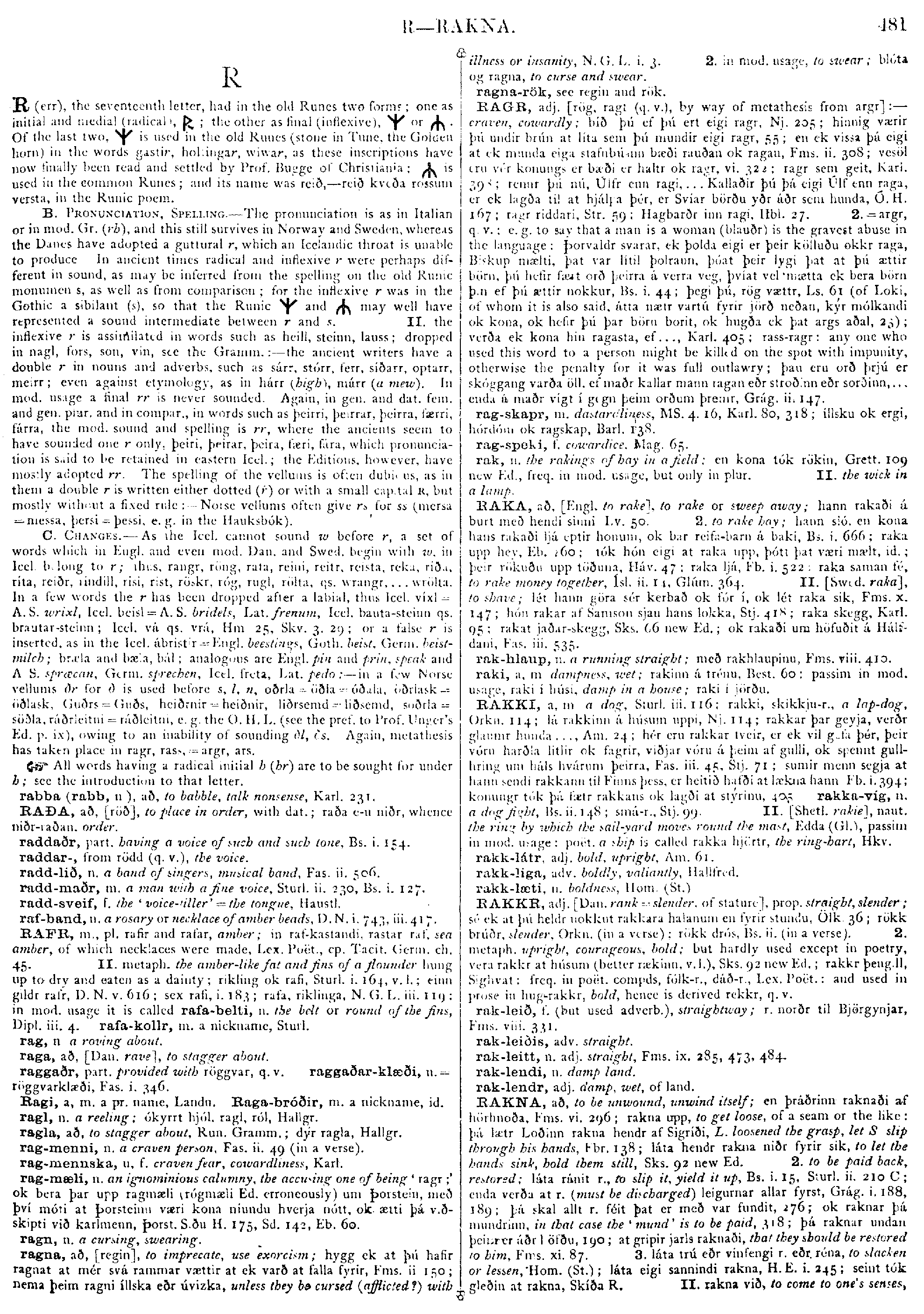
R, (err), the seventeenth letter, had in the old Runes two forms; one as initial and medial (radical), RUNE; the other as final (inflexive), RUNE or RUNE. Of the last two, RUNE is used in the old Runes (stone in Tune, the Golden horn) in the words gastir, hokingar, wiwar, as these inscriptions have now finally been read and settled by Prof. Bugge of Christiana; RUNE is used in the common Runes; and its name was reið, -- reið kveða rossum versta, in the Runic poem. B. PRONUNCIATION, SPELLING. -- The pronunciation is as in Italian or in mod. Gr. (rh), and this still survives in Norway and Sweden, whereas the Danes have adopted a guttural r, which an Icelandic throat is unable to produce In ancient times radical and inflexive r were perhaps different in sound, as may be inferred from the spelling on the old Runic monuments, as well as from comparison; for the inflexive r was in the Gothic a sibilant (s), so that the Runic RUNE and RUNE may well have represented a sound intermediate between r and s. II. the inflexive r is assimilated in words such as heill, steinn, lauss: dropped in nagl, fors, son, vin, see the Gramm. :-- the ancient writers have a double r in nouns and adverbs, such as sárr, stórr, ferr, síðarr, optarr, meirr; even against etymology, as in hárr (high), márr (a mew). In mod. usage a final rr is never sounded. Again, in gen. and dat. fem. and gen. plur. and in compar., in words such as þeirri, þeirrar, þeirra, færri, fárra, the mod. sound and spelling is rr, where the ancients seem to have sounded one r only, þeiri, þeirar, þeira, færi, fára, which pronunciation is said to be retained in eastern Icel.; the Editions, however, have mostly adopted rr. The spelling of the vellums is often dubious, as in them a double r is written either dotted (r) UNCERTAIN or with a small capital R, but mostly without a fixed rule :-- Norse vellums often give rs for ss (mersa = messa, þersi = þessi, e.g. in the Hauksbók). C. CHANGES. -- As the Icel. cannot sound w before r, a set of words which in Engl. and even mod. Dan. and Swed. begin with w, in Icel. belong to r; thus, rangr, röng, rata, reini, reitr, reista, reka, ríða, ríta, reiðr, rindill, risi, rist, röskr, róg, rugl, rölta, qs. wrangr, ... wrölta. In a few words the r has been dropped after a labial, thus Icel. víxl = A.S. wrixl, Icel. beisl = A.S. bridels, Lat. frenum, Icel. bauta-steinn qs. brautar-steinn; Icel. vá qs. vrá, Hm 25, Skv. 3. 29; or a false r is inserted, as in the Icel. ábristir = Engl. beestings, Goth. beist. Germ. beist-milch; bræla and bæla, bál; analogous are Engl. pin and prin, speak and A.S. spræcan, Germ. sprechen, Icel. freta, Lat. pedo :-- in a few Norse vellums ðr for ð is used before s, l, n, oðrla = öðla = óðala, öðrlask = öðlask, Guðrs = Guðs, heiðrnir = heiðnir, liðrsemd = liðsemd, soðrla = söðla, ráðrleitni = ráðleitni, e.g. the O.H.L. (see the pref. to Prof. Unger's Ed. p. ix), owing to an inability of sounding ðl, ðs. Again, metathesis has taken place in ragr, rass, = argr, ars. &FINGER; All words having a radical initial h (hr) are to be sought for under h; see the introduction to that letter.
| Result Page: |  |
Previous | 1 2 3 |
Germanic Lexicon Project (main page)
This search system was written by
Sean Crist
Please consider
volunteering
to correct the data in these online dictionaries.
No rights reserved. Feel free to use these data in any way you please.