|
|

|
Source: Bosworth/Toller, page d0336, entry 21 View original page image as: [TIFF] [PNG] [View previous entry] [View next entry] |
[Comment on this entry] [View comments] |
The following entry has been hand-corrected once. |
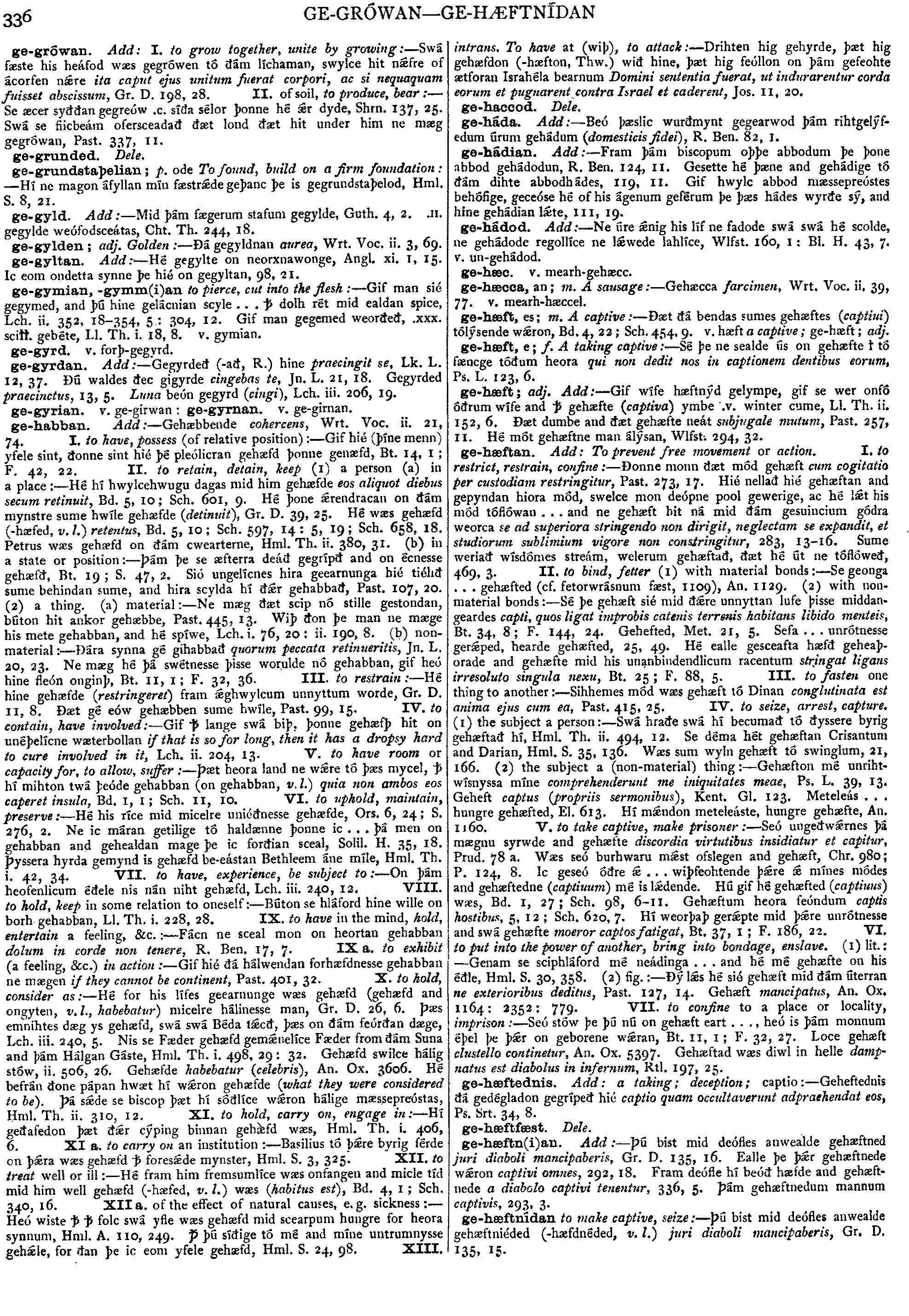
ge-hæftan.
Add:
To
prevent
free
movement
or
action.
I.
to
restrict,
restrain,
confine:--Ðonne
monn
ðæt
mód
gehæft
cum
cogitatio
per
custodiam
restringitur,
Past.
273,
17.
Hié
nellað
hié
gehæftan
and
gepyndan
hiora
mód,
swelce
mon
deópne
pool
gewerige,
ac
hé
l t
his
mód
tóflówan
.
.
.
and
ne
gehæft
hit
ná
mid
ðám
gesuincium
gódra
weorca
se
ad
superiora
stringendo
non
dirigit,
neglectam
se
expandit,
et
studiorum
sublimium
vigore
non
constringitur,
283,
13-16.
Sume
weriað
wísdómes
streám,
welerum
gehæftað,
ðæt
hé
út
ne
tóflóweð,
469,
3.
II.
to
bind,
fetter
(1)
with
material
bonds:--Se
geonga
.
.
.
gehæfted
(cf.
fetorwrásnum
fæst,
1109),
An.
1129.
(2)
with
non-material
bonds:--Sé
þe
gehæft
sié
mid
ðre
unnyttan
lufe
þisse
middangeardes
capti,
quos
ligat
improbis
catenis
terrenis
habitans
libido
menteis,
Bt.
34,
8;
F.
144,
24.
Gehefted,
Met.
21,
5.
Sefa
.
.
.
unrótnesse
gerped,
hearde
gehæfted,
25,
49.
Hé
ealle
gesceafta
hæfð
geheaþorade
and
gehæfte
mid
his
unanbindendlicum
racentum
stringat
ligans
irresoluto
singula
nexu,
Bt.
25;
F.
88,
5.
III.
to
fasten
one
thing
to
another:--Sihhemes
mód
wæs
gehæft
tó
Dinan
conglutinata
est
anima
ejus
cum
ea,
Past.
415,
25.
IV.
to
seize,
arrest,
capture.
(1)
the
subject
a
person:--Swá
hraðe
swá
hí
becumað
tó
ðyssere
byrig
gehæftað
hí,
Hml.
Th.
ii.
494,
12.
Se
déma
hét
gehæftan
Crisantum
and
Darian,
Hml.
S.
35,
136.
Wæs
sum
wyln
gehæft
tó
swinglum,
21,
166.
(2)
the
subject
a
(non-material)
thing:--Gehæfton
mé
unrihtwísnyssa
míne
comprehenderunt
me
iniquitates
meae,
Ps.
L.
39,
13.
Geheft
captus
(propriis
sermonibus),
Kent.
Gl.
123.
Meteleás
.
.
.
hungre
gehæfted,
El.
613.
Hí
mndon
meteleáste,
hungre
gehæfte,
An.
1160.
V.
to
take
captive,
make
prisoner:--Seó
ungeðwrnes
þá
mægnu
syrwde
and
gehæfte
discordia
virtutibus
insidiatur
et
capitur,
Prud.
78
a.
Wæs
seó
burhwaru
mst
ofslegen
and
gehæft,
Chr.
980;
P.
124,
8.
Ic
geseó
óðre
.
.
.
wiþfeohtende
þre
mínes
módes
and
gehæftedne
(captiuum)
mé
is
ldende.
Hú
gif
hé
gehæfted
(captiuus)
wæs,
Bd.
1,
27;
Sch.
98,
6-11.
Gehæftum
heora
feóndum
captis
hostibus,
5,
12;
Sch.
620,
7.
Hí
weorþaþ
gerpte
mid
þre
unrótnesse
and
swá
gehæfte
moeror
captos
fatigat,
Bt.
37,
1;
F.
186,
22.
VI.
to
put
into
the
power
of
another,
bring
into
bondage,
enslave.
(1)
lit.:--Genam
se
sciphláford
mé
neádinga
.
.
.
and
hé
mé
gehæfte
on
his
éðle,
Hml.
S.
30,
358.
(2)
fig.:--Ðý
ls
hé
sié
gehæft
mid
ðám
úterran
ne
exterioribus
deditus,
Past.
127,
14.
Gehæft
mancipatus,
An.
Ox.
1164:
2352:
779.
VII.
to
confine
to
a
place
or
locality,
imprison:--Seó
stów
þe
þú
nú
on
gehæft
eart
.
.
.,
heó
is
þám
monnum
éþel
þe
þr
on
geborene
wran,
Bt.
11,
1;
F.
32,
27.
Loce
gehæft
clustello
continetur,
An.
Ox.
5397.
Gehæftad
wæs
diwl
in
helle
dampnatus
est
diabolus
in
infernum,
Rtl.
197,
25.
t
his
mód
tóflówan
.
.
.
and
ne
gehæft
hit
ná
mid
ðám
gesuincium
gódra
weorca
se
ad
superiora
stringendo
non
dirigit,
neglectam
se
expandit,
et
studiorum
sublimium
vigore
non
constringitur,
283,
13-16.
Sume
weriað
wísdómes
streám,
welerum
gehæftað,
ðæt
hé
út
ne
tóflóweð,
469,
3.
II.
to
bind,
fetter
(1)
with
material
bonds:--Se
geonga
.
.
.
gehæfted
(cf.
fetorwrásnum
fæst,
1109),
An.
1129.
(2)
with
non-material
bonds:--Sé
þe
gehæft
sié
mid
ðre
unnyttan
lufe
þisse
middangeardes
capti,
quos
ligat
improbis
catenis
terrenis
habitans
libido
menteis,
Bt.
34,
8;
F.
144,
24.
Gehefted,
Met.
21,
5.
Sefa
.
.
.
unrótnesse
gerped,
hearde
gehæfted,
25,
49.
Hé
ealle
gesceafta
hæfð
geheaþorade
and
gehæfte
mid
his
unanbindendlicum
racentum
stringat
ligans
irresoluto
singula
nexu,
Bt.
25;
F.
88,
5.
III.
to
fasten
one
thing
to
another:--Sihhemes
mód
wæs
gehæft
tó
Dinan
conglutinata
est
anima
ejus
cum
ea,
Past.
415,
25.
IV.
to
seize,
arrest,
capture.
(1)
the
subject
a
person:--Swá
hraðe
swá
hí
becumað
tó
ðyssere
byrig
gehæftað
hí,
Hml.
Th.
ii.
494,
12.
Se
déma
hét
gehæftan
Crisantum
and
Darian,
Hml.
S.
35,
136.
Wæs
sum
wyln
gehæft
tó
swinglum,
21,
166.
(2)
the
subject
a
(non-material)
thing:--Gehæfton
mé
unrihtwísnyssa
míne
comprehenderunt
me
iniquitates
meae,
Ps.
L.
39,
13.
Geheft
captus
(propriis
sermonibus),
Kent.
Gl.
123.
Meteleás
.
.
.
hungre
gehæfted,
El.
613.
Hí
mndon
meteleáste,
hungre
gehæfte,
An.
1160.
V.
to
take
captive,
make
prisoner:--Seó
ungeðwrnes
þá
mægnu
syrwde
and
gehæfte
discordia
virtutibus
insidiatur
et
capitur,
Prud.
78
a.
Wæs
seó
burhwaru
mst
ofslegen
and
gehæft,
Chr.
980;
P.
124,
8.
Ic
geseó
óðre
.
.
.
wiþfeohtende
þre
mínes
módes
and
gehæftedne
(captiuum)
mé
is
ldende.
Hú
gif
hé
gehæfted
(captiuus)
wæs,
Bd.
1,
27;
Sch.
98,
6-11.
Gehæftum
heora
feóndum
captis
hostibus,
5,
12;
Sch.
620,
7.
Hí
weorþaþ
gerpte
mid
þre
unrótnesse
and
swá
gehæfte
moeror
captos
fatigat,
Bt.
37,
1;
F.
186,
22.
VI.
to
put
into
the
power
of
another,
bring
into
bondage,
enslave.
(1)
lit.:--Genam
se
sciphláford
mé
neádinga
.
.
.
and
hé
mé
gehæfte
on
his
éðle,
Hml.
S.
30,
358.
(2)
fig.:--Ðý
ls
hé
sié
gehæft
mid
ðám
úterran
ne
exterioribus
deditus,
Past.
127,
14.
Gehæft
mancipatus,
An.
Ox.
1164:
2352:
779.
VII.
to
confine
to
a
place
or
locality,
imprison:--Seó
stów
þe
þú
nú
on
gehæft
eart
.
.
.,
heó
is
þám
monnum
éþel
þe
þr
on
geborene
wran,
Bt.
11,
1;
F.
32,
27.
Loce
gehæft
clustello
continetur,
An.
Ox.
5397.
Gehæftad
wæs
diwl
in
helle
dampnatus
est
diabolus
in
infernum,
Rtl.
197,
25.
|
Source: Bosworth/Toller, page d0457, entry 13 View original page image as: [TIFF] [PNG] [View previous entry] [View next entry] |
[Comment on this entry] [View comments] |
The following entry has been hand-corrected once. |
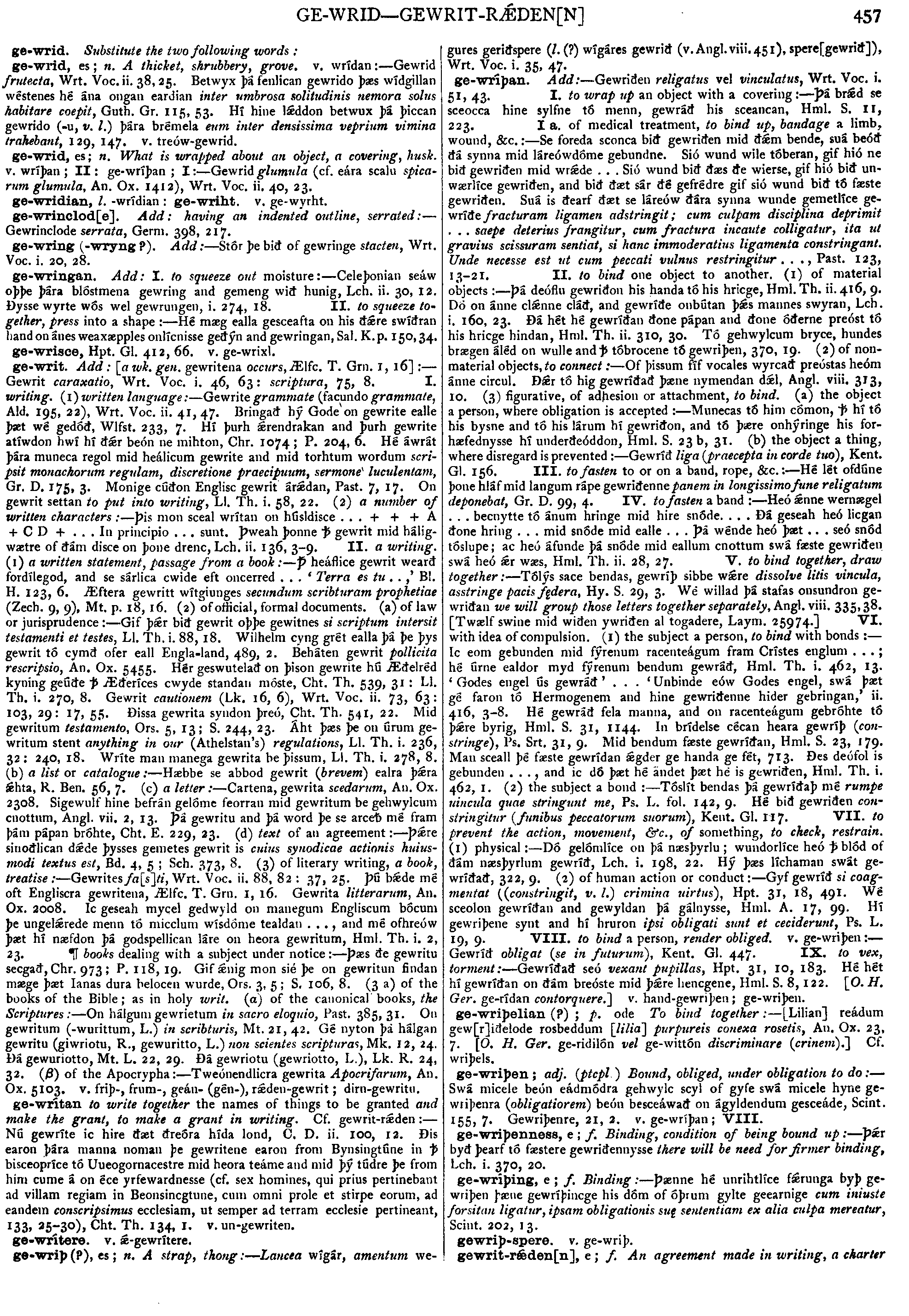
ge-wríþan.
Add:--Gewriðen
religatus
vel
vinculatus,
Wrt.
Voc.
i.
51,
43.
I.
to
wrap
up
an
object
with
a
covering:--Þá
brd
se
sceocca
hine
sylfne
tó
menn,
gewráð
his
sceancan,
Hml.
S.
11,
223.
I
a.
of
medical
treatment,
to
bind
up,
bandage
a
limb,
wound,
&c.:--Se
foreda
sconca
bið
gewriðen
mid
ðm
bende,
suá
beóð
ðá
synna
mid
láreówdóme
gebundne.
Sió
wund
wile
tóberan,
gif
hió
ne
bið
gewriðen
mid
wrde
.
.
.
Sió
wund
bið
ðæs
ðe
wierse,
gif
hió
bið
unwærlíce
gewriðen,
and
bið
ðæt
sár
ðé
gefrédre
gif
sió
wund
bið
tó
fæste
gewriðen.
Suá
is
ðearf
ðæt
se
láreów
ðára
synna
wunde
gemetlíce
gewríðe
fracturam
ligamen
adstringit;
cum
culpam
disciplina
deprimit
.
.
.
saepe
deterius
frangitur,
cum
fractura
incaute
colligatur,
ita
ut
gravius
scissuram
sentiat,
si
hanc
immoderatius
ligamenta
constringant.
Unde
necesse
est
ut
cum
peccati
vulnus
restringitur
.
.
.,
Past.
123,
13-21.
II.
to
bind
one
object
to
another.
(1)
of
material
objects:--Þá
deóflu
gewriðon
his
handa
tó
his
hricge,
Hml.
Th.
ii.
416,
9.
Dó
on
ánne
clnne
cláð,
and
gewríðe
onbútan
þs
mannes
swyran,
Lch.
i.
160,
23.
Ðá
hét
hé
gewríðan
ðone
pápan
and
ðone
óðerne
preóst
tó
his
hricge
hindan,
Hml.
Th.
ii.
310,
30.
Tó
gehwylcum
bryce,
hundes
brægen
áléd
on
wulle
and
 tóbrocene
tó
gewriþen,
370,
19.
(2)
of
non-material
objects,
to
connect:--Of
þissum
fíf
vocales
wyrcað
preóstas
heóm
ánne
circul.
Ðr
tó
hig
gewríðað
þæne
nymendan
dl,
Angl.
viii.
313,
10.
(3)
figurative,
of
adhesion
or
attachment,
to
bind.
(a)
the
object
a
person,
where
obligation
is
accepted:--Munecas
tó
him
cómon,
hí
tó
his
bysne
and
tó
his
lárum
hí
gewriðon,
and
tó
þære
onhýringe
his
forhæfednysse
hí
underðeóddon,
Hml.
S.
23
b,
31.
(b)
the
object
a
thing,
where
disregard
is
prevented:--Gewríð
liga
(praecepta
in
corde
tuo),
Kent.
Gl.
156.
III.
to
fasten
to
or
on
a
band,
rope,
&c.:--Hé
lét
ofdúne
þone
hláf
mid
langum
rápe
gewriðenne
panem
in
longissimo
fune
religatum
deponebat,
Gr.
D.
99,
4.
IV.
to
fasten
a
band:--Heó
nne
wernægel
.
.
.
becnytte
tó
ánum
hringe
mid
hire
snóde.
.
.
.
Ðá
geseah
heó
licgan
ðone
hring
.
.
.
mid
snóde
mid
ealle
.
.
.
Þá
wende
heó
þæt.
.
.
seó
snód
tóslupe;
ac
heó
áfunde
þá
snóde
mid
eallum
cnottum
swá
fæste
gewriðen
swá
heó
r
wæs,
Hml.
Th.
ii.
28,
27.
V.
to
bind
together,
draw
together:--Tólýs
sace
bendas,
gewríþ
sibbe
wre
dissolve
litis
vincula,
asstringe
pacis
f
tóbrocene
tó
gewriþen,
370,
19.
(2)
of
non-material
objects,
to
connect:--Of
þissum
fíf
vocales
wyrcað
preóstas
heóm
ánne
circul.
Ðr
tó
hig
gewríðað
þæne
nymendan
dl,
Angl.
viii.
313,
10.
(3)
figurative,
of
adhesion
or
attachment,
to
bind.
(a)
the
object
a
person,
where
obligation
is
accepted:--Munecas
tó
him
cómon,
hí
tó
his
bysne
and
tó
his
lárum
hí
gewriðon,
and
tó
þære
onhýringe
his
forhæfednysse
hí
underðeóddon,
Hml.
S.
23
b,
31.
(b)
the
object
a
thing,
where
disregard
is
prevented:--Gewríð
liga
(praecepta
in
corde
tuo),
Kent.
Gl.
156.
III.
to
fasten
to
or
on
a
band,
rope,
&c.:--Hé
lét
ofdúne
þone
hláf
mid
langum
rápe
gewriðenne
panem
in
longissimo
fune
religatum
deponebat,
Gr.
D.
99,
4.
IV.
to
fasten
a
band:--Heó
nne
wernægel
.
.
.
becnytte
tó
ánum
hringe
mid
hire
snóde.
.
.
.
Ðá
geseah
heó
licgan
ðone
hring
.
.
.
mid
snóde
mid
ealle
.
.
.
Þá
wende
heó
þæt.
.
.
seó
snód
tóslupe;
ac
heó
áfunde
þá
snóde
mid
eallum
cnottum
swá
fæste
gewriðen
swá
heó
r
wæs,
Hml.
Th.
ii.
28,
27.
V.
to
bind
together,
draw
together:--Tólýs
sace
bendas,
gewríþ
sibbe
wre
dissolve
litis
vincula,
asstringe
pacis
f dera,
Hy.
S.
29,
3.
Wé
willad
þá
stafas
onsundron
gewriðan
we
will
group
those
letters
together
separately,
Angl.
viii.
335,
38.
[Twælf
swine
mid
wiðen
ywriðen
al
togadere,
Laym.
25974.]
VI.
with
idea
of
compulsion.
(1)
the
subject
a
person,
to
bind
with
bonds:--Ic
eom
gebunden
mid
fýrenum
racenteágum
fram
Crístes
englum
.
.
.;
hé
úrne
ealdor
myd
fýrenum
bendum
gewráð,
Hml.
Th.
i.
462,
13.
'Godes
engel
ús
gewráð'
.
.
.
'Unbinde
eów
Godes
engel,
swá
þæt
gé
faron
tó
Hermogenem
and
hine
gewriðenne
hider
gebringan,'
ii.
416,
3-8.
Hé
gewráð
fela
manna,
and
on
racenteágum
gebróhte
tó
þre
byrig,
Hml.
S.
31,
1144.
In
brídelse
cécan
heara
gewríþ
(constringe),
Ps.
Srt.
31,
9.
Mid
bendum
fæste
gewríðan,
Hml.
S.
23,
179.
Man
sceall
þé
fæste
gewrídan
gder
ge
handa
ge
fét,
713.
Ðes
deófol
is
gebunden
.
.
.,
and
ic
dó
þæt
hé
andet
þæt
hé
is
gewriðen,
Hml.
Th.
i.
462,
1.
(2)
the
subject
a
bond:--Tóslít
bendas
þá
gewríðaþ
mé
rumpe
uincula
quae
stringunt
me,
Ps.
L.
fol.
142,
9.
Hé
bið
gewriðen
constringitur
(funibus
peccatorum
suorum),
Kent.
Gl.
117.
VII.
to
prevent
the
action,
movement,
&c.,
of
something,
to
check,
restrain.
(1)
physical:--Dó
gelómlíce
on
þá
næsþyrlu;
wundorlíce
heó
blód
of
ðám
næsþyrlum
gewríð,
Lch.
i.
198,
22.
Hý
þæs
líchaman
swát
gewríðað,
322,
9.
(2)
of
human
action
or
conduct:--Gyf
gewríð
si
coagmentat
((constringit,
v.
l.)
crimina
uirtus),
Hpt.
31,
18,
491.
Wé
sceolon
gewríðan
and
gewyldan
þá
gálnysse,
Hml.
A.
17,
99.
Hí
gewriþene
synt
and
hí
hruron
ipsi
obligati
sunt
et
ceciderunt,
Ps.
L.
19,
9.
VIII.
to
bind
a
person,
render
obliged.
v.
ge-wriþen:--Gewríð
obligat
(se
in
futurum),
Kent.
Gl.
447.
IX.
to
vex,
torment:--Gewríðað
seó
vexant
pupillas,
Hpt.
31,
10,
183.
Hé
hét
hí
gewríðan
on
ðám
breóste
mid
þre
hencgene,
Hml.
S.
8,
122.
[O.
H.
Ger.
ge-rídan
contorquere.]
v.
hand-gewriþen;
ge-wriþen.
dera,
Hy.
S.
29,
3.
Wé
willad
þá
stafas
onsundron
gewriðan
we
will
group
those
letters
together
separately,
Angl.
viii.
335,
38.
[Twælf
swine
mid
wiðen
ywriðen
al
togadere,
Laym.
25974.]
VI.
with
idea
of
compulsion.
(1)
the
subject
a
person,
to
bind
with
bonds:--Ic
eom
gebunden
mid
fýrenum
racenteágum
fram
Crístes
englum
.
.
.;
hé
úrne
ealdor
myd
fýrenum
bendum
gewráð,
Hml.
Th.
i.
462,
13.
'Godes
engel
ús
gewráð'
.
.
.
'Unbinde
eów
Godes
engel,
swá
þæt
gé
faron
tó
Hermogenem
and
hine
gewriðenne
hider
gebringan,'
ii.
416,
3-8.
Hé
gewráð
fela
manna,
and
on
racenteágum
gebróhte
tó
þre
byrig,
Hml.
S.
31,
1144.
In
brídelse
cécan
heara
gewríþ
(constringe),
Ps.
Srt.
31,
9.
Mid
bendum
fæste
gewríðan,
Hml.
S.
23,
179.
Man
sceall
þé
fæste
gewrídan
gder
ge
handa
ge
fét,
713.
Ðes
deófol
is
gebunden
.
.
.,
and
ic
dó
þæt
hé
andet
þæt
hé
is
gewriðen,
Hml.
Th.
i.
462,
1.
(2)
the
subject
a
bond:--Tóslít
bendas
þá
gewríðaþ
mé
rumpe
uincula
quae
stringunt
me,
Ps.
L.
fol.
142,
9.
Hé
bið
gewriðen
constringitur
(funibus
peccatorum
suorum),
Kent.
Gl.
117.
VII.
to
prevent
the
action,
movement,
&c.,
of
something,
to
check,
restrain.
(1)
physical:--Dó
gelómlíce
on
þá
næsþyrlu;
wundorlíce
heó
blód
of
ðám
næsþyrlum
gewríð,
Lch.
i.
198,
22.
Hý
þæs
líchaman
swát
gewríðað,
322,
9.
(2)
of
human
action
or
conduct:--Gyf
gewríð
si
coagmentat
((constringit,
v.
l.)
crimina
uirtus),
Hpt.
31,
18,
491.
Wé
sceolon
gewríðan
and
gewyldan
þá
gálnysse,
Hml.
A.
17,
99.
Hí
gewriþene
synt
and
hí
hruron
ipsi
obligati
sunt
et
ceciderunt,
Ps.
L.
19,
9.
VIII.
to
bind
a
person,
render
obliged.
v.
ge-wriþen:--Gewríð
obligat
(se
in
futurum),
Kent.
Gl.
447.
IX.
to
vex,
torment:--Gewríðað
seó
vexant
pupillas,
Hpt.
31,
10,
183.
Hé
hét
hí
gewríðan
on
ðám
breóste
mid
þre
hencgene,
Hml.
S.
8,
122.
[O.
H.
Ger.
ge-rídan
contorquere.]
v.
hand-gewriþen;
ge-wriþen.
Germanic Lexicon Project (main page)
This search system was written by
Sean Crist
Please consider
volunteering
to correct the data in these online dictionaries.
No rights reserved. Feel free to use these data in any way you please.