|
|

Tip: In the search results, you can click on any word or abbreviation for more information.
|
Source: Bosworth/Toller, page b0223, entry 1 View original page image as: [TIFF] [PNG] [View previous entry] [View next entry] |
[Comment on this entry] [View comments] |
The following entry has been hand-corrected once. |
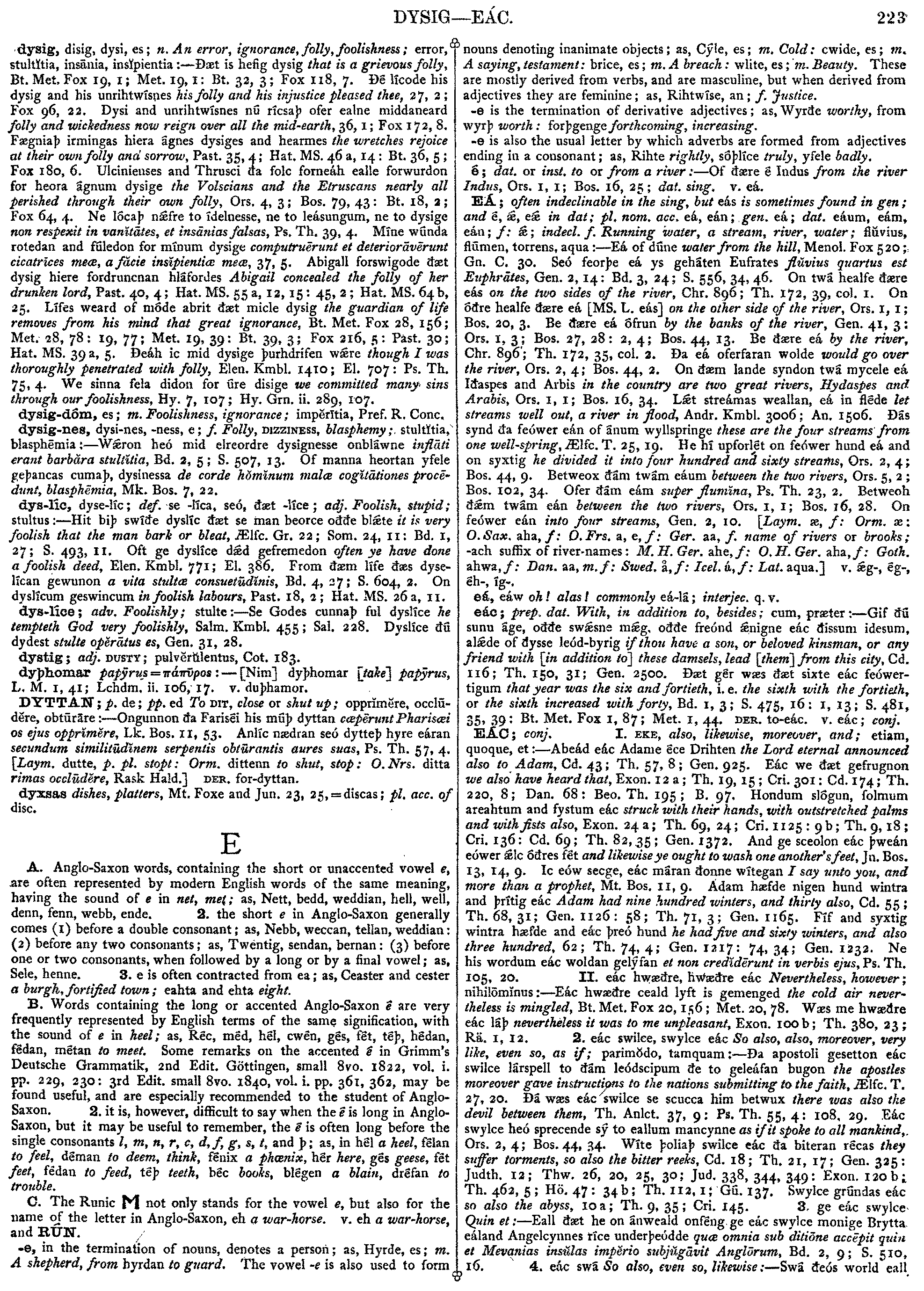
dysig,
disig,
dysi,
es;
n.
An
error,
ignorance,
folly,
foolishness;
error,
stult tia,
ins
tia,
ins nia.
inspientia
:--
Ðæt
is
hefig
dysig
that
is
a
grievous
folly,
Bt.
Met.
Fox
19,
1;
Met.
19,
1:
Bt.
32,
3;
Fox
118,
7.
Ðé
lícode
his
dysig
and
his
unrihtwísnes
his
folly
and
his
injustice
pleased
thee,
27,
2;
Fox
96,
22.
Dysi
and
unrihtwísnes
nú
rícsaþ
ofer
ealne
middaneard
folly
and
wickedness
now
reign
over
all
the
mid-earth,
36,
1;
Fox
172,
8.
Fægniaþ
irmingas
hiera
ágnes
dysiges
and
hearmes
the
wretches
rejoice
at
their
own
folly
and
sorrow,
Past.
35,
4;
Hat.
MS.
46
a.
14:
Bt.
36,
5;
Fox
180,
6.
Ulcinienses
and
Thrusci
ða
folc
forneáh
ealle
forwurdon
for
heora
ágnum
dysige
the
Volscians
and
the
Etruscans
nearly
all
perished
through
their
own
folly,
Ors.
4,
3;
Bos.
79,
43:
Bt.
18,
2;
Fox
64,
4.
Ne
lócaþ
n
nia.
inspientia
:--
Ðæt
is
hefig
dysig
that
is
a
grievous
folly,
Bt.
Met.
Fox
19,
1;
Met.
19,
1:
Bt.
32,
3;
Fox
118,
7.
Ðé
lícode
his
dysig
and
his
unrihtwísnes
his
folly
and
his
injustice
pleased
thee,
27,
2;
Fox
96,
22.
Dysi
and
unrihtwísnes
nú
rícsaþ
ofer
ealne
middaneard
folly
and
wickedness
now
reign
over
all
the
mid-earth,
36,
1;
Fox
172,
8.
Fægniaþ
irmingas
hiera
ágnes
dysiges
and
hearmes
the
wretches
rejoice
at
their
own
folly
and
sorrow,
Past.
35,
4;
Hat.
MS.
46
a.
14:
Bt.
36,
5;
Fox
180,
6.
Ulcinienses
and
Thrusci
ða
folc
forneáh
ealle
forwurdon
for
heora
ágnum
dysige
the
Volscians
and
the
Etruscans
nearly
all
perished
through
their
own
folly,
Ors.
4,
3;
Bos.
79,
43:
Bt.
18,
2;
Fox
64,
4.
Ne
lócaþ
n fre
to
ídelnesse,
ne
to
leásungum,
ne
to
dysige
non
respexit
in
vanttes,
et
insnias
falsas,
Ps.
Th.
39,
4.
Míne
wúnda
rotedan
and
fúledon
for
mínum
dysige
computru
fre
to
ídelnesse,
ne
to
leásungum,
ne
to
dysige
non
respexit
in
vanttes,
et
insnias
falsas,
Ps.
Th.
39,
4.
Míne
wúnda
rotedan
and
fúledon
for
mínum
dysige
computru runt
et
deteriorvrunt
cicatr
runt
et
deteriorvrunt
cicatr ces
meæ,
a
f
ces
meæ,
a
f cie
inspientiæ
meæ,
37,
5.
Abigail
forswigode
ðæt
dysig
hiere
fordruncnan
hláfordes
Abigail
concealed
the
folly
of
her
drunken
lord,
Past.
40,
4;
Hat.
MS.
55
a,
12,
15:
45,
2;
Hat.
MS.
64
b,
25.
Lífes
weard
of
mode
abrit
ðæt
micle
dysig
the
guardian
of
life
removes
from
his
mind
that
great
ignorance,
Bt.
Met.
Fox
28,
156;
Met.
28,
78:
19,
77;
Met.
19,
39:
Bt.
39,
3;
Fox
216,
5:
Past.
30;
Hat.
MS.
39
a,
5.
Ðeáh
ic
mid
dysige
þurhdrifen
wsére
though
I
was
thoroughly
penetrated
with
folly,
Elen.
Kmbl.
1410;
El.
707:
Ps.
Th.
75,
4.
We
sinna
fela
didon
for
úre
disige
we
committed
many
sins
through
our
foolishness,
Hy.
7,
107;
Hy.
Grn.
ii.
289,
107.
cie
inspientiæ
meæ,
37,
5.
Abigail
forswigode
ðæt
dysig
hiere
fordruncnan
hláfordes
Abigail
concealed
the
folly
of
her
drunken
lord,
Past.
40,
4;
Hat.
MS.
55
a,
12,
15:
45,
2;
Hat.
MS.
64
b,
25.
Lífes
weard
of
mode
abrit
ðæt
micle
dysig
the
guardian
of
life
removes
from
his
mind
that
great
ignorance,
Bt.
Met.
Fox
28,
156;
Met.
28,
78:
19,
77;
Met.
19,
39:
Bt.
39,
3;
Fox
216,
5:
Past.
30;
Hat.
MS.
39
a,
5.
Ðeáh
ic
mid
dysige
þurhdrifen
wsére
though
I
was
thoroughly
penetrated
with
folly,
Elen.
Kmbl.
1410;
El.
707:
Ps.
Th.
75,
4.
We
sinna
fela
didon
for
úre
disige
we
committed
many
sins
through
our
foolishness,
Hy.
7,
107;
Hy.
Grn.
ii.
289,
107.
|
Source: Bosworth/Toller, page b0456, entry 9 View original page image as: [TIFF] [PNG] [View previous entry] [View next entry] |
[Comment on this entry] [View comments] |
The following entry has been hand-corrected once. |
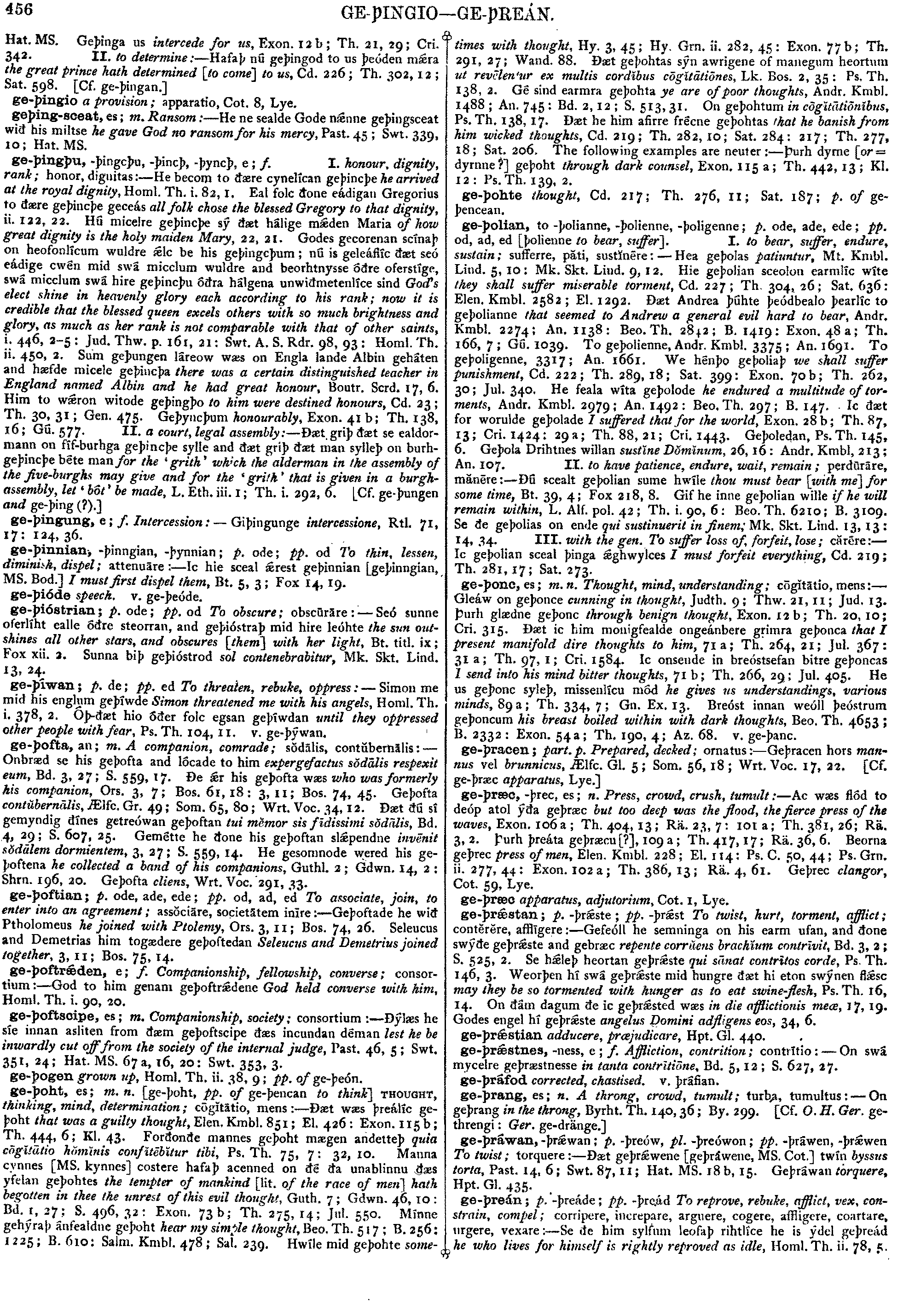
ge-þofta,
an;
m.
A
companion,
comrade;
s dlis,
cont
dlis,
cont bernlis
:--
Onbræd
se
his
geþofta
and
lócade
to
him
expergefactus
sdlis
respexit
eum,
Bd.
3,
27;
S.
559,
17.
Ðe
r
his
geþofta
wæs
who
was
formerly
his
companion,
Ors.
3,
7;
Bos.
61,
18:
3,
11;
Bos.
74,
45.
Geþofta
contbernlis,
Ælfc.
Gr.
49;
Som.
65,
80;
Wrt.
Voc.
34,
12.
Ðæt
ðú
sí
gemyndig
ðínes
getreówan
geþoftan
tui
m
bernlis
:--
Onbræd
se
his
geþofta
and
lócade
to
him
expergefactus
sdlis
respexit
eum,
Bd.
3,
27;
S.
559,
17.
Ðe
r
his
geþofta
wæs
who
was
formerly
his
companion,
Ors.
3,
7;
Bos.
61,
18:
3,
11;
Bos.
74,
45.
Geþofta
contbernlis,
Ælfc.
Gr.
49;
Som.
65,
80;
Wrt.
Voc.
34,
12.
Ðæt
ðú
sí
gemyndig
ðínes
getreówan
geþoftan
tui
m mor
sis
fdissimi
sdlis,
Bd.
4,
29;
S.
607,
25.
Gemétte
he
ðone
his
geþoftan
slpendne
invnit
sdlem
dormientem,
3,
27;
S.
559,
14.
He
gesomnode
wered
his
geþoftena
he
collected
a
band
of
his
companions,
Guthl.
2;
Gdwn.
14,
2:
Shrn.
196,
20.
Geþofta
cliens,
Wrt.
Voc.
291,
33.
mor
sis
fdissimi
sdlis,
Bd.
4,
29;
S.
607,
25.
Gemétte
he
ðone
his
geþoftan
slpendne
invnit
sdlem
dormientem,
3,
27;
S.
559,
14.
He
gesomnode
wered
his
geþoftena
he
collected
a
band
of
his
companions,
Guthl.
2;
Gdwn.
14,
2:
Shrn.
196,
20.
Geþofta
cliens,
Wrt.
Voc.
291,
33.
|
Source: Bosworth/Toller, page b0554, entry 24 View original page image as: [TIFF] [PNG] [View previous entry] [View next entry] |
[Comment on this entry] [View comments] |
The following entry has been hand-corrected once. |
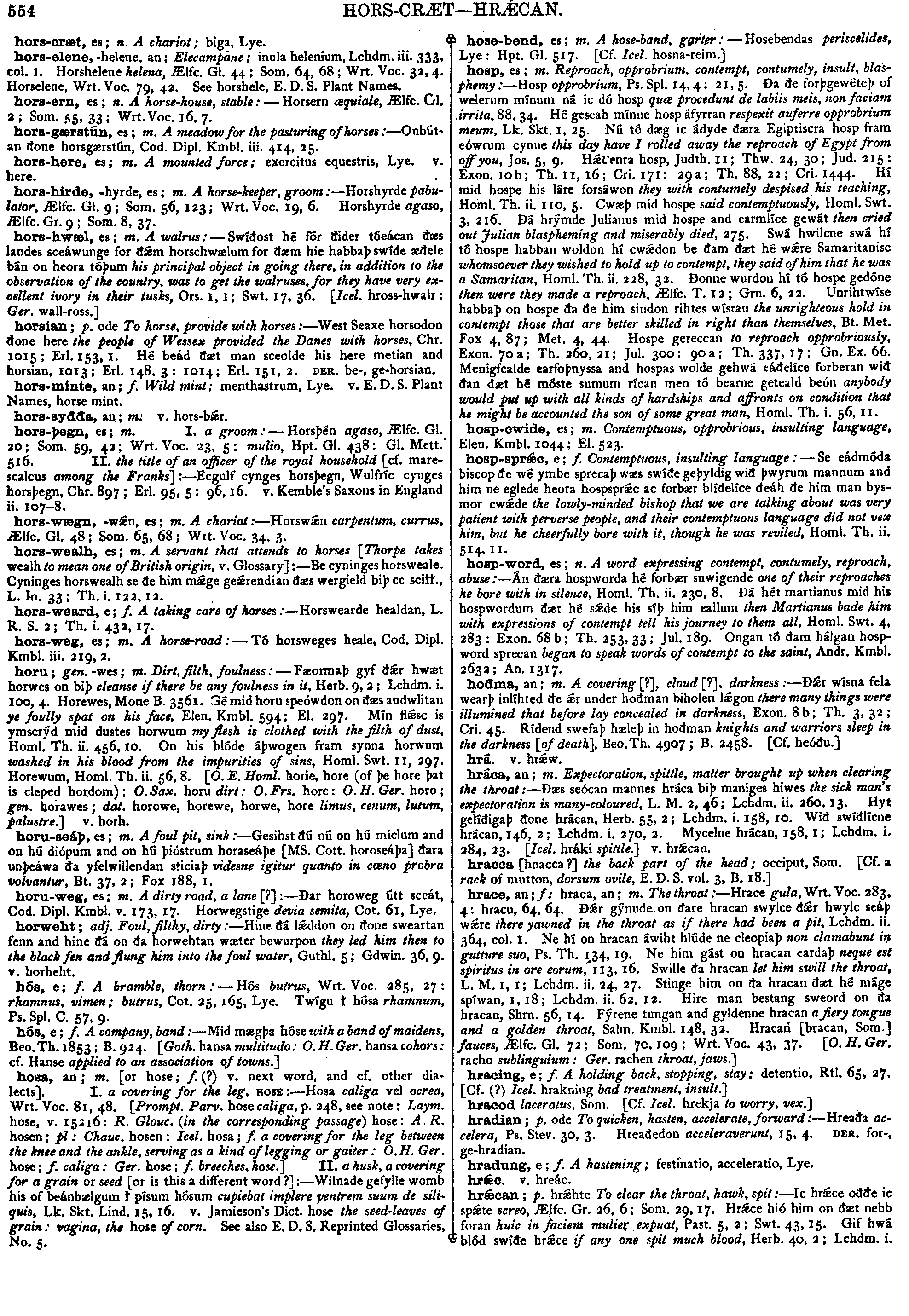
hosp,
es;
m.
Reproach,
opprobrium,
contempt,
contumely,
insult,
blasphemy
:--
Hosp
opprobrium,
Ps.
Spl.
14,
4:
21,
5.
Ða
ðe
forþgewéteþ
of
welerum
mínum
ná
ic
dó
hosp
quæ
procedunt
de
labiis
meis,
non
faciam
irrita,
88,
34.
Hé
geseah
mínne
hosp
áfyrran
respexit
auferre
opprobrium
meum,
Lk.
Skt.
1,
25.
Nú
tó
dæg
ic
ádyde
ðæra
Egiptiscra
hosp
fram
eówrum
cynne
this
day
have
I
rolled
away
the
reproach
of
Egypt
from
off
you,
Jos.
5,
9.
Hðenra
hosp,
Judth.
11;
Thw.
24,
30;
Jud.
215:
Exon.
10
b;
Th.
11,
16;
Cri.
171:
29
a;
Th.
88,
22;
Cri.
1444.
Hí
mid
hospe
his
láre
forsáwon
they
with
contumely
despised
his
teaching,
Homl.
Th.
ii.
110,
5.
Cwæþ
mid
hospe
said
contemptuously,
Homl.
Swt.
3,
216.
Ðá
hrýmde
Julianus
mid
hospe
and
earmlíce
gewát
then
cried
out
Julian
blaspheming
and
miserably
died,
275.
Swá
hwilcne
swá
hí
tó
hospe
habban
woldon
hí
cwdon
be
ðam
ðæt
hé
wre
Samaritanisc
whomsoever
they
wished
to
hold
up
to
contempt,
they
said
of
him
that
he
was
a
Samaritan,
Homl.
Th.
ii.
228,
32.
Ðonne
wurdon
hí
tó
hospe
gedóne
then
were
they
made
a
reproach,
Ælfc.
T.
12;
Grn.
6,
22.
Unrihtwíse
habbaþ
on
hospe
ða
ðe
him
sindon
rihtes
wísran
the
unrighteous
hold
in
contempt
those
that
are
better
skilled
in
right
than
themselves,
Bt.
Met.
Fox
4,
87;
Met.
4,
44.
Hospe
gereccan
to
reproach
opprobriously,
Exon.
70
a;
Th.
260,
21;
Jul.
300:
90
a;
Th.
337,
17;
Gn.
Ex.
66.
Menigfealde
earfoþnyssa
and
hospas
wolde
gehwá
eáðelíce
forberan
wið
ðan
ðæt
hé
móste
sumum
rícan
men
tó
bearne
geteald
beón
anybody
would
put
up
with
all
kinds
of
hardships
and
affronts
on
condition
that
he
might
be
accounted
the
son
of
some
great
man,
Homl.
Th.
i.
56,
11.
|
Source: Bosworth/Toller, page b0737, entry 15 View original page image as: [TIFF] [PNG] [View previous entry] [View next entry] |
[Comment on this entry] [View comments] |
The following entry has been hand-corrected once. |
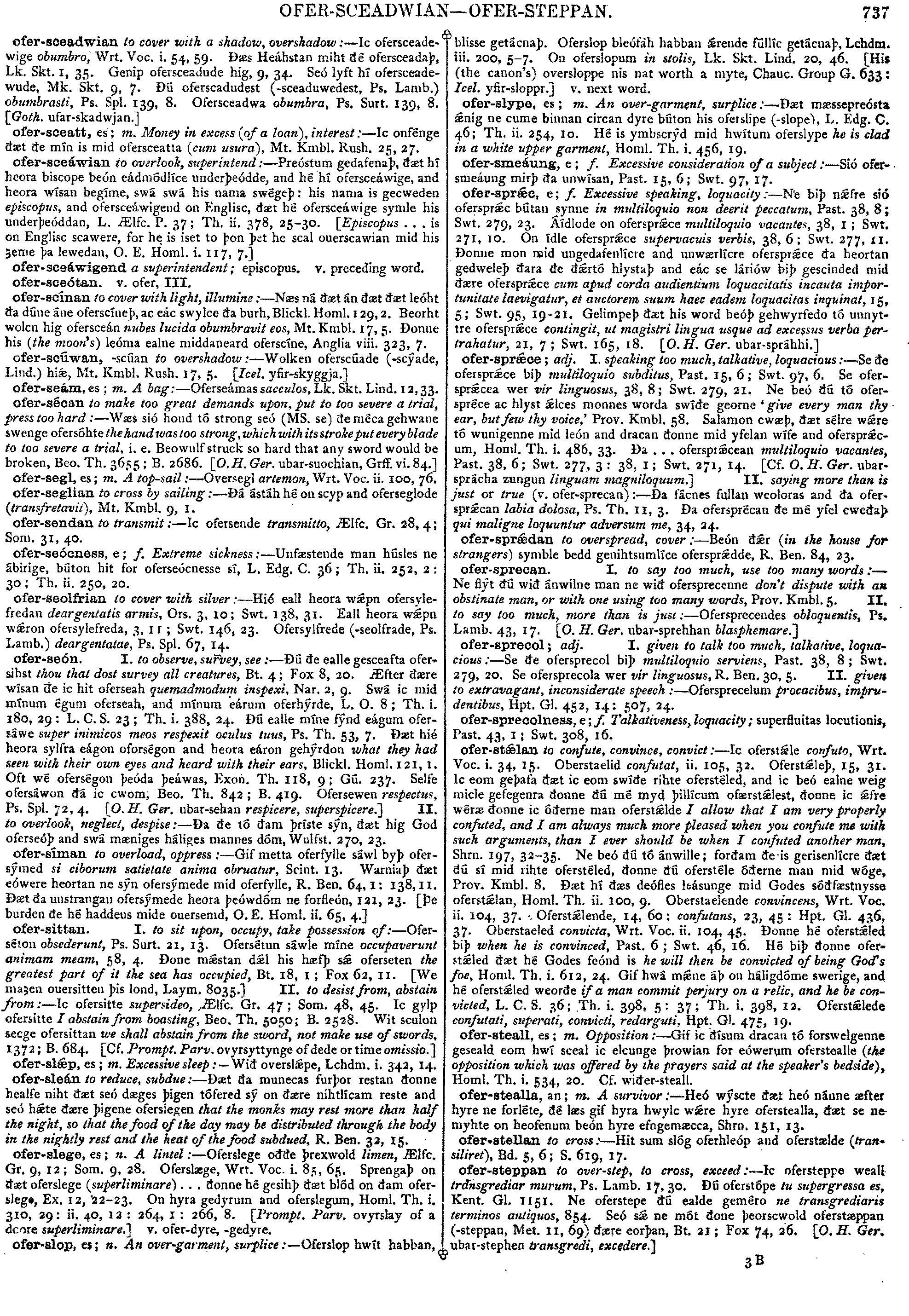
ofer-seon. I. to observe, survey, see:--Ðú ðe ealle gesceafta ofersihst thou that dost survey all creatures, Bt. 4 ; Fox 8, 20. Æfter ðære wísan ðe ic hit oferseah quemadmodum inspexi. Nar. 2, 9, Swá ic mid mínum égum oferseah, and mínum eárun oferhýrde, L. O. 8 ; Th. i. 180, 29 : L. C. S. 23 ; Th. i. 388, 24. Ðú ealle míne fýnd eágum ofersáwe super inimicos meos respexit oculus tuus, Ps. Th. 53, 7. Ðæt hié heora sylfra eágon oforségon and heora eáron gehýrdon what they had seen with their own eyes and heard with their ears, Blickl. Homl. 121, 1. Oft wé oferségon þeóda þeáwas, Exon. Th. 118, 9; Gú. 237. Selfe ofersáwon ðá ic cwom, Beo. Th. 842 ; B. 419. Ofersewen respectus, Ps. Spl. 72, 4. [O. H. Ger. ubar-sehan respicere, superspicere.] II. to overlook, neglect, despise:-- Ða ðe tó ðam þríste sýn, ðæt hig God oferseóþ and swá mæniges háliges mannes dóm, Wulfst. 270, 23.
|
Source: Bosworth/Toller, page b0828, entry 1 View original page image as: [TIFF] [PNG] [View previous entry] [View next entry] |
[Comment on this entry] [View comments] |
The following entry has been hand-corrected once. |
sceáwigan,
93,
4;
Gen.
1540.
Ðæt
mæg
mon
on
bócum
sceáwigean,
hú
monega
gewin
hé
dreógende
wæs,
Ors.
1,
11;
Swt.
50,
25.
Hwylce
ða
nú
synd
tó
sceáwigenne
quales
illi
nunc
appareant,
L.
Ecg.
P.
iv.
66;
Th.
ii.
226,
21.
Tó
sceáwianne,
Exon.
Th.
57,
7;
Cri.
915.
Sceáwiendum
contemplantibus,
intuentibus,
Wrt.
Voc.
ii.
134,
83.
III.
to
look
at,
look
on
with
favour,
to
regard,
have
respect
to
:--
Ic
sceáwiu
wegas
ðíne
'I
will
have
respect
unto
thy
ways'
(A.
V.),
Ps.
Surt.
118,
15.
Hé
hyra
dde
sceáwaþ
God
will
regard
the
deeds
of
the
charitable,
Exon.
Th.
106,
35;
Gú.
51.
Hé
sceáwode
ða
eáþmódnesse
his
þeówene
respexit
humilitatem
ancillae
suae,
Blickl.
Homl.
7,
3.
Sceáwa
(respice)
ðis
folc,
Ex.
33,
13.
Cyning
eallwihta
Caines
ne
wolde
tiber
sceáwian
'to
Cain
and
to
his
offering
the
Lord
had
not
respect'
(A.
V.
Gen.
4,
5),
Cd.
Th.
60,
9;
Gen.
979.
IV.
to
look
at
with
care,
consider,
inspect,
examine,
scrutinize,
reconnoitre
:--
Sceáwaþ
speculatur,
Wülck.
Gl.
250,
8.
Ðá
ðæt
eall
gedón
wæs
swá
se
geótere
ðæm
æðelinge
r
behét
se
æðeling
ðæt
ðá
sceáwode
when
all
that
was
done
as
the
founder
(Perillus)
promised
the
prince
(Phalaris),
the
prince
then
inspected
it,
Ors.
1,
12;
Swt.
54,
29.
Se
cyng
sceáwode
ðæt
mádmehús
and
ða
gersuman
ðe
his
fæder
r
gegaderode,
Chr.
1086;
Erl.
223,
27.
Ðonne
seó
ádl
cume
rest
on
ðone
mannan,
ðonne
sceáwa
his
tungan,
Lchdm.
ii.
280,
8.
Sceáwiaþ
ða
lilian
hú
hí
wexaþ
considerate
lilia
quomodo
crescunt,
Lk.
Skt.
12,
27.
Ic
eów
bidde
ðæt
ánra
manna
gehwylc
sceáwige
hine
sylfne
on
his
heortan,
Blickl.
Homl.
57,
33:
107,
13.
Moyses
sende
and
hét
sceáwian
Azer
misit
Moyses,
qui
explorarent
Jazer,
Num.
21,
32.
Iosue
ásende
twegen
sceáweras
dígellíce
and
hét
sceáwian
ðæt
land,
Jos.
2,
1.
Him
ðá
féran
gewát
land
sceáwian,
Cd.
Th.
106,
33;
Gen.
1780:
Beo.
Th.
2831;
B.
1413.
Hord
sceáwian,
5481;
B.
2744.
Land
sceáwigan,
Cd.
Th.
115,
16;
Gen.
1920.
Ðá
ongon
ic
geornlícor
ðá
stówe
sceáwigan
and
geond
ða
bearwas
gongan
igitur
perambulare
totum
nemus
incipio,
Nar.
27,
20.
Ceós
ðé
menn
ðæt
magon
sceáwigean
ðone
eard
mitte
viros,
qui
considerent
terram,
Num.
13,
3.
Gé
cómon
ðis
land
tó
sceáwienne,
Gen.
42,
12.
V.
to
look
out,
seek
for,
select,
choose,
provide
:--
Ðá
sceáwode
man
þreó
þegnas
of
ðam
gemóte
three
thanes
were
chosen
from
the
moot
(to
go
on
a
certain
business),
Chart.
Th.
337,
12.
Gyf
ðú
énigne
gódne
heorde
hæbbe
...
sceáwa
hyne
mé;
gyf
ðú
ðonne
nánne
swá
gerádne
næbbe,
séc
hyne
óð
ðú
hyne
finde,
Shrn.
164,
31.
Se
ðe
ðás
gemót
forbúge,
ðonne
sceáwige
(scifte,
MS.
D.)
man
of
ðam
gemóte
ða
ðe
him
tó
rídan,
L.
Edg.
ii.
7;
Th.
i.
268,
15:
L.
C.
S.
25;
Th.
i.
390,
18.
Him
Loth
gewát
wíc
sceáwian
óþ
ðæt
hié
eorþscræf
fundon
Lot
went
seeking
a
dwelling,
until
they
found
a
cave,
Cd.
Th.
156,
24;
Gen.
2593.
Drihtnes
earc
fór
beforan
him
þrí
dagas
sceáwiende
ða
wícstówa
providens
castrorum
locum,
Num.
10,
33.
VI.
to
shew
(favour,
respect,
etc.),
to
grant,
v.
ge-sceáwian,
I
:--
Ðá
geornde
se
eorl
griðes
and
gísla
...
Ðá
wyrnde
him
mann
ðera
gísla
and
sceáwede
him
maim
.v.
nihta
grið
út
of
lande
tó
farenne
then
the
earl
asked
for
safe-conduct
and
hostages.
...
The
hostages
were
refused
him,
and
safe-conduct
during
five
days
was
granted
him
to
go
out
of
the
country,
Chr.
1048;
Erl.
180,
11-14.
[O.
Sax.
skawón
to
see,
observe:
O.
L.
Ger.
scauwón,
scouwón
respicere,
despicere:
O.
Frs.
skawia,
skowia
to
see,
inspect:
O.
H.
Ger.
scawón,
scauwón,
scouwón
videre,
conspicere,
intendere,
considerare,
contemplari,
scrutari,
speculari,
perpensare,
censere.]
v.
be-,
ge-,
geond-,
ofer-sceáwian.
|
Source: Bosworth/Toller, page b0981, entry 5 View original page image as: [TIFF] [PNG] [View previous entry] [View next entry] |
[Comment on this entry] [View comments (1)] |
The following entry has been hand-corrected once. |
tiber,
tifer,
es;
n.
A
sacrifice,
offering,
victim:--Wit
fýr
and
sweord
habbaþ,
hwr
is
ðæt
tiber
ðæt
ðú
torht
Gode
tó
ðam
brynegielde
bringan
þencest
(cf.
ic
áxige
hwr
seó
offrung
sig;
hér
ys
wudu
and
fýr
ecce
ignis
et
ligna;
ubi
est
victima?
Gen.
22,
7),
Cd.
Th.
175,
4;
Gen.
2890.
Ðú
scealt
mé
onsecgan
sunu
ðínne
tó
tibre
offeres
filium
tuum
in
holocaustum
(Gen.
22,
2),
172,
31;
Gen.
2852.
Se
ðe
on
tifre
gesalde
Diihten
Hlend,
301,
1;
Sat.
575.
Hié
Drihtne
lác
begen
brohton;
brego
engla
beseah
on
Abeles
gield,
cyning
eallwihta,
Caines
ne
wolde
tiber
sceáwian
(ad
munera
illius
(Cain)
non
respexit
Dominus,
Gen.
4.
5),
60,
9;
Gen.
979.
Noe
tiber
onsægde
(obtulit
holocausta,
Gen.
8,
20),
90,
29;
Gen.
1502:
108,
17;
Gen.
1807.
Hálig
tiber
(Isaac),
204,
6;
Exod.
415.
Ic
on
ðín
hús
gange
and
ðr
tídum
ðé
tifer
onsecge
.
.
.
Ðás
ic
mid
múðe
aspræc
.
.
.
ðæt
ic
ðé
on
tifrum
forgulde
ealle
ða
gehát
ðe
ic
mid
mínum
welerum
tódlde
introibo
in
domum
tuam
in
holocaustis
.
.
.
Haec
locutum
est
os
meum
.
.
.
:
Holocausta
offeram
tibi,
Ps.
Th.
65,
12-13.
Tiber,
Cd.
Th.
9,
2;
Gen.
135.
v.
timber.
[O.
H.
Ger.
zepar,
zebar
hostia,
sacrificium,
holocaustum:
Ger.
ziefer
in
ungeziefer.
Cf.
Icel.
tafn
a
sacrifice,
victim.
See
Grmm.
D.
M.
p.
36.]
v.
fyrd-
(?),
sige-,
sigor-,
wín-tiber
(-tifer).
|
Source: Bosworth/Toller, page b1084, entry 17 View original page image as: [TIFF] [PNG] [View previous entry] [View next entry] |
[Comment on this entry] [View comments] |
The following entry has been hand-corrected once. |
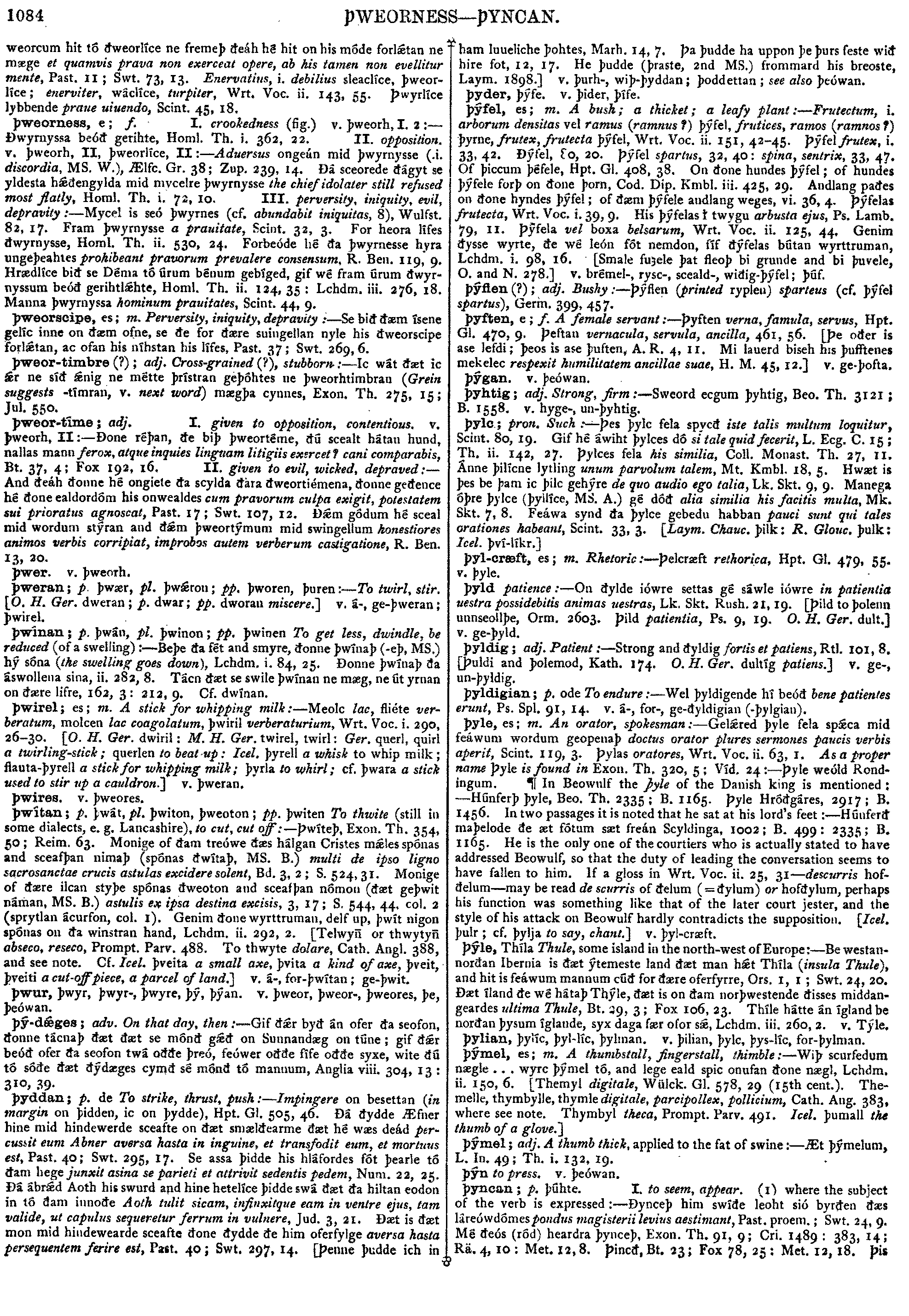
þyften, e; f. A female servant :-- Þyften verna, famula, servus, Hpt. Gl. 470, 9. Þeftan vernacula, servula, ancilla, 461, 56. [Þe oðer is ase lefdi; þeos is ase þuften, A. R. 4, 11. Mi lauerd biseh his þufftenes mekelec respexit humilitatem ancillae suae, H. M. 45, 12.] v. ge-þofta.
|
Source: Bosworth/Toller, page b1247, entry 15 View original page image as: [TIFF] [PNG] [View previous entry] [View next entry] |
[Comment on this entry] [View comments] |
The following entry has been hand-corrected once. |
wiþ;
prep.
(adv.
conj.).
I.
with
gen.
(1)
determining
the
direction
of
motion
or
action,
(a)
marking
an
object
towards
which
motion
is
directed,
towards,
to,
in
the
direction
of
:--
Wende
hé
hine
west
wið
Exanceastres,
Chr.
894;
Erl.
91,
10.
Rád
út
wið
Lygtúnes,
917;
Erl.
102,
16.
Hé
áfaren
wæs
wiþ
þara
scipa,
Ors.
6,
36;
Swt.
292,
30.
On
ðone
ealdan
weg
wið
huítan
stanes,
Cod.
Dip.
Kmbl.
ii.
29,
5.
Fleógan
wið
ðæs
holtes,
Byrht.
Th.
131,
14;
By.
8.
Wið
ðæs
fæstengeates
folc
onette,
Judth.
Thw.
23,
38;
Jud.
162:
25,
7;
Jud.
248.
Hé
irneþ
wið
his
eardes,
Met.
5,
15.
Heó
stígþ
wiþ
hire
uprynæs,
Bt.
25;
Fox
88,
27.
Hé
him
bebeád,
swá
hié
feohtan
angunnen,
ðæt
hié
wið
his
flugen,
Ors.
3,
7;
Swt.
116,
28.
Hé
wið
ðæs
beornes
stóp,
Byrht.
Th.
135,
41
;
By.
131.
Líget
fleáh
wið
ðæs
hðenan
folces,
Homl.
Th.
i.
504,
29.
Ðæt
wolcn
leát
wið
his
and
hine
genam
fram
heora
gesihðum,
296,
2.
Ðá
se
hálga
wer
ne
com,
ðá
cómon
hí
eft
wið
his
(they
made
their
way
to
him),
ii.
172,
22.
Sum
fmne
ásende
wið
his,
506,
6.
Hí
ásendan
twégen
weras
wið
his
(tó
him,
v.
l.
),
Homl.
Skt.
i.
10,
61.
Ne
gemét
hé
hine,
ne
rihtne
weg
wiþ
his
ne
áredaþ,
Bt.
33,
3;
Fox
128,
2.
(b)
marking
an
object
towards
which
an
action
is
directed,
towards,
to,
at
:--
Hé
hnáh
ILLEGIBLE
tó
eorðan,
áleát
wið
ðæs
engles
(he
bowed
to
the
angel),
Num.
22,
31;
Homl.
Th.
i.
120,
2.
Hí
luton
wið
heora,
38,
21.
Gríp
wið
ðæs
grundes
clutch
at
the
bottom,
Cd.
Th.
308,
31
;
Sat.
701.
Se
lég
lhte
wið
ðes
láþan,
309,
25
;
Sat.
716.
Beseah
hé
hine
underbæc
wiþ
ðæs
wífes,
Bt.
35,
6;
Fox
170,
14:
Cd.
Th.
154,
29;
Gen.
2563.
(c)
marking
the
object
of
an
operation,
purpose,
aim,
feeling,
with,
towards,
to,
at,
against
:--
Gif
gebyrige
ðæt
heora
hwilc
wið
úre
bige
habban
wille
(wants
to
come
to
us
to
buy),
oþþe
wé
wið
heora,
L.
A.
G.
5
;
Th.
i.
156,
3.
Hé
beseah
wið
mín
respexit
me,
Ps.
Th.
39,
1.
Hé
wrigaþ
wiþ
his
gecyndes,
Bt.
25
;
Fox
88,
24,
28
:
Met.
13,
67.
Wiþ
ðæs,
ic
wát,
ðú
wilt
higian,
Bt.
11,
2;
Fox
34,
7.
Mé
wre
liófre
ðæt
ic
onette
wiþ
ðæs,
ðæt
ic
ðé
móste
gelstan
ðæt
ic
ðé
r
gehét
festino
debitum
promissionis
absolvere,
40,
5
;
Fox
240,
16.
Hwí
murcnast
ðú
wið
mín
?
7,
3;
Fox
20,
3.
Deófles
anda
bið
ástyred
wið
ðín,
Homl.
Skt.
ii.
30,
115.
(2)
marking
position,
over
against,
opposite
to
:--
Sætt
se
Hlend
wið
(contra)
ðæs
dores,
Mk.
Skt.
Lind.
12,
41.
(3)
marking
an
object
against
which
there
is
protection,
against,
from
:--
Hé
hié
wið
ðæs
héhstan
brógan
gefriðode,
Judth.
Thw.
21,
3;
Jud.
4.
Wið
hungres
hleó,
Elen.
Kmbl.
1228;
El.
616.
Wið
yfela
gefreó
ús
feónda
gehwylces,
Hy.
6,
31.
II.
with
dat.
(1)
marking
local
relations,
(a)
proximity,
by,
near,
against,
beside
:--
Æt
Alre,
and
ðæt
is
wiþ
Æþelingga
eige,
Chr.
878
;
Erl.
80,
22.
Hire
líchama
resteþ
wið
Rómebirig
on
ðam
wege
ðe
man
nemneþ
Latina,
Shrn.
31,
28.
Sweall
uplang
gestód
wið
Israhélum,
Cd.
Th.
197,
8;
Exod.
303.
(b)
extension,
unto
:
--Wið
wolcnum
usque
ad
nubes,
Ps.
Th.
56,
12.
(c)
contact,
at,
against
:--
Heald
wiþ
wtan
(or
acc.?),
Lchdm.
ii.
150,
7.
Him
on
hreþre
langað
beorn
wið
blóde
(burnt
against
the
blood,
heated
his
blood
?),
Beo.
Th.
3764;
B.
1880.
(d)
collision
or
impact,
with,
against,
on:
--
Scearp
cymeþ
sceó
wiþ
óþrum,
ecg
wið
ecge,
Exon.
Th.
385,
8
;
Rä.
4,
41.
Ic
hnítan
sceal
hearde
wið
heardum,
497,
23;
Rä.
87,
5.
Streámas
wundon
sund
wið
sande,
Beo.
Th.
431
;
B.
213.
Hé
wið
áttorsceaðan
oreðe
gersde
(rushed
and
met
the
breath),
5670;
B.
2839:
Cd.
Th.
126,
14;
Gen.
2095.
Hire
wið
halse
heard
grápode,
Beo.
Th.
3136;
B.
1566.
Mid
grápe
fón
wið
feónde
to
lay
hands
on
the
foe,
882
;
B.
439.
Ne
sceal
mon
nó
mid
openlíce
edwíte
him
wið
sleán
non
aperta
exprobratione
sunt
feriendi,
Past.
40;
Swt.
295,
11.
(e)
confronting,
over
against,
opposite
:--
Ongan
ic
steppan
forð
ána
wið
englum
I
stepped
forth
and
alone
confronted
the
angels,
Cd.
Th.
280,
1
;
Sat.
249.
Be
norðan
is
se
s,
ðe
gþer
is
ge
nearo
ge
hreóh
wið
Italia
ðam
lande
(opposite
Italy),
Ors.
1,
1
;
Swt.
28,
12.
(f)
obstruction,
against,
in
the
way
of
:--
Bordrand
onswáf
wið
ðam
gryregieste,
Beo.
Th.
5113
;
B.
2560.
(2)
marking
association,
combination,
with.
v.
III.
2
:--
Gesweotula
ðín
sylfes
weorc,
and
forlt
weall
wið
wealle
(let
wall
join
with
wall),
Exon.
Th.
1,
20;
Cri.
11.
Hé
teofanade
ghwylc
wiþ
óþrum,
349,
10;
Sch.
44.
Sand
is
geblonden,
grund
wið
greóte,
Andr.
Kmbl.
849
;
An.
425.
Mengan
lyge
wið
sóðe,
leóht
wið
þýstrum,
Elen.
Kmbl.
613;
El.
307.
Hí
wið
mánfullum
mengdan
þeóde
commisti
sunt
inter
gentes,
Ps.
Th.
105,
26.
Swá
gð
þeóstru
wið
leóhte
sicut
tenebrae
ejus,
ita
et
lumen
ejus,
138,
11.
Ðá
bæd
heó
hire
wer
ðæt
hé
wið
hire
wylne
týman
sceolde,
Boutr.
Scrd.
22,
23.
(3)
marking
separation,
with
(as
in
part
with),
from.
v.III.
3
;
and
see
wiþ-faran,
-ferian,
-ldan
:--
Tósceádene
mid
Tréntan
streáme
wiþ
Norþ-Myrcum
discreti
fluvio
Treanta
ab
Aquilonalibus
Mercis,
Bd.
3,
24;
S.
557,
37.
Hé
gesundrode
leóht
wið
þeóstrum,
sceade
wið
scíman,
Cd.
Th.
8,
21;
Gen.
127:
10,
27;
Gen.
163.
Hwonne
se
dæg
cume
ðe
hé
sceole
wið
ðæm
líchomon
hine
gedlon,
Blickl.
Homl.
97,
20.
Gedlan
líf
wið
líce,
Beo.
Th.
4837;
B.
2423:
Apstls.
Kmbl.
73
;
Ap.
37.
Nó
hé
hine
wið
monna
miltse
gedlde,
Exon.
Th.
122,
7;
Gú.
302:
146,
18;
Gú.
711.
Swá
nó
man
scyle
his
gástes
lufan
wið
Gode
dlan,
Cd.
Th.
217,
12;
Dan.
21.
Ðam
ðe
his
gást
wile
meltan
wið
morðre,
mergan
of
sorge,
ásceádan
of
scyldum,
Salm.
Kmbl.
111
;
Sal.
55.
(4)
marking
exchange
or
return,
(a)
buying
(lit.
or
fig.),
marking
the
object
for
which
a
price
is
paid,
for,
in
return
for,
as
payment
for
:--
Abraham
sealde
feówer
hund
scillinga
seolfres
wið
ðæm
æcere
and
wið
ðam
scræfe,
Gen.
23,
16:
Chart.
Th.
232,
13.
Twá
and
twéntig
þúsend
punda
goldes
and
seolfres
mon
gesealde
ðam
here
of
Ængla-lande
wið
friðe,
L.
Eth.
ii.
7;
Th.
i.
288,
12.
Cantware
him
feoh
gehéton
wiþ
ðam
friþe,
Chr.
865
;
Erl.
70,
33.
Sendan
beágas
wið
gebeorge,
Byrht.
Th.
132,
44;
By.
31.
Ðá
beád
hé
ealle
his
hta
wiþ
his
feore,
Bt.
29,
2
;
Fox
104,
21.
Ðæt
mihte
beón
geboden
wið
clnum
legere,
Chart.
Th.
208,
30.
Hé
sealde
lcon
nne
penig
wið
hys
dæges
worce,
Mt.
Kmbl.
20,
2.
Hé
bæd
ðæt
hé
him
ðs
siiþfætes
látteów
wre,
and
him
mycel
feoh
wið
ðon
gebeád,
Bd.
4,
5
;
S.
571,
35.
(b)
selling
(lit.
or
fig.),
marking
the
payment
which
is
received,
for,
in
consideration
of:
--
Hwí
ne
sealde
heó
ðás
sealfe
wiþ
þrím
hundred
penegon?
quare
hoc
ungentum
non
uenit
trecentis
denariis?
Jn.
Skt.
12,
5.
Hí
him
ðæt
land
sealdon
wiþ
.iii.
pundon,
Chart.
Erl.
235,
27.
Hé
|
Source: Bosworth/Toller, page b1259, entry 15 View original page image as: [TIFF] [PNG] [View previous entry] [View next entry] |
[Comment on this entry] [View comments] |
The following entry has been hand-corrected once. |
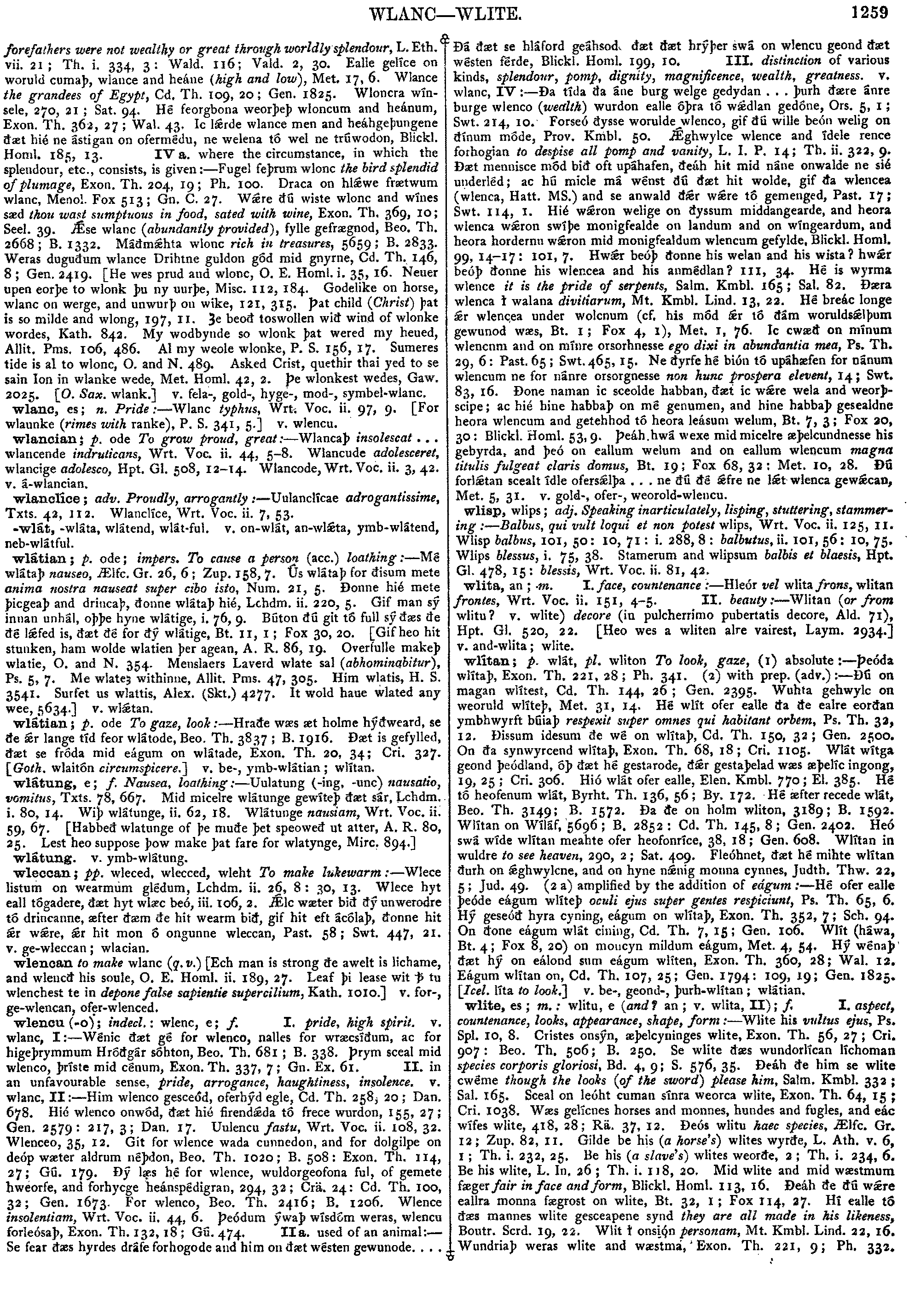
wlítan;
p.
wlát,
pl.
wliton
To
look,
gaze,
(1)
absolute:--Þeóda
wlítaþ,
Exon.
Th.
221,
28;
Ph.
341.
(2)
with
prep.
(adv.):--Ðú
on
magan
wlítest,
Cd.
Th.
144,
26;
Gen.
2395.
Wuhta
gehwylc
on
weoruld
wlíteþ,
Met.
31,
14.
Hé
wlít
ofer
ealle
ða
ðe
ealre
eorðan
ymbhwyrft
búiaþ
respexit
super
omnes
qui
habitant
orbrm,
Ps.
Th.
32,
12.
Ðissum
idesum
ðe
wé
on
wlítaþ,
Cd.
Th.
150,
32;
Gen.
2500.
On
ða
synwyrcend
wlítaþ,
Exon.
Th.
68,
18;
Cri.
1105.
Wlát
wítga
geond
þeódland,
óþ
ðæt
hé
gestarode,
ðr
gestaþelad
wæs
æþelíc
ingong,
19,
25;
Cri.
306.
Hió
wlát
ofer
ealle,
Elen.
Kmbl.
770;
El.
385.
Hé
tó
heofenum
wlát,
Byrht.
Th.
136,
56;
By.
172.
Hé
æfter
recede
wlát,
Beo.
Th.
3149;
B.
1572.
Ða
ðe
on
holm
wliton,
3189;
B.
1592.
Wlítan
on
Wíláf,
5696;
B.
2852:
Cd.
Th.
145,
8;
Gen.
2402.
Heó
swá
wíde
wlítan
meahte
ofer
heofonríce,
38,
18;
Gen.
608.
Wlítan
in
wuldre
to
see
heaven,
290,
2;
Sat.
409.
Fleóhnet,
ðæt
hé
mihte
wlítan
ðurh
on
ghwylcne,
and
on
hyne
nnig
monna
cynnes,
Judth.
Thw.
22,
5;
Jud.
49.
(2
a)
amplified
by
the
addition
of
eágum:--Hé
ofer
ealle
þeóde
eágum
wlíteþ
oculi
ejus
super
gentes
respiciunt,
Ps.
Th.
65,
6.
Hý
geseóð
hyra
cyning,
eágum
on
wlítaþ,
Exon.
Th.
352,
7;
Sch.
94.
On
ðone
eágum
wlát
cining,
Cd.
Th.
7,
15;
Gen.
106.
Wlít
(háwa,
Bt.
4;
Fox
8,
20)
on
moncyn
mildum
eágum,
Met.
4,
54.
Hý
wénaþ
ðæt
hý
on
eálond
sum
eágum
wlíten,
Exon.
Th.
360,
28;
Wal.
12.
Eágum
wlítan
on,
Cd.
Th.
107,
25;
Gen.
1794:
109,
19;
Gen.
1825.
[Icel.
líta
to
look.]
v.
be-,
geond-,
þurh-wlítan;
wlátian.
|
Source: Bosworth/Toller, page d0089, entry 13 View original page image as: [TIFF] [PNG] [View previous entry] [View next entry] |
[Comment on this entry] [View comments] |
The following entry has been hand-corrected once. |
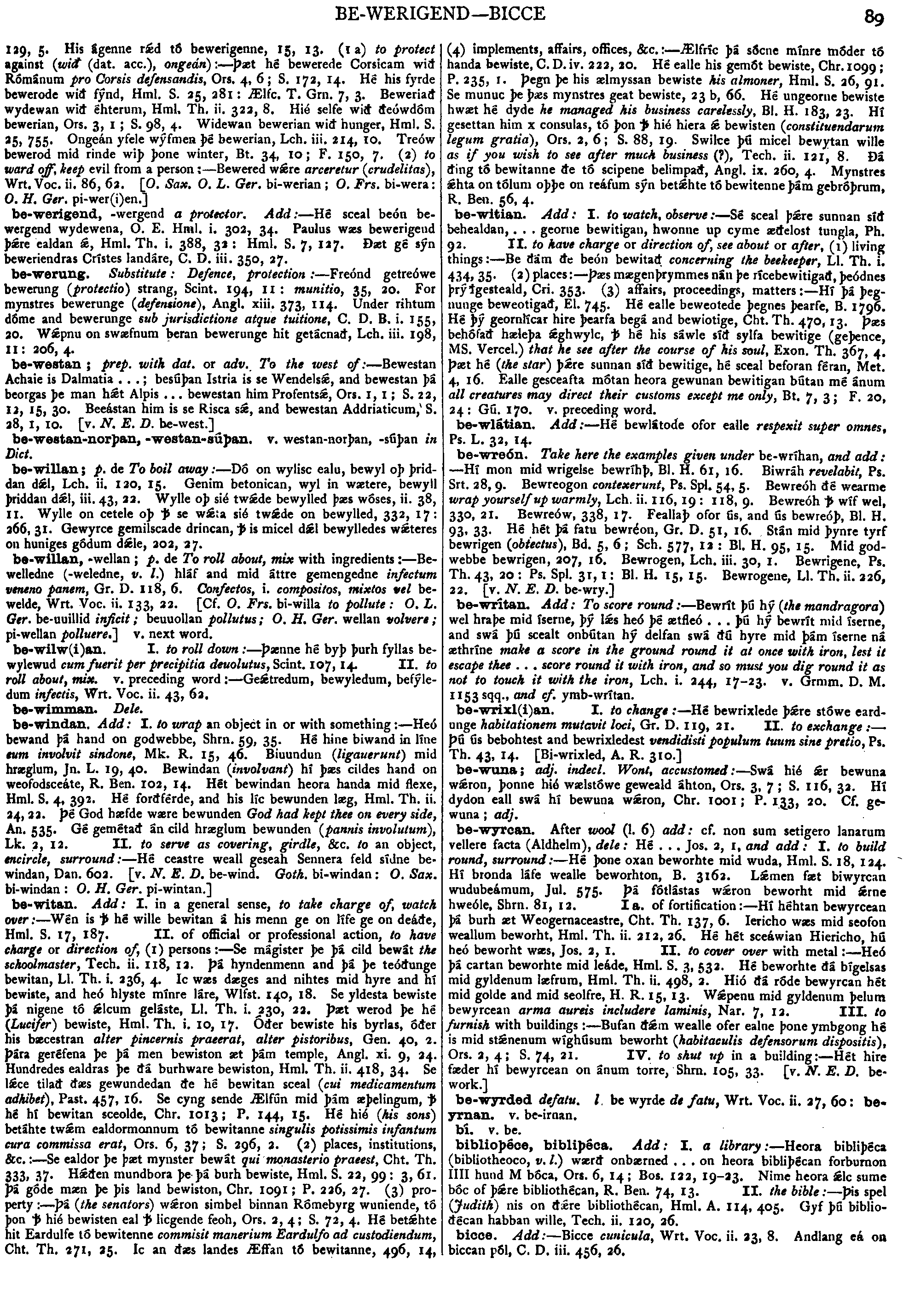
be-wlátian. Add :-- Hé bewlátode ofor ealle respexit super omnes, Ps. L. 32, 14.
| Result Page: | 1 2 | Next |  |
Germanic Lexicon Project (main page)
This search system was written by
Sean Crist
Please consider
volunteering
to correct the data in these online dictionaries.
No rights reserved. Feel free to use these data in any way you please.