|
|

Tip: In the search results, you can click on any word or abbreviation for more information.
|
Source: Bosworth/Toller, page d0523, entry 5 View original page image as: [TIFF] [PNG] [View previous entry] [View next entry] |
[Comment on this entry] [View comments] |
The following entry has been hand-corrected once. |
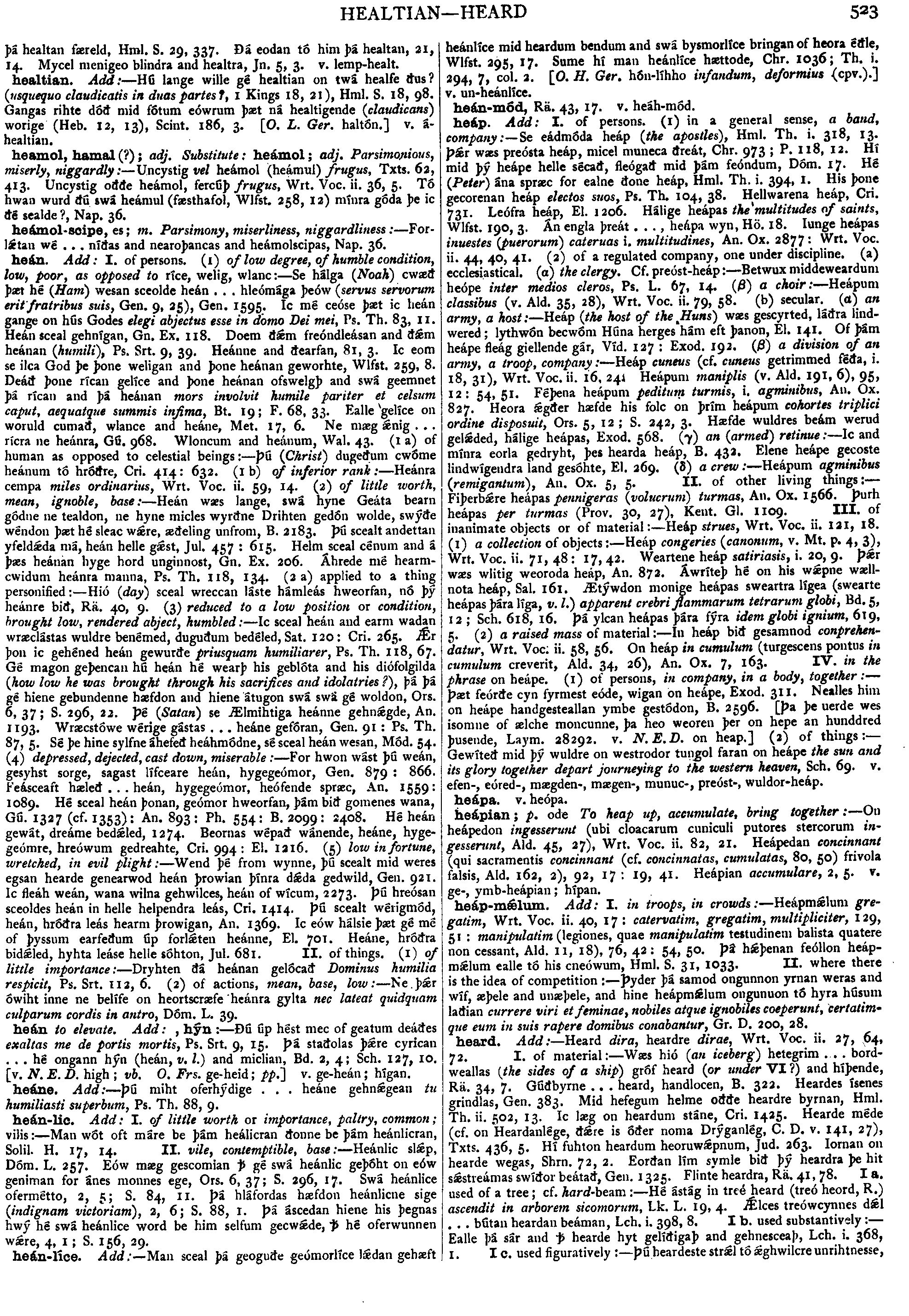
heán.
Add;
I.
of
persons.
(1)
of
low
degree,
of
humble
condition,
low,
poor,
as
opposed
to
ríce,
welig,
wlanc
:--
Se
hálga
(Noah)
cwæð
þæt
hé
(Ham)
wesan
sceolde
heán
.
.
.
hleómága
þeów
(servus
servorum
erit
fratribus
suis,
Gen.
9,
25),
Gen.
1595.
Ic
mé
ceóse
þæt
ic
heán
gange
on
hús
Godes
elegi
abjectus
esse
in
domo
Dei
mei,
Ps.
Th.
83,
11.
Heán
sceal
gehnígan,
Gn.
Ex.
118.
Doem
þ m
freóndleásan
and
ðm
heánan
(humili),
Ps.
Srt.
9,
39.
Heánne
and
ðearfan,
81,
3.
Ic
eom
se
ilca
God
þe
þone
weligan
and
þone
heánan
geworhte,
Wlfst.
259,
8.
Deáð
þone
rícan
gelíce
and
þone
heánan
ofswelgþ
and
swá
geemnet
þá
rícan
and
þá
heánan
mors
involvit
humile
pariter
et
celsum
caput,
aequatque
summis
infima,
Bt.
19;
F.
68,
33.
Ealle
gelíce
on
woruld
cumað,
wlance
and
heáne,
Met.
17,
6.
Ne
mæg
nig
.
.
.
rícra
ne
heánra,
Gú.
968.
Wloncum
and
heánum.
Wal.
43.
(1
a)
of
human
as
opposed
to
celestial
beings
:--
Ðú
(Christ)
dugeðum
cwóme
heánum
tó
hróðre,
Cri.
414:
632.
(1
b)
of
inferior
rank
:--
Heánra
cempa
miles
ordinarius,
Wrt.
Voc.
ii.
59,
14.
(2)
of
little
worth,
mean,
ignoble,
base
:--
Heán
waes
lange,
swá
hyne
Geáta
bearn
gódne
ne
tealdon,
ne
hyne
micles
wyrðne
Drihten
gedón
wolde,
swýðe
wéndon
þæt
hé
sleac
wre,
æðeling
unfrom,
B.
2183.
Ðú
scealt
andettan
yfeldda
má,
heán
helle
gst.
Jul.
457
:
615.
Helm
sceal
cénum
and
á
þæs
heánan
hyge
hord
unginnost,
Gn.
Ex.
206.
Áhrede
mé
hearmcwidum
heánra
manna,
Ps.
Th.
118,
134.
(2
a)
applied
to
a
thing
personified
:--
Hió
(day)
sceal
wreccan
láste
hámleás
hweorfan,
nó
þý
heánre
bið,
Rä.
40,
9.
(3)
reduced
to
a
low
position
or
condition,
brought
low,
rendered
abject,
humbled
:--
Ic
sceal
heán
and
earm
wadan
wræclástas
wuldre
benémed,
duguðum
bedéled,
Sat.
120:
Cri.
265.
Æ-acute;r
þon
ic
gehéned
heán
gewurðe
priusquam
humiliarer,
Ps.
Th.
118,
67.
Gé
magon
geþencan
hú
heán
hé
wearþ
his
geblóta
and
his
diófolgilda
(how
low
he
was
brought
through
his
sacrifices
and
idolatries
?),
þá
þá
gé
hiene
gebundenne
hæfdon
and
hiene
átugon
swá
swá
gé
woldon,
Ors.
6,
37;
S.
296,
22.
Þé
(Satan)
se
Ælmihtiga
heánne
gehngde,
An.
1193.
Wræcstówe
wérige
gástas
.
.
.
heáne
gefóran,
Gen.
91:
Ps.
Th.
87,
5.
Sé
þe
hine
sylfne
áhefeð
heáhmódne,
sé
sceal
heán
wesan,
Mód.
54.
(4)
depressed,
dejected,
cast
down,
miserable
:--
For
hwon
wást
þú
weán,
gesyhst
sorge,
sagast
lífceare
heán,
hygegeómor,
Gen.
879
:
866.
Feasceaft
hæleð
.
.
.
heán,
hygegeómor,
heófende
spræc,
An.
1559:
1089.
Hé
sceal
heán
þonan,
geómor
hweorfan,
þám
bið
gomenes
wana,
Gú.
1327
(cf.
1353):
An.
893:
Ph.
554:
B.
2099:
2408.
Hé
heán
gewát,
dreáme
bedled,
1274.
Beornas
wépað
wánende,
heáne,
hygegeómre,
hreówum
gedreahte,
Cri.
994:
El.
1216.
(5)
low
in
fortune,
wretched,
in
evil
plight
:--
Wend
þé
from
wynne,
þú
scealt
mid
weres
egsan
hearde
genearwod
heán
þrowian
þínra
dda
gedwild,
Gen.
921.
Ic
fleáh
weán,
wana
wilna
gehwilces,
heán
of
wícum,
2273.
Þú
hreósan
sceoldes
heán
in
helle
helpendra
leás,
Cri.
1414.
Þú
scealt
wérigmód,
heán,
hróðra
leás
hearm
þrowigan,
An.
1369.
Ic
eów
hálsie
þæt
gé
mé
of
þyssum
earfeðum
úp
forlten
heánne,
El.
701.
Heáne,
hróðra
bidled,
hyhta
leáse
helle
sóhton.
Jul.
681.
II.
of
things.
(1)
of
little
importance
:--
Dryhten
ðá
heánan
gelócað
Dominus
humilia
respicit,
Ps.
Srt.
112,
6.
(2)
of
actions,
mean,
base,
low
:--
Ne
þr
ówiht
inne
ne
belífe
on
heortscræfe
heánra
gylta
nec
laleat
guidquam
culparum
cordis
in
antro,
Dóm.
L.
m
freóndleásan
and
ðm
heánan
(humili),
Ps.
Srt.
9,
39.
Heánne
and
ðearfan,
81,
3.
Ic
eom
se
ilca
God
þe
þone
weligan
and
þone
heánan
geworhte,
Wlfst.
259,
8.
Deáð
þone
rícan
gelíce
and
þone
heánan
ofswelgþ
and
swá
geemnet
þá
rícan
and
þá
heánan
mors
involvit
humile
pariter
et
celsum
caput,
aequatque
summis
infima,
Bt.
19;
F.
68,
33.
Ealle
gelíce
on
woruld
cumað,
wlance
and
heáne,
Met.
17,
6.
Ne
mæg
nig
.
.
.
rícra
ne
heánra,
Gú.
968.
Wloncum
and
heánum.
Wal.
43.
(1
a)
of
human
as
opposed
to
celestial
beings
:--
Ðú
(Christ)
dugeðum
cwóme
heánum
tó
hróðre,
Cri.
414:
632.
(1
b)
of
inferior
rank
:--
Heánra
cempa
miles
ordinarius,
Wrt.
Voc.
ii.
59,
14.
(2)
of
little
worth,
mean,
ignoble,
base
:--
Heán
waes
lange,
swá
hyne
Geáta
bearn
gódne
ne
tealdon,
ne
hyne
micles
wyrðne
Drihten
gedón
wolde,
swýðe
wéndon
þæt
hé
sleac
wre,
æðeling
unfrom,
B.
2183.
Ðú
scealt
andettan
yfeldda
má,
heán
helle
gst.
Jul.
457
:
615.
Helm
sceal
cénum
and
á
þæs
heánan
hyge
hord
unginnost,
Gn.
Ex.
206.
Áhrede
mé
hearmcwidum
heánra
manna,
Ps.
Th.
118,
134.
(2
a)
applied
to
a
thing
personified
:--
Hió
(day)
sceal
wreccan
láste
hámleás
hweorfan,
nó
þý
heánre
bið,
Rä.
40,
9.
(3)
reduced
to
a
low
position
or
condition,
brought
low,
rendered
abject,
humbled
:--
Ic
sceal
heán
and
earm
wadan
wræclástas
wuldre
benémed,
duguðum
bedéled,
Sat.
120:
Cri.
265.
Æ-acute;r
þon
ic
gehéned
heán
gewurðe
priusquam
humiliarer,
Ps.
Th.
118,
67.
Gé
magon
geþencan
hú
heán
hé
wearþ
his
geblóta
and
his
diófolgilda
(how
low
he
was
brought
through
his
sacrifices
and
idolatries
?),
þá
þá
gé
hiene
gebundenne
hæfdon
and
hiene
átugon
swá
swá
gé
woldon,
Ors.
6,
37;
S.
296,
22.
Þé
(Satan)
se
Ælmihtiga
heánne
gehngde,
An.
1193.
Wræcstówe
wérige
gástas
.
.
.
heáne
gefóran,
Gen.
91:
Ps.
Th.
87,
5.
Sé
þe
hine
sylfne
áhefeð
heáhmódne,
sé
sceal
heán
wesan,
Mód.
54.
(4)
depressed,
dejected,
cast
down,
miserable
:--
For
hwon
wást
þú
weán,
gesyhst
sorge,
sagast
lífceare
heán,
hygegeómor,
Gen.
879
:
866.
Feasceaft
hæleð
.
.
.
heán,
hygegeómor,
heófende
spræc,
An.
1559:
1089.
Hé
sceal
heán
þonan,
geómor
hweorfan,
þám
bið
gomenes
wana,
Gú.
1327
(cf.
1353):
An.
893:
Ph.
554:
B.
2099:
2408.
Hé
heán
gewát,
dreáme
bedled,
1274.
Beornas
wépað
wánende,
heáne,
hygegeómre,
hreówum
gedreahte,
Cri.
994:
El.
1216.
(5)
low
in
fortune,
wretched,
in
evil
plight
:--
Wend
þé
from
wynne,
þú
scealt
mid
weres
egsan
hearde
genearwod
heán
þrowian
þínra
dda
gedwild,
Gen.
921.
Ic
fleáh
weán,
wana
wilna
gehwilces,
heán
of
wícum,
2273.
Þú
hreósan
sceoldes
heán
in
helle
helpendra
leás,
Cri.
1414.
Þú
scealt
wérigmód,
heán,
hróðra
leás
hearm
þrowigan,
An.
1369.
Ic
eów
hálsie
þæt
gé
mé
of
þyssum
earfeðum
úp
forlten
heánne,
El.
701.
Heáne,
hróðra
bidled,
hyhta
leáse
helle
sóhton.
Jul.
681.
II.
of
things.
(1)
of
little
importance
:--
Dryhten
ðá
heánan
gelócað
Dominus
humilia
respicit,
Ps.
Srt.
112,
6.
(2)
of
actions,
mean,
base,
low
:--
Ne
þr
ówiht
inne
ne
belífe
on
heortscræfe
heánra
gylta
nec
laleat
guidquam
culparum
cordis
in
antro,
Dóm.
L.
|
Source: Bosworth/Toller, page d0559, entry 8 View original page image as: [TIFF] [PNG] [View previous entry] [View next entry] |
[Comment on this entry] [View comments (1)] |
The following entry has been hand-corrected once. |
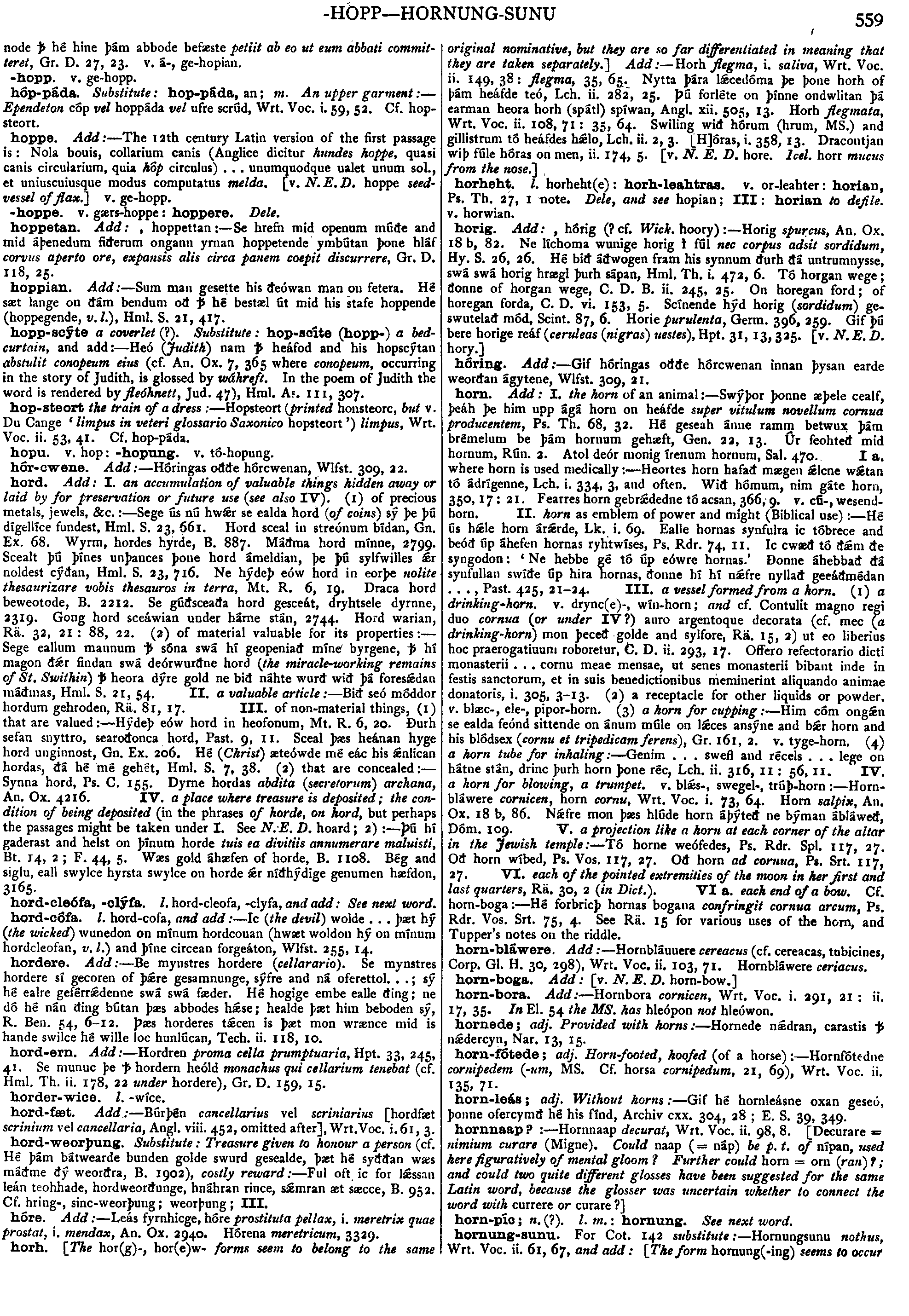
hopp-sc te
a
coverlet
(?).
Substitute:
hop-sc
te
a
coverlet
(?).
Substitute:
hop-sc te
(hopp-)
a
bed-curtain,
and
add
:--
Heó
(Judith)
nam
te
(hopp-)
a
bed-curtain,
and
add
:--
Heó
(Judith)
nam
 heáfod
and
his
hopsctan
abstulit
conopeum
eius
(cf.
An.
Ox.
7,
365
where
conopeum,
occurring
in
the
story
of
Judith,
is
glossed
by
wáhreft.
In
the
poem
of
Judith
the
word
is
rendered
byfleóhnett,
Jud.
47),
Hml.
As.
III,
307.
heáfod
and
his
hopsctan
abstulit
conopeum
eius
(cf.
An.
Ox.
7,
365
where
conopeum,
occurring
in
the
story
of
Judith,
is
glossed
by
wáhreft.
In
the
poem
of
Judith
the
word
is
rendered
byfleóhnett,
Jud.
47),
Hml.
As.
III,
307.
|
Source: Bosworth/Toller, page d0564, entry 7 View original page image as: [TIFF] [PNG] [View previous entry] [View next entry] |
[Comment on this entry] [View comments] |
The following entry has been hand-corrected once. |
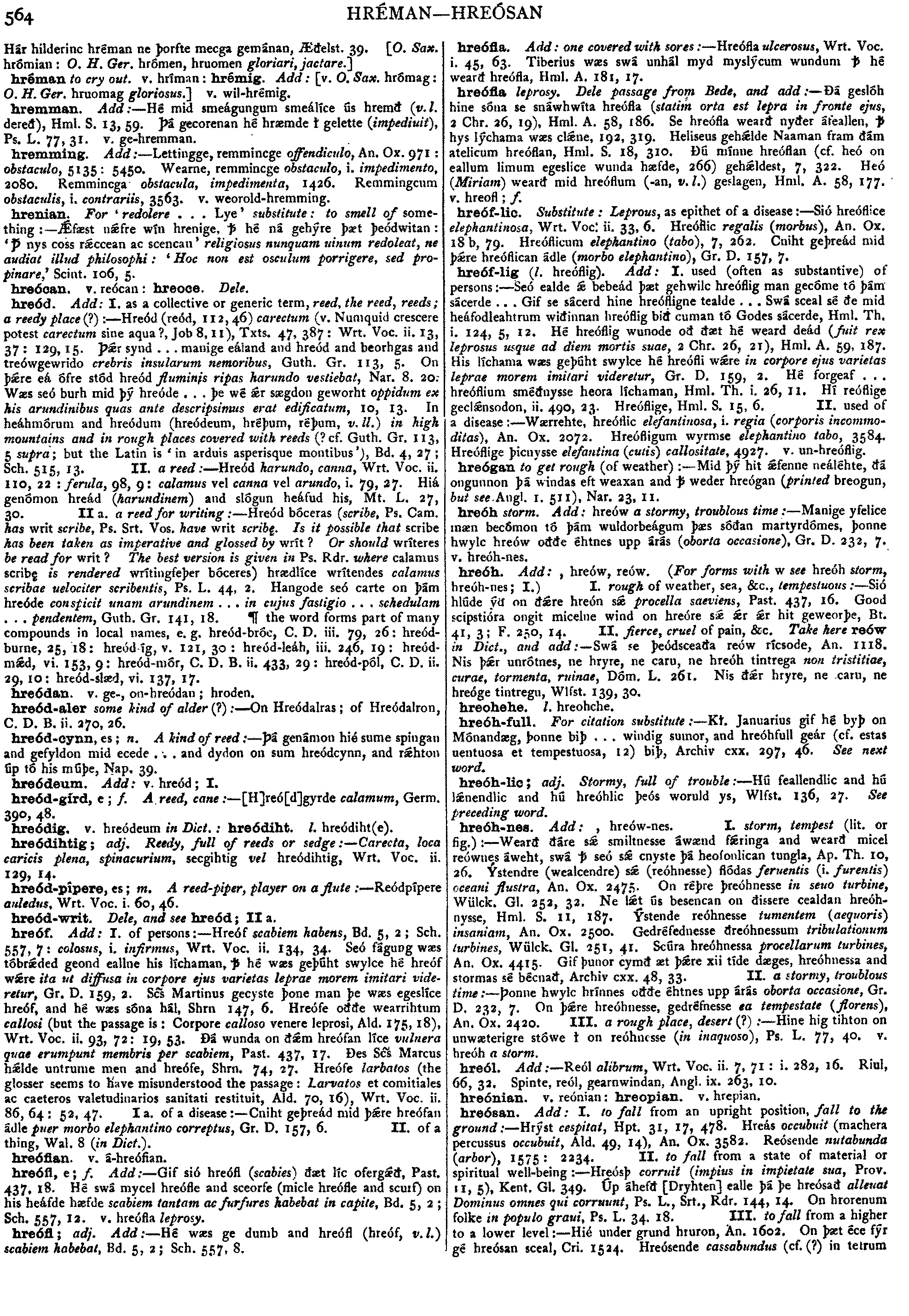
hreód.
Add:
I.
as
a
collective
or
generic
term,
reed,
the
reed,
reeds;
a
reedy
place(?):--Hreód
(reód,
112,
46)
carectum
(v.
Numquid
crescere
potest
carectum
sine
aqua?,
Job
8,
11),
Txts.
47,
387:
Wrt.
Voc.
ii.
13,
37:
129,
15.
Þr
synd
.
.
.
manige
eáland
and
hreód
and
beorhgas
and
treówgewrido
crebris
insularum
nemoribus,
Guth.
Gr.
113,
5.
On
þre
eá
ófre
stód
hreód
fluminis
ripas
harundo
vestiebat,
Nar.
8.
20.
Wæs
seó
burh
mid
þý
hreóde
.
.
.
þe
wé
r
sægdon
geworht
oppidum
ex
his
arundinibus
quas
ante
descripsimus
erat
edificatum,
10,
13.
In
heáhmórum
and
hreódum
(hreódeum,
hréþum,
réþum,
v.
ll.)
in
high
mountains
and
in
rough
places
covered
with
reeds
(?
cf.
Guth.
Gr.
113,
5
supra;
but
the
Latin
is
'in
arduis
asperisque
montibus'),
Bd.
4,
27;
Sch.
515,
13.
II.
a
reed:--Hreód
harundo,
canna,
Wrt.
Voc.
ii.
110,
22:
ferula,
98,
9:
calamus
vel
canna
vel
arundo,
i.
79,
27.
Hiá
genómon
hreád
(harundinem)
and
slógun
heáfud
his,
Mt.
L.
27,
30.
II
a.
a
reed
for
writing:--Hreód
bóceras
(scribe,
Ps.
Cam.
has
writ
scribe,
Ps.
Srt.
Vos.
have
writ
scrib .
Is
it
possible
that
scribe
has
been
taken
as
imperative
and
glossed
by
wrít?
Or
should
wríteres
be
read
for
writ?
The
best
version
is
given
in
Ps.
Rdr.
where
calamus
scrib,
is
rendered
wrítingfeþer
bóceres)
hrædlíce
wrítendes
calamus
scribae
uelociter
scribentis,
Ps.
L.
44,
2.
Hangode
seó
carte
on
þám
hreóde
conspicit
unam
arundinem
.
.
.
in
cujus
fastigio
.
.
.
schedulam
.
.
.
pendentem,
Guth.
Gr.
141,
18.

the
word
forms
part
of
many
compounds
in
local
names,
e.
g.
hreód-bróc,
C.
D.
iii.
79,
26:
hreód-burne,
25,
18:
hreód-
íg,
v.
121,
30:
hreód-leáh,
iii.
246,
19:
hreód-md,
vi.
153,
9:
hreód-mór,
C.
D.
B.
ii.
433,
29:
hreód-pól,
C.
D.
ii.
29,
10:
hreód-slæd,
vi.
137,
17.
.
Is
it
possible
that
scribe
has
been
taken
as
imperative
and
glossed
by
wrít?
Or
should
wríteres
be
read
for
writ?
The
best
version
is
given
in
Ps.
Rdr.
where
calamus
scrib,
is
rendered
wrítingfeþer
bóceres)
hrædlíce
wrítendes
calamus
scribae
uelociter
scribentis,
Ps.
L.
44,
2.
Hangode
seó
carte
on
þám
hreóde
conspicit
unam
arundinem
.
.
.
in
cujus
fastigio
.
.
.
schedulam
.
.
.
pendentem,
Guth.
Gr.
141,
18.

the
word
forms
part
of
many
compounds
in
local
names,
e.
g.
hreód-bróc,
C.
D.
iii.
79,
26:
hreód-burne,
25,
18:
hreód-
íg,
v.
121,
30:
hreód-leáh,
iii.
246,
19:
hreód-md,
vi.
153,
9:
hreód-mór,
C.
D.
B.
ii.
433,
29:
hreód-pól,
C.
D.
ii.
29,
10:
hreód-slæd,
vi.
137,
17.
|
Source: Bosworth/Toller, page d0592, entry 12 View original page image as: [TIFF] [PNG] [View previous entry] [View next entry] |
[Comment on this entry] [View comments] |
The following entry has been hand-corrected once. |
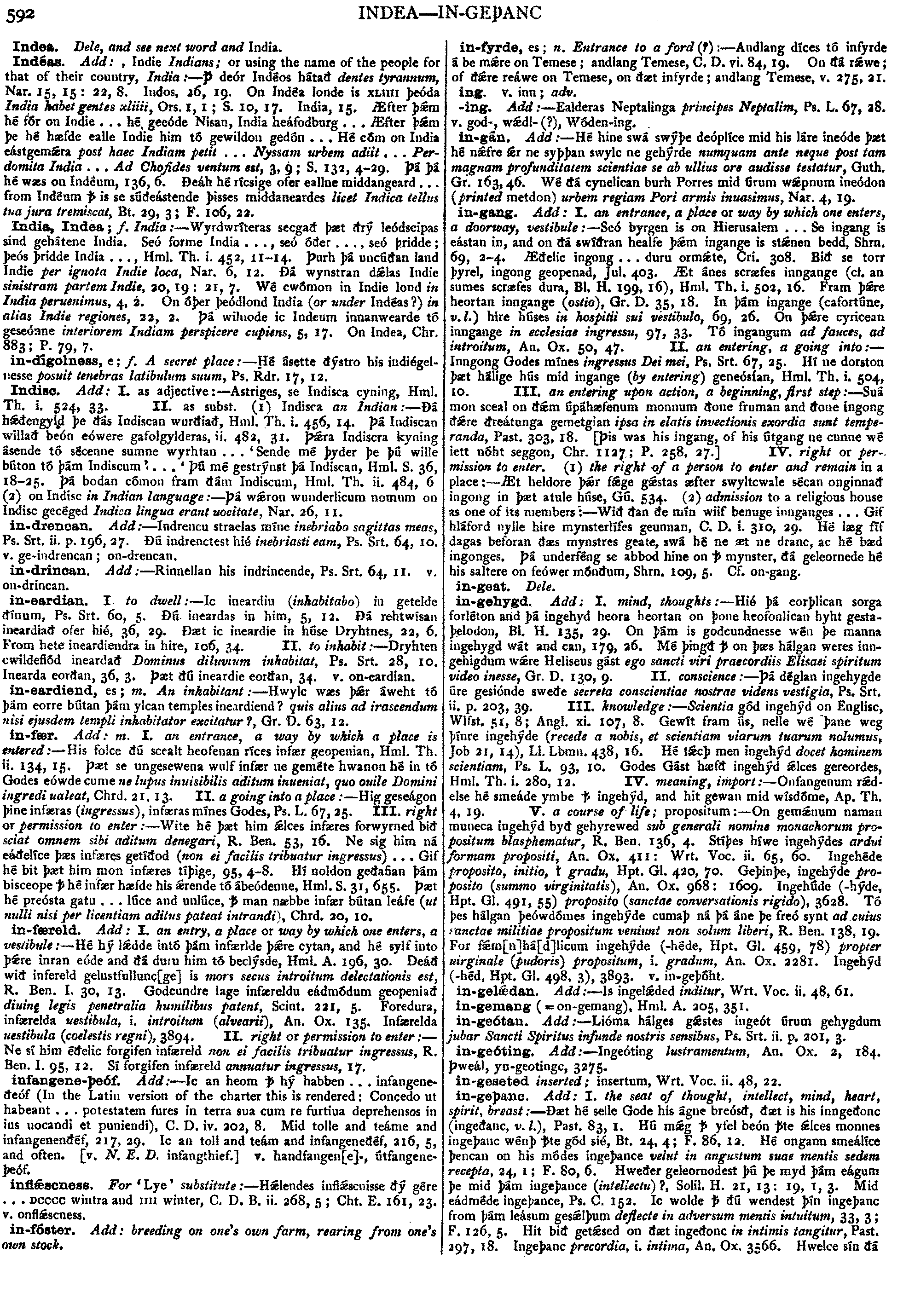
infangene-þeóf.
Add
:--
Ic
an
heom
hý
habben
...
infangeneðeóf
(In
the
Latin
version
of
the
charter
this
is
rendered:
Concedo
ut
habeant
...
potestatem
fures
in
terra
sua
cum
re
furtiua
deprehensos
in
ios
uocandi
et
puniendi),
C.D.
iv.
202,
8.
Mid
tolle
and
teáme
and
infangenenðéf,
217,
29.
Ic
an
toll
and
teám
and
infangeneðéf,
216,
5,
and
often,
[v.
N.E.D.
infangthief.]
v.
handfangen[e]-,
útfangene-þeóf.
|
Source: Bosworth/Toller, page d0619, entry 11 View original page image as: [TIFF] [PNG] [View previous entry] [View next entry] |
[Comment on this entry] [View comments] |
The following entry has been hand-corrected once. |
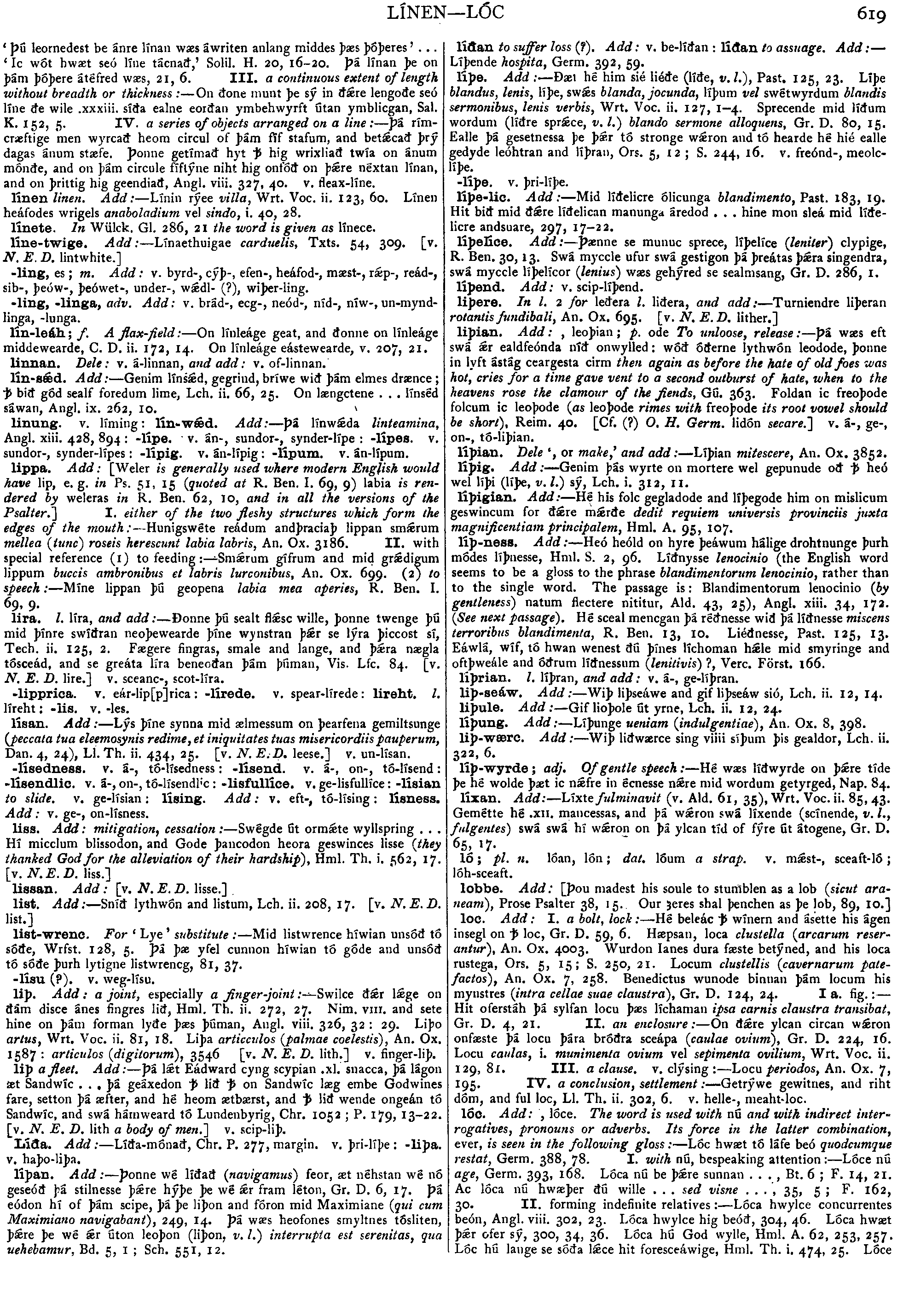
lippa.
Add:
[Weler
is
generally
used
where
modern
English
would
have
lip,
e.
g.
in
Ps.
51,
15
(quoted
at
R.
Ben.
I.
69,
9)
labia
is
rendered
by
weleras
in
R.
Ben.
62,
10,
and
in
all
the
versions
of
the
Psalter.]
I.
either
of
the
two
fleshy
structures
which
form
the
edges
of
the
mouth:
--
Hunigswéte
reádum
andþraciaþ
lippan
smrum
mellea
(tune)
roseis
herescunt
labia
labris,
An.
Ox.
3186.
II.
with
special
reference
(1)
to
feeding
:--
Smrum
gífrum
and
mid
grdigum
lippum
buccis
ambronibus
et
labris
lurconibus.
An.
Ox.
699.
(2)
to
speech
:--
Míne
lippan
þú
geopena
labia
mea
aperies,
R.
Ben.
I.
69,
9.
|
Source: Bosworth/Toller, page d0759, entry 1 View original page image as: [TIFF] [PNG] [View previous entry] [View next entry] |
[Comment on this entry] [View comments] |
The following entry has been hand-corrected once. |
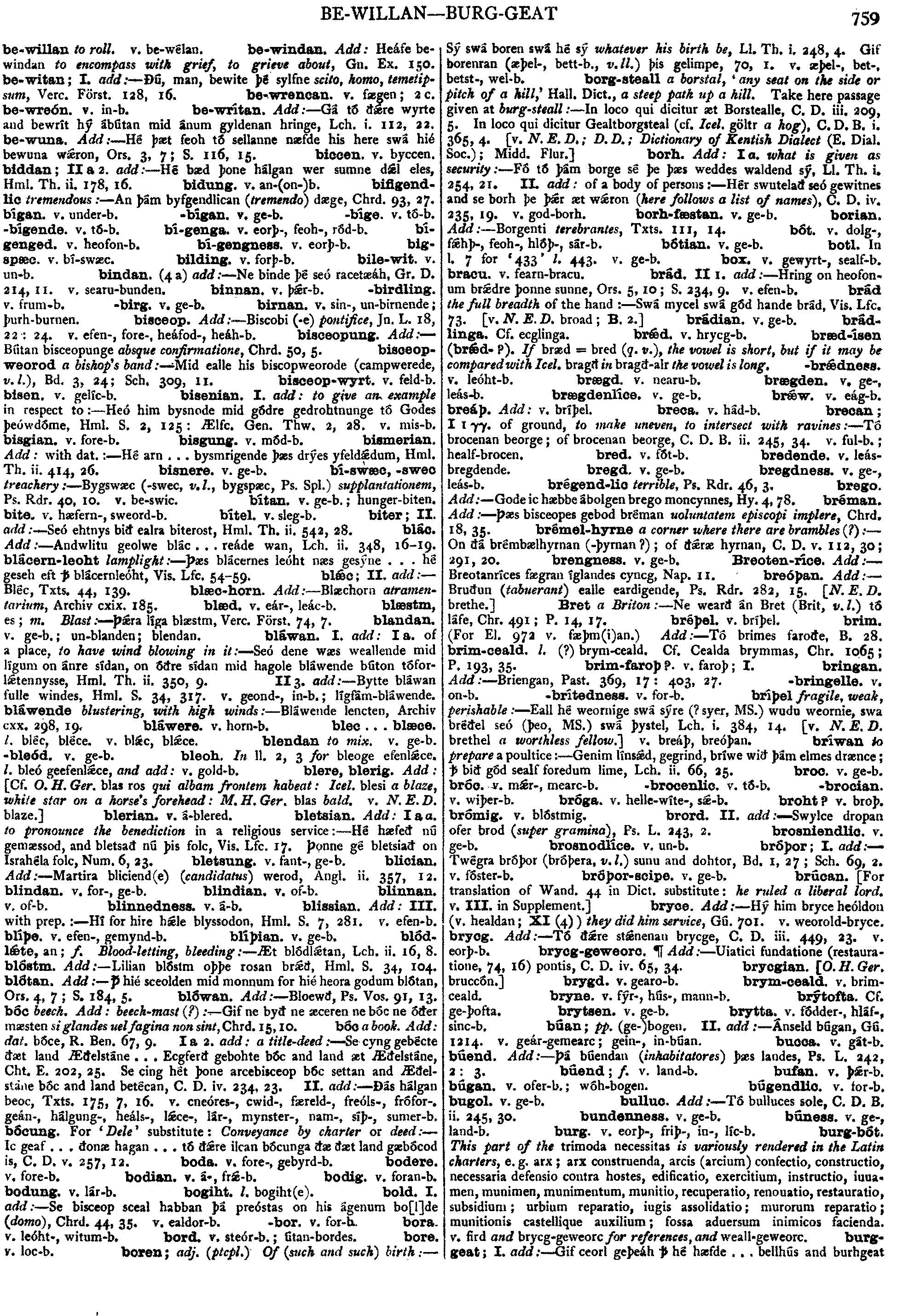
be-willan
to
roll,
v.
be-wélan.
be-windan.
Add:
Heáfe
bewindan
to
encompass
with
grief,
to
grieve
about,
Gn.
Ex.
150.
be-witan;
I.
add
:--
Ðú,
man,
bewite
þé
sylfne
scito,
homo,
temetipsum,
Verc.
Först.
128,
16.
be-wrencan.
v.
fægen;
2
c.
be-wreón.
v.
in-b.
be-wrítan.
Add
:--
Gá
tó
ðre
wyrte
and
bewrít
hý
ábútan
mid
ánum
gyldenan
hringe,
Lch.
i.
112,
22.
be-wuna.
Add
:--
Hé
þæt
feoh
tó
sellanne
næfde
his
here
swá
hié
bewuna
wron,
Ors.
3,
7;
S.
116,
15.
biccen.
v.
byccen.
biddan;
II
a
2.
add
:--
Hé
bæd
þone
hálgan
wer
sumne
dl
eles,
Hml.
Th.
ii.
178,
16.
bidung.
v.
an-(on-)b.
bifigendlic
tremendous
:--
An
þám
byfgendlican
(tremendo)
dæge,
Chrd.
93,
27.
bígan.
v.
under-b.
-bígan.
v.
ge-b.
-bíge.
v.
tó-b.
-bígende.
v.
tó-b.
bí-genga.
v.
eorþ-,
feoh-,
ród-b.
bí-genged.
v.
heofon-b.
bí-gengness.
v.
eorþ-b.
big-spæc.
v.
bí-swæc.
bilding.
v.
forþ-b.
bile-wit.
v.
un-b.
bindan.
(4
a)
add
:--
Ne
binde
þé
seó
racetæáh,
Gr.
D.
214,
11.
v.
searu-bunden.
binnan.
v.
þr-b.
-birdling.
v.
frum-b.
-birg.
v.
ge-b.
birnan.
v.
sin-,
un-birnende;
þurh-burnen.
bisceop.
Add
:--
Biscobi
(-e)
pontifice,
Jn.
L.
18,
22:
24.
v.
efen-,
fore-,
heáfod-,
heáh-b.
bisceopung.
Add
:--
Bútan
bisceopunge
absque
confirmatione,
Chrd.
50,
5.
bisceop-weorod
a
bishop's
band
:--
Mid
ealle
his
biscopweorode
(campwerede,
v.
l.),
Bd.
3,
24;
Sch.
309,
11.
bisceop-wyrt.
v.
feld-b.
bisen.
v.
gelíc-b.
bisenian.
I.
add:
to
give
an
example
in
respect
to
:--
Heó
him
bysnode
mid
gódre
gedrohtnunge
tó
Godes
þeówdóme,
Hml.
S.
2,
125:
Ælfc.
Gen.
Thw.
2,
28.
v.
mis-b.
bisgian.
v.
fore-b.
bisgung.
v.
mód-b.
bismerian.
Add:
with
dat.
:--
He
arn
...
bysmrigende
þæs
drýes
yfelddum,
Hml.
Th.
ii.
414,
26.
bisnere.
v.
ge-b.
bí-swæc,
-swec
treachery
:--
Bygswæc
(-swec,
v.
l.,
bygspæc,
Ps.
Spl.)
supplantationem,
Ps.
Rdr.
40,
10.
v.
be-swic.
bítan.
v.
ge-b.;
hunger-biten.
bite.
v.
hæfern-,
sweord-b.
bítel.
v.
sleg-b.
biter;
II.
add
:--
Seó
ehtnys
bið
ealra
biterost,
Hml.
Th.
ii.
542,
28.
blác.
Add
:--
Andwlitu
geolwe
blác
...
reáde
wan,
Lch.
ii.
348,
16-19.
blácern-leoht
lamplight
:--
Þæs
blácernes
leóht
næs
gesýne
...
hé
geseh
eft
blácernleóht,
Vis.
Lfc.
54-59.
blc;
II.
add
:--
Bléc,
Txts.
44,
139.
blæc-horn.
Add
:--
Blæchorn
atramentarium,
Archiv
cxix.
185.
blæd,
v.
eár-,
leác-b.
blæstm,
es;
m.
Blast
:--
Þra
líga
blæstm,
Verc.
Först.
74,
7.
blandan.
v.
ge-b.;
un-blanden;
blendan.
bláwan.
I.
add:
I
a.
of
a
place,
to
have
wind
blowing
in
it
:--
Seó
dene
wæs
weallende
mid
lígum
on
ánre
sídan,
on
óðre
sídan
mid
hagole
bláwende
búton
tóforltennysse,
Hml.
Th.
ii.
350,
9.
II
3.
add
:--
Bytte
bláwan
fulle
windes.
Hml.
S.
34,
317.
v.
geond-,
in-b.;
lígfám-bláwende.
bláwende
blustering,
with
high
winds
:--
Bláwende
lencten,
Archiv
cxx.
298,
19.
bláwere.
v.
horn-b.
blec
...
blæce.
l.
bléc,
bléce.
v.
blc,
blce.
blendan
to
mix,
v.
ge-b.
-bleód.
v.
ge-b.
bleoh.
In
ll.
2,
3
for
bleoge
efenlce.
l.
bleó
geefenlce,
and
add:
v.
gold-b.
blere,
blerig.
Add:
[Cf.
O.
H.
Ger.
blas
ros
qui
albam
frontem
habeat:
Icel.
blesi
a
blaze,
white
star
on
a
horse's
forehead:
M.
H.
Ger.
blas
bald,
v.
N.
E.
D.
blaze.]
blerian.
v.
á-blered.
bletsian.
Add:
I
a
 .
to
pronounce
the
benediction
in
a
religious
service
:--
Hé
hæfeð
nú
gemæssod,
and
bletsað
nú
þis
folc,
Vis.
Lfc.
17.
Þonne
gé
bletsiað
on
Israhéla
folc,
Num.
6,
23.
bletsung.
v.
fant-,
ge-b.
blician.
Add
:--
Martira
bliciend(e)
(candidatus)
werod,
Angl.
ii.
357,
12.
blindan.
v.
for-,
ge-b.
blindian.
v.
of-b.
blinnan.
v.
of-b.
blinnedness.
v.
á-b.
blissian.
Add:
III.
with
prep.
:--
Hí
for
hire
hle
blyssodon,
Hml.
S.
7,
281.
v.
efen-b.
blíþe.
v.
efen-,
gemynd-b.
blíþian.
v.
ge-b.
blod-lte,
an;
f.
Blood-letting,
bleeding
:--
Æt
blódltan,
Lch.
ii.
16,
8.
blostm.
Add
:--
Lilian
blóstm
oþþe
rosan
brð,
Hml.
S.
34,
104.
blótan.
Add
:--
hié
sceolden
mid
monnum
for
hié
heora
godum
blótan,
Ors.
4,
7;
S.
184,
5.
blówan.
Add
:--
Bloewð,
Ps.
Vos.
91,
13.
bóc
beech.
Add:
beech-mast
(?)
:--
Gif
ne
byð
ne
æceren
ne
bóc
ne
oðer
mæsten
si
glandes
uel
fagina
non
sint,
Chrd.
15,
10.
bóc
a
book.
Add:
dat.
bóce,
R.
Ben.
67,
9.
I
a
2.
add:
a
title-deed
:--
Se
cyng
gebécte
ðæt
land
Æðelstáne
...
Ecgferð
gebohte
bóc
and
land
æt
Æðelstáne,
Cht.
E.
202,
25.
Se
cing
hét
þone
arcebisceop
bóc
settan
and
Æðelstáne
bóc
and
land
betécan,
C.
D.
iv.
234,
23.
II.
add
:--
Ðás
hálgan
beoc,
Txts.
175,
7,
16.
v.
cneóres-,
cwid-,
færeld-,
freóls-,
frófor-,
geán-,
hálgung-,
heáls-,
lce-,
lár-,
mynster-,
nam-,
síþ-,
sumer-b.
bócung.
For
'Dele'
substitute:
Conveyance
by
charter
or
deed
:--
Ic
geaf
...
ðonæ
hagan
...
tó
ðre
ilcan
bócunga
ðæ
ðæt
land
gæbócod
is,
C.
D.
v.
257,
12.
boda.
v.
fore-,
gebyrd-b.
bodere.
v.
fore-b.
bodian.
v.
á-,
fr-b.
bodig.
v.
foran-b.
bodung.
v.
lár-b.
bogiht.
l.
bogiht(e).
bold.
I.
add
:--
Se
biseeop
sceal
habban
þá
preóstas
on
his
ágenum
bo[l]de
(domo),
Chrd.
44,
35.
v.
ealdor-b.
-bor.
v.
for-b.
bora.
v.
leóht-,
witum-b.
bord.
v.
steor-b.;
útan-bordes.
bore.
v.
loc-b.
boren;
adj.
(ptcpl.)
Of
(such
and
such)
birth
:--
Sý
swá
boren
swá
hé
sý
whatever
his
birth
be,
Ll.
Th.
i.
248,
4.
Gif
borenran
(æþel-,
bett-b.,
v.
ll.)
þis
gelimpe,
70,
1.
v.
æþel-,
bet-,
betst-,
wel-b.
borg-steall
a
borstal,
'any
seat
on
the
side
or
pitch
of
a
hill,'
Hall.
Dict.,
a
steep
path
up
a
hill.
Take
here
passage
given
at
burg-steall
:--
In
loco
qui
dicitur
æt
Borstealle,
C.
D.
iii.
209,
5.
In
loco
qui
dicitur
Gealtborgsteal
(cf.
Icel.
göltr
a
hog),
C.
D.
B.
i.
365,
4.
[v.
N.
E.
D.;
D.
D.;
Dictionary
of
Kentish
Dialect
(E.
Dial.
Soc.);
Midd.
Flur.]
borh.
Add:
I
a.
what
is
given
as
security
:--
Fó
tó
þam
borge
sé
þe
þæs
weddes
waldend
sý,
Ll.
Th.
i.
254,
21.
II.
add:
of
a
body
of
persons
:--
Hér
swutelað
seó
gewitnes
and
se
borh
þe
þr
æt
wron
(here
follows
a
list
of
names),
C.
D.
iv.
235,
19.
v.
god-borh.
borh-fæstan.
v.
ge-b.
borian.
Add
:--
Borgenti
terebrantes,
Txts.
111,
14.
bót.
v.
dolg-,
fhþ-,
feoh-,
hlóþ-,
sár-b.
bótian.
v.
ge-b.
botl.
In
l.
7
for
'433'
l.
443.
v.
ge-b.
box.
v.
gewyrt-,
sealf-b.
bracu.
v.
fearn-bracu.
brád.
II
1.
add
:--
Hring
on
heofonum
brdre
þonne
sunne,
Ors.
5,
10;
S.
234,
9.
v.
efen-b.
brád
the
full
breadth
of
the
hand
:--
Swá
mycel
swá
gód
hande
brád,
Vis.
Lfc.
73.
[v.
N.
E.
D.
broad;
B.
2.]
brádian.
v.
ge-b.
brádlinga.
Cf.
ecglinga.
brd.
v.
hrycg-b.
bræd-ísen
(brd-
?).
If
bræd
=
bred
(q.
v.),
the
vowel
is
short,
but
if
it
may
be
compared
with
Icel.
bragð
in
bragð-alr
the
vowel
is
long.
-brdness.
v.
leoht-b.
brægd.
v.
nearu-b.
brægden.
v.
ge-,
leás-b.
brægdenlíce.
v.
ge-b.
brw.
v.
eág-b.
breáþ.
Add:
v.
bríþel.
breca.
v.
hád-b.
brecan;
I
1
.
to
pronounce
the
benediction
in
a
religious
service
:--
Hé
hæfeð
nú
gemæssod,
and
bletsað
nú
þis
folc,
Vis.
Lfc.
17.
Þonne
gé
bletsiað
on
Israhéla
folc,
Num.
6,
23.
bletsung.
v.
fant-,
ge-b.
blician.
Add
:--
Martira
bliciend(e)
(candidatus)
werod,
Angl.
ii.
357,
12.
blindan.
v.
for-,
ge-b.
blindian.
v.
of-b.
blinnan.
v.
of-b.
blinnedness.
v.
á-b.
blissian.
Add:
III.
with
prep.
:--
Hí
for
hire
hle
blyssodon,
Hml.
S.
7,
281.
v.
efen-b.
blíþe.
v.
efen-,
gemynd-b.
blíþian.
v.
ge-b.
blod-lte,
an;
f.
Blood-letting,
bleeding
:--
Æt
blódltan,
Lch.
ii.
16,
8.
blostm.
Add
:--
Lilian
blóstm
oþþe
rosan
brð,
Hml.
S.
34,
104.
blótan.
Add
:--
hié
sceolden
mid
monnum
for
hié
heora
godum
blótan,
Ors.
4,
7;
S.
184,
5.
blówan.
Add
:--
Bloewð,
Ps.
Vos.
91,
13.
bóc
beech.
Add:
beech-mast
(?)
:--
Gif
ne
byð
ne
æceren
ne
bóc
ne
oðer
mæsten
si
glandes
uel
fagina
non
sint,
Chrd.
15,
10.
bóc
a
book.
Add:
dat.
bóce,
R.
Ben.
67,
9.
I
a
2.
add:
a
title-deed
:--
Se
cyng
gebécte
ðæt
land
Æðelstáne
...
Ecgferð
gebohte
bóc
and
land
æt
Æðelstáne,
Cht.
E.
202,
25.
Se
cing
hét
þone
arcebisceop
bóc
settan
and
Æðelstáne
bóc
and
land
betécan,
C.
D.
iv.
234,
23.
II.
add
:--
Ðás
hálgan
beoc,
Txts.
175,
7,
16.
v.
cneóres-,
cwid-,
færeld-,
freóls-,
frófor-,
geán-,
hálgung-,
heáls-,
lce-,
lár-,
mynster-,
nam-,
síþ-,
sumer-b.
bócung.
For
'Dele'
substitute:
Conveyance
by
charter
or
deed
:--
Ic
geaf
...
ðonæ
hagan
...
tó
ðre
ilcan
bócunga
ðæ
ðæt
land
gæbócod
is,
C.
D.
v.
257,
12.
boda.
v.
fore-,
gebyrd-b.
bodere.
v.
fore-b.
bodian.
v.
á-,
fr-b.
bodig.
v.
foran-b.
bodung.
v.
lár-b.
bogiht.
l.
bogiht(e).
bold.
I.
add
:--
Se
biseeop
sceal
habban
þá
preóstas
on
his
ágenum
bo[l]de
(domo),
Chrd.
44,
35.
v.
ealdor-b.
-bor.
v.
for-b.
bora.
v.
leóht-,
witum-b.
bord.
v.
steor-b.;
útan-bordes.
bore.
v.
loc-b.
boren;
adj.
(ptcpl.)
Of
(such
and
such)
birth
:--
Sý
swá
boren
swá
hé
sý
whatever
his
birth
be,
Ll.
Th.
i.
248,
4.
Gif
borenran
(æþel-,
bett-b.,
v.
ll.)
þis
gelimpe,
70,
1.
v.
æþel-,
bet-,
betst-,
wel-b.
borg-steall
a
borstal,
'any
seat
on
the
side
or
pitch
of
a
hill,'
Hall.
Dict.,
a
steep
path
up
a
hill.
Take
here
passage
given
at
burg-steall
:--
In
loco
qui
dicitur
æt
Borstealle,
C.
D.
iii.
209,
5.
In
loco
qui
dicitur
Gealtborgsteal
(cf.
Icel.
göltr
a
hog),
C.
D.
B.
i.
365,
4.
[v.
N.
E.
D.;
D.
D.;
Dictionary
of
Kentish
Dialect
(E.
Dial.
Soc.);
Midd.
Flur.]
borh.
Add:
I
a.
what
is
given
as
security
:--
Fó
tó
þam
borge
sé
þe
þæs
weddes
waldend
sý,
Ll.
Th.
i.
254,
21.
II.
add:
of
a
body
of
persons
:--
Hér
swutelað
seó
gewitnes
and
se
borh
þe
þr
æt
wron
(here
follows
a
list
of
names),
C.
D.
iv.
235,
19.
v.
god-borh.
borh-fæstan.
v.
ge-b.
borian.
Add
:--
Borgenti
terebrantes,
Txts.
111,
14.
bót.
v.
dolg-,
fhþ-,
feoh-,
hlóþ-,
sár-b.
bótian.
v.
ge-b.
botl.
In
l.
7
for
'433'
l.
443.
v.
ge-b.
box.
v.
gewyrt-,
sealf-b.
bracu.
v.
fearn-bracu.
brád.
II
1.
add
:--
Hring
on
heofonum
brdre
þonne
sunne,
Ors.
5,
10;
S.
234,
9.
v.
efen-b.
brád
the
full
breadth
of
the
hand
:--
Swá
mycel
swá
gód
hande
brád,
Vis.
Lfc.
73.
[v.
N.
E.
D.
broad;
B.
2.]
brádian.
v.
ge-b.
brádlinga.
Cf.
ecglinga.
brd.
v.
hrycg-b.
bræd-ísen
(brd-
?).
If
bræd
=
bred
(q.
v.),
the
vowel
is
short,
but
if
it
may
be
compared
with
Icel.
bragð
in
bragð-alr
the
vowel
is
long.
-brdness.
v.
leoht-b.
brægd.
v.
nearu-b.
brægden.
v.
ge-,
leás-b.
brægdenlíce.
v.
ge-b.
brw.
v.
eág-b.
breáþ.
Add:
v.
bríþel.
breca.
v.
hád-b.
brecan;
I
1
 .
of
ground,
to
make
uneven,
to
intersect
with
ravines
:--
Tó
brocenan
beorge;
of
brocenan
beorge,
C.
D.
B.
ii.
245,
34.
v.
ful-b.;
healf-brocen.
bred.
v.
fót-b.
bredende.
v.
leás-bregdende.
bregd.
v.
ge-b.
bregdness.
v.
ge-,
leás-b.
brégend-lic
terrible,
Ps.
Rdr.
46,
3.
brego.
Add
:--
Gode
ic
hæbbe
ábolgen
brego
moncynnes,
Hy.
4,
78.
bréman.
Add
:--
Þæs
bisceopes
gebod
bréman
uoluntatem
episcopi
implere,
Chrd.
18,
35.
brémel-hyrne
a
corner
where
there
are
brambles
(?)
:--
On
ðá
brémbælhyrnan
(-þyrnan?);
of
ðræ
hyrnan,
C.
D.
v.
112,
30;
291,
20.
brengness.
v.
ge-b.
Breoten-ríce.
Add
:--
Breotanríces
fægran
íglandes
cyncg,
Nap.
11.
breóþan.
Add
:--
Bruðun
(tabuerant)
ealle
eardigende,
Ps.
Rdr.
282,
15.
[N.
E.
D.
brethe.]
Bret
a
Briton
:--
Ne
wearð
án
Bret
(Brit,
v.
l.)
tó
láfe,
Chr.
491;
P.
14,
17.
bréþel.
v.
bríþel.
brim.
(For
El.
972
v.
fæþm(i)an.)
Add
:--
Tó
brimes
faroðe,
B.
28.
brim-ceald.
l.
(?)
brym-ceald.
Cf.
Cealda
brymmas,
Chr.
1065;
P.
193,
35.
brim-faroþ?.
v.
faroþ;
I.
bringan.
Add
:--
Briengan,
Past.
369,
17:
403,
27.
-bringelle.
v.
on-b.
-brítedness.
v.
for-b.
bríþel
fragile,
weak,
perishable
:--
Eall
hé
weornige
swá
sýre
(?
syer,
MS.)
wudu
weornie,
swa
bréðel
seó
(þeo,
MS.)
swá
þystel,
Lch.
i.
384,
14.
[v.
N.
E.
D.
brethel
a
worthless
fellow.]
v.
breáþ,
breóþan.
bríwan
to
prepare
a
poultice
:--
Genim
línsd,
gegrind,
bríwe
wið
þám
elmes
drænce;
bið
gód
sealf
foredum
lime,
Lch.
ii.
66,
25.
broc.
v.
ge-b.
bróc.
v.
mr-,
mearc-b.
-brocenlic.
v.
tó-b.
-brocian.
v.
wiþer-b.
bróga.
v.
helle-wíte-,
s-b.
broht
?
v.
broþ.
brómig.
v.
blóstmig.
brord.
II.
add
:--
Swylce
dropan
ofer
brod
(super
gramina),
Ps.
L.
243,
2.
brosniendlic.
v.
ge-b.
broanodlíce.
v.
un-b.
bróþor;
I.
add
:--
Twégra
bróþor
(bróþera,
v.
l.)
sunu
and
dohtor,
Bd.
1,
27;
Sch.
69,
2.
v.
fóster-b.
bróþor-scipe.
v.
ge-b.
brúcan.
[For
translation
of
Wand.
44
in
Dict.
substitute:
he
ruled
a
liberal
lord.
v.
III.
in
Supplement.]
bryce.
Add
:--
Hý
him
bryce
heóldon
(v.
healdan;
XI
(4))
they
did
him
service,
Gú.
701.
v.
weorold-bryce.
brycg.
Add
:--
Tó
ðre
stnenan
brycge,
C.
D.
iii.
449,
23.
v.
eorþ-b.
brycg-geweorc.

Add
:--
Uiatici
fundatione
(restauratione,
74,
16)
pontis,
C.
D.
iv.
65,
34.
brycgian.
[O.
H.
Ger.
bruccón.]
brygd.
v.
gearo-b.
brym-ceald.
v.
brim-ceald.
bryne.
v.
fýr-,
hús-,
mann-b.
brýtofta.
Cf.
ge-þofta.
brytsen.
v.
ge-b.
brytta.
v.
fódder-,
hláf-,
sinc-b.
búan;
pp.
(ge-)bogen.
II.
add
:--
Ánseld
búgan,
Gú.
1214.
v.
geár-gemearc;
gein-,
in-búan.
bucca.
v.
gát-b.
búend.
Add
:--
Þá
búendan
(inhabitatores)
þæs
landes,
Ps.
L.
242,
2:
3.
búend;
f.
v.
land-b.
bufan.
v.
þr-b.
búgan.
v.
ofer-b.;
wóh-bogen.
búgendlic.
v.
for-b.
bugol.
v.
ge-b.
bulluc.
Add
:--
Tó
bulluces
sole,
C.
D.
B.
ii.
245,
30.
bundenness.
v.
ge-b.
búness.
v.
ge-,
land-b.
burg.
v.
eorþ-,
friþ-,
in-,
líc-b.
burg-bót.
This
part
of
the
trimoda
necessitas
is
variously
rendered
in
the
Latin
charters,
e.g.
arx;
arx
construenda,
arcis
(arcium)
confectio,
constructio,
necessaria
defensio
contra
hostes,
edificatio,
exercitium,
instructio,
iuuamen,
munimen,
munimentum,
munitio,
recuperatio,
renouatio,
restauratio,
subsidium;
urbium
reparatio,
iugis
assolidatio;
murorum
reparatio;
munitionis
castellique
auxilium;
fossa
aduersum
inimicos
facienda.
v.
fird
and
brycg-geweorc
for
references,
and
weall-geweorc.
burg-geat;
I.
add
:--
Gif
ceorl
geþeáh
hé
hæfde
...
bellhús
and
burhgeat
.
of
ground,
to
make
uneven,
to
intersect
with
ravines
:--
Tó
brocenan
beorge;
of
brocenan
beorge,
C.
D.
B.
ii.
245,
34.
v.
ful-b.;
healf-brocen.
bred.
v.
fót-b.
bredende.
v.
leás-bregdende.
bregd.
v.
ge-b.
bregdness.
v.
ge-,
leás-b.
brégend-lic
terrible,
Ps.
Rdr.
46,
3.
brego.
Add
:--
Gode
ic
hæbbe
ábolgen
brego
moncynnes,
Hy.
4,
78.
bréman.
Add
:--
Þæs
bisceopes
gebod
bréman
uoluntatem
episcopi
implere,
Chrd.
18,
35.
brémel-hyrne
a
corner
where
there
are
brambles
(?)
:--
On
ðá
brémbælhyrnan
(-þyrnan?);
of
ðræ
hyrnan,
C.
D.
v.
112,
30;
291,
20.
brengness.
v.
ge-b.
Breoten-ríce.
Add
:--
Breotanríces
fægran
íglandes
cyncg,
Nap.
11.
breóþan.
Add
:--
Bruðun
(tabuerant)
ealle
eardigende,
Ps.
Rdr.
282,
15.
[N.
E.
D.
brethe.]
Bret
a
Briton
:--
Ne
wearð
án
Bret
(Brit,
v.
l.)
tó
láfe,
Chr.
491;
P.
14,
17.
bréþel.
v.
bríþel.
brim.
(For
El.
972
v.
fæþm(i)an.)
Add
:--
Tó
brimes
faroðe,
B.
28.
brim-ceald.
l.
(?)
brym-ceald.
Cf.
Cealda
brymmas,
Chr.
1065;
P.
193,
35.
brim-faroþ?.
v.
faroþ;
I.
bringan.
Add
:--
Briengan,
Past.
369,
17:
403,
27.
-bringelle.
v.
on-b.
-brítedness.
v.
for-b.
bríþel
fragile,
weak,
perishable
:--
Eall
hé
weornige
swá
sýre
(?
syer,
MS.)
wudu
weornie,
swa
bréðel
seó
(þeo,
MS.)
swá
þystel,
Lch.
i.
384,
14.
[v.
N.
E.
D.
brethel
a
worthless
fellow.]
v.
breáþ,
breóþan.
bríwan
to
prepare
a
poultice
:--
Genim
línsd,
gegrind,
bríwe
wið
þám
elmes
drænce;
bið
gód
sealf
foredum
lime,
Lch.
ii.
66,
25.
broc.
v.
ge-b.
bróc.
v.
mr-,
mearc-b.
-brocenlic.
v.
tó-b.
-brocian.
v.
wiþer-b.
bróga.
v.
helle-wíte-,
s-b.
broht
?
v.
broþ.
brómig.
v.
blóstmig.
brord.
II.
add
:--
Swylce
dropan
ofer
brod
(super
gramina),
Ps.
L.
243,
2.
brosniendlic.
v.
ge-b.
broanodlíce.
v.
un-b.
bróþor;
I.
add
:--
Twégra
bróþor
(bróþera,
v.
l.)
sunu
and
dohtor,
Bd.
1,
27;
Sch.
69,
2.
v.
fóster-b.
bróþor-scipe.
v.
ge-b.
brúcan.
[For
translation
of
Wand.
44
in
Dict.
substitute:
he
ruled
a
liberal
lord.
v.
III.
in
Supplement.]
bryce.
Add
:--
Hý
him
bryce
heóldon
(v.
healdan;
XI
(4))
they
did
him
service,
Gú.
701.
v.
weorold-bryce.
brycg.
Add
:--
Tó
ðre
stnenan
brycge,
C.
D.
iii.
449,
23.
v.
eorþ-b.
brycg-geweorc.

Add
:--
Uiatici
fundatione
(restauratione,
74,
16)
pontis,
C.
D.
iv.
65,
34.
brycgian.
[O.
H.
Ger.
bruccón.]
brygd.
v.
gearo-b.
brym-ceald.
v.
brim-ceald.
bryne.
v.
fýr-,
hús-,
mann-b.
brýtofta.
Cf.
ge-þofta.
brytsen.
v.
ge-b.
brytta.
v.
fódder-,
hláf-,
sinc-b.
búan;
pp.
(ge-)bogen.
II.
add
:--
Ánseld
búgan,
Gú.
1214.
v.
geár-gemearc;
gein-,
in-búan.
bucca.
v.
gát-b.
búend.
Add
:--
Þá
búendan
(inhabitatores)
þæs
landes,
Ps.
L.
242,
2:
3.
búend;
f.
v.
land-b.
bufan.
v.
þr-b.
búgan.
v.
ofer-b.;
wóh-bogen.
búgendlic.
v.
for-b.
bugol.
v.
ge-b.
bulluc.
Add
:--
Tó
bulluces
sole,
C.
D.
B.
ii.
245,
30.
bundenness.
v.
ge-b.
búness.
v.
ge-,
land-b.
burg.
v.
eorþ-,
friþ-,
in-,
líc-b.
burg-bót.
This
part
of
the
trimoda
necessitas
is
variously
rendered
in
the
Latin
charters,
e.g.
arx;
arx
construenda,
arcis
(arcium)
confectio,
constructio,
necessaria
defensio
contra
hostes,
edificatio,
exercitium,
instructio,
iuuamen,
munimen,
munimentum,
munitio,
recuperatio,
renouatio,
restauratio,
subsidium;
urbium
reparatio,
iugis
assolidatio;
murorum
reparatio;
munitionis
castellique
auxilium;
fossa
aduersum
inimicos
facienda.
v.
fird
and
brycg-geweorc
for
references,
and
weall-geweorc.
burg-geat;
I.
add
:--
Gif
ceorl
geþeáh
hé
hæfde
...
bellhús
and
burhgeat
|
Source: Cleasby/Vigfusson, page b0012, entry 25 View original page image as: [TIFF] [PNG] [View previous entry] [View next entry] |
[Comment on this entry] [View comments] |
The following entry has been hand-corrected once. |
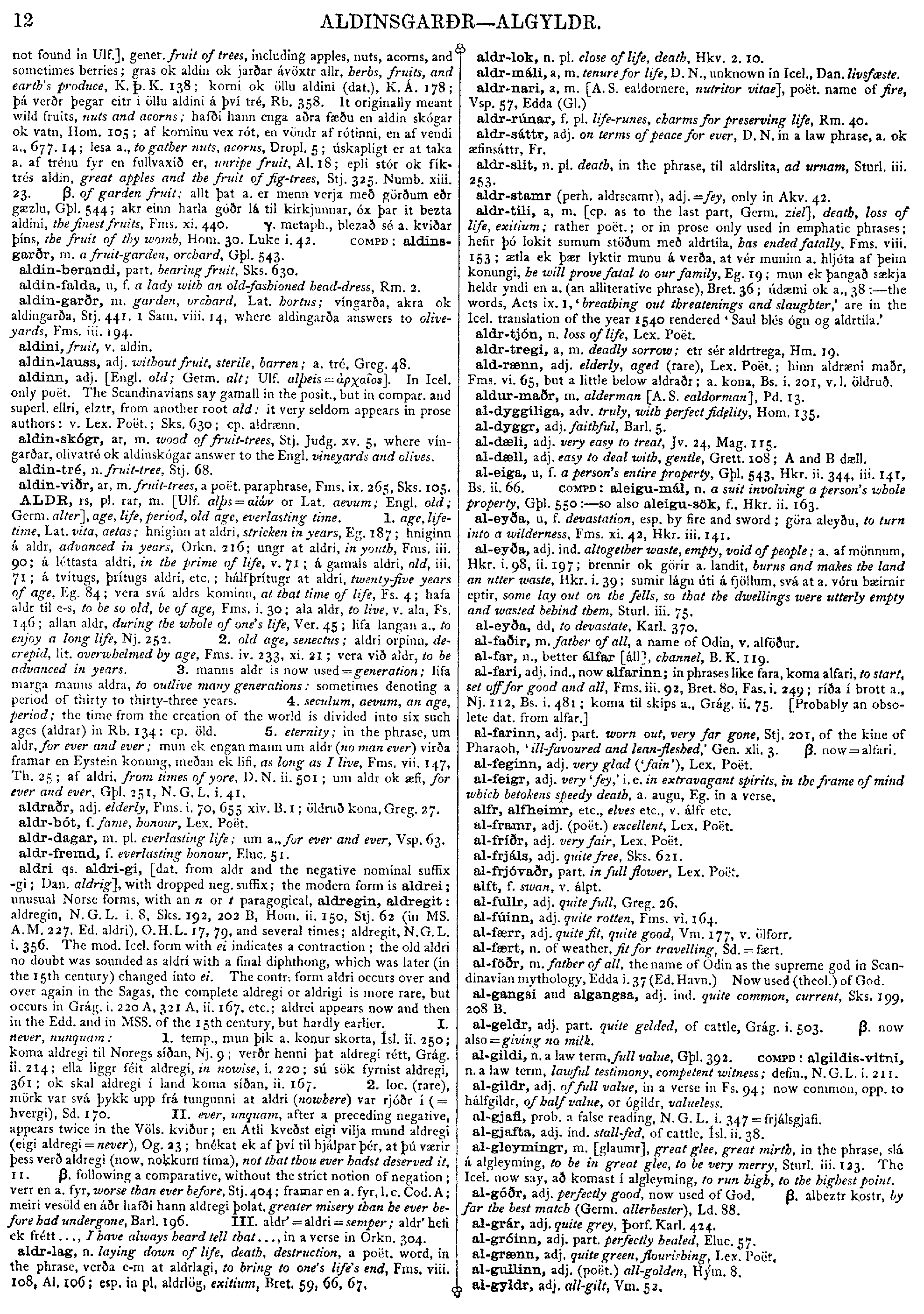
aldr-tili, a, m. [cp. as to the last part, Germ, ziel], death, loss of life, exitium; rather poët.; or in prose only used in emphatic phrases; hefir þó lokit sumum stöðum með aldrtila, has ended fatally, Fms. viii. 153; ætla ek þær lyktir munu á verða, at vér munim a. hljóta af þeim konungi, he will prove fatal to our family, Eg. 19; mun ek þangað sækja heldr yndi en a. (an alliterative phrase), Bret. 36; údæmi ok a., 38 :-- the words, Acts ix. I, 'breathing out tbreatenings and slaughter,' are in the Icel. translation of the year 1540 rendered 'Saul blés ógn og aldrtila.'
|
Source: Cleasby/Vigfusson, page b0013, entry 1 View original page image as: [TIFF] [PNG] [View previous entry] [View next entry] |
[Comment on this entry] [View comments] |
The following entry has been hand-corrected once. |
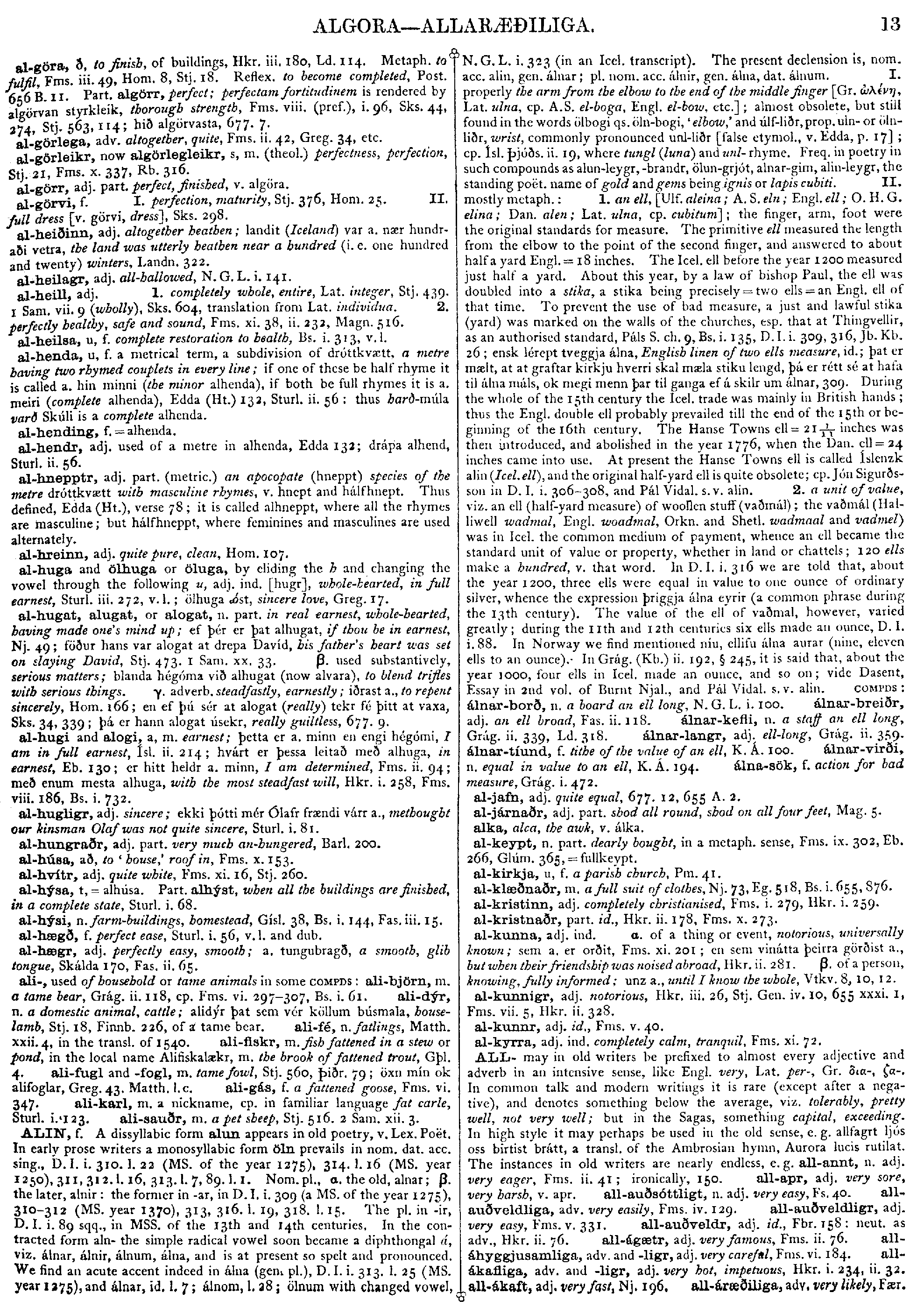
al-göra, ð, to finish, of buildings, Hkr. iii. 180, Ld. 114. Metaph. to fulfil Fms. iii. 49, Hom. 8, Stj. 18. Reflex, to become completed, Post. 626 B. II. Part. algörr, perfect; perfectam fortitudinem is rendered by algorvan styrkleik, thorough strength, Fms. viii. (pref.), i. 96, Sks. 44, 274, Stj. 563, 114; hið algörvasta, 677. 7.
|
Source: Cleasby/Vigfusson, page b0016, entry 7 View original page image as: [TIFF] [PNG] [View previous entry] [View next entry] |
[Comment on this entry] [View comments] |
The following entry has been hand-corrected once. |
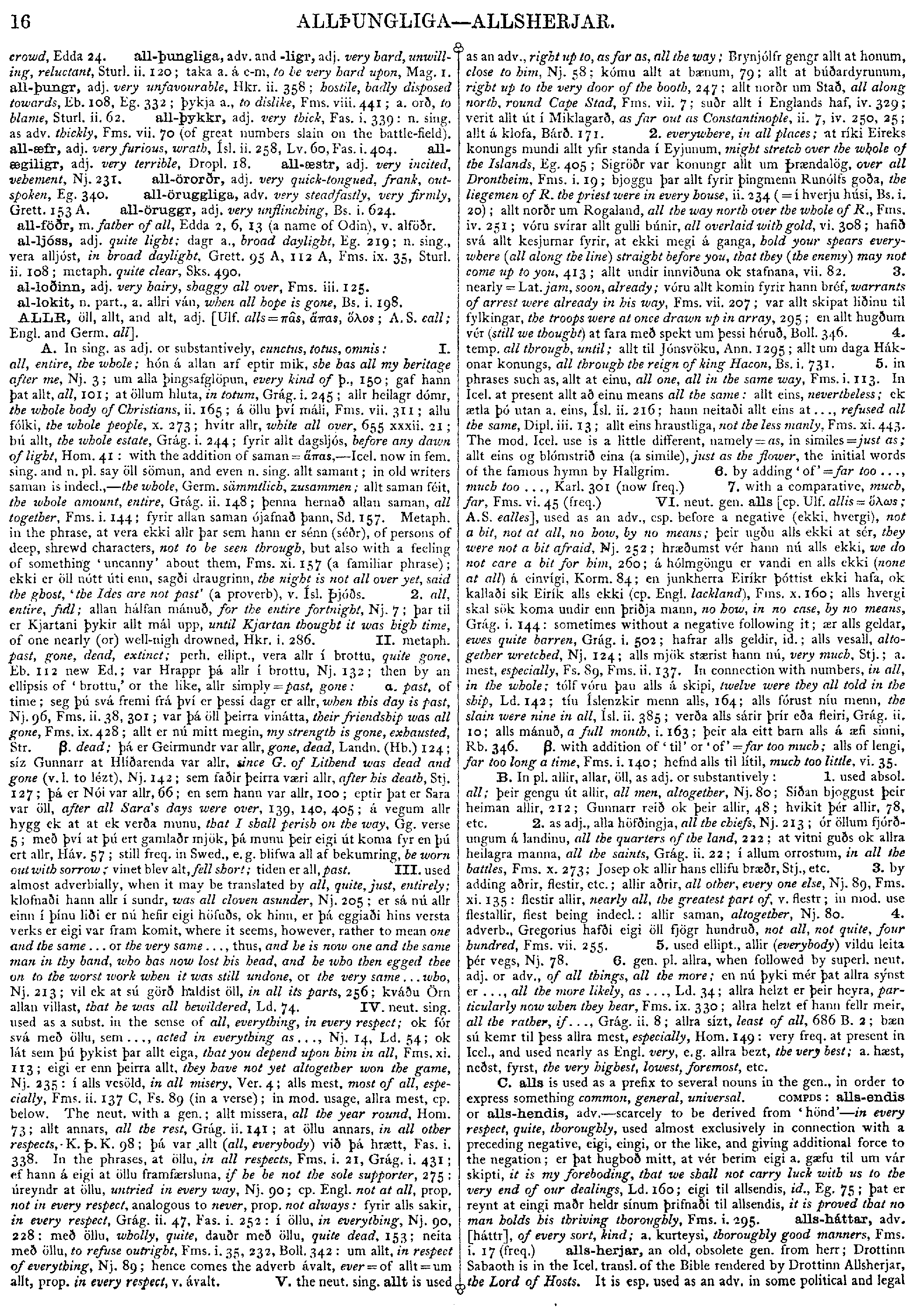
A.
In
sing,
as
adj.
or
substantively,
cunctus,
totus,
omnis:
I.
all,
entire,
the
whole;
hón
á
allan
arf
eptir
mik,
she
has
all
my
heritage
after
me,
Nj.
3;
um
alla
þingsafglöpun,
every
kind
of
þ.,
150;
gaf
hann
þat
allt,
all,
101;
at
öllum
hluta,
in
totum,
Grág.
i.
245;
allr
heilagr
dómr,
the
whole
body
of
Christians,
ii.
165;
á
öllu
því
máli,
Fms.
vii.
311;
allu
fólki,
thewhole
people,
x.
273;
hvitr
allr,
white
all
over,
655
xxxii.
21;
bú
allt,
thewhole
estate,
Grág.
i.
244;
fyrir
allt
dagsljós,
before
any
dawn
of
light,
Hom.
41:
with
the
addition
of
saman
=
GREEK
--
Icel.
now
in
fem.
sing.
and
n.
pl.
say
öll
sömun,
and
even
n.
sing.
allt
samant;
in
old
writers
saman
is
indecl.,
--
the
whole,
Germ,
sänmtlich,
zusammen;
allt
saman
féit,
thewhole
amount,
entire,
Grág.
ii.
148;
þenna
hernað
allan
saman,
all
together,
Fms.
i.
144;
fyrir
allan
saman
ójafnað
þann,
Sd.
157.
Metaph.
in
the
phrase,
at
vera
ekki
allr
þar
sem
hann
er
sénn
(séðr),
of
persons
of
deep,
shrewd
characters,
not
to
be
seen
through,
but
also
with
a
feeling
of
something
'uncanny'
about
them,
Fms.
xi.
157
(a
familiar
phrase);
ekki
er
oil
nótt
úti
enn,
sagði
draugrinn,
the
night
is
not
all
over
yet,
said
the
ghost,
'the
Ides
are
not
past'
(a
proverb),
v.
Ísl.
þjóðs.
2.
all,
entire,
full;
allan
hálfan
mánuð,
for
the
entire
fortnight,
Nj.
7;
þar
til
er
Kjartani
þykir
allt
mál
upp,
until
Kjartan
thought
it
was
high
time,
of
one
nearly
(or)
well-nigh
drowned,
Hkr.
i.
286.
II.
metaph.
past,
gone,
dead,
extinct;
perh.
ellipt.,
vera
allr
í
brottu,
quite
gone,
Eb.
112
new
Ed.;
var
Hrappr
þá
allr
í
brottu,
Nj.
132;
then
by
an
ellipsis
of
'brottu,'
or
the
like,
allr
simply
==
past,
gone:
.
past,
of
time;
seg
þú
svá
fremi
frá
því
er
þessi
dagr
er
allr,
when
this
day
is
past,
Nj.
96,
Fms.
ii.
38,
301;
var
þá
öll
þeirra
vinátta,
their
friendship
was
all
gone,
Fms.
ix.
428;
allt
er
mi
mitt
megin,
my
strength
is
gone,
exhausted,
Str.
 .
dead;
þá
er
Geirmundr
var
allr,
gone,
dead,
Landn.
(Hb.)
124;
siz
Gunnarr
at
Hlíðarenda
var
allr,
since
G.
of
Lithend
was
dead
and
gone
(v.
l.
to
lézt),
Nj.
142;
sem
faðir
þeirra
væri
allr,
after
his
death,
Stj.
127;
þá
er
Nói
var
allr,
66;
en
sem
hann
var
allr,
100;
eptir
þat
er
Sara
var
öll,
after
all
Sara's
days
were
over,
139,
140,
405;
á
vegum
allr
hygg
ek
at
at
ek
verða
munu,
that
I
shall
perish
on
the
way,
Gg.
verse
5;
með
því
at
þú
ert
gamlaðr
mjök,
þá
munu
þeir
eigi
út
koma
fyr
en
þú
ert
allr,
Háv.
57;
still
freq.
in
Swed.,
e.
g.
blifwa
all
af
bekumring,
be
worn
out
with
sorrow;
vinet
blev
alt,
fell
short;
tiden
er
all,
past.
III.
used
almost
adverbially,
when
it
may
be
translated
by
all,
quite,
just,
entirely;
klofnaði
hann
allr
í
sundr,
was
all
cloven
asunder,
Nj.
205;
er
sá
nú
allr
einn
í
þínu
liði
er
nú
hefir
eigi
höfuðs,
ok
hinn,
er
þá
eggiaði
hins
versta
verks
er
eigi
var
fram
komit,
where
it
seems,
however,
rather
to
mean
one
and
the
same
...
or
the
very
same
...,
thus,
and
he
is
now
one
and
the
same
man
in
thy
band,
who
has
now
lost
his
bead,
and
he
who
then
egged
tbee
on
to
the
worst
work
when
it
was
still
undone,
or
the
very
same,
...
who,
Nj.
213;
vil
ek
at
sú
görð
häldist
öll,
in
all
its
parts,
256;
kváðu
Örn
allan
villast,
that
he
was
all
bewildered,
Ld.
74.
IV.
neut.
sing,
used
as
a
subst.
in
the
sense
of
all,
everything,
in
every
respect;
ok
for
svá
með
öllu,
sem
...,
acted
in
everything
as...,
Nj.
14,
Ld.
54;
ok
lát
sem
þú
þykist
þar
allt
eiga,
that
you
depend
upon
him
in
all,
Fms.
xi.
113;
eigi
er
enn
þeirra
allt,
they
have
not
yet
altogether
won
the
game,
Nj.
235:
í
alls
vesöld,
in
all
misery,
Ver.
4;
alls
mest,
most
of
all,
espe-
cially,
Fms.
ii.
137
C,
Fs.
89
(in
a
verse);
in
mod.
usage,
allra
mest,
cp.
below.
The
neut.
with
a
gen.;
allt
missera,
all
the
year
round,
Hom.
73;
allt
annars,
all
the
rest,
Grág.
ii.
141;
at
öllu
annars,
in
all
other
respects,
-
K.
Þ.
K.
98;
þá
var
allt
(all,
everybody)
við
þá
hrætt,
Fas.
i.
338.
In
the
phrases,
at
öllu,
in
all
respects,
Fms.
i.
21,
Grág.
i.
431;
ef
hann
á
eigi
at
öllu
framfærsluna,
if
he
be
not
the
sole
supporter,
275:
úreyndr
at
öllu,
untried
in
every
way,
Nj.
90;
cp.
Engl.
not
at
all,
prop.
not
in
every
respect,
analogous
to
never,
prop,
not
always:
fyrir
alls
sakir,
in
every
respect,
Grág.
ii.
47,
Fas.
i.
252:
í
öllu,
in
everything,
Nj.
90,
228:
með
öllu,
wholly,
quite,
dauðr
með
öllu,
quite
dead,
153;
neita
með
öllu,
to
refuse
outright,
Fms.
i.
35,
232,
Boll.
342:
um
allt,
in
respect
of
everything,
Nj.
89;
hence
comes
the
adverb
ávalt,
ever
=
of
allt
=
um
allt,
prop,
in
every
respect,
v.
ávalt.
V.
the
neut.
sing,
allt
is
used
as
an
adv.,
right
up
to,
as
far
as,
all
the
way;
Brynjólfr
gengr
allt
at
honum,
close
to
him,
Nj.
58;
kómu
allt
at
bænum,
79;
allt
at
búðardyrunum,
right
up
to
the
very
door
of
the
booth,
247;
allt
norðr
urn
Stað,
all
along
north,
round
Cape
Stad,
Fms.
vii.
7;
suðr
allt
í
Englands
haf,
iv.
329;
verit
allt
út
í
Miklagarð,
as
far
out
as
Constantinople,
ii.
7,
iv.
250,
25;
allt
á
klofa,
Bárð.
171.
2.
everywhere,
in
all
places;
at
riki
Eireks
konungs
mundi
allt
yfir
standa
í
Eyjunum,
might
stretch
over
the
whole
of
the
Islands,
Eg.
405;
Sigröðr
var
konungr
allt
um
Þrændalög,
over
all
Drontheim,
Fms.
i.
19;
bjoggu
þar
allt
fyrir
þingmenn
Runólfs
goða,
the
liegemen
of
R.
the
priest
were
in
every
house,
ii.
-234
(=
í
hverju
húsi,
Bs.
i.
20);
allt
norðr
um
Rogaland,
all
the
way
north
over
the
whole
of
R.,
Fms.
iv.
251;
vóru
svirar
allt
gulli
búnir,
all
overlaid
with
gold,
vi.
308;
hafið
svá
allt
kesjurnar
fyrir,
at
ekki
megi
á
ganga,
hold
your
spears
every-
where
(all
along
the
line)
straight
before
you,
that
they
(the
enemy)
may
not
come
up
to
you,
413;
allt
imdir
innviðuna
ok
stafnana,
vii.
82.
3.
nearly
=
Lat.
jam,
soon,
already;
vóru
allt
komin
fyrir
hann
bréf,
warrants
of
arrest
were
already
in
his
way,
Fms.
vii.
207;
var
allt
skipat
liðinu
til
fylkingar,
the
troops
were
at
once
drawn
up
in
array,
295;
en
allt
hugðum
vér
(still
we
thought)
at
fara
með
spekt
um
þessi
héruð,
Boll.
346.
4.
temp.
all
through,
until;
allt
til
Júnsvöku,
Ann.
1295;
allt
um
daga
Hák-
onar
konungs,
all
through
the
reign
of
king
Hacon,
Bs.
i.
731.
5.
in
phrases
such
as,
allt
at
einu,
all
one,
all
in
the
same
way,
Fms.
i.
113.
In
Icel.
at
present
allt
að
einu
means
all
the
same:
allt
eins,
nevertheless;
ek
ætla
þó
utan
a.
eins,
Ísl.
ii.
216;
hann
neitaði
allt
eins
at...,
refused
all
the
same,
Dipl.
iii.
13;
allt
eins
hraustliga,
not
the
less
manly,
Fms.
xi.
443.
The
mod.
Icel.
use
is
a
little
different,
namely
=
as,
in
similes
=
just
as;
allt
eins
og
blómstrið
eina
(a
simile),
just
as
the
flower,
the
initial
words
of
the
famous
hymn
by
Hallgrim.
6.
by
adding
'of'
=
far
too
...,
much
too
...,
Karl.
301
(now
freq.)
7.
with
a
comparative,
much,
far,
Fms.
vi.
45
(freq.)
VI.
neut.
gen.
alls
[cp.
Ulf.
allis
=
GREEK;
A.
S.
ealles],
used
as
an
adv.,
esp.
before
a
negative
(ekki,
hvergi),
not
a
bit,
not
at
all,
no
how,
by
no
means;
þeir
ugðu
alls
ekki
at
sér,
they
were
not
a
bit
afraid,
Nj.
252;
hræðumst
vér
hann
nú
alls
ekki,
we
do
not
care
a
bit
for
him,
260;
á
hólmgöngu
er
vandi
en
alls
ekki
(none
at
all)
á
einvigi,
Korm.
84;
en
junkherra
Eiríkr
þóttíist
ekki
hafa,
ok
kallaði
sik
Eirik
alls
ekki
(cp.
Engl.
lackland),
Fms.
x.
160;
alls
hvergi
skal
sök
koma
undir
enn
þriðja
mann,
no
how,
in
no
case,
by
no
means,
Grág.
i.
144:
sometimes
without
a
negative
following
it;
ær
alls
geldar,
ewes
quite
barren,
Grág.
i.
502;
hafrar
alls
geldir,
id.;
alls
vesall,
alto-
gether
wretched,
Nj.
124;
alls
mjök
stærist
hann
nú,
very
much,
Stj.;
a.
mest,
especially,
Fs.
89,
Fms.
ii.
137.
In
connection
with
numbers,
in
all,
in
the
whole;
tólf
vóru
þau
alls
á
skipi,
twelve
were
they
all
told
in
the
ship,
Ld.
142;
tíu
Íslenzkir
menn
alls,
164;
alls
fórust
níu
menn,
the
slain
were
nine
in
all,
Ísl.
ii.
385;
verða
alls
sárir
þrír
eða
fleiri,
Grág.
ii.
10;
alls
mánuð,
a
full
month,
i.
163;
þeir
ala
eitt
barn
alls
á
aefi
sinni,
Rb.
346.
.
with
addition
of
'til'
or
'of'
=
far
too
much;
alls
of
lengi,
far
too
long
a
time,
Fms.
i.
140;
hefnd
alls
til
lítil,
much
too
little,
vi.
35.
B.
In
pl.
allir,
allar,
öll,
as
adj.
or
substantively:
1.
used
absol.
all;
þeir
gengu
út
allir,
all
men,
altogether,
Nj.
80;
Síðan
bjoggust
þeir
heiman
allir,
212;
Gunnarr
reið
ok
beir
allir,
48;
hvikit
þér
allir,
78,
etc.
2.
as
adj.,
alla
höfðingja,
all
the
chiefs,
Nj.
213;
ór
öllum
fjórð-
ungum
á
landinu,
all
the
quarters
of
the
land,
222;
at
vitni
guðs
ok
allra
heilagra
manna,
all
the
saints,
Grág.
ii.
22;
í
allum
orrostum,
in
all
the
battles,
Fms.
x.
273;
Josep
ok
allir
hans
ellifu
bræðr,
Stj.,
etc.
3.
by
adding
aðrir,
flestir,
etc.;
allir
aðrir,
all
other,
everyone
else,
Nj.
89,
Fms.
xi.
135:
flestir
allir,
nearly
all,
the
greatest
part
of,
v.
flestr;
in
mod.
use
flestallir,
flest
being
indecl.:
allir
saman,
altogether,
Nj.
80.
4.
adverb.,
Gregorius
hafði
eigi
öll
fjögr
hundruð,
not
all,
not
quite,
four
hundred,
Fms.
vii.
255.
5.
used
ellipt.,
allir
(everybody)
vildu
leita
þér
vegs,
Nj.
78.
6.
gen.
pl.
allra,
when
followed
by
superl.
neut.
adj.
or
adv.,
of
all
things,
all
the
more;
en
nú
þyki
mér
þat
allra
sýnst
er
...,
all
the
more
likely,
as
...,
Ld.
34;
allra
helzt
er
þeir
heyra,
par-
ticularly
now
when
they
hear,
Fms.
ix.
330;
allra
helzt
ef
hann
fellr
meir,
all
the
rather,
if
...,
Grág.
ii.
8;
allra
sízt,
least
of
all,
686
B.
2;
bæn
sú
kemr
til
þess
allra
mest,
especially,
Hom.
149:
very
freq.
at
present
in
Icel.,
and
used
nearly
as
Engl.
very,
e.
g.
allra
bezt,
the
very
best;
a.
hæst,
neðst,
fyrst,
the
very
highest,
lowest,
foremost,
etc.
C.
alls
is
used
as
a
prefix
to
several
nouns
in
the
gen.,
in
order
to
express
something
common,
general,
universal.
COMPDS:
alls-endis
or
alls-hendis,
adv.
--
scarcely
to
be
derived
from
'hönd'
--
in
every
respect,
quite,
thoroughly,
used
almost
exclusively
in
connection
with
a
preceding
negative,
eigi,
eingi,
or
the
like,
and
giving
additional
force
to
the
negation;
er
þat
hugboð
mitt,
at
vér
berim
eigi
agæfu
til
um
vár
skipti,
it
is
my
foreboding,
that
we
shall
not
carry
luck
with
us
to
the
very
end
of
our
dealings,
Ld.
160;
eigi
til
allsendis,
id.,
Eg.
75;
þat
er
reynt
at
eingi
maðr
heldr
sínum
þrifnaði
til
allsendis,
it
is
proved
that
no
man
holds
his
thriving
thoroughly,
Fms.
i.
295.
alls-háttar,
adv.
[háttr],
of
every
sort,
kind;
a.
kurteysi,
thoroughly
good
manners,
Fms.
i.
17
(freq.)
alls-herjar,
an
old,
obsolete
gen.
from
herr;
Drottinn
Sabaoth
is
in
the
Icel.
transl.
of
the
Bible
rendered
by
Drottinn
AUsherjar,
the
Lord
of
Hosts.
It
is
esp.
used
as
an
adv.
in
some
political
and
legal
.
dead;
þá
er
Geirmundr
var
allr,
gone,
dead,
Landn.
(Hb.)
124;
siz
Gunnarr
at
Hlíðarenda
var
allr,
since
G.
of
Lithend
was
dead
and
gone
(v.
l.
to
lézt),
Nj.
142;
sem
faðir
þeirra
væri
allr,
after
his
death,
Stj.
127;
þá
er
Nói
var
allr,
66;
en
sem
hann
var
allr,
100;
eptir
þat
er
Sara
var
öll,
after
all
Sara's
days
were
over,
139,
140,
405;
á
vegum
allr
hygg
ek
at
at
ek
verða
munu,
that
I
shall
perish
on
the
way,
Gg.
verse
5;
með
því
at
þú
ert
gamlaðr
mjök,
þá
munu
þeir
eigi
út
koma
fyr
en
þú
ert
allr,
Háv.
57;
still
freq.
in
Swed.,
e.
g.
blifwa
all
af
bekumring,
be
worn
out
with
sorrow;
vinet
blev
alt,
fell
short;
tiden
er
all,
past.
III.
used
almost
adverbially,
when
it
may
be
translated
by
all,
quite,
just,
entirely;
klofnaði
hann
allr
í
sundr,
was
all
cloven
asunder,
Nj.
205;
er
sá
nú
allr
einn
í
þínu
liði
er
nú
hefir
eigi
höfuðs,
ok
hinn,
er
þá
eggiaði
hins
versta
verks
er
eigi
var
fram
komit,
where
it
seems,
however,
rather
to
mean
one
and
the
same
...
or
the
very
same
...,
thus,
and
he
is
now
one
and
the
same
man
in
thy
band,
who
has
now
lost
his
bead,
and
he
who
then
egged
tbee
on
to
the
worst
work
when
it
was
still
undone,
or
the
very
same,
...
who,
Nj.
213;
vil
ek
at
sú
görð
häldist
öll,
in
all
its
parts,
256;
kváðu
Örn
allan
villast,
that
he
was
all
bewildered,
Ld.
74.
IV.
neut.
sing,
used
as
a
subst.
in
the
sense
of
all,
everything,
in
every
respect;
ok
for
svá
með
öllu,
sem
...,
acted
in
everything
as...,
Nj.
14,
Ld.
54;
ok
lát
sem
þú
þykist
þar
allt
eiga,
that
you
depend
upon
him
in
all,
Fms.
xi.
113;
eigi
er
enn
þeirra
allt,
they
have
not
yet
altogether
won
the
game,
Nj.
235:
í
alls
vesöld,
in
all
misery,
Ver.
4;
alls
mest,
most
of
all,
espe-
cially,
Fms.
ii.
137
C,
Fs.
89
(in
a
verse);
in
mod.
usage,
allra
mest,
cp.
below.
The
neut.
with
a
gen.;
allt
missera,
all
the
year
round,
Hom.
73;
allt
annars,
all
the
rest,
Grág.
ii.
141;
at
öllu
annars,
in
all
other
respects,
-
K.
Þ.
K.
98;
þá
var
allt
(all,
everybody)
við
þá
hrætt,
Fas.
i.
338.
In
the
phrases,
at
öllu,
in
all
respects,
Fms.
i.
21,
Grág.
i.
431;
ef
hann
á
eigi
at
öllu
framfærsluna,
if
he
be
not
the
sole
supporter,
275:
úreyndr
at
öllu,
untried
in
every
way,
Nj.
90;
cp.
Engl.
not
at
all,
prop.
not
in
every
respect,
analogous
to
never,
prop,
not
always:
fyrir
alls
sakir,
in
every
respect,
Grág.
ii.
47,
Fas.
i.
252:
í
öllu,
in
everything,
Nj.
90,
228:
með
öllu,
wholly,
quite,
dauðr
með
öllu,
quite
dead,
153;
neita
með
öllu,
to
refuse
outright,
Fms.
i.
35,
232,
Boll.
342:
um
allt,
in
respect
of
everything,
Nj.
89;
hence
comes
the
adverb
ávalt,
ever
=
of
allt
=
um
allt,
prop,
in
every
respect,
v.
ávalt.
V.
the
neut.
sing,
allt
is
used
as
an
adv.,
right
up
to,
as
far
as,
all
the
way;
Brynjólfr
gengr
allt
at
honum,
close
to
him,
Nj.
58;
kómu
allt
at
bænum,
79;
allt
at
búðardyrunum,
right
up
to
the
very
door
of
the
booth,
247;
allt
norðr
urn
Stað,
all
along
north,
round
Cape
Stad,
Fms.
vii.
7;
suðr
allt
í
Englands
haf,
iv.
329;
verit
allt
út
í
Miklagarð,
as
far
out
as
Constantinople,
ii.
7,
iv.
250,
25;
allt
á
klofa,
Bárð.
171.
2.
everywhere,
in
all
places;
at
riki
Eireks
konungs
mundi
allt
yfir
standa
í
Eyjunum,
might
stretch
over
the
whole
of
the
Islands,
Eg.
405;
Sigröðr
var
konungr
allt
um
Þrændalög,
over
all
Drontheim,
Fms.
i.
19;
bjoggu
þar
allt
fyrir
þingmenn
Runólfs
goða,
the
liegemen
of
R.
the
priest
were
in
every
house,
ii.
-234
(=
í
hverju
húsi,
Bs.
i.
20);
allt
norðr
um
Rogaland,
all
the
way
north
over
the
whole
of
R.,
Fms.
iv.
251;
vóru
svirar
allt
gulli
búnir,
all
overlaid
with
gold,
vi.
308;
hafið
svá
allt
kesjurnar
fyrir,
at
ekki
megi
á
ganga,
hold
your
spears
every-
where
(all
along
the
line)
straight
before
you,
that
they
(the
enemy)
may
not
come
up
to
you,
413;
allt
imdir
innviðuna
ok
stafnana,
vii.
82.
3.
nearly
=
Lat.
jam,
soon,
already;
vóru
allt
komin
fyrir
hann
bréf,
warrants
of
arrest
were
already
in
his
way,
Fms.
vii.
207;
var
allt
skipat
liðinu
til
fylkingar,
the
troops
were
at
once
drawn
up
in
array,
295;
en
allt
hugðum
vér
(still
we
thought)
at
fara
með
spekt
um
þessi
héruð,
Boll.
346.
4.
temp.
all
through,
until;
allt
til
Júnsvöku,
Ann.
1295;
allt
um
daga
Hák-
onar
konungs,
all
through
the
reign
of
king
Hacon,
Bs.
i.
731.
5.
in
phrases
such
as,
allt
at
einu,
all
one,
all
in
the
same
way,
Fms.
i.
113.
In
Icel.
at
present
allt
að
einu
means
all
the
same:
allt
eins,
nevertheless;
ek
ætla
þó
utan
a.
eins,
Ísl.
ii.
216;
hann
neitaði
allt
eins
at...,
refused
all
the
same,
Dipl.
iii.
13;
allt
eins
hraustliga,
not
the
less
manly,
Fms.
xi.
443.
The
mod.
Icel.
use
is
a
little
different,
namely
=
as,
in
similes
=
just
as;
allt
eins
og
blómstrið
eina
(a
simile),
just
as
the
flower,
the
initial
words
of
the
famous
hymn
by
Hallgrim.
6.
by
adding
'of'
=
far
too
...,
much
too
...,
Karl.
301
(now
freq.)
7.
with
a
comparative,
much,
far,
Fms.
vi.
45
(freq.)
VI.
neut.
gen.
alls
[cp.
Ulf.
allis
=
GREEK;
A.
S.
ealles],
used
as
an
adv.,
esp.
before
a
negative
(ekki,
hvergi),
not
a
bit,
not
at
all,
no
how,
by
no
means;
þeir
ugðu
alls
ekki
at
sér,
they
were
not
a
bit
afraid,
Nj.
252;
hræðumst
vér
hann
nú
alls
ekki,
we
do
not
care
a
bit
for
him,
260;
á
hólmgöngu
er
vandi
en
alls
ekki
(none
at
all)
á
einvigi,
Korm.
84;
en
junkherra
Eiríkr
þóttíist
ekki
hafa,
ok
kallaði
sik
Eirik
alls
ekki
(cp.
Engl.
lackland),
Fms.
x.
160;
alls
hvergi
skal
sök
koma
undir
enn
þriðja
mann,
no
how,
in
no
case,
by
no
means,
Grág.
i.
144:
sometimes
without
a
negative
following
it;
ær
alls
geldar,
ewes
quite
barren,
Grág.
i.
502;
hafrar
alls
geldir,
id.;
alls
vesall,
alto-
gether
wretched,
Nj.
124;
alls
mjök
stærist
hann
nú,
very
much,
Stj.;
a.
mest,
especially,
Fs.
89,
Fms.
ii.
137.
In
connection
with
numbers,
in
all,
in
the
whole;
tólf
vóru
þau
alls
á
skipi,
twelve
were
they
all
told
in
the
ship,
Ld.
142;
tíu
Íslenzkir
menn
alls,
164;
alls
fórust
níu
menn,
the
slain
were
nine
in
all,
Ísl.
ii.
385;
verða
alls
sárir
þrír
eða
fleiri,
Grág.
ii.
10;
alls
mánuð,
a
full
month,
i.
163;
þeir
ala
eitt
barn
alls
á
aefi
sinni,
Rb.
346.
.
with
addition
of
'til'
or
'of'
=
far
too
much;
alls
of
lengi,
far
too
long
a
time,
Fms.
i.
140;
hefnd
alls
til
lítil,
much
too
little,
vi.
35.
B.
In
pl.
allir,
allar,
öll,
as
adj.
or
substantively:
1.
used
absol.
all;
þeir
gengu
út
allir,
all
men,
altogether,
Nj.
80;
Síðan
bjoggust
þeir
heiman
allir,
212;
Gunnarr
reið
ok
beir
allir,
48;
hvikit
þér
allir,
78,
etc.
2.
as
adj.,
alla
höfðingja,
all
the
chiefs,
Nj.
213;
ór
öllum
fjórð-
ungum
á
landinu,
all
the
quarters
of
the
land,
222;
at
vitni
guðs
ok
allra
heilagra
manna,
all
the
saints,
Grág.
ii.
22;
í
allum
orrostum,
in
all
the
battles,
Fms.
x.
273;
Josep
ok
allir
hans
ellifu
bræðr,
Stj.,
etc.
3.
by
adding
aðrir,
flestir,
etc.;
allir
aðrir,
all
other,
everyone
else,
Nj.
89,
Fms.
xi.
135:
flestir
allir,
nearly
all,
the
greatest
part
of,
v.
flestr;
in
mod.
use
flestallir,
flest
being
indecl.:
allir
saman,
altogether,
Nj.
80.
4.
adverb.,
Gregorius
hafði
eigi
öll
fjögr
hundruð,
not
all,
not
quite,
four
hundred,
Fms.
vii.
255.
5.
used
ellipt.,
allir
(everybody)
vildu
leita
þér
vegs,
Nj.
78.
6.
gen.
pl.
allra,
when
followed
by
superl.
neut.
adj.
or
adv.,
of
all
things,
all
the
more;
en
nú
þyki
mér
þat
allra
sýnst
er
...,
all
the
more
likely,
as
...,
Ld.
34;
allra
helzt
er
þeir
heyra,
par-
ticularly
now
when
they
hear,
Fms.
ix.
330;
allra
helzt
ef
hann
fellr
meir,
all
the
rather,
if
...,
Grág.
ii.
8;
allra
sízt,
least
of
all,
686
B.
2;
bæn
sú
kemr
til
þess
allra
mest,
especially,
Hom.
149:
very
freq.
at
present
in
Icel.,
and
used
nearly
as
Engl.
very,
e.
g.
allra
bezt,
the
very
best;
a.
hæst,
neðst,
fyrst,
the
very
highest,
lowest,
foremost,
etc.
C.
alls
is
used
as
a
prefix
to
several
nouns
in
the
gen.,
in
order
to
express
something
common,
general,
universal.
COMPDS:
alls-endis
or
alls-hendis,
adv.
--
scarcely
to
be
derived
from
'hönd'
--
in
every
respect,
quite,
thoroughly,
used
almost
exclusively
in
connection
with
a
preceding
negative,
eigi,
eingi,
or
the
like,
and
giving
additional
force
to
the
negation;
er
þat
hugboð
mitt,
at
vér
berim
eigi
agæfu
til
um
vár
skipti,
it
is
my
foreboding,
that
we
shall
not
carry
luck
with
us
to
the
very
end
of
our
dealings,
Ld.
160;
eigi
til
allsendis,
id.,
Eg.
75;
þat
er
reynt
at
eingi
maðr
heldr
sínum
þrifnaði
til
allsendis,
it
is
proved
that
no
man
holds
his
thriving
thoroughly,
Fms.
i.
295.
alls-háttar,
adv.
[háttr],
of
every
sort,
kind;
a.
kurteysi,
thoroughly
good
manners,
Fms.
i.
17
(freq.)
alls-herjar,
an
old,
obsolete
gen.
from
herr;
Drottinn
Sabaoth
is
in
the
Icel.
transl.
of
the
Bible
rendered
by
Drottinn
AUsherjar,
the
Lord
of
Hosts.
It
is
esp.
used
as
an
adv.
in
some
political
and
legal
|
Source: Cleasby/Vigfusson, page b0048, entry 28 View original page image as: [TIFF] [PNG] [View previous entry] [View next entry] |
[Comment on this entry] [View comments] |
The following entry has been hand-corrected once. |
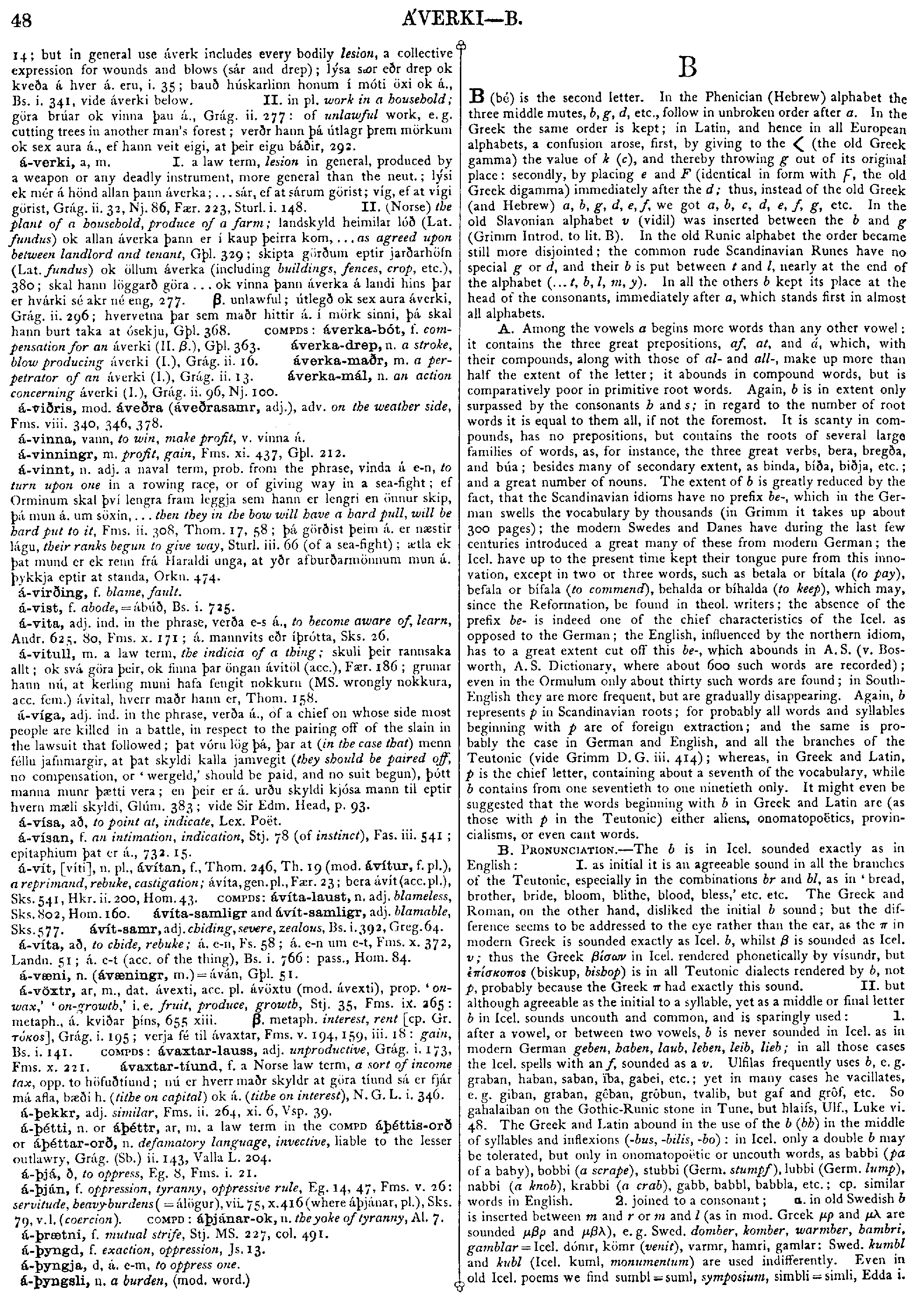
B.
PRONUNCIATION.
--
The
b
is
in
Icel.
sounded
exactly
as
in
English:
I.
as
initial
it
is
an
agreeable
sound
in
all
the
branches
of
the
Teutonic,
especially
in
the
combinations
br
and
bl,
as
in
'bread,
brother,
bride,
bloom,
blithe,
blood,
bless,'
etc.
etc.
The
Greek
and
Roman,
on
the
other
hand,
disliked
the
initial
b
sound;
but
the
difference
seerns
to
be
addressed
to
the
eye
rather
than
the
ear,
as
the
 in
modern
Greek
is
sounded
exactly
as
Icel.
b,
whilst
is
sounded
as
Icel.
v;
thus
the
Greek
GREEK
in
Icel.
rendered
phonetically
by
vísundr,
but
GREEK
(biskup,
bishop)
is
in
all
Teutonic
dialects
rendered
by
b,
not
p,
probably
because
the
Greek
had
exactly
this
sound.
II.
but
although
agreeable
as
the
initial
to
a
syllable,
yet
as
a
middle
or
final
letter
b
in
Icel.
sounds
uncouth
and
common,
and
is
sparingly
used:
1.
after
a
vowel,
or
between
two
vowels,
b
is
never
sounded
in
Icel.
as
in
modern
German
geben,
haben,
laub,
leben,
leib,
lieb;
in
all
those
cases
the
Icel.
spells
with
an
f,
sounded
as
a
v.
Ulfilas
frequently
uses
b,
e.g.
graban,
haban,
saban,
ïba,
gabei,
etc.;
yet
in
many
cases
he
vacillates,
e.g.
giban,
graban,
gêban,
grôbun,
tvalib,
but
gaf
and
grôf,
etc.
So
gahalaiban
on
the
Gothic-Runic
stone
in
Tune,
but
hlaifs,
Ulf.,
Luke
vi.
48.
The
Greek
and
Latin
abound
in
the
use
of
the
b
(bh)
in
the
middle
of
syllables
and
inflexions
(-bus,
-bills,
-bo):
in
Icel.
only
a
double
b
may
be
tolerated,
but
only
in
onomatopoëtic
or
uncouth
words,
as
babbi
(pa
of
a
baby),
bobbi
(a
scrape),
stubbi
(Germ.
stumpf),
lubbi
(Germ.
lump),
nabbi
(a
knob),
krabbi
(a
crab),
gabb,
babbl,
babbla,
etc.;
cp.
similar
words
in
English.
2.
joined
to
a
consonant;
.
in
old
Swedish
b
is
inserted
between
m
and
r
or
m
and
l
(as
in
mod.
Greek
in
modern
Greek
is
sounded
exactly
as
Icel.
b,
whilst
is
sounded
as
Icel.
v;
thus
the
Greek
GREEK
in
Icel.
rendered
phonetically
by
vísundr,
but
GREEK
(biskup,
bishop)
is
in
all
Teutonic
dialects
rendered
by
b,
not
p,
probably
because
the
Greek
had
exactly
this
sound.
II.
but
although
agreeable
as
the
initial
to
a
syllable,
yet
as
a
middle
or
final
letter
b
in
Icel.
sounds
uncouth
and
common,
and
is
sparingly
used:
1.
after
a
vowel,
or
between
two
vowels,
b
is
never
sounded
in
Icel.
as
in
modern
German
geben,
haben,
laub,
leben,
leib,
lieb;
in
all
those
cases
the
Icel.
spells
with
an
f,
sounded
as
a
v.
Ulfilas
frequently
uses
b,
e.g.
graban,
haban,
saban,
ïba,
gabei,
etc.;
yet
in
many
cases
he
vacillates,
e.g.
giban,
graban,
gêban,
grôbun,
tvalib,
but
gaf
and
grôf,
etc.
So
gahalaiban
on
the
Gothic-Runic
stone
in
Tune,
but
hlaifs,
Ulf.,
Luke
vi.
48.
The
Greek
and
Latin
abound
in
the
use
of
the
b
(bh)
in
the
middle
of
syllables
and
inflexions
(-bus,
-bills,
-bo):
in
Icel.
only
a
double
b
may
be
tolerated,
but
only
in
onomatopoëtic
or
uncouth
words,
as
babbi
(pa
of
a
baby),
bobbi
(a
scrape),
stubbi
(Germ.
stumpf),
lubbi
(Germ.
lump),
nabbi
(a
knob),
krabbi
(a
crab),
gabb,
babbl,
babbla,
etc.;
cp.
similar
words
in
English.
2.
joined
to
a
consonant;
.
in
old
Swedish
b
is
inserted
between
m
and
r
or
m
and
l
(as
in
mod.
Greek

 and
and
 are
sounded
and
,
e.g.
Swed.
domber,
komber,
warmber,
hambri,
gamblar
=
Icel.
dómr,
komr
(venit),
varmr,
hamri,
gamlar:
Swed.
kumbl
and
kubl
(Icel.
kuml,
monumentum)
are
used
indifferently.
Even
in
old
Icel.
poems
we
find
sumbl
=
suml,
symposium,
simbli
=
simli,
Edda
i.
are
sounded
and
,
e.g.
Swed.
domber,
komber,
warmber,
hambri,
gamblar
=
Icel.
dómr,
komr
(venit),
varmr,
hamri,
gamlar:
Swed.
kumbl
and
kubl
(Icel.
kuml,
monumentum)
are
used
indifferently.
Even
in
old
Icel.
poems
we
find
sumbl
=
suml,
symposium,
simbli
=
simli,
Edda
i.
| Result Page: |  |
Previous | 1 2 3 4 5 6 7 8 9 10 11 12 13 14 | Next |  |
Germanic Lexicon Project (main page)
This search system was written by
Sean Crist
Please consider
volunteering
to correct the data in these online dictionaries.
No rights reserved. Feel free to use these data in any way you please.