|
|

Tip: In the search results, you can click on any word or abbreviation for more information.
|
Source: Cleasby/Vigfusson, page b0587, entry 1 View original page image as: [TIFF] [PNG] [View previous entry] [View next entry] |
[Comment on this entry] [View comments] |
The following entry has been hand-corrected once. |
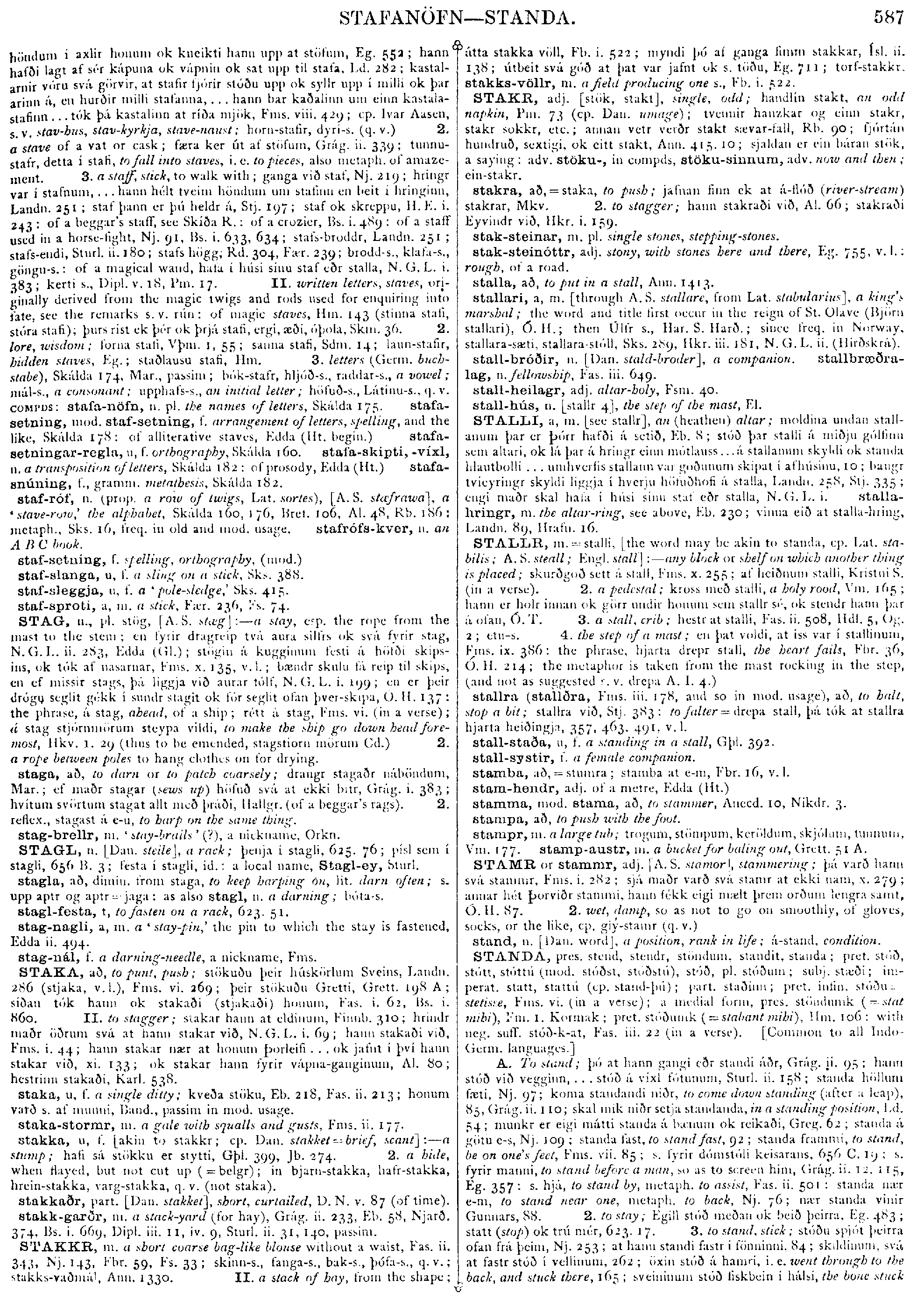
höndum í axlir honum ok kneikti hann upp at stöfum, Eg. 552; hann hafði lagt af sér kápuna uk vápnin ok sat upp til stafa, Ld. 282; kastalarnir vóru svá görvir, at stafir fjórir stóðu upp ok syllr upp í milli ok þar arinn á, en hurðir milli stafanna, ... hann bar kaðalinn um einn kastala-stafinn ... tók þá kastalinn at ríða mjök, Fms. viii. 429; cp. Ivar Aasen, s.v. stav-hus, stav-kyrkja, stave-naust; horn-stafir, dyri-s. (q.v.) 2. a stave of a vat or cask; færa ker út af stöfum, Grág. ii. 339; tunnu-stafr, detta í stafi, to fall into staves, i.e. to pieces, also metaph. of amazement. 3. a staff, stick, to walk with; ganga við staf, Nj. 219; hringr var í stafnum, ... hann hélt tveim höndum um stafinn en beit í hringinn, Landn. 251; staf þann er þú heldr á, Stj. 197; staf ok skreppu, H.E. i. 243: of a beggar's staff, see Skíða R.: of a crozier, Bs. i. 489: of a staff used in a horse-fight, Nj. 91, Bs. i. 633, 634; stafs-broddr, Landn. 251; stafs-endi, Sturl. ii. 180; stafs högg, Rd. 304, Fær. 239; brodd-s., klafa-s., göngu-s.: of a magical wand, hafa í húsi sínu staf eðr stalla, N.G.L. i. 383; kerti s., Dipl. v. 18, Pm. 17. II. written letters, staves, originally derived from the magic twigs and rods used for enquiring into fate, see the remarks s.v. rún: of magic staves, Hm. 143 (stinna stafi, stóra stafi); þurs ríst ek þér ok þrjá stafi, ergi, æði, óþola, Skm. 36. 2. lore, wisdom; forna stafi, Vþm. 1, 55; sanna stafi, Sdm. 14; laun-stafir, hidden staves, Eg.; staðlausu stafi, Hm. 3. letters (Germ. buch-stabe), Skálda 174, Mar., passim; bók-stafr, hljóð-s., raddar-s., a vowel; mál-s., a consonant; upphafs-s., an initial letter; höfuð-s., Látínu-s., q.v. COMPDS: stafa-nöfn, n. pl. the names of letters, Skálda 175. stafa-setning, mod. staf-setning, f. arrangement of letters, spelling, and the like, Skálda 178: of alliterative staves, Edda (Ht. begin.) stafa-setningar-regla, u, f. orthography, Skálda 160. stafa-skipti, -víxl, n. a transposition of letters, Skálda 182: of prosody, Edda (Ht.) stafa-snúning, f., gramm. metathesis, Skálda 182.
|
Source: Cleasby/Vigfusson, page b0590, entry 5 View original page image as: [TIFF] [PNG] [View previous entry] [View next entry] |
[Comment on this entry] [View comments] |
The following entry has been hand-corrected once. |
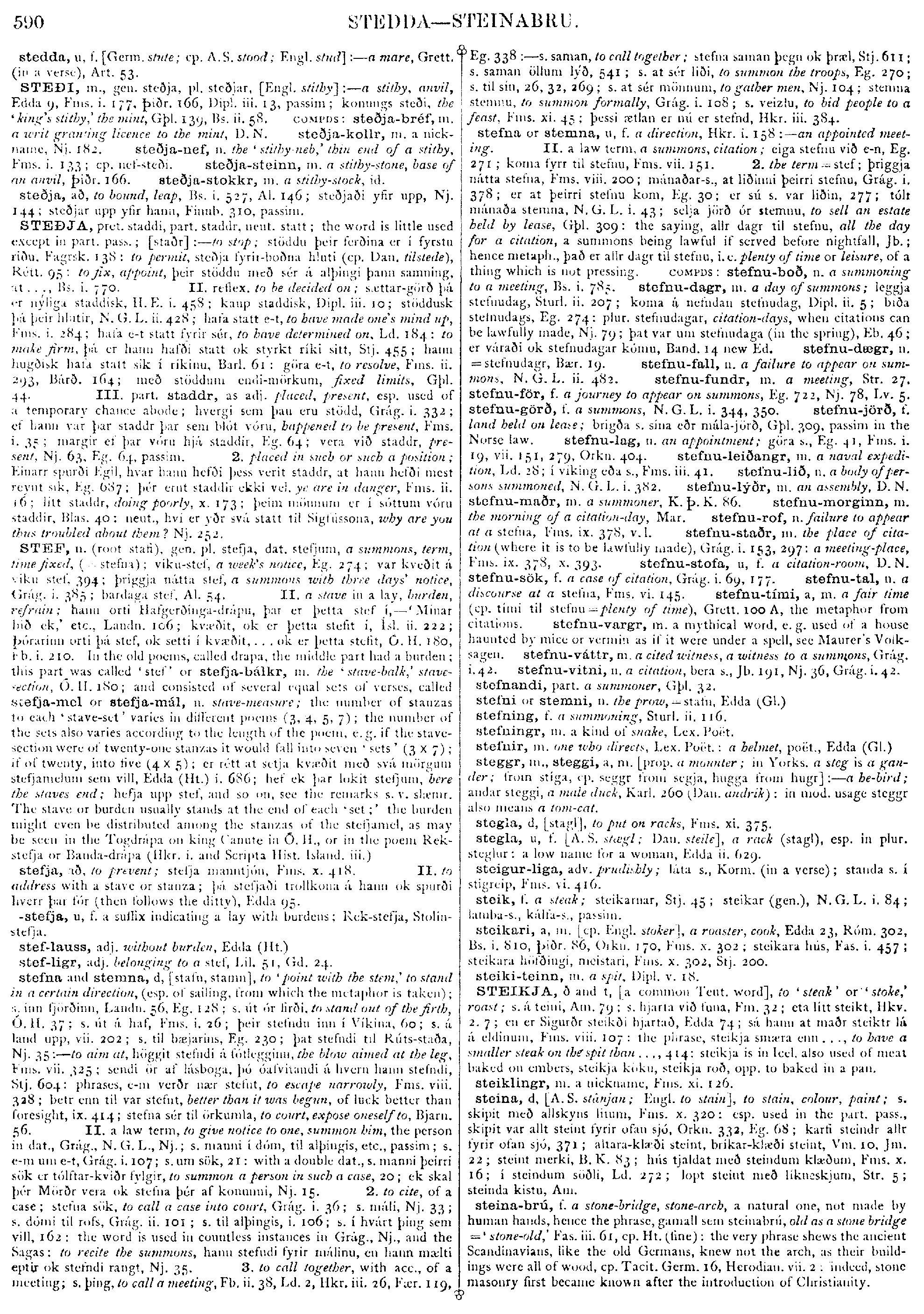
STEF, n. (root stafi), gen. pl. stefja, dat. stefjum, a summons, term, time fixed, (= stefna); viku-stef, a week's notice, Eg. 274; var kveðit á viku stef, 394; þriggja nátta stef, a summons with three days' notice, Grág. i. 385; bardaga stef, Al. 54. II. a stave in a lay, burden, refrain; hann orti Hafgerðinga-drápu, þat er þetta stef í, -- 'Minar bið ek,' etc., Landn. 106; kvæðit, ok er þetta stefit í, Ísl. ii. 222; Þórarinn orti þá stef, ok setti í kvæðit, ... ok er þetta stefit, Ó.H. 180, Eb. i. 210. In the old poems, called drapa, the middle part had a burden; this part was called 'stef' or stefja-bálkr, m. the 'stave-balk,' stave-section, Ó.H. 180; and consisted of several equal sets of verses, called stefja-mel or stefja-mál, n. stave-measure; the number of stanzas to each 'stave-set' varies in different poems (3, 4, 5, 7); the number of the sets also varies according to the length of the poem, e.g. if the stave-section were of twenty-one stanzas it would fall into seven 'sets' (3 x 7); if of twenty, into five (4 x 5); er rétt at setja kvæðit með svá mörgum stefjamelum sem vill, Edda (Ht.) i. 686; hef ek þar lokit stefjum, here the staves end; hefja upp stef, and so on, see the remarks s.v. slæmr. The stave or burden usually stands at the end of each 'set;' the burden might even be distributed among the stanzas of the stefjamel, as may be seen in the Togdrápa on king Canute in Ó.H., or in the poem Rek-stefja or Banda-dápa (Hkr. i. and Scripta Hist. Island, iii.)
|
Source: Cleasby/Vigfusson, page b0593, entry 31 View original page image as: [TIFF] [PNG] [View previous entry] [View next entry] |
[Comment on this entry] [View comments] |
The following entry has been hand-corrected once. |
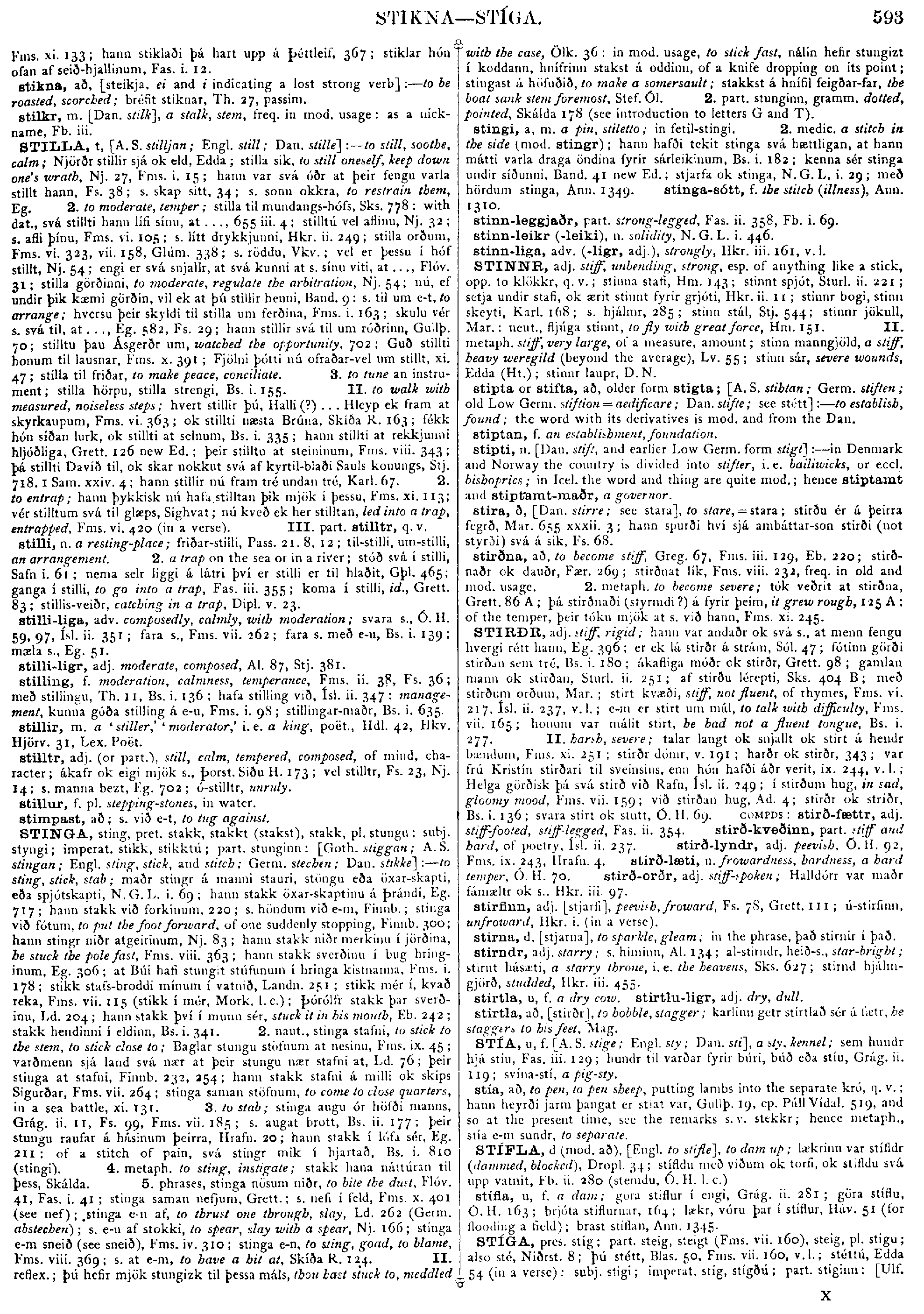
stía, að, to pen, to pen sheep, putting lambs into the separate kró, q.v.; hann heyrði jarm þangat er stiat var, Gullþ. 19, cp. Páll Vídal. 519, and so at the present time, see the remarks s.v. stekkr; hence metaph., stía e-m sundr, to separate.
|
Source: Cleasby/Vigfusson, page b0603, entry 47 View original page image as: [TIFF] [PNG] [View previous entry] [View next entry] |
[Comment on this entry] [View comments] |
The following entry has been hand-corrected once. |
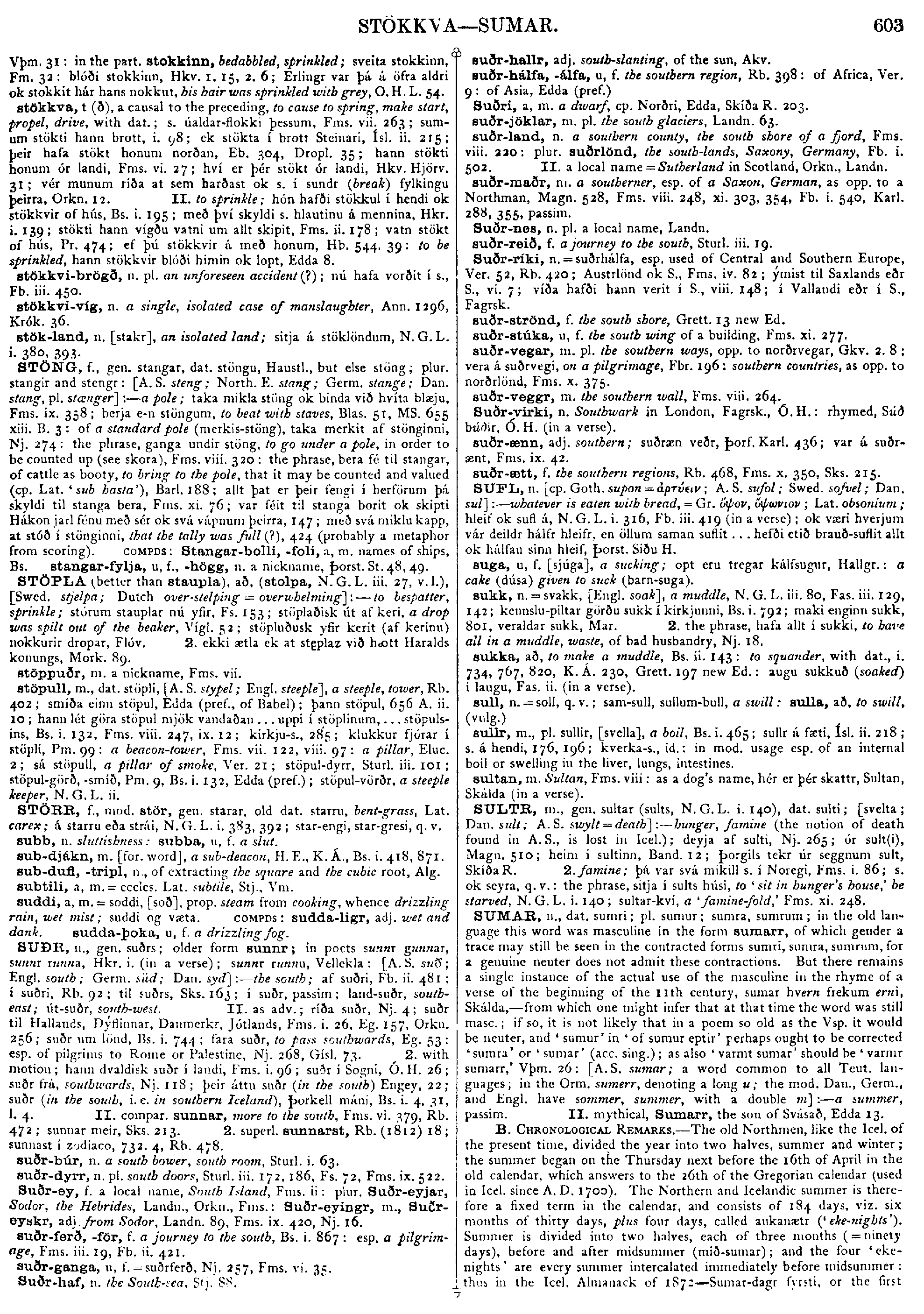
SUMAR, n., dat. sumri; pl. sumur; sumra, sumrum; in the old language this word was masculine in the form sumarr, of which gender a trace may still be seen in the contracted forms sumri, sumra, sumrum, for a genuine neuter does not admit these contractions. But there remains a single instance of the actual use of the masculine in the rhyme of a verse of the beginning of the 11th century, sumar hvern frekum erni, Skálda, -- from which one might infer that at that time the word was still masc.; if so, it is not likely that in a poem so old as the Vsp. it would be neuter, and 'sumur' in 'of sumur eptir' perhaps ought to be corrected 'sumra' or 'sumar' (acc. sing.); as also 'varmt sumar' should be 'varmr sumarr,' Vþm. 26: [A.S. sumar; a word common to all Teut. languages; in the Orm. sumerr, denoting a long u; the mod. Dan., Germ., and Engl. have sommer, summer, with a double m] :-- a summer, passim. II. mythical, Sumarr, the son of Svásað, Edda 13. B. CHRONOLOGICAL REMARKS. -- The old Northmen, like the Icel. of the present time, divided the year into two halves, summer and winter; the summer began on the Thursday next before the 16th of April in the old calendar, which answers to the 26th of the Gregorian calendar (used in Icel. since A.D. 1700). The Northern and Icelandic summer is therefore a fixed term in the calendar, and consists of 184 days, viz. six months of thirty days, plus four days, called aukanætr ('eke-nights'). Summer is divided into two halves, each of three months (= ninety days), before and after midsummer (mið-sumar); and the four 'eke-nights' are every summer intercalated immediately before midsummer: thus in the Icel. Almanack of 1872 -- Sumar-dagr fyrsti, or the first
|
Source: Cleasby/Vigfusson, page b0605, entry 25 View original page image as: [TIFF] [PNG] [View previous entry] [View next entry] |
[Comment on this entry] [View comments] |
The following entry has been hand-corrected once. |
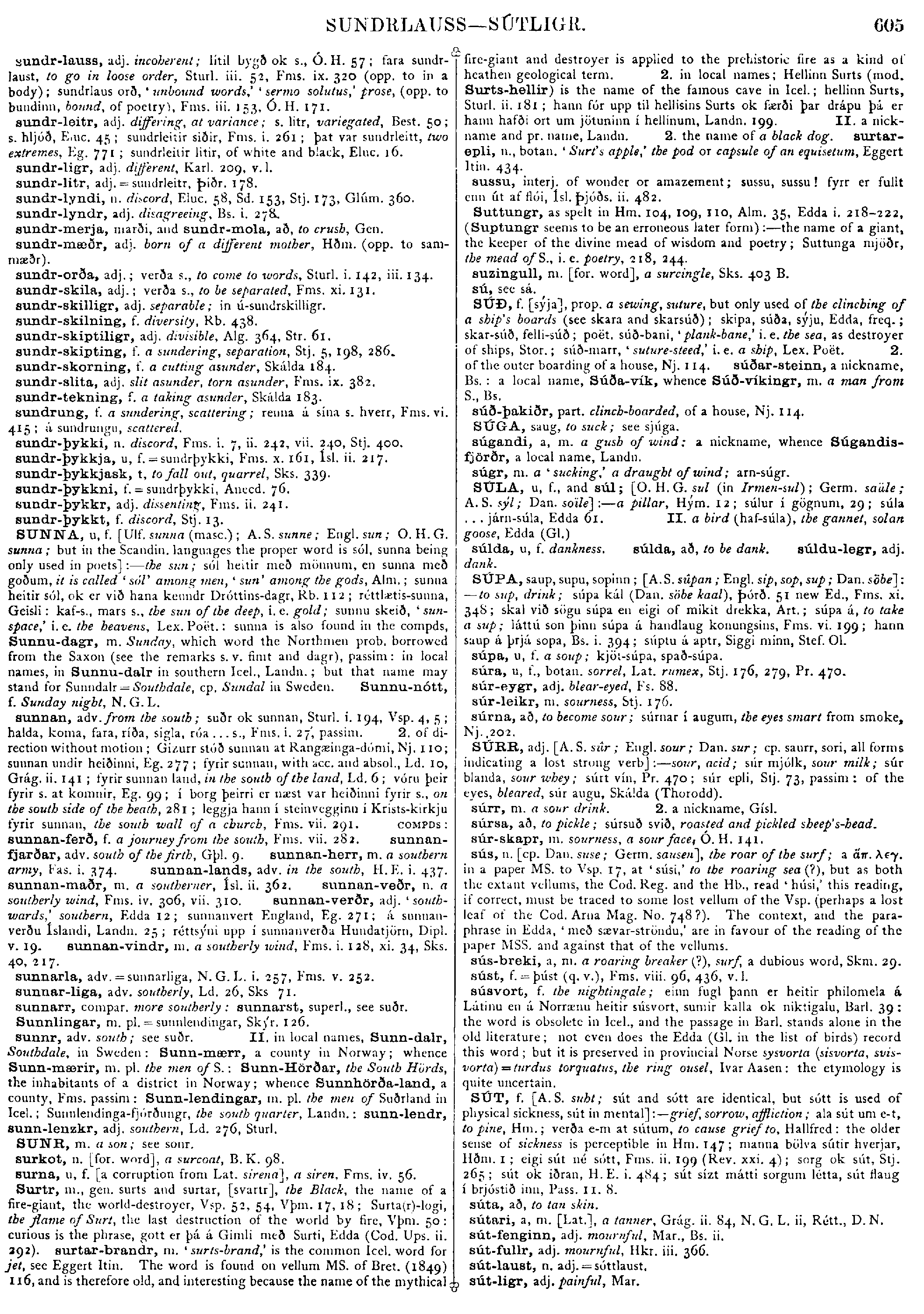
SUNNA, u, f. [Ulf. sunna (masc.); A.S. sunne; Engl. sun; O.H.G. sunna; but in the Scandin. languages the proper word is sól, sunna being only used in poets] :-- the sun; sól heitir með mönnum, en sunna með goðum, it is called 'sól' among men, 'sun' among the gods, Alm.; sunna heitir sól, ok er við hana kenndr Dróttins-dagr, Rb. 112; réttlætis-sunna, Geisli: kaf-s., mars s., the sun of the deep, i.e. gold; sunnu skeið, 'sun-space,' i.e. the heavens, Lex. Poët.: sunna is also found in the compds, Sunnu-dagr, m. Sunday, which word the Northmen prob. borrowed from the Saxon (see the remarks s.v. fimt and dagr), passim: in local names, in Sunnu-dalr in southern Icel., Landn.; but that name may stand for Sunndalr = Southdale, cp. Sundal in Sweden. Sunnu-nótt, f. Sunday night, N.G.L.
|
Source: Cleasby/Vigfusson, page b0617, entry 8 View original page image as: [TIFF] [PNG] [View previous entry] [View next entry] |
[Comment on this entry] [View comments] |
The following entry has been hand-corrected once. |
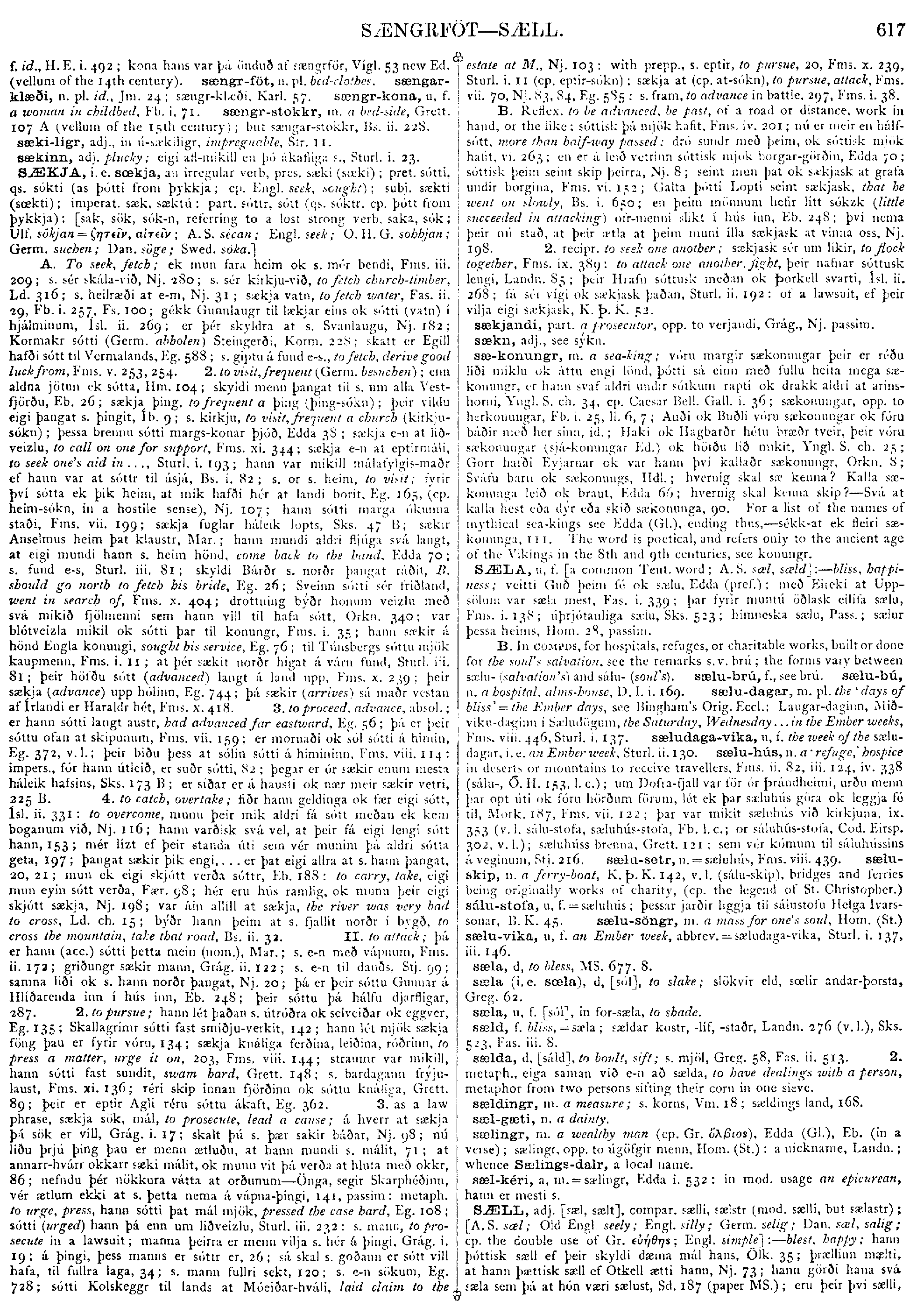
SÆLA, u, f. [a common Teut. word; A.S. sæl, sæld] :-- bliss, happiness; veitti Guð þeim fé ok sælu, Edda (pref.); með Eireki at Uppsölum var sæla mest, Fas. i. 339; þar fyrir muntú öðlask eilífa sælu, Fms. i. 138; úþrjótanliga sælu, Sks. 523; himneska sælu, Pass.; sælur þessa heims, Hom. 28, passim. B. In COMPDS, for hospitals, refuges, or charitable works, built or done for the soul's salvation, see the remarks s.v. brú; the forms vary between sælu- (salvation's) and sálu- (soul's). sælu-brú, f., see brú. sælu-bú, n. a hospital, alms-house, D.I. i. 169. sælu-dagar, m. pl. the 'days of bliss' = the Ember days, see Bingham's Orig. Eccl.; Laugar-daginn, Miðviku-daginn í Sæludögum, the Saturday, Wednesday... in the Ember weeks, Fms. viii. 446, Sturl. i. 137. sæludaga-vika, u, f. the week of the sælu-dagar, i.e. an Ember week, Sturl. ii. 130. sælu-hús, n. a 'refuge,' hospice in deserts or mountains to receive travellers, Fms. ii. 82, iii. 124, iv. 338 (sálu-, Ó.H. 153, l.c.); um Dofra-fjall var för ór Þrándheimi, urðu menn þar opt úti ok fóru hörðum förum, lét ek þar sæluhús göra ok leggja fé til, Mork. 187, Fms. vii. 122; þar var mikit sæluhús við kirkjuna, ix. 353 (v.l. sálu-stofa, sæluhús-stofa, Fb. l.c.; or sáluhús-stofa, Cod. Eirsp. 302, v.l.); sæluhúss brenna, Grett. 121; sem vér kómum til sáluhússins á veginum, Stj. 216. sælu-setr, n. = sæluhús, Fms. viii. 439. sælu-skip, n. a ferry-boat, K.Þ.K. 142, v.l. (sálu-skip), bridges and ferries being originally works of charity, (cp. the legend of St. Christopher.) sálu-stofa, u, f. = sæluhús; þessar jarðir liggja til sálustofu Helga Ivarssonar, B.K. 45. sælu-söngr, m. a mass for one's soul, Hom. (St.) sælu-vika, u, f. an Ember week, abbrev. = sæludaga-vika, Sturl. i. 137, iii. 146.
|
Source: Cleasby/Vigfusson, page b0618, entry 6 View original page image as: [TIFF] [PNG] [View previous entry] [View next entry] |
[Comment on this entry] [View comments] |
The following entry has been hand-corrected once. |
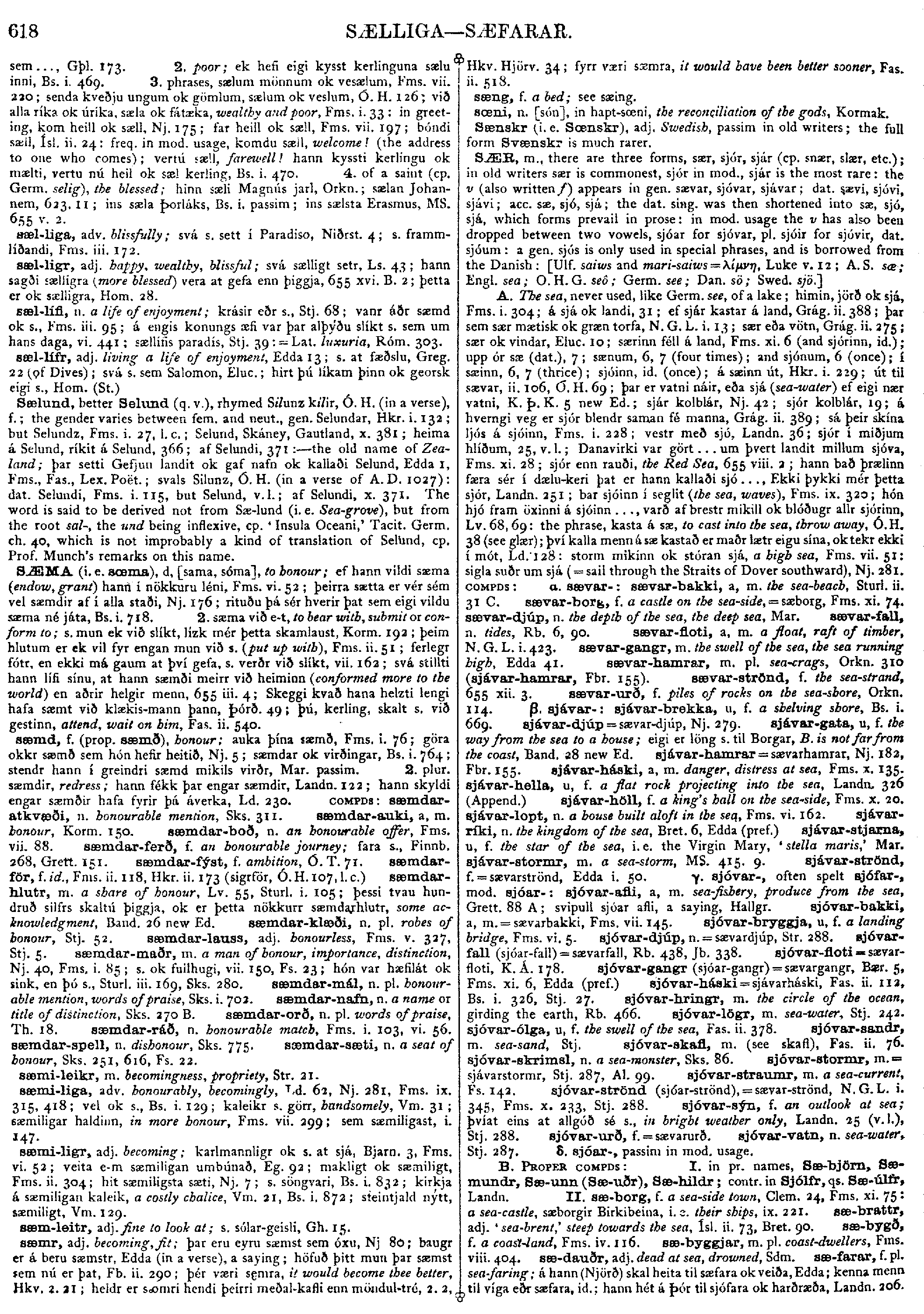
Sælund, better Selund (q.v.), rhymed Silunz kilir, Ó.H. (in a verse), f.; the gender varies between fem, and neut., gen. Selundar, Hkr. i. 132; but Selundz, Fms. i. 27, l.c.; Selund, Skáney, Gautland, x. 381; heima á Selund, ríkit á Selund, 366; af Selundi, 371 :-- the old name of Zealand; þar setti Gefjun landit ok gaf nafn ok kallaði Selund, Edda 1, Fms., Fas., Lex. Poët.; svals Silunz, Ó.H. (in a verse of A.D. 1027): dat. Selundi, Fms. i. 115, but Selund, v.l; af Selundi, x. 371. The word is said to be derived not from Sæ-lund (i.e. Sea-grove), but from the root sal-, the und being inflexive, cp. 'Insula Oceani,' Tacit. Germ. ch. 40, which is not improbably a kind of translation of Selund, cp. Prof. Munch's remarks on this name.
|
Source: Cleasby/Vigfusson, page b0625, entry 2 View original page image as: [TIFF] [PNG] [View previous entry] [View next entry] |
[Comment on this entry] [View comments] |
The following entry has been hand-corrected once. |
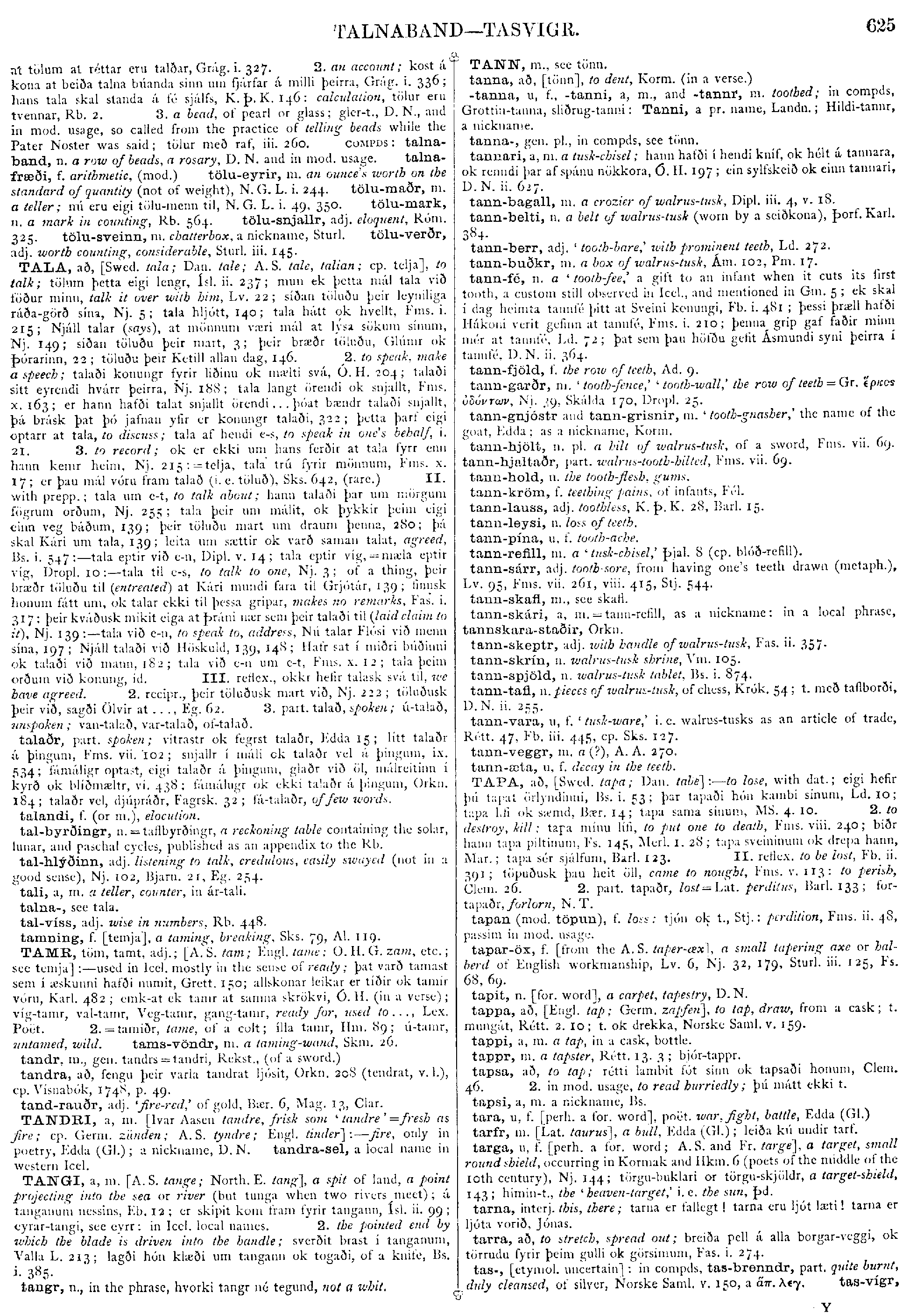
TALA, að, [Swed. tala; Dan. tale; A.S. tale, talian; cp. telja], to talk; tölum þetta eigi lengr, Ísl. ii. 237; mun ek þetta mál tala við föður minu, talk it over with him, Lv. 22; síðan töluðu þeir leyniliga ráða-görð sína, Nj. 5; tala hljótt, 140; tala hátt ok hvellt, Fms. i. 215; Njáll talar (says), at mönnum væri mál at lýsa sökum sínum, Nj. 149; síðan töluðu þeir mart, 3; þeir bræðr töluðu, Glúmr ok Þórarinn, 22; töluðu þeir Ketill allan dag, 146. 2. to speak, make a speech; talaði konungr fyrir liðinu ok mælti svá, Ó.H. 204; talaði sitt eyrendi hvárr þeirra, Nj. 188; tala langt örendi ok snjallt, Fms. x. 163; er hann hafði talat snjallt örendi ... þóat bændr talaði snjallt, þá brásk þat þó jafnan yfir er konungr talaði, 322; þetta þarf eigi optarr at tala, to discuss; tala af hendi e-s, to speak in one's behalf, i. 21. 3. to record; ok er ekki um hans ferðir at tala fyrr enn hann kemr heim, Nj. 215: = telja, tala trú fyrir mönnum, Fms. x. 17; er þau mál vóru fram talað (i.e. töluð), Sks. 642, (rare.) II. with prepp.; tala um e-t, to talk about; hann talaði þar um mörgum fögrum orðum, Nj. 255; tala þeir um málit, ok þykkir þeim eigi einn veg báðum, 139; þeir töluðu mart um draum þenna, 280; þá skal Kári um tala. 139; leita um sættir ok varð saman talat, agreed, Bs. i. 547 :-- tala eptir við e-n, Dipl. v. 14; tala eptir víg, = mæla eptir víg, Dropl. 10 :-- tala til e-s, to talk to one, Nj. 3; of a thing, þeir bræðr töluðu til (entreated) at Kári mundi fara til Grjótár, 139; finnsk honum fátt um, ok talar ekki til þessa gripar, makes no remarks. Fas. i. 317; þeir kváðusk mikit eiga at Þráni nær sem þeir talaði til (laid claim to it), Nj. 139 :-- tala við e-n, to speak to, address, Nú talar Flósi við menn sína, 197; Njáll talaði við Höskuld, 139, 148; Hafr sat í miðri búðinni ok talaði við mann. 182; tala við e-n um e-t, Fms. x. 12; tala þeim orðum við konung, id. III. reflex., okkr hefir talask svá til, we have agreed. 2. recipr., þeir töluðusk mart við, Nj. 222; töluðusk þeir við, sagði Ölvir at ..., Eg. 62. 3. part. talað, spoken; ú-talað, unspoken; van-talað, var-talað, of-talað.
|
Source: Cleasby/Vigfusson, page b0627, entry 1 View original page image as: [TIFF] [PNG] [View previous entry] [View next entry] |
[Comment on this entry] [View comments] |
The following entry has been hand-corrected once. |
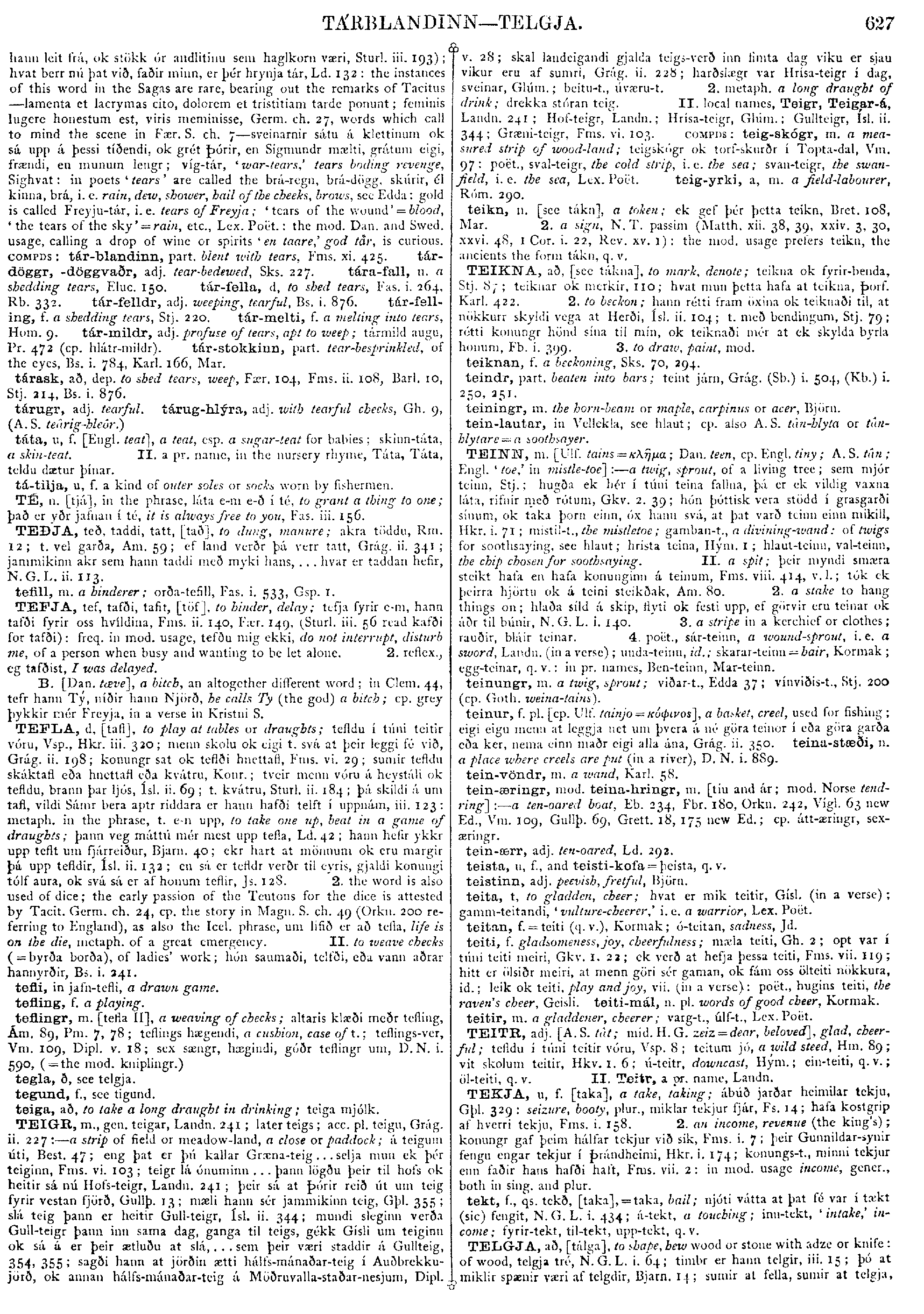
hann leit frá, ok stökk ór andlitiuu sem haglkorn væri, Sturl. iii. 193); hvat berr nú þat við, faðir minn, er þér hrynja tár, Ld. 132: the instances of this word in the Sagas are rare, bearing out the remarks of Tacitus -- lamenta et lacrymas cito, dolorem et tristitiam tarde ponunt; feminis lugere honestum est, viris meminisse, Germ. ch. 27, words which call to mind the scene in Fær. S. ch. 7 -- sveinarnir sátu á klettimun ok sá upp á þessi tíðendi. ok grét Þórir, en Sigmundr mælti, grátum eigi, frændi, en munum lengr; víg-tár, 'war-tears,' tears boding revenge, Sighvat: in poets 'tears' are called the brá-regn, brú-dögg, skúrir, él kinna, brá, i.e. rain, dew, shower, hail of the cheeks, brows, see Edda: gold is called Freyju-tár, i.e. tears of Freyja; 'tears of the wound' = blood, 'the tears of the sky' = rain, etc., Lex. Poët.: the mod. Dan. and Swed. usage, calling a drop of wine or spirits 'en taare,' god tår, is curious. COMPDS: tár-blandinn, part. blent with tears, Fms. xi. 425. tár-döggr, -döggvaðr, adj. tear-bedewed, Sks. 227. tára-fall, n. a shedding tears, Eluc. 150. tár-fella, d, to shed tears, Fas. i. 264, Rb. 332. tár-felldr, adj. weeping, tearful, Bs. i. 876. tár-felling, f. a shedding tears, Stj. 220. tár-melti, f. a melting into tears, Hom. 9, tár-mildr, adj. profuse of tears, apt to weep; tármild augu, Pr. 472 (cp. hlátr-mildr). tár-stokkinn, part. tear-besprinkled, of the eyes, Bs. i. 784, Karl. 166, Mar.
|
Source: Cleasby/Vigfusson, page b0638, entry 13 View original page image as: [TIFF] [PNG] [View previous entry] [View next entry] |
[Comment on this entry] [View comments] |
The following entry has been hand-corrected once. |
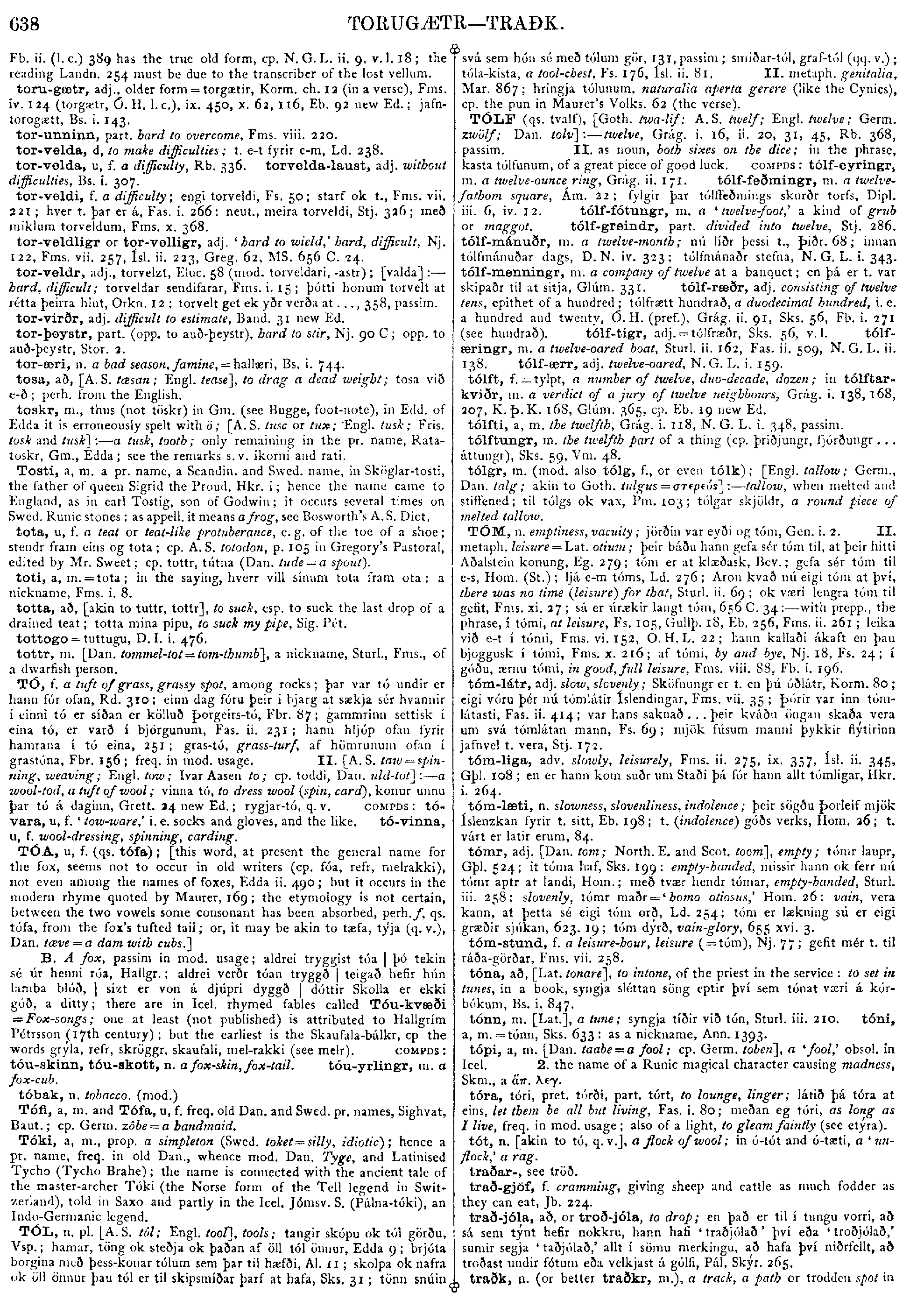
toskr, m., thus (not töskr) in Gm. (see Bugge, foot-note), in Edd. of Edda it is erroneously spelt with ö; [A.S. tusc or tux; Engl. tusk; Fris. tosk and tusk] :-- a tusk, tooth; only remaining in the pr. name, Ratatoskr, Gm., Edda; see the remarks s.v. íkorni and rati.
| Result Page: |  |
Previous | 1 2 3 4 5 6 7 8 9 10 | Next |  |
Germanic Lexicon Project (main page)
This search system was written by
Sean Crist
Please consider
volunteering
to correct the data in these online dictionaries.
No rights reserved. Feel free to use these data in any way you please.