|
|

|
Source: Cleasby/Vigfusson, page b0424, entry 28 View original page image as: [TIFF] [PNG] [View previous entry] [View next entry] |
[Comment on this entry] [View comments] |
The following entry has been hand-corrected once. |
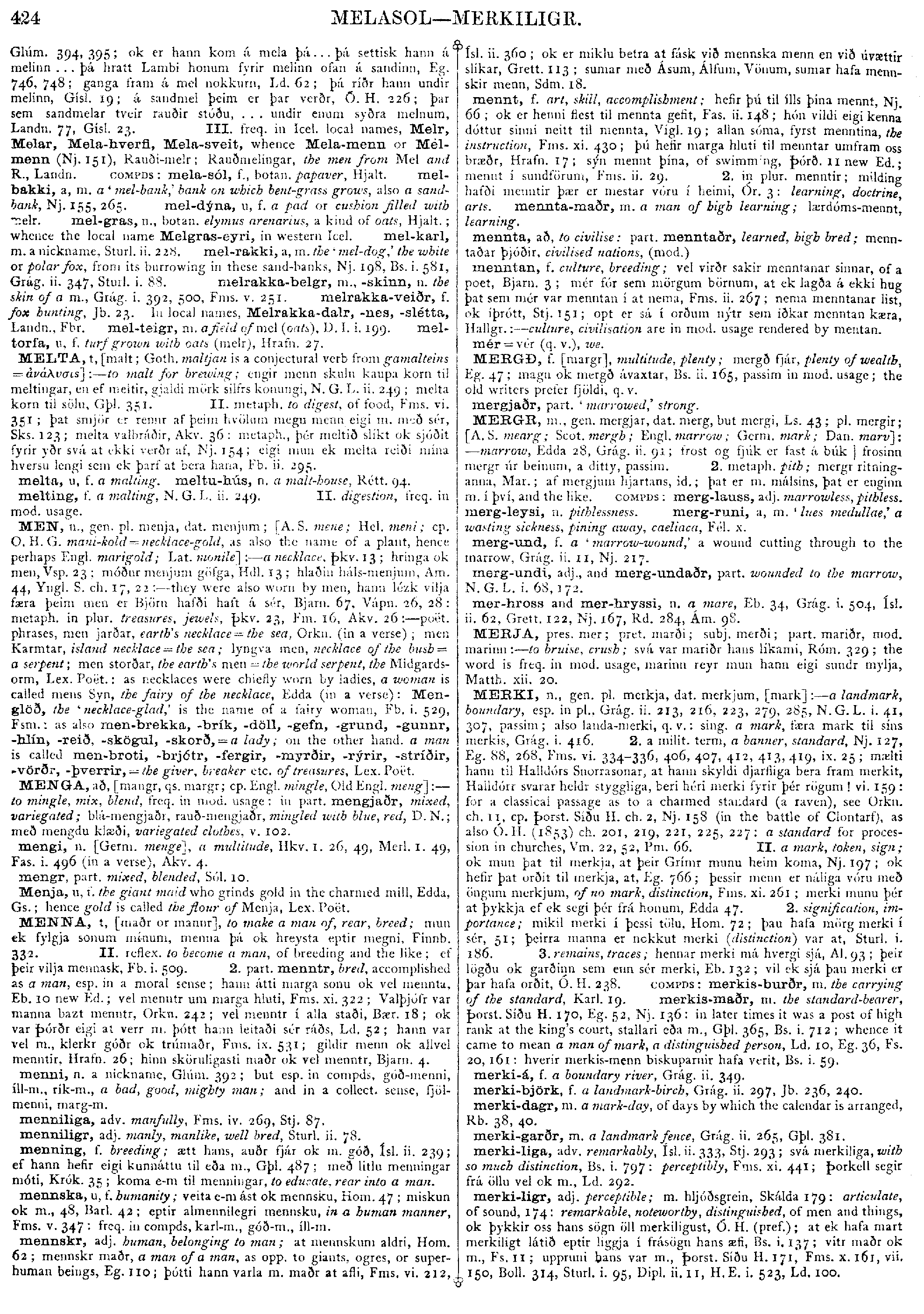
MERKI, n., gen. pl. merkja, dat. merkjum, [mark] :-- a landmark, boundary, esp. in pl., Grág. ii. 213, 216, 223, 279, 285, N.G.L. i. 41, 307, passim; also landa-merki, q.v.: sing. a mark, færa mark til síns merkis, Grág. i. 416. 2. a milit. term, a banner, standard, Nj. 127, Eg. 88, 268, Fms. vi. 334-336, 406, 407, 412, 413, 419, ix. 25; mælti hann til Halldórs Snorrasonar, at hann skyldi djarfliga bera fram merkit, Halldórr svarar heldr styggliga, beri héri merki fyrir þér rögum! vi. 159: for a classical passage as to a charmed standard (a raven), see Orkn. ch. 11, cp. Þorst. Síðu H. ch. 2, Nj. 158 (in the battle of Clontarf), as also Ó.H. (1853) ch. 201, 219, 221, 225, 227: a standard for procession in churches, Vm. 22, 52, Pm. 66. II. a mark, token, sign; ok mun þat til merkja, at þeir Grímr munu heim koma, Nj. 197; ok hefir þat orðit til merkja, at, Eg. 766; þessir menn er náliga vóru með öngum merkjum, of no mark, distinction, Fms. xi. 261; merki munu þér at þykkja ef ek segi þér frá honum, Edda 47. 2. signification, importance; mikil merki í þessi tölu, Hom. 72; þau hafa mörg merki í sér, 51; þeirra manna er nokkut merki (distinction) var at, Sturl. i. 186. 3. remains, traces; hennar merki má hvergi sjá, Al. 93; þeir lögðu ok garðinn sem enn sér merki, Eb. 132; vil ek sjá þau merki er þar hafa orðit, Ó.H. 238. COMPDS: merkis-burðr, m. the carrying of the standard, Karl. 19. merkis-maðr, m. the standard-bearer, Þorst. Siðu H. 170, Eg. 52, Nj. 136: in later times it was a post of high rank at the king's court, stallari eða m., Gþl. 365, Bs. i. 712; whence it came to mean a man of mark, a distinguished person, Ld, 10, Eg. 36, Fs. 20, 161: hverir merkis-menn biskuparnir hafa verit, Bs. i. 59.
|
Source: Cleasby/Vigfusson, page b0426, entry 4 View original page image as: [TIFF] [PNG] [View previous entry] [View next entry] |
[Comment on this entry] [View comments] |
The following entry has been hand-corrected once. |
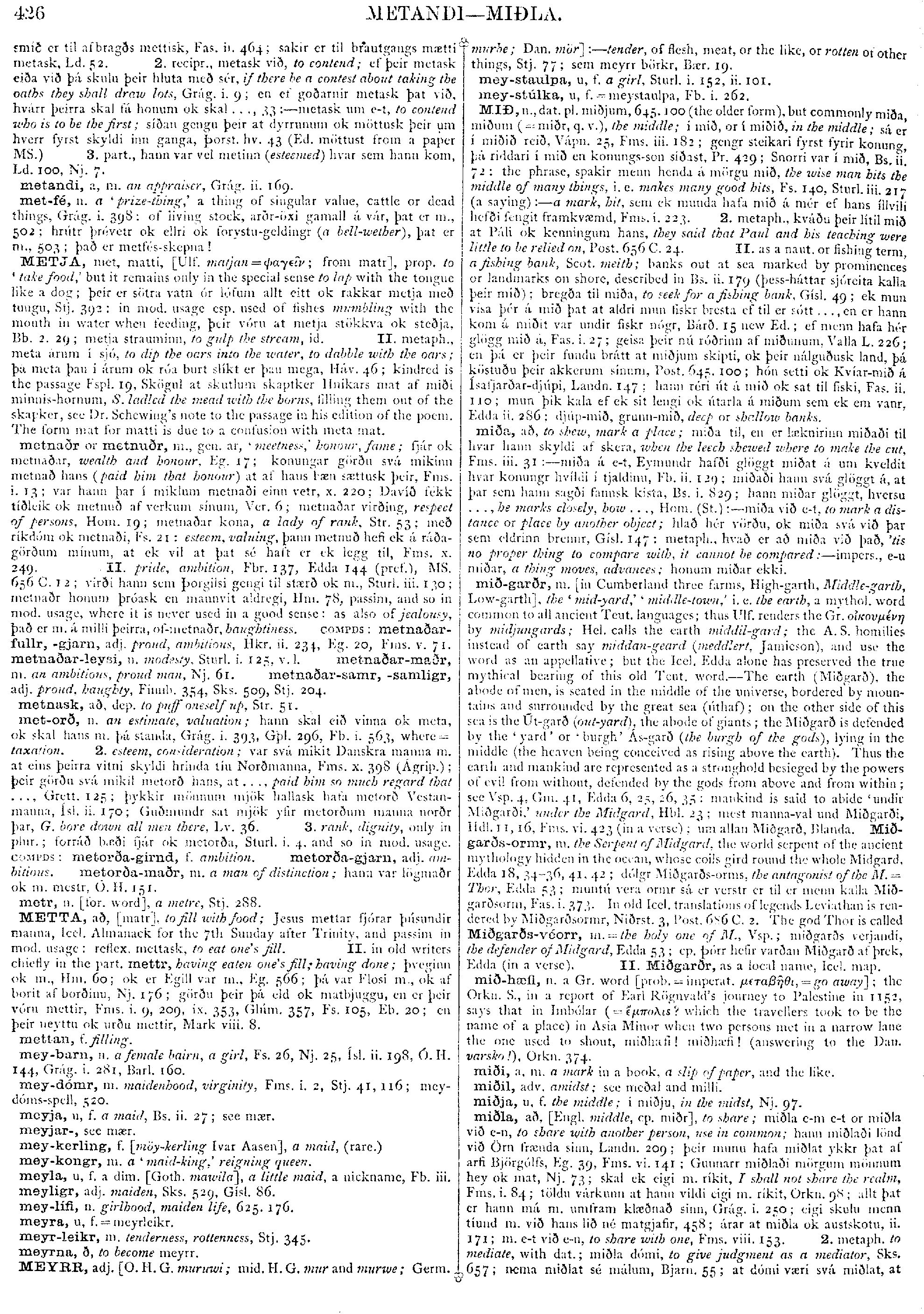
METJA, met, matti, [Ulf. matjan = GREEK; from matr], prop. to 'take food,' but it remains only in the special sense to lap with the tongue like a dog; þeir er sötra vatn ór lófum allt eitt ok rakkar metja með tungu, Stj. 392: in mod. usage esp. used of fishes mumbling with the mouth in water when feeding, þtir vóru at metja stökkva ok steðja, Bb. 2. 29; metja strauminn, to gulp the stream, id. II. metaph., meta árum í sjó, to dip the oars into the water, to dabble with the oars; þá meta þau í árum ok róa burt slíkt er þau mega, Háv. 46; kindred is the passage Fspl. 19, Skögul at skutlum skaptker Hnikars mat af miði minnis-hornum, S. ladled the mead with the horns, filling them out of the skapker, see Dr. Schewing's note to the passage in his edition of the poem. The form mat for matti is due to a confusion with meta mat.
|
Source: Cleasby/Vigfusson, page b0430, entry 8 View original page image as: [TIFF] [PNG] [View previous entry] [View next entry] |
[Comment on this entry] [View comments] |
The following entry has not been hand-corrected. However, the page is reserved and someone is correcting it. |
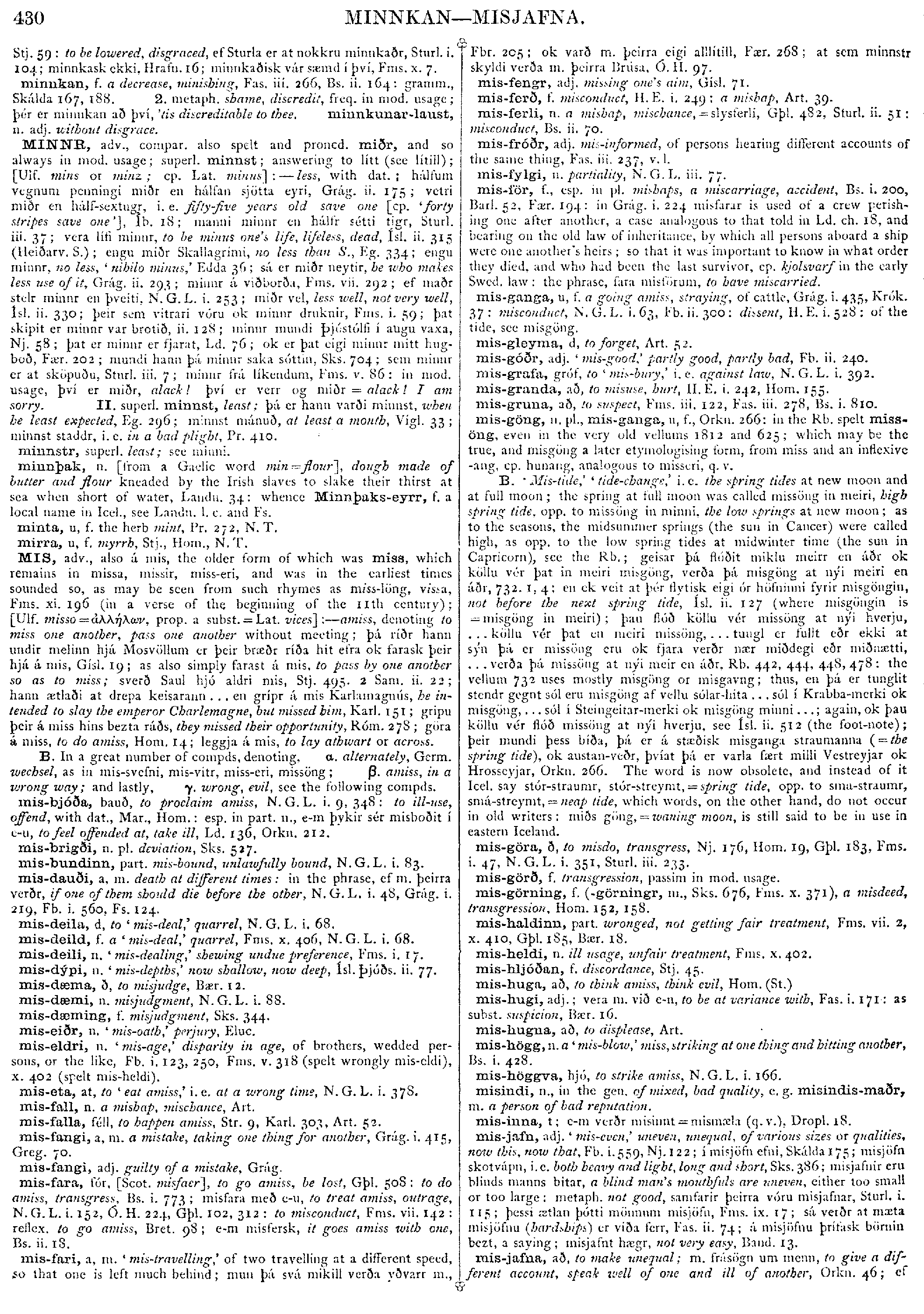
MIS, adv., also ú mis, the older form of which was miss, which remains in missa, missir, miss-eri, and was in the earliest times sounded so, as may be seen from such rhymes as m is s-long, v i ssa, Fms. xi. 196 (in a verse of the beginning of the nth century); [Ulf. misso = ciAATjAo. '!/, prop, a subst. = Lat. vi ces] :-- amiss, denoting to miss one another, pass one another without meeting: þá ríðr hann undir melinn hjá Mosvöllum er þeir bræðr ríða hit efra ok farask peir hjf'i á mis, Gísl. 19; as also simply farast ú mis, to pass by one another so as to miss; sverð Saul hjó aldri mis, Stj. 495. 2 Sam. ii. 22; hann ætlaði at drepa keisarann ... en grípr á mis Karlamagnús, he in- tended to slay the emperor Charlemagne, but missed him, Karl. 151; gripu þeir á miss hins bezta ráðs, they missed their opportunity, Róm. 278; göra á miss, to do amiss, Hom. 14; leggja á mis, to l a y athwart or a cros s. B. In a great number of compds, denoting, a. alternately, Germ. wechsel, as in mis-svefni, mis-vitr, miss-eri, missöng; P. amiss, in a wrong way; and lastly, y. wrong, evil, see the following compds.
|
Source: Cleasby/Vigfusson, page b0435, entry 39 View original page image as: [TIFF] [PNG] [View previous entry] [View next entry] |
[Comment on this entry] [View comments] |
The following entry has been hand-corrected once. |
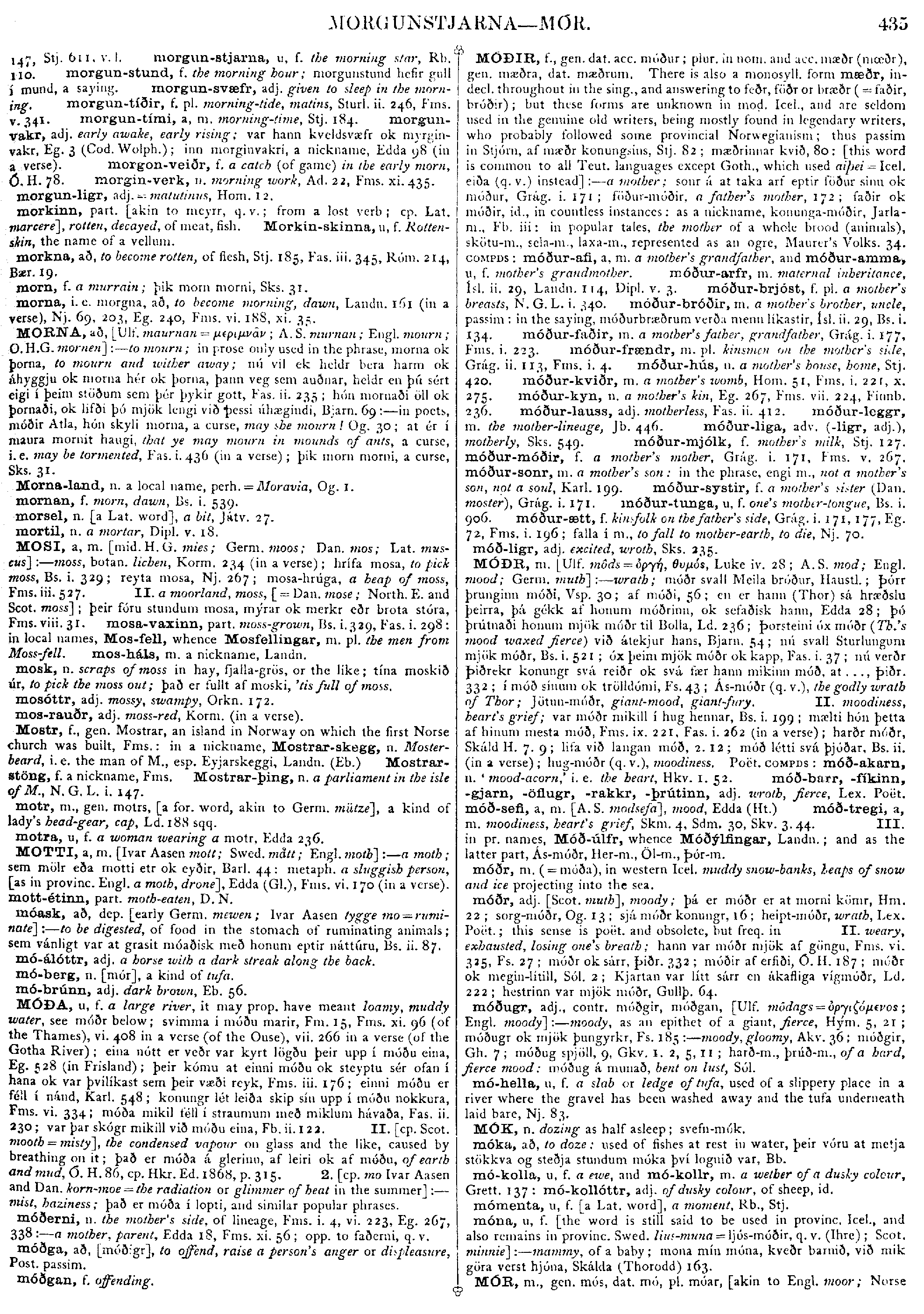
móna, u, f. [the word is still said to be used in provinc. Icel., and also remains in provinc. Swed. lius-muna = ljós-móðir, q.v. (Ihre); Scot. minnie] :-- mammy, of a baby; mona mín móna, kveðr barnið, við mik göra verst hjóna, Skálda (Thorodd) 163.
|
Source: Cleasby/Vigfusson, page b0437, entry 1 View original page image as: [TIFF] [PNG] [View previous entry] [View next entry] |
[Comment on this entry] [View comments] |
The following entry has been hand-corrected once. |
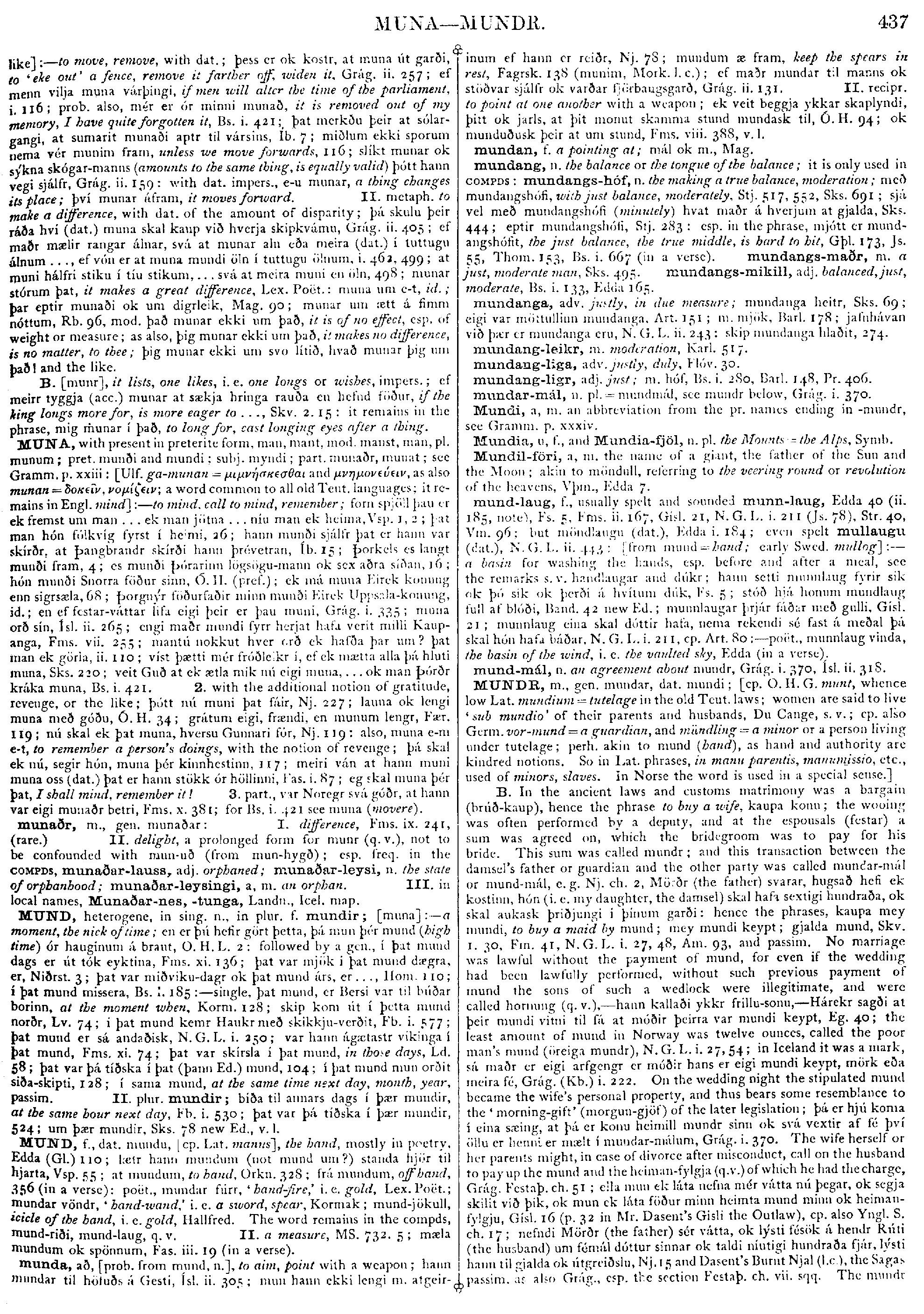
like] :-- to move, remove, with dat.; þess er ok kostr, at muna út garði, to 'eke out' a fence, remove it farther off, widen it, Grág. ii. 257; ef menn vilja muna várþingi, if men will alter the time of the parliament, i. 116; prob. also, mér er ór minni munað, it is removed out of my memory, I have quite forgotten it, Bs. i. 421; þat merkðu þeir at sólar-gangi, at sumarit munaði aptr til vársins, Íb. 7; miðlum ekki sporum nema vér munim fram, unless we move forwards, 116; slíkt munar ok sýkna skógar-manns (amounts to the same thing, is equally valid) þútt hann vegi sjálfr, Grág. ii. 159: with dat. impers., e-u munar, a thing changes its place; því munar áfram, it moves forward. II. metaph. to make a difference, with dat. of the amount of disparity; þá skulu þeir ráða hví (dat.) muna skal kaup við hverja skipkvámu, Grág. ii. 403; ef maðr mælir rangar álnar, svá at munar aln eða meira (dat.) í tuttugu álnum ..., ef vón er at muna mundi öln í tuttugu ölnum, i. 462, 499; at muni hálfri stiku í tíu stikum, ... svá at meira muni en öln, 498; munar stórum þat, it makes a great difference, Lex. Poët.: muna um e-t, id.; þar eptir munaði ok um digrleik, Mag. 90; munar um ætt á fimm nóttum, Rb. 96, mod. það munar ekki um það, it is of no effect, esp. of weight or measure; as also, þig munar ekki um það, it makes no difference, is no matter, to thee; þig munar ekki um svo lítið, hvað munar þig um það! and the like. B. [munr], it lists, one likes, i.e. one longs or wishes, impers.; ef meirr tyggja (acc.) munar at sækja hringa rauða en hefnd föður, if the king longs more for, is more eager to ..., Skv. 2. 15: it remains in the phrase, mig munar í það, to long for, cast longing eyes after a thing.
|
Source: Cleasby/Vigfusson, page b0437, entry 2 View original page image as: [TIFF] [PNG] [View previous entry] [View next entry] |
[Comment on this entry] [View comments] |
The following entry has been hand-corrected once. |
MUNA, with present in preterite form, man, mant, mod. manst, man, pl. munum; pret. munði and mundi: subj. myndi; part. munaðr, munat; see Gramm. p. xxiii: [Ulf. ga-munan = GREEK and GREEK, as also munan = GREEK; a word common to all old Teut. languages; it remains in Engl. mind] :-- to mind, call to mind, remember; forn spjöll þau er ek fremst um man ... ek man jötna ... níu man ek heima. Vsp. 1, 2; þat man hón fólkvíg fyrst í heimi, 26; hann munði sjálfr þat er hann var skírðr, at Þangbrandr skírði hann þrévetran, Íb. 15; Þorkek es langt munði fram, 4; es munði Þórarinn lögsögu-mann ok sex aðra síðan, 16; hón munði Snorra föður sinn, Ó.H. (pref.); ek má muna Eirek konung enn sigrsæla, 68; Þorgnýr föðurfaðir minn munði Eirek Uppsala-konung, id.; en ef fostar-váttar lífa eigi þeir er þau muni, Grág. i. 335; muna orð sín, Ísl. ii. 265; engi maðr mundi fyrr herjat hafa verit milli Kaupanga, Fms. vii. 255; mantú nokkut hver orð ek hafða þar um? þat man ek görla, ii. 110; víst þætti mér fróðleikr í, ef ek mætta alla þá hluti muna, Sks. 220; veit Guð at ek ætla mik nú eigi muna, ... ok man Þórðr kráka muna, Bs. i. 421. 2. with the additional notion of gratitude, revenge, or the like; þótt nú muni þat fáir, Nj. 227; launa ok lengi muna með góðu, Ó.H. 34; grátum eigi, frændi, en munum lengr, Fær. 119; nú skal ek þat muna, hversu Gunnari fór, Nj. 119: also, muna e-m e-t, to remember a person's doings, with the notion of revenge; þá skal ek nú, segir hón, muna þér kinnhestinn, 117; meiri ván at hann muni muna oss (dat.) þat er hann stökk ór höllinni, Fas. i. 87; eg skal muna þér þat, I shall mind, remember it! 3. part., vár Noregr svá góðr, at hann var eigi munaðr betri, Fms. x. 381; for Bs. i. 421 see muna (movere).
|
Source: Cleasby/Vigfusson, page b0437, entry 5 View original page image as: [TIFF] [PNG] [View previous entry] [View next entry] |
[Comment on this entry] [View comments] |
The following entry has been hand-corrected once. |
MUND, f., dat. mundu, [cp. Lat. manus], the hand, mostly in poetry, Edda (Gl.) 110; læfr hann mundum (not mund um?) standa hjör til hjarta, Vsp. 55; at mundum, to hand, Orkn. 328; frá mundum, off hand, 356 (in a verse): poët., mundar fúrr, 'hand-fire,' i.e. gold, Lex. Poët.; mundar vöndr, 'hand-wand' i.e. a sword, spear, Kormak; mund-jökull, icicle of the hand, i.e. gold, Hallfred. The word remains in the compds, mund-riði, mund-laug, q.v. II. a measure, MS. 732. 5; mæla mundum ok spönnum, Fas. iii. 19 (in a verse).
|
Source: Cleasby/Vigfusson, page b0442, entry 26 View original page image as: [TIFF] [PNG] [View previous entry] [View next entry] |
[Comment on this entry] [View comments] |
The following entry has been hand-corrected once. |
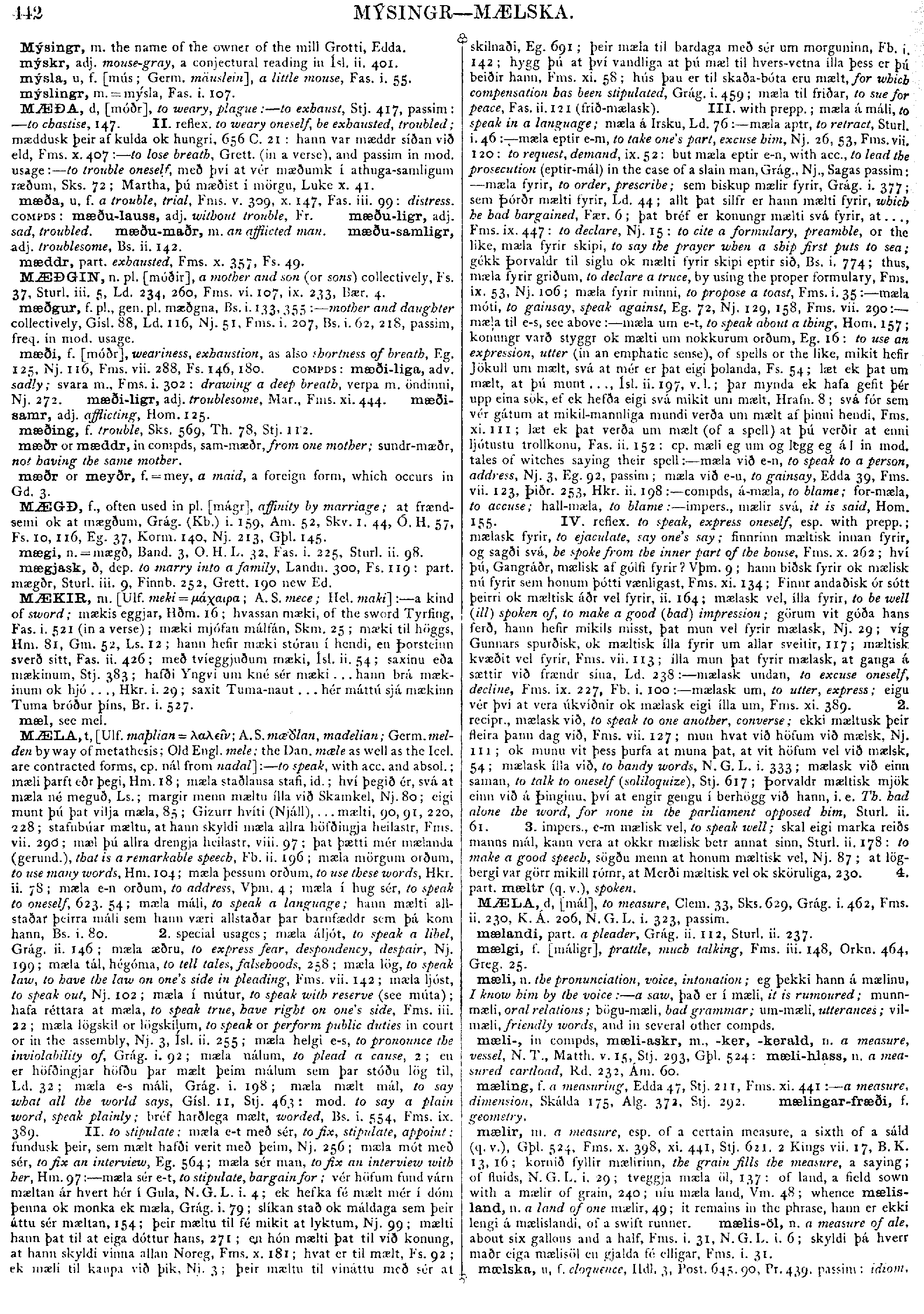
mælir, m. a measure, esp. of a certain measure, a sixth of a sáld (q.v.), Gþl. 524, Fms. x. 398, xi. 441, Stj. 621. 2 Kings vii. 17, B.K. 13, 16; kornið fyllir mælirinn, the grain fills the measure, a saying; of fluids, N.G.L. i. 29; tveggja mæla öl, 137: of land, a field sown with a mælir of grain, 240; níu mæla land, Vm. 48; whence mælis-land, n. a land of one mælir, 49; it remains in the phrase, hann er ekki lengi á mælislandi, of a swift runner. mælis-öl, n. a measure of ale, about six gallons and a half, Fms. i. 31, N.G.L. i. 6; skyldi þá hverr maðr eiga mælisöl en gjalda fé elligar, Fms. i. 31.
|
Source: Cleasby/Vigfusson, page b0443, entry 11 View original page image as: [TIFF] [PNG] [View previous entry] [View next entry] |
[Comment on this entry] [View comments] |
The following entry has been hand-corrected once. |
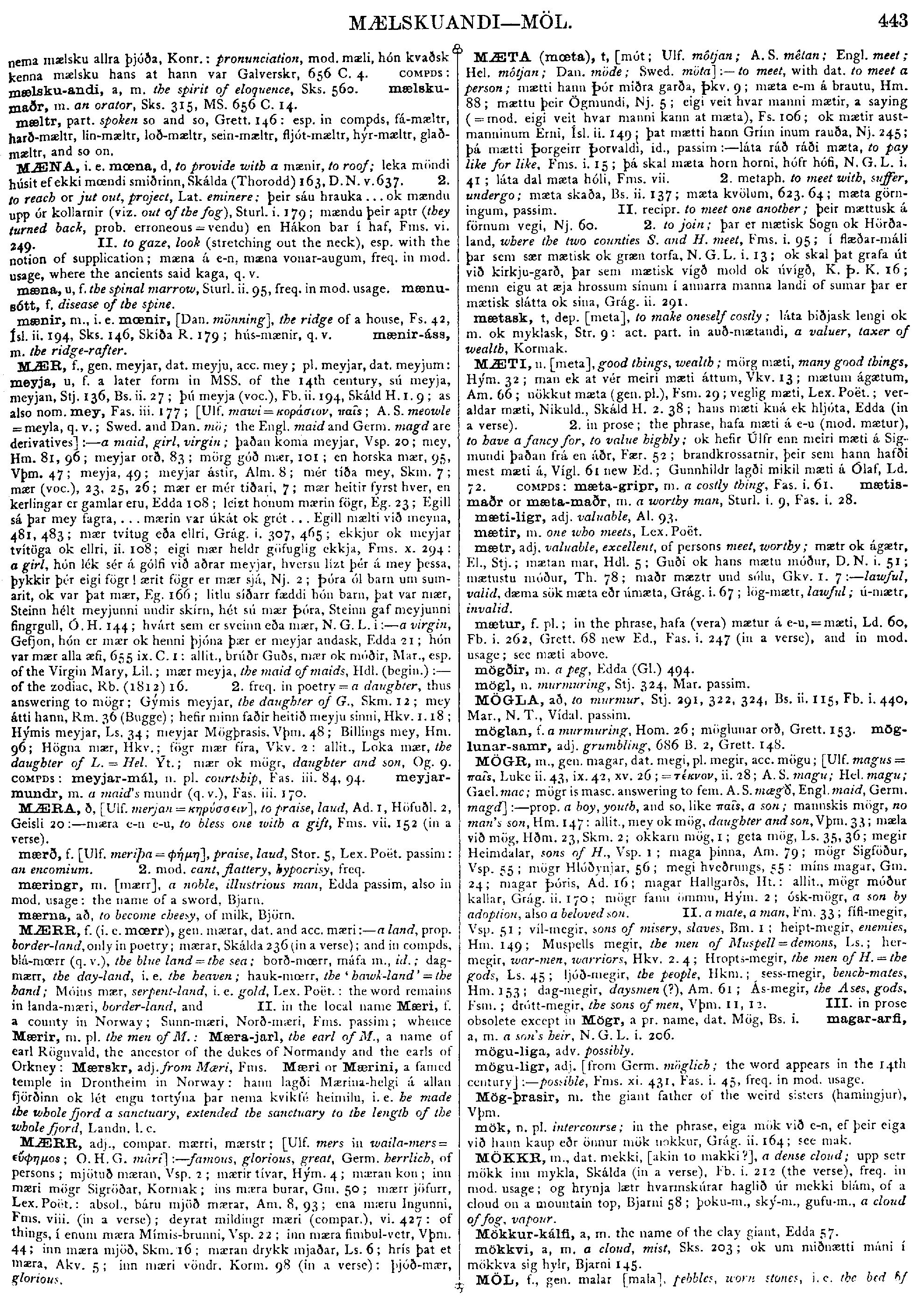
MÆRR, f. (i.e. mœrr), gen. mærar, dat. and acc. mæri :-- a land, prop. border-land, only in poetry; mærar, Skálda 236 (in a verse); and in compds, blá-mœrr (q.v.), the blue land = the sea; borð-mœrr, máfa m., id.; dag-mærr, the day-land, i.e. the heaven; hauk-mœrr, the 'hawk-land' = the hand; Móins mær, serpent-land, i.e. gold. Lex. Poët.: the word remains in landa-mæri, border-land, and II. in the local name Mæri, f. a county in Norway; Sunn-mæri, Norð-mæri, Fms. passim; whence Mærir, m. pl. the men of M.: Mæra-jarl, the earl of M., a name of earl Rögnvald, the ancestor of the dukes of Normandy and the earls of Orkney: Mærskr, adj. from Mæri, Fms. Mæri or Mærini, a famed temple in Drontheim in Norway: hann lagði Mærina-helgi á allan fjörðinn ok lét engu tortýna þar nema kvikfé heimilu, i.e. he made the whole fjord a sanctuary, extended the sanctuary to the length of the whole fjord, Landn. l.c.
|
Source: Cleasby/Vigfusson, page b0451, entry 28 View original page image as: [TIFF] [PNG] [View previous entry] [View next entry] |
[Comment on this entry] [View comments] |
The following entry has been hand-corrected once. |
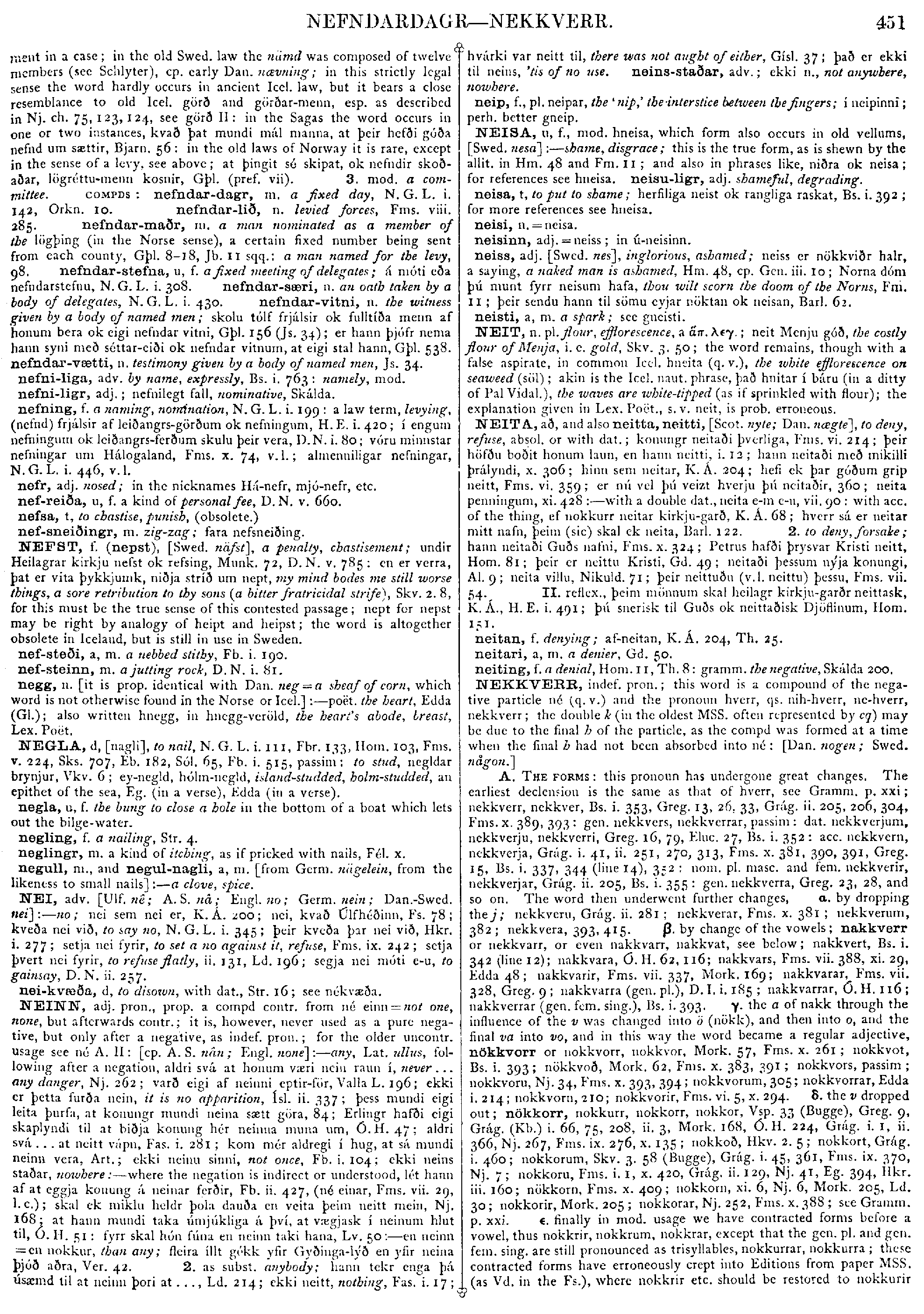
NEIT, n. pl. flour, efflorescence, a GREEK. GREEK.; neit Menju góð, the costly flour of Menja, i. e. gold, Skv. 3. 50; the word remains, though with a false aspirate, in common Icel. hneita (q. v.), the white efflorescence on seaweed (söl); akin is the Icel. naut. phrase, það hnitar í báru (in a ditty of Pal Vídal.), the waves are white-tipped (as if sprinkled with flour); the explanation given in Lex. Poët., s. v. neit, is prob. erroneous.
| Result Page: |  |
Previous | 5 6 7 8 9 10 11 12 13 14 15 16 17 18 19 20 21 22 23 | Next |  |
Germanic Lexicon Project (main page)
This search system was written by
Sean Crist
Please consider
volunteering
to correct the data in these online dictionaries.
No rights reserved. Feel free to use these data in any way you please.