|
|

Tip: In the search results, you can click on any word or abbreviation for more information.
|
Source: Bosworth/Toller, page b0434, entry 9 View original page image as: [TIFF] [PNG] [View previous entry] [View next entry] |
[Comment on this entry] [View comments] |
The following entry has been hand-corrected once. |
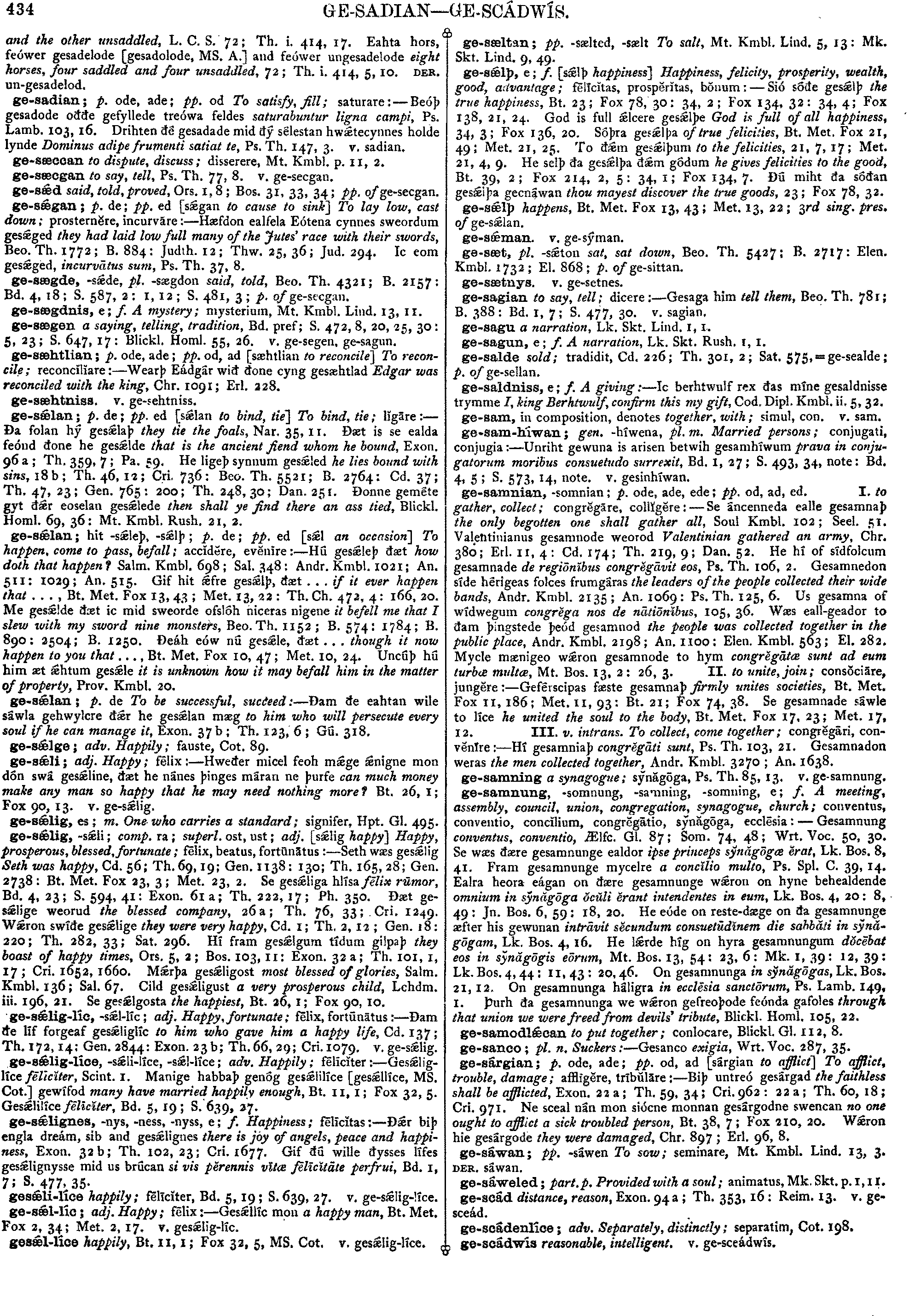
ge-sæhtlian;
p.
ode,
ade;
pp.
od,
ad
[sæhtlian
to
reconcile]
To
reconcile;
reconc lare
:--
Wearþ
Eádgár
wið
ðone
cyng
gesæhtlad
Edgar
was
reconciled
with
the
king,
Chr.
1091;
Erl.
228.
lare
:--
Wearþ
Eádgár
wið
ðone
cyng
gesæhtlad
Edgar
was
reconciled
with
the
king,
Chr.
1091;
Erl.
228.
|
Source: Bosworth/Toller, page b0439, entry 10 View original page image as: [TIFF] [PNG] [View previous entry] [View next entry] |
[Comment on this entry] [View comments] |
The following entry has been hand-corrected once. |
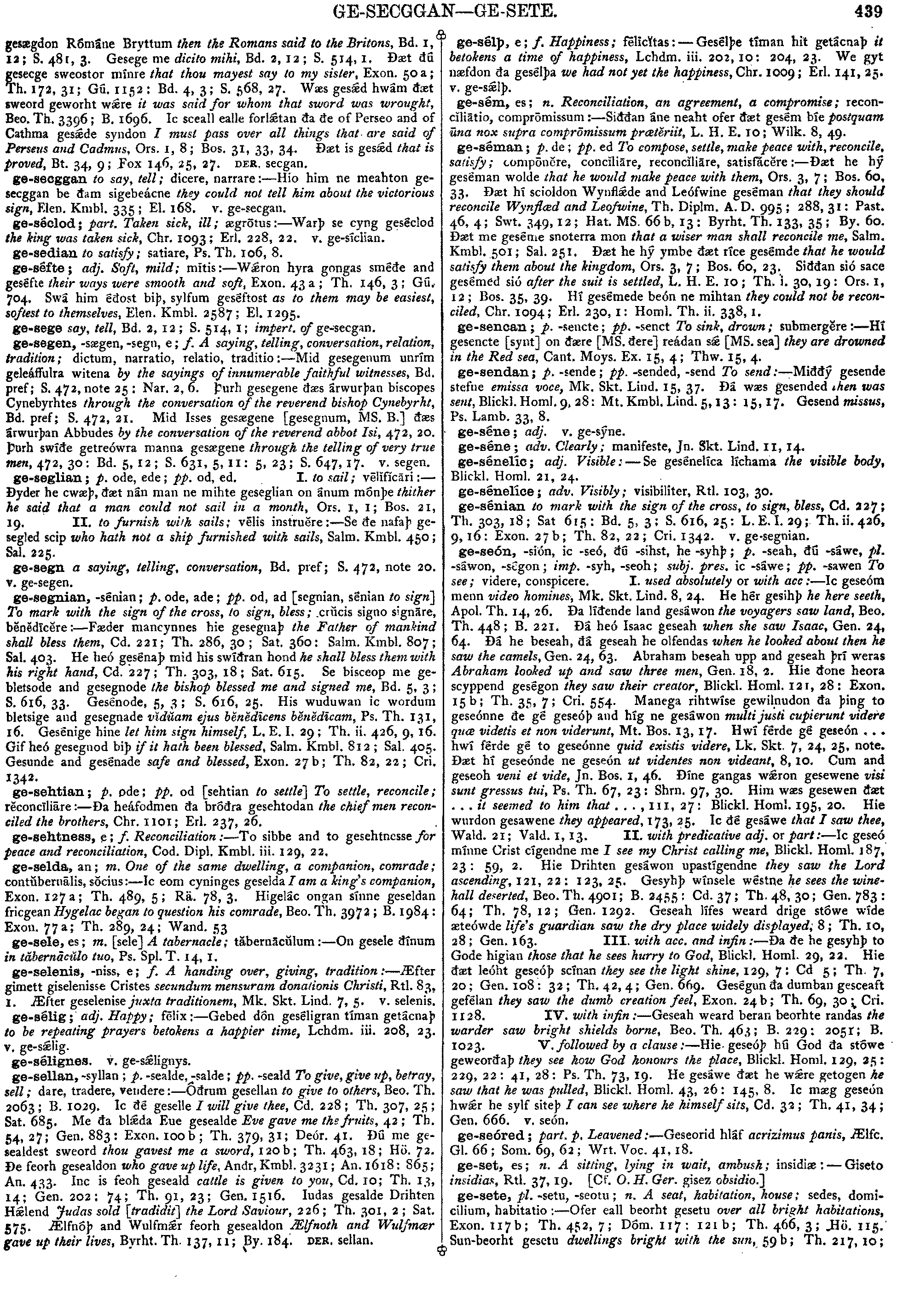
ge-sehtian;
p.
ode;
pp.
od
[sehtian
to
settle]
To
settle,
reconcile;
r conc
conc li
li re
:--
Ða
heáfodmen
ða
bróðra
gesehtodan
the
chief
men
reconciled
the
brothers,
Chr.
1l01;
Erl.
237,
26.
re
:--
Ða
heáfodmen
ða
bróðra
gesehtodan
the
chief
men
reconciled
the
brothers,
Chr.
1l01;
Erl.
237,
26.
|
Source: Bosworth/Toller, page b0439, entry 20 View original page image as: [TIFF] [PNG] [View previous entry] [View next entry] |
[Comment on this entry] [View comments] |
The following entry has been hand-corrected once. |
ge-séman;
p.
de;
pp.
ed
To
compose,
settle,
make
peace
with,
reconcile,
satisfy;
comp nre,
conclire,
reconclire,
satisf
nre,
conclire,
reconclire,
satisf cre
:--
Ðæt
he
hý
geséman
wolde
that
he
would
make
peace
with
them,
Ors.
3,
7;
Bos.
60,
33.
Ðæt
hí
scioldon
Wynfl
cre
:--
Ðæt
he
hý
geséman
wolde
that
he
would
make
peace
with
them,
Ors.
3,
7;
Bos.
60,
33.
Ðæt
hí
scioldon
Wynfl de
and
Leófwine
geséman
that
they
should
reconcile
Wynflæd
and
Leofwine,
Th.
Diplm.
A.
D.
995;
288,
31:
Past.
46,
4;
Swt.
349,
12;
Hat.
MS.
66
b,
13:
Byrht.
Th.
133,
35;
By.
60.
Ðæt
me
geséme
snoterra
mon
that
a
wiser
man
shall
reconcile
me,
Salm.
Kmbl.
501;
Sal.
251.
Ðæt
he
hý
ymbe
ðæt
ríce
gesémde
that
he
would
satisfy
them
about
the
kingdom,
Ors.
3,
7;
Bos.
60,
23.
Siððan
sió
sace
gesémed
sió
after
the
suit
is
settled,
L.
H.
E.
10;
Th.
i.
30,
19:
Ors.
1,
12;
Bos.
35,
39.
Hí
gesémede
beón
ne
mihtan
they
could
not
be
reconciled,
Chr.
1094;
Erl.
230,
1:
Homl.
Th.
ii.
338,
1.
de
and
Leófwine
geséman
that
they
should
reconcile
Wynflæd
and
Leofwine,
Th.
Diplm.
A.
D.
995;
288,
31:
Past.
46,
4;
Swt.
349,
12;
Hat.
MS.
66
b,
13:
Byrht.
Th.
133,
35;
By.
60.
Ðæt
me
geséme
snoterra
mon
that
a
wiser
man
shall
reconcile
me,
Salm.
Kmbl.
501;
Sal.
251.
Ðæt
he
hý
ymbe
ðæt
ríce
gesémde
that
he
would
satisfy
them
about
the
kingdom,
Ors.
3,
7;
Bos.
60,
23.
Siððan
sió
sace
gesémed
sió
after
the
suit
is
settled,
L.
H.
E.
10;
Th.
i.
30,
19:
Ors.
1,
12;
Bos.
35,
39.
Hí
gesémede
beón
ne
mihtan
they
could
not
be
reconciled,
Chr.
1094;
Erl.
230,
1:
Homl.
Th.
ii.
338,
1.
|
Source: Bosworth/Toller, page b0440, entry 16 View original page image as: [TIFF] [PNG] [View previous entry] [View next entry] |
[Comment on this entry] [View comments] |
The following entry has been hand-corrected once. |
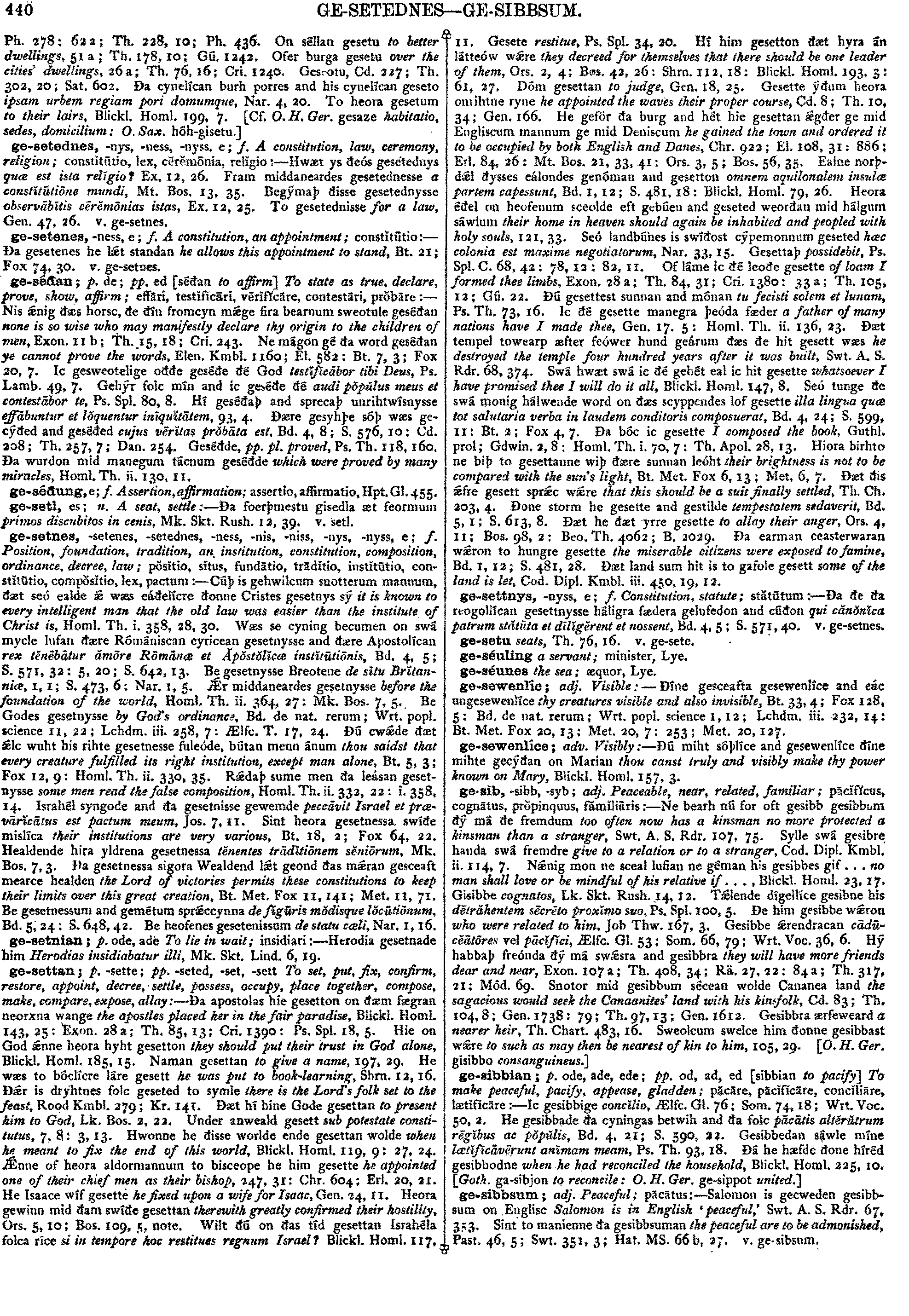
ge-sibbian;
p.
ode,
ade,
ede;
pp.
od,
ad,
ed
[sibbian
to
pacify]
To
make
peaceful,
pacify,
appease,
gladden;
pcre,
pcfcre,
conclire,
lætfcre
:--
Ic
gesibbige
conclio,
Ælfc.
Gl.
76;
Som.
74,
18;
Wrt.
Voc.
50,
2.
He
gesibbade
ða
cyningas
betwih
and
ða
folc
pctis
altr trum
r
trum
r gbus
ac
p
gbus
ac
p plis,
Bd.
4,
21;
S.
590,
22.
Gesibbedan
sáwle
míne
lætfcvrunt
anmam
meam,
Ps.
Th.
93,
18.
Ðá
he
hæfde
ðone
híréd
gesibbodne
when
he
had
reconciled
the
household,
Blickl.
Homl.
225,
10.
[Goth.
ga-sibjon
to
reconcile:
O.
H.
Ger.
ge-sippot
united.]
plis,
Bd.
4,
21;
S.
590,
22.
Gesibbedan
sáwle
míne
lætfcvrunt
anmam
meam,
Ps.
Th.
93,
18.
Ðá
he
hæfde
ðone
híréd
gesibbodne
when
he
had
reconciled
the
household,
Blickl.
Homl.
225,
10.
[Goth.
ga-sibjon
to
reconcile:
O.
H.
Ger.
ge-sippot
united.]
|
Source: Bosworth/Toller, page b0455, entry 28 View original page image as: [TIFF] [PNG] [View previous entry] [View next entry] |
[Comment on this entry] [View comments] |
The following entry has been hand-corrected once. |
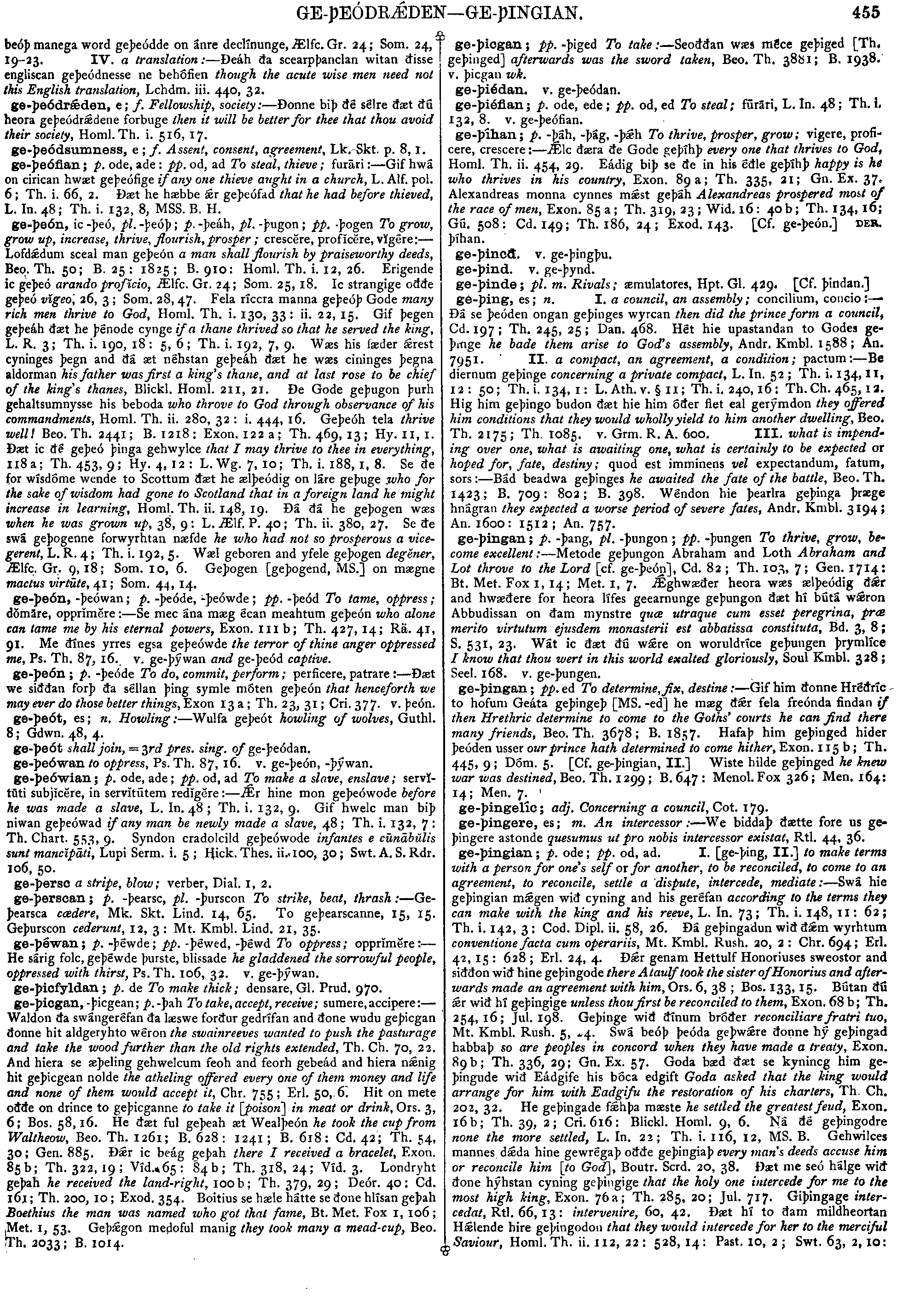
ge-þingian;
p.
ode;
pp.
od,
ad.
I.
[ge-þing,
II.]
to
make
terms
with
a
person
for
one's
self
or
for
another,
to
be
reconciled,
to
come
to
an
agreement,
to
reconcile,
settle
a
dispute,
intercede,
mediate
:--
Swá
hie
geþingian
mgen
wið
cyning
and
his
geréfan
according
to
the
terms
they
can
make
with
the
king
and
his
reeve,
L.
In.
73;
Th.
i.
148,
11:
62;
Th.
i.
142,
3:
Cod.
Dipl.
ii.
58,
26.
Ðá
geþingadun
wið
ðm
wyrhtum
conventione
facta
cum
operariis,
Mt.
Kmbl.
Rush.
20,
2:
Chr.
694;
Erl.
42,
15:
628;
Erl.
24,
4.
Ðr
genam
Hettulf
Honoriuses
sweostor
and
siððon
wið
hine
geþingode
there
Ataulf
took
the
sister
of
Honorius
and
afterwards
made
an
agreement
with
him,
Ors.
6,
38;
Bos.
133,
15.
Bútan
ðú
r
wið
hí
geþingige
unless
thou
first
be
reconciled
to
them,
Exon.
68
b;
Th.
254,
16;
Jul.
198.
Geþinge
wið
ðínum
bróðer
reconciliare
fratri
tuo,
Mt.
Kmbl.
Rush.
5,
24.
Swá
beóþ
þeóda
geþwre
ðonne
hý
geþingad
habbaþ
so
are
peoples
in
concord
when
they
have
made
a
treaty,
Exon.
89
b;
Th.
336,
29;
Gn.
Ex.
57.
Goda
bæd
ðæt
se
kynincg
him
geþingude
wið
Eádgife
his
bóca
edgift
Goda
asked
that
the
king
would
arrange
for
him
with
Eadgifu
the
restoration
of
his
charters,
Th.
Ch.
202,
32.
He
geþingade
fhþa
mæste
he
settled
the
greatest
feud,
Exon.
16
b;
Th.
39,
2;
Cri.
616:
Blickl.
Homl.
9,
6.
Ná
ðé
geþingodre
none
the
more
settled,
L.
In.
22;
Th.
i.
116,
12,
MS.
B.
Gehwilces
manes,
dda
hine
gewrégaþ
oððe
geþingiaþ
every
man's
deeds
accuse
him
or
reconcile
him
[to
God],
Boutr.
Scrd.
20,
38.
Ðæt
me
seó
hálge
wið
ðone
hýhstan
cyning
geþingige
that
the
holy
one
intercede
for
me
to
the
most
high
king,
Exon.
76
a;
Th.
285,
20;
Jul.
717.
Giþingage
intercedat,
Rtl.
66,
13:
intervenire,
60,
42.
Ðæt
hí
to
ðam
mildheortan
Hlende
hire
geþingodon
that
they
would
intercede
for
her
to
the
merciful
Saviour,
Homl.
Th.
ii.
112,
22:
528,
14:
Past.
10,
2;
Swt.
63,
2,
10:
Hat.
MS.
Geþinga
us
intercede
for
us,
Exon.
12
b;
Th.
21,
29;
Cri.
342.
II.
to
determine
:--
Hafaþ
nú
geþingod
to
us
þeóden
mra
the
great
prince
hath
determined
[to
come]
to
us,
Cd.
226
;
Th.
302,
12;
Sat.
598.
[Cf.
ge-þingan.]
|
Source: Bosworth/Toller, page b0815, entry 29 View original page image as: [TIFF] [PNG] [View previous entry] [View next entry] |
[Comment on this entry] [View comments] |
The following entry has been hand-corrected once. |
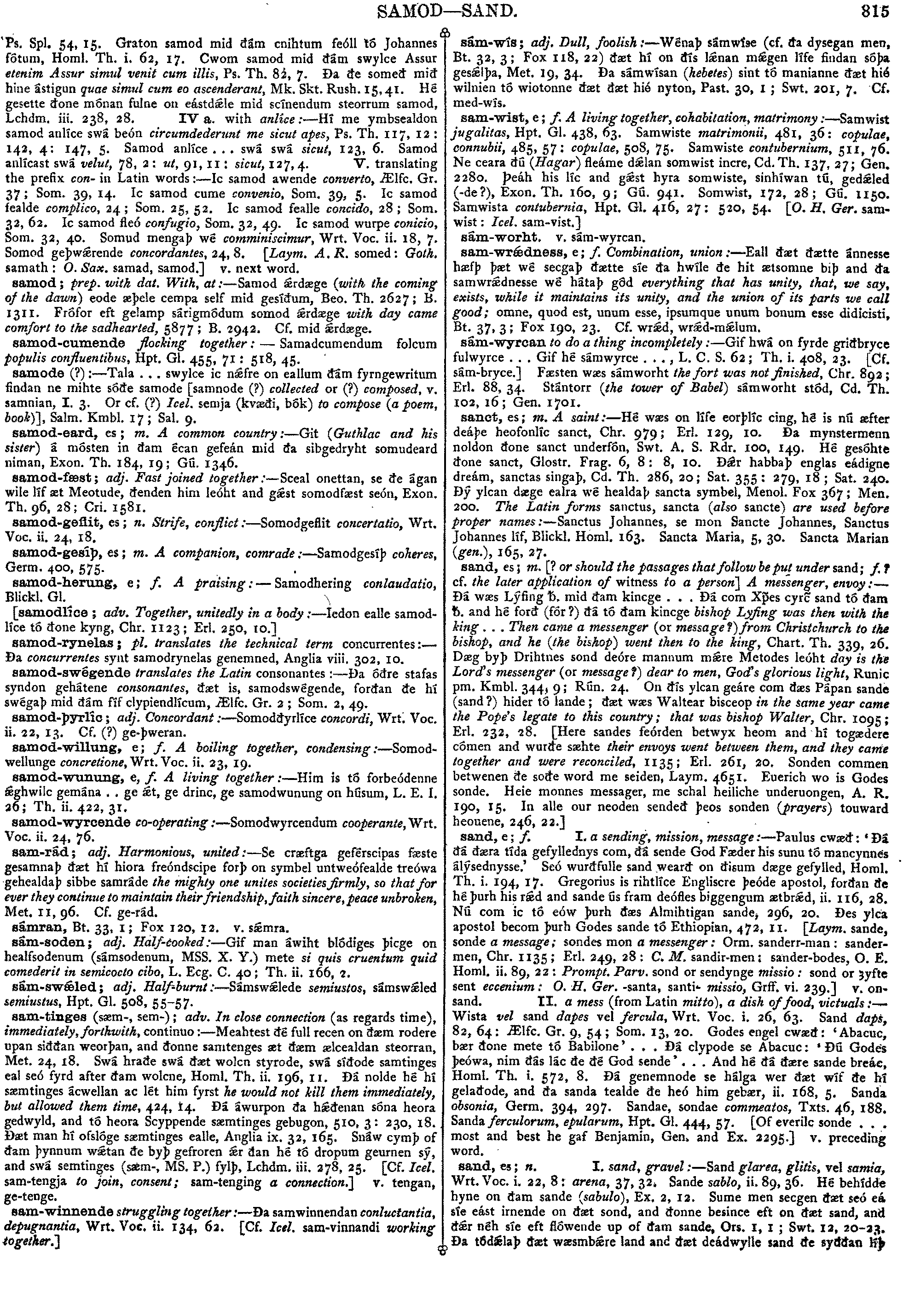
sand,
es;
m.
[?
or
should
the
passages
that
follow
be
put
under
sand;
f.?
cf.
the
later
application
of
witness
to
a
person]
A
messenger,
envoy:--Ðá
wæs
Lýfing
 mid
ðám
kincge
.
.
.
Ðá
com
X&p-tilde;es
cyr
mid
ðám
kincge
.
.
.
Ðá
com
X&p-tilde;es
cyr sand
tó
ðám
and
hé
forð
(fór
?)
ðá
tó
ðám
kincge
bishop
Lyfing
was
then
with
the
king.
.
.
Then
came
a
messenger
(or
message?
)
from
Christchurch
to
the
bishop,
and
he
(the
bishop)
went
then
to
the
king,
Chart.
Th.
339,
26.
Dæg
byþ
Drihtnes
sond
deóre
mannum
mre
Metodes
leóht
day
is
the
Lord's
messenger
(or
message?)
dear
to
men,
God's
glorious
light,
Runic
pm.
Kmbl.
344,
9;
Rún.
24.
On
ðís
ylcan
geáre
com
ðæs
Pápan
sande
(sand?)
hider
tó
lande;
ðæt
wæs
Waltear
bisceop
in
the
same
year
came
the
Pope's
legate
to
this
country;
that
was
bishop
Walter,
Chr.
1095;
Erl.
232,
28.
[Here
sandes
feórden
betwyx
heom
and
hí
togædere
cómen
and
wurðe
sæhte
their
envoys
went
between
them,
and
they
came
together
and
were
reconciled,
1135;
Erl.
261,
20.
Sonden
commen
betwenen
ðe
soðe
word
me
seiden,
Laym.
4651.
Euericb
wo
is
Godes
sonde.
Heie
monnes
messager,
me
schal
heiliche
underuongen,
A.
R.
190,
15.
In
alle
our
neoden
sendeð
þeos
sonden
(prayers)
touward
heouene,
246,
22.]
sand
tó
ðám
and
hé
forð
(fór
?)
ðá
tó
ðám
kincge
bishop
Lyfing
was
then
with
the
king.
.
.
Then
came
a
messenger
(or
message?
)
from
Christchurch
to
the
bishop,
and
he
(the
bishop)
went
then
to
the
king,
Chart.
Th.
339,
26.
Dæg
byþ
Drihtnes
sond
deóre
mannum
mre
Metodes
leóht
day
is
the
Lord's
messenger
(or
message?)
dear
to
men,
God's
glorious
light,
Runic
pm.
Kmbl.
344,
9;
Rún.
24.
On
ðís
ylcan
geáre
com
ðæs
Pápan
sande
(sand?)
hider
tó
lande;
ðæt
wæs
Waltear
bisceop
in
the
same
year
came
the
Pope's
legate
to
this
country;
that
was
bishop
Walter,
Chr.
1095;
Erl.
232,
28.
[Here
sandes
feórden
betwyx
heom
and
hí
togædere
cómen
and
wurðe
sæhte
their
envoys
went
between
them,
and
they
came
together
and
were
reconciled,
1135;
Erl.
261,
20.
Sonden
commen
betwenen
ðe
soðe
word
me
seiden,
Laym.
4651.
Euericb
wo
is
Godes
sonde.
Heie
monnes
messager,
me
schal
heiliche
underuongen,
A.
R.
190,
15.
In
alle
our
neoden
sendeð
þeos
sonden
(prayers)
touward
heouene,
246,
22.]
|
Source: Bosworth/Toller, page b1061, entry 5 View original page image as: [TIFF] [PNG] [View previous entry] [View next entry] |
[Comment on this entry] [View comments] |
The following entry has been hand-corrected once. |
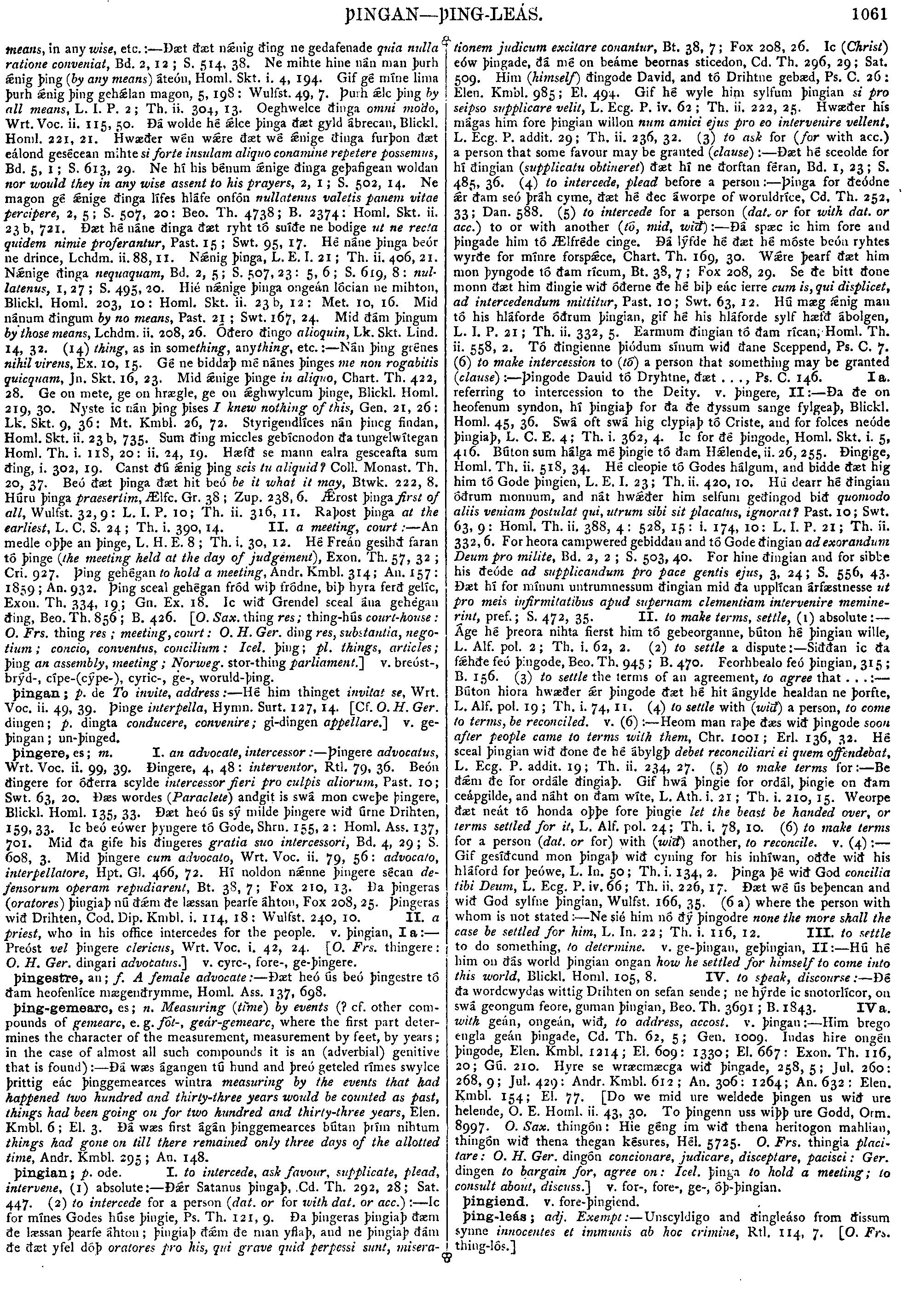
þingian;
p.
ode.
I.
to
intercede,
ask
favour,
supplicate,
plead,
intervene,
(1)
absolute
:--
Ðr
Satanus
þingaþ,
Cd.
Th.
292,
28;
Sat.
447.
(2)
to
intercede
for
a
person
(dat.
or
for
with
dat.
or
acc.)
:--
Ic
for
mínes
Godes
húse
þingie,
Ps.
Th.
121,
9.
Ða
þingeras
þingiaþ
ðæm
ðe
læssan
þearfe
áhton;
þingiaþ
ðm
ðe
man
yflaþ,
and
ne
þingiaþ
ðám
ðe
ðæt
yfel
dóþ
oratores
pro
his,
qui
grave
quid
perpessi
sunt,
miserationem
judicum
excitare
conantur,
Bt.
38,
7;
Fox
208,
26.
Ic
(Christ)
eów
þingade,
ðá
mé
on
beáme
beornas
sticedon,
Cd.
Th.
296,
29;
Sat.
509.
Him
(himself)
ðingode
David,
and
tó
Drihtne
gebæd,
Ps.
C.
26:
Elen.
Kmbl.
985;
El.
494.
Gif
hé
wyle
him
sylfum
þingian
si
pro
seipso
supplicare
velit,
L.
Ecg.
P.
iv.
62;
Th.
ii.
222,
25.
Hwæðer
his
mágas
him
fore
þingian
willon
num
amici
ejus
pro
eo
intervenire
vellent,
L.
Ecg.
P.
addit.
29;
Th.
ii.
236,
32.
(3)
to
ask
for
(for
with
acc.)
a
person
that
some
favour
may
be
granted
(clause)
:--
Ðæt
hé
sceolde
for
hí
ðingian
(supplicatu
obtineret)
ðæt
hí
ne
ðorftan
féran,
Bd.
1,
23;
S.
485,
36.
(4)
to
intercede,
plead
before
a
person
:--
Þinga
for
ðeódne
r
ðam
seó
þráh
cyme,
ðæt
hé
ðec
áworpe
of
woruldríce,
Cd.
Th.
252,
33;
Dan.
588.
(5)
to
intercede
for
a
person
(dat.
or
for
with
dat.
or
acc.)
to
or
with
another
(tó,
mid,
wið)
:--
Ðá
spæc
ic
him
fore
and
þingade
him
tó
Ælfréde
tinge,
Ðá
lýfde
hé
ðæt
hé
móste
beón
ryhtes
wyrðe
for
mínre
forspce,
Chart.
Th.
169,
30.
Wre
þearf
ðæt
him
mon
þyngode
tó
ðam
rícum,
Bt.
38,
7;
Fox
208,
29.
Se
ðe
bitt
ðone
monn
ðæt
him
ðingie
wið
óðerne
ðe
hé
biþ
eác
ierre
cum
is,
qui
displicet,
ad
intercedendum
mittitur,
Past.
10;
Swt.
63,
12.
Hú
mæg
nig
man
tó
his
hláforde
óðrum
þingian,
gif
hé
his
hláforde
sylf
hæfð
ábolgen,
L.
I.
P.
21;
Th.
ii.
332,
5.
Earmum
ðingian
tó
ðam
rícan;
Homl.
Th.
ii.
558,
2.
Tó
ðingienne
þiódum
sínum
wið
ðane
Sceppend,
Ps.
C.
7.
(6)
to
make
intercession
to
(tó)
a
person
that
something
may
be
granted
(clause)
:--
Þingode
Dauid
tó
Dryhtne,
ðæt...,
Ps.
C.
146.
I
a.
referring
to
intercession
to
the
Deity.
v.
þingere,
II
:--
Ða
ðe
on
heofenum
syndon,
hí
þingiaþ
for
ða
ðe
ðyssum
sange
fylgeaþ,
Blickl.
Homl.
45,
36.
Swá
oft
swá
hig
clypiaþ
tó
Criste,
and
for
folces
neóde
þingiaþ,
L.
C.
E.
4;
Th.
i.
362,
4.
Ic
for
ðé
þingode,
Homl.
Skt.
i.
5,
416.
Búton
sum
hálga
me
þingie
tó
ðam
Hlende,
ii.
26,
255.
Ðingige,
Homl.
Th.
ii.
518,
34.
Hé
cleopie
tó
Godes
hálgum,
and
bidde
ðæt
hig
him
tó
Gode
þingien,
L.
E.
I.
23;
Th.
ii.
420,
10.
Hú
dearr
hé
ðingian
óðrum
monnum,
and
nát
hwðer
him
selfum
geðingod
bið
quomodo
aliis
veniam
postulat
qui,
utrum
sibi
sit
placates,
ignorat?
Past.
10;
Swt.
63,
9:
Homl.
Th.
ii.
388,
4:
528,
15:
i.
174,
10:
L.
I.
P.
21;
Th.
ii.
332,
6.
For
heora
campwered
gebiddan
and
tó
Gode
ðingian
ad
exorandum
Deum
pro
milite,
Bd.
2,
2;
S.
503,
40.
For
hine
ðingian
and
for
sibbe
his
ðeóde
ad
supplicandum
pro
pace
gentis
ejus,
3,
24;
S.
556,
43.
Ðæt
hí
for
mínum
untrunmessum
ðingian
mid
ða
upplícan
árfæstnesse
ut
pro
meis
infirmitatibus
apud
supernam
clementiam
intervenire
meminerint,
pref.;
S.
472,
35.
II.
to
make
terms,
settle,
(1)
absolute
:--
Áge
hé
þreora
nihta
fierst
him
tó
gebeorganne,
búton
hé
þingian
wille,
L.
Alf.
pol.
2;
Th.
i.
62,
2.
(2)
to
settle
a
dispute
:--
Siððan
ic
ða
fhðe
feód
þingode,
Beo.
Th.
945;
B.
470.
Feorhbealo
feó
þingian,
315;
B.
156.
(3)
to
settle
the
terms
of
an
agreement,
to
agree
that
...
:--
Búton
hiora
hwæðer
r
þingode
ðæt
hé
hit
ángylde
healdan
ne
þorfte,
L.
Alf.
pol.
19;
Th.
i.
74,
11.
(4)
to
settle
with
(wið)
a
person,
to
come
to
terms,
be
reconciled.
v.
(6)
:--
Heom
man
raþe
ðæs
wið
þingode
soon
after
people
came
to
terms
with
them,
Chr.
100l;
Erl.
136,
32.
Hé
sceal
þingian
wið
ðone
ðe
hé
ábylgþ
debet
reconciliari
ci
quem
offendebat,
L.
Ecg.
P.
addit.
19;
Th.
ii.
234,
27.
(5)
to
make
terms
for
:--
Be
ðm
ðe
for
ordále
ðingiaþ.
Gif
hwá
þingie
for
ordál,
þingie
on
ðam
ceápgilde,
and
náht
on
ðam
wíte,
L.
Ath.
i.
21;
Th.
i.
210,
15.
Weorpe
ðæt
neát
tó
honda
oþþe
fore
þingie
let
the
beast
be
handed
over,
or
terms
settled
for
it,
L.
Alf.
pol.
24;
Th.
i.
78,
10.
(6)
to
make
terms
for
a
person
(dat.
or
for)
with
(wið)
another,
to
reconcile.
v.
(4)
:--
Gif
gesíðcund
mon
þingaþ
wið
cyning
for
his
inhíwan,
oððe
wið
his
hláford
for
þeówe,
L.
In.
50;
Th.
i.
134,
2.
Þinga
þé
wið
God
concilia
tibi
Deum,
L.
Ecg.
P.
iv.
66;
Th.
ii.
226,
17.
Ðæt
wé
ús
beþencan
and
wið
God
sylfne
þingian,
Wulfst.
166,
35.
(6
a)
where
the
person
with
whom
is
not
stated
:--
Ne
sié
him
nó
ðý
þingodre
none
the
more
shall
the
case
be
settled
for
him,
L.
In.
22;
Th.
i.
116,
12.
III.
to
settle
to
do
something,
to
determine.
v.
ge-þingan,
geþingian,
II
:--
Hú
hé
him
on
ðás
world
þingian
ongan
how
he
settled
for
himself
to
come
into
this
world,
Blickl.
Homl.
105,
8.
IV.
to
speak,
discourse
:--
Ðú
ða
wordcwydas
wittig
Drihten
on
sefan
sende;
ne
hýrde
ic
snotorlícor,
on
swá
geongum
feore,
guman
þingian,
Beo.
Th.
3691;
B.
1843.
IV
a.
with
geán,
ongeán,
wið,
to
address,
accost.
v.
þingan
:--
Him
brego
engla
geán
þingade,
Cd.
Th.
62,
5;
Gen.
1009.
Iudas
hire
ongén
þingode,
Elen.
Kmbl.
1214;
El.
609:
1330;
El.
667:
Exon.
Th.
116,
20;
Gú.
210.
Hyre
se
wræcmæcga
wið
þingade,
258,
5;
Jul.
260:
268,
9;
Jul.
429:
Andr.
Kmbl.
612;
An.
306:
1264;
An.
632;
Elen.
Kmbl.
154;
El.
77.
[Do
we
mid
ere
weldede
þingen
us
wið
ure
helende,
O.
E.
Homl.
ii.
43,
30.
To
þingenn
uss
wiþþ
ure
Godd,
Orm.
8997.
O.
Sax.
thingón:
Hie
géng
im
wið
thena
heritogon
mahlian,
thingón
wið
thena
thegan
késures,
Hél.
5725.
O.
Frs.
thingia
placitare:
O.
H.
Ger.
dingón
concionare,
judicare,
disceptare,
pacisci:
Ger.
dingen
to
bargain
for,
agree
on:
Icel.
þinga
to
hold
a
meeting;
to
consult
about,
discuss.]
v.
for-,
fore-,
ge-,
óþ-þingian.
|
Source: Bosworth/Toller, page b1128, entry 23 View original page image as: [TIFF] [PNG] [View previous entry] [View next entry] |
[Comment on this entry] [View comments] |
The following entry has been hand-corrected once. |
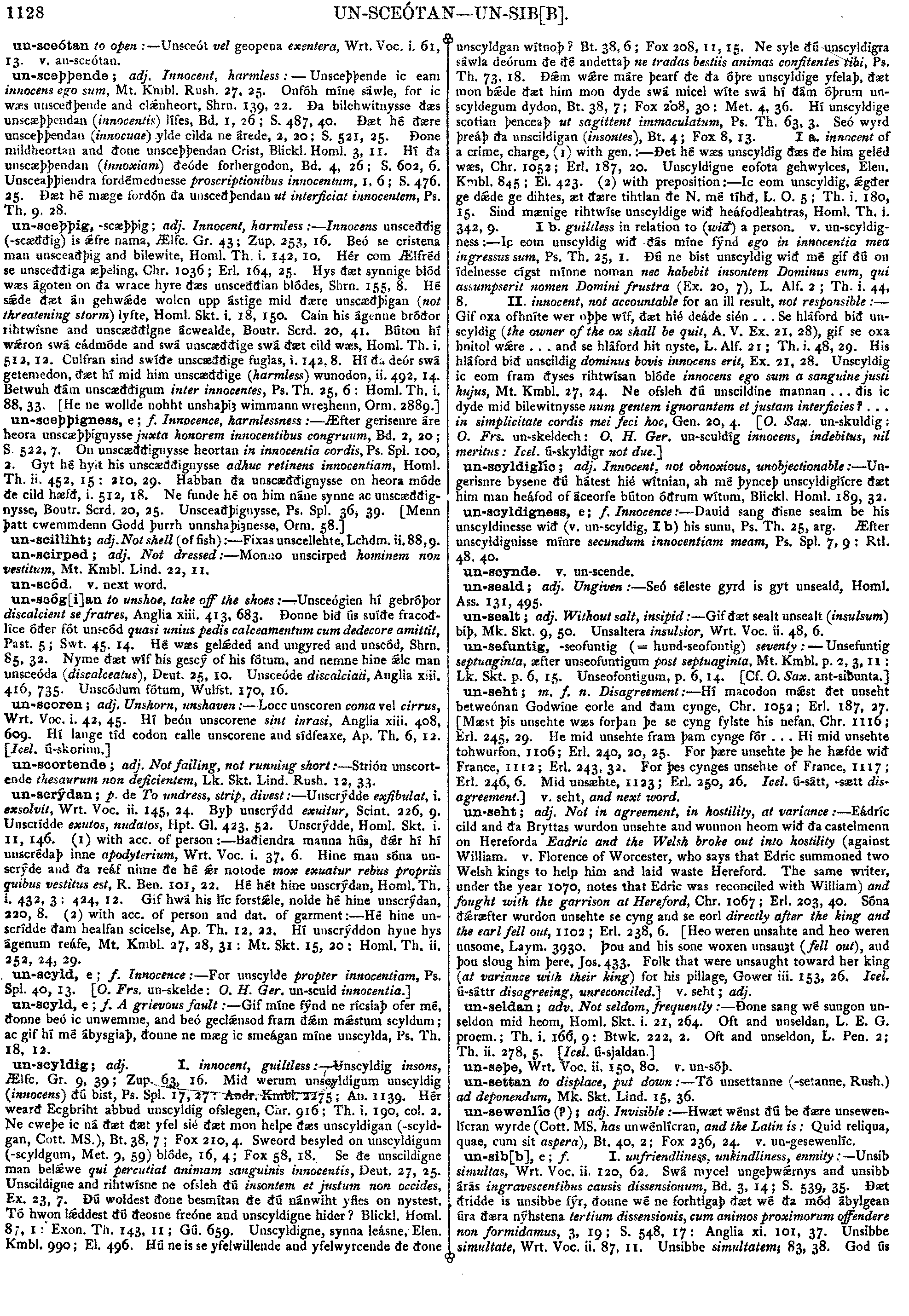
un-seht;
adj.
Not
in
agreement,
in
hostility,
at
variance
:--
Eádríc
cild
and
ða
Bryttas
wurdon
unsehte
and
wunnon
heom
wið
ða
castelmenn
on
Hereforda
Eadric
and
the
Welsh
broke
out
into
hostility
(against
William.
v.
Florence
of
Worcester,
who
says
that
Edric
summoned
two
Welsh
kings
to
help
him
and
laid
waste
Hereford.
The
same
writer,
under
the
year
1070,
notes
that
Edric
was
reconciled
with
William)
and
fought
with
the
garrison
at
Hereford,
Chr.
1067;
Erl.
203,
40.
Sóna
ðæræfter
wurdon
unsehte
se
cyng
and
se
eorl
directly
after
the
king
and
the
earl
fell
out,
1102;
Erl.
238,
6.
[Heo
weren
unsahte
and
heo
weren
unsome,
Laynt.
3930.
Þou
and
his
sone
woxen
unsau t
(fell
out),
and
þou
sloug
him
þere,
Jos.
433.
Folk
that
were
unsaught
toward
her
king
(at
variance
with
their
king)
for
his
pillage,
Gower
iii.
153,
26.
Icel.
ú-sáttr
disagreeing,
unreconciled.]
v.
seht;
adj.
t
(fell
out),
and
þou
sloug
him
þere,
Jos.
433.
Folk
that
were
unsaught
toward
her
king
(at
variance
with
their
king)
for
his
pillage,
Gower
iii.
153,
26.
Icel.
ú-sáttr
disagreeing,
unreconciled.]
v.
seht;
adj.
|
Source: Bosworth/Toller, page d0411, entry 11 View original page image as: [TIFF] [PNG] [View previous entry] [View next entry] |
[Comment on this entry] [View comments] |
The following entry has been hand-corrected once. |
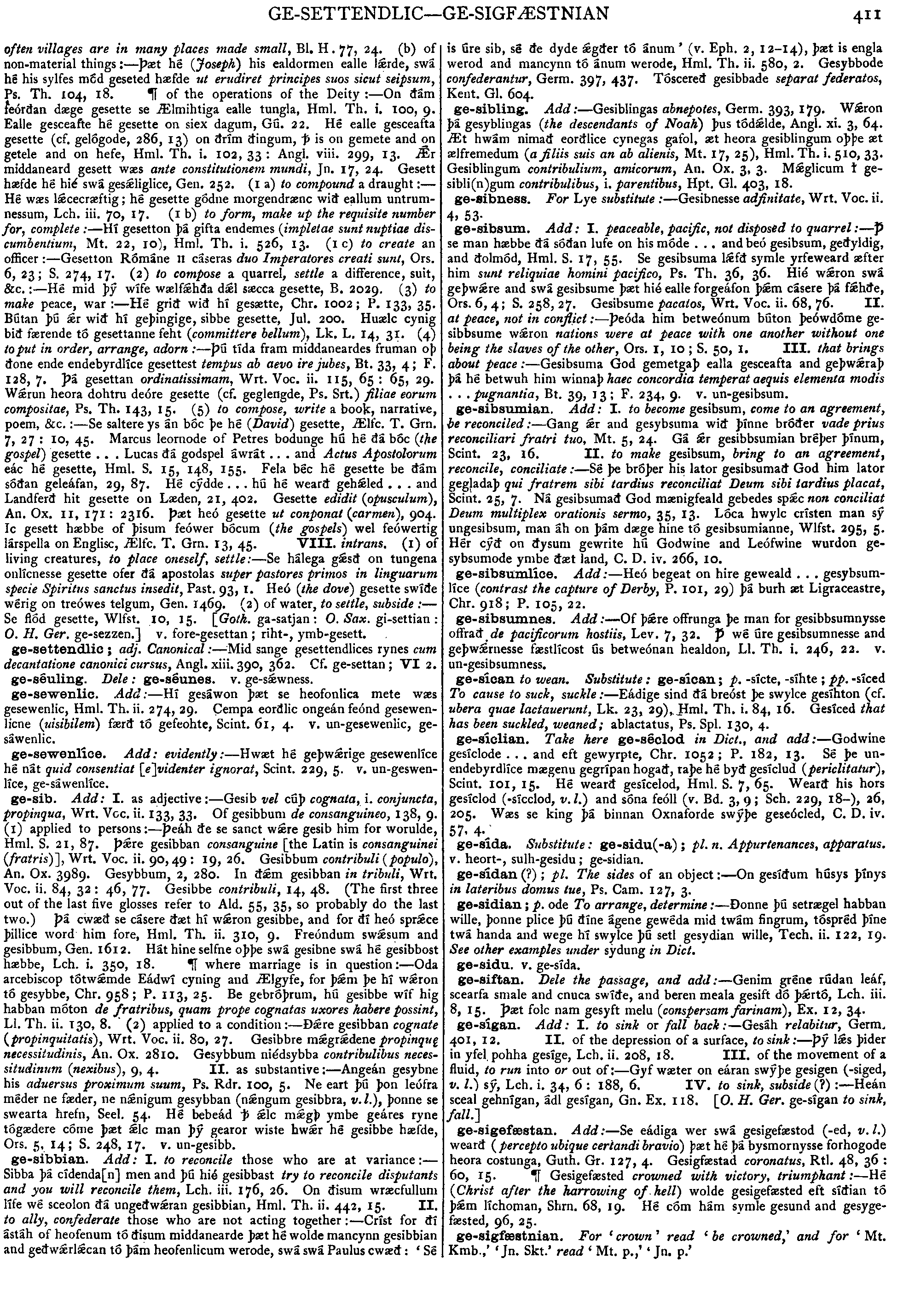
ge-sibsumian.
Add:
I.
to
become
gesibsum,
come
to
an
agreement,
be
reconciled
:--
Gang
r
and
gesybsuma
wið
þínne
bróðer
vade
prius
reconciliari
fratri
tuo,
Mt.
5,
24.
Gá
r
gesibbsumian
bréþer
þínum,
Scint.
23,
16.
II.
to
make
gesibsum,
bring
to
an
agreement,
reconcile,
conciliate
:--
Sé
þe
bróþer
his
lator
gesibsumað
God
him
lator
gegladaþ
qui
fratrem
sibi
tardius
reconciliat
Deum
sibi
tardius
placat,
Scint.
25,
7.
Ná
gesibsumað
God
mænigfeald
gebedes
spc
non
conciliat
Deum
multiplex
orationis
sermo,
35,
13.
Lóca
hwylc
crísten
man
sý
ungesibsum,
man
áh
on
þám
dæge
hine
tó
gesibsumianne,
Wlfst.
295,
5.
Hér
cýð
on
ðysum
gewrite
hú
Godwine
and
Leófwine
wurdon
ge-sybsumode
ymbe
ðæt
land,
C.
D.
iv.
266,
10.
|
Source: Bosworth/Toller, page d0433, entry 1 View original page image as: [TIFF] [PNG] [View previous entry] [View next entry] |
[Comment on this entry] [View comments] |
The following entry has been hand-corrected once. |
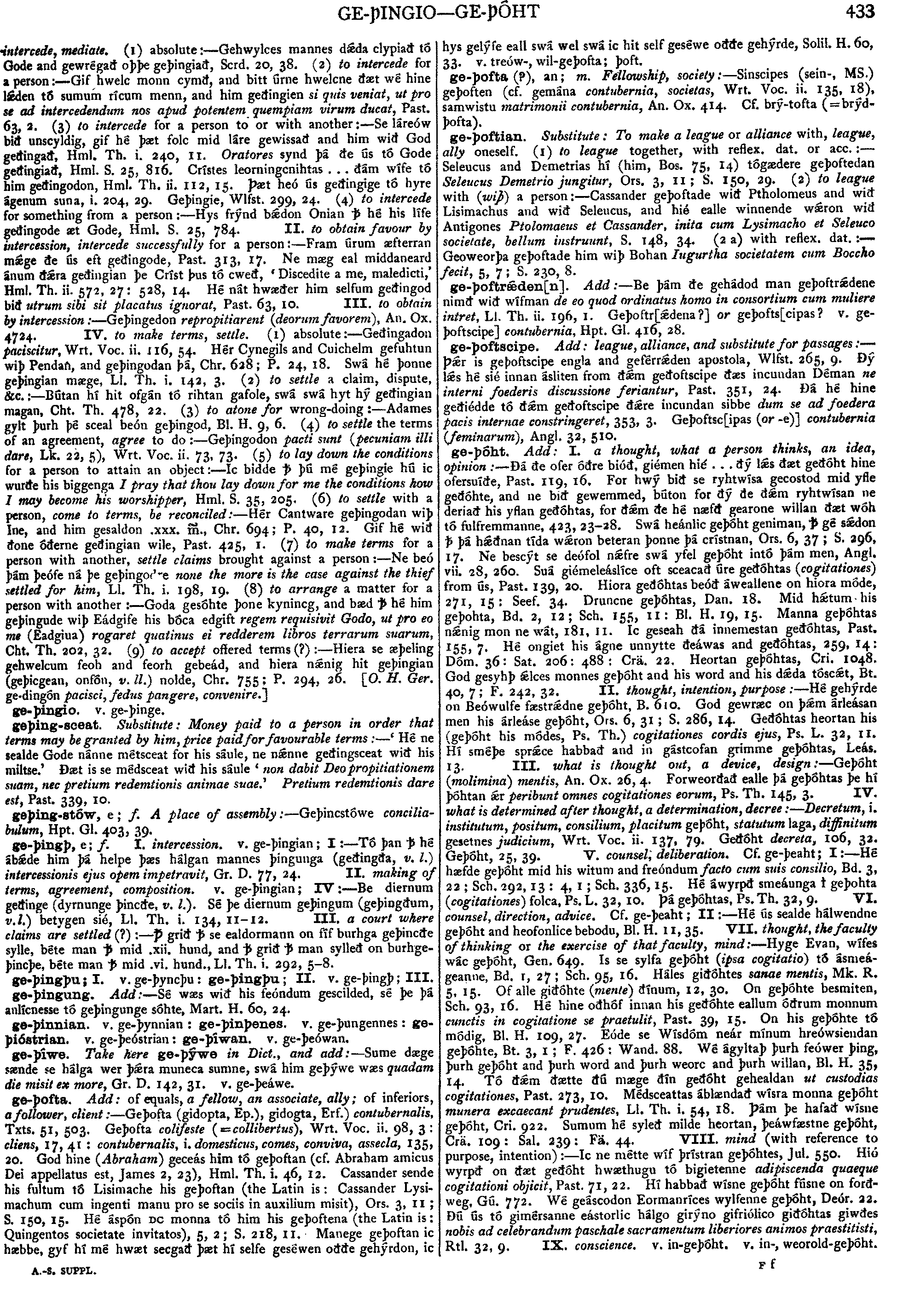
intercede,
mediate.
(1)
absolute
:--
Gehwylces
mannes
dda
clypiað
tó
Gode
and
gewrégað
oþþe
geþingiað,
Scrd.
20,
38.
(2)
to
intercede
for
a
person
:--
Gif
hwelc
monn
cymð,
and
bitt
úrne
hwelcne
ðæt
wé
hine
lden
tó
sumum
rícum
menn,
and
him
geðingien
si
quis
veniat,
ut
pro
se
ad
intercedendum
nos
apud
potentem
quempiam
virum
ducat,
Past.
63,
2.
(3)
to
intercede
for
a
person
to
or
with
another
:--
Se
láreów
bið
unscyldig,
gif
hé
þæt
folc
mid
láre
gewissað
and
him
wið
God
geðingað,
Hml.
Th.
i.
240,
11.
Oratores
synd
þá
ðe
ús
tó
Gode
geðingiað,
Hml.
S.
25,
816.
Crístes
leorningcnihtas
...
ðám
wífe
tó
him
geðingodon,
Hml.
Th.
ii.
112,
15.
Þæt
heó
ús
geðingige
tó
hyre
ágenum
suna,
i.
204,
29.
Geþingie,
Wlfst.
299,
24.
(4)
to
intercede
for
something
from
a
person
:--
Hys
frýnd
bdon
Onian
 hé
his
lífe
geðingode
æt
Gode,
Hml.
S.
25,
784.
II.
to
obtain
favour
by
intercession,
intercede
successfully
for
a
person
:--
Fram
úrum
æfterran
mge
ðe
ús
eft
geðingode,
Past.
313,
17.
Ne
mæg
eal
middaneard
ánum
ðra
geðingian
þe
Críst
þus
tó
cweð,
'Discedite
a
me,
maledicti,'
Hml.
Th.
ii.
572,
27:
528,
14.
Hé
nát
hwæðer
him
selfum
geðingod
bið
utrum
sibi
sit
placatus
ignorat,
Past.
63,
10.
III.
to
obtain
by
intercession
:--
Geþingedon
repropitiarent
(deorum
favorem),
An.
Ox.
4724.
IV.
to
make
terms,
settle.
(1)
absolute
:--
Geðingadon
paciscitur,
Wrt.
Voc.
ii.
116,
54.
Hér
Cynegils
and
Cuichelm
gefuhtun
wiþ
Pendan,
and
geþingodan
þá,
Chr.
628;
P.
24,
18.
Swá
hé
þonne
geþingian
mæge,
Ll.
Th.
i.
142,
3.
(2)
to
settle
a
claim,
dispute,
&c.
:--
Bútan
hí
hit
ofgán
tó
rihtan
gafole,
swá
swá
hyt
hý
geðingian
magan,
Cht.
Th.
478,
22.
(3)
to
atone
for
wrong-doing
:--
Adames
gylt
þurh
þé
sceal
beón
geþingod,
Bl.
H.
9,
6.
(4)
to
settle
the
terms
of
an
agreement,
agree
to
do
:--
Geþingodon
pacti
sunt
(pecuniam
illi
dare,
Lk.
22,
5),
Wrt.
Voc.
ii.
73,
73.
(5)
to
lay
down
the
conditions
for
a
person
to
attain
an
object
:--
Ic
bidde
þú
mé
geþingie
hú
ic
wurðe
his
biggenga
I
pray
that
thou
lay
down
for
me
the
conditions
how
I
may
become
his
worshipper,
Hml.
S.
35,
205.
(6)
to
settle
with
a
person,
come
to
terms,
be
reconciled
:--
Hér
Cantware
geþingodan
wiþ
Ine,
and
him
gesaldon
.xxx.
hé
his
lífe
geðingode
æt
Gode,
Hml.
S.
25,
784.
II.
to
obtain
favour
by
intercession,
intercede
successfully
for
a
person
:--
Fram
úrum
æfterran
mge
ðe
ús
eft
geðingode,
Past.
313,
17.
Ne
mæg
eal
middaneard
ánum
ðra
geðingian
þe
Críst
þus
tó
cweð,
'Discedite
a
me,
maledicti,'
Hml.
Th.
ii.
572,
27:
528,
14.
Hé
nát
hwæðer
him
selfum
geðingod
bið
utrum
sibi
sit
placatus
ignorat,
Past.
63,
10.
III.
to
obtain
by
intercession
:--
Geþingedon
repropitiarent
(deorum
favorem),
An.
Ox.
4724.
IV.
to
make
terms,
settle.
(1)
absolute
:--
Geðingadon
paciscitur,
Wrt.
Voc.
ii.
116,
54.
Hér
Cynegils
and
Cuichelm
gefuhtun
wiþ
Pendan,
and
geþingodan
þá,
Chr.
628;
P.
24,
18.
Swá
hé
þonne
geþingian
mæge,
Ll.
Th.
i.
142,
3.
(2)
to
settle
a
claim,
dispute,
&c.
:--
Bútan
hí
hit
ofgán
tó
rihtan
gafole,
swá
swá
hyt
hý
geðingian
magan,
Cht.
Th.
478,
22.
(3)
to
atone
for
wrong-doing
:--
Adames
gylt
þurh
þé
sceal
beón
geþingod,
Bl.
H.
9,
6.
(4)
to
settle
the
terms
of
an
agreement,
agree
to
do
:--
Geþingodon
pacti
sunt
(pecuniam
illi
dare,
Lk.
22,
5),
Wrt.
Voc.
ii.
73,
73.
(5)
to
lay
down
the
conditions
for
a
person
to
attain
an
object
:--
Ic
bidde
þú
mé
geþingie
hú
ic
wurðe
his
biggenga
I
pray
that
thou
lay
down
for
me
the
conditions
how
I
may
become
his
worshipper,
Hml.
S.
35,
205.
(6)
to
settle
with
a
person,
come
to
terms,
be
reconciled
:--
Hér
Cantware
geþingodan
wiþ
Ine,
and
him
gesaldon
.xxx.
 .,
Chr.
694;
P.
40,
12.
Gif
hé
wið
ðone
óðerne
geðingian
wile,
Past.
425,
1.
(7)
to
make
terms
for
a
person
with
another,
settle
claims
brought
against
a
person
:--
Ne
beó
þám
þeófe
ná
þe
geþingodre
none
the
more
is
the
case
against
the
thief
settled
for
him,
Ll.
Th.
i.
198,
19.
(8)
to
arrange
a
matter
for
a
person
with
another
:--
Goda
gesóhte
þone
kynincg,
and
bæd
hé
him
geþingude
wiþ
Eádgife
his
bóca
edgift
regem
requisivit
Godo,
ut
pro
eo
me
(Eadgiua)
rogaret
quatinus
ei
redderem
libros
terrarum
suarum,
Cht.
Th.
202,
32.
(9)
to
accept
offered
terms
(?)
:--
Hiera
se
æþeling
gehwelcum
feoh
and
feorh
gebeád,
and
hiera
nnig
hit
geþingian
(geþicgean,
onfón,
v.
ll.)
nolde,
Chr.
755;
P.
294,
26.
[O.
H.
Ger.
ge-dingón
pacisci,
fedus
pangere,
convenire.]
.,
Chr.
694;
P.
40,
12.
Gif
hé
wið
ðone
óðerne
geðingian
wile,
Past.
425,
1.
(7)
to
make
terms
for
a
person
with
another,
settle
claims
brought
against
a
person
:--
Ne
beó
þám
þeófe
ná
þe
geþingodre
none
the
more
is
the
case
against
the
thief
settled
for
him,
Ll.
Th.
i.
198,
19.
(8)
to
arrange
a
matter
for
a
person
with
another
:--
Goda
gesóhte
þone
kynincg,
and
bæd
hé
him
geþingude
wiþ
Eádgife
his
bóca
edgift
regem
requisivit
Godo,
ut
pro
eo
me
(Eadgiua)
rogaret
quatinus
ei
redderem
libros
terrarum
suarum,
Cht.
Th.
202,
32.
(9)
to
accept
offered
terms
(?)
:--
Hiera
se
æþeling
gehwelcum
feoh
and
feorh
gebeád,
and
hiera
nnig
hit
geþingian
(geþicgean,
onfón,
v.
ll.)
nolde,
Chr.
755;
P.
294,
26.
[O.
H.
Ger.
ge-dingón
pacisci,
fedus
pangere,
convenire.]
| Result Page: | 1 2 | Next |  |
Germanic Lexicon Project (main page)
This search system was written by
Sean Crist
Please consider
volunteering
to correct the data in these online dictionaries.
No rights reserved. Feel free to use these data in any way you please.