|
|

Search for read again, using less strict matching (535 results)
|
Source: Bosworth/Toller, page d0572, entry 34 View original page image as: [TIFF] [PNG] [View previous entry] [View next entry] |
[Comment on this entry] [View comments] |
The following entry has been hand-corrected once. |
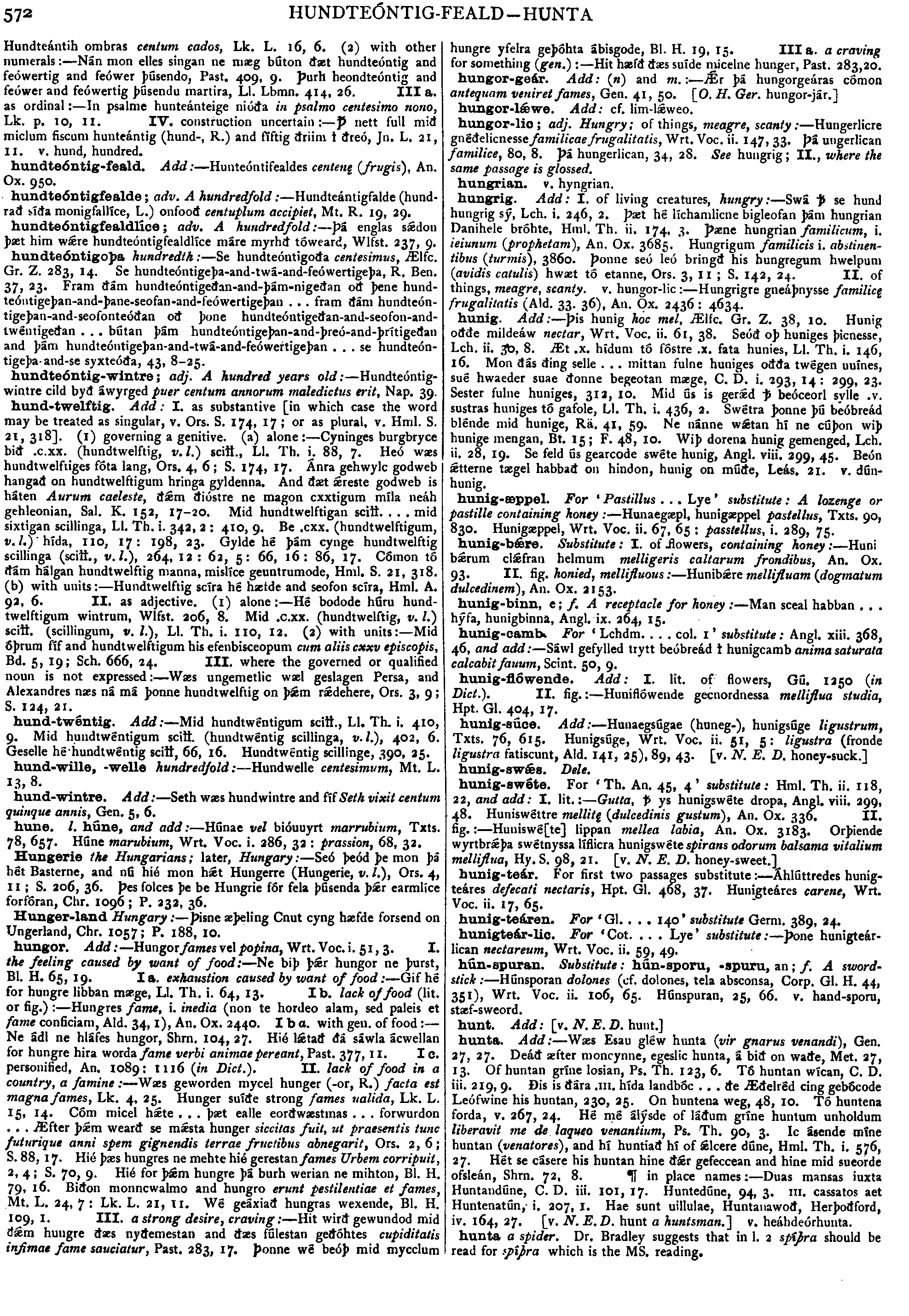
hunta.
Add:
--
Wæs
Esau
gléw
hunta
(vir
gnarus
venandi),
Gen.
27,
27.
Deáð
æfter
moncynne,
egeslic
hunta,
á
bið
on
waðe,
Met.
27,
13.
Of
huntan
gríne
losian,
Ps.
Th.
123,
6.
Tó
huntan
wícan,
C.
D.
iii.
219,
9.
Ðis
is
ðára
.iii.
hída
landbóc
.
.
.
ðe
Æðelréd
cing
gebócode
Leófwine
his
huntan,
230,
25.
On
huntena
weg,
48,
10.
Tó
huntena
forda,
v.
267,
24.
Hé
me
álýsde
of
láðum
gríne
huntum
unholdum
liberavit
me
de
laqueo
venantium,
Ps.
Th.
90,
3.
Ic
ásende
míne
huntan
(venatores),
and
hi
huntiað
hí
of
 lcere
dúne,
Hml.
Th.
i.
576,
27.
Hét
se
cásere
his
huntan
hine
ðr
gefeccean
and
hine
mid
sueorde
ofsleán,
Shrn.
72,
8.
in
place
names
:--
Duas
mansas
iuxta
Huntandúne,
C.
D.
iii.
101,
17.
Huntedúne,
94,
3.
iii.
cassatos
aet
Huntenatún,
-
i.
207,
I.
Hae
sunt
uillulae,
Huntanawoð,
Herþoðford,
iv.
164,
27.
[v.
N.
E.
D.
hunt
a
huntsman.]
v.
heáhdeórhunta.
hunta
a
spider.
Dr.
Bradley
suggests
that
in
1.
2
spí
þra
should
be
read
for
sþíþra
which
is
the
MS.
reading.
lcere
dúne,
Hml.
Th.
i.
576,
27.
Hét
se
cásere
his
huntan
hine
ðr
gefeccean
and
hine
mid
sueorde
ofsleán,
Shrn.
72,
8.
in
place
names
:--
Duas
mansas
iuxta
Huntandúne,
C.
D.
iii.
101,
17.
Huntedúne,
94,
3.
iii.
cassatos
aet
Huntenatún,
-
i.
207,
I.
Hae
sunt
uillulae,
Huntanawoð,
Herþoðford,
iv.
164,
27.
[v.
N.
E.
D.
hunt
a
huntsman.]
v.
heáhdeórhunta.
hunta
a
spider.
Dr.
Bradley
suggests
that
in
1.
2
spí
þra
should
be
read
for
sþíþra
which
is
the
MS.
reading.
|
Source: Bosworth/Toller, page d0576, entry 1 View original page image as: [TIFF] [PNG] [View previous entry] [View next entry] |
[Comment on this entry] [View comments (2)] |
The following entry has been hand-corrected once. |
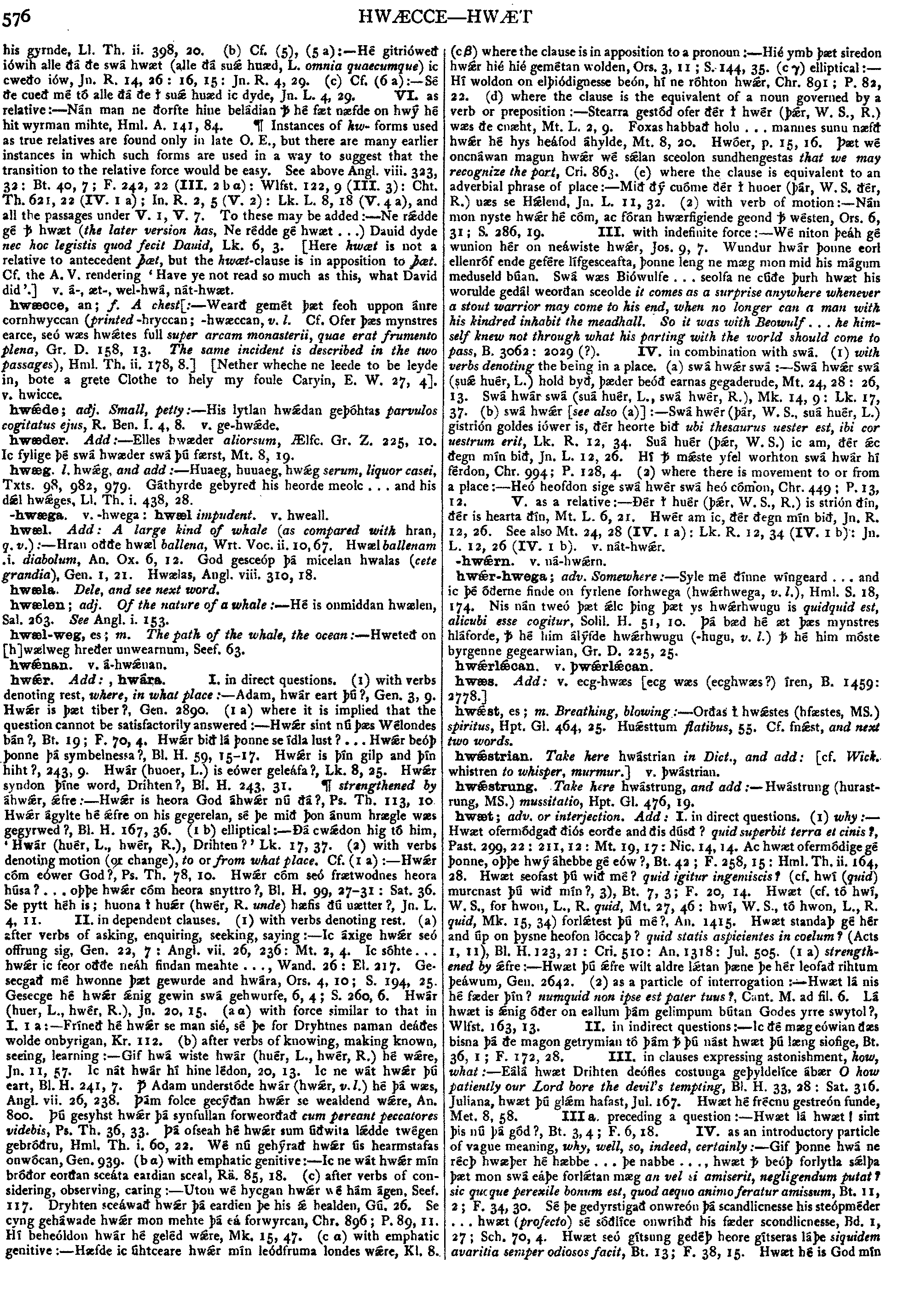
his
gyrnde,
Ll.
Th.
ii.
398,
20.
(b)
Cf.
(5),
(5
a)
:--
Hé
gitrióweð
iówih
alle
ða
ðe
swá
hwæt
(alle
ðá
su
huæd,
L.
omnia
quaecumque)
ic
cweðo
iów,
Jn.
R.
14,
26:
16,
15:
Jn.
R.
4,
29.
(c)
Cf.
(6
a)
:--
Sé
ðe
cueð
mé
tó
alle
ðá
ðe
 su
huæd
ic
dyde,
Jn.
L.
4,
29.
VI.
as
relative
:--
Nán
man
ne
ðorfte
hine
beládian
su
huæd
ic
dyde,
Jn.
L.
4,
29.
VI.
as
relative
:--
Nán
man
ne
ðorfte
hine
beládian
 hé
fæt
næfde
on
hwý
hé
hit
wyrman
mihte,
Hml.
A.
141,
84.

Instances
of
hw-
forms
used
as
true
relatives
are
found
only
in
late
O.
E.,
but
there
are
many
earlier
instances
in
which
such
forms
are
used
in
a
way
to
suggest
that
the
transition
to
the
relative
force
would
be
easy.
See
above
Angl.
viii.
323,
32:
Bt.
40,
7;
F.
242,
22
(III.
2
b
hé
fæt
næfde
on
hwý
hé
hit
wyrman
mihte,
Hml.
A.
141,
84.

Instances
of
hw-
forms
used
as
true
relatives
are
found
only
in
late
O.
E.,
but
there
are
many
earlier
instances
in
which
such
forms
are
used
in
a
way
to
suggest
that
the
transition
to
the
relative
force
would
be
easy.
See
above
Angl.
viii.
323,
32:
Bt.
40,
7;
F.
242,
22
(III.
2
b
 ):
Wlfst.
122,
9
(III.
3):
Cht.
Th.
621,
22
(IV.
1
a);
In.
R.
2,
5
(V.
2):
Lk.
L.
8,
18
(V.
4
a),
and
all
the
passages
under
V.
1,
V.
7.
To
these
may
be
added
:--
Ne
rdde
gé
hwæt
(the
later
version
has,
Ne
rédde
gé
hwæt
...)
Dauid
dyde
nec
hoc
legistis
quod
fecit
Dauid,
Lk.
6,
3.
[Here
hwæt
is
not
a
relative
to
antecedent
þæt,
but
the
hwæt-clause
is
in
apposition
to
þæt.
Cf.
the
A.
V.
rendering
'Have
ye
not
read
so
much
as
this,
what
David
did'.]
v.
á-,
æt-,
wel-hwá,
nát-hwæt.
):
Wlfst.
122,
9
(III.
3):
Cht.
Th.
621,
22
(IV.
1
a);
In.
R.
2,
5
(V.
2):
Lk.
L.
8,
18
(V.
4
a),
and
all
the
passages
under
V.
1,
V.
7.
To
these
may
be
added
:--
Ne
rdde
gé
hwæt
(the
later
version
has,
Ne
rédde
gé
hwæt
...)
Dauid
dyde
nec
hoc
legistis
quod
fecit
Dauid,
Lk.
6,
3.
[Here
hwæt
is
not
a
relative
to
antecedent
þæt,
but
the
hwæt-clause
is
in
apposition
to
þæt.
Cf.
the
A.
V.
rendering
'Have
ye
not
read
so
much
as
this,
what
David
did'.]
v.
á-,
æt-,
wel-hwá,
nát-hwæt.
|
Source: Bosworth/Toller, page d0586, entry 36 View original page image as: [TIFF] [PNG] [View previous entry] [View next entry] |
[Comment on this entry] [View comments] |
The following entry has been hand-corrected once. |
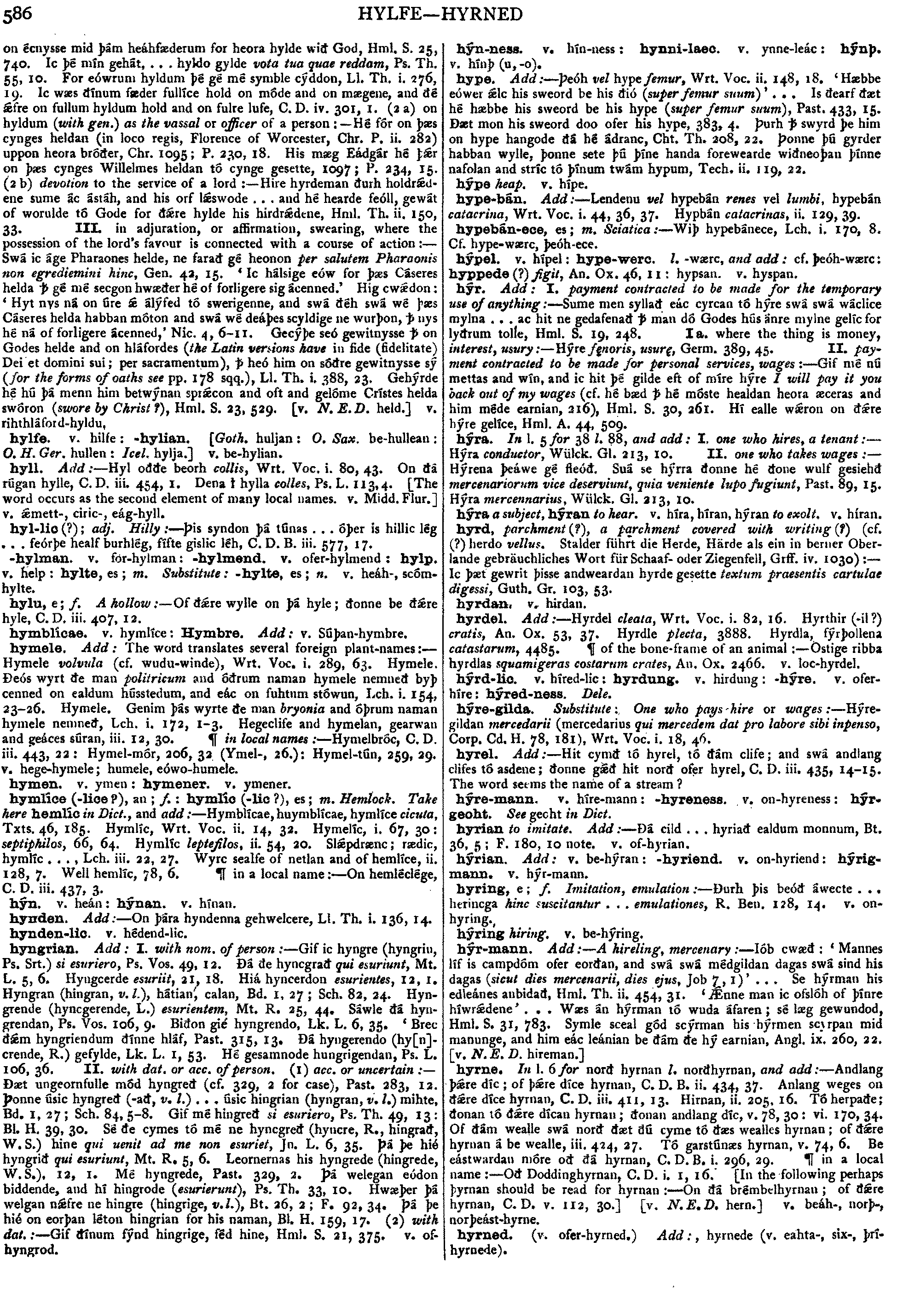
hyrne.
in
l.
6
for
nor hyrnan
l.
norhyrnan,
and
add
:--
Andlang
þ
hyrnan
l.
norhyrnan,
and
add
:--
Andlang
þ re
d
re
d c
;
of
þre
dce
hyrnan,
C.
D.
B.
ii.
434,
37.
Anlang
weges
on
re
dce
hyrnan,
C.
D.
iii.
411,
13.
Hirnan,
ii.
205,
16.
T
c
;
of
þre
dce
hyrnan,
C.
D.
B.
ii.
434,
37.
Anlang
weges
on
re
dce
hyrnan,
C.
D.
iii.
411,
13.
Hirnan,
ii.
205,
16.
T herpae;
onan
t
dre
dcan
hyrnan;
onan
andlang
dc,
v.
78,
30:
vi.
170,
34.
Of
herpae;
onan
t
dre
dcan
hyrnan;
onan
andlang
dc,
v.
78,
30:
vi.
170,
34.
Of
 m
wealle
sw
nor
æt
d
m
wealle
sw
nor
æt
d cyme
t
æs
wealles
hyrnan
;
of
re
hyrnan
be
wealle,
iii.
424,
27.
T
garstnæs
hyrnan,
v.
74,
6.
Be
eástwardan
mre
o
hyrnan,
C.
D.
B.
i.
296,
29.

in
a
local
name
:--
O
Doddinghyrnan,
C.
D.
i.
l,
16.
[In
the
following
perhaps
þyrnan
should
be
read
for
hyrnan
:--
On
br
cyme
t
æs
wealles
hyrnan
;
of
re
hyrnan
be
wealle,
iii.
424,
27.
T
garstnæs
hyrnan,
v.
74,
6.
Be
eástwardan
mre
o
hyrnan,
C.
D.
B.
i.
296,
29.

in
a
local
name
:--
O
Doddinghyrnan,
C.
D.
i.
l,
16.
[In
the
following
perhaps
þyrnan
should
be
read
for
hyrnan
:--
On
br mbelhyrnan;
of
re
hyrnan,
C.
D.
v.
112,
30.]
[v.
N.
E.
D.
hern.]
v.
beáh-,
norþ-,
norþeást-hyrne.
mbelhyrnan;
of
re
hyrnan,
C.
D.
v.
112,
30.]
[v.
N.
E.
D.
hern.]
v.
beáh-,
norþ-,
norþeást-hyrne.
|
Source: Bosworth/Toller, page d0587, entry 24 View original page image as: [TIFF] [PNG] [View previous entry] [View next entry] |
[Comment on this entry] [View comments] |
The following entry has been hand-corrected once. |
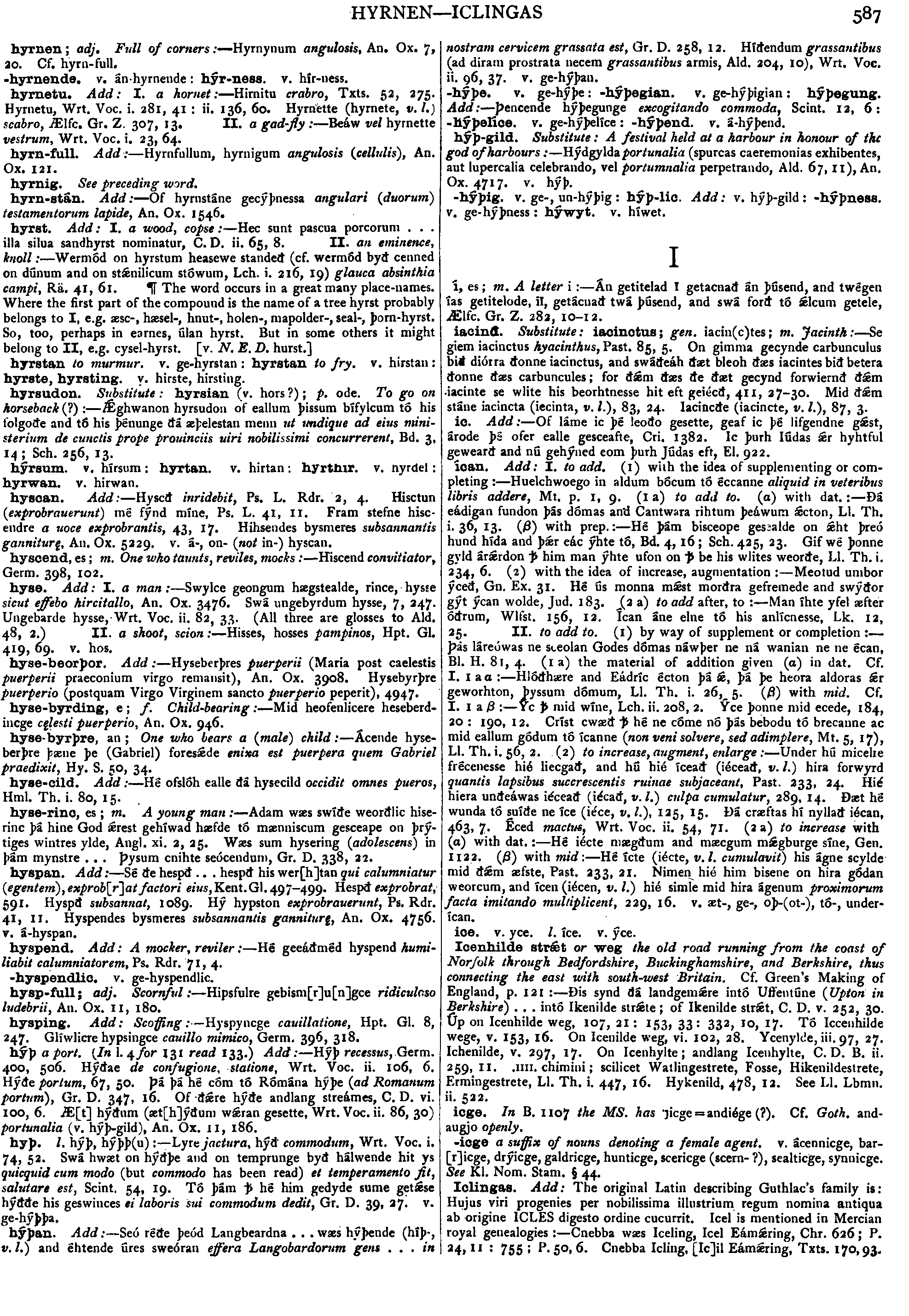
hýþ
a
port.
(In
l.
4
for
131
read
133.)
Add
:--
H þ
recessus,
Germ.
400,
506.
Hæ
de
confugione,
statione,
Wrt.
Voc.
ii.
106,
6.
He
portum,
67,
50.
Þ
þ
h
cm
t
Rmna
hþe
(ad
Romanum
portum),
Gr.
D.
347,
16.
Of
re
he
andlang
streámes,
C.
D.
vi.
100,
6.
Æ[t]
hum
(æt[h]um
wran
gesette,
Wrt.
Voc.
ii.
86,
30)
portunalia
(v.
hþ-gild),
An.
Ox.
ll,
186.
þ
recessus,
Germ.
400,
506.
Hæ
de
confugione,
statione,
Wrt.
Voc.
ii.
106,
6.
He
portum,
67,
50.
Þ
þ
h
cm
t
Rmna
hþe
(ad
Romanum
portum),
Gr.
D.
347,
16.
Of
re
he
andlang
streámes,
C.
D.
vi.
100,
6.
Æ[t]
hum
(æt[h]um
wran
gesette,
Wrt.
Voc.
ii.
86,
30)
portunalia
(v.
hþ-gild),
An.
Ox.
ll,
186.
|
Source: Bosworth/Toller, page d0587, entry 25 View original page image as: [TIFF] [PNG] [View previous entry] [View next entry] |
[Comment on this entry] [View comments] |
The following entry has been hand-corrected once. |
hyþ,
l.
hþ,
hþþ(u)
:--
Lyte
jactura,
hd
commodum,
Wrt.
Voc.
i.
74,
52.
Sw
hwæt
on
hþe
and
on
temprunge
by
hlwende
hit
ys
quicquid
cum
modo
(but
commodo
has
been
read)
et
temperamento
fit,
salutare
est,
Scint.
54,
19.
T
þm
h
him
gedyde
sume
getse
he
his
geswinces
ei
laboris
sui
commodum
dedit,
Gr.
D.
39,
27.
v.
ge-hþþa.
|
Source: Bosworth/Toller, page d0588, entry 13 View original page image as: [TIFF] [PNG] [View previous entry] [View next entry] |
[Comment on this entry] [View comments] |
The following entry has been hand-corrected once. |
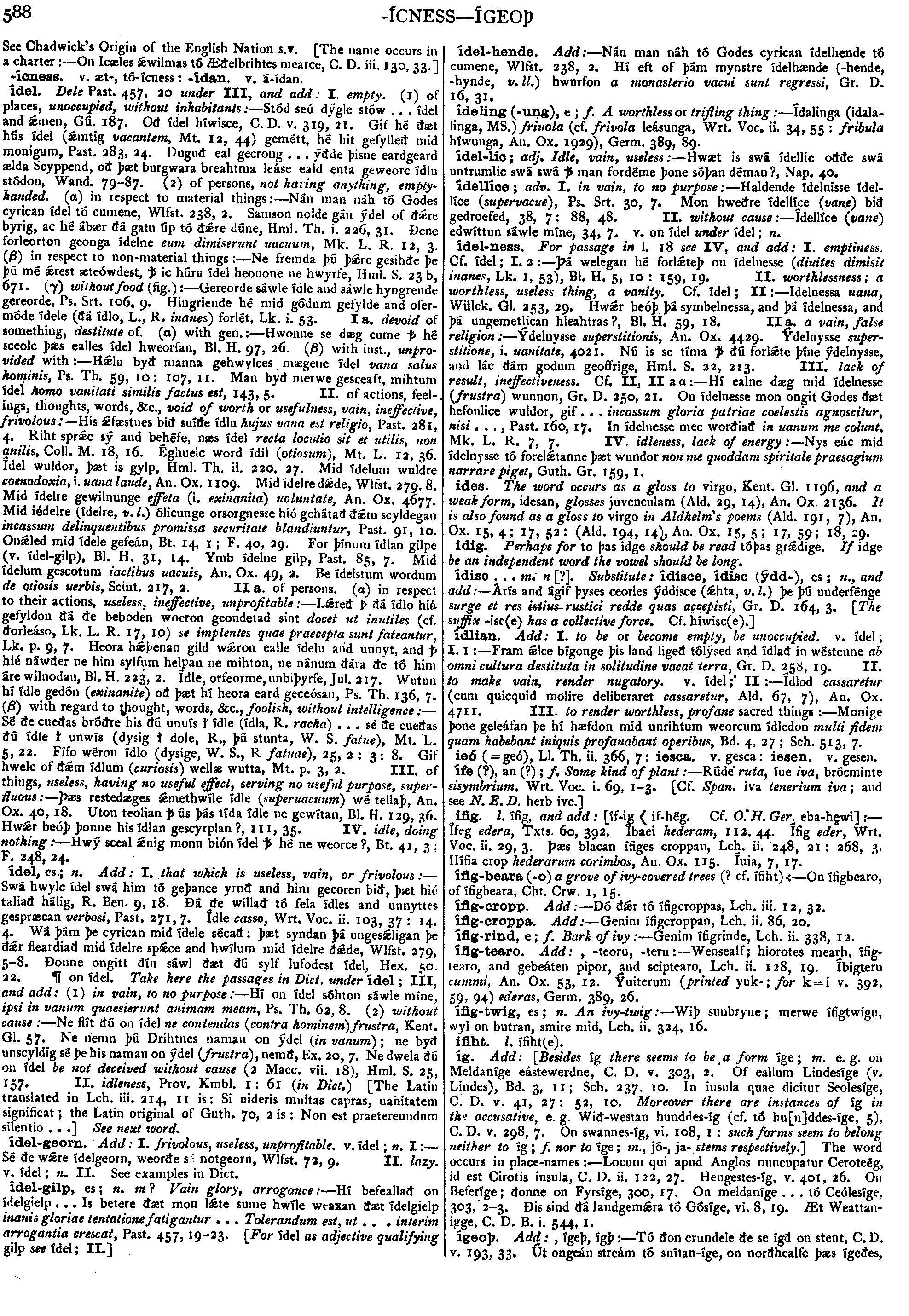
idig.
Perhaps
for
to
þas
idge
should
be
read
tþas
grdige.
If
idge
be
an
independent
word
the
vowel
should
be
long.
|
Source: Bosworth/Toller, page d0591, entry 24 View original page image as: [TIFF] [PNG] [View previous entry] [View next entry] |
[Comment on this entry] [View comments (1)] |
The following entry has been hand-corrected once. |
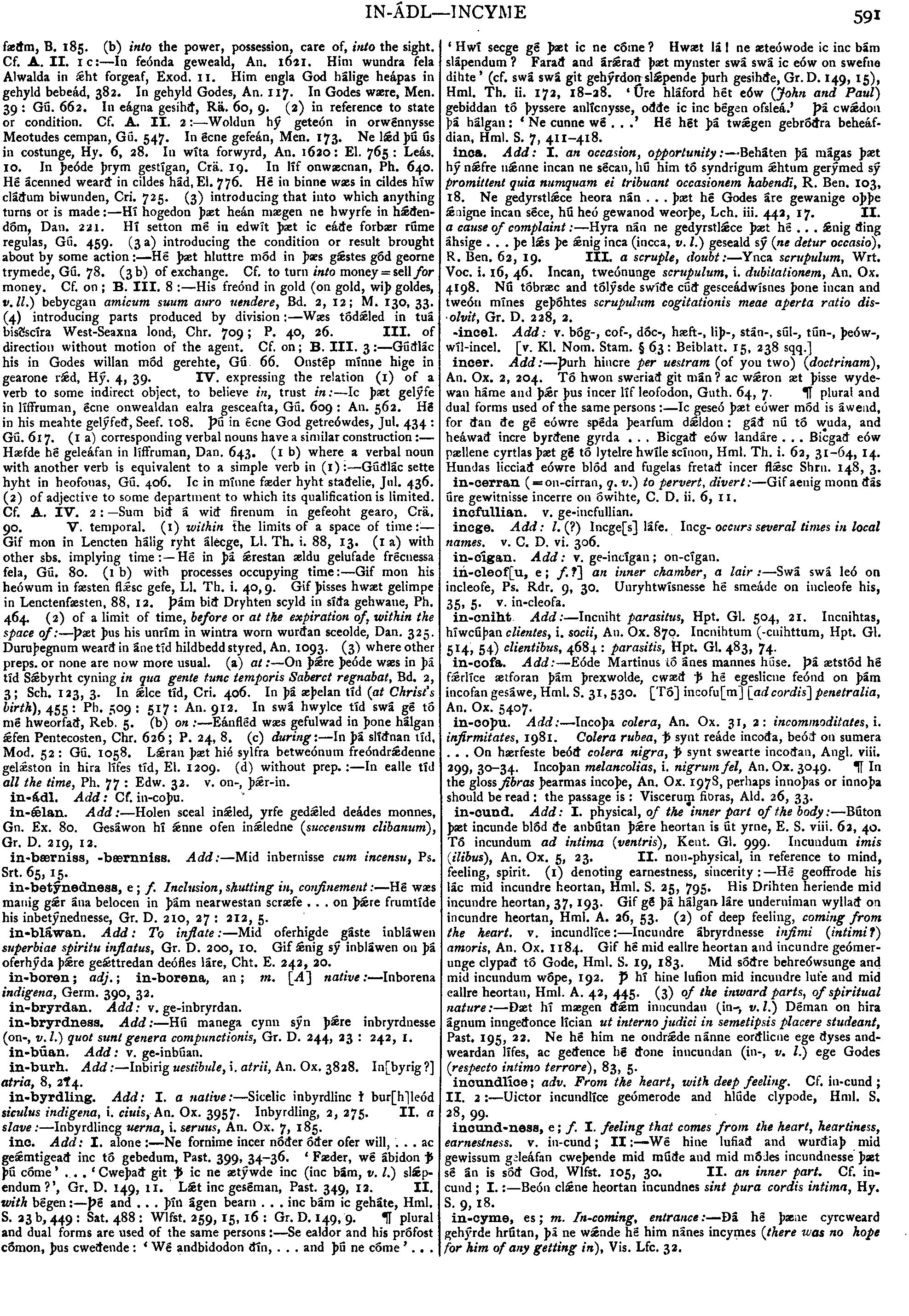
in-coþu.
Add
:--
Incoþa
colera,
An.
Ox.
31,
2:
incommoditates,
i.
infirmitates,
1981.
Colera
rubea,
synt
reáde
incoða,
beóí
on
sumera
...
On
hærfeste
beóð
colera
nigra,
synt
swearte
incoðan,
Angl.
viii.
299,
30-34.
Incoþan
melancolias,
i.
nigrum
fel,
An.
Ox.
3049.

In
the
gloss
fibras
þearmas
incoþe,
An.
Ox.
1978,
perhaps
innoþas
or
innoþa
should
be
read:
the
passage
is:
Viscerum
fibras,
Ald.
26,
33.
|
Source: Bosworth/Toller, page d0593, entry 35 View original page image as: [TIFF] [PNG] [View previous entry] [View next entry] |
[Comment on this entry] [View comments] |
The following entry has been hand-corrected once. |
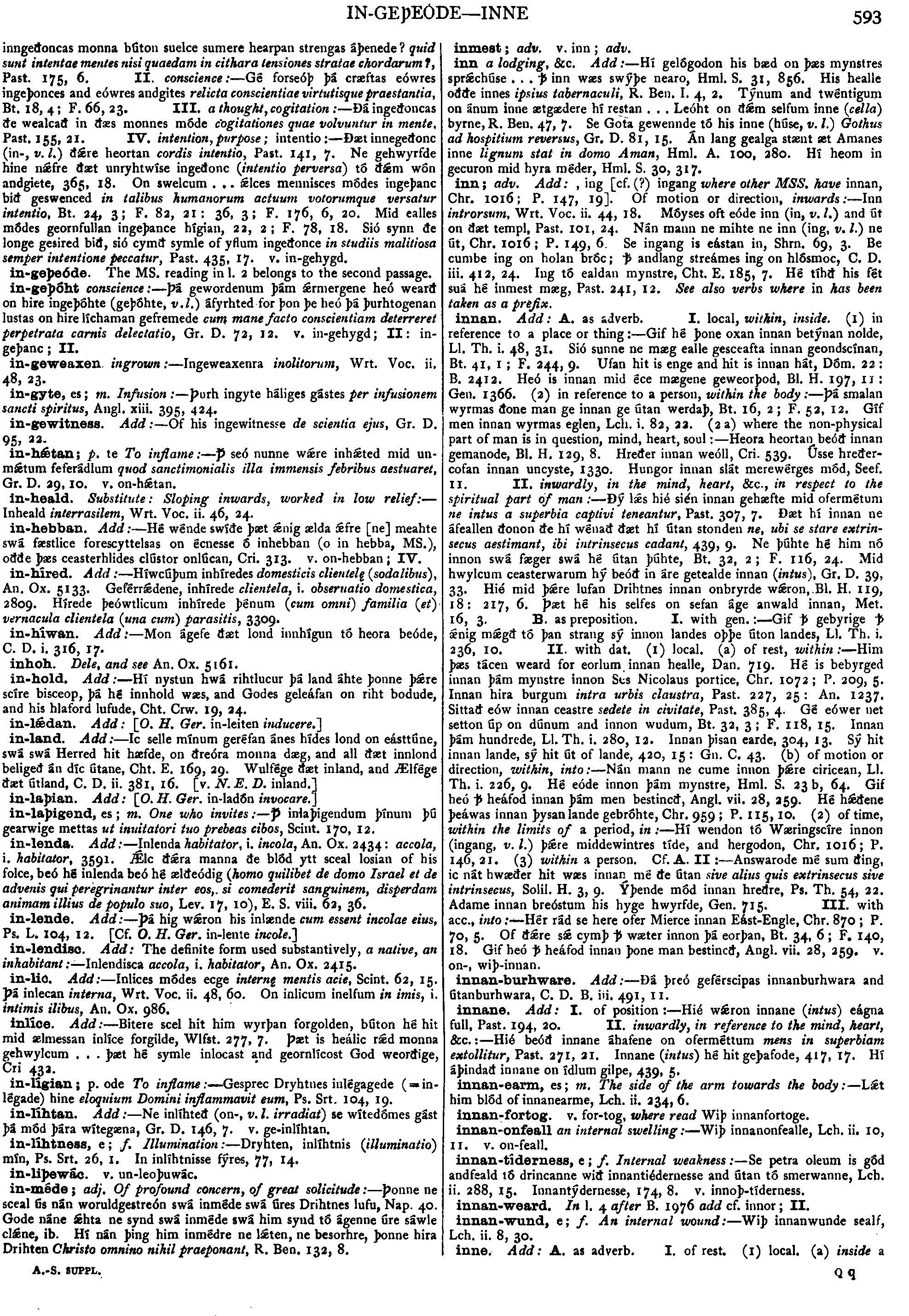
innan-fortog. v. for-tog, where read Wiþ innanfortoge.
|
Source: Bosworth/Toller, page d0595, entry 1 View original page image as: [TIFF] [PNG] [View previous entry] [View next entry] |
[Comment on this entry] [View comments] |
The following entry has been hand-corrected once. |
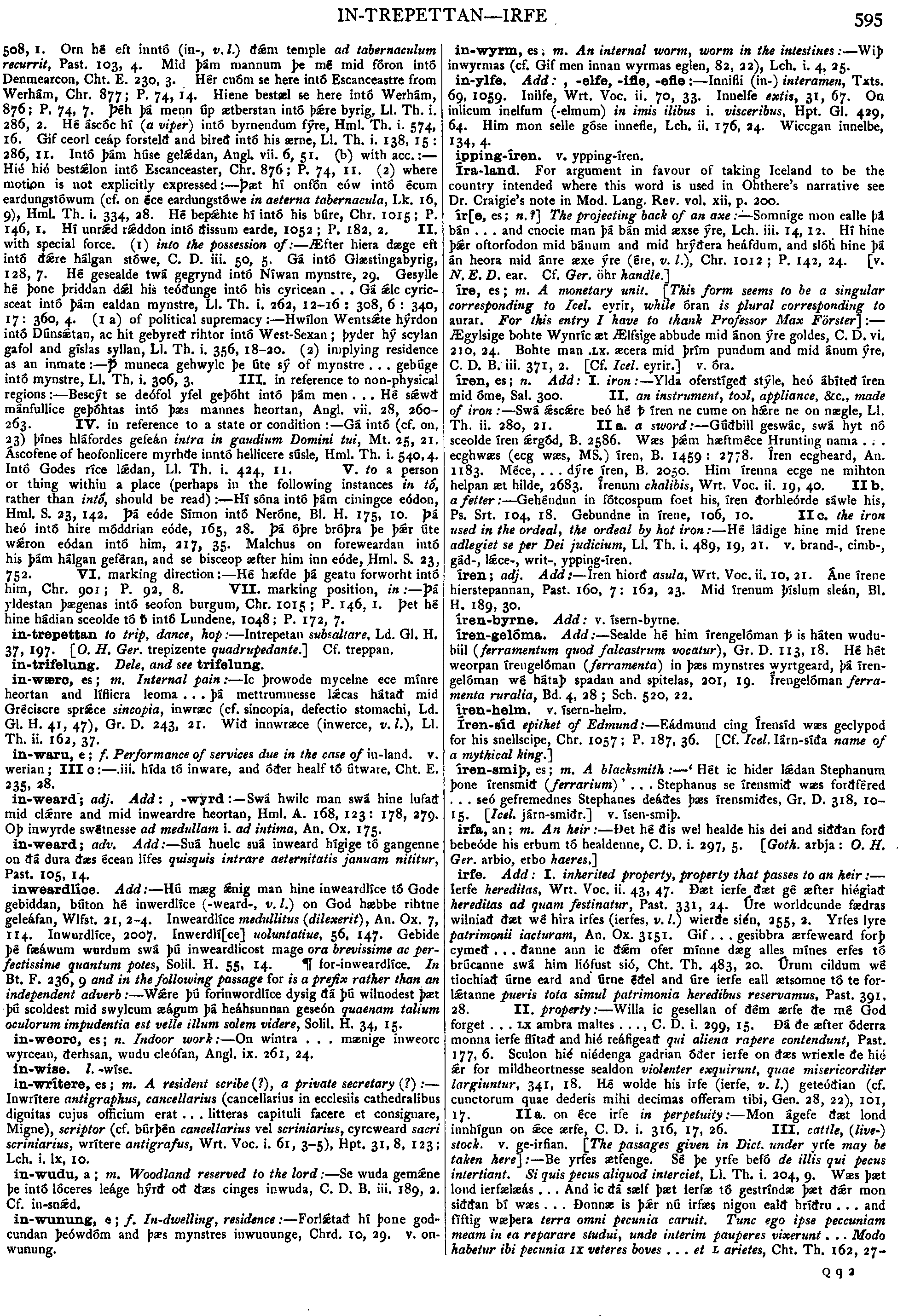
508,
1.
Orn
hé
eft
inntó
(in-,
v.
l.)
ðm
temple
ad
tabernaculum
recurrit,
Past.
103,
4.
Mid
þám
mannum
þe
mé
mid
fóron
intó
Denmearcon,
Cht.
E.
230,
3.
Hér
cuóm
se
here
intó
Escanceastre
from
Werhám,
Chr.
877;
P.
74,
14.
Hiene
bestæl
se
here
intó
Werhám,
876;
P.
74,
7.
Þéh
þá
menn
úp
ætberstan
intó
þre
byrig,
Ll.
Th.
i.
286,
2.
Hé
áscóc
hí
(a
viper)
intó
byrnendum
fýre,
Hml.
Th.
i.
574,
16.
Gif
ceorl
ceáp
forstelð
and
bireð
intó
his
ærne,
Ll.
Th.
i.
138,
15
:
286,
11.
Intó
þám
húse
geldan,
Angl.
vii.
6,
51.
(b)
with
acc.:--
Hié
hié
bestlon
intó
Escanceaster,
Chr.
876;
P.
74,
11.
(2)
where
motion
is
not
explicitly
expressed
:--
Þæt
hí
onfón
eów
intó
écum
eardungstówum
(cf.
on
éce
eardungstówe
in
aeterna
tabernacula,
Lk.
16,
9),
Hml.
Th.
i.
334,
28.
Hé
bephte
hí
intó
his
búre,
Chr.
1015;
P.
146,
1.
Hí
unrd
rddon
intó
ðissum
earde,
1052
;
P.
182,
2.
II.
with
special
force.
(1)
into
the
possession
of
:--
Æfter
hiera
dæge
eft
intó
ðre
hálgan
stówe,
C.
D.
iii.
50,
5.
Gá
intó
Glæstingabyrig,
128,
7.
Hé
gesealde
twá
gegrynd
intó
Níwan
mynstre,
29.
Gesylle
hé
þone
þriddan
dl
his
teóðunge
intó
his
cyricean
.
.
.
Gá
lc
cyric sceat
intó
þám
ealdan
mynstre,
Ll.
Th.
i.
262,
12-16
:
308,
6
:
340,
17:
360,
4.
(1
a)
of
political
supremacy
:--
Hwílon
Wentste
hýrdon
intó
Dúnstan,
ac
hit
gebyreð
rihtor
intó
West-Sexan;
þyder
hý
scylan
gafol
and
gíslas
syllan,
Ll.
Th.
i.
356,
18-20.
(2)
implying
residence
as
an
inmate
:--
muneca
gehwylc
þe
úte
sý
of
mynstre
.
.
.
gebúge
intó
mynstre,
Ll.
Th.
i.
306,
3.
III.
in
reference
to
non-physical
regions
:--
Bescýt
se
deófol
yfel
geþóht
intó
þám
men
.
.
.
Hé
swð
mánfullice
geþóhtas
intó
þæs
mannes
heortan,
Angl.
vii.
28,
260-263.
IV.
in
reference
to
a
state
or
condition
:--
Gá
intó
(cf.
on,
23)
þínes
hláfordes
gefeán
intra
in
gaudium
Domini
tui,
Mt.
25,
21.
Áscofene
of
heofonlicere
myrhðe
inntó
hellicere
súsle,
Hml.
Th.
i.
540,
4.
Intó
Godes
ríce
ldan,
Ll.
Th.
i.
424,
11.
V.
to
a
person
or
thing
within
a
place
(perhaps
in
the
following
instances
in
tó,
rather
than
intó,
should
be
read)
:--
Hí
sóna
intó
þám
ciningce
eódon,
Hml.
S.
23,
142.
Þá
eóde
Símon
intó
Neróne,
Bl.
H.
175,
10.
Þa
heó
intó
hire
móddrian
eóde,
165,
28.
Þá
óþre
bróþra
þe
þr
úte
wron
eódan
intó
him,
217,
35.
Malchus
on
foreweardan
intó
his
þám
hálgan
geféran,
and
se
bisceop
æfter
him
inn
eóde,
Hml.
S.
23,
752.
VI.
marking
direction
:--
Hé
hæfde
þá
geatu
forworht
intó
him,
Chr.
901;
P.
92,
8.
VII.
marking
position,
in
:--
Þá
yldestan
þægenas
intó
seofon
burgum,
Chr.
1015
;
P.
146,
1.
Þet
hé
hine
hádian
sceolde
tó
sceat
intó
þám
ealdan
mynstre,
Ll.
Th.
i.
262,
12-16
:
308,
6
:
340,
17:
360,
4.
(1
a)
of
political
supremacy
:--
Hwílon
Wentste
hýrdon
intó
Dúnstan,
ac
hit
gebyreð
rihtor
intó
West-Sexan;
þyder
hý
scylan
gafol
and
gíslas
syllan,
Ll.
Th.
i.
356,
18-20.
(2)
implying
residence
as
an
inmate
:--
muneca
gehwylc
þe
úte
sý
of
mynstre
.
.
.
gebúge
intó
mynstre,
Ll.
Th.
i.
306,
3.
III.
in
reference
to
non-physical
regions
:--
Bescýt
se
deófol
yfel
geþóht
intó
þám
men
.
.
.
Hé
swð
mánfullice
geþóhtas
intó
þæs
mannes
heortan,
Angl.
vii.
28,
260-263.
IV.
in
reference
to
a
state
or
condition
:--
Gá
intó
(cf.
on,
23)
þínes
hláfordes
gefeán
intra
in
gaudium
Domini
tui,
Mt.
25,
21.
Áscofene
of
heofonlicere
myrhðe
inntó
hellicere
súsle,
Hml.
Th.
i.
540,
4.
Intó
Godes
ríce
ldan,
Ll.
Th.
i.
424,
11.
V.
to
a
person
or
thing
within
a
place
(perhaps
in
the
following
instances
in
tó,
rather
than
intó,
should
be
read)
:--
Hí
sóna
intó
þám
ciningce
eódon,
Hml.
S.
23,
142.
Þá
eóde
Símon
intó
Neróne,
Bl.
H.
175,
10.
Þa
heó
intó
hire
móddrian
eóde,
165,
28.
Þá
óþre
bróþra
þe
þr
úte
wron
eódan
intó
him,
217,
35.
Malchus
on
foreweardan
intó
his
þám
hálgan
geféran,
and
se
bisceop
æfter
him
inn
eóde,
Hml.
S.
23,
752.
VI.
marking
direction
:--
Hé
hæfde
þá
geatu
forworht
intó
him,
Chr.
901;
P.
92,
8.
VII.
marking
position,
in
:--
Þá
yldestan
þægenas
intó
seofon
burgum,
Chr.
1015
;
P.
146,
1.
Þet
hé
hine
hádian
sceolde
tó
 UNCERTAIN
intó
Lundene,
1048;
P.
172,
7.
UNCERTAIN
intó
Lundene,
1048;
P.
172,
7.
|
Source: Bosworth/Toller, page d0598, entry 31 View original page image as: [TIFF] [PNG] [View previous entry] [View next entry] |
[Comment on this entry] [View comments (1)] |
The following entry has been hand-corrected once. |
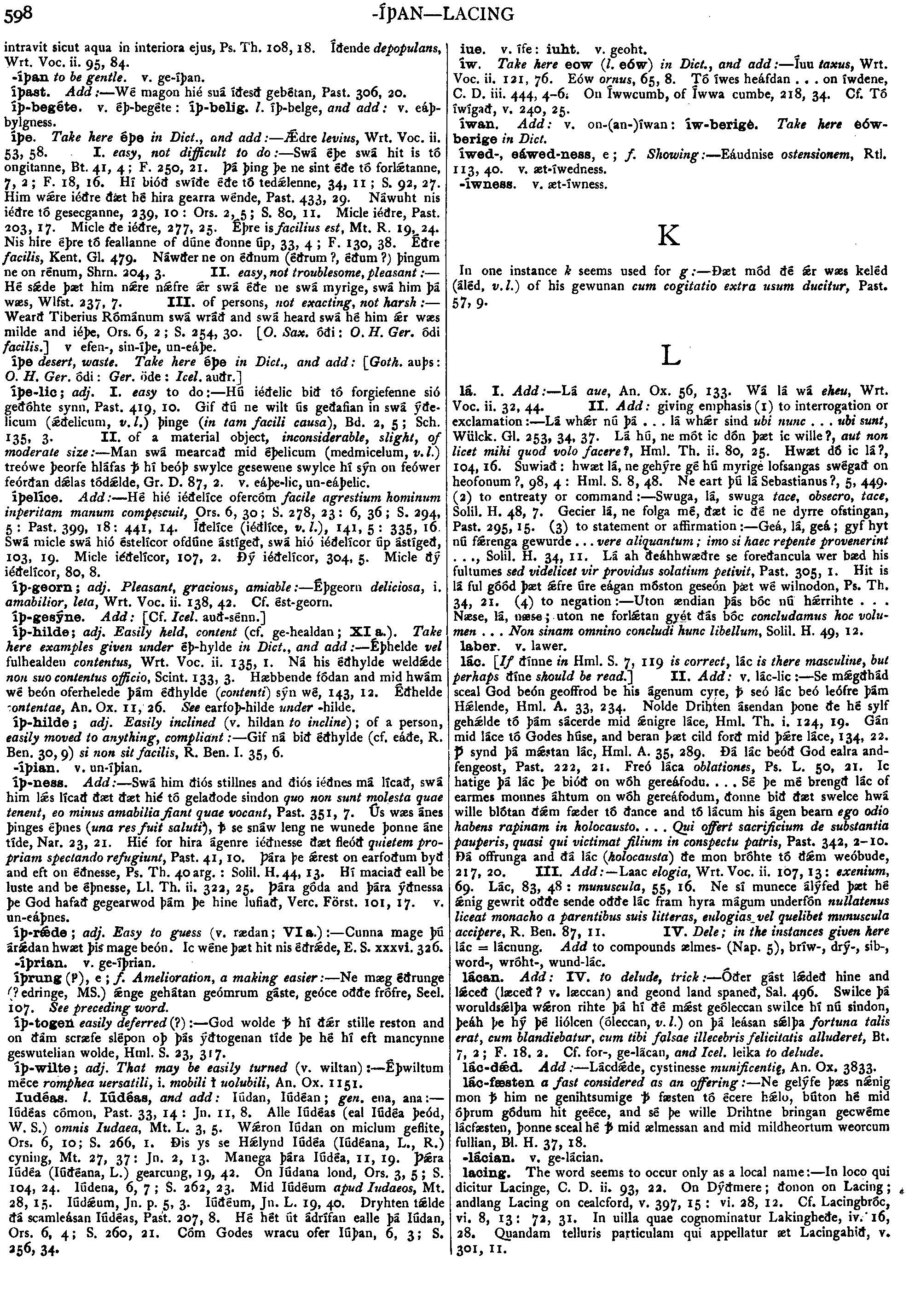
lác.
[If
ðínne
in
Hml.
S.
7,
119
is
correct,
lác
is
there
masculine,
but
perhaps
ðíne
should
be
read.]
II.
Add;
v.
lác-lic
:--
Se
mgðhád
sceal
God
beón
geoffrod
be
his
ágenum
eyre,
seó
lác
beo
leófre
þám
Hlende,
Hml.
A.
33,
234.
Nolde
Drihten
ásendan
þone
ðe
hé
sylf
gehlde
tó
þám
sácerde
mid
nigre
láce,
Hml.
Th.
i.
124,
19.
Gán
mid
láce
tó
Godes
húse,
and
beran
þæt
cild
forð
mid
þre
láce,
134,
22.
synd
þá
mstan
lác,
Hml.
A.
35,
289.
Ðá
lác
beóð
God
ealra
andfengeost,
Past.
222,
21.
Freó
láca
oblationes,
Ps.
L.
50,
21.
Ic
hatige
þá
lác
þe
bióð
on
wóh
gereáfodu.
...
Sé
þe
mé
brengð
lác
of
earmes
monnes
áhtum
on
wóh
gereáfodum,
ðonne
bið
dæt
swelce
hwá
wille
blótan
ðm
fæder
tó
ðance
and
tó
lácum
his
ágen
bearn
ego
odio
habens
rapinam
in
holocausto.
...
Qui
offert
sacrificium
de
substantia
pauperis,
quasi
qui
victimat
filium
in
conspectu
patris,
Past.
342,
2-10.
Ðá
offrunga
and
ðá
lác
(holocausta)
ðe
mon
bróhte
tó
ðm
weóbude,
217,
20.
III.
Add
:--
Laac
elogia,
Wrt.
Voc.
ii.
107,
13:
exenium,
69.
Lác,
83,
48:
munuscula,
55,
16.
Ne
sí
munece
álýféd
þæt
hé
nig
gewrit
oððe
sende
oððe
lác
fram
hyra
mágum
underfón
nullatenus
liceat
monacho
a
parentibus
suis
litteras,
eulogias
vel
quelibet
munuscula
accipere,
R.
Ben.
87,
11.
IV.
Dele;
in
tie
instances
given
here
lác
=
lácnung.
Add
to
compounds
ælmes-
(Nap.
5),
bríw-,
drý-,
sib-,
word-,
wróht-,
wund-lác.
| Result Page: |  |
Previous | 16 17 18 19 20 21 22 23 24 25 26 27 28 29 30 31 32 33 34 | Next |  |
Germanic Lexicon Project (main page)
This search system was written by
Sean Crist
Please consider
volunteering
to correct the data in these online dictionaries.
No rights reserved. Feel free to use these data in any way you please.