|
|

|
Source: Cleasby/Vigfusson, page b0158, entry 5 View original page image as: [TIFF] [PNG] [View previous entry] [View next entry] |
[Comment on this entry] [View comments] |
The following entry has been hand-corrected once. |
FJÖÐR,
gen.
fjaðrar;
old
pl.
fjaðrar,
later
fjaðrir;
dat.
fjöðrum:
[A.
S.
feðer;
Engl.
feather;
Germ.
feder;
Gr.
GREEK]
:--
a
feather,
it
may
be
used
of
either
the
plume
or
the
quill,
but
usually
a
distinction
is
made
between
fiðri
or
fiðr,
plumage,
and
fjaðrar,
quills;
væng-fjöðr,
a
wing-feather;
stél-fjöðr,
a
tail-feather;
dynja
hana
fjaðrar,
Bm.
1;
hár
ok
fjaðrar,
Edda
(pref.);
plokkaði
af
fjaðrarnar,
77:
phrases
and
sayings,
það
er
ekki
fjöðr
af
fati
þínu,
'tis
no
feather
of
thy
gear,
thou
needst
not
be
proud
of
it,
cp.
Aesop's
fable;
verðr
hverr
að
fljúga
sem
hann
er
fjaðraðr,
every
one
must
fly
as
he
is
feathered;
draga
fjöðr
um
e-t,
to
slur
over
a
thing
(vide
draga),
Fms.
vii.
20:
cp.
the
proverb
in
Rafns
S.
Bs.
i.
647,
--
lítið
er
nef
várt,
en
breiðar
fjaðrar,
our
neb
is
small,
but
the
feathers
large,
perhaps
somewhat
corrupt
in
the
text,
being
taken
from
some
fable
about
birds;
the
sense
seems
to
be
something
like
the
Fr.
'l'homme
propose,
Dieu
dispose.'
2.
metaph.
of
feather-formed
things,
 .
the
blade
of
a
spear,
Eg.
285,
Stj.
461,
Ld.
244,
Grett.
121,
Sturl.
ii.
60,
Fas.
ii.
209,
Fb.
111.
409.
.
the
blade
of
a
spear,
Eg.
285,
Stj.
461,
Ld.
244,
Grett.
121,
Sturl.
ii.
60,
Fas.
ii.
209,
Fb.
111.
409.
 .
the
fin
of
a
fish,
Fas.
ii.
131;
fiskr
niðr
frá
beltis-stað
ok
fjöðr
á,
Fms.
iv.
56
(rare).
COMPDS:
fjaðra-broddr,
m.
a
feathered,
i.e.
double-edged,
spike,
Bárð.
170.
fjaðra-lauss,
adj.
featherless,
Fas.
ii.
378;
in
the
riddle,
fuglinn
flaug
fjaðra-lauss,
elti
fuglinn
fóta-lauss.
fjaðra-sárr,
adj.
=
fjaðr-sárr.
fjaðra-spjót,
n.
a
kind
of
sword-spear
to
thrust
with,
=
fjaðr-spjót.
.
the
fin
of
a
fish,
Fas.
ii.
131;
fiskr
niðr
frá
beltis-stað
ok
fjöðr
á,
Fms.
iv.
56
(rare).
COMPDS:
fjaðra-broddr,
m.
a
feathered,
i.e.
double-edged,
spike,
Bárð.
170.
fjaðra-lauss,
adj.
featherless,
Fas.
ii.
378;
in
the
riddle,
fuglinn
flaug
fjaðra-lauss,
elti
fuglinn
fóta-lauss.
fjaðra-sárr,
adj.
=
fjaðr-sárr.
fjaðra-spjót,
n.
a
kind
of
sword-spear
to
thrust
with,
=
fjaðr-spjót.
|
Source: Cleasby/Vigfusson, page b0161, entry 21 View original page image as: [TIFF] [PNG] [View previous entry] [View next entry] |
[Comment on this entry] [View comments] |
The following entry has been hand-corrected once. |
FLJÚGA,
pres.
flýg,
pl.
fljúgum;
pret.
flaug,
2nd
pers.
flaugt,
mod.
flaugst,
pl.
flugum;
another
old
pret.
fló,
Haustl.
2,
8,
Þkv.
5,
9,
Gh.
17,
Ýt.
14,
and
prose
passim;
the
form
flaug
is
very
rare,
in
old
poets;
fló
is
now
quite
obsolete,
flaug,
pl.
flugu,
being
the
current
form:
part.
floginn;
sup.
flogit;
pret.
subj.
1st
pers.
flygja,
3rd
pers.
flygi;
with
the
neg.
suf.
flýgrat,
Hm.
151:
[not
on
record
in
Goth.,
as
the
Apocal.
is
lost
in
Ulf.;
A.
S.
fleôgan;
Engl.
fly;
O.
H.
G.
fliôgan;
Germ.
fliegen;
Dutch
vliegen;
Swed.
flyge;
Dan.
flyve:
cp.
flug]
:--
to
fly,
Lat.
volare,
of
birds;
in
the
allit.
phrase,
fuglinn
fljúgandi;
valr
flýgr,
Grág.
ii.
170;
fló
sá
hrafn
aptr
um
stafn,
Landn.
29;
fló
hann
þangat
til,
Niðrst.
4;
at
fljúga
eigi
upp
fyrr,
Edda
60;
Johannes
flaug
upp
til
himins,
Hom.
47.
2.
metaph.,
fljúga
á
e-n
(á-flog,
q.v.),
to
fly
at
one
another,
in
a
fight,
Nj.
32:
recipr.,
fljúgask
á,
to
join
in
a
fight,
N.
G.
L.
i.
46,
Nj.
56.
.
of
weapons,
sparks,
rumour,
and
the
like;
spjótið
fló
yfir
hann
fram,
Nj.
58:
kesjan
flaug
í
völlinn,
Eg.
379;
gneistarnir
(the
sparks)
flugu,
Fms.
viii.
8;
at
vápn
skyli
falla
at
manni
eðr
f.
at
honum,
Grág.
Kb.
108;
fljúgandi
fleinn,
Hm.
85,
151;
fleinn
floginn,
Höfuðl.
12:
um
konu
þá
fló
út
ferlegt
úorðan,
Hom.
115;
sá
kvittr
fló
í
bygðinni,
Fms.
ix.
237:
flaug
þat
sem
sinu-eldr,
i.
21.
 .
of
shooting
pains
(vide
flog);
þaðan
af
fló
á
hann
mein
þat,
Bs.
i.
446.
II.
in
old
poetry
and
on
Runic
stones,
used
=
flýja
(q.v.),
to
flee,
Lat.
fugere;
sá
er
eigi
fló
at
Uppsölum,
who
fled
not
at
Upsala,
Baut.
1169;
en
þínir
fjándr
flugu,
Hkm.
12;
fló
ór
landi,
fled
from
the
land,
Ýt.
14.
.
of
shooting
pains
(vide
flog);
þaðan
af
fló
á
hann
mein
þat,
Bs.
i.
446.
II.
in
old
poetry
and
on
Runic
stones,
used
=
flýja
(q.v.),
to
flee,
Lat.
fugere;
sá
er
eigi
fló
at
Uppsölum,
who
fled
not
at
Upsala,
Baut.
1169;
en
þínir
fjándr
flugu,
Hkm.
12;
fló
ór
landi,
fled
from
the
land,
Ýt.
14.
|
Source: Cleasby/Vigfusson, page b0162, entry 9 View original page image as: [TIFF] [PNG] [View previous entry] [View next entry] |
[Comment on this entry] [View comments] |
The following entry has been hand-corrected once. |
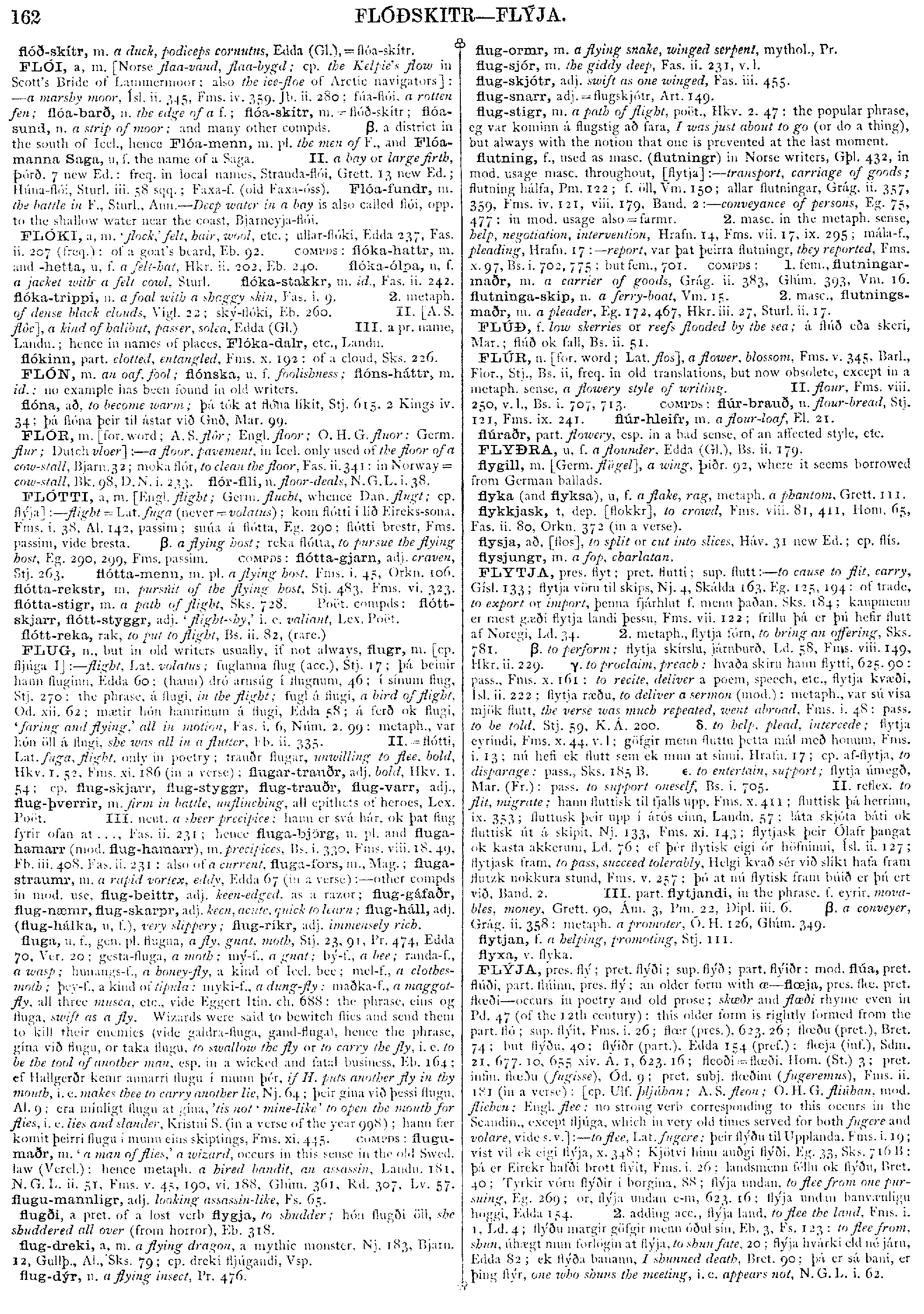
flótt-reka, rak, to put to flight, Bs. ii. 82, (rare.)
|
Source: Cleasby/Vigfusson, page b0163, entry 36 View original page image as: [TIFF] [PNG] [View previous entry] [View next entry] |
[Comment on this entry] [View comments] |
The following entry has been hand-corrected once. |
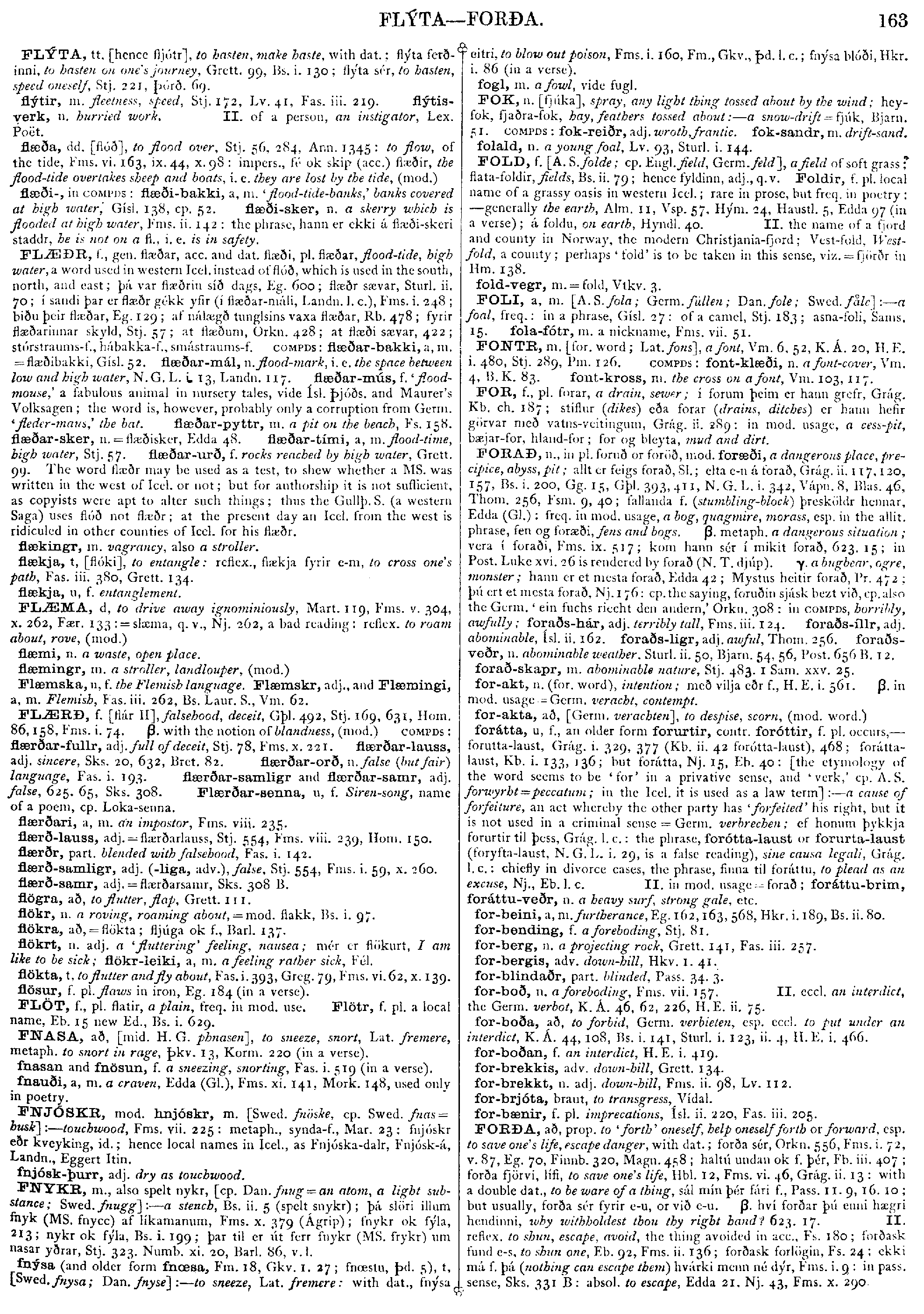
FOLD, f. [A. S. folde; cp. Engl. field, Germ. feld], a field of soft grass; flata-foldir, fields, Bs. ii. 79; hence fyldinn, adj., q.v. Foldir, f. pl. local name of a grassy oasis in western Icel.; rare in prose, but freq. in poetry: -- generally the earth, Alm. 11, Vsp. 57, Hým. 24, Haustl. 5, Edda 97 (in a verse); á foldu, on earth, Hyndl. 40. II. the name of a fjord and county in Norway, the modern Christjania-fjord; Vest-fold, West-fold, a county; perhaps 'fold' is to be taken in this sense, viz. = fjörðr in Hm. 138.
|
Source: Cleasby/Vigfusson, page b0164, entry 57 View original page image as: [TIFF] [PNG] [View previous entry] [View next entry] |
[Comment on this entry] [View comments] |
The following entry has been hand-corrected once. |
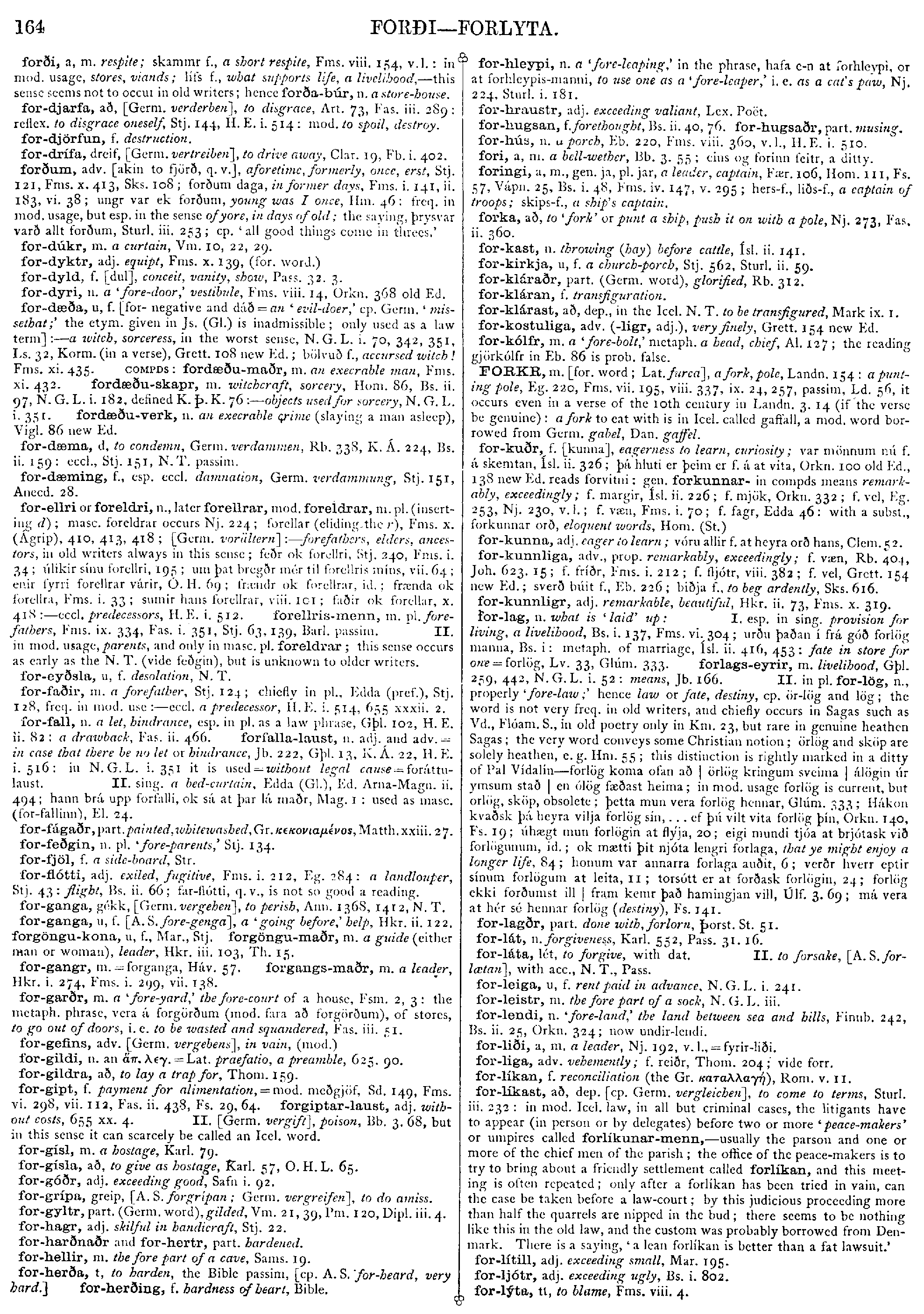
for-lag, n. what is 'laid' up: I. esp. in sing, provision for living, a livelihood, Bs. i. 137, Fms. vi. 304; urðu þaðan í frá góð forlög manna, Bs. i: metaph. of marriage, Ísl. ii. 416, 453: fate in store for one = forlög, Lv. 33, Glúm. 333. forlags-eyrir, m. livelihood, Gþl. 259, 442, N. G. L. i. 52: means, Jb. 166. II. in pl. for-lög, n., properly 'fore-law;' hence law or fate, destiny, cp. ör-lög and lög; the word is not very freq. in old writers, and chiefly occurs in Sagas such as Vd., Flóam. S., in old poetry only in Km. 23, but rare in genuine heathen Sagas; the very word conveys some Christian notion; örlög and sköp are solely heathen, e.g. Hm. 55; this distinction is rightly marked in a ditty of Pal Vídalín -- forlög koma ofan að | örlög kringum sveima | álögin úr ymsum stað | en ólög fæðast heima; in mod. usage forlög is current, but orlög, sköp, obsolete; þetta mun vera forlög hennar, Glúm. 333; Hákon kvaðsk þá heyra vilja forlög sin, ... ef þú vilt vita forlög þín, Orkn. 140, Fs. 19; úhægt mun forlögin at flýja, 20; eigi mundi tjóa at brjótask við forlögunum, id.; ok mætti þit njóta lengri forlaga, that ye might enjoy a longer life, 84; honum var annarra forlaga auðit, 6; verðr hverr eptir sínum forlögum at leita, 11; torsótt er at forðask forlögin, 24; forlög ekki forðumst ill | fram kemr það hamingjan vill, Úlf. 3. 69; má vera at hér sé hennar forlög (destiny), Fs.
|
Source: Cleasby/Vigfusson, page b0165, entry 2 View original page image as: [TIFF] [PNG] [View previous entry] [View next entry] |
[Comment on this entry] [View comments] |
The following entry has been hand-corrected once. |
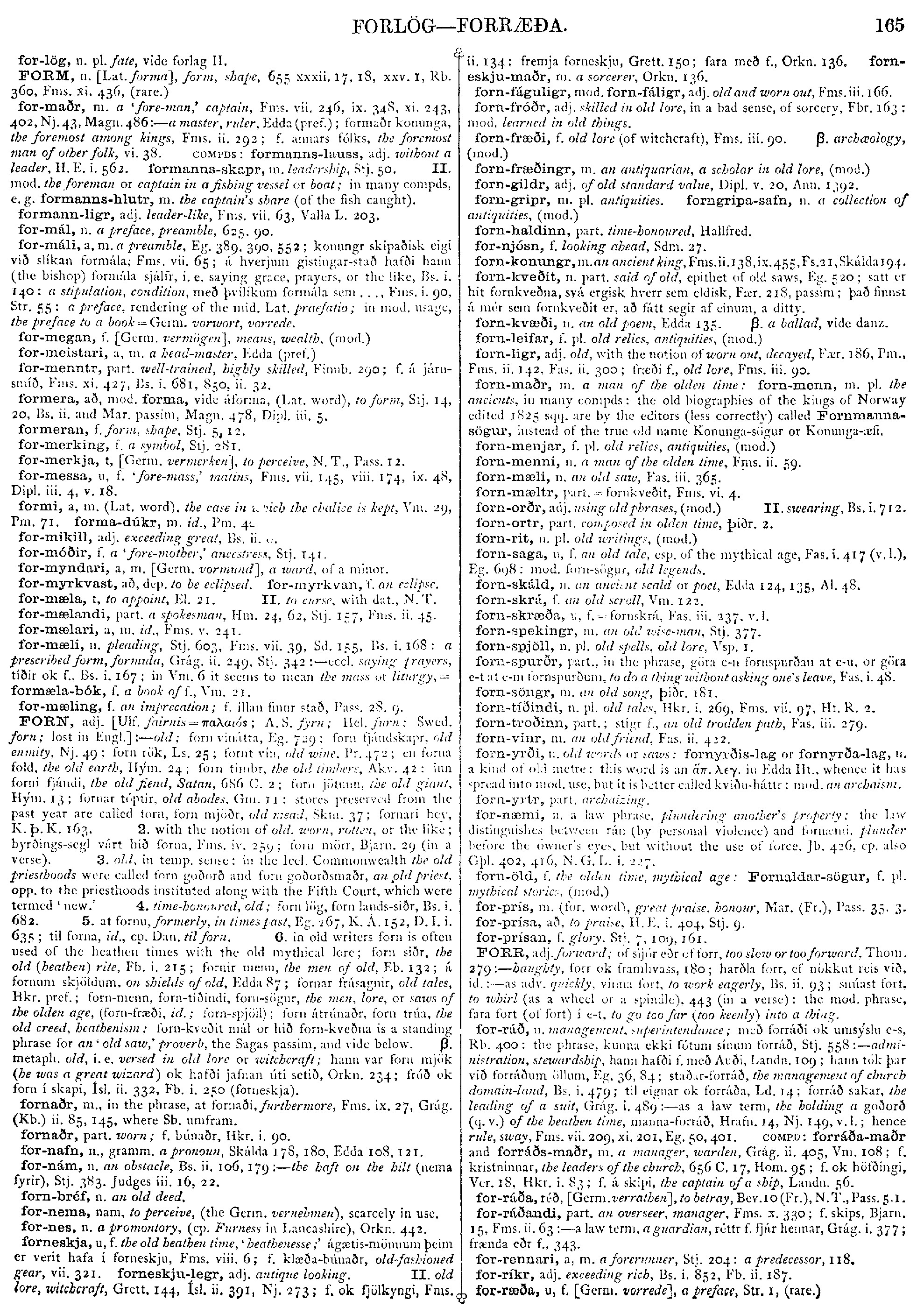
FORM, n. [Lat. forma], form, shape, 655 xxxii. 17, 18, xxv. 1, Rb. 360, Fms. xi. 436, (rare.)
|
Source: Cleasby/Vigfusson, page b0165, entry 79 View original page image as: [TIFF] [PNG] [View previous entry] [View next entry] |
[Comment on this entry] [View comments] |
The following entry has been hand-corrected once. |
for-ræða, u, f, .[Germ. vorrede], a preface, Str. 1, (rare.)
|
Source: Cleasby/Vigfusson, page b0166, entry 1 View original page image as: [TIFF] [PNG] [View previous entry] [View next entry] |
[Comment on this entry] [View comments] |
The following entry has been hand-corrected once. |
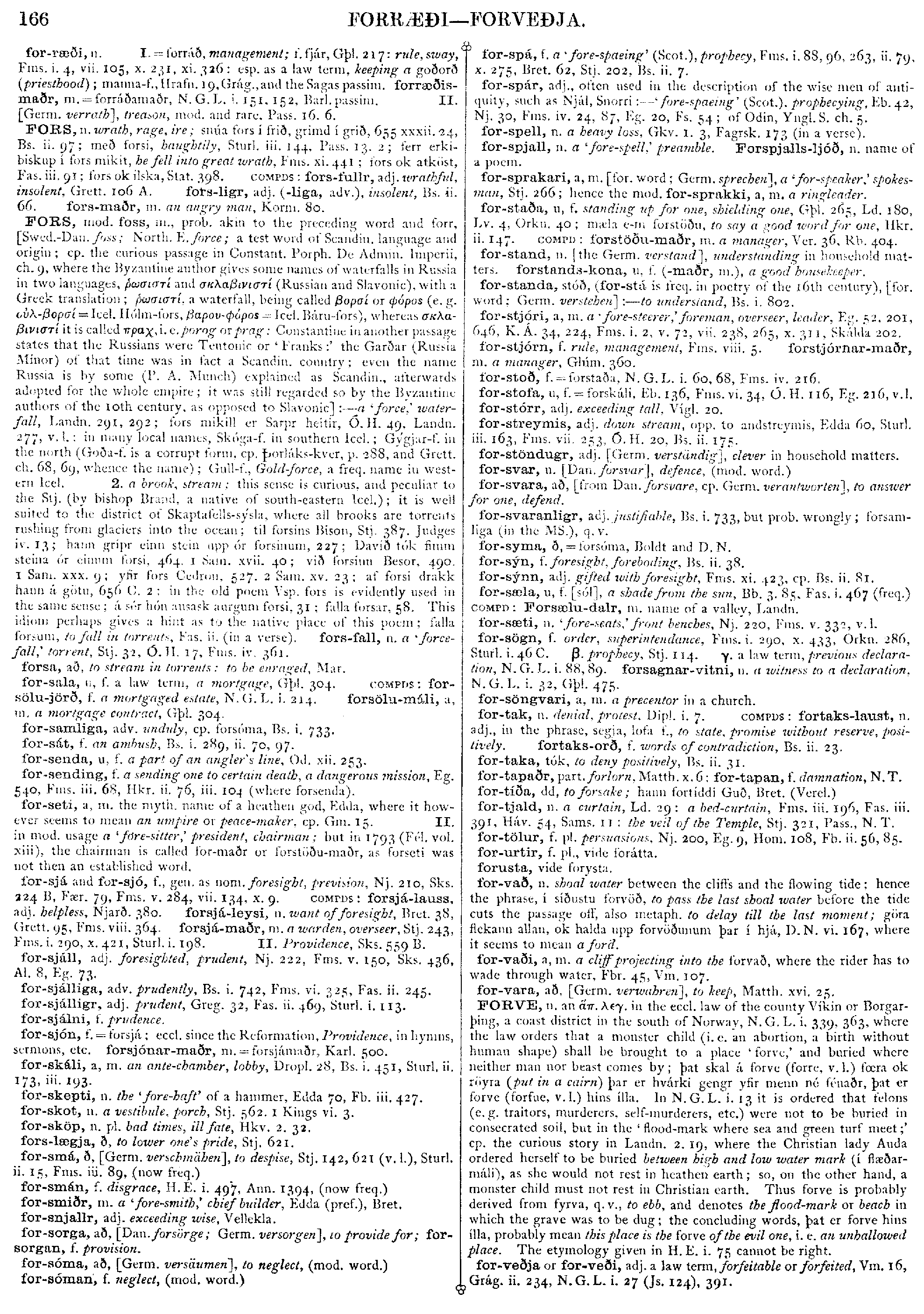
for-ræði, n. I. = forráð, management; f. fjár, Gþl. 217: rule, sway, Fms. i. 4, vii. 105, x. 231, xi. 326: esp. as a law term, keeping a goðorð (priesthood); manna-f., Hrafn. 19, Grág., and the Sagas passim, forræðis-maðr, m. = forráðamaðr, N. G. L. i. 151, 152, Barl. passim. II. [Germ. verrath], treason, mod. and rare. Pass. 16. 6.
|
Source: Cleasby/Vigfusson, page b0167, entry 23 View original page image as: [TIFF] [PNG] [View previous entry] [View next entry] |
[Comment on this entry] [View comments] |
The following entry has been hand-corrected once. |
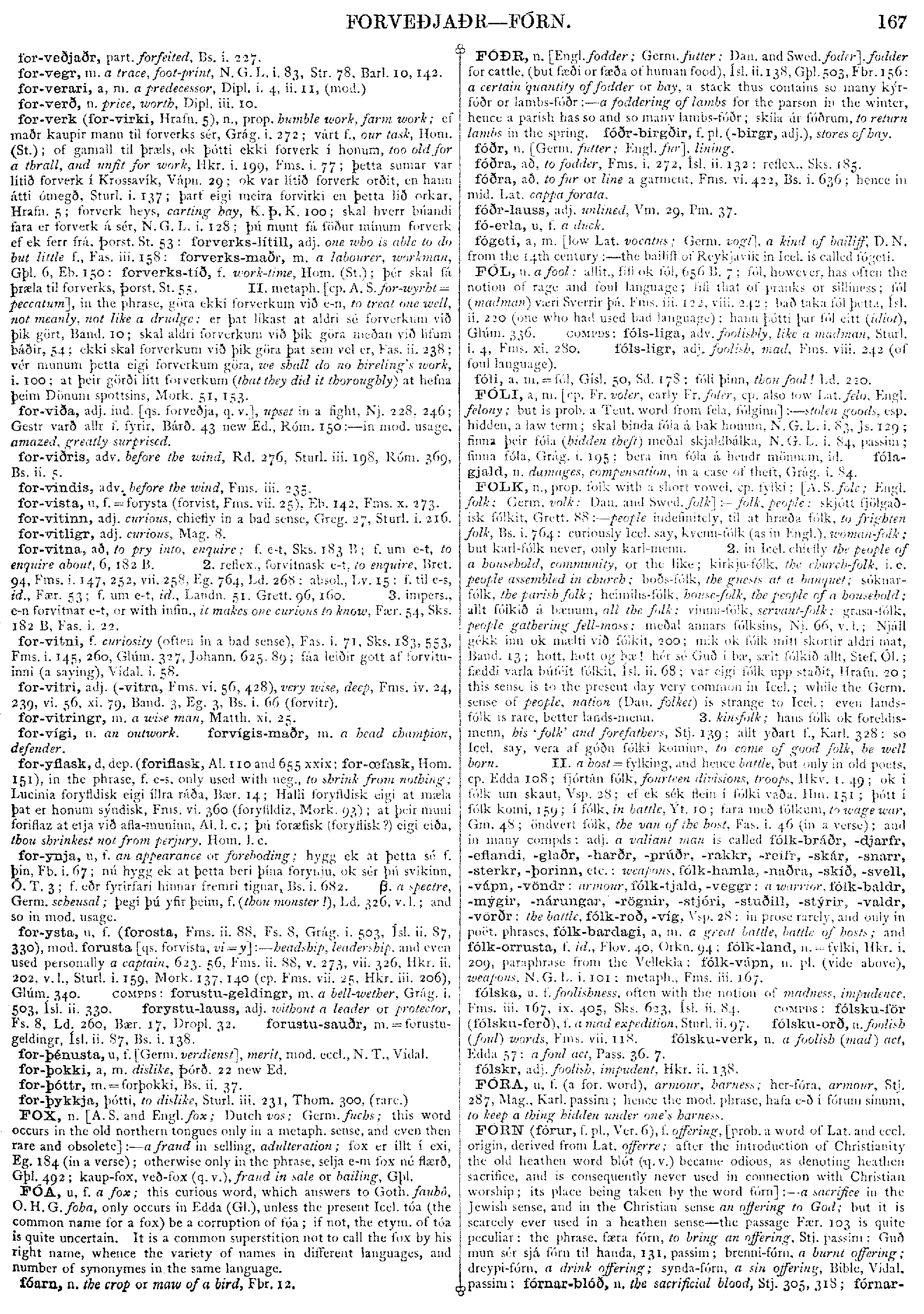
for-þykkja, þótti, to dislike, Sturl. iii. 231, Thom. 300, (rare.)
|
Source: Cleasby/Vigfusson, page b0167, entry 24 View original page image as: [TIFF] [PNG] [View previous entry] [View next entry] |
[Comment on this entry] [View comments] |
The following entry has been hand-corrected once. |
FOX, n. [A. S. and Engl. fox; Dutch vos; Germ. fuchs; this word occurs in the old northern tongues only in a metaph. sense, and even then rare and obsolete] :-- a fraud in selling, adulteration; fox er íllt í exi, Eg. 184 (in a verse); otherwise only in the phrase, selja e-m fox né flærð, Gþl. 492; kaup-fox, veð-fox (q.v.), fraud in sale or bailing, Gþl.
| Result Page: |  |
Previous | 8 9 10 11 12 13 14 15 16 17 18 19 20 21 22 23 24 25 26 | Next |  |
Germanic Lexicon Project (main page)
This search system was written by
Sean Crist
Please consider
volunteering
to correct the data in these online dictionaries.
No rights reserved. Feel free to use these data in any way you please.