|
|

Search for qui again, using less strict matching (1384 results)
|
Source: Bosworth/Toller, page b0093, entry 1 View original page image as: [TIFF] [PNG] [View previous entry] [View next entry] |
[Comment on this entry] [View comments] |
The following entry has been hand-corrected once. |
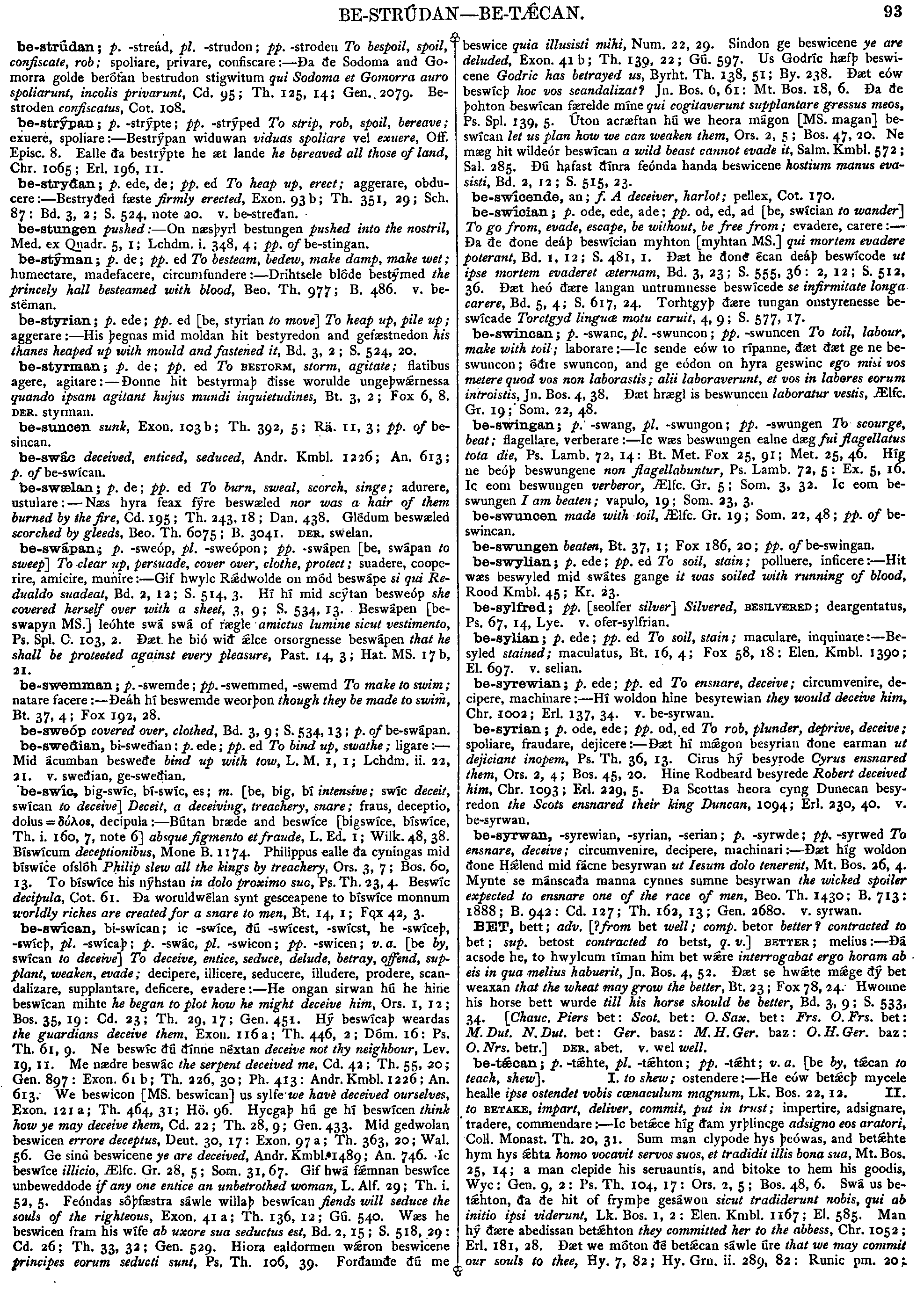
be-strúdan; p. -streád, pl. -strudon; pp. -stroden To bespoil, spoil, confiscate, rob; spoliare, privare, confiscare :-- Ða ðe Sodoma and Gomorra golde berófan bestrudon stigwitum qui Sodoma et Gomorra auro spoliarunt, incolis privarunt, Cd. 95; Th. 125, 14; Gen. 2079. Bestroden confiscatus, Cot. 108.
|
Source: Bosworth/Toller, page b0093, entry 17 View original page image as: [TIFF] [PNG] [View previous entry] [View next entry] |
[Comment on this entry] [View comments] |
The following entry has been hand-corrected once. |
be-swícan,
bi-swícan;
ic
-swíce,
ðú
-swícest,
-swícst,
he
-swíceþ,
-swícþ,
pl.
-swícaþ;
p.
-swác,
pl.
-swicon;
pp.
-swicen;
v.
a.
[be
by,
swícan
to
deceive]
To
deceive,
entice,
seduce,
delude,
betray,
offend,
supplant,
weaken,
evade;
decipere,
illicere,
seducere,
illudere,
prodere,
scandalizare,
supplantare,
deficere,
evadere
:--
He
ongan
sirwan
hú
he
hine
beswícan
mihte
he
began
to
plot
how
he
might
deceive
him,
Ors.
1,
12;
Bos.
35,
19
:
Cd.
23;
Th.
29,
17;
Gen.
451.
Hý
beswícaþ
weardas
the
guardians
deceive
them,
Exon.
116
a;
Th.
446,
2;
Dóm.
16
:
Ps.
Th.
61,
9.
Ne
beswíc
ðú
ðínne
néxtan
deceive
not
thy
neighbour,
Lev.
19,
11.
Me
nædre
beswác
the
serpent
deceived
me,
Cd.
42;
Th.
55,
20;
Gen.
897
:
Exon.
61
b;
Th.
226,
30;
Ph.
413
:
Andr.
Kmbl.
1226;
An.
613.
We
beswicon
[MS.
beswican]
us
sylfe
we
have
deceived
ourselves,
Exon.
121
a;
Th.
464,
31;
Hö.
96.
Hycgaþ
hú
ge
hí
beswícen
think
how
ye
may
deceive
them,
Cd.
22;
Th.
28,
9;
Gen.
433.
Mid
gedwolan
beswicen
errore
deceptus,
Deut.
30,
17
:
Exon.
97
a;
Th.
363,
20;
Wal.
56.
Ge
sind
beswicene
ye
are
deceived,
Andr.
Kmbl.
1489;
An.
746.
Ic
beswíce
illicio,
Ælfc.
Gr.
28,
5;
Som.
31,
67.
Gif
hwá
f mnan
beswíce
unbeweddode
if
any
one
entice
an
unbetrothed
woman,
L.
Alf.
29;
Th.
i.
52,
5.
Feóndas
sóþfæstra
sáwle
willaþ
beswícan
fiends
will
seduce
the
souls
of
the
righteous,
Exon.
41
a;
Th.
136,
12;
Gú.
540.
Wæs
he
beswicen
fram
his
wífe
ab
uxore
sua
seductus
est,
Bd.
2,
15;
S.
518,
29
:
Cd.
26;
Th.
33,
32;
Gen.
529.
Hiora
ealdormen
wron
beswicene
principes
eorum
seducti
sunt,
Ps.
Th.
106,
39.
Forðamðe
ðú
me
beswice
quia
illusisti
mihi,
Num.
22,
29.
Sindon
ge
beswicene
ye
are
deluded,
Exon.
41
b;
Th.
139,
22;
Gú.
597.
Us
Godríc
hæfþ
beswicene
Godric
has
betrayed
us,
Byrht.
Th.
138,
51;
By.
238.
Ðæt
eów
beswícþ
hoc
vos
scandalizat?
Jn.
Bos.
6,
61
:
Mt.
Bos.
18,
6.
Ða
ðe
þohton
beswícan
færelde
míne
qui
cogitaverunt
supplantare
gressus
meos,
Ps.
Spl.
139,
5.
Úton
acræftan
hú
we
heora
mágon
[MS.
magan]
beswícan
let
us
plan
how
we
can
weaken
them,
Ors.
2,
5;
Bos.
47,
20.
Ne
mæg
hit
wildeór
beswícan
a
wild
beast
cannot
evade
it,
Salm.
Kmbl.
572;
Sal.
285.
Ðú
hafast
ðínra
feónda
handa
beswicene
hostium
manus
evasisti,
Bd.
2,
12;
S.
515,
23.
mnan
beswíce
unbeweddode
if
any
one
entice
an
unbetrothed
woman,
L.
Alf.
29;
Th.
i.
52,
5.
Feóndas
sóþfæstra
sáwle
willaþ
beswícan
fiends
will
seduce
the
souls
of
the
righteous,
Exon.
41
a;
Th.
136,
12;
Gú.
540.
Wæs
he
beswicen
fram
his
wífe
ab
uxore
sua
seductus
est,
Bd.
2,
15;
S.
518,
29
:
Cd.
26;
Th.
33,
32;
Gen.
529.
Hiora
ealdormen
wron
beswicene
principes
eorum
seducti
sunt,
Ps.
Th.
106,
39.
Forðamðe
ðú
me
beswice
quia
illusisti
mihi,
Num.
22,
29.
Sindon
ge
beswicene
ye
are
deluded,
Exon.
41
b;
Th.
139,
22;
Gú.
597.
Us
Godríc
hæfþ
beswicene
Godric
has
betrayed
us,
Byrht.
Th.
138,
51;
By.
238.
Ðæt
eów
beswícþ
hoc
vos
scandalizat?
Jn.
Bos.
6,
61
:
Mt.
Bos.
18,
6.
Ða
ðe
þohton
beswícan
færelde
míne
qui
cogitaverunt
supplantare
gressus
meos,
Ps.
Spl.
139,
5.
Úton
acræftan
hú
we
heora
mágon
[MS.
magan]
beswícan
let
us
plan
how
we
can
weaken
them,
Ors.
2,
5;
Bos.
47,
20.
Ne
mæg
hit
wildeór
beswícan
a
wild
beast
cannot
evade
it,
Salm.
Kmbl.
572;
Sal.
285.
Ðú
hafast
ðínra
feónda
handa
beswicene
hostium
manus
evasisti,
Bd.
2,
12;
S.
515,
23.
|
Source: Bosworth/Toller, page b0093, entry 19 View original page image as: [TIFF] [PNG] [View previous entry] [View next entry] |
[Comment on this entry] [View comments] |
The following entry has been hand-corrected once. |
be-swícian; p. ode, ede, ade; pp. od, ed, ad [be, swícian to wander] To go from, evade, escape, be without, be free from; evadere, carere :-- Ða ðe ðone deáþ beswícian myhton [myhtan MS.] qui mortem evadere poterant, Bd. 1, 12; S. 481, 1. Ðæt he ðone écan deáþ beswícode ut ipse mortem evaderet æternam, Bd. 3. 23; S. 555, 36 : 2, 12; S. 512, 36. Ðæt heó ðære langan untrumnesse beswícede se infirmitate longa carere, Bd. 5, 4; S. 617, 24. Torhtgyþ ðære tungan onstyrenesse be-swícade Torctgyd linguæ motu caruit, 4, 9; S. 577, 17.
|
Source: Bosworth/Toller, page b0093, entry 31 View original page image as: [TIFF] [PNG] [View previous entry] [View next entry] |
[Comment on this entry] [View comments] |
The following entry has been hand-corrected once. |
be-tcan;
p.
-thte,
pl.
-thton;
pp.
-teht;
v.
a.
[be
by,
tcan
to
teach,
shew].
I.
to
shew;
ostendere
:--
He
eów
betcþ
mycele
healle
ipse
ostendet
vobis
cænaculum
magnum,
Lk.
Bos.
22,
12.
II.
to
BETAKE,
impart,
deliver,
commit,
put
in
trust;
impertire,
adsignare,
tradere,
commendare
:--
Ic
betce
híg
ðam
yrþlincge
adsigno
eos
aratori,
Coll.
Monast.
Th.
20,
31.
Sum
man
clypode
hys
þeówas,
and
bethte
hym
hys
hta
homo
vocavit
servos
suos,
et
tradidit
illis
bona
sua,
Mt.
Bos.
25,
14;
a
man
clepide
his
seruauntis,
and
bitoke
to
hem
his
goodis,
Wyc
:
Gen.
9,
2
:
Ps.
Th.
104,
17
:
Ors.
2,
5;
Bos.
48,
6.
Swá
us
be-thton,
ða
ðe
hit
of
frymþe
gesáwon
sicut
tradiderunt
nobis,
qui
ab
initio
ipsi
viderunt,
Lk.
Bos.
1,
2
:
Elen.
Kmbl.
1167;
El.
585.
Man
hý
ðære
abedissan
bethton
they
committed
her
to
the
abbess,
Chr.
1052;
Ed.
181,
28.
Ðæt
we
móton
ðé
betcan
sáwle
úre
that
we
may
commit
our
souls
to
thee,
Hy.
7,
82;
Hy.
Grn.
ii.
289,
82
:
Runic
pm.
20
:
Kmbl.
343,
18;
Hick.
Thes.
i.
135.
III.
to
send,
follow,
pursue;
mittere,
insequi,
amandare
:--
Betcan
[MS,
betæcen]
cildru
on
scóle
to
send
children
to
school;
mittere
pueros
in
scholam,
Obs.
Lun.
§
4;
Lchdm.
iii.
184,
28.
Mid
swiftum
húndum
ic
betce
wildeór
with
swift
hounds
I
pursue
wild
beasts;
cum
velocibus
canibus
insequor
feras,
Coll.
Monast.
Th.
21,
27.
Ic
betce
fram
me
amando,
Ælfc.
Gr.
47;
Som.
48,
35.
|
Source: Bosworth/Toller, page b0096, entry 26 View original page image as: [TIFF] [PNG] [View previous entry] [View next entry] |
[Comment on this entry] [View comments] |
The following entry has been hand-corrected once. |
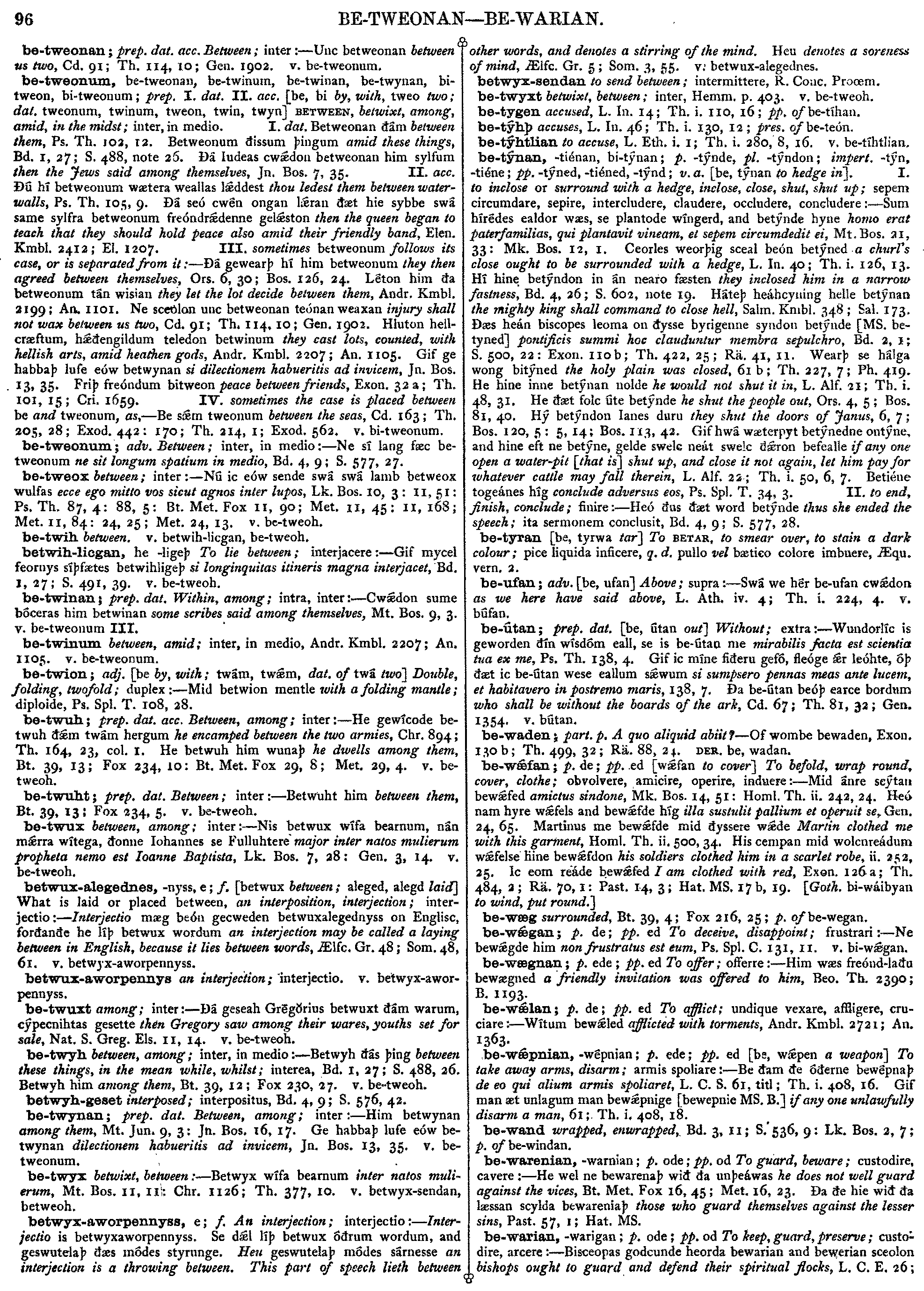
be-týnan,
-tiénan,
bi-týnan;
p.
-týnde,
pl.
-týndon;
impert.
-týn,
-tiéne;
pp.
-týned,
-tiéned,
-týnd;
v.
a.
[be,
týnan
to
hedge
in].
I.
to
inclose
or
surround
with
a
hedge,
inclose,
close,
shut,
shut
up;
sepem
circumdare,
sepire,
intercludere,
claudere,
occludere,
concludere
:--
Sum
hírédes
ealdor
wæs,
se
plantode
wíngerd,
and
betýnde
hyne
homo
erat
paterfamilias,
qui
plantavit
vineam,
et
sepem
circumdedit
ei,
Mt.
Bos.
21,
33
:
Mk.
Bos.
12,
1.
Ceorles
weorþig
sceal
beón
betýned
a
churl's
close
ought
to
be
surrounded
with
a
hedge,
L.
In.
40;
Th.
i.
126,
13.
Hí
hine
betýndon
in
án
nearo
fæsten
they
inclosed
him
in
a
narrow
fastness,
Bd.
4,
26;
S.
602,
note
19.
Háteþ
heáhcyning
helle
betýnan
the
mighty
king
shall
command
to
close
hell,
Salm.
Kmbl.
348;
Sal.
173.
Ðæs
heán
biscopes
leoma
on
ðysse
byrigenne
syndon
betýnde
[MS.
betyned]
pontificis
summi
hoc
clauduntur
membra
sepulchro,
Bd.
2,
1;
S.
500,
22
:
Exon.
110
b;
Th.
422,
25;
Rä.
41,
11.
Wearþ
se
hálga
wong
bitýned
the
holy
plain
was
closed,
61
b;
Th.
227,
7;
Ph.
419.
He
hine
inne
betýnan
nolde
he
would
not
shut
it
in,
L.
Alf.
21;
Th.
i.
48,
31.
He
ðæt
folc
úte
betýnde
he
shut
the
people
out,
Ors.
4,
5;
Bos.
81,
40.
Hý
betýndon
Ianes
duru
they
shut
the
doors
of
Janus,
6,
7;
Bos.
120,
5
:
5,
14;
Bos.
113,
42.
Gif
hwá
wæterpyt
betýnedne
ontýne,
and
hine
eft
ne
betýne,
gelde
swelc
neát
swelc
ðron
befealle
if
any
one
open
a
water-pit
[that
is]
shut
up,
and
close
it
not
again,
let
him
pay
for
whatever
cattle
may
fall
therein,
L.
Alf.
22;
Th.
i.
50,
6,
7.
Betiéne
togeánes
híg
conclude
adversus
eos,
Ps.
Spl.
T.
34,
3.
II.
to
end,
finish,
conclude;
finire
:--
Heó
ðus
ðæt
word
betýnde
thus
she
ended
the
speech;
ita
sermonem
conclusit,
Bd.
4,
9;
S.
577,
28.
|
Source: Bosworth/Toller, page b0096, entry 36 View original page image as: [TIFF] [PNG] [View previous entry] [View next entry] |
[Comment on this entry] [View comments] |
The following entry has been hand-corrected once. |
be-wpnian,
-wépnian;
p.
ede;
pp.
ed
[be,
wpen
a
weapon]
To
take
away
arms,
disarm;
armis
spoliare
:--
Be
ðam
ðe
óðerne
bewépnaþ
de
eo
qui
alium
armis
spoliaret,
L.
C.
S.
61,
titl;
Th.
i.
408,
16.
Gif
man
æt
unlagum
man
bewpnige
[bewepnie
MS.
B.]
if
any
one
unlawfully
disarm
a
man,
61;
Th.
i.
408,
18.
|
Source: Bosworth/Toller, page b0097, entry 27 View original page image as: [TIFF] [PNG] [View previous entry] [View next entry] |
[Comment on this entry] [View comments] |
The following entry has been hand-corrected once. |
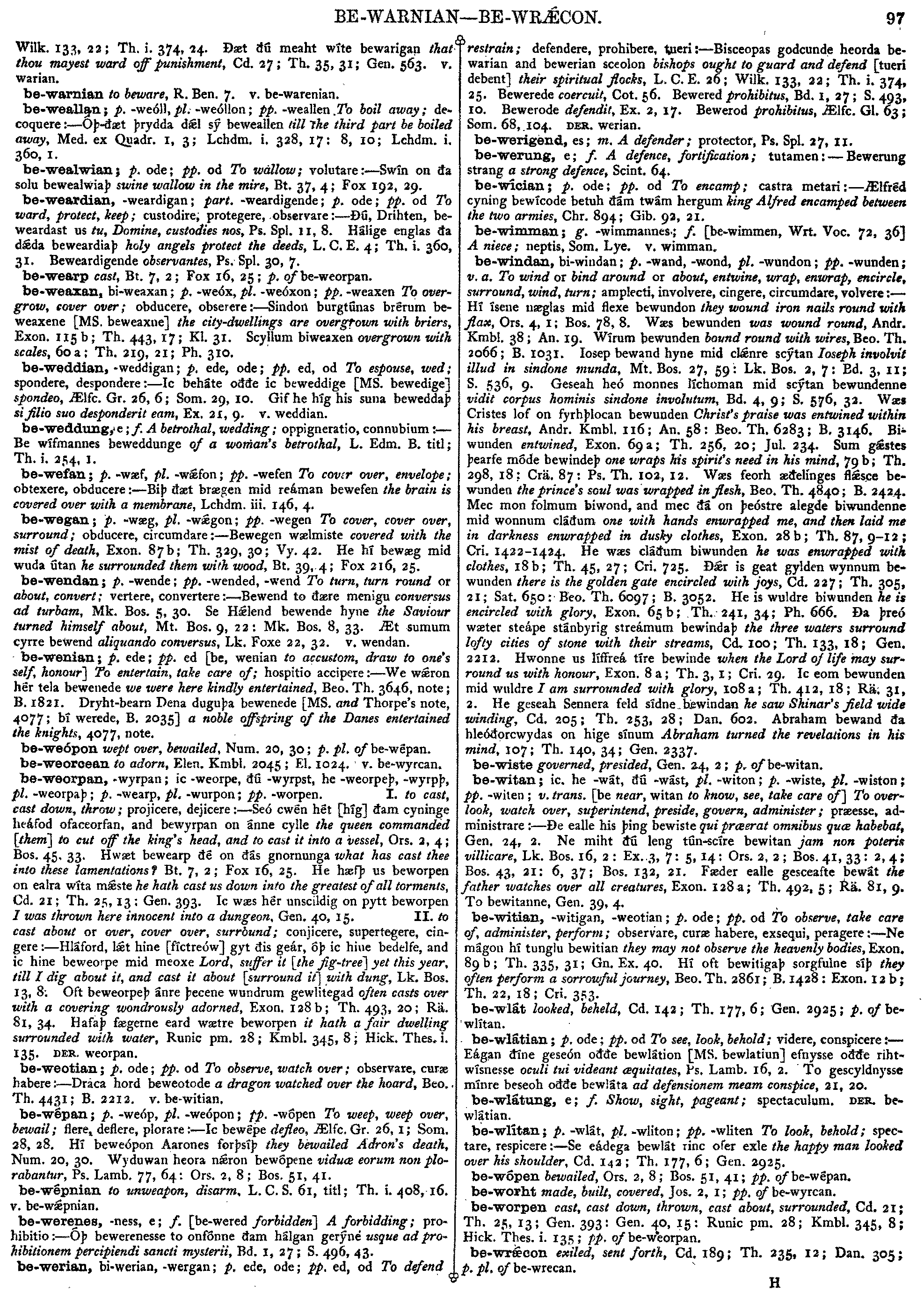
be-witan; ic. he -wát, ðú -wást, pl. -witon; p. -wiste, pl. -wiston; pp. -witen; v. trans. [be near, witan to know, see, take care of] To overlook, watch over, superintend, preside, govern, administer; præesse, administrare :-- Ðe ealle his þing bewiste qui præerat omnibus quæ habebat, Gen. 24, 2. Ne miht ðú leng tún-scíre bewitan jam non poteris villicare, Lk. Bos. 16, 2 : Ex. 3, 7 : 5, 14 : Ors. 2, 2; Bos. 41, 33 : 2, 4; Bos. 43, 21 : 6, 37; Bos. 132, 21. Fæder ealle gesceafte bewát the father watches over all creatures, Exon. 128 a; Th. 492, 5; Rä. 81, 9. To bewitanne, Gen. 39, 4.
|
Source: Bosworth/Toller, page b0100, entry 40 View original page image as: [TIFF] [PNG] [View previous entry] [View next entry] |
[Comment on this entry] [View comments] |
The following entry has been hand-corrected once. |
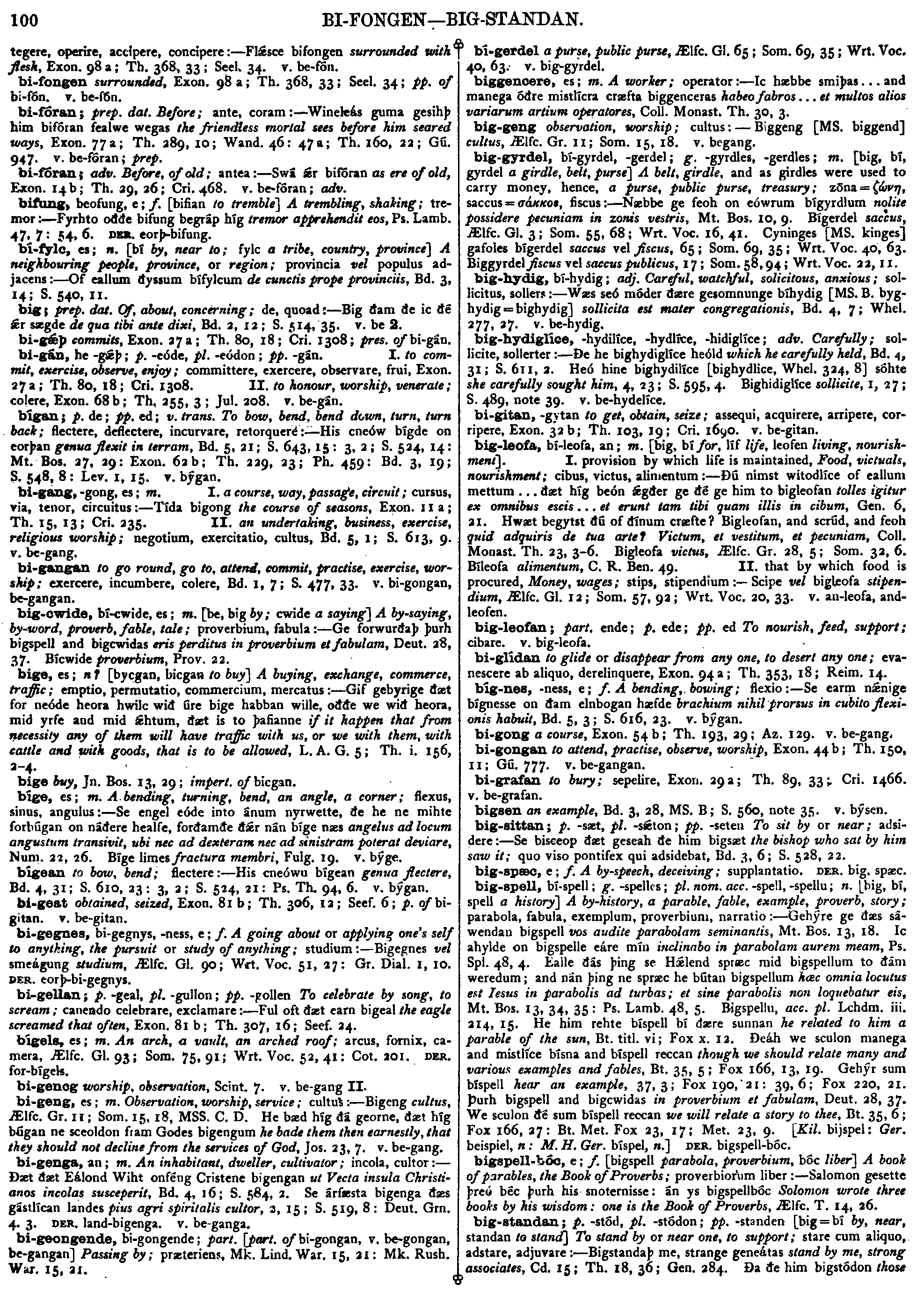
big-sittan;
p.
-sæt,
pl.
-ston;
pp.
-seten
To
sit
by
or
near;
adsidere
:--
Se
bisceop
ðæt
geseah
ðe
him
bigsæt
the
bishop
who
sat
by
him
saw
it;
quo
viso
pontifex
qui
adsidebat,
Bd.
3,
6;
S.
528,
22.
|
Source: Bosworth/Toller, page b0101, entry 33 View original page image as: [TIFF] [PNG] [View previous entry] [View next entry] |
[Comment on this entry] [View comments] |
The following entry has been hand-corrected once. |
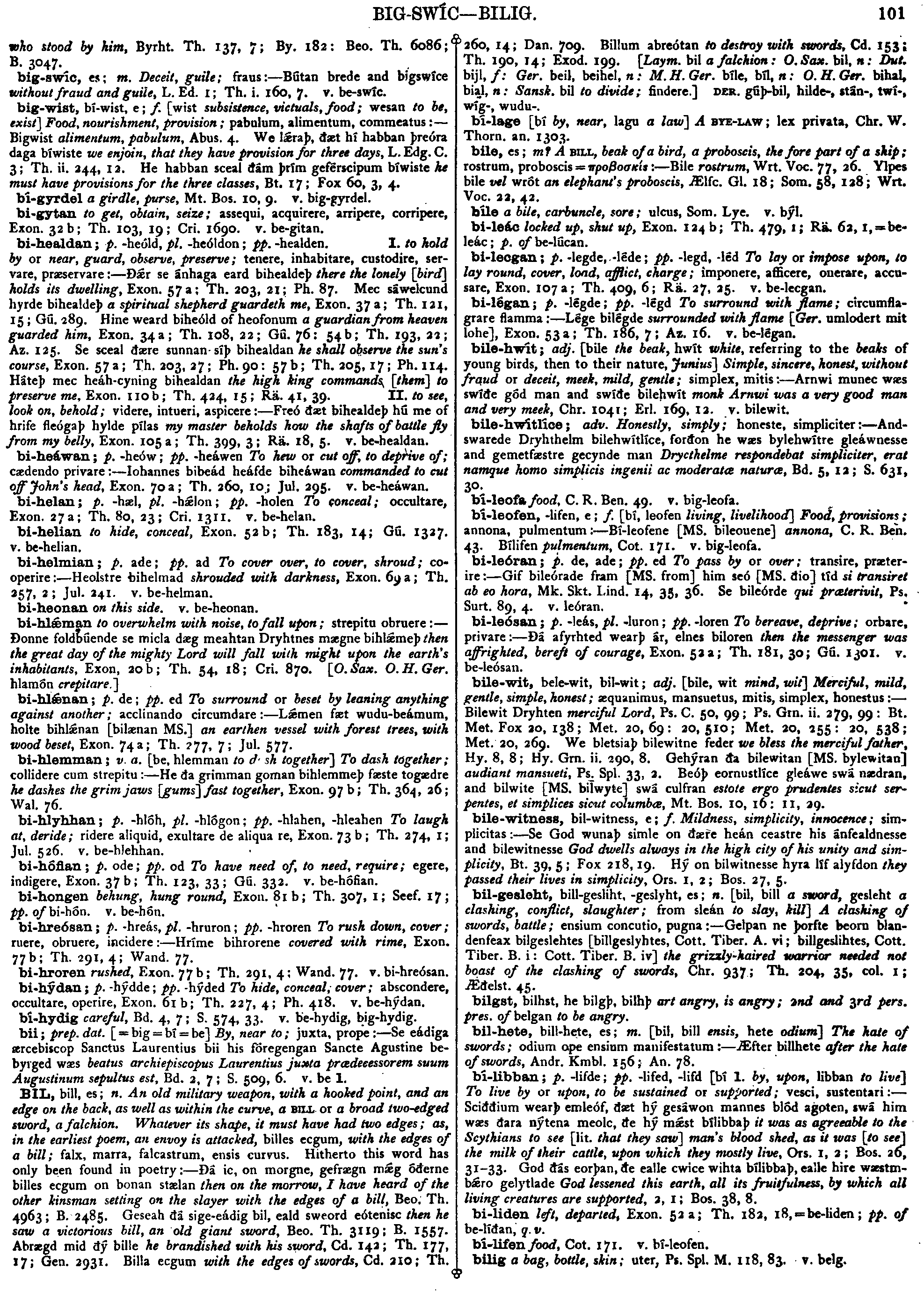
bi-leóran; p. de, ade; pp. ed To pass by or over; transire, præterire :-- Gif bileórade fram [MS. from] him seó [MS. ðio] tíd si transiret ab eo hora, Mk. Skt. Lind. 14, 35, 36. Se bileórde qui præterivit, Ps. Surt. 89, 4. v. leóran.
|
Source: Bosworth/Toller, page b0103, entry 4 View original page image as: [TIFF] [PNG] [View previous entry] [View next entry] |
[Comment on this entry] [View comments] |
The following entry has been hand-corrected once. |
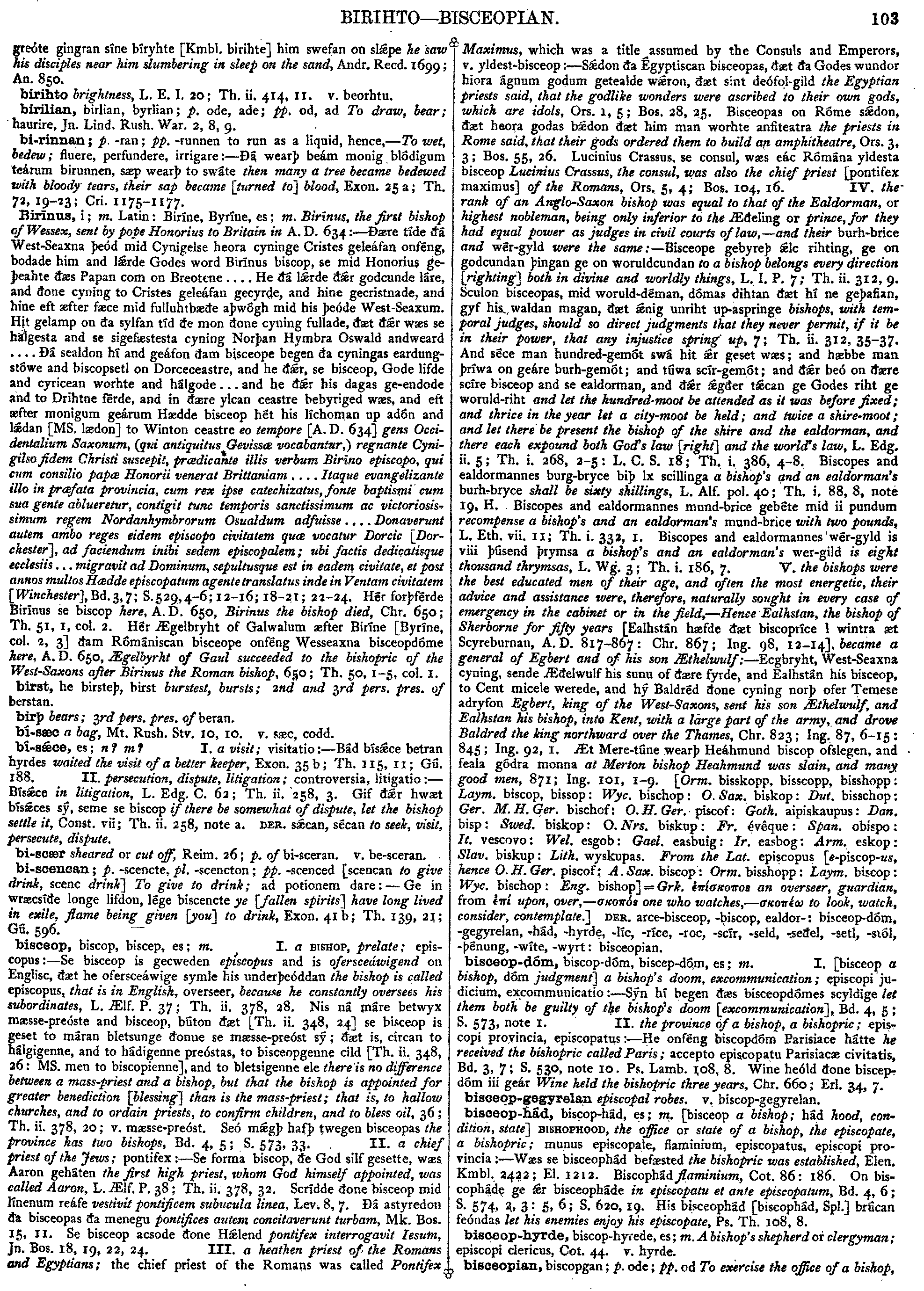
Birínus,
i;
m.
Latin:
Biríne,
Byríne,
es;
m.
Bir nus,
the
first
bishop
of
Wessex,
sent
by
pope
Honorius
to
Britain
in
A.
D.
634
:--
Ðære
tíde
ðá
West-Seaxna
þeód
mid
Cynigelse
heora
cyninge
Cristes
geleáfan
onféng,
bodade
him
and
lrde
Godes
word
Birnus
biscop,
se
mid
Honorius
geþeahte
ðæs
Papan
com
on
Breotene....
He
ðá
lrde
ðr
godcunde
láre,
and
ðone
cyning
to
Cristes
geleáfan
gecyrde,
and
hine
gecristnade,
and
hine
eft
æfter
fæce
mid
fulluhtbæðe
aþwógh
mid
his
þeóde
West-Seaxum.
Hit
gelamp
on
ða
sylfan
tíd
ðe
mon
ðone
cyning
fullade,
ðæt
ðr
wæs
se
halgesta
and
se
sigefæstesta
cyning
Norþan
Hymbra
Oswald
andweard....
Ðá
sealdon
hí
and
geáfon
ðam
bisceope
begen
ða
cyningas
eardungstówe
and
biscopsetl
on
Dorceceastre,
and
he
ðr,
se
bisceop,
Gode
lifde
and
cyricean
worhte
and
hálgode
...
and
he
ðr
his
dagas
ge-endode
and
to
Drihtne
férde,
and
in
ðære
ylcan
ceastre
bebyriged
wæs,
and
eft
æfter
monigum
geárum
Hædde
bisceop
hét
his
líchoman
up
adón
and
ldan
[MS.
lædon]
to
Winton
ceastre
eo
tempore
[A.
D.
634]
gens
Occidentalium
Saxonum,
(qui
antiquitus,Gevissæ
vocabantur,)
regnante
Cynigilso
fidem
Christi
suscepit,
prædicante
illis
verbum
Birno
episcopo,
qui
cum
consilio
papæ
Honorii
venerat
Brittaniam....
Itaque
evangelizante
illo
in
præfata
provincia,
cum
rex
ipse
catechizatus,
fonte
baptismi
cum
sua
gente
ablueretur,
contigit
tunc
temporis
sanctissimum
ac
victoriosissimum
regem
Nordanhymbrorum
Osualdum
adfuisse....
Donaverunt
autem
ambo
reges
eidem
episcopo
civitatem
quæ
vocatur
Dorcic
[Dorchester],
ad
faciendum
inibi
sedem
episcopalem;
ubi
factis
dedicatisque
ecclesiis
...
migravit
ad
Dominum,
sepultusque
est
in
eadem
civitate,
et
post
annos
multos
Hædde
episcopatum
agente
translatus
inde
in
Ventam
civitatem
[Winchester],
Bd.
3,
7;
S.
529,
4-6;
12-16;
18-21;
22-24,
Hér
forþférde
Birnus
se
biscop
here,
A.
D.
650,
Birinus
the
bishop
died,
Chr.
650;
Th.
51,
1,
col.
2.
Hér
Ægelbryht
of
Galwalum
æfter
Biríne
[Byríne,
col.
2,
3]
ðam
Rómániscan
bisceope
onféng
Wesseaxna
bisceopdóme
here,
A.
D.
650,
Ægelbyrht
of
Gaul
succeeded
to
the
bishopric
of
the
West-Saxons
after
Birinus
the
Roman
bishop,
650;
Th.
50,
1-5,
col.
1.
nus,
the
first
bishop
of
Wessex,
sent
by
pope
Honorius
to
Britain
in
A.
D.
634
:--
Ðære
tíde
ðá
West-Seaxna
þeód
mid
Cynigelse
heora
cyninge
Cristes
geleáfan
onféng,
bodade
him
and
lrde
Godes
word
Birnus
biscop,
se
mid
Honorius
geþeahte
ðæs
Papan
com
on
Breotene....
He
ðá
lrde
ðr
godcunde
láre,
and
ðone
cyning
to
Cristes
geleáfan
gecyrde,
and
hine
gecristnade,
and
hine
eft
æfter
fæce
mid
fulluhtbæðe
aþwógh
mid
his
þeóde
West-Seaxum.
Hit
gelamp
on
ða
sylfan
tíd
ðe
mon
ðone
cyning
fullade,
ðæt
ðr
wæs
se
halgesta
and
se
sigefæstesta
cyning
Norþan
Hymbra
Oswald
andweard....
Ðá
sealdon
hí
and
geáfon
ðam
bisceope
begen
ða
cyningas
eardungstówe
and
biscopsetl
on
Dorceceastre,
and
he
ðr,
se
bisceop,
Gode
lifde
and
cyricean
worhte
and
hálgode
...
and
he
ðr
his
dagas
ge-endode
and
to
Drihtne
férde,
and
in
ðære
ylcan
ceastre
bebyriged
wæs,
and
eft
æfter
monigum
geárum
Hædde
bisceop
hét
his
líchoman
up
adón
and
ldan
[MS.
lædon]
to
Winton
ceastre
eo
tempore
[A.
D.
634]
gens
Occidentalium
Saxonum,
(qui
antiquitus,Gevissæ
vocabantur,)
regnante
Cynigilso
fidem
Christi
suscepit,
prædicante
illis
verbum
Birno
episcopo,
qui
cum
consilio
papæ
Honorii
venerat
Brittaniam....
Itaque
evangelizante
illo
in
præfata
provincia,
cum
rex
ipse
catechizatus,
fonte
baptismi
cum
sua
gente
ablueretur,
contigit
tunc
temporis
sanctissimum
ac
victoriosissimum
regem
Nordanhymbrorum
Osualdum
adfuisse....
Donaverunt
autem
ambo
reges
eidem
episcopo
civitatem
quæ
vocatur
Dorcic
[Dorchester],
ad
faciendum
inibi
sedem
episcopalem;
ubi
factis
dedicatisque
ecclesiis
...
migravit
ad
Dominum,
sepultusque
est
in
eadem
civitate,
et
post
annos
multos
Hædde
episcopatum
agente
translatus
inde
in
Ventam
civitatem
[Winchester],
Bd.
3,
7;
S.
529,
4-6;
12-16;
18-21;
22-24,
Hér
forþférde
Birnus
se
biscop
here,
A.
D.
650,
Birinus
the
bishop
died,
Chr.
650;
Th.
51,
1,
col.
2.
Hér
Ægelbryht
of
Galwalum
æfter
Biríne
[Byríne,
col.
2,
3]
ðam
Rómániscan
bisceope
onféng
Wesseaxna
bisceopdóme
here,
A.
D.
650,
Ægelbyrht
of
Gaul
succeeded
to
the
bishopric
of
the
West-Saxons
after
Birinus
the
Roman
bishop,
650;
Th.
50,
1-5,
col.
1.
| Result Page: |  |
Previous | 1 2 3 4 5 6 7 8 9 10 11 12 13 14 15 | Next |  |
Germanic Lexicon Project (main page)
This search system was written by
Sean Crist
Please consider
volunteering
to correct the data in these online dictionaries.
No rights reserved. Feel free to use these data in any way you please.