|
|

|
Source: Bosworth/Toller, page b0643, entry 22 View original page image as: [TIFF] [PNG] [View previous entry] [View next entry] |
[Comment on this entry] [View comments] |
The following entry has been hand-corrected once. |
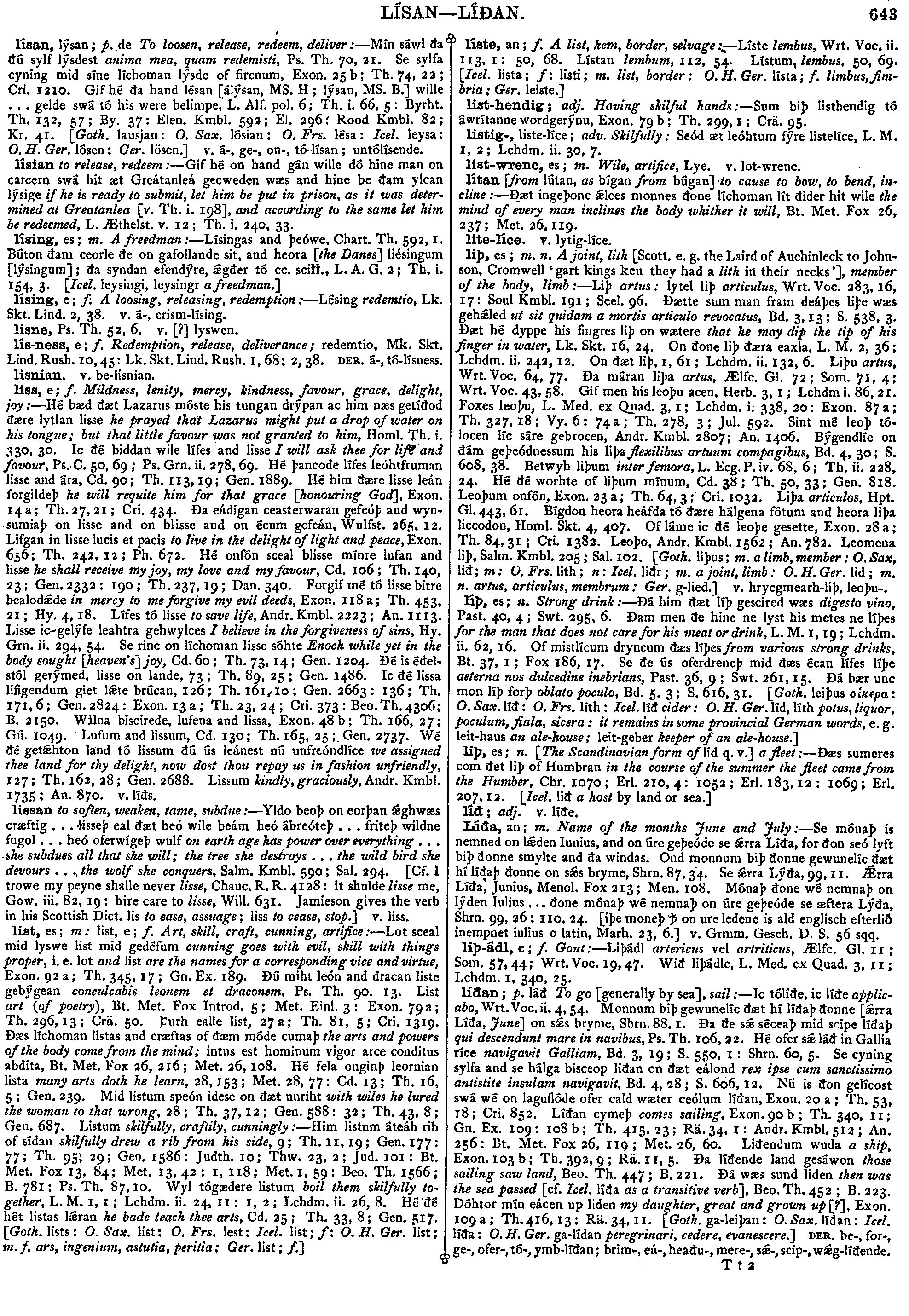
liþ-ádl, e; f. Gout :-- Liþádl artericus vel artriticus, Ælfc. Gl. 11; Som. 57, 44; Wrt. Voc. 19, 47. Wið liþádle, L. Med. ex Quad. 3, 11; Lchdm. 1, 340, 25.
|
Source: Bosworth/Toller, page b0648, entry 23 View original page image as: [TIFF] [PNG] [View previous entry] [View next entry] |
[Comment on this entry] [View comments] |
The following entry has been hand-corrected once. |
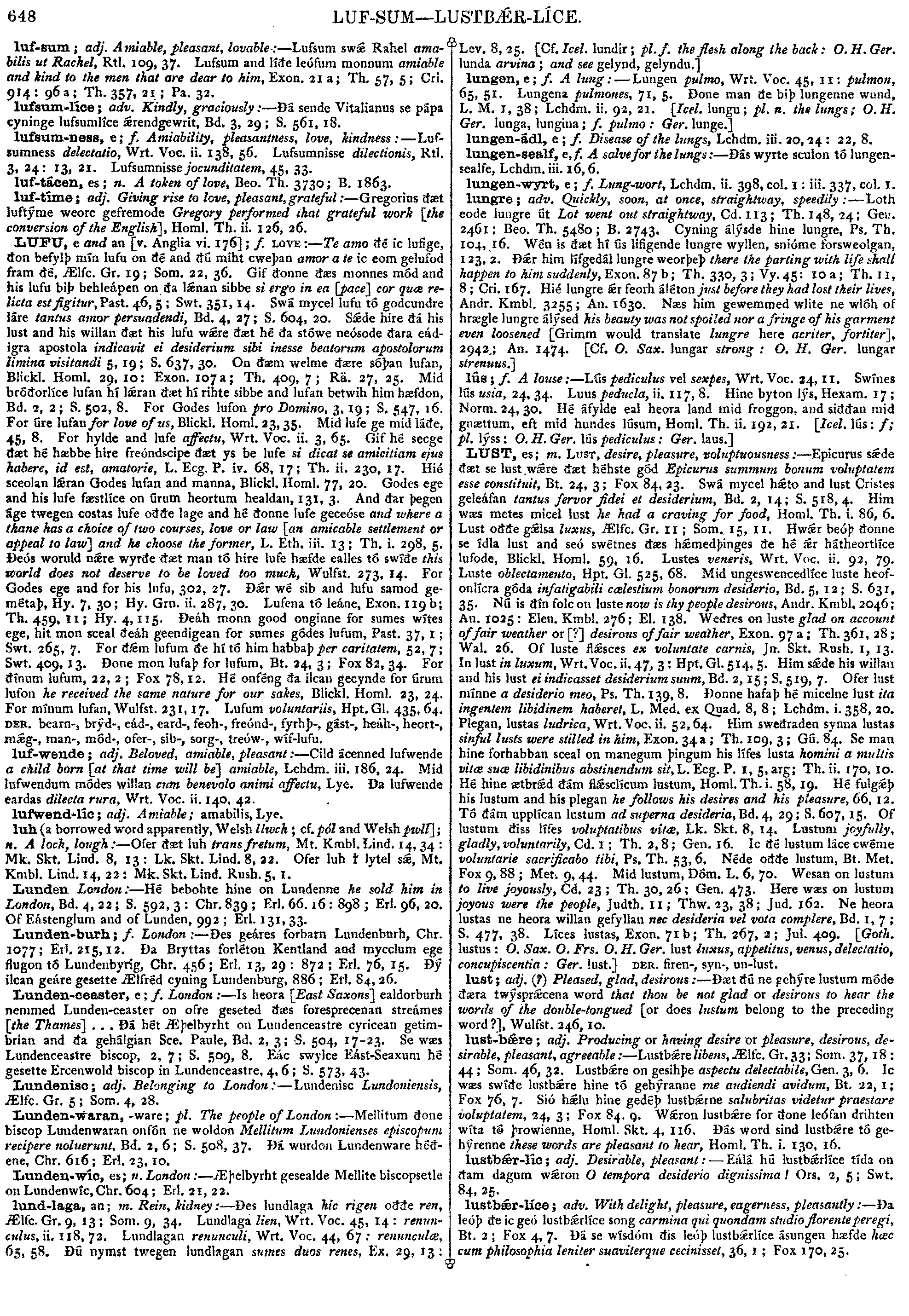
LUST,
es;
m.
LUST,
desire,
pleasure,
voluptuousness
:--
Epicurus
s de
ðæt
se
lust
wre
ðæt
héhste
gód
Epicurus
summum
bonum
voluptatem
esse
constituit,
Bt.
24,
3;
Fox
84,
23.
Swá
mycel
hto
and
lust
Cristes
geleáfan
tantus
fervor
fidei
et
desiderium,
Bd.
2,
14;
S.
518,
4.
Him
wæs
metes
micel
lust
he
had
a
craving
for
food,
Homl.
Th.
i.
86,
6.
Lust
oððe
glsa
luxus,
Ælfc.
Gr.
11;
Som.
15,
11.
Hwr
beóþ
ðonne
se
ídla
lust
and
seó
swétnes
ðæs
hmedþinges
ðe
hé
r
hátheortlíce
lufode,
Blickl.
Homl.
59,
16.
Lustes
veneris,
Wrt.
Voc.
ii.
92,
79.
Luste
oblectamento,
Hpt.
Gl.
525,
68.
Mid
ungeswencedlíce
luste
heofonlícra
góda
infatigabili
cælestium
bonorum
desiderio,
Bd.
5,
12;
S.
631,
35.
Nú
is
ðín
folc
on
luste
now
is
thy
people
desirous,
Andr.
Kmbl.
2046;
An.
1025:
Elen.
Kmbl.
276;
El.
138.
Wedres
on
luste
glad
on
account
of
fair
weather
or[?]
desirous
of
fair
weather,
Exon.
97
a;
Th.
361,
28;
Wal.
26.
Of
luste
flsces
ex
voluntate
carnis,
Jn.
Skt.
Rush.
1,
13.
In
lust
in
luxum,
Wrt.
Voc.
ii.
47,
3:
Hpt.
Gl.
514,
5.
Him
sde
his
willan
and
his
lust
ei
indicasset
desiderium
suum,
Bd.
2,
15;
S.
519,
7.
Ofer
lust
mínne
a
desiderio
meo,
Ps.
Th.
139,
8.
Ðonne
hafaþ
hé
micelne
lust
ita
ingentem
libidinem
haberet,
L.
Med.
ex
Quad.
8,
8;
Lchdm.
i.
358,
20.
Plegan,
lustas
ludrica,
Wrt.
Voc.
ii.
52,
64.
Him
sweðraden
synna
lustas
sinful
lusts
were
stilled
in
him,
Exon.
34
a;
Th.
109,
3;
Gú.
84.
Se
man
hine
forhabban
sceal
on
manegum
þingum
his
lífes
lusta
homini
a
multis
vitæ
sum
libidinibus
abstinendum
sit,
L.
Ecg.
P.
1,
5,
arg;
Th.
ii.
170,
10.
Hé
hine
ætbrd
ðám
flsclícum
lustum,
Homl.
Th.
i.
58,
19.
Hé
fulgþ
his
lustum
and
his
plegan
he
follows
his
desires
and
his
pleasure,
66,
12.
Tó
ðám
upplícan
lustum
ad
superna
desideria,
Bd.
4,
29;
S.
607,
15.
Of
lustum
ðiss
lífes
voluptatibus
vitæ,
Lk.
Skt.
8,
14.
Luftum
joyfully,
gladly,
voluntarily,
Cd.
1;
Th.
2,
8;
Gen.
16.
Ic
ðé
lustum
láce
cwéme
voluntarie
sacrifcabo
tibi,
Ps.
Th.
53,
6.
Néde
oððe
lustum,
Bt.
Met.
Fox
9,
88;
Met.
9,
44.
Mid
lustum,
Dóm.
L.
6,
70.
Wesan
on
lustum
to
live
joyously,
Cd.
23;
Th.
30,
26;
Gen.
473.
Here
wæs
on
lustum
joyous
were
the
people,
Judth.
11;
Thw.
23,
38;
Jud.
162.
Ne
heora
lustas
ne
heora
willan
gefyllan
nec
desideria
vel
vota
complere,
Bd.
1,
7;
S.
477,
38.
Líces
lustas,
Exon.
71
b;
Th.
267,
2;
Jul.
409.
[Goth.
lustus:
O.
Sax.
O.
Frs.
O.
H.
Ger.
lust
luxus,
appetitus,
venus,
delectatio,
concupiscentia:
Ger.
lust.]
DER.
firen-,
syn-,
un-lust.
de
ðæt
se
lust
wre
ðæt
héhste
gód
Epicurus
summum
bonum
voluptatem
esse
constituit,
Bt.
24,
3;
Fox
84,
23.
Swá
mycel
hto
and
lust
Cristes
geleáfan
tantus
fervor
fidei
et
desiderium,
Bd.
2,
14;
S.
518,
4.
Him
wæs
metes
micel
lust
he
had
a
craving
for
food,
Homl.
Th.
i.
86,
6.
Lust
oððe
glsa
luxus,
Ælfc.
Gr.
11;
Som.
15,
11.
Hwr
beóþ
ðonne
se
ídla
lust
and
seó
swétnes
ðæs
hmedþinges
ðe
hé
r
hátheortlíce
lufode,
Blickl.
Homl.
59,
16.
Lustes
veneris,
Wrt.
Voc.
ii.
92,
79.
Luste
oblectamento,
Hpt.
Gl.
525,
68.
Mid
ungeswencedlíce
luste
heofonlícra
góda
infatigabili
cælestium
bonorum
desiderio,
Bd.
5,
12;
S.
631,
35.
Nú
is
ðín
folc
on
luste
now
is
thy
people
desirous,
Andr.
Kmbl.
2046;
An.
1025:
Elen.
Kmbl.
276;
El.
138.
Wedres
on
luste
glad
on
account
of
fair
weather
or[?]
desirous
of
fair
weather,
Exon.
97
a;
Th.
361,
28;
Wal.
26.
Of
luste
flsces
ex
voluntate
carnis,
Jn.
Skt.
Rush.
1,
13.
In
lust
in
luxum,
Wrt.
Voc.
ii.
47,
3:
Hpt.
Gl.
514,
5.
Him
sde
his
willan
and
his
lust
ei
indicasset
desiderium
suum,
Bd.
2,
15;
S.
519,
7.
Ofer
lust
mínne
a
desiderio
meo,
Ps.
Th.
139,
8.
Ðonne
hafaþ
hé
micelne
lust
ita
ingentem
libidinem
haberet,
L.
Med.
ex
Quad.
8,
8;
Lchdm.
i.
358,
20.
Plegan,
lustas
ludrica,
Wrt.
Voc.
ii.
52,
64.
Him
sweðraden
synna
lustas
sinful
lusts
were
stilled
in
him,
Exon.
34
a;
Th.
109,
3;
Gú.
84.
Se
man
hine
forhabban
sceal
on
manegum
þingum
his
lífes
lusta
homini
a
multis
vitæ
sum
libidinibus
abstinendum
sit,
L.
Ecg.
P.
1,
5,
arg;
Th.
ii.
170,
10.
Hé
hine
ætbrd
ðám
flsclícum
lustum,
Homl.
Th.
i.
58,
19.
Hé
fulgþ
his
lustum
and
his
plegan
he
follows
his
desires
and
his
pleasure,
66,
12.
Tó
ðám
upplícan
lustum
ad
superna
desideria,
Bd.
4,
29;
S.
607,
15.
Of
lustum
ðiss
lífes
voluptatibus
vitæ,
Lk.
Skt.
8,
14.
Luftum
joyfully,
gladly,
voluntarily,
Cd.
1;
Th.
2,
8;
Gen.
16.
Ic
ðé
lustum
láce
cwéme
voluntarie
sacrifcabo
tibi,
Ps.
Th.
53,
6.
Néde
oððe
lustum,
Bt.
Met.
Fox
9,
88;
Met.
9,
44.
Mid
lustum,
Dóm.
L.
6,
70.
Wesan
on
lustum
to
live
joyously,
Cd.
23;
Th.
30,
26;
Gen.
473.
Here
wæs
on
lustum
joyous
were
the
people,
Judth.
11;
Thw.
23,
38;
Jud.
162.
Ne
heora
lustas
ne
heora
willan
gefyllan
nec
desideria
vel
vota
complere,
Bd.
1,
7;
S.
477,
38.
Líces
lustas,
Exon.
71
b;
Th.
267,
2;
Jul.
409.
[Goth.
lustus:
O.
Sax.
O.
Frs.
O.
H.
Ger.
lust
luxus,
appetitus,
venus,
delectatio,
concupiscentia:
Ger.
lust.]
DER.
firen-,
syn-,
un-lust.
|
Source: Bosworth/Toller, page b0664, entry 27 View original page image as: [TIFF] [PNG] [View previous entry] [View next entry] |
[Comment on this entry] [View comments] |
The following entry has been hand-corrected once. |
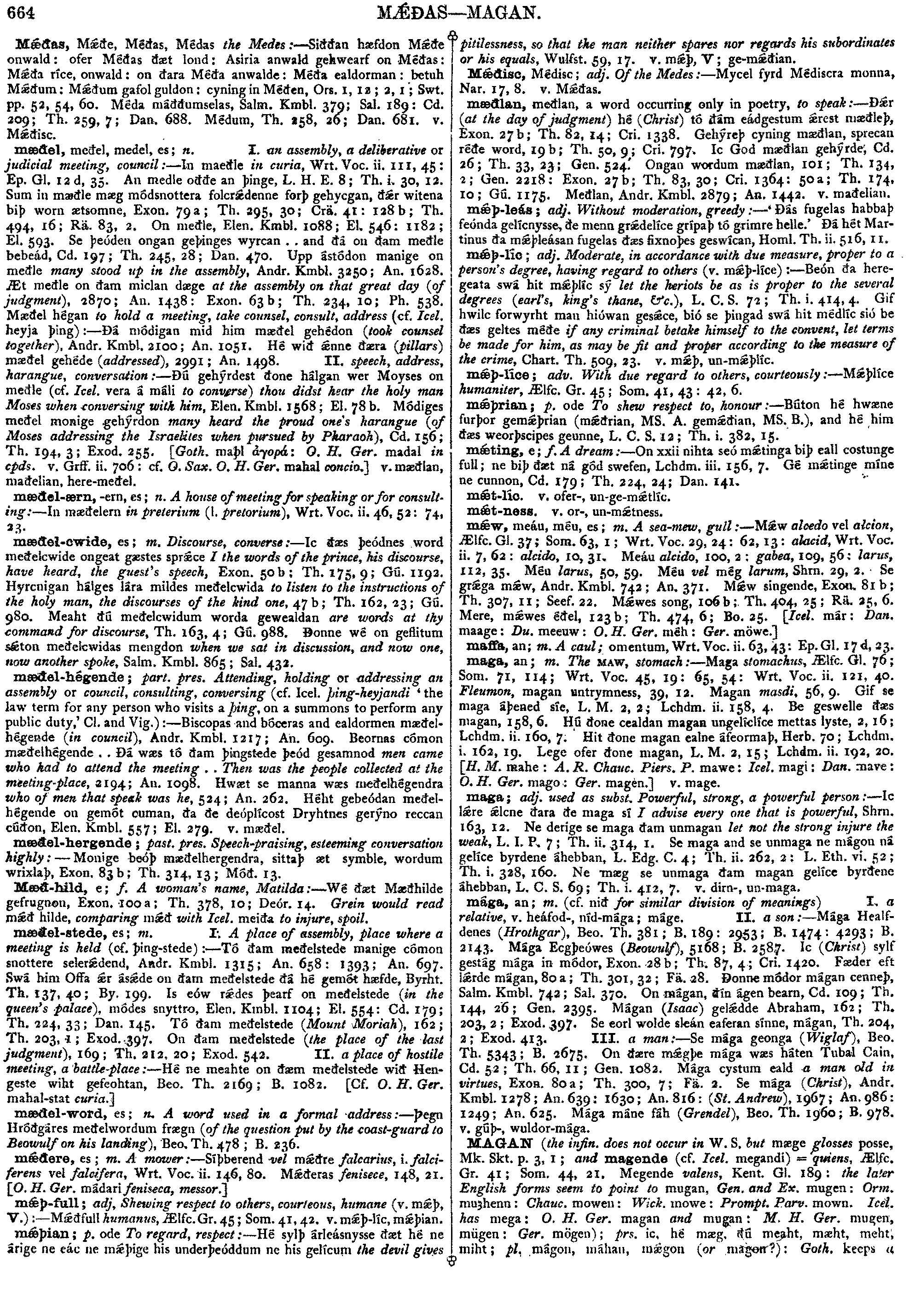
MAGAN
(the
infin.
does
not
occur
in
W.
S.
but
mæge
glosses
posse,
Mk.
Skt.
p.
3,
1;
and
magende
(cf.
Icel.
megandi)
=
quiens,
Ælfc.
Gr.
41;
Som.
44,
21.
Megende
valens,
Kent.
Gl.
189:
the
later
English
forms
seem
to
point
to
mugan,
Gen.
and
Ex.
mugen:
Orm.
mu henn:
Chauc.
mowen:
Wick.
mowe:
Prompt.
Parv.
mown.
Icel.
has
mega:
O.
H.
Ger.
magan
and
mugan:
M.
H.
Ger.
mugen,
mügen:
Ger.
mögen);
prs.
ic,
hé
mæg,
ðú
meaht,
mæht,
meht,
miht;
pl.
mágon,
máhan,
mgon
(or
magen?):
Goth.
keeps
a
throughout:
Icel.
megum:
O.
Sax.
O.
Frs.
mugan:
O.
H.
Ger.
(sie)
magun,
mugun
(later
mugen);
p.
meahte,
mæhte,
mehte,
mihte
(Goth.
mahta:
O.
Sax.
mahta,
mohta;
O.
Frs.
machte:
Icel.
mátti:
O.
H.
Ger.
mahta,
mohta:
M.
H.
Ger.
mohte:
Ger.
mochte);
subj.
prs.
mge,
máge,
mége,
meige
(or
mæge?
Icel.
megi:
O.
Sax.
mugi:
O.
H.
Ger.
megi,
mugi)
I.
to
be
strong,
efficacious,
to
avail,
prevail,
be
sufficient:--
Gif
ðú
meht
si
vales,
Kent.
Gl.
52.
Wel
mæg
ðæm
dæg
wérignise
his
sufficit
diei
malitia
sua,
Mt.
Kmbl.
Lind.
6,
34:
Mk.
Skt.
Lind.
Rush.
14,
41.
Ne
meg
mon
non
praevaleat
homo,
Ps.
Surt.
9,
20.
Ne
mágon
úre
woruldfrýnd
ús
ðonne
nigum
góde
our
friends
will
avail
us
nothing
then,
Wulfst.
151,
12.
Helle
gatu
me
mágon
ongén
ða
portæ
inferi
non
prævalebunt
adversum
eam,
Mt.
Kmbl.
16,
18.
Magan
tó
to
serve
a
purpose,
be
good
for,
have
an
effect,
be
the
cause
of:--
Ne
mæg
tó
náhte
ad
nihilum
valet,
5,
13.
Biþ
men
ful
lytle
ðý
bet
ðeáh
ðe
hé
gódne
fæder
hæbbe,
gif
hé
self
tó
náuhte
ne
mæg,
Bt.
30,
1;
Fox
108,
30.
Tó
hwan
mæg
ðis
eorþlíce
hús,
gif
hit
ýdel
stent,
Homl.
Th.
ii.
582,
12:
432,
15:
Past.
Swt.
7,
12.
Him
mæg
tó
sorge
ðæt
hé
nát
hwæt
him
tóweard
biþ
it
causes
him
anxiety
that
he
knows
not
what
will
happen
to
him,
Bt.
11,
1;
Fox
32,
12.
Wæs
geworden
ðætte
seó
ylce
eorþe
mihte
tó
hle
factum
est
ut
ipsa
terra
gratiæ
salutaris
haberet
effectum,
Bd.
3,
11;
S.
535,
34:
Exon.
21
b;
Th.
57,
21;
Cri.
922:
100
a;
Th.
374,
17;
Seel.
127:
82
b;
Th.
311,
30;
Seef.
100.
Magan
wið
(cf,
Icel.
mega
við)
to
prevail
with
or
against,
to
be
efficacious
against
(of
a
medicine)
to
be
good
for
(a
disease):--
Gif
ic
swá
wel
wið
ðé
mæg
if
I
am
so
influential
with
thee,
Homl.
Skt.
3,176.
Wið
lcum
áttre
mágon
contra
venexum
valent,
Bd.
1,
1;
S.
474,
36.
Ðeós
wyrt
mæg
wið
manega
untrumnyssa,
Herb.
171,
1;
Lchdm.
i.
300,
24:
L.
Med.
ex
Quad.
5,
3;
Lchdm.
i.
348,
9:
L.
M.
2,
64;
Lchdm.
ii.
290,
10.
Ðis
mæg
horse
wið
ðon
ðe
him
biþ
corn
on
ða
fét,
Lchdm.
iii.
62,
24.
Migtigra
wíte
wealdeþ
ðonne
hé
him
wið
mge
one
too
mighty
for
him
to
withstand
is
the
disposer
of
punishment,
Cd.
200;
Th.
249,
1;
Dan.
523.
II.
to
be
strong,
be
in
good
health
(so
Icel.
mega
vel,
&c.):--
'Hú
mæg
he?'
Hig
cwdon
ðt
hé
wel
mihte
'sanusne
est?'
'Valet,'
inquiunt,
Gen.
29,
6.
Ðá
sde
se
cnapa
ðæt
hé
swíðe
wel
mihte,
Homl.
Skt.
3,
435.
Ðonne
ðú
mé
getrymedest,
ðæt
ic
teala
mihte,
Ps.
Th.
70,
20.
III.
to
be
able,
may
(because
a
thing
is
possible):--
Ic
mæg
queo;
magende
quiens,
Ælfc.
Gr.
41;
Som.
44,
21.
Ic
mæg
queo,
ðú
miht
quis,
hé
mæg
quit;
ic
mihte
quivi,
30;
Som.
35,
5.
(1)
With
infin.:--
Ic
mid
handum
ne
mæg
heofon
gercan,
Cd.
216;
Th.
275,
9;
Sat.
169.
Hér
ys
seó
bót
hú
ðú
meaht
ðíne
æceras
bétan,
Lchdm.
i.
398,
1:
Cd.
27;
Th.
36,
1;
Gen.
565.
Ðú
..
ðe
ghwylc
miht
wundor
gewyrcean,
Ps.
Th.
76,
11.
Hú
mæg
ðæt
yfel
beón
ðætte
lces
monnes
ingeþanc
wénþ
ðætte
gód
sie,
Bt.
24,
4;
Fox
86,
12.
Ðæt
mæg
engel
ðín
eáþ
geféran,
387;
An.
194.
Eall
ðis
mágon
him
sylfe
geseón
...
mágun
leóda
bearn
oncnáwan,
Exon.
24
a;
Th.
69,
5-12;
Cri.
1115.
Hí
me
mágon
ðone
earman
gefyllan,
Bt.
11,
1;
Fox
34,
1.
Him
ða
stormas
derian
me
máhan
(mgon,
Cott.
MS.),
7,
3;
Fox
22,
6.
Wé
ðæt
sóþ
mgon
secgan,
Cd.
94;
Th.
121,
21;
Gen.
2013.
[Beo
ðan
wé
mugen
understanden,
Shrn.
17,
26.]
Ðt
hé
ána
mge
geríman,
Cd.
163;
Th.
205,
21;
Exod.
439.
Ic
mæege,
Mt.
Kmbl.
Lind.
26,
61.
Ic
mége
possim,
Ps.
Surt.
70,
8.
Ðú
meige
possis,
Kent.
Gl.
958.
Ðæt
ic
máge
geseón,
Homl.
Th.
i.
152,
22.
Cunnige
máge
man
of
eágum
teáras
gercan
try
whether
tears
can
be
drawn
from
their
eyes,
L.
P.
M.
3;
Th.
ii.
288,
4.
Gif
wé
hit
mgen
áþencan,
Cd.
21;
Th.
26,
2;
Gen.
400:
226;
Th.
302,
11;
Sat.
597.
Ué
mgi,
Rtl.
45,
3.
Mgi
hiá,
95,
16.
Wíddra
ðonne
befæðman
mge
foldan
sceattas,
163;
Th.
204,
32;
Exod.
428.
[Ðæt
heó
þurh
ða
mugen
tó
lífes
wege
becumen
..
ðæt
ða
ðe
ðr
ingáþ
mugen
ðone
leóme
geseón,
Shrn.
12,
10-13.]
Ne
meahte
hé
æt
his
hige
findan,
Cd.
14;
Th.
18,
1;
Gen.
266:
Beo.
Th.
3322;
B.
1659.
Mehte,
2168;
B.
1082.
Eáþe
heó
mehte
beón
geseald,
Blickl.
Homl.
69,
7.
Swá
swá
mihte
beón
fíf
þúsend
wera,
Homl.
Th.
i.
182,
16.
Ðú
meahtes
geseón
gðer
ge
fét
ge
heáfod,
Past.
35;
Swt.
241,
14:
St.
And.
10,
22:
Exon.
39
b;
Th.
130,
19;
Gú.
440.
Mihtest,
Blickl.
Homl.
175,
28.
Ða
ne
meahton
ásecgan,
145,
13:
Cd.
115;
Th.
150,
14;
Gen.
2491.
Wé
ðæt
deór
gewundigan
ne
meahte,
Nar.
21,
4.
Maehtun,
Ps.
Surt.
20,
12.
Mehton,
Blickl.
Homl.
15,
13.
Mihton,
79,
16.
Ðæt
láðra
nnig
sceððan
ne
meahte,
Beo.
Th.
492;
B.
243.
Óþ
ðæt
ðú
meahte
..
forsión,
meahtes
..
lácan,
Bt.
Met.
Fox
24,
11-17;
Met.
24,
6-9.
Mihte,
Blickl.
Homl.
45,
27,
Swá
hit
men
fægrost
geþencean
meahton,
125,
23:
Elen.
Kmbl.
648;
El.
324.
Meahten,
Exon.
64
a;
Th.
236,
13;
Ph.
573.
Meahte,
39
a;
Th.
128,
14;
Gú.
404.
Mehten,
Ors.
3,
1;
Swt.
98,
3.
Mihtan,
Blickl.
Homl.
45,
14:
137,
1.
Mihten,
Cd.
224;
Th.
298,
11;
Sat.
500.
Mihton,
Blickl.
Homl.
49,
10.
Mihte,
Ps.
Th.
77,
1.
(2)
followed,
by
a
clause:--
Hwá
mæg
ðæt
hé
ne
wundrige,
Bt.
34,
10;
Fox
150,
9.
(3)
with
ellipsis
of
the
infin.
(a)
of
a
verb
which
occurs
elsewhere
in
the
sentence:--
Gelácna
ðú
hý
forðan
ðú
éðest
miht
(gelácnian),
Hy.
1,
6;
Hy.
Grn.
ii.
280,
6.
Nelle
ic
aldre
beneótan,
ðeáh
ic
eáðe
mge,
Beo.
Th.
1365;
B.
680.
Ðæs
ofereode,
ðisses
swá
mæg,
Exon.
100
a;
Th.
377,
22;
Deór.
7.
Telle
ðás
steorran,
gif
ðú
máge,
Gen.
15,
5:
Bd.
5,
3;
S.
616,
31.
Forlte
swá
hé
oftost
mge,
Bt.
Met.
Fox
22,
18;
Met.
22,
9:
27,
58,
66;
Met.
27,
29,
33.
Árás
swá
hé
hraðost
meahte,
Exon.
49
a;
Th.
168,
24;
Gú.
1080.
Wolde
ic
freóndscipe
ðínne,
gif
ic
mihte,
begitan,
Andr.
Kmbl.
958;
An.
479.
(b)
of
a
verb
whose
place
is
taken
by
swá:--
Wolde
freádrihtnes
feorh
ealgian,
ðr
hié
meahton
swá,
Beo.
Th.
1599;
B.
797.
Cwdon
ðæt
heó
ríce
ágan
woldon,
and
swá
eáðe
meahtan,
Cd,
3;
Th.
4,
4;
Gen.
48.
Wyllen
forsweolgan,
gif
hí
swá
mágon,
Ps.
Th.
123,
2.
(c)
of
a
verb
to
be
inferred
from
the
context
(i)
verbs
of
motion:--
Nó
dý
r
fram
meahte
(might
escape),
Beo.
Th.
1513;
B.
754.
Ic
ne
mæg
of
ðissum
lioþobendum,
Cd.
19;
Th.
24,
22;
Gen.
381.
Ne
mæg
hé
on
ðæt
non
intrabit
its
illud,
Mk.
Skt.
10,
15.
On
ðone
forecwedenan
portic
má
ne
mihte
prædicta
porticus
plura
capere
nequivit,
Bd.
2,
3;
S.
504,
38.
Ðæt
ic
up
heonon
mge,
Cd.
222;
Th.
291,
3;
Sat.
425.
(ii)
other
verbs
(see
also
I):--
Wel
ðæt
swá
mæg
that
may
well
be
so,
Bd.
2,
1;
S.
501,
18.
þuhte
heom
ðæt
hit
mihte
swá,
ðæt
hié
wéron
seolfe
swegles
brytan,
Cd.
213;
Th.
266,
15;
Sat.
22:
Andr.
Kmbl.
2786;
An.
1395.
Wolde
hyre
búr
átimbrian,
gif
hit
swá
meahte,
Exon.
108
a;
Th.
411,
28;
Rä.
30,
6.
Wísdóm
sde
ðæt
men
mihton
(could
understand)
be
Gode
swelce
hí
mte,
Bt.
tit.
26;
Fox
xiv.
16.
Ne
mágon
ðam
breahtme
býman
ne
hornas
(cannot
equal),
Exon.
57
b;
Th.
206,
29;
Ph.
134.
IV.
may
(because
a
thing
is
permissible
or
lawful,
because
there
is
sufficient
cause):--
Ðú
miht
ðæs
habban
þanc,
ðæt
ðú
mínra
gifa
wel
bruce.
Ne
miht
ðú
nó
gereccan
ðæt
ðú
ðínes
áuht
forlure,
Bt.
7,
3;
Fox
20,
12.
Hú
miht
(mæht,
Lind.)
ðú
secgan
ðínum
bréðer,
Lk.
Skt.
6,
42.
Ðú
meaht
ðé
forþ
faran,
Cd.
26;
Th.
34,
25;
Gen.
543.
Hié
leng
ne
mágon
healdan
heofonríce,
35;
Th.
45,
24;
Gen.
731.
Nú
wit
mágon
sorgian
for
his
síðe
we
have
good
cause
to
rue
his
journey,
38;
Th.
49,
29;
Gen.
799;
Exon.
9
b:
Th.
8,
34;
Cri.
127.
Hwæðer
sél
mge
wunde
gedýgan,
Beo.
Th.
5054;
B.
2530.
Hit
me
meahte
swá
that
was
not
allowed,
Exon.
41
a;
Th.
136,
29;
Gú.
548.
V.
in
the
Northumbrian
Gospels
the
verb
is
used
as
an
auxiliary
in
the
translation
of
the
Latin
subjunctive,
or
fut.
indic.:--
Synngiga
mæge
peccabit,
Mt.
Kmbl.
Lind.
18,
21.
Wé
habbas
henn:
Chauc.
mowen:
Wick.
mowe:
Prompt.
Parv.
mown.
Icel.
has
mega:
O.
H.
Ger.
magan
and
mugan:
M.
H.
Ger.
mugen,
mügen:
Ger.
mögen);
prs.
ic,
hé
mæg,
ðú
meaht,
mæht,
meht,
miht;
pl.
mágon,
máhan,
mgon
(or
magen?):
Goth.
keeps
a
throughout:
Icel.
megum:
O.
Sax.
O.
Frs.
mugan:
O.
H.
Ger.
(sie)
magun,
mugun
(later
mugen);
p.
meahte,
mæhte,
mehte,
mihte
(Goth.
mahta:
O.
Sax.
mahta,
mohta;
O.
Frs.
machte:
Icel.
mátti:
O.
H.
Ger.
mahta,
mohta:
M.
H.
Ger.
mohte:
Ger.
mochte);
subj.
prs.
mge,
máge,
mége,
meige
(or
mæge?
Icel.
megi:
O.
Sax.
mugi:
O.
H.
Ger.
megi,
mugi)
I.
to
be
strong,
efficacious,
to
avail,
prevail,
be
sufficient:--
Gif
ðú
meht
si
vales,
Kent.
Gl.
52.
Wel
mæg
ðæm
dæg
wérignise
his
sufficit
diei
malitia
sua,
Mt.
Kmbl.
Lind.
6,
34:
Mk.
Skt.
Lind.
Rush.
14,
41.
Ne
meg
mon
non
praevaleat
homo,
Ps.
Surt.
9,
20.
Ne
mágon
úre
woruldfrýnd
ús
ðonne
nigum
góde
our
friends
will
avail
us
nothing
then,
Wulfst.
151,
12.
Helle
gatu
me
mágon
ongén
ða
portæ
inferi
non
prævalebunt
adversum
eam,
Mt.
Kmbl.
16,
18.
Magan
tó
to
serve
a
purpose,
be
good
for,
have
an
effect,
be
the
cause
of:--
Ne
mæg
tó
náhte
ad
nihilum
valet,
5,
13.
Biþ
men
ful
lytle
ðý
bet
ðeáh
ðe
hé
gódne
fæder
hæbbe,
gif
hé
self
tó
náuhte
ne
mæg,
Bt.
30,
1;
Fox
108,
30.
Tó
hwan
mæg
ðis
eorþlíce
hús,
gif
hit
ýdel
stent,
Homl.
Th.
ii.
582,
12:
432,
15:
Past.
Swt.
7,
12.
Him
mæg
tó
sorge
ðæt
hé
nát
hwæt
him
tóweard
biþ
it
causes
him
anxiety
that
he
knows
not
what
will
happen
to
him,
Bt.
11,
1;
Fox
32,
12.
Wæs
geworden
ðætte
seó
ylce
eorþe
mihte
tó
hle
factum
est
ut
ipsa
terra
gratiæ
salutaris
haberet
effectum,
Bd.
3,
11;
S.
535,
34:
Exon.
21
b;
Th.
57,
21;
Cri.
922:
100
a;
Th.
374,
17;
Seel.
127:
82
b;
Th.
311,
30;
Seef.
100.
Magan
wið
(cf,
Icel.
mega
við)
to
prevail
with
or
against,
to
be
efficacious
against
(of
a
medicine)
to
be
good
for
(a
disease):--
Gif
ic
swá
wel
wið
ðé
mæg
if
I
am
so
influential
with
thee,
Homl.
Skt.
3,176.
Wið
lcum
áttre
mágon
contra
venexum
valent,
Bd.
1,
1;
S.
474,
36.
Ðeós
wyrt
mæg
wið
manega
untrumnyssa,
Herb.
171,
1;
Lchdm.
i.
300,
24:
L.
Med.
ex
Quad.
5,
3;
Lchdm.
i.
348,
9:
L.
M.
2,
64;
Lchdm.
ii.
290,
10.
Ðis
mæg
horse
wið
ðon
ðe
him
biþ
corn
on
ða
fét,
Lchdm.
iii.
62,
24.
Migtigra
wíte
wealdeþ
ðonne
hé
him
wið
mge
one
too
mighty
for
him
to
withstand
is
the
disposer
of
punishment,
Cd.
200;
Th.
249,
1;
Dan.
523.
II.
to
be
strong,
be
in
good
health
(so
Icel.
mega
vel,
&c.):--
'Hú
mæg
he?'
Hig
cwdon
ðt
hé
wel
mihte
'sanusne
est?'
'Valet,'
inquiunt,
Gen.
29,
6.
Ðá
sde
se
cnapa
ðæt
hé
swíðe
wel
mihte,
Homl.
Skt.
3,
435.
Ðonne
ðú
mé
getrymedest,
ðæt
ic
teala
mihte,
Ps.
Th.
70,
20.
III.
to
be
able,
may
(because
a
thing
is
possible):--
Ic
mæg
queo;
magende
quiens,
Ælfc.
Gr.
41;
Som.
44,
21.
Ic
mæg
queo,
ðú
miht
quis,
hé
mæg
quit;
ic
mihte
quivi,
30;
Som.
35,
5.
(1)
With
infin.:--
Ic
mid
handum
ne
mæg
heofon
gercan,
Cd.
216;
Th.
275,
9;
Sat.
169.
Hér
ys
seó
bót
hú
ðú
meaht
ðíne
æceras
bétan,
Lchdm.
i.
398,
1:
Cd.
27;
Th.
36,
1;
Gen.
565.
Ðú
..
ðe
ghwylc
miht
wundor
gewyrcean,
Ps.
Th.
76,
11.
Hú
mæg
ðæt
yfel
beón
ðætte
lces
monnes
ingeþanc
wénþ
ðætte
gód
sie,
Bt.
24,
4;
Fox
86,
12.
Ðæt
mæg
engel
ðín
eáþ
geféran,
387;
An.
194.
Eall
ðis
mágon
him
sylfe
geseón
...
mágun
leóda
bearn
oncnáwan,
Exon.
24
a;
Th.
69,
5-12;
Cri.
1115.
Hí
me
mágon
ðone
earman
gefyllan,
Bt.
11,
1;
Fox
34,
1.
Him
ða
stormas
derian
me
máhan
(mgon,
Cott.
MS.),
7,
3;
Fox
22,
6.
Wé
ðæt
sóþ
mgon
secgan,
Cd.
94;
Th.
121,
21;
Gen.
2013.
[Beo
ðan
wé
mugen
understanden,
Shrn.
17,
26.]
Ðt
hé
ána
mge
geríman,
Cd.
163;
Th.
205,
21;
Exod.
439.
Ic
mæege,
Mt.
Kmbl.
Lind.
26,
61.
Ic
mége
possim,
Ps.
Surt.
70,
8.
Ðú
meige
possis,
Kent.
Gl.
958.
Ðæt
ic
máge
geseón,
Homl.
Th.
i.
152,
22.
Cunnige
máge
man
of
eágum
teáras
gercan
try
whether
tears
can
be
drawn
from
their
eyes,
L.
P.
M.
3;
Th.
ii.
288,
4.
Gif
wé
hit
mgen
áþencan,
Cd.
21;
Th.
26,
2;
Gen.
400:
226;
Th.
302,
11;
Sat.
597.
Ué
mgi,
Rtl.
45,
3.
Mgi
hiá,
95,
16.
Wíddra
ðonne
befæðman
mge
foldan
sceattas,
163;
Th.
204,
32;
Exod.
428.
[Ðæt
heó
þurh
ða
mugen
tó
lífes
wege
becumen
..
ðæt
ða
ðe
ðr
ingáþ
mugen
ðone
leóme
geseón,
Shrn.
12,
10-13.]
Ne
meahte
hé
æt
his
hige
findan,
Cd.
14;
Th.
18,
1;
Gen.
266:
Beo.
Th.
3322;
B.
1659.
Mehte,
2168;
B.
1082.
Eáþe
heó
mehte
beón
geseald,
Blickl.
Homl.
69,
7.
Swá
swá
mihte
beón
fíf
þúsend
wera,
Homl.
Th.
i.
182,
16.
Ðú
meahtes
geseón
gðer
ge
fét
ge
heáfod,
Past.
35;
Swt.
241,
14:
St.
And.
10,
22:
Exon.
39
b;
Th.
130,
19;
Gú.
440.
Mihtest,
Blickl.
Homl.
175,
28.
Ða
ne
meahton
ásecgan,
145,
13:
Cd.
115;
Th.
150,
14;
Gen.
2491.
Wé
ðæt
deór
gewundigan
ne
meahte,
Nar.
21,
4.
Maehtun,
Ps.
Surt.
20,
12.
Mehton,
Blickl.
Homl.
15,
13.
Mihton,
79,
16.
Ðæt
láðra
nnig
sceððan
ne
meahte,
Beo.
Th.
492;
B.
243.
Óþ
ðæt
ðú
meahte
..
forsión,
meahtes
..
lácan,
Bt.
Met.
Fox
24,
11-17;
Met.
24,
6-9.
Mihte,
Blickl.
Homl.
45,
27,
Swá
hit
men
fægrost
geþencean
meahton,
125,
23:
Elen.
Kmbl.
648;
El.
324.
Meahten,
Exon.
64
a;
Th.
236,
13;
Ph.
573.
Meahte,
39
a;
Th.
128,
14;
Gú.
404.
Mehten,
Ors.
3,
1;
Swt.
98,
3.
Mihtan,
Blickl.
Homl.
45,
14:
137,
1.
Mihten,
Cd.
224;
Th.
298,
11;
Sat.
500.
Mihton,
Blickl.
Homl.
49,
10.
Mihte,
Ps.
Th.
77,
1.
(2)
followed,
by
a
clause:--
Hwá
mæg
ðæt
hé
ne
wundrige,
Bt.
34,
10;
Fox
150,
9.
(3)
with
ellipsis
of
the
infin.
(a)
of
a
verb
which
occurs
elsewhere
in
the
sentence:--
Gelácna
ðú
hý
forðan
ðú
éðest
miht
(gelácnian),
Hy.
1,
6;
Hy.
Grn.
ii.
280,
6.
Nelle
ic
aldre
beneótan,
ðeáh
ic
eáðe
mge,
Beo.
Th.
1365;
B.
680.
Ðæs
ofereode,
ðisses
swá
mæg,
Exon.
100
a;
Th.
377,
22;
Deór.
7.
Telle
ðás
steorran,
gif
ðú
máge,
Gen.
15,
5:
Bd.
5,
3;
S.
616,
31.
Forlte
swá
hé
oftost
mge,
Bt.
Met.
Fox
22,
18;
Met.
22,
9:
27,
58,
66;
Met.
27,
29,
33.
Árás
swá
hé
hraðost
meahte,
Exon.
49
a;
Th.
168,
24;
Gú.
1080.
Wolde
ic
freóndscipe
ðínne,
gif
ic
mihte,
begitan,
Andr.
Kmbl.
958;
An.
479.
(b)
of
a
verb
whose
place
is
taken
by
swá:--
Wolde
freádrihtnes
feorh
ealgian,
ðr
hié
meahton
swá,
Beo.
Th.
1599;
B.
797.
Cwdon
ðæt
heó
ríce
ágan
woldon,
and
swá
eáðe
meahtan,
Cd,
3;
Th.
4,
4;
Gen.
48.
Wyllen
forsweolgan,
gif
hí
swá
mágon,
Ps.
Th.
123,
2.
(c)
of
a
verb
to
be
inferred
from
the
context
(i)
verbs
of
motion:--
Nó
dý
r
fram
meahte
(might
escape),
Beo.
Th.
1513;
B.
754.
Ic
ne
mæg
of
ðissum
lioþobendum,
Cd.
19;
Th.
24,
22;
Gen.
381.
Ne
mæg
hé
on
ðæt
non
intrabit
its
illud,
Mk.
Skt.
10,
15.
On
ðone
forecwedenan
portic
má
ne
mihte
prædicta
porticus
plura
capere
nequivit,
Bd.
2,
3;
S.
504,
38.
Ðæt
ic
up
heonon
mge,
Cd.
222;
Th.
291,
3;
Sat.
425.
(ii)
other
verbs
(see
also
I):--
Wel
ðæt
swá
mæg
that
may
well
be
so,
Bd.
2,
1;
S.
501,
18.
þuhte
heom
ðæt
hit
mihte
swá,
ðæt
hié
wéron
seolfe
swegles
brytan,
Cd.
213;
Th.
266,
15;
Sat.
22:
Andr.
Kmbl.
2786;
An.
1395.
Wolde
hyre
búr
átimbrian,
gif
hit
swá
meahte,
Exon.
108
a;
Th.
411,
28;
Rä.
30,
6.
Wísdóm
sde
ðæt
men
mihton
(could
understand)
be
Gode
swelce
hí
mte,
Bt.
tit.
26;
Fox
xiv.
16.
Ne
mágon
ðam
breahtme
býman
ne
hornas
(cannot
equal),
Exon.
57
b;
Th.
206,
29;
Ph.
134.
IV.
may
(because
a
thing
is
permissible
or
lawful,
because
there
is
sufficient
cause):--
Ðú
miht
ðæs
habban
þanc,
ðæt
ðú
mínra
gifa
wel
bruce.
Ne
miht
ðú
nó
gereccan
ðæt
ðú
ðínes
áuht
forlure,
Bt.
7,
3;
Fox
20,
12.
Hú
miht
(mæht,
Lind.)
ðú
secgan
ðínum
bréðer,
Lk.
Skt.
6,
42.
Ðú
meaht
ðé
forþ
faran,
Cd.
26;
Th.
34,
25;
Gen.
543.
Hié
leng
ne
mágon
healdan
heofonríce,
35;
Th.
45,
24;
Gen.
731.
Nú
wit
mágon
sorgian
for
his
síðe
we
have
good
cause
to
rue
his
journey,
38;
Th.
49,
29;
Gen.
799;
Exon.
9
b:
Th.
8,
34;
Cri.
127.
Hwæðer
sél
mge
wunde
gedýgan,
Beo.
Th.
5054;
B.
2530.
Hit
me
meahte
swá
that
was
not
allowed,
Exon.
41
a;
Th.
136,
29;
Gú.
548.
V.
in
the
Northumbrian
Gospels
the
verb
is
used
as
an
auxiliary
in
the
translation
of
the
Latin
subjunctive,
or
fut.
indic.:--
Synngiga
mæge
peccabit,
Mt.
Kmbl.
Lind.
18,
21.
Wé
habbas
 mágon
habba
habebimus,
21,
38.
(Also
the
W.
S.
version
in
Mt.
Kmbl.
26,
54,
has
hú
mágon
beón
gefyllede
quomodo
implebuntur.)
Hú
hine
mæhtes
tó
lose
gedóa
quomodo
eum
perderent,
12,
14.
Ðatte
hiá
éton
mæhton
eata
quod
manducarent,
Mk.
Skt.
Lind.
8,
1.
Huu
hine
hiá
ácuoella
mæhton
(mæhtun,
Rush.)
perderent,
11,
18.
Mæghton
(mæhtun,
Rush.),
Lk.
Skt.
Lind.
22,
2.
mágon
habba
habebimus,
21,
38.
(Also
the
W.
S.
version
in
Mt.
Kmbl.
26,
54,
has
hú
mágon
beón
gefyllede
quomodo
implebuntur.)
Hú
hine
mæhtes
tó
lose
gedóa
quomodo
eum
perderent,
12,
14.
Ðatte
hiá
éton
mæhton
eata
quod
manducarent,
Mk.
Skt.
Lind.
8,
1.
Huu
hine
hiá
ácuoella
mæhton
(mæhtun,
Rush.)
perderent,
11,
18.
Mæghton
(mæhtun,
Rush.),
Lk.
Skt.
Lind.
22,
2.
|
Source: Bosworth/Toller, page b0674, entry 25 View original page image as: [TIFF] [PNG] [View previous entry] [View next entry] |
[Comment on this entry] [View comments] |
The following entry has been hand-corrected once. |
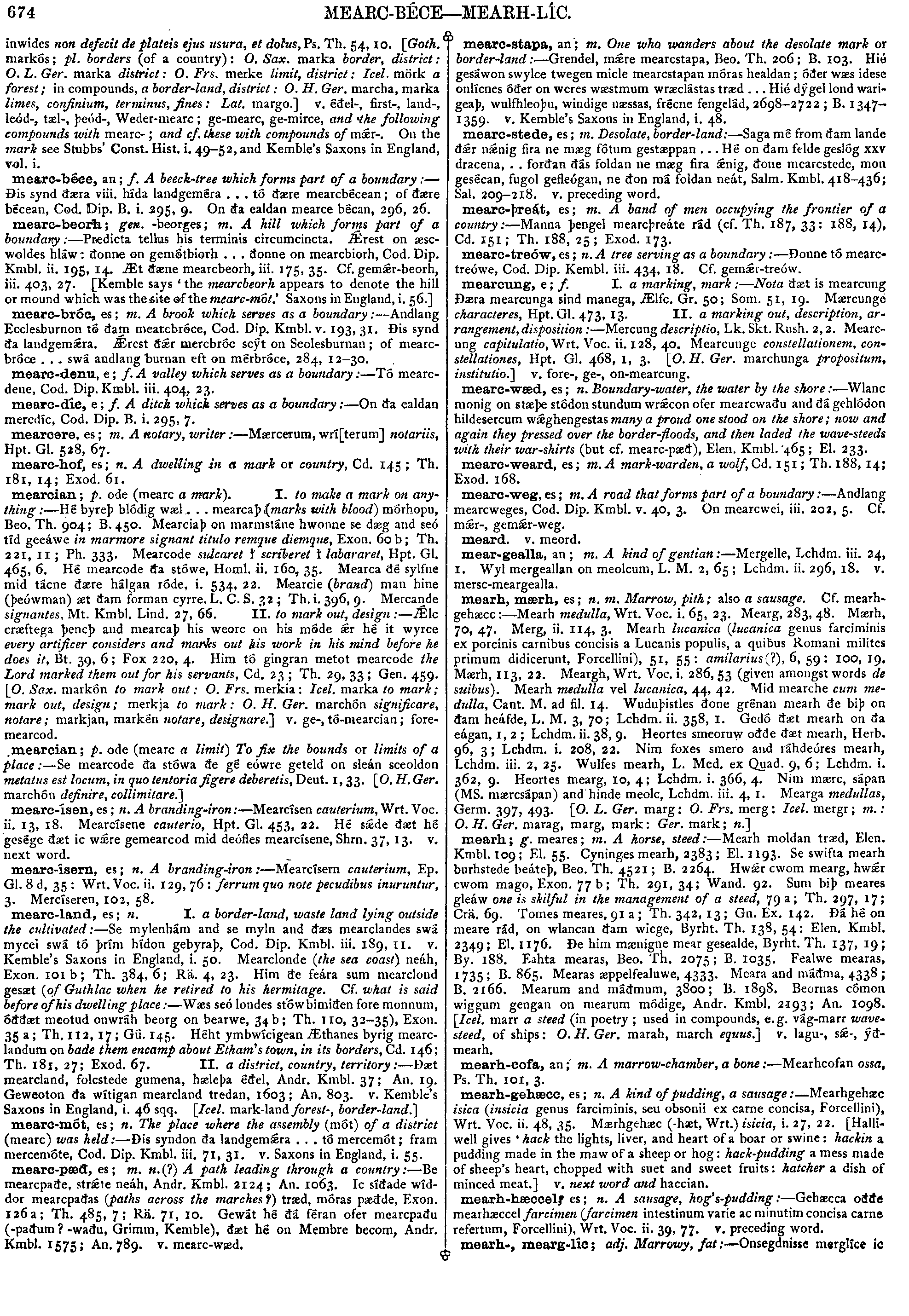
mearh, mærh, es; n. m. Marrow, pith; also a sausage. Cf. mearh-gehæcc :-- Mearh medulla, Wrt. Voc. i. 65, 23. Mearg, 283, 48. Mærh, 70, 47. Merg, ii. 114, 3. Mearh lucanica (lucanica genus farciminis ex porcinis carnibus concisis a Lucanis populis, a quibus Romani milites primum didicerunt, Forcellini), 51, 55: amilarius(?), 6, 59: 100, 19. Mærh, 113, 22. Meargh, Wrt. Voc. i. 286, 53 (given amongst words de suibus). Mearh medulla vel lucanica, 44, 42. Mid mearche cum medulla, Cant. M. ad fil. 14. Wuduþistles ðone grénan mearh ðe biþ on ðam heáfde, L. M. 3, 70; Lchdm. ii. 358, 1. Gedó ðæt mearh on ða eágan, 1, 2; Lchdm. ii. 38, 9. Heortes smeoruw oððe ðæt mearh, Herb. 96, 3; Lchdm. i. 208, 22. Nim foxes smero and ráhdeóres mearh, Lchdm. iii. 2, 25. Wulfes mearh, L. Med. ex Quad. 9, 6; Lchdm. i. 362, 9. Heortes mearg, 10, 4; Lchdm. i. 366, 4. Nim mærc, sápan (MS. mærcsápan) and hinde meolc, Lchdm. iii. 4, 1. Mearga medullas, Germ. 397, 493. [O. L. Ger. marg: O. Frs. merg: Icel. mergr; m.: O. H. Ger. marag, marg, mark: Ger. mark; n.]
|
Source: Bosworth/Toller, page b0682, entry 34 View original page image as: [TIFF] [PNG] [View previous entry] [View next entry] |
[Comment on this entry] [View comments] |
The following entry has been hand-corrected once. |
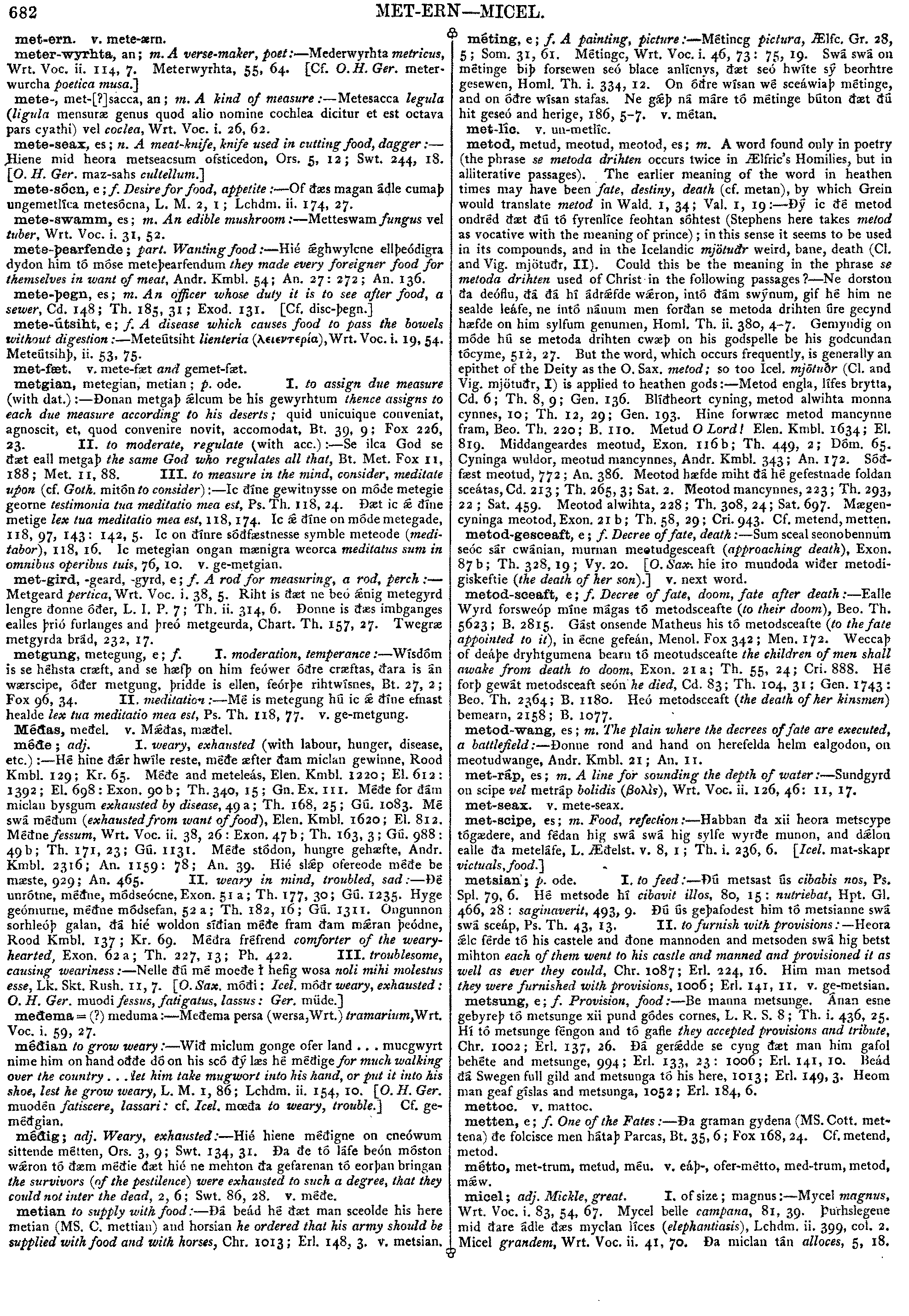
micel;
adj.
Mickle,
great.
I.
of
size;
magnus
:--
Mycel
magnus,
Wrt.
Voc.
i.
83,
54,
67.
Mycel
belle
campana,
81,
39.
Þurhslegene
mid
ðare
ádle
ðæs
myclan
líces
(elephantiasis),
Lchdm.
ii.
399,
col.
2.
Micel
grandem,
Wrt.
Voc.
ii.
41,
70.
Ða
miclan
tán
alloces,
5,
18.
God
geworhte
twá
micele
leóht,
ðæt
máre
leóht
tó
ðæs
dæges
líhtinge,
and
ðæt
læsse
leóht
tó
ðære
nihte
líhtinge,
Gen.
1,
16.
Se
læssa
íl
iricius;
se
mára
íl
istrix,
Wrt.
Voc.
ii.
49,
52,
53.
Ic
tówurpe
míne
bernu
and
ic
wyrce
máran
(majora),
Lk.
Skt.
12,
18.
Hit
is
ealra
wyrta
mst
majus
est
omnibus
holeribus,
Mt.
Kmbl.
13,
32.
Feldhúsa
mst,
Cd.
146;
Th.
183,
3;
Exod.
85.
Of
mstan
dle
maxima
ex
parte,
Bd.
5,
13;
S.
633,
2:
Ors.
1,
1;
Swt.
21,
2.
Ðá
geseah
ic
beforan
unc
ðone
mstan
weal,
5,
12;
S.
629,
13.
Ða
téþ
of
ádó
ða
ðe
hé
mste
hæbbe
remove
the
biggest
teeth
it
has,
L.
Med.
ex.
Quad.
1;
Lchdm.
i.
326,
13.
II.
of
quantity,
much,
many;
multus
:--
Mycel
multum,
Wrt.
Voc.
i.
83,
67.
Ðá
com
micel
wynsum
stenc,
Shrn.
91,
28.
Gé
sáwaþ
micel
sd
and
rípaþ
litel
sementem
multam
jacies
in
terram
et
modicum
congregabis,
Deut.
28,
38.
Him
fyligdon
mycele
menigu
(turbæ
multæ),
Mt.
Kmbl.
4,
25.
Eálá
sáwel
ðú
hæfst
mycele
gód
(multa
bona),
Lk.
Skt.
12,
19.
Ðes
man
wyrcþ
mycele
tácna
(multa
signa),
Jn.
Skt.
11,
47.
Him
mon
sóhte
mstra
daga
lce
they
were
attacked
most
days,
Chr.
894;
Erl.
90,
15.
His
fultum
mihte
mstra
(MS.
C.
mstne)
lcne
heora
flána
on
heora
feóndum
áfæstnian,
Ors.
6,
36;
Bos.
132,
10.
III.
great
in
a
metaphorical
sense
:--
God,
ðú
eart
se
miccla
kyning,
Hy.
3,
38;
Hy.
Grn.
ii.
282,
38.
Ic
ne
eom
swá
micel
swelgere
I
am
not
so
great
a
glutton;
non
sum
tam
vorax,
Coll.
Monast.
Th.
34,
35.
Ðá
wæs
geworden
mycel
(loud)
stefn
of
heofonum,
Blickl.
Homl.
145,
14:
Mt.
Kmbl.
27,
46.
Micel
sido
mid
Rómwarum
wæs
ðæt
ðr
náne
óðre
on
ne
ston
búton
ða
weorþestan
(a
custom
carefully
observed),
Bt.
27,
1;
Fox
96,
1.
Micel
is
ðæt
and
wundorlíc
ðæt
ðú
gehtst
magna
promittis,
36,
3;
Fox
174,
30.
Micel
óga
him
becom,
Gen.
15,
12.
Biþ
ðr
seó
miccle
milts
áfyrred,
Exon.
28
a;
Th.
84,
9;
Cri.
1371.
On
ðam
miclan
dæge
(the
day
of
judgment),
23
a;
Th.
65,
7;
Cri.
1051.
On
hyra
mandryhtnes
miclan
þearfe,
Beo.
Th.
5691;
B.
2849.
Mre
miclu
weorc
drihtnes
magna
opera
domini,
Ps.
Lamb.
110,
2.
Se
lícette
litlum
and
miclum,
gumena
gehwylcum,
Bt.
Met.
Fox
26,
72;
Met.
26,
36.
Ne
árás
betwyx
wífa
bearnum
mára
Johanne
Fulwihtere,
Mt.
Kmbl.
11,
11.
Ðes
is
mára
ðonne
Saolmon,
12,
42.
Nys
óðer
máre
bebod,
Mk.
Skt.
12,
31.
Ne
þorfte
hé
ná
máran
fultumes
ðonne
his
selfes,
Bt.
26,
2;
Fox
92,
23:
33,
1;
Fox
120,
13.
Se
hæfþ
máran
synne
se
ðe
mé
sealde,
Jn.
Skt.
19,
11.
Æ-acute;gðer
ge
on
ðm
máran
(main)
landum
ge
on
ðm
íglandum,
Ors.
1,
1;
Swt.
16,
25.
Ðonne
ðæt
gefeoht
mst
wre
when
the
fight
was
hottest,
4,
11;
Swt.
206,
18.
Se
msta
precipuus,
Wrt.
Voc.
ii.
81,
66.
Drihten
is
on
Sion
déma
se
msta,
Ps.
Th.
98,
2.
Manege
tellaþ
ðæt
tó
mstum
góde
and
tó
mstere
geslþe
ðæt
mon
síe
simle
blíðe,
Bt.
24,
2;
Fox
82,
12.
On
ðæm
mstan
dæge
(the
day
of
judgment),
Exon.
115
b;
Th.
445,
11;
Dóm.
6.
Pirrusan
ðone
mstan
feónd
Rómánum,
Ors.
3,
5;
Swt.
106,
4.
On
ðám
wron
ða
restan
and
ða
mstan
(primi
et
præcipui),
Bd.
1,
29;
S.
498,
7.
IV.
neuter
used
substantively
(a)
with
gen.
:--
Ic
nát
náht
gewislíce
hwæðer
ðæs
feós
swá
micel
is,
ne
ic
nát
ðeáh
his
máre
sý,
Chart.
Th.
490,
15.
Heora
heriges
wæs
mycel
ofslægen,
Bd.
3,
18;
S.
546,
35.
Hé
wæs
wilniende
ðæt
hé
ðæs
gewinnes
mehte
máre
gefremman
he
was
desirous
to
carry
on
the
struggle,
Ors.
2,
5;
Swt.
82,
8.
Hit
máre
ðæs
landes
forbærnde
ðonne
hit
fre
r
dyde,
5,
2;
Swt.
220,
16.
Ðæt
hí
þurh
ðæt
mge
mst
bearna
begitan,
Bt.
24,
3;
Fox
82,
25.
Ðr
manna
wese
mst
ætgædere,
Ps.
Th.
78,
10.
Se
ðissum
herige
mst
hearma
gefremede,
Andr.
Kmbl.
2397;
An.
1200.
(b)
without
gen.
:--
On
swá
miclum
heó
hæfþ
genóg
swá
wé
r
sprcon.
Gif
ðú
heore
máre
selest
...,
Bt.
14,
1;
Fox
42,
11.
Ðæt
hé
mid
swá
lytle
weorode
swá
micel
anginnan
dorste,
Ors.
3,
9;
Swt.
124,
16.
Hú
mycel
scealt
ðú
quantum
debes?
Lk.
Skt.
16,
5.
Hú
mycel
hé
dyde
mínre
sáwle,
Ps.
Th.
65,
14.
Ðæt
hé
genóg
hæbbe
and
nó
máran
ne
þurfe,
Bt.
26,
1;
Fox
92,
10.
Ðm
ðe
nigre
wuhte
máre
habbaþ
...
swá
hé
máre
hæfþ
swá
hé
má
monna
óleccan
sceal,
26,
2;
Fox
92,
29-33:
26,
3;
Fox
94,
16.
Ic
sceal
erian
fulne
æcer
oððe
máre
|
Source: Bosworth/Toller, page b0683, entry 12 View original page image as: [TIFF] [PNG] [View previous entry] [View next entry] |
[Comment on this entry] [View comments] |
The following entry has been hand-corrected once. |
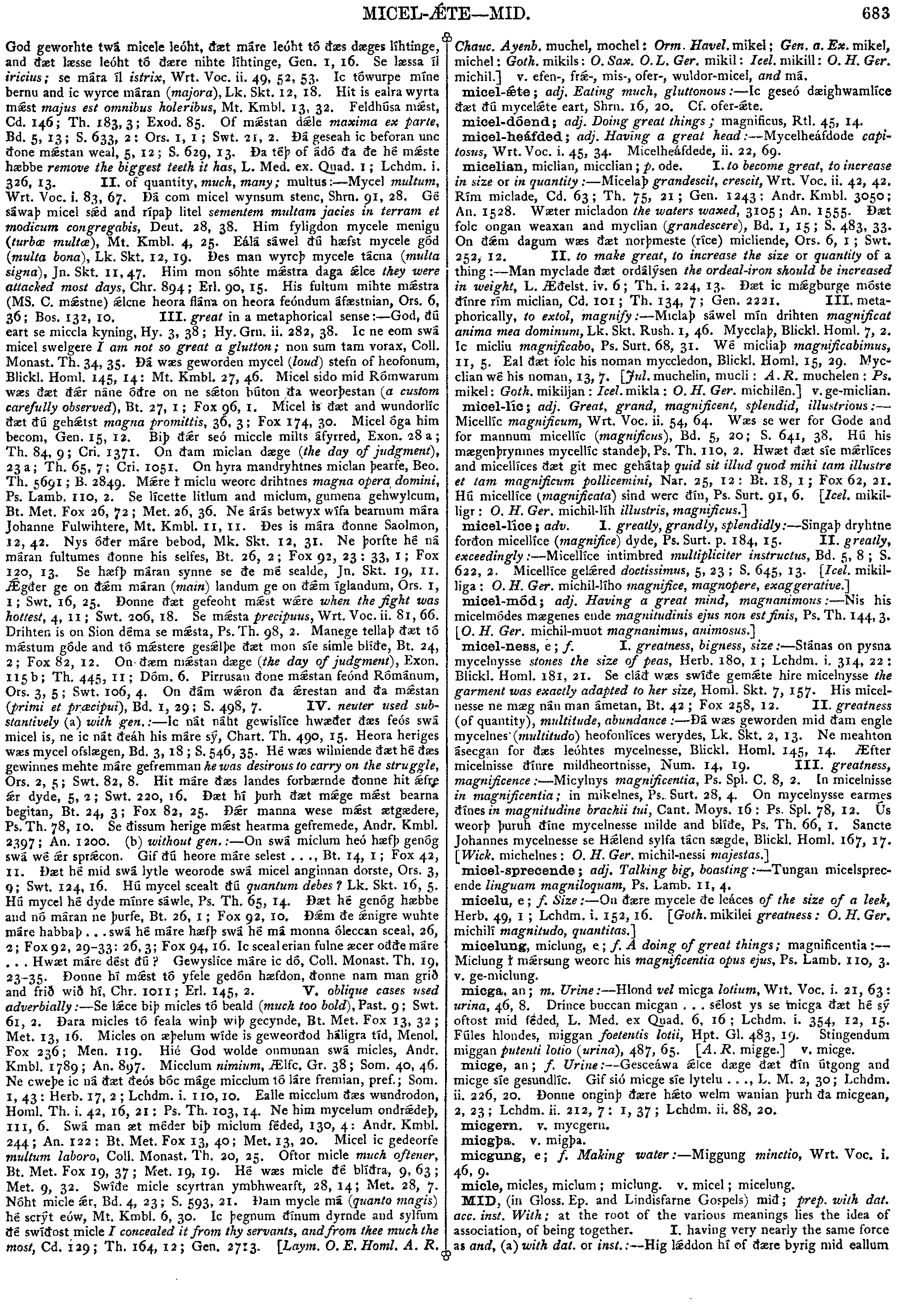
micga, an; m. Urine :-- Hlond vel micga lotium, Wrt. Voc. i. 21, 63: urina, 46, 8. Drince buccan micgan ... sélost ys se micga ðæt hé sý oftost mid féded, L. Med. ex Quad. 6, 16; Lchdm. i. 354, 12, 15. Fúles hlondes, miggan foetentis lotii, Hpt. Gl. 483, 19. Stingendum miggan putenti lotio (urina), 487, 65. [A. R. migge.] v. micge.
|
Source: Bosworth/Toller, page b0687, entry 19 View original page image as: [TIFF] [PNG] [View previous entry] [View next entry] |
[Comment on this entry] [View comments] |
The following entry has been hand-corrected once. |
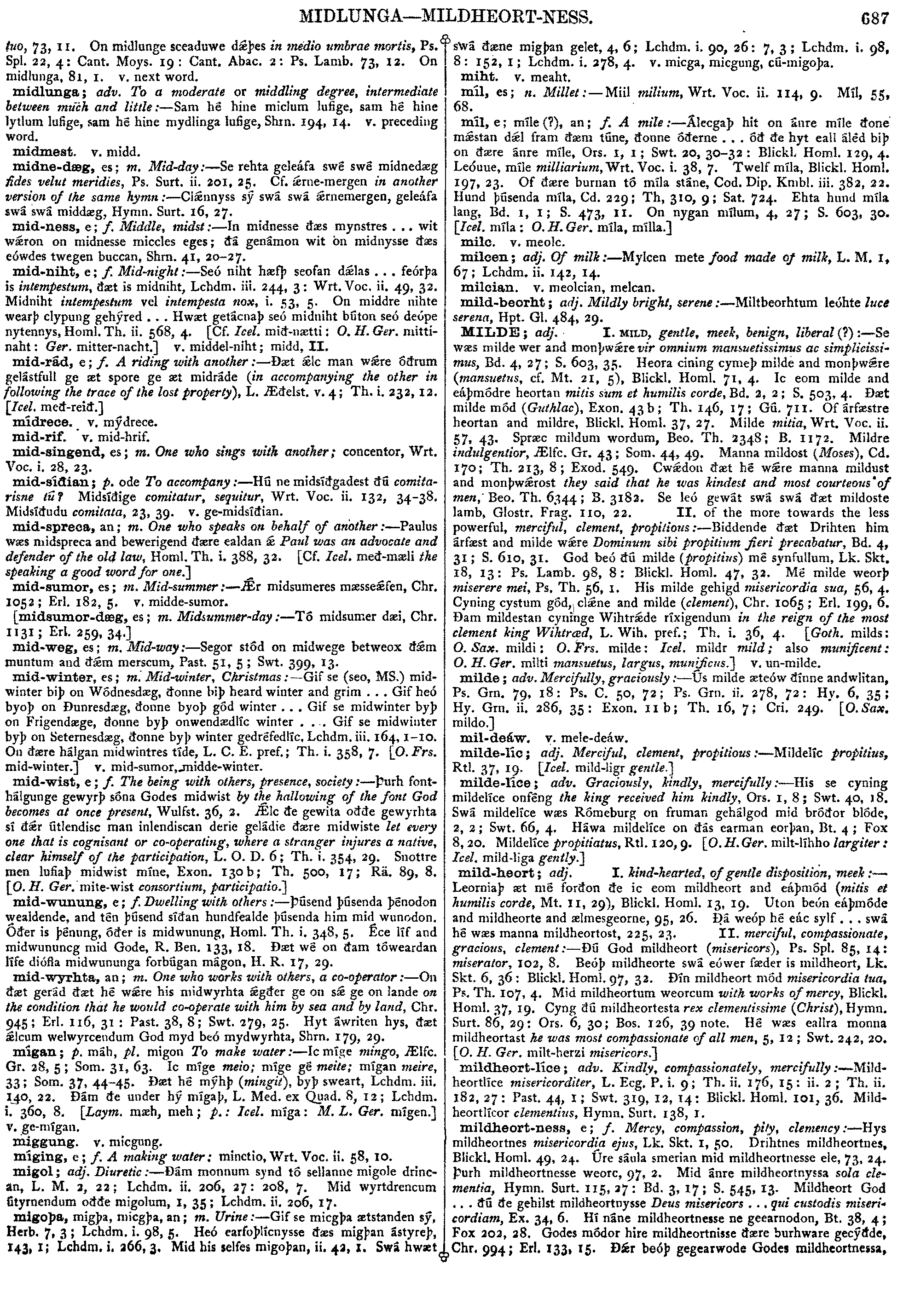
mígan; p. máh, pl. migon To make water :-- Ic míge mingo, Ælfc. Gr. 28, 5; Som. 31, 63. Ic míge meio; míge gé meite; mígan meire, 33; Som. 37, 44-45. Ðæt hé mýhþ (mingit), byþ sweart, Lchdm. iii. 140, 22. Ðám ðe under hý mígaþ, L. Med. ex Quad. 8, 12; Lchdm. i. 360, 8. [Laym. mæh, meh; p.: Icel. míga: M. L. Ger. mígen.] v. ge-mígan.
|
Source: Bosworth/Toller, page b0688, entry 11 View original page image as: [TIFF] [PNG] [View previous entry] [View next entry] |
[Comment on this entry] [View comments] |
The following entry has been hand-corrected once. |
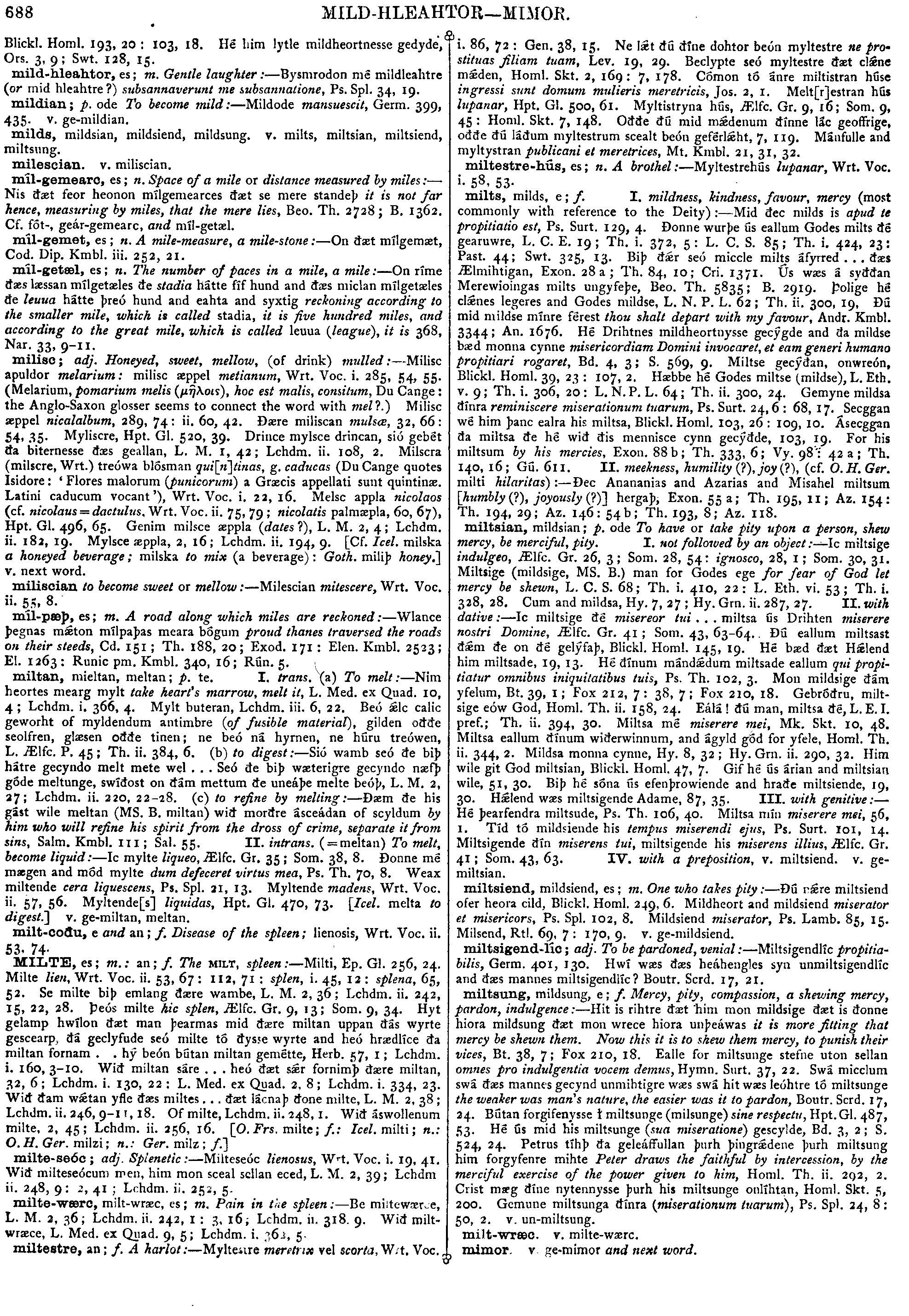
miltan,
mieltan,
meltan;
p.
te.
I.
trans.
(a)
To
melt
:--
Nim
heortes
mearg
mylt
take
heart's
marrow,
melt
it,
L.
Med.
ex
Quad.
10,
4;
Lchdm.
i.
366,
4.
Mylt
buteran,
Lchdm.
iii.
6,
22.
Beó
lc
calic
geworht
of
myldendum
antimbre
(of
fusible
material),
gilden
oððe
seolfren,
glæsen
oððe
tinen;
ne
beó
ná
hyrnen,
ne
húru
treówen,
L.
Ælfc.
P.
45;
Th.
ii.
384,
6.
(b)
to
digest
:--
Sió
wamb
seó
ðe
biþ
hátre
gecyndo
melt
mete
wel
...
Seó
ðe
biþ
wæterigre
gecyndo
næfþ
góde
meltunge,
swíðost
on
ðám
mettum
ðe
uneáþe
melte
beóþ,
L.
M.
2,
27;
Lchdm.
ii.
220,
22-28.
(c)
to
refine
by
melting
:--
Ðæm
ðe
his
gást
wile
meltan
(MS.
B.
miltan)
wið
morðre
ásceádan
of
scyldum
by
him
who
will
refine
his
spirit
from
the
dross
of
crime,
separate
it
from
sins,
Salm.
Kmbl.
111;
Sal.
55.
II.
intrans.
(
=
meltan)
To
melt,
become
liquid
:--
Ic
mylte
liqueo,
Ælfc.
Gr.
35;
Som.
38,
8.
Ðonne
mé
mægen
and
mód
mylte
dum
defeceret
virtus
mea,
Ps.
Th.
70,
8.
Weax
miltende
cera
liquescens,
Ps.
Spl.
21,
13.
Myltende
madens,
Wrt.
Voc.
ii.
57,
56.
Myltende[s]
liquidas,
Hpt.
Gl.
470,
73.
[Icel.
melta
to
digest.]
v.
ge-miltan,
meltan.
|
Source: Bosworth/Toller, page b0688, entry 13 View original page image as: [TIFF] [PNG] [View previous entry] [View next entry] |
[Comment on this entry] [View comments] |
The following entry has been hand-corrected once. |
MILTE,
es;
m.:
an;
f.
The
MILT,
spleen
:--
Milti,
Ep.
Gl.
256,
24.
Milte
lien,
Wrt.
Voc.
ii.
53,
67:
112,
71:
splen,
i.
45,
12:
splena,
65,
52.
Se
milte
biþ
emlang
ðære
wambe,
L.
M.
2,
36;
Lchdm.
ii.
242,
15,
22,
28.
Þeós
milte
hic
splen,
Ælfc.
Gr.
9,
13;
Som.
9,
34.
Hyt
gelamp
hwílon
ðæt
man
þearmas
mid
ðære
miltan
uppan
ðás
wyrte
gescearp,
ðá
geclyfude
seó
milte
tó
ðysse
wyrte
and
heó
hrædlíce
ða
miltan
fornam
.
.
hý
beón
bútan
miltan
gemétte,
Herb.
57,
1;
Lchdm.
i.
160,
3-10.
Wið
miltan
sáre
...
heó
ðæt
sr
fornimþ
ðære
miltan,
32,
6;
Lchdm.
i.
130,
22:
L.
Med.
ex
Quad.
2,
8;
Lchdm.
i.
334,
23.
Wið
ðam
wtan
yfle
ðæs
miltes
...
ðæt
lácnaþ
ðone
milte,
L.
M.
2,
38;
Lchdm.
ii.
246,
9-11,
18.
Of
milte,
Lchdm.
ii.
248,
1.
Wið
áswollenum
milte,
2,
45;
Lchdm.
ii.
256,
16.
[O.
Frs.
milte;
f.:
Icel.
milti;
n.:
O.
H.
Ger.
milzi;
n.:
Ger.
milz;
f.]
|
Source: Bosworth/Toller, page b0688, entry 15 View original page image as: [TIFF] [PNG] [View previous entry] [View next entry] |
[Comment on this entry] [View comments] |
The following entry has been hand-corrected once. |
milte-wærc, milt-wræc, es; m. Pain in tare spleen :-- Be miltewærce, L. M. 2, 36; Lchdm. ii. 242, 1: 3, 16; Lchdm. ii. 318, 9. Wið milt-wræce, L. Med. ex Quad. 9, 5; Lchdm. i. 362, 5.
| Result Page: |  |
Previous | 1 2 3 4 | Next |  |
Germanic Lexicon Project (main page)
This search system was written by
Sean Crist
Please consider
volunteering
to correct the data in these online dictionaries.
No rights reserved. Feel free to use these data in any way you please.