|
|

Tip: In the search results, you can click on any word or abbreviation for more information.
|
Source: Bosworth/Toller, page d0423, entry 30 View original page image as: [TIFF] [PNG] [View previous entry] [View next entry] |
[Comment on this entry] [View comments] |
The following entry has been hand-corrected once. |
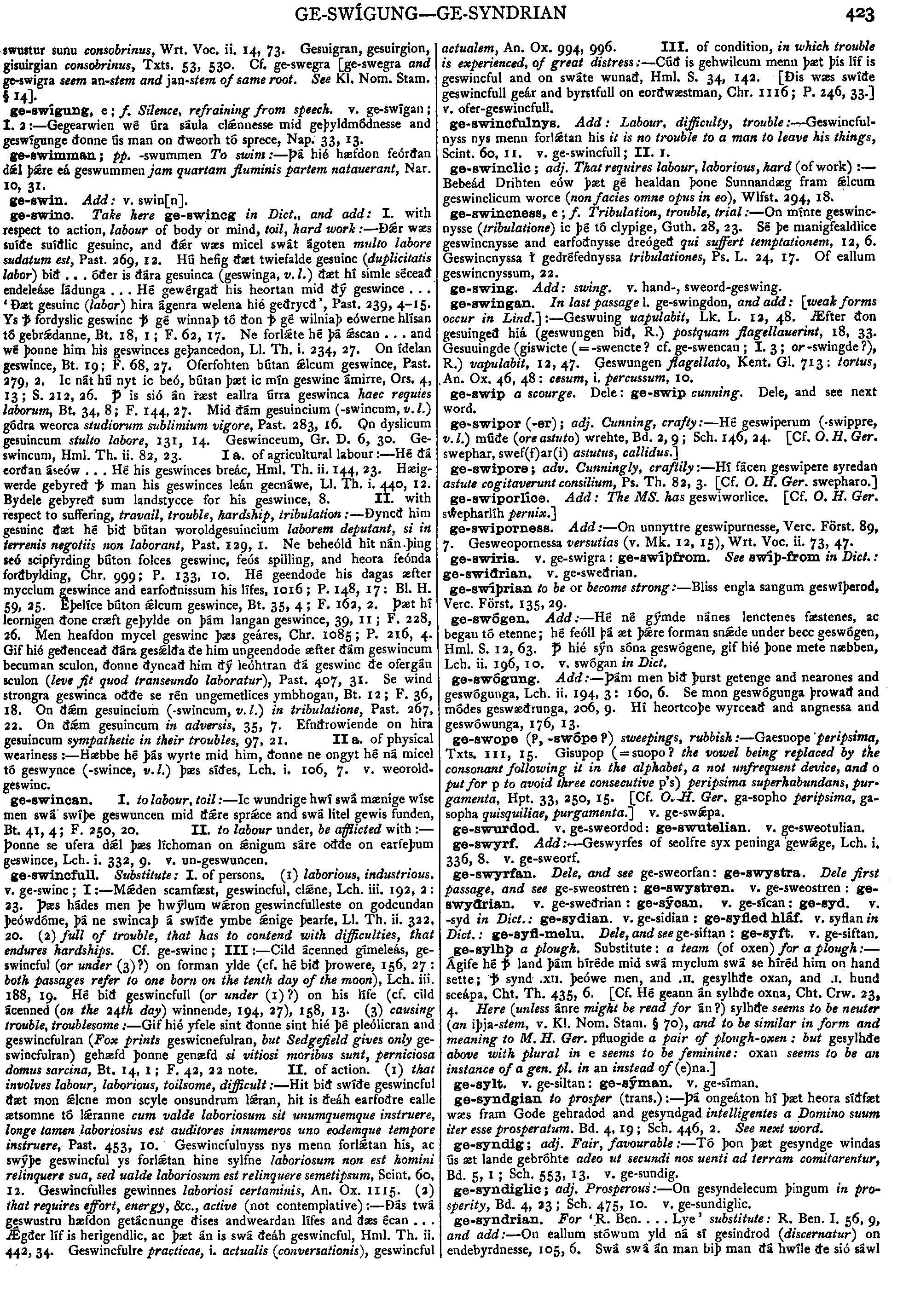
ge-syndiglic; adj. Prosperous :-- On gesyndelecum þingum in prosperity, Bd. 4, 23 ; Sch. 475, 10. v. ge-sundiglic.
|
Source: Bosworth/Toller, page d0479, entry 1 View original page image as: [TIFF] [PNG] [View previous entry] [View next entry] |
[Comment on this entry] [View comments] |
The following entry has been hand-corrected once. |
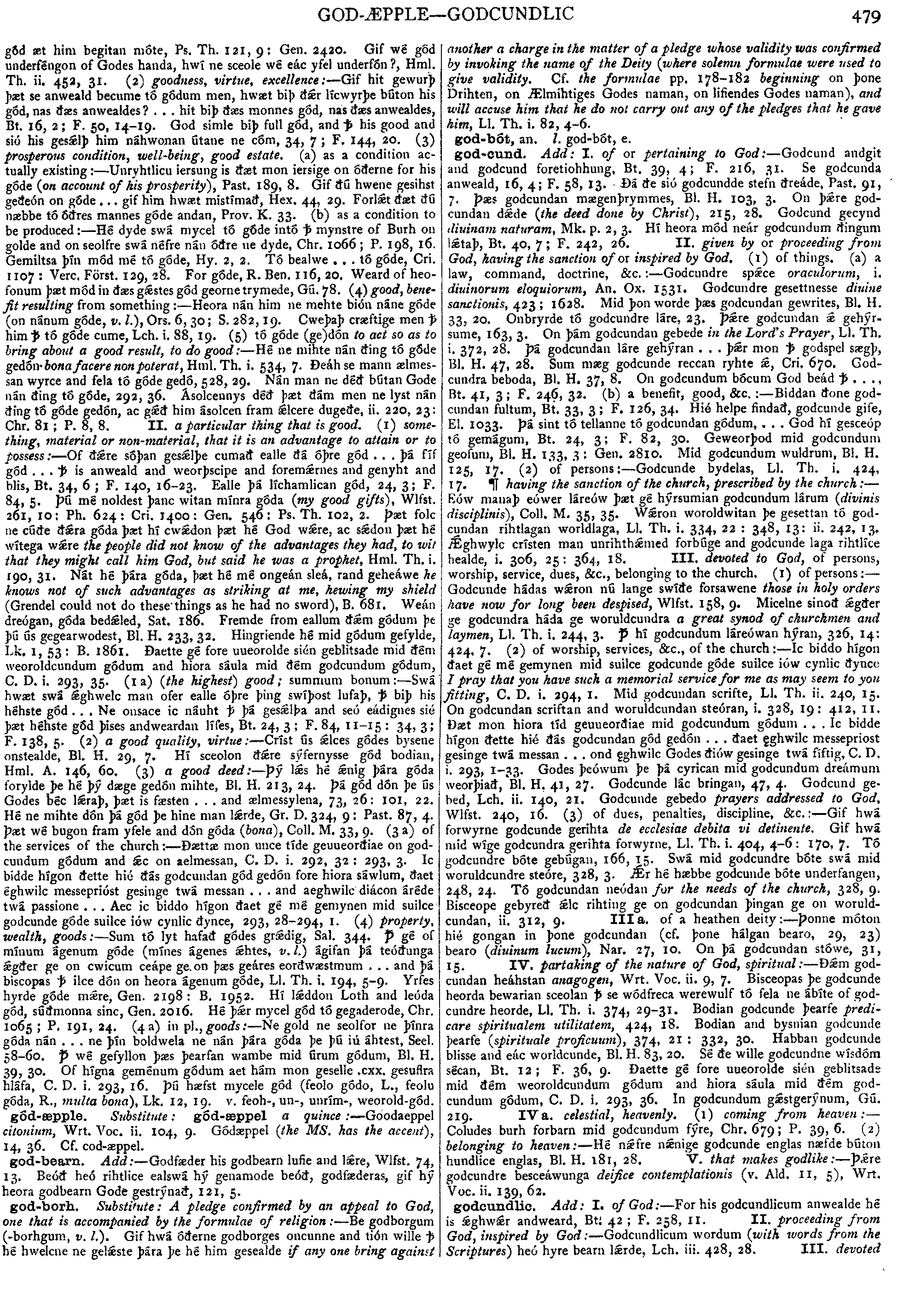
gód
æt
him
begitan
móte,
Ps.
Th.
121,
9:
Gen.
2420.
Gif
wé
gód
underféngon
of
Godes
handa,
hwí
ne
sceole
wé
eác
yfel
underfón
?,
Hml.
Th.
ii.
452,
31.
(2)
goodness,
virtue,
excellence:--Gif
hit
gewurþ
þæt
se
anweald
becume
tó
gódum
men,
hwæt
biþ
ð r
lícwyrþe
búton
his
gód,
nas
ðæs
anwealdes?
.
.
.
hit
biþ
ðæs
monnes
gód,
nas
ðæs
anwealdes,
Bt.
16,
2;
F.
50,
14-19.
God
simle
biþ
full
gód,
and
r
lícwyrþe
búton
his
gód,
nas
ðæs
anwealdes?
.
.
.
hit
biþ
ðæs
monnes
gód,
nas
ðæs
anwealdes,
Bt.
16,
2;
F.
50,
14-19.
God
simle
biþ
full
gód,
and
 his
good
and
sió
his
geslþ
him
náhwonan
útane
ne
cóm,
34,
7;
F.
144,
20.
(3)
prosperous
condition,
well-being,
good
estate.
(a)
as
a
condition
actually
existing:--Unryhtlicu
iersung
is
ðæt
mon
iersige
on
óðerne
for
his
góde
(on
account
of
his
prosperity),
Past.
189,
8.
Gif
ðú
hwene
gesihst
geðeón
on
góde
.
.
.
gif
him
hwæt
mistímað,
Hex.
44,
29.
Forlt
ðæt
ðú
næbbe
tó
óðres
mannes
góde
andan,
Prov.
K.
33.
(b)
as
a
condition
to
be
produced:--Hé
dyde
swá
mycel
tó
góde
intó
mynstre
of
Burh
on
golde
and
on
seolfre
swá
néfre
nán
óðre
ne
dyde,
Chr.
1066;
P.
198,
16.
Gemiltsa
þín
mód
mé
tó
góde,
Hy.
2,
2.
Tó
bealwe
.
.
.
tó
góde,
Cri.
1107:
Verc.
Först.
129,
28.
For
góde,
R.
Ben.
116,
20.
Weard
of
heofonum
þæt
mód
in
ðæs
gstes
gód
georne
trymede,
Gú.
78.
(4)
good,
benefit
resulting
from
something:--Heora
nán
him
ne
mehte
bión
náne
góde
(on
nánum
góde,
v.
l.),
Ors.
6,
30;
S.
282,
19.
Cweþaþ
cræftige
men
him
tó
góde
cume,
Lch.
i.
88,
19.
(5)
tó
góde
(ge)dón
to
act
so
as
to
bring
about
a
good
result,
to
do
good:--Hé
ne
mihte
nán
ðing
tó
góde
gedón
bona
facere
non
poterat,
Hml.
Th.
i.
534,
7.
Ðeáh
se
mann
ælmessan
wyrce
and
fela
tó
góde
gedó,
528,
29.
Nán
man
ne
déð
bútan
Gode
nán
ðing
tó
góde,
292,
36.
Ásolcennys
déð
þæt
ðám
men
ne
lyst
nán
ðing
tó
góde
gedón,
ac
gð
him
ásolcen
fram
lcere
dugeðe,
ii.
220,
23:
Chr.
81;
P.
8,
8.
II.
a
particular
thing
that
is
good.
(1)
something,
material
or
non-material,
that
it
is
an
advantage
to
attain
or
to
possess:--Of
ðre
sóþan
geslþe
cumað
ealle
ðá
óþre
gód
.
.
.
þá
fíf
gód
.
.
.
is
anweald
and
weorþscipe
and
foremrnes
and
genyht
and
blis,
Bt.
34,
6;
F.
140,
16-23.
Ealle
þá
líchamlican
gód,
24,
3;
F.
84,
5.
Þú
mé
noldest
þanc
witan
mínra
góda
(my
good
gifts),
Wlfst.
261,
10:
Ph.
624:
Cri.
1400:
Gen.
546:
Ps.
Th.
102,
2.
Þæt
folc
ne
cúðe
ðra
góda
þæt
hí
cwdon
þæt
hé
God
wre,
ac
sdon
þæt
hé
wítega
wre
the
people
did
not
know
of
the
advantages
they
had,
to
wit
that
they
might
call
him
God,
but
said
he
was
a
prophet,
Hml.
Th.
i.
190,
31.
Nát
hé
þára
góda,
þæt
hé
mé
ongeán
sleá,
rand
geheáwe
he
knows
not
of
such
advantages
as
striking
at
me,
hewing
my
shield
(Grendel
could
not
do
these
things
as
he
had
no
sword),
B.
681.
Weán
dreógan,
góda
bedled,
Sat.
186.
Fremde
from
eallum
ðm
gódum
þe
þú
ús
gegearwodest,
Bl.
H.
233,
32.
Hingriende
hé
mid
gódum
gefylde,
Lk.
1,
53:
B.
1861.
Ðaette
gé
fore
uueorolde
sién
geblitsade
mid
ðém
weoroldcundum
gódum
and
hiora
sáula
mid
ðém
godcundum
gódum,
C.
D.
i.
293,
35.
(1
a)
(the
highest)
good;
summum
bonum:--Swá
hwæt
swá
ghwelc
man
ofer
ealle
óþre
þing
swíþost
lufaþ,
biþ
his
héhste
gód
.
.
.
Ne
onsace
ic
náuht
þá
geslþa
and
seó
eádignes
sié
þæt
héhste
gód
þises
andweardan
lífes,
Bt.
24,
3;
F.
84,
11-15:
34,
3;
F.
138,
5.
(2)
a
good
quality,
virtue:--Críst
ús
lces
gódes
bysene
onstealde,
Bl.
H.
29,
7.
Hí
sceolon
ðre
sýfernysse
gód
bodian,
Hml.
A.
146,
60.
(3)
a
good
deed:--Þý
ls
hé
nig
þára
góda
forylde
þe
hé
þý
dæge
gedón
mihte,
Bl.
H.
213,
24.
Þá
gód
dón
þe
ús
Godes
béc
lraþ,
þæt
is
fæsten
.
.
.
and
ælmessylena,
73,
26:
101,
22.
Hé
ne
mihte
dón
þá
gód
þe
hine
man
lrde,
Gr.
D.
324,
9:
Past.
87,
4.
Þæt
wé
bugon
fram
yfele
and
dón
góda
(bona),
Coll.
M.
33,
9.
(3
a)
of
the
services
of
the
church:--Ðættæ
mon
unce
tíde
geuueorðiae
on
godcundum
gódum
and
c
on
aelmessan,
C.
D.
i.
292,
32:
293,
3.
Ic
bidde
hígon
ðette
hié
ðás
godcundan
gód
gedón
fore
hiora
sáwlum,
ðaet
éghwilc
messeprióst
gesinge
twá
messan
.
.
.
and
aeghwilc
diácon
áréde
twá
passione
.
.
.
Aec
ic
biddo
hígon
ðaet
gé
mé
gemynen
mid
suilce
godcunde
góde
suilce
iów
cynlic
ðynce,
293,
28-294,
1.
(4)
property,
wealth,
goods:--Sum
tó
lyt
hafað
gódes
grdig,
Sal.
344.
Þ-bar;
gé
of
mínum
ágenum
góde
(mínes
ágenes
htes,
v.
l.)
ágifan
þá
teóðunga
gðer
ge
on
cwicum
ceápe
ge
on
þæs
geáres
eorðwæstmum
.
.
.
and
þá
biscopas
ilce
dón
on
heora
ágenum
góde,
Ll.
Th.
i.
194,
5-9.
Yrfes
hyrde
góde
mre,
Gen.
2198:
B.
1952.
Hí
lddon
Loth
and
leóda
gód,
súðmonna
sinc,
Gen.
2016.
Hé
þr
mycel
gód
tó
gegaderode,
Chr.
1065;
P.
191,
24.
(4
a)
in
pl.,
goods:--Ne
gold
ne
seolfor
ne
þínra
góda
nán
.
.
.
ne
þín
boldwela
ne
nán
þára
góda
þe
þú
iú
áhtest,
Seel.
58-60.
Þ-bar;
wé
gefyllon
þæs
þearfan
wambe
mid
úrum
gódum,
Bl.
H.
39,
30.
Of
hígna
geménum
gódum
aet
hám
mon
geselle
.cxx.
gesuflra
hláfa,
C.
D.
i.
293,
16.
Þú
hæfst
mycele
gód
(feolo
gódo,
L.,
feolu
góda,
R.,
multa
bona),
Lk.
12,
19.
v.
feoh-,
un-,
unrím-,
weorold-gód.
his
good
and
sió
his
geslþ
him
náhwonan
útane
ne
cóm,
34,
7;
F.
144,
20.
(3)
prosperous
condition,
well-being,
good
estate.
(a)
as
a
condition
actually
existing:--Unryhtlicu
iersung
is
ðæt
mon
iersige
on
óðerne
for
his
góde
(on
account
of
his
prosperity),
Past.
189,
8.
Gif
ðú
hwene
gesihst
geðeón
on
góde
.
.
.
gif
him
hwæt
mistímað,
Hex.
44,
29.
Forlt
ðæt
ðú
næbbe
tó
óðres
mannes
góde
andan,
Prov.
K.
33.
(b)
as
a
condition
to
be
produced:--Hé
dyde
swá
mycel
tó
góde
intó
mynstre
of
Burh
on
golde
and
on
seolfre
swá
néfre
nán
óðre
ne
dyde,
Chr.
1066;
P.
198,
16.
Gemiltsa
þín
mód
mé
tó
góde,
Hy.
2,
2.
Tó
bealwe
.
.
.
tó
góde,
Cri.
1107:
Verc.
Först.
129,
28.
For
góde,
R.
Ben.
116,
20.
Weard
of
heofonum
þæt
mód
in
ðæs
gstes
gód
georne
trymede,
Gú.
78.
(4)
good,
benefit
resulting
from
something:--Heora
nán
him
ne
mehte
bión
náne
góde
(on
nánum
góde,
v.
l.),
Ors.
6,
30;
S.
282,
19.
Cweþaþ
cræftige
men
him
tó
góde
cume,
Lch.
i.
88,
19.
(5)
tó
góde
(ge)dón
to
act
so
as
to
bring
about
a
good
result,
to
do
good:--Hé
ne
mihte
nán
ðing
tó
góde
gedón
bona
facere
non
poterat,
Hml.
Th.
i.
534,
7.
Ðeáh
se
mann
ælmessan
wyrce
and
fela
tó
góde
gedó,
528,
29.
Nán
man
ne
déð
bútan
Gode
nán
ðing
tó
góde,
292,
36.
Ásolcennys
déð
þæt
ðám
men
ne
lyst
nán
ðing
tó
góde
gedón,
ac
gð
him
ásolcen
fram
lcere
dugeðe,
ii.
220,
23:
Chr.
81;
P.
8,
8.
II.
a
particular
thing
that
is
good.
(1)
something,
material
or
non-material,
that
it
is
an
advantage
to
attain
or
to
possess:--Of
ðre
sóþan
geslþe
cumað
ealle
ðá
óþre
gód
.
.
.
þá
fíf
gód
.
.
.
is
anweald
and
weorþscipe
and
foremrnes
and
genyht
and
blis,
Bt.
34,
6;
F.
140,
16-23.
Ealle
þá
líchamlican
gód,
24,
3;
F.
84,
5.
Þú
mé
noldest
þanc
witan
mínra
góda
(my
good
gifts),
Wlfst.
261,
10:
Ph.
624:
Cri.
1400:
Gen.
546:
Ps.
Th.
102,
2.
Þæt
folc
ne
cúðe
ðra
góda
þæt
hí
cwdon
þæt
hé
God
wre,
ac
sdon
þæt
hé
wítega
wre
the
people
did
not
know
of
the
advantages
they
had,
to
wit
that
they
might
call
him
God,
but
said
he
was
a
prophet,
Hml.
Th.
i.
190,
31.
Nát
hé
þára
góda,
þæt
hé
mé
ongeán
sleá,
rand
geheáwe
he
knows
not
of
such
advantages
as
striking
at
me,
hewing
my
shield
(Grendel
could
not
do
these
things
as
he
had
no
sword),
B.
681.
Weán
dreógan,
góda
bedled,
Sat.
186.
Fremde
from
eallum
ðm
gódum
þe
þú
ús
gegearwodest,
Bl.
H.
233,
32.
Hingriende
hé
mid
gódum
gefylde,
Lk.
1,
53:
B.
1861.
Ðaette
gé
fore
uueorolde
sién
geblitsade
mid
ðém
weoroldcundum
gódum
and
hiora
sáula
mid
ðém
godcundum
gódum,
C.
D.
i.
293,
35.
(1
a)
(the
highest)
good;
summum
bonum:--Swá
hwæt
swá
ghwelc
man
ofer
ealle
óþre
þing
swíþost
lufaþ,
biþ
his
héhste
gód
.
.
.
Ne
onsace
ic
náuht
þá
geslþa
and
seó
eádignes
sié
þæt
héhste
gód
þises
andweardan
lífes,
Bt.
24,
3;
F.
84,
11-15:
34,
3;
F.
138,
5.
(2)
a
good
quality,
virtue:--Críst
ús
lces
gódes
bysene
onstealde,
Bl.
H.
29,
7.
Hí
sceolon
ðre
sýfernysse
gód
bodian,
Hml.
A.
146,
60.
(3)
a
good
deed:--Þý
ls
hé
nig
þára
góda
forylde
þe
hé
þý
dæge
gedón
mihte,
Bl.
H.
213,
24.
Þá
gód
dón
þe
ús
Godes
béc
lraþ,
þæt
is
fæsten
.
.
.
and
ælmessylena,
73,
26:
101,
22.
Hé
ne
mihte
dón
þá
gód
þe
hine
man
lrde,
Gr.
D.
324,
9:
Past.
87,
4.
Þæt
wé
bugon
fram
yfele
and
dón
góda
(bona),
Coll.
M.
33,
9.
(3
a)
of
the
services
of
the
church:--Ðættæ
mon
unce
tíde
geuueorðiae
on
godcundum
gódum
and
c
on
aelmessan,
C.
D.
i.
292,
32:
293,
3.
Ic
bidde
hígon
ðette
hié
ðás
godcundan
gód
gedón
fore
hiora
sáwlum,
ðaet
éghwilc
messeprióst
gesinge
twá
messan
.
.
.
and
aeghwilc
diácon
áréde
twá
passione
.
.
.
Aec
ic
biddo
hígon
ðaet
gé
mé
gemynen
mid
suilce
godcunde
góde
suilce
iów
cynlic
ðynce,
293,
28-294,
1.
(4)
property,
wealth,
goods:--Sum
tó
lyt
hafað
gódes
grdig,
Sal.
344.
Þ-bar;
gé
of
mínum
ágenum
góde
(mínes
ágenes
htes,
v.
l.)
ágifan
þá
teóðunga
gðer
ge
on
cwicum
ceápe
ge
on
þæs
geáres
eorðwæstmum
.
.
.
and
þá
biscopas
ilce
dón
on
heora
ágenum
góde,
Ll.
Th.
i.
194,
5-9.
Yrfes
hyrde
góde
mre,
Gen.
2198:
B.
1952.
Hí
lddon
Loth
and
leóda
gód,
súðmonna
sinc,
Gen.
2016.
Hé
þr
mycel
gód
tó
gegaderode,
Chr.
1065;
P.
191,
24.
(4
a)
in
pl.,
goods:--Ne
gold
ne
seolfor
ne
þínra
góda
nán
.
.
.
ne
þín
boldwela
ne
nán
þára
góda
þe
þú
iú
áhtest,
Seel.
58-60.
Þ-bar;
wé
gefyllon
þæs
þearfan
wambe
mid
úrum
gódum,
Bl.
H.
39,
30.
Of
hígna
geménum
gódum
aet
hám
mon
geselle
.cxx.
gesuflra
hláfa,
C.
D.
i.
293,
16.
Þú
hæfst
mycele
gód
(feolo
gódo,
L.,
feolu
góda,
R.,
multa
bona),
Lk.
12,
19.
v.
feoh-,
un-,
unrím-,
weorold-gód.
|
Source: Bosworth/Toller, page d0488, entry 31 View original page image as: [TIFF] [PNG] [View previous entry] [View next entry] |
[Comment on this entry] [View comments] |
The following entry has been hand-corrected once. |
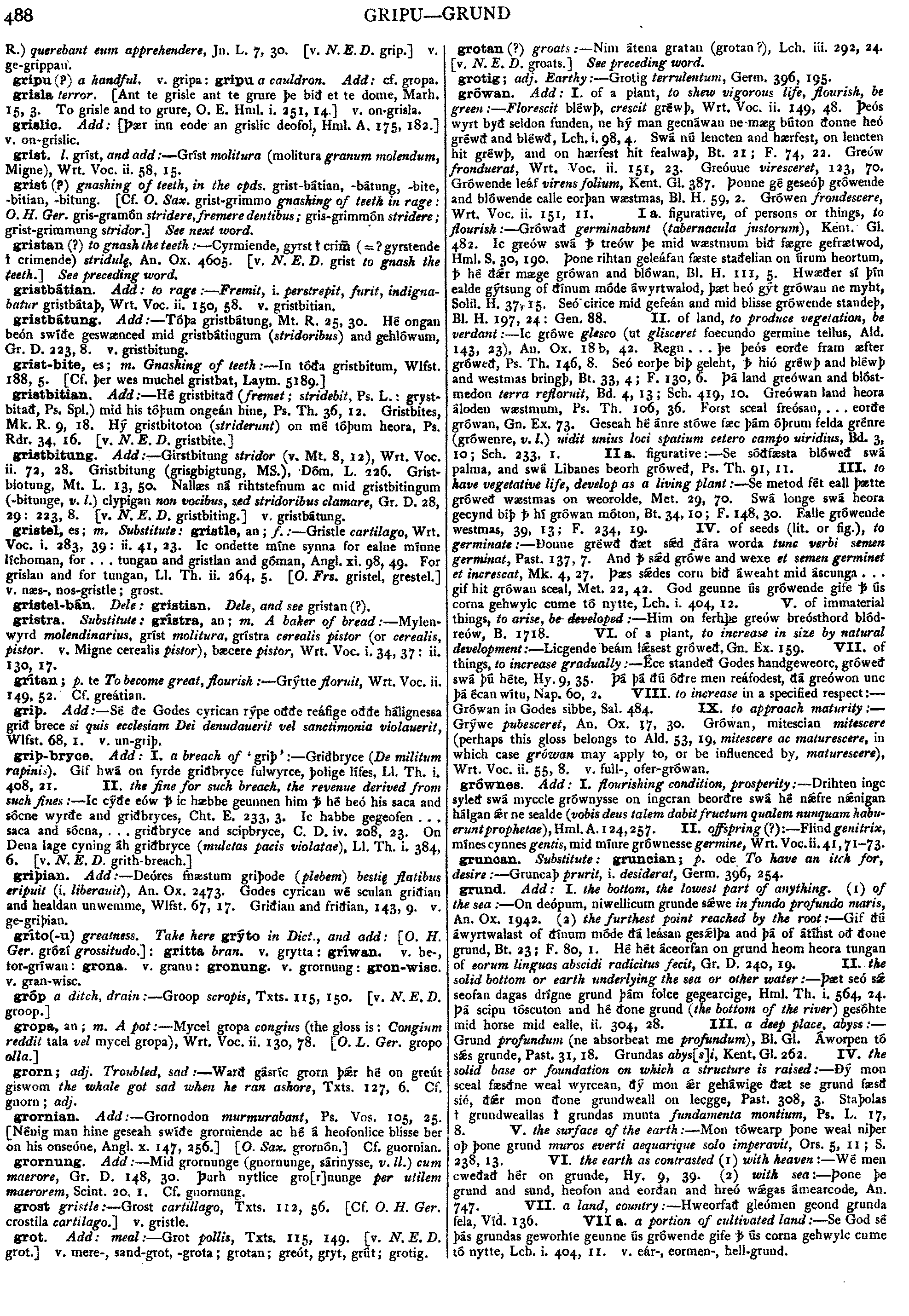
grównes.
Add:
I.
flourishing
condition,
prosperity
:--
Drihten
ingc
syleð
swá
myccle
grównysse
on
ingcran
beorðre
swá
hé
nfre
nnigan
hálgan
r
ne
sealde
(vobis
deus
talem
dabit
fructum
qualem
nunquam
habuerunt
prophetae),
Hml.
A.
124,
257.
II.
offspring
(?)
:--
Flind
genitrix,
mínes
cynnes
gentis,
mid
mínre
grównesse
germine,
Wrt.
Voc.
ii.
41,
71-73.
|
Source: Bosworth/Toller, page d0496, entry 4 View original page image as: [TIFF] [PNG] [View previous entry] [View next entry] |
[Comment on this entry] [View comments (2)] |
The following entry has been hand-corrected once. |
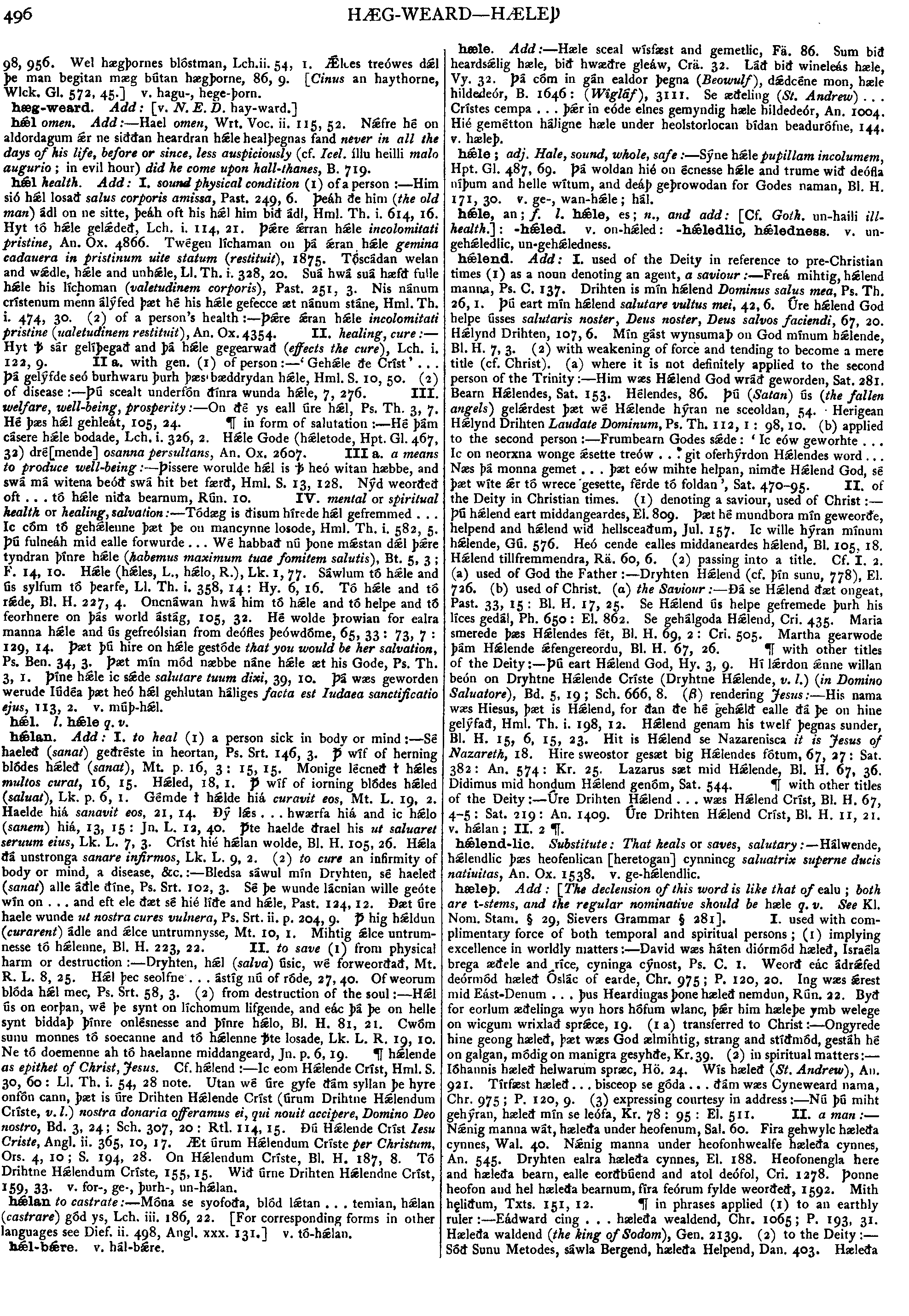
hl
health.
Add:
I.
sound
physical
condition
(1)
of
a
person
:--
Him
sió
hæl
losað
solus
carports
amissa,
Fast.
249,
6.
Þeáh
ðe
him
(the
old
man)
ádl
on
ne
sitte,
þeáh
oft
his
hl
him
bið
ádl,
Hml.
Th.
i.
614,
16.
Hyt
tó
hle
geldeð,
Lch.
i.
114,
21.
Þre
rran
hle
incohmitati
pristine,
An.
Ox.
4866.
Twégen
líchaman
on
þá
ran
hle
gemina
cadauera
in
pristinum
uite
statum
(restituit),
1875.
Tóscádan
welan
and
wdle,
hle
and
unhle,
Ll.
Th.
i.
328,
20.
Suá
hwá
suá
hæfð
fulle
hiéle
his
líchoman
(valetudinem
corporis),
Past.
251,
3.
Nis
nánum
crístenum
menn
álýfed
bæt
hé
his
hle
gefecce
æt
nánum
stáne,
Hml.
Th.
i.
474,
30.
(2)
of
a
person's
health
:--
Þre
ran
hle
incolomitati
pristine
(ualetudinem
reítitwit),
An.
Ox.
4354.
II.
healing,
care
:--
Hyt
sár
gelíþegað
and
þá
hle
gegearwað
(effects
the
cure),
Lch.
i.
122,
9.
II
a.
with
gen.
(1)
of
person
:--
'Gehle
ðe
Críst'
.
.
.Þá
gelýfde
seó
burhwaru
þurh
þæs
bæddrydan
hle,
Hml.
S.
10,
50.
(2)
of
disease
:--
JJú
scealt
underfón
ftínra
wunda
hle,
7,
276.
III.
welfare,
well-being,
prosperity
:--
On
ðé
ys
eall
úre
hl,
Ps.
Th.
3,
7.
Hé
þæs
hl
gehleát,
105,
24.

in
form
of
salutation
:--
Hé
þám
cásere
hle
bodade,
Lch.
i.
326,
2.
Hle
Gode
(hletode,
Hpt.
Gl.
467,
32)
dré[mende]
osanna
persultans,
An.
Ox.
2607.
Ill
a.
a
means
to
produce
well-being
:--
Þissere
worulde
hl
is
heó
witan
hæbbe,
and
swá
má
witena
beóð
swá
hit
bet
færð,
Hml.
S.
13,
128.
Nýd
weorieð
oft
.
.
.
tó
hle
niða
bearnum,
Run.
10.
IV.
mental
or
spiritual
health
or
healing,
salvation
:--
Tódæg
is
ðisum
hírede
hl
gefremmed
.
.
.
Ic
cóm
tó
gehlenne
þæt
þe
on
mancynne
losode,
Hml.
Th.
i.
582,
5.
Þú
fulneáh
mid
ealle
forwurde
.
.
.
Wé
habbað
nú
þone
mstan
dl
þre
tyndran
þínre
hle
(habemus
maximum
tuae
fomitem
salutis),
Bt.
5,
3
;
F.
14,
10.
Hle
(hles,
L.
,
hlo,
R.
),
Lk.
l,
77.
Sáwlum
tó
hle
and
fis
sylfum
tó
þearfe,
Ll.
Th.
i.
358,
14:
Hy.
6,
16.
Tó
hle
and
tó
rde,
Bl.
H.
227,
4.
Oncnáwan
hwá
him
tó
hle
and
tó
helpe
and
tó
feorhnere
on
þás
world
ástág,
105,
32.
Hé
wolde
þrowian
for
ealra
manna
hle
and
ús
gefreólsian
from
deófles
þeówdóme,
65,
33
:
73,
7
:
129,
14.
Þæt
þú
hire
cn
hle
gestóde
that
you
would
be
her
salvation,
Ps.
Ben.
34,
3.
Þæt
mín
mód
næbbe
náne
hle
æt
his
Gode,
Ps.
Th.
3,
Þíne
hle
ic
sde
salutare
tuum
dixi,
39,
10.
Þá
wæs
geworden
werude
Iúdea
þæt
heó
hl
gehlutan
háliges
facto
est
ludaea
sanctificatio
ejus,
113,
2.
v.
múp
hl.
|
Source: Bosworth/Toller, page d0497, entry 11 View original page image as: [TIFF] [PNG] [View previous entry] [View next entry] |
[Comment on this entry] [View comments (1)] |
The following entry has been hand-corrected once. |
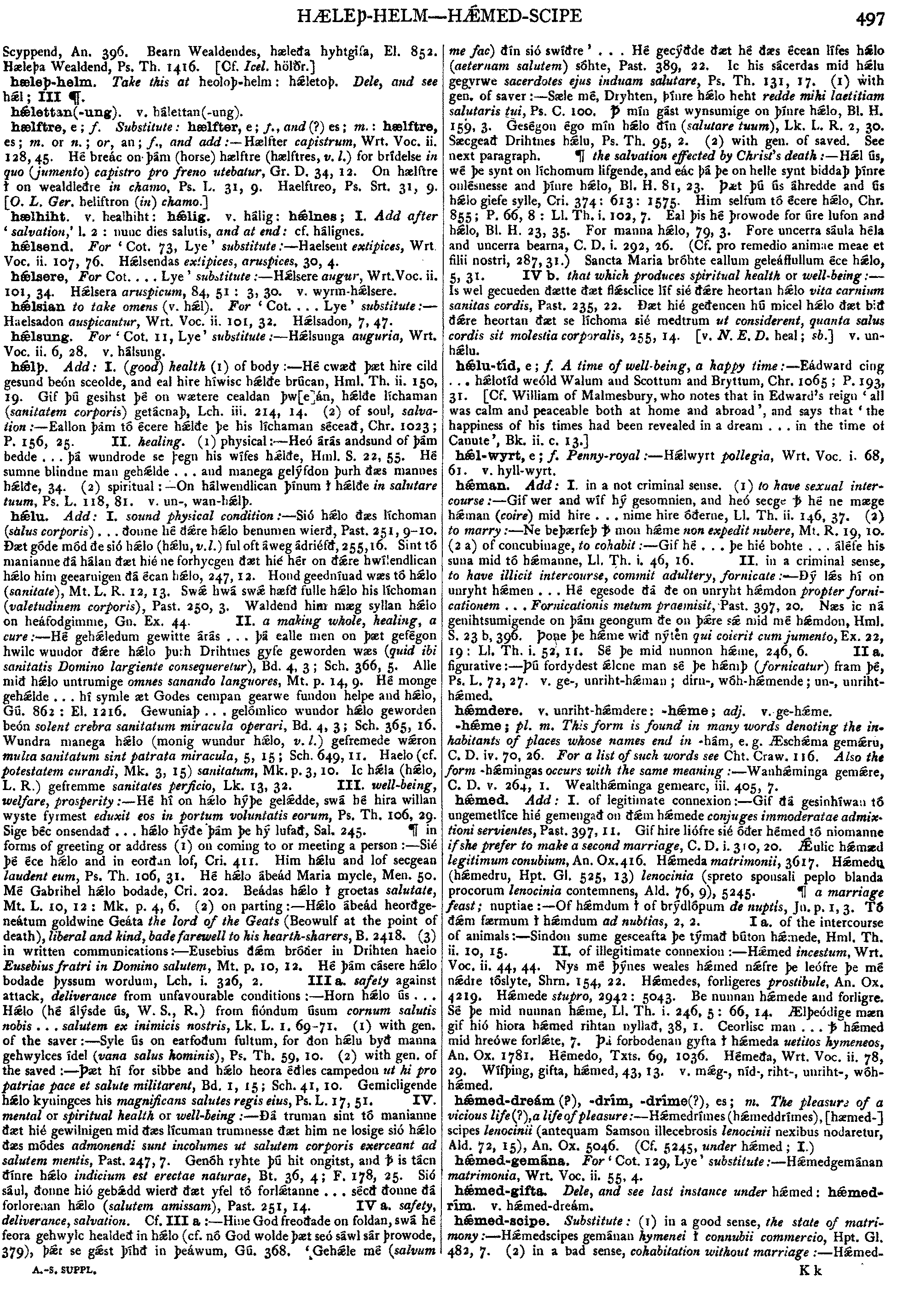
hlu.
Add:
I.
sound
physical
condition
:--
Sió
hlo
ðæs
líchoman
(salus
corporis)
,
.
.
ðonne
hé
ðre
hlo
benumen
wierð,
Past.
251,
9-10.
Ðæt
góde
mód
de
sió
hlo
(hlu,
v.
l.)
fut
oft
áweg
ádriéfð,
255,
16.
Sine
tó
manianneðá
hálan
ðæt
hié
ne
forhycgen
ðæt
hié
hér
on
ðre
hwilendlican
hlo
him
geearuigen
ðá
écan
hlo,
247,
12.
Hond
geedníuad
wæs
tó
hlo
(sanitate),
Mt.
L.
R.
12,
13.
Sw
hwá
sw
hæfð
fulle
hlo
his
líchoman
(valeiudinem
carports),
Past.
250,
3.
Waldend
him
mæg
syllan
hlo
on
heáfodgimme,
Gn.
Ex.
44.
II.
a
making
whole,
healing,
a
cure
:--
Hé
gehledum
gewitte
árás
.
.
.
þá
ealle
men
on
þæt
gefégon
hwilc
wundor
ðre
hlo
þurh
Drihtnes
gyfe
geworden
wæs
(quid
ibi
sanitatis
Domino
largiente
consejuerelur),
Bd.
4,
3
;
Sch.
366,
5.
Alle
mið
hlo
untrumige
omties
sanando
languores,
Mt.
p.
14,
9.
Hé
monge
gehlde
.
.
.
hí
symle
æt
Godes
cempan
gearwe
fundon
helpe
and
hlo,
Gú.
861
:
El.
1216.
Gewuniaþ
.
.
,
gelómlico
wundor
hlo
geworden
beón
solent
crebra
sanitatum
miracula
operari,
Bd.
4,
3;
Sch.
365,
16.
Wundra
manega
hlo
(monig
wundur
hlo,
v.
l.)
gefremede
wron
mulra
sauitatum
sint
patrata
miracula,
5,
15;
Sch.
649,
11.
Haelo
(cf.
potestatem
curandi,
Mk.
3,
15)
sanitatum.
Mk.
p.
3,
10.
Ic
hla
(hlo,
L.
R.
)
gefremme
sanitates
perficio,
Lk.
13,
32.
III.
well-being,
welfare,
prosperity
:--
Hé
hí
on
hlo
hýþe
geldde,
swá
hé
hira
willan
wyste
fytmest
eduxit
eos
in
portum
voluntatis
eorum,
Ps.
Th.
106,
29.
Sige
béc
onsendað
.
.
.
hlo
hýðe
þám
þe
hý
lufai,
Sal.
245.

in
forms
of
greeting
or
address
(1)
on
coming
to
or
meeting
a
person
:--
Sié
þé
éce
hlo
and
in
eorðan
lof,
Cri.
411.
Him
hlu
and
lof
secgean
laudent
eum,
Ps.
Th.
106,
31.
Hé
hlo
ábeád
Maria
mycle,
Men.
50.
Mé
Gabrihel
hlo
bodade,
Cri.
202.
Beádas
hlo
 groetas
salutate,
Mt.
L.
ID,
12
:
Mk.
p.
4,
6.
(2)
on
parting
:--
Hlo
ábeád
heorðgeneátum
goldwine
Geáta
the
lord
of
the
Geats
(Beowulf
at
the
point
of
death),
liberal
and
kind,
bade
farewell
to
his
hearth-sharers,
B.
2418.
(3)
in
written
communications
:--
Eusebius
dm
bróder
in
Drihten
hlo
Eusebius
fratri
in
Domino
salulem,
Mt.
p,
10,
12.
Hé
þám
cásere
hlo
bodade
þyssum
worduin,
Lch.
i.
326,
2.
Ilia,
safety
against
attack,
deliverance
from
unfavourable
conditions
:--
Horn
hlo
ús.
.
.
Hlo
(he
álýsde
ús,
W.
S.
,
R.
)
from
fióndum
úsum
cornum
salutis
nobis
.
.
.
salutem
ex
inimicis
nostris,
Lk.
L.
l.
69-71.
(1)
with
gen.
of
the
saver
:--
Syle
ús
on
earfoðum
fultum,
for
don
hlu
byð
manna
gehwylces
ídel
(vana
solus
hominis),
Ps.
Th.
59,
10.
(2)
with
gen.
of
the
saved
:--
Þæt
hí
for
sibbe
and
hlo
heora
éðles
campedon
ut
hi
pro
patriae
pace
et
salute
mililarent,
Bd.
1,
15;
Sch.
41,
10.
Gemicligende
hlo
kyningces
his
magnificans
salutes
regis
eius,
Ps.
L.
17,
51.
IV.
mental
or
spiritual
health
or
well-being
:--
Ðá
truman
sint
tó
manianne
ðæt
hié
gewilnigen
mid
ðæs
lícuman
trumnesse
ðæt
him
ne
losige
sió
hlo
ðæs
módes
admanend:
sunt
incolumes
ut
salutem
carports
exerceant
ad
salutem
mentis,
Past.
247,
7.
Genóh
ryhte
þú
hit
ongitst,
and
is
tácn
ðínre
hlo
indicium
est
erectae
naturae,
Bt.
36,
4;
F.
178,
25.
SiÍ
sául,
ðonne
hió
gebdd
wierð
ðæt
yfel
tó
forltanne
.
.
.
sécð
ðonne
ðá
forloreaan
hlo
(salutem
amissam),
Past.
251,
14.
IV
a.
safety,
deliverance,
salvation.
Cf.
III
a
:--
Hine
God
freoðade
on
foldan,
swá
hé
feora
gehwylc
healdeð
in
hlo
(cf.
nó
God
wolde
þæt
seó
sáwl
sár
þrowode,
379),
þr
se
gst
þíhð
in
þeáwum,
Gú.
368.
'Gehle
mé
(salvum
me
fac)
ðín
sió
swíðre
'
.
.
.
Hé
gecýðde
ðæt
hé
dæs
écean
llfes
hílo
(aeternam
salutem)
sóhte,
Past.
389,
22.
Ic
his
sácerdas
mid
hlu
gegyrwe
sacerdotes
ejus
induam
salutare,
Ps.
Th.
131,
17.
(1)
with
gen.
of
saver
:--
Sæle
mé,
Dryhten,
þínre
hlo
heht
redde
mihi
laetitiam
salutaris
tui,
Ps.
C.
loo.
Þ-bar;
mín
gást
wynsumige
on
þínre
hlo,
Bl.
H.
159,
3.
Geségon
égo
mín
hlo
ðín
(salutare
tuum),
Lk.
L.
R.
2,
30.
Sæcgeað
Drihtnes
hlu,
Ps.
Th.
95,
2.
(2)
with
gen.
of
saved.
See
next
paragraph.

the
salvation
effected
by
Christ's
death
:--
Hl
ús,
wé
þe
synt
on
líchomum
lifgende,
and
eác
þá
þe
on
helle
synt
biddaþ
þínre
onlésnesse
and
þínre
hlo,
Bl.
H.
81,
23.
Þt
þú
ús
áhredde
and
ús
hlo
giefe
sylle,
Cri.
374:
613:
1575.
Him
selfum
tó
écere
hlo.
Chr.
855;
P.
66,
8
:
Ll.
Th.
i.
103,
7.
Eal
þis
hé
þrowode
for
úre
lufon
and
hlo,
61.
H.
23,
35.
For
manna
hlo,
79,
3.
Fore
uncerra
sáula
héla
and
uncerra
bearna,
C.
D.
i.
292,
26.
(Cf.
pro
remedio
animae
meae
et
filii
nostri,
287,
31.
)
Sancta
Maria
bróhte
eallum
geleaffullum
éce
hlo,
5,
31.
IV
b.
that
which
produces
spiritual
health
or
well-being
:--
Is
wel
gecueden
ðætte
ðæt
flsclice
líf
sié
ðre
heortan
hlo
vita
carnium
sanitas
cordis,
Past.
235,
22.
Ðæt
hié
geðencen
hú
micel
hlo
ðæt
bið
ðre
heortan
ðæt
se
líchoma
sié
medtrum
ut
considerent,
quanta
salus
cordis
sit
molestia
corporalis,
255,
14.
[v.
N.
E.
D.
heal;
sb.]
v.
un-hlu.
groetas
salutate,
Mt.
L.
ID,
12
:
Mk.
p.
4,
6.
(2)
on
parting
:--
Hlo
ábeád
heorðgeneátum
goldwine
Geáta
the
lord
of
the
Geats
(Beowulf
at
the
point
of
death),
liberal
and
kind,
bade
farewell
to
his
hearth-sharers,
B.
2418.
(3)
in
written
communications
:--
Eusebius
dm
bróder
in
Drihten
hlo
Eusebius
fratri
in
Domino
salulem,
Mt.
p,
10,
12.
Hé
þám
cásere
hlo
bodade
þyssum
worduin,
Lch.
i.
326,
2.
Ilia,
safety
against
attack,
deliverance
from
unfavourable
conditions
:--
Horn
hlo
ús.
.
.
Hlo
(he
álýsde
ús,
W.
S.
,
R.
)
from
fióndum
úsum
cornum
salutis
nobis
.
.
.
salutem
ex
inimicis
nostris,
Lk.
L.
l.
69-71.
(1)
with
gen.
of
the
saver
:--
Syle
ús
on
earfoðum
fultum,
for
don
hlu
byð
manna
gehwylces
ídel
(vana
solus
hominis),
Ps.
Th.
59,
10.
(2)
with
gen.
of
the
saved
:--
Þæt
hí
for
sibbe
and
hlo
heora
éðles
campedon
ut
hi
pro
patriae
pace
et
salute
mililarent,
Bd.
1,
15;
Sch.
41,
10.
Gemicligende
hlo
kyningces
his
magnificans
salutes
regis
eius,
Ps.
L.
17,
51.
IV.
mental
or
spiritual
health
or
well-being
:--
Ðá
truman
sint
tó
manianne
ðæt
hié
gewilnigen
mid
ðæs
lícuman
trumnesse
ðæt
him
ne
losige
sió
hlo
ðæs
módes
admanend:
sunt
incolumes
ut
salutem
carports
exerceant
ad
salutem
mentis,
Past.
247,
7.
Genóh
ryhte
þú
hit
ongitst,
and
is
tácn
ðínre
hlo
indicium
est
erectae
naturae,
Bt.
36,
4;
F.
178,
25.
SiÍ
sául,
ðonne
hió
gebdd
wierð
ðæt
yfel
tó
forltanne
.
.
.
sécð
ðonne
ðá
forloreaan
hlo
(salutem
amissam),
Past.
251,
14.
IV
a.
safety,
deliverance,
salvation.
Cf.
III
a
:--
Hine
God
freoðade
on
foldan,
swá
hé
feora
gehwylc
healdeð
in
hlo
(cf.
nó
God
wolde
þæt
seó
sáwl
sár
þrowode,
379),
þr
se
gst
þíhð
in
þeáwum,
Gú.
368.
'Gehle
mé
(salvum
me
fac)
ðín
sió
swíðre
'
.
.
.
Hé
gecýðde
ðæt
hé
dæs
écean
llfes
hílo
(aeternam
salutem)
sóhte,
Past.
389,
22.
Ic
his
sácerdas
mid
hlu
gegyrwe
sacerdotes
ejus
induam
salutare,
Ps.
Th.
131,
17.
(1)
with
gen.
of
saver
:--
Sæle
mé,
Dryhten,
þínre
hlo
heht
redde
mihi
laetitiam
salutaris
tui,
Ps.
C.
loo.
Þ-bar;
mín
gást
wynsumige
on
þínre
hlo,
Bl.
H.
159,
3.
Geségon
égo
mín
hlo
ðín
(salutare
tuum),
Lk.
L.
R.
2,
30.
Sæcgeað
Drihtnes
hlu,
Ps.
Th.
95,
2.
(2)
with
gen.
of
saved.
See
next
paragraph.

the
salvation
effected
by
Christ's
death
:--
Hl
ús,
wé
þe
synt
on
líchomum
lifgende,
and
eác
þá
þe
on
helle
synt
biddaþ
þínre
onlésnesse
and
þínre
hlo,
Bl.
H.
81,
23.
Þt
þú
ús
áhredde
and
ús
hlo
giefe
sylle,
Cri.
374:
613:
1575.
Him
selfum
tó
écere
hlo.
Chr.
855;
P.
66,
8
:
Ll.
Th.
i.
103,
7.
Eal
þis
hé
þrowode
for
úre
lufon
and
hlo,
61.
H.
23,
35.
For
manna
hlo,
79,
3.
Fore
uncerra
sáula
héla
and
uncerra
bearna,
C.
D.
i.
292,
26.
(Cf.
pro
remedio
animae
meae
et
filii
nostri,
287,
31.
)
Sancta
Maria
bróhte
eallum
geleaffullum
éce
hlo,
5,
31.
IV
b.
that
which
produces
spiritual
health
or
well-being
:--
Is
wel
gecueden
ðætte
ðæt
flsclice
líf
sié
ðre
heortan
hlo
vita
carnium
sanitas
cordis,
Past.
235,
22.
Ðæt
hié
geðencen
hú
micel
hlo
ðæt
bið
ðre
heortan
ðæt
se
líchoma
sié
medtrum
ut
considerent,
quanta
salus
cordis
sit
molestia
corporalis,
255,
14.
[v.
N.
E.
D.
heal;
sb.]
v.
un-hlu.
|
Source: Bosworth/Toller, page d0621, entry 8 View original page image as: [TIFF] [PNG] [View previous entry] [View next entry] |
[Comment on this entry] [View comments (1)] |
The following entry has been hand-corrected once. |
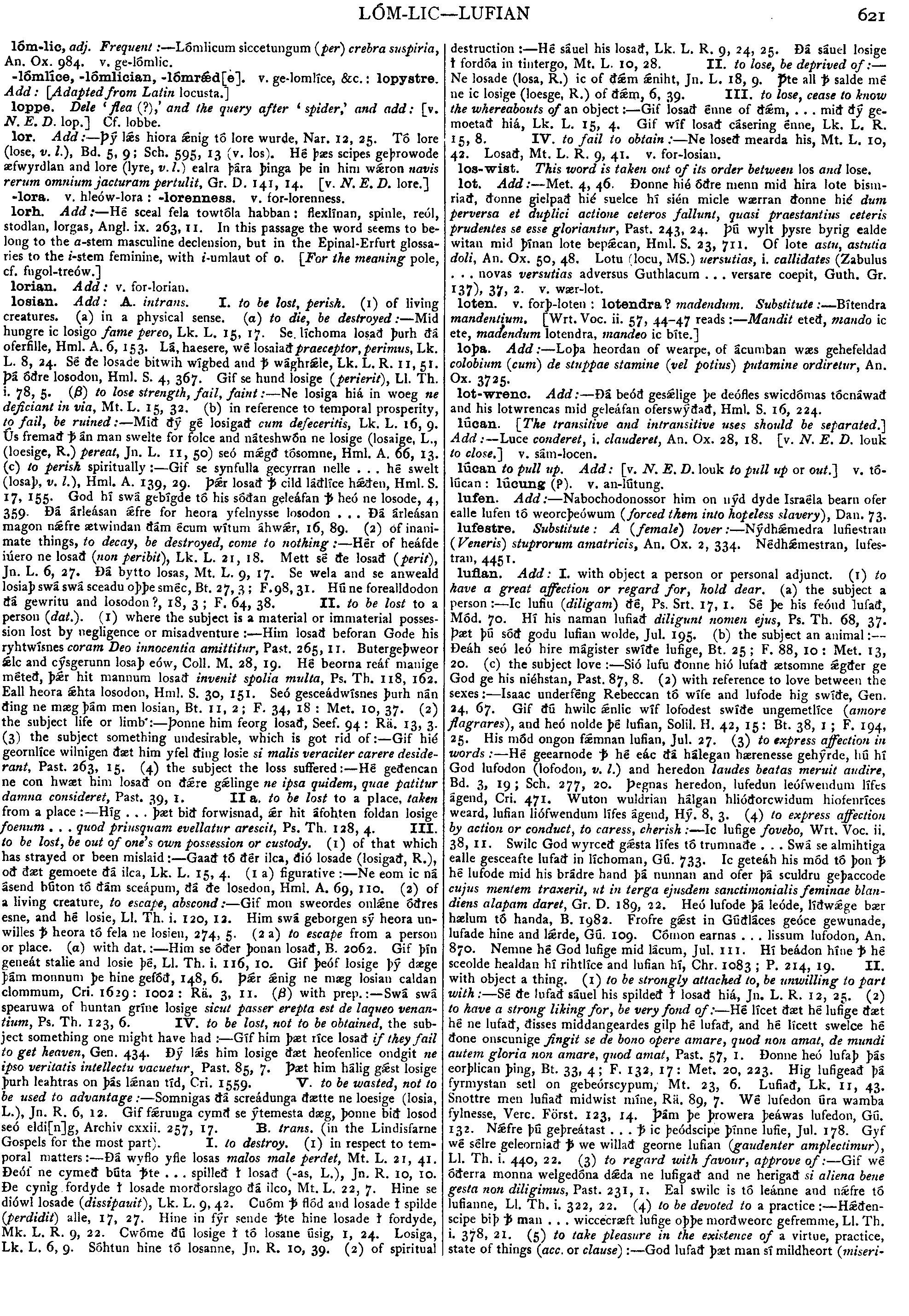
losian.
Add:
A.
intrans.
I.
to
be
lost,
perish,
(1)
of
living
creatures,
( )
in
a
physical
sense,
(a)
to
die,
be
destroyed
:--
Mid
hungre
ic
losigo
fame
pereo,
Lk.
L.
15,
17.
Se
líchoma
losað
þurh
ðá
oferfille,
Hml.
A.
6,
153.
Lá
haesere,
we
losaiað
praeceptor,
perimus,
Lk.
L.
8,
24.
Sé
ðe
losade
bitwih
wigbed
and
wághrle,
Lk.
L.
R.
11,
51.
Þá
óðre
losodon.
Hml.
S.
4,
367.
Gif
se
hund
losige
(perierit),
Ll.
Th.
i.
78,
5.
(
)
in
a
physical
sense,
(a)
to
die,
be
destroyed
:--
Mid
hungre
ic
losigo
fame
pereo,
Lk.
L.
15,
17.
Se
líchoma
losað
þurh
ðá
oferfille,
Hml.
A.
6,
153.
Lá
haesere,
we
losaiað
praeceptor,
perimus,
Lk.
L.
8,
24.
Sé
ðe
losade
bitwih
wigbed
and
wághrle,
Lk.
L.
R.
11,
51.
Þá
óðre
losodon.
Hml.
S.
4,
367.
Gif
se
hund
losige
(perierit),
Ll.
Th.
i.
78,
5.
( )
to
lose
strength,
fail,
faint
:--
Ne
losiga
hiá
in
woeg
ne
deficiant
in
via,
Mt.
L.
15,
32.
(b)
in
reference
to
temporal
prosperity,
to
fail,
be
ruined
:--
Mið
ðý
gé
losigað
cum
defecerifis,
Lk.
L.
16,
9.
Ús
fremað
án
man
swelte
for
folce
and
náteshwón
ne
losige
(losaige,
L.
,
(loesige,
R.
)
pereat.
Jn.
L.
ii.
50)
seó
mgð
tósomne,
Hml.
A.
66,
13.
(c)
to
perish
spiritually
:--
Gif
se
synfulla
gecyrran
nelle
.
.
.
hé
swell
(losaþ,
v.
l.),
Hml.
A.
139,
29.
þr
losað
cild
láðlíce
hðen,
Hml.
S.
17,
155.
God
hí
swá
gebígde
tó
his
sóðan
geleáfan
heó
ne
losode,
4,
359.
Ðá
árleásan
fre
for
heora
yfelnysse
losodon
.
.
.
Ðá
árleásan
magon
nfre
ætwindan
ðám
écum
wítum
áhwr,
16,
89.
(2)
of
inanimate
things,
to
decay,
be
destroyed,
come
to
nothing
:--
Hér
of
heáfde
iúero
ne
losað
(mm
peribit),
Lk.
L.
21,
18.
Mett
sé
ðe
losað
(perit),
Jn.
L.
6,
27.
Ðá
bytto
losas,
Mt.
L.
9,
17.
Se
wela
and
se
anweald
losiaþ
swá
swá
sceadu
oþþe
sméc,
Bt.
27,
3;
F.
98.
31.
Húne
forealldodon
ðá
gewritu
and
losodon
?,
18,
3
;
F.
64,
38.
II.
to
be
lost
to
a
person
(dat.
).
(1)
where
the
subject
is
a
material
or
immaterial
possession
lost
by
negligence
or
misadventure
:--
Him
losað
beforan
Gode
his
ryhtwísnes
coram
Deo
innocentia
amittitur,
Past.
265,
11.
Butergeþweor
lc
and
cýsgerunn
losaþ
eów,
Coll.
M.
28,
19.
Hé
beorna
reáf
manige
méteð,
þr
hit
mannum
losað
invetiit
spolia
multa.
Ps.
Th.
118,
162.
Eall
heora
hta
losodon,
Hml.
S.
30,
151.
Seó
gesceádwísnes
þurh
nán
ðing
ne
mæg
þám
men
losian,
Bt.
11,
2;
F.
34,
18
:
Met.
10,
37.
(2)
the
subject
life
or
limb
:--
Þonne
him
feorg
losað,
Seef.
94
:
Rä.
13,
3.
(3)
the
subject
something
undesirable,
which
is
got
rid
of
:--
Gif
hié
geornlíce
wilnigen
ðæt
him
yfel
ðing
losie
si
malis
veraciter
carere
desiderant,
Past.
263,
15.
(4)
the
subject
the
loss
suffered
:--
Hé
geðencan
ne
con
hwæt
him
losað
on
ðre
glinge
ne
ipsa
quidem,
guae
patitur
damna
consideret,
Past.
39,
II
a.
to
be
lost
to
a
place,
taken
from
a
place
:--
Híg
.
.
.
þæt
bið
forwisnad,
r
hit
áfohten
foldan
losige
foenum
.
.
.
quod
pritisquam
evellatur
arescil,
Ps.
Th.
128,
4,
III.
to
be
lost,
be
out
of
one's
own
possession
or
custody.
(1)
of
that
which
has
strayed
or
been
mislaid
:--
Gaað
tó
ðér
ilca,
ðió
losade
(losigað,
R.
),
oð
ðæt
gemoete
dá
ilca,
Lk.
L.
15,
4.
(l
a)
figurative
:--
Ne
eom
ic
ná
ásend
búton
tó
ðám
sceápum,
ðá
ðe
losedon,
Hml.
A.
69,
110.
(2)
of
a
living
creature,
to
escape,
abscond
:--
Gif
mon
sweordes
onlne
óðres
esne,
and
hé
losie,
Ll.
Th.
i.
120,
12.
Him
swá
geborgen
sý
heora
un-willes
heora
tó
fela
ne
losien,
274,
5.
(2
a)
to
escape
from
a
person
or
place,
()
with
dat.
:--
Him
se
óðer
þonan
losað,
B.
2062.
Gif
þin
geneát
stalie
and
losie
þé,
Ll.
Th.
i.
116,
10.
Gif
þeóf
losige
þý
dæge
þám
monnum
þe
hine
gefóó,
148,
6.
Þr
nig
ne
mæg
losian
caldan
clommum,
Cri.
1629:
1002:
Rä.
3,
()
with
prep.
:--
Swá
swá
spearuwa
of
huntan
gríne
losige
sicut
passer
erepta
est
de
laqtteo
venantium,
Ps.
Th.
123,
6.
IV.
to
be
lost,
not
to
be
obtained,
the
subject
something
one
might
have
had
:--
Gíf
him
þæt
ríce
losað
if
they
fail
to
get
heaven,
Gen.
434.
Ðý
ls
him
losige
ðæt
heofenlice
ondgit
ne
ipso
veritatis
intettectu
vacuetur,
Past.
85,
7.
Þæt
him
hálig
gst
losige
þurh
leahtras
on
þás
lnan
tíd,
Cri.
1559.
V.
to
be
wasted,
not
to
be
used
to
advantage
:--
Somnigas
ðá
screádunga
ðætte
ne
loesige
(losia,
L.
),
Jn.
R.
6,
12.
Gif
frunga
cymð
se
ýtemesta
dæg,
þonne
bið
losod
seó
eldi[n]g,
Archiv
cxxii.
257,
17.
B.
trans,
(in
the
Lindisfame
Gospels
for
the
most
part).
I.
to
destroy.
(l)
in
respect
to
temporal
matters
:--
Ðá
wyflo
yfle
losas
males
male
perdet,
Mt.
L.
n,
41.
Ðeóf
ne
cymeð
búta
þte
.
.
.
spilleð
losað
(-as,
L.
),
Jn.
R.
10,
10.
Ðe
cynig.
fordyde
losade
morðorslago
ðá
ilco,
Mt.
L.
22,
7.
Hine
se
diówl
losade
(dissipauit),
Lk.
L.
9,
42.
Cuóm
flód
and
losade
spilde
(perdidit)
alle,
17,
27.
Hine
in
fýr
sende
te
hine
losade
fordyde,
Mk.
L.
R.
9,
22.
Cwóme
ðú
losige
tó
losane
úsig,
l,
24.
Losiga,
Lk.
L.
6,
9.
Sóhtun
hine
tó
losanne,
Jn.
R.
10,
39.
(2)
of
spiritual
destruction
:--
Hé
sauel
his
losað,
Lk.
L.
R.
9,
24,
25.
Ðá
sáuel
losige
fordóa
in
tintergo,
Mt.
L.
10,
28.
II.
to
lose,
be
deprived
of
:--
Ne
losade
(losa,
R.
)
ic
of
ðm
niht,
Jn.
L.
18,
9.
te
all
salde
mé
ne
ic
losige
(loesge,
R.
)
of
ðm,
6,
39.
III.
to
lose,
cease
to
know
the
whereabouts
of
an
object
:--
Gif
losað
énne
of
ðm,
.
.
.
mið
ðý
gemoetað
hiá,
Lk.
L.
15,
4.
Gif
wíf
losað
cásering
énne,
Lk.
L.
R.
15,
8.
IV.
to
fail
to
obtain
:--
Ne
loseð
mearda
his,
Mt.
L.
10,
42.
Losað,
Mt.
L.
R.
9,
41.
v.
for-losian.
)
to
lose
strength,
fail,
faint
:--
Ne
losiga
hiá
in
woeg
ne
deficiant
in
via,
Mt.
L.
15,
32.
(b)
in
reference
to
temporal
prosperity,
to
fail,
be
ruined
:--
Mið
ðý
gé
losigað
cum
defecerifis,
Lk.
L.
16,
9.
Ús
fremað
án
man
swelte
for
folce
and
náteshwón
ne
losige
(losaige,
L.
,
(loesige,
R.
)
pereat.
Jn.
L.
ii.
50)
seó
mgð
tósomne,
Hml.
A.
66,
13.
(c)
to
perish
spiritually
:--
Gif
se
synfulla
gecyrran
nelle
.
.
.
hé
swell
(losaþ,
v.
l.),
Hml.
A.
139,
29.
þr
losað
cild
láðlíce
hðen,
Hml.
S.
17,
155.
God
hí
swá
gebígde
tó
his
sóðan
geleáfan
heó
ne
losode,
4,
359.
Ðá
árleásan
fre
for
heora
yfelnysse
losodon
.
.
.
Ðá
árleásan
magon
nfre
ætwindan
ðám
écum
wítum
áhwr,
16,
89.
(2)
of
inanimate
things,
to
decay,
be
destroyed,
come
to
nothing
:--
Hér
of
heáfde
iúero
ne
losað
(mm
peribit),
Lk.
L.
21,
18.
Mett
sé
ðe
losað
(perit),
Jn.
L.
6,
27.
Ðá
bytto
losas,
Mt.
L.
9,
17.
Se
wela
and
se
anweald
losiaþ
swá
swá
sceadu
oþþe
sméc,
Bt.
27,
3;
F.
98.
31.
Húne
forealldodon
ðá
gewritu
and
losodon
?,
18,
3
;
F.
64,
38.
II.
to
be
lost
to
a
person
(dat.
).
(1)
where
the
subject
is
a
material
or
immaterial
possession
lost
by
negligence
or
misadventure
:--
Him
losað
beforan
Gode
his
ryhtwísnes
coram
Deo
innocentia
amittitur,
Past.
265,
11.
Butergeþweor
lc
and
cýsgerunn
losaþ
eów,
Coll.
M.
28,
19.
Hé
beorna
reáf
manige
méteð,
þr
hit
mannum
losað
invetiit
spolia
multa.
Ps.
Th.
118,
162.
Eall
heora
hta
losodon,
Hml.
S.
30,
151.
Seó
gesceádwísnes
þurh
nán
ðing
ne
mæg
þám
men
losian,
Bt.
11,
2;
F.
34,
18
:
Met.
10,
37.
(2)
the
subject
life
or
limb
:--
Þonne
him
feorg
losað,
Seef.
94
:
Rä.
13,
3.
(3)
the
subject
something
undesirable,
which
is
got
rid
of
:--
Gif
hié
geornlíce
wilnigen
ðæt
him
yfel
ðing
losie
si
malis
veraciter
carere
desiderant,
Past.
263,
15.
(4)
the
subject
the
loss
suffered
:--
Hé
geðencan
ne
con
hwæt
him
losað
on
ðre
glinge
ne
ipsa
quidem,
guae
patitur
damna
consideret,
Past.
39,
II
a.
to
be
lost
to
a
place,
taken
from
a
place
:--
Híg
.
.
.
þæt
bið
forwisnad,
r
hit
áfohten
foldan
losige
foenum
.
.
.
quod
pritisquam
evellatur
arescil,
Ps.
Th.
128,
4,
III.
to
be
lost,
be
out
of
one's
own
possession
or
custody.
(1)
of
that
which
has
strayed
or
been
mislaid
:--
Gaað
tó
ðér
ilca,
ðió
losade
(losigað,
R.
),
oð
ðæt
gemoete
dá
ilca,
Lk.
L.
15,
4.
(l
a)
figurative
:--
Ne
eom
ic
ná
ásend
búton
tó
ðám
sceápum,
ðá
ðe
losedon,
Hml.
A.
69,
110.
(2)
of
a
living
creature,
to
escape,
abscond
:--
Gif
mon
sweordes
onlne
óðres
esne,
and
hé
losie,
Ll.
Th.
i.
120,
12.
Him
swá
geborgen
sý
heora
un-willes
heora
tó
fela
ne
losien,
274,
5.
(2
a)
to
escape
from
a
person
or
place,
()
with
dat.
:--
Him
se
óðer
þonan
losað,
B.
2062.
Gif
þin
geneát
stalie
and
losie
þé,
Ll.
Th.
i.
116,
10.
Gif
þeóf
losige
þý
dæge
þám
monnum
þe
hine
gefóó,
148,
6.
Þr
nig
ne
mæg
losian
caldan
clommum,
Cri.
1629:
1002:
Rä.
3,
()
with
prep.
:--
Swá
swá
spearuwa
of
huntan
gríne
losige
sicut
passer
erepta
est
de
laqtteo
venantium,
Ps.
Th.
123,
6.
IV.
to
be
lost,
not
to
be
obtained,
the
subject
something
one
might
have
had
:--
Gíf
him
þæt
ríce
losað
if
they
fail
to
get
heaven,
Gen.
434.
Ðý
ls
him
losige
ðæt
heofenlice
ondgit
ne
ipso
veritatis
intettectu
vacuetur,
Past.
85,
7.
Þæt
him
hálig
gst
losige
þurh
leahtras
on
þás
lnan
tíd,
Cri.
1559.
V.
to
be
wasted,
not
to
be
used
to
advantage
:--
Somnigas
ðá
screádunga
ðætte
ne
loesige
(losia,
L.
),
Jn.
R.
6,
12.
Gif
frunga
cymð
se
ýtemesta
dæg,
þonne
bið
losod
seó
eldi[n]g,
Archiv
cxxii.
257,
17.
B.
trans,
(in
the
Lindisfame
Gospels
for
the
most
part).
I.
to
destroy.
(l)
in
respect
to
temporal
matters
:--
Ðá
wyflo
yfle
losas
males
male
perdet,
Mt.
L.
n,
41.
Ðeóf
ne
cymeð
búta
þte
.
.
.
spilleð
losað
(-as,
L.
),
Jn.
R.
10,
10.
Ðe
cynig.
fordyde
losade
morðorslago
ðá
ilco,
Mt.
L.
22,
7.
Hine
se
diówl
losade
(dissipauit),
Lk.
L.
9,
42.
Cuóm
flód
and
losade
spilde
(perdidit)
alle,
17,
27.
Hine
in
fýr
sende
te
hine
losade
fordyde,
Mk.
L.
R.
9,
22.
Cwóme
ðú
losige
tó
losane
úsig,
l,
24.
Losiga,
Lk.
L.
6,
9.
Sóhtun
hine
tó
losanne,
Jn.
R.
10,
39.
(2)
of
spiritual
destruction
:--
Hé
sauel
his
losað,
Lk.
L.
R.
9,
24,
25.
Ðá
sáuel
losige
fordóa
in
tintergo,
Mt.
L.
10,
28.
II.
to
lose,
be
deprived
of
:--
Ne
losade
(losa,
R.
)
ic
of
ðm
niht,
Jn.
L.
18,
9.
te
all
salde
mé
ne
ic
losige
(loesge,
R.
)
of
ðm,
6,
39.
III.
to
lose,
cease
to
know
the
whereabouts
of
an
object
:--
Gif
losað
énne
of
ðm,
.
.
.
mið
ðý
gemoetað
hiá,
Lk.
L.
15,
4.
Gif
wíf
losað
cásering
énne,
Lk.
L.
R.
15,
8.
IV.
to
fail
to
obtain
:--
Ne
loseð
mearda
his,
Mt.
L.
10,
42.
Losað,
Mt.
L.
R.
9,
41.
v.
for-losian.
|
Source: Bosworth/Toller, page d0691, entry 17 View original page image as: [TIFF] [PNG] [View previous entry] [View next entry] |
[Comment on this entry] [View comments] |
The following entry has been hand-corrected once. |
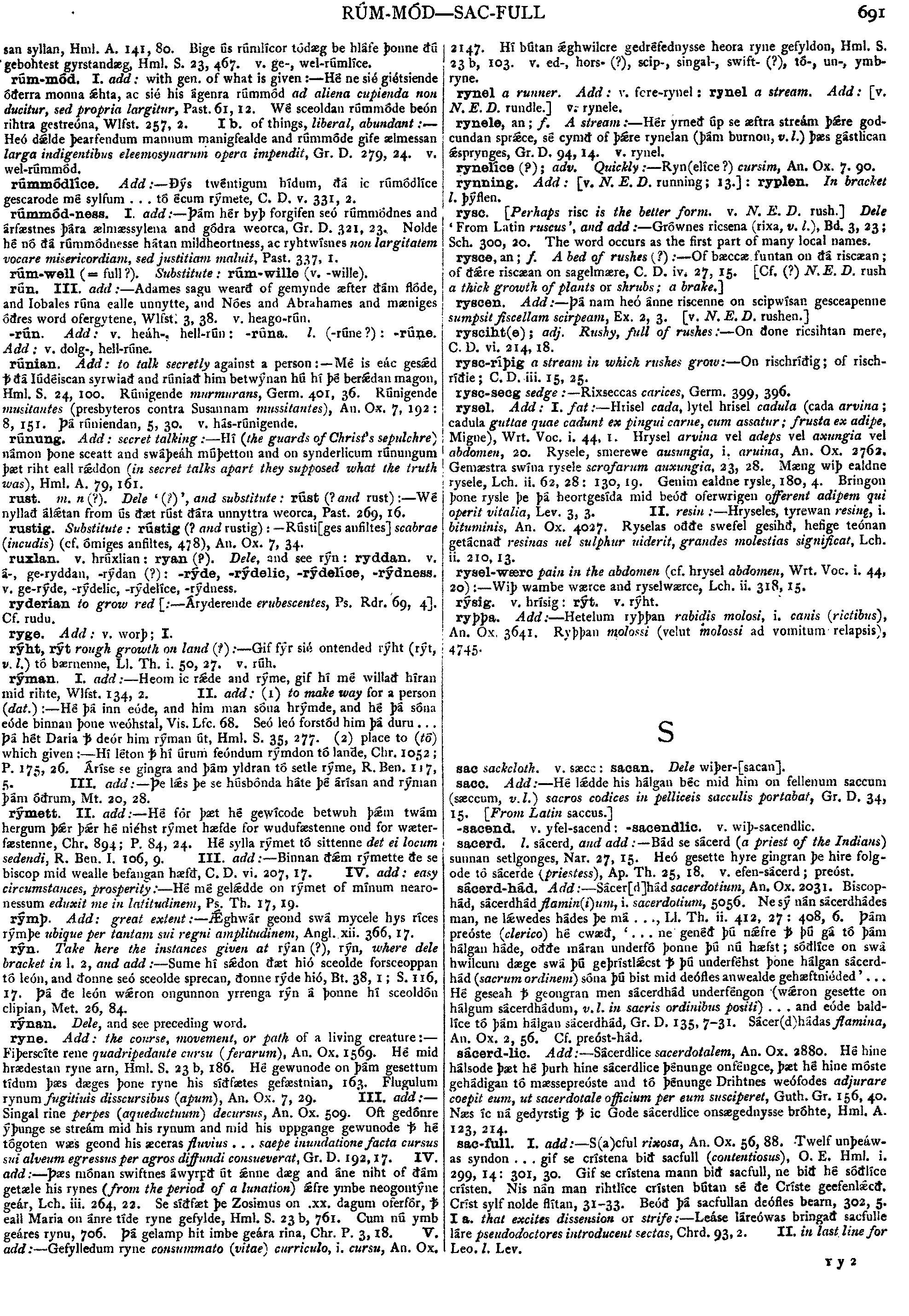
rýmett.
II.
add
:--
Hé
fór
þæt
hé
gewícode
betwuh
þm
twám
hergum
þr
þr
hé
niéhst
rýmet
hæfde
for
wudufæstenne
ond
for
wæterfæstenne,
Chr.
894;
P.
84,
24.
Hé
sylla
rýmet
tó
sittenne
det
ei
locum
sedendi,
R.
Ben.
I.
106,
9.
III.
add
:--
Binnan
ðrn
rýmette
ðe
se
biscop
mid
wealle
befangan
hæfð,
C.
D.
vi.
207,
17.
IV.
add:
easy
circumstances,
prosperity
:--
Hé
mé
geldde
on
rýmet
of
mínum
nearonessum
eduxit
me
in
latitudinem,
Ps.
Th.
17,
19.
|
Source: Bright's OE Grammar, page b0258, entry 4 View original page image as: [TIFF] [PNG] [View previous entry] [View next entry] |
[Comment on this entry] [View comments] |
The following entry has been hand-corrected once. |
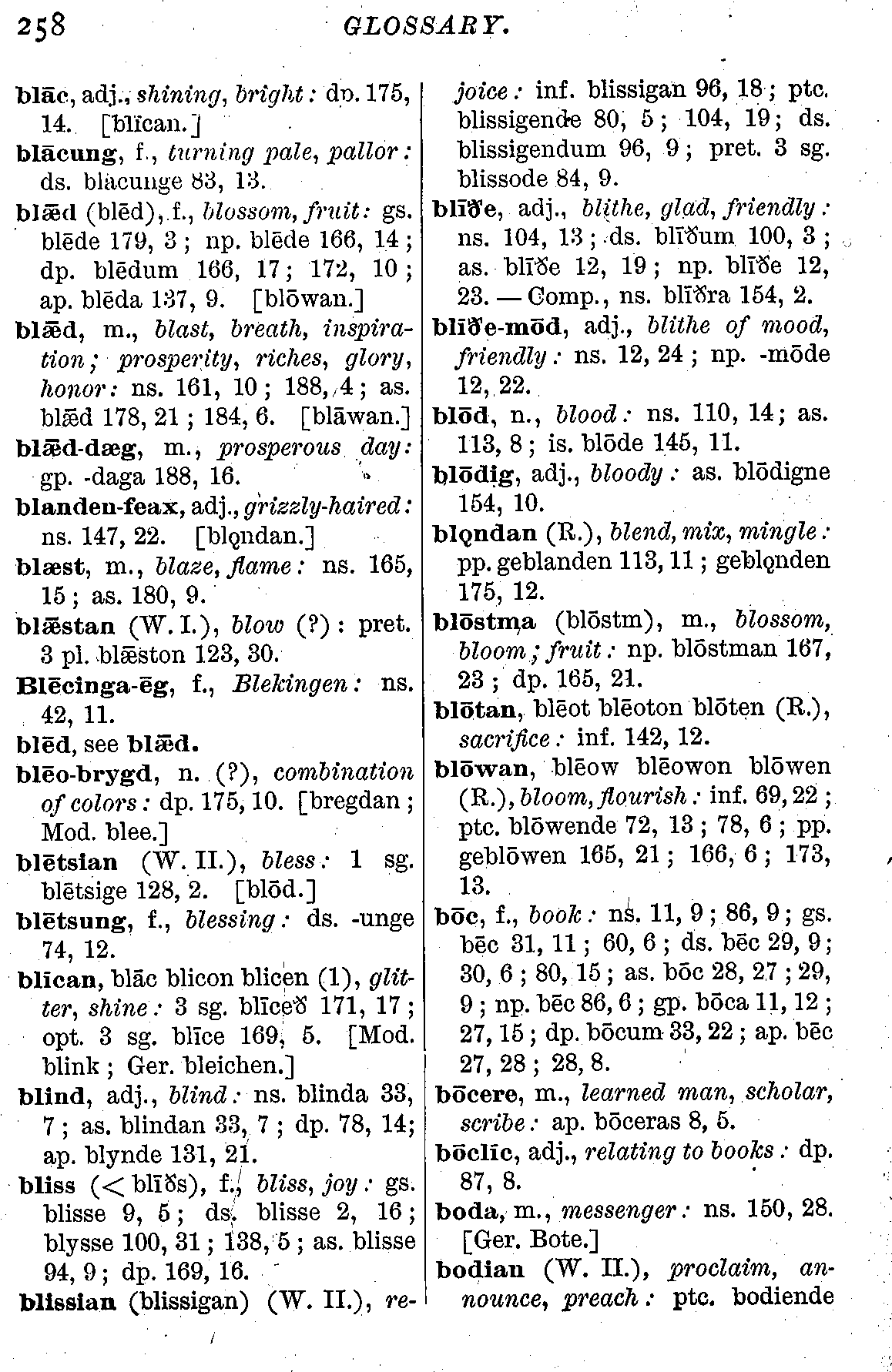
bl d
m
blast,
breath,
inspiration,
prosperity,
riches,
glory,
honor
d
m
blast,
breath,
inspiration,
prosperity,
riches,
glory,
honor
 wan]
wan]
|
Source: Bright's OE Grammar, page b0300, entry 21 View original page image as: [TIFF] [PNG] [View previous entry] [View next entry] |
[Comment on this entry] [View comments] |
The following entry has been hand-corrected once. |
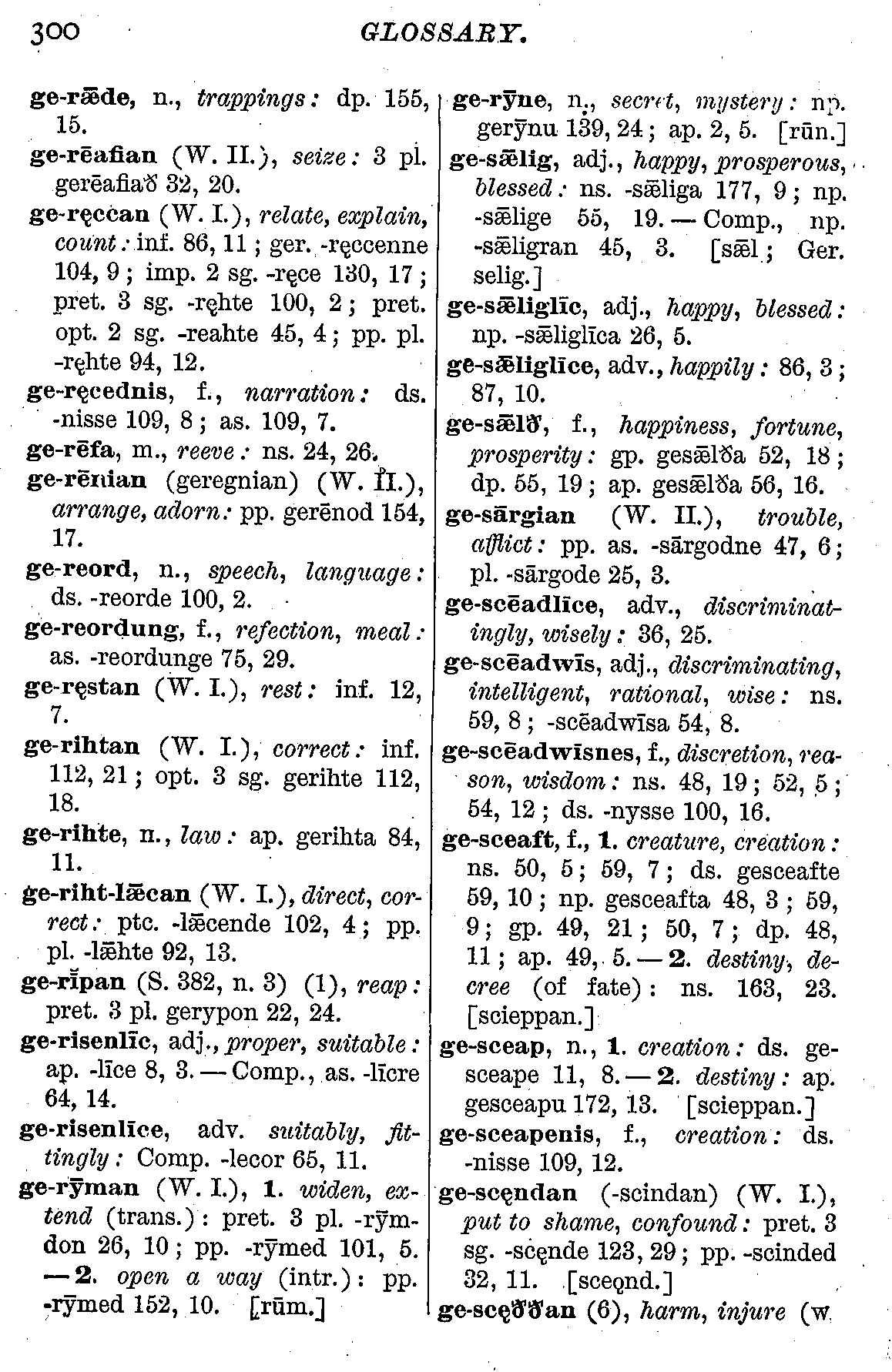
ge-slð
f
happiness,
fortune,
prosperity
|
Source: Bright's OE Grammar, page b0303, entry 1 View original page image as: [TIFF] [PNG] [View previous entry] [View next entry] |
[Comment on this entry] [View comments] |
The following entry has been hand-corrected once. |
| Result Page: |  |
Previous | 1 2 3 4 5 6 7 | Next |  |
Germanic Lexicon Project (main page)
This search system was written by
Sean Crist
Please consider
volunteering
to correct the data in these online dictionaries.
No rights reserved. Feel free to use these data in any way you please.