|
|

Tip: In the search results, you can click on any word or abbreviation for more information.
|
Source: Bosworth/Toller, page b1086, entry 12 View original page image as: [TIFF] [PNG] [View previous entry] [View next entry] |
[Comment on this entry] [View comments] |
The following entry has been hand-corrected once. |
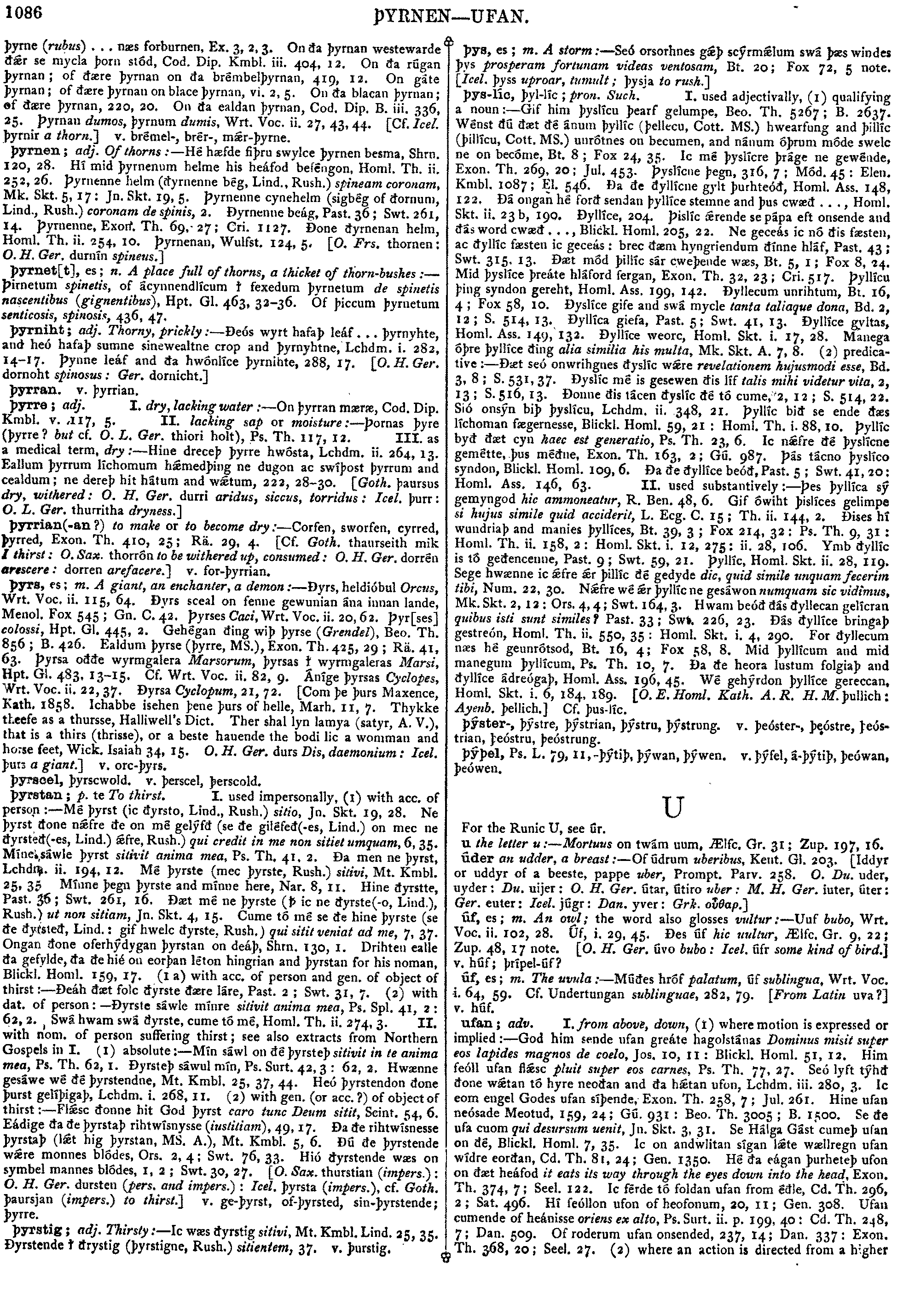
þys-líc,
þyl-líc;
pron.
Such.
I.
used
adjectivally,
(1)
qualifying
a
noun
:--
Gif
him
þyslícu
þearf
gelumpe,
Beo.
Th.
5267;
B.
2637.
Wénst
ðú
ðæt
ðé
ánum
þyllíc
(þellecu,
Cott.
MS.)
hwearfung
and
þillíc
(þillícu,
Cott.
MS.)
unrótnes
on
becumen,
and
nánum
óþrum
móde
swelc
ne
on
becóme,
Bt.
8;
Fox
24,
35.
Ic
mé
þyslícre
þráge
ne
gewénde,
Exon.
Th.
269,
20;
Jul.
453.
Þyslícne
þegn,
316,
7;
Mód.
45:
Elen.
Kmbl.
1087;
El.
546.
Ða
ðe
ðyllícne
gylt
þurhteóð,
Homl.
Ass.
148,
122.
Ðá
ongan
hé
forð
sendan
þyllíce
stemne
and
þus
cwæð...,
Homl.
Skt.
ii.
23
b,
190.
Ðyllíce,
204.
Þislíc
 rende
se
pápa
eft
onsende
and
ðás
word
cwæð...,
Blickl.
Honnl.
205,
22.
Ne
geceás
ic
nó
ðis
fæsten,
ac
ðyllíc
fæsten
ic
geceás:
brec
ðæm
hyngriendum
ðínne
hláf,
Past.
43;
Swt.
315,
13.
Ðæt
mód
þillíc
sár
cweþende
wæs,
Bt.
5,
1;
Fox
8,
24.
Mid
þyslíce
þreáte
hláford
fergan,
Exon.
Th.
32,
23;
Cri.
517.
Þyllícu
þing
syndon
gereht,
Homl.
Ass.
199,
142.
Ðyllecum
unrihtum,
Bt.
16,
4;
Fox
58,
10.
Ðyllíce
gife
and
swá
mycle
tanta
taliaque
dona,
Bd.
2,
12;
S.
514,
13.
Ðyllíca
giefa,
Past.
5;
Swt.
41,
13.
Ðyllíce
gyltas,
Homl.
Ass.
149,
132.
Ðyllíce
weorc,
Homl.
Skt.
i.
17,
28.
Manega
óþre
þyllíce
ðing
alia
similia
his
multa,
Mk.
Skt.
A.
7,
8.
(2)
predicative
:--
Ðæt
seó
onwrihgnes
ðyslíc
wre
revelationem
hujusmodi
esse,
Bd.
3,
8;
S.
531,
37.
Ðyslíc
mé
is
gesewen
ðis
líf
talis
mihi
videtur
vita,
2,
13;
S.
556,
13.
Ðonne
ðis
tácen
ðyllíc
ðé
tó
cume,
2,
12;
S.
514,
22.
Sió
onsýn
biþ
þyslícu,
Lchdm.
ii.
348,
21.
Þyllíc
bið
se
ende
ðæs
líchoman
fægernesse,
Blickl.
Homl.
59,
21:
Homl.
Th.
i.
88,
50.
Þyllíc
byð
ðæt
cyn
haec
est
generatio,
Ps.
Th.
23,
6.
Ic
nfre
ðé
þyslícne
gemétte,
þus
méðne,
Exon.
Th.
163,
2;
Gú.
987.
Þás
tácno
þyslíco
syndon,
Blickl.
Homl.
109,
6.
Ða
ðe
ðyllíce
beóð,
Past.
5;
Swt.
41,
20:
Homl.
Ass.
146,
63.
II.
used
substantively
:--
Þes
þyllíca
sý
gemyngod
hic
ammoneatur,
R.
Ben.
48,
6.
Gif
ówiht
þislíces
gelimpe
si
hujus
simile
quid
acciderit,
L.
Ecg.
C.
15;
Th.
ii.
144,
2.
Ðises
hí
wundriaþ
and
manies
þyllíces,
Bt.
39,
3;
Fox
214,
32:
Ps.
Th.
9,
31:
Homl.
Th.
ii.
158,
2:
Homl.
Skt.
i.
12,
275:
ii.
28,
106.
Ymb
ðyllíc
is
tó
geðencenne,
Past.
9;
Swt.
59,
21.
Þyllíc,
Homl.
Skt.
ii.
28,
119.
Sege
hwænne
ic
fre
r
þillíc
ðé
gedyde
dic,
quid
simile
unquam
fecerim
tibi,
Num.
22,
30.
Nfre
wé
r
þyllíc
ne
gesáwon
numquam
sic
vidimus,
Mk.
Skt.
2,
12:
Ors.
4,
4;
Swt.
164,
3.
Hwam
beóð
ðás
ðyllecan
gelícran
quibus
isti
sunt
similes?
Past.
33;
Swt.
226,
23.
Ðás
ðyllíce
bringaþ
gestreón,
Homl.
Th.
ii.
550,
35:
Homl.
Skt.
i.
4,
290.
For
ðyllecum
næs
hé
geunrótsod,
Bt.
16,
4;
Fox
58,
8.
Mid
þyllícum
and
mid
manegum
þyllícum,
Ps.
Th.
10,
7.
Ða
ðe
heora
lustum
folgiaþ
and
ðyllíce
ádreógaþ,
Homl.
Ass.
196,
45.
Wé
gehýrdon
þyllíce
gereccan.
Homl.
Skt.
i.
6,
184,
189.
[O.
E.
Homl.
Kath.
A.
R.
H.
M.
þullich:
Ayenb.
þellich.]
Cf.
þus-líc.
rende
se
pápa
eft
onsende
and
ðás
word
cwæð...,
Blickl.
Honnl.
205,
22.
Ne
geceás
ic
nó
ðis
fæsten,
ac
ðyllíc
fæsten
ic
geceás:
brec
ðæm
hyngriendum
ðínne
hláf,
Past.
43;
Swt.
315,
13.
Ðæt
mód
þillíc
sár
cweþende
wæs,
Bt.
5,
1;
Fox
8,
24.
Mid
þyslíce
þreáte
hláford
fergan,
Exon.
Th.
32,
23;
Cri.
517.
Þyllícu
þing
syndon
gereht,
Homl.
Ass.
199,
142.
Ðyllecum
unrihtum,
Bt.
16,
4;
Fox
58,
10.
Ðyllíce
gife
and
swá
mycle
tanta
taliaque
dona,
Bd.
2,
12;
S.
514,
13.
Ðyllíca
giefa,
Past.
5;
Swt.
41,
13.
Ðyllíce
gyltas,
Homl.
Ass.
149,
132.
Ðyllíce
weorc,
Homl.
Skt.
i.
17,
28.
Manega
óþre
þyllíce
ðing
alia
similia
his
multa,
Mk.
Skt.
A.
7,
8.
(2)
predicative
:--
Ðæt
seó
onwrihgnes
ðyslíc
wre
revelationem
hujusmodi
esse,
Bd.
3,
8;
S.
531,
37.
Ðyslíc
mé
is
gesewen
ðis
líf
talis
mihi
videtur
vita,
2,
13;
S.
556,
13.
Ðonne
ðis
tácen
ðyllíc
ðé
tó
cume,
2,
12;
S.
514,
22.
Sió
onsýn
biþ
þyslícu,
Lchdm.
ii.
348,
21.
Þyllíc
bið
se
ende
ðæs
líchoman
fægernesse,
Blickl.
Homl.
59,
21:
Homl.
Th.
i.
88,
50.
Þyllíc
byð
ðæt
cyn
haec
est
generatio,
Ps.
Th.
23,
6.
Ic
nfre
ðé
þyslícne
gemétte,
þus
méðne,
Exon.
Th.
163,
2;
Gú.
987.
Þás
tácno
þyslíco
syndon,
Blickl.
Homl.
109,
6.
Ða
ðe
ðyllíce
beóð,
Past.
5;
Swt.
41,
20:
Homl.
Ass.
146,
63.
II.
used
substantively
:--
Þes
þyllíca
sý
gemyngod
hic
ammoneatur,
R.
Ben.
48,
6.
Gif
ówiht
þislíces
gelimpe
si
hujus
simile
quid
acciderit,
L.
Ecg.
C.
15;
Th.
ii.
144,
2.
Ðises
hí
wundriaþ
and
manies
þyllíces,
Bt.
39,
3;
Fox
214,
32:
Ps.
Th.
9,
31:
Homl.
Th.
ii.
158,
2:
Homl.
Skt.
i.
12,
275:
ii.
28,
106.
Ymb
ðyllíc
is
tó
geðencenne,
Past.
9;
Swt.
59,
21.
Þyllíc,
Homl.
Skt.
ii.
28,
119.
Sege
hwænne
ic
fre
r
þillíc
ðé
gedyde
dic,
quid
simile
unquam
fecerim
tibi,
Num.
22,
30.
Nfre
wé
r
þyllíc
ne
gesáwon
numquam
sic
vidimus,
Mk.
Skt.
2,
12:
Ors.
4,
4;
Swt.
164,
3.
Hwam
beóð
ðás
ðyllecan
gelícran
quibus
isti
sunt
similes?
Past.
33;
Swt.
226,
23.
Ðás
ðyllíce
bringaþ
gestreón,
Homl.
Th.
ii.
550,
35:
Homl.
Skt.
i.
4,
290.
For
ðyllecum
næs
hé
geunrótsod,
Bt.
16,
4;
Fox
58,
8.
Mid
þyllícum
and
mid
manegum
þyllícum,
Ps.
Th.
10,
7.
Ða
ðe
heora
lustum
folgiaþ
and
ðyllíce
ádreógaþ,
Homl.
Ass.
196,
45.
Wé
gehýrdon
þyllíce
gereccan.
Homl.
Skt.
i.
6,
184,
189.
[O.
E.
Homl.
Kath.
A.
R.
H.
M.
þullich:
Ayenb.
þellich.]
Cf.
þus-líc.
|
Source: Bosworth/Toller, page b1094, entry 7 View original page image as: [TIFF] [PNG] [View previous entry] [View next entry] |
[Comment on this entry] [View comments] |
The following entry has been hand-corrected once. |
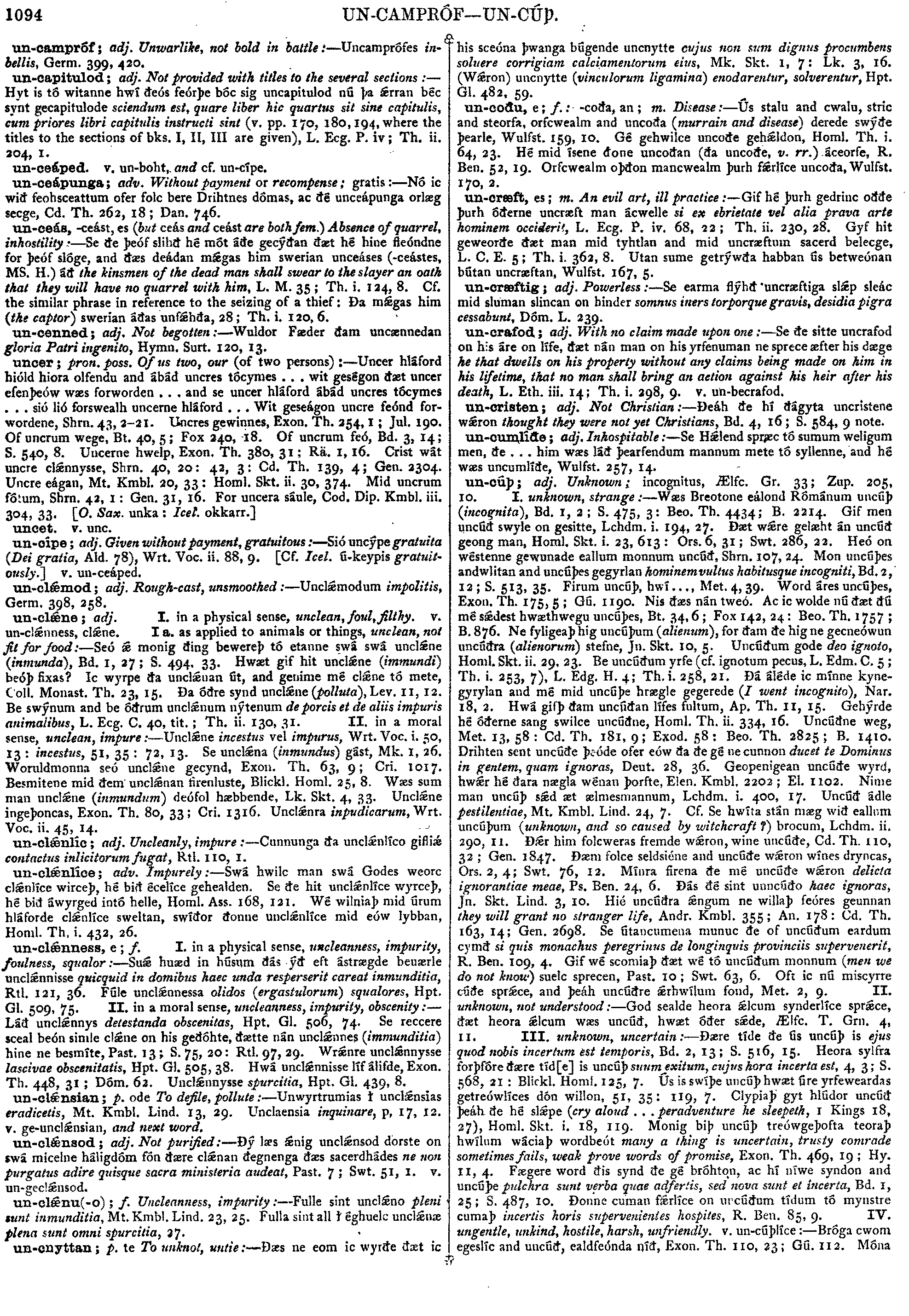
uncer;
pron.
poss.
Of
us
two,
our
(of
two
persons)
:--
Uncer
hláford
hióld
hiora
olfendu
and
ábád
uncres
tócymes
...
wit
geségon
ðæt
uncer
efenþeów
wæs
forworden
...
and
se
uncer
hláford
ábád
uncres
tócymes
...
sió
lió
forswealh
uncerne
hláford
...
Wit
geseágon
uncre
feónd
forwordene,
Shrn.
43,
2-21.
Uncres
gewinnes,
Exon.
Th.
254,
1;
Jul.
190.
Of
uncrum
wege,
Bt.
40,
5;
Fox
240,
18.
Of
uncrum
feó,
Bd.
3,
14;
S.
540,
8.
Uncerne
hwelp,
Exon.
Th.
380,
31;
Rä.
1,
16.
Crist
wát
uncre
clnnysse,
Shrn.
40,
20:
42,
3:
Cd.
Th.
139,
4;
Gen.
2304.
Uncre
eágan,
Mt.
Kmbl.
20,
33:
Homl.
Skt.
ii.
30,
374.
Mid
uncrum
fótum,
Shrn.
42,
1:
Gen.
31,
16.
For
uncera
sáule,
Cod.
Dip.
Kmbl.
iii.
304,
33.
[O.
Sax.
unka:
Icel.
okkarr.]
|
Source: Bosworth/Toller, page b1143, entry 5 View original page image as: [TIFF] [PNG] [View previous entry] [View next entry] |
[Comment on this entry] [View comments] |
The following entry has been hand-corrected once. |
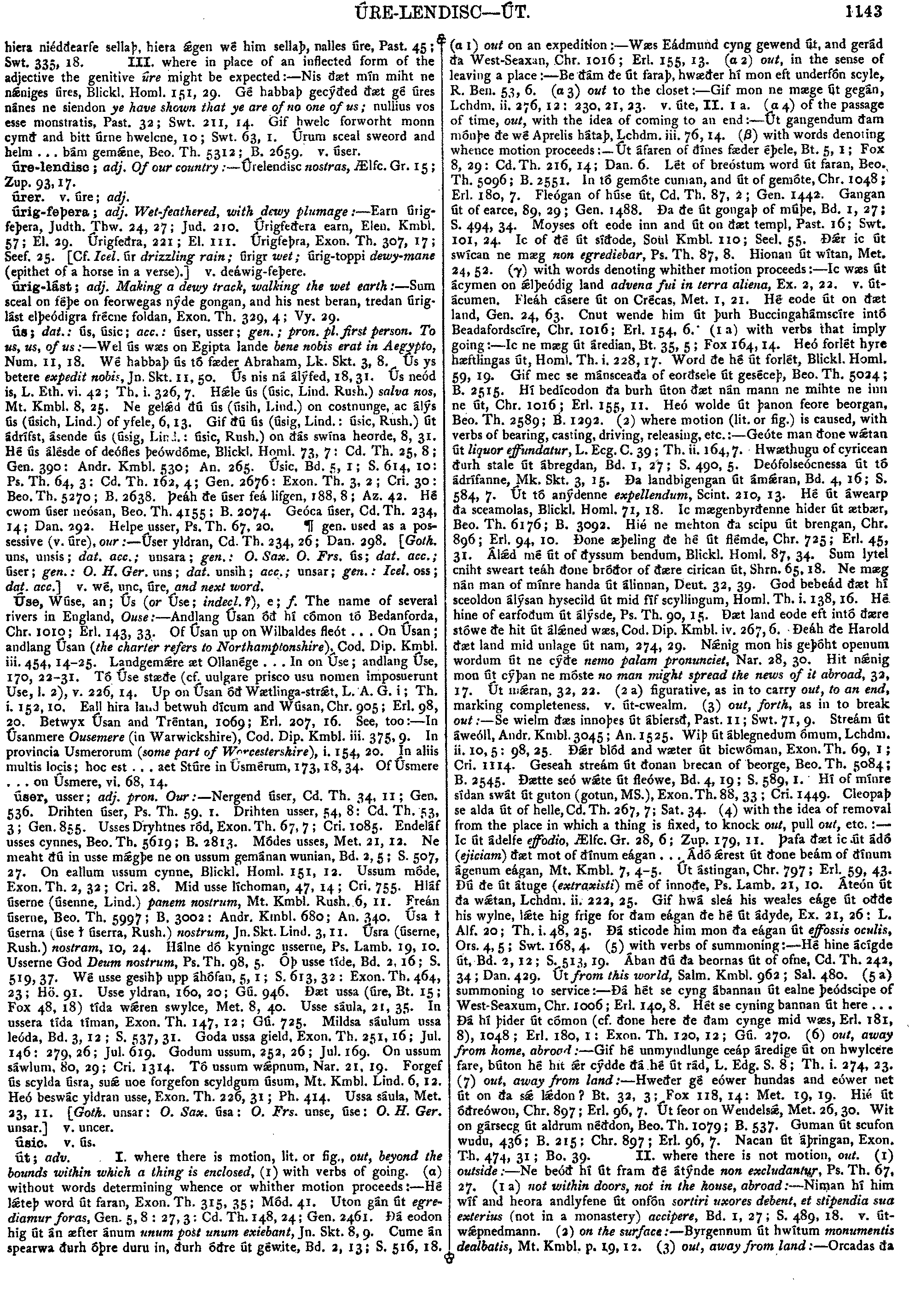
ús;
dat.:
ús,
úsic;
acc.:
úser,
usser;
gen.;
pron.
pl.
first
person.
To
us,
us,
of
us
:--
Wel
ús
wæs
on
Egipta
lande
bene
nobis
erat
in
Aegypto,
Num.
11,
18.
Wé
habbaþ
ús
tó
fæder
Abraham,
Lk.
Skt.
3,
8.
Ús
ys
betere
expedit
nobis,
Jn.
Skt.
11,
50.
Ús
nis
ná
álýfed,
18,
31.
Ús
neód
is,
L.
Eth.
vi.
42;
Th.
i.
326,
7.
Hle
ús
(úsic,
Lind.
Rush.)
salva
nos,
Mt.
Kmbl.
8,
25.
Ne
gelfd
ðú
ús
(úsih,
Lind.)
on
costnunge,
ac
álýs
ús
(úsich,
Lind.)
of
yfele,
6,
13.
Gif
ðú
ús
(úsig,
Lind.:
úsic,
Rush.)
út
ádrífst,
ásende
ús
(úsig,
Lind.:
úsic,
Rush.)
on
ðás
swína
heorde,
8,
31.
Hé
ús
álésde
of
deófles
þeówdóme,
Blickl.
Homl.
73,
7:
Cd.
Th.
25,
8;
Gen.
390:
Andr.
Kmbl.
530;
An.
265.
Úsic,
Bd.
5,
1;
S.
614,
10:
Ps.
Th.
64,
3:
Cd.
Th.
162,
4;
Gen.
2676:
Exon.
Th.
3,
2;
Cri.
30:
Beo.
Th.
5270;
B.
2638.
Þeáh
ðe
úser
feá
lifgen,
188,
8;
Az.
42.
Hé
cwom
úser
neósan,
Beo.
Th.
4155;
B.
2074.
Geóca
úser,
Cd.
Th.
234,
|
Source: Bosworth/Toller, page b1143, entry 8 View original page image as: [TIFF] [PNG] [View previous entry] [View next entry] |
[Comment on this entry] [View comments] |
The following entry has been hand-corrected once. |
úser,
usser;
adj.
pron.
Our
:--
Nergend
úser,
Cd.
Th.
34,
11;
Gen.
536.
Drihten
úser,
Ps.
Th.
59,
1.
Drihten
usser,
54,
8:
Cd.
Th.
53,
3;
Gen.
855.
Usses
Dryhtnes
ród,
Exon.
Th.
67,
7;
Cri.
1085.
Endeláf
usses
cynnes,
Beo.
Th.
5619;
B.
2813.
Módes
usses,
Met.
21,
12.
Ne
meaht
ðú
in
usse
mgþe
ne
on
ussum
gemánan
wunian,
Bd.
2,
5;
S.
507,
27,
On
eallum
ussum
cynne,
Blickl.
Homl.
151,
12.
Ussum
móde,
Exon.
Th.
2,
32;
Cri.
28.
Mid
usse
líchoman,
47,
14;
Cri.
755.
Hláf
úserne
(úsenne,
Lind.)
panem
nostrum,
Mt.
Kmbl.
Rush.
6,
11.
Freán
úserne,
Beo.
Th.
5997;
B.
3002:
Andr.
Kmbl.
680;
An.
340.
Úsa
 úserna
(úse
úserra,
Rush.)
nostrum,
Jn.
Skt.
Lind.
3,
11.
Úsra
(úserne,
Rush.)
nostram,
10,
24.
Hálne
dó
kyningc
usserne,
Ps.
Lamb.
19,
10.
Usserne
God
Deum
nostrum,
Ps.
Th.
98,
5.
Óþ
usse
tóde,
Bd.
2,
16;
S.
519,
37.
Wé
usse
gesihþ
upp
áhófan,
5,
1;
S.
613,
32:
Exon.
Th.
464,
23;
Hö.
91.
Usse
yldran,
160,
20;
Gú.
946.
Ðæt
ussa
(úre,
Bt.
15;
Fox
48,
18)
tída
wren
swylce,
Met.
8,
40.
Usse
sáula,
21,
35.
In
ussera
tída
timan,
Exon.
Th.
147,
12;
Gú.
725.
Mildsa
sáulum
ussa
leóda,
Bd.
3,
12;
S.
537,
31.
Goda
ussa
gield,
Exon.
Th.
252,
16;
Jul.
146:
279,
26;
Jul.
619.
Godum
ussum,
252,
26;
Jul.
169.
On
ussum
sáwlum,
80,
29;
Cri.
1314.
Tó
ussum
wpnum,
Nar.
21,
19.
Forgef
ús
scylda
úsra,
su
uoe
forgefon
scyldgum
úsum,
Mt.
Kmbl.
Lind.
6,
12.
Heó
beswác
yldran
usse,
Exon.
Th.
226,
31;
Ph.
414.
Ussa
sáula,
Met.
23,
11.
[Goth.
unsar:
O.
Sax.
úsa:
O.
Frs.
unse,
úse:
O.
H.
Ger.
unsar.]
v.
uncer.
úserna
(úse
úserra,
Rush.)
nostrum,
Jn.
Skt.
Lind.
3,
11.
Úsra
(úserne,
Rush.)
nostram,
10,
24.
Hálne
dó
kyningc
usserne,
Ps.
Lamb.
19,
10.
Usserne
God
Deum
nostrum,
Ps.
Th.
98,
5.
Óþ
usse
tóde,
Bd.
2,
16;
S.
519,
37.
Wé
usse
gesihþ
upp
áhófan,
5,
1;
S.
613,
32:
Exon.
Th.
464,
23;
Hö.
91.
Usse
yldran,
160,
20;
Gú.
946.
Ðæt
ussa
(úre,
Bt.
15;
Fox
48,
18)
tída
wren
swylce,
Met.
8,
40.
Usse
sáula,
21,
35.
In
ussera
tída
timan,
Exon.
Th.
147,
12;
Gú.
725.
Mildsa
sáulum
ussa
leóda,
Bd.
3,
12;
S.
537,
31.
Goda
ussa
gield,
Exon.
Th.
252,
16;
Jul.
146:
279,
26;
Jul.
619.
Godum
ussum,
252,
26;
Jul.
169.
On
ussum
sáwlum,
80,
29;
Cri.
1314.
Tó
ussum
wpnum,
Nar.
21,
19.
Forgef
ús
scylda
úsra,
su
uoe
forgefon
scyldgum
úsum,
Mt.
Kmbl.
Lind.
6,
12.
Heó
beswác
yldran
usse,
Exon.
Th.
226,
31;
Ph.
414.
Ussa
sáula,
Met.
23,
11.
[Goth.
unsar:
O.
Sax.
úsa:
O.
Frs.
unse,
úse:
O.
H.
Ger.
unsar.]
v.
uncer.
|
Source: Bosworth/Toller, page b1170, entry 16 View original page image as: [TIFF] [PNG] [View previous entry] [View next entry] |
[Comment on this entry] [View comments] |
The following entry has been hand-corrected once. |
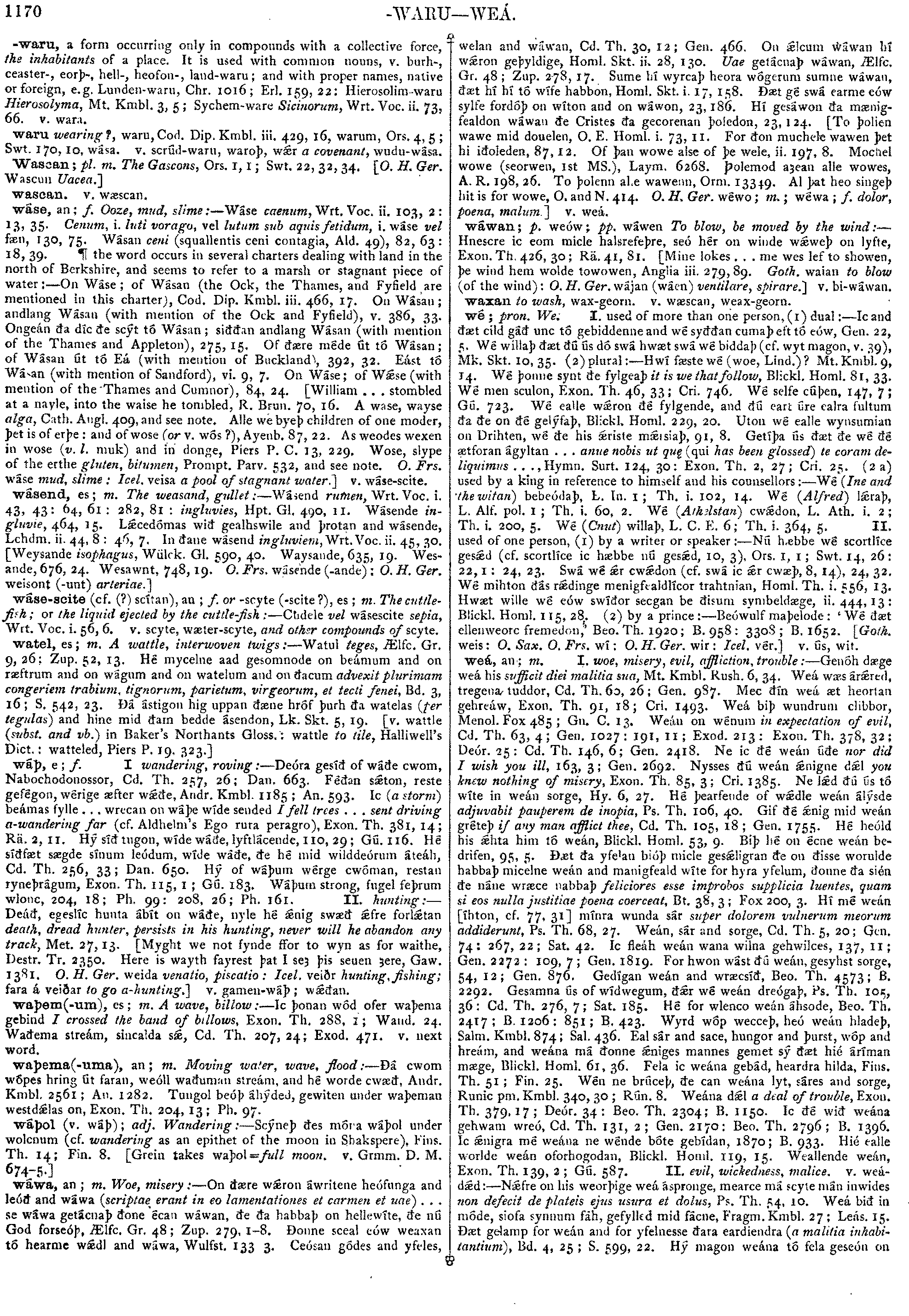
wé
;
pron.
We.
I.
used
of
more
than
one
person,
(1)
dual
:--
Ic
and
ðæt
cild
gáð
unc
tó
gebiddenne
and
wé
syððan
cumaþ
eft
tó
eów,
Gen.
22,
5.
Wé
willaþ
ðæt
ðú
ús
dó
swá
hwæt
swá
wé
biddaþ
(cf.
wyt
magon,
v.
39),
Mk.
Skt.
10,
35.
(2)
plural
:--
Hwí
fæste
wé
(woe,
Lind.)?
Mt.
Kmbl.
9,
14.
Wé
þonne
synt
ðe
fylgeaþ
it
is
we
that
follow,
Blickl.
Homl.
81,
33.
Wé
men
sculon,
Exon.
Th.
46,
33;
Cri.
746.
Wé
selfe
cúþen,
147,
7;
Gú.
723.
Wé
ealle
wron
ðé
fylgende,
and
ðú
eart
úre
ealra
fultum
ða
ðe
on
ðé
gelýfaþ,
Blickl.
Homl.
229,
20.
Uton
wé
ealle
wynsumian
on
Drihten,
wé
ðe
his
riste
ILLEGIBLE,
91,
8:
Getíþa
ús
ðæt
ðe
wé
ðé
ætforan
ágyltan
.
.
.
anue
nobis
ut
quê
(qui
has
been
glossed)
te
coram
de liquimus.
.
.,
Hymn.
Surt.
124,
30:
Exon.
Th.
2,
27;
Cri.
25.
(2
a)
used
by
a
king
in
reference
to
himself
and
his
counsellors
:--
Wé
(Ine
and
the
witan)
bebeódaþ,
L.
In.
1;
Th.
i.
102,
14.
Wé
(Alfred)
lraþ,
L.
Alf.
pol.
1;
Th.
i.
60,
2.
Wé
(Athelstan)
cwdon,
L.
Ath.
i.
2
;
Th.
i.
200,
5.
Wé
(Cnut)
willaþ,
L.
C.
E.
6;
Th.
i.
364,
5.
II.
used
of
one
person,
(1)
by
a
writer
or
speaker
:--
Nú
ILLEGIBLE
wé
scortlíce
gesd
(cf.
Scortlíce
ic
hæbbe
nú
gesd,
10,
3),
Ors.
1,1;
Swt.
14,
26:
22,
1:
24,
23.
Swá
wé
r
cwdon
(cf.
swá
ic
r
cwæþ,
8,
14),
24,
32.
Wé
mihton
ðás
rdinge
menigfealdlícor
trahtnian,
Homl.
Th.
i.
556,
13.
Hwæt
wille
wé
eów
swíðor
secgan
be
ðisum
symbeldæge,
ii.
444,
13:
Blickl.
Homl.
115,
28.
(2)
by
a
prince
:--
Beówulf
maþelode
:
'
Wé
ðæt
ellenweorc
fremedon',
Beo.
Th.
1920;
B.
958:
3308;
B.
1652.
[Goth.
weis:
O.
Sax.
O.
Frs.
wí:
O.
H.
Ger.
wir:
Icel.
vér.]
v.
ús,
wit.]
liquimus.
.
.,
Hymn.
Surt.
124,
30:
Exon.
Th.
2,
27;
Cri.
25.
(2
a)
used
by
a
king
in
reference
to
himself
and
his
counsellors
:--
Wé
(Ine
and
the
witan)
bebeódaþ,
L.
In.
1;
Th.
i.
102,
14.
Wé
(Alfred)
lraþ,
L.
Alf.
pol.
1;
Th.
i.
60,
2.
Wé
(Athelstan)
cwdon,
L.
Ath.
i.
2
;
Th.
i.
200,
5.
Wé
(Cnut)
willaþ,
L.
C.
E.
6;
Th.
i.
364,
5.
II.
used
of
one
person,
(1)
by
a
writer
or
speaker
:--
Nú
ILLEGIBLE
wé
scortlíce
gesd
(cf.
Scortlíce
ic
hæbbe
nú
gesd,
10,
3),
Ors.
1,1;
Swt.
14,
26:
22,
1:
24,
23.
Swá
wé
r
cwdon
(cf.
swá
ic
r
cwæþ,
8,
14),
24,
32.
Wé
mihton
ðás
rdinge
menigfealdlícor
trahtnian,
Homl.
Th.
i.
556,
13.
Hwæt
wille
wé
eów
swíðor
secgan
be
ðisum
symbeldæge,
ii.
444,
13:
Blickl.
Homl.
115,
28.
(2)
by
a
prince
:--
Beówulf
maþelode
:
'
Wé
ðæt
ellenweorc
fremedon',
Beo.
Th.
1920;
B.
958:
3308;
B.
1652.
[Goth.
weis:
O.
Sax.
O.
Frs.
wí:
O.
H.
Ger.
wir:
Icel.
vér.]
v.
ús,
wit.]
|
Source: Bosworth/Toller, page b1186, entry 11 View original page image as: [TIFF] [PNG] [View previous entry] [View next entry] |
[Comment on this entry] [View comments] |
The following entry has been hand-corrected once. |
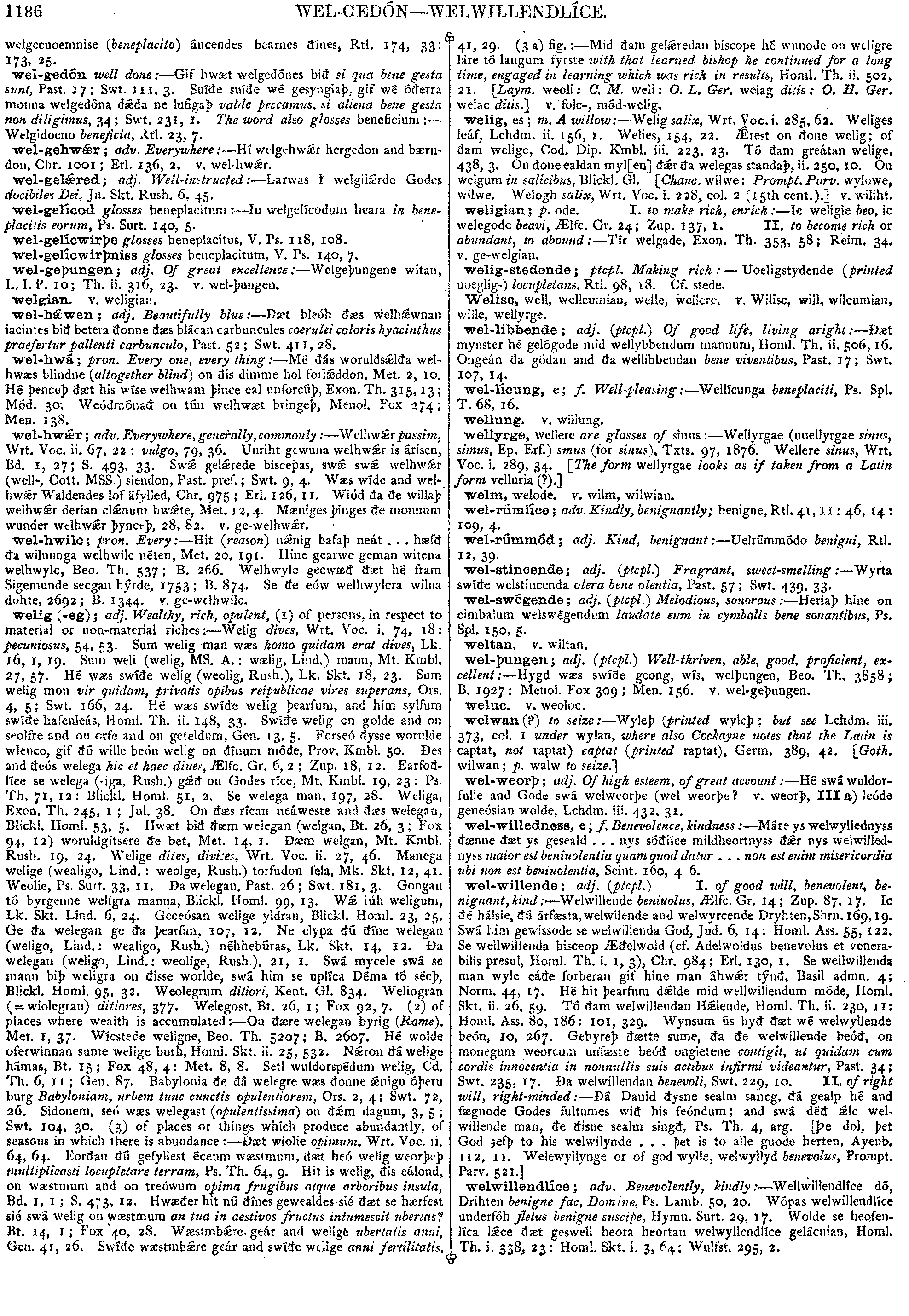
wel-hwá
pron.
Every
one,
every
thing:--Mé
ðás
woruldslða
welhwæs
blindne
(altogether
blind)
on
ðis
dimme
hol
forlddon,
Met.
2,
10.
Hé
þenceþ
ðæt
his
wíse
welhwam
þince
eal
unforcúþ,
Exon.
Th.
315,
13;
Mód.
30;
Weódmónað
on
tún
welhwæt
bringeþ,
Menol.
Fox
274;
Men.
138.
|
Source: Bosworth/Toller, page b1186, entry 13 View original page image as: [TIFF] [PNG] [View previous entry] [View next entry] |
[Comment on this entry] [View comments] |
The following entry has been hand-corrected once. |
wel-hwilc;
pron.
Every:--Hit
(reason)
nnig
hafaþ
neát
.
.
.
hæfð
ða
wilnunga
welhwilc
néten,
Met.
20,
191.
Hine
gearwe
geman
witena
welhwylc,
Beo.
Th.
537;
B.
266.
Welhwylc
gecwæð
ðæt
hé
fram
Sigemunde
secgan
hýrde,
1753;
B.
874.
Se
ðe
eów
welhwylcra
wilna
dohte,
2692;
B.
1344.
v.
ge-welhwilc.
|
Source: Bosworth/Toller, page b1187, entry 16 View original page image as: [TIFF] [PNG] [View previous entry] [View next entry] |
[Comment on this entry] [View comments] |
The following entry has been hand-corrected once. |
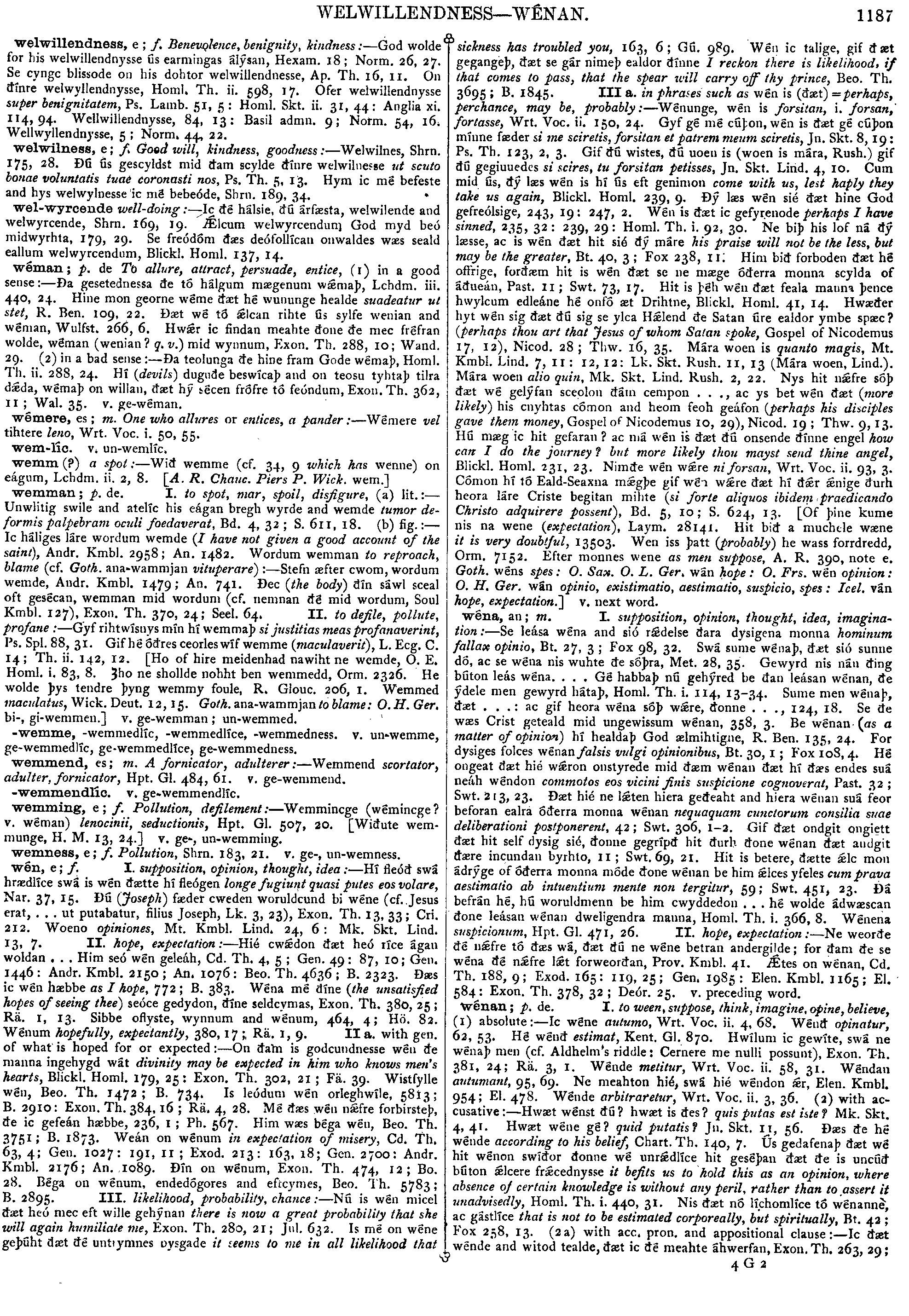
wénan;
p.
de.
I.
to
ween,
suppose,
think,
imagine,
opine,
believe,
(1)
absolute:--Ic
wéne
autumo,
Wrt.
Voc.
ii.
4,
68.
Wénð
opinatur,
62,
53.
Hé
wénð
estimat,
Kent.
Gl.
870.
Hwílum
ic
gewíte,
swá
ne
wénaþ
men
(cf.
Aldhelm's
riddle:
Cernere
me
nulli
possunt),
Exon.
Th.
381,
24;
Rä.
3,
1.
Wénde
metitur,
Wrt.
Voc.
ii.
58,
31.
Wéndan
autumant,
95,
69.
Ne
meahton
hié,
swá
hié
wéndon
r,
Elen.
Kmbl.
954;
El.
478.
Wénde
arbitraretur,
Wrt.
Voc.
ii.
3,
36.
(2)
with
accusative:--Hwæt
wénst
ðú?
hwæt
is
ðes?
quis
putas
est
iste?
Mk.
Skt.
4,
41.
Hwæt
wéne
gé?
quid
putatis?
Jn.
Skt.
11,
56.
Ðæs
ðe
hé
wénde
according
to
his
belief,
Chart.
Th.
140,
7.
Ús
gedafenaþ
ðæt
wé
hit
wénon
swíðor
ðonne
wé
unrdlíce
hit
geséþan
ðæt
ðe
is
uncúð
búton
lcere
frcednysse
it
befits
us
to
hold
this
as
an
opinion,
where
absence
of
certain
knowledge
is
without
any
peril,
rather
than
to
assert
it
unadvisedly,
Homl.
Th.
i.
440,
31.
Nis
ðæt
nó
líchomlíce
tó
wénanne,
ac
gástlíce
that
is
not
to
be
estimated
corporeally,
but
spiritually,
Bt.
42;
Fox
258,
13.
(2
a)
with
acc.
pron.
and
appositional
clause:--Ic
ðæt
wénde
and
witod
tealde,
ðæt
ic
ðé
meahte
áhwerfan,
Exon.
Th.
263,
29;
|
Source: Bosworth/Toller, page b1188, entry 1 View original page image as: [TIFF] [PNG] [View previous entry] [View next entry] |
[Comment on this entry] [View comments] |
The following entry has been hand-corrected once. |
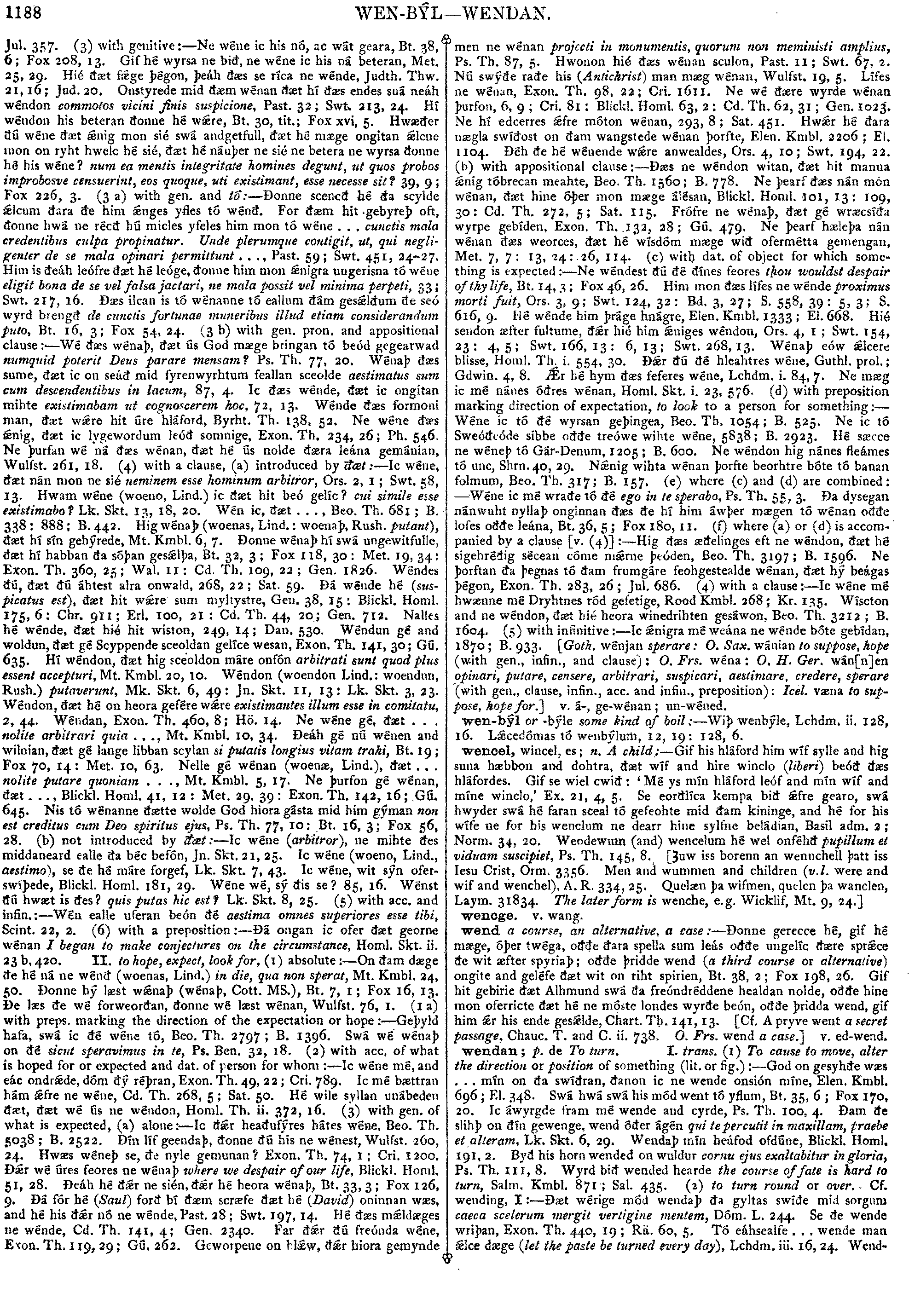
Jul.
357.
(3)
with
genitive:--
Ne
wéne
ic
his
nó,
ac
wát
geara,
Bt.
38,
6;
Fox
208,
13.
Gif
hé
wyrsa
ne
bið,
ne
wéne
ic
his
ná
beteran,
Met.
25,
29.
Hié
ðæt
fge
þégon,
þeáh
ðæs
se
ríca
ne
wénde,
Judth.
Thw.
21,
16;
Jud.
20.
Onstyrede
mid
ðæm
wénan
ðæt
hí
ðæs
endes
suá
neáh
wéndon
commotos
vicini
finis
suspicione,
Past.
32;
Swt.
213,
24.
Hí
wéndon
his
beteran
ðonne
hé
wre,
Bt.
30,
tit.;
Fox
xvi,
5.
Hwæðer
ðú
wéne
ðæt
nig
mon
sié
swá
andgetfull,
ðæt
hé
mæge
ongitan
lcne
mon
on
ryht
hwelc
hé
sié,
ðæt
hé
náuþer
ne
sié
ne
betera
ne
wyrsa
ðonne
hé
his
wéne?
num
ea
mentis
integritate
homines
degunt,
ut
quos
probos
improbosve
censuerint,
eos
quoque,
uti
existimant,
esse
necesse
sit?
39,
9;
Fox
226,
3.
(3
a)
with
gen.
and
tó:--Ðonne
scencð
hé
ða
scylde
lcum
ðara
ðe
him
nges
yfles
tó
wénð.
For
ðæm
hit
gebyreþ
oft,
ðonne
hwá
ne
récð
hú
micles
yfeles
him
mon
tó
wéne
.
.
.
cunctis
mala
credentibus
culpa
propinatur.
Unde
plerumque
contigit,
ut,
qui
negligenter
de
se
mala
opinari
permittunt
.
.
.,
Past.
59;
Swt.
451,
24-27.
Him
is
ðeáh
leófre
ðæt
hé
leóge,
ðonne
him
mon
nigra
ungerisna
tó
wéne
eligit
bona
de
se
vel
falsa
jactari,
ne
mala
possit
vel
minima
perpeti,
33;
Swt.
217,
16.
Ðæs
ilcan
is
tó
wénanne
tó
eallum
ðám
geslðum
ðe
seó
wyrd
brengð
de
cunctis
fortunae
muneribus
illud
etiam
considerandum
puto,
Bt.
16,
3;
Fox
54,
24.
(3
b)
with
gen.
pron.
and
appositional
clause:--Wé
ðæs
wénaþ,
ðæt
ús
God
mæge
bringan
tó
beód
gegearwad
numquid
poterit
Deus
parare
mensam?
Ps.
Th.
77,
20.
Wénaþ
ðæs
sume,
ðæt
ic
on
seáð
mid
fyrenwyrhtum
feallan
sceolde
aestimatus
sum
cum
descendentibus
in
lacum,
87,
4.
Ic
ðæs
wénde,
ðæt
ic
ongitan
mihte
existimabam
ut
cognoscerem
hoc,
72,
13.
Wénde
ðæs
formoni
man,
ðæt
wre
hit
úre
hláford,
Byrht.
Th.
138,
52.
Ne
wéne
ðæs
nig,
ðæt
ic
lygewordum
leóð
somnige,
Exon.
Th.
234,
26;
Ph.
546.
Ne
þurfan
wé
ná
ðæs
wénan,
ðæt
hé
ús
nolde
ðæra
leána
gemánian,
Wulfst.
261,
18.
(4)
with
a
clause,
(a)
introduced
by
ðæt:--Ic
wéne,
ðæt
nán
mon
ne
sié
neminem
esse
hominum
arbitror,
Ors.
2,
1;
Swt.
58,
13.
Hwam
wéne
(woeno,
Lind.)
ic
ðæt
hit
beó
gelíc?
cui
simile
esse
existimabo?
Lk.
Skt.
13,
18,
20.
Wén
ic,
ðæt
.
.
.,
Beo.
Th.
681;
B.
338:
888;
B.
442.
Hig
wénaþ
(woenas,
Lind.:
woenaþ,
Rush.
putant),
ðæt
hí
sín
gehýrede,
Mt.
Kmbl.
6,
7.
Ðonne
wénaþ
hí
swá
ungewitfulle,
ðæt
hí
habban
ða
sóþan
geslþa,
Bt.
32,
3;
Fox
118,
30:
Met.
19,
34:
Exon.
Th.
360,
25;
Wal.
11:
Cd.
Th.
109,
22;
Gen.
1826.
Wéndes
ðú,
ðæt
ðú
áhtest
alra
onwald,
268,
22;
Sat.
59.
Ðá
wénde
hé
(suspicatus
est),
ðæt
hit
wre
sum
myltystre,
Gen.
38,
15:
Blickl.
Homl.
175,
6:
Chr.
911;
Erl.
100,
21:
Cd.
Th.
44,
20;
Gen.
712.
Nalles
hé
wénde,
ðæt
hié
hit
wiston,
249,
14;
Dan.
530.
Wéndun
gé
and
woldun,
ðæt
gé
Scyppende
sceoldan
gelíce
wesan,
Exon.
Th.
141,
30;
Gú.
635.
Hí
wéndon,
ðæt
hig
sceoldon
máre
onfón
arbitrati
sunt
quod
plus
essent
accepturi,
Mt.
Kmbl.
20,
10.
Wéndon
(woendon
Lind.:
woendun,
Rush.)
putaverunt,
Mk.
Skt.
6,
49:
Jn.
Skt.
11,
13:
Lk.
Skt.
3,
23.
Wéndon,
ðæt
hé
on
heora
gefére
wre
existimantes
illum
esse
in
comitatu,
2,
44.
Wéndan,
Exon.
Th.
460,
8;
Hö.
14.
Ne
wéne
gé,
ðæt
.
.
.
nolite
arbitrari
quia
.
.
.,
Mt.
Kmbl.
10,
34.
Ðeáh
gé
nú
wénen
and
wilnian,
ðæt
gé
lange
libban
scylan
si
putatis
longius
vitam
trahi,
Bt.
19;
Fox
70,
14:
Met.
10,
63.
Nelle
gé
wénan
(woenæ,
Lind.),
ðæt
.
.
.
nolite
putare
quoniam
.
.
.,
Mt.
Kmbl.
5,
17.
Ne
þurfon
gé
wénan,
ðæt
.
.
.,
Blickl.
Homl.
41,
12:
Met.
29,
39:
Exon.
Th.
142,
16;
Gú.
645.
Nis
tó
wénanne
ðætte
wolde
God
hiora
gásta
mid
him
gýman
non
est
creditus
cum
Deo
spiritus
ejus,
Ps.
Th.
77,
10:
Bt.
16,
3;
Fox
56,
28.
(b)
not
introduced
by
ðæt:--Ic
wéne
(arbitror),
ne
mihte
ðes
middaneard
ealle
ða
béc
befón,
Jn.
Skt.
21,
25.
Ic
wéne
(woeno,
Lind.,
aestimo),
se
ðe
hé
máre
forgef,
Lk.
Skt.
7,
43.
Ic
wéne,
wit
sýn
oferswíþede,
Blickl.
Homl.
181,
29.
Wéne
wé,
sý
ðis
se?
85,
16.
Wénst
ðú
hwæt
is
ðes?
quis
putas
hic
est?
Lk.
Skt.
8,
25.
(5)
with
acc.
and
infin.:--Wén
ealle
uferan
beón
ðé
aestima
omnes
superiores
esse
tibi,
Scint.
22,
2.
(6)
with
a
preposition:--Ðá
ongan
ic
ofer
ðæt
georne
wénan
I
began
to
make
conjectures
on
the
circumstance,
Homl.
Skt.
ii.
23
b,
420.
II.
to
hope,
expect,
look
for,
(1)
absolute:--On
ðam
dæge
ðe
hé
ná
ne
wénð
(woenas,
Lind.)
in
die,
qua
non
sperat,
Mt.
Kmbl.
24,
50.
Ðonne
hý
læst
wnaþ
(wénaþ,
Cott.
MS.),
Bt.
7,
1;
Fox
16,
13.
Ðe
læs
ðe
wé
forweorðan,
ðonne
wé
læst
wénan,
Wulfst.
76,
1.
(1
a)
with
preps.
marking
the
direction
of
the
expectation
or
hope:--Geþyld
hafa,
swá
ic
ðé
wéne
tó,
Beo.
Th.
2797;
B.
1396.
Swá
wé
wénaþ
on
ðé
sicut
speravimus
in
te,
Ps.
Ben.
32,
18.
(2)
with
acc.
of
what
is
hoped
for
or
expected
and
dat.
of
person
for
whom:--Ic
wéne
mé,
and
eác
ondrde,
dóm
ðý
réþran,
Exon.
Th.
49,
22;
Cri.
789.
Ic
mé
bættran
hám
fre
ne
wéne,
Cd.
Th.
268,
5;
Sat.
50.
Hé
wile
syllan
unábeden
ðæt,
ðæt
wé
ús
ne
wéndon,
Homl.
Th.
ii.
372,
16.
(3)
with
gen.
of
what
is
expected,
(a)
alone:--Ic
ðr
heaðufýres
hátes
wéne,
Beo.
Th.
5038;
B.
2522.
Ðín
líf
geendaþ,
ðonne
ðú
his
ne
wénest,
Wulfst.
260,
24.
Hwæs
wéneþ
se,
ðe
nyle
gemunan?
Exon.
Th.
74,
1;
Cri.
1200.
Ðr
wé
úres
feores
ne
wénaþ
where
we
despair
of
our
life,
Blickl.
Homl.
51,
28.
Ðeáh
hé
ðr
ne
sién,
ðr
hé
heora
wénaþ,
Bt.
33,
3;
Fox
126,
9.
Ðá
fór
hé
(Saul)
forð
bí
ðæm
scræfe
ðæt
hé
(David)
oninnan
wæs,
and
hé
his
ðr
nó
ne
wénde,
Past.
28;
Swt.
197,
14.
Hé
ðæs
mldæges
ne
wénde,
Cd.
Th.
141,
4;
Gen.
2340.
Far
ðr
ðú
freónda
wéne,
Exon.
Th.
119,
29;
Gú.
262.
Geworpene
on
hlw,
ðr
hiora
gemynde
men
ne
wénan
projecti
in
monumentis,
quorum
non
meministi
amplius,
Ps.
Th.
87,
5.
Hwonon
hié
ðæs
wénan
sculon,
Past.
11;
Swt.
67,
2.
Nú
swýðe
raðe
his
(Antichrist)
man
mæg
wénan,
Wulfst.
19,
5.
Lífes
ne
wénan,
Exon.
Th.
98,
22;
Cri.
1611.
Ne
wé
ðære
wyrde
wénan
þurfon,
6,
9;
Cri.
81:
Blickl.
Homl.
63,
2:
Cd.
Th.
62,
31;
Gen.
1023.
Ne
hí
edcerres
fre
móton
wénan,
293,
8;
Sat.
451.
Hwr
hé
ðara
nægla
swíðost
on
ðam
wangstede
wénan
þorfte,
Elen.
Kmbl.
2206;
El.
1104.
Ðéh
ðe
hé
wénende
wre
anwealdes,
Ors.
4,
10;
Swt.
194,
22.
(b)
with
appositional
clause:--Ðæs
ne
wéndon
witan,
ðæt
hit
manna
nig
tóbrecan
meahte,
Beo.
Th.
1560;
B.
778.
Ne
þearf
ðæs
nán
mon
wénan,
ðæt
hine
óþer
mon
mæge
álésan,
Blickl.
Homl.
101,
13:
109,
30:
Cd.
Th.
272,
5;
Sat.
115.
Frófre
ne
wénaþ,
ðæt
gé
wræcsíða
wyrpe
gebíden,
Exon.
Th.
132,
28;
Gú.
479.
Ne
þearf
hæleþa
nán
wénan
ðæs
weorces,
ðæt
hé
wísdóm
mæge
wið
ofermétta
gemengan,
Met.
7,
7:
13,
24:
26,
114.
(c)
with
dat.
of
object
for
which
something
is
expected:--Ne
wéndest
ðú
ðé
ðínes
feores
thou
wouldst
despair
of
thy
life,
Bt.
14,
3;
Fox
46,
26.
Him
mon
ðæs
lífes
ne
wénde
proximus
morti
fuit,
Ors.
3,
9;
Swt.
124,
32:
Bd.
3,
27;
S.
558,
39:
5,
3:
S.
616,
9.
Hé
wénde
him
þráge
hnágre,
Elen.
Kmbl.
1333;
El.
668.
Hié
sendon
æfter
fultume,
ðr
hié
him
niges
wéndon,
Ors.
4,
1;
Swt.
154,
23:
4,
5;
Swt.
166,
13:
6,
13;
Swt.
268,
13.
Wénaþ
eów
lcere
blisse,
Homl.
Th.
i.
554,
30.
Ðr
ðú
ðé
hleahtres
wéne,
Guthl.
prol.;
Gdwin.
4,
8.
Æ-acute;r
hé
hym
ðæs
feferes
wéne,
Lchdm.
i.
84,
7.
Ne
mæg
ic
mé
nánes
óðres
wénan,
Homl.
Skt.
i.
23,
576.
(d)
with
preposition
marking
direction
of
expectation,
to
look
to
a
person
for
something:--Wéne
ic
tó
ðé
wyrsan
geþingea,
Beo.
Th.
1054;
B.
525.
Ne
ic
tó
Sweóðeóde
sibbe
oððe
treówe
wihte
wéne,
5838;
B.
2923.
Hé
sæcce
ne
wéneþ
tó
Gár-Denum,
1205;
B.
600.
Ne
wéndon
hig
nánes
fleámes
tó
unc,
Shrn.
40,
29.
Nnig
wihta
wénan
þorfte
beorhtre
bóte
tó
banan
folmum,
Beo.
Th.
317;
B.
157.
(e)
where
(c)
and
(d)
are
combined:--Wéne
ic
mé
wraðe
tó
ðé
ego
in
te
sperabo,
Ps.
Th.
55,
3.
Ða
dysegan
nánwuht
nyllaþ
onginnan
ðæs
ðe
hí
him
áwþer
mægen
tó
wénan
oððe
lofes
oððe
leána,
Bt.
36,
5;
Fox
180,
11.
(f)
where
(a)
or
(d)
is
accompanied
by
a
clause
[v.
(4)]:--Hig
ðæs
æðelinges
eft
ne
wéndon,
ðæt
hé
sigehrédig
sécean
cóme
mrne
þeóden,
Beo.
Th.
3197;
B.
1596.
Ne
þorftan
ða
þegnas
tó
ðam
frumgáre
feohgestealde
wénan,
ðæt
hý
beágas
þégon,
Exon.
Th.
283,
26;
Jul.
686.
(4)
with
a
clause:--Ic
wéne
mé
hwænne
mé
Dryhtnes
ród
gefetige,
Rood
Kmbl.
268;
Kr.
135.
Wíscton
and
ne
wéndon,
ðæt
hié
heora
winedrihten
gesáwon,
Beo.
Th.
3212;
B.
1604.
(5)
with
infinitive:--Ic
nigra
mé
weána
ne
wénde
bóte
gebídan,
1870;
B.
933.
[Goth.
wénjan
sperare:
O.
Sax.
wánian
to
suppose,
hope
(with
gen.,
infin.,
and
clause):
O.
Frs.
wéna:
O.
H.
Ger.
wán[n]en
opinari,
putare,
censere,
arbitrari,
suspicari,
aestimare,
credere,
sperare
(with
gen.,
clause,
infin.,
acc.
and
infin.,
preposition):
Icel.
væna
to
suppose,
hope
for.]
v.
á-,
ge-wénan;
un-wéned.
|
Source: Bosworth/Toller, page b1242, entry 32 View original page image as: [TIFF] [PNG] [View previous entry] [View next entry] |
[Comment on this entry] [View comments] |
The following entry has been hand-corrected once. |
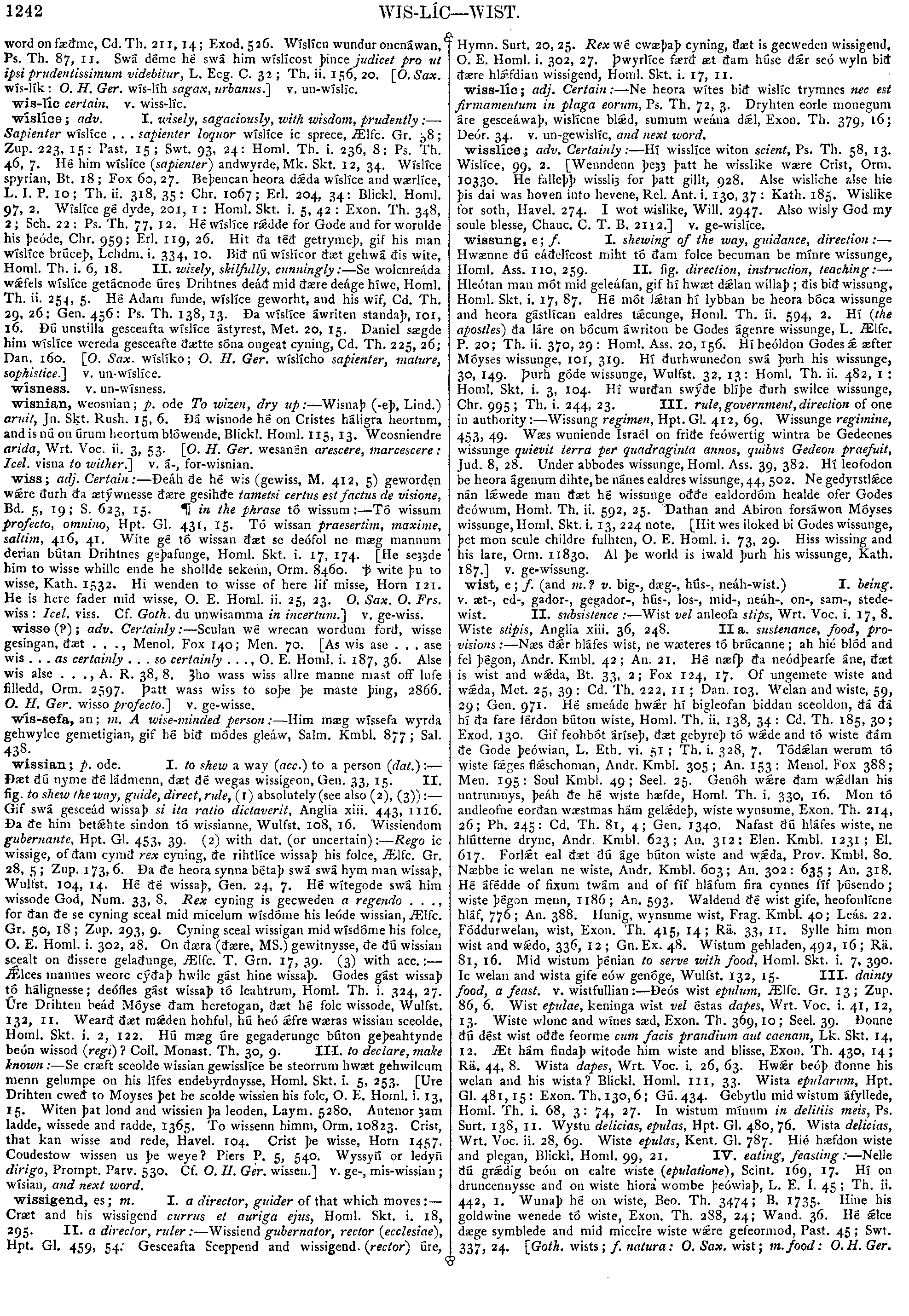
wit;
pers.
pron.
We
two,
(1)
I
and
thou,
(a)
alone:--Ðæt
hí
sýn
án
swá
wyt
sýn
án,
Jn.
Skt.
17,
22.
Abram
cwæð
tó
Lothe:
'Wyt
sind
gebróðru,'
Gen.
13,
8.
Wit,
Cd.
Th.
114,
14;
Gen.
1904.
Geþenc
hwæt
wit
sprcon,
Beo.
Th.
2957;
B.
1476:
Exon.
Th.
172,
18;
Gú.
1145.
Wit
baru
standaþ,
Cd.
Th.
50,
20;
Gen.
811.
(b)
with
numeral
forms:--Wit
bútú
sprecaþ,
Cd.
Th.
36,
20;
Gen.
574:
52,
3;
Gen.
838.
Ne
forlte
ic
ðé,
þenden
wit
lifiaþ
bú,
136,
11;
Gen.
2256.
(2)
I
and
he
(she),
(a)
alone:--Ðá
becóme
wit
tó
ðam
inneran
dle
ðæs
wéstenes
ðr
uncer
hlfdige
wæs,
and
wit
wron
belocene
in
carcerne,
Shrn.
38,
20:
Gen.
41,
12.
Rincas
míne,
restaþ
incit
hér,
wit
(Isaac
and
I)
eft
cumaþ,
Cd.
Th.
174,
21;
Gen.
2882:
152,
31;
Gen.
2529:
Beo.
Th.
1074;
B.
535.
(b)
with
numeral
forms:--Ic
wæs
gehloten
mid
ánum
wífe
in
ánes
ceorles
þeówdóme.
Ðá
wron
wit
twégen
on
ánum
olfende,
Shrn.
38,
14.
Ic
gean
intó
Élíg,
ðér
mínes
hláfordes
líchoma
rest,
ðara
þreó
landa
ðe
wit
bútá
geheótan
Gode,
Chart.
Th.
524,
20.
Ðá
bær
unc
mon
liþ
forþ,
and
wit
bú
druncan,
Bd.
5,
3;
S.
616,
31.
(c)
with
the
name
of
the
person
associated
with
the
speaker:--Wit
Scilling
for
uncrum
sigedryhtne
song
áhófan,
Exon.
Th.
324,
31;
Víd.
103.
(d)
with
name
and
numeral:--Wit
Adam
twá
eaples
þigdon,
Cd.
Th.
290,
6;
Sat.
411.
[Gif
þu
me
dest
woh
and
wit
beon
anes
lauerdes
men,
O.
E.
Homl.
i.
33,
1.
Þe
bet
wit
(he
and
I;
we,
2nd
MS.)
mawen
libben,
Laym.
9515.
Wit
(we,
2nd
MS.)
tweie,
23653.
Witt
ne
mu henn
tæmenn,
Orm.
202.
Wit
beoð
ifestnet
and
þe
cnotte
is
icnut
bituhhen
unc
tweien,
Kath.
1512.
Ðo
quat
Laban:
'Frend
sule
wit
ben
and
trewðe
pligt
nu
unc
bitwen,
Gen.
and
Ex.
1775.
Goth.
O.
Sax.
wit:
Icel.
vit.]
v.
unc,
wé.
henn
tæmenn,
Orm.
202.
Wit
beoð
ifestnet
and
þe
cnotte
is
icnut
bituhhen
unc
tweien,
Kath.
1512.
Ðo
quat
Laban:
'Frend
sule
wit
ben
and
trewðe
pligt
nu
unc
bitwen,
Gen.
and
Ex.
1775.
Goth.
O.
Sax.
wit:
Icel.
vit.]
v.
unc,
wé.
| Result Page: |  |
Previous | 1 2 3 4 5 6 7 8 9 10 11 12 13 14 15 16 17 | Next |  |
Germanic Lexicon Project (main page)
This search system was written by
Sean Crist
Please consider
volunteering
to correct the data in these online dictionaries.
No rights reserved. Feel free to use these data in any way you please.