|
|

Tip: In the search results, you can click on any word or abbreviation for more information.
|
Source: Cleasby/Vigfusson, page b0104, entry 5 View original page image as: [TIFF] [PNG] [View previous entry] [View next entry] |
[Comment on this entry] [View comments] |
The following entry has not been hand-corrected. However, the page is reserved and someone is correcting it. |
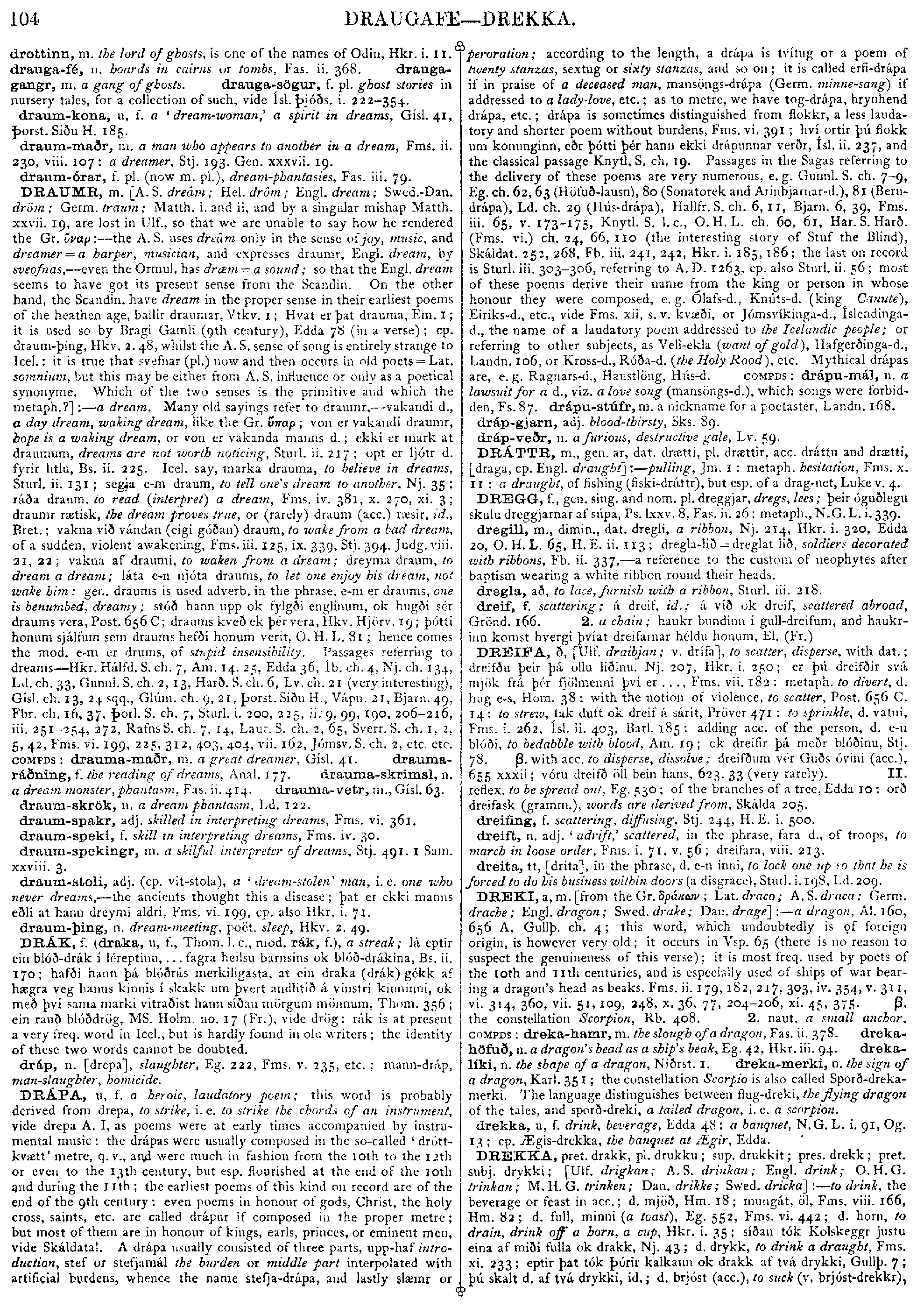
DRAUMR, m. [A. S. dream; Hel. drorn; Engl. dream; Swed. -Dan. drain; Germ, traum; Matth. i. and ii, and by a singular mishap Matth. xxvii. 19, are lost in Ulf., so that we are unable to say how he rendered the Gr. ôvap'. -- the A. S. uses dream onlv in the sense of jo y, music, and dreamer= a bar per, musician, and expresses draumr, Engl. dream, by sveofnas, -- even the Ormul. has drœm = a sound; so that the Engl. dream seems to have got its present sense from the Scandin. On the other hand, the Scandin. have dream in the proper sense in their earliest poems of the heathen age, ballir draumar, Vtkv. I; Hvat er þat draurna, Em. I; it is used so by Bragi Gamli (gth century), Edda 78 (iu a verse); cp. draum-þing, Hkv. 2. 48, whilst the A. S. sense of song is entirely strange to Icel.: it is true that svefnar (pl.) now and then occurs in old poets = Lat. somnium, but this may be either from A. S. influence or only as a poetical synonyme. Which of the two senses is the primitive and which the metaph. ?] :-- a dream. Many old sayings refer to draumr, -- vakandi d., a day dream, waking dream, like the Gr. virap; von er vakandi draumr, hope is a waking dream, or von er vakanda maims d.; ekki er mark at draumum, dreams are not worth noticing, Sturl. ii. 217; opt er Ijotr d. fyrir litlu, Bs. ii. 225. Icel, say, marka drauma, to believe in dreams, Sturl. ii. 131; seg^a e-m draum, to tell one's dream to another, Nj. 35; ráða dranm, to read (interpret) a dream, Fms. iv. 381, x. 270, xi. 3; draumr raetisk, the dream proves true, or (rarely) draum (acc.) ræsir, id., Bret.; vakna við vándan (eigi góðan) draum, to wake from a bad dream, of a sudden, violent awakening, Fms. iii. 125, ix. 339, Stj. 394. Judg. viii. 21, 22; vakna af draumi, to waken from a dream; dreyma draum, to dream a dream; láta e-n njóta draurns, to let one enjoy his dream, not wake him: gen. draums is used adverb, in the phrase, e-m er draums, one is benumbed, dreamy: stóð hann upp ok fylgði englinum, ok hugði sér draums vera, Post. 656 C; draums kveð ek ber vera, Hkv. Hjorv. 19; þótti honum sjálfum sern draums hefði honum verit, 0. H. L. 81; hence comes the mod. e-m er drums, of stupid insensibility. Passages referring to dreams -- Hkr. Hálfd. S. ch. 7, Am. 14. 25, Edda 36, lb. ch. 4, Nj. ch. 134, Ld. ch. 33, Gunnl. S. ch. 2, 13, Harð. S. ch. 6, Lv. ch. 21 (very interesting), Gísl. ch. 13, 24 sqq., Glúm. ch. 9, 21, þorst. Síðu H., Vápn. 21, Bjarn. 49, Fbr. ch. 16, 37, fiorl. S. ch. 7, Sturl. i. 200, 225, ii. 9, 99, 190, 206-216, iii. 251-254, 272, RafnsS. ch. 7, 14, Laur. S. ch. 2, 65, Sverr. S. ch. I. 2. 5, 42, Fms. vi. 199, 225, 312, 403, 404, vii. 162, Jóinsv. S. ch. 2, etc. etc. COMPDS: drauma-maðr, m. a great dreamer, Gísl. 41. drauma- ráðning, f. the reading of dreams, Anal. 177. drauma-skrimsl, n. a dream monster, phantasm, Fas. ii. 414. drauma-vetr, m., Gísl. 63.
|
Source: Cleasby/Vigfusson, page b0113, entry 31 View original page image as: [TIFF] [PNG] [View previous entry] [View next entry] |
[Comment on this entry] [View comments] |
The following entry has been hand-corrected once. |
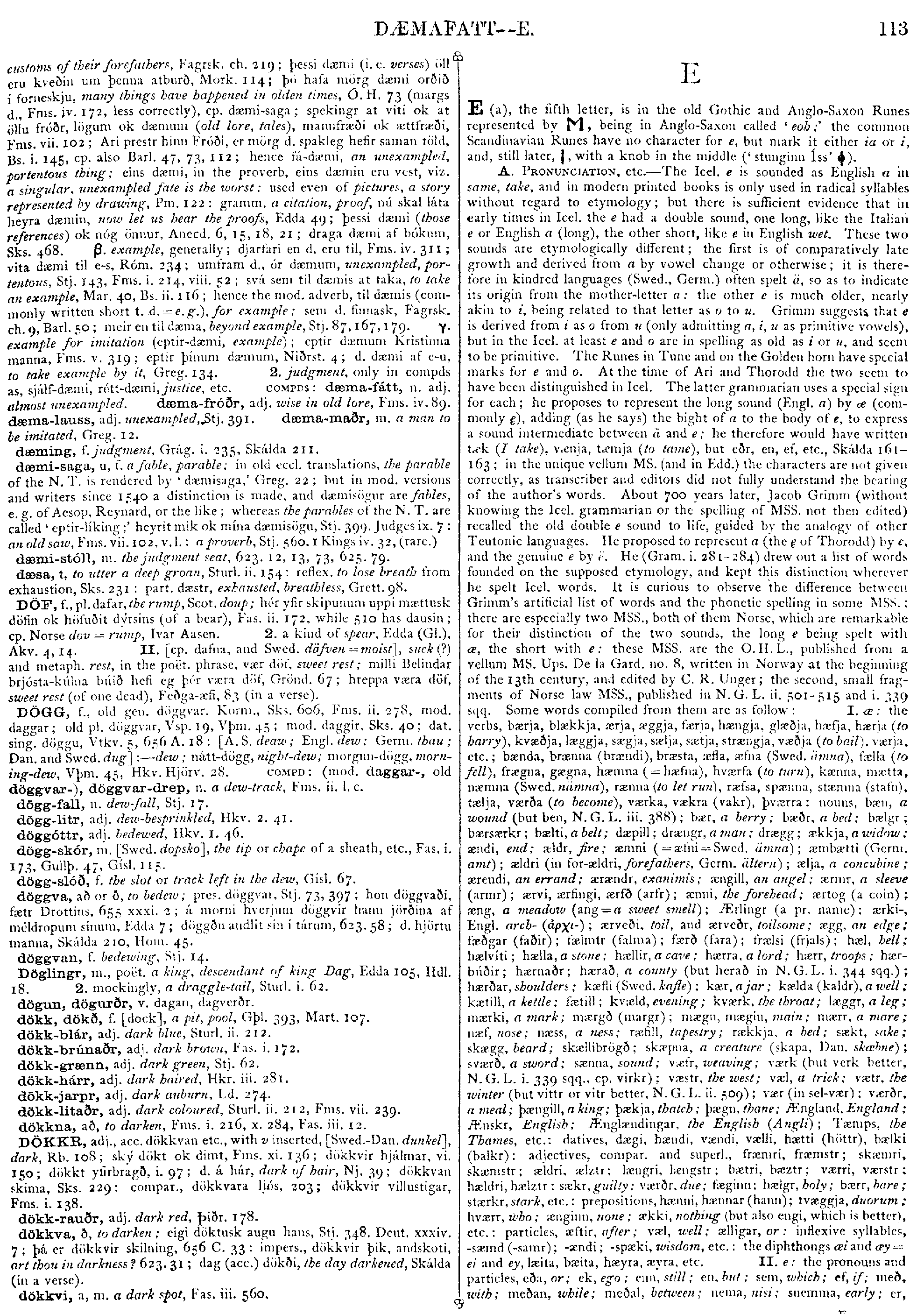
A.
PRONUNCIATION,
etc.
--
The
Icel.
e
is
sounded
as
English
a
in
same,
take,
and
in
modern
printed
books
is
only
used
in
radical
syllables
without
regard
to
etymology;
but
there
is
sufficient
evidence
that
in
early
times
in
Icel.
the
e
had
a
double
sound,
one
long,
like
the
Italian
e
or
English
a
(long),
the
other
short,
like
e
in
English
wet.
These
two
sounds
are
etymologically
different;
the
first
is
of
comparatively
late
growth
and
derived
from
a
by
vowel
change
or
otherwise;
it
is
therefore
in
kindred
languages
(Swed.,
Germ.)
often
spelt
ä,
so
as
to
indicate
its
origin
from
the
mother-letter
a:
the
other
e
is
much
older,
nearly
akin
to
i,
being
related
to
that
letter
as
o
to
u.
Grimm
suggests
that
e
is
derived
from
i
as
o
from
u
(only
admitting
a,
i,
u
as
primitive
vowels),
but
in
the
Icel.
at
least
e
and
o
are
in
spelling
as
old
as
i
or
u,
and
seem
to
be
primitive.
The
Runes
in
Tune
and
on
the
Golden
horn
have
special
marks
for
e
and
o.
At
the
time
of
Ari
and
Thorodd
the
two
seem
to
have
been
distinguished
in
Icel.
The
latter
grammarian
uses
a
special
sign
for
each;
he
proposes
to
represent
the
long
sound
(Engl.
a)
by
UNCERTAIN
(commonly
 ),
adding
(as
he
says)
the
bight
of
a
to
the
body
of
e,
to
express
a
sound
intermediate
between
ä
and
e;
he
therefore
would
have
written
UNCERTAIN
(I
take),
UNCERTAIN,
UNCERTAIN
(to
tame),
but
eðr,
en,
ef,
etc.,
Skálda
161-163;
in
the
unique
vellum
MS.
(and
in
Edd.)
the
characters
are
not
given
correctly,
as
transcriber
and
editors
did
not
fully
understand
the
bearing
of
the
author's
words.
About
700
years
later,
Jacob
Grimm
(without
knowing
the
Icel.
grammarian
or
the
spelling
of
MSS.
not
then
edited)
recalled
the
old
double
e
sound
to
life,
guided
by
the
analogy
of
other
Teutonic
languages.
He
proposed
to
represent
a
(the
of
Thorodd)
by
e,
and
the
genuine
e
by
ë.
He
(Gram.
i.
281-284)
drew
out
a
list
of
words
founded
on
the
supposed
etymology,
and
kept
this
distinction
wherever
he
spelt
Icel.
words.
It
is
curious
to
observe
the
difference
between
Grimm's
artificial
list
of
words
and
the
phonetic
spelling
in
some
MSS.;
there
are
especially
two
MSS.,
both
of
them
Norse,
which
are
remarkable
for
their
distinction
of
the
two
sounds,
the
long
e
being
spelt
with
æ,
the
short
with
e:
these
MSS.
are
the
O.
H.
L.,
published
from
a
vellum
MS.
Ups.
De
la
Gard.
no.
8,
written
in
Norway
at
the
beginning
of
the
13th
century,
and
edited
by
C.
R.
Unger;
the
second,
small
fragments
of
Norse
law
MSS.,
published
in
N.
G.
L.
ii.
501-515
and
i.
339
sqq.
Some
words
compiled
from
them
are
as
follow:
I.
æ:
the
verbs,
bærja,
blækkja,
ærja,
æggja,
færja,
hængja,
glæðja,
hæfja,
hærja
(to
harry),
kvæðja,
læggja,
sægja,
sælja,
sætja,
strængja,
væðja
(to
bail),
værja,
etc.;
bænda,
brænna
(brændi),
bræsta,
æfla,
æfna
(Swed.
ämna),
fælla
(to
fell),
frægna,
gægna,
hæmna
(
=
hæfna),
hværfa
(to
turn),
kænna,
mætta,
næmna
(Swed.
nämna),
rænna
(to
let
run),
ræfsa,
spænna,
stæmna
(stafn),
tælja,
værða
(to
become),
værka,
vækra
(vakr),
þværra:
nouns,
bæn,
a
wound
(but
ben,
N.
G.
L.
iii.
388);
bær,
a
berry;
bæðr,
a
bed;
bælgr;
bærsærkr;
bælti,
a
belt;
dæpill;
drængr,
a
man;
drægg;
ækkja,
a
widow;
ændi,
end;
ældr,
fire;
æmni
(
=
æfni
=
Swed.
ämna);
æmbætti
(Germ.
amt);
ældri
(in
for-ældri,
forefathers,
Germ.
ältern);
ælja,
a
concubine;
ærendi,
an
errand;
ærændr,
exanimis;
ængill,
an
angel;
ærmr,
a
sleeve
(armr);
ærvi,
ærfingi,
ærfð
(arfr);
ænni,
the
forehead;
ærtog
(a
coin);
æng,
a
meadow
(ang
=
a
sweet
smell);
Ærlingr
(a
pr.
name);
ærki-,
Engl.
arch-
(GREEK);
ærveði,
toil,
and
ærveðr,
toilsome;
ægg,
an
edge;
fæðgar
(faðir);
fælmtr
(falma);
færð
(fara);
frælsi
(frjals);
hæl,
hell;
hælviti;
hælla,
a
stone;
hællir,
a
cave;
hærra,
a
lord;
hærr,
troops;
hærbúðir;
hærnaðr;
hærað,
a
county
(but
herað
in
N.
G.
L.
i.
344
sqq.);
hærðar,
shoulders;
kæfli
(Swed.
kafle);
kær,
a
jar;
kælda
(kaldr),
a
well;
kætill,
a
kettle;
fætill;
kvæld,
evening;
kværk,
the
throat;
læggr,
a
leg;
mærki,
a
mark;
mærgð
(margr);
mægn,
mægin,
main;
mærr,
a
mare;
næf,
nose;
næss,
a
ness;
ræfill,
tapestry;
rækkja,
a
bed;
sækt,
sake;
skægg,
beard;
skællibrögð;
skæpna,
a
creature
(skapa,
Dan.
skæbne);
sværð,
a
sword;
sænna,
sound;
væfr,
weaving;
værk
(but
verk
better,
N.
G.
L.
i.
339
sqq.,
cp.
virkr):
væstr,
the
west;
væl,
a
trick;
vætr,
the
winter
(but
vittr
or
vitr
better,
N.
G.
L.
ii.
509);
vær
(in
sel-vær);
værðr,
a
meal;
þængill,
a
king;
þækja,
thatch;
þægn,
thane;
Ængland,
England;
Ænskr,
English;
Ænglændingar,
the
English
(Angli);
Tæmps,
the
Thames,
etc.:
datives,
dægi,
hændi,
vændi,
vælli,
hætti
(höttr),
bælki
(balkr):
adjectives,
compar.
and
superl.,
fræmri,
fræmstr;
skæmri,
skæmstr;
ældri,
ælztr;
længri,
længstr;
bætri,
bæztr;
værri,
værstr;
hældri,
hælztr:
sækr,
guilty;
værðr,
due;
fæginn;
hælgr,
holy;
bærr,
bare;
stærkr,
stark,
etc.:
prepositions,
hænni,
hænnar
(hann);
tvæggja,
duorum;
hværr,
who;
ænginn,
none;
ækki,
nothing
(but
also
engi,
which
is
better),
etc.:
particles,
æftir,
after;
væl,
well;
ælligar,
or:
inflexive
syllables,
-sæmd
(-sanir);
-ændi;
-spæki,
wisdom,
etc.:
the
diphthongs
æi
and
æy
=
ei
and
ey,
læita,
bæita,
hæyra,
æyra,
etc.
II.
e:
the
pronouns
and
particles,
eða,
or;
ek,
ego;
enn,
still;
en,
but;
sem,
which;
ef,
if;
með,
with;
meðan,
while;
meðal,
between;
nema,
nisi;
snemma,
early;
er,
),
adding
(as
he
says)
the
bight
of
a
to
the
body
of
e,
to
express
a
sound
intermediate
between
ä
and
e;
he
therefore
would
have
written
UNCERTAIN
(I
take),
UNCERTAIN,
UNCERTAIN
(to
tame),
but
eðr,
en,
ef,
etc.,
Skálda
161-163;
in
the
unique
vellum
MS.
(and
in
Edd.)
the
characters
are
not
given
correctly,
as
transcriber
and
editors
did
not
fully
understand
the
bearing
of
the
author's
words.
About
700
years
later,
Jacob
Grimm
(without
knowing
the
Icel.
grammarian
or
the
spelling
of
MSS.
not
then
edited)
recalled
the
old
double
e
sound
to
life,
guided
by
the
analogy
of
other
Teutonic
languages.
He
proposed
to
represent
a
(the
of
Thorodd)
by
e,
and
the
genuine
e
by
ë.
He
(Gram.
i.
281-284)
drew
out
a
list
of
words
founded
on
the
supposed
etymology,
and
kept
this
distinction
wherever
he
spelt
Icel.
words.
It
is
curious
to
observe
the
difference
between
Grimm's
artificial
list
of
words
and
the
phonetic
spelling
in
some
MSS.;
there
are
especially
two
MSS.,
both
of
them
Norse,
which
are
remarkable
for
their
distinction
of
the
two
sounds,
the
long
e
being
spelt
with
æ,
the
short
with
e:
these
MSS.
are
the
O.
H.
L.,
published
from
a
vellum
MS.
Ups.
De
la
Gard.
no.
8,
written
in
Norway
at
the
beginning
of
the
13th
century,
and
edited
by
C.
R.
Unger;
the
second,
small
fragments
of
Norse
law
MSS.,
published
in
N.
G.
L.
ii.
501-515
and
i.
339
sqq.
Some
words
compiled
from
them
are
as
follow:
I.
æ:
the
verbs,
bærja,
blækkja,
ærja,
æggja,
færja,
hængja,
glæðja,
hæfja,
hærja
(to
harry),
kvæðja,
læggja,
sægja,
sælja,
sætja,
strængja,
væðja
(to
bail),
værja,
etc.;
bænda,
brænna
(brændi),
bræsta,
æfla,
æfna
(Swed.
ämna),
fælla
(to
fell),
frægna,
gægna,
hæmna
(
=
hæfna),
hværfa
(to
turn),
kænna,
mætta,
næmna
(Swed.
nämna),
rænna
(to
let
run),
ræfsa,
spænna,
stæmna
(stafn),
tælja,
værða
(to
become),
værka,
vækra
(vakr),
þværra:
nouns,
bæn,
a
wound
(but
ben,
N.
G.
L.
iii.
388);
bær,
a
berry;
bæðr,
a
bed;
bælgr;
bærsærkr;
bælti,
a
belt;
dæpill;
drængr,
a
man;
drægg;
ækkja,
a
widow;
ændi,
end;
ældr,
fire;
æmni
(
=
æfni
=
Swed.
ämna);
æmbætti
(Germ.
amt);
ældri
(in
for-ældri,
forefathers,
Germ.
ältern);
ælja,
a
concubine;
ærendi,
an
errand;
ærændr,
exanimis;
ængill,
an
angel;
ærmr,
a
sleeve
(armr);
ærvi,
ærfingi,
ærfð
(arfr);
ænni,
the
forehead;
ærtog
(a
coin);
æng,
a
meadow
(ang
=
a
sweet
smell);
Ærlingr
(a
pr.
name);
ærki-,
Engl.
arch-
(GREEK);
ærveði,
toil,
and
ærveðr,
toilsome;
ægg,
an
edge;
fæðgar
(faðir);
fælmtr
(falma);
færð
(fara);
frælsi
(frjals);
hæl,
hell;
hælviti;
hælla,
a
stone;
hællir,
a
cave;
hærra,
a
lord;
hærr,
troops;
hærbúðir;
hærnaðr;
hærað,
a
county
(but
herað
in
N.
G.
L.
i.
344
sqq.);
hærðar,
shoulders;
kæfli
(Swed.
kafle);
kær,
a
jar;
kælda
(kaldr),
a
well;
kætill,
a
kettle;
fætill;
kvæld,
evening;
kværk,
the
throat;
læggr,
a
leg;
mærki,
a
mark;
mærgð
(margr);
mægn,
mægin,
main;
mærr,
a
mare;
næf,
nose;
næss,
a
ness;
ræfill,
tapestry;
rækkja,
a
bed;
sækt,
sake;
skægg,
beard;
skællibrögð;
skæpna,
a
creature
(skapa,
Dan.
skæbne);
sværð,
a
sword;
sænna,
sound;
væfr,
weaving;
værk
(but
verk
better,
N.
G.
L.
i.
339
sqq.,
cp.
virkr):
væstr,
the
west;
væl,
a
trick;
vætr,
the
winter
(but
vittr
or
vitr
better,
N.
G.
L.
ii.
509);
vær
(in
sel-vær);
værðr,
a
meal;
þængill,
a
king;
þækja,
thatch;
þægn,
thane;
Ængland,
England;
Ænskr,
English;
Ænglændingar,
the
English
(Angli);
Tæmps,
the
Thames,
etc.:
datives,
dægi,
hændi,
vændi,
vælli,
hætti
(höttr),
bælki
(balkr):
adjectives,
compar.
and
superl.,
fræmri,
fræmstr;
skæmri,
skæmstr;
ældri,
ælztr;
længri,
længstr;
bætri,
bæztr;
værri,
værstr;
hældri,
hælztr:
sækr,
guilty;
værðr,
due;
fæginn;
hælgr,
holy;
bærr,
bare;
stærkr,
stark,
etc.:
prepositions,
hænni,
hænnar
(hann);
tvæggja,
duorum;
hværr,
who;
ænginn,
none;
ækki,
nothing
(but
also
engi,
which
is
better),
etc.:
particles,
æftir,
after;
væl,
well;
ælligar,
or:
inflexive
syllables,
-sæmd
(-sanir);
-ændi;
-spæki,
wisdom,
etc.:
the
diphthongs
æi
and
æy
=
ei
and
ey,
læita,
bæita,
hæyra,
æyra,
etc.
II.
e:
the
pronouns
and
particles,
eða,
or;
ek,
ego;
enn,
still;
en,
but;
sem,
which;
ef,
if;
með,
with;
meðan,
while;
meðal,
between;
nema,
nisi;
snemma,
early;
er,
|
Source: Cleasby/Vigfusson, page b0118, entry 13 View original page image as: [TIFF] [PNG] [View previous entry] [View next entry] |
[Comment on this entry] [View comments] |
The following entry has been hand-corrected once. |
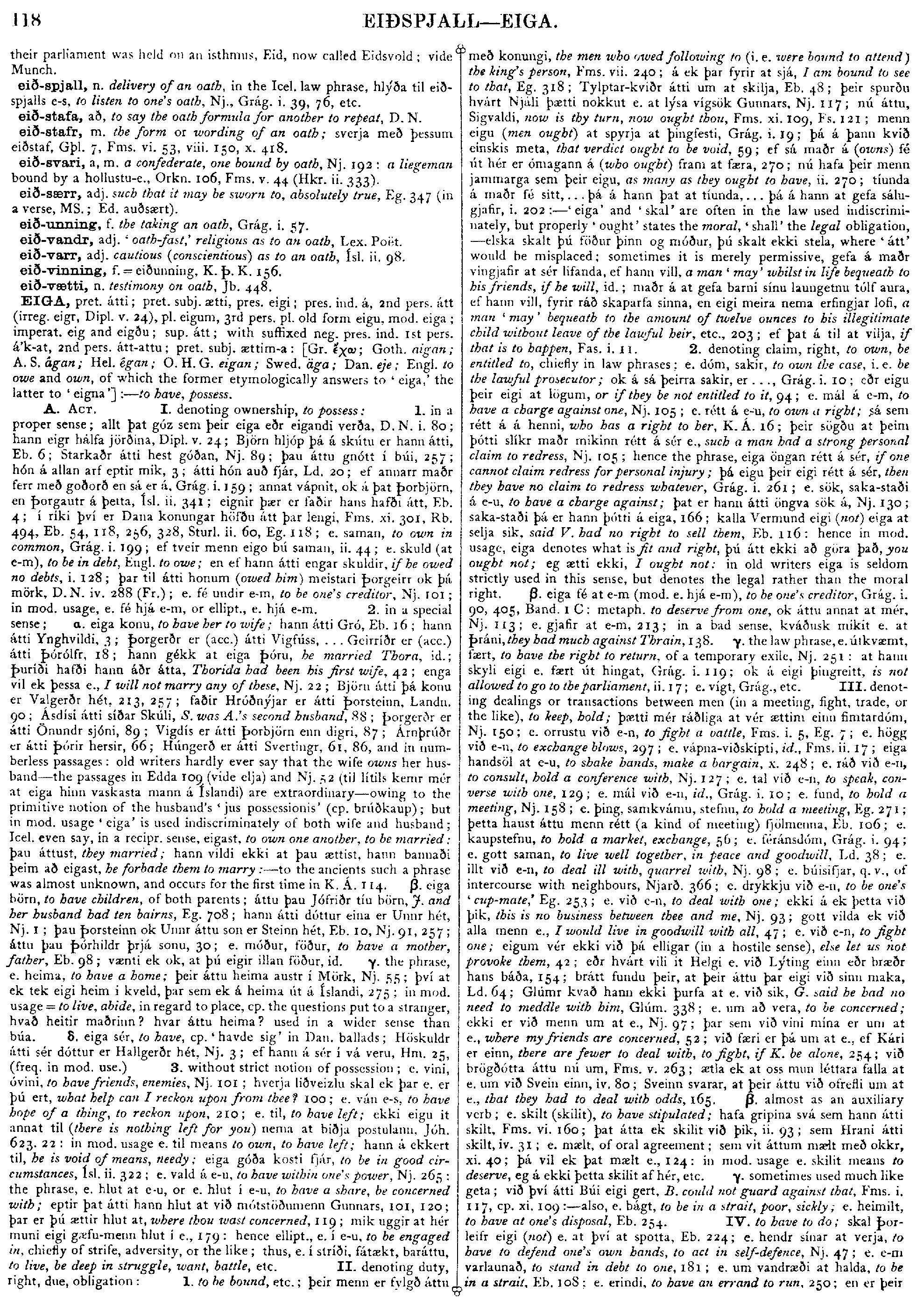
A.
ACT.
I.
denoting
ownership,
to
possess:
1.
in
a
proper
sense;
allt
þat
góz
sem
þeir
eiga
eðr
eigandi
verða,
D.
N.
i.
80;
hann
eigr
hálfa
jörðina,
Dipl.
v.
24;
Björn
hljóp
þá
á
skútu
er
hann
átti,
Eb.
6;
Starkaðr
átti
hest
góðan,
Nj.
89;
þau
áttu
gnótt
í
búi,
257;
hón
á
allan
arf
eptir
mik,
3;
átti
hón
auð
fjár,
Ld.
20;
ef
annarr
maðr
ferr
með
goðorð
en
sá
er
á,
Grág.
i.
159;
annat
vápnit,
ok
á
þat
Þorbjörn,
en
Þorgautr
á
þetta,
Ísl.
ii.
341;
eignir
þær
er
faðir
hans
hafði
átt,
Eb.
4;
í
ríki
því
er
Dana
konungar
höfðu
átt
þar
lengi,
Fms.
xi.
301,
Rb.
494,
Eb.
54,
118,
256,
328,
Sturl.
ii.
60,
Eg.
118;
e.
saman,
to
own
in
common,
Grág.
i.
199;
ef
tveir
menn
eigo
bú
saman,
ii.
44;
e.
skuld
(at
e-m),
to
be
in
debt,
Engl.
to
owe;
en
ef
hann
átti
engar
skuldir,
if
he
owed
no
debts,
i.
128;
þar
til
átti
honum
(owed
him)
meistari
Þorgeirr
ok
þá
mörk,
D.
N.
iv.
288
(Fr.);
e.
fé
undir
e-m,
to
be
one's
creditor,
Nj.
101;
in
mod.
usage,
e.
fé
hjá
e-m,
or
ellipt.,
e.
hjá
e-m.
2.
in
a
special
sense;
 .
eiga
konu,
to
have
her
to
wife;
hann
átti
Gró,
Eb.
16;
hann
átti
Ynghvildi,
3;
Þorgerðr
er
(acc.)
átti
Vigfúss,
...
Geirríðr
er
(acc.)
átti
Þórólfr,
18;
hann
gékk
at
eiga
Þóru,
he
married
Thora,
id.;
Þuríði
hafði
hann
áðr
átta,
Thorida
had
been
his
first
wife,
42;
enga
vil
ek
þessa
e.,
I
will
not
marry
any
of
these,
Nj.
22;
Björn
átti
þá
konu
er
Valgerðr
hét,
213,
257;
faðir
Hróðnýjar
er
átti
Þorsteinn,
Landn.
90;
Ásdísi
átti
síðar
Skúli,
S.
was
A.'s
second
husband,
88;
Þorgerðr
er
átti
Önundr
sjóni,
89;
Vigdís
er
átti
Þorbjörn
enn
digri,
87;
Árnþrúðr
er
átti
Þórir
hersir,
66;
Húngerð
er
átti
Svertingr,
6l,
86,
and
in
numberless
passages:
old
writers
hardly
ever
say
that
the
wife
owns
her
husband--the
passages
in
Edda
109
(vide
elja)
and
Nj.
52
(til
lítils
kemr
mér
at
eiga
hinn
vaskasta
mann
á
Islandi)
are
extraordinary--owing
to
the
primitive
notion
of
the
husband's
'jus
possessionis'
(cp.
brúðkaup);
but
in
mod.
usage
'eiga'
is
used
indiscriminately
of
both
wife
and
husband;
Icel.
even
say,
in
a
recipr.
sense,
eigast,
to
own
one
another,
to
be
married:
þau
áttust,
they
married;
hann
vildi
ekki
at
þau
ættist,
hann
bannaði
þeim
að
eigast,
he
forbade
them
to
marry
:--
to
the
ancients
such
a
phrase
was
almost
unknown,
and
occurs
for
the
first
time
in
K.
Á.
114.
.
eiga
konu,
to
have
her
to
wife;
hann
átti
Gró,
Eb.
16;
hann
átti
Ynghvildi,
3;
Þorgerðr
er
(acc.)
átti
Vigfúss,
...
Geirríðr
er
(acc.)
átti
Þórólfr,
18;
hann
gékk
at
eiga
Þóru,
he
married
Thora,
id.;
Þuríði
hafði
hann
áðr
átta,
Thorida
had
been
his
first
wife,
42;
enga
vil
ek
þessa
e.,
I
will
not
marry
any
of
these,
Nj.
22;
Björn
átti
þá
konu
er
Valgerðr
hét,
213,
257;
faðir
Hróðnýjar
er
átti
Þorsteinn,
Landn.
90;
Ásdísi
átti
síðar
Skúli,
S.
was
A.'s
second
husband,
88;
Þorgerðr
er
átti
Önundr
sjóni,
89;
Vigdís
er
átti
Þorbjörn
enn
digri,
87;
Árnþrúðr
er
átti
Þórir
hersir,
66;
Húngerð
er
átti
Svertingr,
6l,
86,
and
in
numberless
passages:
old
writers
hardly
ever
say
that
the
wife
owns
her
husband--the
passages
in
Edda
109
(vide
elja)
and
Nj.
52
(til
lítils
kemr
mér
at
eiga
hinn
vaskasta
mann
á
Islandi)
are
extraordinary--owing
to
the
primitive
notion
of
the
husband's
'jus
possessionis'
(cp.
brúðkaup);
but
in
mod.
usage
'eiga'
is
used
indiscriminately
of
both
wife
and
husband;
Icel.
even
say,
in
a
recipr.
sense,
eigast,
to
own
one
another,
to
be
married:
þau
áttust,
they
married;
hann
vildi
ekki
at
þau
ættist,
hann
bannaði
þeim
að
eigast,
he
forbade
them
to
marry
:--
to
the
ancients
such
a
phrase
was
almost
unknown,
and
occurs
for
the
first
time
in
K.
Á.
114.
 .
eiga
börn,
to
have
children,
of
both
parents;
áttu
þau
Jófriðr
tíu
börn,
J.
and
her
husband
had
ten
bairns,
Eg.
708;
hann
átti
dóttur
eina
er
Unnr
hét,
Nj.
1;
þau
Þorsteinn
ok
Unnr
áttu
son
er
Steinn
hét,
Eb.
10,
Nj.
91,
257;
áttu
þau
Þórhildr
þrjá
sonu,
30;
e.
móður,
föður,
to
have
a
mother,
father,
Eb.
98;
vænti
ek
ok,
at
þú
eigir
illan
föður,
id.
.
eiga
börn,
to
have
children,
of
both
parents;
áttu
þau
Jófriðr
tíu
börn,
J.
and
her
husband
had
ten
bairns,
Eg.
708;
hann
átti
dóttur
eina
er
Unnr
hét,
Nj.
1;
þau
Þorsteinn
ok
Unnr
áttu
son
er
Steinn
hét,
Eb.
10,
Nj.
91,
257;
áttu
þau
Þórhildr
þrjá
sonu,
30;
e.
móður,
föður,
to
have
a
mother,
father,
Eb.
98;
vænti
ek
ok,
at
þú
eigir
illan
föður,
id.
 .
the
phrase,
e.
heima,
to
have
a
home;
þeir
áttu
heima
austr
í
Mörk,
Nj.
55;
því
at
ek
tek
eigi
heim
í
kveld,
þar
sem
ek
á
heima
út
á
Íslandi,
275;
in
mod.
usage
=
to
live,
abide,
in
regard
to
place,
cp.
the
questions
put
to
a
stranger,
hvað
heitir
maðrinn?
hvar
áttu
heima?
used
in
a
wider
sense
than
búa.
.
the
phrase,
e.
heima,
to
have
a
home;
þeir
áttu
heima
austr
í
Mörk,
Nj.
55;
því
at
ek
tek
eigi
heim
í
kveld,
þar
sem
ek
á
heima
út
á
Íslandi,
275;
in
mod.
usage
=
to
live,
abide,
in
regard
to
place,
cp.
the
questions
put
to
a
stranger,
hvað
heitir
maðrinn?
hvar
áttu
heima?
used
in
a
wider
sense
than
búa.
 .
eiga
sér,
to
have,
cp.
'havde
sig'
in
Dan.
ballads;
Höskuldr
átti
sér
dóttur
er
Hallgerðr
hét,
Nj.
3;
ef
hann
á
sér
í
vá
veru,
Hm.
25,
(freq.
in
mod.
use.)
3.
without
strict
notion
of
possession;
e.
vini,
óvini,
to
have
friends,
enemies,
Nj.
101;
hverja
liðveizlu
skal
ek
þar
e.
er
þú
ert,
what
help
can
I
reckon
upon
from
thee?
100;
e.
ván
e-s,
to
have
hope
of
a
thing,
to
reckon
upon,
210;
e.
til,
to
have
left;
ekki
eigu
it
annat
til
(there
is
nothing
left
for
you)
nema
at
biðja
postulann.
Jóh.
623.
22:
in
mod.
usage
e.
til
means
to
own,
to
have
left;
hann
á
ekkert
til,
he
is
void
of
means,
needy;
eiga
góða
kosti
fjár,
to
be
in
good
circumstances,
Ísl.
ii.
322;
e.
vald
á
e-u,
to
have
within
one's
power,
Nj.
265;
the
phrase,
e.
hlut
at
e-u,
or
e.
hlut
í
e-u,
to
have
a
share,
be
concerned
with;
eptir
þat
átti
hann
hlut
at
við
mótstöðumenn
Gunnars,
101,
120;
þar
er
þú
ættir
hlut
at,
where
thou
wast
concerned,
119;
mik
uggir
at
hér
muni
eigi
gæfu-menn
hlut
í
e.,
179:
hence
ellipt.,
e.
í
e-u,
to
be
engaged
in,
chiefly
of
strife,
adversity,
or
the
like;
thus,
e.
í
stríði,
fátaekt,
baráttu,
to
live,
be
deep
in
struggle,
want,
battle,
etc.
II.
denoting
duty,
right,
due,
obligation:
1.
to
be
bound,
etc.;
þeir
menn
er
fylgð
áttu
með
konungi,
the
men
who
owed
following
to
(i.e.
were
bound
to
attend)
the
king's
person,
Fms.
vii.
240;
á
ek
þar
fyrir
at
sjá,
I
am
bound
to
see
to
that,
Eg.
318;
Tylptar-kviðr
átti
um
at
skilja,
Eb.
48;
þeir
spurðu
hvárt
Njáli
þætti
nokkut
e.
at
lýsa
vígsök
Gunnars,
Nj.
117;
nú
áttu,
Sigvaldi,
now
is
thy
turn,
now
ought
thou,
Fms.
xi.
109,
Fs.
121;
menn
eigu
(men
ought)
at
spyrja
at
þingfesti,
Grág.
i.
19;
þá
á
þann
kvið
einskis
meta,
that
verdict
ought
to
be
void,
59;
ef
sá
maðr
á
(owns)
fé
út
hér
er
ómagann
á
(who
ought)
fram
at
færa,
270;
nú
hafa
þeir
menn
jammarga
sem
þeir
eigu,
as
many
as
they
ought
to
have,
ii.
270;
tíunda
á
maðr
fé
sitt,
...
þá
á
hann
þat
at
tíunda,
...
þá
á
hann
at
gefa
sálugjafir,
i.
202
:--
'eiga'
and
'skal'
are
often
in
the
law
used
indiscriminately,
but
properly
'ought'
states
the
moral,
'shall'
the
legal
obligation,--elska
skalt
þú
föður
þinn
og
móður,
þú
skalt
ekki
stela,
where
'átt'
would
be
misplaced;
sometimes
it
is
merely
permissive,
gefa
á
maðr
vingjafir
at
sér
lifanda,
ef
hann
vill,
a
man
'may'
whilst
in
life
bequeath
to
his
friends,
if
he
will,
id.;
maðr
á
at
gefa
barni
sínu
laungetnu
tólf
aura,
ef
hann
vill,
fyrir
ráð
skaparfa
sinna,
en
eigi
meira
nema
erfingjar
lofi,
a
man
'may'
bequeath
to
the
amount
of
twelve
ounces
to
his
illegitimate
child
without
leave
of
the
lawful
heir,
etc.,
203;
ef
þat
á
til
at
vilja,
if
that
is
to
happen,
Fas.
i.
11.
2.
denoting
claim,
right,
to
own,
be
entitled
to,
chiefly
in
law
phrases;
e.
dóm,
sakir,
to
own
the
case,
i.e.
be
the
lawful
prosecutor;
ok
á
sá
þeirra
sakir,
er
...,
Grág.
i.
10;
eðr
eigu
þeir
eigi
at
lögum,
or
if
they
be
not
entitled
to
it,
94;
e.
mál
á
e-m,
to
have
a
charge
against
one,
Nj.
105;
e.
rétt
á
e-u,
to
own
a
right;
sá
sem
rétt
á
á
henni,
who
has
a
right
to
her,
K.
Á.
16;
þeir
sögðu
at
þeim
þótti
slíkr
maðr
mikinn
rétt
á
sér
e.,
such
a
man
had
a
strong
personal
claim
to
redress,
Nj.
105;
hence
the
phrase,
eiga
öngan
rétt
á
sér,
if
one
cannot
claim
redress
for
personal
injury;
þá
eigu
þeir
eigi
rétt
á
sér,
then
they
have
no
claim
to
redress
whatever,
Grág.
i.
261;
e.
sök,
saka-staði
á
e-u,
to
have
a
charge
against;
þat
er
hann
átti
öngva
sök
á,
Nj.
130;
saka-staði
þá
er
hann
þótti
á
eiga,
166;
kalla
Vermund
eigi
(not)
eiga
at
selja
sik,
said
V.
had
no
right
to
sell
them,
Eb.
116:
hence
in
mod.
usage,
eiga
denotes
what
is
fit
and
right,
þú
átt
ekki
að
göra
það,
you
ought
not;
eg
ætti
ekki,
I
ought
not:
in
old
writers
eiga
is
seldom
strictly
used
in
this
sense,
but
denotes
the
legal
rather
than
the
moral
right.
.
eiga
fé
at
e-m
(mod.
e.
hjá
e-m),
to
be
one's
creditor,
Grág.
i.
90,
405,
Band.
1
C:
metaph.
to
deserve
from
one,
ok
áttu
annat
at
mér,
Nj.
113;
e.
gjafir
at
e-m,
213;
in
a
bad
sense,
kváðusk
mikit
e.
at
Þráni,
they
had
much
against
Thrain,
138.
.
the
law
phrase,
e.
útkvæmt,
fært,
to
have
the
right
to
return,
of
a
temporary
exile,
Nj.
251:
at
hann
skyli
eigi
e.
fært
út
hingat,
Grág.
i.
119;
ok
á
eigi
þingreitt,
is
not
allowed
to
go
to
the
parliament,
ii.
17;
e.
vígt,
Grág.,
etc.
III.
denoting
dealings
or
transactions
between
men
(in
a
meeting,
fight,
trade,
or
the
like),
to
keep,
hold;
þætti
mér
ráðliga
at
vér
ættim
einn
fimtardóm,
Nj.
150;
e.
orrustu
við
e-n,
to
fight
a
battle,
Fms.
i.
5,
Eg.
7;
e.
högg
við
e-n,
to
exchange
blows,
297;
e.
vápna-viðskipti,
id.,
Fms.
ii.
17;
eiga
handsöl
at
e-u,
to
shake
hands,
make
a
bargain,
x.
248;
e.
ráð
við
e-n,
to
consult,
hold
a
conference
with,
Nj.
127;
e.
tal
við
e-n,
to
speak,
converse
with
one,
129;
e.
mál
við
e-n,
id.,
Grág.
i.
10;
e.
fund,
to
hold
a
meeting,
Nj.
158;
e.
þing,
samkvámu,
stefnu,
to
hold
a
meeting,
Eg.
271;
þetta
haust
áttu
menn
rétt
(a
kind
of
meeting)
fjölmenna,
Eb.
106;
e.
kaupstefnu,
to
hold
a
market,
exchange,
56;
e.
féránsdóm,
Grág.
i.
94;
e.
gott
saman,
to
live
well
together,
in
peace
and
goodwill,
Ld.
38;
e.
illt
við
e-n,
to
deal
ill
with,
quarrel
with,
Nj.
98;
e.
búisifjar,
q.v.,
of
intercourse
with
neighbours,
Njarð.
366;
e.
drykkju
við
e-n,
to
be
one's
'cup-mate,'
Eg.
253;
e.
við
e-n,
to
deal
with
one;
ekki
á
ek
þetta
við
þik,
this
is
no
business
between
thee
and
me,
Nj.
93;
gott
vilda
ek
við
alla
menn
e.,
I
would
live
in
goodwill
with
all,
47;
e.
við
e-n,
to
fight
one;
eigum
vér
ekki
við
þá
elligar
(in
a
hostile
sense),
else
let
us
not
provoke
them,
42;
eðr
hvárt
vili
it
Helgi
e.
við
Lýting
einn
eðr
bræðr
hans
báða,
154;
brátt
fundu
þeir,
at
þeir
áttu
þar
eigi
við
sinn
maka,
Ld.
64;
Glúmr
kvað
hann
ekki
þurfa
at
e.
við
sik,
G.
said
he
had
no
need
to
meddle
with
him,
Glúm.
338;
e.
um
að
vera,
to
be
concerned;
ekki
er
við
menn
um
at
e.,
Nj.
97;
þar
sem
við
vini
mína
er
um
at
e.,
where
my
friends
are
concerned,
52;
við
færi
er
þá
um
at
e.,
ef
Kári
er
einn,
there
are
fewer
to
deal
with,
to
fight,
if
K.
be
alone,
254;
við
brögðótta
áttu
nú
um,
Fms.
v.
263;
ætla
ek
at
oss
mun
léttara
falla
at
e.
um
við
Svein
einn,
iv.
80;
Sveinn
svarar,
at
þeir
áttu
við
ofrefli
um
at
e.,
that
they
had
to
deal
with
odds,
165.
.
almost
as
an
auxiliary
verb;
e.
skilt
(skilit),
to
have
stipulated;
hafa
gripina
svá
sem
hann
átti
skill,
Fms.
vi.
160;
þat
átta
ek
skilit
við
þik,
ii.
93;
sem
Hrani
átti
skilt,
iv.
31;
e.
mælt,
of
oral
agreement;
sem
vit
áttum
mælt
með
okkr,
xi.
40;
þá
vil
ek
þat
mælt
e.,
124:
in
mod.
usage
e.
skilit
means
to
deserve,
eg
á
ekki
þetta
skilit
af
hér,
etc.
.
sometimes
used
much
like
geta;
við
því
átti
Búi
eigi
gert,
B.
could
not
guard
against
that,
Fms.
i.
117,
cp.
xi.
109
:--
also,
e.
bágt,
to
be
in
a
strait,
poor,
sickly;
e.
heimilt,
to
have
at
one's
disposal,
Eb.
254.
IV.
to
have
to
do;
skal
Þorleifr
eigi
(not)
e.
at
því
at
spotta,
Eb.
224;
e.
hendr
sínar
at
verja,
to
have
to
defend
one's
own
hands,
to
act
in
self-defence,
Nj.
47;
e.
e-m
varlaunað,
to
stand
in
debt
to
one,
181;
e.
um
vandræði
at
halda,
to
be
in
a
strait,
Eb.
108;
e.
erindi,
to
have
an
errand
to
run,
250;
en
er
þeir
.
eiga
sér,
to
have,
cp.
'havde
sig'
in
Dan.
ballads;
Höskuldr
átti
sér
dóttur
er
Hallgerðr
hét,
Nj.
3;
ef
hann
á
sér
í
vá
veru,
Hm.
25,
(freq.
in
mod.
use.)
3.
without
strict
notion
of
possession;
e.
vini,
óvini,
to
have
friends,
enemies,
Nj.
101;
hverja
liðveizlu
skal
ek
þar
e.
er
þú
ert,
what
help
can
I
reckon
upon
from
thee?
100;
e.
ván
e-s,
to
have
hope
of
a
thing,
to
reckon
upon,
210;
e.
til,
to
have
left;
ekki
eigu
it
annat
til
(there
is
nothing
left
for
you)
nema
at
biðja
postulann.
Jóh.
623.
22:
in
mod.
usage
e.
til
means
to
own,
to
have
left;
hann
á
ekkert
til,
he
is
void
of
means,
needy;
eiga
góða
kosti
fjár,
to
be
in
good
circumstances,
Ísl.
ii.
322;
e.
vald
á
e-u,
to
have
within
one's
power,
Nj.
265;
the
phrase,
e.
hlut
at
e-u,
or
e.
hlut
í
e-u,
to
have
a
share,
be
concerned
with;
eptir
þat
átti
hann
hlut
at
við
mótstöðumenn
Gunnars,
101,
120;
þar
er
þú
ættir
hlut
at,
where
thou
wast
concerned,
119;
mik
uggir
at
hér
muni
eigi
gæfu-menn
hlut
í
e.,
179:
hence
ellipt.,
e.
í
e-u,
to
be
engaged
in,
chiefly
of
strife,
adversity,
or
the
like;
thus,
e.
í
stríði,
fátaekt,
baráttu,
to
live,
be
deep
in
struggle,
want,
battle,
etc.
II.
denoting
duty,
right,
due,
obligation:
1.
to
be
bound,
etc.;
þeir
menn
er
fylgð
áttu
með
konungi,
the
men
who
owed
following
to
(i.e.
were
bound
to
attend)
the
king's
person,
Fms.
vii.
240;
á
ek
þar
fyrir
at
sjá,
I
am
bound
to
see
to
that,
Eg.
318;
Tylptar-kviðr
átti
um
at
skilja,
Eb.
48;
þeir
spurðu
hvárt
Njáli
þætti
nokkut
e.
at
lýsa
vígsök
Gunnars,
Nj.
117;
nú
áttu,
Sigvaldi,
now
is
thy
turn,
now
ought
thou,
Fms.
xi.
109,
Fs.
121;
menn
eigu
(men
ought)
at
spyrja
at
þingfesti,
Grág.
i.
19;
þá
á
þann
kvið
einskis
meta,
that
verdict
ought
to
be
void,
59;
ef
sá
maðr
á
(owns)
fé
út
hér
er
ómagann
á
(who
ought)
fram
at
færa,
270;
nú
hafa
þeir
menn
jammarga
sem
þeir
eigu,
as
many
as
they
ought
to
have,
ii.
270;
tíunda
á
maðr
fé
sitt,
...
þá
á
hann
þat
at
tíunda,
...
þá
á
hann
at
gefa
sálugjafir,
i.
202
:--
'eiga'
and
'skal'
are
often
in
the
law
used
indiscriminately,
but
properly
'ought'
states
the
moral,
'shall'
the
legal
obligation,--elska
skalt
þú
föður
þinn
og
móður,
þú
skalt
ekki
stela,
where
'átt'
would
be
misplaced;
sometimes
it
is
merely
permissive,
gefa
á
maðr
vingjafir
at
sér
lifanda,
ef
hann
vill,
a
man
'may'
whilst
in
life
bequeath
to
his
friends,
if
he
will,
id.;
maðr
á
at
gefa
barni
sínu
laungetnu
tólf
aura,
ef
hann
vill,
fyrir
ráð
skaparfa
sinna,
en
eigi
meira
nema
erfingjar
lofi,
a
man
'may'
bequeath
to
the
amount
of
twelve
ounces
to
his
illegitimate
child
without
leave
of
the
lawful
heir,
etc.,
203;
ef
þat
á
til
at
vilja,
if
that
is
to
happen,
Fas.
i.
11.
2.
denoting
claim,
right,
to
own,
be
entitled
to,
chiefly
in
law
phrases;
e.
dóm,
sakir,
to
own
the
case,
i.e.
be
the
lawful
prosecutor;
ok
á
sá
þeirra
sakir,
er
...,
Grág.
i.
10;
eðr
eigu
þeir
eigi
at
lögum,
or
if
they
be
not
entitled
to
it,
94;
e.
mál
á
e-m,
to
have
a
charge
against
one,
Nj.
105;
e.
rétt
á
e-u,
to
own
a
right;
sá
sem
rétt
á
á
henni,
who
has
a
right
to
her,
K.
Á.
16;
þeir
sögðu
at
þeim
þótti
slíkr
maðr
mikinn
rétt
á
sér
e.,
such
a
man
had
a
strong
personal
claim
to
redress,
Nj.
105;
hence
the
phrase,
eiga
öngan
rétt
á
sér,
if
one
cannot
claim
redress
for
personal
injury;
þá
eigu
þeir
eigi
rétt
á
sér,
then
they
have
no
claim
to
redress
whatever,
Grág.
i.
261;
e.
sök,
saka-staði
á
e-u,
to
have
a
charge
against;
þat
er
hann
átti
öngva
sök
á,
Nj.
130;
saka-staði
þá
er
hann
þótti
á
eiga,
166;
kalla
Vermund
eigi
(not)
eiga
at
selja
sik,
said
V.
had
no
right
to
sell
them,
Eb.
116:
hence
in
mod.
usage,
eiga
denotes
what
is
fit
and
right,
þú
átt
ekki
að
göra
það,
you
ought
not;
eg
ætti
ekki,
I
ought
not:
in
old
writers
eiga
is
seldom
strictly
used
in
this
sense,
but
denotes
the
legal
rather
than
the
moral
right.
.
eiga
fé
at
e-m
(mod.
e.
hjá
e-m),
to
be
one's
creditor,
Grág.
i.
90,
405,
Band.
1
C:
metaph.
to
deserve
from
one,
ok
áttu
annat
at
mér,
Nj.
113;
e.
gjafir
at
e-m,
213;
in
a
bad
sense,
kváðusk
mikit
e.
at
Þráni,
they
had
much
against
Thrain,
138.
.
the
law
phrase,
e.
útkvæmt,
fært,
to
have
the
right
to
return,
of
a
temporary
exile,
Nj.
251:
at
hann
skyli
eigi
e.
fært
út
hingat,
Grág.
i.
119;
ok
á
eigi
þingreitt,
is
not
allowed
to
go
to
the
parliament,
ii.
17;
e.
vígt,
Grág.,
etc.
III.
denoting
dealings
or
transactions
between
men
(in
a
meeting,
fight,
trade,
or
the
like),
to
keep,
hold;
þætti
mér
ráðliga
at
vér
ættim
einn
fimtardóm,
Nj.
150;
e.
orrustu
við
e-n,
to
fight
a
battle,
Fms.
i.
5,
Eg.
7;
e.
högg
við
e-n,
to
exchange
blows,
297;
e.
vápna-viðskipti,
id.,
Fms.
ii.
17;
eiga
handsöl
at
e-u,
to
shake
hands,
make
a
bargain,
x.
248;
e.
ráð
við
e-n,
to
consult,
hold
a
conference
with,
Nj.
127;
e.
tal
við
e-n,
to
speak,
converse
with
one,
129;
e.
mál
við
e-n,
id.,
Grág.
i.
10;
e.
fund,
to
hold
a
meeting,
Nj.
158;
e.
þing,
samkvámu,
stefnu,
to
hold
a
meeting,
Eg.
271;
þetta
haust
áttu
menn
rétt
(a
kind
of
meeting)
fjölmenna,
Eb.
106;
e.
kaupstefnu,
to
hold
a
market,
exchange,
56;
e.
féránsdóm,
Grág.
i.
94;
e.
gott
saman,
to
live
well
together,
in
peace
and
goodwill,
Ld.
38;
e.
illt
við
e-n,
to
deal
ill
with,
quarrel
with,
Nj.
98;
e.
búisifjar,
q.v.,
of
intercourse
with
neighbours,
Njarð.
366;
e.
drykkju
við
e-n,
to
be
one's
'cup-mate,'
Eg.
253;
e.
við
e-n,
to
deal
with
one;
ekki
á
ek
þetta
við
þik,
this
is
no
business
between
thee
and
me,
Nj.
93;
gott
vilda
ek
við
alla
menn
e.,
I
would
live
in
goodwill
with
all,
47;
e.
við
e-n,
to
fight
one;
eigum
vér
ekki
við
þá
elligar
(in
a
hostile
sense),
else
let
us
not
provoke
them,
42;
eðr
hvárt
vili
it
Helgi
e.
við
Lýting
einn
eðr
bræðr
hans
báða,
154;
brátt
fundu
þeir,
at
þeir
áttu
þar
eigi
við
sinn
maka,
Ld.
64;
Glúmr
kvað
hann
ekki
þurfa
at
e.
við
sik,
G.
said
he
had
no
need
to
meddle
with
him,
Glúm.
338;
e.
um
að
vera,
to
be
concerned;
ekki
er
við
menn
um
at
e.,
Nj.
97;
þar
sem
við
vini
mína
er
um
at
e.,
where
my
friends
are
concerned,
52;
við
færi
er
þá
um
at
e.,
ef
Kári
er
einn,
there
are
fewer
to
deal
with,
to
fight,
if
K.
be
alone,
254;
við
brögðótta
áttu
nú
um,
Fms.
v.
263;
ætla
ek
at
oss
mun
léttara
falla
at
e.
um
við
Svein
einn,
iv.
80;
Sveinn
svarar,
at
þeir
áttu
við
ofrefli
um
at
e.,
that
they
had
to
deal
with
odds,
165.
.
almost
as
an
auxiliary
verb;
e.
skilt
(skilit),
to
have
stipulated;
hafa
gripina
svá
sem
hann
átti
skill,
Fms.
vi.
160;
þat
átta
ek
skilit
við
þik,
ii.
93;
sem
Hrani
átti
skilt,
iv.
31;
e.
mælt,
of
oral
agreement;
sem
vit
áttum
mælt
með
okkr,
xi.
40;
þá
vil
ek
þat
mælt
e.,
124:
in
mod.
usage
e.
skilit
means
to
deserve,
eg
á
ekki
þetta
skilit
af
hér,
etc.
.
sometimes
used
much
like
geta;
við
því
átti
Búi
eigi
gert,
B.
could
not
guard
against
that,
Fms.
i.
117,
cp.
xi.
109
:--
also,
e.
bágt,
to
be
in
a
strait,
poor,
sickly;
e.
heimilt,
to
have
at
one's
disposal,
Eb.
254.
IV.
to
have
to
do;
skal
Þorleifr
eigi
(not)
e.
at
því
at
spotta,
Eb.
224;
e.
hendr
sínar
at
verja,
to
have
to
defend
one's
own
hands,
to
act
in
self-defence,
Nj.
47;
e.
e-m
varlaunað,
to
stand
in
debt
to
one,
181;
e.
um
vandræði
at
halda,
to
be
in
a
strait,
Eb.
108;
e.
erindi,
to
have
an
errand
to
run,
250;
en
er
þeir
|
Source: Cleasby/Vigfusson, page b0176, entry 4 View original page image as: [TIFF] [PNG] [View previous entry] [View next entry] |
[Comment on this entry] [View comments] |
The following entry has been hand-corrected once. |
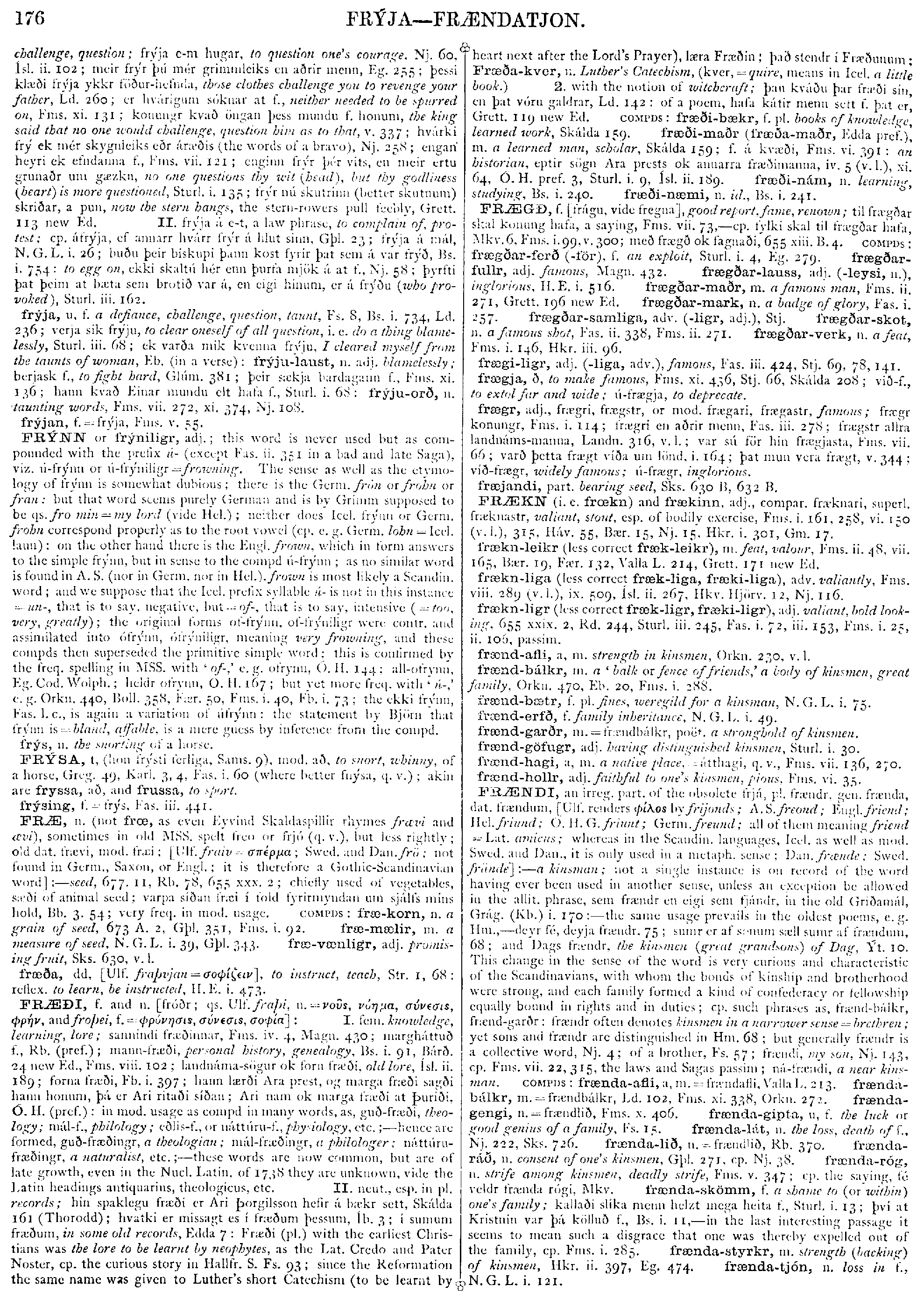
FRÝNN or frýniligr, adj.; this word is never used but as compounded with the prefix ú- (except Fas. ii. 351 in a bad and late Saga), viz. ú-frýnn or ú-frýniligr = frowning. The sense as well as the etymology of frýnn is somewhat dubious; there is the Germ. fron or frohn or fran; but that word seems purely German and is by Grimm supposed to be qs. fro min = my lord (vide Hel.); neither does Icel. frýnn or Germ. frohn correspond properly as to the root vowel (cp. e.g. Germ. lohn = Icel. laun): on the other hand there is the Engl. frown, which in form answers to the simple frýnn, but in sense to the compd ú-frýnn; as no similar word is found in A. S. (nor in Germ. nor in Hel.), frown is most likely a Scandin. word; and we suppose that the Icel. prefix syllable ú- is not in this instance = un-, that is to say, negative, but = of-, that is to say, intensive ( = too, very, greatly); the original forms of-frýnn, of-frýniligr were contr. and assimilated into ófrýnn, ófrýniligr, meaning very frowning, and these compds then superseded the primitive simple word: this is confirmed by the freq. spelling in MSS. with 'of-' e.g. ofrynn, Ó. H. 144; all-ofrynn, Eg. Cod. Wolph.; heldr ofrynn, Ó. H. 167; but yet more freq. with 'ú-' e.g. Orkn. 440, Boll. 358, Fær. 50, Fms. i. 40, Fb. i. 73; the ekki frýnn, Fas. l.c., is again a variation of úfrýnn: the statement by Björn that frýnn is = bland, affable, is a mere guess by inference from the compd.
|
Source: Cleasby/Vigfusson, page b0200, entry 28 View original page image as: [TIFF] [PNG] [View previous entry] [View next entry] |
[Comment on this entry] [View comments] |
The following entry has been hand-corrected once. |
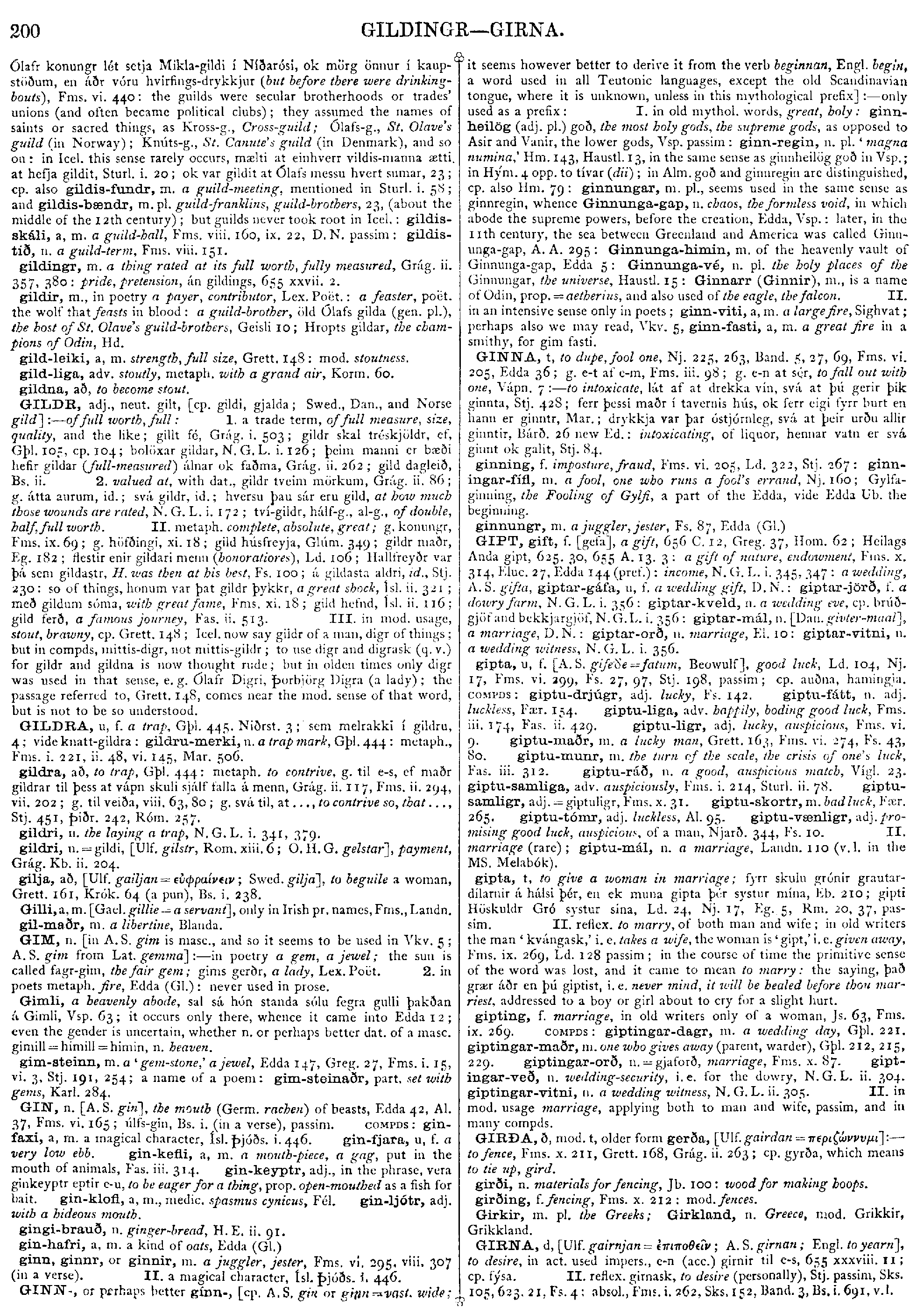
gipta,
t,
to
give
a
woman
in
marriage;
fyrr
skulu
grónir
grautar dílarnir
á
hálsi
þér,
en
ek
muna
gipta
þér
systur
mína,
Eb.
210;
gipti
Höskuldr
Gró
systur
sina,
Ld.
24,
Nj.
17,
Eg.
5,
Rm.
20,
37,
passim.
II.
reflex,
to
marry,
of
both
man
and
wife;
in
old
writers
the
man
'kvángask,'
i.e.
takes
a
wife,
the
woman
is
'gipt,'
i.e.
given
away,
Fms.
ix.
269,
Ld.
128
passim;
in
the
course
of
time
the
primitive
sense
of
the
word
was
lost,
and
it
came
to
mean
to
marry:
the
saying,
það
grær
áðr
en
þú
giptist,
i.e.
never
mind,
it
will
be
healed
before
thou
marriest,
addressed
to
a
boy
or
girl
about
to
cry
for
a
slight
hurt.
dílarnir
á
hálsi
þér,
en
ek
muna
gipta
þér
systur
mína,
Eb.
210;
gipti
Höskuldr
Gró
systur
sina,
Ld.
24,
Nj.
17,
Eg.
5,
Rm.
20,
37,
passim.
II.
reflex,
to
marry,
of
both
man
and
wife;
in
old
writers
the
man
'kvángask,'
i.e.
takes
a
wife,
the
woman
is
'gipt,'
i.e.
given
away,
Fms.
ix.
269,
Ld.
128
passim;
in
the
course
of
time
the
primitive
sense
of
the
word
was
lost,
and
it
came
to
mean
to
marry:
the
saying,
það
grær
áðr
en
þú
giptist,
i.e.
never
mind,
it
will
be
healed
before
thou
marriest,
addressed
to
a
boy
or
girl
about
to
cry
for
a
slight
hurt.
|
Source: Cleasby/Vigfusson, page b0206, entry 15 View original page image as: [TIFF] [PNG] [View previous entry] [View next entry] |
[Comment on this entry] [View comments] |
The following entry has been hand-corrected once. |
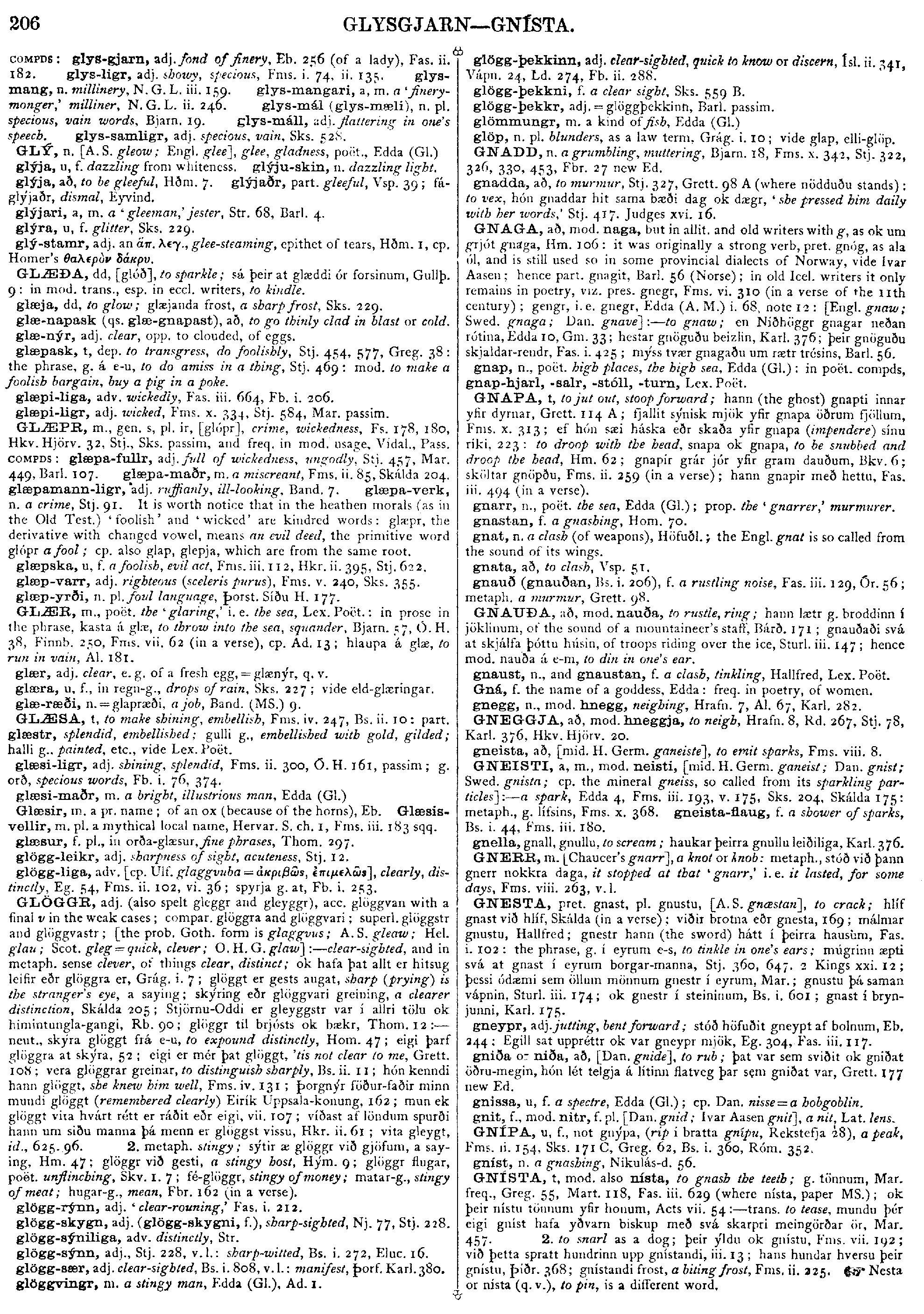
GLÆPR, m., gen. s, pl. ir, [glópr], crime, wickedness, Fs. 178, 180, Hkv. Hjörv. 32, Stj., Sks. passim, and freq. in mod. usage, Vídal., Pass. COMPDS: glæpa-fullr, adj. full of wickedness, ungodly, Stj. 457, Mar. 449, Barl. 107. glæpa-maðr, m. a miscreant, Fms. ii. 85, Skálda 204. glæpamann-ligr, adj. ruffianly, ill-looking, Band. 7. glæpa-verk, n. a crime, Stj. 91. It is worth notice that in the heathen morals (as in the Old Test.) 'foolish' and 'wicked' are kindred words: glæpr, the derivative with changed vowel, means an evil deed, the primitive word glópr a fool; cp. also glap, glepja, which are from the same root.
|
Source: Cleasby/Vigfusson, page b0219, entry 7 View original page image as: [TIFF] [PNG] [View previous entry] [View next entry] |
[Comment on this entry] [View comments] |
The following entry has been hand-corrected once. |
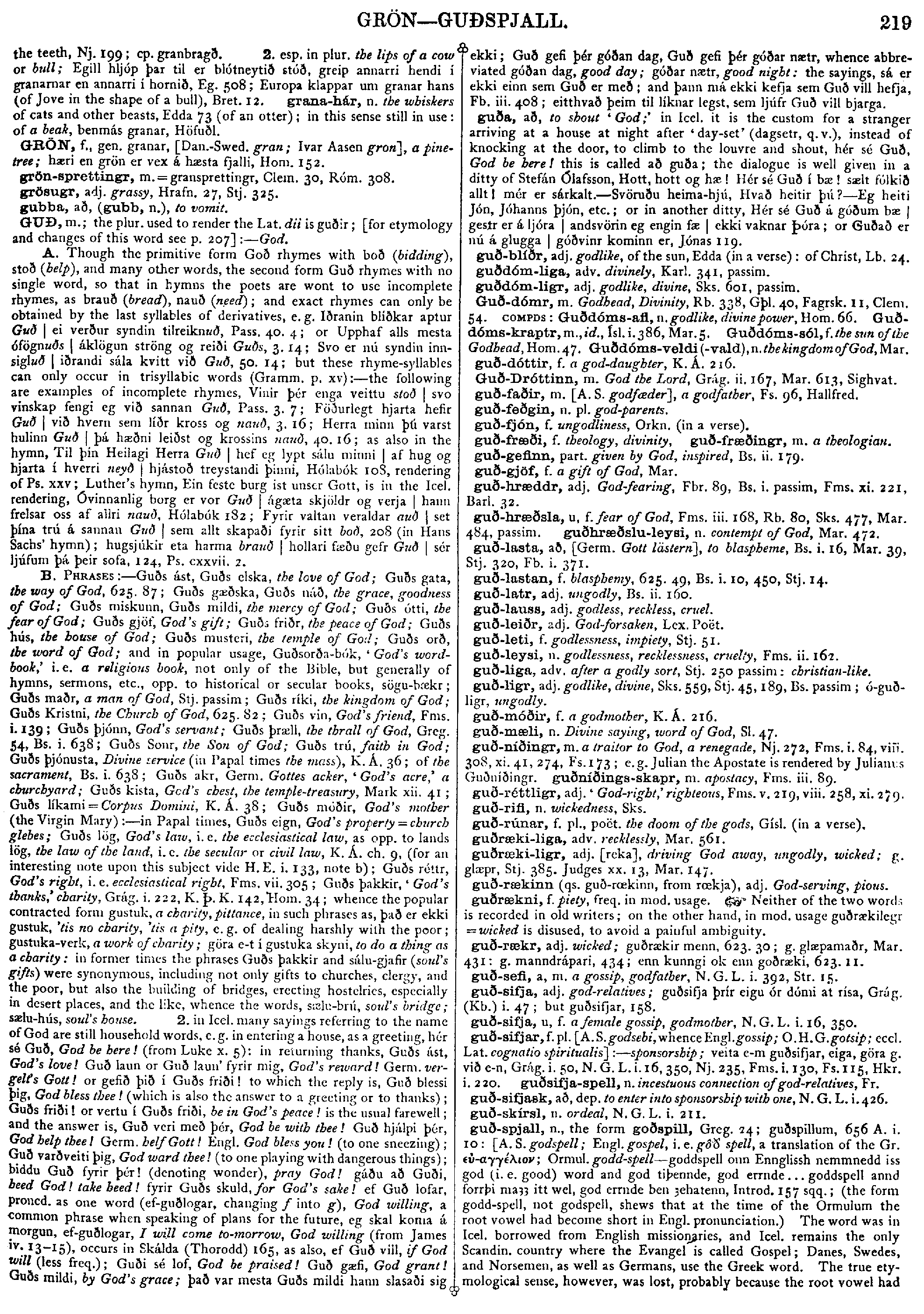
A. Though the primitive form Goð rhymes with boð (bidding), stoð (help), and many other words, the second form Guð rhymes with no single word, so that in hymns the poets are wont to use incomplete rhymes, as brauð (bread), nauð (need); and exact rhymes can only be obtained by the last syllables of derivatives, e.g. Iðranin blíðkar aptur Guð | ei verður syndin tilreiknuð, Pass. 40. 4; or Upphaf alls mesta ófögnuðs | áklögun ströng og reiði Guðs, 3. 14; Svo er nú syndin innsigluð | iðrandi sála kvitt við Guð, 50. 14; but these rhyme-syllables can only occur in trisyllabic words (Gramm. p. xv) :-- the following are examples of incomplete rhymes, Vinir þér enga veittu stoð | svo vinskap fengi eg við sannan Guð, Pass. 3. 7; Föðurlegt hjarta hefir Guð | við hvern sem líðr kross og nauð, 3. 16; Herra minn þú varst hulinn Guð | þá hæðni leiðst og krossins nauð, 40. 16; as also in the hymn, Til þín Heilagi Herra Guð | hef eg lypt sálu minni | af hug og hjarta í hverri neyð | hjástoð treystandi þinni, Hólabók 108, rendering of Ps. xxv; Luther's hymn, Ein feste burg ist unser Gott, is in the Icel. rendering, Óvinnanlig borg er vor Guð | ágæta skjöldr og verja | hann frelsar oss af allri nauð, Hólabók 182; Fyrir valtan veraldar auð | set þína trú á sannan Guð | sem allt skapaði fyrir sitt boð, 208 (in Hans Sachs' hymn); hugsjúkir eta harma brauð | hollari fæðu gefr Guð | sér ljúfum þá þeir sofa, 124, Ps. cxxvii. 2.
|
Source: Cleasby/Vigfusson, page b0231, entry 1 View original page image as: [TIFF] [PNG] [View previous entry] [View next entry] |
[Comment on this entry] [View comments] |
The following entry has been hand-corrected once. |
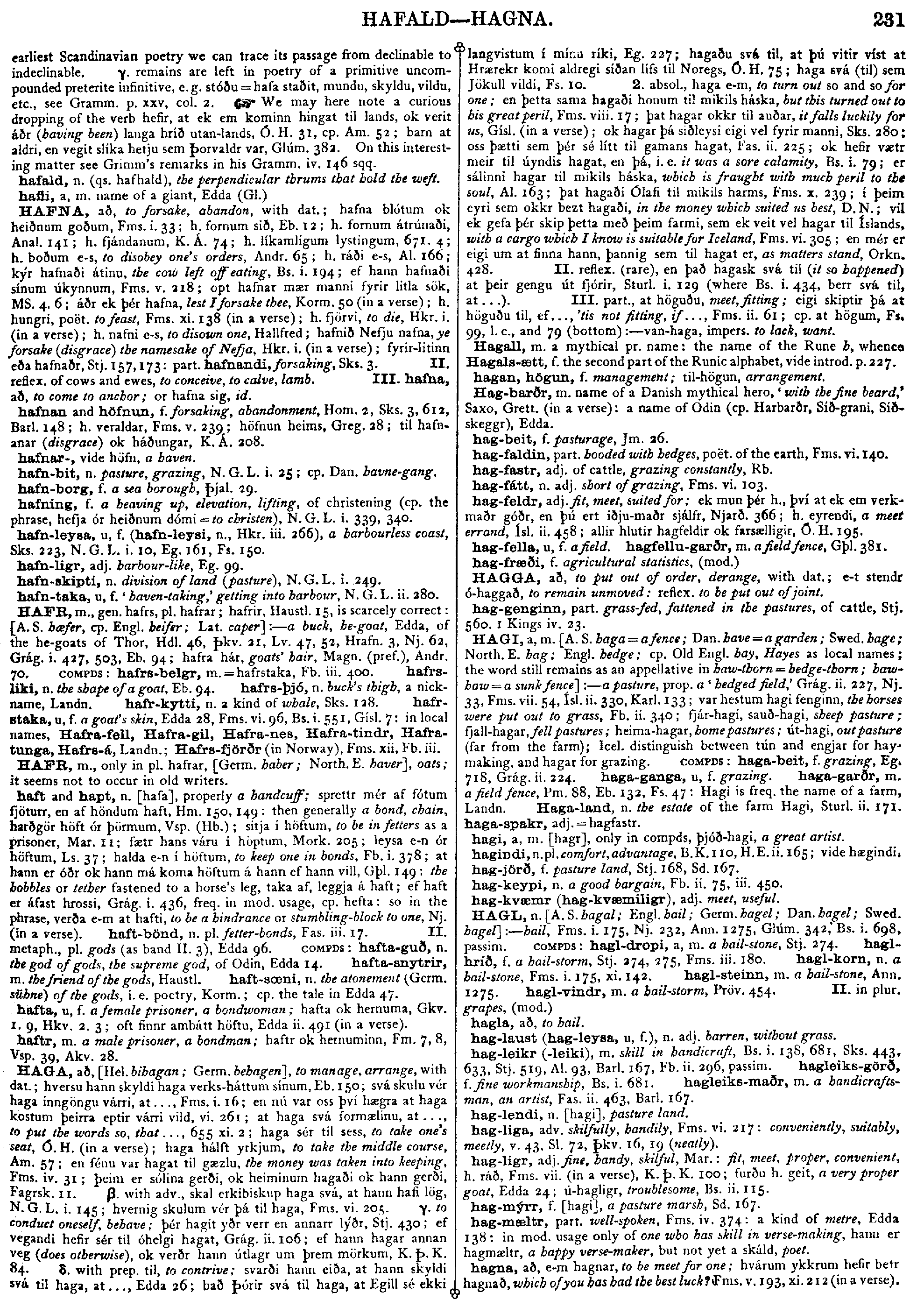
earliest
Scandinavian
poetry
we
can
trace
its
passage
from
declinable
to
indeclinable.
.
remains
are
left
in
poetry
of
a
primitive
uncompounded
preterite
infinitive,
e.g.
stóðu
=
hafa
staðit,
mundu,
skyldu,
vildu,
etc.,
see
Gramm.
p.
xxv,
col.
2.
UNCERTAIN
We
may
here
note
a
curious
dropping
of
the
verb
hefir,
at
ek
em
kominn
hingat
til
lands,
ok
verit
áðr
(having
been)
langa
hríð
utan-lands,
Ó.
H.
31,
cp.
Am.
52;
barn
at
aldri,
en
vegit
slíka
hetju
sem
Þorvaldr
var,
Glúm.
382.
On
this
interesting
matter
see
Grimm's
remarks
in
his
Gramm.
iv.
146
sqq.
|
Source: Cleasby/Vigfusson, page b0232, entry 30 View original page image as: [TIFF] [PNG] [View previous entry] [View next entry] |
[Comment on this entry] [View comments] |
The following entry has been hand-corrected once. |
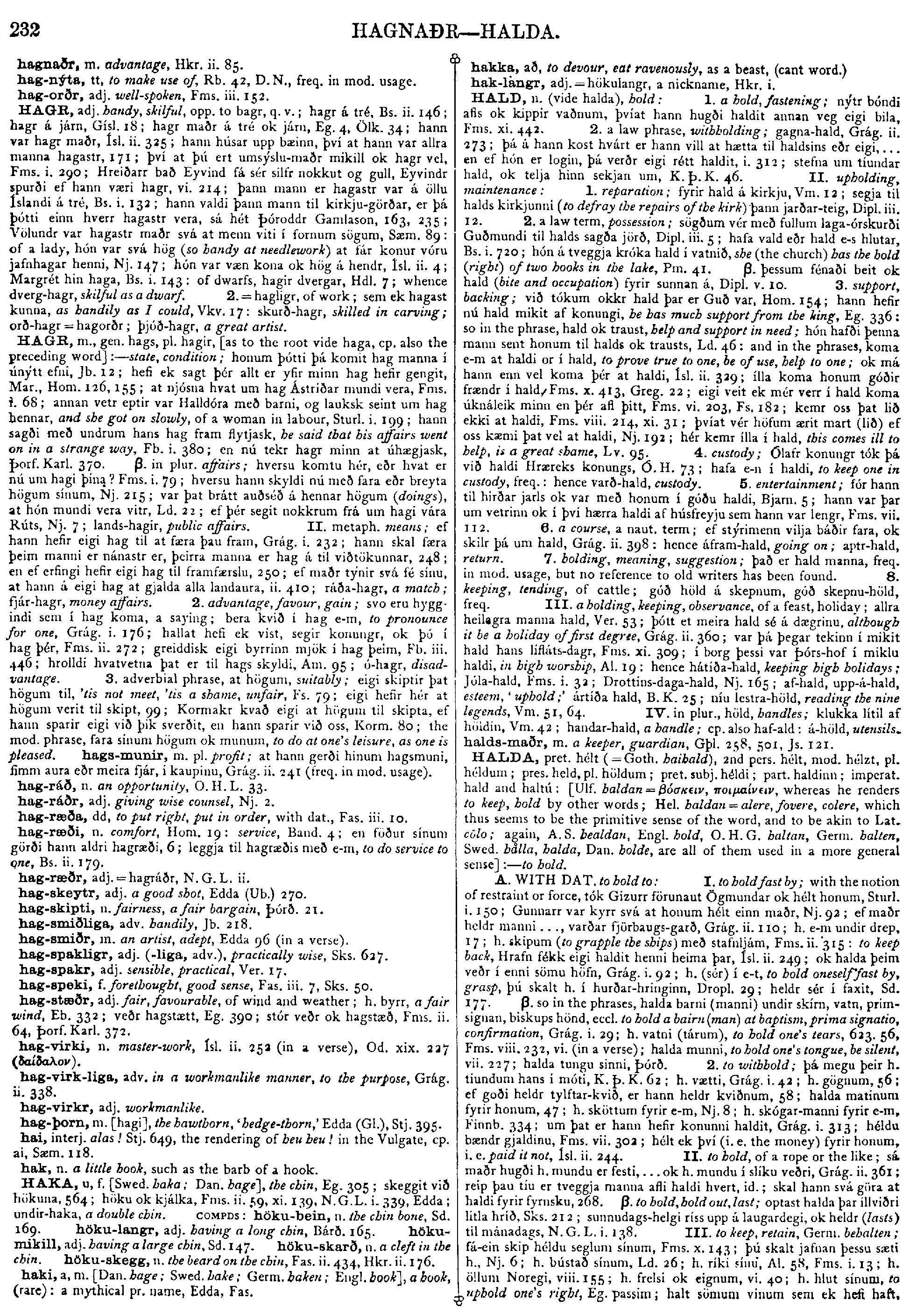
HALDA,
pret.
hélt
(=
Goth.
haihald),
2nd
pérs.
hélt,
mod.
hélzt,
pl.
héldum;
pres.
held,
pl.
höldum;
pret.
subj.
héldi;
part.
haldinn;
imperat.
hald
and
haltú:
[Ulf.
haldan
=
GREEK,
GREEK,
whereas
he
renders
to
keep,
hold
by
other
words;
Hel.
haldan
=
alere,
fovere,
colere,
which
thus
seems
to
be
the
primitive
sense
of
the
word,
and
to
be
akin
to
Lat.
c lo;
again,
A.
S.
healdan,
Engl.
hold,
O.
H.
G.
haltan,
Germ.
halten,
Swed.
hålla,
halda,
Dan.
holde,
are
all
of
them
used
in
a
more
general
sense]
:--
to
hold.
lo;
again,
A.
S.
healdan,
Engl.
hold,
O.
H.
G.
haltan,
Germ.
halten,
Swed.
hålla,
halda,
Dan.
holde,
are
all
of
them
used
in
a
more
general
sense]
:--
to
hold.
|
Source: Cleasby/Vigfusson, page b0234, entry 2 View original page image as: [TIFF] [PNG] [View previous entry] [View next entry] |
[Comment on this entry] [View comments] |
The following entry has been hand-corrected once. |
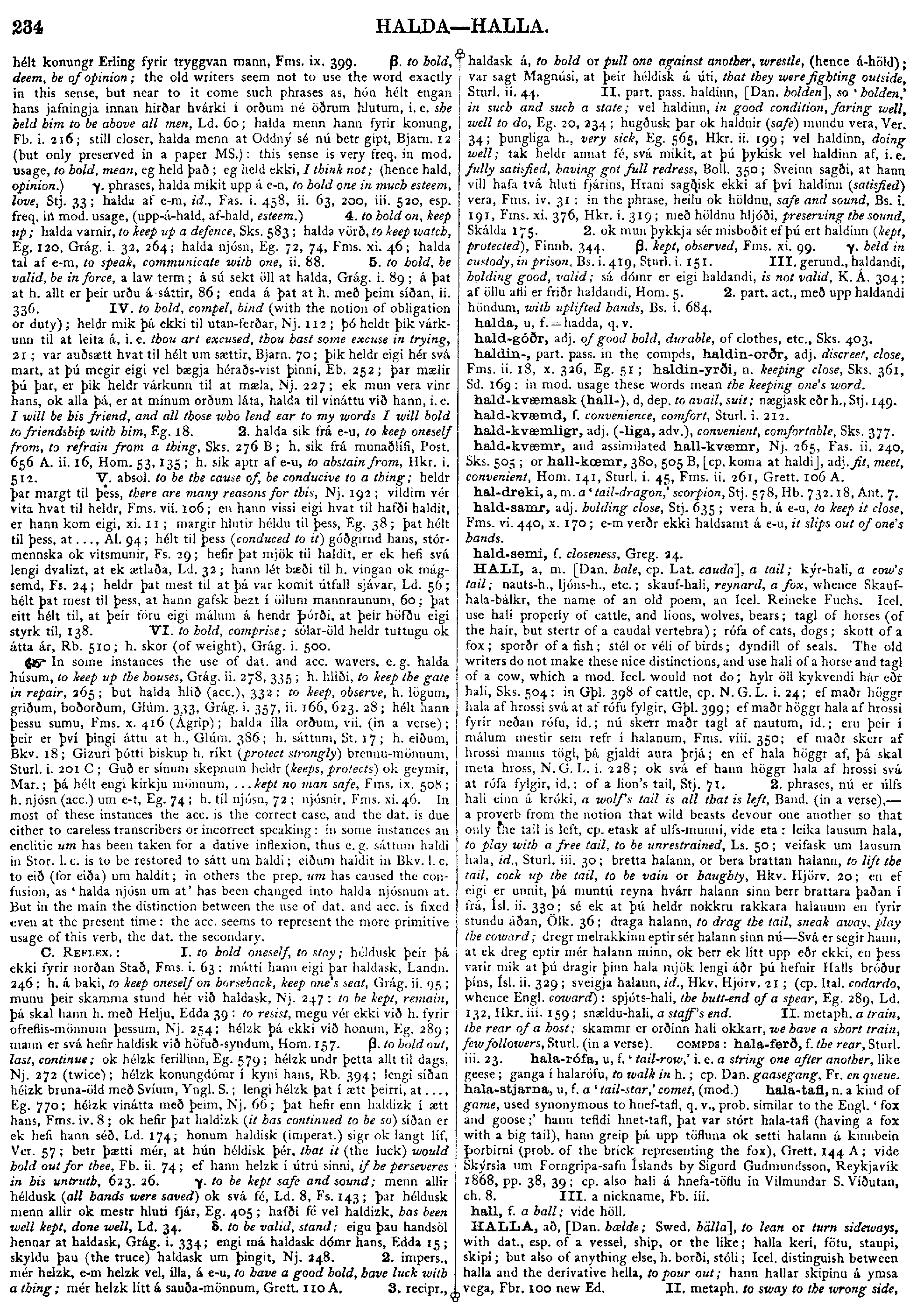
UNCERTAIN In some instances the use of dat. and acc. wavers, e.g. halda húsum, to keep up the houses, Grág. ii. 278, 335; h. hliði, to keep the gate in repair, 265; but halda hlið (acc.), 332: to keep, observe, h. lögum, griðum, boðorðum, Glúm. 333, Grág. i. 357, ii. 166, 623. 28; hélt hann þessu sumu, Fms. x. 416 (Ágrip); halda ílla orðum, vii. (in a verse); þeir er því þingi áttu at h., Glúm. 386; h. sáttum, St. 17; h. eiðum, Bkv. 18; Gizuri þótti biskup h. ríkt (protect strongly) brennu-mönnum, Sturl. i. 201 C; Guð er sínum skepnum heldr (keeps, protects) ok geymir, Mar.; þá hélt engi kirkju mönnum, ... kept no man safe, Fms. ix. 508; h. njósn (acc.) um e-t, Eg. 74; h. til njósn, 72; njósnir, Fms. xi. 46. In most of these instances the acc. is the correct case, and the dat. is due either to careless transcribers or incorrect speaking: in some instances an enclitic um has been taken for a dative inflexion, thus e.g. sáttum haldi in Stor. l.c. is to be restored to sátt um haldi; eiðum haldit in Bkv. l.c. to eið (for eiða) um haldit; in others the prep. um has caused the confusion, as 'halda njósn um at' has been changed into halda njósnum at. But in the main the distinction between the use of dat. and acc. is fixed even at the present time: the acc. seems to represent the more primitive usage of this verb, the dat. the secondary.
| Result Page: |  |
Previous | 1 2 3 4 5 | Next |  |
Germanic Lexicon Project (main page)
This search system was written by
Sean Crist
Please consider
volunteering
to correct the data in these online dictionaries.
No rights reserved. Feel free to use these data in any way you please.