|
|

Tip: In the search results, you can click on any word or abbreviation for more information.
|
Source: Cleasby/Vigfusson, page b0184, entry 39 View original page image as: [TIFF] [PNG] [View previous entry] [View next entry] |
[Comment on this entry] [View comments] |
The following entry has been hand-corrected once. |
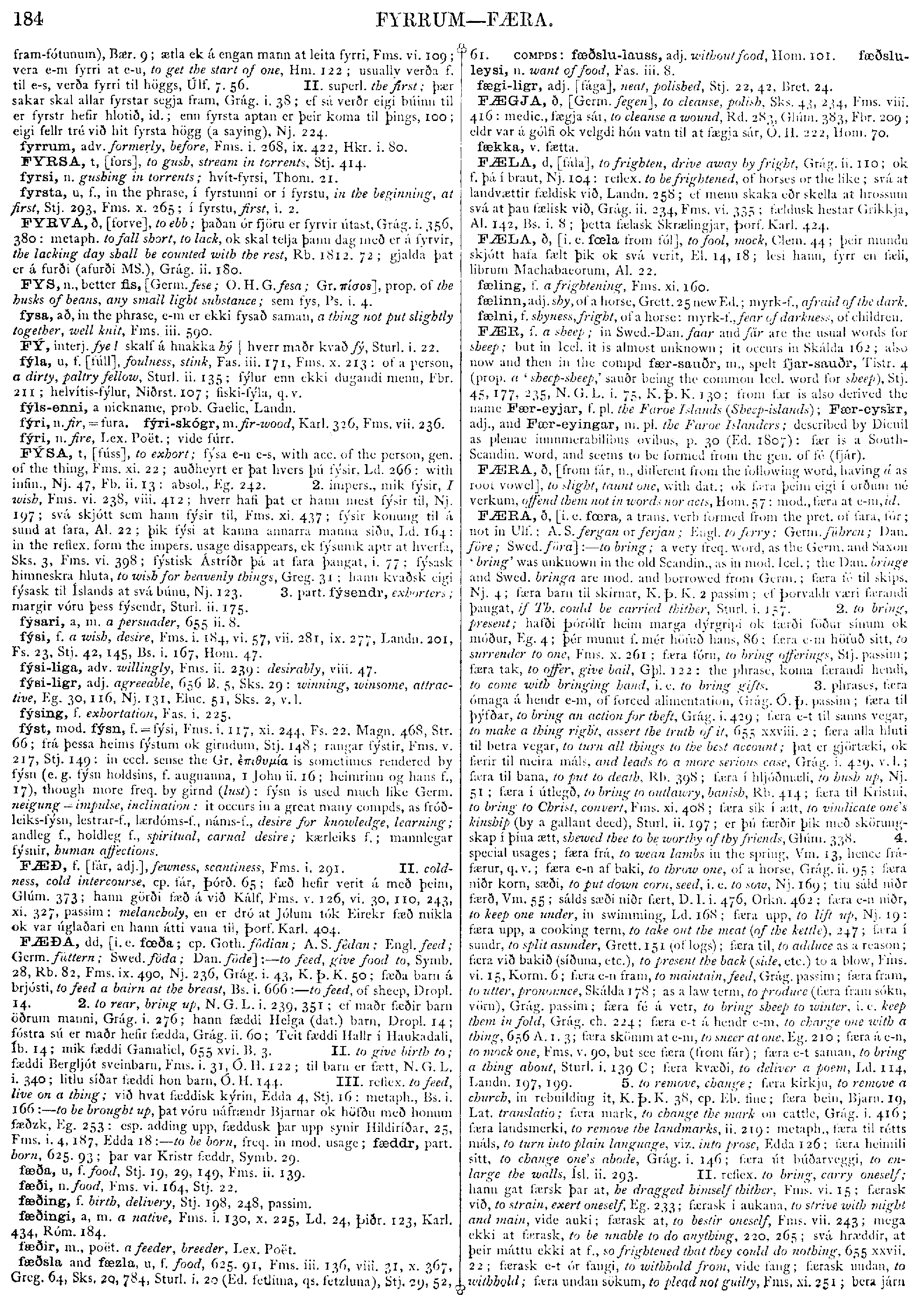
FÆRA, ð, [i.e. fœra, a trans. verb formed from the pret. of fara, fór; not in Ulf.; A. S. fergan or ferjan; Engl. to ferry; Germ. führen; Dan. före; Swed. föra] :-- to bring; a very freq. word, as the Germ. and Saxon 'bring' was unknown in the old Scandin., as in mod. Icel.; the Dan. bringe and Swed. bringa are mod. and borrowed from Germ.; færa fé til skips, Nj. 4; færa barn til skírnar, K. Þ. K. 2 passim; ef Þorvaldr væri færandi þangat, if Th. could be carried thither, Sturl. i. 157. 2. to bring, present; hafði Þórólfr heim marga dýrgripi ok færði föður sínum ok móður, Eg. 4; þér munut f. mér höfuð hans, 86; færa e-m höfuð sitt, to surrender to one, Fms. x. 261; færa fórn, to bring offerings, Stj. passim; færa tak, to offer, give bail, Gþl. 122: the phrase, koma færandi hendi, to come with bringing hand, i.e. to bring gifts. 3. phrases, færa ómaga á hendr e-m, of forced alimentation, Grág. Ó. Þ. passim; færa til þýfðar, to bring an action for theft, Grág. i. 429; færa e-t til sanns vegar, to make a thing right, assert the truth of it, 655 xxviii. 2; færa alla hluti til betra vegar, to turn all things to the best account; þat er gjörtæki, ok færir til meira máls, and leads to a more serious case, Grág. i. 429, v.l.; færa til bana, to put to death, Rb. 398; færa í hljóðmæli, to hush up, Nj. 51; færa í útlegð, to bring to outlawry, banish, Rb. 414; færa til Kristni, to bring to Christ, convert, Fms. xi. 408; færa sik í ætt, to vindicate one's kinship (by a gallant deed), Sturl. ii. 197; er þú færðir þik með skörungskap í þína ætt, shewed thee to be worthy of thy friends, Glúm. 338. 4. special usages; færa frá, to wean lambs in the spring, Vm. 13, hence frá-færur, q.v.; færa e-n af baki, to throw one, of a horse, Grág. ii. 95: færa niðr korn, sæði, to put down corn, seed, i.e. to sow, Nj. 169; tiu sáld niðr færð, Vm. 55; sálds sæði niðr fært, D. I. i. 476, Orkn. 462; færa e-n niðr, to keep one under, in swimming, Ld. 168; færa upp, to lift up, Nj. 19: færa upp, a cooking term, to take out the meat (of the kettle), 247; færa í sundr, to split asunder, Grett. 151 (of logs); færa til, to adduce as a reason; færa við bakið (síðuna, etc.), to present the back (side, etc.) to a blow, Fms. vi. 15, Korm. 6; færa e-n fram, to maintain, feed, Grág. passim; færa fram, to utter, pronounce, Skálda 178; as a law term, to produce (færa fram sókn, vörn), Grág. passim; færa fé á vetr, to bring sheep to winter, i.e. keep them in fold, Grág. ch. 224; færa e-t á hendr e-m, to charge one with a thing, 656 A. 1. 3; færa skömm at e-m, to sneer at one, Eg. 210; færa á e-n, to mock one, Fms. v. 90, but see færa (from fár); færa e-t saman, to bring a thing about, Sturl. i. 139 C; færa kvæði, to deliver a poem, Ld. 114, Landn. 197, 199. 5. to remove, change; færa kirkju, to remove a church, in rebuilding it, K. Þ. K. 38, cp. Eb. fine; færa bein, Bjarn. 19, Lat. translatio; færa mark, to change the mark on cattle, Grág. i. 416; færa landsmerki, to remove the landmarks, ii. 219: metaph., færa til rétts máls, to turn into plain language, viz. into prose, Edda 126; færa heimili sitt, to change one's abode, Grág. i. 146; færa út búðarveggi, to enlarge the walls, Ísl. ii. 293. II. reflex. to bring, carry oneself; hann gat færsk þar at, he dragged himself thither, Fms. vi. 15; færask við, to strain, exert oneself, Eg. 233; færask í aukana, to strive with might and main, vide auki; færask at, to bestir oneself, Fms. vii. 243; mega ekki at færask, to be unable to do anything, 220, 265; svá hræddir, at þeir máttu ekki at f., so frightened that they could do nothing, 655 xxvii. 22; færask e-t ór fangi, to withhold from, vide fang; færask undan, to withhold; færa undan sökum, to plead not guilty, Fms. xi. 251; bera járn
|
Source: Cleasby/Vigfusson, page b0202, entry 26 View original page image as: [TIFF] [PNG] [View previous entry] [View next entry] |
[Comment on this entry] [View comments] |
The following entry has been hand-corrected once. |
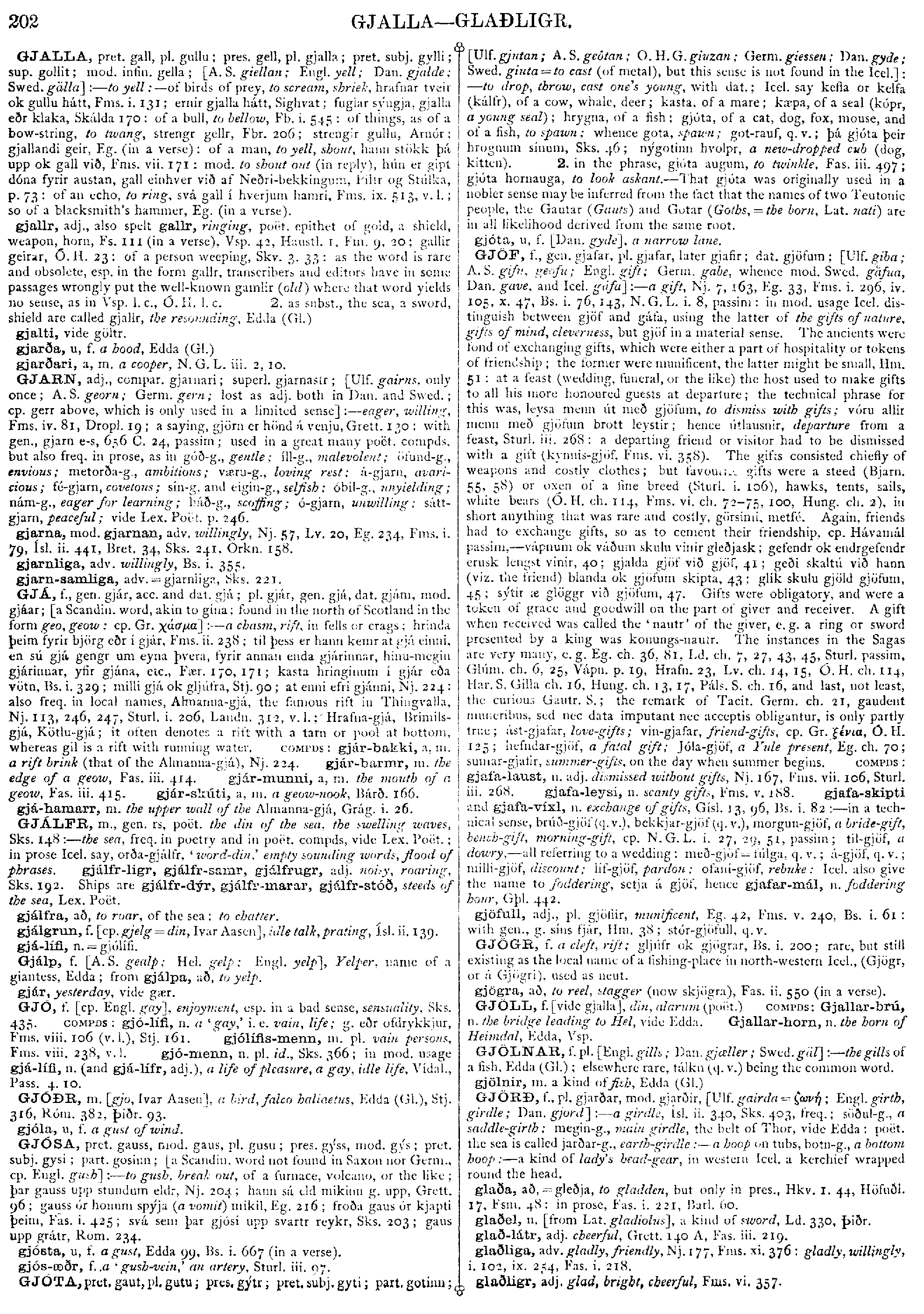
GJÖF, f., gen. gjafar, pl. gjafar, later gjafir; dat. gjöfum: [Ulf. giba; A. S. gifu, geofu; Engl. gift; Germ. gabe, whence mod. Swed. gåfua, Dan. gave, and Icel. gáfa] :-- a gift, Nj. 7, 163, Eg. 33, Fms. i. 296, iv. 105, x. 47, Bs. i. 76, 143, N. G. L. i. 8, passim: in mod. usage Icel. distinguish between gjöf and gáfa, using the latter of the gifts of nature, gifts of mind, cleverness, but gjöf in a material sense. The ancients were fond of exchanging gifts, which were either a part of hospitality or tokens of friendship; the former were munificent, the latter might be small, Hm. 51: at a feast (wedding, funeral, or the like) the host used to make gifts to all his more honoured guests at departure; the technical phrase for this was, leysa menn út með gjöfum, to dismiss with gifts; vóru allir menn með gjöfum brott leystir; hence útlausnir, departure from a feast, Sturl. iii. 268: a departing friend or visitor had to be dismissed with a gift (kynnis-gjöf, Fms. vi. 358). The gifts consisted chiefly of weapons and costly clothes; but favourite gifts were a steed (Bjarn. 55, 58) or oxen of a fine breed (Sturl. i. 106), hawks, tents, sails, white bears (Ó. H. ch. 114, Fms. vi. ch. 72-75, 100, Hung. ch. 2), in short anything that was rare and costly, görsimi, metfé. Again, friends had to exchange gifts, so as to cement their friendship, cp. Hávamál passim, -- vápnum ok váðum skulu vinir gleðjask; gefendr ok endrgefendr erusk lengst vinir, 40; gjalda gjöf við gjöf, 41; geði skaltú við hann (viz. the friend) blanda ok gjöfum skipta, 43; glík skulu gjöld gjöfum, 45; sýtir æ glöggr við gjöfum, 47. Gifts were obligatory, and were a token of grace and goodwill on the part of giver and receiver. A gift when received was called the 'nautr' of the giver, e.g. a ring or sword presented by a king was konungs-nautr. The instances in the Sagas are very many, e.g. Eg. ch. 36, 81, Ld. ch. 7, 27, 43, 45, Sturl. passim, Glúm. ch. 6, 25, Vápn. p. 19, Hrafn. 23, Lv. ch. 14, 15, Ó. H. ch. 114, Har. S. Gilla ch. 16, Hung. ch. 13, 17, Páls. S. ch. 16, and last, not least, the curious Gautr. S.; the remark of Tacit. Germ. ch. 21, gaudent muneribus, sed nec data imputant nec acceptis obligantur, is only partly true; ást-gjafar, love-gifts; vin-gjafar, friend-gifts, cp. Gr. GREEK, Ó. H. 125; hefndar-gjöf, a fatal gift; Jóla-gjöf, a Yule present, Eg. ch. 70; sumar-gjafir, summer-gifts, on the day when summer begins. COMPDS: gjafa-laust, n. adj. dismissed without gifts, Nj. 167, Fms. vii. 106, Sturl. iii. 268. gjafa-leysi, n. scanty gifts, Fms. v. 188. gjafa-skipti and gjafa-víxl, n. exchange of gifts, Gísl. 13, 96, Bs. i. 82 :-- in a technical sense, brúð-gjöf (q.v.), bekkjar-gjöf (q.v.), morgun-gjöf, a bride-gift, bench-gift, morning-gift, cp. N. G. L. i. 27, 29, 51, passim: til-gjöf, a dowry, -- all referring to a wedding: með-gjöf -- fúlga, q.v.; á-gjöf, q.v.; milli-gjöf, discount; líf-gjöf, pardon; ofaní-gjöf, rebuke: Icel. also give the name to foddering, setja á gjöf, hence gjafar-mál, n. foddering hour, Gþl. 442.
|
Source: Cleasby/Vigfusson, page b0212, entry 15 View original page image as: [TIFF] [PNG] [View previous entry] [View next entry] |
[Comment on this entry] [View comments] |
The following entry has been hand-corrected once. |
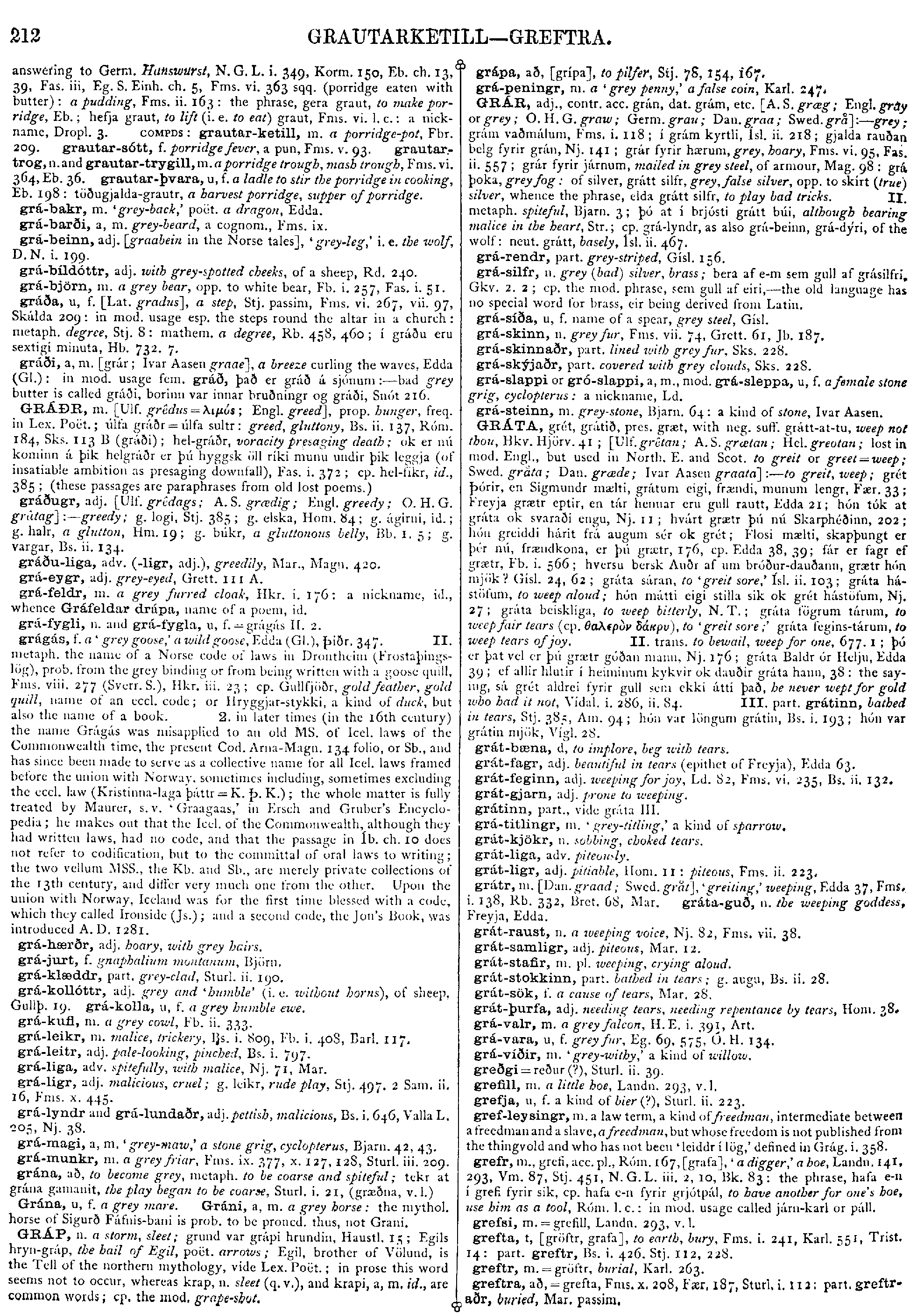
grágás, f. a 'grey goose,' a wild goose, Edda (Gl.), Þiðr. 347. II. metaph. the name of a Norse code of laws in Drontheim (Frostaþingslög), prob. from the grey binding or from being written with a goose quill, Fms. viii. 277 (Sverr. S.), Hkr. iii. 23; cp. Gullfjöðr, gold feather, gold quill, name of an eccl. code; or Hryggjar-stykki, a kind of duck, but also the name of a book. 2. in later times (in the 16th century) the name Grágás was misapplied to an old MS. of Icel. laws of the Commonwealth time, the present Cod. Arna-Magn. 134 folio, or Sb., and has since been made to serve as a collective name for all Icel. laws framed before the union with Norway, sometimes including, sometimes excluding the eccl. law (Kristinna-laga þáttr = K.Þ.K.); the whole matter is fully treated by Maurer, s.v. 'Graagaas,' in Ersch and Gruber's Encyclopedia; he makes out that the Icel. of the Commonwealth, although they had written laws, had no code, and that the passage in Íb. ch. 10 does not refer to codification, but to the committal of oral laws to writing; the two vellum MSS., the Kb. and Sb., are merely private collections of the 13th century, and differ very much one from the other. Upon the union with Norway, Iceland was for the first time blessed with a code, which they called Ironside (Js.); and a second code, the Jon's Book, was introduced A.D. 1281.
|
Source: Cleasby/Vigfusson, page b0227, entry 2 View original page image as: [TIFF] [PNG] [View previous entry] [View next entry] |
[Comment on this entry] [View comments] |
The following entry has been hand-corrected once. |
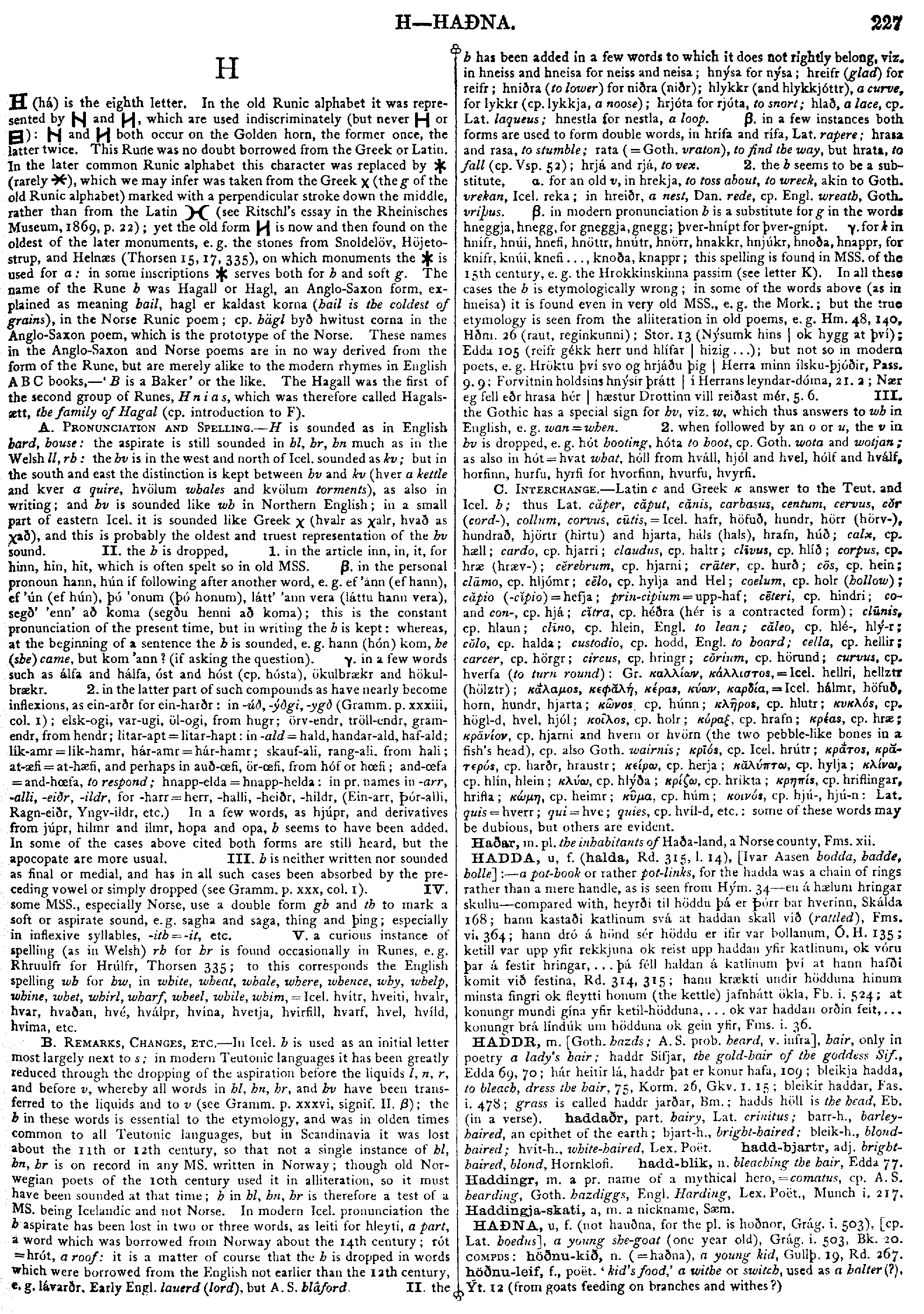
A.
PRONUNCIATION
AND
SPELLING.
--
H
is
sounded
as
in
English
hard,
house:
the
aspirate
is
still
sounded
in
hl,
hr,
hn
much
as
in
the
Welsh
ll,
rh:
the
hv
is
in
the
west
and
north
of
Icel.
sounded
as
kv;
but
in
the
south
and
east
the
distinction
is
kept
between
hv
and
kv
(hver
a
kettle
and
kver
a
quire,
hvölum
whales
and
kvölum
torments),
as
also
in
writing;
and
hv
is
sounded
like
wh
in
Northern
English;
in
a
small
part
of
eastern
Icel.
it
is
sounded
like
Greek
 (hvalr
as
alr,
hvað
as
að),
and
this
is
probably
the
oldest
and
truest
representation
of
the
hv
sound.
II.
the
h
is
dropped,
1.
in
the
article
inn,
in,
it,
for
hinn,
hin,
hit,
which
is
often
spelt
so
in
old
MSS.
(hvalr
as
alr,
hvað
as
að),
and
this
is
probably
the
oldest
and
truest
representation
of
the
hv
sound.
II.
the
h
is
dropped,
1.
in
the
article
inn,
in,
it,
for
hinn,
hin,
hit,
which
is
often
spelt
so
in
old
MSS.
 .
in
the
personal
pronoun
hann,
hún
if
following
after
another
word,
e.g.
ef
'ann
(ef
hann),
ef
'ún
(ef
hún),
þó
'onum
(þó
honum),
látt'
'ann
vera
(láttu
hann
vera),
segð'
'enn'
að
koma
(segðu
henni
að
koma);
this
is
the
constant
pronunciation
of
the
present
time,
but
in
writing
the
h
is
kept:
whereas,
at
the
beginning
of
a
sentence
the
h
is
sounded,
e.g.
hann
(hón)
kom,
he
(she)
came,
but
kom
'ann
?
(if
asking
the
question).
.
in
the
personal
pronoun
hann,
hún
if
following
after
another
word,
e.g.
ef
'ann
(ef
hann),
ef
'ún
(ef
hún),
þó
'onum
(þó
honum),
látt'
'ann
vera
(láttu
hann
vera),
segð'
'enn'
að
koma
(segðu
henni
að
koma);
this
is
the
constant
pronunciation
of
the
present
time,
but
in
writing
the
h
is
kept:
whereas,
at
the
beginning
of
a
sentence
the
h
is
sounded,
e.g.
hann
(hón)
kom,
he
(she)
came,
but
kom
'ann
?
(if
asking
the
question).
 .
in
a
few
words
such
as
álfa
and
hálfa,
óst
and
host
(cp.
hósta),
ökulbrækr
and
hökulbraekr.
2.
in
the
latter
part
of
such
compounds
as
have
nearly
become
inflexions,
as
ein-arðr
for
ein-harðr:
in
-úð,
-ýðgi,
-ygð
(Gramm.
p.
xxxiii,
col.
1);
elsk-ogi,
var-ugi,
öl-ogi,
from
hugr;
örv-endr,
tröll-endr,
gram-endr,
from
hendr;
litar-apt
=
litar-hapt:
in
-ald
=
hald,
handar-ald,
haf-ald;
lík-amr
=
lík-hamr,
hár-amr
=
hár-hamr;
skauf-ali,
rang-ali,
from
hali;
at-æfi
=
at-hæfi,
and
perhaps
in
auð-œfi,
ör-œfi,
from
hóf
or
hœfi;
and-œfa
=
and-hœfa,
to
respond;
hnapp-elda
=
hnapp-helda:
in
pr.
names
in
-arr,
-alli,
-eiðr,
-ildr,
for
-harr
=
herr,
-halli,
-heiðr,
-hildr,
(Ein-arr,
Þór-alli,
Ragn-eiðr,
Yngv-ildr,
etc.)
In
a
few
words,
as
hjúpr,
and
derivatives
from
júpr,
hilmr
and
ilmr,
hopa
and
opa,
h
seems
to
have
been
added.
In
some
of
the
cases
above
cited
both
forms
are
still
heard,
but
the
apocopate
are
more
usual.
III.
h
is
neither
written
nor
sounded
as
final
or
medial,
and
has
in
all
such
cases
been
absorbed
by
the
preceding
vowel
or
simply
dropped
(see
Gramm.
p.
xxx,
col.
1).
IV.
some
MSS.,
especially
Norse,
use
a
double
form
gh
and
th
to
mark
a
soft
or
aspirate
sound,
e.g.
sagha
and
saga,
thing
and
þing;
especially
in
inflexive
syllables,
-ith
=
-it,
etc.
V.
a
curious
instance
of
spelling
(as
in
Welsh)
rh
for
hr
is
found
occasionally
in
Runes,
e.g.
Rhruulfr
for
Hrúlfr,
Thorsen
335;
to
this
corresponds
the
English
spelling
wh
for
hw,
in
white,
wheat,
whale,
where,
whence,
why,
whelp,
whine,
whet,
whirl,
wharf,
wheel,
while,
whim,
=
Icel.
hvítr,
hveiti,
hvalr,
hvar,
hvaðan,
hvé,
hválpr,
hvína,
hvetja,
hvirfill,
hvarf,
hvel,
hvíld,
hvima,
etc.
.
in
a
few
words
such
as
álfa
and
hálfa,
óst
and
host
(cp.
hósta),
ökulbrækr
and
hökulbraekr.
2.
in
the
latter
part
of
such
compounds
as
have
nearly
become
inflexions,
as
ein-arðr
for
ein-harðr:
in
-úð,
-ýðgi,
-ygð
(Gramm.
p.
xxxiii,
col.
1);
elsk-ogi,
var-ugi,
öl-ogi,
from
hugr;
örv-endr,
tröll-endr,
gram-endr,
from
hendr;
litar-apt
=
litar-hapt:
in
-ald
=
hald,
handar-ald,
haf-ald;
lík-amr
=
lík-hamr,
hár-amr
=
hár-hamr;
skauf-ali,
rang-ali,
from
hali;
at-æfi
=
at-hæfi,
and
perhaps
in
auð-œfi,
ör-œfi,
from
hóf
or
hœfi;
and-œfa
=
and-hœfa,
to
respond;
hnapp-elda
=
hnapp-helda:
in
pr.
names
in
-arr,
-alli,
-eiðr,
-ildr,
for
-harr
=
herr,
-halli,
-heiðr,
-hildr,
(Ein-arr,
Þór-alli,
Ragn-eiðr,
Yngv-ildr,
etc.)
In
a
few
words,
as
hjúpr,
and
derivatives
from
júpr,
hilmr
and
ilmr,
hopa
and
opa,
h
seems
to
have
been
added.
In
some
of
the
cases
above
cited
both
forms
are
still
heard,
but
the
apocopate
are
more
usual.
III.
h
is
neither
written
nor
sounded
as
final
or
medial,
and
has
in
all
such
cases
been
absorbed
by
the
preceding
vowel
or
simply
dropped
(see
Gramm.
p.
xxx,
col.
1).
IV.
some
MSS.,
especially
Norse,
use
a
double
form
gh
and
th
to
mark
a
soft
or
aspirate
sound,
e.g.
sagha
and
saga,
thing
and
þing;
especially
in
inflexive
syllables,
-ith
=
-it,
etc.
V.
a
curious
instance
of
spelling
(as
in
Welsh)
rh
for
hr
is
found
occasionally
in
Runes,
e.g.
Rhruulfr
for
Hrúlfr,
Thorsen
335;
to
this
corresponds
the
English
spelling
wh
for
hw,
in
white,
wheat,
whale,
where,
whence,
why,
whelp,
whine,
whet,
whirl,
wharf,
wheel,
while,
whim,
=
Icel.
hvítr,
hveiti,
hvalr,
hvar,
hvaðan,
hvé,
hválpr,
hvína,
hvetja,
hvirfill,
hvarf,
hvel,
hvíld,
hvima,
etc.
|
Source: Cleasby/Vigfusson, page b0228, entry 3 View original page image as: [TIFF] [PNG] [View previous entry] [View next entry] |
[Comment on this entry] [View comments] |
The following entry has been hand-corrected once. |
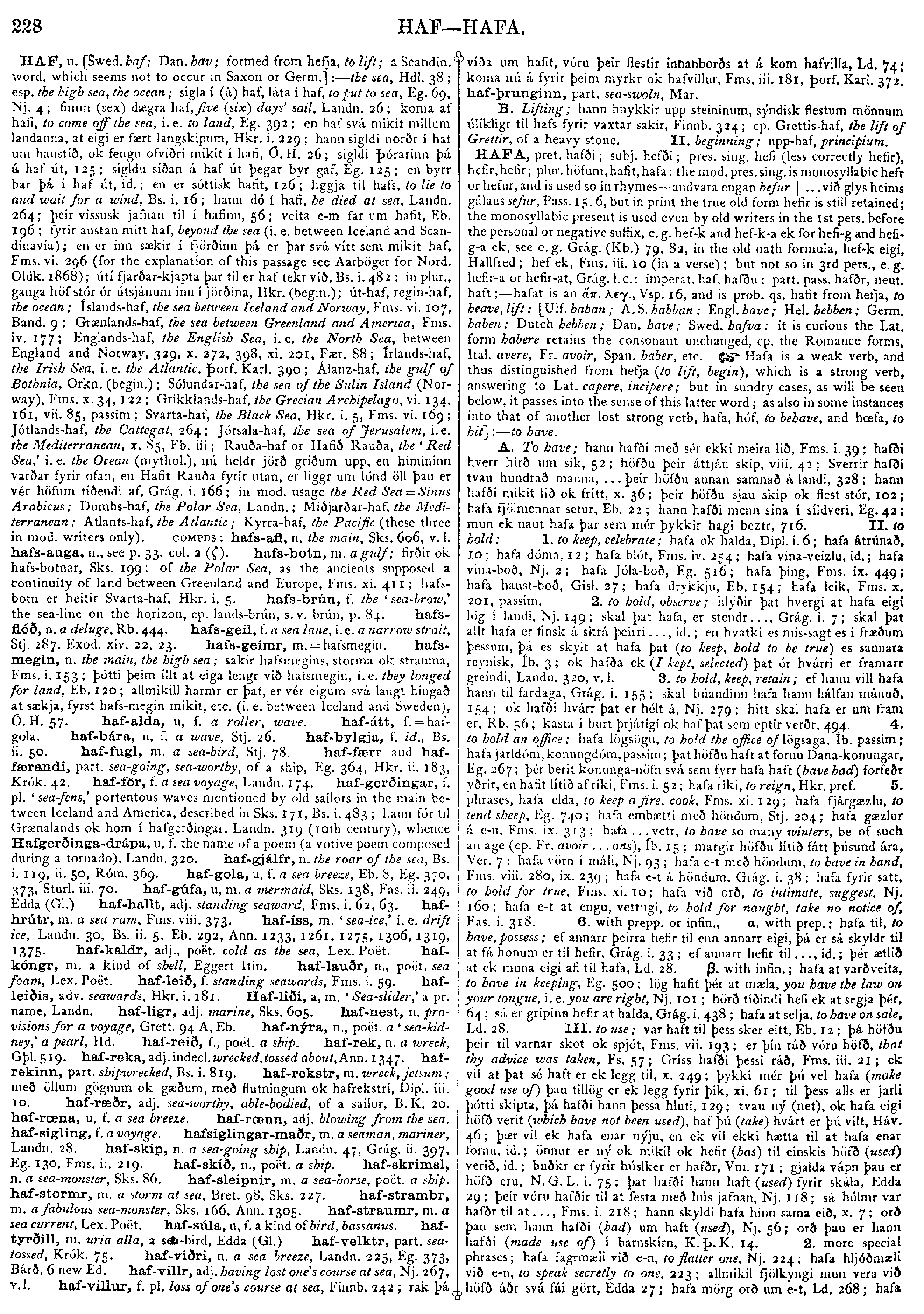
HAFA, pret. hafði; subj. hefði; pres. sing, hefi (less correctly hefir), hefir, hefir; plur. höfum, hafit, hafa: the mod. pres. sing, is monosyllabic hefr or hefur, and is used so in rhymes -- andvara engan hefur | ... við glys heims gálaus sefur, Pass. 15. 6, but in print the true old form hefir is still retained; the monosyllabic present is used even by old writers in the 1st pers. before the personal or negative suffix, e.g. hef-k and hef-k-a ek for hefi-g and hefig-a ek, see e.g. Grág. (Kb.) 79, 82, in the old oath formula, hef-k eigi, Hallfred; hef ek, Fms. iii. 10 (in a verse); but not so in 3rd pers., e.g. hefir-a or hefir-at, Grág. l.c.: imperat. haf, hafðu: part. pass. hafðr, neut. haft; -- hafat is an GREEK, Vsp. 16, and is prob. qs. hafit from hefja, to heave, lift: [Ulf. haban; A. S. habban; Engl. have; Hel. hebben; Germ. haben; Dutch hebben; Dan. have, Swed. hafva: it is curious the Lat. form habere retains the consonant unchanged, cp. the Romance forms, Ital. avere, Fr. avoir, Span. haber, etc. UNCERTAIN Hafa is a weak verb, and thus distinguished from hefja (to lift, begin), which is a strong verb, answering to Lat. capere, incipere; but in sundry cases, as will be seen below, it passes into the sense of this latter word; as also in some instances into that of another lost strong verb, hafa, hóf, to behave, and hœfa, to hit] :-- to have.
|
Source: Cleasby/Vigfusson, page b0229, entry 2 View original page image as: [TIFF] [PNG] [View previous entry] [View next entry] |
[Comment on this entry] [View comments] |
The following entry has been hand-corrected once. |
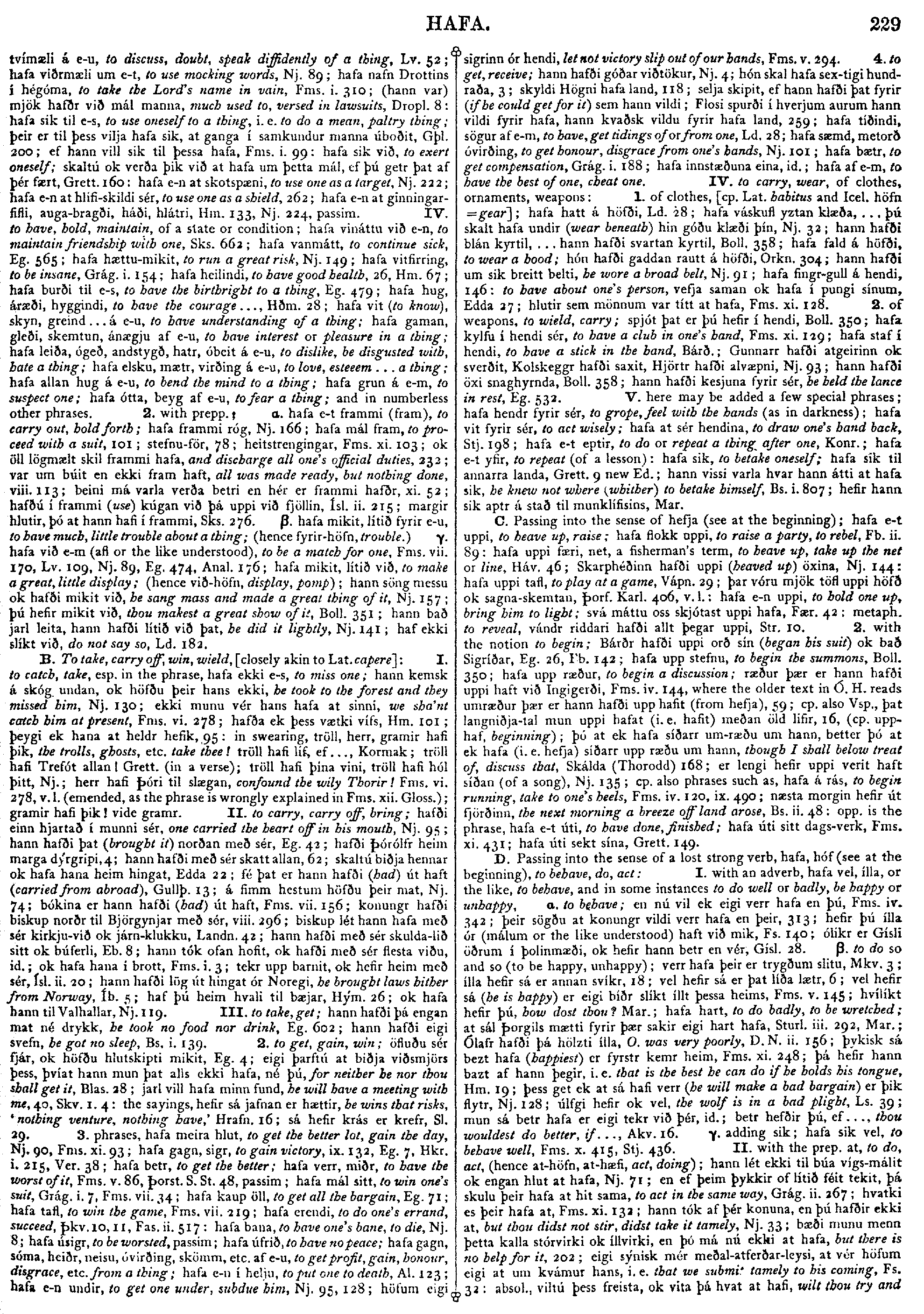
B. To take, carry off, win, wield, [closely akin to Lat. capere]: I. to catch, take, esp. in the phrase, hafa ekki e-s, to miss one; hann kemsk á skóg undan, ok höfðu þeir hans ekki, he took to the forest and they missed him, Nj. 130; ekki munu vér hans hafa at sinni, we sha'nt catch him at present, Fms. vi. 278; hafða ek þess vætki vífs, Hm. 101; þeygi ek hana at heldr hefik, 95: in swearing, tröll, herr, gramir hafi þik, the trolls, ghosts, etc. take thee! tröll hafi líf, ef ..., Kormak; tröll hafi Trefót allan! Grett. (in a verse); tröll hafi þína vini, tröll hafi hól þitt, Nj.; herr hafi Þóri til slægan, confound the wily Thorir! Fms. vi. 278, v.l. (emended, as the phrase is wrongly explained in Fms. xii. Gloss.); gramir hafi þik! vide gramr. II. to carry, carry off, bring; hafði einn hjartað í munni sér, one carried the heart off in his mouth, Nj. 95; hann hafði þat (brought it) norðan með sér, Eg. 42; hafði Þórólfr heim marga dýrgripi, 4; hann hafði með sér skatt allan, 62; skaltú biðja hennar ok hafa hana heim hingat, Edda 22; fé þat er hann hafði (had) út haft (carried from abroad), Gullþ. 13; á fimm hestum höfðu þeir mat, Nj. 74; bókina er hann hafði (had) út haft, Fms. vii. 156; konungr hafði biskup norðr til Björgynjar með sér, viii. 296; biskup lét hann hafa með sér kirkju-við ok járn-klukku, Landn. 42; hann hafði með sér skulda-lið sitt ok búferli, Eb. 8; hann tók ofan hofit, ok hafði með sér flesta viðu, id.; ok hafa hana í brott, Fms. i. 3; tekr upp barnit, ok hefir heim með sér, Ísl. ii. 20; hann hafði lög út hingat ór Noregi, he brought laws hither from Norway, Íb. 5; haf þú heim hvali til bæjar, Hým. 26; ok hafa hann til Valhallar, Nj. 119. III. to take, get; hann hafði þá engan mat né drykk, he took no food nor drink, Eg. 602; hann hafði eigi svefn, he got no sleep, Bs. i. 139. 2. to get, gain, win; öfluðu sér fjár, ok höfðu hlutskipti mikit, Eg. 4; eigi þarftú at biðja viðsmjörs þess, þvíat hann mun þat alls ekki hafa, né þú, for neither he nor thou shall get it, Blas. 28; jarl vill hafa minn fund, he will have a meeting with me, 40, Skv. 1. 4: the sayings, hefir sá jafnan er hættir, he wins that risks, 'nothing venture, nothing have,' Hrafn. 16; sá hefir krás er krefr, Sl. 29. 3. phrases, hafa meira hlut, to get the better lot, gain the day, Nj. 90, Fms. xi. 93; hafa gagn, sigr, to gain victory, ix. 132, Eg. 7, Hkr. i. 215, Ver. 38; hafa betr, to get the better; hafa verr, miðr, to have the worst of it, Fms. v. 86, Þorst. S. St. 48, passim; hafa mál sitt, to win one's suit, Grág. i. 7, Fms. vii. 34; hafa kaup öll, to get all the bargain, Eg. 71; hafa tafl, to win the game, Fms. vii. 219; hafa erendi, to do one's errand, succeed, Þkv. 10, 11, Fas. ii. 517: hafa bana, to have one's bane, to die, Nj. 8; hafa úsigr, to be worsted, passim; hafa úfrið, to have no peace; hafa gagn, sóma, heiðr, neisu, óvirðing, skömm, etc. af e-u, to get profit, gain, honour, disgrace, etc. from a thing; hafa e-n í helju, to put one to death, Al. 123; hafa e-n undir, to get one under, subdue him, Nj. 95, 128; höfum eigi, sigrinn ór hendi, let not victory slip out of our hands, Fms. v. 294. 4. to get, receive; hann hafði góðar viðtökur, Nj. 4; hón skal hafa sex-tigi hundraða, 3; skyldi Högni hafa land, 118; selja skipit, ef hann hafði þat fyrir (if he could get for it) sem hann vildi; Flosi spurði í hverjum aurum hann vildi fyrir hafa, hann kvaðsk vildu fyrir hafa land, 259; hafa tíðindi, sögur af e-m, to have, get tidings of or from one, Ld. 28; hafa sæmd, metorð óvirðing, to get honour, disgrace from one's hands, Nj. 101; hafa bætr, to get compensation, Grág. i. 188; hafa innstæðuna eina, id.; hafa af e-m, to have the best of one, cheat one. IV. to carry, wear, of clothes, ornaments, weapons: 1. of clothes, [cp. Lat. habitus and Icel. höfn = gear]; hafa hatt á höfði, Ld. 28; hafa váskufl yztan klæða, ... þú skalt hafa undir (wear beneath) hin góðu klæði þín, Nj. 32; hann hafði blán kyrtil, ... hann hafði svartan kyrtil, Boll. 358; hafa fald á höfði, to wear a hood; hón hafði gaddan rautt á höfði, Orkn. 304; hann hafði um sik breitt belti, he wore a broad belt, Nj. 91; hafa fingr-gull á hendi, 146: to have about one's person, vefja saman ok hafa í pungi sínum, Edda 27; hlutir sem mönnum var títt at hafa, Fms. xi. 128. 2. of weapons, to wield, carry; spjót þat er þú hefir í hendi, Boll. 350; hafa kylfu í hendi sér, to have a club in one's hand, Fms. xi. 129; hafa staf í hendi, to have a stick in the hand, Bárð.; Gunnarr hafði atgeirinn ok sverðit, Kolskeggr hafði saxit, Hjörtr hafði alvæpni, Nj. 93; hann hafdi öxi snaghyrnda, Boll. 358; hann hafði kesjuna fyrir sér, he held the lance in rest, Eg. 532. V. here may be added a few special phrases; hafa hendr fyrir sér, to grope, feel with the hands (as in darkness); hafa vit fyrir sér, to act wisely; hafa at sér hendina, to draw one's hand back, Stj. 198; hafa e-t eptir, to do or repeat a thing after one, Konr.; hafa e-t yfir, to repeat (of a lesson): hafa sik, to betake oneself; hafa sik til annarra landa, Grett. 9 new Ed.; hann vissi varla hvar hann átti at hafa sik, he knew not where (whither) to betake himself, Bs. i. 807; hefir hann sik aptr á stað til munklífisins, Mar.
|
Source: Cleasby/Vigfusson, page b0230, entry 4 View original page image as: [TIFF] [PNG] [View previous entry] [View next entry] |
[Comment on this entry] [View comments] |
The following entry has been hand-corrected once. |
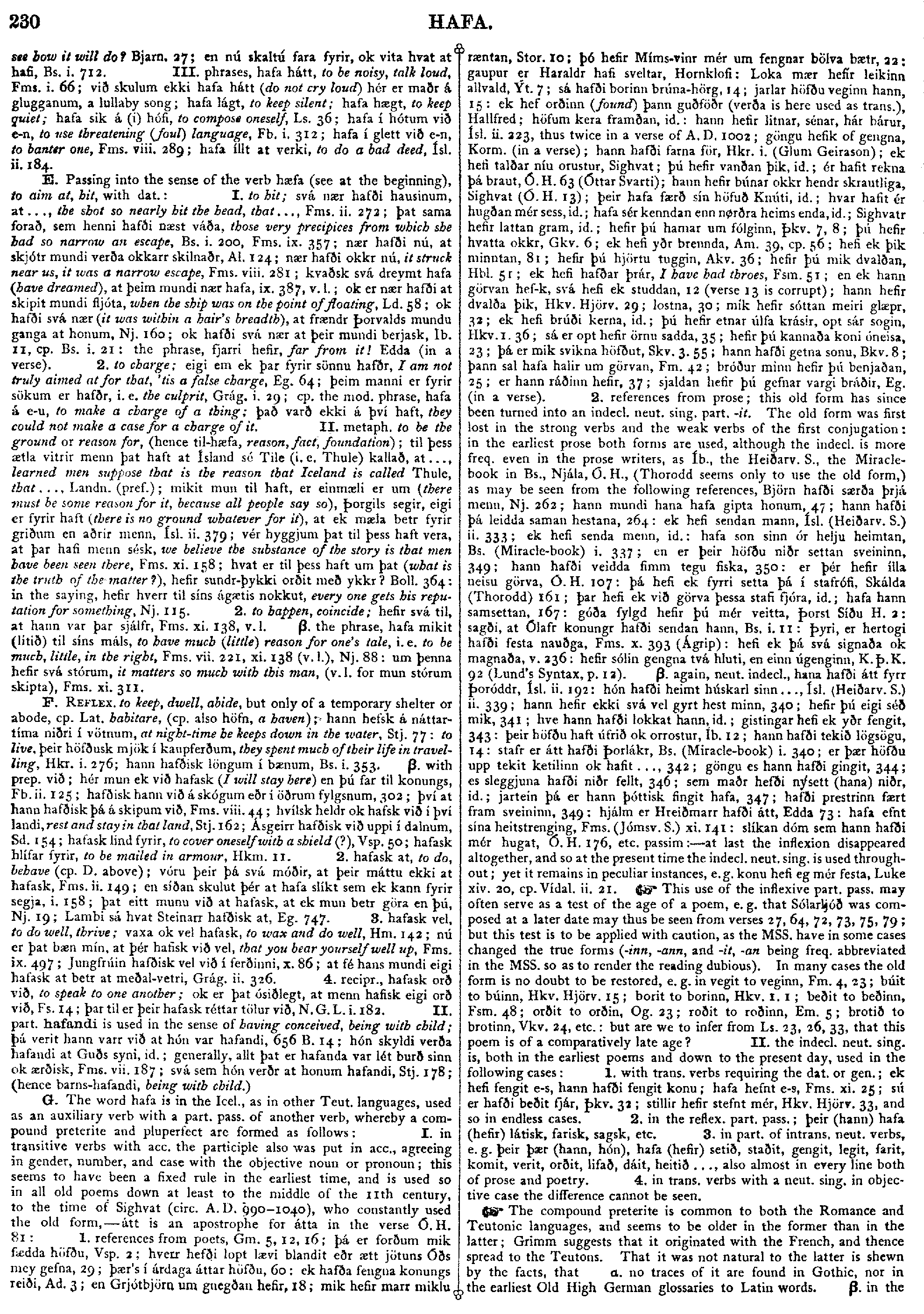
G.
The
word
hafa
is
in
the
Icel.,
as
in
other
Teut.
languages,
used
as
an
auxiliary
verb
with
a
part.
pass.
of
another
verb,
whereby
a
compound
preterite
and
pluperfect
are
formed
as
follows:
I.
in
transitive
verbs
with
acc.
the
participle
also
was
put
in
acc.,
agreeing
in
gender,
number,
and
case
with
the
objective
noun
or
pronoun;
this
seems
to
have
been
a
fixed
rule
in
the
earliest
time,
and
is
used
so
in
all
old
poems
down
at
least
to
the
middle
of
the
11th
century,
to
the
time
of
Sighvat
(circ.
A.D.
990-1040),
who
constantly
used
the
old
form,
--
átt
is
an
apostrophe
for
átta
in
the
verse
Ó.
H.
81:
1.
references
from
poets,
Gm.
5,
12,
16;
þá
er
forðum
mik
fædda
höfðu,
Vsp.
2;
hverr
hefði
lopt
lævi
blandit
eðr
ætt
jötuns
Óðs
mey
gefna,
29;
þær's
í
árdaga
áttar
höfðu,
60:
ek
hafða
fengna
konungs
reiði,
Ad.
3;
en
Grjótbjörn
um
gnegðan
hefir,
18;
mik
hefir
marr
miklu
ræntan,
Stor.
10;
þó
hefir
Míms-vinr
mér
um
fengnar
bölva
bætr,
22:
gaupur
er
Haraldr
hafi
sveltar,
Hornklofi:
Loka
mær
hefir
leikinn
allvald,
Ýt.
7;
sá
hafði
borinn
brúna-hörg,
14;
jarlar
höfðu
veginn
hann,
15:
ek
hef
orðinn
(found)
þann
guðföðr
(verða
is
here
used
as
trans.),
Hallfred;
höfum
kera
framðan,
id.:
hann
hefir
litnar,
sénar,
hár
bárur,
Ísl.
ii.
223,
thus
twice
in
a
verse
of
A.D.
1002;
göngu
hefik
of
gengna,
Korm.
(in
a
verse);
hann
hafði
farna
för,
Hkr.
i.
(Glum
Geirason);
ek
hefi
talðar
níu
orustur,
Sighvat;
þú
hefir
vanðan
þik,
id.;
ér
hafit
rekna
þá
braut,
Ó.
H.
63
(Óttar
Svarti);
hann
hefir
búnar
okkr
hendr
skrautliga,
Sighvat
(Ó.
H.
13);
þeir
hafa
færð
sín
höfuð
Knúti,
id.;
hvar
hafit
ér
hugðan
mér
sess,
id.;
hafa
sér
kenndan
enn
nørðra
heims
enda,
id.;
Sighvatr
hefir
lattan
gram,
id.;
hefir
þú
hamar
um
fólginn,
Þkv.
7,
8;
þú
hefir
hvatta
okkr,
Gkv.
6;
ek
hefi
yðr
brennda,
Am.
39,
cp.
56;
hefi
ek
þik
minntan,
81;
hefir
þú
hjörtu
tuggin,
Akv.
36;
hefir
þú
mik
dvalðan,
Hbl.
51;
ek
hefi
hafðar
þrár,
I
have
had
throes,
Fsm.
51;
en
ek
hann
görvan
hef-k,
svá
hefi
ek
studdan,
12
(verse
13
is
corrupt);
hann
hefir
dvalða
þik,
Hkv.
Hjörv.
29;
lostna,
30;
mik
hefir
sóttan
meiri
glæpr,
32;
ek
hefi
brúði
kerna,
id.;
þú
hefir
etnar
úlfa
krásir,
opt
sár
sogin,
Hkv.
1.
36;
sá
er
opt
hefir
örnu
sadda,
35;
hefir
þú
kannaða
koni
óneisa,
23;
þá
er
mik
svikna
höfðut,
Skv.
3.
55;
hann
hafði
getna
sonu,
Bkv.
8;
þann
sal
hafa
halir
um
görvan,
Fm.
42;
bróður
minn
hefir
þú
benjaðan,
25;
er
hann
ráðinn
hefir,
37;
sjaldan
hefir
þú
gefnar
vargi
bráðir,
Eg.
(in
a
verse).
2.
references
from
prose;
this
old
form
has
since
been
turned
into
an
indecl.
neut.
sing.
part.
-it.
The
old
form
was
first
lost
in
the
strong
verbs
and
the
weak
verbs
of
the
first
conjugation:
in
the
earliest
prose
both
forms
are
used,
although
the
indecl.
is
more
freq.
even
in
the
prose
writers,
as
Íb.,
the
Heiðarv.
S.,
the
Miracle-book
in
Bs.,
Njála,
Ó.
H.,
(Thorodd
seems
only
to
use
the
old
form,)
as
may
be
seen
from
the
following
references,
Björn
hafði
særða
þrjá
menn,
Nj.
262;
hann
mundi
hana
hafa
gipta
honum,
47;
hann
hafði
þá
leidda
saman
hestana,
264:
ek
hefi
sendan
mann,
Ísl.
(Heiðarv.
S.)
ii.
333;
ek
nefi
senda
menn,
id.:
hafa
son
sinn
ór
helju
heimtan,
Bs.
(Miracle-book)
i.
337;
en
er
þeir
höfðu
niðr
settan
sveininn,
349;
hann
hafði
veidda
fimm
tegu
fiska,
350:
er
þér
hefir
ílla
neisu
gorva,
Ó.
H.
107:
þá
hefi
ek
fyrri
setta
þá
í
stafrófi,
Skálda
(Thorodd)
161;
þar
hefi
ek
við
görva
þessa
stafi
fjóra,
id.;
hafa
hann
samsettan,
167:
góða
fylgd
hefir
þú
mér
veitta,
Þorst
Síðu
H.
2:
sagði,
at
Ólafr
konungr
hafði
sendan
hann,
Bs.
i.
11:
Þyri,
er
hertogi
hafði
festa
nauðga,
Fms.
x.
393
(Ágrip):
hefi
ek
þá
svá
signaða
ok
magnaða,
v.
236:
hefir
sólin
gengna
tvá
hluti,
en
einn
úgenginn,
K.
Þ.
K.
92
(Lund's
Syntax,
p.
12).
.
again,
neut.
indecl.,
hana
hafði
átt
fyrr
Þoróddr,
Ísl.
ii.
192:
hón
hafði
heimt
húskarl
sinn
...,
Ísl.
(Heiðarv.
S.)
ii.
339;
hann
hefir
ekki
svá
vel
gyrt
hest
minn,
340;
hefir
þú
eigi
séð
mik,
341;
hve
hann
hafði
lokkat
hann.
id.;
gistingar
hefi
ek
yðr
fengit,
343:
þeir
höfðu
haft
úfrið
ok
orrostur,
Íb.
12;
hann
hafði
tekið
lögsögu,
14:
stafr
er
átt
hafði
Þorlákr,
Bs.
(Miracle-book)
i.
340;
er
þær
höfðu
upp
tekit
ketilinn
ok
hafit
...,
342;
göngu
es
hann
hafði
gingit,
344;
es
sleggjuna
hafði
niðr
fellt,
346;
sem
maðr
hefði
nýsett
(hana)
niðr,
id.;
jartein
þá
er
hann
þóttisk
fingit
hafa,
347;
hafði
prestrinn
fært
fram
sveininn,
349:
hjálm
er
Hreiðmarr
hafði
átt,
Edda
73:
hafa
efnt
sína
heitstrenging,
Fms.
(Jómsv.
S.)
xi.
141:
slíkan
dóm
sem
hann
hafði
mér
hugat,
Ó.
H.
176,
etc.
passim
:--
at
last
the
inflexion
disappeared
altogether,
and
so
at
the
present
time
the
indecl.
neut.
sing,
is
used
throughout;
yet
it
remains
in
peculiar
instances,
e.g.
konu
hefi
eg
mér
festa,
Luke
xiv.
20,
cp.
Vídal.
ii.
21.
UNCERTAIN
This
use
of
the
inflexive
part.
pass.
may
often
serve
as
a
test
of
the
age
of
a
poem,
e.g.
that
Sólarljóð
was
composed
at
a
later
date
may
thus
be
seen
from
verses
27,
64,
72,
73,
75,
79;
but
this
test
is
to
be
applied
with
caution,
as
the
MSS.
have
in
some
cases
changed
the
true
forms
(-inn,
-ann,
and
-it,
-an
being
freq.
abbreviated
in
the
MSS.
so
as
to
render
the
reading
dubious).
In
many
cases
the
old
form
is
no
doubt
to
be
restored,
e.g.
in
vegit
to
veginn,
Fm.
4,
23;
búit
to
búinn,
Hkv.
Hjörv.
15;
borit
to
borinn,
Hkv.
1.
1;
beðit
to
beðinn,
Fsm.
48;
orðit
to
orðin,
Og.
23;
roðit
to
roðinn,
Em.
5;
brotið
to
brotinn,
Vkv.
24,
etc.:
but
are
we
to
infer
from
Ls.
23,
26,
33,
that
this
poem
is
of
a
comparatively
late
age?
II.
the
indecl.
neut.
sing.
is,
both
in
the
earliest
poems
and
down
to
the
present
day,
used
in
the
following
cases:
1.
with
trans.
verbs
requiring
the
dat.
or
gen.;
ek
hefi
fengit
e-s,
hann
hafði
fengit
konu;
hafa
hefnt
e-s,
Fms.
xi.
25;
sú
er
hafði
beðit
fjár,
Þkv.
32;
stillir
hefir
stefnt
mér,
Hkv.
Hjörv.
33,
and
so
in
endless
cases.
2.
in
the
reflex.
part.
pass.;
þeir
(hann)
hafa
(hefir)
látisk,
farisk,
sagsk,
etc.
3.
in
part.
of
intrans.
neut.
verbs,
e.g.
þeir
þær
(hann,
hón),
hafa
(hefir)
setið,
staðit,
gengit,
legit,
farit,
komit,
verit,
orðit,
lifað,
dáit,
heitið
...,
also
almost
in
every
line
both
of
prose
and
poetry.
4.
in
trans.
verbs
with
a
neut.
sing.
in
objective
case
the
difference
cannot
be
seen.
|
Source: Cleasby/Vigfusson, page b0234, entry 2 View original page image as: [TIFF] [PNG] [View previous entry] [View next entry] |
[Comment on this entry] [View comments] |
The following entry has been hand-corrected once. |
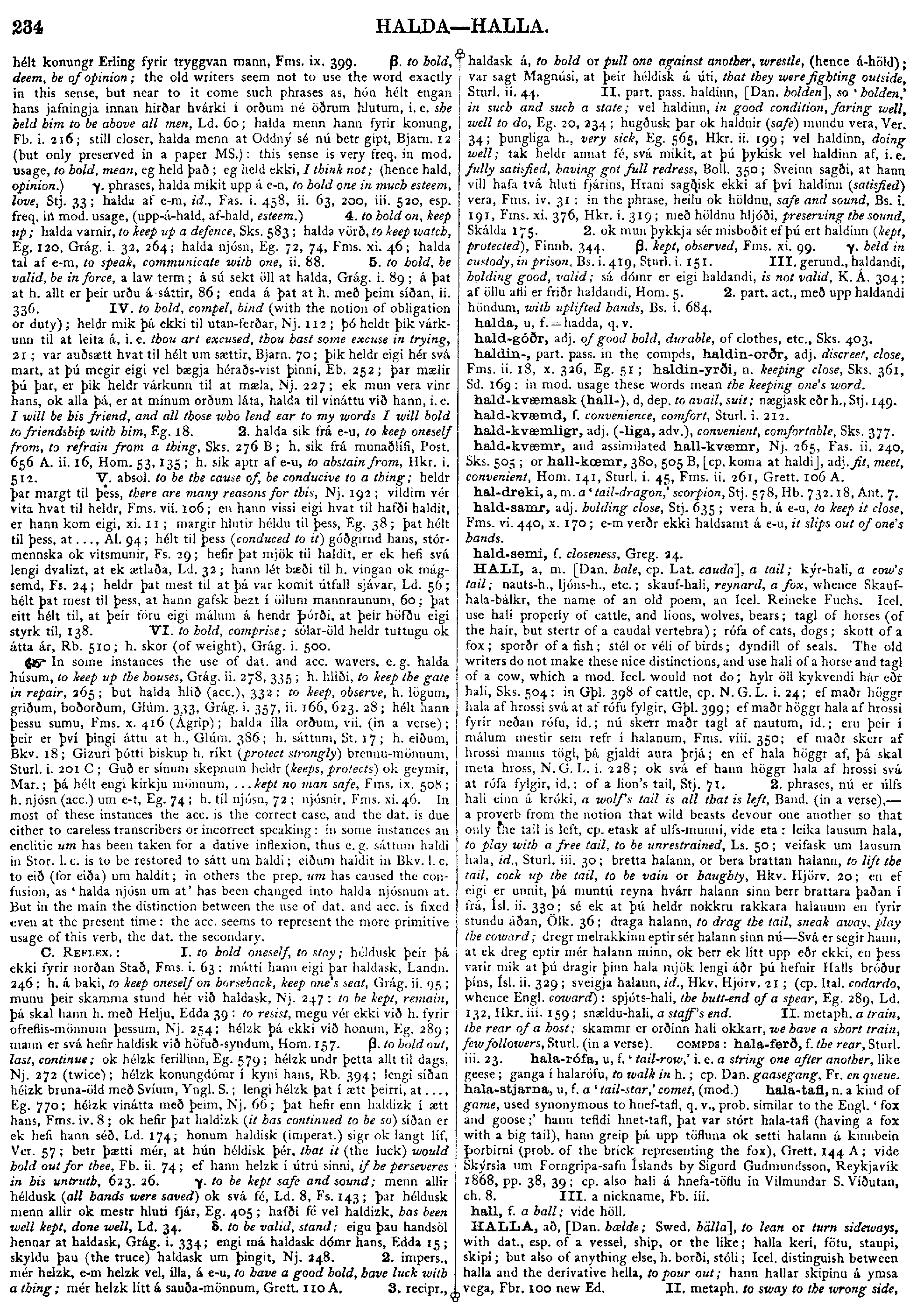
UNCERTAIN In some instances the use of dat. and acc. wavers, e.g. halda húsum, to keep up the houses, Grág. ii. 278, 335; h. hliði, to keep the gate in repair, 265; but halda hlið (acc.), 332: to keep, observe, h. lögum, griðum, boðorðum, Glúm. 333, Grág. i. 357, ii. 166, 623. 28; hélt hann þessu sumu, Fms. x. 416 (Ágrip); halda ílla orðum, vii. (in a verse); þeir er því þingi áttu at h., Glúm. 386; h. sáttum, St. 17; h. eiðum, Bkv. 18; Gizuri þótti biskup h. ríkt (protect strongly) brennu-mönnum, Sturl. i. 201 C; Guð er sínum skepnum heldr (keeps, protects) ok geymir, Mar.; þá hélt engi kirkju mönnum, ... kept no man safe, Fms. ix. 508; h. njósn (acc.) um e-t, Eg. 74; h. til njósn, 72; njósnir, Fms. xi. 46. In most of these instances the acc. is the correct case, and the dat. is due either to careless transcribers or incorrect speaking: in some instances an enclitic um has been taken for a dative inflexion, thus e.g. sáttum haldi in Stor. l.c. is to be restored to sátt um haldi; eiðum haldit in Bkv. l.c. to eið (for eiða) um haldit; in others the prep. um has caused the confusion, as 'halda njósn um at' has been changed into halda njósnum at. But in the main the distinction between the use of dat. and acc. is fixed even at the present time: the acc. seems to represent the more primitive usage of this verb, the dat. the secondary.
|
Source: Cleasby/Vigfusson, page b0239, entry 4 View original page image as: [TIFF] [PNG] [View previous entry] [View next entry] |
[Comment on this entry] [View comments] |
The following entry has been hand-corrected once. |
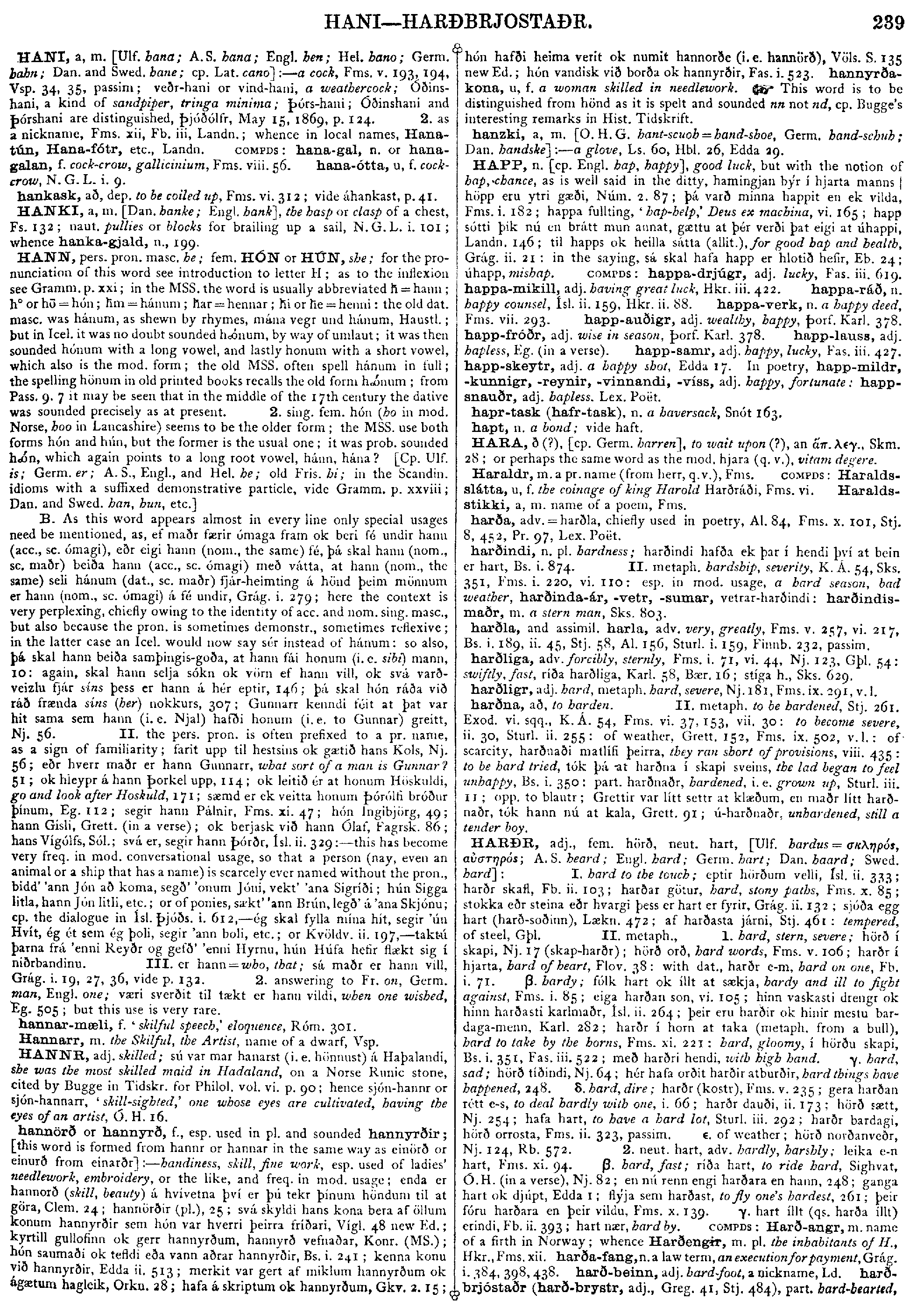
HANN,
pers.
pron.
masc.
he;
fem.
HÓN
or
HÚN,
she;
for
the
pronunciation
of
this
word
see
introduction
to
letter
H;
as
to
the
inflexion
see
Gramm.
p.
xxi;
in
the
MSS.
the
word
is
usually
abbreviated
&h-bar;
=
hann;
hº
or
h =
hón;
&h-bar;m
=
hánum;
&h-bar;ar
=
hennar;
&h-bar;i
or
&h-bar;e
=
henni:
the
old
dat.
masc.
was
hánum,
as
shewn
by
rhymes,
mána
vegr
und
hánum,
Haustl.;
but
in
Icel.
it
was
no
doubt
sounded
h
=
hón;
&h-bar;m
=
hánum;
&h-bar;ar
=
hennar;
&h-bar;i
or
&h-bar;e
=
henni:
the
old
dat.
masc.
was
hánum,
as
shewn
by
rhymes,
mána
vegr
und
hánum,
Haustl.;
but
in
Icel.
it
was
no
doubt
sounded
h num,
by
way
of
umlaut;
it
was
then
sounded
hónum
with
a
long
vowel,
and
lastly
honum
with
a
short
vowel,
which
also
is
the
mod.
form;
the
old
MSS.
often
spell
hánum
in
full;
the
spelling
hönum
in
old
printed
books
recalls
the
old
form
hnum;
from
Pass.
9.
7
it
may
be
seen
that
in
the
middle
of
the
17th
century
the
dative
was
sounded
precisely
as
at
present.
2.
sing.
fem.
hón
(ho
in
mod.
Norse,
hoo
in
Lancashire)
seems
to
be
the
older
form;
the
MSS.
use
both
forms
hón
and
hún,
but
the
former
is
the
usual
one;
it
was
prob.
sounded
hn,
which
again
points
to
a
long
root
vowel,
hánn,
hána?
[Cp.
Ulf.
is;
Germ.
er;
A.
S.,
Engl.,
and
Hel.
he;
old
Fris.
hi;
in
the
Scandin.
idioms
with
a
suffixed
demonstrative
particle,
vide
Gramm.
p.
xxviii;
Dan.
and
Swed.
han,
hun,
etc.]
num,
by
way
of
umlaut;
it
was
then
sounded
hónum
with
a
long
vowel,
and
lastly
honum
with
a
short
vowel,
which
also
is
the
mod.
form;
the
old
MSS.
often
spell
hánum
in
full;
the
spelling
hönum
in
old
printed
books
recalls
the
old
form
hnum;
from
Pass.
9.
7
it
may
be
seen
that
in
the
middle
of
the
17th
century
the
dative
was
sounded
precisely
as
at
present.
2.
sing.
fem.
hón
(ho
in
mod.
Norse,
hoo
in
Lancashire)
seems
to
be
the
older
form;
the
MSS.
use
both
forms
hón
and
hún,
but
the
former
is
the
usual
one;
it
was
prob.
sounded
hn,
which
again
points
to
a
long
root
vowel,
hánn,
hána?
[Cp.
Ulf.
is;
Germ.
er;
A.
S.,
Engl.,
and
Hel.
he;
old
Fris.
hi;
in
the
Scandin.
idioms
with
a
suffixed
demonstrative
particle,
vide
Gramm.
p.
xxviii;
Dan.
and
Swed.
han,
hun,
etc.]
|
Source: Cleasby/Vigfusson, page b0261, entry 3 View original page image as: [TIFF] [PNG] [View previous entry] [View next entry] |
[Comment on this entry] [View comments] |
The following entry has been hand-corrected once. |
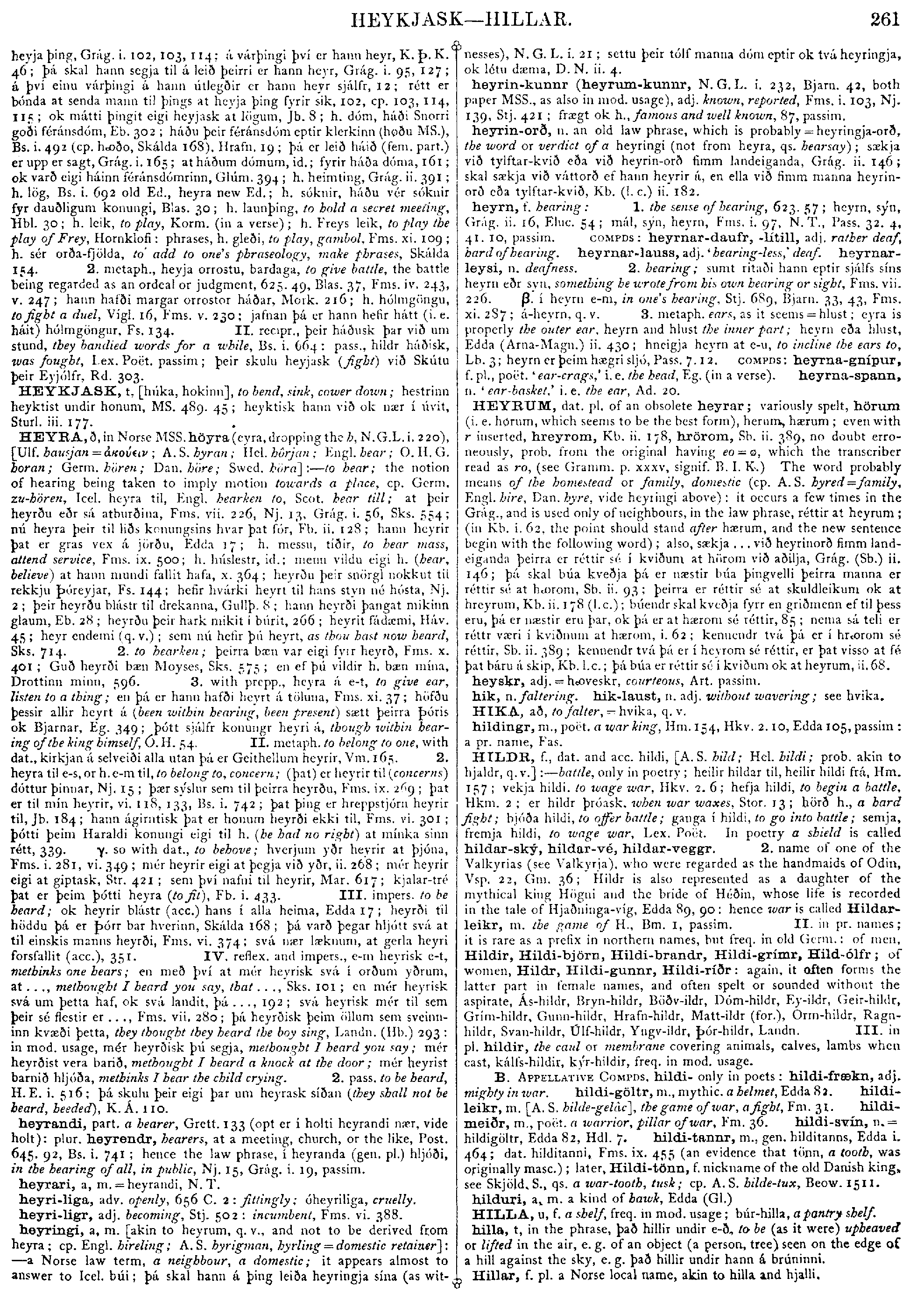
HEYRA,
ð,
in
Norse
MSS.
höyra
(eyra,
dropping
the
h,
N.
G.
L.
i.
220),
[Ulf.
hausjan
=
GREEK;
A.
S.
hyran;
Hel.
hôrjan;
Engl.
hear;
O.
H.
G.
horan;
Germ.
hören;
Dan.
höre;
Swed.
höra]
:--
to
hear;
the
notion
of
hearing
being
taken
to
imply
motion
towards
a
place,
cp.
Germ.
zu-hören,
Icel.
heyra
til,
Engl.
hearken
to,
Scot.
hear
till;
at
þeir
heyrðu
eðr
sá
atburðina,
Fms.
vii.
226,
Nj.
13,
Grág.
i.
56,
Sks.
554;
nú
heyra
þeir
til
liðs
konungsins
hvar
þat
fór,
Fb.
ii.
128;
hann
heyrir
þat
er
gras
vex
á
jörðu,
Edda
17;
h.
messu,
tíðir,
to
hear
mass,
attend
service,
Fms.
ix.
500;
h.
húslestr,
id.;
menn
vildu
eigi
h.
(hear,
believe)
at
hann
mundi
fallit
hafa,
x.
364;
heyrðu
þeir
snörgl
nokkut
til
rekkju
Þóreyjar,
Fs.
144;
hefir
hvárki
heyrt
til
hans
styn
né
hósta,
Nj.
2;
þeir
heyrðu
blástr
til
drekanna,
Gullþ.
8;
hann
heyrði
þangat
mikinn
glaum,
Eb.
28;
heyrðu
þeir
hark
mikit
í
búrit,
266;
heyrit
fádæmi,
Háv.
45;
heyr
endemi
(q.v.);
sem
nú
hefir
þú
heyrt,
as
thou
hast
now
heard,
Sks.
714.
2.
to
hearken;
þeirra
bæn
var
eigi
fyrr
heyrð,
Fms.
x.
401;
Guð
heyrði
bæn
Moyses,
Sks.
575;
en
ef
þú
vildir
h.
bæn
mína,
Drottinn
minn,
596.
3.
with
prepp.,
heyra
á
e-t,
to
give
ear,
listen
to
a
thing;
en
þá
er
hann
hafði
heyrt
á
töluna,
Fms.
xi.
37;
höfðu
þessir
allir
heyrt
á
(been
within
hearing,
been
present)
sætt
þeirra
Þóris
ok
Bjarnar,
Eg.
349;
þótt
sjálfr
konungr
heyri
á,
though
within
hearing
of
the
king
himself,
Ó.
H.
54.
II.
metaph.
to
belong
to
one,
with
dat.,
kirkjan
á
selveiði
alla
utan
þá
er
Geithellum
heyrir,
Vm.
165.
2.
heyra
til
e-s,
or
h.
e-m
til,
to
belong
to,
concern;
(þat)
er
heyrir
til
(concerns)
dóttur
þinnar,
Nj.
15;
þær
sýslur
sem
til
þeirra
heyrðu,
Fms.
ix.
269;
þat
er
til
mín
heyrir,
vi.
118,
133,
Bs.
i.
742;
þat
þing
er
hreppstjórn
heyrir
til,
Jb.
184;
hann
ágirntisk
þat
er
honum
heyrði
ekki
til,
Fms.
vi.
301;
þótti
þeim
Haraldi
konungi
eigi
til
h.
(he
had
no
right)
at
mínka
sinn
rétt,
339.
.
so
with
dat.,
to
behove;
hverjum
yðr
heyrir
at
þjóna,
Fms.
i.
281,
vi.
349;
mér
heyrir
eigi
at
þegja
við
yðr,
ii.
268;
mér
heyrir
eigi
at
giptask,
Str.
421;
sem
því
nafni
til
heyrir,
Mar.
617;
kjalar-tré
þat
er
þeim
þótti
heyra
(to
fit),
Fb.
i.
433.
III.
impers.
to
be
heard;
ok
heyrir
blástr
(acc.)
hans
í
alla
heima,
Edda
17;
heyrði
til
höddu
þá
er
Þórr
bar
hverinn,
Skálda
168;
þá
varð
þegar
hljótt
svá
at
til
einskis
manns
heyrði,
Fms.
vi.
374;
svá
nær
læknum,
at
gerla
heyri
forsfallit
(acc.),
351.
IV.
reflex.
and
impers.,
e-m
heyrisk
e-t,
methinks
one
hears;
en
með
því
at
mér
heyrisk
svá
í
orðum
yðrum,
at
...,
methought
I
heard
you
say,
that
...,
Sks.
101;
en
mér
heyrisk
svá
um
þetta
haf,
ok
svá
landit,
þá
...,
192;
svá
heyrisk
mér
til
sem
þeir
sé
flestir
er
...,
Fms.
vii.
280;
þá
heyrðisk
þeim
öllum
sem
sveinninn
kvæði
þetta,
they
thought
they
heard
the
boy
sing,
Landn.
(Hb.)
293:
in
mod.
usage,
mér
heyrðisk
þú
segja,
methought
I
heard
you
say;
mér
heyrðist
vera
barið,
methought
I
heard
a
knock
at
the
door;
mér
heyrist
barnið
hljóða,
methinks
I
hear
the
child
crying.
2.
pass.
to
be
heard,
H.
E.
i.
516;
þá
skulu
þeir
eigi
þar
um
heyrask
síðan
(they
shall
not
be
heard,
heeded),
K.
Á.
110.
| Result Page: |  |
Previous | 17 18 19 20 21 22 23 24 25 26 27 28 29 30 31 32 33 34 35 | Next |  |
Germanic Lexicon Project (main page)
This search system was written by
Sean Crist
Please consider
volunteering
to correct the data in these online dictionaries.
No rights reserved. Feel free to use these data in any way you please.