|
|

Tip: In the search results, you can click on any word or abbreviation for more information.
|
Source: Cleasby/Vigfusson, page b0230, entry 4 View original page image as: [TIFF] [PNG] [View previous entry] [View next entry] |
[Comment on this entry] [View comments] |
The following entry has been hand-corrected once. |
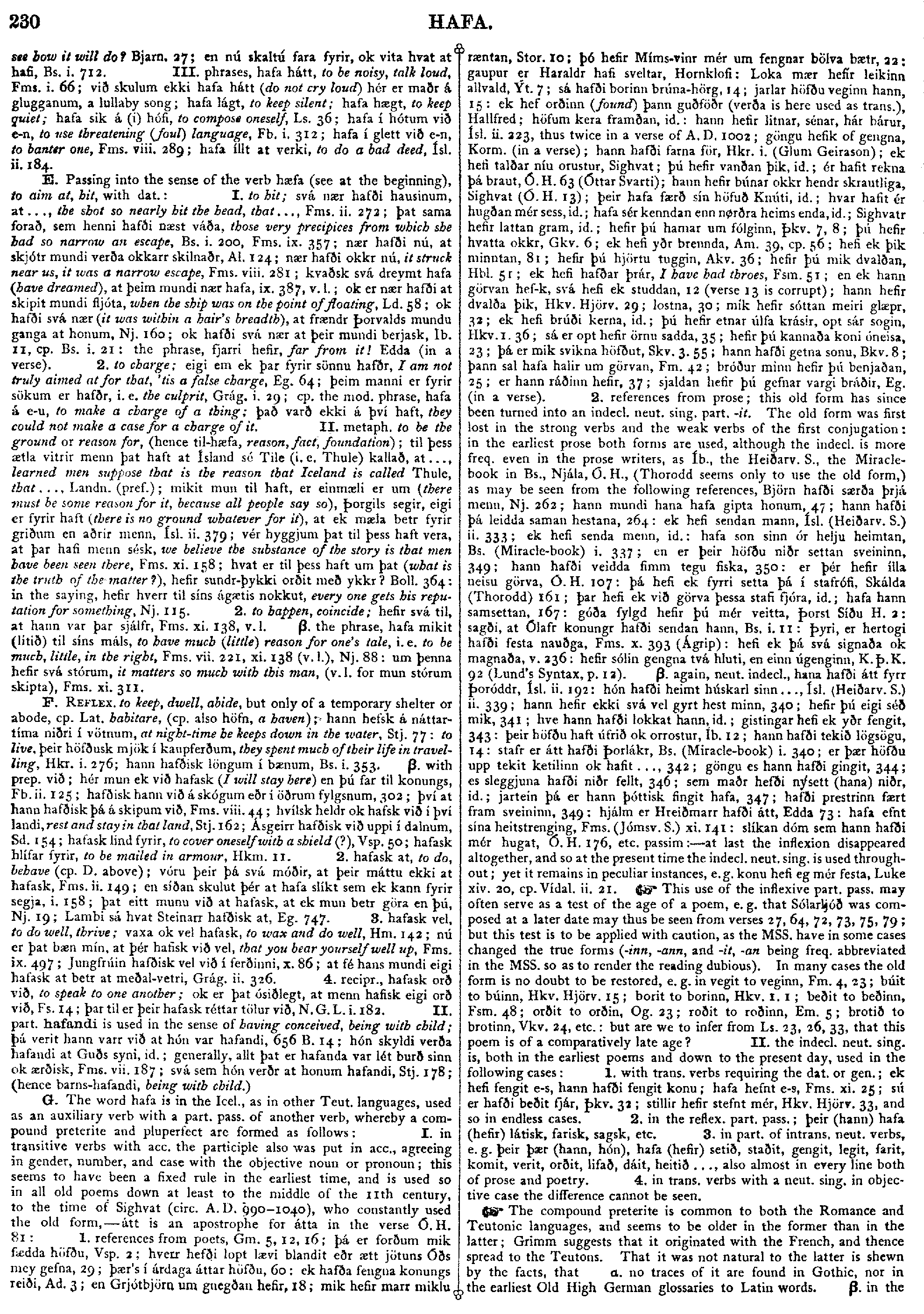
G.
The
word
hafa
is
in
the
Icel.,
as
in
other
Teut.
languages,
used
as
an
auxiliary
verb
with
a
part.
pass.
of
another
verb,
whereby
a
compound
preterite
and
pluperfect
are
formed
as
follows:
I.
in
transitive
verbs
with
acc.
the
participle
also
was
put
in
acc.,
agreeing
in
gender,
number,
and
case
with
the
objective
noun
or
pronoun;
this
seems
to
have
been
a
fixed
rule
in
the
earliest
time,
and
is
used
so
in
all
old
poems
down
at
least
to
the
middle
of
the
11th
century,
to
the
time
of
Sighvat
(circ.
A.D.
990-1040),
who
constantly
used
the
old
form,
--
átt
is
an
apostrophe
for
átta
in
the
verse
Ó.
H.
81:
1.
references
from
poets,
Gm.
5,
12,
16;
þá
er
forðum
mik
fædda
höfðu,
Vsp.
2;
hverr
hefði
lopt
lævi
blandit
eðr
ætt
jötuns
Óðs
mey
gefna,
29;
þær's
í
árdaga
áttar
höfðu,
60:
ek
hafða
fengna
konungs
reiði,
Ad.
3;
en
Grjótbjörn
um
gnegðan
hefir,
18;
mik
hefir
marr
miklu
ræntan,
Stor.
10;
þó
hefir
Míms-vinr
mér
um
fengnar
bölva
bætr,
22:
gaupur
er
Haraldr
hafi
sveltar,
Hornklofi:
Loka
mær
hefir
leikinn
allvald,
Ýt.
7;
sá
hafði
borinn
brúna-hörg,
14;
jarlar
höfðu
veginn
hann,
15:
ek
hef
orðinn
(found)
þann
guðföðr
(verða
is
here
used
as
trans.),
Hallfred;
höfum
kera
framðan,
id.:
hann
hefir
litnar,
sénar,
hár
bárur,
Ísl.
ii.
223,
thus
twice
in
a
verse
of
A.D.
1002;
göngu
hefik
of
gengna,
Korm.
(in
a
verse);
hann
hafði
farna
för,
Hkr.
i.
(Glum
Geirason);
ek
hefi
talðar
níu
orustur,
Sighvat;
þú
hefir
vanðan
þik,
id.;
ér
hafit
rekna
þá
braut,
Ó.
H.
63
(Óttar
Svarti);
hann
hefir
búnar
okkr
hendr
skrautliga,
Sighvat
(Ó.
H.
13);
þeir
hafa
færð
sín
höfuð
Knúti,
id.;
hvar
hafit
ér
hugðan
mér
sess,
id.;
hafa
sér
kenndan
enn
nørðra
heims
enda,
id.;
Sighvatr
hefir
lattan
gram,
id.;
hefir
þú
hamar
um
fólginn,
Þkv.
7,
8;
þú
hefir
hvatta
okkr,
Gkv.
6;
ek
hefi
yðr
brennda,
Am.
39,
cp.
56;
hefi
ek
þik
minntan,
81;
hefir
þú
hjörtu
tuggin,
Akv.
36;
hefir
þú
mik
dvalðan,
Hbl.
51;
ek
hefi
hafðar
þrár,
I
have
had
throes,
Fsm.
51;
en
ek
hann
görvan
hef-k,
svá
hefi
ek
studdan,
12
(verse
13
is
corrupt);
hann
hefir
dvalða
þik,
Hkv.
Hjörv.
29;
lostna,
30;
mik
hefir
sóttan
meiri
glæpr,
32;
ek
hefi
brúði
kerna,
id.;
þú
hefir
etnar
úlfa
krásir,
opt
sár
sogin,
Hkv.
1.
36;
sá
er
opt
hefir
örnu
sadda,
35;
hefir
þú
kannaða
koni
óneisa,
23;
þá
er
mik
svikna
höfðut,
Skv.
3.
55;
hann
hafði
getna
sonu,
Bkv.
8;
þann
sal
hafa
halir
um
görvan,
Fm.
42;
bróður
minn
hefir
þú
benjaðan,
25;
er
hann
ráðinn
hefir,
37;
sjaldan
hefir
þú
gefnar
vargi
bráðir,
Eg.
(in
a
verse).
2.
references
from
prose;
this
old
form
has
since
been
turned
into
an
indecl.
neut.
sing.
part.
-it.
The
old
form
was
first
lost
in
the
strong
verbs
and
the
weak
verbs
of
the
first
conjugation:
in
the
earliest
prose
both
forms
are
used,
although
the
indecl.
is
more
freq.
even
in
the
prose
writers,
as
Íb.,
the
Heiðarv.
S.,
the
Miracle-book
in
Bs.,
Njála,
Ó.
H.,
(Thorodd
seems
only
to
use
the
old
form,)
as
may
be
seen
from
the
following
references,
Björn
hafði
særða
þrjá
menn,
Nj.
262;
hann
mundi
hana
hafa
gipta
honum,
47;
hann
hafði
þá
leidda
saman
hestana,
264:
ek
hefi
sendan
mann,
Ísl.
(Heiðarv.
S.)
ii.
333;
ek
nefi
senda
menn,
id.:
hafa
son
sinn
ór
helju
heimtan,
Bs.
(Miracle-book)
i.
337;
en
er
þeir
höfðu
niðr
settan
sveininn,
349;
hann
hafði
veidda
fimm
tegu
fiska,
350:
er
þér
hefir
ílla
neisu
gorva,
Ó.
H.
107:
þá
hefi
ek
fyrri
setta
þá
í
stafrófi,
Skálda
(Thorodd)
161;
þar
hefi
ek
við
görva
þessa
stafi
fjóra,
id.;
hafa
hann
samsettan,
167:
góða
fylgd
hefir
þú
mér
veitta,
Þorst
Síðu
H.
2:
sagði,
at
Ólafr
konungr
hafði
sendan
hann,
Bs.
i.
11:
Þyri,
er
hertogi
hafði
festa
nauðga,
Fms.
x.
393
(Ágrip):
hefi
ek
þá
svá
signaða
ok
magnaða,
v.
236:
hefir
sólin
gengna
tvá
hluti,
en
einn
úgenginn,
K.
Þ.
K.
92
(Lund's
Syntax,
p.
12).
 .
again,
neut.
indecl.,
hana
hafði
átt
fyrr
Þoróddr,
Ísl.
ii.
192:
hón
hafði
heimt
húskarl
sinn
...,
Ísl.
(Heiðarv.
S.)
ii.
339;
hann
hefir
ekki
svá
vel
gyrt
hest
minn,
340;
hefir
þú
eigi
séð
mik,
341;
hve
hann
hafði
lokkat
hann.
id.;
gistingar
hefi
ek
yðr
fengit,
343:
þeir
höfðu
haft
úfrið
ok
orrostur,
Íb.
12;
hann
hafði
tekið
lögsögu,
14:
stafr
er
átt
hafði
Þorlákr,
Bs.
(Miracle-book)
i.
340;
er
þær
höfðu
upp
tekit
ketilinn
ok
hafit
...,
342;
göngu
es
hann
hafði
gingit,
344;
es
sleggjuna
hafði
niðr
fellt,
346;
sem
maðr
hefði
nýsett
(hana)
niðr,
id.;
jartein
þá
er
hann
þóttisk
fingit
hafa,
347;
hafði
prestrinn
fært
fram
sveininn,
349:
hjálm
er
Hreiðmarr
hafði
átt,
Edda
73:
hafa
efnt
sína
heitstrenging,
Fms.
(Jómsv.
S.)
xi.
141:
slíkan
dóm
sem
hann
hafði
mér
hugat,
Ó.
H.
176,
etc.
passim
:--
at
last
the
inflexion
disappeared
altogether,
and
so
at
the
present
time
the
indecl.
neut.
sing,
is
used
throughout;
yet
it
remains
in
peculiar
instances,
e.g.
konu
hefi
eg
mér
festa,
Luke
xiv.
20,
cp.
Vídal.
ii.
21.
UNCERTAIN
This
use
of
the
inflexive
part.
pass.
may
often
serve
as
a
test
of
the
age
of
a
poem,
e.g.
that
Sólarljóð
was
composed
at
a
later
date
may
thus
be
seen
from
verses
27,
64,
72,
73,
75,
79;
but
this
test
is
to
be
applied
with
caution,
as
the
MSS.
have
in
some
cases
changed
the
true
forms
(-inn,
-ann,
and
-it,
-an
being
freq.
abbreviated
in
the
MSS.
so
as
to
render
the
reading
dubious).
In
many
cases
the
old
form
is
no
doubt
to
be
restored,
e.g.
in
vegit
to
veginn,
Fm.
4,
23;
búit
to
búinn,
Hkv.
Hjörv.
15;
borit
to
borinn,
Hkv.
1.
1;
beðit
to
beðinn,
Fsm.
48;
orðit
to
orðin,
Og.
23;
roðit
to
roðinn,
Em.
5;
brotið
to
brotinn,
Vkv.
24,
etc.:
but
are
we
to
infer
from
Ls.
23,
26,
33,
that
this
poem
is
of
a
comparatively
late
age?
II.
the
indecl.
neut.
sing.
is,
both
in
the
earliest
poems
and
down
to
the
present
day,
used
in
the
following
cases:
1.
with
trans.
verbs
requiring
the
dat.
or
gen.;
ek
hefi
fengit
e-s,
hann
hafði
fengit
konu;
hafa
hefnt
e-s,
Fms.
xi.
25;
sú
er
hafði
beðit
fjár,
Þkv.
32;
stillir
hefir
stefnt
mér,
Hkv.
Hjörv.
33,
and
so
in
endless
cases.
2.
in
the
reflex.
part.
pass.;
þeir
(hann)
hafa
(hefir)
látisk,
farisk,
sagsk,
etc.
3.
in
part.
of
intrans.
neut.
verbs,
e.g.
þeir
þær
(hann,
hón),
hafa
(hefir)
setið,
staðit,
gengit,
legit,
farit,
komit,
verit,
orðit,
lifað,
dáit,
heitið
...,
also
almost
in
every
line
both
of
prose
and
poetry.
4.
in
trans.
verbs
with
a
neut.
sing.
in
objective
case
the
difference
cannot
be
seen.
.
again,
neut.
indecl.,
hana
hafði
átt
fyrr
Þoróddr,
Ísl.
ii.
192:
hón
hafði
heimt
húskarl
sinn
...,
Ísl.
(Heiðarv.
S.)
ii.
339;
hann
hefir
ekki
svá
vel
gyrt
hest
minn,
340;
hefir
þú
eigi
séð
mik,
341;
hve
hann
hafði
lokkat
hann.
id.;
gistingar
hefi
ek
yðr
fengit,
343:
þeir
höfðu
haft
úfrið
ok
orrostur,
Íb.
12;
hann
hafði
tekið
lögsögu,
14:
stafr
er
átt
hafði
Þorlákr,
Bs.
(Miracle-book)
i.
340;
er
þær
höfðu
upp
tekit
ketilinn
ok
hafit
...,
342;
göngu
es
hann
hafði
gingit,
344;
es
sleggjuna
hafði
niðr
fellt,
346;
sem
maðr
hefði
nýsett
(hana)
niðr,
id.;
jartein
þá
er
hann
þóttisk
fingit
hafa,
347;
hafði
prestrinn
fært
fram
sveininn,
349:
hjálm
er
Hreiðmarr
hafði
átt,
Edda
73:
hafa
efnt
sína
heitstrenging,
Fms.
(Jómsv.
S.)
xi.
141:
slíkan
dóm
sem
hann
hafði
mér
hugat,
Ó.
H.
176,
etc.
passim
:--
at
last
the
inflexion
disappeared
altogether,
and
so
at
the
present
time
the
indecl.
neut.
sing,
is
used
throughout;
yet
it
remains
in
peculiar
instances,
e.g.
konu
hefi
eg
mér
festa,
Luke
xiv.
20,
cp.
Vídal.
ii.
21.
UNCERTAIN
This
use
of
the
inflexive
part.
pass.
may
often
serve
as
a
test
of
the
age
of
a
poem,
e.g.
that
Sólarljóð
was
composed
at
a
later
date
may
thus
be
seen
from
verses
27,
64,
72,
73,
75,
79;
but
this
test
is
to
be
applied
with
caution,
as
the
MSS.
have
in
some
cases
changed
the
true
forms
(-inn,
-ann,
and
-it,
-an
being
freq.
abbreviated
in
the
MSS.
so
as
to
render
the
reading
dubious).
In
many
cases
the
old
form
is
no
doubt
to
be
restored,
e.g.
in
vegit
to
veginn,
Fm.
4,
23;
búit
to
búinn,
Hkv.
Hjörv.
15;
borit
to
borinn,
Hkv.
1.
1;
beðit
to
beðinn,
Fsm.
48;
orðit
to
orðin,
Og.
23;
roðit
to
roðinn,
Em.
5;
brotið
to
brotinn,
Vkv.
24,
etc.:
but
are
we
to
infer
from
Ls.
23,
26,
33,
that
this
poem
is
of
a
comparatively
late
age?
II.
the
indecl.
neut.
sing.
is,
both
in
the
earliest
poems
and
down
to
the
present
day,
used
in
the
following
cases:
1.
with
trans.
verbs
requiring
the
dat.
or
gen.;
ek
hefi
fengit
e-s,
hann
hafði
fengit
konu;
hafa
hefnt
e-s,
Fms.
xi.
25;
sú
er
hafði
beðit
fjár,
Þkv.
32;
stillir
hefir
stefnt
mér,
Hkv.
Hjörv.
33,
and
so
in
endless
cases.
2.
in
the
reflex.
part.
pass.;
þeir
(hann)
hafa
(hefir)
látisk,
farisk,
sagsk,
etc.
3.
in
part.
of
intrans.
neut.
verbs,
e.g.
þeir
þær
(hann,
hón),
hafa
(hefir)
setið,
staðit,
gengit,
legit,
farit,
komit,
verit,
orðit,
lifað,
dáit,
heitið
...,
also
almost
in
every
line
both
of
prose
and
poetry.
4.
in
trans.
verbs
with
a
neut.
sing.
in
objective
case
the
difference
cannot
be
seen.
|
Source: Cleasby/Vigfusson, page b0236, entry 14 View original page image as: [TIFF] [PNG] [View previous entry] [View next entry] |
[Comment on this entry] [View comments] |
The following entry has been hand-corrected once. |
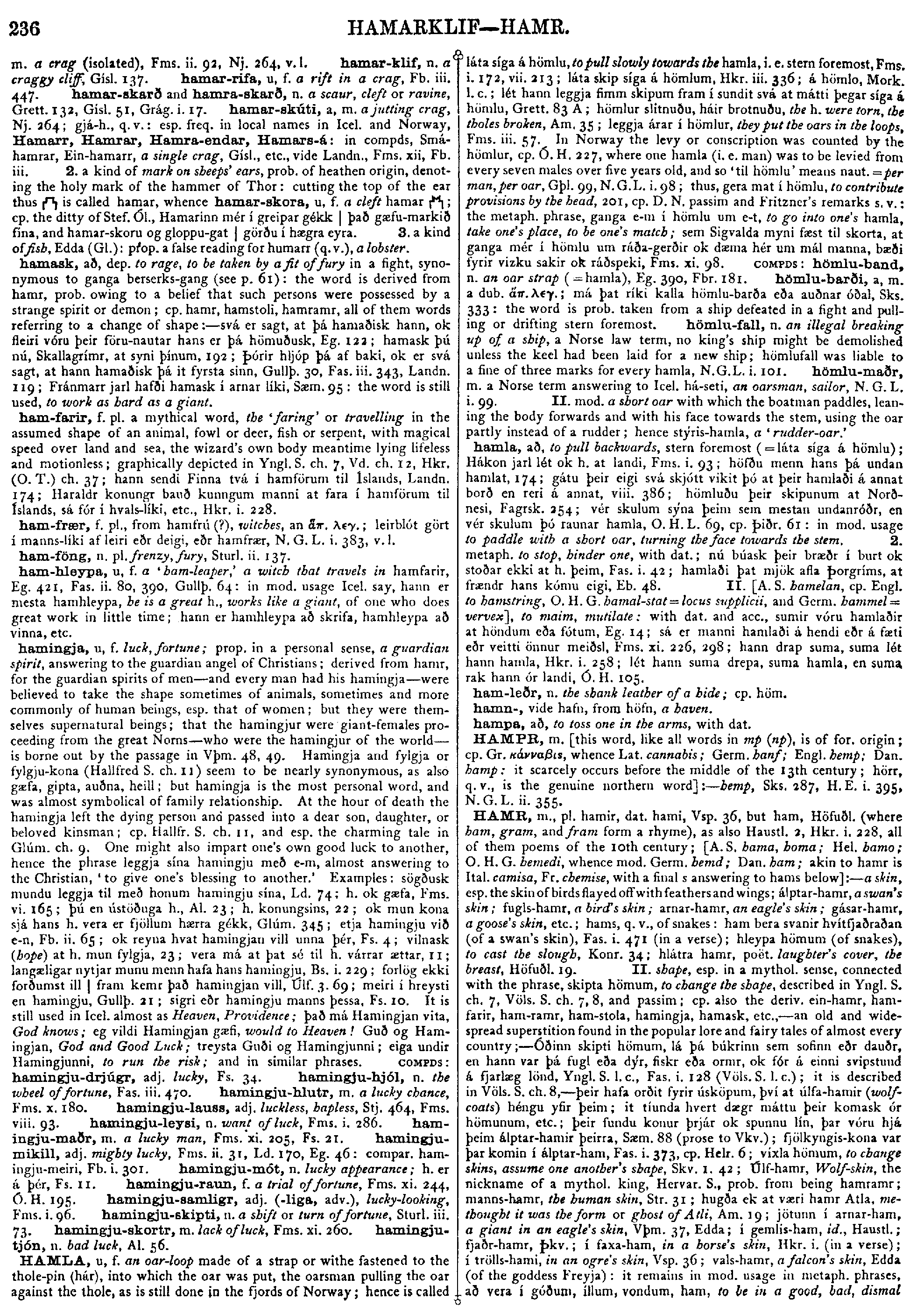
HAMR, m., pl. hamir, dat. hami, Vsp. 36, but ham, Höfuðl. (where ham, gram, and fram form a rhyme), as also Haustl. 2, Hkr. i. 228, all of them poems of the 10th century; [A. S. hama, homa; Hel. hamo; O. H. G. hemedi, whence mod. Germ. hemd; Dan. ham; akin to hamr is Ital. camisa, Fr. chemise, with a final s answering to hams below] :-- a skin, esp. the skin of birds flayed off with feathers and wings; álptar-hamr, a swan's skin; fugls-hamr, a bird's skin; arnar-hamr, an eagle's skin; gásar-hamr, a goose's skin, etc.; hams, q.v., of snakes: ham bera svanir hvítfjaðraðan (of a swan's skin), Fas. i. 471 (in a verse); hleypa hömum (of snakes), to cast the slough, Konr. 34; hlátra hamr, poët. laughter's cover, the breast, Höfuðl. 19. II. shape, esp. in a mythol. sense, connected with the phrase, skipta hömum, to change the shape, described in Yngl. S. ch. 7, Völs. S. ch. 7, 8, and passim; cp. also the deriv. ein-hamr, ham-farir, ham-ramr, ham-stola, hamingja, hamask, etc., -- an old and widespread superstition found in the popular lore and fairy tales of almost every country; -- Óðinn skipti hömum, lá þá búkrinn sem sofinn eðr dauðr, en hann var þá fugl eða dýr, fiskr eða ormr, ok fór á einni svipstund á fjarlæg lönd, Yngl. S. l.c., Fas. i. 128 (Völs. S. l.c.); it is described in Völs. S. ch. 8, -- þeir hafa orðit fyrir úsköpum, því at úlfa-hamir (wolf-coats) héngu yfir þeim; it tíunda hvert dægr máttu þeir komask ór hömunum, etc.; þeir fundu konur þrjár ok spunnu lín, þar vóru hjá þeim álptar-hamir þeirra, Sæm. 88 (prose to Vkv.); fjölkyngis-kona var þar komin í álptar-ham, Fas. i. 373, cp. Helr. 6; víxla hömum, to change skins, assume one another's shape, Skv. 1. 42; Úlf-hamr, Wolf-skin, the nickname of a mythol. king, Hervar. S., prob. from being hamramr; manns-hamr, the human skin, Str. 31; hugða ek at væri hamr Atla, methought it was the form or ghost of Atli, Am. 19; jötunn í arnar-ham, a giant in an eagle's skin, Vþm. 37, Edda; í gemlis-ham, id., Haustl.; fjaðr-hamr, Þkv.; í faxa-ham, in a horse's skin, Hkr. i. (in a verse); í trölls-hami, in an ogre's skin, Vsp. 36; vals-hamr, a falcon's skin, Edda (of the goddess Freyja): it remains in mod. usage in metaph. phrases, að vera í góðum, íllum, vondum, ham, to be in a good, bad, dismal
|
Source: Cleasby/Vigfusson, page b0244, entry 124 View original page image as: [TIFF] [PNG] [View previous entry] [View next entry] |
[Comment on this entry] [View comments] |
The following entry has been hand-corrected once. |
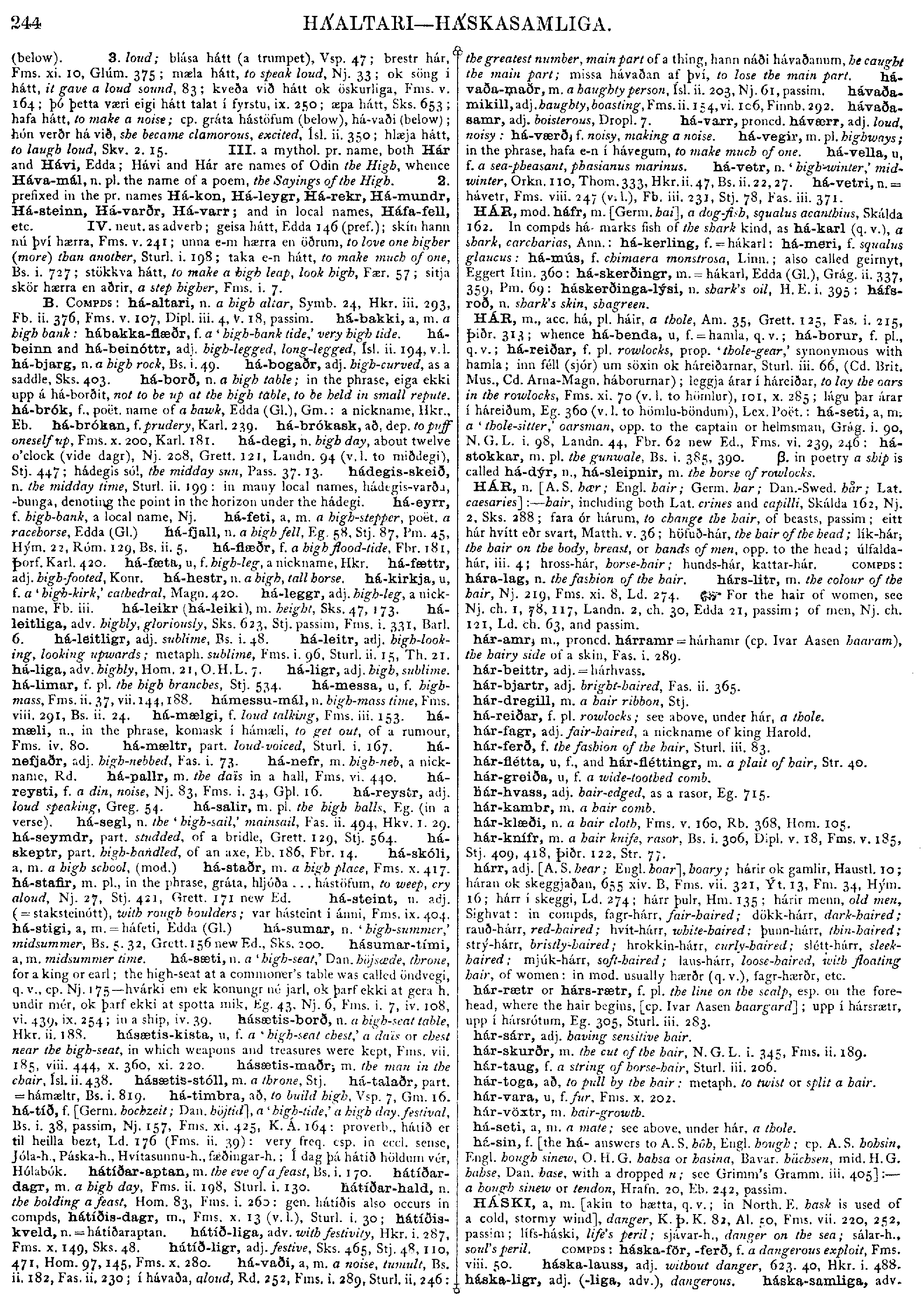
HÁTTR,
m.,
gen.
háttar,
dat.
hætti,
pl.
hættir,
acc.
háttu,
[akin
to
hagr,
qs.
hagtr],
manner,
habit:
I.
a
mode
of
life,
habit;
ríkra
manna
háttr,
Nj.
268;
fara
vel
með
sínum
háttum,
to
conduct
oneself
well,
Eg.
65;
ráða
sjálfr
háttum
sínum,
to
be
one's
own
master,
Fms.
vii.
199;
fornmennis-háttr,
ii.
59;
riddaraligr
háttr,
x.
230;
víkinga-háttr,
Fb.
i.
412;
þat
er
háttr
skálda
at
(it
is
the
fashion
of
poets
to)
lofa
þann
mest
er
þá
eru
þeir
fyrir,
Hkr.
(pref.):
hátta-góðr,
adj.
well-mannered,
Eb.
258:
halda
teknum
hætti,
to
go
on
in
one's
usual
way,
persevere,
Fb.
ii.
85,
Eb.
77.
2.
conduct;
vanda
um
háttu
manna,
Fb.
ii.
37.
II.
a
mode,
way
of
doing
a
thing;
kunna
hátt
á
e-u,
to
know
how
to
do
a
thing,
Barl.
101
:--
answering
to
Lat.
hoc
modo,
hunc
ad
modum,
hann
reist
örn
á
baki
honum
með
þeima
hætti,
at
...,
Hkr.
i.
108;
hann
stóð
upp
ok
svaraði
erendi
konungs
með
þessum
hætti
(as
follows),
Fms.
i.
33;
með
hverjum
hætti,
in
what
manner?
how?
með
ymsum
hætti,
etc.
2.
appearance,
manner;
hversu
vóru
þeir
menn
í
hátt,
how
did
those
men
look?
Stj.
396;
jörðin
ok
dýrin
ok
fuglarnir
höfðu
saman
eðli
í
sumum
hlutum,
en
þó
ólík
at
hætti,
but
unlike
in
manners,
Edda
144
(pref.):
manner,
kind,
sá
er
annarr
háttr
jarldóms,
N.
G.
L.
ii.
403.
3.
moderation,
measure;
ágirni
kann
engan
hátt,
Hom.
18;
hófsemi
er
háttr
alls
lífs,
28.
4.
adverbial
usages
answering
to
Lat,
-modi
in
hujusmodi,
ejusmodi:
 .
gen.,
mikils
háttar,
Fms.
vi.
20,
144,
229,
viii.
198,
x.
234;
lítils
háttar,
insignificant,
vi.
7,
229,
viii.
198;
minna
háttar,
i.
160;
alls-háttar,
of
every
kind,
iii.
184;
nokkurs
háttar,
in
some
way,
Stj.
178;
þess-háttar,
of
that
kind,
Edda
149
(pref.),
passim;
engis-háttar,
in
nowise,
Stj.
81;
margs-háttar,
of
many
kinds,
Stj.
passim.
.
acc.,
á
allan
hátt,
in
every
respect,
Bs.
i.
857;
á
engan
hátt,
by
no
means;
á
ymsan
hátt,
in
various
respects;
á
hvárigan
hátt,
etc.
.
gen.,
mikils
háttar,
Fms.
vi.
20,
144,
229,
viii.
198,
x.
234;
lítils
háttar,
insignificant,
vi.
7,
229,
viii.
198;
minna
háttar,
i.
160;
alls-háttar,
of
every
kind,
iii.
184;
nokkurs
háttar,
in
some
way,
Stj.
178;
þess-háttar,
of
that
kind,
Edda
149
(pref.),
passim;
engis-háttar,
in
nowise,
Stj.
81;
margs-háttar,
of
many
kinds,
Stj.
passim.
.
acc.,
á
allan
hátt,
in
every
respect,
Bs.
i.
857;
á
engan
hátt,
by
no
means;
á
ymsan
hátt,
in
various
respects;
á
hvárigan
hátt,
etc.
 .
eptir
hætti,
duly,
tolerably,
as
may
be
expected.
III.
a
metre;
þenna
hátt
fann
fyrst
Veili,
Edda
(Ht.)
131;
þeir
létu
vera
fimm
vísur
með
hverjum
hætti,
Orkn.
304,
cp.
Edda
(Ht.)
passim;
eptir
hætti,
in
the
proper
metre,
Edda
131.
Names
of
metres,
Kviðu-háttr,
the
epic
metre
(as
the
Völuspá),
Skálda;
Ljóða-h.
or
Ljóðs-h.,
the
trimeter
in
old
saws
and
didactic
poems
(as
the
Háva-mál);
Mála-h.,
Ref-hvarfa-h.,
Orðskviða-h.,
Draugs-h.,
Flagða-h.,
Dýri-h.,
Nýi-h.,
Álags-h.,
Hátt-lausa:
derived
from
the
names
of
men,
Egils-h.,
Braga-h.,
Torf-Einars-h.,
Fleins-h.;
Núfu-h.,
Edda;
of
countries,
Grænlenzki-h.,
expounded
in
Edda
(Ht.)
and
Háttat.
Rögnvalds,
Skálda:
a
saying
is
called
máls-háttr.
COMPDS:
hátta-föll,
n.
pl.
a
flaw
in
a
metre,
Edda
(Ht.)
134,
135,
Skálda
210.
hátta-lykill,
m.
a
key
to
metres,
the
name
of
an
old
poem
on
metres,
Orkn.
304
(printed
at
the
end
of
the
Skálda,
Reykjavík
1849).
hátta-skipti,
n.
a
shifting
of
metre,
Edda
129.
hátta-tal,
n.
a
number
of
metres,
the
name
of
a
poem
on
metres,
=
Hátta-lykill,
Edda
192;
also
in
the
title
of
Edda
(Ub.)
ii.
250.
.
eptir
hætti,
duly,
tolerably,
as
may
be
expected.
III.
a
metre;
þenna
hátt
fann
fyrst
Veili,
Edda
(Ht.)
131;
þeir
létu
vera
fimm
vísur
með
hverjum
hætti,
Orkn.
304,
cp.
Edda
(Ht.)
passim;
eptir
hætti,
in
the
proper
metre,
Edda
131.
Names
of
metres,
Kviðu-háttr,
the
epic
metre
(as
the
Völuspá),
Skálda;
Ljóða-h.
or
Ljóðs-h.,
the
trimeter
in
old
saws
and
didactic
poems
(as
the
Háva-mál);
Mála-h.,
Ref-hvarfa-h.,
Orðskviða-h.,
Draugs-h.,
Flagða-h.,
Dýri-h.,
Nýi-h.,
Álags-h.,
Hátt-lausa:
derived
from
the
names
of
men,
Egils-h.,
Braga-h.,
Torf-Einars-h.,
Fleins-h.;
Núfu-h.,
Edda;
of
countries,
Grænlenzki-h.,
expounded
in
Edda
(Ht.)
and
Háttat.
Rögnvalds,
Skálda:
a
saying
is
called
máls-háttr.
COMPDS:
hátta-föll,
n.
pl.
a
flaw
in
a
metre,
Edda
(Ht.)
134,
135,
Skálda
210.
hátta-lykill,
m.
a
key
to
metres,
the
name
of
an
old
poem
on
metres,
Orkn.
304
(printed
at
the
end
of
the
Skálda,
Reykjavík
1849).
hátta-skipti,
n.
a
shifting
of
metre,
Edda
129.
hátta-tal,
n.
a
number
of
metres,
the
name
of
a
poem
on
metres,
=
Hátta-lykill,
Edda
192;
also
in
the
title
of
Edda
(Ub.)
ii.
250.
|
Source: Cleasby/Vigfusson, page b0247, entry 19 View original page image as: [TIFF] [PNG] [View previous entry] [View next entry] |
[Comment on this entry] [View comments] |
The following entry has been hand-corrected once. |
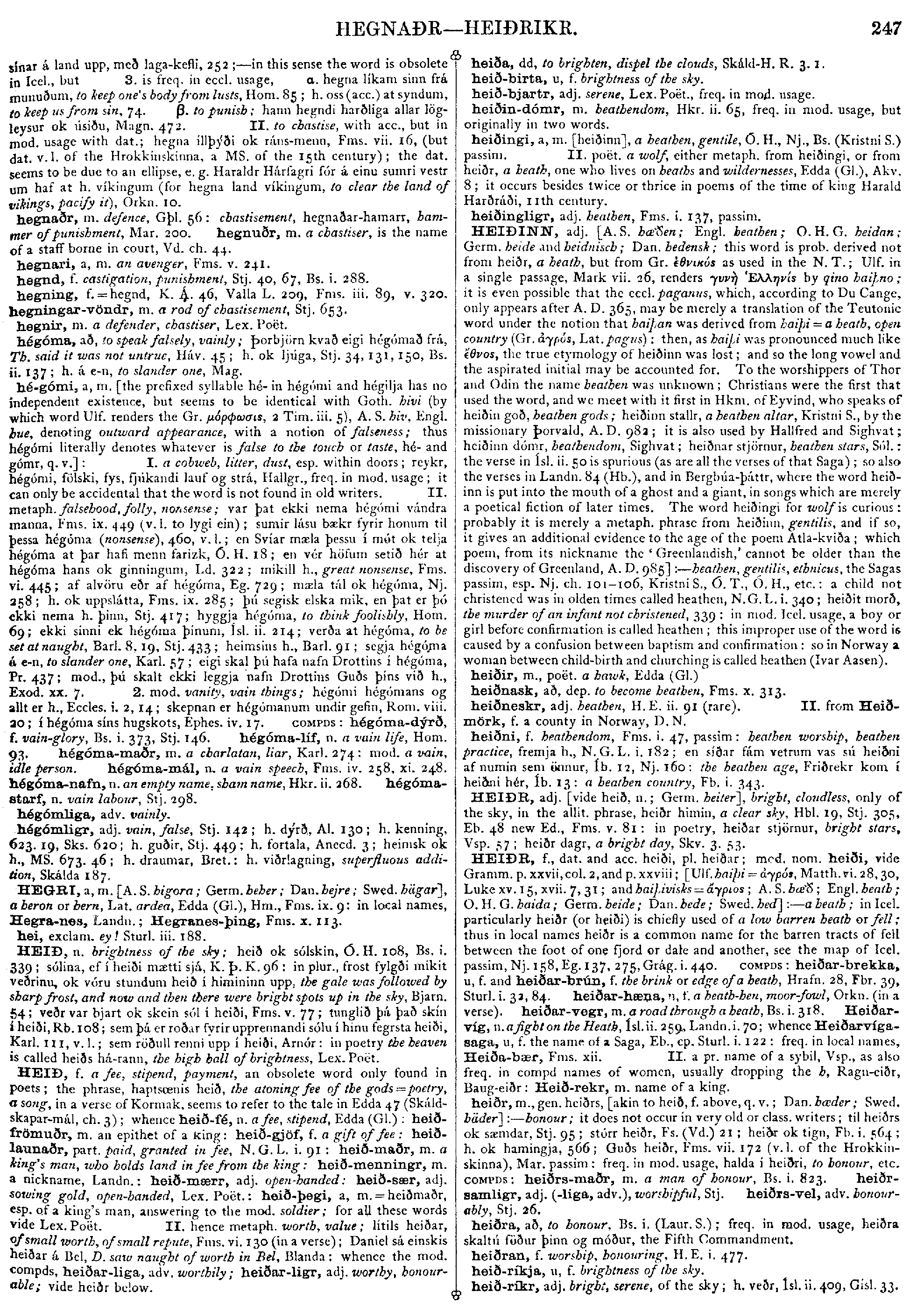
heiðingi, a, m. [heiðinn], a heathen, gentile, Ó. H., Nj., Bs. (Kristni S.) passim. II. poët. a wolf, either metaph. from heiðingi, or from heiðr, a heath, one who lives on heaths and wildernesses, Edda (Gl.), Akv. 8; it occurs besides twice or thrice in poems of the time of king Harald Harðráði, 11th century.
|
Source: Cleasby/Vigfusson, page b0252, entry 13 View original page image as: [TIFF] [PNG] [View previous entry] [View next entry] |
[Comment on this entry] [View comments] |
The following entry has been hand-corrected once. |
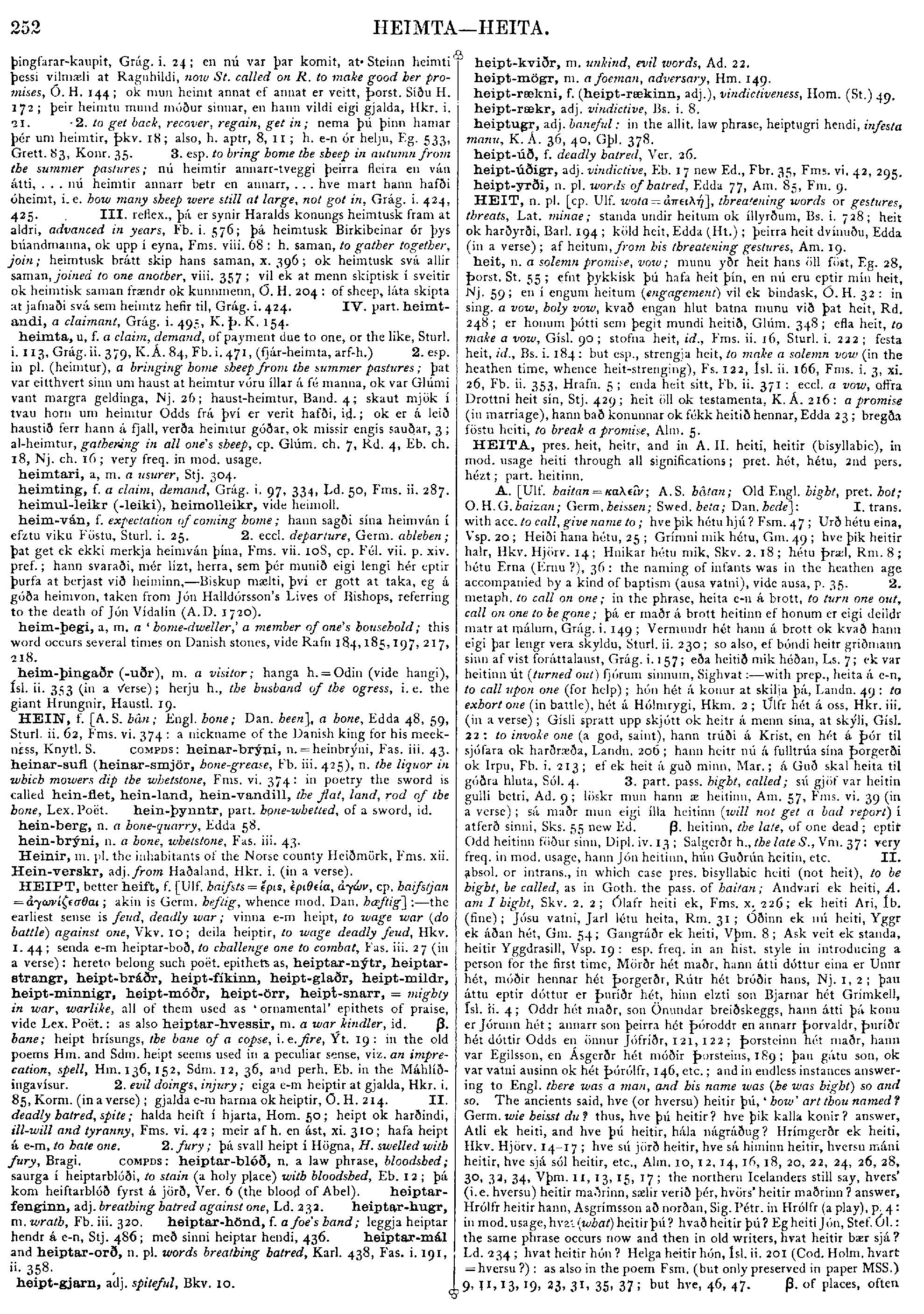
HEIPT,
better
heift,
f.
[Ulf.
haifsts
=
GREEK,
cp.
haifstjan
=
GREEK;
akin
is
Germ.
heftig,
whence
mod.
Dan.
hæftig]
:--
the
earliest
sense
is
feud,
deadly
war;
vinna
e-m
heipt,
to
wage
war
(do
battle)
against
one,
Vkv.
10;
deila
heiptir,
to
wage
deadly
feud,
Hkv.
1.
44;
senda
e-m
heiptar-boð,
to
challenge
one
to
combat,
Fas.
iii.
27
(in
a
verse):
hereto
belong
such
poët.
epithets
as,
heiptar-nýtr,
heiptar-strangr,
heipt-bráðr,
heipt-fíkinn,
heipt-glaðr,
heipt-mildr,
heipt-minnigr,
heipt-móðr,
heipt-örr,
heipt-snarr,
=
mighty
in
war,
warlike,
all
of
them
used
as
'ornamental'
epithets
of
praise,
vide
Lex.
Poët.:
as
also
heiptar-hvessir,
m.
a
war
kindler,
id.
.
bane;
heipt
hrísungs,
the
bane
of
a
copse,
i.e.
fire,
Ýt.
19:
in
the
old
poems
Hm.
and
Sdm.
heipt
seems
used
in
a
peculiar
sense,
viz.
an
imprecation,
spell,
Hm.
136,
152,
Sdm.
12,
36,
and
perh.
Eb.
in
the
Máhlíðingavísur.
2.
evil
doings,
injury;
eiga
e-m
heiptir
at
gjalda,
Hkr.
i.
85,
Korm.
(in
a
verse);
gjalda
e-m
harma
ok
heiptir,
Ó.
H.
214.
II.
deadly
hatred,
spite;
halda
heift
í
hjarta,
Hom.
50;
heipt
ok
harðindi,
ill-will
and
tyranny,
Fms.
vi.
42;
meir
af
h.
en
ást,
xi.
310;
hafa
heipt
á
e-m,
to
hate
one.
2.
fury;
þá
svall
heipt
í
Högna,
H.
swelled
with
fury,
Bragi.
COMPDS:
heiptar-blóð,
n.
a
law
phrase,
bloodshed;
saurga
í
heiptarblóði,
to
stain
(a
holy
place)
with
bloodshed,
Eb.
12;
þá
kom
heiftarblóð
fyrst
á
jörð,
Ver.
6
(the
blood
of
Abel).
heiptar-fenginn,
adj.
breathing
hatred
against
one,
Ld.
232.
heiptar-hugr,
m.
wrath,
Fb.
iii.
320.
heiptar-hönd,
f.
a
foe's
band;
leggja
heiptar
hendr
á
e-n,
Stj.
486;
með
sinni
heiptar
hendi,
436.
heiptar-mál
and
heiptar-orð,
n.
pl.
words
breathing
hatred,
Karl.
438,
Fas.
i.
191,
ii.
358.
|
Source: Cleasby/Vigfusson, page b0263, entry 2 View original page image as: [TIFF] [PNG] [View previous entry] [View next entry] |
[Comment on this entry] [View comments] |
The following entry has been hand-corrected once. |
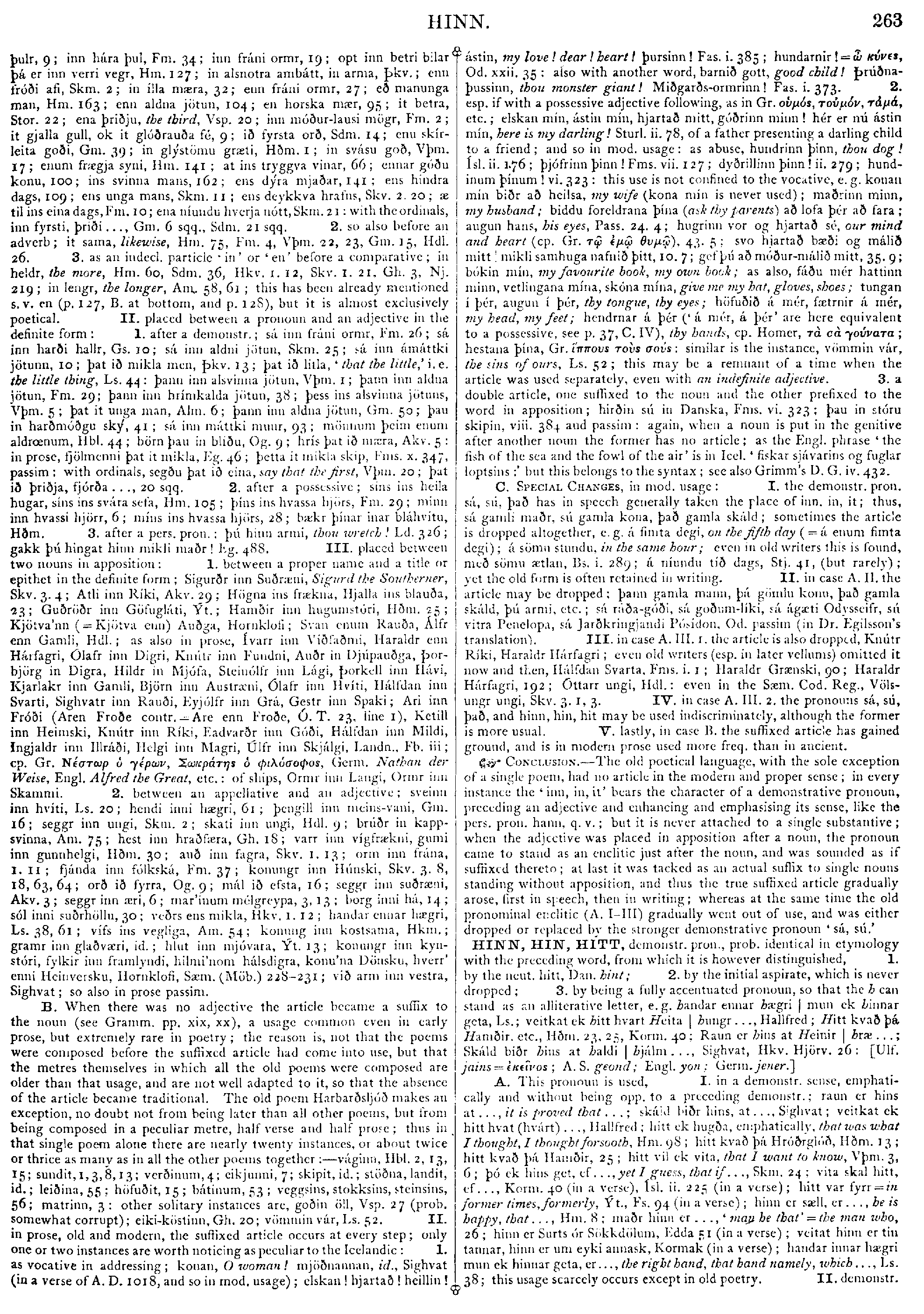
B. When there was no adjective the article became a suffix to the noun (see Gramm. pp. xix, xx), a usage common even in early prose, but extremely rare in poetry; the reason is, not that the poems were composed before the suffixed article had come into use, but that the metres themselves in which all the old poems were composed are older than that usage, and are not well adapted to it, so that the absence of the article became traditional. The old poem Harbarðsljóð makes an exception, no doubt not from being later than all other poems, but from being composed in a peculiar metre, half verse and half prose; thus in that single poem alone there are nearly twenty instances, or about twice or thrice as many as in all the other poems together :-- váginn, Hbl. 2, 13, 15; sundit, 1, 3, 8, 13; verðinum, 4; eikjunni, 7; skipit, id.; stöðna, landit, id.; leiðina, 55; höfuðit, 15; bátinum, 53; veggsins, stokksins, steinsins, 56; matrinn, 3: other solitary instances are, goðin öll, Vsp. 27 (prob. somewhat corrupt); eiki-köstinn, Gh. 20; vömmin vár, Ls. 52. II. in prose, old and modern, the suffixed article occurs at every step; only one or two instances are worth noticing as peculiar to the Icelandic: 1. as vocative in addressing; konan, O woman! mjöðnannan, id., Sighvat (in a verse of A.D. 1018, and so in mod. usage); elskan! hjartað! heillin! ástin, my love! dear! heart! þursinn! Fas. i. 385; hundarnir! = GREEK, Od. xxii. 35: also with another word, barnið gott, good child! Þrúðnaþussinn, thou monster giant! Miðgarðs-ormrinn! Fas. i. 373. 2. esp. if with a possessive adjective following, as in Gr. GREEK, etc.; elskan mín, ástin mín, hjartað mitt, góðrinn minn! hér er nú ástin mín, here is my darling! Sturl. ii. 78, of a father presenting a darling child to a friend; and so in mod. usage: as abuse, hundrinn þinn, thou dog! Ísl. ii. 176; þjófrinn þinn! Fms. vii. 127; dyðrillinn þinn! ii. 279; hundinum þínum! vi. 323: this use is not confined to the vocative, e.g. konan mín biðr að heilsa, my wife (kona mín is never used); maðrinn minn, my husband; biddu foreldrana þína (ask thy parents) að lofa þér að fara; augun hans, his eyes, Pass. 24. 4; hugrinn vor og hjartað sé, our mind and heart (cp. Gr. GREEK), 43. 5; svo hjartað bæði og málið mitt | mikli samhuga nafnið þitt, 10. 7; gef þú að móður-málið mitt, 35. 9; bókin mín, my favourite book, my own book; as also, fáðu mér hattinn minn, vetlingana mína, skóna mína, give me my hat, gloves, shoes; tungan í þér, augun í þér, thy tongue, thy eyes; höfuðið á mér, fætrnir á mér, my head, my feet; hendrnar á þér ('á mér, á þér' are here equivalent to a possessive, see p. 37, C. IV), thy hands, cp. Homer, GREEK; hestana þína, Gr. GREEK: similar is the instance, vömmin vár, the sins of ours, Ls. 52; this may be a remnant of a time when the article was used separately, even with an indefinite adjective. 3. a double article, one suffixed to the noun and the other prefixed to the word in apposition; hirðin sú in Danska, Fms. vi. 323; þau in stóru skipin, viii. 384 and passim: again, when a noun is put in the genitive after another noun the former has no article; as the Engl. phrase 'the fish of the sea and the fowl of the air' is in Icel. 'fiskar sjávarins og fuglar loptsins:' but this belongs to the syntax; see also Grimm's D. G. iv. 432.
|
Source: Cleasby/Vigfusson, page b0268, entry 17 View original page image as: [TIFF] [PNG] [View previous entry] [View next entry] |
[Comment on this entry] [View comments] |
The following entry has been hand-corrected once. |
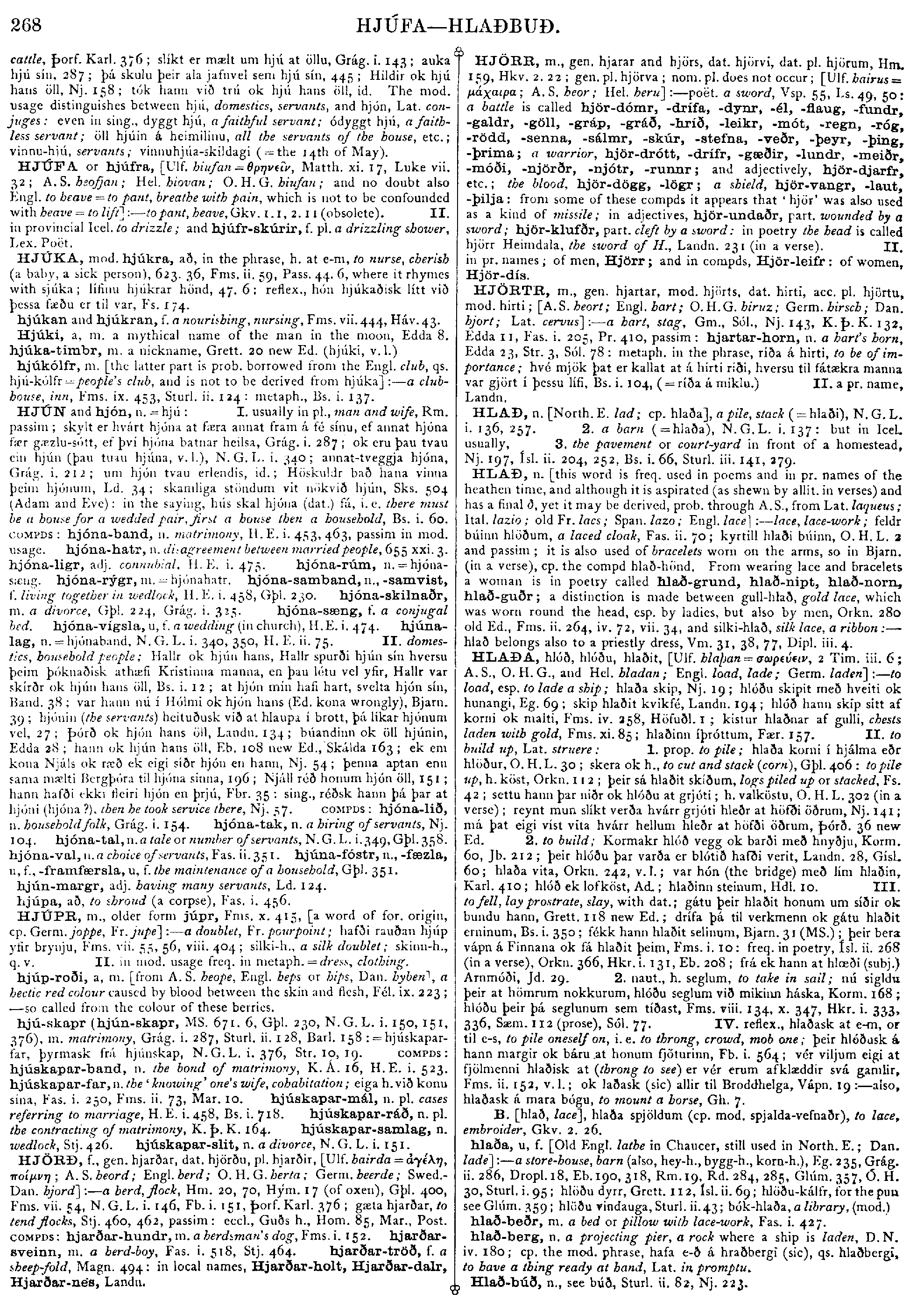
HLAÐ, n. [this word is freq. used in poems and in pr. names of the heathen time, and although it is aspirated (as shewn by allit. in verses) and has a final ð, yet it may be derived, prob. through A. S., from Lat. laqueus; Ital. lazio; old Fr. lacs; Span, lazo; Engl. lace] :-- lace, lace-work; feldr búinn hlöðum, a laced cloak, Fas. ii. 70; kyrtill hlaði búinn, O. H. L. 2 and passim; it is also used of bracelets worn on the arms, so in Bjarn. (in a verse), cp. the compd hlað-hönd. From wearing lace and bracelets a woman is in poetry called hlað-grund, hlað-nipt, hlað-norn, hlað-guðr; a distinction is made between gull-hlað, gold lace, which was worn round the head, esp. by ladies, but also by men, Orkn. 280 old Ed., Fms. ii. 264, iv. 72, vii. 34, and silki-hlað, silk lace, a ribbon :-- hlað belongs also to a priestly dress, Vm. 31, 38, 77, Dipl. iii. 4.
|
Source: Cleasby/Vigfusson, page b0278, entry 45 View original page image as: [TIFF] [PNG] [View previous entry] [View next entry] |
[Comment on this entry] [View comments] |
The following entry has been hand-corrected once. |
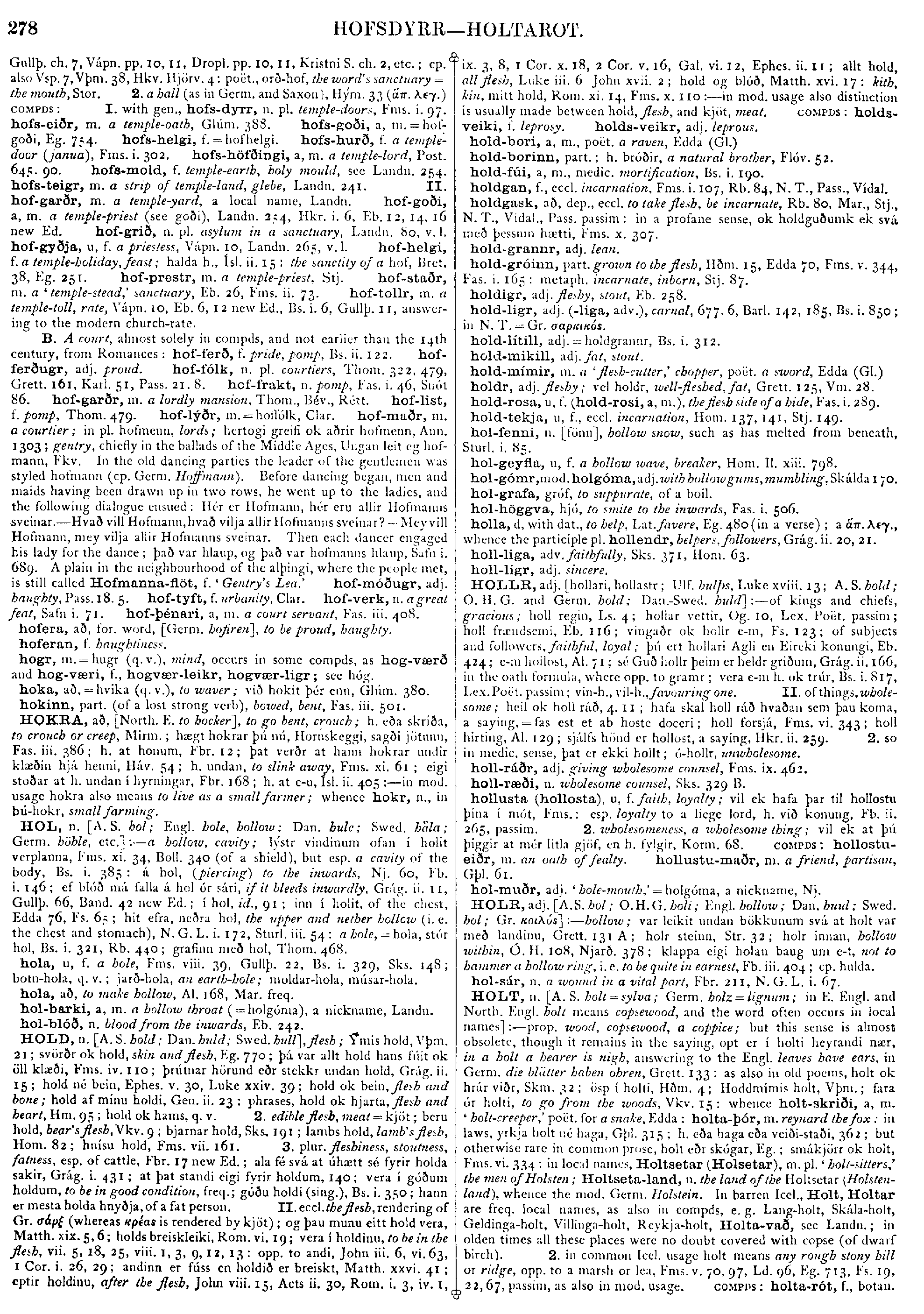
HOLT, n. [A. S. holt = sylva; Germ. holz = lignum; in E. Engl. and North. Engl. holt means copsewood, and the word often occurs in local names] :-- prop. wood, copsewood, a coppice; but this sense is almost obsolete, though it remains in the saying, opt er í holti heyrandi nær, in a holt a hearer is nigh, answering to the Engl. leaves have ears, in Germ. die blätter haben ohren, Grett. 133: as also in old poems, holt ok hrár viðr, Skm. 32; ösp í holti, Hðm. 4; Hoddmímis holt, Vþm.; fara ór holti, to go from the woods, Vkv. 15: whence holt-skriði, a, m. 'holt-creeper,' poët. for a snake, Edda: holta-þór, m. reynard the fox: in laws, yrkja holt né haga, Gþl. 315; h. eða haga eða veiði-staði, 362; but otherwise rare in common prose, holt eðr skógar, Eg.; smákjörr ok holt, Fms. vi. 334: in local names, Holtsetar (Holsetar), m. pl. 'holt-sitters,' the men of Holsten; Holtseta-land, n. the land of the Holtsetar (Holstenland), whence the mod. Germ. Holstein. In barren Icel., Holt, Holtar are freq. local names, as also in compds, e.g. Lang-holt, Skála-holt, Geldinga-holt, Villinga-holt, Reykja-holt, Holta-vað, see Landn.; in olden times; all these places were no doubt covered with copse (of dwarf birch). 2. in common Icel. usage holt means any rough stony hill or ridge, opp. to a marsh or lea, Fms. v. 70, 97, Ld. 96, Eg. 713, Fs. 19, 22, 67, passim, as also in mod. usage. COMPDS: holta-rót, f., botan.
|
Source: Cleasby/Vigfusson, page b0282, entry 22 View original page image as: [TIFF] [PNG] [View previous entry] [View next entry] |
[Comment on this entry] [View comments] |
The following entry has been hand-corrected once. |
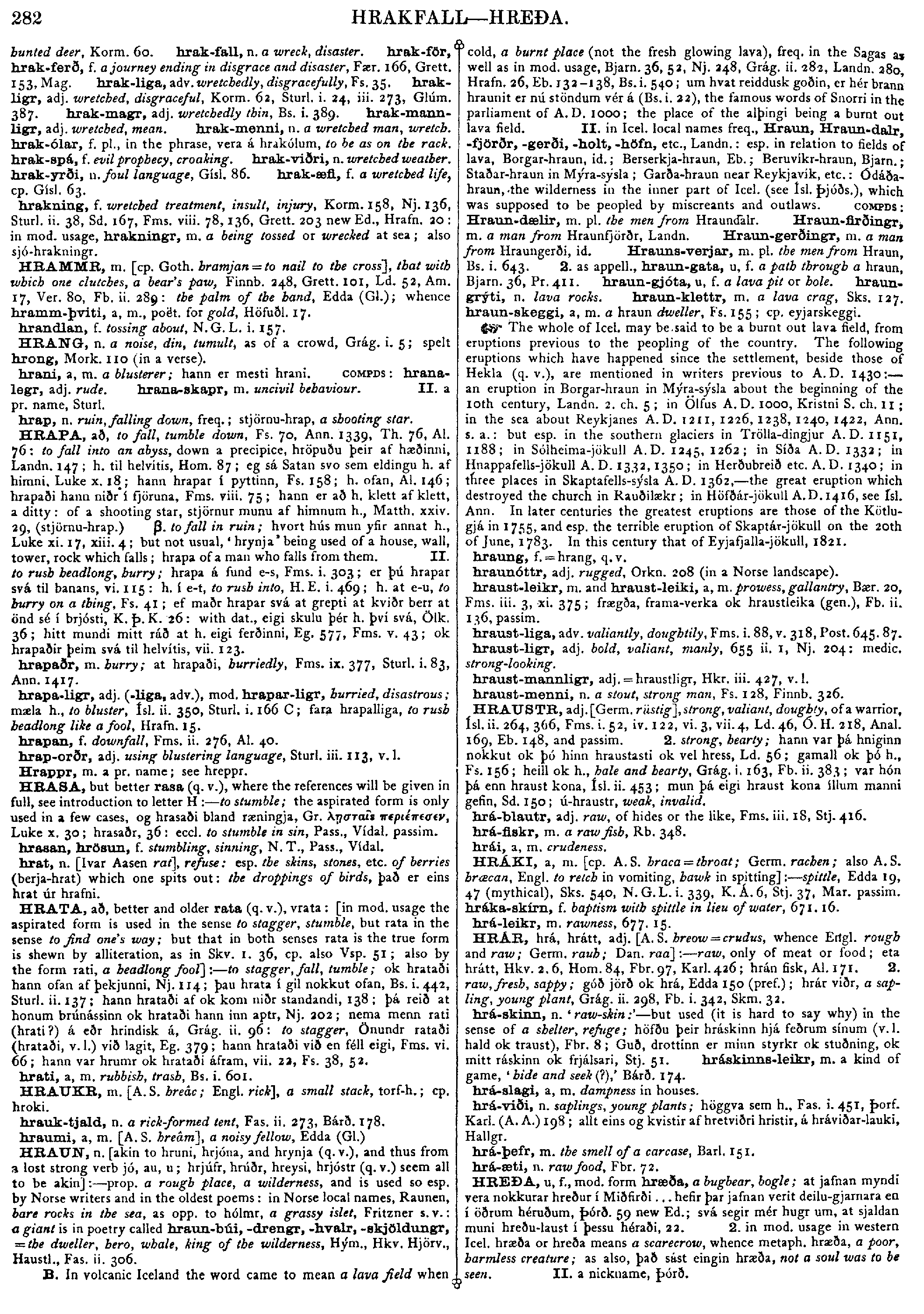
HRAUN, n. [akin to hruni, hrjóna, and hrynja (q.v.), and thus from a lost strong verb jó, au, u; hrjúfr, hrúðr, hreysi, hrjóstr (q.v.) seem all to be akin] :-- prop. a rough place, a wilderness, and is used so esp. by Norse writers and in the oldest poems: in Norse local names, Raunen, bare rocks in the sea, as opp. to hólmr, a grassy islet, Fritzner s.v.: a giant is in poetry called hraun-búi, -drengr, -hvalr, -skjöldungr, = the dweller, hero, whale, king of the wilderness, Hým., Hkv. Hjörv., Haustl., Fas. ii. 306.
|
Source: Cleasby/Vigfusson, page b0286, entry 27 View original page image as: [TIFF] [PNG] [View previous entry] [View next entry] |
[Comment on this entry] [View comments] |
The following entry has been hand-corrected once. |
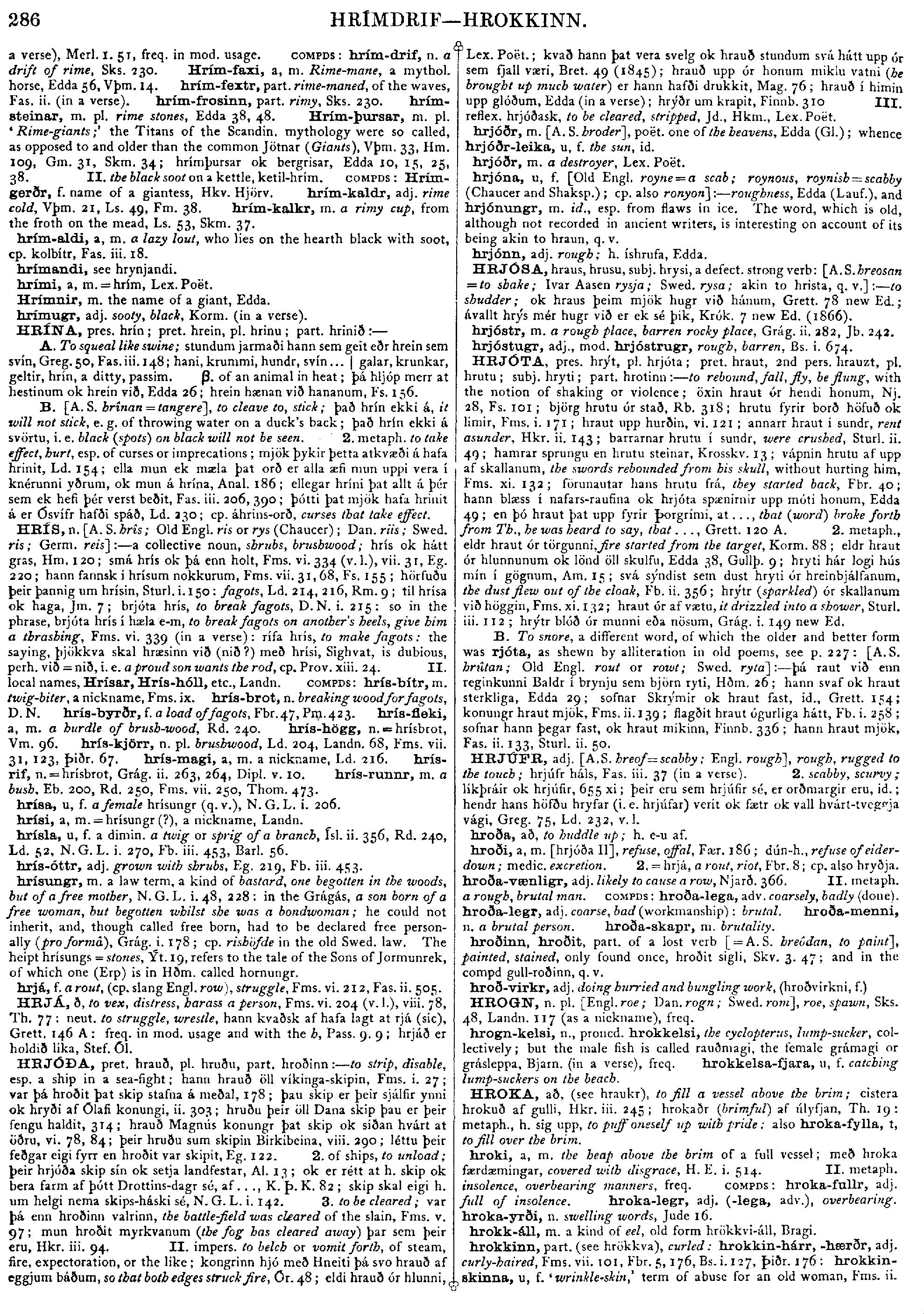
B. To snore, a different word, of which the older and better form was rjóta, as shewn by alliteration in old poems, see p. 227: [A. S. hrûtan; Old Engl. rout or rowt; Swed. ryta] :-- þá raut við enn reginkunni Baldr í brynju sem björn ryti, Hðm. 26; hann svaf ok hraut sterkliga, Edda 29; sofnar Skrýmir ok hraut fast, id., Grett. 154; konungr hraut mjök, Fms. ii. 139; flagðit hraut ógurliga hátt, Fb. i. 258; sofnar hann þegar fast, ok hraut mikinn, Finnb. 336; hann hraut mjök, Fas. ii. 133, Sturl. ii. 50.
| Result Page: |  |
Previous | 1 2 3 4 5 6 7 8 9 10 11 12 13 14 15 16 17 18 | Next |  |
Germanic Lexicon Project (main page)
This search system was written by
Sean Crist
Please consider
volunteering
to correct the data in these online dictionaries.
No rights reserved. Feel free to use these data in any way you please.